Principal’s Computer Application Skills as a Determinant of
Computer Use in Administration of Public Secondary Schools
in Kiambu County, Kenya
27
Principal’s Computer Application Skills as a Determinant of
Computer Use in Administration of Public Secondary Schools
in Kiambu County, Kenya
1Samuel N. Njathi
Post Graduate Student: School of Education, Maasai Mara University
2Dr. Boniface Ngaruiya
Senior Lecturer, Department of Educational Communication and Technology University of Nairobi
3Dr. Paul Maithya
Senior Lecturer, Department of Curriculum Instruction and Educational Management, School of Education,
Maasai Mara University
Abstract
Purpose: The purpose of this study was to establish the relationship that existed between principals‟ computer application skills and computer use in administration of public secondary schools in Kiambu County. Computer use in schools administration is a contemporary issue in the improvement of quality leadership in schools. The study was triggered by the need for effective leadership in schools which would lead to improved academic performance in Kiambu County.
Methodology: The study adopted descriptive survey research design. The target population for this study was all the 307 principals of public secondary schools in Kiambu County. The study sample comprised of 205 principals which translated to 67% of the target population. Simple random and purposive sampling techniques were used in the selection of the respondents. A questionnaire was used for data collection. Relationship between the two variables under study was established by use of spearman rho. Pearson‟s Chi- square test of independence with the help of Statistical Package for Social Sciences (SPSS) was used to test the null hypotheses.
28
Unique contribution to the theory, practice and policy: The study recommended provision of computer skill courses relevant to administration work, and ICT technical support to advise school principals on usage and maintenance of computers and review of both teacher preparation and staff development programs to ensure that universities and Teacher Training Colleges provide pre-service and in-service training programs to enable school principals to successfully use computers carrying out administrative tasks. The study further recommended that the government should develop a policy framework for training all educators/education officers on computers and ICT applications in Schools.
Keywords: Computer Use, Public School Administration, Computer Skills. 1.0 Introduction
1.1 Background of the Study
Computer use in school administration has been a focus of many policy initiatives by governments worldwide over the years. Addressing the issue of computer use in school administration, Tearle (2004) who analysed the use of computers in three schools in the United Kingdom, argues that the need for a whole-school vision for computer use, along with a role for school characteristics, culture and ethos that support change are all coupled with the practical support and the visible involvement of the principal. Carmen (2013) notes that school administration needs computers to keep the records of all the activities in school, examination results, schedules of all departments, meetings and minutes, teacher-parent conferences and many others tasks. The use of computers can increase school efficiency and reduce unnecessary bureaucracy in school administration (Carmen 2013). Alex (2003) argues that without computers, schools administrators will have to monitor all the records of the school activities by entering the details manually on the books and records of the schools. However, the use of computers and the various computer programs available can greatly enhance school administration. Although the role of the principal in supporting technology integration is very important, no study had been carried out in Kiambu County to establish the factors that influence the use of computers by school principals.
29
The Kenya government has therefore seen the need to include relevant technology for educational management as supported by the Kenya National ICT Strategy for Education and Training (MoE, 2006a: 4). In this strategy, it is implied that although the impact of information and communication technology on education goals is still inconclusive, reported observations include rapid expansion of knowledge, improved examination outcomes, enhanced communication and technical efficiency (Makhanu 2010).
Although earlier studies such as Blake (2000), Alex (2003) ; Meador (2011) and Carmen 2013) had shown the benefits of using computer in school administration, school principals in Kiambu County had lagged behind in embracing the use of computers. Referring to records available at the Githunguri Sub County Education Office in 2013, Muchiri (2014) notes that out of the 32 public secondary schools in the Sub County, only 12 (38%) of them, had integrated computer use in school administration. This was a very low percentage considering that some countries had reported up to 41% of computer use in school administration and learning by 2003(Kelles, 2003). Despite the government‟s efforts to encourage the use of computer technology in school administration, different stakeholders have expressed dissatisfaction with the levels of its application. No documented study had been carried out to address the principals‟ attitude towards computer use as a factor influencing the use computers by school principals. This study did exactly that.
1.2 Objective and Research Hypothesis
The objective of this study was to determine principal‟s computer application skills on computer use in administration of public secondary schools by school principals in Kiambu County. To this end, the following null hypothesis was formulated and tested to establish the relationship between the principal‟s computer application skills and computer use in secondary school administration;
“There is no significant relationship between principal‟s computer application skills and computer use in administration of public secondary schools by school principals in Kiambu County”.
2.0 Literature Review
30
According to Pernia (2008), technical skills training ensures that an individual is proficient in the various applications of computers which include searching and accessing information, collecting and organising data, integrating and interpreting information from multiple sources and assessing validity and reliability of information.
The confidence and competence of principals in the use of computers are key determinants of the effective use of computers for administrative purposes in the schools. Markauskaite (2005) reveals that many school principals have low levels of confidence and competence to enable them to make effective use of computers in school administration. School principals need formal training and sustained support from their colleagues to help them learn how best to integrate technology in to their administrative duties.
According to Waibodhi, (2002) many countries globally lack adequate human capacity in ICT application and this is even more critical in African counties. In Kenya for example most of the high- end ICT training takes place in public institutions but these institutions lose their computer literate staff to the private sector who offers better salaries (Chepkonga, 2014). The consequence of the high staff turnover is over- reliance on part time and less qualified lecturers with its attendant quality implications.
Despite all the potential of technology, Tilya (2007) reported that the main factor affecting ICT application in a school was leadership. School principals are the lead teachers and when principals embrace the use of computers in administration ICT adoption in schools will be assured. Muchiri (2014) identifies the main causes of low use of ICT as; lack of enthusiasm towards ICT integration among principals, inadequate ICT literacy among principals and lack of technical support for heads of departments in public secondary schools.
31
On the same note, Ayoo and Otike (2002) take a very critical stance and maintain that the formulation of an information policy in Kenya is hampered by the lack of information skills, mainly among top policy makers, which results in making the wrong choices of ICTs. Principals are the key administrators at school level and their skills in computer application are very crucial as it will determine the extent of computer use in schools. The ICT and Education survey reveals the need to address information literacy when implementing ICTs in education, mainly due to a deficit in HRC (Farrell, 2007).
Menjo and Boit (2005) in a study carried out in Nandi North District in Kenya identified lack of adequate training in computer use by administrators, and limited hardware for administrators as factors hindering computer use in school administration. Odera (2002) found that lack of teacher training in use of computer technology, adequate computers facilities, software and policy on and use of computers in the teaching of traditional subjects like English, Mathematics, Biology, Chemistry among others, contributed to non-computer use in Nyanza Province.
Another reason could be due to lack of competence and quality training of the administrators on computers on the use of ICT (Kirkwood, 2000). Muthomi, Mbugua and Githua (2013) attribute the slow adoption of computer use among principals in Kenya to inadequate preparation of principals for their new role as technology leaders.
Momanyi, et al. (2015) quoting a study by Felton (2006) notes that competence is a key to the use of computers by principals in monitoring administrative activities. The study further shows that competence in operating a computer and in utilizing software may improve the quality and efficiency of administration in schools. Computer training is crucial if principals are to use computers effectively in their work. These findings agreed with the findings of Menjo and Boit in Nandi North District (2005), and Odera (2002) in Nyanza Province which found that lack of training in computer by teachers and administrators hindered their utilization in schools. In general school administrators were inadequately prepared in computer application skills in Nyamira North District. The application skills such as Ms Word, Ms Excel, Power point and SPSS, which make Computer usage interesting, were found to be ill equipped in most of the administrators. Yee, (2000), notes that we are living in the information and technology age where school educators must possess computing capabilities. They must be users of technology and role models to those they lead. Yee (2000) notes that it is difficult for a leader who does not use technology to convince teachers that it is important. This study investigated the effect of principals‟ possession of computer application skills on computer use in school administration in Kiambu County which earlier studies had not addressed.
3.0 Research Methodology
32
The county lies between latitudes 0°75′ and 1° 20′ south of Equator and longitudes 36° 54′ and 36° 85′ East (http://riitho.word press.com). Kiambu County is densely populated mainly due to her location and nearness to the capital city and her attractive climate and landscape.
According to Muriko (2015), Kiambu County had shown slackness in embracing the use of computers in the administration of schools. This had resulted in some schools in Kiambu County employing very many workers to handle the enormous paper work in the schools. These workers include bursars, accounts clerks, store keepers, secretaries, and typist. Manual work demands a lot from the administrators which may at times cause unnecessary stress on the part of the principal (Angie and Rita 2013). The use of manual work in the development of schools timetables is time-consuming and biased at times. These were administrative issues that would be addressed by use computer use in school administration.
Earlier studies had focused on the impact of ICT on student and how ICT was enhancing teaching and learning, challenges and success of ICT in teaching of mathematics in primary and secondary schools in Kenya (Kamau, 2012; Kithinji, 2008). In secondary schools research had been conducted in the use and impact of ICT in administration in Kilungu and Nairobi (Mumbua, 2009; Kanyeki, 2006). Although many secondary schools in Kenya introduced computers in great numbers starting early 1990‟s there was limited information on their use in school administration. Research had not been carried out to establish the causes of low uptake of computer use in the administration of secondary schools in Kiambu County. Due to this glaring gap this study was designed to investigate the effects of principals‟ attitude towards computer use in the administration of secondary schools in Kiambu.
The target population for this study comprised of all the 307 principals of public secondary schools in Kiambu County. Stratified random, simple random sampling techniques were used to acquire the intended appropriate. This was due to the non-uniform nature of the target population. National schools, extra county, county and sub county secondary schools had different characteristics in terms of ICT infrastructure which dictated the use of computers in schools among other characteristics. The sample comprised of 205 principals which was an adequate representative sample of the population.
33
Quantitative data analysis techniques were employed for data analysis. The analysis involved calculation of measures of central tendency (frequencies and means) which were used to summarize the responses alongside the main variables of study. Further analyses were built on the initial findings, seeking patterns and relationships in the data by use of analysis of the spearman rho. To establish the actual contribution of the variable under study towards the use of computers by school principals, Coefficients of Determination (R2) were calculated. These were obtained by squaring the values of the calculated spearman‟s correlation coefficients. Partial correlations were calculated to establish the significance of the relationships between the variables where some relationship existed. Pearson‟s Chi- square test of independence with the help of Statistical Package for Social Sciences (SPSS) was used to test each of the null hypotheses. The values obtained guided the researcher on which null hypotheses to reject and which ones not to reject. Hypotheses were tested at 0.05 level of significance. This was considered to be a standard level of significance (Orodho, 2005).
Questionnaire Return Rate
Two hundred and ten questionnaires were administered to public school principals in Kiambu County. Out of the 210 questionnaires that were administered five were never returned while some other five questionnaires were not complete thus they were discarded. This gave a questionnaire return rate of 95.2%. The targeted four ICT champions and the six officers in charge of ICT at the MOE headquarters were all interviewed. Thus in total 210 out of the targeted 215 respondents participated in the study. This was 97.7% of the sample size and was considered statistically representative.
4.0 Findings of the Study
The findings of the study are presented as per the questionnaire items.
4.1 Frequency of Usage of Computers
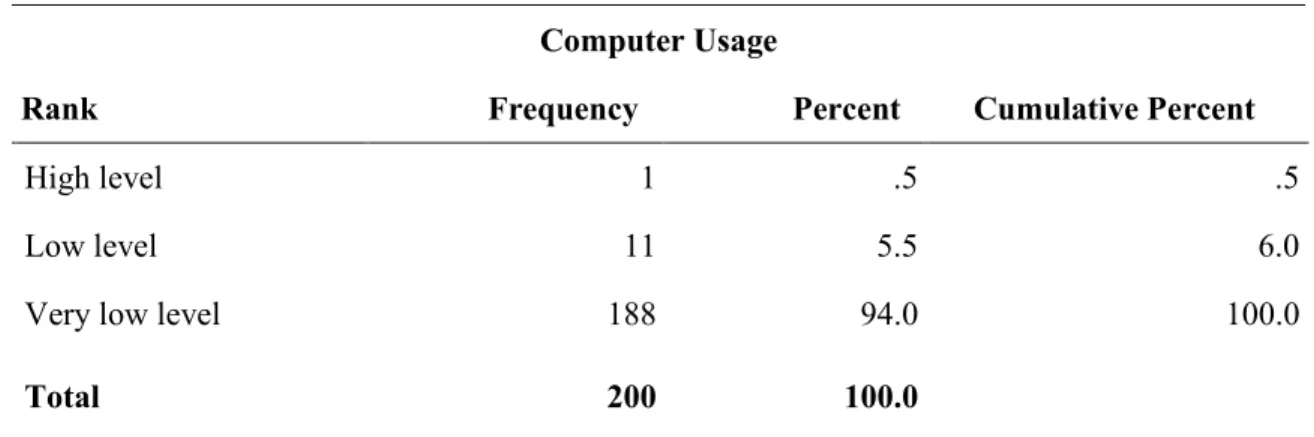
The researcher was first interested in establishing the frequency of computer use by school principals to confirm or dispute the use of computers by schools principals. Findings showed that 79 (39.5%) of the principals used computers only once in a month while 68(34%) used computers at least once in a week. Six (3.0%) reported that they never used computers in the administration of their schools. Only 47 (23.5%) of the principals reported that they were using computers on daily basis. This was a very small percentage considering the effort that had been put by the government and other bodies to ensure computer use in school administration.
34 Table 1: Frequency of Usage of Computers
Computer Usage
Rank Frequency Percent Cumulative Percent
High level 1 .5 .5
Low level 11 5.5 6.0
Very low level 188 94.0 100.0
Total 200 100.0
Three levels of computer use had been identified and ranked as; High Level=1, Low Level=2 and very low level =3. Data analysis showed that majority (188, 94%) of the respondents reported that they were using computers for administrative purposes at very low level. This was further shown by the the mean of the responses which was calculated at 3.6. This implied very low level of computer use among school principals. This was a trend that needed to be curbed and principal‟s encouraged to use computers in handling their administrative tasks.
4.2 Principals’ Computer Skill and Computer Use
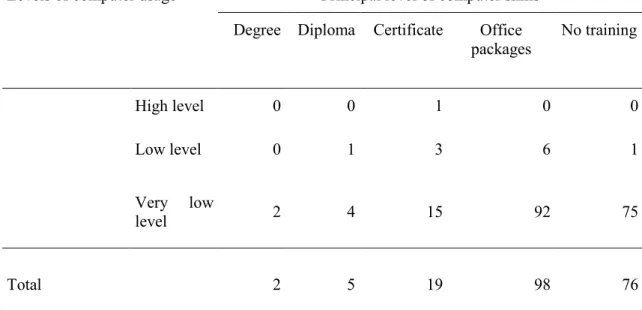
Possession of computer skills is necessary for school principals to use computers in undertaking their day to day administrative tasks. Principals were asked to indicate the level of computer training they had attained. The principals who participated in this study had different levels of computer training as presented in Table 8.
35
Table 2: Computer Usage * Principal level of computer skills Crosstabulation Computer Usage * Principal level of computer skills Crosstabulation
Levels of computer usage Principal level of computer skills T
o t a l
Degree Diploma Certificate Office
packages
No training
High level 0 0 1 0 0 1
Low level 0 1 3 6 1 11
Very low
level 2 4 15 92 75
1 8 8
Total 2 5 19 98 76
2 0 0
Table 2 shows that seventy six (38%) of the principals reported that they had not had any training in computer use while on the overall 87% of the principals did not have adequate computer skills which could have been a major drawback in the use of computers in the administration of public secondary schools. According to Table 8, 188(94%) of the principals were using computers at very low levels. Only one principal reported high level of computer use while 11(5%) reported low level of computer use. This implied that only a few administrators had a good proficiency in computer use suggesting that majority of them were only average users. What is of concern most is that possession of advanced computer skills among school principals was very low especially among those that were in the rural or remote areas of Kiambu County.
36
Analysis of the bivariate correlations between principals‟ level of computer skills and use of computers in the administration of public secondary schools showed positive correlation of 0.209. To establish the actual contribution of computer skills on the use of computers by school principals, coefficient of determination (R2) was calculated. This was obtained by squaring the values of the calculated spearman‟s correlation coefficient. This gave a value of 16.73. This meant that 16.73% usage of computers in the administration of secondary schools could be attributed to principals‟ possession of computer skills.
To establish the significance of the relationship between principals‟ computer skills and principal‟s age, principals‟ experience, principals‟ gender, principal‟s qualification, perception and challenges Partial correlations were calculated. The calculated partial correlation between principals‟ computer skills and academic qualification, principals‟ age principals‟ experience, gender, perception and challenges was 0.365. This correlation confirmed that principals‟ computer skills were a considerable determinant of computer use among principals in the administration of public secondary schools.
The null hypothesis (H05); “There is no significant relationship principal‟s possession of
computer skills on the use of computers in the administration of public secondary schools.” was tested at 95% level of confidence, a Pearson chi- square of 0.018 was obtained. Since the obtained probability (0.018) was less than the α-value (0.05) the null hypothesis was rejected at 95% level of confidence implying that principals‟ possession of computer skills influenced the use of computers among the school principals in Kiambu County. This confirms the findings from the bivariate and partial correlations which showed that there was significant relationship between principal‟s passion of computer skills and computer use in the administration of public secondary schools. This finding was in line with Chepkonga (2015) who in a study on relationship of ICT training of principals in ICT integration in management Public Secondary Schools: A case of Nairobi County; found out that the level of training in ICT of the principal was significantly related to the level of integration of information communication technology in management of secondary schools. This therefore implied that while enhancing integration of ICT to promote effective administration of secondary schools, it is important to enhance and provide principals with relevant computer skills.
5.0 Conclusion
There was a significant relationship between principal‟s possession of computer skills and use of computers in the administration of public secondary schools. This finding agreed with Kirkwood, (2000) who found out that lack of competence and quality training of the administrators on computers was a factor that was determining the levels of computer in schools.
37
could stimulate more use of computer in secondary school administration would be widespread training of secondary school principals and teacher trainees in using computer-based administration tools. By making such training part and parcel of a general education preparation, the younger generation of teachers and education administrators would be highly trainable in using computers in educational administration in schools. Computer training is crucial if principals are to use computers effectively in their work. This finding agreed with the findings of Menjo and Boit in Nandi North District (2005), and Odera (2002) in Nyanza Province who found out that lack of training in computer by teachers and administrators hindered their utilization in schools.
The Ministry of Education and schools therefore need to set aside money for training not only the school principal but also the teachers in computer use.
6.0 Recommendations of the Study
i. The study recommended that the Ministry of Education should encourage the adoption computer use in administration in schools in the county through provision of computer skill courses relevant to administration work, and ICT technical support to advice school principals on usage and maintenance of computers
ii. The study further recommended that the government, through the Ministry of Education to review both teacher preparation and staff development programs and require that universities and Teacher Training Colleges to provide pre-service and in-service training programs to enable school principals to successfully use computers carrying out administrative tasks in schools. iii. The study also recommended that the government should develop a policy framework for training all educators/education officers on computers and ICT applications in schools. These are key people in the implementation of government polies at the school level.
38
REFERENCES
Abu, S. (2010).Computer Use by Secondary School Principals. The Turkish Online Journal of Educational Technology; July 2010, volume 9 Issue 3.
Adeya, C.N. and Cogburn, D. (1999).Globalization and the Information Economy: Challenges and Opportunities for Africa. Adis Ababa. UNCA.
Aduwa-Ogiegbaen, S.E., &Iyam, E.O.S. (2005). “Using Information and Communication
Technology in Secondary Schools in Nigeria: Problems and Prospects.” A journal of Education Technology and Society, 8(1), 104-112
Angie, O. and Rita, N.U(2013). The Place of ICT (Information and Communication Technology) in the Administration of Secondary Schools in South Eastern States of Nigeria, US-China Education Review A, ISSN 2161-623X April 2013, Vol. 3, No. 4, 231-238
Carmen, P. (2013). The Use of Computers in School Administration; http://www.ehow.com, facts-6836922-network-systems-administration
Communication Commission of Kenya (2011) Kenya Internet and Mobile Phone Usage Report: Publications and Research. Retrieved from http://www.cck.go.ke
Chepkonga S (2015) An Investigation of the Relationship of ICT Training of Principals
in ICT integration in Management Public Secondary Schools: A case of Nairobi County, Kenya; online research paper www.iiste.org ISSN 2222-1735 (Paper) ISSN 2222-288X (Online) Vol.6, No.18,
Coleman (2003) Gender and School Leadership: The experience of women and men secondary principals; Paper presented at UNITEC, Auckland,
Derar S. (2007). School Principals' Attitudes towards the Use of Technology: United Arab Emirates Technology Workshop the Turkish Online Journal of Educational Technology – Tojet April 2007 ISSN: 1303-6521 Volume 6 Issue 2 Article 5; Arizona State University
Farrel, G. (2007). The Kenya ICT Survey Document. Retrieved July 2011 from http:// www.inforDev.org.
39
Gakuu C M. and Kidombo H.J. Closing the Chasm: Are Secondary School Teachers in Kenya Using ICTs Effectively To Deliver Curriculum Content? School of Continuing and Distance Education, University Of Nairobi.
Kipng‟etich, K. and Ahmed, O. (2012) Headteachers‟ Perception of Their Roles in Secondary Schools in Kenya: A Study of Kericho Day Secondary School in Kericho County.(International Journal of Humanities and Social Science Vol. 2 No. 23; December 2012
Kiptalam, G.K Accessibility and Utilization of ICTs among Secondary School Teachers In Kenya Aga Khan University, Kenya,[email protected], Rodrigues, A.J
Kamau, G.K. (2012). Constraints in the Use of ICT in Teaching-Learning Process in
Secondary Schools in Nyandarua south District in Kenya. Kenyatta University. Unpublished Masters of Education Project report.
Kanyeki, W.M. (2006). An Investigation into the Use and Impact of Information
Technology in Management of Public Secondary Schools in Nairobi Province. Kenyatta University. Unpublished Masters of Education Project report
Krejcie, R. & Morgan, D. (1970).Determining Sample Size for Research Activities. Educational and Psychological Measurement. Pp 607-610.
Lange, D. (1988). Tomorrow‟s Schools: The reform of Education Administration in New Zealand. Wellington: The Government Printer.
Makhanu E.S (2010) Principals Literacy in Information and Communication Technology
(ICT): Towards Improving Secondary School Performance in Kenya; PhD thesis presented to the University of South Africa.
Menjo, K. M. &Boit M. J. (2005).“Challenges of using Information Communication Technology (ICT) in School Administration in Kenya,” Unpublished Paper. Moi University, Eldoret.
Momanyi, C., Ocharo, Nyakweba, I and Momanyi, G., (2015).Challenges Facing Computers‟ Implementation on Administration Use in Public Secondary Schools in Nyamira North District, Nyamira County- Kenya.International Journal of Novel Research in Education and Learning Vol. 2, Issue 1, Available at: www.noveltyjournals.com
Muchiri, G.M. (2014) Factors Influencing School Principals‟ Integration of ICT In
40
Mugenda, O.M and Mugenda, A.G (1999) Research Methods: Quantitative and Qualitative Approaches, Nairobi, ACTS Press.
Mukima, (2013). The Role Effectiveness of the Board of Governors and Parents Teachers Association in Management of Public Secondary Schools: A Case of Thika, Ruiru Division, Thika District, Kiambu County, Kenya. http://ir-library.ku.ac.ke/handle/123456789/6407
Muturi and Gathenya (2013) ICT Integration by Kenyan High School Teachers Under the Government Sponsored Project in Thika West-Kenya: A Literature Review; Proceedings of 1st JKUAT-SHRD Research Conference 12th and 13th September 2013, Jomo Kenyatta University of Agriculture and Technology
Muriko G. L (2015) Factors Affecting Utilization of ICT in Administration of Public
Secondary Schools in Kiambu sub-county, Kiambu County, Kenya. Unpublished project report, Kenyatta University
Mumbua, V. (2009). An Assessment of the Utilization of ICT on School Administration
in Public Secondary schools in Kilungu, Makueni District. Kenyatta University. Unpublished project report , Kenyatta university
Orodho, J.A (2005) Techniques of Writing Research Proposals and Reports in Education and Social sciences (2010 Edition) Nairobi Kanezja Hp Enterprises.
Republic of Kenya (2012) Ministry of Education and Ministry Of Higher Education, Science & Technology Sessional Paper No. 14 of 2012 on Reforming Education and Training Sectors in Kenya
Republic of Kenya (2012) The Teachers Service Commission Act, 2012; Kenya gazette supplement acts, 2012, Nairobi
Robert V. Krejcie and W.Morgan (1970). Determining Sample Size For Research
Activities Educational and Psychological Measurement1970, 30, 607-610. University of Minnesota, Duluth Texas A. &M. University
Rogers, E. M. (1995). Diffusion of Innovations (4thed.). New York: The Free Press.
41
Wanjira K. (2009) Educational development in Kenya and the role of information and Communication technology; International Journal of Education and Development using Information and Communication Technology (IJEDICT), 2009, Vol. 5, Issue 2, pp. 6-20
Zhao, Y. and Frank, K. (2003). Factors affecting technology uses in schools: An ecological perspective. American Educational Research Journal, 40(4), 807–840.
Schiller, J. (2003). Working with ICT Perceptions of Australian principals. Journal of Educational Administration, 41(2), 171-185.