1
Building Capacity for Contributing to SDG6 in Belgian Development Cooperation Programs: the Water Nexus Project
Alonso, A., Vanclooster, M., Cools, J., Forio, M.A.E., Goethals, P., Ho, L.T., Huge, J., Marx, A., Verbist B. 2019. Building Capacity for Contributing to SDG6 in Belgian Development Cooperation Programs: the Water Nexus Project. Conference Proceeding for the International Conference on Sustainable Development. 2019.
Building Capacity for Contributing to SDG6 in Belgian Development Cooperation Programs: the Water Nexus Project
A. Alonso, Postdoctoral researcher, Earth and Life Institute, Université catholique de Louvain, Belgium M. Vanclooster, Full Professor, Earth and Life Institute, Université catholique de Louvain (corresponding author)
Place croix du Sud Bte L7.05.02 1348 Louvain-la-Neuve
Belgium
J. Cools, Research Manager, Institute of Environment and Sustainable Development, University of Antwerp, Belgium
M.A.E. Forio, Postdoctoral researcher, Department of Animal Sciences and Aquatic Ecology, Ghent University, Belgium
P. Goethals, Full professor, Department of Animal Sciences and Aquatic Ecology, Ghent University T. Ho Long, Postdoctoral researcher, Department of Animal Sciences and Aquatic Ecology, Ghent University, Belgium
J. Huge, Postdoctoral researcher, Centre for Environmental Science, Hasselt University, Belgium and Systems Ecology and Resource Management Unit, Université Libre de Bruxelles, Belgium
A. Marx, Deputy Director, Leuven Center for Global Governance Studies, Katholieke Universiteit Leuven, Belgium
B. Verbist, Postdoctoral researcher, Earth and Environmental Sciences Department, Forest, nature and landscape, Katholieke Universiteit Leuven, Belgium
Abstract
Coordination of the water, energy and food nexus is burdened by several barriers, which often reduce the efficiency and effectiveness of development cooperation programs. The policy support research project Water Nexus aims to provide insights into such barriers with a focus on water for the 14 priority partner countries of the Belgian development cooperation program. The outcomes are used to develop a consolidated Belgian water strategy for development cooperation programs. We also provide policy support on how to best contribute to SDG6 in the Belgian partner countries. For doing this, we are implementing a policy support project structured around four axes, the fourth ax being the integration of the other three: (i) Framing the water-context in partner countries (stakeholders, programs, and
challenges) and the role played by Belgian stakeholders; (ii) Documenting tools and strategies to assess the impact of development cooperation projects on water resources and to report on progress made; (iii) Conducting policy-support research projects that align with knowledge gaps identified by policymakers
2
and practitioners and; and (iv) Developing a platform to support a coherent and efficient Belgian water strategy and programs in the water domain. In this paper, we present and discuss the preliminary outcomes, challenges faced and perspectives of this ongoing policy support project.
Introduction
Water is vital to life on Earth and directly or indirectly supports all socio-economic activities in modern societies. Water-dependent services include drinking water provisioning, health and sanitation, food and energy production, and ecosystem stability. Given the importance of the resource, water insecurity is one of the major obstacles in the development of many countries of the Global South. Importantly, the water sector is intrinsically linked with the food and energy sector, meaning that an action in one sector affects the other two (the water-food-energy nexus) (Hussey and Pittock 2012; Scott et al. 2011; Siddiqi and Anadon 2011). Therefore, strategies and goals for development cooperation and value-chain actions must be defined while ensuring that it does not create a set of separated goals. Yet, planning in the food (agriculture and industry) and energy sectors is still most often conducted with a limited set of objectives in mind, which inevitably cascades to unwanted consequences on water quantity, quality, and dynamics, and, hence, leads to water insecurity (Nilsson, Griggs, and Visbeck 2016; Ottino 2004; Hetemäki et al. 2017; Bhaduri et al. 2016). This, in turn, creates unfavorable conditions for socio-political stability and economic growth. Given its critical importance, water support ranks high on the development aid agenda and it is strongly embedded in the Sustainable Development Goals (SDG), with the SDG6 specifically dedicated to water. However, effective coordination of the water, energy and food nexus is burdened by several barriers, which often reduces the efficiency and effectiveness of development cooperation programs. The policy support research project Water Nexus was launched in January 2019 with the overarching goals to (i) provide insights in such barriers with a focus on water (nexus) for the 14 priority partner countries of the Belgian development cooperation program, and (ii) provide elements to design the Belgian water strategy, and boost effectiveness in development cooperation actions.
The specific objectives are the following:
(i) to map the main Belgian stakeholders (public and private) and programs in the water sector and identify possible synergies and ways through which existing capacity can be leveraged and strengthened;
(ii) to map the main stakeholders and programs in the water sector in the partner countries and identify ways through which more coordinated and coherent actions could be implemented; (iii) to customize a water toolkit assessing the impact of private sector development and
cooperation actions in the water domain;
(iv) to synthesize the existing data (regional and global database of institutional and satellite data) and data opportunities for SDG6;
(v) to conduct exploratory research projects on water nexus-related questions based on current needs;
(vi) to provide the official Belgian development cooperation with operational elements and expertise for designing a water strategy.
This paper broadly outlines the methodology, and the preliminary results for a set of the outcomes obtained so far. It also summarizes the challenges faced during the first stages of the project.
3
Overall Methodology of the Project
The Water Nexus project is a policy support research project funded by the Belgian Ministry of Foreign affairs, Development cooperation and Humanitarian aids1 since January 2019. It is a one-year project renewable twice. It is run by a consortium of Belgian universities that gathers scientists with a wide spectrum of complementary expertise from integrated water management and water access, sanitation and hygiene, policy support for sustainable transitions, sustainable development goals, natural resources governance, and legal aspects, private sector development and valorization of research for uptake in society and economy, environmental impact assessment to data analytics and decision support systems for water and environmental management. The consortium is anchored in universities from the Walloon, Flemish and Brussels regions and it has a long-term experience in many countries of the Global South. The overall project has been structured around four axes, the fourth axe being the integration of the other three: (i) Framing the water-context in partner countries (stakeholders, programs, and challenges) and mapping the –current and future- role played by Belgian stakeholders; (ii) Documenting tools and strategies to assess the impact of development cooperation projects on water resources and to report on progress made; (iii) Conducting policy-support research projects; and (iv) Building a platform to support a coherent and efficient Belgian water strategy and programs. The central element of that platform is a website (www.waternexusbelgium.org) bringing together the project outputs and information about water context, data, actors and projects by or relevant to Belgian cooperation actors, and an interactive
dashboard summarizing the database of actors and projects.
Among the series of actions taken within these axes, this paper focuses on the following: 1. The realization of a survey to:
a. Identify the Belgian stakeholders in the water sector in development cooperation; b. Survey the Belgian stakeholders and embassies about the water context, barriers, and
opportunities in the Belgian partner countries, and ask for recommendations; and c. Survey the Belgian stakeholders about current water project monitoring and evaluation
procedures;
2. The compilation of a database of Belgian stakeholders and water-related projects conducted by Belgian stakeholders and its integration in a dynamic, interactive online tool (the Water Nexus dashboard)
3. The study of the water and development nexus and its management among development actors in neighboring countries of Belgium.
The methodology specific to each point and the preliminary results are briefly outlined in the following sections.
1Belgium has a population of about 11.4 million people. It is divided into three autonomous regions:
Flanders, Wallonia, and the Brussels-Capital Region, and is home to three linguistic groups: the Dutch-speaking, and the French-speaking Community, and the small German-speaking Community.Belgium is currently (2019) supporting 14 partner countries, selected based on their degree of poverty, aspects of good governance and Belgium's potential for providing meaningful support. These countries are Benin, Burkina Faso, Burundi, DR Congo, Guinea, Mali, Morocco, Mozambique, Niger, Palestinian Territory, Rwanda, Senegal, Tanzania, and Uganda. In 2018, the Belgian budget for development cooperation was settled at 1,124 million which accounted for approximately 0.43% of GNI. (Directorate-General
4
Mapping Actors, Programs, Challenges and Opportunities in Belgium and its
Partner Countries
Inventory of stakeholders Methodology
We collected information about the Belgian stakeholders in the water sector in development cooperation. The information collected aimed at gathering general contact information and allow s the mapping of stakeholders according to their field of expertise and the countries where they are active. A form was designed using the online survey tool SurveyMonkey and sent by email. Questionnaires were available in English and French.
A list of Belgian stakeholders potentially involved in water-related projects in the development cooperation was compiled using multiple directory sources, among which:
- The list of NGOs recognized by the Belgian government from which we selected NGOs with potential links with the water sector;
- The distribution list used by the Belgian National Committee of the UNESCO International Hydrology Program;
- The contacts of Flemish and Walloon Government agencies involved in environment and international affairs;
- The directory of small hydraulics released by the Walloon Region;
- The members' list of the ÊWE, the Walloon non-profit organization gathering stakeholders and engineering offices of the private water sector
The list included about 150 recipients.
A series of associations and umbrella organizations was also invited to advertise through emails to their members and through any other communication channels they use such as webpages and newsletters:
- The Flemish Partnership for Water Development (VPvWO)
- The development cooperation department of the French and Dutch speaking organizations for research and education (ARES and VLIR-UOS respectively)
- The development associations (NGO-Federatie and ACODEV) - The federation of renewable energy (EDORA)
- The ReWallonia portal that aims to gather all the technological players of the renewable energy sector in Wallonia and Brussels
- The associations of cities and counties of the Brussels, Flemish and Walloon regions (AVCB/VSGB)
- The Flemish Knowledge Center for Water (Vlakwa)
- The Walloon Union of Public Water Cycle Operators (Aquawal)
- The Walloon Agency for Exportation (AWEX). The agency in partnership with Walloon society of Water (SWDE) and the Société Publique de Gestion de l’eau (SPGE, Public Water
Management Company) recently launched a private sector water platform of Walloon private sector in support to exportation in the water sector
- A platform for all the citizens' initiatives for development cooperation that are undertaken worldwide from Flanders: the Vierde Pijler (‘Fourth Pillar (of development cooperation)). All responses were translated into English before these analyses. Phone interviews are being conducted at the time of writing (September 2019) to reach more stakeholders. Although the phone interviews are still ongoing, we can already share some preliminary findings based on the online data obtained in the first iteration.
5
Preliminary results
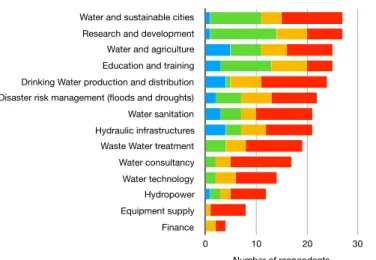
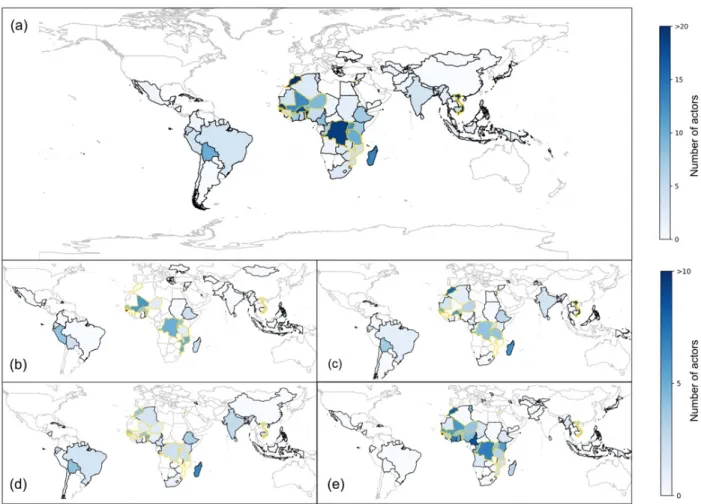
Sixty-nine stakeholders filled in the online form: 18 from academic institutions, 15 from the private sector, 9 from public agencies and utilities, and seven from NGOs and non-profit organizations. Figure 1 shows that the surveyed organizations cover a broad range of expertise, with higher most focusing on Water Access, Sanitation, and Hygiene (WASH), Integrated Water Resources Management (IWRM) and research, development, education, and training. Figure 2 shows the number of actors having had projects during the past 10 years in the Global South.
Figure 1. Field of expertise related to water and the number of respondents who declared having that as their expertise (over a total of 69 responses).
Water and sustainable cities Research and development Water and agriculture Education and training Drinking Water production and distribution Disaster risk management (floods and droughts) Water sanitation Hydraulic infrastructures Waste Water treatment Water consultancy Water technology Hydropower Equipment supply Finance
Number of respondents
0 10 20 30
6
Figure 2. World maps displaying the number of respondents having had activities or projects in each developing country over the last 10 years. (a) all respondents (b) NGOs and NPOs; (c) educational or research institutions; (d) public agencies and utilities; (e) private sector. Belgian partner countries are bordered with a yellow line.
Questionnaires Methodology
The questionnaires aimed for Belgian stakeholders to share their knowledge, voice their opinion and provide experience-based recommendations to policy-makers. We designed two different questionnaires – both included multiple-choices and open-ended questions. The questionnaire was discussed with members from DGD, the Belgian Development agency ENABEL, and an important Belgian NGO Join for Water. They were sent by e-mail to stakeholders in May 2019, together with the form for actor inventory. Questionnaire I
The first questionnaire was country-specific (i.e. each organization was expected to fill one questionnaire for each country where they are implementing initiatives. The questionnaire focused on the water-related context, barriers and opportunities, and partnerships in each country. The questionnaire consisted of 36 questions structured in seven sections: (1) Country of interest; (2) Information about the respondent’s organization; (3) Water context in the country of interest (main actors and programs, challenges and opportunities); (4) Partnerships ; (5) Lessons learned; (6) Recommendations; (7) Closing section. When relevant, the questions were formulated around the eight targets of SDG6.
7
Questionnaire 2
The second questionnaire was not country-specific (i.e. there was only one questionnaire to be filled by each organization). It aimed to collect information about databases and information sources used by project implementers, about information and data needs, and about the way project implementers are monitoring, evaluating and reporting the results of their projects.
The questionnaires were designed using the online survey tool SurveyMonkey and were available in English and French. All responses were translated into English before the analyses. The questionnaire had 21 questions structured in seven sections: (1) Information about the organization; (2) Baseline
information; (3) Evaluation of project results; (4) Evaluation of project impacts; (5) Data sources; (6) About SDGs; (7) Closing section.
Preliminary results
Fifty organizations replied to the first questionnaire, 19 of which stopped responding after a few
questions. Among the 31 remaining questionnaires, eight respondents did not reply to the questionnaire as being country-specific. Instead, these respondents used a single questionnaire for the multiple countries they are active in. One organization filled in the questionnaires separately for five different countries. All other organizations filled in a single questionnaire about one country of interest. The countries of interest and number of organizations replying for each country are in Figure 3.
Figure 3. The number of questionnaires filled for each Belgian partner country. (Questionnaire I)
Given the low response rate, the analysis of the results was mostly done for all countries together and not on a country-basis. However, unless specified otherwise, the results in this paper focus on the 24
questionnaires that were filled in for a single country (referred to as country of interest). Nineteen responses were collected for the second questionnaire. A subset of results is displayed in Figure 6 to Figure 10, and Table 1 to Table 3. The questions are written in the captions. To support the reading, open- answers are organized by themes, but the wording of the respondents is used verbatim (after translation to English when needed).
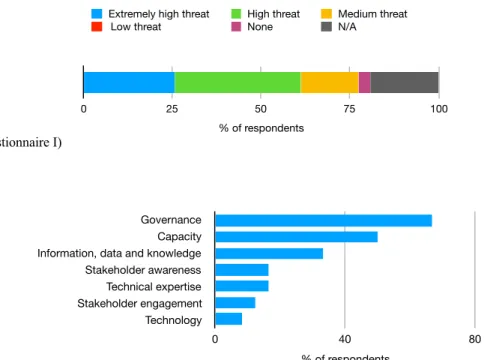
Unsurprisingly, the majority of survey respondents (>50%) perceive the achievement of the SDG6 targets as being highly to extremely important to reach all the other SDGs (Figure 4). Less than 25% finds it not so to not at all important, except for the sixth target on water ecosystem for that is perceived as being slightly less important. The threat of climate change on SDG6 is seen as a high to an extremely high threat by over 50% of the respondents in their country of interest, and medium to extremely high for over 75% of them (Figure 5). When asked to select the three most important barriers to achieving the SDG6,
DR Congo Benin Burundi Senegal Mozambique Burkina Faso Mali Morocco Niger Rwanda Tanzania Guinea Uganda Palestinian Territories
Number of respondents
8
respondents primarily picked the governance, the clack of capacity, and the “data, information and knowledge” (Figure 6). These results are also repeatedly expressed in the open-answer questions about lessons learned (Table 1) and experience-based recommendations (
9
Table
2). A specific question on data and knowledge also revealed some major gaps in that aspect (Table
3). On the other hand, most respondents to questionnaire II estimate that additional tools and training would be helpful to help support the collection of baseline information and the assessment of project results and impacts (Figure 9). In these open-answer questions, a recurrent point of concern is the lack of funding to support the maintenance and operation of infrastructures in place after the project isimplemented, which is considered to significantly jeopardize the longevity of any projects on the long-term. A large portion of the respondents sees the financing by external aid insufficient to achieve the SDG6 in their country of interest (Figure 7). A large portion also see the need to enhance partnerships of all kind (Figure 8).
Figure 4. Please rate your perception of the importance of the SDG6 targets in achieving the other SDGs (and thus sustainable development in general) in the country of interest. (Questionnaire I)
Figure 5. ! (Questionnaire I)
Figure 6. Please select the three most important barriers you think constrain reaching the SDG6 targets in the country of interest. (Questionnaire I)
SDG 6.1. Drinking water SDG 6.2. Sanitation SDG 6.3. Water quality SDG 6.4. Water use efficiency for reducing water scarcity SDG 6.5. Integrated water resources management SDG 6.6. Water important ecosystems SDG 6.A. International cooperation and capacity-building SDG 6.B. Participation of local community
% of respondents
0 50 100
Not at all important Not so important Somewhat important Highly important Extremely important N/A
% of respondents
0 25 50 75 100
Extremely high threat High threat Medium threat
Low threat None N/A
Governance Capacity Information, data and knowledge Stakeholder awareness Technical expertise Stakeholder engagement Technology
% of respondents
10
Figure 7. Do you estimate that external aid funding is sufficient to achieve the SDG6 targets? All responses (31) considered? (Questionnaire I)
Figure 8. How would you rate the need to enhance partnerships to improve the impact of Belgian development cooperation programs? (Questionnaire I)
Belgian ODA Foreign ODA FDI by Belgians FDI by Foreign investors Remittance (diaspora)
% of respondents
0 25 50 75 100
Extremely sufficient Sufficient Somewhat sufficient Not so sufficient Not at all sufficient NA
Between Belgian organisations Between Belgian and international organisations Between Belgian and organisations from the country of interest Between organisations in the country of interest
% of respondents
0 25 50 75 100
11
Table 1. Can you describe at least one weakness that you have observed during your water-related projects (during the planning, implementation and/or evaluation phases)?
Country of
interest Weakness
Project formulation, implementation & management
Benin Misunderstanding of the reality of things by the people who write the project specifications Burkina Faso Difficulty of sustaining the infrastructures
DR Congo Do not associate the water projects with environmental protection aspects Niger Management of infrastructures after their commissioning
Institutional, governance, fundings
Burkina Faso
The communal team changes following elections hampers the continuity of an action by the fact that the new team does not control the texts that frame the policy of access to drinking water
DR Congo - Lack of governance interests due to limited finances
- Limit of financial resources available or to be available, despite requests and the importance of the project for communities
- The number of projects to be completed is almost unlimited in many areas. The means are however difficult to find. Moreover, once found, it must also be protected and ensure that it is dedicated to the initial project without "leaks".
Rwanda Water = politics. Because of political issues, implementation is delayed, scopes are changes, a lot of money is wasted
Human capacity and skills
Benin Not enough technical capacity
Burundi Lack of time for training. People with limited skills in the face of an unknown system. Modern technical equipment
DR Congo - Reliability of local businesses
- Administrative slowness making it cumbersome in the implementation. Cost and duration of transport Mozambique The lack of staff at the level of the state structures in the field which limits the capacity building. This
aspect is reinforced by the fact that the donors to advance with the projects tend to capture its resources once formed
Mozambique Weak institutional and technical capacity of the districts
Data, information & knowledge
Benin Poor assessment of the water resources available on certain agricultural sites as part of the project study Mali Access to recent statistical data on the situation of water points
12
Table 2. What recommendations would you like to give to Belgian policy-makers? (Questionnaire I) Country of
interest Recommendations for Belgian policy-makerrs Thematics / Strategic axes
All Staying active in the water sector, given the countries of bilateral cooperation, this is an essential aspect for the poorest populations
Benin - Finance project preparations
- Allocate resources for management and maintenance of infrastructures.
Burkina Faso Continue helping the country in the field of urban water management and sanitation DR Congo - Focus on water, water, and water
- The water sector is a priority on the well-being and the health of the populations. The impact is directly with immediate benefits on the investment
Mali Advocate with TFPs to mobilize funding for sanitation Rwanda Prioritize the water need in the development programs
Senegal - Financing preferably projects including infrastructure monitoring, maintenance, population monitoring, etc.
- The guidelines in terms of development cooperation are currently in favor of developing the economic fabric of the partner countries. Water is an input or even the main input into most economic activities of the partner countries of Belgium. It is important to intervene also in the factors of production to ensure the companies a profitability and thus a viable economic fabric
Institutional, governance, fundings
Benin - Work out a long-term strategy together with the intended country - Control of the money flow
Burundi Check and compare the budget allocated to the different parts of the project. Talk with local stakeholders to assess the budget and techniques to be implemented
Infrastructure, capacity, capability, human resources
Benin Make more use of the expertise available/developped in Belgium Benin Move away from the private sector
Benin Means to continuously train municipal and regional authorities on the appropriation of existing regulations Rwanda Train the diplomatic personel in the water related needs
Country from Western Africa
Educate potential future leaders.
Partnerships
Country from Western AfricaInvest first in mutual exchange and training projects.
DR Congo Establishment of synergies between projects to pool the benefits Mali Develop multi-stakeholder partnerships in the water sector
Various
DR Congo Make sure that Belgian companies work where possible. In any case, it is very complicated for a Belgian company to work with foreign funds (e.g. Germany)
All Contact Louvain Cooperation for its environmental integration tool "OIE" for the awareness of water users
13
Table 3. Can you describe any data and/or knowledge gaps that you observed in your projects? (Questionnaire I)
Figure 9. Would support (e.g. training), tools and/or additional information sources be beneficial for an improved assessment of (Left) the baseline situation? (Middle) the results of a project? (Right) the impacts of a project? (Questionnaire II)
Figure 10. Does your organization take into account the current and predicted future effects of climate change and other changing external factors when defining and implementing its actions and projects? (Questionnaire II)
Country of interest
Date and/or knowledge gap
Benin Difficulty for small scale producers to access support services to assess the potential of their water
resources for agriculture.
DR Congo - Scientific capacity
- Weakness of national control bodies (laboratory)
- Projects are carried out on instinct, based on observations of similar projects, without any knowledge base (at least in our hydroelectricity field). If there is no support, before, during and after, projects, time and investments are lost.
- Poor knowledge of the supply network
- Lack of cartography and essential data for the project (no data archives)
Mali Demographics based on population projection assumptions from the census back to 2009. These
statistics do not take into account current population dynamics and migration flows. The update of water point database is not systematic
Mozambique Lack of reliable water and sanitation database which play important role during the planning of any
intervention or solution
Mozambique Problem concerning databases, which is why [ORG] started in the first phase of the project to develop /
rebuild the database in the provinces where it operates;
Niger Data and knowledge on hydrogeological storages
Senegal Existing data but disposition, sharing / dissemination of data and / or knowledge is not optimal
% of r
espondents
0 40 80
Baseline Results Impact
Yes No N/A
Climate changes Socio-eco changes Demographic changes
Number of respondents
0 50 100
No consideration
Consideration without formal framework
Formal integration of these aspects in the project management workflow
14
Water Nexus Dashboard for Belgian Development Cooperation
The Water Nexus dashboard is an interactive tool hosted on the Water Nexus website and centralizing data about the Belgian actors, projects, and scientific research related to the water sector in the development cooperation. The databases are searchable based on a set of filters, and the data are displayed in the form of statistics, charts, and metrics. The dashboard is composed of three independent elements: 1) Belgian actors in the water sector; 2) Projects led/co-conducted by Belgian actors; 3) Bibliometrics of water-related research conducted by Belgian actors.
The first element relies on the inventory of Belgian actors (private sector, NGO, public utilities, academics) compiled during the questionnaire surveys (cf. supra). The actors and their contact information can be searched based on their type of organization, the field of expertise, keywords and countries where active.
The second element aims to report and summarize the water-related projects in the development cooperation in which Belgian stakeholders are involved. The first step involved the retrieving of the project databases from each funding agency and other organizations supporting or leading projects. We contacted twenty relevant organizations and requested their databases. These organizations included the Belgian Ministry of Foreign Affairs, Development Cooperation, and Humanitarian Aid (DGD), the Belgian development agency, an organization supporting Flemish and Walloon research and educational institutions, platform grouping private companies and non-profit organizations, and other relevant Belgian agencies in charge of development cooperation-related issues. The OECD and International Aids
Transparency Initiative database were also retrieved. So far, 14 of them responded to our request, among which nine had available databases. The other five have not been documenting their projects in a formal database to this date. The technical challenges we faced so far were multiple. First, organizations use different sets of attribute types and names for registering and documenting their projects, which
complicates the harmonization in a common database. Second, several projects are co-funded by multiple Belgian actors and are therefore have been registered in several databases. Hence, the removal of
duplicated projects is necessary but their identification is complicated by the fact that some projects have different identifiers depending on the reporting organization. Lastly, the multilingual nature of these original databases – which is a consequence of the linguistic landscape in Belgium- makes the merging process difficult and introduces the risk of translation errors.
The projects are searchable based on the country, sector, keywords, actors involved, funding agency, budget ranges, and date of implementation. A beta version of the project dashboard is already available on the project web site.
Once fully operational, the two dashboard elements on actors and projects will progressively expand through an automatic transfer of information from the organization databases, and through the manual registration of actors wishing to do so.
The third element relies on a bibliometric analysis to map the water-related peer-reviewed publications (co-)published by Belgian scientists over the last 10 years (2009 – 2019). The goal is to summarize the Belgian academic expertise in the international context, to summarize how it contributes to topics that support the achievement of the eight targets of SDG 6, and to investigate the publication patterns. The integration of the outcomes within the dashboard increases the transparency of Belgian academics focusing on water research and will allow the identification of Belgian scientific experts and studies conducted on specific topics and/or countries. It will also allow revealing some gaps in scientific outcomes supporting the targets of SDG6. The bibliometric analysis is carried out on the peer-reviewed literature taken from the Scopus database, using the RScopus package (Muschelli, 2018). The analysis is based on carefully selected keywords related to the eight SDG6 targets. Preliminary results about the actors, keywords, and countries with whom Belgian researchers mostly published are shown in Figure 11 and Figure 12. These figures result from a query with water-related keywords but are not yet specific to SDG6 targets. Although the data need to be interpreted with caution, Figure 11 already suggests that
15
Belgian scientific expertise in the field of water is very diverse, and investigates some more cross-cutting issues such as climate change, drought, and biodiversity, waste-water treatment, and risk assessment as well as more specific topics and advanced technologies addressing among other clean water and sanitation (e.g. nanoparticles, microstructures, toxicity, metals, etc.). Figure 12 suggests that Belgian authors are mostly co-authoring with authors from high-income countries (North America or Europe).
Figure 11: Map of authors’ keywords in the water-related publications (co-)conducted by Belgian scientists from 01/2009 to 06/2019.
Figure 12: World map indicating the number of water-related publications by country co-authored with Belgian scientists between 2009 and 2019.
Learning from our neighbors: water and development strategies in the UK, France, and The Netherlands
Drafting a new water and development strategy, which needs to balance clear future-oriented goals with flexibility and adaptability, is not an easy task. As part of the preparation of the Belgian Development Cooperation’s new water strategy, we also studied the water and development nexus and its management
16
among development actors in the United Kingdom, France, and the Netherlands. The overall objectives of this activity are to gain a better understanding of other development departments' and agencies' strategies, actors, monitoring and evaluation, tools and capacity building regarding water and development, to contribute to a well-informed water strategy for the Belgian development cooperation actors. We developed a semi-structured questionnaire consisting of five sections.
- Section 1. Understanding the bigger picture – What about the water strategy/-ies, the overall context?
- Section 2. Who’s in and why? Water and development stakeholders;
- Section 3. Monitoring and evaluation of water projects and programs;
- Section 4. Decision-support tools: how to mainstream water concerns in development initiatives?
- Section 5. Knowledge gaps and capacity building challenges;
The questionnaire was addressed at water and development stakeholders in the three countries, and respondents were drawn from the official development assistance (ODA)-providing agencies, think tanks, independent evaluation commissions, non-governmental organizations, etc.
While the study is still ongoing at the time of writing (September 2019), we can already share some preliminary findings. An overarching water strategy is not always present within the ODA-providing agencies in Belgium’s neighboring countries, although many water and development actors expressed the need for a guiding framework, not only to work towards common goals but also to allow comparison, benchmarking and a clearer division of tasks. The Sustainable Development Goals (SDGs) and their associated targets can be a guiding framework, but are found to lack detail and to be meaningful only at the policy level, but not at the operational level – where water projects are implemented. Mainstreaming water concerns into development projects are seen as being complementary to climate change
mainstreaming. As powerfully stated by one of the interviewees ‘when climate change happens, we see it through water’. Hence the slow but steady institutionalization of climate and development mainstreaming is an opportunity for water and development initiatives. Regarding monitoring and evaluation,
interviewees welcomed the increasing public demands for transparency and accountability, which have for instance led to the development of the devtracker-website (https://devtracker.dfid.gov.uk/), which collects and presents all data regarding British development projects managed by the Department for International Development (DFID). Challenges remain regarding long-term impact monitoring and regarding intra- and inter-donor coordination.
Finally, another important take away from these meetings is the need to move beyond a project mode of 3-4 years and aim for a project approach with a longer time frame, that includes milestones and
quantitative outputs. Even though some modifications might be needed in the strategy along the way it is good to stick to a long-term vision.
In the next step, systematic qualitative coding of the interviews will be done, to draw conclusions and comparisons that may feed into the Belgian development cooperation's new water strategy, and that will be shared with other donors, e.g. through the OECD's Development Assistance Committee (DAC).
Discussion and Conclusions
The Water Nexus project has been recently launched to support the elaboration of an efficient and coherent water development strategy for Belgium and its partner countries. The project follows multiple streams of action, a few of which were presented in this paper. Although we are too early in the project to present finalized outcomes, the first stages have already produced informative elements and are paving the way for promising deliverables.
An interactive and dynamic dashboard is being developed to inventory and summarizes the Belgian actors, projects and the body of scientific research in the water domain co-conducted by Belgian actors.
17
Notwithstanding the challenges faced due to the multi-lingual context of the country, the various formats of databases from different funding agencies, and the significant amount of incomplete entries, we believe that this tool, when these challenges will be overcome, will trigger an enhanced communication between, and knowledge of, the Belgian actors and projects in the water and development cooperation domain. This will be favorable to new synergies and boost the efficiency of the Belgian actions in the water domain for development cooperation. Importantly, this dashboard also intends, in the later stages, to support a transparent reporting process of each individual project and the Belgian country as a whole to the SDG6. The cumbersomeness of the database compilation stresses the need for organizations to make an even bigger effort for a consistent and coherent reporting of their projects, among others by adopting a common, standardized procedure such as the IATI standard (Wood et al. 2018).
A survey has been deployed to voice the Belgian stakeholders and take stock on their expertise and context-specific knowledge. Although the number of responses was fairly limited, these questionnaires revealed some interesting patterns and shed light on a few important issues. Among others, they reveal a consensus on the high importance of achieving the SDG6 in the partner countries of Belgium and the overall insufficient means currently in place to reach them. They also highlight a persistent data and knowledge gap in the partner countries that undermine the definition and conduction of relevant projects. The results exploring the full depth of these questionnaires will be documented in a report, including the open-answers questions that are generally very informative. This report will be publicly available handed to policy-makers. The report will also serve as the discussion basis for a workshop that will convene stakeholders from all sectors to discuss and approve a text on the different issues addressed in the questionnaires.
Although the outputs so far do not directly contribute to the SDG6 per se, they reveal the numerous current bottlenecks and are providing relevant information and tools to identify where and how Belgian actors can best contribute, and how their actions can be strengthened with more coordinated actions. As stressed through the discussions with water representatives in the neighboring countries, it is important that the discussion goes beyond the SDG6 and lead to more specific targets adequate to the operational level. Importantly, we think the outputs have the potential to progressively lead to a national debate on how to address the aforementioned points. As such, we are hoping the Water Nexus project to pave the way toward the institutionalization of water and development, as it is slowly the case with climate
concerns. The different project elements presented in this paper all unquestionably concurred with the fact that water is strongly linked with climate. Mainstreaming water concerns into development projects are therefore complementary with climate change mainstreaming.
Finally, although the Water Nexus project focusses on water and SDG6, it is highly intertwined with SDG17 (strengthen the means of implementation and revitalize the global partnership for sustainable development). Our research and outcomes contribute to that SDG as well, among others by supporting the definition of coordinated and coherent policy and building capacity. On another hand, the questionnaires' results overwhelmingly point that the issues of access to science, technology and innovation, enhanced knowledge, and finance – all targeted by this SDG17 – remain a major obstacle in achieving SDG6 in the Belgian partner countries.
Acknowledgments
The authors would like to thank the Belgian Ministry of Foreign Affairs and Development Cooperation (DGD), VLIR-UOS and ARES for funding and support. They wish to thank the member of the steering committee for useful feedbacks, in particular, Carol Durieux from DGD, Katrien Van Hooydonk, and Dirk Grass from Join for Water, and Stéphane Dress from ENABEL.
18
References
Bhaduri, Anik, Janos Bogardi, Afreen Siddiqi, Holm Voigt, Charles Vörösmarty, Claudia Pahl-Wostl, Stuart E. Bunn, et al. 2016. “Achieving Sustainable Development Goals from a Water Perspective.” Frontiers in Environmental Science 4 (OCT). https://doi.org/10.3389/fenvs.2016.00064.
Directorate-General Development Cooperation and Humanitarian Aid (DGD). 2019. “Belgium Partner in Development - Annual Report 2018.” Brussels.
Hetemäki, Lauri, Marc Hanewinkel, Bart Muys, Markku Ollikainen, Marc Palahí, and Antoni Trasobares Foreword. 2017. “Leading the Way to a European Circular Bioeconomy Strategy. From Science to Policy,” 52. http://www2.efi.int/files/attachments/publications/efi_fstp_5_summary_2017.pdf. Hussey, Karen, and Jamie Pittock. 2012. “The Energy-Water Nexus: Managing the Links between Energy and
Water for a Sustainable Future.” ECOLOGY AND SOCIETY 17 (1). https://doi.org/10.5751/ES-04641-170131.
Muschellin J. 2018. Scopus database ‘API’ interface. R package version 0.6.3.
Nilsson, Måns, Dave Griggs, and Martin Visbeck. 2016. "Policy: Map the interactions between Sustainable Development Goals." Nature 534 (7607): 320–22. https://doi.org/10.1038/534320a.
Ottino, J. M. 2004. “Engineering Complex Systems.” Nature 427: 399–399.
Scott, Christopher A, Suzanne A Pierce, Martin J Pasqualetti, Alice L Jones, Burrell E Montz, and Joseph H Hoover. 2011. “Policy and Institutional Dimensions of the Water-Energy Nexus.” ENERGY POLICY 39 (10): 6622–30. https://doi.org/10.1016/j.enpol.2011.08.013.
Siddiqi, Afreen, and Laura Diaz Anadon. 2011. “The Water-Energy Nexus in Middle East and North Africa.”
ENERGY POLICY 39 (8, SI): 4529–40. https://doi.org/10.1016/j.enpol.2011.04.023.
Wood, Joanna, Natig Veliev, Andrew Rizk, Lucie Laplante, and Anitta Underlin. 2018. “IFRC IATI Data Publishing Procedure Document Reference Number : 242 Author.”