Associations between perceived neighborhood environment
and cognitive function among middle‑aged and older women
and men: Hispanic Community Health Study/Study of Latinos
Sociocultural Ancillary Study
Mayra L. Estrella1 · Ramon A. Durazo‑Arvizu1,2 · Linda C. Gallo3 · Carmen R. Isasi4 · Krista M. Perreira5 ·
Thanh‑Huyen T. Vu6 · Elizabeth Vasquez7 · Shruti Sachdeva1 · Donglin Zeng8 · Maria M. Llabre9 · Wassim Tarraf10 · Hector M. González11 · Martha L. Daviglus1 · Melissa Lamar12
Received: 13 January 2019 / Accepted: 24 December 2019 © Springer-Verlag GmbH Germany, part of Springer Nature 2020
Abstract
Purpose To examine cross-sectional associations between perceived neighborhood environment and cognitive function among middle-aged and older Hispanic/Latino women and men.
Methods Data from the Hispanic Community Health Study/Study of Latinos (2008–2011) and its Sociocultural Ancillary Study (2009–2010) were used. Participants were Hispanic/Latino women (n = 1812) and men (n = 1034) aged 45–74 years. Survey-weighted linear regression models were used to examine associations between self-reported perceived neighborhood environment (i.e., neighborhood social cohesion and problems categorized as quintiles, and neighborhood safety from crime categorized as low, medium, or high) with cognitive function (i.e., global cognition, verbal learning, memory, verbal fluency, and processing speed scores) in women and men. Final model adjusted for age, Hispanic/Latino background, language, field site, household income, education, years lived in neighborhood, and depressive symptoms.
Results Women in the lowest quintile of perceived neighborhood problems (vs. highest quintile) had higher global cogni-tion (β 0.48, 95% CI 0.03, 0.94, p trend 0.229) and memory scores (0.60, 95% CI 0.11, 1.09, p trend: 0.060). Women in the highest quintile of perceived neighborhood social cohesion (vs. lowest quintile) had lower global cognition (β − 0.56, 95% CI − 1.02, − 0.09, p trend 0.004), verbal learning (B − 1.01, 95% CI − 2.00, − 0.03, p trend 0.015), verbal fluency (B − 2.00, 95% CI − 3.83, − 0.16, p trend 0.006), and processing speed (B − 2.11, 95% CI − 3.87, − 0.36, p trend 0.009). There was no association between perceived neighborhood safety from crime and cognition among women, or between any perceived neighborhood environment measure and cognition among men.
Conclusions Middle-aged and older Hispanic/Latina women living in neighborhoods with the lowest perceived problems had higher global cognition and memory. Women living in neighborhoods with the highest perceived social cohesion had lower global cognition, verbal learning, verbal fluency, and processing speed.
Keywords Hispanics/Latinos · Social cohesion · Safety from crime · Neighborhood problems · Cognition
Introduction
Socio-ecological [1] and life course models [2] emphasize the role of environmental factors on health outcomes, sug-gesting that living in neighborhoods with favorable envi-ronments (e.g., low social disorder and crime, and strong social ties) may contribute to better cognitive health [3]. Therefore, neighborhood environments, or the character-istics that inform perceptions of these environments, are attractive targets for promoting cognitive health because as
Electronic supplementary material The online version of this article (https ://doi.org/10.1007/s0012 7-019-01829 -0) contains supplementary material, which is available to authorized users.
* Mayra L. Estrella
people age their ability to move across neighborhoods tends to decline [4, 5]. Perceived neighborhood environments, as proxies for neighborhood-derived psychosocial stressors, may play a role in shaping cognitive health through lifestyle [6], cardiovascular [4], and/or psychological pathways [5, 7].
Evidence indicates that perceptions of one’s neighbor-hood environment are more strongly associated with vari-ous health outcomes including overall well-being [8], walk-ing [9], and sedentary time [10] than objective measures, regardless of age or race/ethnicity. However, only a few studies [11–14] have examined the associations between perceived neighborhood environment and cognitive func-tion, and results have been inconsistent. Some studies have reported associations between favorable perceived neigh-borhood environment and better cognitive function in older Hispanic immigrants [11], as well as older non-Hispanic white and African Americans [12], but other studies report null associations in older non-Hispanic white women [13] and older Japanese adults [14]. Most of these studies on the association between perceived neighborhood environment and cognitive function had samples of older non-Hispanic whites and African Americans. To date, replication stud-ies from large samples of middle-aged and older Hispanics/ Latinos have not been conducted. This is despite the fact that Hispanics/Latinos living in the USA tend to experience ear-lier onset of progressive declines in cognitive abilities [15] such as verbal learning and memory, and executive function. The current study addresses this gap in the literature.
Using data from the Hispanic Community Health Study/ Study of Latinos (HCHS/SOL) and its Sociocultural Ancil-lary Study (SCAS), we examined the cross-sectional asso-ciations between perceived neighborhood environment and cognitive function among middle-aged and older Hispanic/ Latino women and men. A potential reason for the discrepan-cies reported across previous studies of perceived neighbor-hood environment and cognition in other race/ethnic groups [11–14] is that associations between perceived neighborhood environment and cognitive function have not been examined by gender. This is particularly important given there exists an extensive body of research documenting that gender dif-ferences exist in the impact of the perceived neighborhood environment on health outcomes among non-Hispanic white and African American adults [16–23]. For example, among women but not men, better perceived neighborhood environ-ment has been associated with higher physical activity [16,
22], longer telomere length [21], and lower risk of coronary artery calcification [17], incident depression [18–20], and cardiovascular disease [23].
Thus, based on evidence of stronger associations of per-ceived neighborhood environment on vascular and meta-bolic risk factors among women compared to men, cou-pled with the known sex differences in cognitive function that exist in the HCHS/SOL cohort [24] (i.e., women had
higher cognitive scores with the exception of verbal fluency, regardless of key confounders), we hypothesized that more favorable perceived neighborhood environment measures (i.e., higher neighborhood social cohesion, lower neighbor-hood problems, and higher safety from crime) would each be associated with higher cognitive function among women but not among men. Given that middle-aged and older Hispan-ics/Latinos are one of the fastest growing segments of the US population [25], there is an urgent need for identifying potentially modifiable factors to promote cognitive health and successful aging in this population [1].
Methods
Study design and analytic sample
The HCHS/SOL is a multicenter population-based study of cardiovascular diseases and related chronic conditions among adults ages 18–74 years at baseline (2008–2011) of Cuban, Central American, Dominican, Mexican, Puerto Rican, South American, and other/more than one Hispanic/ Latino backgrounds [26–28]. Study enrollment (N = 16,415) was conducted from selected households in four US metro-politan areas (i.e., Bronx, NY; Chicago, IL; Miami, FL; and San Diego, CA). The purpose of the SCAS is to examine associations of multiple sociocultural and psychosocial fac-tors with cardiovascular disease and metabolic syndrome prevalence in Hispanics/Latinos. The conceptual framework of the SCAS is based on the Reserve Capacity [29] and Lifespan Biopsychosocial Models [30], which highlight the role of resources and stressors as pathways underlying socio-economic and ethnic influences on health outcomes. Those HCHS/SOL participants who consented to be contacted for future studies were eligible to participate in the SCAS (2009–2010) [28], which had a 72.6% participation rate. The SCAS sample (N = 5313) is representative of the HCHS/ SOL cohort, although individuals from higher socioeco-nomic strata were less likely to participate [28]. The HCHS/ SOL was approved by the Institutional Review Boards of all sites. All participants provided written informed consent.
covariates (n = 87). The final analytic sample of the current study comprised 2846 participants (1812 women and 1034 men). Compared to our analytic sample, excluded HCHS/ SOL participants ages 45 and older were more likely to be of higher income (p = 0.002), but did not significantly differ by gender, education, language preference, or field site.
Study measures
Cognitive function
Trained interviewers administered cognitive tests in the preferred language of the participant (English or Spanish). Verbal learning and memory were assessed using the Brief Spanish–English Verbal Learning Test (B-SEVLT) [33,
34]. During three consecutive trials, the interviewer read all words included in a 15-item list (i.e., list A) and asked the participant to recall them. After reading a distractor list, the interviewer asked participants to recall as many words from list A as possible to assess free recall post-interference. Verbal learning is the sum of the items correctly recalled from list A across the three learning trials (range 0–45) and memory is the sum of the number of items correctly recalled post-interference (range 0–15). Verbal fluency was assessed through an adapted version of the Word Fluency Test of the Multilingual Aphasia Examination [35, 36]. Participants were asked to generate as many words as possible in 60 s that began with the letter F (first trial) and the letter A (sec-ond trial). Verbal fluency score is the sum of the correctly generated words across trials (range 0–50). Processing speed was assessed using the Wechsler Adult Intelligence Scale-Revised Digit Symbol Substitution Subtest [37]. Participants were asked to write the corresponding symbol for each digit based on the provided key. Processing speed score is the sum of the correctly identified symbols in 90 s (range 0–83). To measure global cognitive function, a composite score was calculated by summing the z scores (i.e., [individual value− mean value]/SD) for performance across the four cognitive tests (i.e., verbal learning, memory, verbal flu-ency, and processing speed). Across all tests, higher scores represent better cognitive function.
Perceived neighborhood environment
In the SCAS, perceived neighborhood environment data were collected via interviewer-administered questionnaires originally developed for use in the Multi-Ethnic Study of Atherosclerosis [38]. Neighborhood was defined to the par-ticipants as “the area around where you live and around your house. It may include places you shop, religious or pub-lic institutions, or a local business district. It is the general area around your house where you might perform routine
tasks, such as shopping, going to the park, or visiting with neighbors.”
A 7-item scale [38] was used to assess participants’ per-ceptions of the neighborhood physical environment (i.e., neighborhood problems) related to disorder including exces-sive noise, heavy traffic or speeding cars, lack of access to adequate food shopping, lack of parks or playgrounds, trash and litter, no or poorly maintained sidewalks, and violence. Participants indicated the seriousness of each item based on a scale ranging from 1 = “very serious problem” to 4 = “not really a problem.” All items were reverse coded and a total score (range 7–28) was computed by summing item scores for participants who answered all seven items (Cronbach’s alpha = 0.79 in our sample). Construct validity of the per-ceived neighborhood problems measure has been shown in a sample of US Hispanic/Latino adults [39].
Sampson’s Social Cohesion 5-item scale [40] was used to assess perceived neighborhood social cohesion (i.e., social environment characterized by the presence of trusting relationships and connection to one’s neighbors). Partici-pants indicated their extent of agreement with each state-ment based on a scale ranging from 1 = “strongly agree” to 5 = “strongly disagree.” Sample items include: “People around here are willing to help their neighbor” and “Peo-ple in this neighborhood can be trusted." Three items were reverse coded. A total score (range 5–25) was derived by summing item scores for participants who answered all five items (Cronbach’s alpha = 0.68 in our sample). Previous research has shown sufficient reliability, internal consist-ency, and construct validity for US Hispanics/Latinos [38,
39].
To assess perceived neighborhood safety from crime, par-ticipants were asked, “How safe from crime do you consider your neighborhood to be?” Response ranged from 1 = “very safe” to 5 = “not at all safe” and were reverse coded. Pre-vious research has shown sufficient reliability and internal consistency for Hispanic/Latino adults [39].
distribution of the overall sample). Perceived neighborhood safety from crime was categorized as low (responses = 1–2), medium (response = 3), and high (responses = 4–5), since it was assessed based on a single item.
Covariates
Covariates included self-reported age, Hispanic/Latino background, language preference for baseline examination, field site, years lived in neighborhood, annual household income, education, physical activity, and depressive symp-toms. Physical activity in a typical week was assessed using the Global Physical Activity Questionnaire [41] and cat-egorized according to adherence to the 2008 US Guidelines for meeting high or medium activity levels [41]. Adherence included high activity (i.e., > 300 min/week of moderate-intensity physical activity, or > 150 min/week of vigor-ous activity, or combination of both) and medium activity (i.e., 150–300 min/week of moderate-intensity activity, or 75–150 min/week of vigorous-intensity physical activ-ity, or combination of both). Lack of adherence included low activity (i.e., activity beyond baseline but < 150 min/ week of moderate-intensity physical activity, or < 75 min/ week of vigorous-intensity activity, or combination of both) and inactivity (i.e., no activity beyond baseline activities of daily living). Depressive symptoms were ascertained with the ten-item version of the Center for Epidemiologic Studies Depression scale [42]. Covariates were selected based on prior empirical studies and because, in preliminary bivari-ate analyses, they were associbivari-ated with either the neighbor-hood environment features in our sample and/or cognitive function.
Statistical analysis
All analyses were conducted separately among women and men, as it has been consistently documented that percep-tions of the neighborhood environment are differently asso-ciated with health outcomes in women compared to men [16–23]. Descriptive statistics (i.e., percentages and means with standard errors) were generated to characterize women and men of our target population based on study covariates. Differences in participant characteristics by each perceived neighborhood environment measure were examined among women and men using F tests for continuous variables and Chi-square tests for categorical variables. Adjusted linear regression models were used to examine the associations between each perceived neighborhood environment meas-ure and cognitive function in women and men. p values were computed to examine linear trends across categories of neighborhood perceptions. Model 1 adjusted for socio-demographic characteristics (i.e., age, Hispanic/Latino background, language preference, field site, years lived in
neighborhood, annual household income, and education). Model 2 additionally adjusted for depressive symptoms. Further adjustment for physical activity did not change our results (data not shown); thus, physical activity was not con-sidered a confounder in the current study.
All reported values were weighted to account for the com-plex study design (except sample size which is unweighted). Weights were trimmed to limit precision losses and cali-brated to the 2010 Census characteristics by age, sex, and Hispanic/Latino background in each field site’s target popu-lation. Data management was performed using SAS 9.4 soft-ware (SAS Institute, Cary, NC) and statistical analyses were performed using Stata software Release 15 (Stata Corp LP, College Station, TX). All significance tests were two-sided and significance level was defined as 5%.
Results
Characteristics of the target population
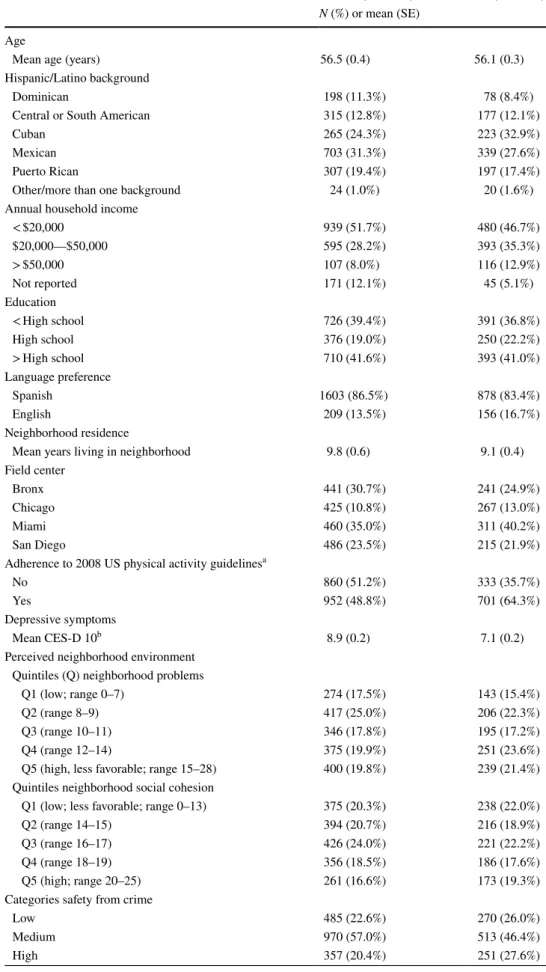
The mean age of women and men was estimated to be 56 years of age and the target population was predominantly of Mexican background (Table 1). Most women (51.7%) and men (46.7%) reported less than $20,000 as the annual house-hold income, and most women (86.5%) and men (83.4%) reported Spanish as the preferred language for the baseline examination. Women and men lived in their current neigh-borhood for 10 and 9 years on average, respectively. Approx-imately, 12.4% of women and 13.9% of men exhibited low mental status as defined as a score of 4 or below on the Six-Item Screener. In bivariate analyses, women and men living in neighborhoods with the least favorable levels of perceived neighborhood problems and safety from crime were more likely to report lower annual household income and had higher depressive symptoms (Supplementary Tables 1 and 2). Among women, but not men, all of the perceived neigh-borhood environment measures were associated with global cognitive function.
Associations between perceived neighborhood environment and cognitive function
Table 1 Characteristics of the study population: women and men
Women (n = 1812) Men (n = 1034)
N (%) or mean (SE) Age
Mean age (years) 56.5 (0.4) 56.1 (0.3) Hispanic/Latino background
Dominican 198 (11.3%) 78 (8.4%)
Central or South American 315 (12.8%) 177 (12.1%)
Cuban 265 (24.3%) 223 (32.9%)
Mexican 703 (31.3%) 339 (27.6%)
Puerto Rican 307 (19.4%) 197 (17.4%)
Other/more than one background 24 (1.0%) 20 (1.6%) Annual household income
< $20,000 939 (51.7%) 480 (46.7%)
$20,000—$50,000 595 (28.2%) 393 (35.3%)
> $50,000 107 (8.0%) 116 (12.9%)
Not reported 171 (12.1%) 45 (5.1%)
Education
< High school 726 (39.4%) 391 (36.8%)
High school 376 (19.0%) 250 (22.2%)
> High school 710 (41.6%) 393 (41.0%)
Language preference
Spanish 1603 (86.5%) 878 (83.4%)
English 209 (13.5%) 156 (16.7%)
Neighborhood residence
Mean years living in neighborhood 9.8 (0.6) 9.1 (0.4) Field center
Bronx 441 (30.7%) 241 (24.9%)
Chicago 425 (10.8%) 267 (13.0%)
Miami 460 (35.0%) 311 (40.2%)
San Diego 486 (23.5%) 215 (21.9%)
Adherence to 2008 US physical activity guidelinesa
No 860 (51.2%) 333 (35.7%)
Yes 952 (48.8%) 701 (64.3%)
Depressive symptoms
Mean CES-D 10b 8.9 (0.2) 7.1 (0.2)
Perceived neighborhood environment Quintiles (Q) neighborhood problems
Q1 (low; range 0–7) 274 (17.5%) 143 (15.4%) Q2 (range 8–9) 417 (25.0%) 206 (22.3%) Q3 (range 10–11) 346 (17.8%) 195 (17.2%) Q4 (range 12–14) 375 (19.9%) 251 (23.6%) Q5 (high, less favorable; range 15–28) 400 (19.8%) 239 (21.4%) Quintiles neighborhood social cohesion
Q1 (low; less favorable; range 0–13) 375 (20.3%) 238 (22.0%) Q2 (range 14–15) 394 (20.7%) 216 (18.9%) Q3 (range 16–17) 426 (24.0%) 221 (22.2%) Q4 (range 18–19) 356 (18.5%) 186 (17.6%) Q5 (high; range 20–25) 261 (16.6%) 173 (19.3%) Categories safety from crime
Low 485 (22.6%) 270 (26.0%)
Medium 970 (57.0%) 513 (46.4%)
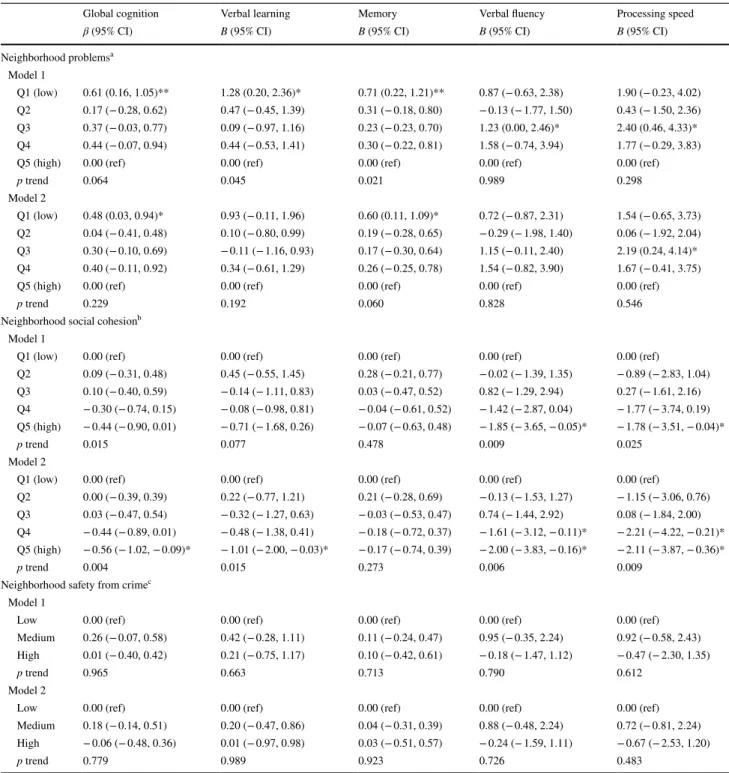
quintile of perceived neighborhood problems (vs. highest quin-tile) and higher processing speed in Models 1 and 2 (Model 1:
B 2.40, 95% CI 0.46, 4.33; and Model 2: B 2.19, 95% CI 0.24, 4.14, respectively). There was evidence of a linear trend in the associations of perceived neighborhood problems with verbal learning and memory in Model 1 (p trend = 0.045 and 0.021, respectively), but not in any of the final models.
Women in the highest quintile of perceived neighborhood social cohesion (vs. lowest quintile) had lower verbal fluency (B − 1.85, 95% CI − 3.65, − 0.05) and processing speed (B
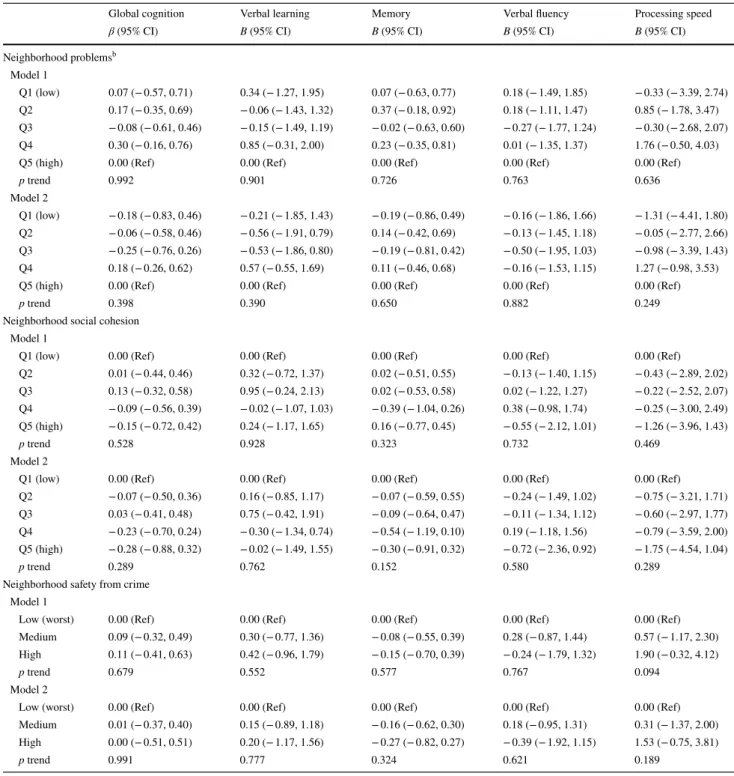
− 1.78, 95% CI − 3.51, − 0.04) (Mode1; Table 2). After addi-tional adjustment for depressive symptoms, the association of the highest quintile of perceived neighborhood social cohesion with lower verbal fluency (B − 2.00, 95% CI − 3.83, − 0.16) and processing speed (B − 2.11, 95% CI − 3.87, − 0.36) remained significant, and the highest quintile of perceived neighborhood social cohesion became significantly associ-ated with lower global cognition (β − 0.56, 95% CI − 1.02, − 0.09) and verbal learning (B − 1.01, 95% CI − 2.00, − 0.03). In Model 2, there was evidence of a linear trend in the afore-mentioned associations of perceived neighborhood social cohesion with global cognition, verbal learning, verbal fluency, and processing speed among women (p trend = 0.004, 0.015, 0.006, and 0.009, respectively). Finally, there were no associa-tions between perceived neighborhood safety from crime and cognitive function among women. Among men, we observed no associations between any of the perceived neighborhood
environment measures and cognitive function regardless of adjustments (Table 3).
Discussion
To our knowledge, this is the most comprehensive exami-nation of associations between perceived neighborhood environment and cognitive function among middle-aged and older Hispanic/Latino women and men. Our results revealed that women living in neighborhoods with the low-est perceived problems (versus highlow-est) had higher global cognition and memory, regardless of socio-demographic characteristics and depressive symptoms. Unexpectedly, we also found that women living in neighborhoods with the highest perceived social cohesion (versus lowest) had lower global cognition, verbal learning, verbal fluency, and processing speed. No associations were observed of perceived neighborhood environment and cognitive func-tion among men. Our findings support results from pre-vious research [16–23] on the associations between per-ceived neighborhood environment and health outcomes among women but not men, and extend these results to include cognitive function as an additional health out-come of interest. The present study also highlights the complexity of these relationships when considering
Table 1 (continued) Women (n = 1812) Men (n = 1034)
N (%) or mean (SE) Cognitive function
Mean global cognition (z score) 0.3 (0.1) − 0.4 (0.1) Mean verbal learning 23.4 (0.3) 21.3 (0.2)
Mean memory 8.5 (0.1) 7.6 (0.1)
Mean verbal fluency 18.6 (0.4) 18.5 (0.3) Mean processing speed 35.2 (0.6) 33.7 (0.5) Low mental statusc
SIS ≤ 4 213 (12.4%) 152 (13.9%)
Values in parentheses are standard errors. Sample size is unweighted and all other reported values are weighted to represent the target Hispanic/Latino population
Q quintile, SIS Six-Item Screener
a Physical activity levels were assessed using the Global Physical Activity Questionnaire (GPAP) and were
categorized according to the 2008 US Guidelines for meeting high or medium activity levels
b Depressive symptoms were assessed using the ten-item Center for Epidemiologic Studies Depression
Scale (CES-D-10)
Table 2 Associations between perceived neighborhood environment and cognitive function among women (n = 1812)
Sample size is unweighted and all other values are weighted
Model 1: Age, Hispanic/Latino background, language preference, field site, years living in neighborhood, annual household income, and education Model 2: Model 1+ depressive symptoms
Q quintiles
a Perceived neighborhood problems’ score range according to quintile and sample size: Q1: 0–7 (n = 274); Q2: 8–9 (n = 417); Q3: 10–11
(n = 346); Q4: 12–14 (n = 375); Q5: 15–28 (n = 400)
b Perceived neighborhood social cohesion’s score range according to quintile and sample size: Q1: 5.0–13.0 (n = 375); Q2: 14–15 (n = 394); Q3:
16–17 (n = 426); Q4: 18–19 (n = 356); Q5: 19–25 (n = 261)
c Perceived neighborhood safety categories’ sample size: low: 483; medium: 964; high: 355
*p < 0.05 **p < 0.01
Global cognition Verbal learning Memory Verbal fluency Processing speed
β (95% CI) B (95% CI) B (95% CI) B (95% CI) B (95% CI)
Neighborhood problemsa
Model 1
Q1 (low) 0.61 (0.16, 1.05)** 1.28 (0.20, 2.36)* 0.71 (0.22, 1.21)** 0.87 (− 0.63, 2.38) 1.90 (− 0.23, 4.02) Q2 0.17 (− 0.28, 0.62) 0.47 (− 0.45, 1.39) 0.31 (− 0.18, 0.80) − 0.13 (− 1.77, 1.50) 0.43 (− 1.50, 2.36) Q3 0.37 (− 0.03, 0.77) 0.09 (− 0.97, 1.16) 0.23 (− 0.23, 0.70) 1.23 (0.00, 2.46)* 2.40 (0.46, 4.33)* Q4 0.44 (− 0.07, 0.94) 0.44 (− 0.53, 1.41) 0.30 (− 0.22, 0.81) 1.58 (− 0.74, 3.94) 1.77 (− 0.29, 3.83) Q5 (high) 0.00 (ref) 0.00 (ref) 0.00 (ref) 0.00 (ref) 0.00 (ref)
p trend 0.064 0.045 0.021 0.989 0.298
Model 2
Q1 (low) 0.48 (0.03, 0.94)* 0.93 (− 0.11, 1.96) 0.60 (0.11, 1.09)* 0.72 (− 0.87, 2.31) 1.54 (− 0.65, 3.73) Q2 0.04 (− 0.41, 0.48) 0.10 (− 0.80, 0.99) 0.19 (− 0.28, 0.65) − 0.29 (− 1.98, 1.40) 0.06 (− 1.92, 2.04) Q3 0.30 (− 0.10, 0.69) − 0.11 (− 1.16, 0.93) 0.17 (− 0.30, 0.64) 1.15 (− 0.11, 2.40) 2.19 (0.24, 4.14)* Q4 0.40 (− 0.11, 0.92) 0.34 (− 0.61, 1.29) 0.26 (− 0.25, 0.78) 1.54 (− 0.82, 3.90) 1.67 (− 0.41, 3.75) Q5 (high) 0.00 (ref) 0.00 (ref) 0.00 (ref) 0.00 (ref) 0.00 (ref)
p trend 0.229 0.192 0.060 0.828 0.546
Neighborhood social cohesionb
Model 1
Q1 (low) 0.00 (ref) 0.00 (ref) 0.00 (ref) 0.00 (ref) 0.00 (ref)
Q2 0.09 (− 0.31, 0.48) 0.45 (− 0.55, 1.45) 0.28 (− 0.21, 0.77) − 0.02 (− 1.39, 1.35) − 0.89 (− 2.83, 1.04) Q3 0.10 (− 0.40, 0.59) − 0.14 (− 1.11, 0.83) 0.03 (− 0.47, 0.52) 0.82 (− 1.29, 2.94) 0.27 (− 1.61, 2.16) Q4 − 0.30 (− 0.74, 0.15) − 0.08 (− 0.98, 0.81) − 0.04 (− 0.61, 0.52) − 1.42 (− 2.87, 0.04) − 1.77 (− 3.74, 0.19) Q5 (high) − 0.44 (− 0.90, 0.01) − 0.71 (− 1.68, 0.26) − 0.07 (− 0.63, 0.48) − 1.85 (− 3.65, − 0.05)* − 1.78 (− 3.51, − 0.04)*
p trend 0.015 0.077 0.478 0.009 0.025
Model 2
Q1 (low) 0.00 (ref) 0.00 (ref) 0.00 (ref) 0.00 (ref) 0.00 (ref)
Q2 0.00 (− 0.39, 0.39) 0.22 (− 0.77, 1.21) 0.21 (− 0.28, 0.69) − 0.13 (− 1.53, 1.27) − 1.15 (− 3.06, 0.76) Q3 0.03 (− 0.47, 0.54) − 0.32 (− 1.27, 0.63) − 0.03 (− 0.53, 0.47) 0.74 (− 1.44, 2.92) 0.08 (− 1.84, 2.00) Q4 − 0.44 (− 0.89, 0.01) − 0.48 (− 1.38, 0.41) − 0.18 (− 0.72, 0.37) − 1.61 (− 3.12, − 0.11)* − 2.21 (− 4.22, − 0.21)* Q5 (high) − 0.56 (− 1.02, − 0.09)* − 1.01 (− 2.00, − 0.03)* − 0.17 (− 0.74, 0.39) − 2.00 (− 3.83, − 0.16)* − 2.11 (− 3.87, − 0.36)*
p trend 0.004 0.015 0.273 0.006 0.009
Neighborhood safety from crimec
Model 1
Low 0.00 (ref) 0.00 (ref) 0.00 (ref) 0.00 (ref) 0.00 (ref) Medium 0.26 (− 0.07, 0.58) 0.42 (− 0.28, 1.11) 0.11 (− 0.24, 0.47) 0.95 (− 0.35, 2.24) 0.92 (− 0.58, 2.43) High 0.01 (− 0.40, 0.42) 0.21 (− 0.75, 1.17) 0.10 (− 0.42, 0.61) − 0.18 (− 1.47, 1.12) − 0.47 (− 2.30, 1.35)
p trend 0.965 0.663 0.713 0.790 0.612
Model 2
Low 0.00 (ref) 0.00 (ref) 0.00 (ref) 0.00 (ref) 0.00 (ref) Medium 0.18 (− 0.14, 0.51) 0.20 (− 0.47, 0.86) 0.04 (− 0.31, 0.39) 0.88 (− 0.48, 2.24) 0.72 (− 0.81, 2.24) High − 0.06 (− 0.48, 0.36) 0.01 (− 0.97, 0.98) 0.03 (− 0.51, 0.57) − 0.24 (− 1.59, 1.11) − 0.67 (− 2.53, 1.20)
socio-demographic, behavioral, and psychological vari-ables particularly among Hispanic/Latina women.
Among women, as hypothesized, we found that the most favorable level of perceived neighborhood problems (first quintile) was associated with better global cognitive func-tion and memory in the fully adjusted model. Overall, such finding is consistent with theories positing that adverse neighborhood conditions can act as psychosocial stress-ors that are associated with wstress-orst mental health outcomes [43]. It is consistent with a study reporting an association between lower perceived neighborhood disorder and lower cognitive decline over time in older African American adults [12] and a study reporting that living in more advan-taged neighborhoods (based on objective assessments) is associated with better cognitive function in older non-His-panic white women [44]. There were no significant linear trends in the neighborhood problems–cognition associa-tions. Most significant associations were only present when comparing the highest to the lowest quintiles, which may be partly due to low variability across neighborhoods since communities with a high proportion of Hispanics/Latinos were oversampled in HCHS/SOL [46].
Surprisingly, among women, the most favorable level of perceived neighborhood social cohesion (i.e., fifth quintile) was associated lower global cognition, verbal learning, ver-bal fluency, and processing speed scores. There was evi-dence of significant linear trends in the neighborhood social cohesion–cognition associations, where cognitive function scores decreased as social cohesion was higher. This unex-pected direction may simply suggest that women with better cognitive function have greater capacity to comprehensively assess and develop nuanced understandings of the quality of social relations in their neighborhood. Alternatively, it may be that neighborhood social cohesion may not promote col-lective resources and actions, but rather serve as a stressor in neighborhoods of lower socioeconomic status [45, 46]. In fact, inconsistent findings have been reported across previous studies [47] with a study reporting an association between better perceived neighborhood social climate and better cognitive function [11], but other studies [13, 14] reporting no associations. These inconsistent findings across studies may be due, in part, to the cross-sectional design of the available studies, cross-cultural differences in the sam-ples used, and/or differences in the measures employed to assess the neighborhood environment. Longitudinal research on the associations between perceived neighborhood prob-lems and social cohesion with changes in cognitive function particularly among women is warranted.
Overall, the null associations in men but not women sug-gest that perceptions of one’s neighborhood environment may play a greater role in shaping cognitive function among women compared to men, a possibility that may be related to gender differences in neighborhood-based activities and/
or social relationships. For example, compared to men, women tend to report larger social network size [48–50] and seek more social support outside of their family [49, 50] which may result in better quality of social relations with their neighbors. Alternatively, a potential explanation for the largely null findings observed among men is that they had lower cognitive function scores (compared to women) which could contribute to lower ability to ascertain and report nuances in their neighborhood environment. How-ever, it is important to note that although we describe some statistically significant associations present for women and not men, post hoc analyses showed that only the associa-tion between perceived neighborhood social cohesion and processing speed had a significant interaction term (p inter-action = 0.038) in the fully adjusted model. Future research with a larger sample size is needed to confirm such finding.
Additionally, the lack of associations between perceived neighborhood safety from crime and cognitive function in women and men may reflect that these associations oper-ate through multiple indirect pathways rather than directly as examined in the current study. For example, higher per-ceived neighborhood safety from crime has been associated with higher levels of neighborhood-based walking [51] which in turn is associated with increased opportunities for social engagement with neighbors [51], an important protective factor for cognitive function [52]. In the present study, how-ever, there was no evidence of bivariate associations between perceived neighborhood safety from crime and adherence to the 2008 US physical activity guidelines in either women or men. More work is needed investigating the complex interplay of perceived neighborhood safety from crime and associated healthy behaviors that may relate to the cognitive function of middle-aged and older Hispanics/Latinos.
Table 3 Associations between perceived neighborhood environment and cognitive function among men (n = 1034)
Sample size is unweighted and all other values are weighted
Model 1: age, Hispanic/Latino background, language preference, field site, years living in neighborhood, annual household income, and educa-tion
Model 2: Model 1 + depressive symptoms
Q quintiles
a Perceived neighborhood problems’ score range according to quintile and sample size: Q1: 0–7 (n = 143); Q2: 8–9 (n = 205); Q3: 10–11
(n = 194); Q4: 12–14 (n = 249); Q5: 15–28 (n = 238)
b Perceived neighborhood social cohesion’s score range according to quintile and sample size: Q1: 5.0–13.0 (n = 236); Q2: 14–15 (n = 216); Q3:
16–17 (n = 221); Q4: 18–19 (n = 185); Q5: 19–25 (n = 171)
c Perceived neighborhood safety categories’ sample size: low: 268; medium: 511; high: 250
Global cognition Verbal learning Memory Verbal fluency Processing speed
β (95% CI) B (95% CI) B (95% CI) B (95% CI) B (95% CI)
Neighborhood problemsb
Model 1
Q1 (low) 0.07 (− 0.57, 0.71) 0.34 (− 1.27, 1.95) 0.07 (− 0.63, 0.77) 0.18 (− 1.49, 1.85) − 0.33 (− 3.39, 2.74) Q2 0.17 (− 0.35, 0.69) − 0.06 (− 1.43, 1.32) 0.37 (− 0.18, 0.92) 0.18 (− 1.11, 1.47) 0.85 (− 1.78, 3.47) Q3 − 0.08 (− 0.61, 0.46) − 0.15 (− 1.49, 1.19) − 0.02 (− 0.63, 0.60) − 0.27 (− 1.77, 1.24) − 0.30 (− 2.68, 2.07) Q4 0.30 (− 0.16, 0.76) 0.85 (− 0.31, 2.00) 0.23 (− 0.35, 0.81) 0.01 (− 1.35, 1.37) 1.76 (− 0.50, 4.03) Q5 (high) 0.00 (Ref) 0.00 (Ref) 0.00 (Ref) 0.00 (Ref) 0.00 (Ref)
p trend 0.992 0.901 0.726 0.763 0.636
Model 2
Q1 (low) − 0.18 (− 0.83, 0.46) − 0.21 (− 1.85, 1.43) − 0.19 (− 0.86, 0.49) − 0.16 (− 1.86, 1.66) − 1.31 (− 4.41, 1.80) Q2 − 0.06 (− 0.58, 0.46) − 0.56 (− 1.91, 0.79) 0.14 (− 0.42, 0.69) − 0.13 (− 1.45, 1.18) − 0.05 (− 2.77, 2.66) Q3 − 0.25 (− 0.76, 0.26) − 0.53 (− 1.86, 0.80) − 0.19 (− 0.81, 0.42) − 0.50 (− 1.95, 1.03) − 0.98 (− 3.39, 1.43) Q4 0.18 (− 0.26, 0.62) 0.57 (− 0.55, 1.69) 0.11 (− 0.46, 0.68) − 0.16 (− 1.53, 1.15) 1.27 (− 0.98, 3.53) Q5 (high) 0.00 (Ref) 0.00 (Ref) 0.00 (Ref) 0.00 (Ref) 0.00 (Ref)
p trend 0.398 0.390 0.650 0.882 0.249
Neighborhood social cohesion Model 1
Q1 (low) 0.00 (Ref) 0.00 (Ref) 0.00 (Ref) 0.00 (Ref) 0.00 (Ref) Q2 0.01 (− 0.44, 0.46) 0.32 (− 0.72, 1.37) 0.02 (− 0.51, 0.55) − 0.13 (− 1.40, 1.15) − 0.43 (− 2.89, 2.02) Q3 0.13 (− 0.32, 0.58) 0.95 (− 0.24, 2.13) 0.02 (− 0.53, 0.58) 0.02 (− 1.22, 1.27) − 0.22 (− 2.52, 2.07) Q4 − 0.09 (− 0.56, 0.39) − 0.02 (− 1.07, 1.03) − 0.39 (− 1.04, 0.26) 0.38 (− 0.98, 1.74) − 0.25 (− 3.00, 2.49) Q5 (high) − 0.15 (− 0.72, 0.42) 0.24 (− 1.17, 1.65) 0.16 (− 0.77, 0.45) − 0.55 (− 2.12, 1.01) − 1.26 (− 3.96, 1.43)
p trend 0.528 0.928 0.323 0.732 0.469
Model 2
Q1 (low) 0.00 (Ref) 0.00 (Ref) 0.00 (Ref) 0.00 (Ref) 0.00 (Ref) Q2 − 0.07 (− 0.50, 0.36) 0.16 (− 0.85, 1.17) − 0.07 (− 0.59, 0.55) − 0.24 (− 1.49, 1.02) − 0.75 (− 3.21, 1.71) Q3 0.03 (− 0.41, 0.48) 0.75 (− 0.42, 1.91) − 0.09 (− 0.64, 0.47) − 0.11 (− 1.34, 1.12) − 0.60 (− 2.97, 1.77) Q4 − 0.23 (− 0.70, 0.24) − 0.30 (− 1.34, 0.74) − 0.54 (− 1.19, 0.10) 0.19 (− 1.18, 1.56) − 0.79 (− 3.59, 2.00) Q5 (high) − 0.28 (− 0.88, 0.32) − 0.02 (− 1.49, 1.55) − 0.30 (− 0.91, 0.32) − 0.72 (− 2.36, 0.92) − 1.75 (− 4.54, 1.04)
p trend 0.289 0.762 0.152 0.580 0.289
Neighborhood safety from crime Model 1
Low (worst) 0.00 (Ref) 0.00 (Ref) 0.00 (Ref) 0.00 (Ref) 0.00 (Ref) Medium 0.09 (− 0.32, 0.49) 0.30 (− 0.77, 1.36) − 0.08 (− 0.55, 0.39) 0.28 (− 0.87, 1.44) 0.57 (− 1.17, 2.30) High 0.11 (− 0.41, 0.63) 0.42 (− 0.96, 1.79) − 0.15 (− 0.70, 0.39) − 0.24 (− 1.79, 1.32) 1.90 (− 0.32, 4.12)
p trend 0.679 0.552 0.577 0.767 0.094
Model 2
Low (worst) 0.00 (Ref) 0.00 (Ref) 0.00 (Ref) 0.00 (Ref) 0.00 (Ref) Medium 0.01 (− 0.37, 0.40) 0.15 (− 0.89, 1.18) − 0.16 (− 0.62, 0.30) 0.18 (− 0.95, 1.31) 0.31 (− 1.37, 2.00) High 0.00 (− 0.51, 0.51) 0.20 (− 1.17, 1.56) − 0.27 (− 0.82, 0.27) − 0.39 (− 1.92, 1.15) 1.53 (− 0.75, 3.81)
as a mediator of the neighborhood–cognition associations is warranted [56]. Interestingly, we found strong bivariate associations between worse perceptions of the neighbor-hood environment and higher depressive symptoms among women and men, which will be relevant to consider in future research. Although consideration of physical activity may be important in the associations examined in the current study (because it could be either a confounder or mediator of the associations), adding physical activity to our final model did not change our findings. Potential reasons for this unex-pected finding is the lack of bivariate association between neighborhood activity and physical activity in our study and that physical activity (objectively assessed) is not associated with cognitive function in our sample [57]. Another limita-tion of our study is that perceived neighborhood safety from crime was assessed using a single question; while it has been shown to have statistical validity [39], this limitation may nonetheless have affected our findings. While response bias [58] is another potential limitation of our study, e.g., partici-pants with worse cognitive function may report poorer rating of their neighborhood, the combined relatively young age and low prevalence of lower mental status in our cohort may lessen this possibility. Finally, Hispanics/Latinos living in suburban or rural areas were not included in the HCHS/SOL study and our cohort is not representative of those tions. Nevertheless, most of the US Hispanic/Latino popula-tion lives in urban areas [59] (including those sampled in the HCHS/SOL). An important strength of this study is that we included a diverse cohort of middle-age and older US His-panics/Latinos and we highlight the importance of explor-ing gender differences in the associations between perceived neighborhood features and cognitive function. Addition-ally, we employed well-recognized and validated measures to assess various perceived neighborhood environmental features, and validated tests of cognitive function (both as individual test items and as a measure of global cognitive function). Future studies should examine whether Hispanic/ Latino background moderates the neighborhood–cognition associations and whether objective neighborhood environ-ment measures (e.g., green spaces, crime rates, and socio-cultural environment) are associated with cognitive function among Hispanics/Latinos. We were able to adjust our mod-els by duration of exposure to the neighborhood environment (approximately 9 years on average), which is important to consider when investigating the relationships between neigh-borhood environments and individual health.
Conclusion
This study provides cross-sectional evidence suggesting that lower levels of perceived neighborhood problems (as a proxy for neighborhood-derived psychosocial stressors)
is associated with higher global cognitive function and memory scores among middle-aged and older Hispanic/ Latina women but not among men. Future research should include longitudinal measures and consider mechanistic pathways to aim to better understand the role of perceived neighborhood environment on cognitive function among middle-aged and older Hispanics/Latinos. A better under-standing of these associations is warranted given the need to identify public health approaches that may aid in the promotion of cognitive health among Hispanics/Latinos, an understudied yet rapidly growing segment of the US population [25] at increased risk for developing early onset of cognitive impairment [15].
Acknowledgements The authors would like to thank the HCHS/SOL and its SCAS participants as well as the staff for their commitment to this study. Mayra L. Estrella was partially supported by the NIH-National Heart, Lung, and Blood Institute (NHLBI) T32-HL125294 and by a Diversity Supplement from the NIH-NHLBI for HCHS/SOL Chicago Field Center (75N92019D00012). Dr. Hector González was supported by the NIH-National Aging Institute (5R01AG048642-04). The HCHS/SOL was carried out as a collaborative study sup-ported by contracts from the NHLBI to the University of North Carolina (N01-HC65233), University of Miami (N01-HC65234), Albert Einstein College of Medicine (N01-HC65235), University of Illinois at Chicago (HHSN268201300003I), Northwestern University (N01-HC65236), and San Diego State University (N01-HC65237). The following institutes/centers/offices contribute to the HCHS/SOL through a transfer of funds to the NHLBI: National Institute on Minor-ity Health and Health Disparities, National Institute on Deafness and Other Communication Disorders, National Institute of Dental and Craniofacial Research, National Institute of Diabetes and Digestive and Kidney Diseases, National Institute of Neurological Disorders and Stroke, NIH Institution Office of Dietary Supplements. The views expressed in this manuscript are those of the authors and do not nec-essarily represent the views of the National Heart, Lung, and Blood Institute; the National Institutes of Health; or the US Department of Health and Human Services.
Compliance with ethical standards
Conflict of interest On behalf of all authors, the corresponding author
states that there is no conflict of interest.
References
1. Hill CV, Pérez-Stable EJ, Anderson NA, Bernard MA (2015) The National Institute on aging health disparities research framework. Ethn Dis 25:245–254. https ://doi.org/10.18865 /ed.25.3.245
2. Glymour MM, Manly JJ (2008) Lifecourse social conditions and racial and ethnic patterns of cognitive aging. Neuropsychol Rev 18:223–254. https ://doi.org/10.1007/s1106 5-008-9064-z
3. Wu Y-T, Prina AM, Brayne C (2015) The association between community environment and cognitive function: a systematic review. Soc Psychiatry Psychiatr Epidemiol 50:351–362. https :// doi.org/10.1007/s0012 7-014-0945-6
Am J Prev Med 53:241–251. https ://doi.org/10.1016/j.amepr e.2017.02.013
5. Aneshensel CS, Ko MJ, Chodosh J, Wight RG (2011) The urban neighborhood and cognitive functioning in late middle age. J Health Soc Behav 52:163–179. https ://doi.org/10.1177/00221 46510 39397 4
6. Gorelick PB, Furie KL, Iadecola C et al (2017) Defining optimal brain health in adults: a Presidential Advisory from the American Heart Association/American Stroke Association. Stroke 48:e00– e00. https ://doi.org/10.1161/STR.00000 00000 00014 8
7. Ogden CL, Carroll MD, Kit BK, Flegal KM (2014) Prevalence of childhood and adult obesity in the United States, 2011–2012. JAMA 311:806. https ://doi.org/10.1001/jama.2014.732
8. Townley G, Kloos B (2014) Mind over matter? The role of indi-vidual perceptions in understanding the social ecology of housing environments for individuals with psychiatric disabilities. Am J Community Psychol 54:205–218. https ://doi.org/10.1007/s1046 4-014-9664-0
9. Koohsari MJ, Badland H, Sugiyama T et al (2015) Mismatch between perceived and objectively measured land use mix and street connectivity: associations with neighborhood walk-ing. J Urban Heal 92:242–252. https ://doi.org/10.1007/s1152 4-014-9928-x
10. Ahuja C, Ayers C, Hartz J et al (2018) Examining relationships between perceptions and objective assessments of neighborhood environment and sedentary time: data from the Washington, D.C. Cardiovascular Health and Needs Assessment. Prev Med Rep 9:42–48. https ://doi.org/10.1016/j.pmedr .2017.12.002
11. Brown SC, Mason CCA, Spokane AR et al (2009) The relation-ship of neighborhood climate to perceived social support and mental health in older Hispanic immigrants in Miami, Florida. Aging Heal 21:431–459. https ://doi.org/10.1177/08982 64308 32897 6
12. Boardman J, Barnes L, Wilson R, Evans D (2012) Social disor-der, APOE-E4 genotype, and change in cognitive function among older adults living in Chicago. Soc Sci 10:1584–1590
13. Magaziner J, Cadigan DA (1989) Community resources and men-tal health of older women living alone. J Aging Health 1:35–49.
https ://doi.org/10.1177/08982 64389 00100 103
14. Murayama H, Nishi M, Matsuo E et al (2013) Do bonding and bridging social capital affect self-rated health, depressive mood and cognitive decline in older Japanese? A prospective cohort study. Soc Sci Med 98:247–252. https ://doi.org/10.1016/j.socsc imed.2013.09.026
15. Alzheimer’s Association (2017) 2017 Alzheimer’s disease facts and figures. Alzheimer’s Dement 13:325–373. https ://doi. org/10.1016/j.jalz.2017.02.006
16. Strong LL, Reitzel LR, Wetter DW, McNeill LH (2013) Asso-ciations of perceived neighborhood physical and social environ-ments with physical activity and television viewing in African-American men and women. Am J Health Promot 27:401–409.
https ://doi.org/10.4278/ajhp.12030 6-QUAN-127
17. Kim D, Roux AV, Kiefe CI et al (2010) Do Neighborhood socio-economic deprivation and low social cohesion predict coronary calcification The CARDIA Study. Am J Epidemiol 172:288– 298.https ://doi.org/10.1093/aje/kwq09 8
18. Mair C, Roux AV, Shen M et al (2009) Cross-sectional and lon-gitudinal associations of neighborhood cohesion and stressors with depressive symptoms in the Multiethnic Study of Athero-sclerosis. Ann Epidemiol 19:49–57. https ://doi.org/10.1016/j. annep idem.2008.10.002
19. Mair C, Roux AV, Morenoff JD (2010) Neighborhood stressors and social support as predictors of depressive symptoms in the Chicago Community Adult Health Study. Health Place 16:811– 819.https ://doi.org/10.1016/J.HEALT HPLAC E.2010.04.006
20. Choi NG, Kim J, DiNitto DM, Marti CN (2015) Perceived social cohesion, frequency of going out, and depressive symp-toms in older adults: examination of longitudinal relation-ships. Gerontol Geriatr Med 1:2333721415615478. https ://doi. org/10.1177/23337 21415 61547 8
21. Gebreab SY, Riestra P, Gaye A et al (2016) Perceived neighbor-hood problems are associated with shorter telomere length in African-American women. Psychoneuroendocrinology 69:90– 97.https ://doi.org/10.1016/j.psyne uen.2016.03.018
22. Suminski RR, Poston WSC, Petosa RL et al (2005) Features of the neighborhood environment and walking by US adults. Am J Prev Med 28:149–155. https ://doi.org/10.1016/j.amepr e.2004.09.009
23. Barber S, Hickson DA, Wang X et al (2016) Neighborhood disad-vantage, poor social conditions, and cardiovascular disease inci-dence among African-American adults in the Jackson Heart Study. Am J Public Health 106:2219–2226. https ://doi.org/10.2105/ AJPH.2016.30347 1
24. González HM, Tarraf W, Gouskova N et al (2015) Neurocognitive function among middle-aged and older Hispanic/Latinos: results from the Hispanic Community Health Study/Study of Latinos. Arch Clin Neuropsychol 30:68–77. https ://doi.org/10.1093/arcli n/acu06 6
25. Passel JCD (2008) US population projections: 2005–2050. Pew Research Center, Washington
26. Sorlie PD, -Santa LM, Wassertheil-Smoller S et al (2010) Design and implementation of the Hispanic Community Health Study/ Study of Latinos. Ann Epidemiol 20:629–641. https ://doi. org/10.1016/j.annep idem.2010.03.015
27. LaVange LM, Kalsbeek WD, Sorlie PD et al (2010) Sample design and cohort selection in the Hispanic Community Health Study/Study of Latinos. Ann Epidemiol 20:642–649. https ://doi. org/10.1016/j.annep idem.2010.05.006
28. Gallo LC, Penedo FJ, Carnethon M et al (2014) The Hispanic Community Health Study/Study of Latinos Sociocultural Ancil-lary Study: sample, design, and procedures. Ethn Dis 24:77–83 29. Gallo LC, Penedo FJ, de los Monteros KE, Arguelles W (2009)
Resiliency in the face of disadvantage: do Hispanic cultural char-acteristics protect health outcomes? J Pers 77:1707–1746. https ://doi.org/10.1111/j.1467-6494.2009.00598 .x
30. Myers HF (2009) Ethnicity- and socio-economic status-related stresses in context: an integrative review and conceptual model. J Behav Med 32:9–19. https ://doi.org/10.1007/s1086 5-008-9181-4
31. Deckers K, Schievink SHJ, Rodriquez MMF et al (2017) Coronary heart disease and risk for cognitive impairment or dementia: sys-tematic review and meta-analysis. PLoS ONE ONE 12:e0184244.
https ://doi.org/10.1371/journ al.pone.01842 44
32. Levine DA, Wadley VG, Langa KM et al (2018) Risk factors for poststroke cognitive decline: the REGARDS Study (Reasons for Geographic and Racial Differences in Stroke). Stroke 49:987–994.
https ://doi.org/10.1161/STROK EAHA.117.01852 9
33. González HM, Mungas D, Reed BR et al (2001) A new verbal learning and memory test for English- and Spanish-speaking older people. J Int Neuropsychol Soc 7:544–555
34. González HM, Mungas D, Haan MN (2002) A verbal learning and memory test for English- and Spanish-speaking older Mexican-American adults. Clin Neuropsychol (Neuropsychol Dev Cogn Sect D) 16:439–451. https ://doi.org/10.1076/clin.16.4.439.13908
35. Lezak M, Howieson DBLD (2004) Neuropsychological assess-ment. Oxford University Press, New York
36. Benton ALHK (1989) Multilingual aphasia examination, 2nd edn. AJA Associates, Iowa City
37. Wechsler D (1981) WAIS-R manual. Psychological Corporation, San Antonio
from psychometrics to ecometrics. Am J Epidemiol 165:858–867.
https ://doi.org/10.1093/aje/kwm04 0
39. Echeverria SE, -Roux AV, Link BG (2004) Reliability of self-reported neighborhood characteristics. J Urban Heal Bull NY Acad Med 81:682–701. https ://doi.org/10.1093/jurba n/jth15 1
40. Sampson RJ (1997) Neighborhoods and violent crime: a multi-level study of collective efficacy. Science 277:918–924. https :// doi.org/10.1126/scien ce.277.5328.918
41. Armstrong T, Bull F (2006) Development of the World Health Organization Global Physical Activity Questionnaire (GPAQ). J Public Health (Bangkok) 14:66–70. https ://doi.org/10.1007/s1038 9-006-0024-x
42. Andresen EM, Malmgren JA, Carter WB, Patrick DL (1993) Screening for depression in well older adults: evaluation of a short form of the CES-D (Center for Epidemiologic Studies Depression Scale). Am J Prev Med 10:77–84. https ://doi.org/10.4236/healt h.2013.53a07 8
43. Cutrona CE, Wallace G, Wesner KA (2006) Neighborhood char-acteristics and depression. Curr Dir Psychol Sci 15:188–192. https ://doi.org/10.1111/j.1467-8721.2006.00433 .x
44. Shih RA, Dastidar B, Margolis KL et al (2011) Neighbor-hood socioeconomic status and cognitive function in women. Am J Public Health 101:1721–1728. https ://doi.org/10.2105/ AJPH.2011.30016 9
45. Berkman L, Glass T (2000) Social integration, social networks, social support, and health. In: Berkman LF, Kawachi I (eds) Social epidemiology. Oxford University Press, New York, pp 137–173 46. Echeverría S, -Roux AV, Shea S et al (2008) Associations of
neighborhood problems and neighborhood social cohesion with mental health and health behaviors: the Multi-Ethnic Study of Atherosclerosis. Health Place 14:853–865. https ://doi. org/10.1016/j.healt hplac e.2008.01.004
47. Kuiper JS, Zuidersma M, Zuidema SU et al (2016) Social relation-ships and cognitive decline: a systematic review and meta-analysis of longitudinal cohort studies. Int J Epidemiol 45:dyw089. https ://doi.org/10.1093/ije/dyw08 9
48. McLaughlin D, Vagenas D, Pachana NA et al (2010) Gender dif-ferences in social network size and satisfaction in adults in their 70s. J Health Psychol 15:671–679. https ://doi.org/10.1177/13591 05310 36817 7
49. Antonucci TC, Akiyama H (1987) An examination of sex differ-ences in social support among older men and women. Sex Roles 17:737–749. https ://doi.org/10.1007/BF002 87685
50. Cornwell B, Laumann EO, Schumm LP (2008) The SOCIAL connectedness of older adults: a national profile. Am Sociol Rev 73:185–203
51. Stafford M, Chandola T, Marmot M (2007) Association between fear of crime and mental health and physical functioning. Am J Public Health 97:2076–2081. https ://doi.org/10.2105/ AJPH.2006.09715 4
52. Krueger KR, Wilson RS, Kamenetsky JM et al (2009) Social engagement and cognitive function in old age. Exp Aging Res 35:45–60. https ://doi.org/10.1080/03610 73080 25450 28
53. Clarke PJ, Weuve J, Barnes L et al (2015) Cognitive decline and the neighborhood environment. Ann Epidemiol 25:849–854. https ://doi.org/10.1016/j.annep idem.2015.07.001
54. Kovalchik SA, Slaughter ME, Miles J et al (2015) Neighbourhood racial/ethnic composition and segregation and trajectories of cog-nitive decline among US older adults. J Epidemiol Community Health 69:978–984. https ://doi.org/10.1136/jech-2015-20560 0
55. Liu S, Jones RN, Glymour MM (2010) Implications of lifecourse epidemiology for research on determinants of adult disease. Public Health Rev 32:489–511
56. Blair A, Ross NA, Gariepy G, Schmitz N (2014) How do neigh-borhoods affect depression outcomes? A realist review and a call for the examination of causal pathways. Soc Psychiatry Psychiatr Epidemiol 49:873–887. https ://doi.org/10.1007/s0012 7-013-0810-z
57. Vásquez E, Strizich G, Isasi CR et al (2017) Is there a relationship between accelerometer-assessed physical activity and sedentary behavior and cognitive function in US Hispanic/Latino adults? The Hispanic Community Health Study/Study of Latinos (HCHS/ SOL). Prev Med (Baltim) 103:43–48. https ://doi.org/10.1016/j. ypmed .2017.07.024
58. Macleod J, Davey Smith G, Heslop P et al (2002) Psychologi-cal stress and cardiovascular disease: empiriPsychologi-cal demonstration of bias in a prospective observational study of Scottish men. BMJ 324:1247–1251. https ://doi.org/10.1136/bmj.324.7348.1247
59. Krogstad JM (2016) Key facts about how the US Hispanic popula-tion is changing. Pew Research Center, Washington
Affiliations
Mayra L. Estrella1 · Ramon A. Durazo‑Arvizu1,2 · Linda C. Gallo3 · Carmen R. Isasi4 · Krista M. Perreira5 ·
Thanh‑Huyen T. Vu6 · Elizabeth Vasquez7 · Shruti Sachdeva1 · Donglin Zeng8 · Maria M. Llabre9 · Wassim Tarraf10 · Hector M. González11 · Martha L. Daviglus1 · Melissa Lamar12
1 Institute for Minority Health Research, University of Illinois
At Chicago, Chicago, IL, USA
2 Department of Public Health Sciences, Loyola University
Chicago, Chicago, IL, USA
3 Department of Psychology, San Diego State University,
San Diego, CA, USA
4 Department of Epidemiology and Population Health, Albert
Einstein College of Medicine, Bronx, NY, USA
5 Department of Social Medicine, University of North Carolina
at Chapel Hill, Chapel Hill, NC, USA
6 Department of Preventive Medicine, Northwestern
University, Chicago, IL, USA
7 Department of Epidemiology and Biostatistics, University
at Albany State University of New York, Albany, NY, USA
8 Collaborative Studies Coordinating Center, University
of North Carolina at Chapel Hill, Chapel Hill, NC, USA
9 Department of Psychology, University of Miami, Miami, FL,
USA
10 Department of Healthcare Sciences, Wayne State University,
Detroit, MI, USA
11 Department of Neurosciences and Shiley-Marcos
Alzheimer’s Disease Research Center, University of California San Diego, La Jolla, CA, USA
12 Department of Behavioral Sciences, Rush University Medical