STUDENT No 10032794 Dissertation submitted in partial fulfilment
of the requirements of the
BA (HONS) LEADERSHIP AND MANAGEMENT BY PART TIME STUDY of Northumbria University
NAME XXX
DEGREE BA (Hons) Leadership and Management SUPERVISOR Paul Leonard
TITLE How can XXX change its practises to introduce more effective talent management?
DATE August 2011
DECLARATIONS
I declare the following:-
(1) that the material contained in this dissertation is the end result of my own work and that due acknowledgement has been given in the bibliography and references to ALL sources be they printed, electronic or personal.
(2) the Word Count of this Dissertation is: Executive Summary: 1075 words Main body: 10920 words Personal Reflection: 1165 words
(3) that unless this dissertation has been confirmed as confidential, I agree to an entire electronic copy or sections of the dissertation to being placed on Blackboard, if deemed appropriate, to allow future students the opportunity to see examples of past dissertations. I understand that if displayed on Blackboard it would be made available for no longer than five years and that students would be able to print off copies or download. The authorship would remain anonymous.
(4) I agree to my dissertation being submitted to a plagiarism detection service, where it will be stored in a database and compared against work submitted from this or any other School or from other institutions using the service.
In the event of the service detecting a high degree of similarity between content within the service this will be reported back to my supervisor and second marker, who may decide to undertake further investigation which may ultimately lead to disciplinary actions, should instances of plagiarism be detected.
(5) I have read the University Policy Statement on Ethics in Research and Consultancy and the Policy for Informed Consent in Research and Consultancy and I declare that ethical issues have been considered and taken into account in this research.
SIGNED: XXX
ACKNOWLEDGMENTS
I would like to offer my sincere thanks to a number of people who have helped me complete this professional project and additionally my BA (Hons) in Leadership and Management, firstly to my wife who has offered so much support and patience throughout the entire year. Thank you to the entire lecturing team at Newcastle Business School who have helped me this year, in particular to Guy Brown, Claire Hoy and Paul Leonard who has helped me as my guidance tutor
EXECUTIVE SUMMARY
STUDENT NAME Andrew Ball
DEGREE BA (Hons) Leadership and Management
DISSERTATION SUPERVISOR Paul Leonard
DISSERTATION TITLE How can XXX change its practises to introduce more effective talent management?
DATE August 2011
KEYWORDS Talent Management
Talent Strategy Attracting Talent Developing Talent Retaining Talent Succession Planning
Voluntary organisations need to always show value for money to their trustees and funders so it is essential to save money in all areas possible. The overall costs of employee recruitment and turnover are high so it is beneficial to have a talent management strategy in place to attract, develop and manage the „talented‟ employees within the organisation. Lewis & Heckman (2006) suggest talent management is a collection of human resource practises such as recruiting, selection, development, career and succession planning.
The CIPD explain there are positives and negatives to employee turnover. A
This project seeks to provide an understanding of talent management and how various talent strategies can be implemented depending on the approach of the organisation. The research will establish how an effective talent strategy can be implemented within the author‟s current employer XXX.
Successful talent management requires implementing a talent strategy; Taylor (2010) linked strategy to talent management and suggested there were four distinct viewpoints on what constitutes a successful talent strategy. An „alignment-focused‟ perspective is one that focuses on the corporate goals of the organisation and attracting talent that will help the organisation achieve its goals.
To attract and retain talent Tansley et al (2007) suggest the main factors are the image of the organisation, industry and how the employees relate to the values of the organisation. XXX place a high value on how the values and ethos of
organisation are communicated. Taylor (2010) by contrast highlights that more emphasis is put on travel to work, salary and developmental opportunities when attracting and developing talent.
Funding dictates the future success of the voluntary sector; however this should not dictate an organisations corporate strategy. Scullion and Collins (2011) describe succession planning as an effort by the organisation to ensure leadership continuity in key positions and encouraging individual advancement. Pilbeam and Corbridge (2010) on the other hand describe succession planning as a failure to acknowledge that changes happen within an organisation.
The qualitative and quantitative research methodologies have been adopted using primary research. The primary research has been undertaken via a questionnaire distributed to all employees of XXX and two semi-structured interviews with Senior Managers within the same organisation.
Although Taylor (2010) claims that people are attracted by travel to work, salary and flexibility research showed that employees at XXX were attracted by the difference they make and the values of the organisation. This is in agreement with Tansley et al (2007) who highlight the importance of an organisations image and values. Many respondents felt that to attract better talent XXX needed to raise more public
awareness of what they do and how well they do it which concurs with the author‟s conclusions.
such as a good working environment, flexible working and a range of benefits that pull people to stay. The respondents to the research specified that lack of
progression opportunities, low pay and feeling undervalued where the main reasons they had seen some employees leave.
Scullions and Collins (2011) describe succession planning as ensuring an
organisation has the right skills, in the right place and at the right time. This view focuses on ensuring the organisations future success. Pilbeam and Corbridge (2010) on the other hand believe that succession planning should recognise that individuals make career decisions themselves. The primary research shows that employees realise there are issues such as funding that affects succession planning however more variety in roles would give people the skills to move forward with the organisation.
The author makes recommendations based on the four elements of a talent strategy as suggested by Lewis and Heckman (2006). XXX is the largest homeless charity in the UK yet does not have a large media profile. A positive media profile can be a huge benefit when attracting new donors or partners to an organisation. A new position linking the fundraising department with a media and PR role would be of huge benefit as we could show how our values and ethos get results with hard to reach young people. Targets would be set on raising the public profile of the
An accreditation based internal training programme with opportunities to move to a higher level would offer employees an incentive to stay and develop with the
organisation. They would also consistently have the opportunity to use their acquired talents within the workplace giving a better service to the young people.
The effect of employees feeling recognised cannot be underestimated and the author recommends XXXcommunicate with staff in a more effective way. A newsletter that focuses on both individual and regional successes would show employees their talents were being recognised and celebrated. It would also give employees the opportunity to learn from other employee‟s good practise.
Many staff have talents that go beyond their job description and realities of their work. XXX need to unearth this talent and see how it can be used to benefit XXX and the young people they work with. An annual regional away-day with a focus on staff talent would empower people to talk about their talents and how they could benefit other departments of XXX. Time should be given to carry this through, an additional benefit to the employee would be the experience gained in other areas of XXX thereby opening up progression routes for the future.
TABLE OF CONTENTS
Page
Title page
Declaration and Word Count 1
Acknowledgements 2
Contents Page 8
List of figures
CHAPTER1 INTRODUCTION 9
Reason for choice of topic
Academic objectives of dissertation
CHAPTER 3 LITERATURE REVIEW 13
Rationale for literature reviewed
Critical review of literature relating to academic objectives
CHAPTER 4 METHODOLOGY 30
Scope of the research
Basic methodology
The design and implementation of the inquiry
Sources of bias
Limitations of research process
CHAPTER 5 FINDINGS AND ANALYSIS 40
CHAPTER 6 CONCLUSIONS AND RECOMMENDATIONS 49
References 57
Bibiography 60
Appendices 1 – Implications and Benefits
2 – Reflective statement on professional project -
3 – Porters 5 Forces
4 – Corporate Strategy of XXX
5 – Blank Questionnaire
6 – Completed Questionnaires
7 – Interview Response – Steve McKinlay 8 – Interview response – Paul Marriott
9 – Graphs
Chapter 1 Introduction
1.1 Project Rationale
XXX is a national organisation whose primary focus is to work with disadvantaged young people. The vision is to ensure that everyone has a place to call home and mission is to offer homeless and disadvantaged young people the opportunity to fulfil their potential and move towards an independent and positive future. The
organisation employs 170 people and supports 300 volunteers who help them with the work.
XXX has a focus of delivering high quality services to young people in both residential and training and education services. Project staff work with the young people and have the biggest role to play in delivering these services in line with the Vision, Mission and Values of the organisation. These are:
Vision
Everyone has a place to call home and a stake in their community Mission
To offer homeless and disadvantaged people the opportunity to fulfil their potential and move towards an independent and positive future
Values
Our key values and indicators underpin all of the work we do 1. We celebrate the potential of people
2. We put our words into action
XXX has 3 levels of staffing structure within the organisation. These are Project staff who deliver the day to day work with young disadvantaged young people worked with. All project staff are suitably qualified to deliver their work they do and must have a minimum 2 years experience working with disadvantaged young people.
1.2 Current Situation
Project managers are responsible for managing staff, managing budgets, managing funders and delivering the project‟s annual plan as well as reporting to the
organisations senior management and trustees. Project managers have overall responsibility for responding to the external and internal environment in which their project fits.
Senior managers are responsible for setting the overall strategic direction of the organisation, responding to local policy and ensuring the project managers are achieving their goals. They must set the organisation to respond to local initiatives ensuring we are in a strong position to apply for both local and national funding securing the long-term future of the organisation.
XXX have a set of staff Core Competencies that are set at Project Worker, Project Manager and Senior Manager level.
The author is addressing the problem of poor retention of project staff within XXX. All project staff employed within the organisation have a history of working with young people and this is written into our recruitment and selection policy. The
problem is that when new staff have a minimum of 2 years experience working within our client group they may spend one year in a similar role with XXX before
elsewhere to fulfil their ambitions. Within the voluntary sector it is very difficult to compete with other organisations by offering higher salaries as to attract funding it is essential to offer value for money. Funders often frown at high salaries and prefer to see money invested in the delivery of services. XXX as with many voluntary
organisations relies on reputation, culture and excellent services to attract employees.
A high staff turnover presents many problems for the organisation such as the expense of recruiting, inducting and training. There is also a time period in which a project will be short on staff or be left without staff if it is a single person project. This puts pressure on achieving targets set by funders and this may have a cost
implication if targets are not achieved. The added pressure on project managers and other staff may lead to additional stress and pressure which can also lead to staff sickness. The biggest issue comes with the young people we work with who build positive relationships with staff members they are working with.
The successes XXX have with young people rely on the face to face staff that work directly with the young people. The author thinks it is essential that face to face project workers stay and develop within the organisation and that there are opportunities for personal development.
This professional project is important to XXX as it will identify areas in which they can improve their staff retention, think about a talent strategy and how this can help them stay ahead of other similar organisations in the delivery of their services. It will also improve the work we do with the young people by having staff that have
staff can be used elsewhere to develop services and create more opportunities for the young people and for staff to develop within the organisation. Less pressure will also be placed on Human Resources who can then also concentrate on other areas of their work such as staff training.
1.3 Aims and Objectives
The author‟s aims and objectives of the professional project are:
1. To review and research XXX‟s current situation on talent management and staff retention, focusing on the organisation‟s strategy for developing and retaining talent.
2. To research and evaluate the way talent is identified and retained in XXX, focusing on external and internal factors that affect staff retention
3. To develop conclusions and recommendations on how XXX can recruit, develop and retain the right staff to thrive within the voluntary sector.
4. To critically review relevant literature on talent management and talent strategy.
Chapter 2 Literature Review
2.1 Talent management: What is it and are we consistent in our thinking of
what talent management is?
The term talent management can be used in terms of nurturing elite staff, developing ordinary staff or simply to manage all staff as these are the talent. Armstrong and Brown (2006) explain „Talent management is not just about developing high flyers; it is also about developing the abilities of the core people on whom the organisation depend.‟
CIPD (Chartered Institute of Personell and Development) alternately describe talent management as „The systematic attraction, identification, development,
engagement/retention and deployment of those individuals with high potential who are of particular value to an organisation, either in view of „their potential‟ for the future or because they are fulfilling business/operation-critical roles.‟
This view takes „talent management‟ a step further by explaining that a factor in talent management is identifying their potential for the future. This can be through taking staff that are starting out in their career or identifying those with the desire, talent or development to fulfil business or operational roles.
Lewis and Heckman (2006) identified three conceptions of the term talent management through research. The first of these is
„A collection of typical human resource department practises... such as recruiting, selection, development and career and succession planning‟
„Talent management focuses on predicting or modelling the flow of human resources through the organisation, based on factors such as workforce skills, supply and demand, and growth and attrition‟
This suggests that talent management is the same as human resource or workforce planning, especially when connected with other organisational systems.
Pfeffer (2001) goes against this by signifying an exclusive focus on external recruitment and retention of high talent could have a negative impact on the workforce and the organisation. He identifies that this could increase internal competition, thus undermining teamwork.
Finally Pfeffer (2001) says that by „sourcing, developing and rewarding employee talent which advocates the treatment of employees identified as having exceptional talent such as those who are high performing or showing high potential.‟ Morton (2004) reflects this theory by defining talent as „individuals who have the capability to make a significant difference to the current and future performance of the company‟
The author works for an organisation within the voluntary sector that puts a huge emphasis on the value and importance of all employees, not just those who it sees as „high fliers.‟ It also has to show value for money and all staff employed must be necessary and justified to external funders and trustees. The statement by
2.2 Talent Strategy: What is a talent strategy and what talent strategy is
right for XXX ?
A „talent strategy‟ is a strategy for improving employee recruitment, retention and engagement. It needs to be closely aligned to the Corporate Strategy of the organisation and both internal and external factors should be taken into account when developing the strategy. A talent strategy is important because it will help the organisation understand the skills, experience and capabilities needed to deliver its strategic objectives and business plans. In the current economic downturn recruiting and retaining talent should be a high priority for all organisations, especially for an organisation such as XXXin the voluntary sector.
Taylor (2010) uses the concept of linking strategy into talent management by
suggesting there are four distinct viewpoints on what constitutes a successful talent management strategy. A „military type perspective,‟ „alignment focused perspective,‟ „future orientated approach‟ and an „employment market perspective.‟
2.2.1 A Military type perspective
2.1.2 An alignment-focused perspective
This perspective uses the organisation‟s business strategy as a starting point. The strategy should „be derived from, support and clearly align with the strategic aims of the organisation‟ Taylor (2010) For example an organisation‟s strategy may be to provide low cost services to its customers at a basic level of quality. Profit is limited and has large sales volumes. Their organisation‟s talent strategy would be to keep wage budgets low, pay and conditions set at the minimum level practicable in order to attract and retain competent staff. Alternately the organisation may want to compete on the quality of its services. Such a strategy would involve attracting and retaining people of a superior ability following best practise approaches to
recruitment and selection.
2.1.3 A future-orientated approach
This perspective focuses on the environment in which the organisation operates, looking at predictable trends and recruiting staff of the quality and numbers it requires in the future. Organisations may look at predictable trends without being certain of what exactly is going to happen. Although the unexpected has a habit of destabilising what were previous confident expectations, this need not stop
It is important when planning for the future to use Porters five forces analysis to analyse what the factors are affecting the strategy, this will help make this as accurate as possible. Porter‟s five forces analysis is shown in Appendix 3 2.1.4 An employment market perspective
„The final way is to focus very much on the organisation‟s particular employment markets and on its capacity to recruit and retain the staff it needs‟ Taylor (2010). The particular focus here is on areas where there are no skills shortages and where recruiting and retaining staff is unproblematic and there is no need for a particular strategy. The issue becomes apparent where labour markets are tight and many organisations are competing to attract and retain talent, in critical roles and where skills are particularly rare. Talent strategies now become vital to an organisation meeting its objectives and strategies are designed to compete for people more effectively than other organisations. The strategy will require the organisation to attract talent through a good reputation and defining themselves as being different from its competitors.
The CIPD on the other hand take a one-dimensional approach to a talent strategy and focus on diversity. The CIPD focuses on six stages in developing a Talent Strategy. These are As-is, direction, focus, draft, deliver and evaluate.
2.1.5 As-is (What do you have?)
whether or not to focus on the whole organisation or on areas of greatest difficulty or opportunity.
2.1.6 Direction (Where are you going and why?)
Where are we going and why? It is important to ask why a talent strategy is being introduced. It may be to support change, address skill gaps, develop future leaders or to support current workforce. An organisation will also need to consider the internal and external factors that may affect the organisation and how these will change in time. CIPD advises to think about doing a PESTLE (Political, economic, sociological, technological, legal and environmental) analysis to evaluate these factors.
2.1.7 Consult (what do you want?)
To develop a good strategy it is important to gain top level support. To gain further understanding speaking to target groups such as staff representative groups and specialists. Taking these steps will engage the key stakeholders in the issues and find out what they want from a talent strategy. They can also review the strategy and feedback their own views.
2.1.8 Focus (What do you need?)
involvement and commitment to the talent strategy process. They do this through performance management and appraisals, training, coaching and development, openness and reward and recognition.
2.1.9 Draft (you’ve listened but have you got it right?)
There is not a one size fits all but CIPD suggest organisations consider the following for drafting a talent strategy
1. Has it got a clear purpose, a vision of where you want to get and how you will know when you have got there?
2. Have you got a business case for why it matters and the difference it will make?
3. Analysis and evidence to support the rational decision making, including indications of best practise?
4. Plans for communication, engagement and implementation?
5. Analysis of risks and potential derailers?
6. Plans to review and evaluate the measurable impact?
2.1.10 Deliver (How will you turn the plan into action?)
CIPD suggest taking a structured approach as a strategy is only effective if it is implemented in the right way. It also suggests making pragmatic decisions based on the local culture and circumstances.
It is important to measure the success but this may be difficult due to the long term nature of a talent strategy. This requires excellent information management
delivered to the original drivers of the talent strategy and others whom the
organisation needs to convince. Basic statistics about how many people applied for the roles, the type of people who applied, what difference they have made, how many have been promoted and the cost per individual would be important. From an organisational perspective statistics will be needed on overall costs, achievement of business objectives, employee engagement, degree of diversity and number of promotions over a period of time. Once evaluations have been made action needs to be taken to ensure solutions are appropriate so that talent is a constantly evolving process.
The author believes that XXXfits within the alignment focused talent strategy as the organisation has a focus on helping disadvantaged young people and improving their futures. The alignment focused approach would focus on the „Corporate Strategy‟ (Appendix 4) of the organisation and within XXXthis is very important. The
organisation also focuses very much on delivering high quality services and this means attracting top quality employees. A voluntary sector organisation could not compete with private or public sector in terms of salaries but can compete in terms of giving employees flexibility within their employment, good organisational culture and a huge emphasis on the reward element of the role. The reward for an employee would be by way of helping disadvantaged young people progress in their life and see first-hand successes that they helped them make.
Sadler (1993: 47-48) looks at the advantages and disadvantages of recruiting talent. He says
„Companies recruit exceptionally talented people for their potential, for what it is hoped they will do in the future. This rationale has 2 distinct aspects: one is to ensure an adequate future supply of high level talent; the other is recognition that tomorrows best practise in any particular field may well be radically different from todays.‟ This looks at why companies seek out particularly talented employees. The second aspect of this is particularly important to the voluntary sector as things can change very quickly and the employees/talent needs to have the ability to adapt within their role.
The ability to attract external talent depends upon how potential applicants view the organisation, the industry or the sector it operates in and whether they share the values of that organisation CIPD (2007).
Others see this on a much broader scale and focus on the degree to which each side has the greater degree of market power, the employee or the employer? „A tight labour market is one in which employers are obliged to compete fiercely to secure the services of the people they need. By contrast when people are in plentiful supply, labour markets are characterised as being loose‟ Taylor (2010)
When the labour market is tight Taylor (2010) continues to state that more focus is put on „travel to work areas,‟ salary, flexibility, working conditions and developmental opportunities.
2. The image of the organisation as a place to work
3. The extent to which potential employees identify with the organisations values.
The author believes that employees do not work in the voluntary sector purely for the salary, although salary is important to people the voluntary sector is not as well paid as the private or public sector, this fits in with the opinion of Tansley et al (2007) that the main focus there is on values and culture. This however may not be the case in corporate industries where profit is the key. Within the voluntary sector there are organisations that pay very poor wages and have a strategy where they recruit employees with very little experience but have the attraction of a very good training programme. These may lead the organisation to having a very high turnover of staff.
2.4 Developing talent:
Having attracted the correct levels of talent it is vital to now develop talent; this requires putting in place effective talent development processes. CIPD (2007) suggest that one challenge for all organisations is to create the sort of organisations where:
1. The development of talent is supported
2. Talent management has clear links to the organisations business strategy
3. Employees have opportunities to expand their learning experiences
CIPD also suggest that larger organisations make extensive attempts to clearly link career progression with appropriate learning and development interventions. Taylor (2010) on the other hand states that there are two points of view that are put forward when the issue of training is discussed:
„It can be argued that investment in training for employees is essential if you want to encourage them to stay. A failure to train, or at least to offer training opportunities, will lead career minded people to start looking for an alternative employer who will provide training.‟ Taylor (2010)
Additionally:
„It can be argued that providing employees with training makes them more likely to leave because it provides them with skills which are sought by other employers. It opens up opportunities for quits which were not available to the employees
concerned before they received training.‟ Taylor (2010)
The author believes that two elements of developing talent need to be considered, especially within the voluntary sector. Continuous training needs to be established in core elements of the work focused on the actual job the employee is doing. This should be linked to the business strategy and focusing also on the ever changing demands of the market and Health and Safety. This is something the author‟s organisation sees as „Core Training.‟ The second element is of an employee‟s personal development and may involve extra training outside of the Core Training. This may be management training or training in a different area of expertise. This falls partly in line with the view of the CIPD.
When an organisation has carried out its plan to attract talent and developed talent the next stage is to manage the talent correctly so it stays and helps the organisation succeed. Employers can link talent management into wider processes such as performance management and some place an emphasis on staff retention and internal workforce development.
Given that there are sometimes issues with labour turnover there is a case for
organisations to develop and implement a retention strategy. To do this effectively it is important to identify the reasons why people leave and to analyse the „push and pull‟ factors. Pilbeam and Corbridge (2010) state „push factors are those less desirable dimensions of the job or organisation that push people to look for a new employer and may include low levels of pay, the nature of supervision, limited potential for progression, lack of training opportunities, limited availability of flexible working or an absence of employee voice mechanisms. Pull factors in contrast are those dimensions which are attractive in alternative employers and may include a desirable working environment, a more convenient geographical location, an extensive range of benefits or an employer choice brand.‟
The author agrees with Pilbeam and Corbridge (2010) as this highlights both sides of an employee leaving, not only why they want to leave the organisation but also what has drawn them to another organisation.
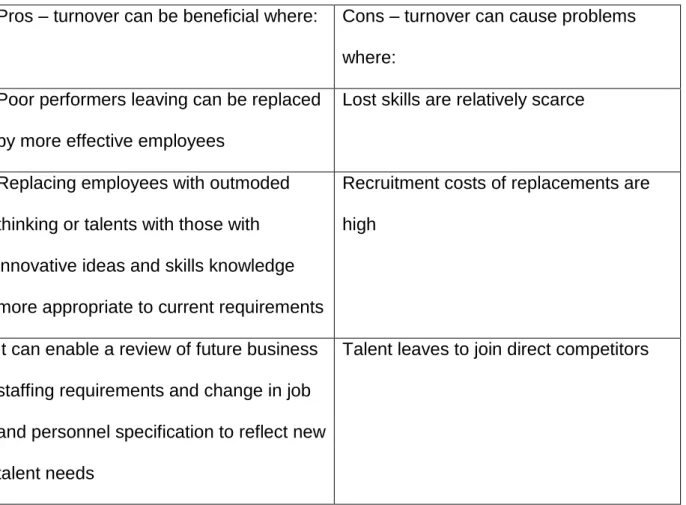
CIPD states that there are pros and cons employee turnover. These are set out in table 1.1
Table 1.1. The pros and cons of employee turnover
Pros – turnover can be beneficial where: Cons – turnover can cause problems where:
Poor performers leaving can be replaced by more effective employees
Lost skills are relatively scarce
Replacing employees with outmoded thinking or talents with those with innovative ideas and skills knowledge more appropriate to current requirements
Recruitment costs of replacements are high
It can enable a review of future business staffing requirements and change in job and personnel specification to reflect new talent needs
Talent leaves to join direct competitors
vital information that will help them to develop, target and deliver interventions that improve retention rates.
The author believes that by analysing both the push and pull factors it may be helpful to respond to some of the pull factors if it is feasible to do so. It is also essential to ensure that employees feel valued within the organisation. The author has already covered developing talent so will focus on rewarding talent and to do this the organisation needs to know what motivates the employee. Weiss and Mackay (2009: 125-127) set out six retention strategies
1. Get connected to the people, in particular your direct reports and people on your succession plan. This is the single most important retention strategy 2. Give people learning and growth opportunities
3. Reward and recognise people for making a contribution 4. Provide career certainty for top performers
5. Create variety for top performers 6. Make people feel significant.
The author agrees with some of this list such as getting connected to the people. This is important as employers need to know what motivates their staff. Reward and recognise people for making a contribution is also vital and this does not have to be financial reward. It may be a mention in the staff newsletter or an e mail saying well done. The author does not agree with providing career certainty for top performers as this may demotivate someone as they think they will have a job anyway. 2.6 Succession planning:
may be ready to do the job, short term successors, or seen as having longer term potential, long term successors.‟
Scullion and Collings (2011) focus on the leadership aspect by describing it as „a deliberate and systematic effort by an organisation to ensure leadership continuity in key positions and encourage individual advancement.‟ It continues to describe succession planning at a basic level as „ensuring an organisation has the right skills, in the right place, at the right time.‟
Pilbeam and Corbridge (2010) imply that succession planning is „inflexible and of failing to acknowledge the changes that are apparent within an organisation.‟ Another disadvantage is that succession planning seems to be about organisational needs and does not recognise that people make career decisions, not organisations. The author feels that whilst succession planning for individuals may be a good idea in some industries it is not ideal in others. A good salesman may not have the traits or skills to lead a team of salesmen so a succession plan of moving up within the organisation may not work. In the voluntary sector the succession planning should be identified for the organisation and not the individuals within it. External factors such as funding may direct succession planning therefore the main aim of the organisation is to connect the succession planning to the corporate strategy or the business plan.
2.7 Conclusion
Although there are many definitions of talent management the research has shown that the interpretation of this term will depend upon the type of organisation. The type of talent strategy will also depend up upon the type of organisation however some similarities are there such as closely aligning the strategy to the corporate or business strategy. The four types of talent strategy will lend itself to the type of organisation or business and it is very important to choose the right approach. If the corporate strategy is to offer fantastic service and high quality products, the talent strategy will be very different to that of an organisation who wants to offer basic products with a view on cost management. From a voluntary sector point of view there is also a difference between an organisation that wants to win funding contracts for being a cheaper provider than others, paying cheaper wages and showing more cost effectiveness than an organisation that values their service delivery higher and pays higher wages to reflect this. The organisation that pays the higher salary will undoubtedly attract employees who have more experience and better talent. Both will be an alignment focused strategy but with very different strategies.
talent they bring in. The problem may come again when funding becomes
Chapter 3 Methodology
3.1 Research strategies:
Saunders (2007) defines research as „something that people undertake in order to find out things in a systematic way, thereby increasing their knowledge.‟ Saunders (2007) also suggests that research has a number of characteristics.
1. Data are collected systematically 2. Data are interpreted systematically
3. There is a clear purpose: to find things out
White B (2002: 21) uses an explanation by Johnson (1994) that states „a focused and systematic enquiry that goes beyond generally available knowledge to acquire specialised and detailed information, providing a basis for analysis and elucidatory comment on the topic of enquiry.‟ Johnson (1994) also highlights four key issues in this definition.
1. Research should be focused, not general
2. Systematic – the approach to a problem should be structured and organised 3. Beyond generally available knowledge
4. A basis for analysis and elucidatory knowledge
3.1.1 Quantitative approach
A quantitative approach is taken when statistics are needed to find out clear
generalizable conclusions.‟ Quantitative information can be easily measured by gaining information through questionnaires or surveys.
The author will gain these results through asking a series of questions through a questionnaire with yes or no answers. The questionnaire which was distributed is shown in Appendix 5.
3.1.2 Qualitative approach
Qualitative data as explained by Saunders, Lewis and Thornhill (2007) is „non-numerical data or data that has not been quantified.‟ This cannot be measured easily and consists of ideas and opinions. Qualitative information can be gained through interviews, focus groups and customer feedback. McMillan & Weyers (2010: 124) describe this as „generally explorative in nature; it may be preceded or followed by quantitative investigations.‟ Qualitative research implies a degree of bias,
therefore maintaining objectivity is as important in conducting the research as it is in reporting the findings.
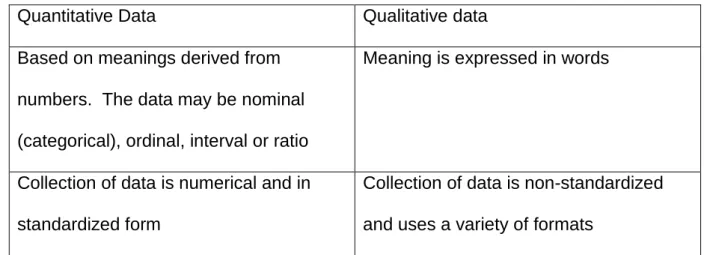
White B (2002) explains the differences between quantitative and qualitative data in the following way:
Table 2: Differences between qualitative and quantitative data.
Quantitative Data Qualitative data
Based on meanings derived from numbers. The data may be nominal (categorical), ordinal, interval or ratio
Meaning is expressed in words
Analysis is by the use of tables, diagrams and statistical methods. The methods used depend on whether the data is nominal (categorical), ordinal, interval or ratio
Analysis is via the use of descriptions and the identification of concepts
The author is using a research strategy known as a pluralist strategy. The author will be using both qualitative and quantitative data; this will gain the best results giving the most comprehensive recommendations. The quantitative data will gain an overall view of talent management within XXX, the author will collect and analyse data on employee feelings towards talent management. The qualitative data will allow the author the chance to find the reasons behind the quantitative data and compare this to the literature within the literature review. This aids triangulation which Saunders, Lewis and Thornhill (2007: 614) describes as „The use of two or more independent sources of data or data collection methods within one study in order to help ensure that the data are telling you what you think you are telling you.‟ The author believes that just getting quantitative data will not be enough within this investigation and as well as the statistical information it is vital to know why
employees felt the way they did. This method of using both qualitative and quantitative methods will hopefully result in the quantitative results confirming the qualitative results.
3.2 Research methods:
Curtis, Jones, Morgan, Norman and Sykes (1994) 73: describe the differences between Primary data and Secondary data as „Published information is called secondary data, whereas information obtained from market sample surveys is termed primary data.
The author will be using primary data, which has been obtained from a questionnaire and an interview. Primary data as explained by Saunders, Lewis and Thornhill (2007) is „data collected specifically for the research project being undertaken.‟ The primary data will be collected through questionnaires sent out via e mail to all
employees of XXXwith a response time of two weeks. Additionally the author will be carrying out an interview with the Chief Executive and North East Regional Manager to gain their thoughts on talent management within XXX. Secondary data will be obtained through data and statistics published by XXX on average length of service at XXX.
The questionnaire will be self administered gaining both qualitative and quantitative data. This is the chosen method because XXXis a national organisation and every employee must be reached to gain the most data possible. E mail is the quickest and most reliable way of ensuring everyone is reached. Limitations to sending out a questionnaire are that respondents may not understand the topic or the questions; this may lead to respondents guessing answers. The author has overcome this by describing the topic in the introduction. Another limitation is that respondents may also discuss the questions or responses with others.
interview are that any misunderstandings can be cleared up straight away and either side can question anything they do not understand. Additionally the interviewer can reword or re-order the questions. The disadvantage of administering an interview is that they are quite time consuming. Travel time to and from the interview may also need to be considered. Additionally the interviewee may want to please the
interviewer and may not tell the truth. The interviewer also needs to ensure their personal views (bias) do not come into it when interview information is being evaluated.
The questionnaire relates to the literature review with regards to the questions it asks which ensures the questions are relevant. The questionnaire will be distributed to over 170 employees of XXXgaining both qualitative and quantitative answers. The questions were tested in two pilots with the Head of Services and the Director of HR. White B (2000: 31) explains „always pilot the final list of questions and topics on a small sample of people. This ensures the questions are clear to understand and helps remove ambiguity.‟ The pilot was given out to ensure that all data being requested was both relevant to the organisation and that it did not affect any other data gathering that was happening at the same time as the questionnaire. The questionnaire is designed to gain the views and statistics of XXXstaff on how their views on how XXXattracts talent, retains it and develops it. It was also designed to ask if they think XXXhas a talent strategy.
1. Researcher is clear about the data required and designs a question 2. Respondent decodes the question in the way the researcher intended 3. Respondent answers the question
4. Researcher decodes the answer in the way the respondent intended
In the introduction the author has described the topic and chosen a topic that surrounds their own development which should gain their interest and motivation. Questions have been designed to give two responses. The question starts with two possible answers, yes or no which will provide the quantitative data needed for the study, this is known as dichotomous. There is an opportunity for the respondent to explain their answer which will lead to qualitative data analysis.
3.3 Sampling
Fisher C (2007: 190) explains „to send questionnaires to people you need a list of the names and addresses of all the people in the appropriate population. Such a list is called the sampling frame.‟ White B (2000) adds to this by stating „the individuals within the population are called the sampling units.‟
The author has chosen to do the research study on the organisation he works for and therefore has access to all employees‟ e mail addresses; this is done through e mailing internal and external offices. The author will also be sending out reminder e mails as the deadline approaches.
„Probability samples are so constructed that every customer or element has a known probability or chance of selection and the limits of possible error are known in
advance.‟ This includes simple random sampling, systematic sampling, stratified random sampling, cluster sampling and multistage sampling.
„Non-probability samples are based simply on the choice of the selector and may be subject to error in sample selection.‟ These include quota sampling, convenience sampling, self-selection and judgement sampling.
The author will be using self-selection sampling for the questionnaire which comes under non probability sampling. Saunders, Lewis & Thornhill (2007: 233) „self-selection sampling occurs when you allow each individual case, usually individuals, to identify their desire to take part in the research.‟ Employees are divided into Senior Managers, Managers and Project staff. XXXhas over 170 employees; although this questionnaire is focused more for project staff and managers the author must bear in mind that some senior managers have benefited from effective talent management. Each individual employee will be e mailed the questionnaire with a response deadline, the employees will decide if they want to respond or not. Relative costs will be low however the author will have no control over how many people respond.
The author will be using quota sampling to administer the two interviews. Saunders, Lewis & Thornhill (2007: 233) say „quota sampling is entirely non random and is used for interview surveys.‟ The author thought it beneficial to interview two
3.4 Piloting
The questionnaire was piloted on the Director of HR and the Head of Services XXX. It was important to pilot the questionnaire to gain constructive feedback and have the opportunity to refine the questionnaire ensuring respondents understand the
questions and are therefore able to respond accurately. The end result will be a valid questionnaire and the data collected will be reliable. As a result of the pilot the author made adjustments to the structure of the questions and refined some of the actual questions.
When all of the data is collected the author will have both quantitative and qualitative data, this is known as „mixed method research.‟ The reason for this is to gain
statistical information on employees opinions on talent management. The qualitative data will evidence further the reasons for these opinions.
The quantitative data will be presented using a series of tables and graphs, making it easier to understand for the reader. Demographic data will be presented such as region worked in or sex of the responder. Answers to the quantitative data asked in the questionnaire will also be presented which can present ideas that can be
compared.
3.5 Data analysis
Qualitative data will be analysed and summarised in their own key themes.
Quotations will be used from respondents and the key features of the responses will be presented and theories analysed.
3.6 Ethics
There have been ethical issues to consider whilst carrying out this research project. Ethics as stated by McMillan & Weyes (2010: 280) are „The moral principles, rules and standards of conduct that apply to investigations.‟ Needham, Dransfield, Harris & Coles (1995: 23) generalise this by stating „Ethics are moral principles or rules of conduct which are generally accepted by most members of society.‟ The author has ensured all research has been ethical by first of all consulting with XXXHuman Resources and Senior Management team when first deciding the topic of the research project. This had to be accepted at the Senior Management meeting and by the trustees of the organisation. Whilst preparing the questionnaire this also had to be given permission by the Human Resource Department to ensure that the information gained was ethical and within XXX‟s policy. I ensured all respondents were aware the questionnaire was confidential; the purpose was very clear and were aware of how the findings were going to be presented by presenting the topic and reasons for the questionnaire both in an e mail and on the questionnaire itself. All responses were voluntary and via e mail ensuring confidentiality.
3.7 Limitations
There were potential limitations, which may have prevented the study from achieving its aims. As the questionnaire and interview were both voluntary there may have been a small response. This would have made analysing the data very difficult and may affect validity. A large percentage of respondents may have come from a
Chapter 4 Findings and Analysis
4.1 Introduction
The findings and analysis will focus on the primary research conducted through a semi structured interview with the Chief Executive and Regional Manager of XXX, additionally a questionnaire was administered to employees of XXX.
The author asked a series of questions to challenge the views of the authors highlighted in the literature review and gain the views of the employees of XXX on how they attract, retain and develop talent within the organisation. It is also
designed to highlight good practise and factors that may restrain talent from developing within XXXand evaluate the current practises within XXX to attract, develop and retain talent.
Each question listed was asked in both the questionnaire and the semi structured interview. The analysis will focus on quotes from individuals, relevant points and links to the literature review. The full responses and graphs can be viewed in Appendices 6, 7 and 8
4.2 Questionnaire and Semi Structures Interviews – Findings and Analysis
Question 1: Do you think your talents are recognised at XXX?
The author felt it was important to ask how the employees felt about how their own talents were utilised.
Questionnaire response:
states “I get really good feedback for things I have accomplished and I know I am appreciated.”
Interview response:
“My talents are recognised but not utilised. They are recognised through feedback from Senior Managers and Staff.”
Armstrong and Brown (2006) realise the importance of talent management by
describing it as „developing the abilities of the core people on whom the organisation depend.‟
Question 2: Do you think XXXis effective at retaining its own talent?
The author wanted to find out employee opinions on how effective they thought XXXwas with regard to retaining employees.
Questionnaire response:
Most respondents said yes XXXis effective at retaining talent. One response states that “Uneven measures are taken within the region and a situation wherein someone can work for the organisation for 6 years and still be on the bottom pay scale.” Another states “where there is true talent and commitment there are opportunities provided the resources are there to retain them.”
Interview response:
Retaining talent is important as stated by the CIPD when describing the pro‟s and con‟s of employee turnover. The cons are described as the costs of recruitment are high, good skills are lost and talent may leave to join a competitor.
Question 3: Do you think XXXis effective at attracting and developing talent?
The author wanted to gain opinion on how employees felt about how effective XXXwas in attracting and developing talent.
Questionnaire response:
Most employees said yes XXXis effective. Respondents stated “I think some of the projects advertised are interesting and therefore attract people who are ambitious to make their mark.” Alternately “Training is very basic, and not geared towards staff development i.e. No progression from one course to another” was a reason as to say no.
Interview response:
“When we advertise we advertise well.” “Don‟t think we develop talent as well as we could, there is no accredited training, all training is core internal XXXtraining which is not a real motivator for people to progress.
Taylor (2010) heaps importance on developing talent by stating that this will „lead career minded people to start looking for an alternative employer who will provide training.‟
Question 4: Do you think XXX’s staffing structure gives talent the opportunity
to progress their careers?
The response to this question was quite mixed. Responses included “There is not much room for personal improvement but people do appear to leave and go onto bigger and better things.” “Most of the managers have worked their way up.” Interview response:
“It is better now than what it was.” Was the initial response. This was followed with “As a result of listening to staff feedback and the need to change due to funding the opportunity was taken to restructure and introduce Senior Project Workers.”
Question 5: What is currently stopping talented individuals from progressing
within the organisation?
Questionnaire response:
“A fairly flat structure and reduced funding environment” and “Current structures” were two answers that highlighted the structure of the organisation as the main reason that hindered progression.
Interview response:
“We also now have a very flat structure which is hindering talent from developing within the organisation.”
Taylor (2010) suggests a „future orientated approach‟ which suggests looking at “looking at predictable trends and recruiting staff of the quality and numbers it requires for the future.” This highlights the importance of having the right staffing structure and the right opportunities for people to move to.
Questionnaire response:
“Through supervisions and JARS (Joint Annual reviews)” Another stated that “There should be a bonus system related to performance.”
Interview response:
“This is down to the line managers initially and it is their responsibility to notice and celebrate individual and a team‟s talent.”
Question 7: How would you like your talent to be recognised within the
organisation?
Questionnaire response:
“A clear strategy on developing staff ie. Reward strategy, internal recruitment, acting up and secondment opportunities.” “More regular, clear and open communication about what projects are doing/have achieved within a region.”
Interview response:
“He is regularly appreciated by his line manager and gets a lot of job satisfaction.” The interview also stated “The TOM (Tactical Operations Meeting) in which all Senior Managers meet on a weekly basis has a section which highlights good outcomes and good news within the organisation.“
Weiss and Mackay (2009) highlights that employees want to see learning and growth opportunities and are made to feel significant. This shows the importance of
organisations recognising talent and the effect this will have on employees.
Question 8: Has XXX’s training programme helped you develop your talent?
A greater number of people felt XXX‟s training programme and helped them develop their talent. “It is basic with no progression to higher levels.” Another response states “The training that I have been offered is advantageous to me both within the learning elements required for my post and for my professional development.” This seemed to suggest that for front line workers it was good but the training was not designed to progress into management.
Interview response:
“For front line workers it is good, especially for new staff who may not have some of the core skills needed.” Additionally “things could change in the future to identify training needs within certain roles such by undertaking audits on projects and giving out surveys to staff.”
Taylor (2010) highlights the importance in training by stating “Investment in training for employees is essential if you want to encourage them to stay.”
Question 9: During the Joint Annual Review (JAR) process has your talent
been recognised, with help to identify new ways to develop your talents?
Questionnaire response:
“If JAR‟s were done properly they could help a lot but doing them annually doesn‟t seem to work.” The same respondent had mentioned earlier about project audits and stated “As an example if an audit was done on a project and Risk Assessing of clients seemed to be weak this would immediately highlight a training need.”
Both sets off responses state the JAR process was ok if done properly but identified a need for this to be done not just as a once per year process.
Question 10: Do you think we attract the best talent to the organisation during
the recruitment process?
Questionnaire response:
“The public awareness and reputation of XXXwill impact on this, as also will the decision where and how to publicise the need to recruit.” Another respondent states “I don‟t think recruitment advertise widely enough.”
Interview response:
“We attract good talent and this is recognised by the work the employees within XXXdo.” The other interviewee states “he has tried to invest money in the right adverts and tried websites that he felt would attract the best applicants but is still disappointed by the response.”
Sadler (1993) emphasises the importance of good recruiting by saying it ensures the future supply of high level talent.
Question 11: What could we do to attract/recruit more talent to the
organisation?
“Get better known.” “Review terms and conditions” and “develop our learning and development plan” were a few suggestions on this question.
Interview response:
“A modular training programme which would preferable be accredited would be an improvement in staff development and when attracting employees”
Question 12: How could the organisation improve to allow more talent to
progress within the organisation?
Questionnaire response:
“Grow by expansion and diversification.” “Secondment Opportunities” “Get and implement a new and concrete strategic direction, and rebuild the Services team around this. It will instil vigour and energy, something that has waned of late.” Interview response:
“A modular training programme which would preferably be accredited would be an improvement in staff development and when attracting employees. Additionally the use of secondments and acting up roles to allow employees to gain experience would be an improvement.”
Research by Scullion and Corbridge (2010) describes the importance of succession planning as „a deliberate and systematic effort by an organisation to ensure
leadership continuity in key positions and encourage individual advancement.‟
4.3 Conclusion
Chapter 5 Conclusions and Recommendations
5.1 Introduction
This chapter aims to draw conclusions on the current talent strategy of XXXand how effective current employees think this talent strategy is. The author will summarise the research using the data presented within the literature review and comparing it with the data found in the findings and analysis. The author will give a number of recommendations based on research and briefly discuss the limitations of the professional project and future areas of research linked to the topic „talent management.‟
5.2 Conclusion
The primary data gathered suggest that the employees at XXXthink that their talents are recognised and managed using the tools managers are given to do this such as supervisions and joint annual reviews. It was recognised that within the voluntary sector funding is a major issue in managing talent however they believe the system put in place could be better. This complies with the views of Lewis and Heckman 2006 who suggests that talent management takes a systems approach and can be identified in procedures and policies.
5.2.1 Attracting talent
The primary research suggested the main reason XXXattracted talent was based on the culture of the organisation and the actual work done with very hard to reach young people. It also highlighted instances where talent had come to the
organisation from a rival organisation which shows that we can attract talent. This corresponds with the views of Tansley et al (2007) who identify the main factors of attracting talent as being the industry image, organisation image and the extent to which employees identify with the organisation values. The respondents put a lot of focus on our low profile, where and how we advertise posts, salary and incentives, this corresponds with Taylor (2010) who suggests that in a tight labour market more focus is put on these areas.
The quantitative data shows that 76% of the respondents had been at the organisation either for up to two years or over seven years showing that the
respondents were either new to the organisation or had passed the stage where they had „learnt their trade‟ and looking to move on.
5.2.2 Developing talent
The primary research suggested that although XXXwere good at developing talent it was quite isolated to new staff and those in Project Worker positions and helping them carry out their role. There is very little to help someone gain management skills or the skills to move across to another part of the organisation. The current structure of the organisation is also stopping people from developing as there is very little opportunity for developing, although many of the current managers have
have moved up reflects the theory by Morton (2004) who defines talent as those who can make a significant difference to the current and future performance of the
company. The questionnaire results suggest that the biggest hindrance towards staff developing was the staff structure.
5.2.3 Retaining talent
This topic is linked in to developing talent but how the organisation needs to retain the talent it has developed. As has been highlighted already the staff structure is a major barrier to this as if there is a lack of opportunity then it will be difficult to keep an employee who has reached their peak. The primary research suggests that some employees feel undervalued and low wages and high work load are factors in staff leaving. The secondary research however shows that when benchmarking against other similar sized organisations XXX‟s salaries are similar if not greater than other similar organisations. Funding has also been recognised as a major reason for losing talented staff. Pilbeam and Corbridge (2010) agree with these reasons as stated when talking about „push‟ factors and the less desirable reasons people are leaving such as limited potential for progression and heavy workloads.
5.2.4 Succession planning
systematic effort by the organisation to ensure leadership continuity in key positions and encourage individual advancement.‟
5.3 Recommendations
Lewis and Heckman (2006) describe talent management as a collection of human resource practises including recruiting, selection, development and career and succession planning. The author is going to focus on four practises that fit this theory, attracting talent, developing talent, retaining talent and succession planning. Using the primary research and theories and expertise in the literature review the author will make recommendations in each of these areas.
5.3.1 Attracting talent
XXXis the largest homelessness charity in the UK yet the profile of the organisation is relatively small compared to its competitors both regionally and nationally. This needs to be raised both on a national basis and a regional basis to show case the work being done and how the values and ethos of the organisation are helping us do this. Tansley et al (2007) describe the three main factors of attracting talent as being the image of the organisation, the workplace and how much employees identify with the organisation‟s values.
new projects/funding and recruiting local ambassadors who would also talk to local relevant audiences. An example of how this role could attract talent would be when we are looking to recruit for a new project. A press release would go out to tell the region about this new project, the impact it will make and how it fits with XXX values. This will create a buzz around the position and the organisation. Good talented individuals will then be looking out for an advert and already know about the organisation image and the values of the organisation.
5.3.2 Developing talent
XXXcurrently has a training programme offering core training, which is relevant to the work we do but it is not accredited. The author is recommending developing a training programme that is linked to the strategic aims of the organisation and follows an accreditation route that can be continued over a number of years. Taylor (2010) argues that investment in training for employees is essential if you want to
encourage them to stay. Recognised accredited training with opportunities to move to a higher level would encourage employees to stay on longer and use the skills they have learnt within the workplace. As an example a large proportion of the employees within the organisation are project workers within supported
Management programmes can be accessed on completion of initial qualifications and as a direct result of employees regularly achieving targets set in their year plans.
5.3.3 Retaining Talent
XXXhave currently have some means of communicating with employees such as an annual conference and by releasing minutes of the Tactical Operations Meeting in which a section is dedicated to successes. The author is recommending a better way of celebrating the successes of projects and individual staff. Weiss and Mackay (2009) highlight in their retention strategy that organisations should make people feel significant. One way of doing this could be through a staff newsletter which
highlights projects that are being successful and individuals who have achieved something great for a young person. The newsletter would have a focus on sharing good practise, sharing success and a focus on one particular project each month.
5.3.4 Succession Planning
Many people have talents beyond their employment role and feel frustrated that they cannot show this off. In these particularly hard times for voluntary organisations the author is recommending XXXuses forums such as an annual away day to find the various talents employees have and uses them to the advantaged of the
used, thus empowering the employee. It would also enable employees to gain experience in other departments of the organisation and open up future progression routes.
5.4 Implementing Change
The author sees XXXbest fits „Morgans‟ organisational metaphor of the „machine‟ It is designed and structured to meet the organisational goals and expectations of the young people we work with. Lewin‟s 3 step model of change best fits the „machine‟ organisation therefore the author would recommend using this method of change. 1. Unfreeze would involve defining the current state and highlighting restraining
forces. It will also look at the desired end state
2. Move would involve the employees into why the change is happening and the positive impact this will have on the organisation.
3. Refreeze would involve making the change, setting new policy and rewarding success.
5.5 Limitations of the study