Sharif University of Technology
Scientia IranicaTransactions A: Civil Engineering www.scientiairanica.com
Research Note
Progressive collapse of framed structures: Suggestions
for robustness assessment
H.R. Tavakoli
a;and F. Kiakojouri
ba. Department of Earthquake Engineering, Babol University of Technology, Babol, P.O. Box 484, Iran. b. Department of Structural Engineering, Islamic Azad University, Takestan Branch, Iran.
Received 14 January 2013; received in revised form 6 July 2013; accepted 7 September 2013
KEYWORDS Progressive collapse; Robustness;
Column loss;
Alternative load path; Dynamic nonlinear analysis.
Abstract. The term \progressive collapse" has been used to describe the spread of local failure in a manner analogous to a chain reaction that leads to partial or total collapse of a structure. Robustness is dened as a fundamental property of structural systems to prevent damage propagation and to mitigate the potential of progressive collapse. In this paper, the progressive collapse capacity of steel moment-resisting frames was rst investigated using the alternative load path method, then suggestions are made for assessment of structural robustness, and the robustness of frames is quantied. According to the results, the robustness and progressive collapse potential of the frames varied signicantly, depending on the location of the initial local failure and number of building stories.
c
2014 Sharif University of Technology. All rights reserved.
1. Introduction
The term \progressive collapse" has been used to describe the spread of an initial local failure in a manner analogous to a chain reaction that leads to partial or total collapse of a building. The underlying characteristic of progressive collapse is that the nal state of failure is disproportionately greater than the initial failure [1]. Progressive collapse rst attracted the attention of researchers from the partial failure of Ronan Point, a 22-story apartment in London, UK, in 1968. After the event of 11th September, 2001, more researchers around the world have refocused on the causes of progressive collapse. After such a disaster, concepts of progressive collapse and structural robustness have been reected in new guidelines and codes [2,3]. Robustness is the ability of a structure to resist damage without premature or brittle failure, due to events like impact, blast, re or consequences
*. Corresponding author. Tel.: 0111-3231707, 0911-1214285 E-mail addresses: [email protected] (H.R. Tavakoli); [email protected] (F. Kiakojouri)
of human error, because of its vigorous strength and toughness [2]. According to this denition, robustness is a structural property, dened as the insensitivity of a structure to local failure. Parameters such as ductility, redundancy, continuity and energy absorption have an inuence on progressive collapse resistance and are listed as factors that inuence the robustness of structures [4].
Among dierent approaches to analyzing and designing buildings against progressive collapse, the guidelines recommend the alternative load path method. In this method, the building is analyzed and designed, such that, if one structural element fails, alternative paths are available for the loads and, therefore, collapse does not occur. The alternative load path method is a threat-independent methodology. This method does not consider the type of triggering event, but, rather, considers the structural response after the initial local failure.
Most of the published progressive collapse analy-ses are based on the alternative load path method with sudden column removal, as recommended in previously mentioned guidelines [2,3]. In most of the published
numerical studies of progressive collapse, commercial and open source nonlinear FEA packages are used, such as Abaqus [5-7], SAP2000 [8-10] and Opensees [11-13]. Most considerations are conned to 2D frames using a beam element. Detailed 3D numerical studies using a shell element are rare, due to the required computational time and the poor pre-processing ability of most general purpose FEA packages. An example of complete 3D nite element modeling by Ls-Dyna is provided in [14]. As mentioned above, all these papers are based on numerical study, but, in recent years, some parametric [15,16] or experimental [17-19] studies also have been presented in the literature.
The potential abnormal loads that can trigger progressive collapse are categorized as: aircraft impact, design error, construction error, re, gas explosions, accidental overload, hazardous materials, vehicular collision, and bomb explosions, etc. [1]. As mentioned before, most of the published papers use a threat-independent methodology, but, in recent years, more research has been focused on progressive collapse due to certain triggering events, such as re-induced progres-sive collapse [20-22], seismic progresprogres-sive collapse [23-25], blast-induced progressive collapse [7,26,27] and impact-induced progressive collapse [28,29].
To date, there is no uniform theory of robustness assessment. A large variety of dierent approaches for quantication of structural robustness has been suggested. These approaches include both determin-istically dened and probabildetermin-istically dened. Most of them are based on assuming damage and either comparing the property of damaged and undamaged structures [30,31] or examining the response of a struc-ture after initial local failure [32]. An exception to the mentioned approaches is presented in [33]. Starossek classied these approaches into three basic categories: Stiness-based, damage-based and energy-based mea-sures of robustness, and compared the applicability of these approaches to dierent structures and dierent types of progressive collapse [4].
In this paper, the progressive collapse capacity of steel moment resisting frames is rst investigated using the alternate load path method. The structural responses of models under sudden loss of columns under dierent scenarios of column removal were studied. Since progressive collapse is inherently a nonlinear and dynamic event, nonlinear dynamic analysis is more desirable when investigating progressive collapse potential and the collapse mechanism of frames. Ac-cordingly, in this study, the nonlinear dynamic method was used for progressive collapse analysis. The linear dynamic analysis method was used for comparison. Then, suggestions are made for assessment of the robustness of steel frames. Using these approaches, structural robustness is quantied, and the results are compared and contrasted.
2. Finite element model
In this study nite element analysis is performed using the general purpose nite element package, Abaqus/Explicit, version 6.10. An explicit method solves dynamic response problems using an explicit direct-integration procedure. In an implicit dynamic analysis, the integration operator matrix must be inverted and a set of nonlinear equilibrium equations must be solved at each time increment. On the other hand, in an explicit dynamic analysis, problems are solved incrementally, and displacements are calculated in terms of quantities that are known at the beginning of an increment. There is no need to form or invert stiness matrices, which means that each increment is relatively inexpensive compared to the increments in an implicit integration. Therefore, the explicit method is very robust and great for highly nonlinear problems and short-term events, such as blast, impact and collapse [34].
2.1. Analytical model
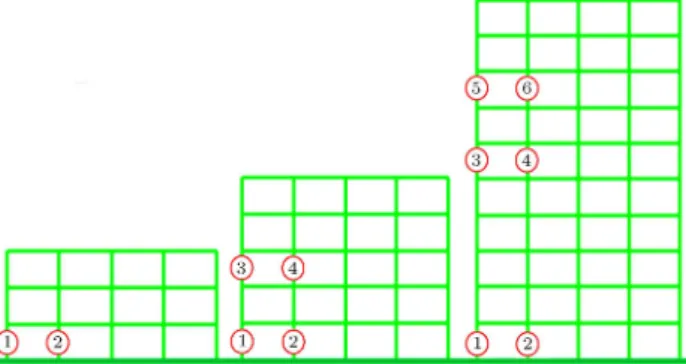
The model structures are the 3, 5, and 10-story steel moment resisting frames, the oor height is 3.2 m and the span length is 5m, as shown in Figure 1. Box and I sections are used for columns and beams, respectively. More input data can be found in [7]. Connections between beams and columns are perfectly rigid, and the bottoms of the rst story columns are xed. In column removal analysis, beam to beam continuity is assumed to be maintained across a removed column, according to [2]. The structures were assumed to be located in a high seismic zone, and the steel moment frames were designed to carry gravity and seismic loads. The seismic design was performed using an equivalent static method, according to the Iranian Building Code [35].
In this study, the beam element in the Abaqus element library was used to model the beams and columns. The selection of the type of element to be used is based on the fact that the study considers the global response of the structures; therefore, beam theory is sucient. All beam elements in Abaqus
Figure 1. Elevation of model structure and column removal cases.
are beam-column elements, and means that they allow axial, bending, and torsional deformation [34]. How-ever, torsion is not applicable to the in-plane behavior of the 2D frames. The beam properties are input by dening the section from the Abaqus cross-section library. At each increment of the analysis, the stress over the cross-section of the elements is numerically integrated to dene the beams response as the analysis proceeds [34]. The inuence of mesh size has been studied, and it is suciently ne to ensure the accuracy of the model structure. The analyses were conducted with 5% mass proportional damping, which is common for analysis of structures subjected to extreme loads [36].
3D and slab eects were not involved in this study. As found by Qian and Li [37], 3D and slab eects are important in progressive collapse analysis, but, in this paper, these eects are ignored. Also, the speed of column removal will aect the dynamic response. Sudden column removal provides a larger structural response than gradual column removal [38,39]. These eects are not considered in this study and columns are removed suddenly.
2.2. Material property
The adopted material properties were: Young's mod-ulus, E = 210 GPa, Poisson coecient, v = 0:3, and density = 7850 kg/m3. The static yield stress was fy = 240 MPa. The plastic property is shown
in Figure 2. Abaqus provides the classical metal plasticity; the elastic part being dened by Young's modulus and Poisson's ratio. The plastic part is dened as the true stress and logarithmic plastic strain. During the analysis, Abaqus calculates the values of yield stress from the current values of plastic strain. It approximates the stress-strain behavior of the material with a series of straight lines joining the given data points to simulate the actual material behavior. The rst piece of data given denes the initial yield stress of the material and, therefore, should have a plastic strain value of zero. In this study, bilinear curves were used. The material will behave as a linear elastic material up to the yield stress of the material. After this stage,
Figure 2. Plastic property.
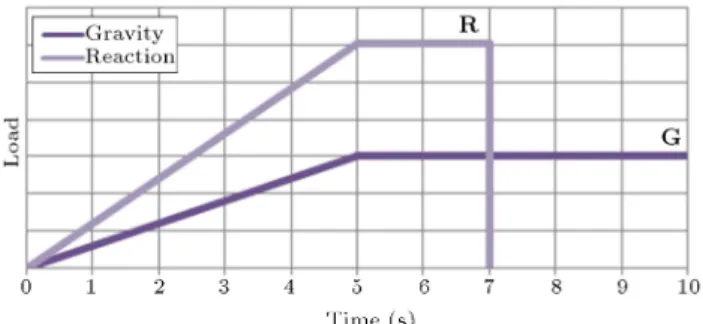
Figure 3. Applied loads for column removal analysis.
it goes into the strain hardening stage until reaching ultimate stress [34].
2.3. Applied loads for dynamic column removal analysis
For nonlinear dynamic analysis, load DL+0.25LL was uniformly applied to the entire span of frame as a vertical load [2]. To carry out dynamic analysis, the axial force acting on a column is determined before its removal. Then, the column is removed and replaced by the concentrated load equivalent of its forces. To simulate the phenomenon of progressive collapse, the member forces are removed after a certain time elapses, as shown in Figure 3, where the variables, R, denote the reaction forces and G is the vertical gravity load. In this paper, the forces were increased linearly for ve seconds until they reached their maximum amounts. Then, they were kept unchanged for two seconds until the structure reached a stable condition, and the concentrated forces were suddenly removed at seven seconds to simulate the dynamic eect caused by the sudden removal of the column [36]. More information about dynamic column removal is presented in [39]. Dierent cases for column removal are presented in Figure 1.
3. Results and discussion
Nonlinear dynamic analysis is performed using the gen-eral purpose nite element package, Abaqus/Explicit, version 6.10. In this paper, the words \displacement" and \response" are used to refer to the \vertical displacement of the column removal point".
The nonlinear analysis method is more sophis-ticated than the linear method in characterizing the response of a structure under extreme loading con-ditions. When this method is used, the codes allow less restrictive acceptance criteria. In this paper, the nonlinear dynamic method was performed for progres-sive collapse analysis, and the linear dynamic analysis method was used for comparison.
3.1. Column removal analysis
Nonlinear dynamic time-history analyses were carried out by removing the selected column, as shown in
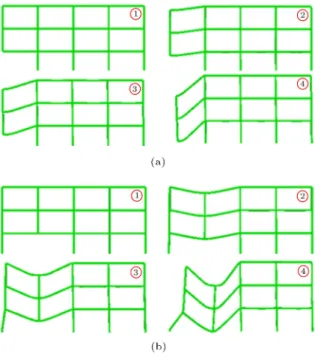
Figure 4. Collapse mode of 3-story frame: a) Corner column is removed; and b) second column is removed.
Figure 1. When the corner column in the rst story of a 3-story structure was suddenly removed, the entire corner of the building collapsed, as shown in Figure 4(a). When the second column in the rst story was suddenly removed, again, collapse occurred (see Figure 4(b)). Collapse modes are drastically dependent on the location of removed columns. This is related to the aected members of the structure after column removal. Figure 5 shows the vertical displacements of the model structures obtained from time-history analyses, when the rst and second columns in the rst story of a 3-story structure were removed.
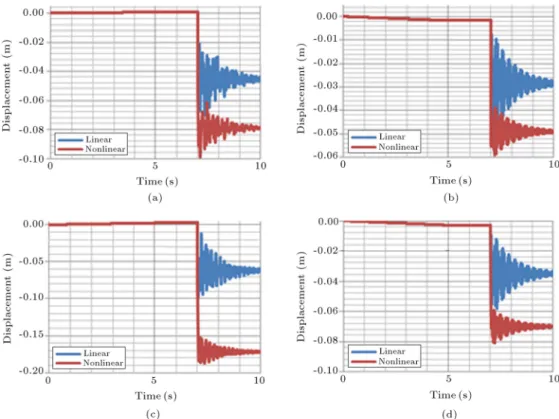
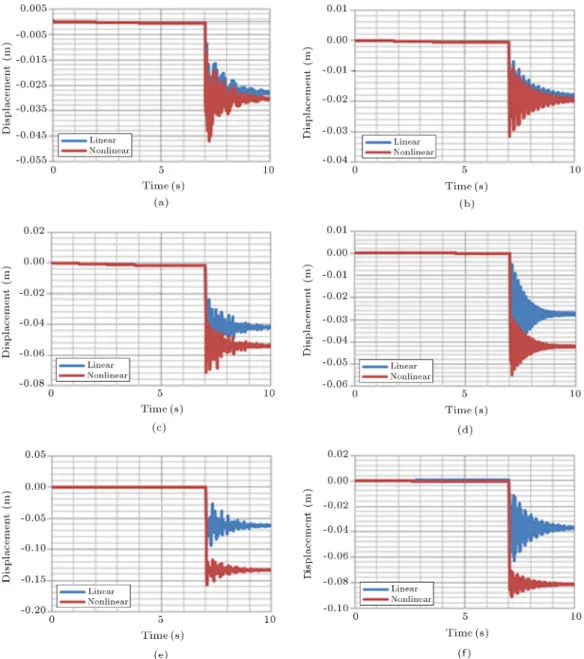
In a 5-story structure, for case 1, when the corner column in the rst story (as shown in Figure 1), was suddenly removed, the node on the top of the removed column vibrated and reached a peak vertical displacement of 98 mm in the nonlinear procedure and 70 mm in the linear procedure. For case 2, when the second column in the rst story was suddenly
removed, the node on the top of the removed column vibrated and reached a peak vertical displacement of 59 mm in the nonlinear procedure and 51 mm in the linear procedure. From the comparison of case 1 and case 2, it can be seen that the building is more vulnerable to the removal of corner columns. The time history of the column removal point vertical displacement for the two mentioned cases is shown in Figure 6(a) and (b), respectively. It is obvious that maximum vertical displacements obtained by linear analysis are meaningfully smaller than those obtained by nonlinear analysis. It also can be observed that, in comparison with the linear analysis results, the results of nonlinear analysis vary signicantly, depending on model parameters such as the location of the removed column and the number of building stories.
When a column at a higher story was removed, the vertical displacement of the column removal point signicantly increased, because less structural members contributed to energy absorption after column removal. In this analysis, when the corner column in the third story of a 5-story structure was suddenly removed (case 3, 5-story structure), the node on the top of the removed column vibrated and reached a peak vertical displacement of 186 mm in the nonlinear procedure and 96mm in the linear procedure. For case 4, when the second column in the third story was suddenly removed, the node on the top of the removed column vibrated and reached a peak vertical displacement of 81mm in the nonlinear procedure and 64 mm in the linear procedure. This conclusion can be obtained for other higher stories; column removal at a higher level will induce larger vertical displacement than column removal in the rst story. This conclusion is consistent with the ndings presented in [6]. Displacements of the column removal point for cases 3 and 4 are shown in Figure 6(c) and (d), respectively.
It was also observed that as the number of stories increases, the displacement of the column removal point decreases, because more structural members participate in resisting collapse and, therefore, more load path is available. In a 10-story structure, for
Figure 6. Displacement time history in a 5-story structure: a) Case 1; b) case 2; c) case 3; and d) case 4.
case 1, when the corner column in the rst story (as shown in Figure 1), were suddenly removed, the node on the top of the removed column vibrated and reached a peak vertical displacement of 47 mm in the nonlinear procedure and 45 mm in the linear procedure. For case 2, when the second column in the rst story was suddenly removed, the node on the top of the removed column vibrated and reached a peak vertical displacement of 32 mm in the nonlinear procedure and 31 mm in the linear procedure. It can be concluded that the progressive collapse potential decreased as the number of stories increased. The ndings obtained are consistent with the ndings presented in [36]. The time histories of the column removal point vertical displace-ment for two displace-mentioned cases are shown in Figure 7(a) and (b), respectively. It is obvious that maximum vertical displacements obtained by linear analysis are smaller than those obtained by nonlinear analysis in all considered cases. But, it was also observed that the dierence in results obtained by the two approaches decreased as the number of stories increased.
The overall results obtained in the previous struc-tures are also true in the case of a 10-story structure. That means that column removal at a higher level will induce larger vertical displacement than column removal in the rst story, and that the building is more vulnerable to the removal of corner columns. It can be concluded that, as long as an alternative load path is available in damaged structures, the above results will be true. The time histories of the column
removal vertical displacement of cases 3-6 are presented in Figure 7(c) to (f).
3.2. Robustness analysis
Robustness indicates the overall performance of the damaged structure after initial local failure. The progressive collapse of the building is more likely to occur for lack of structural robustness. Although the robustness of structures in abnormal events such as explosion and impact has become a worldwide research topic, there has been neither a uniform theory of structural robustness assessment nor a methodology for quantication of robustness in the progressive collapse scenario [4].
The usefulness of the measure of robustness is linked to certain requirements. The measure should quantify the structure's robustness with one single value. It should be possible to derive the measure from the property or response of the structure, and the input data must be quantiable. The measure should be dened in as simple a manner as possible and applicable to any kind of structure, as far as possible [4].
In this section, three simple approaches are pro-posed for robustness assessment, and, using these ap-proaches, structural robustness is quantied and results are compared. A simple measure of robustness from examining the stiness of the structure is presented in Eq. (1):
Rs=KKd
Figure 7. Displacement time history in a 10-story structure: a) Case 1; b) case 2; c) case 3; d) case 4; e) case 5; and f) case 6.
where Rs is the stiness-based measure of robustness
and Kd and Ki are the stiness of the damaged and
intact structure, respectively. In this paper, a simple frequency approach was used for stiness assessment. Since, in the column removal scenario, the mass of the frames do not change considerably, changes in the fre-quency are due to changes in the stiness of the frames. Using Eq. (1), the robustness value is automatically in the range of 0 and 1. In this formulation, the value of 1 represents a complete robust structure, while value 0, represents total lack of robustness.
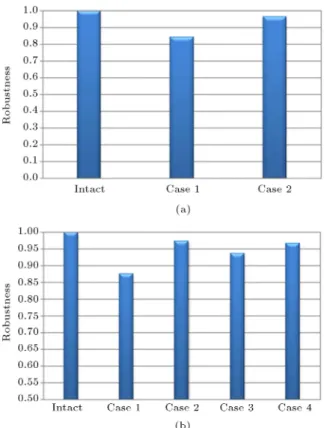
Results show that the robustness value does not change meaningfully when dierent scenarios of column removal are considered. As discussed before, a 3-story structure collapsed in both column removal scenarios. But, as shown in Figure 8(a), the robustness value is
examined very highly using Eq. (1). Furthermore, the most vulnerable case in a 5-story structure is case 3, according to nonlinear dynamic column removal analysis. But, as shown in Figure 8(b), less structural robustness is obtained in case 1. It can be concluded that robustness indexes obtained by Eq. (1) do not correlate well with corresponding column removal sce-narios, and, therefore, this method is not suitable for robustness assessment, at least in the current simple form.
As mentioned before, structural responses tained by linear analysis are smaller than those ob-tained by nonlinear analysis in all considered cases, but, it was also observed that the dierence in results ob-tained by the two approaches decreased as the number of stories increased. Using this idea, another simple
Figure 8. Stiness-based measure of robustness: a) A 3-story structure; and b) a 5-story structure.
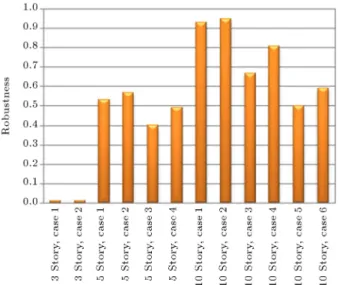
Figure 9. Robustness based on dynamic column removal results.
formulation is proposed for robustness assessment. As shown in Eq. (2), robustness is assumed to be the ratio of maximum structural response in linear dynamic analysis to maximum structural response in nonlinear dynamic analysis:
Rd= max(dmax(dld)
dn); (2)
where Rd is robustness based on dynamic analysis
and dld and dnd are structural responses in linear and
nonlinear dynamic analyses, respectively. As shown in Figure 9, the robustness index obtained by this method does correlate well with the corresponding
column removal scenario. As expected, more struc-tural robustness is obtained in case 2 of the 10-story structure, while less structural robustness is obtained in the 3-story structure.
As a third method for estimating structural ro-bustness, the energy of the structure is considered and robustness is assumed to be the ratio of dierent energies in the column loss scenario, as presented in Eq. (3):
RE = 1 max(Emax(Ep)
I); (3)
where RE is the energy-based assessment of
robust-ness and Ep and EI are plastic dissipation energy
and internal energy in the column removal scenario, respectively. Internal energy was calculated using the following denition:
EI =
Z Z d"
!
dv: (4)
Comparison of the total internal energy history and the total plastic dissipation history is shown in Figure 10 for two dierent cases.
This method focused on the amount of energy that is dissipated in a progressive collapse scenario. The ratio of this energy to total energy is a good index for robustness assessment. As shown in Fig-ure 11, the obtained results for structural robustness
Figure 10. Comparison of the total internal energy history and the total plastic dissipation energy: a) Case 1 of a 5-story structure; and b) case 1 of a 10-story
Figure 11. Robustness based on energy of structure.
are compatible with existing expectations for the pro-gressive collapse potential. More value for robustness is obtained in rst story column removal cases in a 10-story structure. This method is also consistent with the previous method.
It should be noticed that the energy-based ap-proach in its current form is only applicable to the redistribution-class of progressive collapse. When the structure is subjected to pancake-type or domino-type collapse, the rigid motion and impact of the structure's parts or members have a signicant inuence on energy conversion in the collapse scenario. Therefore, kinetic energy should be included in the formulation.
4. Conclusions
In this paper, the progressive collapse capacity of steel moment frames was rst investigated using the alterna-tive load path method. A nonlinear dynamic method was performed for progressive collapse analysis, and the linear dynamic method was used for comparison. Using these methods, the structural response of 3-, 5- and 10-story steel moment resisting frames under the sudden loss of columns for dierent scenarios of column removal was assessed. Then, suggestions were made for assessment of the robustness of steel frames, and structural robustness in dierent column removal scenarios was quantied. It could be concluded that the proposed approaches oer the advantages of com-putational simplicity and practicality for robustness assessment in framed structures.
The results of this study can be summarized as follows:
It was observed that as the number of story in-creases, the displacement of the column removal point decreases, because more structural members participate in resisting progressive collapse.
There-fore, it can be concluded that the progressive col-lapse potential decreased as the number of stories increased.
Potential for progressive collapse is highest when a corner column is suddenly removed, either in the rst, or higher, story.
Column removal at a higher level will induce larger vertical displacement than a column removal in the rst story, because less structural members contributed to energy absorption when a column at a higher level was removed.
It was observed that suciently tall buildings, de-signed according to seismic design specications, have enough strength to resist progressive collapse due to column removal.
It is obvious that maximum vertical displacements obtained by linear analysis are smaller than those obtained by nonlinear analysis in all considered cases. But, it was also observed that the dierence in results obtained by the two approaches decreased as the number of stories increased or the initial local failure location changed.
Three approaches for structural robustness assess-ment were proposed in this paper. It can be concluded the methods based on dynamic column removal analysis have a good capability for robust-ness assessment, especially when the energy of the model is considered, while the methods based on static stiness are not suitable.
The common structures are usually modeled by either the brace or shear wall or moment resisting frame. However, in this study, only the moment frame has been used for studying sudden column loss and, therefore, the results apply only to the steel moment-resisting systems with almost the same height. However, some general conclusions may be applicable to other framed structures. It should be noted that the current methodology, presented in this paper for assessment of structural robustness due to column loss in steel moment resisting frames, can be easily extended to include other steel framed structures.
Any measure of structural robustness should pro-vide a clear distinction between robust and non-robust structures. Therefore, suggested approaches must be normalized or calibrated for each structural system and each progressive collapse type. For this purpose, the structural analysis of more structures and on more collapse scenarios is necessary.
References
1. NIST \Best practices for reducing the potential for progressive collapse in buildings", The U. S. National Institute of Standard and Technology (2007).
2. GSA \Progressive collapse analysis and design guide-lines for new federal oce buildings and major mod-ernization projects", The U.S. General Services Ad-ministration (2003).
3. Unied Facilities Criteria (UFC) \Design of buildings to resist progressive collapse", The U.S. Department of Defense (2009).
4. Starossek, U. \Progressive collapse of structure", Thomastelford, London (2009).
5. Usmani, A.S., Chung, Y.C. and Torero, J.L. \How did the WTC towers collapse: A new theory", Fire Safety Journal, 38(6), pp. 501-533 (2003).
6. Fu, F. \Progressive collapse analysis of high-rise build-ing with 3-D nite element modelbuild-ing method", Journal of Constructional Steel Research, 65(6), pp. 1269-1278 (2009).
7. Tavakoli, H.R. and Kiakojouri, F. \Inuence of sudden column loss on dynamic response of steel moment frames under blast loading", International Journal of Engineering-Transactions B: Applications, 26(2), pp. 197-205 (2013).
8. Marjanishvili, S.M. \Progressive analysis procedure for progressive collapse", Journal of Performance of Constructed Facilities, 18(2), pp. 79-85 (2004). 9. Bae, S.W., LaBoube, R.A., Belarbi, A. and Ayoub
A. \Progressive collapse of cold-formed steel framed structures", Thin-Walled Structures, 46(7), pp. 706-719 (2008).
10. Kim, J. and Lee, Y. \Progressive collapse resisting capacity of tube-type structures", The Structural De-sign of Tall and Special Buildings, 19(7), pp. 761-777 (2010).
11. Kim, T. and Kim, J. \Collapse analysis of steel moment frames with various seismic connections", Journal of Constructional Steel Research, 65(6), pp. 1316-1322 (2009).
12. Kim, H., Kim, J. and An, D.W. \Development of integrated system for progressive collapse analysis of buildings structures considering dynamic eects", Ad-vances in Engineering Software, 40(1), pp. 1-8 (2009). 13. Talaat, M. and Mosalam, K.H. \Modeling progressive collapse in reinforced concrete buildings using direct element removal", Earthquake Engineering and Struc-tural Dynamics, 38(5), pp. 609-634 (2009).
14. Kwasniewski, L. \Nonlinear dynamic simulations of progressive collapse for a multistory building", Engi-neering Structures, 32(5), pp. 1223-1235 (2010). 15. Fu, F. \3-D nonlinear dynamic progressive
col-lapse analysis of multi-storey steel composite frame buildings-parametric study", Engineering Structures, 32(12), pp. 3974-3980 (2010).
16. Yuan, W. and Tan, K.H. \Modeling of progressive collapse of a multi-storey structure using a spring-mass-damper system", Structural Engineering and Me-chanics, 37(1), pp. 79-93 (2011).
17. Brain, I., Sezen, H. and Giriunas, A. \Experimental and analytical assessment on progressive collapse po-tential of two actual steel frame buildings", Structures Congress 2010, Orlando, US, May 12-15 (2010). 18. Demonceau, J.F. and Jaspart, J.P. \Experimental
test simulating a column loss in a composite frame", Advanced Steel Construction, 6(3), pp. 891-913 (2010). 19. Yi, W.J., He, Q.F., Xiao, Y. and Kunnath, S.K. \Experimental study on progressive collapse-resistant behavior of reinforced concrete frame structures", ACI Structural Journal, 105(4), pp. 433-439 (2008). 20. Usmani, A., Student, C.R.P. and Al-Remal, A. \A
very simple method for assessing tall building safety in major res", International Journal of Steel Structures, 9(1), pp. 17-28 (2009).
21. Lange, D., Roben, C. and Usmani, A. \Tall building collapse mechanisms initiated by re: Mechanisms and design methodology", Engineering Structures, 36, pp. 90-103 (2012).
22. Sun, R., Huang, Z. and Burgess, I. W. \Progressive col-lapse analysis of steel structures under re conditions", Engineering Structures, 34, pp. 400-413 (2012). 23. Tavakoli, H. and Kiakojouri, F. \Assessment of
earthquake-induced progressive collapse in steel mo-ment frames", 15th World Conference on Earthquake Engineering, Lisbon, Portugal, September, pp. 24-28 (2012).
24. Parsaeifard, N. and Nateghi-A, F. \The eect of local damage on energy absorption of steel frame buildings during earthquake", International Journal of Engineering-Transactions B: Applications, 26(2), pp. 143-152 (2012).
25. Tavakoli, H.R. and Rashidi Alashti, A. \Evaluation of progressive collapse potential of multi-story moment resisting steel frame buildings under lateral loading", Scientia Iranica-Transactions A: Civil Engineering, 20(1), pp. 77-86 (2013).
26. Almusallam, T. H., Elsanadedy, H. M., Abbas, H., Al-sayed, S.H. and Al-Salloum, Y.A. \Progressive collapse analysis of a RC building subjected to blast loads", Structural Engineering and Mechanics, 36(3), pp. 301-319 (2010).
27. Zhang, X., Duan, Z. and Zhang, C. \Numerical simulation of dynamic response and collapse for steel frame structures subjected to blast load", Transactions of Tianjin University, 14(1), pp. 523-529 (2008). 28. Noldgen, M., Fehling, E., Riedel, W. and Thoma, K.
\Vulnerability and robustness of a security skyscraper subjected to aircraft impact", Computer-Aided Civil and Infrastructure Engineering, 27(5), pp. 358-368 (2012).
29. Horr, A.M. and Sa, M. \Multi-layered energy ab-sorber frames for tall buildings under high-speed impact", The Structural Design of Tall and Special Buildings, 12(5), pp. 423-450 (2003).
30. Lind, N. C. \A measure of vulnerability and damage tolerance", Reliability Engineering and System Safety, 48(1), pp. 1-6 (1995).
31. Maes, M.A., Fritzsons, K.E. and Glowienka, S. \Struc-tural robustness in the light of risk and consequence analysis", Structural engineering international, 16(2), pp. 101-107 (2006).
32. Smith, J.W. \Structural robustness analysis and the fast fracture analogy", Structural Engineering Inter-national, 16(2), pp. 118-123 (2006).
33. Beer, M. and Liebscher, M. \Designing robust structures-a nonlinear simulation based approach", Computers and Structures, 86(10), pp. 1102-1122 (2008).
34. Dassault Systemes \Abaqus analysis user's manual", V6. 10, Dassault Systemes Simulia Corp., Providence, RI 15 (2010).
35. Iranian Building Codes and Standards \Iranian code of practice for seismic resistant design of buildings", Standard No. 2800, 3rd Ed., Building and Housing Research Center (2005).
36. Kim, J. and Kim, T. \Assessment of progressive collapse-resisting capacity of steel moment frames", Journal of Constructional Steel Research, 65(1), pp. 169-179 (2009).
37. Qian, K. and Li, B. \Slab eects on response of reinforced concrete substructures after loss of corner column", ACI Structural Journal, 109(6), pp. 845-856 (2012).
38. Qian, K. and Li, B. \Dynamic performance of RC beam-column substructures under the scenario of the
loss of a corner column-experimental results", Engi-neering Structures, 42, pp. 154-167 (2012).
39. Tavakoli, H.R. and Kiakojouri, F. \Numerical study of progressive collapse in framed structures: A new approach for dynamic column removal", International Journal of Engineering-Transactions A: Basics, 26(7), pp. 685-692 (2013).
Biographies
Hamid Reza Tavakoli was born in 1978, in Nour, Iran. He obtained his MS and PhD degrees in Earth-quake Engineering, in 1996 and 2008, respectively, from IIEES. He is currently Assistant Professor and Dean of the School of Civil Engineering at Babol University of Technology, Iran. His main research interests include explosion/earthquake progressive collapse, per-formance based earthquake engineering, dynamic soil-structure interaction modeling and energy dissipation in composite materials.
Foad Kiakojouri received his MS degree in Structural Engineering from the Islamic Azad University, Iran, in 2012. His main research interests include progressive collapse, blast eect on structures and sandwich struc-tures. Currently, he is working as a civil engineer.