Engaging Undergraduates in Discussions about Ethics in Computing
Brian R. von Konsky Jim Ivins Susan J. Gribble
Curtin University of Technology Department of Computing
Software Engineering Education Research Group GPO Box U1987, PERTH WA Australia
Abstract
oThird-year computing students enrolled in a software engineering subject were introduced to the Australian Computer Society (ACS) Code of Ethics in the context of a computing professional’s obligation to manage quality, safety and reliability. Following an introductory lecture, case study scenarios were interactively discussed during class. Immediately afterwards, students were surveyed to assess their self-perceived and actual ability to apply the ACS Code to another similar scenario. Of the 68 students who gave their informed consent to participate in the study, 34% reported being fully comfortable with applying the ACS Code of Ethics, while 63% were somewhat comfortable. In justifying multiple-choice options for dealing with a new case study scenario, 37% provided a good justification for their choice, 48% provided a poor justification, and 15% provided no justification. A further qualitative analysis of the responses suggests the need for formal assessment of ethics in computing education, and highlights the importance of improving the perceived relevance of ethics to students and the need for in-depth treatment of ethical issues.
Keywords: Ethics, Teaching and Learning, Engagement
1
Introduction
Information and Communication Technology (ICT) professionals are faced with ethical challenges as society adopts new and increasingly complex tools and technologies. These ethical challenges have the potential to dramatically impact consumers of software products and services, the wider community, and colleagues in the workplace.
Recognizing the importance of the ethical and professional responsibilities of ICT professionals, the Australian Computer Society (ACS) requires professionally accredited undergraduate ICT programs to include content related to ethics and the social implications of ICT (Hart, 2003).
Copyright © 2007, Australian Computer Society, Inc. This paper appeared at the Ninth Australasian Computing Education Conference (ACE2007), Ballarat, Victoria, Australia, January 2007. Conferences in Research in Practice in Information Technology, Vol. 66. Samuel Mann and Simon Eds. Reproduction for academic, not-for profit purposes permitted provided this text is included.
Despite common agreement that it is important to expose undergraduate students to the ethical issues associated with their profession, there is a lack of consensus regarding whether ethics should be taught as a separate subject or within the context of technical ICT subjects (Dudley-Sponaugle and Lidkte, 2002, Martin and Huff, 1997), and whether it is necessary to formally assess learning experiences related to ethics in technical subjects (UWA, HREF).
This paper reflects on some of these issues, reporting on the experience associated with making the transition from not assessing ethical issues, to formally examining them in a third-year software engineering subject.
2
Background
Various approaches for teaching ethics to students of Information Technology (IT), Computer Science (CS), and Software Engineering (SE) have been described in the literature. These include the use of written reflective exercises, team debates, and group discussions conducted in the classroom (Towell and Thompson, 2004). Such learning experiences are often structured around case studies drawn from news stories reported in the popular press (Bowern, 2006), from the professional literature (Kumagai. 2004), from the personal experience of the instructor, or from fictitious scenarios designed to highlight the ethical issues faced by professionals working in large organizations with many stakeholders (Epstein, HREF). Often, these learning experiences are conducted in the context of a Code of Ethics from a relevant professional society.
In Australia, the ACS is the recognised professional society for ICT professionals. All ACS members agree to adhere to a Code of Ethics (ACS, HREFa), which is contained within the Society’s National Regulations (ACS, HREFb). The application of the ACS Code of Ethics to fictitious scenarios was used as the framework for teaching computing ethics as reported in this paper. Other professional societies such as the Association for Computing Machinery (ACM) and the British Computer Society (BCS) have their own ethics codes. However, these codes all share common attributes of professionalism, honesty, and social responsibility (Burmeister, 2000). Consequently, the results reported in this paper should still be applicable outside of Australia. The ACS Code of Ethics identifies guiding ethical principals related to competency, honesty and professional development. It further requires ACS
members to consider the impact of their work on society and the profession they represent, and to “… act with professional responsibility and integrity in… dealings with the community and clients, employers, employees and students” (ACS, HREFa).
In particular, an ethical framework is set out in six categories that embody the Society’s core values and ideals. These are found in the opening sections of the Code, with further elaboration provided in subsequent clauses. These six categories are listed below for ease of reference (ACS, HREFa)
“… Priorities
I must place the interests of the community above those of personal or sectional interests.”
“… Competence
I must work competently and diligently for my clients and employers.”
“… Honesty
I must be honest in my representations of skills, knowledge, services and products.”
“… Social Implications
I must strive to enhance the quality of life of those affected by my work.”
“… Professional Development
I must enhance my own professional development, and that of my colleagues, employees and
students.”
“… Information Technology Profession I must enhance the integrity of the information technology profession and the respect of its members for each other.”
2.1
Applying the ACS Code of Ethics
Burmeister (2000) wrote a seminal article in which the ACS Code of Ethics was applied to various case study scenarios. The scenarios involved issues related to intellectual property, privacy, confidentially, quality in professional work, fairness and discrimination, liability for unreliability, software risks, conflicts of interest, and unauthorised access to data. For each scenario, the article discussed the how the Code of Ethics can be applied and suggested other sources for further reading.
More recently, the ACS Code of Ethics Project has provided many new and interesting scenarios, cross referenced with the relevant categories of the Society’s core values and ideals, and with the relevant clauses of the Code, all presented in a convenient tabular format (ACS, HREFc). Additionally, ethical cases studies drawn from the popular press have appeared in Information Age, a publication of the ACS (Bowern, 2006).
2.2
Engagement
Recently, it has been suggested that the extent to which students engage with learning experiences should be considered when evaluating the effectiveness and quality of teaching and learning activities (Coates, 2005). In the context of the present study, this suggests that students
who are not engaged during class discussions of case studies framed in the context of an ethical code of practice may not be in a position to constructively comment on their ability to apply that code.
This may be particularly important in learning experiences conducted in large classroom environments. However, this does not need to be the case. For example, student-student and student-instructor interaction have been shown to be effective pedagogical approaches to teaching and learning, where students learn through engagement in a shared learning experience, even in large lecture environments (Mazur, 1997).
3
Methodology
The study reported in this paper was conducted in a third-year software engineering subject that is a core requirement for students undertaking the Bachelor of Engineering (Software Engineering), Bachelor of Science (Computer Science) and Bachelor of Science (Information Technology) degrees at an Australian university. The initial lecture introduced the ACS Code of Ethics from the standpoint of managing software quality and safety, and included interactive case study discussions. Subsequent topics of a more technical nature included quality management standards, verification and validation, and requirements analysis using formal methods and graphical modelling languages. All topics were presented in the context of managing project quality and safety.
During the initial lecture, application of the ACS Code of Ethics was interactively discussed using scenarios originally posed by Burmeister (2000). The instructor moderating the case study discussion attempted to create an engaging and collegial environment to encourage students to participate in the discussion, and was careful to keep the dialogue focussed on ethical issues rather than technical aspects of the case studies (Sanders, 2005). The ability of students to independently apply the ACS Code of Ethics to a new scenario was evaluated using a short survey and feedback form. Students completed the survey and feedback form at the end of the two-hour lecture and interactive group discussion. Using the survey and feedback instrument, the ability of students to apply the Code was compared to self–perceptions regarding their ability to do so.
The Burmeister article was required reading. Students were instructed to use it to guide further reflection and self-study in preparation for a mid-semester test, which formally assessed their ability to apply the Code.
Additionally, students were asked to reconstruct the intended Learning Outcomes for the entire third-year subject during a practical session held late in the semester. The purpose of this exercise was to evaluate the extent to which students considered ethics to be a formal part of the subject, or merely an add-on to the technical content.
This study was conducted with the approval of the Human Research Ethics Committee at the authors’ institution.
4
Results
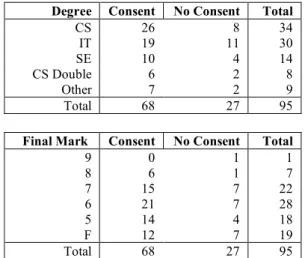
Of the 95 students enrolled in the subject, a total of 68 students or 71% of the class gave their informed consent to participate in the study. A further breakdown by degree and final mark is given in Table 1.
Degree Consent No Consent Total
CS 26 8 34 IT 19 11 30 SE 10 4 14 CS Double 6 2 8 Other 7 2 9 Total 68 27 95
Final Mark Consent No Consent Total
9 0 1 1 8 6 1 7 7 15 7 22 6 21 7 28 5 14 4 18 F 12 7 19 Total 68 27 95
Table 1. Breakdown of the cohort by degree program (top) and final mark (bottom) for consenting and
non-consenting students.
A Chi-squared test of association showed that the consenting and non-consenting groups were statistically similar with respect to degree program (X2=1.62, d.f.=4,
p>0.05) and final mark (X2=4.49, d.f.=5, p>0.05). The
high percentage of students agreeing to participate in the study, together with the statistical similarity between the consenting and non-consenting groups, suggested that the consenting group was representative of the class as a whole. All further data presented in this paper were obtained only from students giving their informed consent to participate.
4.1
Ethical Scenario 1 (Formative Task)
Immediately following an initial lecture on the ACS Code of Ethics and the subsequent interactive discussion of relevant case studies (Burmeister, 2000), students were asked to complete a feedback form which requested identifying information and included the following text:
This is not a test. There is no “right” answer. Completing this part of the form will not impact your mark in this unit.
I feel that I can apply the ACS code of ethics as a result of participating in this lecture.
(Circle One): Yes No Somewhat
Most students believed that they were able to do this with at least some degree of confidence, with 34% responding “yes”, 63% responding “somewhat”, 1% responding “no”, and 1% providing no answer.
The feedback form also presented students with the following hypothetical scenario and choices for potential courses of action.
You studied Java during your undergraduate course. You are now a graduate, who was recently hired by a company that traditionally used Java. However, the company has decided to switch to a different OO programming language on a new project to which you’ve been assigned. You’ve never used the new language. The project has a very aggressive schedule and a tight budget. You want to make a good impression on your new boss and colleagues. In light of the ACS Code of Ethics do you
(circle one)
a) Ask to be shifted to another project that uses Java
b) Read up on the language but don’t tell anyone about your lack of experience
c) Discuss it with the boss and ask for additional training
d) Send an anonymous message to the client warning them of the lack of experience on the part of some members of the company
e) Do the best you can and hope no one notices that you don’t know the new language f) Other (specify)_________________________ Write one or two sentences that explain your answer. It was expected that students would justify the selected response by making an ethical argument positively impacting one or more stakeholders in one or more of the six categories from the ASC Code of Ethics. Less than five minutes were allocated to complete the form, so students were only asked to provide brief explanations. A reasonable justification for selecting choice a) would be to avoid misrepresenting skills and technical abilities in a manner that would potentially have a negative impact on project outcomes and on colleagues, employers, shareholders, and clients.
Alternatively, a reasonable justification for selecting choice c) would be the ethical responsibility of an ICT professional to remain current in ones discipline through professional development, with the effect of being able to serve the expectations of ones employer by learning the new language, leading to other positive outcomes for the client.
As shown in Table 2, almost 80% of the students selected “c) Discuss it with the boss and ask for additional training” in response to the given scenario, while 6% selected “a) ask to be shifted to a different project that uses Java”. 12% proposed an alternative answer, but many of these were a combination of choices a) and c).
Choice N % a) 4 6 b) 1 1.5 c) 53 78 d) 0 0 e) 1 1.5 f) 8 12 No response 1 1.5
As explained below, with respect to the one or two sentences that students were asked to provide to explain their answer, 37% provided a good justification, 48% provided a poor justification, and 15% provided no justification.
The justifications were deemed to be good if they considered ethical issues associated with one or more stakeholders and/or one or more of the six ACS Code of Ethics categories. For example, one student who selected choice c) wrote: “You have an ethical obligation to notify your employer of your shortcomings, or lack of experience.” In this answer, the student acknowledged the role of the employer as a significant stakeholder and was attempting to be honest about skills and abilities.
Another student wrote: “It will allow the boss to realise that I am honest, willing to learn and hardworking. Of course also, willing to constantly upgrade myself.” This student not only acknowledged an employee’s responsibility to the boss, but also one’s personal responsibility to undertake further training and professional development. A third student provided similar justification, but acknowledged a wider range of stakeholders, writing: “I would have to act responsibly and let my boss know of my situation. It would be in the best interests of myself, the company and indirectly the end-consumer.”
Another student considered choice a) but ultimately picked c), writing: “You could ask to be moved to a project which uses Java, but then you will never be able to gain the additional skills and knowledge.” This brief statement suggests that the student considered the acceptable alternatives in light of the Code, but ultimately selected one alternative over another to have the best positive career outcome. Another student apparently agreed with this assessment, writing “I would discuss it with my boss instead of asking to be shifted. This is because while a) is also ethical, I still have to act professionally.” Both students appear to be referring to an ICT professional’s responsibility to undertake professional development as outlined in the Code. Poor explanations generally did not consider ethical issues impacting stakeholders, and did not consider any of the categories from the ACS Code of Ethics. Instead, these explanations tended to be based on technical justifications. For example, one student who selected choice c) justified this by writing “Moving from one OO language to another is usually not significant as long as you understand the fundamental concepts”. Another wrote: “The design of the software should be such that his inexperience won’t impact the final product.”
While most students believed that they could apply the ACS Code of Ethics to some extent following the lecture and subsequent group discussion, over half of the students provided a poor justification, or no justification for their choice of response.
4.2
Ethical Scenario 2 (Assessment Task)
To determine if further private study would improve the ability of students to apply the ACS Code of Ethics, copies of the paper by Burmeister (2000) were distributed to students as required reading. In particular, students were advised to use the paper in preparation for the Mid-Semester Test, which posed the following scenario:
“You are the Chief Technical Officer for a company that has been awarded the contract for a software-based system to automate pumping stations in a new waste treatment network to be implemented in Western Australia. At the onset, you were confident that your firm had the necessary expertise to undertake the project. Mid-way through the project, the Board of Directors agreed to a change in requirements involving a new technology to facilitate telecommunication between the pumping stations. Your firm has limited experience with telecommunications systems, a fact that was not disclosed when the client introduced the change in requirements. You are concerned that the change will have a significant impact on the quality of the delivered system that could potentially result in the spillage of untreated waste into the Swan River. The budget is tight and there are severe contractual penalties for delivering the system late. Stage 1 of the system has already been implemented, but has not yet been tested in the field. The company directors and relevant government ministers are unaware of your concerns. You have a responsibility to serve the interests of all stakeholders, including your shareholders, colleagues, and the citizens of Western Australia.” “Apply the ACS Code of Ethics, describing potential actions that could be taken in light of the Code and considering the interests of the various stakeholders.”
In answering this test question, students were expected to write a short essay describing their preferred outcome, providing greater detail than in the previous exercise. As before, it was expected that solutions to the test question would discuss the impact on stakeholders in light of relevant categories from the Code, in a manner similar to that demonstrated by Burmeister (2000). However, students were not required to memorize the ACS Code of Ethics, or expected to cite specific clauses in formulating their response to the question.
In addition to considering many of the same types of issues discussed in the previous scenario, it was expected that the social implications of a sewage spill and the reputation of the ICT industry would be considered in formulating an appropriate answer.
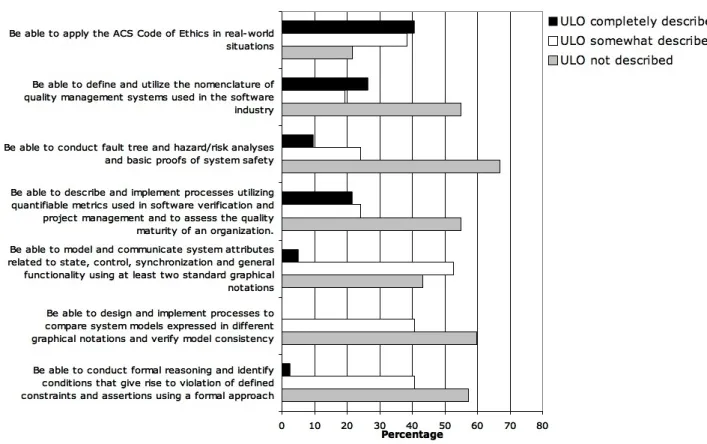
Figure 1. The extent to which students were able to list and describe each Unit Learning Outcome (ULO) in their own words.
In response to the test question, one student wrote the following:
“The ACS Code of Ethics says we should not put our own advancement ahead of the S.E. community or the community at large. If no action is taken the company is putting their own immediate financial gain ahead of the societal consequences, i.e. pollution.”
“The code says we shall not behave in a manner which will bring the SE community/profession into disrepute. Now, if the system were to fail due [to] the engineers’ lack of core knowledge then the industry would indeed be brought into disrepute.”
“The engineers have an ethical obligation to disclose all relevant information to their clients. If the inexperience and potential danger is not disclosed, this is a direct contradiction of the code.”
“My suggested action is to inform the client of the potential risk of failure… Inform them that due to the requirements change a contract variation is needed in order to deliver a system which best and fully meets the needs of the client and the community….”
Another student suggested three potential actions. However, in the subsequent discussion these were largely analysed from a business perspective based on the financial implications, rather than from an ethical standpoint. The student wrote:
“Potential action 1: Inform [the] Board of Directors of your lack of experience in this area, outlining the risks and effects on budget and schedule, and let them decide whether to continue.”
“Potential action 2: Pull out of the project, citing lack of experience in this field.”
“Potential action 3: Hire subcontractors with experience in this field, and cut expenses and time from other aspects of the project.”
While hiring sub-contractors was an interesting suggestion, the subsequent analysis did not discuss this or the other alternatives in any detail. Neither did the analysis discuss the alternatives in the context of the ACS Code of Ethics. Instead, the essay analysed potential actions in terms of the financial ramifications. Additionally, the student failed to take a stand or recommend a specific action from the three nominated possibilities.
Marks were awarded for identifying the appropriate stakeholders and discussing ethical outcomes affecting them in light of the ACS Code of Ethics. The average mark for this test question was 5 out of 9 marks, with a standard deviation of 3. While some students did an excellent job of analysing the test scenario in the context of the ACS Code of Ethics, many students took a technical or financial approach to the analysis, making minimal reference to the Code or its various categories. This was despite the view expressed in the earlier feedback instrument, that students were either fully or
somewhat confident with conducting a case study analysis in the context of the Code.
During the 11th week of instruction in a 12 week teaching semester, students were asked to list each Unit Learning Outcome (ULO) for the subject in their own words, based on the various learning experiences in which they participated, and without referring to the official list of ULOs provided to students at the beginning of the semester. Responses were analysed to determine if each of the seven outcomes was completely, partially, or not described by each student. Results are shown in Figure 1, with those ULOs generally addressed early in the semester shown towards the top, and ULOs generally addressed later in the semester shown towards the bottom.
41% of the students were able to describe the Unit Learning Outcome: “Be able to apply the ACS Code of Ethics in real-world situations”. A further 38% were able to describe it somewhat, writing a ULO statement that said something about ICT ethics, but not necessarily about the ACS Code of Ethics or their ability to apply it. 21% of the students did not describe this ULO at all. This suggests that most students recognised knowledge of ICT ethics to be an outcome of their participation in the subject, alongside the technical content.
Students generally did a better job of articulating the Learning Outcomes associated with ethics and other material presented early in the semester. In contrast, they had greater difficulty describing the more technical Learning Outcomes that were presented later in the semester. While this may be due to the fact that students had already prepared and undertaken formal assessment (i.e. the mid-semester test) for the earlier material, it is generally consistent with the earlier view regarding the level of comfort students associated with applying the Code to various scenarios.
5
Discussion
During previous semesters, the Burmeister (2000) case studies have been discussed during the first lecture of the subject described in this paper. Prior to 2006, however, this material was not formally assessed (von Konsky et al., 2006). Indeed, others have suggested that assessing attainment of ethics learning outcomes is not always necessary (UWA, HREF):
“For example, a discussion about ethical issues may be purposely raised in a tutorial or laboratory session, but there may be no attempt to formally assess whether or not students have achieved the outcome 'appraisal of ethical issues related to the subject matter'. The discussion itself may serve the important purpose of raising pertinent questions for ongoing reflection and consideration.”
However, this study has shown that student opinions regarding the attainment of ethics learning outcomes do not always reflect a student’s ability to apply a Code of Ethics in practice. By itself, the experience reported here suggests that these subjective opinions should not be
taken to demonstrate outcome attainment for the purposes of course review or accreditation.
Further, it appears that many students will make so-called “ethical arguments” solely on the basis of technological and financial considerations. If a student has substantial prior experience with technology or commerce, as is often the case, the experience reported here suggests that this will take priority over a guiding Code of Ethics. In other words, while the technical aspects of a scenario are important, these must be guided by an ethical code of practice to assist in making appropriate decisions. Otherwise, the technical predisposition of ICT students may adversely bias the tradeoffs that are sometimes associated with difficult ethical situations.
These findings further suggest the need to expand related learning experiences beyond those described here, in order to find additional ways to make this material more relevant to students. Indeed, in a question regarding how learning could be improved in the subject, a high distinction student wrote the following on the end of semester questionnaire: “Less ethics or more relevant use of them. I realize it is probably a requirement, however in the current form it seems highly impractical and of little use to me.” While it is unclear if other students shared this view, the comment is well founded.
6
Conclusion
While ICT ethics is sometimes taught in a subject dedicated to ethics and the social impact of ICT, it is also frequently taught in situ in the context of other subject material, as is the case here. Indeed, attempts have been made to construct a pedagogical framework that supports teaching ethics throughout the computer science curriculum (Martin and Huff, 1997).
Whether it is better for ICT ethics to be dealt with in a dedicated subject or spread across the curriculum is unclear. What is clear, however, is that teaching ethics in a manner that is conducive to formal assessment, and that is seen to be practical and relevant by students, is vital to ensure that the next generation of ICT professionals is well prepared to face the ethical challenges of a technologically and socially dynamic world.
7
References
ACS (HREFa): ACS Code of Ethics, last accessed 16 October 2006,
http://www.acs.org.au/index.cfm?action=show&conID =coe
ACS (HREFb): ACS National Regulations, last accessed 16 October 2006
https://www.acs.org.au/about_acs/docs/NATREGSvFe b2005.pdf
ACS (HREFc): Case Studies on Ethics, last accessed 16 October 2006,
http://www.acs.org.au/publication/docs/ACS_CaseStud iesFinal.pdf
Bowern, M. (2006): Ethics: part of being a professional, Information Age, June/July 2006, pp 51-52.
Burmeister, O. (2000): Applying the ACS Code of Ethics, Journal of Research and Practice in Information Technology, 32(2): 107-120.
Coates, M. (2005): The value of student engagement for higher education quality assurance, Quality in Higher Education, 11(1): 25-36.
Dudley-Sponaugle, A., and Lidtke, D. (2002): Preparing to teach Ethics in a computer science curriculum, International Symposium on Technology and Society, 2002, ISTAS'02, pp. 121-125.
Epstein, M. (HREF): The Case of the Killer Robot, last accessed 16 October 2006,
http://onlineethics.org/cases/robot/robot.html Hart, B. (2003): Accreditation of Courses at the
Professional Level, Guidelines for Applicants, The Australian Computer Society,
last accessed 16 October 2006,
http://www.acs.org.au/accreditation/accreditationmanu al.doc
Kumagai, J. (2004): The whistle-blower’s dilemma, IEEE Spectrum, 41(4):53-55.
Martin, C.D., and Huff, C.W. (1997): A conceptual and pedagogical framework for teaching ethics and social impact in computer science, 27th Annual Frontiers in Education Conference, 1:479-483.`
Mazur, E. (1997): Peer Instruction: a user’s manual, Sydney, Prentice Hall Series in Educational Innovation, ISBN 0-13-565441-6.
Moskal, B., Miller, K., and Smith King, L.A. (2002): Grading essays in computer ethics: rubrics considered helpful, ACM SIGCSE Bulletin , Proceedings of the 33rd SIGCSE technical symposium on Computer Science Education, SIGCSE '02, 34(1):101-105. Sanders, A.F. (2005): A discussion format for computer
ethics, ACM SIGCSE Bulletin, Proceedings of the 36th SIGCSE technical symposium on Computer Science Education, SIGCSE '05, 37(1): 352-355.
Towell, E., Thompson, J. B. (2004): A further exploration of teaching ethics in the software engineering curriculum, Proceedings of the 17th Conference on
Software Engineering Education and Training ,CSEE&T’04, pp 39-44.
UWA (HREF): Outcomes Based Education and Assessment at UWA, last accessed 16 October 2006, http://www.catl.uwa.edu.au/__data/page/77897/OBE_a nd_Assessment.pdf
von Konsky, B.R., Loh, A., Robey, M., Gribble, S.J., Ivins, J., and Cooper, D. (2006): The Benefit of Information Technology in Managing Outcomes Focused Curriculum Development Across Related Degree Programs, 8th Australasian Computing Education Conference, ACE 2006, Conferences in Research and Practice in Information Technology, D. Tolhurst and S. Mann, Eds., 52:235-242.