© 2016 Siyu Zhao
ABSTRACT
Siyu Zhao: On The Concept of a True Judge and Judging A Good Artwork (Under the direction of Susan Wolf)
LIST OF FIGURES
TABLE OF CONTENTS
LIST OF FIGURES………..……..……..……..……..……..……..……….. iv
INTRODUCTION………..……..……..……..……..……..……..………. 1
HUME’S CONCEPT OF A TRUE JUDGE……..……..……..……..……..……….. 3
THE ISSUE: IRREALISM OF HUME’S CONCEPT OF A TRUE JUDGE………... 5
SOLUTION PART I: AESTHETIC PLEASURE AND HASTY PLEASURE……… 11
SOLUTION PART 2 ...…..……..……..……..……..……..……..……..……..……… 14
CONCLUSION……..……..……..……..……..……..……..……..……..……..……….. 29
Introduction
In Of the Standard of Taste, David Hume gave an account of a true judge and the standard of taste. Hume argued that certain qualities of an object naturally produce certain sentiments in us, through a relationship, which is defined by Peter Railton as a “match”. In particular, beauty evokes pleasant sentiment and deformity evokes pain. But not everyone is able to consistently and correctly feel the pleasure or pain evoked, because many people may not have delicate tastes, or may have defects in their organs etc. Hume then introduced the concept of a true judge, and argued that only a true judge is able to reliably feel the sentiments produced by certain qualities in the object according to the match. That is, by feeling the pleasant sentiment, the true judge is able to judge whether an artwork is good and is able to judge which among several artworks is better.
qualities of an artwork.
In the second part of the solution, I will offer a candidate for one of Hume’s principles. Hume discussed the source of principles but he did not raise a specific principle for the use of a true judge. By providing an actual principle, I will help a true judge to differentiate the aesthetic pleasure he or she feels from the hasty pleasure he or she feels. When a true judge recognizes the specific source of aesthetic pleasure, he will know the amount of the aesthetic pleasure more accurately, and will be better at avoiding the effect of hasty pleasure on aesthetic pleasure. Since a true judge evaluates an artwork based on the amount of aesthetic pleasure he feels, he is then more likely to reach trustworthy judgments.
In my principle, one factor that makes an artwork good is its effective and accurate capturing of objects, or architecture, or scenery --- its capturing of the core qualities that make a thing what it is. The pleasure that is evoked by this factor of an artwork is strictly aesthetic pleasure. A true judge can thus judge whether the artwork is good based on the amount of aesthetic pleasure he or she feels. We will look at examples of a still life painting by a post-war modern artist, photographs of the Angkor Wat, and an Impressionism painting by Monet. Before I explain my principle, I will take a closer look at Hume’s argument.
Hume believed a certain relationship exists between perceptual objects and our sentiments, in the sense that some forms or qualities of perceptual objects will arouse certain feelings in us through our organs. In particular, some forms or qualities of the original object are “calculated to please, and others to displease” (Hume 223). A man with the best taste is then able to perceive all qualities of an object and experience the sentiments those qualities each naturally produce (Hume 223).
Hume later explained the characteristic of a man with the best taste and developed the concept of a true judge. A man with the best taste should be free from prejudice, and should be able to judge how the perceptual object meets the respective purposes of its creator. As Hume asserted, “We must be able to judge how far the means employed are adapted to their respective purposes” (229). A man with the best taste also needs to hone his taste by practicing and comparing different artworks and different degrees of certain qualities in different object. Given these criteria, Hume concluded in Of the Standard of Taste that,
Strong sense, united to delicate sentiment, improved by practice, perfected by comparison, and cleared of all prejudice, can alone entitle critics to this valuable character; and the joint verdict of such [true judges], wherever they are to be found, is the true standard of taste and beauty. (230)
judge.
Railton analyzed Hume’s arguments and defined the relationship between general organs and objects as a match. In a match, the objects are “by the structure of the mind… naturally calculated to give pleasure”, as quoted from Hume’s words by Railton (Railton 67). Just as this line pointed out that certain qualities of an object evoke pleasure, Hume also noted that deformity evokes pain. “A great inferiority of beauty gives pain to a person conversant in the highest excellence of the kind, and is for that reason pronounced a deformity” (Hume 227). Since a true judge can always by himself or along with other true judges recognize the sentiments that are naturally produced by certain qualities of an object, the true judge then is able to recognize the beauty or deformity in an object by feeling a pleasant sentiment or a painful sentiment.
One of the criteria for being a true judge is that one has honed one’s ability of judging by practicing and comparing different qualities of an object and different objects. Hume emphasized that within this process of comparison, a true judge should specifically compare various types of goodness and the degrees of goodness in different artworks. “It is impossible to continue in the practice of contemplating any order of beauty, without being frequently obliged to form comparisons between the several species and degrees of excellence, and estimating their proportion to each other”(Hume 227).
of beauty in mind, a true judge is then able to decide whether an artwork is good and to compare one artwork with another. Hume assumed that in order for a true judge to make trustworthy judgments about an artwork, the judge has to experience pleasure when he or she views (or hears or reads) it.
The Issue: Irrealism of Hume’s Concept of a True Judge
Hume expected a true judge to always judge an artwork to be good whenever he feels pleasure upon viewing it. He also clearly mentioned that the pleasure a true judge perceives is naturally produced by certain qualities in an artwork. But the way Hume used “pleasure” throughout the paper seems to imply a close connection between a true judge’s personal preference and his aesthetic judgments.
First, It is hard to imagine that Hume would allow a true judge to feel the pleasure produced by certain qualities in a good artwork while not liking the artwork. True judges across time seem to have a highly unified taste, which allows them to correctly judge a historically good artwork to be good. Hume discussed the sources of principles as works that “have survived all the caprices of mode and fashion, all the mistakes of ignorance and envy” (220). A true judge may or may not be aware of the principle he uses while evaluating an artwork. But the process of studying and comparing Old Masters’ artworks equips him with the essential knowledge of how certain qualities can produce pleasure.
which endures the test of time in the art world, it is unlikely that Hume would allow a true judge to personally dislike the artwork. If the true judge personally dislikes a historically good artwork, he must have felt certain amounts of pain. “A great inferiority of beauty gives pain to a person conversant in the highest excellence of the kind, and is for that reason pronounced a deformity”(Hume 227). A bad artwork manifests qualities that naturally evoke pain. However, a historically good painting must have few faults that would evoke pain.
Secondly, the fact that Hume praised a unified perfection in various senses also implies that Hume may have assumed too closely connected a relationship between a true judge’s personal preference or taste with his or her judgment of the artwork. Hume praised a situation where “the perfection of the man, and the perfection of the sense or feeling, are found to be united” (Hume, 224). The perfection of sense or feeling is when one experiences every single minute amount of pleasure evoked by certain qualities of artworks.
We have already seen that problems arise when a true judge dislikes a good artwork. Hume’s assumed high expectation of a true judge’s personal preference is especially problematic when a true judge likes an artwork that is not so good or even bad.
please, they cannot be faults…” (Hume 220). A true judge, who is supposed to have the best taste on earth, seems to be the last person Hume could think of to personally like such an artwork.
More fundamentally, Hume’s assumption regarding the connection between a true judge’s personal preference and aesthetic judgments is rooted in his problematic use of “pleasure”. Hume presumed the type of pleasure that is evoked by certain qualities in the painting as the dominant pleasure. He was not aware of other kinds of pleasure a true judge, who is also an ordinary person, may feel upon viewing an artwork.
Throughout the paper, Hume addressed many characteristics and criteria for being a true judge. Almost all of them are related to a true judge’s qualifications as an ultimate judge with the finest taste. But despite his glamor as a true judge, he may also be an ordinary person that has family and friends. It seems reasonable to allow a true judge to personally like a mediocre or even bad artwork, which is made by his or her daughter or close friends.
one learns something from the artwork. It might be the moment when you feel that you are having a rewarding experience, or it might be the moment when your curiosity is fulfilled. I often feel inspired and satisfied to let the photographs in National Geographic Magazines take me on an unexpected journey to places where I have never been. I also enjoy browsing the photography archives of Life Magazine because the pictures vividly capture a side of history that is untold in textbooks.
While we feel the kinds of pleasure mentioned above, we don't always judge the corresponding artwork to be good. We can still rationally judge the artwork of our friends or our children to be mediocre even when we actually like their artworks. A photograph doesn’t need to be good to record historical events, nor does it need to be good to show urban people an unexplored region of the Earth. In reality, feeling pleasure when viewing an artwork doesn't always incline us to judge it to be good. There then seems to be no way Hume’s concept of a true judge can ever characterize a real person, because Hume suggested that a true judge would always judge an artwork to be good if he feels the pleasure produced by certain qualities in the artwork.
designed. As a true judge, he clearly notices his daughter is no Picasso for the next generation. But as a caring father, he cannot help but feel great pleasure to see his daughter’s work.
Is there any way to interpret or revise Hume’s theory so as to provide a realistic model of reliable judges of art? Hume didn't even raise a potential candidate for a true judge, nor is it important for him to find out the identity of true judges. He suggested that it is sufficient to have proved that at least some men would be acknowledged to have better taste than others (Hume 229). So my job in this paper is to solve the irrealisim of the concept of a true judge and allow Hume’s concept of a true judge to be suitable for the real world.
comparing the amount of goodness of different artworks, and repeated examination and contemplation of the artwork as required criteria for a true judge. Hume described a picture in which one fails to assiduously practice. “Where he is not aided by practice, his verdict is attended with confusion and hesitation. Where no comparison has been employed, the most frivolous beauties, such as rather merit the name of defects, are the objects of his admiration” (Hume, 228).
To solve the irrealism of Hume’s concept of a true judge, I will proceed in two steps. In the first part of the solution, I will classify pleasure into what I will call the aesthetic pleasure and hasty pleasure, and I will limit the pleasure in Hume’s concept of a true judge solely to the aesthetic pleasure. In order for a true judge to correctly judge an artwork to be good, he has to accurately measure the amount of aesthetic pleasure he feels. So in the second part of my solution, I will offer my principle, as a candidate for Hume’s principles, so as to help a true judge differentiate aesthetic pleasure from hasty pleasure.
Solution Part I
principles”(224) to specify that a certain rule or pattern by nature produces pleasure. Hume doesn't illustrate which principles he has in mind. We cannot tell if he even has a clear view of what might be a possible principle.
The foundation of these principles is experience and general observations. Hume further described the kind of experience and observation necessary for seeking those principles. “We shall be able to ascertain [principles’] influence, not so much from the operation of each particular beauty, as from the durable admiration, which attends those works, that have survived all the caprices of mode and fashion, all the mistakes of ignorance and envy” (220). Only people with fine taste are able to at times perceive the pleasure naturally produced, according to a principle, by certain qualities in the object. Whether they can consistently perceive the pleasure and other sentiments a quality produces depends on exterior circumstances like time and place, and interior circumstances like one’s emotion or physical status. A true judge is unable to exercise his delicate senses when he has a fever or when he is in physical pain, nor could he when he loses the due attention to an artwork once he stays up late at night or when he is depressed about his daughter’s disease. Hume concluded that, “a perfect serenity of mind, a recollection of thought, a due attention to the object; if any of these circumstances be wanting, our experiment will be fallacious, and we shall be unable to judge of the catholic and universal beauty” (220).
into two types, aesthetic pleasure and hasty pleasure. Aesthetic pleasure is the pleasure that is, according to general rules of art, produced by certain qualities in an artwork. For example, when the way a painter does strokes reminds a true judge of some Old Master paintings that use a similar technique, he will feel great aesthetic pleasure. The distinguished artistic technique produces the aesthetic pleasure. Hasty pleasure is any pleasure that is not produced by a certain set of qualities in an artwork. Similar to the previous example, if a true judge’s daughter shows him the Christmas card she designed, most if not all pleasure the true judge experiences is hasty pleasure, because most pleasure she experiences are produced by factors that are external to certain qualities of the painting. If his daughter’s design indeed has some good-making qualities, then the true judge will experience certain amounts of aesthetic pleasure and hasty pleasure.
Limiting the pleasure in Hume’s argument to aesthetic pleasure is not enough. Only when a true judge is able to successfully recognize whether the pleasure he feels is aesthetic or hasty, and only when he can measure the amount of aesthetic pleasure, could he offer a trustworthy evaluation of the artwork. Facing the Christmas card his daughter designed, the true judge most likely is able to rationally recognize how mediocre the design is, despite the large amount of hasty pleasure he experiences.
a true judge, he should at least be able to distinguish a good-making quality from an external factor. Hume didn't provide any guidance on the relevant set of qualities an artwork has either. Without a clearly stated principle, a true judge may find himself in a dilemma.
Furthermore, hasty pleasure may in some cases affect one’s ability to fully experience the evoked aesthetic pleasure. It often occurs to us that we find it extremely hard to like a painting, which is obviously attended with much care to the composition, done with incredibly fine strokes, and designed to send a sophisticated message. Our preferences can be so subtle that it only evokes slight uneasiness; it can also be strong enough to produce immediate repulsion. But no matter how weak our preferences are, their power persists while the aesthetic pleasure gradually fades away. It is especially hard to maintain the aesthetic pleasure we initially felt when we are insensible to the exact sources of the aesthetic pleasure.
Can a true judge always differentiate aesthetic pleasure from hasty pleasure, and accurately measure the amount of aesthetic pleasure? Maybe not, unless a true judge knows exactly each principle he uses in his evaluation and the amount of aesthetic pleasure evoked in accordance with each specific principle.
practicing and experience in the art world, a true judge will be so familiar with the appraisable qualities of an artwork that he can recognize outright whether an artwork has the good-making qualities.
Solution Part II
As I mentioned before, the next step to solve the irrealism of Hume’s concept of a true judge is to offer a principle of art, by which a true judge can evaluate an artwork.
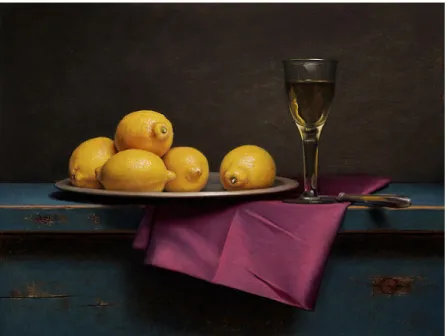
One factor that contributes to making an artwork good is that it effectively captures the core qualities that make a thing what it is. Sometimes, recognizing the artist’s successful depiction of the core qualities is easy. Other times, we can use a two-step-process to testify the accomplishment of the artist --- (1) whether the objects the artist portrays look undoubtedly real; (2) whether the artwork maximally reveals the beauty of the objects by stressing their core qualities. Let’s first look at a still life paining before I apply my principle to other forms of art.
appreciate the napkins in our houses. But Riswick, with his painting technique and light management, unveils the beauty of something so normal that we have barely noticed in our everyday lives.
Fig. 1. Still Life with Lemons and Purple Napkin. Jos Van Riswick, 2015. Oil on panel, 60*45 cm.
The core qualities that define a napkin are its design and its texture; these two qualities together differentiate one napkin from another. They will help us differentiate a purple satin napkin from a navy napkin, a purple cotton napkin, or even a purple tissue. Imagine yourself buying a new napkin for your wife, and you do not have a budget. The first thing that you will look at is usually the print or the fabric, because you know your wife’s tastes and you want her to like it.
specific objects to draw the attention of the audience to a few focal points on the painting. We can tell that Riswick deliberately adjusts the light so that the delicate texture of the purple napkin can be maximally unveiled. A satin napkin looks different under different amounts of light and light from different directions. A still-life painting may depict a satin napkin to look very real in a dark room with no focus on light, and thus fails to capture the glow a satin napkin should have. So the successful capturing of the qualities that make a purple satin napkin what it is, and the artist’s efforts to set the light together contribute to a good painting.
What makes this still life painting even better is its depiction of the lemons. The lemons look extremely real and Riswick successfully captures the beauty of a lemon. The qualities that make an unpeeled lemon what it is are its color and shape. Imagine yourself looking for fresh lemons at the farmer’s market, the first few things you look for are an outer skin with the “right” shade of yellow and a natural shape, because you know lemons with these qualities are usually fresh and have the best taste.
shape, a standard lemon is in a better position to represent the bigger group of lemons, and thus the audience will be likely to praise the artist’s realistic depiction of lemons.
Furthermore, Riswick intentionally places the lemons against a contrasting background of charcoal wallpaper, a pine green coarse table and a deep purple napkin. The vividly yellow lemons pop off the painting, with the oval shaped body and a refreshing yellow outer skin. If Riswick has placed the lemons with some red apples and bananas, the lemons will not create such a special impression on us and the painting might lose its focus. Very often, even if we pick the best lemon we can find in the market, lemons, like napkins, barely win our notice in the kitchen. They either lie in the basket with other fruits or lie in the refrigerator. When we need them, we cut them into pieces before we have a chance to even look at them and appreciate their beauty.
The realness of the lemons depicted differentiates the lemons from other fruits that we may have mistaken to be, and reminds us of our contact with lemons in our lives. The beauty of the lemons Riswick captures is maximized not only by putting it into the spotlight of the whole painting, but also by choosing a perfectly normal and standard lemon. The realness of the lemons depicted and the fact that this painting maximally reveals the qualities that makes a lemon what it is contribute to a good painting.
by itself is not enough to account for a good making quality. For objects captured in the painting, their beauty has to be maximally revealed so that their core qualities can be effectively depicted.
My principle also applies to artworks that portray architecture and scenery. One factor that makes an artwork good is if it captures the core qualities of architecture or a place. This concept of core qualities turns out to be related to the kind of experience we have all had --- while we are sight-seeing, we try hard to use cameras to capture something beyond the physical structure of the place. Before I discuss the evaluation of photographs, I will recount my adventure at the Angkor Wat.
The Angkor Wat is the most famous ancient temple of the ancient kingdom Khmer Empire from 9th to the 15th century. The temple and other remains of the kingdom were discovered in the Cambodian jungle by French missionaries in the late 19th century. In accordance with locals’ suggestions, I arrived there at 5 in the morning to wait for the sunrise. Set off by sunrise, the Angkor Wat showed the greatest beauty and grandeur. The first glimpse of light delineated the vague contour of the temple. The pop-up of the sun from the horizon is rather hard to see since the sun was hiding behind the base of the temple. But when the sun gradually climbed up to the highest point of the temple, the sun brought every brick of the ancient temple a golden glow, as if the power of the ancient kingdom was still alive.
decent job. All physical elements of the sight, including the temple and the sunrise were in the photos but the majesty and sublimity of the moment were lost. When I left the Angkor Wat at noon, I Iooked back at the temple. Without the background setting of the sunrise, even though not a single brick had changed, it was then much harder for me to perceive the status and the significance of this temple.
The grandeur that accommodates the temple’s history and religious symbols is the core quality that makes the temple what it is. Whether I perceive its grandeur truly matters to a tourist like me. I can learn the history of the Angkor Wat through textbooks, but I cannot truly appreciate its importance to the ancient kingdom and its religious symbols until I have a first hand experience of its sublimity. I can perceive the grandeur by actually standing in front of the Angkor Wat at five in the morning, or looking at a carefully processed photograph. Some photographers use Photoshop to edit the photos of the Angkor Wat under sunrise. Some photos, with carefully measured amounts of exposure and shadow, effectively capture the grandeur.
photographer fails to accurately sense the core quality of the Angkor Wat, he will only by accident present a photograph that captures the grandeur.
Many artworks that depict scenery and architecture are like the edited photographs of the Angkor Wat. Some effectively capture the core quality of the place, while some just capture the place’s physical structure or appearances. Each place has its distinct quality that makes it what it is. The use of the place and its history determine the core quality of the place. For example, the quality that makes a church what it is may be its divinity, while the quality that makes an orphanage what it is may be its humanitarianism. There are many ways for an artist to capture the respective quality of a place, but only when an artwork effectively captures these core qualities is the artist contributing to the goodness of the artwork.
Fig. 2. Impression, Soleil Levant. Claude Monet, 1873. Oil on canvas. 48*63 cm. One factor that makes this painting good is Monet’s excellent capturing of the core qualities of the fog --- its thickness in appearance and its penetrability. We can also notice a realistic depiction of the fog and Monet’s efforts to maximize the beauty of the fog by stressing its core qualities.
Remember driving on the highway on a foggy early morning? The fog looks thick and intimidating from afar, because you aren’t so sure about its thickness. It’s not until you notice a dim light from the car in front of you, that you recognize the thickness of the fog based on the distance between your car and the car in front of you, and recognize the fact that you are driving through the fog.
attended with a darker blue than the color of the surrounded fog, hint of the smoke released through huge chimneys of an industrial plant. These strokes seem somewhat abrupt because of their darker color, and the way the strokes are done is distinctly different from the strokes that portray the foggy air. But the depiction of smoke contributes to the depiction of fog since the penetration of smoke through the fog shows us how thin the fog is.
Monet also maximizes the core qualities of the fog by contrasting the combination of smoke and fog with clear water in the front, and with the orange sky at the top of the painting. A painting filled with depiction of smoke and fog will create a suffocating feeling in the audience. Ripples of the water not just create dynamics for the painting, but also shows a contrast of texture to the smoke and fog. At the same time, thick long strokes of the orange sky echoes the Sun while signifying a boundary against the fog.
The realness of the fog captured, and Monet’s efforts to maximize the core qualities of fog, together allow us to identify that “Impression, Sunrise” has a good-making quality.
First of all, we have to notice that an object (or architecture or scenery)’s core qualities vary with the culture and the world one lives in. In ancient times, the Angkor Wat would not have the same core qualities it has now. Suppose I lived in 10th century China and I visited the Angkor Wat, which is then a temple in use for the Khmer Empire in power. I suppose that there was only a little information about the temple from the travel notes that were recorded by previous adventurers. The core qualities of the temple in that world would be its representation of cultural and religious development for the people of Khmer Empire. Maybe I, as an adventurer in that world, would study the religion and the architecture so that I could bring the knowledge back to my country.
Similarly, a lemon does not have the same core qualities now as it would in the world where lemons were just discovered by peasants. Those peasants probably treated lemons as a gift from the god and carefully tried out different ways of using lemons as food or medicine. Even though the lemons in that world look the same as the lemons we have now, it is its rareness and practical use that constituted the core qualities of a lemon at that time. So a thing’s core quality is constrained by the culture and the world one lives in.
was not sure exactly how grand this temple is. Even though I had seen other ancient temples on the other side of the continent, every ancient kingdom has a different history and culture. The Angkor Wat is likely to have very different features than an ancient shrine in Japan. Besides, when I strolled around the temple at noon, my tour guide taught me every detail of the architecture and the rituals they used to perform in the temple. At the time, I understood that this temple was really important to the Khmer people. But not until the sunrise set off the grandeur could I finally connect this feeling with the knowledge I had about the temple, and only then could other people’s claims about the importance of this temple make so much sense.
painting and reconsider lemons, we are connected with the things we know about lemons and the qualities we tend to look for when buying lemons. At that moment, we realize that this painting captures the qualities that make a lemon what it is.
This principle I raised also conforms to Hume’s argument. Hume argues that principles and the related qualities of the artwork are discovered through experience and observation over a long period of time. Similarly, I discover my principle by viewing a large number of artworks that depict a certain object (or architecture or scenery). Evaluating the audience’s reaction to what is praised as good artworks and what is criticized as bad artworks, I am able to summarize a few good-making qualities.
Additionally, Hume rendered the kind of experience and observation necessary for the search of principles. “We shall be able to ascertain [principles’] influence, not so much from the operation of each particular beauty, as from the durable admiration, which attends those works, that have survived all the caprices of mode and fashion, all the mistakes of ignorance and envy” (Hume 220). Only people with fine taste are able to perceive the aesthetic pleasure naturally produced by certain qualities in the object. But they might not be able to consistently perceive the aesthetic pleasure because they might experience serious physical pain or emotion pain from time to time. So attending to works that have gained lasting admiration can diminish the risks of a true judge’s underperformance. A long-term experience and observations can guarantee the discovery of principles.
light.
People have recognized the qualities that make an object (or architecture or scenery) what it is for a long period of time. The core qualities of an object thus have been transformed as subconscious knowledge in people’s minds. For example, the way people view lemons has not changed for thousands of years since lemons became a regular fruit in everyday recipes. People have gained the habit to always look for skins with the “right” shade of yellow and the perfect oval shape. We know what is “right” because we have seen a large number of lemons in our lives and we know what a bad or rotten lemon looks like. We always avoid rotten lemons because our grandmother taught us the trick of picking the best lemons. This knowledge of lemons is there in people’s brains for a large part of the human history. It is upon our ancestors’ experience and observations that we gain the knowledge of lemons, and in particular, the core qualities that make a lemon what it is.
To clarify, It is not the look of lemons that determines whether the painting produces aesthetic pleasure. It is the artist is excellent capturing of lemons that accounts for a good-making quality. If a painting effectively captures the core qualities of a rotten lemon, according to my principle, the painting also has a good-making quality. A true judge will thus experience the aesthetic pleasure produced by its good-making quality.
principle. Maybe other good-making qualities of the artwork affect the quality in my principle. I want to emphasize that my principle only discusses one good-making quality. If there are more principles available, we may be able to discuss the roles various good-making qualities play in a good artwork. It certainly is possible that different qualities contribute to each other’s production of pleasure. Certain quality may also restrain other qualities’ production of pleasure.
Conclusion
Hume presents his concept of a true judge in the paper Of the Standard of Taste. Hume claimed that there are certain principles or rules of art such that certain qualities in an artwork to produce pleasure. A true judge is able to feel the pleasure produced by different qualities, but the true judge may or may not be aware of the corresponding principle when he feels the pleasure produced by certain qualities. Hume suggested that a true judge always judges an artwork to be good if he feels the pleasure produced by certain qualities in the artwork.
bad.
I solved the irrealism of Hume’s concept of a true judge in two steps. First, I revised Hume’s concept of a true judge by narrowing the meaning of “pleasure” in Hume’s paper. I defined that any pleasure that is produced by certain qualities of an artwork is aesthetic pleasure. What I call hasty pleasure is any pleasure that is produced by factors external to certain qualities of an artwork. Then I described how hasty pleasure might influence the aesthetic pleasure a true judge feels.
REFERENCES
Hume, D. (1910). Of the Standard of Taste. In C. W. Eliott (Ed.), English Essays from Sir Philip Sidney to Macaulay (pp. 215–236). P F Collier & Son. (Original work
published 1757) Retrieved from http://bradleymurray.ca
Monet, Claude. Impression, soleil levant. 1873. Wikiart. Web. 5 Nov. 2016. < https://www.wikiart.org/en/claude-monet/impression-sunrise >
Railton, Peter. "Aesthetic value, moral value, and the ambitions of naturalism", Aesthetics and Ethics. Ed. Jerrold Levinson. 1st ed. Cambridge: Cambridge
University Press, 1998. pp. 59-105. Cambridge Books Online. Web. 28 April 2016. http://dx.doi.org/10.1017/CBO9780511663888.003