A Second-Order Growth Model for Longitudinal Item
Response Data
Daniel Serrano
A Dissertation submitted to the faculty of the University of North Carolina at Chapel Hill in partial fulfillment of the requirements for the degree of Doctor of Philosophy in the Department of Psychology: L.L. Thurstone Psychometric Laboratory.
Chapel Hill 2010
Approved by
Patrick J. Curran, Ph.D. Robert C. MacCallum, Ph.D.
David Thissen, Ph.D. Daniel J. Bauer, Ph.D.
c
2010
ABSTRACT
Daniel Serrano: A Second-Order Growth Model for Longitudinal Item Response Data (Under the direction of Patrick J. Curran)
This Dissertation explores the unique issues related to specifying and fitting a
second-order growth model to longitudinal item response data. The model examined is a hybrid
of the logistic IRT model for binary item responses and the latent growth curve model
for repeated measures. Attention centered around parameterization, identification,
es-timation, and issues related to estimation of the model such as convergence, improper
solutions, bias and root mean squared error (RMSE). Two variations on the proposed
model: one with correlated errors (model 2) and one without (model 1). In each model
two types of estimator were examined: full and limited information estimators. Two
sample size conditions were examined, one withN = 750 observations, and another with
N = 3000. In addition, two item parameter sets were examined, one having a wide range
of difficulty and the other, narrow. Comparing analyses stratified across model, findings
indicated greater rates of improper solutions and bias for model 2 versus model 1.
Lim-ited information estimators of model 1 performed worse than full information estimators,
while the opposite was true for model 2. Bias and convergence issues were greatest when
difficulty had a wide range. Lastly, sample size appeared to play a negligible role in bias
and RMSE, though it did affect convergence issues and improper solutions. Based on
empirical results presented in this simulation the proposed model appears to be a logical
ACKNOWLEDGEMENTS
I would like to thank my advisor, Patrick J. Curran, without whose guidance and keen
insights none of this would have been possible. I would like to thank my committee
mem-bers, who have aided this project through feedback throughout the process. Many thanks
are due to Taehun Lee, whose friendship and interest in discussing this project greatly
contributed to the successful completion. Lastly, I would like to thank the institution
of the L. L. Thurstone Psychometric Lab for providing the education, environment, and
TABLE OF CONTENTS
List of Tables . . . viii
List of Figures . . . xi
CHAPTER
1 Introduction . . . 11.1 Proposed Model . . . 5
1.1.1 A Model for Correlated θ . . . 6
1.1.2 Advantages of this Approach . . . 7
1.1.3 Identification . . . 8
1.1.4 Measurement Invariance . . . 9
1.1.5 A Model For Correlated Errors . . . 10
1.2 Estimation . . . 11
1.2.1 Limited Information Estimation . . . 12
1.2.2 Full Information Estimation . . . 16
1.3 Hypotheses . . . 21
1.3.1 Model Complexity Hypothesis . . . 21
1.3.2 Estimator Hypothesis . . . 21
1.3.3 Difficulty Range Hypothesis . . . 22
1.3.4 Sample Size Hypotheses . . . 22
1.3.5 Sample Size By Estimator Hypothesis . . . 22
2 Method . . . 24
2.0.6 Model Complexity Manipulation . . . 24
2.0.8 Difficulty Range Manipulation . . . 26
2.0.9 Implied Moments . . . 38
2.0.10 Sample Size Manipulation . . . 38
2.0.11 Non-Convergence . . . 39
2.0.12 Improper Solutions . . . 39
3 Results . . . 40
3.1 Model 1 . . . 41
3.1.1 Convergence . . . 41
3.1.2 NPD Solutions . . . 41
3.1.3 First Parameter Set Bias . . . 42
3.1.4 First Parameter Set Meta Model Results . . . 44
3.1.5 Second Parameter Set Bias . . . 51
3.1.6 Second Parameter Set Meta Model Results . . . 53
3.1.7 RMSE . . . 59
3.1.8 Summary of Findings . . . 59
3.2 Model 2 . . . 60
3.2.1 Convergence . . . 61
3.2.2 NPD Solutions . . . 61
3.2.3 First Parameter Set Bias . . . 63
3.2.4 First Parameter Set Meta Model Results . . . 67
3.2.5 Second Parameter Set Bias . . . 71
3.2.6 Second Parameter Set Meta Model Results . . . 74
3.2.7 Summary of Findings . . . 78
3.3 Additional Analyses . . . 81
3.3.1 Model 1 with MCEM . . . 81
3.3.2 NPD Sensitivity Analyses . . . 82
4 Discussion . . . 85
4.2 Sample Size Effect . . . 86
4.3 Estimator Effects . . . 87
4.4 WLSMV Bias and Contingency Table Sparseness . . . 88
4.5 Recommendations for Application . . . 89
4.6 Limitations and Future Directions . . . 90
4.7 Conclusion . . . 93
5 Appendices . . . 95
5.1 Appendix 1: Parameter set 1 RMSE . . . 95
5.2 Appendix 2: Parameter set 2 RMSE . . . 99
5.3 Appendix 3: Cell Means . . . 103
LIST OF TABLES
2.1 Population Values for Item and Structural Parameters . . . 26
3.1 Experimental Design . . . 41
3.2 Item and Structural Parameter Bias for Model 1, Set 1, N=750 . . . 43
3.3 Item and Structural Parameter Bias for Model 1, Set 1, N=3000 . . . 44
3.4 Meta Model Results: ˆa Raw Bias for Model 1, Set 1 . . . 46
3.5 Meta Model Results: ˆb Raw Bias for Model 1, Set 1 . . . 47
3.6 Meta Model Results: Fixed Effect Raw Bias for Model 1, Set 1 . . . 48
3.7 Meta Model Results: Random Effect Variance Estimate Raw Bias for Model 1, Set 1 . . . 49
3.8 Meta Model Results: Random Effect Covariance Estimate Raw Bias for Model 1, Set 1 . . . 50
3.9 Meta Model Results: ˆψ Raw Bias for Model 1, Set 1 . . . 51
3.10 Item and Structural Parameter Bias for Model 1, Set 2, N=750 . . . 52
3.11 Item and Structural Parameter Bias for Model 1, Set 2, N=3000 . . . 52
3.12 Meta Model Results: ˆa Raw Bias for Model 1, Set 2 . . . 54
3.13 Meta Model Results: ˆb Raw Bias for Model 1, Set 2 . . . 55
3.14 Meta Model Results: Fixed Effect Raw Bias for Model 1, Set 2 . . . 56
3.15 Meta Model Results: Random Effect Variance Estimate Raw Bias for Model 1, Set 2 . . . 57
3.16 Meta Model Results: Random Effect Covariance Estimate Raw Bias for Model 1, Set 2 . . . 58
3.17 Meta Model Results: ˆψ Raw Bias for Model 1, Set 2 . . . 59
3.18 Item and Structural Parameter Bias for Model 2, Set 1, N=750 . . . 63
3.20 Meta Model Results: ˆa Raw Bias for Model 2, Set 1 . . . 67
3.21 Meta Model Results: ˆb Raw Bias for Model 2, Set 1 . . . 67
3.22 Meta Model Results: Fixed Effect Raw Bias for Model 2, Set 1 . . . 68
3.23 Meta Model Results: Random Effect Variance Estimate Raw Bias for Model 2, Set 1 . . . 69
3.24 Meta Model Results: Random Effect Covariance Estimate Raw Bias for Model 2, Set 1 . . . 69
3.25 Meta Model Results: ˆψ Raw Bias for Model 2, Set 1 . . . 70
3.26 Meta Model Results: ˆρ Raw Bias for Model 2, Set 1 . . . 70
3.27 Item and Structural Parameter Bias for Model 2, Set 2, N=750 . . . 71
3.28 Item and Structural Parameter Bias for Model 2, Set 2, N=3000 . . . 73
3.29 Meta Model Results: ˆa Raw Bias for Model 2, Set 2 . . . 74
3.30 Meta Model Results: ˆb Raw Bias for Model 2, Set 2 . . . 75
3.31 Meta Model Results: Fixed Effect Raw Bias for Model 2, Set 2 . . . 75
3.32 Meta Model Results: Random Effect Variance Estimate Raw Bias for Model 2, Set 2 . . . 76
3.33 Meta Model Results: Random Effect Covariance Estimate Raw Bias for Model 2, Set 2 . . . 77
3.34 Meta Model Results: ˆψ Raw Bias for Model 2, Set 2 . . . 77
3.35 Meta Model Results: ˆρ Raw Bias for Model 2, Set 2 . . . 78
3.36 MCEM Item and Structural Parameter Bias for Model 1, Set 1, N=750 . . . 81
5.1 Item and Structural Parameter RMSE for Model 1, Set 1, N=750 . . . 95
5.2 Item and Structural Parameter RMSE for Model 1, Set 1, N=3000 . . . 97
5.3 Item and Structural Parameter RMSE for Model 2, Set 1 . . . 98
5.4 Item and Structural Parameter RMSE for Model 1, Set 2, N=750 . . . 99
5.5 Item and Structural Parameter RMSE for Model 1, Set 2, N=3000 . . . 100
5.6 Item and Structural Parameter RMSE for Model 2, Set 2 . . . 102
5.7 Item and Structural Parameter Bias Cell Means for Model 1, Set 1 . . . 104
5.8 Item and Structural Parameter Bias Cell Means for Model 1, Set 2 . . . 105
LIST OF FIGURES
2.1 ICCs for Parameter Set 1 at Time 1 . . . 30
2.2 ICCs for Parameter Set 1 at Time 2 . . . 31
2.3 ICCs for Parameter Set 1 at Time 3 . . . 32
2.4 ICCs for Parameter Set 1 at Time 4 . . . 33
2.5 ICCs for Parameter Set 2 at Time 1 . . . 34
2.6 ICCs for Parameter Set 2 at Time 2 . . . 35
2.7 ICCs for Parameter Set 2 at Time 3 . . . 36
CHAPTER 1
Introduction
Over the past 30 years psychological research has gradually shifted away from cross
sectional designs and toward longitudinal or repeated sampling designs, under which
scales are repeatedly administered to a sample of subjects tracked over multiple
assess-ment occasions. The field’s origins in experiassess-mental research likely account for the heavy
reliance on cross sectional designs. However, as research began to focus on
developmen-tal processes of both normative and pathological behavior, longitudinal designs became
prominent (Nesselroade & Baltes, 1979). Advances in statistical theory and computing
have facilitated the adoption of this approach within the field (Bollen & Curran, 2006;
Mehta & West, 2000). However, it is rare for such studies to incorporate measurement
models to account for the measurement error inherent in the study of such unobservable
psychological constructs as internalizing or externalizing behavior.
In the case of most measurement studies, single stage sampling is employed and
re-sults in the random sampling of respondents and their responses to a scale composed
of k items. This historical design resulted in the development of many useful statistical
models for assessing measurement properties in cross section, but renders the analysis of
longitudinal responses complex. The primary obstacle to specification of a latent variable
model characterizing the measurement properties of the sampled responses is the
speci-fication of a distribution for the latent variable and a distribution for the item-responses
conditional upon the latent variable. In the case of dimensional scales, only a
stage sampling design of a uni-dimensional psychopathology scale. In the first stage of
sampling respondents are randomly sampled with equal probability of selection. In the
second stage of sampling, responses to the items composing the uni-dimensional
psy-chopathology scale are sampled at T measurement occasions. This design induces an
T dimensional joint distribution for the latent variables underlying the uni-dimensional
scale at each occasion. Thus the model specification now requires characterizing a T
dimensional distribution for the latent variables, increasing the complexity of the
condi-tional response distributions. When item responses are discrete and we wish to estimate
item parameters or obtain latent variable scores while simultaneously taking into account
the parameters characterizing the T dimensional latent variable distribution, there are
two classes of methods: Factor analysis and item response theory procedures.
Within the factor-analytic tradition several models have been developed for
embed-ding a measurement model for discrete item responses within a longitudinal model for
the joint distribution of the repeated latent-variable measures. While this approach
per-mits specification of a general model for longitudinal measurement models, it is limited
to few items. In addition, it may not be amenable to application to psychopathology
scales. Such scales often contain items which are rarely endorsed within a sample;
ex-amples would include items assessing suicidal ideation on a depression inventory. Such
behaviors are rare enough in the general population that item endorsement rates are
generally low. The factor analytic approach performs poorly with such items. In
con-trast the item response theory (IRT) model easily handles large item sets and rarely
endorsed items. However, the traditional item response theory (IRT) model (Birnbaum,
1968; Bock & Lieberman, 1970; Bock & Aitkin, 1981; Bartholomew & Knott, 1999), is
not easily amenable to accounting for the joint distribution of latent variables arising
from repeated measures. Often, application of the IRT model to longitudinal responses
requires modification of the data to fit existing architecture.
modified longitudinal item response data through a random sampling selection process
converting the longitudinal data into representative cross sectional data thus permitting
item evaluation within existing measurement model architecture. Provisional on the
obtained pseudo-cross-sectional item parameters, latent variable scores were obtained for
each subject at each time-point. However, because the scores were not obtained from
a model which explicitly accounted for the repeated measures, the degree of precision
of the resulting scores was likely distorted. The extent of this distortion is unclear, and
would depend on the representativeness of the sample resulting from the random selection
process. Nonetheless, some imprecision is induced under such an approach and exists for
two reasons.
First, the item parameters on which the scores are conditioned do not characterize
any of the time-specific item response patterns. Thus we can not determine how the scale
performs at any given assessment. In addition, because the item parameters do not map
on to any one assessment, the time-specific latent variable scores that can be estimated
may not be conditioned on the correct item parameters. Consequently there may be some
misspecification in the latent variable scores. Second, latent variable scores of this type
are obtained using a shrinkage estimator. By that I mean scores are concentrated toward
areas of highest precision and extreme scores are pulled in toward the mean. Because
of the random sampling process, a given random draw could result in a preponderance
of cases from a single time-point. In so doing, scores would be shrunken towards those
characterizing a specific time-point rather than the time-specific latent variable which
we desire. These two issues are but a few which serve to motivate the longitudinal IRT
model.
Part of the reason that a more comprehensive model was not implemented by Curran
et al. (2008) is that until recently computational limitations have prevented the
specifi-cation and estimation of such models. In fact, such models remain in their infancy and
response models have been proposed, In this dissertation I develop and study a general
model for longitudinal binary item responses. Specifically, I examine the performance
of second-order growth models in the analysis of longitudinal item response data. I
consider the application of the model to designs commonly encountered in the study of
psychopathology: multiple repeated measures of a small item pool. This is in contrast
to the item pools common to educational testing in which large item sets are repeatedly
sampled few times. The second-order growth model has yet to be explicated or evaluated
in the case of longitudinal item response data.
Though the literature on longitudinal IRT models is diverse, I focus here on the
most prominent and notable work developing general statistical frameworks for
estimat-ing item parameters and scorestimat-ing. Embeddestimat-ing a measurement model within a generalized
linear mixed model, Johnson and Raudenbush (2006) specified a repeated measures Rasch
model for two longitudinal assessments. Because of the Rasch specification prevented
es-timation of a distinct slope for each item, slopes were constrained to equality across items,
the estimates then for the constrained slope and the threshold parameters were estimated
as the average of the parameters between the two repeated measures. Justifications for
employing the restricted Rasch model included estimation limitations, simplicity of
in-terpretation of scale, and an empirical evaluation indicating that the Rasch model fit the
data considered in application better than a two parameter logistic (2pl) model. Because
the model given by Johnson and Raudenbush (2006) specifies item parameters as
aver-ages of the time-specific item parameters, the framework does not provide a means for
testing invariance.
In a recent dissertation, Hill (2006) developed a 2pl IRT bi-factor model for two
repeated measures. Hill (2006) employed the testlet-factors approach to specification,
augmented by a general factor at each time. The testlet factors were specified by giving
each repeated item a constant loading on the testlet, and constraining the mean and
items was then given by the square of the testlet loading. The bi-factor model given by
(Hill, 2006) was identified by constraining θ1 ∼ N(0,1) and freely estimating the mean
and variance ofθ2. Though a simulation design was not employed, Hill (2006) examined
the performance of her model under single replications of several simulated data sets in
order to examine item-set and sample size effects.
Alternative models have been proposed by Gibbons and Hedeker (1997), Liu and
Hedeker (2006), and Liu (2008). These authors have specified IRT models in which
the repeated measures are modeled at the item response level and not the level of θ.
Specifically, these authors have fit standard IRT models at each assessment while
simul-taneously fitting a random effect for time to the observed item-responses. Because the
time trend is modeled at the level of the item responses and not θ, one cannot
disen-tangle the effects of growth from non-invariance. In contrast, the second-order growth
parameterization models the repeated measures at the latent ability (θ) level. Though I
defer thoroughly examining measurement invariance to future work, the model provides a
general framework for the testing of invariance. The contribution of this work is therefore
the explication of the proposed model and assessment of its performance in simulation.
1.1 Proposed Model
The proposed model is based on a second-order growth model where the lower order
measurement models are repeated samples of the IRT model over time. These IRT models
are parameterized using the threshold parameterization for thekth item:
ϕk =ak(θ−bk), (1.1)
whereak is the slope (discrimination in IRT parlance) and bk the threshold, andθ is the
latent variable measured by the items. In this model the item-parameters to be estimated
areakandbk. In the case of binomial family response distributions the model will employ
the logit inverse link function:
P(itemk = 1|θ) = 1
1.1.1 A Model for Correlated θ
To account for the correlated nature of theT longitudinal assessments, a second-order
growth model will be specified for the repeatedθ. The second-order growth model is
sim-ply a mixed effects model forθ, which accounts for the trend in the mean and covariance
structure observed among the repeated measures inθ. Letηbe anRdimensional matrix
of unobserved random effects:
η=
α β,
(1.3)
and let η ∼N(µη,τη). The fixed effects, contained in µη, characterize the mean trend
structure of θ, while the R×R dimensional random effects covariance matrix,τη,
char-acterizes the trend in the covariance structure of θ. The conditional model relatingη to
the 1×T dimensional vector θ, whose Tth element,θ
T, is the latent variable value for a
single respondent at theTth assessment, may be expressed as a function of a mixed-effect
polynomial trend for time:
θ=λη+ǫ (1.4)
The model of interest employs a linear polynomial trend to parameterizeλ, though this
model permits the parameterization of more complex trends. For example,
λ= 1 0 1 1 1 2 ... ...
1 T −1
. (1.5)
The time-specific disturbance terms, contained in ǫ, are assumed ǫ ∼ N(0,ψ), where
ψ is a T ×T dimensional diagonal matrix of time-specific variances, the Tth element of
which is the variance of θT conditioned upon the growth model.
The distribution for θ may be derived using properties of linear combinations of
Gaussian variates from the conditional model. Specifically, θ ∼ N(λµη,λτηλ
′
This model provides estimates of parameters characterizing the distribution of the
time-specific θT. However, the parameters are not freely estimated, but instead are implied
by the linear trend specified in the model. Thus the model explicitly assumes that ability
increases or decreases via a linear polynomial over time.
1.1.2 Advantages of this Approach
There is one main advantages of this approach relative to a multivariate
longitudi-nal model which jointly estimates time-specific IRT models and characterizes the change
over time by freely estimating the saturated mean and covariance structure of the
matrix-valued θ. The advantage relates to the dimensions of integration required for the model
relative to the number of parameters which summarize the moments of the
distribu-tion of θ. Under a binary response model both models estimate 2k item parameters,
consequently the primary difference between the two models relates to the number of
parameters estimated to characterize the distribution of θ. The multivariate model for
T repeated measures estimates (T)(T2+1) parameters characterizing the covariance matrix
θ, andT means. Defining the dimensions of the second-order growth component matrix
(η) as R = dim(η), the number of estimated parameters under the second-order model
may be expressed as (R)(R2+1) parameters characterizing the covariance matrix of η, R
means, and T time-specific error variances. With four repeated measures the saturated
multivariate model estimates 14 total parameters, while the second-order model with
linear polynomial trend estimates a total of 9 parameters. The difference in parameters
required to summarize the distribution ofθ, is a common result of invoking any structural
model, however, what is unexpected is that this can be accomplished without increasing
the burden of numerical integration.
We can express the marginal likelihood generally as
Z Z
which may be partitioned into:
Z
p(y|θ) Z
p(θ|η) φ(η) ∂η
φ(θ) ∂θ (1.7)
And the component of the integrals required to express the conditional model relatingθ
toη:
Z
p(θ|η) φ(η) ∂η (1.8)
has a closed form solution, meaning that this model only requires T dimensions of
inte-gration and not T +R dimensions of integration. Thus, the second-order growth model
can characterize the distribution of θ with as many dimensions of integration as a
mul-tivariate model with fewer parameters. Consequently, the apparent added complexity
of the second-order model results in parametric savings with no additional estimation
burden.
1.1.3 Identification
In traditional IRT sampling situations i = 1. . . L subjects are sampled and each
responds to k = 1. . . N items. Under such sampling we identify the IRT model by
as-suming that θ ∼ N(0,1). However, the model of interest accounts for the effect of time
on θ through parameterization of the mean and covariance matrix of θ. Consequently,
a different identification procedure is required, one that permits estimation of the
pa-rameters characterizing the distribution of θ. One alternative, employed by Hill (2006),
identifies the model by constrainingθ1 ∼N(0,1), constraining the item parameters
corre-sponding to the first item to equality, and freely estimating all other item and structural
parameters. However, consider imposing the constraint that the variance ofV ar(θ1) = 1
in the context of the growth model. Under the proposed model, V ar(θ1) = τα+ψ1,1,
consequently, in order to employ the identification constraint employed by Hill (2006),
the linear constraint τα+ψ1,1 = 1 would have to be imposed on the second order model.
Instead, I advocate identification based on the alternative reference item
item are constrained to 1 and 0 respectively at each time-point and the mean and
vari-ance for θT are freely estimated at each repeated measure. The constraint on the item
parameters implies moments for the distribution ofθ. Specifically, omitting the
inequal-ities used to derive these implied moments,µ=−a⋆
kb⋆k and σ2 = (a⋆k)2. It is important to
observe that selection of the reference item has implications for the moments of the latent
variable, because when estimation is sensitive to the location and dispersion of the
distri-bution of the latent variable, poor choices of the reference item could lead to estimation
difficulties. Thus when employing this identification constraint, it is important to keep
this issue in mind in the event that estimation troubles are encountered. Nonetheless, it
is a common and easily implemented identification constraint. In addition, the reference
item is invariant to time, and therefore, changes in items over time must be attended to
in order to understand potential estimation troubles.
1.1.4 Measurement Invariance
In order to model trends in θ, be it externalizing behavior, or educational ability,
across repeated measures, we must assume that the definition of θ does not change over
time. In other words, to be able to describe change over time in θ we must be able to
demonstrate that θ is changing, rather than the definition of θ changing. While this
notion exists within both the factor analytic and response theoretic frameworks, this
concept of constant definition of θ can generally be referred to as factorial invariance.
There is more than one way of establishing factorial invariance; in this project I define
invariance by holding the item parameters constant within item over time, yet permitting
the mean and variance to change over time as detailed in the preceding section. Though
invariance is likely to be violated within any given application of the proposed model,
a comprehensive examination of the proposed model under both invariance and
non-invariance is beyond the scope of this project. Consequently, in this dissertation all
1.1.5 A Model For Correlated Errors
The probability model given in equation 1.2 expresses a relationship between the true
score and item response under the assumption of independent and standardized errors.
The error model corresponds to the standardized logistic distribution, with error variance
π2
3, and is a necessary restriction imposed for model identification (McCullough & Nelder,
1989). Given a set of repeated item responses one does not know whether the the growth
model explicated is sufficient to model the correlated nature of the repeated responses. In
some circumstances, repeated measurement may induce correlation inboth the true scores
and the errors. In that case one must augment the proposed model with correlations
among the errors. However, constraining the error model for identification does not
permit flexible parameterization of the error covariances as is common in linear models.
Instead, one could consider testlet factors to account for the item-specific correlation.
WhereasθT is a constant person effect at theTth measurement occasion which accounts
for the correlation in item responses, the testlet factor accounts for the correlation within
a specific item induced by repeated administration of that item. The testlet factor model
may be expressed for a given subject by augmenting equation 1.1:
ϕkt=akt(θt−bkt) +λkθk, (1.9)
where λk is the loading that item k has on the item-specific testlet factor θk. For
identi-fication purposes I set θk ∼N(0,1). When item k is measured repeatedly, each realized
item response is a function of the testlet factorθk. Given constant loading on the testlet
factor across items, we can determine the within-item error-correlation resulting from
repeated administration by λλ′
. For example, with three repeated measures of a given
item and constant loading estimated to be .5477 the implied residual item-correlation is
.3, given by λ2
k = .54772 = ρk = .3. This is identical to the method employed by Hill
(2006) for handling correlated errors. In some cases it may be reasonable to expect a
item. In such circumstances, λ may be structured in order to fit patterned correlation
structures. Nonlinear constraints could be employed in order forλk to produce an
autore-gressive structure of user-specified order. A substantial problem with the specification
of an unrestricted error-correlation model is related to computational burden. Whereas
the model for correlated true scores increases by one dimension for every added repeated
measure, the unrestricted model for correlated errors with N items and M repeated
measures consists of a minimum ofN +M dimensions. And that is under a model with
constant error-correlation within item. If error correlations are non-constant within item
over time the dimension of the unrestricted model for correlated errors can have as many
as
M(M −1) 2
N +M (1.10)
dimensions. Thus an unrestricted model may be computationally impractical for more
than a few items or a few repeated measures, unless an estimation routine can be
em-ployed which can handle very high-dimensional models.
1.2 Estimation
Two primary estimation methods exist for latent variable models with Bernoulli item
responses: Full and limited information estimation. The advantage of the full
informa-tion approach is that it takes advantage of the raw response patterns and is rooted in
the established theory of maximum likelihood (Bock & Lieberman, 1970). Historical
disadvantages of the full information approach have included heavy computing burden
and the restriction of the approach to a single factor model and few items. These
dis-advantages motivated the development of limited information techniques that permitted
the fitting of multi-factor models to larger sets of items with reduced computing time
(Christofferson, 1975; Muth´en, 1978; Olsson, 1979). The limited information approach
avoids the use of the raw response patterns and instead uses first-order and second-order
approach has gained wide appeal among factor analysts because it serves as an analog in
discrete indicators to the weighted least squares estimation of the common factor model
under continuous indicators (Bartholomew & Knott, 1999). A substantial limitation of
this approach is the rate at which the weight matrix grows, which has historically
re-stricted the method to the analysis of no more than 25 items. The ascension of the
limited information estimator did not limit work refining the full information estimator.
The modern full-information approach to item parameter estimation is based on the work
of Bock and Aitkin (1981) who employed an EM-type algorithm to facilitate the
approx-imation to the integrals that bogged down the computations in Bock and Lieberman
(1970). The advantage of the Bock and Aitkin (1981) method is that it increased the
number of items that could be analyzed from a maximum of 12 to nearly 100, making
it an exceedingly useful method for estimating single-factor models with large item-sets.
These two approaches to estimation are discussed in the following sections.
1.2.1 Limited Information Estimation
Drawing on the strengths of the factor analytic model, Christofferson (1975), Muth´en
(1978), and Olsson (1979) developed a general framework for fitting models to discretely
distributed item responses. Parameter estimates obtained within this framework may
be translated to IRT parameters. This framework serves as an elegant complement to
the item response model. Because the parameters can be compared, and the proposed
model has been estimable within this framework for years, I am interested in examining
the limited information estimator and its performance relative to the full information
estimator of IRT.
Pearson (1901) pioneered an approach to the analysis of Bernoulli item responses
that has enjoyed widespread favor among psychometricians, primarily because of the
fact that it serves as a heuristic analog in discrete indicators to the widely employed, and
well understood, method of fitting the common factor model to the correlation matrix
{k, l}, the joint Gaussian density defined through an auxiliary threshold model gives conditional proportions: πkl = ∞ Z τk ∞ Z τl
Φ(θk, θl, ρkl)∂θk∂θl, (1.11)
whereθk and θl are unobserved Gaussian variates dichotomized atτk and τl respectively
to define the observed dichotomous indicatorsyk and yl, and whereyk = 1 ⇐⇒ θk ≥τk
and yk = 0 ⇐⇒ θk ≤ τk. The unobserved Gaussian variates are correlated ρkl.
The conditional proportion given above in equation 1.11 corresponds to yk = 1 and
yl = 1, the complement can be obtained by inversion of the integration limits, and the
remaining proportions can be obtained by conditional inversion of the integration limits.
The marginal proportions forykandyldefined by the auxiliary threshold model are given
by πk = ∞ Z τk ∞ Z −∞
Φ(θk, θl, ρkl)∂θk∂θl, (1.12)
πl = ∞ Z −∞ ∞ Z τl
Φ(θk, θl, ρkl)∂θk∂θl, (1.13)
If the proportions, πk, πl, πkl are known then the parameters, τk, τl, and ρkl defining the
joint Gaussian distribution characterizing θk and θl are uniquely defined by the given
functions. However, in the absence of the population proportions, the sample estimates
must be used, resulting in the estimation of a sample tetrachoric correlation coefficient.
When, for all pairs of items, the sample tetrachoric correlation coefficient is computed,
the tetrachoric correlation matrix can be populated. The previously mentioned heuristic
method relies on the sample tetrachoric correlation matrix as input to the fitting
func-tion. An unfortunate property of the sample tetrachoric correlation matrix is that even
when the population tetrachoric correlation matrix is well defined, the sample tetrachoric
correlation matrix can be degenerate, particularly as|ρklˆ | →1 (Lord & Novick, 1968).
Modern methods of limited information estimation are similar to the method
com-puting burden inherent in the approach taken by Pearson (1901) and early full
informa-tion methods (Bock & Lieberman, 1970). The first limited informainforma-tion estimator was
derived by Christofferson (1975) who sought to find some approximation to the full
infor-mation in the data that would permit easier model estiinfor-mation of more complex models for
more items. Rather than employing the response pattern, Christofferson (1975) chose to
employ the first and second-order marginal proportions for model estimation. The
pop-ulation first-order proportions have been defined in equations 1.12 and 1.13 while the
second-order proportions are given in equation 1.11. Christofferson (1975) defined the
sample realizations of these proportions as ˆPk=πk+ǫk, ˆPl =πl+ǫl, and ˆPkl =πkl+ǫkl.
While the first-order sample proportions were estimated by Christofferson (1975) via
standard routines, the second-order sample proportions had to be approximated via the
tetrachoric expansion. The population and sample proportions can be stacked in the
vectors π and P respectively. Stacking the errors, defined as P−π, into the vector ǫ
and then computing the corresponding covariance matrix of these errors yieldsΣǫwould
produce the covariance matrix of the errors, permitting weighted minimization of the
squared errors, ǫΣ−1
ǫ ǫ
′
. Unfortunately,Σǫis not known. Christofferson (1975) derived a
consistent estimator ofΣǫbased on third and fourth-order moments which produced an
efficient generalized least squares (GLS) estimator. In fact, in comparison to the results
obtained by Bock and Lieberman (1970), both the point estimates and the standard
errors for the GLS estimator were nearly identical. Compared to the solution given by
Bock and Lieberman (1970), this approach reduced the computing burden, increased the
analyzable number of items to 25, and allowed for the fitting of multi-factor models.
However, it required the evaluation of the integrals contained in equations 1.11− 1.13
at each stage of iteration.
In order to circumvent the burdensome integration required by the GLS estimator
proposed by Christofferson (1975), Muth´en (1978) inverted the integrals in equations
correlations rather than the first-order and second-order marginal moments employed by
Christofferson (1975). Reparameterizing the elements contained in ǫas a function of the
distance between the sample and model-implied thresholds and tetrachoric correlation
coefficients yielded a GLS estimator as efficient as that derived by Christofferson (1975).
Muth´en (1978) described the relationship between the methods proposed by himself
and Christofferson (1975) to the heuristic method, noting that the heuristic method
was analogous to the GLS method replacing the weight matrix with an identity matrix,
resulting in an unweighted least squares (ULS) solution. The approaches proposed by
Christofferson (1975) and Muth´en (1978) provided a least squares theory for fitting the
heuristic method, with the main added advantage being the provision of efficient standard
errors. Because the fitting function employed in this approach measures discrepancy
primarily as a function of the distance between the sample and model-implied correlation
coefficients, this method serves as the dichotomous analog to the weighted least squares
estimator for continuous indicators.
In the case of polytomous item responses, Olsson (1979) solved the problem of
effi-cient computation of the polychoric correlation matrix. The polychoric correlation
ma-trix is an extension of the tetrachoric correlation to multinomial item responses. Rather
than attempting to evaluate the full multinomial distribution of the set of polytomous
responses in order to estimate the polychoric correlations, Olsson (1979) provided an
algorithm for deriving the correlations as a function of the bivariate marginals obtained
from pairwise contingency tables. Focussing on pairwise evaluation of the conditional
re-lations between the items to characterize the multivariate distribution underlying the set
of contingency tables provided a practical solution to a formerly intractable computing
problem. This approach forms the basis for modern approaches to weighted least squares
estimates of item parameters given discrete item-responses. The algorithm implemented
in most commercial software involves three steps of estimation. In the first stage,
In the second stage, bivariate proportions are employed to obtain estimates of the poly or
tetrachoric correlation (following Olsson, 1979) conditioned upon the threshold estimates
obtained in stage 1. In the final stage of estimation the factor model is estimated by
employing weighted least squares to the polychoric correlation matrix, where the weight
matrix corresponds to the asymptotic covariance matrix of the polychoric correlations.
1.2.2 Full Information Estimation
For the case of both large and small item pools, no estimator is more optimal than
the full information estimator historically employed within IRT. This estimator fits nicely
within the generalized linear model theory (McCullough & Nelder, 1989) in which analysis
is based on the expression and maximization of a likelihood for the raw item responses.
Consequently, the full information estimator retains all the desirable properties associated
with maximum likelihood theory which are not available within the limited information
estimator.
Given the full response pattern rather than statistics summarizing the response
pat-tern, estimation must employ a likelihood for the response given the latent variable.
However, because the latent variable is not observed, in order to obtain estimates of the
item parameters governing the responses to a given item it is reasonable to treat the
latent variable as a nuisance over which to integrate in order to obtain item parameters
marginal to the latent variable. This requires specification and evaluation of the marginal
log likelihood function. This function may be expressed for respondent i as:
ℓi =
N
X
k=1 ∞ Z
−∞
log(g(itemk|θ)) + log(φ(θ))∂θ. (1.14)
Here,g(itemk|θ) is a general expression for the conditional likelihood of the item response
given θ, and φ(θ) is the distribution assumed forθ, in most applications this is the
stan-dardized Gaussian density. In the case of Gaussian item-responses and Gaussian latent
variables one can marginalize the log-likelihood in closed form because the log likelihood
item-responses and Gaussian latent variables, the log likelihood is of indeterminate form
mean-ing that the likelihood cannot be marginalized in closed form. Consequently, marginal
maximization requires integration of the log likelihood over the Gaussian latent variables.
In order to understand the concept of numerical approximations to marginal maximum
likelihood it is useful to understand the procedure given by Bock and Aitkin (1981),
which gave an early and useful means of approximating the integral in equation 1.14.
Following Bartholomew and Knott (1999) the conditional response function may
be expressed generally as πi(θ), thus permitting the derivation of the estimator under
either the probit or logit response functions. The EM-type algorithm given by Bock and
Aitkin (1981) requires Gauss-Hermite quadrature approximations to the marginal and
conditional likelihood functions, given respectively as
f(xh) = r
P
q=1
f(xh|θq)w(θq) (h= 1,2, . . . , n) (1.15)
and
f(xh|θq) = P
Y
i=1
[πi(θq)]xih
[1−πi(θq)]1−xih
, (1.16)
where xh is the observed response pattern, of which there may be n, and θq is the qth
Gauss-Hermite quadrature node, derived as the qth root of the Legendre polynomial,
with corresponding quadrature weight w(θq). Estimation requires maximization of ℓ =
n
P
h=1
f(xh). Expressing the response model asαi0+αi1θ permits a simplified definition of the gradient function:
∂ℓ ∂αil = r X q=1
∂πi(θq)
∂αil
[riq−Nqπi(θq)]
πi(θq)[1−πi(θq)]
(1.17)
whereriqandNqare the expected response pattern and corresponding expected frequency
of that response pattern respectively. Given provisional values of αil, riq and Nq may be
solved for, then holding riq and Nq fixed, values of αil may be obtained by maximum
likelihood, where maximization is based on probit regression in the case of the ogive
this process is repeated until convergence is obtained for estimates ofαil. The asymptotic
covariance matrix need not be computed for estimates to be obtained, thus circumventing
the limitations of the approach taken by Bock and Lieberman (1970). Of course, the lack
of this matrix also prevents computation of standard errors for the item parameters, αil,
which was one of the advantages of the Bock and Lieberman (1970) method.
The full information approach given by Bock and Aitkin (1981) was based on
evalu-ation of the integral via summevalu-ation over Gauss-Hermite quadrature nodes where
integra-tion nodes were distributed across the range of the distribuintegra-tion ofθ, assumingθ ∼N(0,1),
at fixed intervals (generally user specified intervals). This approach is commonly referred
to as fixed quadrature approximations to an integral. While this approach works well
when the posterior distribution is normally distributed and when models have few
di-mensions of integration, the models considered in this dissertation require an alternative
procedure that can accommodate the high-dimensional nature of the models of interest.
Two alternative approximations to the integral exist for just such circumstances, they
are adaptive quadrature and Monte-Carlo integration.
As can be seen in equation 1.15, the integral approximation is based on evaluating
quadrature points distributed at fixed intervals along the assumed range ofθ. Given that
under most applications we assume that θ ∼ N(0,1), quadrature nodes are generally
arrayed at fixed intervals between ±3. An added complexity unique to the models that
I consider here is that the latent ability is now vector-valued for each respondent and is
no longer scalar. Because the integrand evaluated in equation 1.15 is proportional to the
posterior density (Skrondal & Rabe-Hesketh, 2004), when the posterior is asymmetric or
departs substantially from Gaussian form, fixed quadrature may provide a poor solution.
Rather than basing integration on the assumption that the mode of the integrand lies
within the domain corresponding to a standard Gaussian density, we can estimate the
moments of the integrand and relocate the quadrature points according to the estimated
updating, and therefore at each iteration the quadrature nodes adapt to new locations
given the current estimates of the integrand moments. This is the essence of adaptive
quadrature. To be more precise, following Naylor and Smith (1982) the expectation of
the integrand may be expressed as:
ε[f(θq)] =
∞ Z
−∞
f(θ)p(θ)∂θ. (1.18)
Starting with θ ∼ N(0,I), and defining f(θ) as a transformation which gives a
non-standard Gaussian distribution gives a means of defining a function which can be updated
to determine the parameters of the integrand. For example, following the work of Schilling
and Bock (2005), f(θ) = Tθ+µ, where T corresponds to the Cholesky decomposition
of the covariance matrix of the posterior density and µ the posterior mean, estimates
of which help guide the location of the quadrature nodes used in approximating the
integrand. Many implementations of adaptive quadrature estimate the mode (µ˜) and
information matrix at the mode (I−1
(µ˜)) rather than the mean and covariance matrix
because they are easier to estimate. Scaling byf(θ) gives the adaptive quadrature analog
of equation 1.15:
f(θq) =|T| q
X
id=1
Wid. . . q
X
i1=1
Wi1f(Tθi1...id+µ˜), (1.19)
where θiq is a quadrature point and Wiq is the corresponding weight.
Monte-Carlo integration differs from adaptive quadrature in how the moments of
the integrand are estimated. Whereas in adaptive quadrature moments are estimated
by evaluating draws of empirical Bayes estimates of θ at each iteration, in Monte-Carlo
integration the moments are estimated by simulating s = 1. . . t random draws of size n
fromp(θ). As a result,f(θh) is identical to that given in equation 1.19, only weights are
not given because rather than evaluating nodes and weights, simulated draws from each
the Monte-Carlo analog of equation 1.15 is given as:
f(θq) =|T|
1
n t
X
s=1
f(˜θs), (1.20)
whereθ˜s is the vector-valued draw of simulated values ofθ simulated from a multivariate
Gaussian density θ˜s ∼ N( ˜µ,Σ˜).
In sum, each of these approaches to estimation have strengths and limitations.
Weighted least squares with mean and variance adjustment (WLSMV) is widely
rec-ognized as being capable of fitting large models to few items (Joreskog & Moustaki,
2001), in addition certain parameterizations permit easier specification of error
covari-ances/correlations. Consequently, I would expect this to be a stable estimator when few
items are repeatedly sampled and a highly parameterized model is indicated. Full
in-formation estimation based on adaptive quadrature approximations to the integral work
well for large item sets when models are relatively parsimonious. Thus, the fitting of
the model for correlated true scores should be easily fit in this framework even with
item sets that would prove prohibitively large for WLSMV (Skrondal & Rabe-Hesketh,
2004). However, the accuracy of the solution depends on the number of quadrature points
employed per dimension, and as dimensions increase, quadrature points must decrease
to offset the computing burden. Thus, even though a complex model may be fit using
adaptive quadrature, the solution may not be optimal due to increased error in
approx-imating the integral with fewer pieces of information per dimension (Schilling & Bock,
2005). Lastly, for highly parameterized models of many dimensions irrespective of item
set size, I would expect a simulated integral, like that employed in Monte-Carlo
inte-gration, to more readily accommodate optimization than quadrature based approaches.
Therefore, I would expect Monte-Carlo integration to perform well when fitting a model
for either or both the correlated true scores and errors, though the increased computing
time associated with simulating the integral would only justify employing this estimation
1.3 Hypotheses
I propose five key hypotheses relating to model complexity, estimators, difficulty
range width, and sample size, as well as the interaction between estimators across sample
size.
1.3.1 Model Complexity Hypothesis
Two general classes of models are considered in this dissertation: A model for
corre-lated true scores only, denoted model 1, and A model for both correcorre-lated true scoresand
errors, denoted model 2. Comparing these two models in terms of computing time and
rates of estimation failure (non-convergence and boundary solutions) will demonstrate
advantages for Model 1. Models with more complex error correlation structures will
be harder to fit and exhibit greater bias and inflated root mean squared error (RMSE)
compared to models with no error correlations. Though the bias and RMSE may not
be compared directly across model types, the difference in absolute magnitude of the
estimation error will be discussed across stratified analyses.
1.3.2 Estimator Hypothesis
Compared to WLSMV estimation, FIML estimators, either quadrature or
Monte-Carlo based, will differ little in point estimate accuracy. However, observed differences
will favor FIML estimation. In particular, FIML estimation will be less biased and have
lower RMSE than limited information estimation. Within quadrature based estimation,
consistent with the work of Schilling and Bock (2005), accuracy of point estimates will
increase as the number of quadrature points per dimension increase. I expect the relative
ranking of the estimators, in terms of bias and RMSE, to favor FIML based on 7 QP
more than 3 QP, which will be favored over WLSMV. The difference between the limited
information estimator and FIML estimators in terms of computing time will demonstrate
advantages of limited information estimation over full information. Limited information
such that WLSMV will have more cases of non-convergence or improper solutions than
will FIML.
1.3.3 Difficulty Range Hypothesis
Consistent with the ideas put forth by Schilling and Bock (2005), when few items
cover a wide range ofθ, as when the difficulty parameters are spread widely acrossθ,
lim-ited information estimators and quadrature based estimators employing few quadrature
points will fail or exhibit high degrees of bias and RMSE.
1.3.4 Sample Size Hypotheses
Estimates based on larger sample sizes will show less bias and less dispersion (as
measured by RMSE). In addition, rates of non-convergence (NCV) will decrease as sample
size increases.
1.3.5 Sample Size By Estimator Hypothesis
NCV rates will decrease as sample size increases for all estimators. Because NCV
rates for WLSMV are a function of degenerate contingency tables, which are themselves
a function of sample size, the decrease in NCV rates will be greatest for WLSMV. In
addition, because sparse, though not degenerate, contingency tables can pose estimation
problems for WLSMV, compared to other estimators, WLSMV will have higher rates of
bias and RMSE at lower sample sizes. Consequently, increasing sample size will decrease
the difference in bias between the WLSMV and FIML estimators, thus the difference
between estimators will be greatest at small sample sizes and smallest at large sample
sizes. There is no evidence to suggest that a similar effect would be observed for FIML
estimators.
Testing of these hypotheses will permit me to examine two useful and theoretically
important longitudinal IRT models. Because there are no existing simulation studies of
this or any other longitudinal IRT model, these hypotheses will permit the explication
basic and important considerations in any IRT application. Therefore, within existing
computational constraints, this study provides a thorough preliminary examination of
the performance of the proposed models under the most fundamental and important
CHAPTER 2
Method
In order to empirically test the proposed hypotheses I employed a simulation study.
All estimation was based on the Mplus system (Muth´en & Muth´en, 2007). Due to
com-putational considerations I made heavy use of fractional experimental design rather than
a full factorial design. Outcomes of interest in this study included non-convergence rates,
rates of boundary solutions, bias, and root mean squared error (RMSE) of estimates. I
simulated 300 replications per cell of the design.
2.0.6 Model Complexity Manipulation
Two longitudinal models were examined, model 1 and 2. For each model, nine items
were simulated over four repeated measures. Model 1 was the proposed second-order
growth curve with no correlated errors, having 4 dimensions of integration, one for each
time-point. Model 2 extended model 1 to include constant error correlation of.3 for 4 of
the 9 items. Because for FIML estimators the error correlations were parameterized via
testlet factors, model 2 had a total of 8 dimensions of integration. Item and structural
parameters for models 1 and 2 are given in Table 2.1. Item and structural parameters
were held constant across models. The only difference between model 1 and model 2 was
that the constant error correlation of .3 was simulated for the 4 items in model 2.
2.0.7 Estimator Manipulation
The estimator component of the design had three levels: WLSMV, quadrature, and
computing limitations. Consequently, within model 1 WLSMV and quadrature based
estimation were contrasted. The dimensions of integration associated with model 2 likely
exceeded or were at the limit of the available computing resources afforded by quadrature
based estimation, thus, only WLSMV and Monte-Carlo based estimation were contrasted
within this model. Monte-Carlo EM estimation was based onN = 500 simulated draws
from the posterior per dimension of integration. Within model 1, quadrature-based
solutions were contrasted across quadrature point conditions. The quadrature point
effect had two levels: the minimum number greater than one and maximum feasible
number of odd quadrature points per dimension, which were 3 and 7 quadrature points
respectively.
For both full and limited information estimation, Mplus parameterizes the response
model with a slope and intercept (ϕk = ck +akθ), where ck = ak ×bk. Because the
generating model is based on the slope and threshold parameterization, ϕk =ak(θ−bk),
in order to compare accuracy of item parameter estimates to generating parameters,
intercept estimates were re-parameterized to thresholds as bk = ck
ak. Even after this
conversion, an additional rescaling was required for WLSMV estimates obtained from
the theta parameterization, denoted with a ϑ subscript, to translate them from the
probit to logit metric:
af iml=aϑ
bf iml =cϑ aϑ
1.7
σ2f iml= (σ2ϑ) 1.72
Covf iml= (Covϑ) 1.72
µf iml= (µϑ) 1.7.
(2.1)
where 1.7 is a scaling factor for the difference between the standardized Gaussian and
2.0.8 Difficulty Range Manipulation
Width of the difficulty, or threshold, parameter range was manipulated as follows:
holding the distribution parameters forθconstant, when the difficulty parameters covered
a narrow range ofθ, test information plateaus were approximately bounded between ±1
standard deviations of θ at each time point. When the difficulty parameters covered a
wide range, test information plateaus were approximately bounded between±2 standard
deviations of theta at each time point. The number of items were held fixed at 9 items
per assessment. Each model examined had a total of 4 repeated measures, resulting in
a total item set of 9×4 = 36 items. As stated, item parameters within item were held
constant over time, with two parameters per item, this simulation examined a total of
16 item parameters per model. There were 16, and not 18, because one of the items had
item parameters constrained and not estimated for purposes of identification. Slope and
threshold parameters were modeled after those presented by Curran et al. (2008) so as
to be representative of the diversity and magnitude of item parameters encountered in
psychopathology research. Structural parameters for the higher and lower order factors
were held constant across the two response pattern conditions.
Table 2.1: Population Values for Item and Structural Parameters
Generating values
P Set 1 Set 2
a1 0.46 0.46
a2 0.69 0.69
a4 0.92 1.92
a5 1.15 1.20
a6 1.37 1.80
Table 2.1 – continued from previous page
Generating values
P Set 1 Set 2
a7 1.68 1.68
a8 1.76 1.76
a9 0.30 0.30
b1 2.30 3.30
b2 -0.50 -1.00
b4 3.00 4.00
b5 1.50 2.50
b6 1.00 1.20
b7 -0.30 -1.50
b8 2.00 2.80
b9 -1.00 -2.00
µα 1.39 1.39
µβ 0.50 0.50
τα 0.67 0.67
ταβ 0.05 0.05
τβ 0.05 0.05
ψ1 0.67 0.67
ψ2 0.81 0.81
ψ3 1.05 1.05
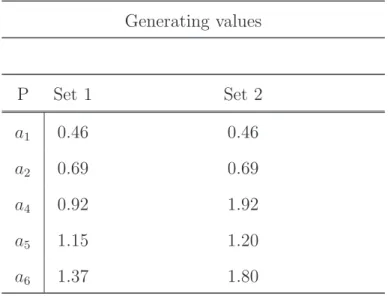
Table 2.1 presents the generating parameters employed in parameter set 1 and 2. Note
that for both parameter sets the only difference is the item parameters, with the structural
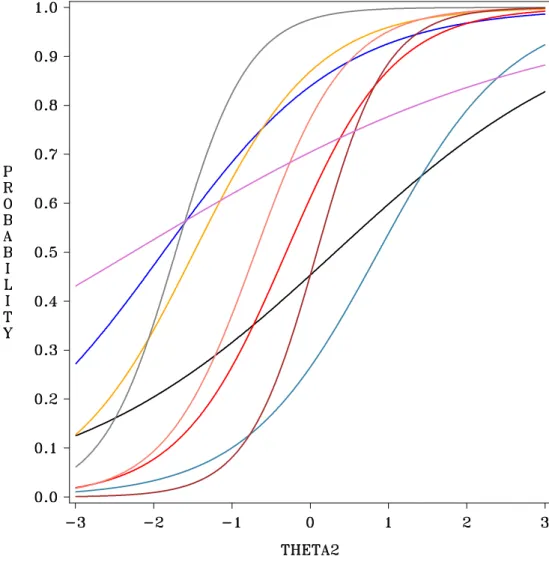
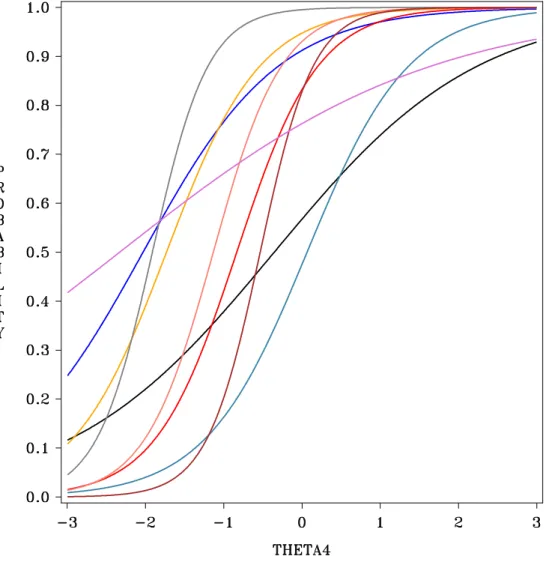
model parameters being fixed across sets. To characterize the difficulty range effect, ICC
plots for the two sets are plotted for each time-point. For ease of interpretation, the
ICCs are based on standardized parameters, and not the raw parameters listed in Table
2.1. The raw parameters were converted to the standardized metric using the following
procedure: Given
ϕkt=akt(θt−bkt) | θt ∼N(µt, σt2), (2.2)
I can obtain a standardized expression forϕkt under θt⋆ ∼N(0,1) by a Gaussian change
of variable function. Let
θ⋆t =
θt−µt
σt → θ
⋆
t ∼N(0,1), (2.3)
then I can express
ϕ⋆kt=a⋆kt(θt⋆−b⋆kt)| θt⋆ ∼N(0,1), (2.4)
where
a⋆kt=akt∗σt and b⋆kt= bkt−µt
σt . (2.5)
As can be seen in the ICC plots for both sets, the generating procedure succeeded
in producing data which are representative of longitudinal studies of substance abuse or
internalizing behavior, in which the phenomenon of interest is rarely observed early on
and items are consequently difficult to endorse and not strongly discriminating, while
later in observation the phenomenon is more common and items appear less difficult
but more highly discriminating. Though both parameter sets were reflective of this
process, they differed in the range of θ measured by the scale. The first parameter set
was representative of a scale which measured a much more narrow range of the latent
construct, while the second parameter set measured a much broader range of the latent
expanding the range of the latent construct being measured resulted in a sparseness of
2.0.9 Implied Moments
The generating parameters given in Table 2.1 coupled with the coding of λ can be
used to calculate the implied moments of θ. As stated, the implied mean vector may
be calculated as µθ = λµη and the implied covariance matrix may be calculated as
Σθ=λτηλ
′ +ψ.
This resulted in
µθ=
1.392 1.892 2.392 2.892
(2.6)
and
Σθ =
1.34 − − −
0.7157575 1.6230301 − −
0.761515 0.9072725 2.1060601 −
0.8072725 1.0030301 1.1987876 2.7890902 , (2.7)
with corresponding correlation matrix
Rθ=
1 − − −
0.4853446 1 − −
0.4533052 0.490726 1 −
0.4175769 0.4714324 0.4946244 1
. (2.8)
Because the structural parameters were held fixed across parameter sets, the implied
moments given here are the same for both parameter sets.
2.0.10 Sample Size Manipulation
All cells of the simulation were examined under two fixed sample sizes: N = 750 and
N = 3000. These sample sizes were chosen in order to minimize optimization problems
for WLSMV estimation under the wide difficulty range condition and because they were
representative of the large samples common in IRT applications. The lower sample size of
N = 750 was selected so as to be representative of what we considered to be a minimally
2.0.11 Non-Convergence
For every cell of the design, non-converged solutions were identified. Within a model
and parameter set combination, replications were fixed across estimator within sample
size cells. Thus, 300 replications were generated when N = 750 and each of these
replications was used in each estimator. Every unique replication which did not converge
across estimators was identified and within a sample size non-converged replications
were deleted and resampling of replications was conducted until a total of 300 converged
solutions were obtained in each sample size.
2.0.12 Improper Solutions
Following the work of Chen, Bollen, Paxton, Curran, and Kirby (2001) I
differ-entiated the importance of improper solutions (non-positive definite (NPD) covariance
matrices and negative variance estimates) based on the magnitude of the departure of
the parameter from its support. Thus, variance parameters for which estimates were only
slightly negative, or covariance matrices with eigenvalues that were trivially negative or
near zero were deemed to result from sampling variation, particularly when they were
associated with generating values which were themselves close to the boundary of
para-metric support. In addition, even when point estimates appear proper, the covariance
matrix may be degenerate, having a negative eigenvalue. Consequently, all variance
esti-mates were screened for degeneracy and replications having trivially degenerate solutions
were identified and described. These replications were not removed from analysis as this
could have induced a selection bias in the outcomes of interest. Rather, analyses were
conducted with results from all 300 converged replications. However, in order to assess
the potential impact of the degenerate solutions, sensitivity analyses, in which models for
bias were re-run omitting replications with improper solutions, were conducted to assess
CHAPTER 3
Results
To more clearly distill the experimental manipulation, and the fractional design
em-ployed, effects of interest related to sample size, estimator, model, and difficulty range
width are outlined in Table 3.1. This table also reflects the order with which results
are presented. First I will present results for Model 1 for the first and then second item
parameter sets, focussing on differences across sample size and estimator cells of the
design. This is then followed by the same presentation for Model 2. Convergence and
NPD solutions are discussed first. Bias and meta-model results are then discussed in
detail. Contrasts of interest in the meta-models include the sample size main effect, the
estimator main effects, and all sample size by estimator interactions. As detailed in the
results section, because patterns observed for RMSE did not differ from those for bias,
Table 3.1: Experimental Design
N = 750 & N = 3000
Estimator
Model Set Limited Information Full Information
1 1 W LSM V QP = 3 QP = 7
1 2 W LSM V QP = 3 QP = 7
2 1 W LSM V M CEM −
2 2 W LSM V M CEM −
3.1 Model 1 3.1.1 Convergence
Non-converged replications were encountered only when estimation was based on
full information with three quadrature points per dimension. Of the 300 replications
simulated per cell, 40 failed to converge when N = 750, and 17 failed to converge when
N = 3000 under item parameter set 1. Under item parameter set 2, whenN = 750 a total
of 27 replications failed to converge, and when N = 3000 a total of 5 replications failed
to converge. The converged solutions corresponding to these replications were deleted
from the 7 quadrature point and WLSMV solutions. An additional 100 replications were
generated in order to replace the failed or deleted replications. This produced solutions
corresponding to 300 identical replications across all analyzed cells.
3.1.2 NPD Solutions
Under item parameter set 1, when N = 750 a total of 36 unique replications had
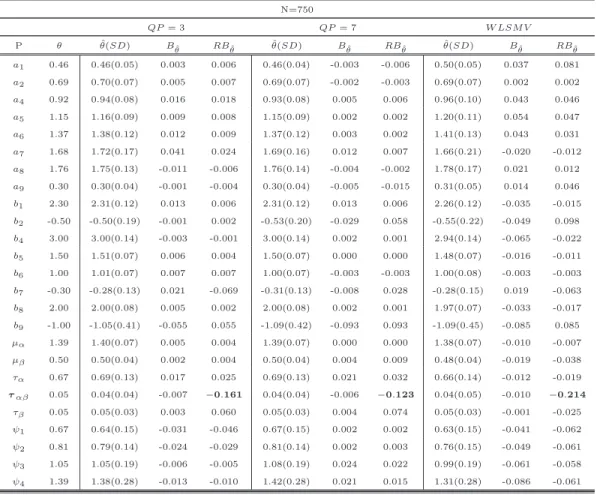
degenerate variance estimates. All estimates were associated with τη. A total of 8