DEVELOPMENT OF RESEARCH COMPETENCIES AMONG ACADEMIC LIBRARIANS
Nina L. Exner
A dissertation submitted to the faculty at the University of North Carolina at Chapel Hill in partial fulfillment of the requirements for the degree of Doctor of Philosophy in the School of
Information and Library Science.
Chapel Hill 2019
Approved by: Barbara B. Moran Kristine R. Brancolini Mohammad Hossein Jarrahi Scott Simkins
ABSTRACT
Nina Exner: Development of Research Competencies among Academic Librarians (Under the direction of Barbara B. Moran)
Academic librarians are often expected to do research. But most librarians take at most one class in doing research. Therefore, academic librarians may not be prepared for researching and publishing. This dissertation asked the question: How do academic librarians develop competencies necessary for success in their initial efforts to do research? Two subquestions emerged: (SQ1) how do academic librarians experience their early research projects, and (SQ2) what personal attributes and contextual factors help academic librarians succeed in their research?
This study interviewed academic librarians who had succeeded in research. Secondary interviews with peers and supervisors explored librarians’ research contexts. Cultural Historical Activity Theory (CHAT) was the theoretical lens for thematic analysis.
ACKNOWLEDGEMENTS
This dissertation, like so many, would not have happened without the support of the people in my life. I cannot name everyone who helped me throughout my doctoral experience, but so many deserve mention. I thank my sites and interviewees foremost, for their time and for their generous welcomes to their libraries. Each site I visited reminded me of why I love our profession. I also thank my pilot interviewees, who shared their experiences and generously tolerated my inexperience. One of the wonderful things about this research was how much I enjoyed the interviews and revisiting those conversations throughout the analysis.
A dissertation does not happen without guidance, and my committee provided the best: Barbara Moran, my advisor and committee chair, who gave unstintingly of her time and counsel on every imaginable topic; Barbara Wildemuth, without whom I would know nothing about qualitative research or theoretical grounding; Mohammad Hossein Jarrahi, who gave me so many wonderful insights into organizational dynamics and practice theories; Scott Simkins, who taught me about the world of faculty development; and Kristine Brancolini, whose tireless efforts to support research in librarianship have sustained not only me but the whole academic librarian community. Kris – along with Marie Kennedy, Lili Luo, Greg Guest, and all of the IRDL team – are the guiding lights of on-the-job research in academic libraries.
wrote, and tolerated my vagaries throughout. Thank you Gwen, I love you! My parents, Carol Exner and Frank Exner Little Bear, encouraged me throughout and warned me of roadblocks.
As a working librarian, I have benefited from amazing professional support. The BLINC section of the North Carolina Library Association are the most magnificent friends and
colleagues anyone could have. My coworkers at the F. D. Bluford Library was a fantastic source of encouragement. I thank them all! I especially want to acknowledge Nastasha Johnson for telling me even before the start of my degree that I could do it; John Teleha for his eternal patience and for mentoring me in my librarianship; and Stephen Bollinger for talking me off the cliff and reminding me that the dissertation needed to come before any of my other crazy project ideas. After I left North Carolina, I found another wonderful community at the Virginia
Commonwealth University libraries, where collegiality and supportiveness are daily bywords. I am fortunate to have found two such supportive libraries in succession.
And speaking of colleagues, the University of North Carolina School of Information and Library Science team are also wonderful. The UNC SILS faculty, staff, and doctoral students have been my research family. Thank you to every faculty member I’ve spoken to for generous sharing of expertise. Further thanks to my fellow docs and especially my writing partner Rachael Clemens who was willing to join me every week despite the commute and give me advice from the road ahead. Furthermore, the support of the UNC libraries for everything from the literature review to data visualization has also been essential throughout this process.
TABLE OF CONTENTS
LIST OF TABLES ... xiv
LIST OF FIGURES ... xv
CHAPTER 1: INTRODUCTION ... 1
1.1 Specific Aims and Research Question ... 3
1.2 Terms and Definitions... 4
1.3 Delimitations and Boundaries of the Study ... 5
CHAPTER 2: LITERATURE REVIEW ... 7
2.1 Practitioner-Research and the Academic Librarian ... 7
2.1.1 Why academic librarians research. ... 8
2.1.2 How academic librarians research. ... 10
2.2 Research Support in Academic Libraries ... 11
2.2.1 Challenges in librarian research. ... 13
2.3 Developing Research Competency among Non-Librarian Researchers ... 14
2.3.1 Graduate students’ research competencies. ... 14
2.3.2 Faculty productivity and research skills. ... 18
2.3.3.1 Researcher development. ... 22
2.3.3.2 Research development and research administration. ... 24
2.3.4 Themes from across the non-librarian researcher competency literature. ... 26
2.4 Cultural-Historical Activity Theory and Research Competency Development ... 28
2.4.1 Origins and history of CHAT. ... 29
2.4.2 Constructs of CHAT. ... 31
2.4.2.1 Subject, Object, and Outcome. ... 31
2.4.2.2 Tools. ... 32
2.4.2.3 Rules. ... 33
2.4.2.4 Division of labor. ... 34
2.4.2.5 Community. ... 35
2.4.3 Analytical concerns of CHAT. ... 35
2.4.4 CHAT and Known Researcher-Librarian Supports and Challenges. ... 37
2.5 Conclusions from the Literature ... 39
2.6 The Research Question ... 40
CHAPTER 3: METHODS ... 42
3.1 Participants ... 43
3.2 Site Visits ... 45
3.3 The Primary Interview ... 46
3.4.1 Peer Interviews... 48
3.4.1.1 Researcher peers. ... 48
3.4.1.2 Non-researcher peers. ... 49
3.4.2 Supervisor interviews... 49
3.5 Focus group ... 52
3.6 Data Analysis ... 52
3.7 Researcher Perspective and Biases ... 56
CHAPTER 4: FINDINGS AND DISCUSSION ... 59
4.1 Organization and Summary of Analysis ... 59
4.2 Subject: The Emerging Researcher-Librarian ... 62
4.2.1 Subject - Attitude and affect: Librarian feelings towards research. ... 63
4.2.1.1 Subject attitude and affect – Research fear, discomfort, and uncertainty. ... 65
4.2.2 Subject - Identity. ... 67
4.2.2.1 Subject identity – History and the flow of time. ... 70
4.2.3 Subject - Mindsets and habits of mind: Thinking about research. ... 71
4.2.3.1 Subject mindset – Hiring for mindset: The search for potential researchers. ... 72
4.2.3.2 Subject mindset – Mindfulness. ... 73
4.2.3.3 Subject mindset – Momentum and progress. ... 75
4.2.3.4 Subject mindset – Strategic thinking about research. ... 77
4.2.4.1 Subject motivation – Extrinsic motivators. ... 81
4.2.4.2 Subject motivation – Intrinsic motivators. ... 84
4.2.5 Summary: Subject ... 84
4.3 Object: Researching ... 85
4.3.1 Object - Distinguishing among research Objects. ... 87
4.3.1.1 Object – Distinguishing output products. ... 88
4.3.1.2 Object – Case studies as a form of practice-based research. ... 90
4.3.1.2.1 Object – Community-built attitudes towards study types and products. ... 91
4.3.2 Object - The research study process. ... 95
4.3.2.1 Object - Activity process: The stages of research Activity... 97
4.3.2.1.1 Object – The idea. ... 98
4.3.2.1.2 Object – Literature review. ... 102
4.3.2.1.3 Object – Design... 104
4.3.2.1.4 Object – Data collection... 105
4.3.2.1.5 Object – Analysis. ... 106
4.3.2.2 Object – Study to product. ... 110
4.3.3 Object - Understanding and uncertainty about research Objects. ... 112
4.3.4 Summary: Object ... 115
4.4 Tools ... 116
4.4.2. Tools - Familiar everyday tools. ... 119
4.4.3 Tools - Time management and organization tools. ... 121
4.4.4 Tools - Understanding new tools. ... 122
4.4.5 Summary: Tools ... 124
4.5 Rules ... 124
4.5.1 Rules - Employment rules: Continuing contracts, tenure, promotion, faculty status. ... 125
4.5.2 Rules - IRB and compliance rules. ... 127
4.5.3 Rules - Learning the rules of the study process and the dissemination process. ... 128
4.5.4 Rules - Resource and support procedures. ... 129
4.5.5 Summary: Rules ... 132
4.6 Division of Labor ... 132
4.6.1 Division of labor - Effects of and on the library’s division of labor... 134
4.6.2 Division of labor - Finding ways to create overlap between research and librarianship. ... 136
4.6.3 Division of labor - Time management and organizing tasks. ... 137
4.6.4 Division of labor - Working with co-authors and teams... 139
4.6.5 Summary: Division of Labor ... 141
4.7 Community ... 142
4.7.1 Community - Administration’s role ... 144
4.7.2.1 Community – Co-authoring and the library Community. ... 146
4.7.2.2 Community – Library peers and other ways in which libraries collaborate around research. ... 148
4.7.3 Community – Campus colleagues and subject departments. ... 150
4.7.4 Community - Family and friends. ... 151
4.7.5 Community - Library school and academic backgrounds. ... 152
4.7.6 Community - Mentors (formal and informal). ... 154
4.7.7 Community - Networks in the profession. ... 156
4.7.8 Community - The organizational community and support. ... 158
4.7.8.1 Community – Supervisory encouragement. ... 159
4.7.8.2 Community – Peer support. ... 161
4.7.8.3 Community – Referrals and the broader community. ... 164
4.7.9 Summary – Community. ... 165
4.8 Outcomes ... 165
4.8.1 Outcomes - Reputation building. ... 166
4.8.1.1 Outcomes – Library reputation. ... 168
4.8.1.2 Outcomes – Personal reputation. ... 170
4.8.1.2.1 Outcomes – Personal reputation on campus. ... 170
4.8.1.2.2 Outcomes – Personal reputation in the profession. ... 171
4.8.4 Summary: Outcomes ... 178
4.9 Chapter summary ... 178
CHAPTER 5: CONCLUSIONS ... 180
5.1 Theoretical Representation of the Activity of Academic Librarians’ Researching ... 180
5.1.1 Cultural-Historical Activity Theory (CHAT) and Academic Librarian Researching Activities ... 181
5.1.1.1 Contradictions and tensions in the nature of the Object of researching. ... 181
5.1.1.2 Fractional navigation of the Zone of Proximal Development. ... 183
5.1.2 Constructs in librarian researching ... 187
5.1.2.1 Subject... 188
5.1.2.2 Object and Outcome. ... 190
5.1.2.3 Tools. ... 192
5.1.2.4 Rules. ... 193
5.1.2.5 Division of Labor. ... 194
5.1.2.6 Community. ... 195
5.1.3 Theoretical Summary and Implications. ... 196
5.2 Practical Implications: Strategies for Success ... 199
5.2.1 Librarian strategies for developing research skills. ... 202
5.2.1.1 Understand. ... 202
5.2.1.2 Simplify... 205
5.2.1.3 Control. ... 207
5.2.1.4 Act. ... 208
5.2.1.5 Summary of librarian strategies for developing research skills ... 209
5.2.2 Library strategies to support librarian scholarship. ... 210
5.2.2.1 Create appropriate policies. ... 210
5.2.2.2 Establish visible administrative support for a pro-research environment. ... 211
5.2.2.3 Build communities that promote supportive relationships. ... 213
5.2.3 Summary of practical implications. ... 214
5.3 Limitations of This Study ... 216
5.3.1 Sample bias and sample limitations. ... 216
5.3.2 Organizational transition experiences. ... 217
5.4 Suggestions for Future Research ... 217
Appendix A: Participant Solicitation E-mail ... 222
Appendix B: Screening Survey ... 224
Appendix C: Primary Interviewee Interview Schedule ... 226
Appendix D: Non-researcher Peer Interview Schedule ... 230
Appendix E: Supervisor Interview Schedule ... 232
Appendix F: Focus Group Instrument ... 234
LISTOFTABLES
Table 2.1: Alignments of known supports and barriers with CHAT constructs ... 37
Table 4.1: Themes and example codes for the Subject construct ... 63
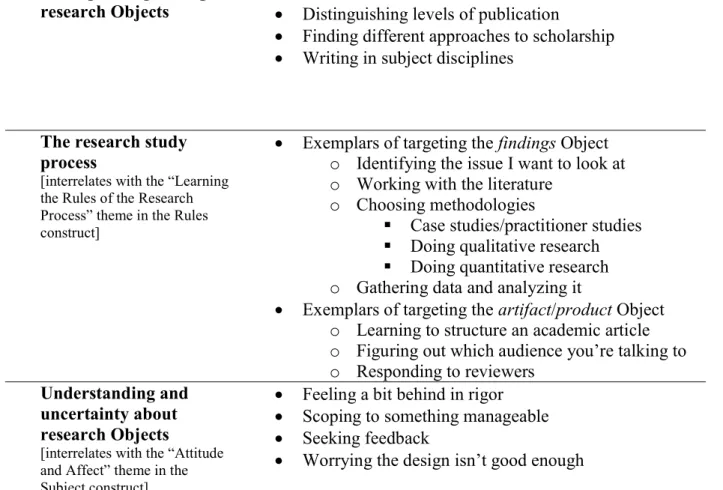
Table 4.2: Themes and example codes for the Object construct ... 87
Table 4.3: Themes and example codes for the Tools construct ... 116
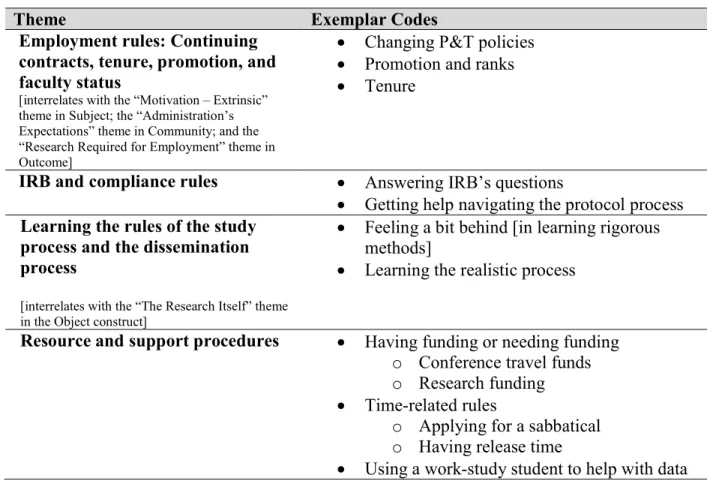
Table 4.4: Themes and example codes for the Rules construct ... 125
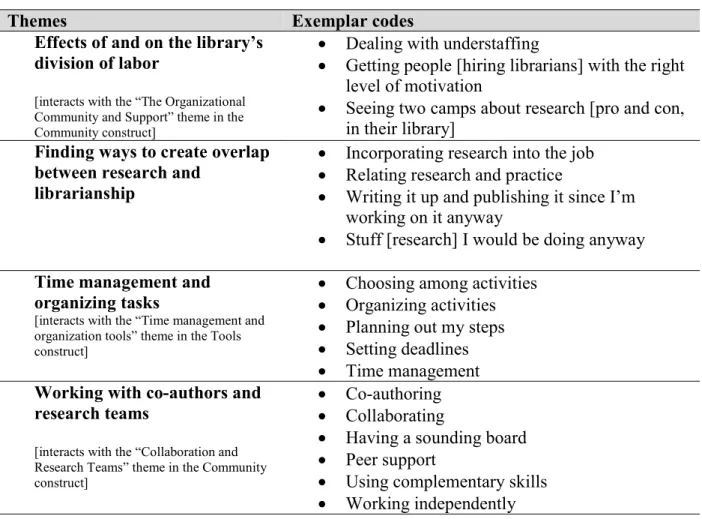
Table 4.5: Themes and example codes for the Division of Labor construct ... 134
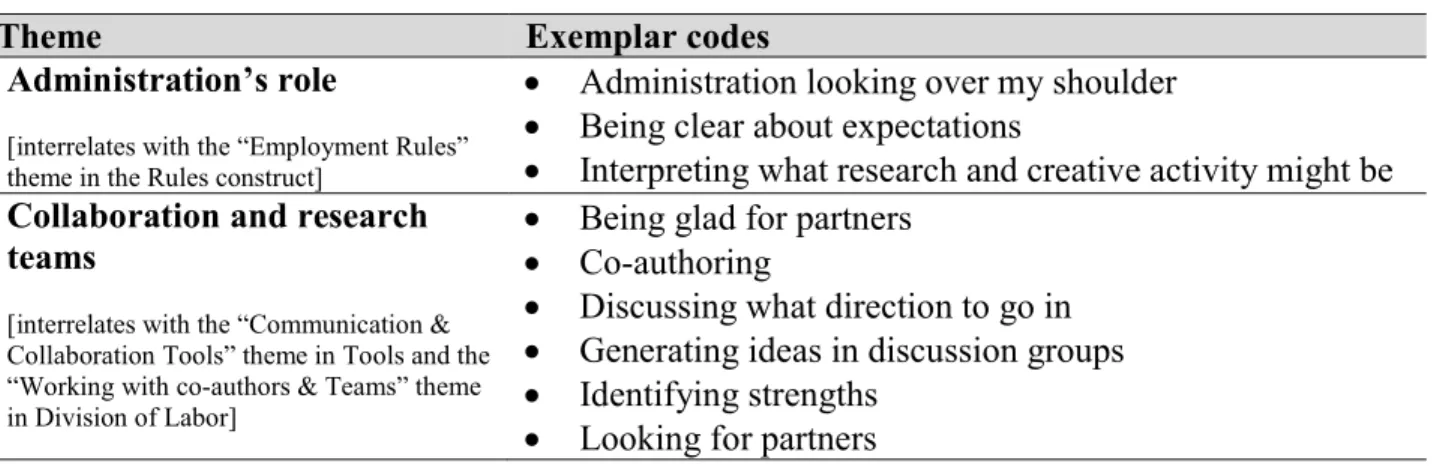
Table 4.6: Themes and example codes for the Community construct ... 143
LISTOFFIGURES
Figure 2.1: Constructs of Second-Generation CHAT (Engestrom, 1999; Wilson, 2013) ... 31
Figure 4.1: Summary of themes and constructs in the researching activity ... 61
Figure 4.2: Dimensions of the Division of Labor of academic librarians' research ... 142
Figure 5.1: The Zone of Proximal Development --- Development by navigating uncertainties ... 184
Figure 5.2: Breaking up the Zone of Proximal Development into smaller uncertainties for navigability ... 185
Figure 5.3: Fractionally navigating the ZPD with partial development in each attempt ... 186
Figure 5.4: Model of academic librarians' Researching Activity ... 188
CHAPTER1:INTRODUCTION
Conducting research is challenging. Learning to conduct research is even more
challenging. Academic librarians have many reasons to learn to conduct research, but they have few strategies for success. There are no established models that show how professional librarians can learn to conduct good research while in the library workplace. The literature shows the need for librarian research. It also shows the frustrations of learning to be a researcher-librarian. But the literature offers mostly anecdotal solutions. There are only a few studies on how librarians can best address their research frustrations and achieve success in research (e.g. Ackerman, Hunter, & Wilkinson, 2018; Booth, 2011; Fennewald, 2008; Hoffmann, Berg, &
Koufogiannakis, 2015, 2017; Kennedy & Brancolini, 2012, 2018). However, existing studies are often based on anecdotal literature, studies focused on specific programs or institutions, or broader surveys which were in turn developed based on either anecdotal literature or limited-scope data. Furthermore, there are few evidence-based models existing that might be used to construct a survey without these limitations. Little is really known of the experiences and process of reaching research success.
To begin to solve the challenges facing would-be academic researcher-librarians, it is necessary to understand how academic librarians experience beginning to research. While many academic librarians support research activities, especially of students and faculty, these support roles do not involve the full research cycle. Knowing about research does not appear to provide knowledge on how to do research. The frustrations voiced in the literature attest to that
Academic librarians have many research-related skills. Typical academic librarian activities include data management, copyright assistance, and training students on working with the literature. So, some essential parts of the research process are familiar to librarians. Yet, these skills do not appear to suffice for academic librarians to become researchers. One possible reason is that librarian research support skills focus on different parts of the process than faculty
researchers focus on. Student literature reviews, which librarians work with the most, are subtly different than literature reviews for original research. Planning for data management may give insight into data structures but not into data collection and analysis. It may be that librarians practice research support in ways that are too different from how original research is practiced.
Another possibility is that there is more to research than an accumulation of skills. Looking at other researchers’ development experiences, this seems to be true. Becoming a researcher is more than acquiring a series of straightforward skills. Being a researcher involves a change in mindset and identity. Learning to research requires integrating diverse skills into a whole that is larger than its parts.
Researchers usually undergo an experiential process of integrating skills into a greater whole that transforms their mindset. However, this experiential process is usually a dedicated process. The most common time this occurs is during doctoral education. Sometimes it also occurs during mentored faculty development experiences. But there are few discussions of how this complex integration can occur for professionals like librarians while they are working in their usual daily professional roles.
and how successful researcher-librarians navigate them, then better supports could be put in place. Systems could be created to encourage researcher-librarianship. The resulting successful researcher-librarians would be better equipped to produce effective, accurate, practice-informed research. The librarians, their libraries, and the profession would benefit from the proliferation of improved research among academic librarians.
1.1 Specific Aims and Research Question
This study investigated the central question: How do academic librarians develop
competencies necessary for success in their initial efforts to do research? Based on the responses and experiences of the participants, two subquestions emerged: (SQ1) how do academic
librarians experience their early research projects, and (SQ2) what personal attributes and contextual factors help academic librarians succeed in their research?
This question demands a look at the contextualized experience of the new researcher. Although development into being a researcher is an individual process, it does not happen in isolation. The internal process of integrating research skills and identity to achieve success in research is connected to the more external realm of professional practices, being mentored, and other challenges and supports. Challenges might be internal barriers to comprehension,
Research is part of academic librarianship, but librarians are frustrated when they do not know how to do research. That is a serious problem, which this research hopefully begins to address. This study is intended to create a better view of how librarians, libraries, and the profession interact to hinder and help research competency. These insights suggest better
supports and strategies for would-be researcher-librarians to develop successfully as researchers. 1.2 Terms and Definitions
Academic librarian: A librarian practicing his/her professional librarianship in a higher education environment. Academic librarians may be found in community and junior colleges, colleges, or universities. The expectation of research productivity is most common among university librarians, but any academic librarian may have reasons to pursue research.
Activity theory: Unless otherwise specified, refers specifically to Engeström’s second-generation cultural historical activity theory (CHAT)
Cultural-Historical Activity Theory (CHAT): A theory, grounded in the Vygotskian school of thought, which focuses on activity as the main organizing and learning process of human beings. In this study, second generation activity theory (Engeström, 1999; Engeström, Miettinen, & Punamäki, 1999) is the primary theoretical framework.
Development: A process of learning and growth by working through complex uncertainties and successfully navigating those uncertainties.
research papers” where students come to the library to find and work with existing knowledge in support of a perspective or conclusion.
Research competencies: The attitudes, skills, knowledge, and other personal attributes needed to conduct original research.
Research productivity: The creation of a concrete, shareable artifact of original findings. Common artifacts of this kind include journal articles, book chapters, and conference posters or presentations.
Researcher-librarian: A practitioner-researcher of librarianship, who is skilled and productive both as a librarian and as a researcher. Many libraries use “faculty” to specify librarians who are expected to be researcher-librarians (as compared to “subject faculty” for non-library academic faculty). Interview sites used terms such as scholar-librarian, librarian scholar, faculty archivist, and faculty librarian.
Researching: The Activity, in the CHAT sense, of doing research and achieving some element of research productivity.
1.3 Delimitations and Boundaries of the Study
those are the core audiences that librarians think of when planning the creation of rigorous original research.
CHAPTER2:LITERATUREREVIEW
There are not many in-depth studies in the literature on librarians’ research. A few key items like Fennewald’s (2008) study of supports at Penn State’s library are focused on large institutions with high budgets. Although he found that internal and organizational motivation factors were both meaningful, and that release time was a valuable support, the specific details are not necessarily transferrable to libraries with smaller budgets or less control over their librarians’ status expectations. Broader studies such as works by Kennedy and Brancolini (2011) and Brancolini, Kennedy, and Chavez (2014) on research skills and research confidence have transferability and validity for a range of academic libraries. But these focus on librarians in a specific career stage, and with the resources of a training institute behind them. A gap exists around the topic of librarians’ needs and libraries’ support options across a wider range of libraries. Libraries with fewer resources, and those where research requirements come as a campus mandate, are in particularly vulnerable positions. To keep these libraries represented in the evidence, an understanding is needed about how a broad range of librarians’ experience research.
2.1 Practitioner-Research and the Academic Librarian
in their research (Hinton & Fischer, 2008; Jarvis, 1999; Shaw & Lunt, 2012). They perform their research on-the-job and balance their research with other professional obligations.
Practitioner-research uses many of the same methods employed by more traditional researchers. Yet practitioner-researchers have different backgrounds and contexts based on their practice. These backgrounds often do not prepare practitioner-researchers to perform research. There are works on the benefits of practitioner-research that include primers on research for practitioners (e.g., Jarvis, 1999). Such advice may be useful for practitioners and librarians trying to figure out research for themselves. Yet, in many fields the practitioner-research lacks rigor. Among librarians, practitioner-originated research is often not rigorous (Hildreth & Aytac, 2007). Librarian practitioner-research is being published, but publication alone does not ensure research quality. This points to some disconnect in librarian research.
2.1.1 Why academic librarians research.
employment. However, the tenure process is stressful, and many pre-tenure librarians have strongly negative views about it (Silva, Galbraith, & Groesbeck, 2017). Pressure to publish is one of the top challenges for faculty-librarians, especially before tenure is achieved (Galbraith, Garrison, & Hales, 2016; Hosburgh, 2011). Faculty status is a top determinant of publication rates (Blecic, et al., 2017; Galbraith et al., 2014). So there is a very tight connection between research for publication and tenure as a motivator for research, but this connection also highlights how challenging librarians find research competency development.
However, faculty status is not the only reason to research. Professionalism motivates many librarians to research and publish. Librarianship as a profession benefits when librarians publish (Etches-Johnson, 2004). Pursuing high-quality original research helps hone librarians’ understanding of research and therefore their ability to support research (Lamothe, 2012; Snyder-Broussard, 2016). Research by librarians helps ensure that the pressing interests of working professionals – which are different from those of library school faculty – are well represented in the literature (Brancolini, 2016; Chang, 2016; Abbas et al., 2016). Research by practitioners is also a way to improve the relationship between research and practice (V. Wilson, 2013). To harness research for the improvement of practice, Evidence-Based Librarianship and Information Practice (EBLIP) has emerged in the profession (Eldredge, 2012). The EBLIP movement has encompassed a wide range of research-, data-, and assessment-based approaches to the
profession, and represents a way of systematically proving and improving librarianship through the use of research (Eldredge, 2013, 2014; Gordon, 2009; Miller er al., 2017). EBLIP is
professionally-focused and may or may not relate to publishing or presentation production (Millet et al., 2017). However, the methods and tools used for library research, EBLIP, and assessment have many similarities (Savage, Piotrowski, & Massengale, 2017). So there is often overlap in the area of skills development and development challenges.
So whether for professional idealism or employment practicalities, academic librarians have good reasons to do research. Librarians benefit professionally from doing research. Their libraries benefit from the skills and recognition that come with having researcher-librarians. And the profession as a whole benefits from practitioner-engaged research adding to the knowledge base of the profession.
2.1.2 How academic librarians research.
There is little ground to describe a dominant methodology for librarians’ research (Risso, 2016). Librarians tend to draw on the social sciences for the knowledge core of information behavior research, but librarians have many interdisciplinary interests as well. For a long time, librarian research was dominated by a much-bemoaned “how we done good” style of activity report (Hildreth & Aytac, 2007). Fortunately perhaps, the research grounding of studies by academic librarians has been growing. Recent librarian research has moved strongly to more evaluative-quantitative, research-oriented quantitative, and rigorously analytical qualitative articles (Slutsky & Aytac, 2014).
education, with economic pressures allowing less time for research in many institutions, but select institutions putting heavy pressure on faculty and others to produce more research.
Survey research is a particularly common research technique among librarians, often written up using descriptive statistical summaries (Slutsky & Aytac, 2014). It is arguable that surveys are overused or at least under-rigorous (Halpern, Eaker, Jackson, & Bougin, 2015). The popularity of surveys is probably because of the low barrier to entry and relatively
straightforward analysis. Descriptive statistics do not require librarians to learn sophisticated quantitative software, and surveys can be created with simple, familiar tools or even given on paper.
2.2 Research Support in Academic Libraries
Organizational support and training are essential if librarians are to engage in research (Miggie, 2016). Libraries have tried a variety of approaches to support and increase research productivity (Miggie, 2016; Hoffmann et al., 2015 Ibegbulam & Jacintha, 2016; Miggie, 2016), but reports of the success of these programs are not systematic. A variety of librarians have reported on the advantages of peer-based support groups for facilitating librarians’ research and writing efforts (Brannock, Miao, & Zelner, 2006; Campbell, Ellis, & Adebonojo, 2011; Cirasella & Smale, 2011; Exner & Houk, 2010; Sullivan, Leong, Yee, Giddens, & Phillips, 2013). The community around a prospective researcher plays an essential role in support. Collaboration and mentoring are both considered to be valuable factors in encouraging research publication
proven effective and offers more in-depth support than peer support alone (Fallon, 2010). More unusual but also effective has been McMaster University’s “Faculty Member in Residence” mentoring program to connect non-library faculty to librarians to help mentor the library faculty in research (Detlor & Lewis, 2015).
There are a variety of institutional structures and supports that have been found to contribute as well (Hoffmann et al., 2015). Many of these are more resource-intensive and organizationally-demanding support mechanisms, so they are only found in larger university libraries. Release time for research and writing – away from the 40-hour work week of the typical academic librarian – has been discussed as a valuable strategy for allowing librarians to concentrate on their scholarly work (Hill, 2005; Kenny & Tietjen, 1990). Unsurprisingly, most of the discussion of this strategy happened before the recent economic downturn.
2.2.1 Challenges in librarian research.
Barriers to research are concerning for all would-be researchers. Barriers are a
particularly serious issue for librarian organizations. Librarian faculty status by name only is the worst possible case; putting status in place by name but without the full rights and
responsibilities of that status can only do harm (Hosburgh, 2011). High-producing librarians generally have supports available to them that are comparable with other campus faculty (Walters, 2016). Advocating for tenure at research universities requires or at least strongly implies advocating for research. As long as libraries expect their librarians to perform research, they must support the performance of research. As long as library organizations and
professionals (e.g. Association of College and Research Libraries, 2012; Gillum, 2010) advocate explicitly or by implication for research, it is necessary to support performance of research.
In a general sense, the barriers are much the same as any faculty member experiences. The research culture of the university and the research culture of the library mirror each other (Walters, 2016). Academic librarians need time, support, mentoring, experience, and
infrastructural support. But because so much of the professional dynamic and background of librarians is different from those of other faculty, there is a sense that the challenges are different. There is also a sense that the challenges are not being adequately supported and developed. This development need is a significant part of the motivation for this study.
2.3 Developing Research Competency among Non-Librarian Researchers
Of the attention that has been paid to these issues in the library literature, none is of a research-based or generalizable-theoretical nature. We have mostly anecdotal discussions of on-the-job librarian research skills support. Having shown that academic librarians have an interest in developing as researchers, I must turn next to other areas to look for research or theory on the emergence and development of these skills. Faculty development, graduate education, scientific industry, and R&D management have all looked a little at issues of research competency
development.
2.3.1 Graduate students’ research competencies.
In the end, I determined that students’ research learning must be included in this
discussion. Only in graduate students’ emergence do we see the full course from non-researcher to producer-of-original-research played out. And only in the study of graduate students’
development as researchers do we see an effort at (potentially) generalizable theory generation of how people become researchers. So it is incumbent to at least consider this area of study.
Considering this area of study, here, means considering whether these potentially generalizable theories suggest valuable insight on developing research competencies in other contexts.
A particularly interesting view is Gardner’s (2008) exploration of becoming an independent researcher in doctoral education. The Gardner model has been applied to other support studies and program development with good success (e.g. Holley & Caldwell, 2012; Murray & Cunningham, 2011). Gardner’s (2008) approach is grounded in observed patterns of student’s needs over time, and finds that research competency develops across personal,
relational, and programmatic dimensions over time. Interesting insights from this are that there is more than just skills-based (programmatic) development needed for eventual success. Doctoral students must also develop into a successful relationship with their advisor and peers, and then transition again into independence. This issue of the transition to independence ties closely the concept of self-regulation, which Kelley and Salisbury-Glennon (2016) have found to be a major factor in whether doctoral students complete the dissertation or leave their program at the All But Dissertation stage. The dual set of transitions – moving into a successful advising relationship and then transitioning out of it into research independence – may give some insight into librarians’ mentor/mentee relationships as well. The personal layer is also critical, as
and external relationship transitions is highlighted in Gardner’s (2008) study. One could envision a mentoring / training program based on this model that has pre-program preparations, then mentoring and training in research skills, then a transition to independence and support for researcher identity formation among professionals. Many of the details would change but some of the fundamental concepts in the process might apply. Murray and Cunningham (2011) applied parts of the Gardner approach to faculty development retreat planning. One could imagine a similar training program supporting librarians, or at least using these insights to help better inform mentors in how to support research mentees. This could be a good model for librarians’ applied support. Having a follow-through stage to support the transition to independence could be particularly important in such a design, and is incorporated into one such training for
librarians, the Institute for Research Design in Librarianship, (Brancolini et al., 2014).
Other studies of graduate student learning have focused less on psychosocial changes and more on psychological ones. Synthesis of research skills, specifically the complexity of
synthesizing skills, features prominently. Several of these center around research as a “threshold concept.” The theory of threshold concepts is a relatively recent approach by Meyer and Land (2003, 2005, 2006) to analyzing how learners learn complex concepts. At least two groups of scholars have, independently, taken approaches to applying the threshold concepts approach to graduate student research development. Threshold concept theory, generally, proposes that there are troublesome concepts throughout learning, and that the process of internalizing these
depreciation in accounting (Meyer & Land, 2005), as well as the concept of information literacy in library science (Townsend, Brunetti, & Hofer, 2011).
Tying doctoral students’ research experiences to librarians’ research experiences is challenging. The contexts are too different. But perhaps librarian researchers have broadly parallel needs. If identity as a researcher is needed, then it becomes important to know what leads a librarian to internalize a researcher identity. If movement to a mentored relationship and then beyond that to a peer relationship is needed, there are parallels that can be understood and created for junior librarians. And finally, if skills-synthesis or “synergy” is needed, then it becomes important to understand how librarians experience the road to integrating scattered research skills. Guidance over barriers, perseverance at intellectual exploration, and integrative experiences are keys in the threshold-crossing literature that could play roles in researcher-librarians’ experiences. In fact, they may provide the key to why academic librarians face challenges in doing research despite their extensive expertise in supporting diverse aspects of research in higher education.
2.3.2 Faculty productivity and research skills.
Another area of thought on developing researchers comes from the faculty development literature, which generally concentrates on the improvement of teaching. However, the principles of faculty development in the United States include all 3 common U.S. pillars of faculty life: teaching, research, and service. The field of research around faculty development includes a branch of study on research productivity. The branch on research productivity has, hitherto, tended to focus on motivation and productivity. Equity across sociodemographic groups and general study of faculty barriers to productivity have also been themes in this literature.
Since some librarians are also faculty, faculty development should be relevant to librarian development. But librarians experience expectations differently than teaching faculty and
2014). Therefore, only certain parts are likely to be relevant. The most promising aspects seem to be the focus themes: motivation, productivity, and sociodemographic equity. On a practical level, productivity is the major concern of librarian organizations and the profession as a whole. So studies of faculty productivity growth may provide some suggestions.
There is tension between two motivational approaches to faculty productivity: the intrinsic and the extrinsic. The intrinsic school of thought is most notably represented by faculty development pioneers Blackburn and Lawrence (1995) in their groundbreaking book, Faculty at Work. They found that faculty members’ intrinsic sense of motivation was the strongest
determinant of productivity, but was then mediated and moderated by many internal and external factors. In the intrinsic school of thought, motivation and support for productivity is key and is fundamentally determined by the faculty member. Organizational factors affect productivity mainly by working on or through the individual faculty member (Blackburn & Lawrence, 1995; O'Meara, Terosky, & Neumann, 2008). The strength of these models is in their explanatory value. They help to explain variance among faculty, as well as why sociodemographic
backgrounds (such as gender, race, and previous experience) can lead to personal challenges in the academy. The sense of being an “impostor” that racial and gender minorities may experience affects their intrinsic state, and they may require support to overcome these motivational
challenges. Intrinsic factors of motivation, preparation, and confidence are then mediated by external factors of fit, communication, and support. By extension this approach shows how the academy fails to equip and accommodate many sociodemographic groups before they become faculty.
other than at the national, systemic level. But there is considerable evidence in the intrinsic school that poor support can stifle even the most intrinsically gifted faculty member. If intrinsic strength can be stifled or undermined, it stands to reason that it must be possible to nurture and uphold it as well. O'Meara et al. (2008) use this logic to study how to nurture intrinsic motivation and reduce these stifling effects. Their study found that promoting faculty learning, sense of agency, and relationship-building all helped reduce barriers and allow motivated faculty to be productive. In the larger body of faculty development research – and the limited available data on researcher-librarianship – the determining versus mediating role of these supports becomes somewhat confounded.
There is another side to the motivational view of faculty productivity. Not all studies agree with early findings that view productivity as intrinsically driven and motivationally determined. When viewed from an organizational sociology perspective, productive
practical ways to improve researcher support and productivity throughout universities - particularly among medical faculty – is often based in these extrinsic views.
Intrinsic and extrinsic approaches disagree on the issue of what constructs are determinants and which are mediators. However, both approaches agree that a supportive environment encourages research productivity and an unsupportive environment stifles it. Anecdotally, the same appears to be true in academic libraries (Hart, 1999; Parker-Gibson, 2007). One of the few empirical studies of an academic library and its productivity found that intrinsic motivation, organizational mandate, and organizational support all played important roles in determining scholarly productivity (Fennewald, 2008). It is difficult to translate this to a specific finding, but it looks like motivation needs to be added to the larger view of research competencies and development.
Faculty development studies apply to very specific research positions and research environments. Nevertheless, these studies - as well as the highlighted tension between intrinsic motivation and extrinsic organizational culture - offer one of the largest bodies of research on encouraging research competencies across many kinds of researchers. These segue naturally into the broader organizationally-oriented approaches to developing organizational or even national capacity to encourage research and support research competency.
2.3.3 Organizational approaches: Research development and researcher
development.
themselves; the subjects and levels of analysis may or may not be researchers. These
organizationally-focused studies aim for an improved researcher environment, and so offer the potential to address contextual issues and barriers to librarians’ development as researchers.
Applying organization-level analyses to an individual product poses challenges though. As the discussion has already shown, research has many group determinants but it occurs
individually. From a practical perspective it makes sense to look at the organization’s role in the individual’s performance. That practical perspective drives these pragmatic fields of discussion and study. However, from an analytical view the relationship between organization and
individual is not well understood. Complex organizations with sophisticated and diverse organizational members represent serious challenges in individual and organizational sensemaking and by extension in the analysis of that sensemaking (Gioia, Thomas, Clark, & Chittipeddi, 1994; Weick, 1995). So while there is a useful, practical logic to this hybrid perspective, it is still relatively difficult to harness from an analytical perspective.
2.3.3.1 Researcher development.
researcher, (3) Research governance and organization: Knowledge of the professional standards and requirements to do research, and (4) Engagement, influence and impact: The knowledge and skills to work with others to ensure the wider impact of research (Vitae, 2010). Each domain then has a list of specific skills that can be demonstrated. Skills lists like the RDF or industry studies of researcher skills (e.g., L’Association Pour l'Emploi des Cadres & Deloitte Consulting, 2010) provide a base for considering relevant skills among different researcher groups. They have advantages in terms of assessment and policymaking (Dear, 2010). But we must consider their applicability to librarian-researcher development. They probably do not apply fully. But the RDF (and related researcher development skills studies) have broad categories that add potential analytical strength. The RDF domains could be used broadly to frame dimensions of inquiry or analysis in a study of librarians as developing researchers. They also provide areas of specific skills to look at for creating training programs for librarians.
the RDF, and lead researcher development to be dominated by professional development practices as a whole (Evans, 2011a; Golovushkina & Milligan, 2012).
Considering this idea of researcher-as-profession is awkward with librarians as researchers, because they are already professionals-in-practice as librarians. The researcher development approach focuses heavily on a bench researcher as its ideal paradigm, as in the image of a professional scientist. But this is a very narrow focus that excludes researchers that produce knowledge from other contexts. The RDF aims to develop a faculty professionality as researchers. Faculty already have a profession as faculty. Therefore, a dualistic professionality is necessary to resolve this approach anyway. It leads to an important question, too, which it would be incumbent on this study to consider. Do researcher-librarians see themselves differently than other academic librarians? It is possible that there is a duality to their professional views (or some other professional difference) that distinguishes established researcher-librarians from academic librarians who are not researchers.
There are other broad conceptualizations emerging from the researcher development field. Gilstrap, Jaron, Milorad, and Buckley (2011) have discussed the idea of researcher vitality as a career development issue among researchers. They suggest that vitality – as a sort of
combination of personal energy and contextual support to maintain that energy – is a valuable construct for understanding why some research careers are sustained and some are not. This could be a promising concept for library administrators in sustaining researcher-librarians as well.
2.3.3.2 Research development and research administration.
capacity building. Whereas researcher development in the UK comes from a human resources perspective, research development comes from research administration, which in turn stems from the public administration field and perspective.
Research development is a nascent profession as well; its professional society, the National Organization of Research Development Professionals, has been in existence for less than ten years (National Organization of Research Development Professionals, 2016). Its professional and epistemological foundations in the research administration field makes it heavily focused on grant funded researchers and their needs. Research development is therefore quite conceptually far from academic librarianship. Nevertheless, its focus on institutions could help bridge the gap between individual librarians and library administrations. Research
This identity-formation step has not been discussed in the library literature; that may be a gap that shows why librarians do not always make that extra step to become established
researchers. Librarians who write one or two articles solely because of evaluation mandates may lack this sense of identity. The identity-formation step connects with the doctoral development process (discussed in 2.3.1 above). The idea of a post-training mentoring stage or some other post-writing-group follow-through presents itself as a way to cement librarians’ long-term identity as researchers.
The organizational-level views of supporting researcher competency offer some awkward but potentially useful ideas. Research development may be a useful lens on library policies. Researcher development may offer ideas for the profession. In both cases, they identify trends outside of libraries that the librarian community should be aware of and even connect with (as librarians in the UK have with the RDF) for supporting their constituents. But librarians should also consider these trends as potential sources of extra-library inspiration and even support for developing researcher-librarians.
2.3.4 Themes from across the non-librarian researcher competency literature.
Some surprising overlaps have appeared in the course of this discussion. These
commonalities point to some important dimensions of researcher competency development. In turn they inform this discussion of librarian-researcher competency development.
through different lenses, and evolve their view of the nature and process of research. There is also an aspect of “doing” or experiential and active participation in research competency. The existing evidence points to a need for active engagement in the transformational process of becoming a researcher. By doing research and engaging in the guided processes of research, the researcher gradually synthesizes the necessary skills and becomes a capable independent
researcher. The researcher must be an active and engaged participant. However, because there is a synthesis needed beyond skills, some guidance is also required.
Therefore, secondly, there are both relationship-building and relationship-changing experiences over the course of researcher development (Cusick, 2015; Gardner, 2008; Lee & Boud, 2003). It is necessary to create relationships which in turn create the researcher. But it is then necessary to transform those relationships to independent collegiality, in order to transform a novice researcher into a fully self-guided researcher. This is a difficult process, with all of the inherent complications of the mentor/mentee relationship and an additional process of navigating from mentee-ship towards independence at the end of the process, to become a researcher
capable of performing their own research. In doctoral education, this process is fairly well established and delimited through the dissertation process. But in the professional field there is no such delimitation. Without the structure of graduate education, finding a mentor is less guided than for doctoral students, and moving towards independence has no natural guidelines either. Furthermore, there is no set community of research practice, as there is in academic faculty life, for a researcher-librarian to move into and take up a role and position in. A professional
If communities of researcher-librarians form, that would be a potential support for socialization to support researcher competencies.
Socialization leads to a third important area: identity formation. Becoming a skilled faculty or industry researcher includes an internal transition to develop self-efficacy and psychological identity as a researcher (Black et al., 2013; Blackburn & Lawrence, 1995; Hemmings & Kay, 2010; Lambie & Vaccaro, 2011; Swenson-Britt & Berndt, 2013). Research ability and determination depends heavily on psychological factors of cognition, motivation, and identity (Blackburn & Lawrence, 1995; Golovushkina & Milligan, 2012; Hemmings & Kay, 2010; Pitcher & Åkerlind, 2009; Reybold, 2003; Vitae, 2010).
2.4 Cultural-Historical Activity Theory and Research Competency Development
As we have seen, social context plays an important role in researcher-librarianship. Many of the benefits of academic librarian practitioner-research are gleaned by the library or the profession. These organizations, therefore, have interest in and responsibility for supporting research. More importantly, the development of researcher competency is very dependent on the librarian’s context. External supports and challenges appear to be important parts of the
development process. Relationships and socialization are important, at least among more
traditional developing researchers, to successful researcher development. Therefore, this analysis needs a theoretical framework that puts a heavy emphasis on social contexts.
There are many theories that include contextual level. One concern particular to
practices as embodiments of meaning in human social life (Schatzki, von Savigny, & Knorr-Cetina, 2001). There is no unified approach to theorizing about practice, but the practice theories generally look at practices as depending on shared understandings which are embodied in action (Schatzki et al., 2001). Because research is an action, yet reflects both the agreed-on ideas of scholarship in higher education generally and (in this case) of librarianship in particular, this seemed like a valuable school of thought. Moreover, practice theories seemed especially suitable because of the community-built expectations and contexts that seem to be essential to this study. Finally, the complexity of developing as a researcher has led to a paucity of explanation in the dynamics of research learning. It appeared from the preliminary and sometimes
contradictory nature of the literature that it would be difficult to understand the detailed roles and relationships of the many forces that might challenge or support researchers’ development. When I was considering theories, I felt that I would need one with multiple layers but some clarity of operationalization to help guide my analysis. Yet, much of practice theory is of a more
philosophical nature, without specific operationalization of constructs. I identified one that I felt had a balance of complexity and clarity that might help me to untangle the many possible threads of librarians’ research stories. Furthermore, that one theory has a focus on uncertainty and
learning that seemed to suit this question well. And so, in this analysis I have chosen to apply Cultural-Historical Activity Theory (CHAT, or more informally, activity theory).
2.4.1 Origins and history of CHAT.
trait of CHAT as a theory is that it encourages the activity itself to be an analytical level, encompassing sub-activities and constructs that are traits of the activity or sub-activity. In CHAT, there is a separation between component actions and overall activities. Because complex activities are made up of many actions and each action has many influences, there are many ways for uncertainty to emerge and create challenges in trying to complete activities.
Since its very origins, CHAT has held that contextual culture and the developmental
history of an agent have fundamental influence over that agent’s activities. Sociocontextual
factors are considered to be essentially entwined with the individual’s behavior and
development. Agency in activity theory is generally placed within the individual. However, collectives and groups also hold the agency to act and develop and learn, and many later
applications of cultural-historical activity theory have placed the agency for development at the collective level (Engeström, 1999; Engeström & Glaveanu, 2012; Engeström & Kerosuo, 2007; Engeström, Kerosuo, & Kajamaa, 2007; Engeström et al., 1999).
Activity theory has many different pieces and variants. The version that I use in this analysis is second-generation CHAT. The core of this approach to activity theory is seven interrelated constructs: a subject, an object, and a set of tools or instruments; plus norms/rules, community, and the division of labo(u)r; all of which lead together to an outcome. The
organizationally-contextualized activities. Second-generation CHAT is therefore the most relevant to librarians within their library contexts.
2.4.2 Constructs of CHAT.
At the heart of CHAT is an Activity. The Activity is a practice defined by those who do it; that is to say that it is active and it is recognized as a unit of activity or practice by the Subject and Community who engage in it. Each Activity is seen to be made up of seven constructs, seen in Figure 2.1. The seven constructs interrelate and interinfluence. The Object is particularly important because it drives the Activity, but all of the constructs influence and control the whole of the Activity.
Figure 2.1: Constructs of Second-Generation CHAT (Engestrom, 1999; Wilson, 2013)
2.4.2.1 Subject, Object, and Outcome.
research, the Subject is an academic librarian and the Object is a research project or the driving target that the Subject defines the research Activity around. The Outcome of the research leads from the Object, and represents the more distal purpose of the Object.
Tools, Rules, Community, and the Division of Labor all influence and shape the subject, Object, and Activity overall. Mediation by tools of the Subject-Object relationship is a particular principle of CHAT, hearkening back to the Vygotskian origins of CHAT (T. D. Wilson, 2014). But all of the constructs influence the Subject and Object. In the Activity of research, the constructs have a variety of roles. They also influence and interact with each other.
2.4.2.2 Tools.
Tools are the physical or mental objects used to complete a task (Wilson, 2014). In the case of researcher-librarianship Tools might be surveys, interview recorders or chat platforms, statistical software, or other materials used in the process of collecting or analyzing data. The availability and options of Tools shape the activity, and may increase or limit the librarian’s research ideas by offering or removing options for how to carry out the research activity.
Collaborative work objects could also be important. These Tools may include cloud-based platforms such as Dropbox, Google Drive, and OneDrive. Means of communication are also possible collaborative platforms, such as video chat, phone, email, and instant messenger. More uncommon Tools such as shared brainstorming and shared literature review systems could also have a big impact on the librarian(s) doing research and the research being performed.
2.4.2.3 Rules.
Rules are the principles that control and direct an Activity (T. D. Wilson, 2014). Rules make themselves most evident among researcher-librarians in their control over extrinsic motivations: research requirements for tenure, reappointment, or promotion are the most obviously influential Rules. There are also Rules to how to conduct and disseminate good research such as guidelines for conducting meta-analyses, Rules for how to perform analyses or statistical tests, and Rules for how to write up and submit articles or presentations.
There are tacit Rules as well as explicit ones, such as informal organizational guidelines for how and when research should be embedded in the job. Even at the professional level, tacit Rules on the acceptability of “how we done good” reports as research have shifted and affected research expectations throughout the profession.
Rules similarly influence the subject and object, as well as the community. Community-related Rules for research include IRB training and procedures. These can influence the
2.4.2.4 Division of labor.
Division of Labor is the way that the work of the Activity and of surrounding Activities is segmented (i.e. divided); this Division can be across persons, resources, component tasks,
elements of the Object, or any other compartmentalization that the Activity must be split across (Engeström, Miettinen, & Punamäki,1999). One can see the influences from Marxist thought through Vygotsky and subsequent thinkers in the importance of the distribution of tasks and resources. Because an Activity must be active – mentally or physically – there is some work or forward momentum involved in the system. Because Activities are complex, the Activity has component tasks. The Object has component elements of physical or mental product; the Subject has only so many resources of time to dedicate to various Object components and Activity subtasks. Subjects can be teams instead of individuals, and must then divide time and work among multiple people as well. With many potential layers of complexity, the distribution and logistics of dividing the work of an Activity can become quite intricate and have considerable implications about techniques and feasibility in Activities, as well as power and resource implications.
The Division of Labor in the library affects the position of the research in the librarian’s larger work duties. It also affects the roles and expectations of community members such as supervisors and library administrators, as well as the departmental organization. These affect the researcher-librarian’s professional work most of all, but because practitioner-researchers’
might be fellow librarians, faculty, or student research assistants. The Division of Labor within research teams also affect the activity, subject, object, and community.
2.4.2.5 Community.
The Community is the larger group of people engaged with the Subject and Object, but not directly involved in this Activity (T. D. Wilson, 2014). They could be engaged in a similar Activity or in another Activity that connects with this Activity, or they could be connected to the Activity only through the Subject and/or Object. The Community influences and is influenced by the Subject and Object just like the other constructs. It also influences and is influenced by Tools, Rules, and the Division of Labor. That gives it a more complex position and set of relationships than less central constructs.
Community could include both the library and the larger campus Community. It could also include the profession as a whole, such as colleagues at conferences or neighboring institutions as well as librarians who consume the results of research. Community can also include the non-academic Community, particularly through friends and family. The breadth of the Community around a given librarian seems likely to have a large influence on their research. A librarian’s connections within the library, campus, and peers have effects on their research activities. The knowledge and suggestions available – or unavailable – are closely connected to the shape of the activity.
2.4.3 Analytical concerns of CHAT.
Understanding these six ideas as applied to librarians’ research provides a framework for looking at the overall research activity as performed by librarians. Understanding the
strategies to address these tensions – can be valuable ways to identify challenges to academic librarians’ research competency development. Tensions in and between parts of the activity often lead to contradictions in the activity and its context (T. D. Wilson, 2014). Some of this is due to the inherent capitalist tensions between the value of activities for their direct usefulness and the value of activities for exchange (Engeström & Glaveanu, 2012). Research as an idealized
practice for academic librarians is a perfect example of this contradiction of values: the use-value of research is in its creation of evidence to improve services, but the exchange-value lies in the benefits that the prestige of faculty status brings to librarians and especially to the library. Other contradictions and tensions may point to issues and challenges that affect the activity and larger context of academic librarian research.
CHAT also has a particularly important feature for this study. Development, on individual and organizational levels, is an essential part of CHAT. This draws from the
different issues, including internal, external, and object-oriented aspects of the uncertainty. This parallels remarkably well with studies in formal research education that have shown a complex synthesis through experience is essential to research success (Gardner, 2008; Kiley, 2009; Kiley & Wisker, 2009; Trafford & Leshem, 2009). CHAT’s conceptualization of development
provides a particularly valuable way to look at research competency development, as well as focusing on several constructs and relationships that can be expected to inform this study. CHAT therefore provides a good guide for interviews and analyses of research competency
development.
2.4.4 CHAT and Known Researcher-Librarian Supports and Challenges.
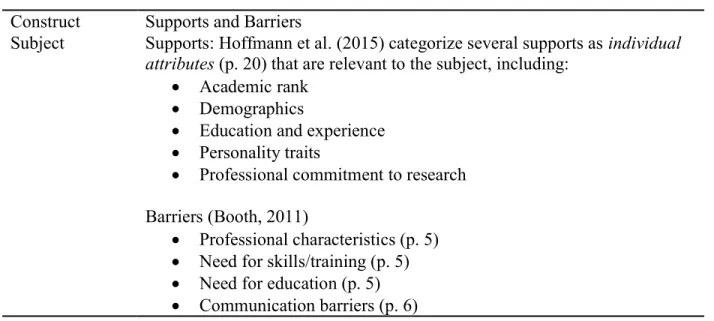
A few systematic reviews have looked across articles and discussions of librarians’ research contexts (e.g. Booth, 2011; Hoffmann et al., 2015). Although the studies that these reviews cover are mostly localized, the reviews help to combine them into a broader view. Booth (2011) focuses on barriers, while Hoffmann et al. (2015) focuses on supports. These provide a source of possible supports and barriers to consider. Looking at these from an activity theory perspective helps frame some of the known possibilities, as background to my study.
Table 2.1: Alignments of known supports and barriers with CHAT constructs
Construct Supports and Barriers
Subject Supports: Hoffmann et al. (2015) categorize several supports as individual
attributes (p. 20) that are relevant to the subject, including:
Academic rank
Demographics
Education and experience
Personality traits
Professional commitment to research Barriers (Booth, 2011)
Professional characteristics (p. 5)
Need for skills/training (p. 5)
Need for education (p. 5)
Language/cultural barriers (especially for non-English speaking librarians) (p. 6)
Object Supports
None relevant to this construct
Barriers (Booth, 2011): These are debatably object barriers or possibly tool barriers
Limitations of the evidence base (p. 4)
Inappropriate orientation of research (p. 5)
The following two may not be part of the research activity at all, but rather part of a separate activity in practice. In EBLIP, because the object of the research activity becomes a tool for the practice activity, it is difficult to separate some activities
o Pace of change (p. 6) o Limitations of EBLIP (p. 6) Tools Supports (Hoffmann et al., 2015, p. 20)
Access to and use of resources in terms of equipment and funds Barriers (Booth, 2011)
Lack of financial resources, in terms of tools those resources might buy (p. 4)
Lack of infrastructure in terms of databases, journals, data systems (p. 4)
Poor access to evidence base (pp. 4-5) Rules Supports (Hoffmann et al., 2015, p. 20)
Extrinsic motivations such as a requirement to publish (other extrinsic motivations may be rules or may be outcomes of the activity)
Positive organizational climate in terms of research being valued by the organization and in some cases a culture of research
Some aspects of time, such as autonomy over work schedule and the availability of release time
Barriers (Booth, 2011)
Lack of financial resources, in terms of rules restricting research funding (p. 4)
Division of Labor
Supports (Hoffmann et al., 2015, p. 20)
Access to and use of resources in terms of staff support
Some aspects of time, such as balance between responsibilities Barriers (Booth, 2011)
Lack of infrastructure, in terms of staffing levels and support skills (p. 4)
Community Hoffmann et al. (2015) categorize several supports under peers and
community (p. 20) that would fall under this construct, including:
Collaboration
“Community,” including: professional associations; research networks; socialization
Guidance and support from editors
Impact of family and personal relationships
Mentoring
Peer support
They further categorize several supports as institutional structures/supports (p. 20), the following of which would fall under this construct:
Department/institution qualities
Positive organizational climate in terms of supportive leadership and in some cases a culture of research
Barriers (Booth, 2011)
Lack of organizational support (p. 4)
Lack of research culture (p. 5)
Leadership (p. 6)
2.5 Conclusions from the Literature
Some things are clear from the literature. Motivation is a complex matter, with studies supporting both intrinsic and extrinsic elements affecting research productivity (Blackburn & Lawrence, 1995; Carole J. Bland et al., 2005; Fennewald, 2008). There is a complex range of challenges and supports that interweave to affect research in academic libraries (Booth, 2011; Hoffmann et al., 2015).
2010; Vitae, 2010). This complexity adds layers to the challenge of becoming a researcher in academic libraries (Booth, 2011; Lamothe, 2012; Schrimsher & Northrup, 2013). However, the context in which librarians work has an enormous impact on their success (Fennewald, 2008; Hoffmann et al., 2015). So does the internal motivation of the researcher (Blackburn &
Lawrence, 1995; Fennewald, 2008). So there is considerably more to librarians’ developing the needed competencies to perform research than coursework or policies alone can make. The activity of research is complicated, and so are the attendant needs of the researchers.
This leads to a need for closer examination of the experiences and processes involved in researcher competency development. Both librarians and libraries need more idea of what is being faced in the process of researching. This gap should be filled in order to inform professional and organizational policies. It is also an important gap to address for helping librarians and departments to make decisions about processes and activities.
2.6 The Research Question
CHAPTER3:METHODS
Learning and development depends heavily on the developing researcher-librarian’s psychological development, and because this is such a new area of study it is important to understand the personal experience of these researcher-librarians. Researching personal experiences offers many challenges to the researcher. While various external measures can be taken, ultimately the only way to know the internal experiences of people is to ask them. For that, interviewing is a common and valuable technique.
Rubin and Rubin (2005) describe qualitative interviewing as an art that builds on human beings' natural inclination towards conversational interactions. Their approach emphasizes the interactions and naturalness of interviewing. An important part of this approach is that interviews are a formalized approach to a prosaic process. People talk to each other about their interests every day. It is an easily understood process, especially for the interviewee. Because conversing is so instinctive for people, many challenges in the art of the interview happen in the design and analysis phases rather than in data collection. There is an art to listening to and encouraging the interviewee - or conversational partner - that is being interviewed. But the act of talking is often an easy act for research participants.
Research interviews are a flexible approach, and they aim to reveal personal subjective experiences. There are many procedural and analytical implications to the flexibility,