RISK PERCEPTIONS AND RISK PREFERENCES IN AN ERA OF PRECARITY AND AUSTERITY
Lindsey Marie King
A dissertation submitted to the faculty at the University of North Carolina at Chapel Hill in partial fulfillment of the requirements for the degree of Doctor of Philosophy in the
Department of Sociology.
Chapel Hill 2015
Approved by: Arne L. Kalleberg Victor W. Marshall Ted Mouw
ABSTRACT
Lindsey M. King: Risk Perceptions and Risk Preferences in an Era of Precarity and Austerity (Under the direction of Arne L. Kalleberg)
In an era of labor market precarity and welfare state austerity, workers in capitalist economies are exposed to manifold risks. How they perceive these risks is an emerging topic of interest. In keeping with the welfare state’s role as a risk manager, labor market policies are found to directly impact workers’ risk perceptions. However, the dearth of theoretical
development, coupled with a lack of conceptual clarity, has hindered our understanding of the policies and labor market conditions that influence workers’ risk perceptions.
This dissertation explores four types of risk perceptions. Job insecurity is the cognitive assessment of an unpredictable, uncontrollable threat to one’s job. Employment insecurity is a belief that, in the event of job loss, a comparable job cannot be found. The third type of insecurity is anxiety about job loss, termed affective insecurity. This dissertation argues that these concepts should be modeled separately in policy research, a practice seldom followed. I also develop the concept of precarity avoidance, a cognitive aversion to precarious labor market situations. Combined, this dissertation explores, from a comparative perspective, what causes workers to feel threatened, what they fear, and what labor market outcomes they hope to avoid.
To worried workers everywhere,
ACKNOWLEDGMENTS
I am grateful to my mentor, Arne Kalleberg, for his guidance. With his encouragement and advice, I shaped an inchoate idea about job insecurity into this dissertation, with enough ideas left over to fuel my research well into the future. I also owe many thanks to my dissertation committee—Ted Mouw, François Nielsen, John Stephens, and Cathy Zimmer—who provided valuable advice on the statistical and theoretical aspects of the dissertation. Victor Marshall also deserves an extra measure of gratitude for providing last-minute assistance at a crucial time. I would like to thank the staff and faculty of the department who have patiently helped me over the years, especially Pam Stokes, Charlie Kurzman, Andy Perrin, and Lisa Pearce.
I thank my graduate school peers in the UNC Department of Sociology for their
friendship, esprit de corp, and belief in my ability as I faced numerous obstacles during graduate school. I could not have prevailed with their help, especially that of Eve Veliz, who was there for me from beginning to end, keeping it real and keeping me sane.
TABLE OF CONTENTS
LIST OF TABLES ... ix
LIST OF FIGURES ... x
LIST OF ABBREVIATIONS ... xi
CHAPTER 1. INTRODUCTION ... 1
Background ... 1
Structure of the Dissertation ... 9
Contributions ... 11
References ... 12
CHAPTER 2. CHANGES IN MARKET RISKS AND MARKET PROTECTIONS: AN INSTITUTIONAL THEORY OF JOB INSECURITY ... 17
Introduction ... 17
Comparative Trends in Job Insecurity ... 20
Defining Job Insecurity ... 26
An Institutional Theory of Job Insecurity ... 30
Data and Measures ... 35
Results... 40
Conclusion ... 42
References ... 45
CHAPTER 3. THE WORRIED WORKER: WELFARE STATE POLICY AND AFFECTIVE INSECURITY ... 63
Insecurity in Comparative Context ... 70
Data and Measures ... 74
Methods ... 78
Results... 81
Discussion ... 87
Conclusion ... 87
References ... 91
CHAPTER 4. THE RELATIVE APPEAL OF TEMPORARY WORK AND UNEMPLOYMENT IN ADVANCED ECONOMIES ... 107
Introduction ... 107
The Relative Risk of Unemployment and Temporary Work in Advanced Economies ... 110
Institutional Components of Labor Market Risk ... 112
Hypotheses ... 119
Data and Variables ... 119
Methods ... 123
Results... 126
Conclusion ... 131
References ... 138
CHAPTER 5. CONCLUSION... 158
LIST OF TABLES
Table 2.1. Summary of Previous Research Findings on Institutional
Predictors of Job Insecurity ...52 Table 2.2. Estimated Effects of Average Change in Market Risks on Job
Insecurity at 1-, 3-, and 5-Year Increments ...55 Table 2.3. Estimated Effects of Average Change in Job Protections on Job
Insecurity at 1, 3-, and 5-Year Increments (3-, 5-, and 10-Year
Increments for Employment Protection Legislation) ...56 Table 2.4. Estimated Effects of Average Change in Worker Protections on
Job Insecurity at 1-, 3-, and 5-Year Increments ...57 Table 3.1. Definitions of Insecurity Used in the Literature ...97 Table 3.2. Country-Aggregated Descriptive Statistics for Three Types of
Insecurity, 2005 ISSP ...98 Table 3.3. Descriptive Statistics for Labor Market Policies and Risks ...99 Table 3.4. Mediation Effects of Job Insecurity between EPL and Affective
Insecurity, Ordinal Logistic Regression ...100 Table 3.5. Mediation Effects of Employment Insecurity between
Active/Passive Labor Market Policies and Affective Insecurity,
Ordinal Logistic Regression ...101 Table 4.1. Frequencies and Means by Welfare Production Regime ...146 Table 4.2. Partial Proportional Odds Models of Preference for Temporary
LIST OF FIGURES
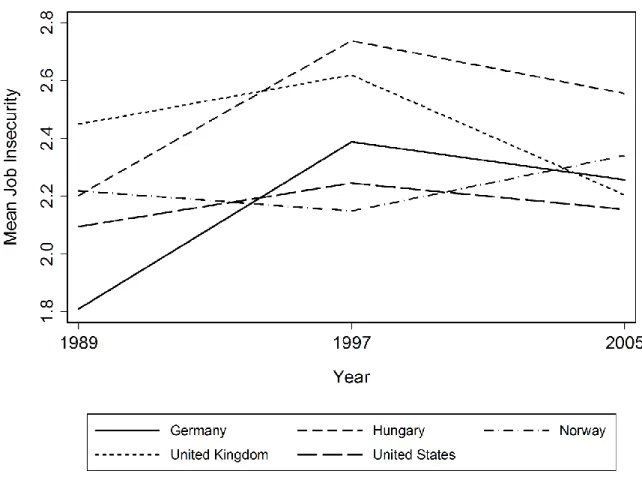
Figure 2.1. Average Job Insecurity in Four Regimes from 1989-2005 ...58
Figure 2.2. Trends in Market Risk in Six Regimes, 1989-2005 ...59
Figure 2.3. Trends in Institutional Job Protections in Six Regimes, 1989-2005 ...60
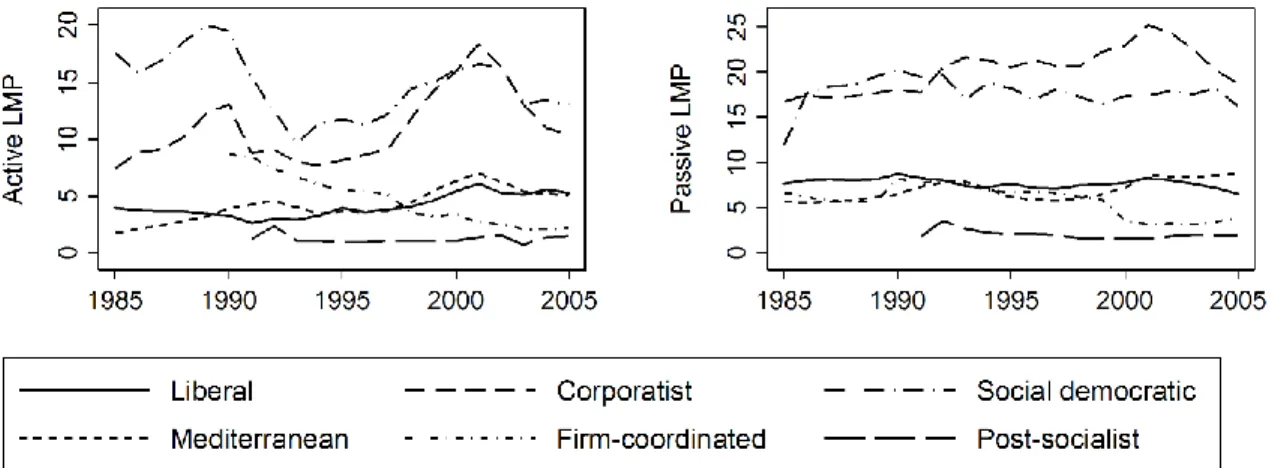
Figure 2.4. Trends in Institutional Worker Protections in Six Regimes, 1989-2005 ...61
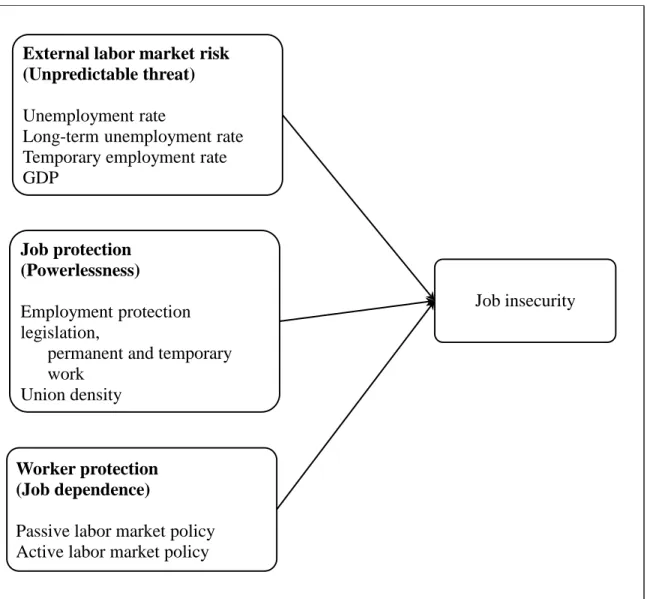
Figure 2.5. An Institutional Model of Job Insecurity...62
Figure 3.1. An Institutional Model of Affective Insecurity, Mediated by Job Insecurity ...102
Figure 4.1. Bivariate Correlation between the Prevalence of Temporary Work and the Strength of EPL for Permanent Work ...152
Figure 4.2. Cumulative Probability of Response to Statement “In order to avoid unemployment I would be willing to accept temporary employment." ...153
Figure 4.3. Average Marginal Effects of Education ...154
Figure 4.4. Average Marginal Effects of Union Membership ...155
Figure 4.5. Average Marginal Effects of Full-Time Employment ...156
LIST OF ABBREVIATIONS
ALMP Active Labor Market Policy
CWS Comparative Welfare States Data Set EPL Employment Protection Legislation ISSP International Social Survey Program
CHAPTER 1.INTRODUCTION
Background
During the past four decades, the rise of contingent work, erosion of the psychological contract, and mass layoffs in times of economic prosperity all indicate an upheaval in
employment relationships. Parallel to this development runs welfare state retrenchment, a rollback of (or, at the least, failure to expand) the welfare state in response to new social risks (Huber and Stephens 2001; Levy 2010). Both the precarity and austerity literatures postulate that workers are exposed to ever-increasing labor market risk. Employers shift the risks of the
employment relationship to workers, while the welfare state fails to compensate for the rearrangement.
How do workers perceive their employment opportunities in the new age of precarity and austerity? Emerging research connects state governance of labor market risks with workers’ perception of those risks, yet the relationship remains underexplored. Considering that stable, lifetime careers with a single employer are, from a historical standpoint, the exception rather than the norm in the span of capitalism (Jacoby 2004; Kalleberg 2009), workers’ perceptions of internal and external labor market risk merit exploration.
De Cuyper, Bernhard-Oettel, Berntson, Witte, and Alarco 2008; Wittekind, Raeder, and Grote 2010). Affective insecurity is a product of both job and employment insecurity (Borg and Elizur 1992; Huang, Lee, Ashford, Zhenxiong, and Xiaopeng 2010), suggesting that the combined cognitive assessment of internal and external labor market prospects converge in a sense of fear about future employment.
To these three types of insecurity, I add a fourth psychological state: precarity avoidance, which I define as a psychological aversion to objectively insecure employment. This fourth concept opens a new avenue of insecurity research, one that explores how precarity and austerity influence job choice. All four of these psychological responses demonstrate workers’ reactions to
unpredictable and uncontrollable labor market situations (Ashford, Lee, and Bobko 1989; Burchell 2002; De Witte 2005). When threats outweigh coping resources, insecurity and avoidance follow. Coping resources counteract threats by providing workers with control over employment outcomes.
If these four risk perceptions show similar trends across advanced capitalist economies, a policy perspective is irrelevant because homogeneity would suggest that countries respond similarly to macroeconomic shifts regardless of policy configurations. However, this explanation fails upon empirical examination. Despite the popular belief that workers in postindustrial
United States, which does show a consistent trend toward higher insecurity (Aaronson and Sullivan 1998; Kalleberg and Marsden 2008; Schmidt 1999).
Have other countries also exhibited rising subjective job insecurity? Evidence from outside the United States is sparse and inconclusive. In a four-country comparison extending from 1989 to 2005, Olsen, Kalleberg, and Nesheim (2010) conclude that workers in West
Germany and the United States grew steadily more insecure between 1989 and 2005. In Norway, job insecurity changed little between 1989 and 1997 but worsened thereafter. Great Britain showed no net change in job insecurity: perceived job insecurity worsened between 1989 and 1997 but then improved by an equivalent amount between 1997 and 2005. Overall, comparative studies do not establish any uniform trend in job insecurity across advanced economies. Based on existing research, the conclusion that workers in advanced economies have become steadily more insecure since the inception of the age of precarity does not receive overwhelming support. Change has been uneven, both temporally and geographically.
While we know much about the state of job insecurity in advanced capitalist economies, comparative research on employment insecurity and affective insecurity is scant, as is research on precarity avoidance. What we do know of employment and affective insecurity is based primarily on Green’s (2009) comparative summary of insecurity. On average, Nordic countries
Establishing the Policy-Perception Connection
To explore the policy-perception link, I rely on three assumptions. First, most workers cannot absorb or counteract all of the market risks to which they are exposed. Against the unfettered free market rises a call for protection from market fluctuations—Polanyi’s “double movement” of free market growth and popular outcry for state protection (Kalleberg 2009;
Polanyi [1944] 2001). The labor force will not abide endless uncertainty. For protection, workers turn to the state, the only non-market institution capable of restraining or addressing market risk. States function as institutionalized labor market risk managers, inextricable from the markets they are designed to regulate. The welfare state is an important third actor in labor markets, governing the relationship between employers and workers.
Second, “[a]ll Western countries are similarly affected by the informalization and
individualization of paid work. But this epochal change is perceived and valued differently in different cultures” (Beck 2000:111). Convergence theories propose that globalization drives advanced economies toward a similar neoliberal model of restricted welfare states (Breen 1997; Howell 2003; Ó Riain 2000; Rodrik 1998; Stryker 1998). From this perspective, countries engage in an international “race to the bottom” that renders everyone insecure and subverts the state to the pressures of international competition.
My dissertation rejects this view, aligning instead with the regime literature, which proposes that welfare states adjust to similar economic changes in disparate ways (Gallie 2007; Hall and Thelen 2009; Iversen 2005; Thelen 2001). Policies are created and coordinated
Scandinavian countries. Strong active and passive labor market policies complement flexible labor markets, and coordinated wage-bargaining systems compress wage differences. Risk is minimized for the greatest possible number of workers.
Third, labor market conditions and policies impinge directly on perception. This dissertation challenges the bulk of the insecurity literature, which situates threats in the employing organization and defines coping resources as individual human capital. In the organizational literature, structural shifts matter only insofar as they create organizational turbulence (Ashford, Lee, and Bobko 1989; Greenhalgh and Rosenblatt 1984; Jacobson 1991; Mauno, Leskinen, and Kinnunen 2001). The psychological perspective also leans heavily toward explaining employment insecurity in terms of human capital, particularly education and skills (Berntson, Sverke, and Marklund 2006; Fugate, Kinicki, and Ashforth 2004). Workplace
turbulence and human capital are undoubtedly important to perceptions of labor market risk, but workplaces are not the only sources of threat, nor are individual resources the only means of coping. Threats may also emanate from the external labor market, as evidenced by the reliably significant influence of the unemployment rate on both job insecurity and employment
insecurity, a relationship that holds both time and countries (Auer 2005; Erlinghagen 2007; Esser and Olsen 2012; Fullerton and Wallace 2007).
Policy and Insecurity
legislation (EPL) establishes hiring and firing practices, protecting workers from job loss. Active labor market policies (ALMP) facilitate labor market matching by serving as an employment intermediary or providing skills training. Passive labor market policies (PLMP) mitigate income shocks induced by job loss. What all employment policies have in common is their function as institutionalized risk management strategies. Employment protection legislation aims to reduce the threat of job loss by stabilizing jobs; active labor market policies help workers cope with finding new work; and passive labor market policies provide a means of coping with
unemployment.
Employment Protection Legislation: Job Insecurity and Precarity Avoidance
As a means of preserving jobs, EPL regulates the hiring and firing of workers, stipulates the conditions under which employers may implement mass layoffs, and outlines the conditions for employment of temporary workers. In practice, EPL may cause outcomes counter to their intentions. Overly strict legislation for permanent work appears to inadvertently create rigid labor markets segmented by contract status. Gash and McGinnity (2007), Gash (2008), Diprete, de Graaf, Luijkx, Tåhlin, and Blossfeld (1997) show that seemingly rigid labor markets with strict EPL maintain numerical flexibility through temporary contracts, relegating temporary work to peripheral labor markets. Strict legislation may reduce employers’ ability to fire workers, but
also makes them more reluctant to hire new employees.
regarding the firing of workers (Dolado, García-Serrano, and Jimeno 2002; Polavieja 2003). A lax regulatory environment, conversely, enables employers to easily hire and fire workers--a condition that may increase the risk of job loss but also facilitates mobility (Auer, Berg, and Coulibaly 2004). In the United States, dictated by a logic of free markets, weak labor laws for both temporary and permanent work obviate the use of temporary contracts. In Finland, the principles of inclusion and full employment are maintained through flexible labor markets and labor laws that dictate that temporary contracts may be used under legally specified
circumstances.
The perverse effects of strict EPL seem to lead to a net null effect on job insecurity (Böckerman 2004; Chung and van Oorschot 2011; Erlinghagen 2008; Esser and Olsen 2012; Robinson 2000). Upon closer inspection, strict EPL polarizes temporary and permanent work. The lack of influence is actually a canceling out of extremes (Lübke and Erlinghagen 2014). When permanent workers benefit from strong employment legislation, temporary workers are relegated to peripheral labor markets. If temporary work is a trap of precarity rather than a bridge to permanent work, workers may deem these jobs a hindrance to their career. In rigid labor markets, where temporary work is marginalized, workers should express deep aversion to these jobs.
spells of unemployment. In countries with weak labor market protection, unemployment is a highly undesirable prospect due to the high likelihood of poverty (Gallie and Paugam 2000). Low replacement rates or benefits of limited duration encourage workers to find new
employment quickly, regardless of how well the new job matches their skill set. Conversely, high benefits of long duration are associated with high unemployment rates and inflated long-term unemployment partly because workers have the luxury of seeking a job that fits their skills and expectations (Gangl 2008; Nickell 1997).
In countries that take a proactive approach to boosting the employability of the jobless, receipt of unemployment benefits is contingent on participation in active labor market programs such as training and job search assistance, both of which have been shown to reduce the duration of unemployment and facilitate mobility back into work (Dieckhoff 2007; Kluve 2006). ALMP offers retraining opportunities to unemployed workers, helping them update their skills and improve their marketability. These policies also include public sector job creation, small business incentives, and job-creation programs targeting private sector employers, though the highest proportion of active labor market spending is devoted to training programs.
With regard to these policies’ effects on risk perceptions, ALMP alleviates employment
insecurity, while PLMP reduces affective insecurity (Anderson and Pontusson 2007; Lübke and Erlinghagen 2014). To the extent that employment insecurity captures a worker’s concern about their marketability in an external labor market, ALMP reassures workers that unemployment will not lead to skill degradation and long-term unemployment. Likewise, insofar as anxiety about job loss relates to anxiety about income loss, PLMP serves as a palliative, lessening workers’
Structure of the Dissertation
This dissertation is motivated by three questions related to workers’ subjective
experience of labor market precarity and welfare state austerity. (1) To the extent that job insecurity is a combination of perceived unpredictability and uncontrollability (De Witte and Näswall 2003), is it affected more by labor market fluctuations or changes in the welfare state? (2) Under what conditions are workers willing to accept precarious work? (3) Do job and employment insecurity mediate the effect of policy on affective insecurity?
I answer these research questions in three papers, all of which analyze survey responses from the Work Orientations Module of the International Social Survey Program (ISSP). The population of interest is adult workers in non-agricultural occupations, age 18 to 65, who work in dependent employment (i.e., not self-employed) at the time of the survey. The ISSP covers a breadth of countries representative of various logics of coordination: egalitarianism (Denmark, Finland, Norway, and Sweden), corporatism (Austria, Belgium, Germany, the Netherlands, Switzerland), liberalism (Australia, Canada, Ireland, New Zealand, the United Kingdom, and the United States), post-socialism (the Czech Republic, Hungary, Poland, Russia, and Slovenia) familialism (France, Italy, Portugal, and Spain), and firm-coordination (Japan and South Korea). To account for countries’ labor market policies and prevalent risks, I incorporate data from the
Organization for Economic Cooperation and Development (OECD 2014a; OECD 2014b) and the Comparative Welfare States Dataset (CWS) (Brady, Huber, and Stephens 2014).
(3) worker protections, measured by active and passive labor market policies. Job insecurity responds most strongly to economic fluctuations but is little affected by changes in policies and coalitions that aim to preserve jobs. Nor is job insecurity influenced by changes in policies that protect workers from the deleterious effects of job loss. I conclude that workers are sensitive to market fluctuations but relatively insensitive to policy shifts.
Chapter 3 disentangles the insecurity literature, rife with idiosyncratic definitions, to clearly delineate job insecurity, employment insecurity, and affective insecurity. In many
research studies, these concepts are combined into a single indicator, a practice that obscures the effects of policy on each specific type of insecurity. Having parsed these concepts, I then explore the policy and market antecedents of affective insecurity, with job and employment insecurity modeled as potential mediators. Multilevel mediation analysis reveals that active and passive labor market policies directly assuage affective insecurity, an effect unmediated by job or employment insecurity.
marginalized. Among protected classes of workers, labor market rigidity generates an aversion to temporary work so great that many of these workers would prefer to be unemployed.
Contributions
This compilation of research addresses three gaps in the growing comparative literature on workers’ risk perceptions. First, I develop an institutional theory of job insecurity, a project that comparative research has so far overlooked. Drawing insight from organizational
researchers, who lead theoretical development in this field, I test how well the main tenets of organizational research apply at the comparative level. In the organizational literature, job insecurity is stoked by organizational change, or at least the threat of such. At the comparative level, threat also induces job insecurity. I establish that workers are concerned with the threat of unpredictable economic shifts, although they are indifferent to policy shifts. This finding
validates the role of threat in the arousal of job insecurity.
Second, this project addresses the definitional inconsistencies prevalent in the literature. Insecurity research has suffered from conceptual confusion, conflating job, employment, and affective insecurity—a definitional knot this dissertation unties. I establish that cognitive evaluations such as job insecurity and employment insecurity differ from the emotional state of affective insecurity, both conceptually and empirically. Third, I explore the novel concept of precarity avoidance. Workers’ aversion to precarious work is an unprecedented research topic, but one that merits attention. If workers find themselves forced to choose between temporary work and unemployment, they may prefer unemployment, where they can search for a permanent job, over precarity. When workers find unemployment more appealing than
REFERENCES
Aaronson, Daniel and Daniel G. Sullivan. 1998. "The Decline of Job Security in the 1990s: Displacement, Anxiety, and Their Effect on Wage Growth." Economic Perspectives 22:17-43.
Anderson, Christopher J. and Jonas Pontusson. 2007. "Workers, Worries and Welfare States: Social Protection and Job Insecurity in 15 OECD Countries." European Journal of Political Research 46:211-235.
Ashford, Susan J., Cynthia Lee, and Philip Bobko. 1989. "Content, Causes, and Consequences of Job Insecurity: A Theory-Based Measure and Substantive Test." The Academy of
Management Journal 32:803-829.
Auer, Peter. 2005. "Protected Mobility for Employment and Decent Work: Labour Market Security in a Globalised World." International Labour Office, Geneva.
Auer, Peter, Janine Berg, and Ibrahim Coulibaly. 2004. "Is a Stable Workforce Good for the Economy? Insights into the Tenure-Productivity-Employment Relationship."
International Labour Office, Geneva.
Beck, Ulrich. 2000. The Brave New World of Work. Cambridge, UK: Polity Press.
Berntson, Erik and Staffan Marklund. 2007. "The Relationship between Perceived Employability and Subsequent Health." Work & Stress 21:279-292.
Berntson, Erik, Magnus Sverke, and Staffan Marklund. 2006. "Predicting Perceived Employabilty: Human Capital or Labour Market Opportunities?" Economic and Industrial Democracy 27:223-244.
Böckerman, Petri. 2004. "Perception of Job Instability in Europe." Social Indicators Research 67:283-314.
Borg, Ingwer and Dov Elizur. 1992. "Job Insecurity: Correlates, Moderators and Measurement." International Journal of Manpower 13:13-26.
Brady, David, Evelyne Huber, and John D. Stephens. 2014. "Comparative Welfare States Data Set." University of North Carolina and WZB Berlin Social Science Center.
Breen, Richard. 1997. "Risk, Recommodification and Stratification." Sociology 31:473-489. Burchell, Brendan. 2002. "The Prevalence and Redistribution of Job Insecurity and Work
Intensification." in Job Insecurity and Work Intensification, edited by B. Burchell, D. Ladipo, and F. Wilkinson. London: Routledge.
Chung, Heejung and Wim van Oorschot. 2011. "Institutions Versus Market Forces: Explaining the Employment Insecurity of European Individuals During (the Beginning of) the Financial Crisis." Journal of European Social Policy 21:287-301.
De Cuyper, Nele , Claudia Bernhard-Oettel, Erik Berntson, Hans De Witte, and Barbara Alarco. 2008. "Employability and Employees’ Well-Being: Mediation by Job Insecurity." Applied Psychology 57:488-509.
De Witte, Hans. 2005. "Job Insecurity: Review of the International Literature on Definitions, Prevalence, Antecedents and Consequences." South African Journal of Industrial Psychology 31:1-6.
De Witte, Hans and Katharina Näswall. 2003. "`Objective' vs `Subjective' Job Insecurity: Consequences of Temporary Work for Job Satisfaction and Organizational Commitment in Four European Countries." Economic and Industrial Democracy 24:149-188.
Dieckhoff, Martina. 2007. "Does it Work? The Effect of Continuing Training on Labour Market Outcomes: A Comparative Study of Germany, Denmark, and the United Kingdom." European Sociological Review 23:295-308.
Diprete, Thomas A., Paul M. de Graaf, Ruud Luijkx, Michael Tåhlin, and Hans-Peter Blossfeld. 1997. "Collectivist versus Individualist Mobility Regimes? Structural Change and Job Mobility in Four Countries." American Journal of Sociology 103:318-58.
Dixon, Jeffrey C., Andrew S. Fullerton, and Dwanna L. Robertson. 2013. "Cross-National Differences in Workers' Perceived Job, Labour Market, and Employment Insecurity in Europe: Empirical Tests and Theoretical Extensions." European Sociological Review 29:1053-1067.
Dolado, Juan J., Carlos García-Serrano, and Juan F. Jimeno. 2002. "Drawing Lessons from the Boom of Temporary Jobs in Spain." The Economic Journal 112:270-295.
Erlinghagen, Marcel. 2007. "Self-Perceived Job Insecurity and Social Context: Are There Different European Cultures of Anxiety?" German Institute for Economic Research, Berlin.
—. 2008. "Self-Perceived Job Insecurity and Social Context: A Multi-Level Analysis of 17 European Countries." European Sociological Review 24:183-197.
Esser, Ingrid and Karen M. Olsen. 2012. "Perceived Job Quality: Autonomy and Job Security within a Multi-Level Framework." European Sociological Review 28:443-454.
Felstead, Alan, Brendan Burchell, and Francis Green. 1998. "Insecurity at Work: Is Job Insecurity Really Much Worse Now than Before?" New Economy 5:180-184.
Fullerton, Andrew S. and Michael Wallace. 2007. "Traversing the Flexible Turn: US Workers’ Perceptions of Job Security, 1977–2002." Social Science Research 36:201-221.
Gallie, Duncan. 2007. "Production Regimes and the Quality of Employment in Europe." Annual Review of Sociology 33:85-104.
Gallie, Duncan and Serge Paugam. 2000. "The Experience of Unemployment in Europe: The Debate." Pp. 1-22 in Welfare Regimes and the Experience of Unemployment in Europe, edited by D. Gallie and S. Paugam: Oxford University Press.
Gangl, Markus. 2008. "Unemployment and Worker Career Prospects: a Cross-National Comparison." Pp. 169-194 in Flexibility and Employment Security in Europe: Labour Markets in Transition, edited by R. J. A. Muffels. Cheltenham, UK: Edward Elgar. Gash, Vanessa. 2008. "Bridge or Trap? Temporary Workers’ Transitions to Unemployment and
to the Standard Employment Contract." European Sociological Review 24:651-668. Gash, Vanessa and Frances McGinnity. 2007. "Fixed-term Contracts--the New European
Inequality? Comparing Men and Women in West Germany and France." Socio-Economic Review 5:467-496.
Green, Francis. 2009. "Subjective Employment Insecurity around the World." Cambridge Journal of Regions, Economy and Society 2:343-363.
Greenhalgh, Leonard and Zehava Rosenblatt. 1984. "Job Insecurity: Toward Conceptual Clarity." The Academy of Management Review 9:438-448.
Hall, Peter A. and Kathleen Thelen. 2009. "Institutional Change in Varieties of Capitalism." Socio-Economic Review 7:7-34.
Howell, Chris. 2003. "Varieties of Capitalism: And Then There Was One?" Comparative Politics 36:103-124.
Huang, Guo-Hua, Cynthia Lee, Susan Ashford, Chen Zhenxiong, and Ren Xiaopeng. 2010. "Affective Job Insecurity: A Mediator of Cognitive Job Insecurity and Employee Outcomes Relationships." International Studies of Management & Organization 40:20-39.
Huber, Evelyne and John D. Stephens. 2001. "Welfare State and Production Regimes in the Era of Retrenchment." Pp. 107-145 in The New Politics of the Welfare State, edited by P. Pierson. Oxford: Oxford University Press.
Iversen, Torben. 2005. Capitalism, Democracy, and Welfare. New York: Cambridge University Press.
Jacoby, Sanford M. 2004. Employing Bureaucracy: Managers, Unions, and the Transformation of Work in the 20th Century. Mahwah, NJ: Lawrence Erlbaum Associates Publishers. Kalleberg, Arne L. 2009. "Precarious Work, Insecure Workers: Employment Relations in
Transition." American Sociological Review 74:1-22.
Kalleberg, Arne L. and Peter V. Marsden. 2008. "Labor Force Insecurity and U.S. Work Attitudes, 1970s-2006."
Kluve, Jochen. 2006. "The Effectiveness of European Active Labor Market Policy." Rheinisch-Westfälisches Institut für Wirtschaftsforschung (RWI), Essen, Germany.
Levy, Jonah D. 2010. "Welfare Retrenchment." Pp. 552-568 in Oxford Handbook of the Welfare State, edited by F. G. Castles, S. Leibfried, J. Lewis, H. Obinger, and C. Pierson: Oxford University Press.
Lübke, Christiane and Marcel Erlinghagen. 2014. "Self-perceived job insecurity across Europe over time: Does changing context matter?" Journal of European Social Policy 24:319-336.
Mauno, Saija, Esko Leskinen, and Ulla Kinnunen. 2001. "Multi-Wave, Multi-Variable Models of Job Insecurity: Applying Different Scales in Studying the Stability of Job Insecurity." Journal of Organizational Behavior 22:919-937.
Nickell, Stephen. 1997. "Unemployment and Labor Market Rigidities: Europe versus North America." The Journal of Economic Perspectives 11:55-74.
Ó Riain, Seán. 2000. "States and Markets in an Era of Globalization." Annual Review of Sociology 26:187-213.
OECD. 2010. "Institutional and Policy Determinants of Labour Market Flows." Pp. 167-210 in OECD Employment Outlook 2010: Moving Beyond the Jobs Crisis. Paris: OECD Publishing.
—. 2014a. "Employment and Labour Market Statistics." Retrieved February 17, 2015
(http://www.oecd-ilibrary.org/employment/data/oecd-employment-and-labour-market-statistics_lfs-data-en).
—. 2014b. "Productivity Statistics." Retrieved February 17, 2015
(http://www.oecd- ilibrary.org/employment/data/oecd-employment-and-labour-market-statistics_lfs-data-en).
Olsen, Karen M., Arne L. Kalleberg, and Torstein Nesheim. 2010. "Perceived Job Quality in the United States, Great Britain, Norway and West Germany, 1989-2005." European Journal of Industrial Relations 16:221-240.
Polavieja, Javier G. 2003. "Temporary Contracts and Labour Market Segmentation in Spain." European Sociological Review 19:501-517.
Robinson, Peter. 2000. "Insecurity and the Flexible Workforce: Measuring the Ill-Defined." in The Insecure Workforce, edited by E. Heery and J. Salmon. London: Routledge. Rodrik, Dani. 1998. "Why Do More Open Economies Have Bigger Governments?" Journal of
Political Economy 106:997-1032.
Schmidt, Stefanie R. 1999. "Long‐Run Trends in Workers' Beliefs about Their Own Job Security: Evidence from the General Social Survey." Journal of Labor Economics 17:127-141.
Stryker, Robin. 1998. "Globalization and the Welfare State." International Journal of Sociology and Social Policy 18:1-49.
Thelen, Kathleen. 2001. "Varieties of Labor Politics in the Developed Democracies." Pp. 71-103 in Varities of Capitalism: The Institutional Foundations of Comparative Advantage, edited by P. A. Hall and D. Soskice. Oxford: Oxford University Press.
Wittekind, Anette, Sabine Raeder, and Gudela Grote. 2010. "A Longitudinal Study of
CHAPTER 2.CHANGES IN MARKET RISKS AND MARKET PROTECTIONS: AN INSTITUTIONAL THEORY OF JOB INSECURITY
Introduction
The psychological effects of economic change were a core concern of early sociologists. Durkheim, in his study of anomic suicide proposed, “If therefore industrial or financial crises
increase suicides, this is not because they cause poverty, since crises of prosperity have the same result, it is because they are crises, that is, disturbances of the collective order” (Durkheim
[1897] 1979:246). Marx’s theory of alienation—in selling one’s labor to another, workers become estranged from their work—is rooted in the economic changes during Britain’s
Industrial Revolution. For Marx, workers constituted a perpetually vulnerable population. “These
labourers, who must sell themselves piecemeal, are a commodity, like every other article of commerce, and are consequently exposed to all the vicissitudes of competition, to all the fluctuations of the market” (Marx [1872] 1976:58). The founders of sociology recognized the close relationship between economic stability and workers’ well-being.
Job insecurity, the perception of impending yet unpredictable involuntary job loss, has replaced the nebulous concepts of alienation and anomie as the primary indicator of the
satisfaction (De Witte and Näswall 2003), turnover intention (Hellgren, Sverke, and Isaksson 1999), and withdrawal of organizational commitment (Ashford, Lee, and Bobko 1989; King 2000). Chronic job insecurity is associated with poor health and depression (Burgard, Brand, and House 2009; Heaney, Israel, and House 1994) and diminished job satisfaction that persists after the objective threat of job loss has passed (Hellgren, Sverke, and Isaksson 1999; Rocha, Hause Crowell, and McCarter 2006). László, Pikhart, Kopp, Bobak, Pajak, Malyutina, Salavecz, and Marmot (2010) demonstrate that this relationship between job insecurity and health is an international phenomenon, endemic to capitalist economies.
In general, job insecurity leads to diminished mental health because “well-being is related to the workers’ ability to foresee, control, and especially to cope with bad events” (Green
2006:129). Secure workers feel equipped to handle economic fluctuations; insecure workers feel no such sense that all will turn out well. This lack of situational clarity causes workers to rely heavily on their subjective evaluations of the environment, because objective cues provide no clear indicator of appropriate responses (Roskies, Louis-Guerin, and Fournier 1993). In the face of ambiguity, workers are left to draw their own conclusions about what their future holds.
The study of the psychological repercussions of economic upheaval on workers, once central to the sociological project, has been largely overtaken by psychologists and
organizational theorists. Though these scholars have significantly advanced theoretical
Oorschot (2011), Green (2003), Green (2009), Esser and Olsen (2012), and Olsen, Kalleberg, and Nesheim (2010), all of whom examine the impact of labor markets and welfare states on workers’ evaluations of the likelihood of job loss. The aggregate message of these studies is that
market conditions reliably predict job insecurity. The empirical evidence regarding welfare state policies is suggestive but not consistent enough to make a definitive statement, especially
considering these studies mostly examine the European case. How well these findings hold up in a broader context is so far unknown.
In a stable economic environment, workers know what to expect. Changes in markets and policies, conversely, render the future uncertain. Changes in policies or collective bargaining impact workers’ power to counteract the threat of job loss. In organizational research, these two
elements—unpredictability and uncontrollability—are the primary instigators of job insecurity. This study aims to apply this organizational definition of job insecurity to a comparative context. I predict that job insecurity reacts to (1) changes in labor market threats and (2) changes in the economic coping resources available to workers.
These hypotheses are tested using the 1989, 1997, and 2005 waves of the International Social Survey Program’s (ISSP) Work Orientations Module, paired with economic and labor
market indicators from the Organization for Economic Co-operation and Development (OECD). This permits analysis of a broad range of political-economic configurations. Empirically,
multilevel modeling allows me to assess the effects of institutional change while controlling for a worker’s labor market position. This method allows me to assess the direct effect of labor market
Comparative Trends in Job Insecurity
Based on the dataset for the dependent variable, Figure 2.1 presents the trends in average job insecurity for capitalist economies that participated in all three waves of the Work
Orientations Module, covering 1989, 1997, and 2005. Job insecurity is measured on a scale from 1 to 5, with high numbers indicative of high insecurity. The range of political-economic
configurations presented in Figure 2.1 cover the typologies developed by Esping-Andersen (1999) and Hall and Soskice (2001). The labor markets of social democratic regimes (Norway) are structured in accordance with an egalitarian logic of flexible security, or “flexicurity.” The logic guiding labor markets in liberal regimes (the United Kingdom and the United States) is one of minimal state intervention. Labor markets in corporatist regimes (Germany) distribute benefits according to occupational class. Hungary does not fall within any established typologies. It is generally classified as a post-socialist regime, where the transition from communism to
capitalism led to a mismatch between the communist logic of centrally planned stability and the reality of competitive capitalist markets, which these countries resolved at different rates.
Institutional Change, 1985-2005
To explore why job insecurity exhibits no clear pattern, it will be helpful to examine the shifts in markets, institutions, and human capital relevant to job insecurity over this period. Figures 2.2 through 2.4 present various measures of institutionalized risk and risk management for the countries to be used in the empirical analyses1, grouped according to typology. These institutional summaries include two additional regimes not described above. The guiding logic of Mediterranean regimes is one of familialism. In practice, this means strong protection for male breadwinners and the concentration of risk among disadvantaged segments of the labor force. This same logic underpins firm-coordinated regimes, although these regimes differ significantly in that protection is divested from the state to firms.
As seen in Figure 2.2, workers’ risk exposure in the form of unstable precarious work rose steadily between 1985 and 2005, except in liberal regimes where the share of temporary work remained consistently low. On its own, this would increase the aggregate job insecurity of a country, as the positive correlation between temporary work and job insecurity is a well-documented international phenomenon (Carr and Chung 2014; De Cuyper and De Witte 2005; De Witte and Näswall 2003; Feather and Rauter 2004; Hesselink and van Vuuren 1999).
However, other market threats follow no clear pattern, which may part. The unemployment rate converged over time; while long-term unemployment rates bifurcated. As a positive indicator of economic conditions, GDP rose steadily.
1 Liberal regimes are Australia, Canada, Ireland, New Zealand, the United Kingdom, and the United States. The
The trend for temporary work’s share of the labor market is partly attributable to the gradual relaxation of employment protection legislation for temporary work. Despite great scholarly distress about the demise of stable employment, Figure 2.3 shows that legislation protecting permanent work barely changed (Lübke and Erlinghagen 2014). Union membership, the other main source of job protection, continued its slow descent over the decades in all regimes except the persistently high social democratic. Leftist party representation, which typically increases the power resources of labor, increased slightly, suggesting that concerns about the erosion of state job protection are only partly justified.
Figure 2.4 depicts trends in state protections for unemployed workers. Active and passive labor market policies that help workers cope with the aftermath of job loss evince cyclical or stable trends. In the context of workers’ increased risk exposure in the form of temporary work and diminished union protection, this could be interpreted as evidence of welfare state
retrenchment, as the state has not responded to the encroachment of the external labor market with greater out-of-work protection. This summary of institutional conditions partially confirms the “great risk shift” (Hacker) from states and employers to workers. The story, though, is one of
lower job protection and higher labor market segmentation rather than decreased coping resources.
that did not use a worker’s existing skills or training (Eichhorst and Marx 2011). The logic of
activation, seen in previous policy reforms, reached its apogee with the Hartz reforms of 2002 through 2005, when restrictions and conditions for unemployment benefits were further tightened, and policy focus was redirected away from training initiatives toward immediate employment. Benefit duration for older workers was almost halved, and, in an unprecedented move, means-tested unemployment assistance was combined with general social assistance (Eichhorst and Marx 2011; Jacobi and Kluve 2006; Kemmerling and Bruttel 2006). The rules governing the use and duration of temporary work were relaxed and eventually eliminated altogether.
Overall, this policy mix achieved “flexibility at the margins” while leaving core workers
unscathed. The policy outcome that best demonstrates this duality is the mini-job, a centerpiece of the Hartz reforms. Part-time mini-jobs, exempt from some social insurance programs with an earnings cap of 400 euros, were intended to draw into the labor market formerly excluded groups, such women and students. Prevalent in service industries, these jobs allow employer to minimize their labor benefit obligations, an appealing opportunity for employers that ensnares many workers who would otherwise prefer full-time work (Kemmerling and Bruttel 2006).
In Japan, employment protection legislation for full-time permanent workers remained stable during the period of 1985 to 2005, while protection for temporary workers and part-time workers quickly eroded. Most notable are changes in the Worker Dispatching Law. Established in 1985, this law legalized temporary work in a “positive list” of permissible occupations, most
to prohibited “negative” occupations (Shire 2002). This rephrasing released temporary work
from the confines of a small subset of occupations, instead carving out a small niche of untouchable occupations.
Policy’s Effect on Job Insecurity
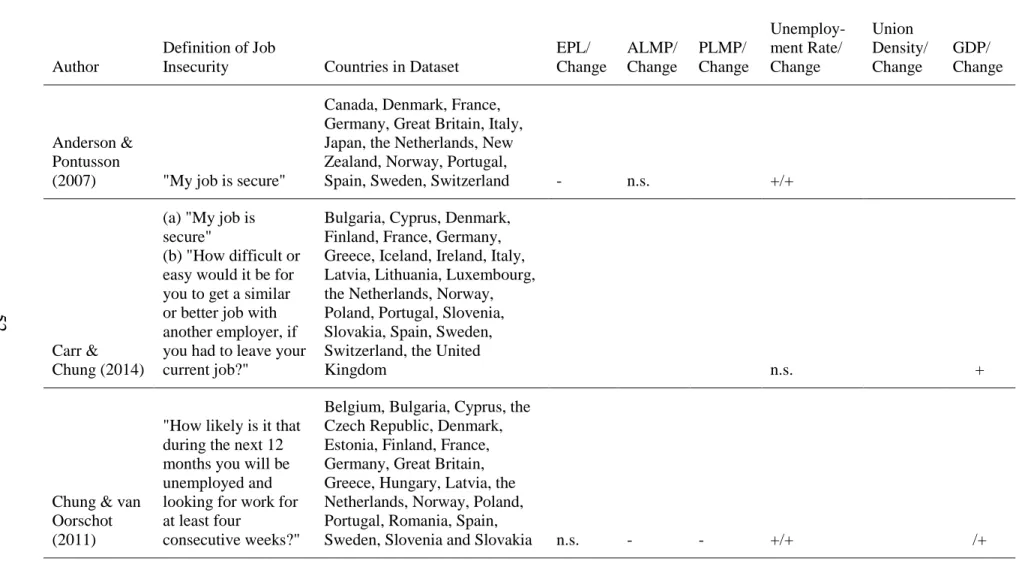
Conditions did not universally deteriorate for workers, although the relative impact of each factor on job insecurity is uncertain. In cross-sectional analyses, comparative researchers draw mixed conclusions about the role of job protections in workers’ assessments of their job security, as Table 2.1 summarizes. Employment protection legislation is, on its face, meant to reduce the threat of job loss through legislative prerequisites for dismissal or layoff. In practice, it may inadvertently increase the threat of job loss, as seen in Anderson and Pontusson’s (2007) research. This counterintuitive finding can be explained by the insider-outsider labor markets that often result from strict employment protection legislation, as Galtier and Gautié (2003) find for France, Gangl (2003) finds for Spain, France, and Italy, and Dolado, García-Serrano, and Jimeno (2002) for Spain. As Gangl (2004) proposes in his “reluctance-to-hire” hypothesis, “dismissal protection increases fixed labour costs to employers because of the implied restrictions on employer job termination rights” (174). When employees are difficult to fire,
employers are reluctant to hire. This creates a protected segment of long-tenured workers
State-sponsored coping mechanisms, designed to stabilize income or facilitate re-employment when the perceived threat of job loss becomes reality, receive mixed support as a source of job insecurity. In research by Anderson and Pontusson (2007) and Lübke and
Erlinghagen (2014), active labor market policies fail to influence job insecurity, whereas Chung and van Oorschot (2011) identify an ameliorative effect2 of both active and passive labor market policies. Some of the studies in Table 2.1 use a combined measure that asks workers to evaluate their job and employment security. State-sponsored coping mechanisms could be reasonably expected to operate mostly through employability perceptions, an interpretation confirmed by the non-significant finding of active labor market policies in Anderson and Pontusson’s research (2007), which asks only about job insecurity.
Market risks, conversely, are repeatedly confirmed as a source of job insecurity. The correlation between national unemployment levels and job insecurity receives strong support and holds to be an international phenomenon (Auer 2005; Auer and Cazes 2003; Erlinghagen 2007; Esser and Olsen 2012; but seeGreen 2006; Paugam and Zhou 2007). Comparative scholarship from Anderson and Pontusson (2007), Chung and van Oorschot (2011), and Lübke and Erlinghagen (2014) argues that job insecurity is exacerbated by both the static unemployment rate and changes in the unemployment rate. In the absence of a direct threat from the employing organization, indicators of short-term labor market risk such as the absolute and relative
unemployment rate provide a rough measure of the probability that one’s own job is at risk, leading Chung and van Oorschot to conclude, “…it is economic and labour market forces that
drive how individuals perceive their employment insecurity perceptions, rather than labour market institutions” (2011:298).
2 Due to the high correlation between active and passive labor market policies, multilevel models often include only
Defining Job Insecurity
The evidence from cross-sectional research establishes a tentative relationship between institutions and insecurity, but lacks a clear theoretical frame to explain why labor market conditions, especially the unemployment rate, exert a far greater influence on job insecurity than labor market policies. Objective institutional risk and subjective individual risk are clearly linked, but the comparative job insecurity literature lacks a theoretical program to bind
institutions to perceptions. This lack of theoretical clarity echoes in conceptual confusion about the definition of insecurity. Only half of the comparative insecurity research listed in Table 2.1 asks exclusively about job insecurity. The other half assess job and employment insecurity simultaneously.
In general, comparative insecurity scholars either hold that job and employment insecurity are distinct concepts with unique impacts on workers’ well-being, or that job
insecurity and employment insecurity are two facets of a latent variable (Chung and van Oorschot 2011). The debate reflects the conventional association of job insecurity with internal labor markets and employment insecurity with external labor markets. For example, a skilled independent contractor whose career exhibits a great deal of job-hopping would not be
considered insecure by this definition, as this worker may be in an objectively insecure job yet also be highly employable. This worker is likely to believe that the most severe repercussions of job loss—prolonged unemployment, income loss, skill degradation—will not befall them. Scholars who argue that “truly” insecure workers feel both job and employment insecurity are
Job insecurity is important to study as something distinct from employment security because job insecurity represents states’ and employers’ withdrawal from employment
obligations in a way that employment insecurity does not. Institutional shifts like
deindustrialization, globalization, and shareholder capitalism significantly altered the economic landscape (Cappelli 1999; Morris and Western 1999), such that “the standard employment relationship, in which workers were assumed to work full-time for a particular employer at the employer’s place of work, often progressing upward on job ladders in internal labor markets, was eroding” (Kalleberg 2009:3). Job insecurity merits individual attention because it represents a
sea-change in the social contract binding employers and employees, workers and the state.
An Organization-Based Definition of Job Insecurity
To understand the institutional determinants of job insecurity, I propose that comparative researchers begin with the definition, well-established in the organizational literature, of job insecurity as a sense of powerlessness to counteract an unpredictable and severe threat to a job (Ashford, Lee, and Bobko 1989; Greenhalgh and Rosenblatt 1984). In Greenhalgh and
Rosenblatt’s theoretical formula for job insecurity, the primary source of threat is organizational
decline. When confronted with the specter of an unpredictable threat, workers who feel helpless will experience job insecurity. “The sense of powerlessness is an important element of job insecurity because it exacerbates the experienced threat” (1984:442).
Job Insecurity as a Reaction to Unpredictable Threats
1989). Although few longitudinal studies link organizational change to job insecurity, extant research demonstrates a clear and strong connection. Borg and Elizur (1992) gathered data from over eight thousand white-collar employees working in multinational corporations in several European countries. In the interim between surveys, one company began to lag behind its competitors in product development, leading to increased ratings of job insecurity among employees. Under these new conditions of organizational uncertainty, there was a 36% decrease in the proportion of respondents who rated their jobs as secure. In a study by Jacobson (1987), Israeli public sector employees discovered that their previously secure jobs were threatened with possible elimination due to government cutbacks. Jacobson conducted his study after the
workforce reduction plan had already been announced, but no specific jobs had yet been eliminated. At the point of the study, workers were left only with the vague anticipation of redundancy but no specific notice as to whose jobs were under direct threat. At least half of all employees expressed job insecurity.
Büssing’s (1999) comparison of blast furnace workers from two steel companies in Germany confirms the psychological harm of persistent uncertainty. One company planned to close part of the plant, taking only some of the workforce, as yet unnamed, to a new plant. The other company had no such instability. Workers in the unstable and ambiguous organizational environment felt lower collective control, a lower expectation of control, and less supervisor support than workers in the stable organization. Mental preparation for the unpredictable
possibility of job loss occurs when real stressors exist, as in the form of organizational decline or restructuring.
because they do not know what to expect” (58). Their research illustrates this point: after
departmental dissolution, workers who were redeployed to another part of the company suffered less insecurity than workers in departments that were threatened with potential cutbacks but not eliminated.
Job Insecurity as Powerlessness
A sense of powerlessness is the second crucial component of job insecurity. In the original formulations of job insecurity put forth by Greenhalgh and Rosenblatt (1984) and Ashford, Lee, and Bobko (1989), powerlessness and threat combine in a multiplicative way to create job insecurity. Workers may remain placid when faced with a credible threat if they have the means to cope. Several factors contribute to a sense of powerlessness: a lack of protection (in the form of either unions or employment contracts), lack of clarity about what one must do to maintain job continuity, organizational culture, and dismissal policies.
low levels of job insecurity, indicating that locus of control is only activated as input into job insecurity under objectively threatening conditions. Coping strategies need only be activated in times of crisis (Büssing 1999).
Job Insecurity as Loss of a Valued Job
Last, job insecurity’s effects are moderated by the value of a job. Though we generally assume work is important to people, its value is not fixed. Individuals may be highly dependent on their jobs when (1) they have low market power due to either a high supply of similarly skilled workers or a low demand for their skills, (2) their family is highly reliant on their income, or (3) a worker lacks an alternative income stream such as unemployment insurance. If workers are unconcerned about job loss, either because of ambivalence, financial independence, or confidence, they are unlikely to experience insecurity (Jacobson 1991). Although job loss carries negative connotations, for some it may be a welcome opportunity for change. If job loss is not interpreted as severe, despite it being unpredictable and uncontrollable, job insecurity is unlikely.
An Institutional Theory of Job Insecurity
Drawing from the organizational theory outlined above, the definition of insecurity as a combination of threat, powerlessness, and job value can be applied to an institutional context. The model for an institutional theory of job insecurity is presented in Figure 2.5, which draws the parallel between the organizational theory and proposed institutional theory.
Market Risks: Unpredictable Threats from the External Labor Market
unemployment rate, provide a quick means of assessing the probability that one’s own job is at risk. The correlation between national unemployment levels and workers’ subjective job
insecurity receives strong support (Auer 2005; Auer and Cazes 2003; Erlinghagen 2007; Esser and Olsen 2012; Paugam and Zhou 2007). Job insecurity has also been found to relate strongly to the long-term unemployment rate (Erlinghagen 2007), suggesting that unemployment affects insecurity when workers believe it may result in a lengthy spell of joblessness, a severe consequence of job loss. A protracted period of unemployment may entail significant income loss and a diminishing probability of finding employment equal to or better than the lost job. Worsening or improving labor market conditions affect insecurity because changes in the labor market imply a shift in the pervasiveness or severity of risk.
Job Protections and Collective Power(lessness)
Market risk is countered by institutional job protections such as state-sanctioned employment protection or union representation, both of which aim to protect jobs from elimination, or at least make the process of job loss orderly and predictable. Labor market policies bolster worker’s market power by reducing their dependence on continuous
employment, so that the value of a job does not rise to the point that workers will keep their job at any cost. Welfare states regulate, react to, and reinforce labor market structures, impacting the labor market risks to which workers are exposed and the severity of those risks. Welfare states can make career trajectories more predictable and lessen the instability inherent in labor market transitions.
relationship: unions, employers, and political parties. Generally employers are more tolerant of change than workers (Polanyi [1944] 2001) and more desirous than workers of employment flexibility that will enable them to adapt to change (Kalleberg 2003). If possible, workers will resist employers’ transfer of risks to them; but if workers have little political power, they possess insufficient power to rebuff employers’ imposition of risk.
Worker control is bolstered through employment protection legislation and collective bargaining—both strategies that protect jobs. Employment protection legislation dictates the conditions under which employers can reduce their permanent labor force or employ temporary workers. Collective bargaining organizations may lobby for various benefits for their
membership: job stability, wage stability, influence over the structure of work, retraining, and the like. Both employment protection legislation and unionization increase workers’ power to resist threats.
Worker Protections and Market Dependence
Risk management resources fall into two categories: job protections and worker
protections. Job protections, described above, provide job stability. Worker protections provide employment or economic stability. These are meant to manage risk for workers regardless of their employer, serving to reduce the income shock of unemployment or reduce its duration. Passive labor market policies like unemployment benefits and active labor market policies such as retraining schemes are attached to workers, not jobs.
Unemployment compensation cushions the financial impact of unemployment, thereby bolstering workers’ sense of job security. International comparisons reveal a strong correlation
between unemployment benefit replacement rate and aggregate job insecurity perceptions (Böckerman 2004; European Commission 2006). Generous unemployment benefits, which stabilize income, function to reduce fear of job loss (Robinson 2000). However, studies that control for both the unemployment rate and the benefit replacement rate conclude that labor market conditions, especially the unemployment rate, exert a far greater influence on job
insecurity than expenditure on social welfare (Erlinghagen 2007; Esser and Olsen 2012). In sum, it is unclear whether welfare state spending on social protections has a direct effect on workers’ appraisals of insecurity or whether the welfare state operates indirectly, through its effects on labor market conditions.
promote flexicurity, combining low job tenure with high mobility, a strategy reflected in worker protections that focus on active retraining for the unemployed. Whereas Danish workers enjoy facilitated mobility, British workers lack an unemployment safety net: the incidence of poverty among British unemployed workers in the 1990s, after taxes and transfers, was at 29%. In the same year, only 4.2% of Danish unemployed experienced poverty (Nolan, Hauser, and Zoyem 2000).
Hypotheses
Changes in any of these arenas—market risk, job protections, or worker protections— may impact the risks to which workers are exposed. A reduction in employment protection legislation enables employers to fire individual workers or implement mass layoffs more easily. Looser employment protections may also reduce restrictions on employers’ use of temporary
contracts. A reduction in unemployment benefits increases the risk of unemployment-related poverty. Cutbacks in retraining programs makes skill acquisition in unemployment more difficult for workers, lessening workers’ employability. My hypotheses test the import of various changes in labor markets and institutional protections to job insecurity.
Labor market risk
Hypothesis 1: A rise in the unemployment or long-term unemployment rate also raises job insecurity.
Hypothesis 2: A rise in the share of the labor force employed in temporary work contributes to higher job insecurity.
Job protections
Hypothesis 4: The relaxation of employment protection legislation for permanent work exacerbates job insecurity.
Hypothesis 5: Change in employment protection legislation for temporary work has ambivalent effects.
Hypothesis 6: A decline in union density increases job insecurity.
Hypothesis 7: As the cumulative left party share rises, workers express significantly less job insecurity.
Worker protections
Hypothesis 8: Increases in active or passive labor market spending alleviate job insecurity.
Data and Measures
Data
I use three waves of the International Social Survey Program’s Work Orientations
Module, conducted in 1989, 1997, and 2005. Table 2.1 shows that comparative research on job insecurity focuses almost entirely on the European case. Though these studies do incorporate a variety of regime types, from the three original typologies of social democratic regimes
(Denmark, Finland, Norway, and Sweden), corporatist regimes (Austria, Belgium, Germany, the Netherlands, Switzerland), and liberal regimes (Ireland and the United Kingdom) to
to also include firm-coordinated regimes (Japan and South Korea) and liberal regimes outside Europe (Australia, Canada, New Zealand, and the United States) and two time points before 1999.
The sample is restricted to non-agricultural employees in dependent employment between the ages of 18 and 65 who were working for pay at the time of the survey. This results in a sample size of 33,936 respondents in 26 countries, though not all countries participated in all three waves of the survey. Country-level sample sizes range from 352 employees in Spain in 1997 to 1,533 employees in Switzerland in 1997.
Measures
To assess job insecurity, workers are asked their level of agreement with the statement “My job is secure.” This simple question avoids the conceptual confusion of double-barreled
questions or combined indicators, as exhibited by some of the studies in Table 2.1. Responses are arranged in a 5-point Likert scale ranging from “strongly agree” to “strongly disagree,” with high values corresponding to high job insecurity.
Country-level data are drawn from two sources: the Organization for Economic Cooperation and Development OECD (2014a; 2014b) database and the Comparative Welfare States Dataset (CWS) compiled by Brady, Huber, and Stephens (2014). I include four measures of external labor market risk as indicators of the overall health of the economy: (1) the
Job protections include separate indicators of employment protection legislation for (1) permanent and (2) temporary work (OECD), both measured on a scale from 0 to 6 in increasing degrees of strictness; (3) trade union density (OECD) is the percentage of workers who are union members; and (4) cumulative left party share (CWS) is the average percentage of total seats held by leftist parties in each year since 1946. Worker protections comprise spending per unemployed on (1) active and (2) passive labor market policies, in 2005 dollars (OECD).
I measure change in all institutional indicators except employment protection legislation as the annual percent change averaged over 1, 3, and 5 years, following the analytic strategy of Lübke and Erlinghagen (2014). The inclusion of a variety of time spans is intended to test whether immediate or long-term institutional developments matter most for job insecurity. Because legislative changes to employment policy occur abruptly and infrequently, average annual percent change is not a useful indicator. Instead, I create an ordinal variable that
categorizes change in legislation according to its standard deviation from zero at increments of 3, 5, and 10 years. The recalibrated variable contains three categories: reduced EPL, increased EPL, and no change.
To control for individual differences, the analysis incorporates fixed effects for
individual-level variables shown to predict job insecurity: gender, age, full-time status (Dixon, Fullerton, and Robertson 2013; but see Erlinghagen 2007 and Green 2009), sector of
employment (Anderson and Pontusson 2007; Burgoon and Dekker 2010; Clark and Postel-Vinay 2005; Dekker 2010), union membership (Aaronson and Sullivan 1998; Bender and Sloane 1999), and occupational class (Mau, Mewes, and Schöneck 2012; Näswall and De Witte 2003).
insecurity (Fullerton and Wallace 2007), but the use of idiosyncratic codes across countries in survey year 1989 meant this variable could only be coded as missing for 1989. If education were included, all countries in year 1989 would be removed from analyses due to missing data on an independent variable. Because country-level variables are the primary interest, education is omitted.
Multi-Level Modeling
The regime literature shows that labor markets are governed by the state according to distinct logics that exert pressure on workers’ subjective experience in the labor market. These
between-cluster differences exist independently of the occupational and demographic
composition of labor markets (Andreß and Heien 2001; Mughan 2007), suggesting the need for a multilevel model, useful when individuals share similarities on a higher-level dimension such as country. I analyze the institutional determinants of job insecurity using multilevel mixed-effects ordered logistic regression with country-level random effects3. Hierarchical generalized linear modeling accounts for individual and country differences simultaneously, while ordered logistic regression retains the rank order of the dependent variable without assuming equal intervals between categories (Long 1997). With surveys spaced eight years apart and non-nested clusters, cross-section time-series methods are not appropriate. Following Cameron and Miller’s (2013) recommendation for dealing with non-nested clusters, I cluster the data on the country dimension and include year fixed effects.
Similar studies that use the ISSP collapse response categories into a binary variable (Erlinghagen 2008; Esser and Olsen 2012), but no natural cutpoint exists between secure and
insecure workers, making the cutpoint somewhat arbitrary. Therefore, I retain all response categories and use ordinal regression to calculate the cumulative probability that a worker will choose each response. Over M categories of the dependent variable, the cumulative logit is represented by the formula:
𝜂𝑚 = log (𝑃𝑟𝑜𝑏(𝑅 ≤ 𝑚) 𝑃𝑟𝑜𝑏(𝑅 > 𝑚))
Assuming proportional odds, we can develop a single model that applies at each level of the dependent variable for individual i in country j:
𝜂𝑚𝑖𝑗 = 𝛽0𝑗+ ∑ 𝛽𝑞𝑗𝑋𝑞𝑖𝑗+ ∑ 𝐷𝑚𝑖𝑗𝛿𝑚 𝑀−1
𝑚=2 𝑄
𝑞=1
where 𝛿𝑚 is the cutpoint between categories and 𝐷𝑚𝑖𝑗 is a dummy variable set to 1 if 𝑚 = 𝑚 and
0 otherwise. At the higher level, the standard random intercept model applies:
𝛽0𝑗 = 𝛾00+ 𝑢0𝑗
variables and four time spans; 1-year change not calculated for either type of employment legislation). For clarity of presentation, only the findings for institutional change are presented.
Results
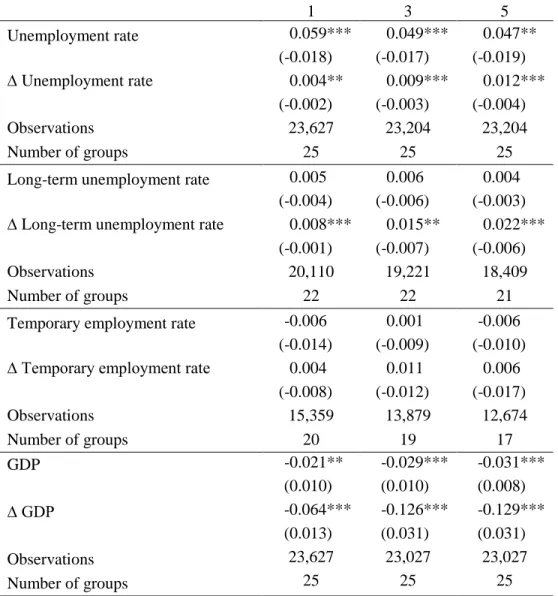
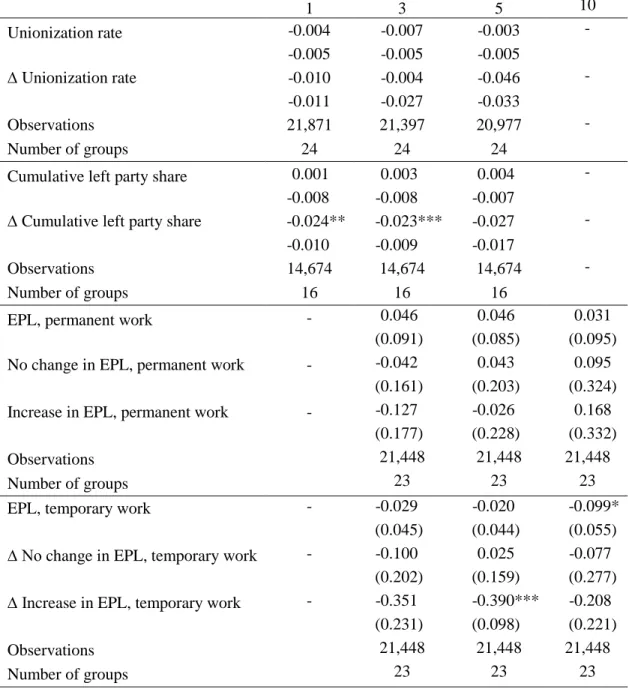
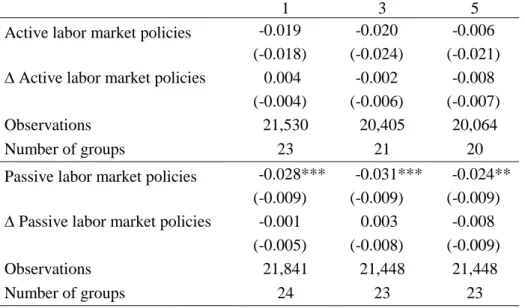
Tables 2.2 through 2.4 present the multilevel ordered logit models of job insecurity4. Models are sorted by hypotheses: Table 2.2 displays estimates for market risks, Table 2.3
presents models for job protections, and Table 2.4 shows the models for worker protections. The first column of results estimates the effects of percent change over the previous year; the second through fourth columns provide estimates for average yearly change across 3, 5, and 10 years (the 10-year column only pertains to employment protection legislation). Employment protection legislation is unlike the other variables in that average annual change is recoded into a set of dummy variables that indicate an increase, decrease, and no change in EPL. In the table, the referent is a decrease in the strength of legislation. The first row of each model presents estimates for the absolute level of the independent variable; the second row shows relative change.
Table 2.2 explores the effect of market risk on job insecurity. Among the absolute variables, the unemployment rate and GDP significantly predict job insecurity in most of the models. Neither the long-term unemployment rate nor the proportion of the labor force in temporary contracts influences job insecurity. Looking at changes in these risks, short-term increases in the unemployment rate and long-term unemployment rate elevate job insecurity. An average increase in either variable over the previous 1, 3, and 5 years raises job insecurity, as predicted by Hypothesis 1. As forecast in Hypothesis 3, economic growth lowers job insecurity,