Realizing the Full Scope of PLM with
Business Process Management
Martin J Harris
IBM Software Group
Executive Summary
Although PLM technologies have been capable of addressing the components of product lifecycle, from initial product concept to disposal, users’ IT foundations have not necessarily always supported full PLM capabilities, resulting in limited implementations of the technology. Used to its full potential, PLM allows users to create and manage the intellectual capital generated in the development of their companies’ products and services, from ideation through to end of life, and importantly, not just during the design stages. It enhances companies’ development processes and their ability to use product information to make the best decisions around which product to make, and how to make it. But the ability to do these things relies on having the supporting IT architectures and infrastructures to fully leverage the inherent scope of PLM.
Business Process Management (BPM) is a discipline that combines software capabilities and business expertise to accelerate process improvements and facilitate business innovation. BPM relies on an enabling technology called Service Oriented Architecture (SOA), an IT architecture that supports integrating a business as linked services.
Executive Summary 2
Industry Trends 3
Fully Leveraging PLM 4
Traditional PLM Response 5
Company Challenges 5
Business Process Management for PLM 6
Service Oriented Architecture 6
The promise of BPM: a case study 7
Adopting BPM 7
Modeling the Business with BPM 8
Using BPM to Extend the Scope of PLM 9
Developing Business Process Management for
Extended PLM Solutions 10
Applying Business Process Management to PLM—
company example 13
Conclusion 15
Leveraging the IBM Services Oriented Architecture, business process management allows organizations to decompose the PLM business and rebuild it into a set of dynamic and flexible services that go beyond the scope of the current limited infrastructure capabilities. This enables a suite of innovative processes which more closely align to clients’ needs to evolve to remain competitive.
Simply put, the adoption of BPM provides organizations with a solid understanding of the efficiency and effectiveness of their business processes. It offers the ability to rapidly create and restructure process driven applications and integrations, as well as the means to tightly integrate the organization and value chain, but with the flexibility to rapidly change and adapt as circumstances require.
BPM ties together the many discrete processes associated with all aspects of product development while providing the ability to adapt to changing environments. The BPM approach is based on optimizing existing capabilities and creating new functionality, enabled by the services oriented approach, to deliver dynamic, agile and flexible processes and improved business automation and data quality.
It is important to note that BPM can be deployed in a roadmap approach starting with simple capture of process models and leading to varying degrees of automation, real-time monitoring and dynamic process execution. In developing BPM content, organizations can start from any number of places depending on their type of project. There is no ‘required’ starting point, because the offerings are interchangeable, flexible, and can be deployed independently of other offerings or in combination.
Whether the user’s need is to realize incremental benefits with their deployment of BPM or if they want to build out strategic BPM solutions to effectively run the organization, IBM has the expertise and applications to meet those needs. The PLM SOA reference architecture, which is enabled by IBM and key partner products and services, is a key first step for companies wishing to embark on a full scale BPM journey.
Industry Trends
Product Lifecycle Management (PLM) technologies have driven product design and production innovation for more than a quarter century but the marketplace for increasingly complex products—such as cars, trains, aircraft, ships, electrical and electronic goods—has never been more challenging.
Companies need high levels of innovation and sophistication, competitively priced products, and efficient support processes. Manufacturing and product delivery organizations have, out of necessity for survival in a highly competitive marketplace, recognized these requirements and are embracing major changes in their working practices and the structure of the value chain in order to meet marketplace demands.
Driven by a need to reduce costs, companies are honing in on core competencies and outsourcing other aspects of their business. By letting ‘specialists’ handle what they do best and allowing more minds to participate in the design process, innovation can be improved.
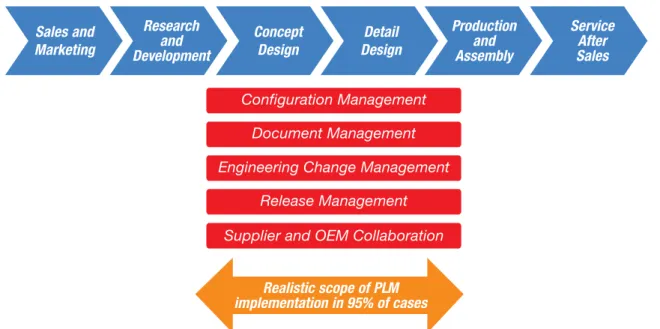
Figure 1: Process focus of most existing PLM implementations
Companies have implemented PLM solutions, but generally only to address limited and obvious needs, such as mechanical design. Therefore, the move to PLM has been driven primarily by engineering departments, resulting in an implementation that is often isolated from the rest of the business.
To support the addition of new PLM applications to integrate design partners’ systems, companies have ‘hard coded’ the connection points between systems and solutions, leading to fragile, difficult to maintain and nearly impossible to change systems. To achieve the greatest efficiency in the design chain and meet marketplace demands, however, companies must be able to reuse parts and minimize changes late in the design process and after the product has been put in service. In addition, companies need to leverage product knowledge throughout the product development process, particularly to determine how well a product meets market requirements before starting the design process.
So the challenge becomes how to maintain complex and heterogeneous IT system environments and still be able to easily change them to quickly react to market dynamics or competitive threats. Incremental improvements in technology capabilities and performance have emerged, but have not necessarily kept pace with companies’ needs.
The bottom line: companies must be able to leverage the full scope of PLM.
Fully leveraging PLM
What if you could maximize the scope of PLM by controlling the product development process from the portfolio planning stage through the retirement stage? What if you could add new partners and applications with ease? What if you could recognize and enhance the most impactful parts of your organization?
Doing so requires having the supporting IT capabilities to fully leverage the inherent scope of PLM. These capabilities allow you to maximize the investment in your PLM solutions through optimized and efficient processes, executed by well trained staff, with process coverage through the entire product lifecycle.
Used to its full potential, PLM allows users to create and manage the intellectual capital generated by their companies’ products, from ideation through end of life—not just during the design stages. It enhances companies’ development processes and their ability to use product information to make the best overall choices around which product to make, and how to make it.
Configuration Management
Document Management
Engineering Change Management
Release Management
Supplier and OEM Collaboration
Sales and
Marketing
Research
and
Development
Concept
Design
Design
Detail
Production
and
Assembly
Service
After
Sales
Realistic scope of PLM
implementation in 95% of cases
Benefits of the full capabilities of PLM include:
Process insight and optimization—
The first step in
many engagements is to simply monitor what is happening.
Having the ability to truly understand what is happening
inside the business will then cement and facilitate the ability
to enhance the most important and impactful parts of an
organization.
Accelerated process improvement—
It’s not just about
‘improvement and optimization’…it’s about how fast you
can identify the parts of the business that will drive change
and how fast you can implement and deploy those changes to
make the improvement happen.
Flexible design for future change—
Finally, it’s critical
to not only make the changes once, but to be prepared for the
inevitable future changes that every organization will face.
Traditional PLM Response
In the vast majority of implementations, PLM technologies are used only in the management, control and distribution of design data, while up and downstream uses of the data and solutions are typically controlled by other applications (see figure 1). Although PLM technologies have been capable of addressing the components of product lifecycle, from first product concept to eventual disposal, users’ IT foundations have not supported PLM’s full capabilities and have resulted in limited implementations of the technology.
•
•
•
Data exchange between applications remains challenging, despite the emergence of third party tools that eliminate the traditional tasks of data translation. However, these efforts remain dependent on the same structured and rigid data model which underpins the PLM applications themselves. So if the process needs to change, new partners need to be added, new workflow rules created or new applications added to the IT architecture, changes are costly, clumsy, time consuming and introduce risk to the project.
There are numerous challenges within a PLM environment, all of which must be addressed. These include:
Adopting new business models to support increasing
globalization
Managing increasing product complexity e.g. integration
between mechanical, software, electrical and electronic
systems.
Reducing massive investment in physical prototypes
Ensuring the integrity of intellectual property when working
with partners and suppliers. A partner for one project may
be a competitor for another, so knowledge protection and
security is vital.
Responding to shifts in risk-sharing within a network of
partners. For instance, ‘through life’ maintenance and
support responsibilities are shifting from the customer
to the OEM.
Outsourcing development and production tasks to low-cost
sources to address the need for quicker time to market and
lower ultimate product cost.
Embracing the execution and compliance of new and
emerging industry and legislative standards.
•
•
•
•
•
•
Business Process Management for PLM
Despite their power, PLM applications are really just tools to be used by the business. In this sense, they are only as effective as the business processes that they serve. Extending the scope of PLM requires examining the broad processes that span the entire product lifecycle—from ideation through product retirement.
Business Process Management (BPM) is a discipline that combines software capabilities and business expertise to accelerate process improvement and facilitate business innovation. BPM governs an organization’s cross-functional, core business processes. It achieves strategic business
objectives by directing the deployment of resources from across the organization into efficient processes that create value.
Quite simply, BPM is a method of efficiently aligning an organization with the wants and needs of its clients. It is a holistic management approach that promotes business effectiveness and efficiency while striving for innovation, flexibility and integration with technology. As organizations strive for attainment of their objectives, BPM can help them to continuously improve processes.
Service Oriented Architecture
BPM relies on an enabling technology called Service Oriented Architecture (SOA). SOA is an IT architectural style that supports integrating a business as linked services. A service is simply a repeatable business task or capability that is part of a business process—e.g. open new part number; modify Bill of Materials (BOM); manage Enterprise Content Management (ECM) processes—but not necessarily software or an IT function or feature.
In approaching BPM, an organization’s day-to-day activities are evaluated and then broken into repeatable business tasks or component services. SOA makes it easy to snap together these services into an improved and more flexible business process, just like snapping together building blocks into a structure.
BPM enabled by SOA provides a flexible architectural style that supports efficient process change and rapid process deployment. The focus on driving overall, bottom line success by integrating organizational silos and optimizing key processes (e.g. integrated product change management, cost and weights reporting, field failure closed loop reporting) differentiates BPM from traditional, functional PLM infrastructure implementations. In addition, intrinsic to BPM is the principle of continuous improvement, perpetually increasing value generation and sustaining market competitiveness (or dominance) of the organization.
Figure 2
Leveraging the IBM Services Oriented Architecture, business process management allows organizations to decompose the PLM business and rebuild it into a suite of dynamic and flexible services that go beyond the scope of the current limited infrastructure capabilities. This enables a suite of innovative processes which more closely align to clients’ needs to evolve to remain competitive.
The promise of BPM: a case study
A global shipbuilder sought to gain product development and productions process flexibility while delivering quality under demanding schedules. The company needed to gain efficiencies through improved data consistency.
It wanted to optimize its historically grown PLM processes, maximize the value of its existing PLM system landscape and start rebuilding its IT processes to become ready for dynamic and cost-effective change.
BPM instilled flexibility into the company’s one-of-a-kind shipbuilding processes. With BPM, the shipbuilder has the real-time process visibility that allows optimal change management decision making. And its enterprise processes are based on reusable services that lower costs and improve market competitiveness.
One company executive says: “With the help of the new solution, our engineers have optimal support for problem analysis and decision making. At the same time, our complex change processes have become significantly more transparent. Even now, during the ramp-up phase, we can figure the effects of reduced cycle times, error avoidance and improved operative planning.”
Adopting BPM
So what does the adoption of Business Process Management mean to PLM?
Simply put, the adoption of BPM first provides organizations with a solid understanding of the efficiency and effectiveness of their business processes. It offers the ability to rapidly create and restructure process driven applications and integrations, as well as the means to tightly integrate the organization and value chain, but with the flexibility to rapidly change and adapt as circumstances require.
For example, PLM users often need to combine information stored within PLM applications with information stored in other enterprise applications. Using BPM enabled by SOA, users can access all product data, regardless of its location, through a single sign-in, accurately and quickly.
The discipline of Business Process Management help you innovate and optimise
end-to-end processes
Model the process Simulate and optimise to predict results
Deploy using industry-specific best practices
Continue to innovate and optimize as conditions change
Measure results with the right business metrics
Concept design Simulation Engineering Change Manufacturing
Perhaps most importantly, adoption of BPM does not mean replacing existing PLM implementations. The BPM approach is based on optimizing existing capabilities and creating new functionality, enabled by the services oriented approach, to deliver dynamic, agile and flexible processes and improved business automation and data quality. Success in BPM projects is maximized by leveraging the expertise of experienced practitioners to deliver and fulfill the promise of BPM.
Modeling the Business with BPM
One of the challenges in realizing BPM is the need to balance the ‘top-down’ approach to addressing business level challenges with the ‘bottom-up’ approach of developing services. To address this challenge, a decomposition of the processes into their constituent components and a similar decomposition of the applications are required, with agreement reached by both technical and business architects in the PLM domain.
Component Business Modeling (CBM) is a proven method that allows organizations to identify opportunities for improvement and innovation by regrouping their activities into a manageable number of discrete, modular, and reusable components and may be used in driving the ‘top down’ development activities. This enables flexibility and provides for a clarified focus on the core capabilities needed to run the business and drive strategy.
IBM has developed a suite of Component Business Model ‘templates’ which address the core industries addressed by PLM. These ‘templates’ are used as a starting point for discussion, which can then be tailored specifically to the way in which an organization works. Because the Component Business Model further divides into a suite of industry processes and sub-processes, as well as a suite of Key Performance Indicators, it is possible to use this model to identify the parts of the business processes which are targets for improvement.
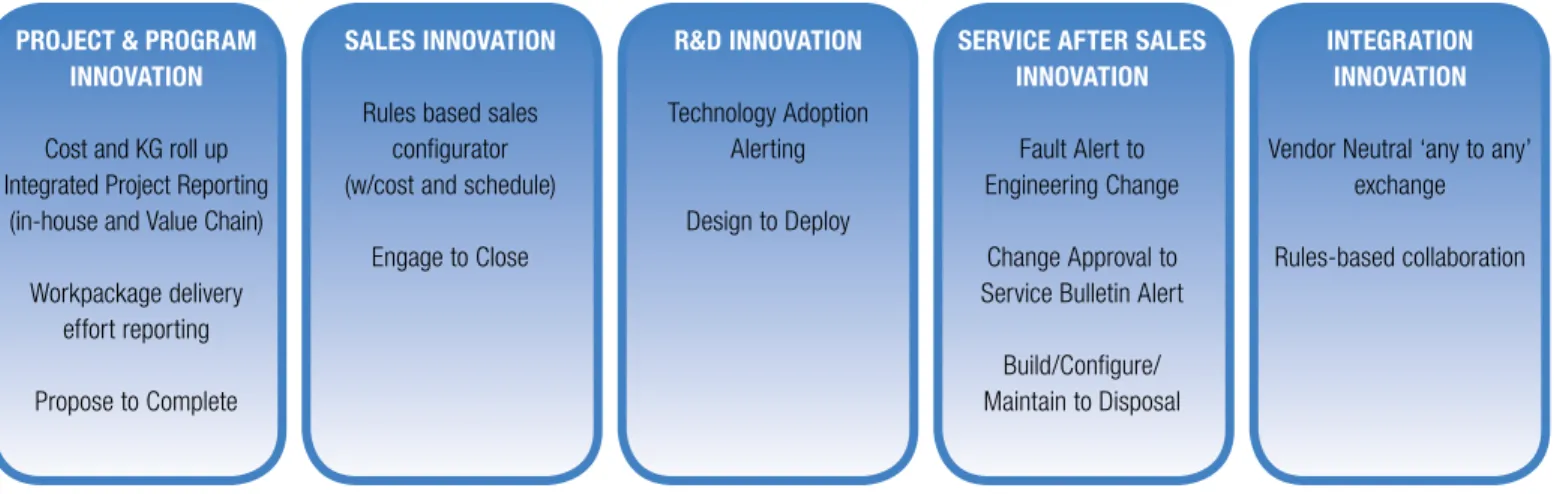
Figure 3: IBM PLM Innovation Processes Using BPM to Expand the Scope of PLM
PLM is the responsibility of the entire organization, not just engineering. However, due to infrastructure limitations, the processes underlying PLM are often fragmented, isolated and largely undefined. Business processes that impact, and are impacted by product expectations, performance and configuration must span the entire enterprise and extend beyond PLM design software.
The full PLM environment is enabled by the flexibility of business process management. BPM ties together the many discrete processes associated with all aspects of product development while providing the ability to adapt to changing environments. With BPM, a participant in product development has no need for visibility of what applications are used in the background, or where they are located; he simply has the results he wants presented in a timely fashion.
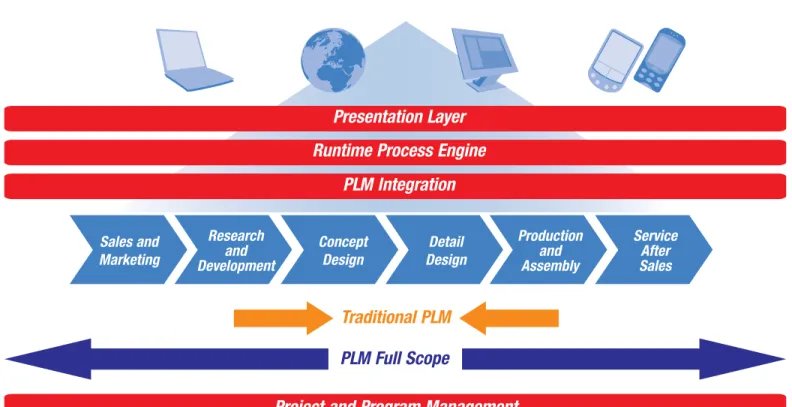
Figure 3 (below) illustrates focus areas for innovation processes to address: sales, research and development, project and program management, service after sales and integration. Automation of workflow and distribution of data is driven through the run time process engine to ensure seamless and automated exchange between applications and data consumers. In turn, the results from the execution of these processes and in addition, the ability to monitor their efficiency and effectiveness, is delivered through a presentation layer to the end user on the tool most appropriate for his/her role.
Presentation Layer
Runtime Process Engine
PLM Integration
Sales and
Marketing
Research
and
Development
Concept
Design
Design
Detail
Production
and
Assembly
Service
After
Sales
Traditional PLM
PLM Full Scope
Figure 4: Application of BPM to extend the scope of PLM
A further decomposition of these focus areas (as shown in figure 4) into target processes identifies current development areas.
Examples of these processes include:
Project & Program Innovation
Cost & Weight Roll Up:
Ability to gather accurate cost and
weight information for a given configuration of a car, plane,
boat, phone etc.—e.g. what is the current weight of a LHD
North American, convertible vehicle when the program is 60
percent through target completion data. Information will
come from multiple internal and external sources at various
maturities (e.g. carry over re-use versus development part).
Sales Innovation:
Customer requirement to Change:
Process where input from customer feedback is collated
and analyzed, then driven through portfolio management,
selection and into a change process.
R&D Innovation:
Technology Adoption Alerting: Process for
ensuring the R&D cycles are abreast with latest technology
and approaches includes trade studies, customer input, field
input, technology monitoring.
•
•
•
Service After Sales Innovation:
Fault Alert to engineering
Change: Process covers the current Integrated IBM PLM
demonstration with fault alerts in the field triggering
warranty, leading to engineering change and collaborative
redesign before embodiment.
Integration Innovation:
Rules based collaboration
process is to ensure Intellectual Property protection when
collaborating with the value chain/customers—i.e. based on
supplier log on, access only to certain data to view, retrieve,
share, create, update, delete, etc.
Developing Business Process Management for PLM
Bringing together the most advanced SOA based software capabilities along with broad expertise will provide the highest value BPM solution. But BPM can be approached in
many ways.
In developing BPM content for PLM, organizations can start from any number of places depending on their type of project. There is no ‘required’ starting point, because the offerings are interchangeable, flexible, and can be deployed independently of other offerings or in combination.
•
•
PROjECT & PROGRAM InnOvATIOn Cost and KG roll up Integrated Project Reporting
(in-house and Value Chain) Workpackage delivery
effort reporting Propose to Complete
SALES InnOvATIOn Rules based sales
configurator (w/cost and schedule)
Engage to Close
R&D InnOvATIOn Technology Adoption
Alerting Design to Deploy
SERvICE AFTER SALES InnOvATIOn
Fault Alert to Engineering Change Change Approval to Service Bulletin Alert Build/Configure/ Maintain to Disposal
InTEGRATIOn InnOvATIOn Vendor Neutral ‘any to any’
exchange Rules-based collaboration
Figure 5
WebSphere Business Monitor
Business Monitoring, Dashboards and Analytics
WebSphere Integration Developer
Collaborative Development
WebSphere Business Modeler
Business Modeling and Simulation
WebSphere Process Server
Workflow and Choreography
Whether the users’ need is to realize incremental benefits with their deployment of BPM or if they want to build out strategic BPM solutions to effectively run the organization, IBM has the expertise and applications to meet those needs, particularly those within the WebSphere brand.
Organizations that prefer taking small steps in BPM to realize incremental benefits might choose to start with WebSphere Business Modeler, for example, to capture current and future state business process models. Models are populated with time and cost parameters which enable the processes to be simulated to establish the cost/benefits of moving up the ‘BPM enabled PLM roadmap’.
In addition, WebSphere Business Modeler is used to capture process reporting documentation required for standards compliance for process modeling.
Ultimately, the goal of the BPM development cycle is feedback into the model for continuous improvement and optimization. This cycle is usually considered in four stages—model, assemble, deploy and monitor. Figure 5 represents the usual cycle of a BPM project and also shows the applications which are typically used at each stage. IBM has software tools under its WebSphere brand that are enabled to assist, support and implement the BPM development cycle tailored to a company’s unique business processes.
Assemble
Deploy
Model
Manage
Clean hand-off to IT with
Business Models, Metrics
Integrated deployment of
policies, rules, and services
based on an SOA platform
Feedback for continuous
improvement and optimization
Real time collaboration and
management of business
processes
Figure 6
WebSphere Business Modeler (WBM)—enables both
business and IT personnel to model and design their
processes
WebSphere Integration Developer (WID)—used in the
development, assembly and testing of applications and
integrations resulting from business process optimization
prior to deployment in the product environment
WebSphere Process Server (WPS)—manages the execution
of the processes, integrations and applications defined in
WID through automated and human tasks
WebSphere Business Monitor—provides real time visibility of
the efficiency and effectiveness of the process to management
teams through a ‘portal dashboard’
WebSphere Business Services Fabric applications—enables
business processes to dynamically change and adapt
according to changing circumstances (e.g. the use of
alternate suppliers at various parts in the development cycle
or being able to change the process according to a set of
business rules).
•
•
•
•
•
Model: Using WebSphere Business Modeler, capture the current state static process model—when simulated, this gives a view of how much the current process costs and how long it takes to execute. Organization-specific, dynamic ‘To-Be’ process states are created based on the IBM Process Classification Framework industry processes.
In addition to a streamlined and effective business process, in the ‘To-Be’ model the Key Performance Indicators are captured, which will be used later in the cycle to monitor how well the process is running. The hand off of the business to the IT architect at the end of the model phase is a Business Process Execution Language (BPEL) model.
Assemble: WebSphere Integration Developer is used by IT architects to read the BPEL export from the model phase. Developers are then able to fine tune the execution of the process, implement policies and rules based on the integration platform and test the model thoroughly before deployment to the production environment.
1. Enterprise Collaboration—Portals and dashboards to Applications
Product Development Integration Framework
2. Enterprise Business Process Management—Cross-application processes
3. Enterprise Integration—Management of PLM and Enterprise Information
IBM SOA Foundation
Decision point—mandate system commonality (‘rip and replace’) or integrate existing systems (‘best of breed’) through SOA!
PLM Application Systems Enterprise Application Systems
Project/Business Management
(OEM and/or Suppliers) (OEM and/or Suppliers)Engineers Quality Operations Sales Service
WEBSPhERE
LOTuS
RATIOnAL
TIvOLI
InFORMATIOn MAnAgEMEnT
Program and Portfolio Management Requirements Management Data Management Mechanical Authoring Data Management Data Management Data Management Electrical Authoring Software Authoring Analysis & Simulation Enterprise PDMERP EAM Other
Enterprise Applications
Deploy: Process Execution/Automation (workflow and choreography), including human task management, are important elements of a business process. Execution occurs with the deployment of the results of the Assemble activities on a process engine preferably running on an Enterprise Service Bus and secure application server, and can include integration with Content Management. In all business processes,
information is either created or consumed as work progresses. Content is the primary object to be manipulated in a business process. Therefore participants in a process need the ability to create new content as well as the ability to access and leverage existing content. Having the right information at your fingertips at the right time is critical to process success.
Monitor: Business Activity Monitoring is the ability to monitor process performance and detect events that may influence performance. Analyzing process efficiency and effectiveness and aligning process improvement with enterprise goals and objectives involves using software technology such as WebSphere Business Monitor to listen for critical business events, correlate event data and update key performance indicators (KPIs), which were captured during the Model phase. When these are combined with KPI-designed dashboards, operational managers can visually monitor and thus better manage the progress of individual work items in real time. This approach enables managers to intercept work where appropriate and alter the work item or the process flow to improve the desired result.
To support an organization implementing a PLM enabled by BPM environment, an established architecture is needed on which to deploy it. Figure 6 (page 12) is a representation of the PLM reference architecture. This environment enables heterogeneous applications to communicate through process driven integrations and collaborations, regardless of the data source, type and consumer. Processes are executed which leverage the value of the data, user knowledge and corporate experience to improve cross-functional collaboration, as well as data quality and integrity, while reducing the burden on the user through seamless delivery of information to the appropriate tool for the task.
Applying Business Process Management to PLM—Client Example
A large manufacturer had been using an IT infrastructure that no longer supported its need to run an adaptable, integrated business. The environment was based on heterogeneous IT systems that the company had inefficiently weaved together over time and included IBM AS/400 servers, Microsoft SQL data servers, SAS software, Java technology and more.
To continue to improve its competitive advantage in its industry, the manufacturer needed to transform its IT environment into a modern Service Oriented Architecture (SOA) that would support the integration and automation of enterprise-wide business processes as a set of linked services. Other goals for the solution were to improve data quality across different systems and to reduce the time required to build the final product in the context of the company’s one-of-a-kind production processes.
The company built an SOA environment based on IBM WebSphere software. They used IBM WebSphere Process Server V6.0.1 software as the basis for a new application that supports all aspects of its production process. IBM WebSphere MQ V6.0 software provides the communication platform between the WebSphere Process Server software-based application and the company’s back-end ENOVIA product lifecycle management (PLM) system.
A Business Process Execution Language (BPEL) technology-based application is the new platform to provide an integration flow that prioritizes tasks to be executed during the product development process. Now, all of the information needed to perform different production tasks is displayed together to provide an overall picture of the entire process. The new application makes it easy for any employee—not just a specific person assigned to a specific task—to complete production tasks using a Web-based front end that also reports status.
The new application is only one part of the company’s overall SOA environment. The SOA provides business flexibility by integrating IT assets and new developments through a loose coupling of services that can be reused, changed and combined according to business needs. The SOA environment also supports business process automation and workflow capabilities. In addition to using the SOA approach to help it switch from a siloed IT infrastructure to an integrated IT environment, the company is using it to transform how various divisions conduct business. The SOA solution is the first step in transforming the organization into a truly integrated company that can be flexible and adapt to the changing requirements of its customers. With new SOA-based applications, the client will be able to make additions and changes dynamically to meet its future requirements.
The new SOA-based application is helping this manufacturer improve the flexibility of its processes by providing an integrated enterprise-wide view of production. Since implementing the application, the company has experienced significant reductions in processing and production times. The company chose the WebSphere software for its strong SOA capabilities. Without this solution, this manufacturer believes that its development and production facilities would shut down in a matter of only five years.
Conclusion
PLM is no longer only about engineering—PLM is about business. It has expanded to include all the upstream and downstream processes that are critical to competitiveness in today’s global economy.
To support these processes, business process management is a powerful discipline that can liberate your business to succeed in today’s challenging and constantly changing marketplace. Leveraging the IBM Services Oriented Architecture, BPM allows you to decompose your product development processes and rebuild them into a set of dynamic and flexible services that can best leverage your IT infrastructure.
In summary, BPM enabled by SOA empowers your business to:
Achieve strategic business objectives by directing the
deployment of resources from across the organization into
efficient processes that create value
Efficiently align the organization with the wants and needs
of your customers
Promote business effectiveness and efficiency, while striving
for innovation, flexibility and integration with technology
•
•
•
Continuously improve processes
Rapidly create and restructure process driven applications
and integrations
Tightly integrate the organization and value chain, but
with the flexibility to rapidly change and adapt as
circumstances require.
Putting BPM to work for your business is easier than you might think. You can start anywhere, but the simplest place to begin is by calling IBM. We can help you determine where to start to gain maximum impact. This might be with Component Business Modeling, or you might want to investigate taking a first step with WebSphere Business Modeler. We can help you develop a plan that’s right for your business.
Start today. Start with IBM.
Visit ibm.com/solutions/plm.
•
•
•
ibm.com
/solutions/plm
For more information contact your IBM Representative, IBM Business Partner, or visit the IBM PLM Web site at:
PLW03001-USEN-00 (03/08) APS
The IBM home page can be found at ibm.com
IBM, the IBM logo and ibm.com are trademarks of International Business Machines Corporation in the United States, other countries or both.
ENOVIA® is a registered trademarks of Dassault
Systèmes.
Other company, product and service names may be trademarks, or service marks of others.
References in this publication to IBM products, programs or services do not imply that IBM intends to make these available in all countries in which IBM operates. Any reference to an IBM product, program or service is not intended to imply that only IBM products, programs or services may be used. Any functionally equivalent product, program or service may be used instead.
IBM hardware products are manufactured from new parts, or new and used parts. In some cases, the hardware product may not be new and may have been previously installed. Regardless, IBM warranty terms apply.
This publication is for general guidance only. Information is subject to change without notice. Please contact your local IBM sales office or reseller for latest information on IBM products
and services.
Photographs may show design models. © Copyright IBM Corporation 2008