Original Research Article
Effect of nasal obstruction surgery on eustachian tube function and
middle ear ventilation
Shiv Kumar Rathaur
1*, Jagram Verma
2INTRODUCTION
Chronic nasal obstruction has a great impact upon health and quality of life. Nasal obstruction can be caused by a diversity of nasal and sinus diseases such as deviated nasal septum, turbinate hypertrophy, allergic or non-allergic rhinitis, acute or chronic rhinosinusitis, nasal polyp, nasal mass etc.1
The eustachian tube is a dynamic conduit between the middle ear and the nasopharynx with secretory, ciliary, and dilatory functions. The eustachian tube serves to
regulate air pressure in the middle ear and mastoid system, clear material from the middle ear, and prevent reflux of material or sound from the nasopharynx.2 One of the consequences of nasal airway resistance is a malfunction of eustachian tube. The tube is frequently involved in different pathological conditions of the nasal, paranasal and nasopharyngeal cavities. Chronic rhinosinusutis is associated with inflammatory changes ranging from polypoid mucosa to gross nasal polyp. Nasal polyp cause post nasal drip which is considered to cause eustachian tube dysfunction.3
ABSTRACT
Background: The purpose of this study was to assess the effect of surgery for nasal obstruction in improving Eustachian tube function and middle ear ventilation.
Methods: This prospective study involved 60 patients with different nasal pathologies causing nasal obstruction along with complaints of ear fullness. In required cases the nasal pathologies were surgically managed. Pre and postoperative impedance audiometric evaluation and nasal endoscopy were done to assess the eustachian tube function, changes the value of middle ear pressure and ear fullness sensation at 1 month and at 3 months after surgery. Results: Preoperatively, 56 (93.3%) patients had sensation of ear fullness, postoperatively at 1 month and at 3 months after nasal surgery only 20 (33.3%) patient and 18 (30%) respectively, has sensation of ear fullness, with significant improvement (p<0.05). Preoperatively, 74 (61.6%) ears were type A tympanogram, 50 ears of them had poor eustachian tube function and 24 ears had good Eustachian tube function. 42 (35%) ears were type C, 4 (3.3%) ear were type B tympanogram, all of them had poor eustachian tube function. The postoperative results of eustachian tube function test and tympanometric value were significantly better than preoperative results (p<0.05).
Conclusions: We find out that nasal obstruction has a definite relationship with eustachian tube function. Surgery for nasal obstruction has a favourable effect on the middle ear pressure and eustachian tube function. Corrective surgery for nasal obstruction should be considered at least 1 month before undertaking the middle ear surgery to improve middle ear ventilation.
Keywords: Eustachian tube, Tympanogram, Middle ear ventilation, Nasal surgery
1Department of Otorhinolaryngology, Government Medical College, Jalaun, Uttar Pradesh, India 2Department of Otorhinolaryngology, MGM Medical College, Indore, Madhya Pradesh, India Received: 03 April 2020
Revised: 20 April 2020 Accepted: 21 April 2020 *Correspondence: Dr. Shiv Kumar Rathaur,
E-mail: [email protected]
Copyright: © the author(s), publisher and licensee Medip Academy. This is an open-access article distributed under the terms of the Creative Commons Attribution Non-Commercial License, which permits unrestricted non-commercial use, distribution, and reproduction in any medium, provided the original work is properly cited.
Dysfunction of the eustachian tube plays a very important role in the pathogenesis of both suppurative and non-suppurative otitis media. Hence, assessment of eustachian tube function is of paramount importance before any surgery for suppurative otitis media.4
The aim of this study was to evaluate the clinical profile of patients has pathology causing nasal obstruction and to the effect of nasal obstruction surgery on ETF and middle ear ventilation by impedance audiometry.
METHODS
This prospective study was carried out in the Department of Otorhinolaryngology MGM Medical College and M. Y. Group of Hospitals Indore Madhya Pradesh India from September 2013 to 2015 for duration of 2 years on 60 patients of age group 18 to 68 years.
Inclusion criteria
Inclusion criteria were patients who had the complaints of nasal obstruction and patient who had abnormal tympanogram type C/B, or complaints of ear fullness at least one ear.
Exclusion criteria
Exclusion criteria were congenital ear or palatal malformation, otosclerosis and ossicular chain dysfunction as suspected clinically or by pure tone audiometry confirmed by tympanometry, history of previous sinus nasal surgery, patient not willing to follow up, patient with acute rhinitis, recent history of middle ear infection, and patient with malignant lesion.
ETF tests in the form of (Valsalva and Toynbee maneuvers) together with tympanometry were performed the one day before the surgical operation, and then repeated at 1month and at 3 months after removal of nasal pack.
Parameters studied
Type of tympanogram that include A/B/C, middle ear pressure (MEP) in daPa, and eustachian tube function (ETF) i.e., good/poor.
A detailed history regarding presenting complaints, history of present illness, past history and family history was taken. Systemic disorders like hypertension, tuberculosis and diabetes were ruled out. Examination of nose and throat along with general physical and systemic examination was carried out.
After preliminary anterior and posterior rhinoscopic examination patients were further evaluated clinically by subjecting them to diagnostic nasal endoscopy using rigid endoscopes O and 30-degree nasal packing was done in all case with 4% lignocaine and adrenaline l:100,000 to
achieve local anesthesia and vasoconstriction. The endoscope was passed along the floor of nose accessing the inferior meatus for nasolacrimal duct opening and then backwards upto posterior choana to view nasopharynx, Eustachian tube orifice for post-nasal discharge and peri-tubal mucosal edema.
Assessment of eustachian tube function
Many methods have been discovered to determine to eustachian tube function, impedance audiometry is superior all of them as is not only measure anatomical patency but also functional integrity of eustachian tube and middle ear just a few minutes and is reproducible, non-invasive and economical.
Equipment
Zodiac 901 (Madson-Zodiac 901) middle ear analyzer are used. The tympanograms were classified in the standard manner according to Jerger.5 A tympanogram with middle ear pressure peak between +50 and -100 daPa was classified as type A. Tympanogram with middle ear pressure peak of -100 daPa or more negative was classified as type C. A tympanogram with a flattened peak of less than 0.3 ml admittance was classified as type B.
Valsalva maneuver
To evaluate the ability to inflate the middle ear actively, patients were asked to pinch the nose and inflate the checks through forced expiration with the mouth closed until a sensation of fullness was achieved in the ears. Patients were then instructed to release the nose and refrain from further swallowing or mandibular movement and an experimental tympanogram was obtained in each ear.
A tympanometric peak pressure shift (generally positive) between baseline and experimental tympanogram less than 10 daPa indicated poor ETF, whereas a tympanometric peak pressure (TPP) shift greater than 10 daPa indicated a good ETF.
Toynbee maneuver
To evaluate the capacity to equalize the middle ear pressure and the rhinopharyngeal pressure, patients were asked to swallow while pinching the nose.
Patients were then instructed to release the nose and refrain from further swallowing and mandibular movement, and an experimental tympanogram was obtained from each ear.
whereas a tympanometric peak pressure shift of greater than 10 daPa indicated a good ETF.
ET functions of the ears in which TPP changed by more than ±10 daPa with the Valsalva and Toynbee maneuvers were accepted as good, and ones in which TPP changed by less than ±10 daPa were accepted as poor ETF. The statistical package for social science (SPSS) version 20.0 will be used for data analysis. A t-test are used for comparison between the middle ear pressure value by tympanometry preoperative and 30 days after pack removal. The comparison between preoperative and postoperative ETF tests are performed using the χ2-test. Differences will be considered significant when p value will be 0.05 or less.
RESULTS
In the present study we included 60 patients with 36 (60%) males and 24 (40%) females, M:F ratio=1.5:1. The age of the patients ranged from 18 to 68 years, mean age 36 years Majority of the patients were being in the age group of 28-38 (36.6%), with complaints of nasal obstruction in 60 (100%) cases, followed by ear fullness 56 (93.3%) cases, ear pain 38 (63.3%) cases, decreased hearing 18 (30%) cases, and tinnitus 6 (10%) cases.
In this study 36 (60%) cases was find out bilateral nasal obstruction, followed by left nasal cavity obstruction was find out in 18 (30%) cases and in 6 (10%) cases right nasal cavity obstruction was present
The most common finding on anterior rhinoscopy was deviated nasal septum in 34 (56.5%) cases and next were nasal discharge 24 (40%), INF turbinate hypertrophy 16 (26.6%), middle turbinate hypertrophy 14 (23.3%) followed by polyps 15 (25%).
The most common diagnosis on nasal endoscopy was deviated nasal septum 34 (56.6%), inf turbinate hypertrophy 16 (26.6%), middle turbinate hypertrophy 15 (25%), Uncinate process oedematous/congested 12 (20%) eustachian tube blockage 46 (76.6%), nasal polyposis 18 (30%), and out of 60 cases there were two cases of allergic fungal rhinosinusitis and one case each of inverted papilloma and bleeding polyposis.
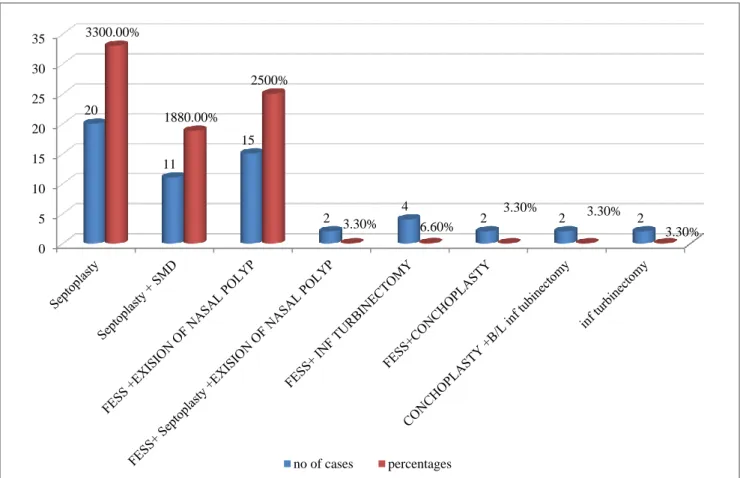
Maximum number of surgery performed in this study was septoplasty in 20 (33.3%) cases, followed by FESS and excision of nasal polyp in 15 (25%) cases, septoplasty and SMD in 18.8% cases, fess and conchoplasty in 6.6 cases, percentage FESS and INF turbinectomy in 6.6 cases, FESS and septoplasty and excision of nasal polyp in 3.3% cases, conchoplasty and bilateral inferior turbinectomy in 3.3 cases and inf turbinectomy in 3.3 cases (Figure 1).
Figure 1: Surgical procedure used in present study.
0 5 10 15 20 25 30 35
20
11
15
2 4 2 2 2
3300.00%
1880.00%
2500%
3.30% 6.60%
3.30% 3.30%
3.30%
Table 1: Types of tympanogram pre-operative and post-operative.
Type Preoperative Postoperative at 1 month Postoperative at 3 months
N (%) N (%) N (%)
Type A 74 (61.6) 107 (89.1) 108 (90)
Type C 42 (35) 10 (8.3) 9 (7.5)
Type B 4 (3.3) 3 (2.5) 3 (2.5)
Total 120 (100) 120 (100) 120 (100)
Table 2:ETF test preoperatively and postoperative at 1 month and at 3 months after pack removal.
Category Patients
Poor (%) Good (%)
Preoperative 96 (80) 24 (20)
Postoperative at 1 month 35 (29.1) 85 (70.8)
Postoperative at 3 months 35 (29.1) 85 (70.8)
Table 3: Middle ear pressure preoperatively and postoperative at 1 month and at 3 months after removal of pack.
Category Preoperative (daPa) Postoperative at 1 month (daPa) Postoperative at 3 months (daPa)
Range -150 to 4 -75 to 4 -80 to 4
Mean -123 -11 -13
Table 4: Relation between laterality of nasal obstruction and pre-operative type of tympanogram.
Nasal obstruction No. of patients
Type of tympanogram
Right ear Left ear
A C A C
Bilateral 36 26 10 28 8
Left side 18 15 3 11 7
Right side 6 5 1 4 2
In this study preoperatively, 74 (61.5%) ears showed normal type-A tympanogram while 46 ears showed abnormal tympanogram out of which 42 (35%) ears showed type C and 4 (3.3%) ear showed type B tympanogram, at 1 month post operatively tympanogram of 107 (89.1%) were normal type A, while 13 ears showed abnormal curved out of which 3 (2.5%) tape B and 10 (8.3%) type C curve, 3 months post operatively tympanogram of 108 (90.%) were normal type A, while 12 ears showed abnormal curved out of which 3 (2.5%) tape B and 9 (7.5%) type C curve at. There was statically significance increase in the proportion of type A cases pre and post operatively p value <0.05 as per chi-square test. This shows that surgery for nasal obstruction postoperatively as evident by statically significant normalization of tympanogram when compared to preoperative status. There was no statically significance change seen in the proportion of type A, postoperatively between at 1 month and at 3 months (Table 1).
Preoperatively, 74 (61.6%) ears were type A, 50 ears of them had poor ETF and 24 ears had good ETF. 42 (35%) ears were type C, 4 (3.3%) ear were type B tympanogram, all of them had poor ETF. Thus, we can see that type A tympanogram does not always mean a
good ETF, but the patient may have poor ETF with eustachian tube dysfunction despite type A tympanogram.
The effect of nasal obstruction surgery on the middle ear pressure preoperatively and at 1month and at 3 month after removal of nasal packs is shown in Table 3, is preoperatively value of middle ear pressure ranged from -150 to 4 daPa, means was -123 and post operatively at 1 month middle ear pressure was from -75 to 4 and means was -11, and at 3 months MEP was from -80 to 4 mean was -13 with a statically significant improvement in middle ear pressure between preoperatively and postoperatively (p<0.05). Thus, nasal obstruction surgery has shown statically significance improvement in middle ear ventilation by post operatively. There was no significant change seen in MEP between post-operative at 1 month and at 3 months.
DISCUSSION
Impedance audiometry is a common and practical method that is used for the measurement of middle ear pressure and eustachian tube function. It has been frequently reported that the functions of the eustachian tube are affected from the pathological conditions in the nasal, paranasal and nasopharyngeal cavities. Three mechanisms were postulated for eustachian tube dysfunction after nasal obstruction.6
First, airflow turbulence may lead to deposition of microorganisms and air pollutants in the region of eustachian tube opining, resulting in tubal epithelium or peri tubal inflammation and mechanical obstruction. Second, tubal mucous viscosity and surface tension may be increased by the drying effects of altered air currents, leading to increased tubal opening pressure. The third postulated mechanism is that the postnasal mechanical receptors’ end on autonomic nerve supply to the Eustachian tube may be stimulated by altered air currents, leading to a reflex alteration in ET.
The lymphatics of the middle ear and Eustachian tube course along the posterior-inferior aspect of the Eustachian tube, getting afferent from nasal cavity, paranasal sinuses, nasopharynx and adenoids. Efferent from plexus terminate in retropharyngeal lymph nodes. Inflammation and oedema in these areas cause obstruction to the flow, resulting in retrograde obstruction of tympanic and tubal lymphatic’s producing tubal dysfunction and middle ear effusion.
We conclude from our data, the most common diagnosis on nasal endoscopy was deviated nasal septum (56.6%) cases, followed by INF turbinate hypertrophy (26.6%) cases, middle turbinate hypertrophy (25%), uncinate process oedematous/ congested (20%) eustachian tube blockage (76.6%), nasal polyposis (30%), and out of 60 cases there were two cases of allergic fungal rhinosinusitis and one case each of inverted papilloma and bleeding polyposis. Kamal et al, they found in their study that deviated nasal septum was present in 68.2% cases of nasal obstruction.7
In our study we found that nasal obstruction surgery has shown statically significance improvement in middle ear ventilation from preoperatively to post operatively but There was no significant change seen value of MEP postoperatively between at 1month and at 3 months. Low et al showed that MEP was -25.7±28.4 mm water pre-operatively, and following surgery increased significantly to -2.9±30.4 mm water (mean±SD) (p<0.001).8 These results are similar to our study’ however, these results differ from those of Salvinelli et al, who found that there were no significant differences between the results of middle ear pressure in the preoperative and postoperative periods up to the 90th day.9
This shows that surgery for nasal obstruction significantly improve ETF by at 1month and at 3 months postoperatively as evident by statically significant normalization of tympanogram when compared to preoperative status. There was no statically significance seen in the proportion of type A, postoperatively between at 1 month and at 3 months.
Patients who had chronic nasal obstruction and poor ETF, seen significant improvement ETF at 1 month and at 3 months postoperatively. There was no significant improvement seen post operatively between at 1 month and 3 months. Osama et al, they found that ETF preoperatively and at 30 days after the removal of nasal packs, preoperative good ETF value was 23.3% cases and postoperatively good ETF was 46.6% cases with a significant improvement in ETF after the nasal obstruction surgery (p<0.002).10
There was statically significance increase in the proportion of type A cases 1 month 3 months postoperatively as evident by statically significant normalization of tympanogram when compared to preoperative status. There was no statically significance seen in the proportion of type A, post-operatively between at 1 month and at 3 months. Kamal et al also found the similar results in their study.9
There was no significant correlation between the laterality of nasal obstruction and tympanometric type and ETF, similar to our study, similar to Osama et al.10 Preoperatively, 56 patients (93.3%) had a sensation of ear fullness. At 1 month and at 3 months after the removal of nasal packs, 44 patients (66.7%) still had a sensation of ear fullness, with significant improvement (p<0.001). Surgery for chronic nasal obstruction significantly improves tubal function and middle ear ventilation at 1month after nasal pack removal and there was no significant improvement seen between at 1 month and at 3 months postoperatively. Hence, corrective surgery for nasal obstruction should be considered at least 1 month before undertaking the middle ear surgery to improve middle ear ventilation, thereby improving the success rate of middle ear surgery.
CONCLUSION
We find out that nasal obstruction has a definite relationship with eustachian tube function. Surgery for nasal obstruction has a favorable effect on the middle ear pressure and Eustachian tube function. Corrective surgery for nasal obstruction should be considered at least 1 month before undertaking the middle ear surgery to improve middle ear ventilation.
Funding: No funding sources Conflict of interest: None declared
REFERENCES
1. Bonding P, Tos M. Middle ear pressure during brief pathological conditions of the nose and throat. Acta Otolaryngol. 1981;92:63-9.
2. Poe DS. Glasscock-Shambaugh Surgery of the Ear Endoscopic Diagnosis of Eustachian Tube Dysfunction. FACS. 2017;2(6):337-43.
3. Chaudhry S, Ahmad Z, Khan FB, Afzal M. Frequency of Otitis Media in Patients of Nasal Polypi. J Ayub Med Coll Abbottabad. 2010;22(2):83-5.
4. Fireman P. Otitis media and Eustachian tube dysfunction: connection to allergic rhinitis. J Allergy Clin Immunol. 1981;99:787-97.
5. Jerger J. Clinical experience with impedance audiometry. Arch Otolaryngol. 1970;92:311-24 . 6. Farenti G, Denaro E. Rhino-pharyngeal disease and
tubal disease. Relations and influences. Middle Ear Dis Surg. 1992;12:199-204.
7. Kamal NP, Harkare V. Nasal obstruction on Eustachian tube dysfunction and middle ear ventilation: how are related. Int J Clin Biomed Res. 2015;1(3):46-50.
8. Low WK, Williatt DJ. The relation between middle ear pressure and deviated nasal septum. Clin Otolaryngol Allied Sci. 1993;18:308-10.
9. Salvinelli F, Casale M, Greco F, Ascanio DL, Petitti T, Peco DV, et al. Nasal surgery and Eustachian tube function: effects on middle ear ventilation. Clin Otolaryngol. 2005;30:409-41.