Year XXI, No. 1, 2015, pp. 57-68
Small Scale Industries and Poverty Reduction in Ondo
State, Nigeria
A. F. Fatusin
Afolabi Francis Fatusin
Department of Geography and Planning Sciences Adekunle Ajasin University, Ondo State, Nigeria
Abstract
toward Ondo Central which is the most cosmopolitan region in the state in terms of the magnitude of these impacts at reducing poverty. The study concluded by recommending improved support by the government to grow the sector to further reduce poverty in the state.
Keywords: poverty, poverty reduction, small scale industries, per- capital income
Introduction
Africa compared with other continents of the world is noted for its high state of underdevelopment (see Human Development Index, 2010). The state of underdevelopment of countries in the continent is a reflection of the low level of technology, high incidence of unemployment and underemployment, as well as the generally high poverty level experienced especially in most African countries. Small-scale industries (SSI) have therefore been recommended by bi-lateral and multi-lateral international agencies as the most viable industrial strategy for the developing countries, especially in poverty reduction (Williams, 2009).
A cursory examination of the sector in Nigeria however shows that its potentials at reducing urban and rural poverty have not been fully explored. It employs just about 20 percent of the labor force while contributing only 0.55 percent to the Gross Domestic Product (Ishengoma, 2004). These contrast sharply with the situation in countries such as United States of America and Israel, where SSI employs between 55 and 53 percent of the work force and contributes up to 50 percent of the Gross Domestic Product (International Development Corporation, 2005).
Enterprises Development Agency (SMEDA) in 2002, and the establishment of industrial estates and parks. The Federal government at various times established the Nigerian Industrial Development Bank (N.I.D.B) which was later renamed Bank of Industry (BOI) in 2002, National Economic Reconstruction Fund (NERFUND), Export Credit Guarantee Scheme and Free Trade and Export Processing Zones in Calabar, Lekki, Olokola, Onne, among others. These were all in a bid to encourage the growth of this sector, in order to make it a spring board of sustainable economic development. While both, the Federal and State governments in Nigeria have formulated and implemented policies designed to improve the standard of living across sectors, it is a fact that poverty rates keep increasing even with the massive economic growth of over 7% per annum that Nigeria has witnessed from 2003 to date. It is therefore necessary to evaluate how small industries scale industrial enterprises have affected poverty rates among its major stakeholders and how this has reflected in regional development of Ondo State.
Research Method
Three major towns Akure, Ikare and Okitipupa, three minor towns Ugbe, Obaile and Odeaye, three major villages, Iboropa Aponmu and Ikoya were investigated. The sample frame covered all the SSI (formal and informal) in the nine settlements selected. There were 1411 in the study area. The sample size of the SSI was 353. This constitutes 25% of the entire sample frame (1411). Moreover two workers in each factory were sampled making a total of 706 workers. To collect the needed data questionnaires were administered on these proprietors and workers of sampled small scale industries. Small scale industries in each town were first identified and numbered during reconnaissance survey. Data were analyzed using simple tables and charts. The study was carried out in Ondo state.
However, the present Ondo State is made up of Akoko, Akure, Okitipupa, Ondo and Owo divisions. Akure remains the State capital. The state has a long history of craft industries. Owo for example was noted for its pottery and beads, Ondo for weaving and metal smelting, Akure was a centre of bronze making, while Okitipupa was noted for production of indigenous soap as well as water based SSI such as fish and shrimp processing and gin making.
Literature review
The number one objective of regional planning is poverty reduction in underdeveloped areas. Nigeria as a nation has abundant human and natural resources. Paradoxically, the national poverty level does not reflect this. The country has the largest number of poverty alleviation agencies, institutions, programmes and policies in Africa, yet its poverty profile keeps growing. Urban poverty, in particular, has been exacerbated in Nigeria by low levels of social development resulting from corruption, misallocation of funds, poor investment habits, poor family planning habits, minimum wage laws, declining life expectancy and inadequacy of production enterprises that can serve as employment stimuli. The Human Development Report (2009) rate Nigeria as the 24th poorest country in the world with 70.2% of its population living below the United Nations Poverty line (US$1 per day).
Livelihood represents the current condition of individuals and households and the means by which they reproduce themselves. Resources represent access to assets such as markets, labour, land and basic services. Knowledge is also a resource and an important dimension of poverty, while rights include formal, traditional, civil and political rights. In this multi-dimensional framework, poverty reduction addresses not only improvement in livelihoods, but also improvement in access to resources, expansion of knowledge, and expansion of production enterprises increased empowerment.
poverty line in 2004, an increase of more than 24 percent since 1980, (Omonoma, 2009). Ogundele (2000) in his study of poverty in Ado Ekiti asserts that government sponsored poverty reduction programmes usually benefit the executors rather than the indigent masses. Okoko (2000), also posit that effective poverty alleviation can only be achieved through the empowerment of the poor to initiate, design, execute and manage their own priorities.
Ravallion, Chen and Sangraula (2007) in their study of poverty in the new millennium provide new evidence on the extent to which absolute poverty has urbanized in the developing world, and the role that population urbanization has played in overall poverty reduction. They find that one-quarter of the world’s poor live in urban areas and that the proportion has been rising over time. By fostering economic growth, urbanization helped reduce absolute poverty in the aggregate but did little for urban poverty. Between 1993 and 2002, the count of the “$1 a day” poor fell by 150 million in rural areas, but rose by 50 million in urban areas. The poor have been urbanizing even more rapidly than the population as a whole.
Looking forward, the recent pace of urbanization and current forecast for urban population growth imply that a majority of the poor will still live in rural areas for many decades to come. There are marked regional differences; Latin America has the urbanized poverty problem, East Asia has the least; there has been a “ruralization” of poverty in the Eastern Europe and central Asia; in marked contrast to other regions, Africa’s urbanization process has not been associated with falling overall poverty. Small enterprises can therefore play a leading role in poverty reduction in the urban areas.
also seen as a means of survival for the migrant, especially when no social welfare services are available in the city.
Unfortunately, governments at times past have had a “lackasidical” attitude towards the SSI especially the uncertainty, inferiority, depravity and constant threats by authorities and the law enforcement agencies (Obada and Agba, 2006) which many enterprise owners have had to contend with. It has been described variously as illegal, parasitic and residual. The conditions under which its activities are forced to operate encourage environmental degradation. Nevertheless, the contributions of small scale industries especially the informal types to urban populations and economies, particularly of the third world would be difficult to sweep under the carpet as it provides succor for many middle class families. It also adds essential funds to the otherwise skimpy family coffers of the urban poor. While studies have shown that many participants in the informal small scale industries remain in the low-income cadre, evidence exists to show that informal enterprises make significant contribution to improving sustenance for the urban poor. Olanrewaju (2000) in his study of informal activities and poverty posit that by participating in the informal sector, there is an autonomous and efficient capacity for generating growth in the income of the poor.
The sector employs over 80% of the working population of Nigerians employed in the manufacturing sector (UNDP, 2000). It is a very important part of the nation’s economy as it acts as a shock absorber by providing employment for workers who otherwise might have been unemployed thus reducing poverty. Although there has been a “ruralisation” of poverty in Eastern Europe and Central Asia, in marked contrast to other regions, Africa’s urbanization process has not been associated with falling overall poverty. Small entrepreneurs played a leading role in poverty reduction in the urban areas.
Results and Discussion
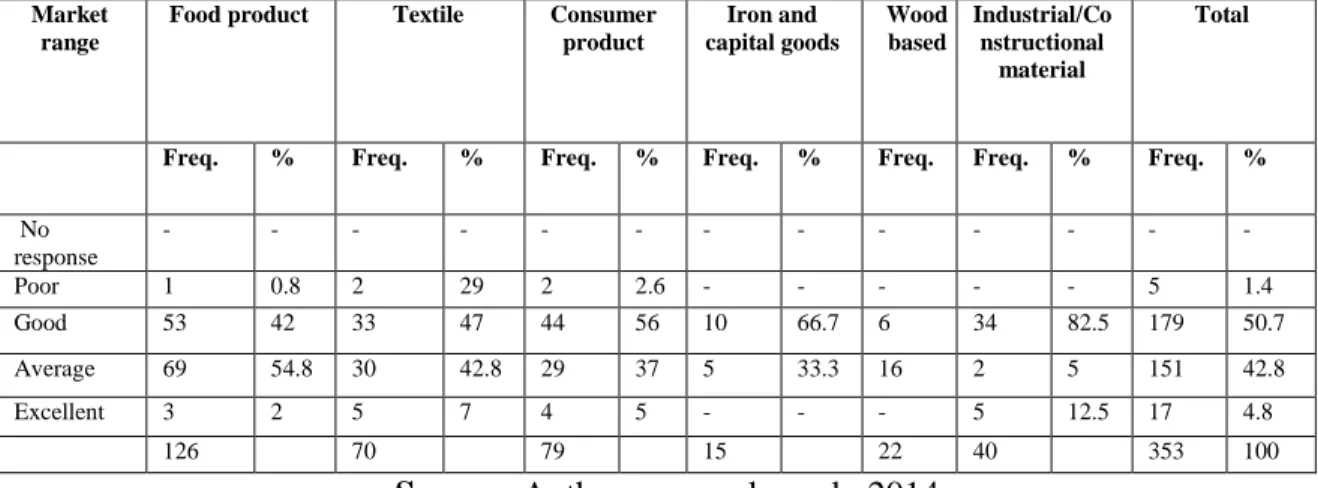
products. A cursory examination of table no.1 indicates that in the opinion of manufacturers, earnings from their enterprises have been good in spite of the global economic crises. One hundred and seventy nine (179) respondents representing 50.7% had picked good Yet a large part of the respondents had picked average (42.8% ) while only few picked poor (1.4%), which is considerably lower than those that had picked excellent. These were discussed in Table no. 1
Table no 1: Return on Capital Investment by Small Scale Industries
Market range
Food product Textile Consumer product
Iron and capital goods
Wood based
Industrial/Co nstructional material
Total
Freq. % Freq. % Freq. % Freq. % Freq. Freq. % Freq. %
No response
- - - -
Poor 1 0.8 2 29 2 2.6 - - - 5 1.4 Good 53 42 33 47 44 56 10 66.7 6 34 82.5 179 50.7 Average 69 54.8 30 42.8 29 37 5 33.3 16 2 5 151 42.8 Excellent 3 2 5 7 4 5 - - - 5 12.5 17 4.8
126 70 79 15 22 40 353 100
Source: Authors research work, 2014
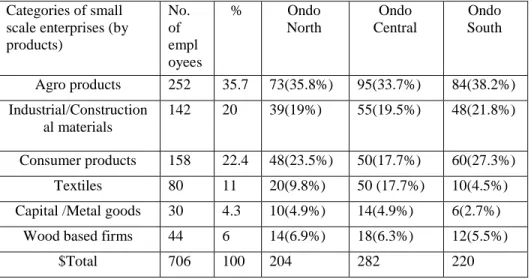
the total number of employees sampled. This is closely followed by consumer products enterprises which had in its employment 158 people or 22.4%. The least number of employees came from enterprises which produced capital/metal goods, which accounted for 4.3% of the total. This is not surprising considering the fact that most of the small enterprises in the study area were agriculture based processing mills or consumer products based firms. There were few capital/metal goods producing enterprises. Aside from that, agriculture based small enterprises have were found to be more linked to the local economy through backward and forward linkages (see table no. 2).
Table no 2: Employment Generation among some categories of small Scale enterprises
Categories of small scale enterprises (by products)
No. of empl oyees
% Ondo
North
Ondo Central
Ondo South
Agro products 252 35.7 73(35.8%) 95(33.7%) 84(38.2%)
Industrial/Construction al materials
142 20 39(19%) 55(19.5%) 48(21.8%)
Consumer products 158 22.4 48(23.5%) 50(17.7%) 60(27.3%)
Textiles 80 11 20(9.8%) 50 (17.7%) 10(4.5%)
Capital /Metal goods 30 4.3 10(4.9%) 14(4.9%) 6(2.7%)
Wood based firms 44 6 14(6.9%) 18(6.3%) 12(5.5%)
$Total 706 100 204 282 220
Source: Authors research work, 2014
averaged 9.8% in Ondo North, 17.7% in Ondo Central and 4.5% in Ondo South. Though capital/metal goods industries accounted for just 4.3% of total employment in Ondo State, it also varied from 4.9% in Ondo North, 4.9% in Ondo Central and 2.7% in Ondo South (see Table no. 2). However, the study proceeded to investigate whether there was a significant difference in the structure of employment generation among different categories of SSI in the 3 regions sampled – Ondo North, Ondo South and Ondo Central.
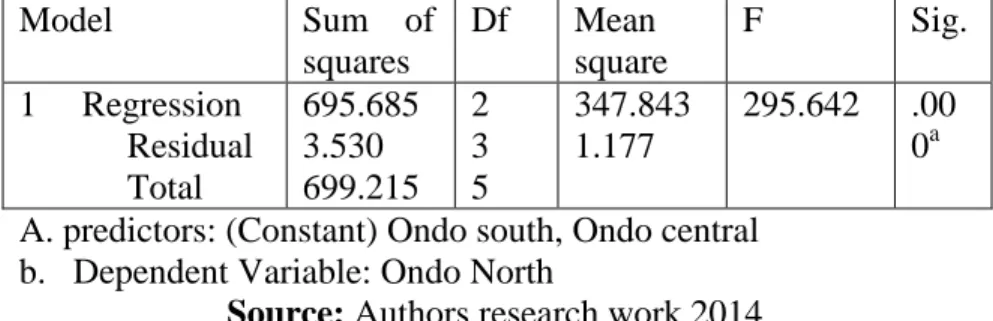
Table no 3: Summary of ANOVA on employment Generation in the 3 Regions
Model Sum of
squares
Df Mean square
F Sig.
1 Regression Residual Total
695.685 3.530 699.215
2 3 5
347.843 1.177
295.642 .00 0a
A. predictors: (Constant) Ondo south, Ondo central b. Dependent Variable: Ondo North
Source: Authors research work 2014
The result above showed that there was a significant difference in the structure of employment among the categories of enterprises in the 3 regions at 0.05 level of significance. Since Fcal
(295.642)>Ftab 0.05 (9.5521). The implication of this is that
employment generation, by different categories of enterprises did not show the same tendency across the 3 regions.
Entrepreneurs earn two types of incomes - profit and monthly salary, although many proprietors of small scale enterprises could not differentiate between the two. The study reveals that many entrepreneurs (45%) are engaged in co-operative societies, 22% were in age grade meetings where they also contribute either weekly or monthly with their profits. These are shared at the end of the month or year creating a lump sum which some of them reinvest in their businesses or used it for capital projects.
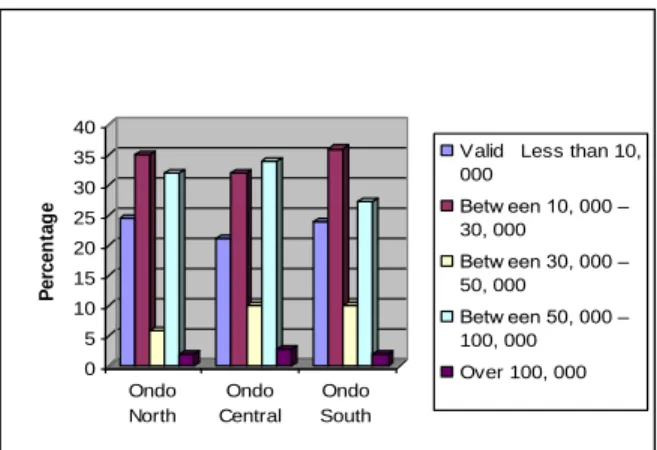
($625) yearly. The average monthly income of workers reflected a generally average income per month. Out of the 706 workers, 38.2% or 1/3 claimed to be earning an average of N20,000 ($125) per month. 31.9% claimed to be earning an average of N75,000 ($469) per month. Only 2.8% of respondents earn over N100,000($625) per month. However out of the 353 proprietors 34.3% earn mean monthly salary of N20, 000 ($125), 31.4% earn N75,000 ($469), while only 2.3% earn N100,000 ($625) as mean monthly salary. The table revealed that Ondo Central has the highest wealthy proprietors and by extension lowest poverty rate among proprietors since the region has the highest number of proprietors earning over N100,000 ($625) per month and those earning between N50,000 and N100,000 per month. This shows that small scale entrepreneurs were having appreciable returns on the capital investment. Therefore it can be deduced that small scale enterprises provided veritable mean of livelihood in the economy or the state. The regional analysis of the average monthly income was calculated. Out of the 34.3% (121) people who earned an average monthly income of between N10,000- N30,000 in Ondo state, minor variation occurred. The variation was exhibited by 36 respondents or 35 % in Ondo North, 45 respondents or 31.9% in Ondo central and 40 respondents or 36% in Ondo South. This is followed by 31.4 % (111) of respondents who earned between 50,000 and 100,000. The figures for the regions being 33 or 32%, 48 or 34% and 30 or 27.3% for Ondo North, Ondo Central and Ondo South (See Fig. no.1)
Fig. no. 1: Inter Regional Variation in Incomes of Proprietors of Small Scale Industries
Source: Field work 2013
0 5 10 15 20 25 30 35 40 P e rc e n ta g e Ondo North Ondo Central Ondo South
Regional differences in Average monthly income proprietors
Valid Less than 10, 000
The study went further to compare the mean salaries of workers who crossed to their present small scale enterprises from other sectors to see whether by crossing over to work in the small enterprise their profits have improved or reduced the number of respondents earning below N10,000 ($62.5) per month which was about $2 per day dropped from 121 to 95 workers since they got employment in their new enterprise. Same with those earning an average of N3,000 ($125) before, which dropped from 183 respondents to 111 respondents, making a net gain of 72 respondents. On the other hand, the number of respondents who were in the high income bracket increased. For example while 82 respondents had indicated mean monthly incomes of N15,000 ($469) before they got employed in their current small enterprise, the number increased to 127, making a net gain of 45 respondents. Same with those earning over N100,000 ($625) before, which increased from 8 respondents to 25 respondents, making a net gain of 17 workers. By this calculation, 195 people were either eliminated from poverty or had become richer.
No wonder therefore that when workers were asked to compare their new incomes with the work they were doing 38% (268) reported that the pay was averagely enough, 24.4% (172) believed the salary was good, while 10.3% (72) of the respondents believed the income was very good. Only 27.3% (193) constituting 28.4% in Ondo North, 24.8% in Ondo Central and 29.5% in Ondo South believed the contrary. All these are positive indicators that in the perception of proprietors and workers of small scale industries have contributed in improving their incomes, even above the daily poverty level of one dollar per day.
Conclusion
number of employees sampled followed by consumer products enterprises which had in its employment, 158 people or 22.4% and the least are enterprises which produced capital/metal goods, which accounted for 4.3% of the total. However, variations exist across the three regions for example agro allied industries which accounted for 35.7% of all employment varied from 35.8% in Ondo North, to 33.7% in Ondo Central and 38.2% in Ondo South. Out of the 142 Industrial raw material/constructional materials employees, who account for 20% employees for the entire state, it averaged 9.8% for Ondo North, 17.7% in Ondo Central and 4.5% in Ondo South. An application of ANOVA to test whether there was any significant differences in the structure of employment across the three regions proved positive.( Fcal (295.642) > Ftab 0.05 (9.5521). The study also
Bibliography
Fatusin, A. (2009). Regional Development Impact of Small Scale Industrial Establishments in Ondo State. An M.Phil Dissertation submitted to Dept. of Urban and Regional Planning Obafemi Awolowo University Ile Ife.
Obadan, M., Agba, U. (2006). Small and Medium Enterprises Development Policy in Brazil, Malaysia, South Africa and South Korea; Lesson for Africa and Nigeria. Business Publ. Union Bank Nig. Plc. 10: p. 24-25
Omonoma (2009). Quantitative Analysis of Rural Poverty in Nigeria. International Food Policy Research Institute vol. 17 p. 14-30 Ravallion, M. C., Prem, S. S. (2008). ”Dollar a day revisited” policy
research workings paper series 4620. The World Bank. Ogundele (2000). “The Marginalized Urban Dweller”. Planning
Issues and Challenges, Being Inaugural Lecture Presented at Lagos State Polytechnic, Lagos.
Okoko, E. (2000). Quantitative techniques in Urban Analysis Kraft books Limited, 2nd ed.
Olanrewaju, O. (2000). “Informal Activities and the Survival of Urban Poor”. Journal of Urban and Environmental Research. FUTA, Akure.
Soludo, C. (2005). Keynote Address Presented at the Seminar on Baseline Economic Survey of SMIs in Nigeria. Organized by the CBN at the Muson Centre, Nigeria.