ISSN: 2147-611X
www.ijemst.com
Exploring
Pre-Service
Elementary
Science
Teachers’
Conceptual
Understanding of Particulate Nature of
Matter through Three-Tier Diagnostic
Test
Mehmet Aydeniz1, Kader Bilican2, Zubeyde Demet Kirbulut3
1The University of Tennessee 2Kırıkkale University 3Harran University
To cite this article:
Aydeniz, M., Bilican, K. & Kirbulut, Z.D. (2017). Exploring pre-service elementary science
teachers‟ conceptual understanding of particulate nature of matter through three-tier
diagnostic test.
International Journal of Education in Mathematics, Science and Technology
(IJEMST), 5
(3), 221-234. DOI:10.18404/ijemst.296036
This article may be used for research, teaching, and private study purposes.
Any substantial or systematic reproduction, redistribution, reselling, loan, sub-licensing,
systematic supply, or distribution in any form to anyone is expressly forbidden.
Authors alone are responsible for the contents of their articles. The journal owns the
copyright of the articles.
Volume 5, Number 3, 2017
DOI:10.18404/ijemst.296036
Exploring Pre-Service Elementary Science Teachers’ Conceptual
Understanding of Particulate Nature of Matter through Three-Tier
Diagnostic Test
Mehmet Aydeniz, Kader Bilican, Zubeyde Demet Kirbulut
Article Info
Abstract
Article History
Received: 29 January 2016
The purpose of this study was to explore Pre-service Elementary Science Teachers‟ (PSTs) conceptual understanding of Particulate Nature of Matter (PNM) through a three-tier diagnostic test. Participants were 215 PSTs from Turkey. Data consisted of participants‟ responses to the Particulate Nature of Matter Test (PNMT). The PNMT consists of three-tier items. Students were asked to choose the correct choice in the first tier, and then to justify their choice of the answer provided in the second tier. Finally, they were asked to indicate the confidence level of their responses in the third tier. Results showed that the PSTs were not competent in their understanding of the PNM concepts. Moreover, some had strongly held misconceptions. Finally, the PSTs struggled to provide coherent answers to the items on the PNMT across three tiers.
Accepted: 16 November 2016
Keywords Elementary science learning
Assessment Pre-service teachers Three-tier test
Introduction
One of the challenges of assessing students‟ conceptual understanding in science is the scarcity of reliable assessment tools and methods (Briggs, Alonzo, Schwab, & Wilson, 2006; Caleon & Subramaniam, 2010; Chu, Treagust, & Chandrasegaran, 2009; Hudson & Treagust, 2013; Kirbulut & Beeth, 2014). Historically, educators have attempted to measure students‟ conceptual understanding in science through multiple-choice assessments, with a single correct answer choice and two or more incorrect options (Linn & Gronlund, 2000; Treagust, 1986). The assumption behind these assessments is that by giving students the opportunity to eliminate the distracting answer choices, and measuring students‟ ability to identify the correct answer choice, one can gather reliable information about students‟ conceptual understanding of the target scientific ideas (Briggs et al., 2006; Kirbulut & Beeth, 2014). While these assessments have been widely used in science education, they have been heavily criticized in recent years. These assessments have been criticized because they have certain limitations in helping educators to access and understand students‟ reasoning behind their answer choices (Pesman & Eryilmaz, 2010; Tan, Goh, Chia, & Treagust, 2002; Voska & Heikkinen, 2000). Critics who have voiced their concerns about the limitations of multiple-choice assessments, developed, used and promoted the use of such assessment tools as open-ended questionnaires (Khalid, 2003) and interviews (Griffiths & Preston, 1992; Osborne & Gilbert, 1980) to assess students‟ conceptual understanding.
Although these assessment tools give students opportunity to elaborate on and justify their responses, they have several drawbacks (Adadan & Savasci, 2012; Briggs et al., 2006; Kirbulut & Beeth, 2014; Tan et al., 2002). First, scoring student responses to open-ended questions takes significant amount of time, which many teachers lack, especially if they are teaching large classes and assessing students‟ understanding frequently (Briggs et al., 2006). Second, while it is true that student responses to open-ended questions or interviews can provide more reliable information about student thinking and knowledge structure, it is hard to get a comprehensive evaluation of students‟ cognitive structure related to core scientific ideas (Briggs et al., 2006; Wang, 2004). More precisely, due to time it takes to answer, it is difficult to administer as many questions as necessary, thus to gather a wide range of information on students‟ knowledge structure related to the topic of interest (Haladyna, 1997).
Chandrasegaran, 2012; Tamir, 1989; Tan et al., 2002; Treagust, 1986; Voska & Heikkinen, 2000; Wandersee, 1983). These types of assessments are advantageous because they ensure the reliability and efficiency of multiple-choice assessments, as well as the capability to diagnose student understanding and reasoning at a deeper level. However, since two-tier tests do not discriminate students‟ lack of knowledge from the misconceptions they hold, educators have come up with three-tier tests, tests that include an additional tier checking on students‟ confidence level in their responses to addres this issue (Arslan, Cigdemoglu, & Moseley, 2012; Caleon & Subramaniam, 2010; Kiray, Aktan, Kaynar, Kilinc & Gorkemli, 2015; Kirbulut & Beeth, 2014; Pesman & Eryilmaz, 2010).
While both students‟ and PST‟s understanding of particulate nature of matter has been studied by several science educators (Banda, Mumba, Chabalengula, & Mbewe, 2011; Nakhleh, Samarampungavan, & Saglam, 2005; Özalp & Kahveci, 2015; Özmen & Kenan, 2007; Yezierski & Berk, 2006), only few of these studies have used two-tier or three-tier assessments in their attempts to measure the PST’s conceptual understanding of the PNM. We focused on the PST‟s conceptual understanding of the PNM, because this topic is taught first at the elementary school and thus the most relevant topic for pre-service elementary science teachers. Similarly, science education literature has reported problems with pre-service and in-service science teachers’ conceptual understanding of the PNM (Chang, 1999; De Jong, Van Driel, & Verloop, 2005; Haidar, 1997; Kahveci, 2009; Özalp &Kahveci, 2015; Özmen, Ayas, & Coştu, 2002; Tatar, 2000; Valanides, 2000). Therefore, an investigation of pre-service elementary science teachers’ conceptual understanding of the PNM merits further exploration. In this study, we used a three-tier diagnostic test to assess the PST‟s understanding of particulate nature of matter.
Review of Relevant Literature
Pre-service science teachers‟ and students‟ conceptual understanding of the PNM has become subject of scholarly investigations for quite sometimes. We discuss a few of these studies in this section. For example, Valanides (2000) investigated pre-service teachers‟ understanding of the macroscopic and microscopic properties of matter. The results of Valadines‟s study showed that majority of the pre-service teachers exhibited limited understanding of the particulate nature of matter. More specifically, they failed to understand the connection between the observable macroscopic changes in matter and the interactions between atoms and molecules at the microscopic level. They also failed to understand how molecules in solutions moved in relation to one another and how they molecules are held together in solutions and gaseous state.
Kahveci (2009) conducted a study with service chemistry teachers in Turkey in which she challenged pre-service teachers to reason about the particulate nature of matter at sub-microscopic level. She found that nearly half of the first year and 20–26% of the fourth and fifth (final) year students could not differentiate between an element and a compound illustrated at sub-microscopic level. Kahveci reasoned that pre-service chemistry teachers develop these misconceptions mainly because they are taught through teacher-centered instructional methods. These methods are not effective at helping students develop meaningful and robust conceptual knowledge. As a result, students end up developing misconceptions. She further argued that if we want pre-service chemistry teachers to develop robust, scientifically accurate knowledge of chemical concepts, we need to adopt effective instructional methods such as inquiry-based instruction.
Collectively, the results of these studies suggest that: 1) both teachers and students harbor several misconceptions related to the particulate nature of matter, 2) teachers‟ can pass their misconceptions onto their students, 3) two-tier multiple-choice items provide an in-depth understanding of learners‟ thinking, thus allows educators to identify and address learners‟ misconceptions through effective interventions such as inquiry-based instruction. While all of these studies have used one or another form of two-tiered assessments, none has used three- tiered assessments.
In this study, taking the advantages of three-tier test into consideration, we used a three-tier diagnostic test to assess the PST‟s conceptual understanding of the particulate nature of matter. The research questions guiding our inquiry were:
1. How competent are pre-service elementary science teachers (PSTs) in understanding particulate nature of matter concepts?
2. How consistent are the PST‟s answers in the Particulate Matter of Nature Test (PNMT) across three tiers? 3. What are the strongly held misconceptions about the particulate nature of matter by the PSTs?
Method
This is a descriptive quantitative study, goal of which is to reliably measure a particular phenomenon and develop assertions that can potentially be generalizable to the whole population (Creswell, 2012). In this study, we measured Turkish PSTs‟ conceptual understanding of the PNM through a three-tier assessment to identify the PST misconceptions.
The sample was drawn from the elementary science pre-service teachers from second tier universities in Turkey. This study took place at four regional universities in Turkey. These are the universities that have been established within the last 20 years and with a heavy focus on teaching with relatively limited research facilities for basic sciences. The participants of the study were 215 PSTs enrolled in four science teacher education programs at four state universities in Turkey. Of the 215 total participants, 89 were sophomores (3rd year) and of 126 were junior (2nd year) students, 165 females and 50 males. All participants had similar background in science content based on the number of mandatory science courses taken in their program areas. The elementary science education program requires students to take 92 mandatory course credits. Of these, 45 credits consist of content courses, such as fundamentals of physics, chemistry, and biology. The participants had taken these science courses in their first and second year of the elementary science education program. These fundamental science courses consisted of two parts: lectures that focus on relevant theories of the science field and laboratory that focus on hands-on lab investigations.
Data Collection
Data consist of the PSTs‟ responses to the PNMT (see Appendix A and Kirbulut & Beeth, 2014 for the instrument). The PNMT consists of three-tier items. Students are asked to choose the correct choice in the first tier, and to justify their choice of the answer with a blank space where students are asked to write an explanation of their reasoning if different from the given reasons is presented in the second tier. Finally, they are asked to indicate their confidence in their responses using a scale ranging from 1-7. The PNMT examines the conceptual areas of Charles Law (3 items), Boyle Law (2 items), Gay-Lussac Law (2 items), conservation of matter (2 items), evaporation (3 items), condensation (2 items), boiling (3 items), and vapor pressure (2 items). The Cronbach alpha reliability coefficient was estimated to be .78 for the PNMT. Participants were informed of the purpose of the study and their consent was sought prior to data collection. Then, the PNMT was administered to the participants at the end of spring semester. They were not given time or instructions to study before they were asked to take the test. They used an entire class period (45 minutes) to complete the test. A sample question from the PNMT is presented below.
1.1 When an amount of water is boiling, you see bubbles coming from the boiling water. What do you think that the bubbles are made of?
A) Air
B) Oxygen gas
1.2 Which one of the followings is the reason of your answer for the previous question? A) When water evaporates, it breaks into oxygen and hydrogen gas.
B) There is air in water and bubbles are made of air.
C) When water evaporates, the distance between water molecules increases.
D) ………..
1.3 How sure you are about your answers for the previous two questions?
Unconfident Confident Confidence Rating: 1 2 3 4 5 6 7
Data Analyses
We used quantitative techniques in analyzing the data. We primarily relied on frequency and percent analyses in reporting our results. Our analyses focused on calculating students‟ correct answers across three tiers of items. Tier I scores were created by using student answers to the first tier of items, students‟ correct answers were coded as 1 and others were coded as 0. Tier II scores were calculated based on student responses to the first and second tiers of items. When student answers to both the first and the second tier of items were correct, they were coded as 1, otherwise 0.
Tier III scores were calculated based on student answers to all three-tier items. The third tier is the confidence tier. When student answers to the first two tier of items were correct, and his/her confidence level was above 4 on a 1-7 scale, they were coded as 1; otherwise 0 (Turker, 2005). The PSTs‟ overall test scores and descriptive statistics were calculated using Microsoft Excel. The maximum possible score for the PNMT is 19. After we calculated frequencies of correct responses for the first tier, the second tier and the confidence tier, we calculated the percentages of students who performed correctly at each tier to compare their answers‟ consistency across all tiers.
We also calculated misconception scores for all tiers based on the list of identified misconceptions presented in Appendix B. While calculating misconception scores, we used a three variable-misconception framework: first-tier, both-first-tier, and all-tier scores. The first-tier misconception score was produced based on a student‟s answer for the first tiers of the items which constitute related misconceptions as indicated in Appendix B. When a student‟s answer to the first tier was a misconception, it was coded as 1; otherwise 0. The both-tier misconception score was created according to a student‟s answer to the both the first and the second tiers for each misconception. When a student‟s answer to both tiers was a misconception as indicated in Appendix B, it was coded as 1; otherwise 0. Misconception all-tier was created based on a student‟s answer to all tiers for each misconception in Appendix B. When a student‟s answer to both tiers was misconceptions and when a student was confident about his/her answers, it was coded as 1; otherwise 0.
Results
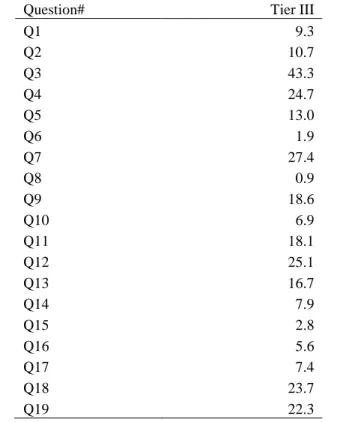
The PST‟s test scores on the PNMT showed that they are not competent in understanding the PNM. The percentage of the PSTs who correctly answered all item tiers ranged from 0.9 to 43.3 (Please see Table 1).The maximum score of the PNMT was 9.0 and the minimum score was 0.0. The mean scores of the PNMT were 2.9 with 2.1 standard deviation.
Results showed that the PSTs struggled to provide consistent answers across all tiers. Participants performed well only on two questions: Q1 (90.2%) and Q5 (81.4%) at the first tier. They performed fairly well on five questions: Q3 (54.9%), Q4 (47.9%), Q9 (50.7%), Q12 (61.4%) and Q13 (48.4%) and they performed poorly or very poorly on 12 questions that were on the PNMT. Meaning less than 45% of the participants were able to answer these questions. When participants were challenged to justify their answers in the second tier, even those who performed well on the first tier items, failed to show the same performance.
Table 1. Summary of students‟ performance for the PNMT (%)
Question# Tier III
Q1 9.3
Q2 10.7
Q3 43.3
Q4 24.7
Q5 13.0
Q6 1.9
Q7 27.4
Q8 0.9
Q9 18.6
Q10 6.9
Q11 18.1
Q12 25.1
Q13 16.7
Q14 7.9
Q15 2.8
Q16 5.6
Q17 7.4
Q18 23.7
Q19 22.3
Participants performed very poorly on nine questions (i.e. Q2, Q6, Q7, Q10, Q11, Q14, Q15, Q16, and Q17, even at Tier I). They performed poorly on six questions (i.e. Q4, Q8, Q9, Q13, Q18 and Q19). No matter how well or how poor students performed on the first tier of the questions, the PSTs did not provide consistent answers across all tiers. The PSTs struggled to justify the responses that they provided in the first tier. Moreover, the majority of the PSTs did not feel confident in their responses. (Please see Table 2 for details).
Table 2. Summary of students‟ competency across question tiers (%)
Question# First Tier Second Tier Confidence Tier
Q1 90.2 23.3 19.1
Q2 22.3 11.2 7.9
Q3 54.9 46.0 38.6
Q4 47.9 32.6 19.1
Q5 81.4 13.5 9.8
Q6 6.0 2.8 1.9
Q7 37.2 29.3 23.7
Q8 42.3 35.3 25.6
Q9 50.7 22.8 14.4
Q10 21.9 7.9 5.6
Q11 29.8 10.7 16.3
Q12 61.4 31.6 20.5
Q13 48.4 23.7 13.5
Q14 28.4 10.7 6.0
Q15 28.4 7.9 4.7
Q16 19.5 8.4 4.2
Q17 28.4 8.4 5.6
Q18 40.0 28.8 18.6
Figure 1.Participant performance across question tiers
Our analyses also revealed that the PSTs held several misconceptions ranging from „Vapor or gas has no weight‟ to „When the gas pressure increases, the weight of the gas also increases‟ (see Appendix B). We summarize the prevalence of each of the misconceptions reported in Appendix B for each tier in Table 3. Tan et al. (2002) reported that misconceptions that are selected by at least 10% of the sample could be considered as strongly-held misconceptions. Table 3 shows that there were eight (misconceptions 2, 3, 7, 14, 16, 17, 18 and 20) strongly-held misconceptions.
Table 3. The percentages of misconceptions for the first-tier, both-tier, and all-tier scores Misconceptions Percentages of Misconceptions
Misconception first-tier Misconception both-tier Misconception all-tier
Misconception1 48 11 9
Misconception 2 76 26 24
Misconception 3 45 13 11
Misconception 4 28 1 1
Misconception 5 16 7 5
Misconception 6 20 10 7
Misconception 7 47 23 19
Misconception 8 38 8 5
Misconception 9 37 10 9
Misconception 10 31 6 4
Misconception 11 23 6 5
Misconception 12 30 7 5
Misconception 13 30 7 6
Misconception 14 39 15 12
Misconception 15 14 3 2
Misconception 16 54 20 17
Misconception 17 32 24 20
Misconception 18 34 20 17
Misconception 19 37 4 3
Misconception 20 33 14 10
*Percentages indicate the percentage of sample that held that particular misconception
0,0 10,0 20,0 30,0 40,0 50,0 60,0 70,0 80,0 90,0 100,0
Q1 Q2 Q3 Q4 Q5 Q6 Q7 Q8 Q9 Q10 Q11 Q12 Q13 Q14 Q15 Q16 Q17 Q18 Q19
P
e
rcen
t
Co
rr
e
ct
Questions
Participants' Performance Across Questions
Tier1
Tier2
Discussion and Conclusion
Science educators have investigated students‟ and teachers‟ conceptual understanding of various scientific ideas for quite sometimes (Adadan, 2014; Kahveci, 2009; Özmen et al., 2002). Researchers conducting conceptual change studies have identified several misconceptions in different domains of science among students and teachers (Canpolat, 2006; Chinn & Brewer, 1993; diSessa, 2006; Peterson, Treagust, & Garnett, 1986; Songer & Mintzes, 1994; Tytler, 2000). Despite the progress achieved in misconception studies, effective identification of students‟ misconceptions continues to be an area of concern (Briggs et al., 2006). In this study, we explored the power of a three-tiered assessment in identifying the PST misconceptions related to the PNM.
Exploring the PSTs‟ misconceptions related to the PNM is important because, the PNM makes up the majority of science curriculum at the elementary school level. Therefore, it is important that the PSTs develop a coherent and scientifically accurate conceptual understanding of the PNM. One way to assure that the PSTs develop such knowledge is by reliably measuring their conceptual understanding of the PNM. In this study, we measured the PSTs‟ conceptual understanding of the PNM through a three-tier assessment. Three-tier assessments provide more reliable information about students‟ level of understanding because they force students to justify their answers; thus allowing teachers to judge whether students can support their answers with confidence (Adadan & Savasci, 2012; Chandrasegaran, Treagust, & Mocerino, 2007; Tan et al., 2002; Wang, 2004). The results from this study along with the results reported in similar studies (Odom & Barrow, 1995) confirm this claim.
The PSTs‟ answers to the three-tier test provided an in-depth understanding of learners‟ cognitive structure related the structure of matter, thus allowing us to detect the PSTs‟ misconceptions related to the PNM. The PNMT scores revealed that the PSTs did not have sufficient conceptual understanding of the PNM. Participants showed several misconceptions such as „Vapor or gas has no weight‟ and „When the gas pressure increases, the weight of the gas also increases‟ in their responses to the PNMT. Moreover, the results showed that the PSTs had some strongly-held misconceptions. Also, regardless of participants‟ performance on tier I items, they showed inconsistency in their responses for tier II and tier III. That is, they mostly could not provide valid justifications for their responses in tier I and they did not feel confident in their responses to the PNMT items. In short, current research provided evidence for the PSTs‟ misconceptions of the PNM as well as identifying the way of the PSTs‟ justifications behind their thinking allowing the science educators to map an effective route to overcome these alternative conceptions.
Recommendations
The majority of the PSTs failed to correctly justify their answers to multiple choice questions asked of them in the first tier. Furthermore, they also failed to show confidence in their responses even when they answered the question correctly. While students can recognize the factual scientific knowledge related to the PNM, they could not elaborate or justify the reasons behind their answers. These findings imply that the instruction that the PSTs receive in their chemistry content courses is not effective. We need to reconsider the ways in which we teach the PSTs fundamental science courses, and adopt student-centered instruction methods that engage students in inquiry-based learning and argumentation. These types of instructional methods are likely to result in better outcomes because they create a context for meaningful learning, engage students in questioning their own and their peers‟ knowledge, and bring students‟ ideas under scrutiny (Duschl & Osborne, 2002; Ford & Wargo, 2011) and allow teachers to intervene and address misconceptions or the gaps in students‟ knowledge (Beeth, 1998).
use conceptual change based instructional approaches to explore and address the misconceptions that the PSTs may hold.
References
Adadan, E. (2014). Investigating the influence of pre-service chemistry teachers' understanding of the particle nature of matter on their conceptual understanding of solution chemistry. Chemistry Education Research and Practice, 15(2), 219-238.
Adadan, E., & Savasci, F. (2012). An analysis of 16–17-year-old students' understanding of solution chemistry concepts using a two-tier diagnostic instrument. International Journal of Science Education, 34(4), 513-544.
Arslan, H. O., Cigdemoglu, C., & Moseley, C. (2012). A three-tier diagnostic test to assess pre-service teachers‟ misconceptions about global warming, greenhouse effect, ozone layer depletion, and acid rain.
International Journal of Science Education, 34(11), 1-20.
Banda, A., Mumba, F., Chabalengula, V. M., & Mbewe, S. (2011). Teachers‟ understanding of the particulate nature of matter: The case of Zambian pre-service science teachers. Asia-Pacific Forum on Science Learning and Teaching, 12(2), 1-16.
Beeth, M. E. (1998). Teaching for conceptual change: Using status as a metacognitive tool. Science Education,
83(2), 343-356.
Briggs, D., Alonzo, A., Schwab, C., & Wilson, M. (2006). Diagnostic assessment with ordered multiple-choice items. Educational Assessment, 11(1), 33-64.
Caleon, I., & Subramaniam, R. (2010). Development and application of a three-tier diagnostic test to assess secondary students‟ understanding of waves. International Journal of Science Education, 32(7), 939-961. Canpolat, N. (2006). Turkish undergraduates‟ misconceptions of evaporation, evaporation rate, and vapour
pressure. International Journal of Science Education, 28(15), 1757-1770.
Chandrasegaran L., Treagust, D. F, & Mocerino, M. (2007). The development of a two-tier multiple-choice diagnostic instrument for evaluating secondary school students‟ ability to describe and explain chemical reactions using multiple levels of representation. Chemistry Education Research and Practice 8(3), 293-307.
Chang, Jin-Yi. (1999). Teachers college students‟ conceptions about evaporation, condensation and boiling.
Science Education, 83(5), 511-526.
Chinn, C. A., & Brewer, W. F. (1993). The role of anomalous data in knowledge acquisition: A theoretical framework and implications for science instruction. Review of Educational Research,63(1), 1-49. Chu, H., Treagust, D. F., & Chandrasegaran, A. (2009). A stratified study of students‟ understanding of basic
optics concepts in different contexts using two-tier multiple-choice items. Research in Science and Technological Education, 27(3), 253-265.
Creswell, J. W. (2012). Educational research: Planning, conducting, and evaluating quantitative and qualitative research (4th ed.). New York: Pearson.
De Jong, O., Van Driel, J. H., & Verloop, N. (2005). Preservice teachers‟ pedagogical content knowledge of using particle models in teaching chemistry. Journal of Research in Science Teaching, 42(8), 946-964. diSessa, A. A. (2006). A history of conceptual change research: Threads and fault lines. In K. Sawyer (Eds.),
Cambridge handbook of the learning sciences (pp. 265-281). Cambridge: Cambridge University Press. Duschl, R. A., & Osborne, J. (2002). Supporting and promoting argumentation discourse in science education.
Studies in Science Education, 38(1), 39-72.
Griffiths, A. K., & Preston, K. R. (1992). Grade-12 students' misconceptions relating to fundamental characteristics of atoms and molecules. Journal of Research in Science Teaching, 29(6), 611-628. Ford, M. J., & Wargo, B. M. (2012). Dialogic framing of scientific content for conceptual and epistemic
understanding. Science Education, 96(3), 369-391.
Haidar, A. H. (1997). Prospective chemistry teachers‟ conceptions of the conservation of matter and related concepts. Journal of Research in Science Teaching, 34(2), 181-197.
Haladyna, T. M. (1997). Writing test items to evaluate higher order thinking. Needham Heights, MA: Allyn & Bacon.
Haslam, F., & Treagust, D. F. (1987). Diagnosing secondary students' misconceptions of photosynthesis and respiration in plants using a two-tier multiple choice instrument. Journal of Biological Education, 21(3), 203-211.
Hudson, R. D., & Treagust, D. F. (2013). Which form of assessment provides the best information about student performance in chemistry examinations? Research in Science & Technological Education, 31(1), 49-65. Kahveci A. (2009). Exploring chemistry teacher candidates‟ profile characteristics, teaching attitudes and
Khalid, T. (2003). Pre-service high school teachers‟ perceptions of three environmental phenomena.
Environmental Education Research, 9(1), 35-50.
Kiray, S. A., Aktan, F., Kaynar, H., Kilinc, S., & Gorkemli, T. (2015). A descriptive study of pre-service science teachers‟ misconceptions about sinking-floating. Asia-Pacific Forum on Science Learning and Teaching, 16(2), Article2.
Kirbulut, Z. D., & Geban, O. (2014). Using three-tier diagnostic test to assess students‟ misconceptions of states of matter. Eurasia Journal of Mathematics, Science and Technology Education, 10(5), 509-521.
Lemma, A. (2013). A diagnostic assessment of eighth grade students‟ and their teachers‟ misconceptions about basic chemical concepts. African Journal of Chemical Education, 3(1), 39-59.
Linn R. L., & Gronlund N. E. (2000). Measurement and assessment in teaching (8th ed.). Upper Saddle River, NJ: Prentice Hall, Inc.
Nakhleh, M. B., Samarampungavan, A., & Saglam, Y. (2005). Middle school students‟ beliefs about matter.
Journal of Research in Science Teaching, 42(5), 581-612.
Odom, A. L., & Barrow, L. H. (1995). Development and application of a two-tier diagnostic test measuring college biology students' understanding of diffusion and osmosis after a course of instruction. Journal of Research in Science Teaching, 32(1), 45-61.
Osborne, R. J., & Gilbert, J. K. (1980). A technique for exploring students' views of the world. Physics Education, 15(6), 376-379.
Özalp, D., & Kahveci, A. (2015). Diagnostic assessment of student misconceptions about the particulate nature of matter from ontological perspective. Chemistry Education Research and Practice, 16(3),619-639.
Özmen, H., Ayas, A., & Coştu, B. (2002). Determination of the science student teachers‟ understanding level and misunderstandings about the particulate nature of the matter. Educational Sciences: Theory and Practice, 2(2), 507-529.
Özmen, H., & Kenan, O. (2007). Determination of the Turkish primary students‟ views about the particulate nature of matter. Asia-Pacific Forum in Science Learning and Teaching, 8(1), 1-15
Pesman, H., & Eryilmaz, A. (2010). Development of a three-tier test to assess misconceptions about simple electric circuits. The Journal of Educational Research, 103(3), 208-222.
Peterson, R., Treagust, D. F., & Garnett, P. (1986). Identification of secondary students‟ misconceptions of covalent bonding and structure concepts using a diagnostic instrument. Research in Science Education, 16(1), 40-48.
Sia, D. T., Treagust, D. F., & Chandrasegaran, A. L. (2012). High school students‟ proficiency and confidence levels in displaying their understanding of basic electrolysis concepts. International Journal of Science and Mathematics Education, 10(6), 1325-1345.
Songer, C. J., & Mintzes, J. J. (1994). Understanding cellular respiration: An analysis of conceptual change in college biology. Journal of Research in Science Teaching, 31(6), 621-637.
Tamir, P. (1989). History and philosophy of science and biological education in Israel. Interchange, 20(2), 95-98.
Tan, K. C. D., Goh, N. K., Chia, L. S., & Treagust, D. F. (2002). Development and application of a two-tier multiple choice diagnostic instrument to assess high school students' understanding of inorganic chemistry qualitative analysis. Journal of Research in Science Teaching, 39(4), 283-301.
Tatar, E. (2000). Prospective primary school teachers‟ misconceptions about state of matter. Educational Research and Reviews, 6(2), 197-200.
Treagust, D. F. (1986). Evaluating students‟ misconceptions by means of diagnostic multiple choice items.
Research in Science Education, 16(1), 199-207.
Turker, F. (2005). Developing a three-tier test to assess high school students’ misconceptions concerning force and motion. Unpublished master‟s thesis, Middle East Technical University, Ankara, Turkey.
Tytler, R. (2000). A comparison of year 1 and year 6 students‟ conceptions of evaporation and condensation: Dimensions of conceptual progression. International Journal of Science Education, 22(5), 447-467. Valanides, N. (2000). Primary student teachers‟ understanding of the particulate nature of matter and its
transformations during dissolving. Chemistry Education: Research and Practice in Europe, 1(2), 249-262.
Voska, K. W., & Heikkinen, H. W. (2000). Identification and analysis of student conceptions used to solve chemical equilibrium problems. Journal of Research in Science Teaching, 37(2), 160-176.
Wandersee, J. H. (1983). Suppose a world without science educators. Journal of Research in Science Teaching, 20(7), 711-712.
Wang, J. R. (2004). Development and validation of a two-tier instrument to examine understanding of internal transport in plants and the human circulatory system. International Journal of Science and Mathematics Education, 2(2),131-157.
Author Information
Mehmet Aydeniz The University of Tennessee
Department of Theory and Practice in Teacher Education A 408 Jane & David Bailey Education Complex Knoxville, TN 37996-3442
Contact e-mail: [email protected]
Kader Bilican Kirikkale University
Kirikkale University, Department of Elementary Education, Kirikkale, Turkey
Zubeyde Demet Kirbulut Harran University
Appendix A. Sample Questions from the States of Matter Diagnostic Test
1.1
A) It would decrease. B) It would not change. C) It would increase.
1.2 Which one of the followings is the reason of your answer for the previous question? A) If the temperature was decreased, air particles in the system would shrink. B) If the temperature was decreased, the pressure in the system would decrease. C) If the temperature was decreased, the pressure in the system would increase. D) If the temperature was decreased, the distance between air particles would decrease. E) Atmospheric pressure is constant.
F) ………..
1.3 How sure you are about your answers for the previous two questions?
Unconfident Confident Confidence Rating: 1 2 3 4 5 6 7
2.1
A) The weight of cold and hot air is the same and equal to zero. B) The weight of cold and hot air is the same and greater than zero. C) Cold air is heavier than hot air.
D) Hot air is heavier than cold air.
2.2 Which one of the followings is the reason of your answer for the previous question? A) Gases are weightless.
B) If you heat a gas, the particles of the gas expand. C) When air is warmed up, it rises up.
D) When air is cooled down, it becomes dense and its particles get closer to each other. E) There is no substance which goes out or goes into the jar.
F) When a gas is warmed up, the movement and pressure of the gas particles increase and the number of collisions on the walls of the jar increases.
G) Hot air is more moisturized than cold air.
H) ... 2.3 How sure you are about your answers for the previous two questions?
Unconfident Confident Confidence Rating: 1 2 3 4 5 6 7
3.1
The system shown on the left figure represents a closed flask connected with a balloon and filled with air at 40 0C. If the temperature of the system was decreased from 40 0C to 5 0C, how would the volume of the balloon change? (Atmospheric pressure is 1 atm for both temperatures.)
Buket weighs a closed jar filled with cold air as shown on the left figure. Then, she exposes the jar to the sun and weighs it again. Buket also knows the weight of the jar after it is vacuumed and subtracts the weight of the container from the weight results of cold and hot air in the jar. What could be said about the weight of cold and hot air in the jar?
A) B) C)
3.2 Which one of the followings is the reason of your answer for the previous question? A) If the temperature increases, the pressure of helium gas in the balloon increases. B) If the temperature increases, the distance between helium gas particles increases. C) If the temperature increases, helium gas particles expand.
D) If the temperature increases, the distance between helium gas particles decrease. E) ... 3.3 How sure you are about your answers for the previous two questions?
Unconfident Confident Confidence Rating: 1 2 3 4 5 6 7
6.1
A) B) C) D)
6.2 Which one of the followings is the reason of your answer for the previous question?
A) If the temperature was decreased, the distance between hydrogen molecules and the volume of the gas would decrease.
B) If the temperature was decreased, hydrogen molecules would shrink.
C) If the temperature was decreased, hydrogen molecules would become heavy and sink to the bottom of the tank.
D) If the temperature was decreased, the movement of hydrogen molecules would slow down and the pressure of the gas would decrease.
E) ... 6.3 How sure you are about your answers for the previous two questions?
Unconfident Confident Confidence Rating: 1 2 3 4 5 6 7
10.1 When an amount of water is boiling, you see bubbles coming from the boiling water. What do you think that the bubbles are made of?
E) Air
F) Oxygen gas
G) Oxygen and hydrogen gas H) Water vapor
10.2 Which one of the followings is the reason of your answer for the previous question? E) When water evaporates, it breaks into oxygen and hydrogen gas.
F) There is air in water and bubbles are made of air.
G) When water evaporates, the distance between water molecules increases.
H) ………..
10.3 How sure you are about your answers for the previous two questions?
Unconfident Confident Confidence Rating: 1 2 3 4 5 6 7
12.1 At room temperature (25 0C), there is an open plastic bottle half-filled with water. If this bottle were left for several days in this room, what would happen to the level of water in the bottle? (Note: The humidity in the air should be considered too little.)
A) The level of water decreases. B) The level of water stays the same. C) The level of water increases.
12.2 Which one of the followings is the reason of your answer for the previous question? A) In order for evaporation to take place, temperature has to be increased.
B) Water evaporates with its own energy at every temperature. C) Water evaporates at or above its boiling point, which is 100 0C.
D) In order for evaporation to take place, a liquid has to take heat from its environment. E) Hot air condenses in the bottle.
F) ………..
12.3 How sure you are about your answers for the previous two questions?
Appendix B .
List of Alternative Conceptions
Alternative Conceptions Item Choices
1. When heated, particles expand; when cooled, they shrink.
(1.1.A, 1.2.A, 1.3.A), (5.1.C, 5.2.B, 5.3.A), (2.1.D, 2.2.B, 2.3.A), (3.1.B, 3.2.C, 3.3.A), (6.1.C, 6.2.B, 6.3.A)
2. In a closed container filled with a gas, when temperature increases/decreases, the gas pressure always increases/decreases.
(1.1.A, 1.2.B, 1.3.A), (5.1.C, 5.2.A, 5.3.A), (3.1.C, 3.2.A, 3.3.A)
3. Hot air is lighter than cold air. (5.1.C, 5.2.C, 5.3.A), (2.1.C, 2.2.C, 2.2.A), (2.1.C, 2.2.D, 2.3.A), (6.1.B, 6.2.C, 6.3.A)
4. Gas always weighs less than liquid (or solid). (2.1.D, 2.2.G, 2.3.A), (8.1.B, 8.2.E, 8.3.A) 5. Vapor or gas has no weight. (2.1.A, 2.2.A, 2.3.A), (8.1.A, 8.2.A, 8.3.A) 6. When the gas pressure increases, the weight of the
gas increases.
(2.1.D, 2.2.F, 2.3.A) 7. In a closed container filled with a gas the volume
of a gas always decreases when the temperature decreases.
(4.1.A, 4.2.C, 4.3.A), (6.1.A, 6.2.A, 6.3.A)
8. When air is compressed, the particles stick together.
(7.1.C, 7.2.A, 7.3.A), (9.1.A, 9.2.A, 9.3.A) 9. When air is compressed, the particles are all
pushed to the end of the syringe.
(7.1.D, 7.2.D, 7.3.A), (9.1.A, 9.2.C, 9.3.A) 10. When air is compressed, the particles change its
shape.
(7.1.A, 7.2.B, 7.3.A), (9.1.A, 9.2.B, 9.3.A) 11. When water boils/evaporates, it breaks into its
components hydrogen and oxygen molecules.
(8.1.B, 8.2.B, 8.3.A), (11.1.B, 11.2.B, 11.3.A) 12. In order for evaporation to take place, a liquid has
to take heat from its environment.
(12.1.B, 12.2.D, 12.3.A), (13.1.B, 13.2.D, 13.3.A)
13. Vaporization starts with boiling. (12.1.B, 12.2.C, 12.3.A), (13.1.B, 13.2.A, 13.3.A)
14. Condensation or evaporation requires a temperature gradient.
(12.1.B, 12.2.A, 12.3.A), (13.1.B, 13.2.B, 13.3.A), (16.1.A, 16.2.B, 16.3.A) 15. Condensation is when air turns into a liquid. (12.1.C, 12.2.E, 12.3.A), (13.1.C, 13.2.E,
13.3.A), (16.1.B, 16.2.C, 16.3.A) 16. The cold surface of the closed container and dry air
react to form water via the combination of hydrogen and oxygen on the surface.
(14.1.A, 14.2.A, 14.3.A), (16.1.A, 16.2.A, 16.3.A)
17. When water boils and bubbles come up, the bubbles are oxygen and hydrogen, air, or heat.
(10.1.C, 10.2.A, 10.3.A), (10.1.A, 10.2.B, 10.3.A)
18. Boiling liquids at atmospheric pressure have different vapor pressures.
(17.1.C, 17.2.A, 17.3.A), (17.1.B, 17.2.B, 17.3.A)
19. Vapor pressure increases/decreases with height and this cause the water boil at lower/higher temperatures.
(19.1.A, 19.2.D, 19.3.A), (19.1.C, 19.2.E, 19.3.A)
20. At constant temperature, the value of the vapor pressure changes with changes in the volume of the vapor in equilibrium with its liquid and in the amount of liquid.