AUSTRALIAN JOURNAL OF BASIC AND
Open Access Journal
Published BY AENSI Publication
© 2016 AENSI Publisher All rights reserved
This work is licensed under the Creative Commons Attribution International License (CC BY). http://creativecommons.org/licenses/by/4.0/
To Cite This Article: Markus Philipp Roessler andTobias Meudt Optimization Technology. Aust. J. Basic & Appl. Sci.,
Mobile Value Stream Simulation
Optimization Technology
Markus Philipp Roessler and Tobias Meudt
Institute of Production Management, Technology and
Address For Correspondence:
Markus Philipp Roessler, Institute of Production Management, Technology and Machine Tools, TechnischeUniversitaet Darmstadt, 64287 Darmstadt, Germany
A R T I C L E I N F O
Article history:
Received 3 March 2016 Accepted 2 May 2016 published 26 May 2016
Keywords:
Value Stream Mapping; Discrete Event Simulation; Mobile Software Engineering
In industrial engineering the methods of lean manufacturing add decisively to the success of producing companies. The goal of these methods is to strengthen the competitiveness of production systems by eliminating waste in the internal and external value c
minimal inventory, maximal productivity and thus efficiently used resources (Caridi and Cavalieri 2004). Value stream mapping (VSM) in this context has been established as the preferred way to implement the principles of lean manufacturing (Grewal 2008). Its focus is not set on the improvement of individual processes, but of entire process chains from receipt
producing companies use VSM and many of them already achieved significant improvements (Haemmerle and Rally 2010). Despite its popularity, VSM has some significant shortcomings: The result
system under consideration. Here, misperceptions of the analysis results are possible as there may be other system properties at any other time. Furthermore, the optimal degree of implementation of the principles of value stream design is difficult to determine. Improvements cannot be quantified before physical implementation (McDonald, van Aken and Rentes 2002). Usually, the conversion of a value stream follows to the principle of "trial and error" (Marvel and Standridge 2009).
Thus, decision makers have to trust the benefits of the method, especially when investments have to be made. Determining the optimal degree of conversion and convincing decision makers of the favorability of suggested improvements is not an easy task even
improvement projects therefore much time and effort is invested and still a suboptimal solution is achieved.
AUSTRALIAN JOURNAL OF BASIC AND
APPLIED SCIENCES
ISSN:1991-8178 EISSN: 2309-8414 Journal home page: www.ajbasweb.com
© 2016 AENSI Publisher All rights reserved
This work is licensed under the Creative Commons Attribution International License (CC BY). http://creativecommons.org/licenses/by/4.0/
Markus Philipp Roessler andTobias Meudt., Mobile Value Stream Simulation –Potentials and Requirements of a new
Aust. J. Basic & Appl. Sci., 10(11): 287-292, 2016
Mobile Value Stream Simulation –Potentials and Requirements of a new
Optimization Technology
Institute of Production Management, Technology and Machine Tools, TechnischeUniversitaet Darmstadt, 64287 Darmstadt, Germany
Institute of Production Management, Technology and Machine Tools, TechnischeUniversitaet Darmstadt, 64287
A B S T R A C T
The use of mobile devices like smartphones and tablets as
continues to experience exponential growth. For some time apps are gaining more and more attention in producing companies as enabler for process optimization. Advances in wireless technologies and an increasing maturity of mobile devic
spread of apps for industrial purposes. In the field of industrial engineering value stream mapping is one of the most common methods for material and information flow optimization. In combination with discrete event simulation it is a po
improving volatile and complex production systems. In this paper the potentials and the requirements of mobile value stream simulation as a new-type optimization technology for industrial engineering are discussed.
INTRODUCTION
In industrial engineering the methods of lean manufacturing add decisively to the success of producing companies. The goal of these methods is to strengthen the competitiveness of production systems by eliminating waste in the internal and external value chain (Holweg 2007). The background is to develop systems with minimal inventory, maximal productivity and thus efficiently used resources (Caridi and Cavalieri 2004).
Value stream mapping (VSM) in this context has been established as the preferred way to implement the principles of lean manufacturing (Grewal 2008). Its focus is not set on the improvement of individual processes, but of entire process chains from receipt to delivery of goods. (Rother and Shook 1999) About 60% of German producing companies use VSM and many of them already achieved significant improvements (Haemmerle and Rally 2010). Despite its popularity, VSM has some significant shortcomings: The result is only a snapshot of the system under consideration. Here, misperceptions of the analysis results are possible as there may be other system properties at any other time. Furthermore, the optimal degree of implementation of the principles of esign is difficult to determine. Improvements cannot be quantified before physical implementation (McDonald, van Aken and Rentes 2002). Usually, the conversion of a value stream follows to the principle of "trial and error" (Marvel and Standridge 2009).
Thus, decision makers have to trust the benefits of the method, especially when investments have to be made. Determining the optimal degree of conversion and convincing decision makers of the favorability of suggested improvements is not an easy task even for experienced experts in the field of lean manufacturing. In improvement projects therefore much time and effort is invested and still a suboptimal solution is achieved.
Potentials and Requirements of a new
Potentials and Requirements of a new
Machine Tools, TechnischeUniversitaet Darmstadt, 64287 Darmstadt, Germany
Institute of Production Management, Technology and Machine Tools, TechnischeUniversitaet Darmstadt, 64287
The use of mobile devices like smartphones and tablets as well as mobile apps continues to experience exponential growth. For some time apps are gaining more and more attention in producing companies as enabler for process optimization. Advances in wireless technologies and an increasing maturity of mobile devices foster a wider spread of apps for industrial purposes. In the field of industrial engineering value stream mapping is one of the most common methods for material and information flow optimization. In combination with discrete event simulation it is a powerful tool for improving volatile and complex production systems. In this paper the potentials and the type optimization technology
In industrial engineering the methods of lean manufacturing add decisively to the success of producing companies. The goal of these methods is to strengthen the competitiveness of production systems by eliminating hain (Holweg 2007). The background is to develop systems with minimal inventory, maximal productivity and thus efficiently used resources (Caridi and Cavalieri 2004).
Value stream mapping (VSM) in this context has been established as the preferred way to implement the principles of lean manufacturing (Grewal 2008). Its focus is not set on the improvement of individual processes, to delivery of goods. (Rother and Shook 1999) About 60% of German producing companies use VSM and many of them already achieved significant improvements (Haemmerle and is only a snapshot of the system under consideration. Here, misperceptions of the analysis results are possible as there may be other system properties at any other time. Furthermore, the optimal degree of implementation of the principles of esign is difficult to determine. Improvements cannot be quantified before physical implementation (McDonald, van Aken and Rentes 2002). Usually, the conversion of a value stream follows to
Through material flow simulation, the limitations of VSM can be partially extended. Another benefit of simulation is its effectiveness in systems with increased material flow complexity where analytical approaches reach their limits. (Fink et al. 2014; Huber 2009) Hence, the prior quantification of possible production system designs, using material flow simulation, is gaining more and more importance.
Using simulation, highly complex processes can be analyzed and optimized during the whole life cycle from planning to operation (VereinDeutscherIngenieure 2010). Currently the technology of discrete event simulation (DES) is widespread especially for the simulation and analysis of material flows (Daniluk and Chisu 2010; Al-Aomar 2011; Maerz et al. 2011). Further, the technologies of system dynamics and agent based simulation allow the simulation of material flows (Negahban and Smith 2014). In a series of preparatory work it could already be demonstrated that it can be purposeful to combine VSM and material flow simulation (Roessler, Riemer and Mueller 2015).
In 2012 nearly 70% of all internet users accessed the internet using mobile devices like smartphones and tablet PCs (Accenture 2012). Apps on these devices are becoming the core of the digital life of consumers and are used for communication in social networks as well as mobile banking and shopping (Groeger et al. 2013). For some time apps are gaining more and more attention in producing companies as enabler for process optimization. In this paper the potentials and the requirements of mobile value stream simulation as a new-type optimization technology for industrial engineering is discussed.
Current Limitations:
Because of existing deficits VSM and material flow simulation currently can only be combined with huge effort. Thus, it is necessary to start with a value stream analysis of the production environment to find out and map the current system status. Such an analysis is usually made by hand with pen and paper and afterwards evaluated outside of the production environment. In conjunction with a downstream material flow simulation, it is necessary to implement this paper-based model in simulation software. When creating a simulation model, several analyzes in the production environment are usually required because the data demand of a simulation exceeds the information content of a conventional value stream analysis (Wolff 2013). The phase of value stream design is following a similar manner: First a paper-based model of a potentially more performant state has to be developed and afterwards to be implemented in a simulation model by a simulation expert.
Following such an approach, significant media disruptions occur because the information collected in the analysis must be partially digitalized. This is characterized by a strong information redundancy and a high error rate; this vulnerability increases with rising complexity of the system to be imaged and the number of involved, but necessary individuals.
Such projects require interdisciplinary teams of participants, mostly composed of production managers with knowledge of VSM and simulation experts or programmers. If existing software is used for material flow simulation due to high degrees of freedom always expertise with respect to simulation modeling is necessary. This represents an enormous financial burden, especially for SMEs, because competence usually must be purchased.
Another limitation of this manual approach is that the involvement of production staff is often neglected in the improvement process. Value stream maps are often displayed away from the shop floor due to the high space requirement. Also discussions and decisions regarding future designs are often made without involving the operative staff. If further an external simulation expert is consulted, the transparency of the procedure and the acceptance by the production employees decreases even further. The ability to initiate and quantify improvements in a transparent manner directly at the scene currently is not given in practice:
• Media disruptions exist during data collection in the production environment and the conversion into simulation models, which entails high costs and transmission errors,
• Extensive expertise on the one hand in terms of material flow simulation, on the other hand with respect to design guidelines for lean material flows is necessary,
• There is a relatively low level of transparency and thus acceptance by the workers, as evaluations and decisions are made away from the production environment.
Objective And Innovative Approach:
The review of the mentioned shortcomings makes it evident that a mobile solution for value stream simulation is advantageous. Having an easy-to-use mapping device and thus all the information needed in the palm of the hands in this case can be a true business enabler.
staff and build simulation models right on the shop floor. The mobility aspect also addresses the factor of worker acceptance.
Thus, a more efficient and effective value stream optimization is enabled, which leads to more competitive production systems. This applies to redesigns of existing value streams as well as to completely new value streams still in the planning phase.
To accomplish the stated goal, the workflow when using the tool follows an extended process model for value stream mapping, see figure 1.
Fig. 1: Comparison of the work flows of VSM following the usual analytical approach and mobile value stream
simulation.
State Of The Art:
Introduction of value stream mapping:
Value stream mapping is a holistic approach to achieve improvements on a production system level. Thus, the entire value stream of a product family between incoming and shipping of goods can be analyzed, see (Rother and Shook 1999; Erlach 2010). VSM conventionally consists of the four phasesselection of a product
family, analysis / mapping of the current state, design / development of the future state and work plan / implementation. In the following a distinction between analysis and design will be made
(VereinDeutscherIngenieure 2012).
Value stream analysis provides a practical way to identify and assess the current state of the material flow
within a production system (Rother and Shook 1999). Value stream analysis involves a form of modeling in which knowledge is gained, that can then be transferred back to reality with a suitable interpretation (Arnold and Furmans 2006). The result of a value stream analysis is an analyzable model (current state) of the selected value stream of a physical production system. Both, value-added and non-value-added activities are considered.
After the analysis phase is finished, the derivation of improvement potential can be started. This phase of so called value stream design leads to an improved model of the value stream, the future or target state. The future state indicates an ideal state of the system and can be gradually converted (Marvel and Standridge 2009). Here, only a single target state is derived following the original literature. However, in science and practice the possibility of multiple target states is mentioned (Wolff 2013; Roessler, Metternich and Abele 2014). To derive potential for improvement out of the current state Rother and Shook defined a set of practical design guidelines (Rother and Shook 1999).
Introduction of material flow simulation:
Material flow simulation provides the opportunity to assess design alternatives and improvements to systems prior to physical implementation by modeling and dynamic examination. Simulation models are predictive models for complex systems, in which cause and effect relationship cannot be modeled analytically (Domschke and Drexel 2007). In the area of production and logistics usually the technology of discrete event simulation is applied (Maerz et al. 2011).
In discrete event simulation (DES) the dynamic and stochastic behavior of systems is modeled by time variant state variables. Events occur at a limited number of instants of time (Domschke and Drexel 2007). Typical events in production systems are the finishing of a task or the arrival of an order at a work station (Maerz et al. 2011). DES has long been the most common simulation technology in the sector of operational research. This also holds true for the special case of material flow simulation. (Siebers et al. 2010)
By quantifying the intended benefits of improvements e. g. their financial effects can be assessed in advance. Various authors suggest a connection of material flow simulation and value stream mapping (McDonald, van Aken and Rentes 2002; Marvel and Standridge 2009; Wolff 2013).
Tool Requirements And Studies:
This section contains a definition of target criteria for the tool development, shows the results of a market study and an expert survey. The novelty of the approach addressed in this paper is based on the fact that so far there is no simulation software, which supports VSM in the aforementioned form that the restrictions can be
Selection of a product family
Mapping of the current state
Development of the future state
Work plan and implementation
Manually and partially far away from the production environment
Usual approach for value stream mapping (VSM):
Enhanced approach for this research:
Mapping of the current state
Simulation and assessment
Development of a future state
alternative
Work plan and
implemen-tation
Tool-supported and directly in the production environment Selection of a
overcome. In the following, target criteria for the tool development are defined and discussed. In addition, for these criteria different characteristics are described ((+), (0) and (-)) to enable a direct comparison of the planned development with the prior state of the art and the tools available on the market.
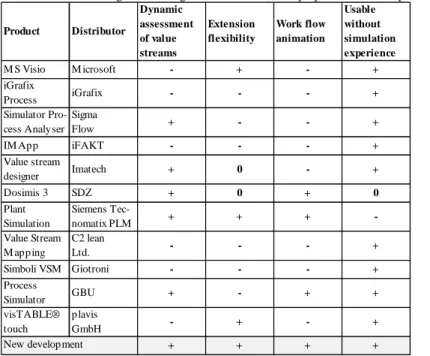
For the purpose of this research a market study was performed to analyze existing IT tools in the field of value stream mapping and assess them according to the following target criteria (cf. tables 1 and 2):
Dynamic assessment of value streams: (+) With the tool it is possible to model, analyze and assess value
streams dynamically using DES. The attribute (-) is given in the assessment, if this is not possible.
Extension flexibility: (+) The tool allows the definition, the parameterization and the programming of new
value stream modules. (0) The tool allows it to expand individual modules (processes, inventories, transports, external entities, ...) by new parameters. (-) The tool allows only the use of predefined modules and existing parameters.
Work flow animation: (+) During simulation the material flow is graphically visualized to check the
plausibility of the models. (-) A graphical display of the material flow to the running time of the simulation is not possible.
Usable without simulation experience: (+) The tool can be used by people with knowledge of value stream
mapping. Programming skills are not necessary. (0) It is possible to create executable models without any knowledge of a programming language. More complex models require programming. (-) It is rather possible to create models without any knowledge of a programming language. Realistic models require the programming of methods.
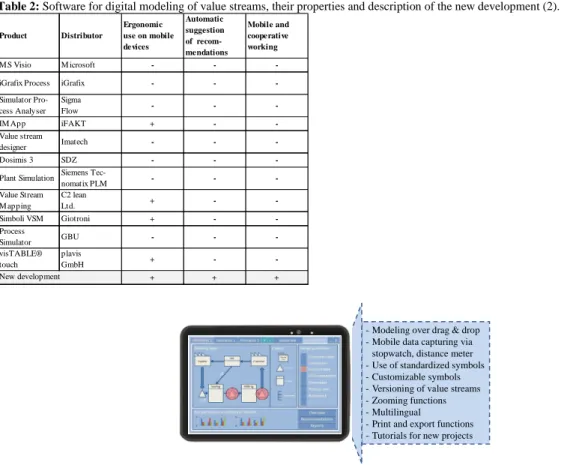
Ergonomic use on mobile devices: (+) The tool has been specifically designed for the use on mobile devices
(display of about 8" to 10") and their usual usage context and is compatible with one of the three newest operating systems for mobile devices (Windows Phone 10, Android 6.X or Apple iOS8.X). (-) The tool can’t be used on any of these operating systems or devices ergonomically.
Automatic suggestion of recommendations: (+) After modeling and assessment of a value stream the tool
recalls guidelines of value stream design and shows fields of opportunity. (-) The tool does not refer to design guidelines.
Mobile and cooperative working: (+) It is supported to work with more than one person from different
locations on one value stream model. (-) The function of cooperative or distributed working is not supported. There are a number of software tools that pick up on the topic, which are listed below in the tables 1 and 2. The market study shows that the aspects of ergonomics and mobility in the area of material flow simulation were not considered yet. Also the suggestion of recommendations is not mentioned before.
Table 1: Software for digital modeling of value streams, their properties and description of the new development (1).
Until today, none of the available tools on the market is able to fulfill all criteria listed before. The desired properties therefore stand out from the current state of the art and require a new development.
In addition to the market study further tool requirements could be raised by an expert survey with eleven experts. These experts work in the field of industrial engineering and are from producing companies out of mechanical engineering and drives / controls industries. They cover the production ranges of high-variance-low-volume and low-variance-high-high-variance-low-volume. Selected results of the expert survey are consolidated in figure 2.
Product Distributor
Dynamic assessment of value streams
Extension flexibility
Work flow animation
Usable without simulation experience
M S Visio M icrosoft - + - +
iGrafix
Process iGrafix - - - +
Simulator Pro-cess Analyser
Sigma
Flow + - - +
IM App iFAKT - - - +
Value stream
designer Imatech + 0 - +
Dosimis 3 SDZ + 0 + 0
Plant Simulation
Siemens
Tec-nomatix PLM + + +
-Value Stream M app ing
C2 lean
Ltd. - - - +
Simboli VSM Giotroni - - - +
Process
Simulator GBU + - + +
visTABLE® touch
p lavis
GmbH - + - +
+ + + +
Table 2: Software for digital modeling of value streams, their properties and description of the new development (2).
Fig. 2: Sketch of a possible user interface of a mobile value stream simulation tool and selected expert
requirements.
Potentials Due To Smart Factory:
In future production systems the acquisition, processing and intelligent linking of all data, which is created during a production process, might play a significant role for industrial engineers. A vision of a smart factory is the fusion of the physical and virtual world leading to Cyber-Physical-Systems (CPS). Both, the data collection and the communication between all involved IT systems and resources in production environments must work without any media breaks, via standardized interfaces and fully automated in the background.
As a direct association and link between the real and the digital world is created on product and manufacturing equipment level, historical and real-time data of a facility can be used for optimization projects. Therefore a user-oriented processing and aggregation of data is essential. The above sketched mobile value stream simulation tool would benefit of a direct database connection resulting in a more realistic picture of the issues in production.
In the course of simulation modelling in the majority of cases deviations and average cycle times are determined on an individual basis due to expert surveys. This approach serves if there is no adequate data basis or results are needed rapidly. Thus the inaccuracy of simulation models increases and the validity of simulation results declines.
If cycle times are taken automatically out of historical data to generate more precise probability distributions the quality of simulation models can be significantly improved. Also during drafting processes for different future states of value streams a data driven approach would increase the credibility of the mobile value stream simulator and support more objective discussions on the shop floor.
Conclusions:
In combination with material flow simulation value stream mapping is a powerful tool for improving volatile and complex production systems. In this paper we discussed the potentials and the requirements of mobile value stream simulation as a new-type optimization technology for industrial engineering. The aspect of mobility can foster the transparency and credibility of planned improvements, minimizes media disruptions and thus can increase the reliability of results. With this new technology a more effective and efficient value stream simulation is potentially enabled.
In future work the mentioned requirements as well as the results of the expert survey will be used further. Thus a prototype of the mentioned software tool will be developed and tested in laboratory and industrial
Product Distributor
Ergonomic use on mobile devices
Automatic suggestion of recom-mendations
Mobile and cooperative working
M S Visio M icrosoft - -
-iGrafix Process iGrafix - -
-Simulator Pro-cess Analyser
Sigma
Flow - -
-IM App iFAKT + -
-Value stream
designer Imatech - -
-Dosimis 3 SDZ - -
-Plant Simulation Siemens
Tec-nomatix PLM - -
-Value Stream M apping
C2 lean
Ltd. + -
-Simboli VSM Giotroni + -
-Process
Simulator GBU - -
-visTABLE® touch
plavis
GmbH + -
-+ + +
New development
- Modeling over drag & drop - Mobile data capturing via
stopwatch, distance meter - Use of standardized symbols - Customizable symbols - Versioning of value streams - Zooming functions - Multilingual
applications to assure the internal and external effectiveness of the technology.
ACKNOWLEDGEMENTS
The authors want to express their kindest thanks to the German Federal Ministry of Education and Research (BMBF), which enabled and supported this work by funding in the course of the research project MobiSim (Funding code: 01IS15025A-C). The funding is carried out within the framework of KMU-innovativ: IKT in the field of Software Systems and Knowledge Technologies.
REFERENCES
Accenture, 2012. Mobile Web Watch Survey.
Al-Aomar, R., 2011. Handling multi-lean measures with simulation and simulated annealing. Journal of the Franklin Institute, doi: 10.1016/j.jfranklin.2010.05.002.
Arnold, D., K. Furmans, 2006. Material Flow in Logistics Systems (6th edn). Heidelberg: Springer-Verlag. Caridi, M., S. Cavalieri, 2004. Multi-agent systems in production planning and control: An overview. Production Planning & Control, doi: 10.1016/S0925-5273(99)00097-3.
Daniluk, D., R. Chisu, 2010. Simulation and Emulation in the Internet of Things.In W. Guenther & M. ten Hompel (Eds.), Internet of Things in Intralogistics (pp: 147–169).Berlin, Heidelberg: Springer-Verlag.
Domschke, W., A. Drexel, 2007. Introduction to Operations Research (7th edn). Berlin: Springer-Verlag. Erlach, K., 2010. Value Stream Design: The Way to the Lean Factory. Berlin: Springer-Verlag.
Fink, A., N. Kliewer, D. Mattfeld, L. Moench, F. Rothlauf, G.S chryen, 2014. Model-based decision support in manufacturing service networks. Business and Information Systems Engineering, doi: 10.1007/s12599-013-0310-4.
Grewal, C., 2008. An initiative to implement lean manufacturing using value stream mapping in a small company. Journal of Manufacturing Technology and Management, 15: 404–417.
Groeger, C., S. Silcher, E. Westkaemper, B. Mitschang, 2013. Leveraging apps in manufacturing: A framework for app technology in the enterprise.Procedia CIRP, doi: 10.1016/j.procir.2013.06.050.
Haemmerle, M., P. Rally, 2010. Wertschoepfung steigern: Ergebnisse der Datenerhebung ueber die Verbreitung und Ausgestaltung von Methoden zur Prozessoptimierung in der Produktion mit besonderem Fokus auf die Wertstrommethode. Stuttgart: FraunhoferVerlag.
Holweg, M., 2007. The genealogy of lean production. Journal of Operations Management, 25(2): 420–437. Huber, D., 2009. Geregelte Vereinfachung hierarchischer Partitionen von Modellen in der Materialflusssimulation. Dissertation.Universitaet Paderborn.
Marvel, J.H., C.R. Standridge, 2009. A simulation-enhanced lean design process. Journal of Industrial Engineering and Management, doi: 10.3926/jiem. 2(1): 90-113.
Maerz, L., H. Krug, O. Rose, G. Weigert, 2011. Simulation and Optimization in Production and Logistics.Berlin, Heidelberg: Springer-Verlag.
McDonald, T., E.M. van Aken, A.F. Rentes, 2002. Utilising simulation to enhance value stream mapping: A manufacturing case application. Journal of Logistics Research and Applications, doi: 10.1080/13675560210148696.
Negahban, A., J.S. Smith, 2014. Simulation for manufacturing system design and operation: Literature review and analysis. Journal of Manufacturing Systems, doi: 10.1016/j.jmsy.2013.12.007.
Roessler, M.P., J. Metternich, E. Abele, 2014. Learning to see clear: Quantification and multidimensional assessment of value stream mapping alternatives considering variability. Business and Management Research, doi: 10.5430/bmr.v3n2p93.
Roessler, M.P., J. Riemer, M. Mueller, 2015. Decision support for choosing an appropriate simulation method for dynamic material flow analysis. Journal of Industrial and Intelligent Information, doi: 10.12720/jiii.3.4.337-341.
Rother, M., J. Shook, 1999. Learning to See: Value Stream Mapping to Add Value and Eliminate Muda. Lean Enterprise Institute.
Siebers, P., C.M. Macal, J. Garnett, D. Buxton, M. Pidd, 2010. Discrete-event simulation is dead, long live agent-based simulation. Journal of Simulation, 4(3): 204–210.
VereinDeutscherIngenieure, 2010. Simulation of Logistics, Material Flow and Production Systems: VDI 3633 Sheet 1 .
Verein Deutscher Ingenieure, 2012. WholisticProduction Systems: VDI 2870 Sheet 1 .