REDUCING COMMUNICATION THROUGH BUFFERS ON A SIMD ARCHITECTURE
A Dissertation Presented to The Academic Faculty
By
Jee W. Choi
In Partial Fulfillment Of the Requirements for the Degree
Master of Science in Electrical and Computer Engineering
REDUCING COMMUNICATION THROUGH BUFFERS ON A SIMD ARCHITECTURE
Approved by:
Dr. D. Scott Wills, Advisor
Dr. Hsien-Hsin Lee
Dr. Sudhakar Yalamanchili
ACKNOWLEDGEMENT
I would like to express my sincerest gratitude to my advisor, Dr. Donald Scott Wills for his guidance, support and encouragement throughout my time at Georgia Tech as a graduate student. Without his help and his unending encouragements, I would not have been able to complete this work.
I would like to thanks Dr. Sudhakar Yalamanchili and Dr. Hsien-Hsin Lee for serving in my thesis committee.
I would also like to thank the member of the PICA group for their helpful advices in times of need.
TABLE OF CONTENTS
Acknowledgements iii
Table of Contents iv
List of Tables v
List of Figures vi
Abstract viii
Chapter 1 Introduction 1
Chapter 2 Background 5
Chapter 3 Methodology 11
3.1 SIMPil: A SIMD Pixel Processor with Integrated Optoelectronic
Detectors 11
3.2 SEP: A High Level Language for Programming on the SIMD
Architecture 12
3.3 SIMcc: A Compiler for the SIMPil Assembly Language 15
3.4 Optimizing Communications 17
3.4.1 Importance of Reducing Communication 17 3.4.2 Algorithm for Tracking the Path of Data 19
3.4.3 Algorithm for Replacement 23
Chapter 4 Results 26
4.1 Percentage of Communication Eliminated 26 4.2 Percentage of Total Communication Eliminated 28 4.3 Percentage of Execution Cycles Eliminated 31 4.4 Effect of Look-ahead Distance on Performance 34
Chapter 5 Conclusions and Future Work 35
LIST OF TABLES
LIST OF FIGURES
Figure 1 Delay for Metal 1 and global wiring versus feature size [19] 3 Figure 2 Impact of different SIMD systems and their compilers to
the development of SEP and SIMcc and the need for an
optimizing compiler for SIMPil 10
Figure 3 Cross sectional diagram showing the coupled detectors and
processors [15] 11
Figure 4 General architecture of the SIMPil system 12 Figure 5 An overview of instructions supported by SEP 13 Figure 6 Execution of a SEP WHILE loop on SIMPil 14 Figure 7 Comparison of various components of different compilers 15 Figure 8 Format and a list of quadruples used in SIMcc 16 Figure 9 Communication paths before and after optimization 18 Figure 10 Steps taken by the algorithm to identify redundant
communication 19
Figure 11 Co-ordinate system with an example trace 20 Figure 12 Example of how data movement is mapped by the algorithm 21 Figure 13 Data structure containing information about overlapping
PEs in the paths 22
Figure 14 Part of the decision tree that can be constructed for buffer
allocation 23
Figure 15 Effect of buffer size on percentage of eliminable XFERs
eliminated for a 5x5 convolution algorithm 27 Figure 16 Effect of buffer size on percentage of eliminable XFERs
eliminated for a 9x9 convolution algorithm 28 Figure 17 Effect of buffer size on percentage of eliminable XFERs
eliminated for a 8x8 DCT algorithm 28
for a 5x5 convolution algorithm 29 Figure 19 Effect of buffer size on percentage of total XFERs eliminated
for a 9x9 convolution algorithm 30
Figure 20 Effect of buffer size on percentage of total XFERs eliminated
for a 8x8 DCT algorithm 30
Figure 21 Effect of buffer size on execution time for a 5x5
convolution algorithm 32
Figure 22 Effect of buffer size on execution time for a 9x9
convolution algorithm 32
Figure 23 Effect of buffer size on execution time for a 8x8 DCT algorithm 33 Figure 24 Effect of look-ahead distance on percentage of eliminable
ABSTRACT
CHAPTER 1 INTRODUCTION
Advances in wireless technologies and the development of inexpensive storage media such as DVD (Digital Versatile Disc) in recent years have enabled large amounts of data to be transmitted or transported to any place on the globe. With growing popularity of multimedia applications, this allows more powerful multimedia applications such as video email and teleconferencing, manipulating captured image or video or real-time rendering of 3-D objects to be carried out on portable devices such as a PDA (Personal Digital Assistant), a digital camera, or a cellular phone. However, in order for processors to be used on such devices, they have to not only be small and powerful, but also energy efficient and cost effective. The processors found on current PDAs or cellular phones are not capable of providing the required computation. SIMPil (SIMD Pixel Processor), a focal plane SIMD architecture currently being studied at Georgia Tech is a promising candidate that may meet the requirements of portable multimedia supercomputing [15].
hardware costs and simpler operations as the communication latency is deterministic [9]. In order to facilitate software development on the SIMPil architecture, a high level language and a compiler for the language are essential. Although often times, programs written directly in assembly language tend to be more efficient than those written in high level languages and then compiled, writing and debugging programs in assembly language is time consuming and difficult, especially as programs size gets larger. Also, the SIMPil architecture, with the NEWS network as its only means of communicating data across nodes, provides another challenge. As data travels further and more frequently, optimizing their movement through the network becomes more and more difficult. Therefore, having an efficient optimizing compiler is absolutely necessary, as it can not only minimize disparity in performance between compiled code and hand-written code, it can also reduce the number of unnecessary communications in the network.
Figure 1 Delay for Metal 1 and global wiring versus feature size [19]
In the future, system designs will become interconnect-centric and design, process technology, packaging, and board construction will all need to come together to provide an integrated system level solution to interconnect requirements [19]. Some of the current research in interconnects include 3D interconnects [21], where interconnects link multiple layers of transistors and wiring stacked on top of each other, and new types of interconnects such as microwave and optical interconnects [20], and nanotubes.
once per platform and memory will become less of a cost as technology improves.
This thesis discusses how a compiler can track the path of data through the network and minimize the number of unnecessary communications by buffering the data in each processor. The algorithm decides whether to buffer the data or not by looking ahead in the program to see how much communication the data can eliminate. 5x5 convolution, 9x9 convolution and 8x8 DCT algorithms were used to exercise the algorithm and the results were compared against those of random and FIFO replacement policies.
CHAPTER 2 BACKGROUND
ILLIAC-IV and ICL DAP
The history of SIMD systems can be traced back to the 1960’s with the design of the ILLIAC-IV which was composed of 64 64-bit processors and had a parallelizing FORTRAN compiler called the IVTRAN. ILLIAC-IV was later followed by the ICL DAP (Distributed Array Processor) in the 1970’s. However, it was not until the 1980’s that interest in SIMD really picked up and led to the development of machines such as the Connection Machine and the MasPar.
Connection Machine
One of the first successful massively parallel machines in the 1980’s was the Thinking Machines Corporation Connection Machine first introduced in 1985. It was designed for general purpose applications whose inherent parallelism could be exploited to increase performance. The CM (Connection Machine) virtual-machine parallel instruction set, called Paris, presents the users with abstract machine architecture. Paris runs on the sequencers, where the instructions are parsed and appropriate sequence of nano-instructions are generated for the data processors. Paris allows for a rich instruction set and a virtual processor abstraction, where the Connection Machine is initialized with a virtual number of processors to fit the application needs, and then the physical processors time-slice itself over multiple data regions that has been assigned to it. This enables effective and flexible programming. Paris is the target language of the high level language compilers that are commonly used on the Connection Machine.
completely new programming style, and of the many that are available, such as Fortran, which uses the array extensions in the draft Fortran 8x standard, and *Lisp and CM-Lisp, which are data parallel dialects of the Common Lisp, C* stands out in particular with its unobtrusive data parallel extensions, as it can be read and written like the common serial C programs [3].
MasPar
massively parallel C for programming the ACU and the parallel array, and has three features that distinguish it from the regular C language. First, a variable can be declared as plural, in which case it is instantiated on all PEs; otherwise it can be declared as singular and instantiated only on the ACU. Expressions can mix plural and singular variables, in which case the scalar variables are broadcasted to the PEs and it is promoted to a plural variable. Control structure semantics are adapted to a SIMD computation model in that if a control expression is plural, then the expression is evaluated in a plural form, and only the active PEs execute the relevant code. Lastly, language syntax has been added to support the use of the X-net and the global router which allows PEs access to a plural variable on a neighboring PE, or an arbitrary PE, respectively [4].
Other Data Parallel Languages and Compilers
SEP Language for SIMPil and its Compiler, SIMcc
Before the development of the SEP language for SIMPil, all programming on SIMPil was done in assembly language. Although this satisfies most of the optimization for relatively small programs it is difficult to create large programs due to the sheer amount of coding required. The SEP language and the SIMcc compiler for the language was created to remedy this problem. The SEP language closely resembles the MasPar’s MPL in that it uses a subset of C language enhanced with the three special grammar features of the MPL as described above to support massively parallel programming. Since SIMPil was targeted for portable multimedia computing, only a small subset of the C language deemed necessary for such applications was selected. This made the SEP language easier to program and to optimize [14]. The original SIMcc compiler for the SEP language was, however, inadequate in terms of achieving any sort of optimizations, as the compiler translated the SEP language directly in to SIMPil assembly language, without the use of any IR (Intermediate Representation) or dataflow analysis. This resulted in inefficient use of registers and thus reduced performance drastically.
Convolution and DCT in Multimedia Applications
becomes cumbersome to re-optimize the code. Using a high level language relieves the problem of complexity in programming but the problem of increased communications becomes more apparent, as the architectural details are hidden from the programmer. Since inter-processor communication time is generally longer than computational time, communication could become a bottleneck in algorithms that have a large number of communications.
Reducing Communications
In the past, several solutions to the problem of reducing communication time were proposed on SIMD systems. CCSIMD (Concurrently Communicating SIMD) hides communication latencies by overlapping communication and computation or by communicating simultaneously in multiple directions [9]. In another example, by utilizing a shared memory, the total number of communications for a bitonic sort on a sorting network was reduced [12].
Summary
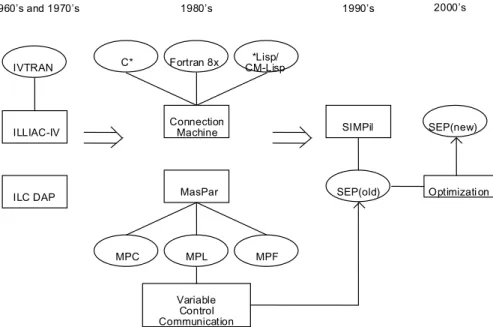
In this paper, methods of reducing inter-processor communication for the SIMPil architecture through the use of high level language and its compiler will be developed and discussed. The overall relationship between different SIMD systems and their compilers and the SIMPil architecture and its SEP language and compiler is illustrated in Figure 2.
Figure 2 Impact of different SIMD systems and their compilers to the development of SEP and SIMcc and the need for an optimizing compiler for SIMPil
ILLI AC-IV
ILCDAP MasPar
Connection
Machine SIMPil
IVTRAN
1960’s and1970’s 1980’s 1990’s
C* Fortran 8x CM-Lisp*Lisp/
MPC MPL MPF
SEP(old)
Variable Control Communication
2000’s
SEP(new)
CHAPTER 3 METHODOLOGY
3.1 SIMPil: A SIMD Pixel Processor with Integrated Optoelectronic Detectors
SIMPil is a SIMD architecture developed at Georgia Tech for portable multimedia applications that exploits inherent data parallelism in images and videos. SIMPil also incorporates an integrated array of thin film detectors stacked directly on top of the processing plane to reduce the image data transfer bottleneck [15]. A cross sectional diagram showing the two layers is shown in Figure 3.
SIMD processing layer detector array & ADC layer
through-wafer optoelectronic communication
Figure 3 Cross sectional diagram showing the coupled detectors and processors [15]
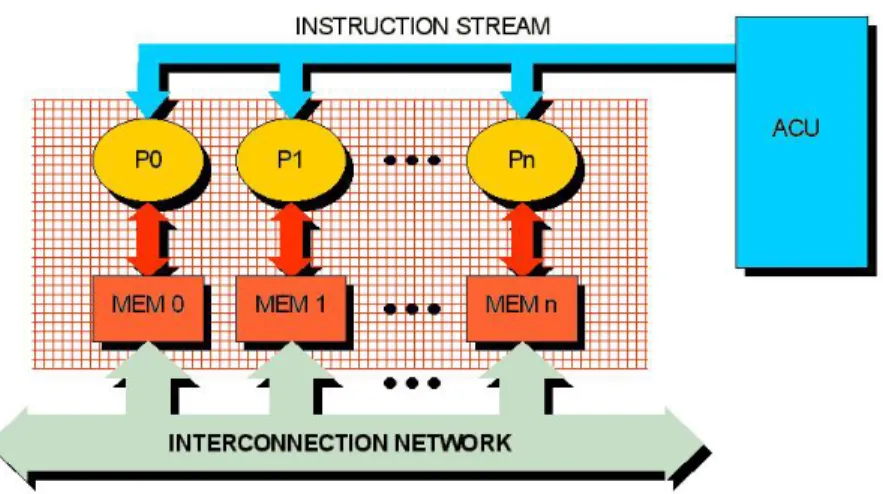
Figure 4 General architecture of the SIMPil system
Each PE is interfaced with a subset array of the thin film detectors stacked on top of the processing plane and an ADC (Analog to Digital Converter) to convert the light intensities incident on the detectors to a digital value. The microarchitecture of a PE consists of 16-bit datapath including an ALU, a barrel shifter, a multiply-accumulator unit, 16-word register file, and a local memory.
Overall, the SIMPil architecture provides the high computational throughput and data bandwidth required by modern multimedia applications while satisfying the low power and low cost constraints required of a portable processor. All tests done on the SIMPil system in this research was done through the SIMPil16 simulator.
3.2 SEP: A High Level Language for Programming on the SIMPil Architecture
In order to facilitate software development on any system, a high level language and a good compiler are essential, and SIMPil is no exception. The SEP language and its compiler, the SIMcc, were first developed by Gunther R. Costas for the SIMPil system with this in mind [14].
creating common image processing applications and syntax similar to that of the widely used C language was adopted. SEP instructions include the WHILE loop, IF condition, arithmetic and logic instructions, and comparison operators. Also, there are special SIMPil specific instructions for communication and instructions for retrieving data sampled by the detector. An overview of instructions supported by SEP is shown in Figure 5.
SINGULAR Singular variable declaration PLURAL Plural variable declaration
IF/ELSE If/else condition
WHILE While loop
GET Communication instruction
LOAD Retrieve data sampled by the detectors SAMPLE Sample image using detector
SHOW_IMAGE Display image stored in memory SET Set architectural parameters +, -, *, /, = Arithmetic operators
&&, ||, ==, !=, <=, >=, <, >
Logical operators
Figure 5 An overview of instructions supported by SEP
SEP supports two types of variables: singular and plural variables. Singular variables are integer variables that are declared only on the ACU, and plural variables are those that are declared on every PE. Plural variables can also be declared as an array. Most SEP instructions can be used with either a singular variable or a plural variable. Operations between variables of the same data type evaluate to a variable of the same data type and operations between a singular variable and a plural variable will evaluate to a plural variable.
condition.
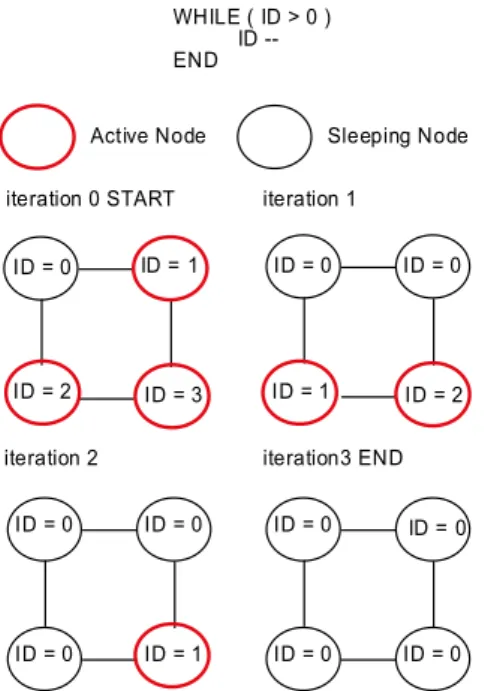
The WHILE loop is similar to the IF condition. When the condition evaluates to a singular variable, the ACU executes the instruction like a normal WHILE loop. However, when the condition evaluates to a plural variable, the ACU sends instructions to the PEs and each PE executes the instructions within the WHILE loop as long as the condition evaluates to be true. However, instead of stopping here, the ACU repeatedly sends the instructions to the PEs until none of the PEs evaluate the condition to be true. A diagram of how a WHILE loop is executed by the PEs is shown in Figure 6.
ID = 0 ID = 1
ID = 2 ID = 3
ID = 0
ID = 1
ID = 0
ID = 1 ID = 2
ID = 0
ID = 0
ID = 0
ID = 0
ID = 0
ID = 0 ID = 0 iteration 0 START iteration 1
iteration 2 iteration3 END WHILE ( ID > 0 )
ID --END
Active Node Sleeping Node
Figure 6 Execution of a SEP WHILE loop on SIMPil
The GET instruction is used to send data across the mesh network in any of the four NEWS directions. The LOAD instruction is used to load pixel data taken by the detectors to a variable. The various logical, arithmetic, and comparison operators used in SEP are identical to those used by the C language.
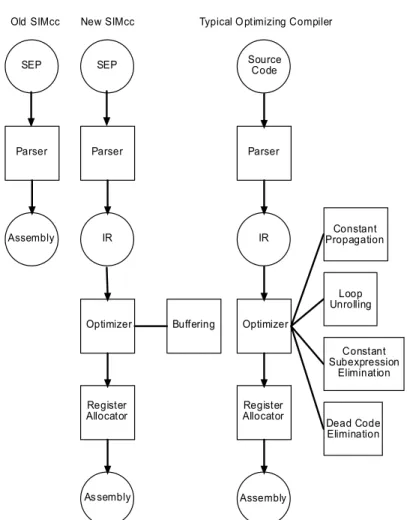
The original SIMcc compiler designed by Gunther R. Costas was a simple single stage compiler which generated SIMPil assembly instructions directly from a SEP program. Such simple compilers are often used for compiling simple languages like SEP as this design makes the compiler easier to implement. However, it also makes the compiler less efficient as it does not allow any form of optimization. Therefore, the original SIMcc compiler was redesigned from the parser level up to include the use of IR, optimizations and more efficient register allocation which was necessary to implement optimizations for communication. A diagram showing the various components of different compilers is shown in Figure 7.
Old SIMcc New SIMcc Typical Optimizing Compiler
SEP
Parser
Assembly
Source Code
Optimizer Buffering
SEP
Parser Parser
IR IR
Optimizer
Register
Allocator AllocatorRegister
As sembly Assembly
Constant Propagation
Loop Unrolling
Constant Subexpression
Elimination
Dead Code Elimination
Figure 7 Comparison of various components of different compilers
assembly instructions. The IR is often instructions that are representative of the assembly instructions but hides some of the architectural details that are unnecessary for optimizations. This way, after optimizations, the IR can be then translated to assembly instructions for the target system, and the optimizations won’t have to be repeated when being compiled on a different architecture.
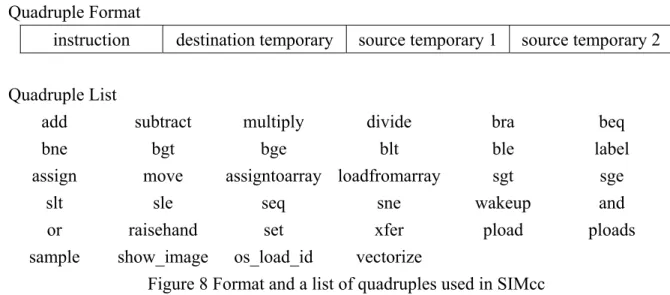
There are different formats for IR, but for SIMcc, quadruples were chosen as they most closely resembled the SIMPil assembly instructions, and this makes translating to assembly instructions much easier. Format of the quadruples and a list of IR instructions used in SIMcc are shown in Figure 8.
Quadruple Format
instruction destination temporary source temporary 1 source temporary 2
Quadruple List
add subtract multiply divide bra beq
bne bgt bge blt ble label
assign move assigntoarray loadfromarray sgt sge
slt sle seq sne wakeup and
or raisehand set xfer pload ploads
sample show_image os_load_id vectorize
Figure 8 Format and a list of quadruples used in SIMcc
Once the parser generates IR, it can then be optimized. Typically optimizations such as constant propagation, constant subexpression elimination, dead code elimination, and loop unrolling are done before allocating registers and generating the final assembly instructions. No optimizations were done on the IR generated by SIMcc as they do not generally affect communication between PEs.
the variables used in the program. Another major change that was made to the compiler was the use of a register allocator. In the old SIMcc, all variables were stored in the memory, and registers were used only when the data was processed. This is analogous to how the C compiler also keeps a copy of all variables in the memory, but in the case of SIMcc, it was unnecessary and it resulted in a very inefficient register usage. Therefore, in the new SIMcc compiler, G. Chaitin’s graph coloring algorithm [1] was used to allocate registers and no variables were stored in the memory unless it was necessary. First, the IR was converted to basic blocks for liveness analysis, with each IR instruction being a basic block. Then, an interference graph was constructed from the result of the liveness analysis, and then the variables and the temporaries were allocated registers. If a register could not be found for a variable or a temporary, the variable was spilled to the memory, and the process was repeated from the beginning. Once the register allocation is complete, a set of assembly instructions that is executable on the SIMPil simulator is generated.
3.4 Optimizing Communications
3.4.1 Importance of Reducing Communication
Many common image and video processing applications on SIMD share data across nodes. In convolution a PE shares its data with all nodes surrounding it, with the radius of communication depending on the size of the mask. In DCT, nodes share data with PEs in the same row and with those on the same column. Other examples include DFT (Discrete Fourier Transform), matrix multiplications and median filtering. Some of these applications have such a large number of communications that a significant amount of time is spent in communicating rather than computing.
and even using SEP it becomes difficult to write efficiently.
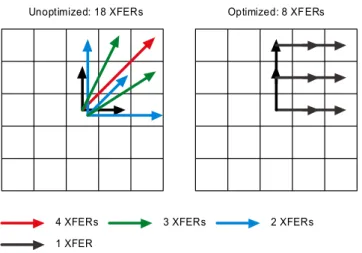
For example, writing a convolution algorithm using a 3x3 mask is simple whether you’re writing in assembly language or in SEP because there is only one way to communicate. Writing a convolution algorithm using a 5x5 mask to communicate efficiently becomes moderately difficult in assembly language and a little trickier in SEP. The real challenge begins when the size of the mask becomes 9x9. With such a large radius of communication, optimizing the communication becomes extremely complicated even in SEP. In this case, trying to minimize the communication by hand would take far too long for it to be practical and mistakes could occur too easily. It would be much simpler to just send each data from one source to one destination every time. However, doing so would greatly raise the number of communication instructions and in the cases of convolution and DCT where the percentage of communication is high, performance would be greatly affected. The most obvious solution to this problem is to allow users to write the algorithm however they want it, and have the compiler eliminate any redundant communication instructions. A diagram of communication paths before and after optimization for a 5x5 convolution is shown in Figure 9.
4 XFERs 3 XFERs 2 XFERs
1 XFER
Unoptimized: 18 XFERs Optimized: 8 XFERs
3.4.2 Algorithm for Tracking the Path of Data
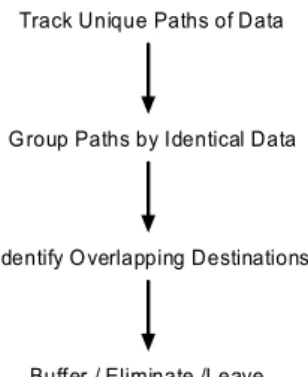
The basic idea behind removing redundant communications is to track the path of data through the nodes and see which nodes are visited multiple times by the same data. By overlapping the paths of identical data and comparing the chronological order in which the communication instructions occur in the program, candidates for removal can be identified. Then, certain data items can be selected to be stored in the buffer to maximize the number of communication instructions that can be eliminated. Since all communications are executed simultaneously by all the nodes, data from all nodes travel in the same manner. Therefore, tracking the path of a variable by studying the instructions is identical to tracking the path of that variable on all nodes. A diagram showing the steps taken by the algorithm identify redundant communication is shown in Figure 10.
Track Unique Paths of Data
Group Paths by Identical Data
Identify Overlapping Destinations
Buffer / Eliminate /Leave
Figure 10 Steps taken by the algorithm to identify redundant communication
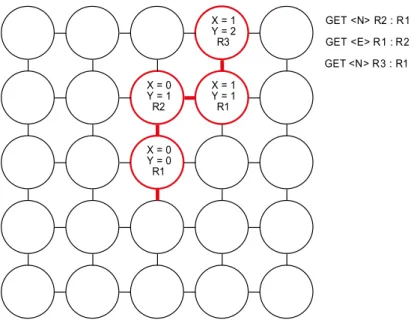
first node in the linked list would have the position (0, 1). If another XFER instruction sends the variable to the east, the new node added to the linked list would have the position (1, 1). A diagram of the co-ordinate system is shown in Figure 11.
X = 0 Y = 0 R1 R2 X = 0
Y = 1 X = 1Y = 1 X = 1 Y = 2
R1 R3
GET <N> R2 : R1
GET <E> R1 : R2
GET <N> R3 : R1
Figure 11 Co-ordinate system with an example trace
GET <N> R1 : R2
GET <N> R3 : R1
GET <S> R1 : R4
GET <E> R5 : R3
R2 R4 R2 R4
X = 0 Y = 1 R1
X = 0 Y = 1 R1
X = 0 Y = 2 R3
R2 R4
X = 0 Y = 1 R1
X = 0 Y = 2 R3
X = 0 Y = -1 R1
R2 R4
X = 0 Y = 1 R1
X = 0 Y = 2 R3
X = 0 Y = -1 R1
X = 1 Y = 2 R5
Cycle 0 Cycle 1
Cycle 2 Cycle 3
Figure 12 Example of how data movement is mapped by the algorithm
Once all the paths have been mapped out, the source variables of all the linked lists are compared to see which are identical. The algorithm that was adopted for this task was a simple one that checks each variable against another to see if one is a copy of the other or if they are copied from the same variable. A much better, but also much more complicated algorithm such as value numbering would return a smaller number of sets of paths as value numbering identifies not just copies of variables but also variables that have the same value. This algorithm was used as it would suffice for the test programs that would be used to measure the performance of SIMcc. In a future update of SIMcc, a value numbering algorithm will most likely replace the current algorithm to improve performance.
paths are then re-organized to identify the overlapping PEs more easily. The algorithm takes each set of paths and creates a 2-D linked list. Each 1-D linked list represents a particular destination that any of the paths in the set traverses and each node in the 1-D linked list represents a particular XFER instruction that sends the data to that PE. The nodes are arranged chronologically, that is in an ascending order with respect to the instruction number. The algorithm constructs this data structure by going through every PE in all the paths in the set and checking its (X, Y) co-ordinates. If the same destination already exists in the data structure, then a new node is created and added to the appropriate place in the corresponding 1-D linked list. If that particular destination has not been encountered, a new 1-D linked list is created for that destination. A diagram depicting the data structure is shown in Figure 13.
X = 0 Y = 1 Inst = 15
X = 0 Y = 1 Inst = 33
X = 0 Y = 1 Inst = 100
X = 1 Y = 1 Inst = 16
X = 1 Y = 1 Inst = 18
X = 1 Y = 1 Inst = 35
Each array element corresponds to a particular set of variables or temporaries whose values are identical
Figure 13 Data structure containing information about overlapping PEs in the paths
eliminated
3.4.3 Algorithm for Buffering and Replacement
Since every XFER instruction can potentially be buffered and the buffer will often be full, a decision will need to be made at every XFER instruction on which data to replace, if any at all. The total number of ways in which to allocate data to the buffer for an entire program is so large that it is not feasible to check through them all to see which yields the largest number of XFER instructions eliminated. However, the different decisions that can be made at every XFER instruction can be formed in to a decision tree, where the tree branches out whenever a XFER instruction is encountered and a choice of which data item in the buffer to replace is made. The problem can then be presented as a search problem where the tree can be traversed or searched in a particular way to find a solution. A small part of the decision tree that can be constructed is shown in Figure 14.
XFER 0
XFER 1
XFER 1 XFER 1
XFER 2 XFER 2 XFER 2
XFER 3
Replace Slot 1 Replace Slot 2
Do Not Buffer
Replace Slot 1 Replace Slot 2 Do Not Buffer
Replace Slot 1
Figure 14 Part of the decision tree that can be constructed for buffer allocation
solution as the path with the smallest depth would be optimal. However, since the size of the buffer determines the number of paths at each node, even if the buffer size is as small as 4, the number of nodes that must be checked at each level increases to such large numbers that checking all of them would be too time consuming to be practical after 10 or so XFER instructions.
Since every path leads to a solution a depth first search can also be used. However, since only one particular path would be explored with a depth first search, determining whether the path that was taken is the optimal path would be more difficult. To find a good solution to the problem using a depth first search algorithm, factors that influence the number of XFER instructions that can be eliminated must be found and decisions must be made based upon those factors. The solution can now be found using a hill climbing algorithm which is a depth first search with a heuristic measurement for ordering the choices and taking the choice with the best chance of yielding the optimal solution [18].
In order to maximize the number of XFER instructions eliminated, each data that is stored in the buffer in a node must be received by the node as many times as possible before the data is replaced. Since the program has already constructed a data structure that keeps track of all the XFER instructions that send a particular data to a particular destination, it can easily determine how many XFER instructions can potentially be eliminated by storing that data in the buffer for a particular number of cycles. The objective is to eliminate as many XFER instructions as possible and therefore storing data that can eliminate more instructions is desirable. Therefore the algorithm ‘looks ahead’ to see how many instructions can be eliminated by storing a particular data in the buffer.
be used. If no such slot is available, it checks the buffer to see which data eliminates the fewest number of XFER instructions from that point in time onwards. If the data item in question eliminates more instructions than the data in the buffer that was found to eliminate the fewest instructions, then that data replaces the one in the buffer, otherwise, nothing is replaced and the XFER instruction is executed.
Whenever a piece of data is stored in the buffer, it is merely copied to a newly created temporary variable. If a XFER instruction is eliminated by that data in the buffer, all occurrences of the destination variable of the XFER instruction between the XFER instruction and the instruction that next kills it, is replaced by the temporary variable. After all modifications to the IR has been made by the buffering algorithm, the temporaries that were used as a buffer slot is allocated by the register allocator. In essence, each buffer slot is a common register that is not being used. This method is more efficient than storing them in a specified location like the memory or in pre-determined registers, as most programs do not use many registers simultaneously and accessing the registers is much faster than accessing the memory.
CHAPTER 4 RESULTS
Several small applications including 8x8 DCT, 5x5 convolution and 9x9 convolution algorithms were created in SEP in order to measure how well SIMcc eliminates communication instructions using the buffer. The sizes of the three programs in SEP and their sizes in assembly language after being compiled by SIMcc without buffering, and their execution cycles are shown in Table 1. The sizes of the programs in SEP and assembly language are those after loop unrolling has been performed on loops with communication instructions.
Table 1 Program sizes and execution times for various applications SEP (lines) Assembly (lines) Execution Cycles
5x5 Convolution 131 348 800
9x9 Convolution 543 1205 2721
8x8 DCT 456 1431 4173
Then, the programs were compiled with buffering in effect, with three different heuristics for buffer replacement: look-ahead, random and FIFO. The compiled assembly program was executed on the SIMPil simulator to measure the effectiveness of the heuristics used to eliminate the communication instructions.
4.1 Percentage of Eliminable Communication Eliminated
instructions that send the data to the 24 surrounding nodes are compulsory, and all others are eliminable, that is, not necessary and therefore could be eliminated if buffered perfectly. Percentage of XFERs eliminated as compared to the total number of eliminable XFERs for varying buffer sizes for 5x5 convolution, 9x9 convolution, and 8x8 DCT are shown in Figure 15, Figure 16, and Figure 17 respectively. Each graph compares the performance of the three different heuristics that were used for replacement.
Comparison of Buffer Replacement Policies for a 5x 5 Conv olution Algorithm
0% 20% 40% 60% 80% 100% 120%
0 1 2 3 4 5 6 7 8 9 10
Buffer Siz e
P e rc e n ta g e O f E lim in a b le X fe rs E lim in a te d Lookahead Replacement FIFO Random
Comparison of Buffer Replacement Policies for a 9x 9 Conv olution Algorithm
0% 20% 40% 60% 80% 100% 120%
0 1 2 3 4 5 6 7 8 9 10
Buffer Siz e
P e rc e n ta g e o f E lim in a b le X fe rs E lim in a te d Lookahead Replacement FIFO Random
Figure 16 Effect of buffer size on percentage of eliminable XFERs eliminated for a 9x9 convolution algorithm
Comparison of Buffer Replacement Policies for a 8x 8 DCT Algorithm 0% 20% 40% 60% 80% 100% 120%
0 1 2 3 4 5 6 7 8 9 10
Buffer Siz e
P e rc e n ta g e o f E lim in a b le X fe rs E lim in a te d Lookahead Replacement FIFO Random
Figure 17 Effect of buffer size on percentage of eliminable XFERs eliminated for a 8x8 DCT algorithm
4.2 Percentage of Total Communication Eliminated
including the mandatory XFERs, for 5x5 convolution, 9x9 convolution, and 8x8 DCT are shown in Figure 18, Figure 19, and Figure 20 respectively. Again, each graph compares the different heuristics used for replacement.
Comparison of Buffer Replacement Policies for a 5x 5 Conv olution Algorithm
0% 10% 20% 30% 40% 50% 60% 70%
0 1 2 3 4 5 6 7 8 9 10
Buffer Siz e
P e rc e n ta g e o f T o ta l X fe rs E lim in a te
d LookaheadReplacement
FIFO
Random
Comparison of Buffer Replacement Policies for a 9x 9 Conv olution Algorithm
0% 10% 20% 30% 40% 50% 60% 70% 80% 90%
0 1 2 3 4 5 6 7 8 9 10
Buffer Siz e
P e rc e n ta g e o f T o ta l X fe rs E lim in a te
d LookaheadReplacement
FIFO
Random
Figure 19 Effect of buffer size on percentage of total XFERs eliminated for a 9x9 convolution algorithm
Comparison of Buffer Replacement Policies for a 8x 8 DCT Algorithm 0% 10% 20% 30% 40% 50% 60% 70% 80%
0 1 2 3 4 5 6 7 8 9 10
BUffer Siz e
P e rc e n ta g e o f T o ta l X fe rs E lim in a te
d LookaheadReplacement
FIFO
Random
Figure 20 Effect of buffer size on percentage of total XFERs eliminated for a 8x8 DCT algorithm
look-ahead replacement method, the number of XFERs eliminated grows quickly as the number of slots increases from 1 to 4, and then it starts to level, hitting the maximum at around buffer size of 9 for 5x5 convolution, and earlier at buffer size of 6 for 9x9 convolution and 8x8 DCT. As the buffer gets larger, enough slots are available to accommodate all data items to eliminate all eliminable XFERs.
By studying the graphs, it can be concluded that the optimal size for the buffer would be either 4 or 5. Although a buffer size of 6 or larger that maximizes the number of XFERs eliminated is desirable, the gain in performance is too small to warrant the use of the extra registers that would be required, as that could potentially result in very costly spills in to the memory.
4.3 Performance Speedup
Comparison of Buffer Replacement Policies for a 5x 5 Conv olution Algoirthm
98% 100% 102% 104% 106% 108%
0 1 2 3 4 5 6 7 8 9 10
Buffer Siz e
P e rcen ta g e C ha n g e in E x ecut io n T im e Lookahead Replacement FIFO Random
Figure 21 Effect of buffer size on execution time for a 5x5 convolution algorithm
Comparison of Buffer Replacement Policies for a 9x 9 Conv olution Algoirthm
90% 95% 100% 105% 110% 115%
0 1 2 3 4 5 6 7 8 9 10
Buffer Siz e
P e rcen ta g e C ha n g e in E x ecut io n T im e Lookahead Replacement FIFO Random
Comparison of Buffer Replacement Policies for a 8x 8 DCT Algorithm 98% 99% 100% 101% 102% 103%
0 1 2 3 4 5 6 7 8 9 10
Buffer Siz e
P e rcen ta g e C ha n g e in E x ecut io n T im e Lookahead Replacement FIFO Random
Figure 23 Effect of buffer size on execution time for a 8x8 DCT algorithm
The results indicates that more instructions are generated than are eliminated when the buffer size is small. Performance gain can be seen only after the buffer size exceeds three. For 5x5 convolution and 8x8 DCT, even after the buffer size exceeds seven or eight when the maximum number of eliminable XFERs is eliminated, the percentage of overall execution cycle saved barely exceeds 1%. Slightly better result can be seen from 9x9 convolution, where about 4% reduction in execution time can be observed with a buffer size of four, 6% at a size of five, and a maximum of 7% at a size of six.
4.4 Effect of Look-ahead Distance on Performance
Another aspect of the buffer algorithm that was studied was the effect of the number of instructions the algorithm looked ahead to see how many XFERs could be eliminated by having that data in the buffer. The effect of the look-ahead distance on the total number of XFERs eliminated for different algorithms is shown in Figure 24. Buffer size of 4 was used.
Effect of Number of Instructions to Lookahead on Various Algorithms on a Buffer of Size 4
0% 20% 40% 60% 80% 100%
0 5 10 15 20 25 30 35 40 45 50 55 60 Instructions Looked Ahead
P e rc e n ta ge of E limin a b l X fe rs E limin a te d
5x 5 Convolution 9x 9 Convolution 8x 8 DCT
Figure 24 Effect of look-ahead distance on percentage of eliminable XFERs eliminated
CHAPTER 5
CONCLUSIONS AND FUTURE WORK
The SIMcc compiler is capable of eliminating a large percentage of redundant communication. However, performance improvement in execution cycles will not be seen unless a large percentage of the instructions are communication instructions. In fact, using buffering degrades performance if there are too few communication instructions or if the communication has already been fully optimized with no redundant instructions.
The look-ahead algorithm performed significantly better than either random or FIFO replacement policies, and the look-ahead algorithm was able to eliminate all redundant communication instructions at a smaller buffer size. The optimal size for the buffer was found to be 4 or 5 at which 86 and 89 percent of redundant communication was eliminated respectively for 5x5 convolution. For the same buffer sizes, 86 and 94 percent of communication instructions were eliminated for 9x9 convolution, and 85 and 94 percent were eliminated for 8x8 DCT. After 4 or 5, the buffer hit the point of diminishing return but still eliminated all communication by 7 or 9. No performance gain in terms of execution cycles was seen with 5x5 convolution or 8x8 DCT as the percentage of communication was too small to affect the performance, but with 9x9 convolution, four and six percent reduction in execution cycles was seen with buffer sizes of four and five respectively.
This version of SIMcc is basic and there is much room for improvement. The buffering mechanism could be improved further by computing the number of registers available at each point in time and using only the ones available to increase the buffer size without spilling into the memory. Better data grouping algorithms like value numbering can be used to minimize the data sets and maximize the number of instructions each buffered data can eliminate.
for better performance and more language constructs can be added for wider programming options. Currently, the compiler assumes a PPE (Pixels per Element) of 1. In a real system this may not suffice as some images may be too large for the processor array to support a PPE of 1. The compiler can be re-designed or modified to hide the PPE from the programmer and automatically detect the optimal PPE to maximize processor usage and generate instructions accordingly.
REFERENCES
[1] G. Chaitin, “Register Allocation and Spilling via Graph Coloring,” ACM SIGPLAN Symposium on Compiler Constructions, 1982, pp. 98-101.
[2] A. Aho, R. Sethi, and J. Ullman, Compilers Principles, Techniques, and Tools, Addison-Wesley, 1988.
[3] L. Tucker and G. Robertson, “Architecture and Applications of the Connection Machine,” Computer, Volume 21, Issue 8, August 1988, pp. 26-38.
[4] P. Christy, “Software to Support Massively Parallel Computing on the MasPar MP-1,” Compcon Spring ’90, ‘Intellectual Leverage’, Digest papers, Thirty-Fifth IEEE Computer Society International Conference, 26 Feb-2 Mar 1990, pp. 29-33.
[5] R. Bargrodia and K. Chandy, “Programming the Connection Machine,” Computer Languages, 1988. Proceedings., International Conference on, 9-13 Oct 1988, pp.50-57.
[6] M. Gokhale and J. Schlesinger, “A Data Parallel C and its Platforms,” Frontiers of Massively Parallel Computations, 1995. Proceedings. ‘Frontiers 95’., Fifth Symposium on the, 6-9 Feb 1995, pp. 194-202.
[7] S. Ranka and S. Sahni, “Convolution on Mesh Connected Multicomputers,” pattern Analysis and Machine Intelligence, IEEE Transactions on, volume 12, issue 3, Mar 1990, pp.315-318.
[8] A. Fisher, J. Leon, and P. Highnam, “Design and Performance of an Optimizing SIMD Compiler,” Frontiers of Massively Parallel Computation, 1990, Proceedings., 3rd Symposium on the, 8-10 Oct 1990, pp. 507-510.
[9] V. Garg and D. Schimmel, “Hiding Communication Latency in Data Parallel Applications,” Parallel Processing Symposium, 1998. 1998 IPPS/SPDP. Proceedings of the First Merged International…and Symposium on Parallel and Distributed Processing 1998, 30 Mar-3 Apr 1998, pp. 18-23.
[10] J. Choi, C. Lin, H. Kim, “Low Power Register Allocation Algorithm using Graph Coloring,” TENCON 2000, Proceedings, volume 3, 2000, pp. 80-85.
[11] A. Watson, “Image Compression Using the Discrete Cosine Transform”
[13] A. Gentile and D. S. Wills, “Portable Video Supercomputing,” to appear in IEEE Transactions on Computers, 29 pages, TC 114531, accepted February 2004.
[14] G. Costas, “Explicitly Parallel Compiling for the SIMPil Architecture,” Pica Group Technical Report, 1998.
[15] H. H. Cat, A. Gentile, J. C. Eble, M. Lee, O. Vendier, Y. J. Joo, D. S. Wills, M. Brooke, N. M. Jokerst, A. S. Brown, and R. Leavitt, “SIMPil: An OE Integrated SIMD Architecture for Focal Plane Processing Applications,” Proceedings of the Third International Conference on Massively Parallel Processing Using Optical Interconnections, pages 44-52, Maui, Hawaii, October 1996.
[16] B. Kahle and W. Hillis, “The Connection Machine Model CM-1 Architecture,” Systems, Man and Cybernetics, IEEE Transactions on, volume 19, issue 4, Jul/Aug 1989, pp. 707-713. [17] J. Nickolls, “The Design of the MasPar MP-1: A Cost Effective Massively Parallel Computer,” Compcon Spring ’90. ‘Intellectual Leverage’. Digest of Papers. Thirty-Fifth IEEE Computer Society International Conference, 26 Feb-2 Mar 1990, pp. 25-28.
[18] Patrick H. Winston, Artificial Intelligence, Addison-Wesley, 1992 [19] International Technology Roadmap for Semiconductors 2003
[20] J. D. Meindl, J. A. Davis, P. Zarkesh-Ha, C. S. Patel, K. P. Martin, P. A. Kohl, “Interconnect Opportunities for Gigascale Integration,” IBM J. Res. & Dev. vol. 46, pp. 245-263, Mar/May 2002.
![Figure 1 Delay for Metal 1 and global wiring versus feature size [19]](https://thumb-us.123doks.com/thumbv2/123dok_us/586760.2057903/11.892.143.751.136.548/figure-delay-metal-global-wiring-versus-feature-size.webp)
![Figure 3 Cross sectional diagram showing the coupled detectors and processors [15]](https://thumb-us.123doks.com/thumbv2/123dok_us/586760.2057903/19.892.158.739.471.679/figure-cross-sectional-diagram-showing-coupled-detectors-processors.webp)