TOPICS:
Medications
(Insulin Delivery
Systems)
Prevent, Detect
and Treat
Chronic
Complications
Through Risk
Reduction
TEACHING OBJECTIVES: 1. Introduce basic pump concepts
including basal and bolus insulin dosing.
2. Discuss advantages and
disadvantages of insulin pump therapy.
3. Review risk factors resulting in hypo/hyperglycemia in pump users.
4. Explain pump options during exercise (disconnect, reduce basal/boluses).
LEARNING OBJECTIVES: Learner (Parents, child, relative or self) will be able to:
1. Differentiate between basal and bolus insulin doses.
2. Cite two advantages and two disadvantages of insulin pump therapy.
3. Identify two causes of low and of high blood sugars in pump users.
4. Identify two possible uses of a temporary-basal rate.
Chapter 26
Insulin
Pumps
H. Peter Chase, MD
Susie Owen, RN, CDE
Jana Gaston, RD
Jen Block, RN, CDE
INTRODUCTION
This chapter is somewhat complex and does not need to be read until the family is ready to consider insulin pump therapy. The chapter is not meant to teach everything one needs to know about insulin pumps. There are entire books (see end of the chapter) written about pump therapy, and this chapter is only meant to provide an overview. An insulin pump is a microcomputer (the size of a pager) that constantly provides insulin. When an insulin pump is used, insulin is first put into a special syringe which is then placed within the pump case. A small plastic tube called a cannula is then inserted under the skin with a needle (the needle is then removed, leaving the plastic tube in place). The cannula is connected to the pump by a small tube. Insulin is infused through the small plastic cannula under the skin (most commonly placed in the
abdomen or buttock). Tape is placed over the cannula set to keep it in place for up to three days.
Pump management involves a high level of diabetes care. It requires a commitment by the entire family to help with the daily management. No matter what age a person begins pump therapy they will need assistance to ensure safety and a positive outcome. Pump management needs to begin during a time when the family can focus on developing new knowledge and skills.
It is important to realize that the current insulin pumps do not vary the insulin dose based on the blood sugar level. The pump is programmed to give a pre-set amount of insulin at
regular intervals (called the “basal” rate). The basal rates do not automatically change as blood sugars change. In addition, each time the person eats or if the blood sugar is elevated, buttons on the pump must be pushed to give a “bolus” insulin dose. The “smart pumps” (explained below) help to calculate the amount of insulin the person should give. However, there is not a “closed-loop” pump at this time that measures blood sugars and turns off the basal insulin if the blood sugar is low or gives more insulin if the blood sugar is high. This will likely become possible at some time in the future.
Pump therapy is usually begun after establishing regular care with the healthcare team over a six month period or more. Extra visits and trainings are generally required to begin treatment with an insulin pump. A nurse educator, social worker, dietitian and physician usually spend about 3-4 hours with the person and family in a routine clinic visit deciding as a team if a pump is the right choice. If it is decided to proceed, the family may then attend the “Pump Basics and Pump Initiation” classes. These classes are to prepare the families for pump therapy. This is often the time when the brand of pump is selected. There are a total of three pump training classes each person attends once they have their pump, a saline class, an insulin class, and an advanced pump training class. The pump trainer and physician spend four hours at the time of starting saline in the pump and then another 2-3 hours at the time of starting insulin in the pump. The “Advanced Pump Training” class occurs about one month after starting the pump (see Post-pump Visits in this chapter).
There is not a “best age” to begin using an insulin pump. The time is right when the person with diabetes and their family are ready and willing. It must not be the parents who want and are pushing for the pump. The ability to count carbohydrates and to reliably calculate and give an insulin dose is an obvious need. Younger children who cannot count
carbohydrates or reliably give a bolus insulin dose must be considered on an individual basis.
The availability of a parent becomes a major factor when putting younger children on a pump. No matter at what age a person begins pump treatment, assistance will be needed when the person is ill, depressed or shows a lack of consistent follow-through with daily tasks.
ADVANTAGES OF
INSULIN PUMPS
Improved Glucose Control
The Diabetes Control and Complications Trial (DCCT), as discussed in Chapter 14, showed that improved glucose control lessened the likelihood of the eye, kidney and nerve complications of type 1 diabetes. Glucose control is measured by doing a HbA1ctest (see Chapter 14) every three months. Many people who use pump therapy have some decrease in their HbA1cvalues and thus decrease their risk for complications. People who are not able to have good sugar control on multiple daily injections of insulin may benefit from insulin pump therapy. Unfortunately, if insulin boluses for food or high sugar levels are missed, glucose control will NOT improve and may worsen (see Disadvantages below).
Insulin Delivery and Availability and Convenience
One of the big advantages of using a pump is that the insulin is readily available. The pump is attached to the person so if they are with friends and are going to share a meal, the insulin is available. It is relatively easy to push a few buttons to take extra insulin. The insulin pump is designed to deliver rapid-acting insulin in two ways:
1. A programmed basal rate (delivered in small amounts every few minutes; see below) 2. A user-initiated bolus dose (a quick burst)
of insulin with meals or with high blood sugars (see below)
This is similar to the insulin output by the normal human pancreas, with a constant (basal)
output of insulin and boluses of insulin with meals. The pump has advantages over multiple daily shots in that insulin does not need to be drawn from a vial and be injected. Youth, who frequently do not like to take multiple shots, are thus more apt to cover random food intake with a bolus of insulin. Only rapid-acting insulin (Humalog, NovoLog or Apidra) is used in the pump.
Hypoglycemia
Severe low blood sugars were three times more common in pump users or in people taking three or more shots per day (all using Regular insulin) compared with people
receiving one or two shots of insulin per day in the DCCT (see Chapter 14). Now, the
exclusive use of rapid-acting insulins (Humalog/NovoLog/Apidra) with more timely absorption, action and disappearance has made pumps safer in relation to hypoglycemia. Data shows that severe lows are now LESS common for “pumpers” than for people receiving twice daily NPH insulin injections. They are similar in number for those receiving Lantus insulin.
Flexibility and Freedom
For some people, the use of a pump
provides a greater opportunity for flexibility and freedom.
Some of the ways in which this happens are:
✔ being able to sleep late in the morning ✔ the ability to alter the time or size of meals
or exercise
✔ the ability to take extra insulin when the blood sugar is high or with illnesses (and having the insulin readily available) ✔ being able to easily remove the pump for
baths, showers, heavy exercise, etc. ✔ The long plastic tubing permits placement
of the pump on the bedstand while sleeping at night. Several special holders are
available for the pump.
✔ Miss America (1999), Nicole Johnson, wore her pump strapped to her leg during the evening gown competition. She had the flexibility to disconnect the pump for the swimsuit competition.
“Pumpers” now have more flexibility since the basal insulin Lantus became available. Lantus is somewhat similar to the basal insulin dose from the pump, and people can come off the pump for a day, week, month or whatever and just take the same number of units of Lantus that they take for their pump basal dose (the total basal dose is given at the end of the basal field on the pump screen). This is often done for people having a water day or week (e.g., Hawaii), during extreme sports or just when people need a break. It is important to remember to stay disconnected from the pump until 24 hours after the last Lantus dose. Call your care provider if you have questions.
Reduction of Blood Sugars After Meals or Whenever High
With the rapid-acting insulins, the high blood sugars that occur after meals can be reduced using boluses prior to mealtime. In addition, extra doses of insulin are easy to take if a high blood sugar is found between meals. This is discussed later under Correction Insulin Dosages. The rapid-acting insulin in the pump works just like when it is given in shots. It starts to work in 10 minutes, peaks in 30-90 minutes and lasts (effectively) three to four hours. As carbs can raise the blood sugar in 10 minutes, it should be obvious that, when possible, at least a part of the bolus should be taken prior to the first bite. Special bolus settings (“square” or “extended” wave, or a “dual” wave) are available to help with the delayed absorption found with high fat, high carb meals such as pizza (see Advanced Pump Training below).
Altering Insulin Dose with Exercise
It is easy to discontinue insulin delivery or to use a temporary basal for periods of exercise. The alterations can be made to fit the past
experience of the individual. Thus, some people decrease insulin 30 or 60 minutes prior to exercise, during the exercise, and/or for three to seven hours after exercise (to prevent “delayed hypoglycemia”, Chapter 6). Similar individualized alterations are more difficult with injections.
DISADVANTAGES OF
INSULIN PUMPS
Remembering to Bolus
Giving an insulin bolus with each meal or snack that is greater than 5g of carbohydrate is difficult for some people to remember. HbA1c values will not improve if boluses are forgotten and in fact they may rise. The basal dose turns off “internal” sugar production (Chapter 2). It does not cover food eaten. There is no
intermediate-acting insulin (e.g., NPH) to peak at a mealtime. If the bolus is forgotten, the blood sugar will rise quite high. In our
experience, forgetting bolus doses is the major reason for people not improving glucose control when on a pump. It is our current “guesstimate” that the HbA1cincreases one-half point if two meal boluses per week are missed for three months. The increase will be by one HbA1cpoint if four meal boluses per week are missed for three months. Alarms in pumps, glucose meters or watches can help some people to remember to bolus. Receiving a reminder from another person can also be helpful. At the time of the clinic visit, it is useful to download the insulin pump to review bolus dosages given (or not given).
Ketonuria or Ketoacidosis
When problems occur with the insulin pump and insulin delivery is interrupted,
ketones can develop quickly as there is no long-acting insulin in the body. Ketones will start to form in four hours (the duration of the last Humalog/NovoLog/Apidra infused).
Eventually, the alarm on a pump may sound if a line or catheter is plugged or if very little insulin is left in the pump. However, it is possible to
have a kinked tube that will deliver less insulin, or a break in the delivery system, or insulin that has been spoiled by temperature extremes, that won’t set off an alarm. It may even be that the cannula has come out and the insulin is not being delivered under the skin. It is important to realize that it may not be possible to tell by inspection that insulin is not being delivered. If the blood sugar does not respond to a pump correction or if more frequent urination or thirst is noted, pump users must do an immediate blood sugar, a ketone test, an injection via a syringe and a change of the infusion set, tubing and reservoir. In addition to having a new infusion set in place, correction insulin doses must be given by syringe or pen until the blood sugar level has come down.
If sugar control has been good for a period of time, ketones will generally not form as rapidly and/or can be cleared more easily. In contrast, if glucose control has been poor, the ketones will develop more rapidly and build up. In our experience, most pump users have times when their catheter comes out, becomes kinked or they experience other problems with
delivery. Insulin and syringes must be kept available in case they are needed for individual shots. Urine or blood ketone test strips (see Chapter 5) must always be readily available. Our pump families are routinely taught to use the Precision Xtra blood ketone meter (Chapter 5). This allows the family to know the exact ketone status at that moment. Anytime
ketones are present, correction doses must be given by syringe or pen, and the infusion set, tubing and reservoir must be changed.
Psychological Factors
Wearing a pump, even though it is not much bigger than a pager, is difficult for some people. We have heard the comment that “Starting the insulin pump was like getting diabetes all over again. People who had not known that I had diabetes now ask me what the pump is.” A considerable amount of learning about the pump is necessary, which is not that much different from the amount required when diabetes was first diagnosed. There are other
feelings expressed such as “constantly being hooked to an instrument.” (In contrast, as discussed earlier, some people like always having insulin with them.) The most important factor is often whether a method can be worked out to prevent missed insulin boluses.
Expense
Pumps are expensive but most insurance companies will now pay for at least a portion of the expense. Initial expenses include buying the pump (approximately $6,000 U.S.), starting the pump ($1,500-$10,000, depending on whether the pump start is done as an outpatient or in the hospital) and yearly pump supplies (about $2,000). We do not do any pump starts in the hospital. Although this may seem like a lot, if the HbA1clevel improves, the cost savings in the prevention of eye, kidney and nerve
complications of diabetes offsets these expenses.
Weight Gain
Some people using insulin pumps who now have better sugar control may gain weight. The sugar in the body is used rather than going out in the urine. The weight gain can happen in any person who improves their sugar control. Working with a dietitian before and after
starting the pump can help to prevent this gain. In contrast, weight gain may be less of a
problem with the pump than with multiple injections as it is not necessary to eat to keep up with insulin previously injected. In our clinic, excessive weight gain for people using insulin pumps has not been a problem.
Skin Infections
Infections can occur at the infusion sites, particularly if the infusion sets are left in for longer than three days. However, if proper cleaning techniques are followed, and the set is changed every two or three days, infections are not common. If redness, heat, and/or pus are noted at the insertion, the physician should be called to get a prescription for antibiotics. Such an area should not be used again as an infusion site until it has healed.
Insulin Unavailability
One must remember to routinely fill the insulin reservoir (syringe) in the pump so that the pump does not run out of insulin at an awkward time. Also, remember that insulin spoils if it freezes (unlikely next to the body) or reaches temperatures above 90º. One of our patients “cooked” her insulin by wearing her waterproof pump in a hot tub. Others have frozen insulin by exposing tubing while skiing. This can be prevented by keeping the tubing close to the body. Whenever the pump is subjected to temperature extremes or direct sunlight the insulin may be compromised.
Infusion Site Locations
It is very common for a person with diabetes to prefer certain locations for their injection sites. With the pump, it is important that all possible site locations be used, even the ones that are not the “favorites.” A pump set can be inserted anywhere an insulin injection would be given. Having several site possibilities helps to prevent hypertrophy in the site
locations. Following a pattern of rotation and using an “infusion site template” are also helpful to give each site maximum healing time before it is re-used.
STARTING THE PUMP:
CLINIC VISITS AND PUMP
TRAININGS
Pre-pump Visits
Insulin pumps are not for everyone.
The person with diabetes (not just other family members) must be ready for the insulin pump, want the pump and be fully committed to using the pump. The visits and trainings below are usually required to initiate insulin pump management:
1. Initial Pre-pump (Routine Clinic) Visit
✔ The person with diabetes and their family meet with the physician, nurse, dietitian and social worker to discuss the basics and the
advantages and disadvantages of pump therapy.
✔ We request four or five blood sugars be done per day, recorded and faxed to us weekly (often for one month). This gives us an idea of the commitment of the person and the family, as well as their reliability. The proof of blood sugar checking may also be required by the insurance company. ✔ If the person is not already counting
carbohydrates, the dietitian will give
instructions in this area. We usually ask that potential pump users (or their parents) be able to count carbohydrates. We also ask that they bring or send completed blood sugar and food records, as well as insulin doses, to the dietitian.
✔ A video on the pump and other information is sent home with the family for review. Either the person or an adult must be able to reliably give bolus dosages, and must be able to deal in tenths of units of insulin. ✔ A “dummy” pump may be taped on to see
how the child tolerates it.
✔ Further instruction with the dietitian about carb counting is usually necessary.
✔ The social worker is available to discuss concerns about starting the pump. ✔ People who are ready for a pump:
● are willing to share with others that they
have diabetes
● want the pump themselves and are not
being pressured by others
● are willing to do frequent blood sugar
monitoring
● are either doing carb counting (Chapter
12), are willing to learn, or have a parent who can do it for them
● are willing to use all possible injection
sites
2. Pump Basics and Pump Initiation Classes
Much of the basic information in this chapter is presented in these two classes. Families are shown the different brands of pumps to help them make their selection. Families are asked to review this chapter together at home.
3. Saline Start Training
The person (and family) is trained to wear the pump, program the pump and to do infusion set changes.
✔ We recommend that the instructional CD-ROM be viewed at least two times to become familiar with all of the basic pump functions before the saline training.
✔ The family must bring the pump, case, batteries and supplies for two or three insertions and reservoirs (in case needed). ✔ Only sterile saline (salt water) is used in the
pump. They discover if they are able to do the required every two or three day infusion set changes. It is important to practice using the pump between the saline and the insulin trainings to become comfortable with how it works. The usual syringe insulin injections continue while wearing the pump with saline.
✔ All technical aspects of the pump are taught at the saline start.
✔ The learning objectives from the beginning of this chapter are reviewed with the
family(ies) to make sure they are learning the essentials.
✔ The person/family should bring significant others who:
● may help with future pump
programming and/or problems
● may assist with blood sugar testing
4. Insulin-start Training and Visit (See Table 1)
a. The morning of the visit:
✔ We ask that NO NPH OR LANTUS INSULIN be taken on the morning when insulin is started in the pump. The normal dose of rapid-acting insulin can be taken to cover breakfast prior to coming to the visit. If Lantus insulin is usually taken at dinner or in the evening, the person will be asked to just take NPH insulin (or multiple shots of rapid-acting insulin) the night before starting the pump. Individual
instructions are outlined in Table 1.
✔ The person/family should bring significant others who:
● must be available to
help with possible hypoglycemia or hyperglycemia
● should review glucagon
administration
● will be assisting in the day-to-day
maintenance of the pump and infusion sites
The support of the significant other(s) helps with success in pump use.
b. The process:
✔ The physician sets the initial basal insulin doses (see “Insulin Delivery” in this chapter). ✔ The dietitian again reviews carb counting
(Chapter 12) and the food records. ✔ The nurse educator or pump trainer
finishes the technical training for the insulin pump and teaches how to trouble shoot and maintain infusion sites and pump. ✔ It is important to review how
to reduce the basal doses using the “Temporary-Basal
Rate.” The percent entered
into the pump is the percent of the usual basal dose to be delivered. For example, if the usual basal rate is to 1.0 units per hour, and 70 percent is entered, 0.7 units per hour will be given. The time to use the temporary basal rate must also be entered. ✔ The social worker is available to discuss
concerns or fears.
12
:4
3
Food in mouth,
hand on pump
Table 1
Pre-Insulin Pump Start Instructions
Name: _____________________ Saline Start Date: ________ Insulin Start Date: ________ The following instructions should be discussed at the saline pump start:
IF YOU ARE CURRENTLY ON N (NPH), or Lantus at dinner or in the evening, your physician recommends the following for the night before your insulin pump start (physician to check all that apply):
■
■ Switch your evening dose of Lantus to N (NPH) and take _____ units of NPH (N) at
_________ p.m.* (If on Lantus, usually about 40 percent of the Lantus dose is given as NPH.) ■
■ Do not take any long-acting insulin the evening before your pump start. Instead, supplement with ______ units of rapid-acting insulin every ____ hours through the evening and night. * If needed, get a prescription from your physician for Humulin or Novolin N (NPH).
If you are currently taking Lantus in the morning, you may take it the morning of the day before your pump start. (Do not take it the morning of your insulin pump start!)
The night before the insulin pump start:
● Give the usual insulin dose at dinner of rapid-acting insulin and follow the directions prescribed
above for your other insulin. Eat a regular meal.
● Get all of your supplies (see below) organized to take to the clinic.
● Watch the pump instructional video or use the interactive computer software one more time. ● Read Chapter 26 on pumps in “Understanding Diabetes” once again.
The morning of the insulin pump start:
DO NOTgive any N (NPH) or Lantus this a.m.
● Give the usual Humalog/NovoLog/Apidra dose with breakfast. Do not take any other
insulins.
● Bring your pump and pump supplies, Humalog/NovoLog/Apidra insulin, blood sugar testing
equipment, snacks and written materials with you to the clinic.
If you have any questions, please contact your healthcare provider.
__________________________________________ _________________ ______________________
Physician Phone Date
__________________________________________ _________________ ______________________
Nurse Phone Date
Remember, you must call or fax blood sugar records in daily for the first 1-2 weeks after your pump start (see Table 4)! Discuss this with your physician or nurse at your insulin start.
INSULIN DELIVERY
Insulin Infusion Sets
We do not recommend one infusion set over another. Every person is different and the favored set varies from person-to-person. Some of the sets most frequently used at present are shown in Table 2. However, new sets are becoming available all the time. For people who have difficulty with needles, it is fine to use EMLA®
or L■M■X-4®cream. These are topical
anesthetic creams which would need to be applied one hour before doing the insertion. The table indicates sets which have an automatic “inserter.” These devices push the needle and plastic tube through the skin, usually with the push of a button. The needle is then removed, leaving the tube in the fatty layer under the skin. The typical cannula length for a child is about the same length as the short needle syringes.
There are several tips to making infusion sets stick better. The first is to start with clean skin (shaved if necessary). Many people then apply Skin Prep™
or IV Prep™
to make the skin sticky (let it dry). Some then place a dressing (Tegaderm™
, IV-3000™
) directly on the skin and insert the infusion set through the dressing. A second dressing can be placed on top of the infusion set to sandwich it in place. If this is done, a hole must be cut in the top dressing so the set can be connected. Some people prefer to just tape the set in place with medical tape (Transpore™
, Hypafix™
) or standard waterproof athletic tape. If the tape is irritating the skin, a wipe-on skin barrier such as Cavilon™may help.
Also, Tincture of Benzoin, Mastisol®
or Skin Bond®
can be applied to the skin before the tape or set and will work like glue. A medical adhesive remover (Uni-Solve®
, Detachol) may then be needed to remove the set and tape.
When possible, it is best to do the set change in the morning. This is because the person may be more sensitive to insulin in the new (non-swollen) site. It also gives time to make sure the set is working well before going to bed. Many times with the typical busy family schedule, set changes are not possible until later in the day.
The second best time to change the infusion set is after school and activities, but before dinner. Then if the set is not working properly, the family will know before bedtime. If it is necessary to do a set change in the evening or night it is essential that the blood sugar be checked 2-3 hours later to make sure the infusion set is working and to make certain the blood sugar is not low. Many families use a temporary basal setting (approximately 70 percent) for the next 4-6 hours if the blood sugar is not high prior to a nighttime set change. It is generally recommended that set changes be done every two to three days. If blood sugars tend to routinely run high on the third day or if the weather has been hot, it may be necessary to do the set change after two days.
Methods of Delivery
The pump delivers insulin in three ways:
1. Basal Dosages
Basal dosages are programmed into the pump with the direction of the healthcare provider and remain the same day-after-day unless purposely changed. Table 3 can be used to direct initial insulin pump doses.
The basal rate:
✔ reflects the units of insulin per hour that would be needed to maintain a stable blood sugar if a person were not eating meals ✔ is similar to the small amount of insulin
released by the pancreas every few minutes to turn off sugar production by the liver and to prevent fat breakdown
✔ usually consists of 50-60 percent of the total daily pump insulin dose
The number one goal in the first week is to calculate and fine-tune the desired basal dosages.
Dosing
In starting the insulin in the pump, the instructions in Table 1 should be followed. The insulin dose for the pump is calculated by different doctors in different ways. Sometimes
Table 2
Pump Infusion Set Options
Your doctor and your insulin pump trainer can help you choose the infusion set that will work the best for you. The variety has increased greatly and many new options are appearing on the market every few months. Some of the most widely used infusion sets are listed below:
Cannula Lengths Tube Lengths Inserter or “Sertable” Medtronic Mini-Med Paradigm Pumps
Paradigm Quick-Set 6mm or 9mm 23” and 43” yes Paradigm Silhouette 17mm 23” and 43” yes
Medtronic Mini-Med (400 series – 508 series pumps)
Quick-Set 6mm or 9mm 23” and 43” yes
Silhouette 17mm 23” and 43” yes
Deltec Cozmo
Comfort 17mm 23”, 31” and 43” no
Cleo90 6mm or 9mm 24”, 31” and 42” yes
Animas
Inset 6mm or 9mm 23” and 43” yes
*All but the Paradigm infusion sets have a luer lock end that will work with all “non-Paradigm” pumps.
the total insulin dose taken by shots in a day (rapid and long-acting insulin) is added and 70 percent of this total is used.
Approximately half of the pump insulin is given as the basal insulin and half as boluses. If the person is on Lantus insulin, the total basal insulin per 24 hours is about the same as the dose of Lantus. Many doctors divide the day into parts (e.g., in three hour time periods: 12 midnight to 3:00 a.m., 3:00 a.m. to 6:00 a.m., etc.) and initially reduce the doses during the night and give a bit extra after meals. (The latter is because most people do not bolus adequately to cover meals.) An example of the schedule we fill out is shown in Table 3. ✔ The number of basal dosages to be used
varies between doctors. Some start with one or two basal rates and others with 8-12 basal rates
✔ Many teenagers and young adults need more insulin in the early morning hours to cover the body’s normal increase in growth hormone (the “dawn phenomenon”) ✔ ALL people are different, and the use of
different basal doses allows for individual fine-tuning
✔ Once the basal rates are set they tend to stay quite consistent
Some reasons to change basal rates are:
● large changes in body weight
● change of time zones (just change time
on pump)
● injuries
● some medications (e.g., steroids) ● temporary reductions for exercise ● temporary increases for menses
✔ At a later date, basal rates can be checked by having the person not eat a meal. If the basal rate is correctly set, the person will not have a low (< 70 mg/dl [< 3.9 mmol/L]) or high (> 200 mg/dl [> 11.1 mmol/L]) sugar despite not having eaten. Skipping the bedtime snack, fasting overnight and having a late breakfast while measuring the blood sugars every 2-3 hours is often the first basal test to do.
2. Bolus Dosages for Food:
✔ These are taken before meals or snacks. The bolus dose (or grams of carbs to be eaten) must be entered in by the user and activated or it will not be given. All carbs should be entered into the new “smart” pumps and it will indicate if a bolus should be given. ✔ Approximately 40-50 percent of the daily
pump insulin doses are given as boluses before meals and snacks. At least a part of the bolus (for the correction and for food to definitely be eaten) must be given prior to the first bite. (Carbs raise blood sugar in 10 minutes and Humalog/Novolog/Apidra begin to work in 10 minutes.) Some people give multiple small doses as they decide to eat more.
✔ Everyone is different and boluses can be chosen to fit individual eating habits.
✔ The dietitian is an important member of the pump team and will need to review and reinforce carb counting. Changes are often suggested in Insulin/Carb (I/C) ratios for different meals after reviewing food records, insulin dosages taken and blood sugar levels two hours after meals.
✔ Most families attend carb counting classes prior to starting insulin pump therapy. However, dosages sometimes change after starting the pump. This is because an intermediate-acting insulin (e.g., a.m. NPH acting at lunch time) is no longer peaking. Good record keeping in the period after beginning the pump is essential.
✔ Some families bring food, insulin and blood sugar records at the time of starting the pump which help to set the initial I/C ratios.
✔ The only way to know if an insulin dose for food was correct is to do a blood sugar level before and two hours and four hours after the meal. The ADA now recommends that the peak blood sugar be less than 180 mg/dl (10.0 mmol/L) following a meal. Many care providers suggest the two-hour value after meals to be below 140 mg/dl (7.8 mmol/L). To test the I/C ratio, start
with the blood sugar in the target range and eat a low-fat microwavable meal with known carbs. (Excess fat delays stomach emptying and prolongs sugar elevations.) Blood glucose must be monitored as described above with the second hour and fourth hour tests. Most people use different insulin to carb (I/C) ratios for different meals. Thus a meal bolus test may need to be tried at each meal time.
✔ It is common for people to have different I/C ratios for different times of the day, especially for bedtime snacks. This allows for a “less aggressive” I/C ratio to be used at this time, thus lessening the chance for nighttime hypoglycemia.
✔ The “rule of 500” is sometimes used to help calculate I/C ratios. The total insulin per day (e.g., 50 units) is divided into 500. For this example (500 ÷ 50 = 10), one unit of insulin would cover 10g of carbohydrate. ✔ The new “smart” pumps can be
programmed with I/C ratios for different times of the day. Then when the grams of carbs to be eaten are entered in the pump, the units of insulin to take shows up on the screen. This is particularly helpful for people not adept at math.
3. Bolus Dosages for “Corrections”
Extra (unscheduled) insulin boluses are important to use if the blood sugar level is high. These can be determined in one of several ways and, once again, it is best to try different methods and see what works. Remember that larger dosages will be required if ketones are present (and should be given by syringe or pen). The healthcare team should be contacted if moderate or large urine ketones or blood ketones > 1.0 mmol/L are found. There are several ways to calculate correction boluses. An example of a correction bolus:
✔ If a patient is using the correction factor of one unit for every 50 mg/dl the glucose is above 150 mg/dl, the 50 mg/dl is the sensitivity factor that says that one unit will
Table 3
Insulin Doses
Name _______________________________________________ *Date___________________________
(*For insulin start)
Starting Basal Rate(s)
Start Time Units per Hour Start Time Units per Hour
1. ________________ ______________________ 7. ________________ _______________________ 2. ________________ ______________________ 8. ________________ _______________________ 3. ________________ ______________________ 9. ________________ _______________________ 4. ________________ ______________________ 10. ________________ _______________________ 5. ________________ ______________________ 11. ________________ _______________________ 6. ________________ ______________________ 12. ________________ _______________________ Total ______________________________________
Carb Counting
Starting Bolus Dosages
Time Insulin/Carb Ratios Time Insulin/Carb Ratios
1. ________________ ______________________ 3. ________________ _______________________ 2. ________________ ______________________ 4. ________________ _______________________ Insulin Sensitivity Ratio
Time 1 unit lowers BG by: Time 1 unit lowers BG by:
1. ________________ ________________ mg/dl 3. ________________ ________________ mg/dl 2. ________________ ________________ mg/dl 4. ________________ ________________ mg/dl
Target Blood Glucose Levels
Time Target BG Time Target BG
1. ________________ ______________________ 3. ________________ _______________________ 2. ________________ ______________________ 4. ________________ _______________________ Duration of Insulin Action: _______ Hours
If you have any questions, please contact your healthcare provider:
MD: ______________________________________________ Phone: ___________________________ RN: _______________________________________________ Phone: ___________________________ Remember, you must call or fax blood sugar records in daily for the first 1-2 weeks after your pump start (see Table 4). Discuss this with your MD or RN at your insulin start.
reduce the blood sugar 50 mg/dl and the 150 mg/dl is the target blood sugar. If the blood sugar level was 300 mg/dl, three units of insulin would be the bolus amount used to bring the blood sugar to 150 mg/dl. (This was determined by subtracting 150 from 300 = 150 and then dividing by 50 = 3 units of insulin.) Most teens correct to 100 mg/dl (5.5 mmol/L) during the daytime hours (e.g., 7 a.m. - 7 p.m.).
✔ For people using mmol/L for glucose values, one unit of insulin for every 2.8 mmol/L above 8.3 mmol/L could be used. For a level of 16.7 mmol/L with a desire to reach 8.3 mmol/L, divide 2.8 into 8.4 (16.7 minus 8.3) and give three units of insulin.
✔ The above calculation and a new bolus can be repeated after two to three hours if the blood sugar is still high.
✔ Many people now use one target blood sugar for the day (e.g., correct to a glucose level of 100 mg/dl [5.5 mmol/L]) and a second, less aggressive target for during the night (e.g., 150 mg/dl [8.3 mmol/L]). It is helpful for the less aggressive target blood sugar to begin two to three hours before bedtime to lessen the chance that the patient will have to treat a
blood sugar that has dropped below 100 mg/dl right before bedtime.
✔ With the newer “smart pumps,” when the blood sugar is entered or transmitted, the correction dose is suggested based on the correction factors already entered into the pump. The user then has the option to accept or not accept the suggested dose. This may be particularly helpful for young children. The smart pumps also calculate the insulin remaining from the previous bolus and subtract that amount from the next bolus.
✔ The smart pumps will suggest a reduced dose when blood sugars are under the target blood sugar and some food is being eaten. If the blood sugar is below 70 mg/dl (3.9 mmol/L) the pump will not suggest a food bolus. These adjustments are based off the blood sugar, the sensitivity factor, and the target blood sugar.
✔ If a blood sugar during the day is high (> 300 mg/dl [16.7 mmol/L]), an extra unit of insulin is often added to the bolus. If moderate or large urine ketones or a blood ketone level > 1.0 mmol/L is present, the correction insulin dose is often doubled.
BLOOD SUGAR TESTING
More frequent blood sugar testing is required in the first week or two to help set the basal rates. The levels to aim for are the same as those shown for different ages in Chapter 7. At a minimum:
✔ tests should be done prior to each meal ✔ before the bedtime snack
✔ two hours after eating two or three meals each day (to help adjust bolus doses) ✔ once during the night (start at 12 midnight
the first night) and then test one hour later (e.g.: 1 a.m.) the second night and one hour later in each succeeding night for one week ✔ two hours after a correction dose
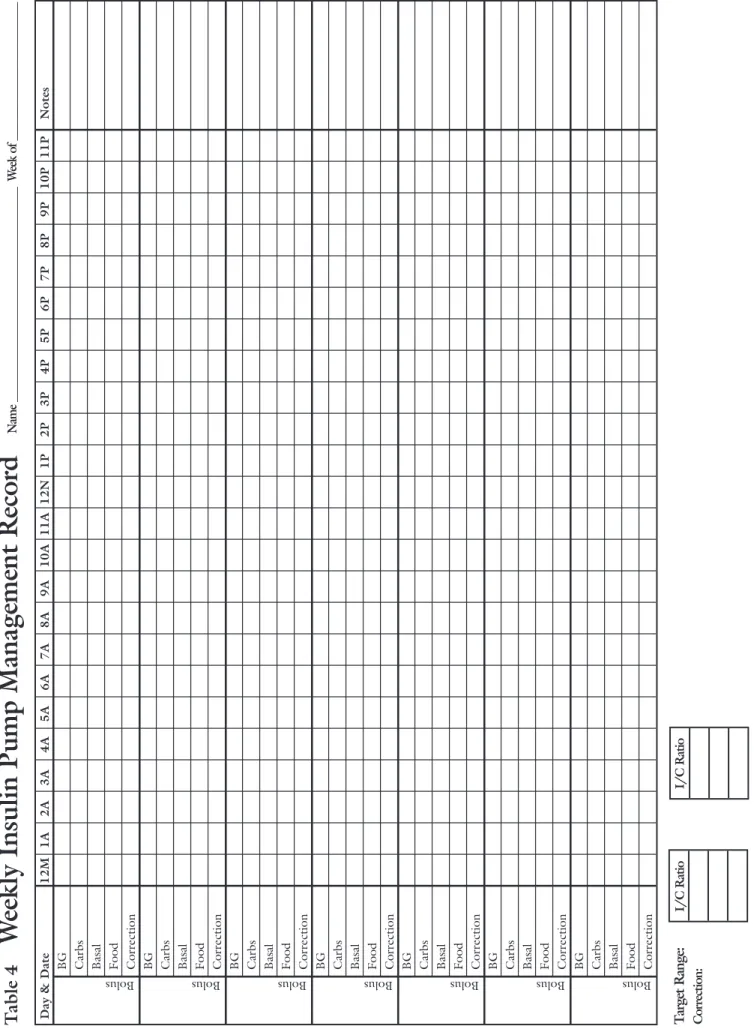
This amounts to seven or eight tests per day. This number may be reduced in the second week to four or five per day. It is obvious that parents or a significant other are extremely helpful at this time to assist with testing. The minimum will eventually be four tests daily with occasional checks during the night; however, when striving for safe “tight” control, more than four blood tests a day are usually needed. The form we like for reporting (faxing or e-mailing) blood sugar results is shown in Table 4 and may be copied as often as desired. It can also be found on our website (www.barbaradaviscenter.org) for use in e-mailing blood sugars.
The person (or family member) faxes blood sugar results daily for the first week, then weekly for several weeks and then every two to four weeks. Good communication at this time is essential.
Post-pump Visit (Advanced Pump Training)
✔ A food record may be brought to this visit to fine tune the insulin-to-carbohydrate ratios with the dietitian. Other methods of preventing high blood sugars after meals (such as the square or extended wave or dual wave bolus) are discussed.
✔ Sick-day management, site care and hypoglycemia are reviewed.
✔ Sometimes a second set of basal doses is programmed into the pump for high exercise days (lower basals) or for menses (higher basals).
✔ A physical exam is done including a careful eye check at this time (particularly if the blood sugar control is rapidly improving).
ADVANCED PUMP
TRAINING
Approximately one month after the insulin start, families complete their training with Advanced Pump Training. The following activities and topics are covered:
✔ Any problems the person/family is having with the pump are addressed.
✔ Programming and application of the advanced features.
✔ How to use the pump to adjust for exercise and how to evaluate the effectiveness of the exercise adjustment. A second set of basal doses may be programmed into the pump. ✔ How to apply basal and bolus tests.
✔ If the Sof-Set®
or Quick-Set™
is primarily being used, the Silhouette Infusion Set®
may be demonstrated. The Silhouette set often stays in place better with heavy exercise. ✔ Trouble shooting is reviewed for pump and
blood sugar issues.
✔ Special bolus features are introduced called the “square” or “extended” wave, or a “dual” wave. These allow a bolus to be given over a period of time (square and extended boluses) or with a portion of bolus given in the usual fashion and a portion as a square wave (dual wave). These special features are helpful for meals such as pizza or spaghetti, which are high in carbs and fat and cause prolonged sugar elevation (for some people).
T a b le 4
W
e
e
k
ly
I
n
s
u
li
n
P
u
m
p
M
a
n
a
g
e
m
e
n
t
R
e
c
o
r
d
N a m e _ _ _ _ _ _ _ _ _ _ _ _ _ _ _ _ _ _ _ _ _ _ _ _ _ _ _ _ _ _ _ _ _ _ _ _ _ _ _ _ _ _ W e e k o f _ _ _ _ _ _ _ _ _ _ _ _ _ _ _ _ _ _ _ _ _ _ _ _ _ _ _ D a y & D a t e 1 2 M 1 A 2 A 3 A 4 A 5 A 6 A 7 A 8 A 9 A 1 0 A 1 1 A 1 2 N 1 P 2 P 3 P 4 P 5 P 6 P 7 P 8 P 9 P 1 0 P 1 1 P N o t e s B G C a rb s B a sa l F o o d C o r r e c ti o n B G C a rb s B a sa l F o o d C o r r e c ti o n B G C a rb s B a sa l F o o d C o r r e c ti o n B G C a rb s B a sa l F o o d C o r r e c ti o n B G C a rb s B a sa l F o o d C o r r e c ti o n B G C a rb s B a sa l F o o d C o r r e c ti o n B G C a rb s B a sa l F o o d C o r r e c ti o n Bolus Bolus Bolus Bolus Bolus Bolus BolusT a rg e t R a n g e : I / C R a ti o I / C R a ti o C o rr e c ti o n : T h is t a b le m a y b e c o p ie d a s o ft e n a s d e s ir e d .
HYPOGLYCEMIA
Causes
The three main causes of low blood sugars for people using an insulin pump are all related to human (not pump) errors.
They are:
1. Too few blood sugars
Some people go through periods when they do not do the extra required work of more frequent blood sugar checking necessary for intensive diabetes management. They may be
having lows and not be aware this is happening. They may then have a severe hypoglycemic event.
2. Incorrect bolus dose
This may be because carbohydrate counting is not being done or because the person
calculated wrong. It can also happen when a bolus is taken and a meal is then interrupted.
3. Wrong adjustment for exercise
Some people fail to think ahead and make needed changes in insulin dosage for exercise. At other times it may be a new exercise or one
Table 5
Keys to Avoiding Lows
Always do AT LEAST four blood sugars daily (and occasional checks during the night)
Count grams of carbs to be eaten (or just eaten) to give correct food bolus
Test before, during and after exercise Recognize the symptoms of lows and treat promptly
Think ahead regarding variations in daily schedule which could result in low blood sugars
If the blood sugar level is below 70 mg/dl (3.9 mmol/L) and it is time for a food bolus dose, subtract one unit from the bolus amount
Reduce bedtime boluses for the bedtime snack or boluses during the night by half (the reduction may vary for different people)
Use a temporary (or alternate) basal pattern for heavy exercise and/or during the night after days of heavy exercise Try not to do routine set changes after dinner. The new area may be more
sensitive to insulin increasing the chance of hypoglycemia. A blood glucose test two hours after each set change is essential.
that is more intense than usual, and they just did not realize how much it would lower their blood sugar. The answer is to test blood sugars before, during and after exercise and to have extra drinks or food available.
Often a “temporary basal” is used during exercise or during the night after a day with heavy exercise. If one enters 70 percent as a temporary basal, 70 percent of the usual basal dose is given (not a 70 percent reduction). Others use a different basal setting (e.g., 0.2 u/hr lower) for days of heavy exercise.
Symptoms of Hypoglycemia
The symptoms and treatment of low blood sugar (hypoglycemia) are the same as those for people receiving insulin shots (Chapter 6). However, the symptoms may be somewhat less obvious when the blood sugar levels fall slowly over time from a mildly elevated level. Some keys to avoiding lows are given in Table 5. Additional symptoms which should alert
people/families to think of hypoglycemia during the nighttime (Chapter 6) are:
✔ inability to sleep or waking up “alert” ✔ waking up sweating
✔ waking up with a fast heart rate ✔ waking up with a headache
✔ waking up feeling “foggy-headed” or with memory loss
IF ANY OF THESE DO OCCUR, DO A BLOOD SUGAR CHECK IMMEDIATELY.
If low, treat appropriately and call the doctor or nurse the next day. A repeat blood sugar should be done (to make sure the blood sugar is back up) prior to again falling asleep. Also think about what was different the previous day (extra exercise, bolus insulin, less food, etc.). This will allow planning ahead to prevent the low with a similar occurrence in the future. If you have questions, call your doctor or nurse. A summary of some key ideas for avoiding lows is given in Table 5.
Treatment of Hypoglycemia
If hypoglycemia is suspected, the person with diabetes should be treated as described in
Chapter 6. If the blood sugar is below 60 mg/dl (3.3 mmol/L), we prefer 15g of “quick-acting” carbohydrate first (four ounces of juice or sugar pop or four glucose tablets). If it is still below 60 mg/dl (3.3 mmol/L) after 15 minutes, repeat this treatment. When it is above 60 mg/dl (3.3 mmol/L), give solid food.
If the glucose value is below 50 mg/dl (2.8 mmol/L) or if the person is “out of it” or unconscious, the pump should be placed on “suspend” or disconnected for a period of at least 30 minutes. Others will set a temporary basal of 0.0 units per hour for the next hour so that the pump will restart without the person having to remember. A parent, teacher or significant other must know how to do this, as the person with the low blood sugar may be confused. It must be remembered that insulin already infused will not yet have peaked, and so giving the sugar is essential. Instant Glucose (or cake decorating gel) and glucagon must be readily available for someone who knows how to give them (as for all people with diabetes).
HIGH BLOOD SUGARS
Non-Pump Related Causes
Some of the causes of high blood sugars for pump users are the same as for people taking their insulin by shots:
✔ extra food intake (without an extra bolus) ✔ lack of exercise
✔ forgetting boluses or giving after meals ✔ illnesses/infections
✔ hormones (stress, menses [many young ladies use a second basal setting which is 0.1 or 0.2 u/hr higher during menses])
✔ over-treating low blood sugars ✔ spoiled insulin
In Addition, Failure to Deliver Insulin May Occur
The most common causes of the pump not delivering insulin are:
✔ an empty reservoir (insulin syringe) ✔ a clogged infusion set
✔ leaks in the infusion set; a bead of insulin may be noted or the scent of insulin may be detected
✔ an infusion set which has come out ✔ a kinked cannula
✔ a dead battery
If the blood sugar has not responded to a correction bolus with the pump or if the blood sugar is extremely high or if there are ketones present, the infusion set must be changed and a syringe shot correction given. If moderate or large urine ketones or a blood ketone level > 1.0 mmol/L is present, the correction insulin dose is often doubled. If a syringe correction has been given and the blood sugar does not respond, the insulin used could be bad.
In order to prevent running out of insulin, the syringe should be filled every 2-3 days as
the set is changed. Table 6 summarizes some possible pump problems. Remember that all pumps have a 1-800 number on the back to call for help 24 hours a day.
EXERCISE
(See Chapter 13 for further discussion) There are several options for altering the insulin dose with exercise. Experience is usually the best teacher to see what works. Doing
more frequent blood sugars to determine the effects of the exercise and the changes in insulin dosage is MOST helpful! Many athletes find pumps are better than injections when exercising. It is generally not as necessary to eat and then perform on a full stomach. ✔ If the exercise is mild to moderate (walking,
golf, dancing, etc.), reducing the basal dosages by half (50 percent reduction) during the exercise may be sufficient. Some people start the reduction 30 to 60 minutes before the exercise and continue it for 30 minutes or longer after the exercise is over. Every person is different and will need to find what works best. Use of the
“temporary basal” can be very helpful.
Table 6
Possible Pump Problems
Problem Pump Alarm
Empty insulin reservoir (syringe) Yes Low pump reservoir Yes Clogged infusion set Yes Partially blocked infusion set No Leaky infusion set No Weak or dead battery Yes
Low battery Yes
Pump malfunction Yes Cannula has come out No
✔ If it is intense exercise (jogging, football, basketball, etc.), most people just disconnect from the pump (some disconnect 30 minutes before the start of the exercise).
There are then several options for insulin adjustments:
Estimate the amount of insulin to be missed while disconnected from the pump and take part of the dose before the exercise
(particularly if the blood sugar is high) and the rest of the dose after the exercise. You may also consider using a temporary basal rate after an exercise of long duration and/or high intensity to lower the incidence of delayed hypoglycemia. This is particularly helpful during the night for some people.
● do a blood sugar test and bolus after the
exercise (particularly if the adrenaline put out with the exercise raises the blood sugar)
● use a bolus of the entire amount missed
while disconnected
● use 1/2 of the amount missed AFTER
the exercise
● Correction boluses given after exercise
are also frequently reduced by half. This helps to prevent delayed hypoglycemia (Chapter 13).
In general, if the pump is to be
disconnected for two hours or more, more frequent blood sugars must be done
(preferably each hour). If the blood sugar is rising, it is easy to reconnect, take a small bolus and again disconnect.
✔ If it is to be an all day exercise (e.g., a long hike or all day skiing), it may work best to reduce the basal and the bolus rates
(perhaps by half) or possibly to not give any bolus doses. People must determine what works best for them.
✔ With exercise, it is important to remember to stay hydrated and to take extra snacks (see Chapter 13). Drinking water or Gatorade (or other sports drinks) works for some people. The carbohydrates from the sports
drinks will provide extra calories and energy. Often a bolus is not given (or reduced) to cover the carbohydrate intake. Snacks such as granola bars provide extra carbohydrates and calories. Make sure that coaches or others around at the time know that you have diabetes and wear an insulin pump.
SMART PUMPS
The so-called “smart pumps” (as discussed above) are those in which the insulin-to-carb ratios for different times of the day as well as correction factors can be pre-entered. Then when the carbs to be eaten and a glucose level are entered, a recommended dose of insulin will be suggested. The person can always override the recommendation. Getting into the habit of entering all carbs, no matter how few, may help establish the bolus-for-food habit. The smart pumps also subtract the amount of insulin still working from the last bolus taken. This requires entry of an estimate (usually three to four hours) of how long the rapid-acting insulin works in each person. Other features may include a reminder to re-check a blood sugar level when the last value was low and alarms to remind the person to bolus if a bolus has not been given within a given time range (e.g., 11 a.m. to 1 p.m.). The latter feature has been shown to be important in helping youth
remember to give meal boluses.
SCHOOL
If the person using the pump is in school, the school nurse should have some knowledge of the pump. You may wish to copy the pump table in Chapter 23 on Schools (or this entire chapter) for the school nurse. (You have our permission to make copies as desired.)
SUMMARY
Insulin pumps have advantages and disadvantages. It is up to each person and family, working with their healthcare team, to decide if a pump would be good for an individual.
DEFINITIONS
Basal dose: A pre-set hourly rate of insulin (for 24 hours) as programmed into an insulin pump.
Bolus dose: An amount of insulin taken prior to a meal or when the blood sugar is high as entered at any time of the day by the person wearing the insulin pump.
Carbohydrate (carb) ratio (see Chapter 12): The number of units of insulin to be taken for a certain number of grams of carbohydrate eaten (e.g., one unit for 15g of carbohydrate).
Closed-loop pump: An insulin pump (not currently available) which would increase insulin given for high blood sugars or decrease insulin given for low blood sugars.
Correction bolus dose: A bolus of insulin used to correct a high blood sugar down to the desired level.
Insulin pump: A microcomputer with a syringe of insulin within the pager-sized device that can infuse a basal insulin dose at a pre-set hourly rate. Bolus insulin dosages can also be entered and given at any time by the person wearing the pump.
Smart pump: This is the term given to a pump that will recommend units of insulin to give when the number of grams of carbs to be eaten is entered. It also recommends a correction insulin dose when the blood sugar level is entered or transmitted to the pump from the glucose meter. (The I/C ratios and correction factors must have been pre-entered into the pump by the user.)
ADDITIONAL READING
1. “Pumping Insulin (Everything In A Book For
Successful Use Of An Insulin Pump)”, Second Edition, by John Walsh, PA, CDE and Ruth Roberts, MS, Torrey Pines Press, 1030 West Upas Street, San Diego, CA 92103-3821
2. “Teens Pumping It Up! Insulin Pump
Therapy” (Guide for Adolescents), by Elizabeth Boland, MSN, APRN, PNP, CDE, Medtronic MiniMed, 18000 Devonshire, Northridge, CA 91325, 1-800-933-3322
3. “The Insulin Pump Therapy Book, Insights
from the Experts”, edited by Linda Fredrickson, MA, RN, CDE and Jay S. Skyler, MD, Medtronic MiniMed, 18000 Devonshire, Northridge, CA 91325, 1-800-933-3322
4. “H-TRONplus®
Advanced Insulin Pump Programming and Practices”, by Disetronic Medical System, Inc., 5201 East River Road, Ste. 312, Minneapolis, MN 55421-1014, 1-800-280-7801
5. “Pumper in the School!”,edited by Linda Fredrickson, MA, RN, CDE and Marilyn R. Graff, RN, BSN, CDE, Medtronic
MiniMed, 18000 Devonshire, Northridge, CA 91325, 1-800-933-3322 or
www.minimed.com
6. “Putting your Diabetes on the Pump”,
Q
UESTIONS AND
A
NSWERS
FROM NEWSNOTES
At what age should children with diabetes be considered for insulin pump therapy?
This question is often asked. There is no “magic” age, although in general, teenagers tend to do better than pre-teens. Other factors which are also important: a. the person must be faithful in doing at least
four blood sugars daily
b. the desire of the patient, and not just the parents, to use a pump
c. the patient’s maturity and ability to problem solve
d. the patient’s ability to faithfully give the bolus dosages
e. the ability to use carbohydrate counting f. family support
Some considerations:
✔ Pumps are expensive at about $6,000 (U.S.), and it is important to make sure the insurance company will support this
expense. The Diabetes Control and Complications Trial (DCCT) showed that the reduction in cost of caring for diabetes complications in later years more than makes up for this cost. However, not all insurance companies are willing to invest in prevention.
✔ Starting insulin pump therapy is time-consuming. We require an initial 3-7 day period of wearing the pump using saline (salt water). Then, if the person is still motivated, another half day is spent in the clinic to begin insulin treatment. We do NOT hospitalize people. Daily phoning and faxing of 6-8 blood sugars per day follows in the first week.
✔ Some people have said that starting the pump can be like getting diabetes all over again. Instead of taking shots in private, a
pager-sized device is now constantly worn. This is removed during intensive exercise. People may ask questions such as, “What is that on your belt?”
✔ An additional drawback of pumps is that if the plastic catheter accidentally pulls out and insulin is not being infused, high sugars and ketones may develop in 3-6 hours. This is because only Humalog/NovoLog insulin is used in the pump, and it is a rapid-acting insulin.
The rewards are also plentiful:
✔ the HbA1coften declines
✔ the likelihood of severe low blood sugars is now less than for people receiving NPH insulin
✔ blood sugars are “smoothed out” with more consistent absorption of the insulin
✔ people may have more energy or feel better ✔ people may have more flexibility to choose
the time they eat meals
✔ people may have more flexibility in choosing the amount they eat
✔ people may be able to vary the time they wake up in the morning
✔ adjusting for exercise and activities can be easier
Although pumps are not for everyone, if it is something you want to know more about, ask your healthcare providers at the time of your clinic visit.
My son is going on a trip without other family members. He uses an insulin pump. Could you remind us of supplies he should be taking along?
In case of pump malfunction, we generally recommend he take extra syringes and bottles of the
intermediate-acting/long-acting insulin he was on prior to starting the pump. You should also look back in your records to send the dosages as
Q
A
Q
A
well. It is also important to have him pack his diabetes supplies in his carry-on luggage. A summary of important items to include are:
1. clinic phone number
2. a supply of rapid-acting insulin
3. intermediate-acting/long-acting insulin 4. insulin syringes
5. extra pump batteries
6. glucose meter/strips/lancets 7. extra meter battery
8. extra infusion sets and inserter (if used) 9. extra pump syringe (reservoir)
10. alcohol pads 11. dressing, tape
12. glucose tablets/instant glucose 13. urine or blood ketone testing strips 14. glucagon emergency kit
Our teenage daughter is on an insulin pump and seems to forget to take some of her insulin mealtime bolus dosages. Do you have any suggestions?
Missing bolus dosages with food is unfortunately fairly common. It is probably the number one cause of elevated HbA1clevels (> 8 percent) for people who receive insulin pump therapy.
When teens show signs of slipping, the parents must again get more involved. They may need to actually observe the breakfast and dinner boluses. Perhaps a friend or teacher can be found to make sure the noon bolus is taken.
Some pumps have alarms to help remind youth to bolus. The FreeStyle Flash meter also has four possible alarm settings.
One of our families found a Timex®
watch called the “Iron Man Triathlon”. It has five separate alarms and can store 10 messages. It can be set as a reminder for bolus dosages.
I know pump supplies can be ordered through the pump
companies. Are there other good sources?
Yes, some families order through GEMCO medical at 1-800-733-7976. Other families use IV-Solutions at 1-800-657-7122.
I am considering an insulin pump. I don’t look forward to being constantly connected to the pump and wonder if you have any thoughts?
A person does not have to be “constantly connected” to a pump. People regularly disconnect for short periods to participate in athletics, to shower or for other reasons. Now that we have the basal insulin, Lantus, it is quite easy to come off the pump for 24 hours or more. The units of Lantus are the same as the total basal units per 24 hours used in the pump. One then takes injections of Humalog/NovoLog/Apidra insulin prior to any food intake – just as bolus insulin dosages are given with the pump.
People most commonly take “pump vacations” when they are going to a beach. I have even had people come off the pump for three months for a sports season and then go back on. They must remember that Lantus lasts 24 hours – so they cannot restart the pump until 24 hours after the last Lantus shot. If you have further questions about this, ask your doctor or nurse.