Graduate Program Prioritization
MS in Bilingual, Multicultural Education & TESOL Program WLL Department
March 29, 2014
1. History, Development and Expectations of the Program
a. Provide, to the best of your ability, a brief description of the program’s history including the evolution of the program over the years. Describe specific changes that have been made to the program curriculum, changes to student demographics and the impact of these changes on the program, and efforts to recruit students to the program. If this is a new program, describe efforts to build the program and the progress of these efforts to date. (550 words)
Approximately 20 years ago, SCSU’s MS/TESOL program was created by World Language faculty to meet the growing need of CT teachers to learn best instructional practices for teaching the growing immigrant English language learning (EL) school population. This population has continued to grow in CT and nationally; it is the only growing K-12 population and the population with the largest achievement gap. Teachers are desperate to better understand how to best instruct ELs.
At the program’s inception, no qualified faculty were involved. In 1999, an applied linguist was hired to coordinate the program. During the next few years, TESOL courses were redesigned to reflect the thinking of the field. An undergraduate initial Bilingual Education/ Elementary Education dual
certification was written, as a condition of a federal US Dept. of Education grant. SCSU’s MS/TESOL program obtained its own US Dept. of Education grant (approximately $1million). And the department hired a second applied linguist to teach part-time in TESOL and part-time in our Foreign Language Certification program.
Responding to students’ needs, these two TESOL faculty completely revised the TESOL curriculum, determined program objectives, ensured that the program measured student attainment of these objectives, developed a new comprehensive exam experience, and created the semi-annual capstone colloquium. TESOL faculty obtained internal grants, which allowed us to bring to campus world-renowned guest linguists each semester. Additionally, faculty collaboratively arranged for an interdepartmental Vietnam grant to sponsor two of our students’ EFL semester long internships overseas.
During the past thirteen years, the TESOL faculty obtained three consecutive U.S. Department of Education grants, totaling just under $5million, to fund our Training for All Teachers (TAT) program. The TAT
program offers training to CT K-12 teachers; has sponsored tuition scholarships for over 60 CT teachers to complete the MS/TESOL degree program and to obtain either a CT cross endorsement in Bilingual Education and/or ESL (English as a Second Language); and maintains a virtual EL curriculum library comprised of hundreds of instructional units, grade K-12. The MS/TESOL prepares teachers: 1) to teach English as a Foreign Language (EFL) overseas; 2) to teach adult ESL here in the States, either in adult education centers or in community colleges, and 3) to prepare certified teachers to additionally teach ESL and/or Bilingual Education in the public schools. Our program does not offer initial certification, but offers the
coursework necessary for currently certified teachers in another area (such as elementary ed, or secondary math) to obtain a second certification, a cross endorsement, in either ESL and/or Bilingual Education. The CT State Department of Education has expressed interest in our becoming an initial certification program; but currently, that would require more human resources than we currently have.
SCSU’s MS/TESOL program is one of four CT institutions, which prepare ESL teachers, along with CCSU, Fairfield and UConn. Our program offers a balanced curriculum built upon linguistic theory, but providing a wide variety of applied courses. In contrast, CCSU’s program is highly theory based; Fairfield’s is highly applied, and UConn’s program primarily
addresses Bilingual Education. Compared to our sister institution, we have graduated 72 MS students in the past five years, while CCSU has graduated 46. We regularly hear a strong request from teachers in western and eastern CT, for SCSU to make their MS/TESOL program available to teachers in districts beyond the commuting distance.
b. Is there anything else you would like us to know? (Issues you might choose to discuss could include visibility of the program, relationships the program has external to the university, changes in the economic support for the program, staffing, etc.) (150 words)
For 8 years, the department employed a third applied linguist for the Foreign Language Certification program. The most recent faculty member to take this position holds an expertise in a field other than applied linguistics, and is therefore unable to teach in the TESOL program. Possessing a strong need for a third applied linguist to teach in TESOL, we are currently undergoing a tenure-track search.
Additionally, we have been operating at full student capacity for some time, with sections having the highest enrollment (over-enrollment) in the School of Arts & Sciences, averaging over 20 per section, when ideally, the graduate sections should enroll no more than 15. We can offer no more than one section
of each course yearly, due to faculty limitations. We are faced with the interesting dilemma of whether and how to grow the program. Bringing on a third applied linguist will help us resolve this issue.
2. External Demand for the Program
a. Using the data provided, review and explain the relationship between the program and external factors that impact the:
i. number of applicants and percentage of applicants accepted ii. 5-year enrollment trends (450 words)
Academic
Year Program Applications Accepted
Acceptance %
2008-2009 MS-FLA 39 37 95%
2009-2010 MS-FLA 32 21 66%
2010-2011 MS-FLA 13 8 62%
2011-2012 MS-FLA 45 17 38%
2012-2013 MS-FLA 33 22 67%
The MS/TESOL program serves primarily two populations: 1) practicing, certified K-12 teachers who wish to receive a cross-endorsement (second certification) in ESL and/or bilingual education while pursuing their Master’s Degree (approximately 75% of our students); and 2) those preparing to be ESL teachers in adult education, community colleges and teachers of EFL overseas (approximately 25%). However we also serve a third population— non-matriculated certified teachers who are ONLY pursuing an ESL or Bilingual Education cross endorsement, and therefore enroll in a portion of our courses without enrolling in the degree program. Typically, 3-5 seats in some of our classes will be filled by this third category.
Given the current number of faculty dedicated to this program (1.5), we offer each of our courses only once each year. Ideally our class size would range from 15-18. Consequently, our ideal admission rate is 15 per year. Aside from the 2008-2009 year, we have accepted on average slightly higher than our ideal (average for these four years: 17). The unusual number of admits during 2008-2009 reflects the one-time cohort of eastern CT teachers who attended a satellite program, funded by our TAT grant. This cohort was in addition to our usual on-campus number of yearly admits.
Our program is not highly competitive in that we do not reject many
candidates. We rarely reject more than 3-5 applicants per year. However, we do frequently steer applicants away from the program when it is clear that our program is not ideally suited for them (either because they are not adequately prepared or because their career goals cannot be met by our
particular program); so that ultimately they self-withdraw from the admission process.
Two external factors are positioned to significantly increase our MS/TESOL enrollments. First, the CT State Department of Education has revised its certification requirements. As of June, 2016, those ‘provisionally’ certified mainstream teachers in all content areas, who apply to obtain the final level of ‘professional’ certification will be required to have earned an MS either in their content area, in a cross –endorsement area (could be ESL), or in a state shortage area (also, could be ESL); they will no longer be able to pursue an MS in Education. Consequently, we anticipate additional applicants for our MS/TESOL degree.
Secondly, we currently are receiving urgent requests from Stamford and Windham school districts to provide the MS/TESOL degree program to
cohorts of their teachers. If we were to resolve the distance challenges, these districts would be sources of additional applicants.
b. Which employers, institutions and/or communities benefit from this program? Describe how the program meets the needs of the state (e.g., economic, cultural, civic, etc.)? (150 words)
SCSU’s MS/TESOL program provides a significant need to CT’s public schools, in that we prepare their certified teachers to become qualified to teach English language learners (ELs), the fastest growing student
population in the state (and in the country). In Connecticut, as the number of public school students declined from 2005-1010, the number of ELs grew from just under 26,000 to 30,000. In the 2009-2010 CT school year, EL students accounted for 5.5% of all K-12 students, and 9% of K-2 students (CSDE November 2010 ELL Data Bulletin, 4.11).
School systems find it very difficult to fill vacant ESL and Bilingual
Education teacher vacancies. Both certifications are listed as “shortage area” certifications in the state of Connecticut. This trend is expected to continue. It is conservatively estimated that by year 2030, 40% of all US school-age children will speak a home language other than English (Thomas & Collier, 2002).
c. Is there anything else you would like us to know? (Issues you might choose to discuss could include competition from local, regional, and other
institutions.) (100 words)
As mentioned above, for the past decade we have received frequent and urgent requests from eastern CT school districts (Windham, Norwich, and New London) and more recently from Stamford, CT to offer satellite
MS/TESOL degree programs for their teachers. We offered one satellite program for eastern CT through our federally funded Training for All Teachers Program. We are exploring video-conferencing technology as one means to solve this need but would need more faculty resources to be able to offer such a program. Currently this is a strong state need that remains un-met.
3. Internal Demand for the Program
a. Using the data provided, please describe how courses in your program serve students in other programs. What percentage of students in your courses come from other programs? Please provide enrollment data for graduate courses offered by your department that are required for other
graduate programs. (Some of your discussion in this section may be repetitive, but is important in understanding the internal demand for the program.) (100 words)
Enrollments - MS-FLA
Fall '08
Spr '09
Fall '09
Spr '10
Fall '10
Spr '11
Female 39 42 46 41 29 22
Male 4 4 8 8 5 2
Total 43 46 54 49 34 24
Full-Time 1 0 5 4 3 3
Part-Time 42 46 49 45 31 21
Fall '11
Spr '12
Fall '12
Spr '13
Fall Avg
Spring Avg
31 28 26 22 34 31
6 4 4 3 5 4
37 32 30 25 40 35
7 4 3 2 4 3
30 28 27 23 36 33
The MS/TESOL program offers three courses required of the undergraduate Elementary Ed/Bilingual Ed dual certification program (the only such
program in the state). Co-offered with our graduate course equivalents, these courses historically serve 1-3 undergraduates yearly. A growing interest in this undergraduate program forecasts an enrollment increase.
Secondly, the Science Education MS program requires TSL518: Content-based Instruction for ELs. Thirdly, 6th Year Classroom Specialist candidates
Table 6a, indicates that 20-30% of our seats were filled by non-majors— teachers pursuing a cross-endorsement, or taking a course before admission into MS program.
b. How is enrollment for your graduate program influenced by enrollment in your undergraduate program? Is there potential for a formal pathway
between the two programs? (100 words)
The MS/TESOL program does not have its own undergraduate program, although it co-offers with Anthropology a growing minor in linguistics. However, there is great potential (and need) for a “formal pathway” from the undergraduate certification programs in Elementary Education and Special Education (and possibly secondary education programs) to the MS/TESOL program. Such a pathway would enable newly certified teachers to earn an MS degree (required of all teachers as part of their professional career ladder) and to obtain the skills needed to successfully work with ELs. We’ve been exploring such a pathway with Elementary Ed’s coordinator, Helen Marx. c. How reliant are you on non-program students taking your courses? (100 words)
We do not rely on internal pathway students, that is students coming from other SCSU programs. Most of our MS/TESOL students come to us from outside the institution. (They may have earned their undergraduate degree from SCSU at some prior point, but the majority has not).
A small number of students in our classes (typically less than 5 per class) are non-matriculants, students with no need for the MS degree, but need to take 6-10 graduate courses to pursue an ESL or Bilingual Education cross
endorsement. We offer this option as a public service to CT’s education community.
d. Does the program produce services needed by other parts of the campus (e.g. clinics, testing services)? (100 words)
TESOL faculty serve as guest lecturers for education classes re: EL issues. e. Is there anything else you would like us to know? (100 words)
The undergraduate dual certification program could not exist without us. The MS Science Ed program would need to drop the required TSL 518 course without our program. ALL post-certified teachers need more training on best
instructional practices for ELs – this is the coursework offered by our MS/TESOL program.
4. Quality of Program Inputs and Processes
a. Please provide a narrative of how the qualifications and assignments of your full- and part-time faculty align with and support the program. Please include a discussion of the challenges and successes the department faces in providing qualified faculty to meet the needs of the program. In those
programs where it is appropriate, please discuss the integration of adjuncts into the program’s curriculum. (450 words)
Two WLL faculty members, both highly qualified applied linguists, are dedicated to the TESOL program; Verplaetse dedicates all 12 credits to the TESOL program, and Schmitt dedicates half of her time to TESOL and half to FL Certification, when she is not chairing the department. The research interests and areas of expertise each of these two faculty members brings to the program is unique and complementary. Verplaetse’s area of research is classroom discourse and her expertise is ELs in US content classrooms. Schmitt’s area of research is first language attrition and her expertise is in bilingualism and ESL/EFL from a global perspective.
Until last year, our department’s second FL Certification faculty member was also an applied linguist and could, therefore, teach courses in the TESOL program. This is no longer the case, as the new FL Certification faculty member’s expertise is outside the TESOL discipline. While Schmitt has been chairing the department, we have had to rely significantly on adjuncts. This has not always been easy or beneficial to the program. Some adjuncts have served the program well; and have taken part in our capstone colloquia and our TAT program events. Others have not been well received by the students. Unfortunately, there are few applied linguists in the area to serve as a source pool; this remains a problem for us. To that end, we are currently searching for an additional applied linguist (tenure track) who can teach TESOL courses and Spanish courses in our department.
Our program has been operating at its limit in terms of numbers of students we can serve and numbers of classes/sections we can offer. Our course sections are seriously overloaded for a graduate program. But we do not currently have the personnel resources to offer a second section of any of our courses. To offer second sections and to ensure sufficient class enrollment for both sections, we would need to immediately double in size –an unrealistic expectation; so this has been an ongoing problem for us. It is our hope that with a new TESOL/Spanish faculty member, we can ease into offering
additional sections, increase our program’s size without having to
immediately double in size, and bring our current section enrollment caps to a size that is more appropriate for graduate studies.
b. Briefly describe the merits and logic of your curriculum. (250 words) Our program is built upon two theoretical constructs. First, we believe that a solid foundation of linguistic theory and language acquisition theory should precede the study of methodology. In simple terms, before one begins to discuss how to teach a language, one needs first to be aware of what a language is and how a language is acquired. Consequently,SCSU’s MS/TESOL program provides a strong theoretical base in Second Language Acquisition, Linguistics, and
Bilingualism. It then bridges and builds upon this theoretical base with a highly engaging, applied series of methods courses: to include TESOL
Methods and Materials, Content-based Instructions, Literacy Development, Assessment, among others. The program is intentionally designed to prepare both K-12 teachers, teachers of adult ESL, and teachers of EFL (English as a Foreign Language) for those planning to teach overseas.
Second, our program is built upon a sociocultural framework of learning. We
believe that language learning (in fact, all learning) occurs most effectively when the learning experience is highly learner-centered, interactive, and authentic.
Consequently, much of the coursework for the teacher candidates is interactive and learner-centered and contains multiple opportunities for the candidates to engage in authentic practices. “Authentic practices” is an academic term that describes activities that have personal meaning for the learner in real time and/or activities that replicate actual professional practices. We have intentionally designed our instructions, major assignments, and even our comprehensive exam experience to create a “community of learners.”
c. How dynamic is your program? Please identify and describe what
procedures are in place to provide continued, regular evaluation and review (include formal and informal activities). Describe the impact of the review on the program and curriculum (e.g., FAAR data may be used as evidence, as well as other documentation of changes to the curriculum). (300 words) Independently, TESOL faculty members review their course evaluations and make course changes as needed. Our most recent Graduate Program Review revealed a student satisfaction rate of 85% or higher in each point in the course evaluations. Additionally, the two TESOL faculty members meet formally at least once a year for program review and planning. Our U.S. Dept. of Education “Training for All
Teachers” (TAT) grant provides us a unique window of opportunity to view student opinion about our courses. Our TAT program manager holds monthly meetings with the TAT fellows (approximately 50% of students enrolled in our MS program,
at any given time) during which these students discuss how they can apply what they are learning in class to what they are doing as teachers. During these meetings, our program manager gathers information about what assignments make sense to the students, and which assignments or texts are problematic, and then shares those finding with Dr. Verplaetse, TAT’s project director. In an annual program review meeting this information is discussed, and TESOL faculty members decide whether we want to make curricular changes in response to these vocalized concerns. Some of the curricular changes that have come out of these discussions in the most recent years are:
Change of texts for FLA/TSL 503.
Expansion of content on authentic assessment in FLA/TSL 521. Requirement of a pre-requisite (TSL 502) before TSL 505.
Creation of new course on educating immigrant students: TSL 563. Development of new assignments, which students can use in their
jobs. Examples: advocacy letter for immigrant students; grammar unit creation; tutoring.
Creation of the Graduate Student Orientation Handbook for MS/TESOL students.
Because the MS/TESOL program is managed by a small number of faculty (two in the WLL dept.), we do not have time nor feel the need for an advisory committee. d. Is there anything else you would like us to know? (Issues you might discuss could include the quality of your incoming students, or a comparison of your curriculum, courses, assessments, experiences to similar programs. How does your program better serve students than similar programs offered
elsewhere?) (200 words)
Four graduate programs exist in the state of CT, which prepare teachers to teach English language learners. Only two of these programs prepare
teachers for an initial ESL certification (in contrast to a cross endorsement, or second certification): Fairfield University and CCSU. Fairfield’s program provides minimal theory courses and bears the expense of a private
university. CCSU’s program provides much more linguistic theory and fewer methods courses. The third program, at UConn, focuses primarily on
bilingual education.
SCSU’s program offers a blend of theory and methods, addresses equally both ESL and bilingual education, and is the only CT university to house a U.S. Department of Education, Office of English Language Acquisition, National Professional Development grant for 15 consecutive years. This grant
contributes approximately 30 full scholarships for MS/TESOL degrees every five years, and provides professional development teacher training on “Best Instructional Practices for ELs” to local school districts.
5. Quality of Program Outcomes
a. How does your program use assessment data to ensure quality of student outcomes? Describe the quality of your program outcomes. (e.g., G.P.A., Student Opinion Surveys, course evaluations, alumni surveys, professional assessment/evaluation, other assessments, participation in groups or
organizations that focus on pedagogy or andragogy. Insert a table listing your program outcomes. Note that the table does not count in the word limit). (900 words)
Table 1: Overall GPAs of MS/TESOL Students Spr '09 Fall '09 Spr '10 Fall '10 Spr '11 Fall '11 Spr '12 Fall '12 Spr '13 Fall Avg Spring Avg
46 54 49 34 24 37 32 30 25 40 35
3.66 3.64 3.90 3.80 3.65 3.91 3.91 3.86 3.77 3.79 3.78 Table 2: Student Opinion Surveys for ALL WLL faculty?
Course Information Survey
AY 08/09 AY 09/10 AY 10/11 AY 11/12 AY 12/13
Statement SA/A SA/A SA/A SA/A SA/A
Methods of instruction have helped me
understand the subject matter. 91% 86% 93% 85% 83% Reading the assigned material has helped me
understand this subject. 95% 89% 92% 86% 85%
Exams and out-of-class assignments have helped
me understand the subject matter. 95% 87% 90% 85% 90% Number of exams & other graded assignments has
been sufficient to evaluate my progress. 94% 89% My experiences in this class make me want to
learn more about this subject. 93% 84% I would rate the quality of instruction in this course
as high. 93% 84%
I would rate the overall quality of this course as
high. 94% 83%
This course helped me meet the learning goals. 98% 90% 90% This course evaluated how well I met those
learning goals. 96% 85% 86%
My experience in this course helped me appreciate
this subject. 93% 88% 89%
The instructor provided regular feedback on my
The instructor had high standards for student
achievement. 96% 88% 92%
The instructor encouraged me to take
responsibility for my own learning. 97% 93% 94%
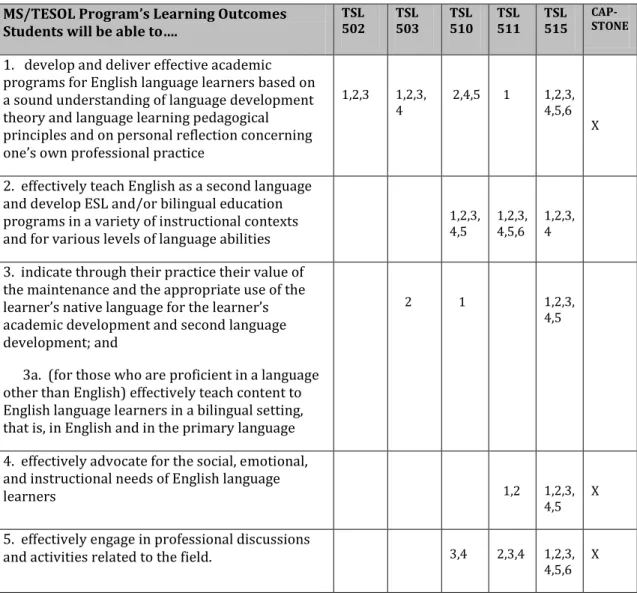
Table 3. MS/TESOL PROGRAM’S LEARNING GOALS Core courses & major assignments*
to assess these learning goals. MS/TESOL Program’s Learning Outcomes
Students will be able to….
TSL
502 TSL 503 TSL 510 TSL 511 TSL 515
CAP-STONE 1. develop and deliver effective academic
programs for English language learners based on a sound understanding of language development theory and language learning pedagogical principles and on personal reflection concerning one’s own professional practice
1,2,3 1,2,3,
4 2,4,5 1 1,2,3,4,5,6 X
2. effectively teach English as a second language and develop ESL and/or bilingual education programs in a variety of instructional contexts and for various levels of language abilities
1,2,3,
4,5 1,2,3,4,5,6 1,2,3,4 3. indicate through their practice their value of
the maintenance and the appropriate use of the learner’s native language for the learner’s academic development and second language development; and
3a. (for those who are proficient in a language other than English) effectively teach content to English language learners in a bilingual setting, that is, in English and in the primary language
2 1 1,2,3, 4,5
4. effectively advocate for the social, emotional, and instructional needs of English language
learners 1,2 1,2,3,
4,5 X 5. effectively engage in professional discussions
and activities related to the field.
3,4 2,3,4 1,2,3, 4,5,6
X * The numbers refer to specific course assignments. These assignments are outlined in the Orientation Student Handbook for the MS/TESOL Program.
Table 3 articulates the overarching learning goals of the MS/TESOL Program and the primary assignments in the program’s core courses used to measure student attainment of these program learning goals. The grading system for our program is quite rigourous; students must exceed expectations to earn grades of A on assignments. Table 1 indicates that the average GPA earned by our MS students is above a 3.5. Therefore, it is reasonable to deduce that
students are, in fact, exceeding performance expectations on our course/program outcome objectives.
Table 2, a summary of student course evaluations, suggests that students indicate satisfaction or strong satisfaction at least 85% of the time for all facets of the program measured by the course surveys. Our program uses two other systematic assessment processes; a program survey issued every five years to matriculants and to alumni, and annual focus group discussions through our Training for All Teachers program. Our most recent program survey was conducted in 2010, at the time of our Graduate Program Review. The number of alumni respondents was too small to report on; however 38 current students responded. The results of this survey follow.
90-100% of the respondents agreed or strongly agreed to these statements: Faculty members show interest in my academic and intellectual development. Faculty create an atmosphere where open discussion is encouraged.
Faculty demonstrate enthusiasm about the subject matter.
Faculty use a variety of engaging teaching methods that help me to learn. Faculty use a variety of assessment methods (e.g. tests, homework,
assignments, reports) to determine if course objectives are being met. Faculty are up-to-date in their field.
Faculty communicate well.
The necessary courses and requirements that I need to earn my degree have been made clear.
Requirements for courses are appropriate for learning the material. The requirements for this program are academically challenging. Access to faculty (in person, on e-mail, via phone) is convenient. My advisor is knowledgeable and provides accurate guidance. Program faculty utilizes university resources (e.g. library resources,
classroom technology, etc.) to effectively accomplish course objectives. My program is helping me to accomplish my educational goals.
I would recommend this program to people interested in this field of study. Only two statements received unsatisfactory ratings greater than 5%:
From a learning perspective, the sequence of courses is well organized. Sufficient courses are scheduled each semester to permit me to follow my
planned program.
These survey results indicate that, overall, students are quite pleased with the program: they find the courses rigorous, the faculty challenging, helpful and
available, and the program meeting their professional needs. One hundred percent would recommend the program to others.
Only two items indicated a stronger need for attention, revision, and improvement. The first of these indicates that 14% of the students found the sequence of the courses to be less than satisfying. We suspect that this level of dissatisfaction was based on two concerns: 1) our eastern CT satellite cohort took courses out of sequence for administrative reasons; 2) students enrolled in TSL 517 and TSL 505 often struggled with the content, if they had not taken TSL 502. We have since then revised the course descriptions for these two courses, now requiring TSL 502 as a prerequisite.
The second of these items indicates that 16% of the students found the number of available courses per semester to be less than satisfactory. This marks a problem with resources, not with program planning and advising. At the time a student designs his/her planned program, we project out the student’s schedule—when s/he will take each of the courses in the planned program. Only twice in the past five years have we had to alter that course schedule, due to section cancellations. Based on comments at the end of program survey, we discerned that several students expressed their desire for more than one section per course be offered, so that they could have a choice of times in the week that courses are offered. While this would be a delightful feature to offer the students, our faculty resources strictly limit us to offering one section of each course per academic year. Students have little flexibility in their course sections, because of our small faculty numbers.
The final systemic form of program assessment is student focus group discussions, through our Training for All Teachers program. Our TAT scholars take part in monthly Community of Practice sessions, during which they discuss how their course work informs their current practice as teachers. The findings
generated from these discussions are brought back to the TESOL faculty, who are able to make instructional revisions on an ongoing fashion, and curricular revisions based on an annual meeting the TESOL faculty hold with the TAT program manager. b. Is there anything else you would like us to know? (Issues you may choose to discuss could include preparing your students for employment or further scholarly pursuits. Where possible provide data driven examples, e.g., number of students who pass the licensing exam). (300 words)
Several of our course assignments are particularly designed to prepare students for future pursuits: some academic, some professional.
Academic: We have designed a gate for writing skills in our TSL 503 course; students must write a theory paper and must pass through a series of drafts, as needed. Students cannot continue into the sequel, TSL 510, until they can write this TSL 503 paper in an acceptable manner. Then in TSL 510, students are given an assignment that models, in fact, the same written product which they will be expected to re-create in their comprehensive exam—the formation of three essay questions which meet particular articulated program criteria.
Professional: In TSL 511, students’ final exam is an oral job interview with the professor. We have heard from graduates that certain school
districts have told applicants that they can tell when an applicant is from SCSU’s TESOL program, because of the polish of their interview skills!
6) Size, scope and productivity of the program
a. How many credit hours does the program generate? (table generated by OMIR)
Note: the MS/TESOL prefix designation shifted from FLA to TSL in 2010.
Credits Generated – FLA
AY 08/09
AY 09/10
Total Academic Credits 331 531 Major Credits 259 423 Total Students 111 177
Credits Generated – TSL
AY 08/09
AY 09/10
AY 10/11
AY 11/12
AY 12/13
Total Academic Credits 397 431 419 Major Credits
Total Students 133 145 143
b. What degrees or certificates are awarded? (This is a simple list of degrees and will list only one degree or certificate unless you are one of the programs approved to report your data in combination)(in table form with item c) MS degree in Bilingual, Multicultural Education & TESOL
c. How many degrees or certificates have been awarded (five year data)?
Degrees Conferred AY 08/09 AY 09/10 AY 10/11 AY 11/12 AY 12/13 MS-FLA (Bilingual Multicultural Ed, TESOL) 7 20 17 12 16
d. Using the data provided, present and discuss the record of the graduate faculty in research/creative activity. (200 words)
Category Counts by Program Faculty Productivity Table-Master of Science in TESOL Report Run Date: February 23, 2014
Publications
Type of Publication
2009-2010 2010-2011 2011-2012 2012-2013
Journal Article, Academic Journal 0 3 0 1
Journal Article, Professional
Journal 0 0 0 1
Journal Article, Public or Trade
Journal 0 0 1 0
Other 0 1 0 0
Professional Presentations
Presentation Type
2009-2010 2010-2011 2011-2012 2012-2013
Keynote/Plenary Address 0 1 0 0
Oral Presentation 0 2 0 4
Paper 0 5 0 0
Poster 0 2 2 0
Professional Conference Participation
Role
2009-2010 2010-2011 2011-2012 2012-2013
Attendee 0 1 1 0
Other 2 1 1 0
Contracts, Grants and Sponsored Research
Type
2009-2010 2010-2011 2011-2012 2012-2013
Grant 0 2 3 0
TESOL’s two faculty have active records of scholarship. The above tables represent the scholarship of these 2 faculty members, one dedicated full-time to TESOL, and one half-time to TESOL. We are uncertain about the accuracy of the above reports, as we know that two papers were presented at major conferences in 2010, which are unreported above. We also know that grants were received every year, though not reported as such in the above tables. In
fact at least one grant totaling approximately $300,000.00/yr. was awarded each of the four years. Lastly, what is not told by these FAAR data, is that one book was also published in 2008.
e. What types of student or student/faculty research or creative activity have been developed and or produced (e.g., include theses, dissertations, special projects)? (100 words)
Students present capstone papers or curriculum projects at our semi-annual capstone colloquia. One example topic was: “What is the effect of identity and power relations on language acquisition. Which bilingual education programs can more appropriately promote equal status between language minority and majority groups?”
Since 2009, six students presented their work at peer-reviewed, annual, international TESOL Conferences. Fourteen presented at our annual Connecticut TESOL conferences. Two graduates were awarded Fulbright scholarships. Moreover, two students were awarded scholarships to spend a semester teaching English in Vietnam. Currently, that TAT program is funding two PhD scholarships for two of our MS graduates.
f. In your narrative discuss how all these data impact or have impacted the size, scope or productivity of your program. (200 words)
The MS/TESOL program is as large as it can be, given the number of faculty dedicated to the program. Given that one of the faculty teaches half-time for TESOL, and the other full-time faculty member spends 3 credits per semester to administer the TAT federal grant program, and another 3 credits to
coordinate the MS/TESOL program, we offer as many courses each semester as possible. Those courses are frequently over-enrolled.
While we are at our limit—for size, our productivity has been strong, in terms of scholarship: student and faculty scholarship. Both faculty members
regularly publish and/or present at national and international conferences. Faculty and TAT personnel are regularly called upon as consultants and trainers to school districts throughout the state. And program students and alumni are active in schools throughout the state and in conference
participation.
Because our faculty and our graduates are so productive in the field, the program has the strong reputation it does. That is why we are recruited so avidly by districts in eastern and western CT, who want to find a way for SCSU to offer its MS/TESOL program to those beyond commuting distance.
g. Is there anything else you would like us to know (this might include a discussion of equipment purchased solely for the purposes of the graduate program). (100 words)
We are in discussions with our A&S Dean exploring how we might use technology to address the strong need from districts in western and eastern CT to access our program. The WLL department is working with IT to install a video-conferencing system, which will allow us to offer face-to-face courses with students housed at CCSU. If this system works, we hope to explore installing this same technology at a western and an eastern CT site, thereby allowing us to offer MS/TESOL courses face-to-face in real time to teachers in these distant districts.
7) Revenue and other resources generated by the program
a. What are the sources and how much revenue does the program generate through student enrollments?
7a 7a 7a
Display Orgn Code
Prioritization Pgm for Reports
Fiscal Year
Student Tuition and Fees
Other Revenue Sources
Grand Total Revenue
22080 MS-FLA 2010 423,864 36,344 460,209
22080 MS-FLA 2011 240,448 22,242 262,690
22080 MS-FLA 2012 305,523 36,109 341,633
b. What are the sources and how much additional revenue does the program generate through fees such as laboratory or special user fees? (50 words) None c. What are the sources and how much revenue does the program generate by services (e.g., external or to other programs)? (50 words) None
d. In the narrative on this section discuss how the revenues and other resources impact the size, scope and productivity of your program? (100 words)
Our US Dept. of Education Training for All Teachers (TAT) grant has regularly funded student tuitions for 10-30 students for each of the above fiscal years. Grant money awarded to us for each of these three years was $300,000 (FY10); $300.000 (FY11); and $573,716 (FY12; two NPD grants). From these funds, tuition
scholarships we awarded for each of these three years totaled: $132,021 (FY10); $102,541 (FY11); and $99,394 (FY12). It is difficult to determine how much these scholarships impact the number of our enrollments. At any given time,
approximately 50% of each class section is filled by TAT scholars on full-tuition scholarships.
e. Is there anything else you need us to know? (You may wish to discuss grant activity, gifts to the University, etc.) (100 words) The TAT Grant has helped to shape the main focus of our program: instruction of English learners in US public schools; approximately 70% of all of our MS/TESOL students are working public school teachers. We value this focus, but we would also like to expand our focus to serve more students interested in EFL—teaching EFL overseas and teaching English to international students here in the states. The recent interdepartmental Vietnamese grant funded two of our TESOL students’ international experiences; and interdepartmental conversations persist with Dr. Schmitt regarding SCSU’s creation of an English Institute for international students.
8) Costs and other expenses
a. What are the total costs of the program? (table) See below. b. What is the ratio of costs to revenues? (table) See below.
8a 8a 8a 8a 8a 8b
Display Orgn Code
Prioritization Pgm for
Reports Fiscal Year Compensation Employee Operating Expenses
Allocated Overhead and Indirect
Costs Grand Total Costs
Net Income / (Loss) Per
BCH Ratio of Costs to Revenue
22080 MS-FLA 2010 (157,916) (2,238) (141,489) (301,642) 170.82 0.68 : 1.00
22080 MS-FLA 2011 (47,536) (768) (66,608) (114,912) 294.74 0.47 : 1.00
22080 MS-FLA 2012 (53,657) (1,458) (83,197) (138,312) 330.51 0.43 : 1.00
c. What investment in new resources does the program require? (200 words)
The MS/TESOL program needs two immediately identifiable resources: 1) an additional (third) tenure-track applied linguist, thereby meeting Graduate Council viability criteria, and allowing us to offer more course sections; thereby reducing class sizes to an appropriate graduate level (this search is underway);
2) funding to support the video-conferencing technology, allowing us to teach face-to-face in three locations synchronously, thereby providing the MS/TESOL to teachers in distant CT districts. (Funding is arranged for the SCSU-CCSU video system; we also need funding and administrative support to link western and eastern CT sites.) Moreover, we need funding to appropriately furnish the upcoming teleconferencing room thereby ensuring that even synchronous distance education adheres to pedagogical principles as outlined by a socio-cultural theoretical
framework.
The MS/TESOL program could expand productivity and enhance its scope and community contributions with two additional resources:
3) funding to support the creation of an English Language Institute at SCSU, thereby providing the
MS/TESOL program, faculty, and students, with a much needed working lab; 4) classroom furnishings, which promote and facilitate task-based, communicative pedagogy; that is, moving
tables and chairs that comfortably fit adults, where adults can sit and discuss in groups, lay out their work, and learn from collective engagement.
d. What demonstrable efficiencies exist in the way the program is operated (e.g., summer courses; cross-listed courses, etc.)? (100 words)
The program offers three of its courses regularly as summer courses; these summer courses always fill beyond capacity. We also offer the undergraduate bilingual ed/elem ed dual cert program by offering three undergraduate TSL courses that are cross listed with the graduate level TSL courses.
9) Impact, justification, and overall essentiality of the program
a. How does this program connect to the University’s mission statement and/or the Graduate School’s mission statement? (100 words)
While SCSU is “committed to…access, social justice, and service for the public good,” the MS/TESOL program prepares teachers who can educate CT’s fastest growing and weakest performing school population—English language learners.
SCSU’s mission is also to “empower every … graduate student … for active participation and impassioned, ethical leadership in our rapidly changing, global society.” SCSU’s MS/TESOL program prepares teachers in best practices for
educating ELs; these teachers ultimately serve as advocates for this unique population of students and as school leaders for this particular goal.
b. How does this program respond to societal needs that the institution values? (e.g., producing a critical thinking, educated citizenry; improving the state’s workforce; meeting health care needs of the community, etc.)? (100 words)
The values of an educated citizenry and improving the state’s teaching workforce are key to SCSU’s MS/TESOL program. The fastest growing student population in CT is English language learners (ELs); unfortunately they also represent the weakest performing K-12 school population. Nationally, and in CT, pre-service teachers are minimally trained in issues of EL education. The need to educate teachers on best instructional practices for ELs is critical. SCSU’s MS/TESOL program addresses that need.
c. To what extent does this program help the institution differentiate itself from similar programs at peer institutions? (100 words)
ECSU and WCSU do not have MS/TESOL programs. Although CCSU does have an MS/TESOL program, SCSU’s MS/TESOL program has graduated 50% more students in past 5 years and is more focused on the applied science of teaching methodology. SCSU is the only one of the four peer institutions with a history of ongoing US Dept. of Education OELA grants (each over $1million/5 years). SCSU’s grant-funded TAT program houses the state’s only virtual EL curriculum library. SCSU’s MS/TESOL
program is urgently courted by school districts in the far northeast and far southwest CT.
d. Is there anything else you would like us to know? (100 words)
Other SCSU programs are eager to increase international student recruitment. To accomplish this, the university will need an ESL center, to prepare international students with their language development needs. The MS/TESOL faculty will be key to the successful introduction of such a program.
10) Opportunity analysis of the program
a. Describe the external opportunities for strengthening your program. (300 words) We will continue to pursue U.S. Dept. of Education OELA grants to keep our TAT program alive, and to continue to fund the MS/TESOL education of CT mainstream teachers. The most recent of our grants brought us $1.8 million for five years.
We have strong, urgent interest by Windham and Stamford school districts to expand our MS/TESOL programs to the NE and SW corners of CT. Our MS/TESOL program is the program of choice for these schools.
We continue to investigate outside funding to allow us to build an ESL institute here at the university, to prepare international students. The MS/TESOL faculty have the expertise to provide consultation re: curriculum and instruction of such a program. b. Describe the internal opportunities for strengthening your program. (300 words) SCSU’s School of Education is actively investigating pathways for their undergraduate pre-service candidates to continue their training in the MS/TESOL program. This will become increasingly important, as the CT State Department of Education has revised what MS degrees they will accept for ‘professional’ certification status, eliminating MS/Education degrees, and emphasizing MS/TESOL programs as one of the preferred final degree programs.
Additionally, the only Elementary Ed/Bilingual Ed dual certification program in the state is here at SCSU. Their coursework relies on cross-listed courses with the MS/TESOL program. This program is growing in popularity due to the efforts of Professor Helen Marx, current elementary ed coordinator. Graduates of this
undergrad program will be a natural recruitment source as they pursue their required MS program as part of their career path.
The introduction of an ESL institute may well rely on TESOL faculty expertise and MS/TESOL student internships, relying on our existing MS/TESOL program.