Multiprocessor Support for Event-Driven Programs
Nickolai Zeldovich
∗, Alexander Yip, Frank Dabek,
Robert T. Morris, David Mazi`eres
†, Frans Kaashoek
[email protected],{yipal, fdabek, rtm, kaashoek}@lcs.mit.edu, [email protected]
MIT Laboratory for Computer Science
200 Technology Square
Cambridge, MA 02139
Abstract
This paper presents a new asynchronous program-ming library (libasync-smp) that allows event-driven ap-plications to take advantage of multiprocessors by run-ning code for event handlers in parallel. To control the concurrency between events, the programmer can spec-ify a color for each event: events with the same color (the default case) are handled serially; events with dif-ferent colors can be handled in parallel. The program-mer can incrementally expose parallelism in existing event-driven applications by assigning different colors to computationally-intensive events that do not share muta-ble state.
An evaluation of libasync-smp demonstrates that ap-plications achieve multiprocessor speedup with little pro-gramming effort. As an example, parallelizing the cryp-tography in the SFS file server required about 90 lines of changed code in two modules, out of a total of about 12,000 lines. Multiple clients were able to read large cached files from the libasync-smp SFS server running on a 4-CPU machine 2.5 times as fast as from an unmod-ified uniprocessor SFS server on one CPU. Applications without computationally intensive tasks also benefit: an event-driven Web server achieves 1.5 speedup on four CPUs with multiple clients reading small cached files.
1
Introduction
To obtain high performance, servers must overlap computation with I/O. Programs typically achieve this overlap using threads or events. Threaded programs typ-ically process each request in a separate thread; when one thread blocks waiting for I/O, other threads can run. Threads provide an intuitive programming model and can take advantage of multiprocessors; however, they
∗Stanford University †New York University
require coordination of accesses by different threads to shared state, even on a uniprocessor. In contrast, event-based programs are structured as a collection of callback functions which a main loop calls as I/O events occur. Event-based programs execute callbacks serially, so the programmer need not worry about concurrency control; however, event-based programs until now have been un-able to take full advantage of multiprocessors without running multiple copies of an application or introducing fine-grained synchronization.
The contribution of this paper is libasync-smp, a li-brary that supports event-driven programs on multipro-cessors. libasync-smp is intended to support the construc-tion of user-level systems programs, particularly network servers and clients; we show that these applications can achieve performance gains on multiprocessors by ex-ploiting coarse-grained parallelism. libasync-smp is in-tended for programs that have natural opportunities for parallel speedup; it has no support for expressing very fine-grained parallelism. The goal of libasync-smp’s currency control mechanisms is to provide enough con-currency to extract parallel speedup without requiring the programmer to reason about the correctness of a fine-grained parallel program.
Much of the effort required to make existing event-driven programs take advantage of multiprocessors is in specifying which events may be handled in parallel.
libasync-smp provides a simple mechanism to allow the
programmer to incrementally add parallelism to unipro-cessor applications as an optimization. This mechanism allows the programmer to assign a color to each callback. Callbacks with different colors can execute in parallel. Callbacks with the same color execute serially. By de-fault, libasync-smp assigns all callbacks the same color, so existing programs continue to work correctly without modification. As programmers discover opportunities to safely execute callbacks in parallel, they can assign dif-ferent colors to those callbacks.
libasync uses operating system asynchronous I/O
facil-ities to support event-based programs on uniprocessors. The modifications for libasync-smp include coordinating access to the shared internal state of a few libasync mod-ules, adding support for colors, and scheduling callbacks on multiple CPUs.
An evaluation of libasync-smp demonstrates that ap-plications achieve multiprocessor speedup with little programming effort. As an example, we modified the SFS [17] file server to use libasync-smp. This server uses more than 260 distinct callbacks. Most of the CPU time is spent in just two callbacks, those responsible for encrypting and decrypting client traffic; this meant that coloring just a few callbacks was sufficient to gain sub-stantial parallel speedup. The changes affected 90 lines in two modules, out of a total of about 12,000 lines. When run on a machine with four Intel Xeon CPUs, the modified SFS server was able to serve large cached files to multiple clients 2.5 times as fast as an unmodified uniprocessor SFS server on one CPU.
Even servers without CPU-intensive operations such as cryptography can achieve speedup approaching that offered by the operating system, especially if the O/S ker-nel can take advantage of a multiprocessor. For example, with a workload of multiple clients reading small cached files, an event-driven web server achieves 1.5 speedup on four CPUs.
The next section (Section 2) introduces libasync, on which libasync-smp is based, and describes its support for uniprocessor event-driven programs. Section 3 and 4 describe the design and implementation of libasync-smp, and show examples of how applications use it. Section 5 uses two examples to show that use of libasync-smp re-quires little effort to achieve parallel speedup. Section 6 discusses related work, and Section 7 concludes.
2
Uniprocessor Event-driven Design
Many applications use an event-driven architecture to overlap slow I/O operations with computation. Input from outside the program arrives in the form of events; events can indicate, for example, the arrival of network data, a new client connection, completion of disk I/O, or a mouse click. The programmer structures the program as a set of callback functions, and registers interest in each type of event by associating a callback with that event type.
In the case of complex event-driven servers, such as named [7], the complete processing of a client request may involve a sequence of callbacks; each consumes an event, initiates some I/O (perhaps by sending a request
packet), and registers a further callback to handle com-pletion of that particular I/O operation (perhaps the rival of a specific response packet). The event-driven ar-chitecture allows the server to keep state for many con-current I/O activities.
Event-driven programs typically use a library to sup-port the management of events. Such a library maintains a table associating incoming events with callbacks. The library typically contains the main control loop of the program, which alternates between waiting for events and calling the relevant callbacks. Use of a common li-brary allows callbacks from mutually ignorant modules to co-exist in a single program.
An event-driven library’s control loop typically calls ready callbacks one at a time. The fact that the callbacks never execute concurrently simplifies their design. How-ever, it also means that an event-driven program typically cannot take advantage of a multiprocessor.
The multiprocessor event-driven library described in this paper is based on the libasync uniprocessor library originally developed as part of SFS [17, 16]. This sec-tion describes uniprocessor libasync and the program-ming style involved in using it. Existing systems, such as named [7] and Flash [19], use event-dispatch mecha-nisms similar to the one described here. The purpose of this section is to lay the foundations for Section 3’s de-scription of extensions for multiprocessors.
2.1
libasync
libasync is a UNIX C++ library that provides both
an event dispatch mechanism and a collection of event-based utility modules for functions such as DNS host name lookup and Sun RPC request/reply dispatch [16]. Applications and utility modules register callbacks with the libasync dispatcher. libasync provides a single main loop which waits for new events with the UNIX
se-lect()system call. When an event occurs, the main
loop calls the corresponding registered callback. Mul-tiple modules can use libasync without knowing about each other, which encourages modular design and re-usable code.
libasync handles a core set of events as well as a
set of events implemented by utility modules. The core events include new connection requests, the arrival of data on file descriptors, timer expiration, and UNIX sig-nals. The RPC utility module allows automatic parsing of incoming Sun RPC calls; callbacks registered per pro-gram/procedure pair are invoked when an RPC arrives. The RPC module also allows a callback to be registered to handle the arrival of the reply to a particular RPC call. The DNS module supports non-blocking concurrent host name lookups. Finally, a file I/O module allows
applica-tions to perform non-blocking file system operaapplica-tions by sending RPCs to the NFS server in the local kernel; this allows non-blocking access to all file system operations, including (for example) file name lookup.
Typical programs based on libasync register a callback at every point at which an equivalent single-threaded se-quential program might block waiting for input. The re-sult is that programs create callbacks at many points in the code. For example, the SFS server creates callbacks at about 100 points.
In order to make callback creation easy, libasync provides a type-checked facility similar to function-currying [23] in the form of the wrap()macro [16].
wrap() takes a function and values as arguments
and returns an anonymous function called a wrap. If
w = wrap(fn, x, y), for example, then a subsequent
callw(z)will result in a call tofn(x, y, z). A wrap can be called more than once; libasync reference-counts wraps and automatically frees them in order to save ap-plications tedious book keeping. Similarly, the library also provides support for programmers to pass reference-counted arguments to wrap. The benefit ofwrap()is that it simplifies the creation of callback structures that carry state.
2.2
Event-driven Programming
Figure 1 shows an abbreviated fragment of a program written using libasync. The purpose of the application is to act as a web proxy. The example code accepts TCP connections, reads an HTTP request from each new nection, extracts the server name from the request, con-nects to the indicated server, etc. One way to view the example code is that it is the result of writing a single se-quential function with all these steps, and then splitting it into callbacks at each point that the function would block for input.
main() calls inetsocket() to create a socket
that listens for new connections on TCP port 80. UNIX makes such a socket appear readable when new con-nections arrive, somain()calls the libasync function
fdcb() to register a read callback. Finally main()
callsamain()to enter the libasync main loop. The libasync main loop will call the callback wrap with no arguments when a new connection arrives on
afd. The wrap callsaccept cb()with the other ar-guments passed towrap(), in this case the file descrip-torafd. After allocating a buffer in which to accumu-late client input,accept cb()registers a callback to
req cb()to read input from the new connection. The
server keeps track of its state for the connection, which consists of the file descriptor and the buffer, by includ-ing it in eachwrap()call and thus passing it from one
main() {
// listen on TCP port 80
int afd = inetsocket(SOCK_STREAM, 80); // register callback for new connections fdcb(afd, READ, wrap(accept_cb, afd));
amain(); // start main loop
}
// called when a new connection arrives accept_cb(int afd)
{
int fd = accept(afd, ...);
str inBuf(""); // new ref-counted buffer // register callback for incoming data fdcb(fd, READ, wrap(req_cb, fd, inBuf)); }
// called when data arrives req_cb(int fd, str inBuf) {
read(fd, buf, ...); append input to inBuf; if(complete request in inBuf){
// un-register callback fdcb(fd, READ, NULL); // parse the HTTP request
parse_request(inBuf, serverName, file); // resolve serverName and connect // both are asynchronous tcpconnect(serverName, 80,
wrap(connect_cb, fd, file)); } else {
// do nothing; wait for more calls to req_cb() }
}
// called when we have connected to the server connect_cb(int client_fd, str file, int server_fd) {
// write the request when the socket is ready fdcb(server_fd, WRITE,
wrap (write_cb, file, server_fd)); }
Figure 1: Outline of a web proxy that uses libasync.
callback to the next. If multiple clients connect to the proxy, the result will be multiple callbacks waiting for input from the client connections.
When a complete request has arrived, the proxy server needs to look up the target web server’s DNS host name and connect to it. The functiontcpconnect() per-forms both of these tasks. The DNS lookup itself in-volves waiting for a response from a DNS server, per-haps more than one in the case of timeouts; thus the
libasync DNS resolver is internally structured as a set
of callbacks. Waiting for TCP connection establishment to complete also involves callbacks. For these reasons,
tcpconnect()takes a wrap as one of its argument,
carries that wrap along in its own callbacks, and finally calls the wrap when the connection process completes or fails. This style of programming is reminiscent of the continuation-passing style [21], and makes it easy for programmers to compose modules.
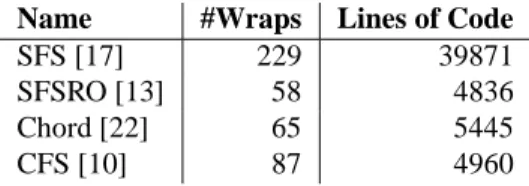
A number of applications are based on libasync; Fig-ure 2 lists some of them, along with the number of dis-tinct calls towrap()in each program. These numbers give a feel for the level of complexity in the programs’ use of callbacks.
Name #Wraps Lines of Code
SFS [17] 229 39871
SFSRO [13] 58 4836
Chord [22] 65 5445
CFS [10] 87 4960
Figure 2: Applications based on libasync, along with the approximate number of distinct calls towrap()in each application. The numbers are exclusive of the wraps cre-ated by libasync itself, which number about 30.
2.3
Interaction with multiprocessors
A single event-driven process derives no direct ben-efit from a multi-processor. There may be an indirect speedup if the operating system or helper processes can make use of the multiprocessor’s other CPUs.
It is common practice to run multiple independent copies of an event-driven program on a multiprocessor. This N-copy approach might work in the case of a web server, since the processing of different client requests can be made independent. The N-copy approach does not work if the program maintains mutable state that is shared among multiple clients or requests. For example, a user-level file server might maintain a table of leases for client cache consistency. In other cases, running multiple independent copies of a server may lead to a decrease in efficiency. A web proxy might maintain a cache of re-cently accessed pages: multiple copies of the proxy could maintain independent caches, but content duplicated in these caches would waste memory.
3
Multiprocessor Design
The focus of this paper is libasync-smp, a multipro-cessor extension of libasync. The goal of libasync-smp is to execute event-driven programs faster by running call-backs on multiple CPUs. Much of the design of
libasync-smp is motivated by the desire to make it easy to adapt
existing libasync-based servers to multiprocessors. The goal of the libasync-smp design is to allow both the par-allelism of the N-copy arrangement and the advantages of shared data structures.
A server based on libasync-smp consists of a single process containing one worker thread per available CPU. Each thread repeatedly chooses a callback from a set of runnable callbacks and runs it. The threads share an ad-dress space, file descriptors, and signals. The library as-sumes that the number of CPUs available to the process is static over its running time. A mechanism such as
sched-uler activations [2] could be used to dynamically deter-mine the number of available CPUs.
There are a number of design challenges to making the single address space approach work, the most inter-esting of which is coordination of access to application data shared by multiple callbacks. An effective concur-rency control mechanism should allow the programmer to easily (and incrementally) identify which parts of a server can safely be run in parallel.
3.1
Coordinating callbacks
The design of the concurrency control mechanisms in libasync-smp is motivated by two observations. First, system software often has natural coarse-grained paral-lelism, because different requests don’t interact or be-cause each request passes through a sequence of inde-pendent processing stages. Second, existing event-driven programs are already structured as non-blocking units of execution (callbacks), often associated with one stage of the processing for a particular client. Together, these ob-servations suggest that individual callbacks are an appro-priate unit of coordination of execution.
libasync-smp associates a color with each registered
callback, and ensures that no two callbacks with the same color execute in parallel. Colors are arbitrary 32-bit val-ues. Application code can optionally specify a color for each callback it creates; if it specifies no color, the call-back has color zero. Thus, by default, callcall-backs execute sequentially on a single CPU. This means that unmod-ified event-driven applications written for libasync will execute correctly with libasync-smp.
The orthogonality of color to the callback’s code eases the adaptation of existing libasync-based servers. A typi-cal arrangement is to run the code that accepts new client connections in the default color. If the processing for dif-ferent connections is largely independent, the program-mer assigns each new connection a new unique color that applies to all the callbacks involved in processing that connection. If a particular stage in request processing shares mutable data among requests (e.g. a cache of web pages), the programmer chooses a color for that stage and applies it to all callbacks that use the shared data, re-gardless of which connection the callback is associated with.
In some cases, application code may need to be re-structured to permit callbacks to be parallelized. For ex-ample, a single callback might use shared data but also have significant computation that does not use shared data. It may help to split such a callback; the first half would use a special libasync-smp call (cpucb()) to schedule the second half with a different color.
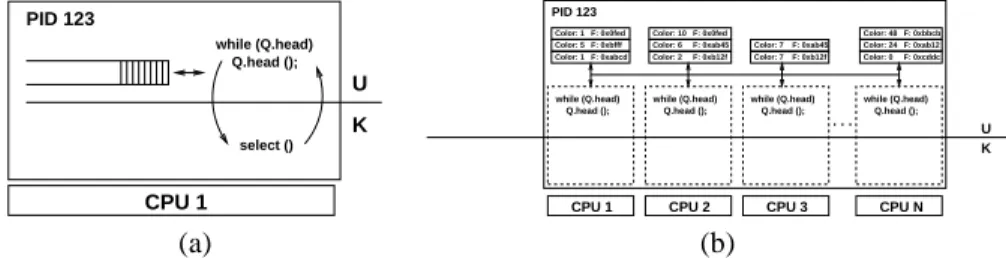
CPU 1 while (Q.head) Q.head (); U K select () PID 123 (a) Color: 7 F: 0xab45 Q.head (); while (Q.head) Q.head (); while (Q.head) Q.head (); while (Q.head) Q.head (); U K
CPU 1 CPU 2 CPU 3 CPU N
Color: 1 F: 0xabcd . . . PID 123 Color: 1 F: 0x0fed Color: 5 F: 0xbfff Color: 48 F: 0xbbcb Color: 24 F: 0xab12 Color: 0 F: 0xcddc Color: 10 F: 0x0fed Color: 6 F: 0xab45 Color: 2 F: 0xb12f Color: 7 F: 0xb12f while (Q.head) (b)
Figure 3: The single process event driven architecture (left) and the libasync-smp architecture (right). Note that in the
libasync-smp architecture callbacks of the same color appear in the same queue. This guarantees that callbacks with
the same color are never run in parallel and always run in the order in which they were scheduled.
The color mechanism is less expressive than locking; for example, a callback can have only one color, which is equivalent to holding a single lock for the complete duration of a callback. However, experience suggests that fine-grained and sophisticated locking, while it may be necessary for correctness with concurrent threads, is rarely necessary to achieve reasonable speedup on mul-tiple CPUs for server applications. Parallel speedup usu-ally comes from the parts of the code that don’t need much locking; coloring allows this speedup to be easily captured, and also makes it easy to port existing event-driven code to multiprocessors.
3.2
libasync-smp API
The API that libasync-smp presents differs slightly from that exposed by libasync. Thecwrap()function is analogous to thewrap()function described in Sec-tion 2 but takes an opSec-tional color argument; Table 1 shows thecwrap()interface. The color specified at the callback’s creation (i.e. when cwrap()is called) dic-tates the color it will be executed under. Embedding color information in the callback object rather than in an ar-gument tofdcb()(and other calls which register call-backs) allows the programmer to write modular functions which accept callbacks and remain agnostic to the color under which those callbacks will be executed. Note that colors are not inherited by new callbacks created inside a callback running under a non-zero color. While color inheritance might seem convenient, it makes it very diffi-cult to write modular code as colors “leak” into modules which assume that callbacks they create carry color zero. Since colors are arbitrary 32-bit values, programmers have considerable latitude in how to assign colors. One reasonable convention is to use each request’s file de-scriptor number as the color for its parallelizable call-backs. Another possibility is to use the address of a data structure to which access must be serialized; for exam-ple, a per-client or per-request state structure. Depend-ing on the convention, it could be the case that unrelated
modules accidentally choose the same color. This might reduce performance, but not correctness.
libasync-smp provides a cpucb() function that
schedules a callback for execution as soon as a CPU is idle. The cpucb()function can be used to register a callback with a color different from that of the currently executing callback. A common use of cpucb()is to split a CPU-intensive callback in two callbacks with dif-ferent colors, one to perform a computation and the other to synchronize with shared state. To minimize program-ming errors associated with splitting an existing callback into a chain ofcpucb()callbacks, libasync-smp guar-antees that all CPU callbacks of the same color will be executed in the order they were scheduled. This main-tains assumptions about sequential execution that the original single callback may have been relying on. Ex-ecution order isn’t defined for callbacks with different colors.
3.3
Example
Consider the web proxy example from Sec-tion 2. For illustrative purposes assume that the
parse request() routine uses a large amount of
CPU time and does not depend on any shared data. We could re-write req cb() to parse different requests in parallel on different CPUs by callingcpucb()and assigning the callback a unique color. Figure 4 shows this change to req cb(). In this example only the
parse request() workload is distributed across
CPUs. As a further optimization, reading requests could be parallelized by creating the read request callback using cwrap() and specifying the request’s file descriptor as the callback’s color.
3.4
Scheduling callbacks
Scheduling callbacks involves two operations: placing callbacks on a worker thread’s queue and, at each thread, deciding which callback to run next.
callback cwrap ((func *)(), arg1, arg2, ..., argN, color c = 0) // Create a callback object with colorc.
void cpucb (callback cb) // Addcbto the runnable callback queue immediately.
Table 1: Sample calls from the libasync-smp API. Queue
Head cpucb1 cpucb2
cpucb
Tail fdcb1 fdcb2 select
Queue Tail Figure 5: The callback queue structure in libasync-smp.cpucb()adds new callbacks to the left of the dummy element marked “cpucb Tail.” New I/O callbacks are added at “Queue Tail.” The scheduler looks for work starting at “Queue Head.”
// called when data arrives req_cb(int fd, str inBuf) {
read(fd, buf, ...); append input to inBuf; if(complete request in inBuf){
// un-register callback fdcb(fd, READ, NULL);
// parse the HTTP request under color fd cpucb (cwrap (parse_request_cb, fd, inBuf,
(color)fd)) } else {
// do nothing; wait for // more calls to req_cb() }
}
// below parsing done w/ color fd parse_req_cb (int fd, str inBuf) {
parse_request (inBuf, serverName, file); // start connection to server
tcpconnect (serverName, wrap(connect_cb, fd, file)); }
Figure 4: Changes to the asynchronous web proxy to take advantage of multiple CPUs
A callback is placed on a thread’s queue in one of two ways: due to a call to cpucb() or because the
libasync-smp main loop detected the arrival of an I/O,
timer, or signal event for which a callback had been reg-istered. A callbacks with colorcis placed in the queue
of worker threadcmodN whereN is the number of
worker threads. This simple rule distributes callbacks ap-proximately evenly among the worker threads. It also preserves the order of activation of callbacks with the same color and may improve cache locality.
If a worker thread’s task queue is empty it attempts to steal work from another thread’s queue [9]. Work must be stolen at the granularity of all callbacks of the same color and the color to be stolen must not be executing currently to preserve guarantees on ordering of callbacks within the same color. libasync-smp consults a per-thread field containing the currently running color to guarantee the latter requirement.
When a color is moved from one thread to another, fu-ture callbacks of that color will be assigned to the new queue; otherwise, callbacks of the same color might ex-ecute in parallel. To ensure that all callbacks with the
same color appear on the same queue, the library main-tains a mapping of colors to threads: the nth element of a 1024 element array indicates which thread should exe-cute all colors which are congruent ton (mod 1024).
This array is initialized in such a way as to give the initial distribution described above.
Each libasync-smp worker thread uses a simple sched-uler to choose a callback to execute next from its queue. The scheduler considers priority and callback/thread affinity when choosing colors; its design is loosely based on that of the Linux SMP kernel [8].
The scheduler favors callbacks of the same color as the last callback executed by the worker in order to increase performance. Callback colors often correspond to par-ticular requests, so libasync-smp tends to run callbacks from the same request on the same CPU. This processor-callback affinity leads to greater cache hit rates and im-proved performance.
When libasync-smp starts, it adds a “select callback” to the run queue of the worker thread responsible for color zero. This callback callsselect()to detect I/O events. The select callback enqueues callbacks in the appropriate queue based on which file descriptors
se-lect()indicates have become ready.
The select callback might block the worker thread that calls it if no file descriptors are ready; this would pre-vent one CPU from executing any other tasks in its work queue. To avoid this, the select callback usesselect()
to poll without blocking. Ifselect()returns some file descriptors, the select callback adds callbacks for those descriptors to the work queue, and then puts itself back on the queue. If no file descriptors were returned, a
block-ing select callback is placed back on the queue instead.
The blocking select callback is only run if it is the only callback on the queue, and callsselect()with a non-zero timeout. In all other aspects, it behaves just like the non-blocking select callback.
The use of the two select callbacks along with work stealing guarantees that a worker thread never blocks in
exe-cuted in the system.
Figure 5 shows the structure of a queue of runnable callbacks. In general, new runnable callbacks are added on the right, butcpucb()callbacks always appear to the left of I/O event callbacks. A worker thread’s uler considers callbacks starting at the left. The sched-uler examines the first few callbacks on the queue. If among these callbacks the scheduler finds a callback whose color is the same as the last callback executed on the worker thread, the scheduler runs that callback. Oth-erwise the scheduler runs the left-most eligible callback. The scheduler favorscpucb()callbacks in order to increase the performance of chains of cpucb() call-backs from the same client request. The state used by
a cpucb() callback is likely to be in cache because
the creator of thecpucb()callback executed recently. Thus, early execution ofcpucb()callbacks increases cache locality.
4
Implementation
libasync-smp is an extension of libasync, the
asyn-chronous library [16] distributed as part of the SFS file system [17]. The library runs on Linux, FreeBSD and Solaris. Applications written for libasync work without modification with libasync-smp.
The worker threads used by libasync-smp to execute callbacks are kernel threads created by a call to the
clone()system call (under Linux),rfork()(under
FreeBSD) orthr create()(under Solaris).
Although programs which use libasync-smp should not need to perform fine grained locking, the
libasync-smp implementation uses spin-locks internally to protect
its own data structures. The most important locks protect the callback run queues, the callback registration tables, retransmit timers in the RPC machinery, and the memory allocator.
The source code for libasync-smp is available as part of the SFS distribution at http://www.fs.neton the CVS branch mp-async.
5
Evaluation
In evaluating libasync-smp we are interested in both its performance and its usability. This section evaluates the parallel speedup achieved by two sample applica-tions using libasync-smp, and compares it to the speedup achieved by existing similar applications. We also evalu-ate usability in terms of the amount of programmer effort required to modify existing event-driven programs to get
good parallel speedup.
The two sample applications are the SFS file server and a caching web server. SFS is an ideal candidate for achieving parallel speedup using libasync-smp: it is writ-ten using libasync and performs compute inwrit-tensive cryp-tographic tasks. Additionally, the SFS server maintains state that can not be replicated among independent copies of the server. A web server is a less promising candidate: web servers do little computation and all state maintained by the server can be safely shared. Accordingly we ex-pect good SMP speedup from the SFS server and a mod-est improvement in performance from the web server.
All tests were performed on a SMP server equipped with four 500 MHz Pentium III Xeon processors. Each processor has 512KB of cache and the system has 512MB of main memory. The disk subsystem consists of a single ultra-wide 10,000 RPM SCSI disk. Load was generated by four fast PCs running Linux, each con-nected to the server via a dedicated full-duplex gigabit Ethernet link. Processor scaling results were obtained by completely disabling all but a certain number of proces-sors on the server.
The server runs a slightly modified version of Linux kernel 2.4.18. The modification removes a limit of 128 on the number of new TCP connections the kernel will queue awaiting an application’s call toaccept(). This limit would have prevented good server performance with large numbers of concurrent TCP clients.
5.1
HTTP server
To explore whether we can use libasync-smp to achieve multiprocessor speedup in applications where the majority of computation is not concentrated in a small portion of the code, we measured the performance of an event-driven HTTP 1.1 web server.
The web server uses an NFS loop-back server to per-form non-blocking disk I/O. The server process main-tains two caches in its memory: a web page cache and a file handle cache. The former holds the contents of re-cently served web pages while the latter caches the NFS file handles of recently accessed files. The page cache is split into a small number (10) of independent caches to allow simultaneous access [6]. Both of the file handle cache and the individual page caches must be protected from simultaneous access.
5.1.1 Parallelizing the HTTP server
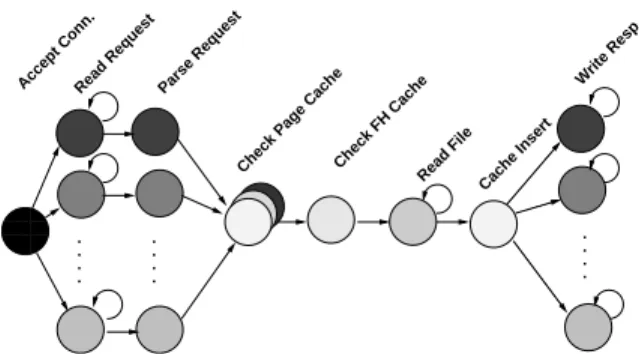
Figure 6 illustrates the concurrency present in the web server when it is serving concurrent requests for pages not in the cache. Each vertical set of circles represents a
single callback, and the arrows connect successive call-backs involved in processing a request. Callcall-backs that can execute in parallel for different requests are indicated by multiple circles. For instance, the callback that reads an HTTP request from the client can execute in paral-lel with any other callback. Other steps involve access to shared mutable data such as the page cache; callbacks must execute serially in these steps.
When the server accepts a new connection, it colors the callback that reads the connection’s request with its file descriptor number. The callback that writes the re-sponse back to the client is similarly colored. The shared caches are protected by coloring all operations that ac-cess a given cache the same color. Only one callback may access each cache simultaneously; however, two callbacks may access two distinct caches simultaneously (i.e. one request can read a page cache while another reads the file handle cache). The code that sends RPCs to the loop-back NFS server to read files is also serialized using a single color. This was necessary since the un-derlying RPC machinery maintains state about pending RPCs which could not safely be shared. The state main-tained by the RPC layer is a candidate for protection via internal mutexes; if this state were protected within the library the “read file” step could be parallelized in the web server.
While this coloring allows the caches and RPC layer to operate safely, it reveals a limitation of coloring as a concurrency control mechanism. Ideally, we should al-low any number of callbacks to read the cache, but limit the number of callbacks accessing the cache to one if the cache is being written. This read/write notion is not ex-pressible with the current locking primitives offered by
libasync-smp although they could be extended to include
it [4]. We did not implement read/write colors since di-viding the page cache into smaller, independent caches provided much of the benefit of read/write locks without requiring modifications to the library.
The server also delegates computation to additional CPUs using calls tocpucb(). When parsing a request the server looks up the longest match for the pathname in the file handle cache (which is implemented as a hash table). To move the computation of the hash function out of the cache color, we use acpucb()callback to first hash each prefix of the path name, and then, in a callback running as the cache color, search for each hash value in the file handle cache.
In all, 23 callbacks were modified to include a color argument or to be invoked via acpucb()(or both). The web server has 1,260 lines of code in total, and 39 calls to wrap.
Read Request Parse Request
. . . .
Accept Conn.
. . . .
Check Page CacheCheck FH CacheRead File
. . . .
Cache Insert Write Resp.
Figure 6: The sequence of callbacks executed when the
libasync-smp web server handles a request for a page not
in the cache. Nodes represent callbacks, arrows indicate that the node at the source scheduled the callback repre-sented by the node at the tip. Nodes on the same vertical line are run under distinct colors (and thus potentially in parallel). The stacked circles in the “Check page cache” stage indicate that a small number of threads (less than the number of concurrent requests) can access the cache simultaneously). Labels at the top of the figure describe each step of the processing.
5.1.2 HTTP server performance
To demonstrate that the web server can take advantage of multiprocessor hardware, we tested the performance of the parallelized web server on a cache-based work-load while varying the number of CPUs available to the server. The workload consisted of 720 files whose sizes were distributed according to the SPECweb99 bench-mark [20]; the total size of the data set was 100MB which fits completely into the server’s in-memory page cache. Four machines simulated a total of 800 concurrent clients. A single instance of the load generation client is capable of reading over 20MB/s from the web server. Each client made 10 requests over a persistent connec-tion before closing the connecconnec-tion and opening a new one. The servers were started with cold caches and run for 4 minutes under load. The server’s throughput was then measured for 60 seconds, to capture its behavior in the steady state.
Figure 7 shows the performance (in terms of total throughput) with different numbers of CPUs for the
libasync-smp web server. Even though the HTTP server
has no particularly processor-intensive operations, we can still observe noticeable speedup on a multiprocessor system: the server’s throughput is 1.28 times greater on two CPUs than it is on one and 1.5 times greater on four CPUs.
To provide an upper bound for the multiprocessor speedup we can expect from the libasync-smp-based web server we contrast its performance with N
inde-0 1 2 3 4 Number of CPUs 0 20 40 60 Throughput (MBytes/s) libasync-smp N-Copy
Figure 7: The performance of the libasync-smp web server serving a cached workload and running on dif-ferent number of CPUs relative to the performance on one CPU (light bars). The performance of N copies of a libasync web server is also shown relative the perfor-mance of the the libasync server’s perforperfor-mance on one CPU (dark bars)
pendent copies of a single process version of the web server (where N is the number of CPUs provided to the
libasync-smp-based server). This single process version
is based on an unmodified version of libasync and thus does not suffer the overhead associated with the
libasync-smp library (callback queue locking, etc). Each copy of
the N-copy server listens for client connections on a dif-ferent TCP port number.
The speedup obtained by the libasync-smp server is well below the speedup obtained by N copies of the
libasync server. Even on a single CPU, the libasync based
server achieved higher throughput than the libasync-smp server. The throughput of the libasync server was 35.4 MB/s while the libasync-smp server’s throughput was 30.4 MB/s.
Profiling the single CPU case explains the base penalty that smp incurs. While running the
libasync-smp web server under load, roughly 35% of the CPU
time is spent in user-level including libasync-smp and the web server. Of that time, at least 37% is spent per-forming tasks needed only by libasync-smp. Atomic ref-erence counting uses 26% of user-level CPU time, and task accounting such as enqueuing and dequeuing tasks takes another 11%. The overall CPU time used for atomic reference counting and task management is 13%, which explains the libasync-smp web server’s decreased single CPU performance.
The reduced performance of the libasync-smp server is partly due to the fact that many of the libasync-smp server’s operations must be serialized, such as accepting
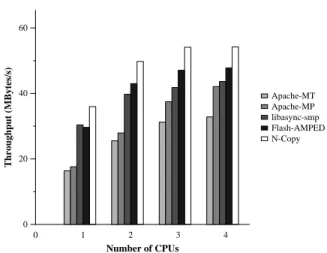
0 1 2 3 4 Number of CPUs 0 20 40 60 Throughput (MBytes/s) Apache-MT Apache-MP libasync-smp Flash-AMPED N-Copy
Figure 8: The performance of several web servers on multiprocessor hardware. Shown are the throughput of the libasync-smp based server (light bars), Apache 2.0.36 (dark bars), and Flash (black bars) on 1,2,3 and 4 proces-sors.
connections and checking caches. In the N-copy case, all of these operations run in parallel. In addition, locking overhead penalizes the libasync-smp server: some data is necessarily shared across threads and must be protected by expensive atomic operations although the server has been written in such a way as to minimize such sharing.
Because the N-copy server can perform all of these operations in parallel and, in addition, extract additional parallelism from the operating system which locks some structures on a per-process basis, the performance of the N-copy server represents a true upper bound for any ar-chitecture which operates in a single address space.
To provide a more realistic performance goal than the N-copy server, we compared the libasync-smp server with two commonly used HTTP servers. Figure 8 shows the performance of Apache 2.0.36 (in both multithreaded and multiprocess mode) and Flash v0.1 990914 on dif-ferent numbers of processors. Apache in multiprocess mode was configured to run with 32 servers. Apache-MT is a multithreaded version of the Apache server. It cre-ates a single heavyweight process and 32 kernel threads within that process by calling clone. The number of processes and threads used by the Apache servers were chosen to maximize throughput for the benchmarks pre-sented here. Flash is an event-driven server; when run on multiprocessors it forks to create N independent copies, where N is the number of available CPUs
The performance of the libasync-smp HTTP server is comparable to the performance of these servers: the
libasync-smp server shows better absolute performance
than both versions of the Apache server and slightly lower performance than N-copies of the Flash server.
200 400 600 800 1000
Number of concurrent clients
10 20 30 40 50 Throughput (MBytes/s)
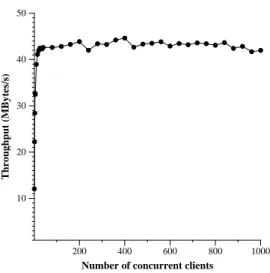
Figure 9: The performance of the web server on a cached workload as the number of concurrent clients is varied.
These servers show better speedup than the
libasync-smp server: Flash achieves 1.68 speedup on four CPUs
while the libasync-smp server is 1.5 times faster on four CPUs. Because Flash runs four heavyweight processes, it is able to take advantage of many of the benefits of the N-copy approach: as a result its speedup and absolute per-formance are greater than that of the libasync-smp server. Although this approach is workable for a web server, in applications that must coordinate shared state such repli-cation would be impossible.
Like the libasync-smp server, Flash and multiprocess Apache do not show the same performance achieved by the N-copy server. Although these servers fully paral-lelize access to their caches and do not perform lock-ing internally, they do exhibit some shared state. For instance, the servers must serialize access to the
ac-cept()system call since all requests arrive on a single
TCP port.
The main reason to parallelize a web server is to in-crease its performance under heavy load. A key part of the ability to handle heavy load is stability: non-decreasing performance as the load increases past the server’s point of peak performance. To explore whether servers based on libasync-smp can provide stable perfor-mance, we measured the web server’s throughput with varying numbers of simultaneous clients. Each client se-lects a file according to the SPECweb99 distribution; the files all fit in the server’s cache. The server uses all four CPUs. Figure 9 shows the results. The event-driven HTTP server offers consistent performance over a wide variety of loads.
5.2
SFS server
To evaluate the performance of libasync-smp on ex-isting libasync programs, we modified the SFS file server [17] to take advantage of a multiprocessor system. The SFS server is a single user-level process. Clients communicate with it over persistent TCP connections. All communication is encrypted using a symmetric stream cipher, and authenticated with a keyed crypto-graphic hash. Clients send requests using an NFS-like protocol. The server process maintains significant muta-ble per-file-system state, such as lease records for client cache consistency. The server performs non-blocking disk I/O by sending NFS requests to the local kernel NFS server. Because of the encryption, the SFS server is compute-bound under some heavy workloads and there-fore we expect that by using libasync-smp we can extract significant multiprocessor speedup.
5.2.1 Parallelizing the SFS server
We used thepct[5] statistical profiler to locate perfor-mance bottlenecks in the original SFS file server code. Encryption appeared to be an obvious target, using 75% of CPU time. We modified the server so that encryption operations for different clients executed in parallel and independently of the rest of the code. The resulting paral-lel SFS server spent about 65% of its time in encryption. The reduction from 75% is due to the time spent coor-dinating access to shared mutable data structures inside
libasync-smp, as well as to additional memory-copy
op-erations that allow for parallel execution of encryption. The modifications to the SFS server are concentrated in the code that encrypts, decrypts, and authenticates data sent to and received from the clients. We split the main send callback-function into three smaller callbacks. The first and last remain synchronized with the rest of the server code (i.e. have the default color), and copy data to be transmitted into and out of a per-client buffer. The second callback encrypts the data in the client buffer, and runs in parallel with other callbacks (i.e., has a different color for each client). This involved modifying about 40 lines of code in a single callback, largely having to do with variable name changes and data copying.
Parallelization of the SFS server’s receive code was slightly more complex because more code interacts with it. About 50 lines of code from four different callbacks were modified, splitting each callback into two. The first of these two callbacks received and decrypted data in parallel with other callbacks (i.e., with a different color for every client), and usedcpucb()to execute the sec-ond callback. The secsec-ond callback remained synchro-nized with the rest of the server code (i.e., had the
de-0 1 2 3 4 Number of CPUs 0 5 10 15 Throughput (MBytes/s) Libasync-smp N-Copy
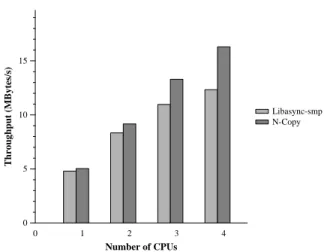
Figure 10: Performance of the SFS file server using dif-ferent numbers of CPUs, relative to the performance on one CPU. The light bars indicate the performance of the server using libasync-smp; dark bars indicate the perfor-mance ofnseparate copies of the original server. Each
bar represents the average of three runs; the variation from run to run was not significant.
fault color), and performed the actual processing of the decrypted data.
5.2.2 Performance improvements
We measured the total throughput of the file server to all clients, in bits per second, when multiple clients read a 200 MByte file whose contents remained in the server’s disk buffer cache. We repeated this experiment for dif-ferent numbers of processors. This test reflects how SFS is used in practice: an SFS client machine sends all of its requests over a single TCP connection to the server.
The bars labeled “libasync-smp” in Figure 10 show the performance of the parallelized SFS server on the throughput test. On a single CPU, the parallelized server achieves 96 percent of the throughput of the original uniprocessor server. The parallelized server is 1.66, 2.20, and 2.5 times as fast as the original uniprocessor server on two, three and four CPUs, respectively.
Because only 65% of the cycles (just encryption) have been parallelized, the remaining 35% creates a bottle-neck. In particular, when the remaining 35% of the code runs continuously on one processor, we can achieve a maximum utilization of 1
0
.35
= 2.85 processors. This
number is close to the maximum speedup (2.5) of the par-allelized server. Further parallelization of the SFS server code would allow it to incrementally take advantage of more processors.
To explore the performance limits imposed by the
hardware and operating system, we also measured the total performance of multiple independent copies of the original libasync SFS server code, as many separate pro-cesses as CPUs. In practice, such a configuration would not work unless each server were serving a distinct file system. An SFS server maintains mutable per-file-system state, such as attribute leases, that would require shared memory and synchronization among the server processes. This test thus gives an upper bound on the per-formance that SFS with libasync-smp could achieve.
The results of this test are labeled “N-copy” in Fig-ure 10. The SFS server with libasync-smp roughly fol-lows the aggregate performance of multiple independent server copies. The performance difference between the
libasync-smp-based SFS server and the N-copy server is
due to the penalty incurred due to shared state maintained by the server, such as file lease data and user ID mapping tables.
Despite comparatively modest changes to the SFS server to expose parallelism, the server’s parallel per-formance was close to the maximum speedup offered by the underlying operating system (as measured by the speedup obtained by multiple copies of the server).
5.3
Library Optimizations
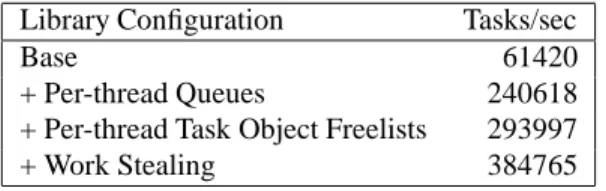
Table 2 shows how much the use of per-thread work queues improves performance. The numbers in the ta-ble indicate how fast a synthetic benchmark executes tasks. The benchmark program creates 16 callbacks with unique colors. Each callback performs a small amount of computation, and then registers a child callback of the same color. The benchmark intentionally assigns colors so that all but one of the task queues are populated, in order to explore the effects of work stealing. The bench-mark was run with four CPUs.
The first line shows the task rate with a single task queue shared among all the worker threads. The entry shows the task completion rate when using per-thread task queues. The increase in task completion rate is dra-matically higher due to better cache locality, and because there is no contention for the task-queue locks. The third line shows the task completion rate when per-thread task free-lists are used in addition to per-thread queues. The fourth configuration adds work stealing between worker threads. Without work stealing, tasks were never run on one of the four CPUs. Work stealing allows the worker thread on that CPU to find work, at the expense of in-creased contention for the other threads’ task queues.
Library Configuration Tasks/sec
Base 61420
+ Per-thread Queues 240618
+ Per-thread Task Object Freelists 293997
+ Work Stealing 384765
Table 2: A synthetic benchmark shows improved task processing rates as thread affinity optimizations are added.
6
Related Work
There is a large body of work exploring the relative merits of thread-based I/O concurrency and the event-driven architecture [18, 11, 12, 15, 1]. This paper does not attempt to argue that either is superior. Instead, we present a technique which improves the performance of the event-driven model on multiprocessors. The work described below also considers performance of event-driven software.
Pai et al. characterized approaches to achieving concurrency in network servers in [19]. They eval-uate a number of architectures: process, multi-threaded, single-process event-driven, and asymmetric multi-process event-driven (AMPED). In this taxonomy,
libasync-smp could be characterized as symmetric
multi-threaded event-driven; its main difference from AMPED is that its goal is to increase CPU concurrency rather than I/O concurrency.
Like libasync-smp, the AMPED architecture intro-duces limited concurrency into an event driven sys-tem. Under the AMPED architecture, a small number of helper processes are used to handle file I/O to over-come the lack of non-blocking support for file I/O in most operating systems. In contrast, libasync-smp uses additional execution contexts to execute callbacks in par-allel. libasync-smp achieves greater CPU concurrency on multiprocessors when compared to the AMPED archi-tecture but places greater demands on the programmer to control concurrency. Like the AMPED-based Flash web server, libasync-smp must also cope with the is-sue of non-blocking file I/O: libasync-smp uses an NFS-loopback server to access files asynchronously. This al-lows libasync-smp to use non-blocking local RPC re-quests rather than blocking system calls.
The Apache web server serves concurrent requests with a pool of independent processes, one per active re-quest [3]. This approach provides both I/O and CPU con-currency. Apache processes cannot easily share mutable state such as a page cache.
The staged, event-driven architecture (SEDA) is a structuring technique for high-performance servers [24].
It divides request processing into a series of well-defined stages, connected by queues of requests. Within each stage, one or more threads dequeue requests from input queue(s), perform that stage’s processing, and enqueue the requests for subsequent stages. A thread can block (to wait for disk I/O, for example), so a stage often contains multiple threads in order to achieve I/O concurrency.
SEDA can take advantage of multiprocessors, since a SEDA server may contain many concurrent threads. One of SEDA’s primary goals is to dynamically manage the number of threads in each stage in order to achieve good I/O and CPU concurrency but avoid unstable be-havior under overload. Both libasync-smp and SEDA use a mixture of events and concurrent threads; from a programmer’s perspective, SEDA exposes more thread-based concurrency which the programmer may need to synchronize, while libasync-smp tries to preserve the se-rial callback execution model.
Cohort scheduling organizes threaded computation into stages in order to increase performance by increas-ing cache locality, reducincreas-ing TLB pressure, and reducincreas-ing branch mispredicts [14]. The staged computation model used by cohort scheduling is more general than the col-ored callback model presented here. However, the parti-tioned stage scheduling policy is somewhat analagous to coloring callbacks for parallel execution (the key corre-sponds to a callback color). Like SEDA, cohort schedul-ing exposes more thread-based concurrency to the pro-grammer. Cohort scheduling can also take advantage of multiprocessor hardware.
7
Conclusion
This paper describes a library that allows event-driven programs to take advantage of multiprocessors with a minimum of programming effort. When high loads make multiple events available for processing, the library can execute event handler callbacks on multiple CPUs. To control the concurrency between events, the program-mer can specify a color for each event: events with the same color (the default case) are handled serially; events with different colors can be handled in parallel. The pro-grammer can incrementally expose parallelism in exist-ing event-driven applications by assignexist-ing different col-ors to computationally-intensive events that don’t share mutable state.
Experience with libasync-smp demonstrates that ap-plications can achieve multi-processor speedup with lit-tle programming effort. Parallelizing the cryptography in the SFS file server required about 90 lines of changed code in two modules, out of a total of about 12,000 lines. Multiple clients were able to read large cached files from
the libasync-smp SFS server running on a 4-CPU ma-chine 2.5 times as fast as from an unmodified uniproces-sor SFS server on one CPU. Applications without com-putationally intensive tasks also benefit: an event-driven Web server achieves 1.5 speedup on four CPUs with mul-tiple clients reading small cached files relative to its per-formance on one CPU.
Acknowledgments
We are grateful to the many people who aided this work. The NMS group at LCS provided (on short no-tice) the SMP server used to test an early version of this software. The anonymous reviewers and our shepherd, Edouard Bugnion, provided helpful feedback.
This research was sponsored by the Defense Advanced Research Projects Agency (DARPA) and the Space and Naval Warfare Systems Center, San Diego, under con-tract N66001-00-1-8927.
References
[1] ADYA, A., HOWELL, J., THEIMER, M., BOLOSKY, W.,
ANDDOUCEUR, J. Cooperative task management with-out manual stack management or, event-driven program-ming is not the opposite of threaded programprogram-ming. In Proc. Usenix Technical Conference (June 2002). [2] ANDERSON, T., BERSHAD, B., LAZOSWKA, E.,AND
LEVY, H. Scheduler activations: Effective kernel support for the user-level management of threads. ACM Transac-tions on Computer Systems 10, 1 (Feb. 1992), 53–79. [3] The Apache web server. http://www.apache.org/, 2002. [4] BIRRELL, A. An introduction to programming with
threads. Tech. Rep. 35, Digital Systems Research Cen-ter, Jan. 1989.
[5] BLAKE, C.,ANDBAUER, S. Simple and general statis-tical profiling with PCT. In Proc. Usenix Technical Con-ference (June 2002).
[6] BLASGEN, M., GRAY, J., MITOMA, M.,ANDPRICE, T. The convoy phenomenon. Operating Systems Review 13, 2 (Apr. 1979), 20–25.
[7] BLOOM, J.,ANDDUNLAP, K. Experiences implement-ing BIND, a distributed name server for the DARPA Inter-net. In Proc. Summer Usenix Conference (1986), pp. 172– 181.
[8] BOVET, D.,ANDCESATI, M. Understanding the Linux Kernel. O’Reilly, 2001.
[9] BURTON, F., AND SLEEP, M. Executing functional programs on a virtual tree of processsors. In Proceed-ings of the 1981 Conference on Functional Programming Languages and Computer Architecture (Portsmouth, New Hampshire, Oct. 1981).
[10] DABEK, F., KAASHOEK, F., KARGER, D., MORRIS, R.,
AND STOICA, I. Wide-area cooperative storage with CFS. In Proc. ACM Symposium on Operating Systems Principles (SOSP) (Banff, Canada, Oct. 2001), pp. 202– 215.
[11] DRAVES, R., BERSHAD, B., RASHID, R.,ANDDEAN, R. Using continuations to implement thread management and communication in operating systems. In Proc. ACM Symposium on Operating Systems Principles (SOSP) (Oct. 1991), pp. 122–136.
[12] FORD, B., HIBLER, M., LEPREAU, J., MCGRATH, R.,
ANDTULLMANN, P. Interface and execution models in the Fluke kernel. In Proc. USENIX Symposium on Oper-ating Systems Design and Implementation (OSDI) (Feb. 1999), pp. 101–115.
[13] FU, K., KAASHOEK, M. F.,ANDMAZIERES` , D. Fast and secure distributed read-only file system. In Proc. USENIX Symposium on Operating Systems Design and Implementation (OSDI) (Oct. 2000), pp. 181–196. [14] LARUS, J.,ANDPARKES, M. Using cohort scheduling
to enhance server performance. In Proc. Usenix Technical Conference (June 2002).
[15] LAUER, H.,ANDNEEDHAM, R. On the duality of oper-ating system structures. In Proc. Second International Symposium on Operating Systems, IRIA (Oct. 1978). Reprinted in Operating Systems Review, Vol. 12, Num-ber 2, April 1979.
[16] MAZIERES` , D. A toolkit for user-level file systems. In Proc. Usenix Technical Conference (June 2001), pp. 261– 274.
[17] MAZIERES` , D., KAMINSKY, M., KAASHOEK, M. F.,
ANDWITCHEL, E. Separating key management from file system security. In Proc. ACM Symposium on Oper-ating Systems Principles (SOSP) (Kiawah Island, South Carolina, Dec. 1999).
[18] OUSTERHOUT, J. Why threads are a bad idea (for most purposes). Invited talk at the 1996 USENIX technical conference, 1996.
[19] PAI, V., DRUSCHEL, P.,ANDZWAENEPOEL, W. Flash: An efficient and portable web server. In Proc. Usenix Technical Conference (June 1999).
[20] SPECweb99 design white paper.
http://www.specbench.org/osg/web99/docs/whitepaper.html, 2002.
[21] STEELE, G.,ANDSUSSMAN, G. Lambda: The ultimate imperative. Tech. Rep. AI Lab Memo AIM-353, MIT AI Lab, Mar. 1976.
[22] STOICA, I., MORRIS, R., KARGER, D., KAASHOEK, M. F., AND BALAKRISHNAN, H. Chord: A scalable peer-to-peer lookup service for Internet applications. In Proceedings of the ACM SIGCOMM ’01 Conference (San Diego, Aug. 2001).
[23] THOMPSON, S. Haskell, The Craft of Functional Pro-gramming. Addison Wesley, 1996.
[24] WELSH, M., CULLER, D.,ANDBREWER, E. SEDA: An architecture for well-conditioned, scalable Internet ser-vices. In Proc. ACM Symposium on Operating Systems Principles (SOSP) (Oct. 2001), pp. 230–243.