Hungarian Association of Agricultural Informatics
European Federation for Information Technology in Agriculture, Food and the Environment
Journal of Agricultural Informatics. 2015 Vol. 6, No. 3 journal.magisz.org
Wood trade perspectives in Greece during economic crisis and new technologies
challenge
Ioakeim Tzoulis1, Zaharoula Andreopoulou2, Marios Trigkas3, George Tsekouropoulos4, Elias Voulgaridis5
I N F O
Received 24 Aug 2015 Accepted 30 Sept 2015 Available on-line 12 Oct 2015 Responsible Editor: M. Herdon
Keywords: wood trade, supply chain, technologies, economic crisis, wood products
A B S T R A C T
In wood trade sector, the supplier is the forest and the product is round wood. The quality, the quantity and value of wood depend heavily on the practices that are applied in the early stages of the supply chain. The aim of the paper is to present the perspectives of wood trade in Greece and also to study how the economic crisis has affected the forest production and trade (imports and exports). Finally, we will discuss the challenge of using new information technologies, such as databases, digital timber traceability systems, sustainable timber and wood products, in collaboration with the traditional methods employed in wood trade sector contemporarily.
1. Introduction
Forest as a natural and renewable asset has offered and still offers important and vital services to humans. Environmental and material profit can be produced from forest. Wood is the initial product for thousands of secondary products, many of which are basic necessities (eg. paper, wood furniture, matches, etc.) (Voulgaridis, 1996). Forests occupy 1/3 of the land surface (FAO, 2000) and play an important role at several levels. From an economic perspective, the forestry sector is an important source of income, as timber is used in a variety of construction, household and industrial operations. Furthermore, from the perspective of the environment, it is crucial for the preservation of the biodiversity and combating climate change, not only for carbon sequestration but also due to the production of biomass and the possibilities they offer in terms of renewable forms of energy. Today, forests contribute 14% of the global energy supply and have the ability to reach up to 50% in energy requirements worldwide during this century (Hall, 2002). About 55% of the amount of wood used worldwide (CRES, 2010) (which reaches 4 billion m3), is used as a wood or charcoal for daily energy requirements that concerns heating and cooking in developing countries. In our country, until the
1 Ioakeim Tzouli
Aristotle University of Thessaloniki, Department of Forestry and Natural Environment Thessaloniki, 54124, PO Box 247
[email protected] 2 Zaharoula Andreopoulou
Aristotle University of Thessaloniki, Department of Forestry and Natural Environment Thessaloniki, 54124, PO Box 247
[email protected] 3 Marios Trigkas
Aristotle University of Thessaloniki, Department of Forestry and Natural Environment Thessaloniki, 54124, PO Box 247
[email protected] 4 George Tsekouropoulos
Ph.D. Agri-business marketing, Alexander Technological Educational Institution of Thessaloniki [email protected]
5 Elias Voulgaridis
Aristotle University of Thessaloniki, Department of Forestry and Natural Environment Thessaloniki, 54124, PO Box 247
1950s, 15% of energy was coming from the forest (Kompelitou & Koskina, 2004), in the form of firewood and charcoal. Since the early ‘60s, however, the Greek households have turned to other sources of energy and thus the consumption of forest biomass for energy purposes, continuously decreases till now, with economic crisis, the data have been diverted. In forest exploitation sector plenty has been achieved up to now because of forest research developments in management of forests. The basic principle of forest management is the sustainability in production and profit. This principle ensures the continuous supply of forest products and services and simultaneously the preservation and improvement of forests. The essence of forest ecosystems governance is its focus on governing and has been reformed in order to achieve transparency, efficiency, and accountability and to end with sustainable economic development in forest areas. The effort to maintain and promote the multiple functions of forests derives from the fact that forests play a multiple role in the field of the environment, thanks to the multiple functions that characterizes it, and their ability to contribute decisively to maintaining nature and overall ecological balance. Within environmental governance, new technologies have a great impact while the Internet provides a new prospective with the provision of quality services within the social, financial and cultural forest regional development (Andreopoulou et al., 2012). The rapid development and spread of modern information and communication technology (ICT) allows access and practice information and methods vital to environmental research and development. Major emphasis is given to the analysis of the entire production systems to support the need to design agro-eco-systems that increasingly have to fulfill multiple objectives. Environmental governance can be implemented through ICT focusing on informing, directing, managing and monitoring environmental activities toward the achievement of sustainable forestry (Andreopoulou et al., 2011). Environmental governance can be enhanced through IT applications and techniques, ICT and e-services adoption, web-based environmental database, GIS employ and supply chain management. The ability to access huge amounts of data, effortlessly and quickly, is the incentive for better communication, scientific growth and technology development, thus, the adoption of ICT combined with organizational and structural change aiming to improve sustainable development (Tzoulis et al., 2013).
In recent years, new and innovative digital solutions and technologies play an important role within strategic planning and decision support in wood trade sector. The study and analysis of the current situation of trade in wood products in the European Union is an important tool in decision-making by the industries of wood. The information on the supply and demand of various wood products and the forecast for the future is sufficient by itself to reduce the risk of business (Tzoulis et al., 2014a). The ability to perform and track the whole follow-up of products in industries has been possible with the implementation of information systems, of automatic identification, which are capable to create a link between the product, the database of the product and of process. Traceability information systems consist of processes to maintain records that expose the trace of a particular input from suppliers to customers. Wood traceability information systems make sure that wood derives from sustainable sources and supply a successful technique to fight illegal logging. These Information systems cover data on the source and movement of wood throughout harvesting area until its final destination. It is important to achieve detailed tracking of the log production and movement of timber and wood products aiming to guarantee the legality of the product (Tzoulis et al., 2014).
The purpose of this paper is to study the perspectives of wood trade in Greece, to discuss the impact of economic crisis and to finally identify the new technologies used as a tool for improved wood trade.
2. Methodology
findings were also used. An overall assessment of wood production and trade in terms of positive and negative factors is attempted. Two main categories of data concerning wood deriving from the forest, construction timber and fragmentation wood, are presented and the annual use of wood and wood products in Greece. We will also describe the amount of wood production from public and non-public forests in tables and diagrams. Further, we will discuss how the economic crisis impacts either the forest ecosystem or the wood trade sector in terms of products, imports and exports. We will further discuss the impact on the wood trade quoting the consequences.
Additionally, the use of new technologies as a means for the improvement of forest certification and the enhancement of wood trade sector will be quoted. We will present new IT solutions and methodologies used in wood trade sector as a major tool in enhancing quality with certification. Various traceability systems are collected and studied in order to add flexibility and immediate feedback on the wood market, always in collaboration with the traditional methods used in wood trade.
3. Results
Wood is the raw material of various primary industrial processing products (sawn timber, plywood, etc.), which are materials for production of other secondary processing products (eg. furniture, paper). Both the primary and secondary wood products can be produced by mechanical or chemical treatment (Voulgaridis, 1996a). For the main forest products we distinguish three phases or development stages, which are: Primary use: it begins immediately after the pre-labelling to the logging trees and ends with the production of raw feedstock products in the cutting area, the forest road or in the yard of the factory, the Forest Harvesting. Secondary use: it contains the use of raw forest products, such as heating with firewood and the production of semi-finished products, eg. sawn timber, sleepers, piles, veneer etc. Tertiary use: includes full refining and use of forest products in perfected form in their final use, such as parquet, wood paneling, furniture, paper, packaging, wood etc. The wood products are divided into two categories, sawn wood (primary and secondary) and industrial wood (plywood - plywood, chipboard, MDF etc.). The production of quality wood starts in the forest. There the timber is cleaned, collected and forwarded to sawmill. There, the trees are cut or placed together. Then ventilation and drying follows, which can be achieved naturally (lasting up to 4 years), or artificially with a drying period of 7 to 10 days. Almost nothing is left unused by a log tree. The top of the tree is usually converted into firewood, while below the top part of the trunk has many branches and is used for production of cellulose and plywood. The next lower section is cut only on simple, square cuts. The middle and lower parts are those that can be cut into planks, cords and slats, which are those that give the materials to carpenters, professionals and amateurs.
Forests provide many benefits to society and the economy and play an important role in preserving biodiversity and mitigating the climate change, they also covering 177 million hectares (42% of the land area) of the 27 EU Member States. Public sector holds 41% while private and other are holding 59%. In Greece covers about 20% of its surface. The Greek forests and woodlands are characterized by high ecological value and biodiversity. Of the total forest, 22% are conifers (pine, spruce, etc.), 30% broad-leaved deciduous forests-primarily oak and the remaining 48% are non-industrial forests. The wood-stock that forests are giving is: coniferous: 54 m3 / ha, deciduous broadleaf: 27,8 m3 / ha, total forest ecosystem: 21,2 m3 / ha. From the total timber produced quantity that serves as firewood is 70 % of the timber, while in Europe the same category is 7-10%. The remaining 30% of the wood harvested, is used as construction wood and industrial wood.
non-industrial (non-productive wood) forests composed mainly of evergreen broadleaved (Ministry of Agriculture, 1992). Two main categories of wood is initially produced into the Greek forest: a. Industrial timber includes: (1) The construction timber, which is called round wood and technical wood and (2) fragmentation wood (or industrial), which is used after the conversion into particles by crushing for particleboards, fiber and paper. (3). Firewood that is pieces, round or slit, and are destinated for household needs. From the total country's public forests 2.707 million cubic meters timber are produced annually (786,000 cubic meters of industrial timber and 1.921 million cubic meters firewood, ratio 29: 71). Those quantities estimated to be added another 400,000 cubic meters Industrial timber and 650,000 cubic meters firewood from private forests and plantations, community, monasteries and other non-public forests (Voulgaridis, 1996a).
Overall, the annual consumption of wood and wood products in Greece is approximately 3,100,000 cubic meters equivalent round wood (not including amounts of produced firewood). The part thus of the domestic production from industrial timber is only 30-35% of the country's needs (Voulgaridis, 1996). Other species that produce small quantities of wood are: cypress, birch, plane tree, maple, walnut, helm oak and other broad-leaved evergreen, etc. Natural forests of our country although they are growing satisfactorily in mountainous and hilly areas, remain in poor condition in terms of quality of the growing stock and the ability to produce technical wood. In the last decade the problems are increasing related to the availability of these small amounts of the produced timber art. This is due to small and fragmented throughout the mountainous Greece production volumes, the unstable and often poor quality of the product, the constantly growing production costs, and the lack of industries producing finished products and powerful competition that exists on imported products. The result is either the distribution of the technical timber be done by loggers directly to small scale local crafts, and utilized in low value added products, whether it remains unsold and is offered at prices below production costs or compromising on firewood. The evolution of the technical production of wood from the Greek forests is obvious that during the last thirty years has a drop in its production of 60%. Moreover, while imports in the early 80s covered only marginally the production, in the early 90s accounted for more than twice, and arrived in the early 00s to more than five times. Similar was the trend in terms of production of firewood (Data source: Forest Services Report, 2009). In the case of firewood we observe that since the late 90s outstanding import firewood is found, approximately 200.000 m3 / year on average. The main producer of forest products, and therefore firewood in our country is the Forest Service, which was expected considering that forests owned by approximately 64% in the Greek public sector, and 36% to individuals. It should be pointed out the extremely low firewood production from conifers. Additional negative factor is the technical inadequacy of the tree for a particular use, and extremely low offer prices from the fragmentation products of timber utilization industries. Furthermore it should be accepted that there are quantities over 200.000 m3 (approx. 20% of total production), trafficked illegally and are therefore not included in official estimates. So overall production is up to 1.200.000 m3.
Their exploitation is made by their owners in accordance with the management studies, with their care, and approved by the local forest services. Regarding forest products produced therein, other than wood, they include Christmas trees, ornamental plants and herbs. Non-public forests constitute 36% of the Greek forests. In terms of composition and capacity these forests are not lacking at all against those from public, on the contrary too many outweigh.
Table 1.
Total forest area per category, MPREE, (2011)
Α. CONIFERS AREA (acres) %
Fir-spruce 3.297.620 13,1
Aleppo-pine 4.757.770 18,9
Black pine 1.370.470 5,5
Other 237.870 0,9
Β. BROADLEAF AREA (acres) %
Oak 7.475.490 29,8
Beech 2.190.700 8,7
Other 1.017.650 4,1
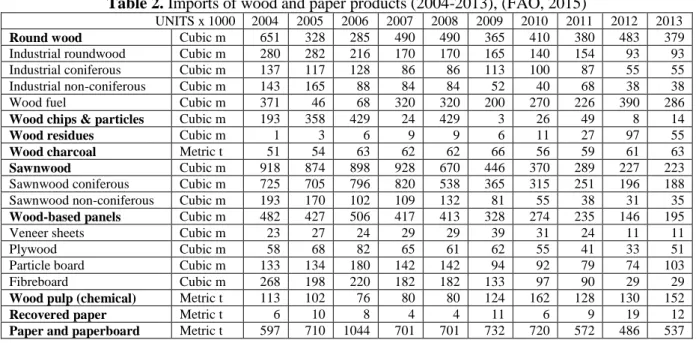
But there are factors that greatly influence the rational exploitation of non-public forests and such are: small size in terms of surface, the capital investment reluctance infrastructure and culture and development of these forests. The capital investment reluctance is mainly because there is reduced and long-term performance of forests and the social character of forest ownership and the emergence of many co-owners so there are discrepancies regarding the correct management. Following there are details on the development of imports and exports of wood products and paper in Greece during the decade 2004-2013, where in some categories the decline observed in recent years is vertical (Data source: FAO, Global Forest Resources Assessment, 2015).
Table 2. Imports of wood and paper products (2004-2013), (FAO, 2015)
UNITS x 1000 2004 2005 2006 2007 2008 2009 2010 2011 2012 2013 Round wood Cubic m 651 328 285 490 490 365 410 380 483 379 Industrial roundwood Cubic m 280 282 216 170 170 165 140 154 93 93 Industrial coniferous Cubic m 137 117 128 86 86 113 100 87 55 55 Industrial non-coniferous Cubic m 143 165 88 84 84 52 40 68 38 38
Wood fuel Cubic m 371 46 68 320 320 200 270 226 390 286
Wood chips & particles Cubic m 193 358 429 24 429 3 26 49 8 14
Wood residues Cubic m 1 3 6 9 9 6 11 27 97 55
Wood charcoal Metric t 51 54 63 62 62 66 56 59 61 63 Sawnwood Cubic m 918 874 898 928 670 446 370 289 227 223 Sawnwood coniferous Cubic m 725 705 796 820 538 365 315 251 196 188 Sawnwood non-coniferous Cubic m 193 170 102 109 132 81 55 38 31 35 Wood-based panels Cubic m 482 427 506 417 413 328 274 235 146 195
Veneer sheets Cubic m 23 27 24 29 29 39 31 24 11 11
Plywood Cubic m 58 68 82 65 61 62 55 41 33 51
Particle board Cubic m 133 134 180 142 142 94 92 79 74 103
Fibreboard Cubic m 268 198 220 182 182 133 97 90 29 29
Wood pulp (chemical) Metric t 113 102 76 80 80 124 162 128 130 152
Recovered paper Metric t 6 10 8 4 4 11 6 9 19 12
Paper and paperboard Metric t 597 710 1044 701 701 732 720 572 486 537
3.1. The impact of economic crisis on Greek forests, and trade of firewood
Lately, an economic crisis has affected Greece since 2009 with a significant impact in wood trade aspects and on forest ecosystems as well. The consequences are quoted and discussed: a) Technical timber production has been always low, now it has been vanished because there is no demand for technical wood, due to development degrade, b) Firewood demand is increased and firewood trade is booming, mainly oak and other hardwoods as well as beech, c) Great pressure from local mountainous populations to satisfy most of their heating needs from local and usual public forests which is shown by the return on woodstoves and fireplaces; the demand for these appliances is also increased, d) illegal-logging and possibly trade has been intensified in continually high rates, with focus on firewood, even for species that so far were considered unfit because of wood characteristics, e) the price of firewood of beech and oak has been increased and will be further increased, f) imports of firewood from Bulgaria are growing in quick rates, g) major boost in the number of firewood entrepreneurship is registered, h) the phenomenon to increase the price depending on the distance from
Figure 1. Imports of wood and paper products (2004-2013)
3.2. The aspect of technologies in wood trade certification
The adoption of new technological developments and innovative management practices will offer flexibility and immediate feedback on the marketing of timber space (Tzoulis and Andreopoulou, 2013, Tzoulis et al., 2013; Tzoulis et al., 2014). Information and Communication Technologies (ICT) and innovative tools and services offer huge opportunities for everyone to advance and take advantage and new opportunities for economic development, better service, social and cultural developments in wood production and in wood market (Tzoulis and Andreopoulou, 2013). Advances in information technology have been identified as drivers of entrepreneurship in the field of commercial timber (Reuber and Fischer, 2011). The international wood trade should necessarily come from sustainable-managed forests, as defined by FSC and PEFC systems. These two certification systems of sustainable forest management have been developed: a) FSC: Forest Stewardship Council and b) PEFC: Program for the Endorsement of Forest Certification schemes (ACE UK, 2012). Forest certification schemes have emerged in recent years to become a significant and innovative venue for standard setting and governance in the environmental realm.
Table 3. Exports of wood and paper products (2004-2013), (FAO, 2015)
UNITS x 1000 2004 2005 2006 2007 2008 2009 2010 2011 2012 2013
Round wood Cubic m 16 16 27 36 36 7 6 11 27 26
Industrial roundwood Cubic m 1 0 21 30 30 5 5 8 21 22
Industrial coniferous Cubic m 0 0 20 23 23 4 4 6 17 8
Industrial non-coniferous Cubic m 1 0 1 7 7 1 1 1 4 14
Wood fuel Cubic m 15 16 7 5 5 2 1 3 6 4
Wood chips & particles Cubic m 0 0 0 0 0 0 0 0 0 0
Wood residues Cubic m 0 0 7 0 0 17 12 12 4 13
Wood charcoal Metric t 0 0 0 0 0 0 0 0 1 2
Sawnwood Cubic m 18 13 9 14 11 17 19 25 26 19
Sawnwood coniferous Cubic m 2 5 4 5 2 4 11 14 16 8
Sawnwood non-coniferous Cubic m 16 8 5 9 8 13 8 10 11 11 Wood-based panels Cubic m 201 200 81 82 80 150 155 232 257 178
Veneer sheets Cubic m 1 1 1 2 2 2 1 1 1 1
Plywood Cubic m 10 11 13 13 11 12 12 38 22 26
Particle board Cubic m 167 155 30 34 34 81 77 96 127 74
Fibreboard Cubic m 23 32 37 33 33 55 65 97 108 77
Wood pulp (chemical) Metric t 7 5 1 1 1 1 2 0 0 2
Recovered paper Metric t 104 141 154 195 195 364 315 238 321 269 Paper and paperboard Metric t 73 72 68 119 119 82 89 92 86 87
In 2003, PEFC restructured itself and went global, changing its official name to the Program for the Endorsement of Forest Certification schemes while retaining the PEFC acronym. The certification model now exists in numerous sectors, covering an ever-expanding suite of production processes (Auld, G. et al., 2008). The wood trade presents forest change, as it relates forest stock change to net trade of wood products by localizing the origin of wood consumed in a given nation (Kastner et al., 2011). Wood for trade should not come a) from illegal cuttings, b) areas of natural value, c) gene-modified trees, d) areas with social conflicts, e) natural forests transformed to other use (Korsnäs, 2012; Tzoulis et al., 2014). This situation was the first indication of the necessity for developing and implementing systems of products follow-up (Stevens, J. et all 1998) and to increase the efficiency of the process and its technologies, (Töyrylä, 1999) highlights that it is possible to improve the logistics chain, the management, the supply and the optimization of raw material. Much remains to be determined regarding the application of international trade law to multicriteria environmental and social labels.
Figure 2.Exports of wood and paper products (2004-2013)
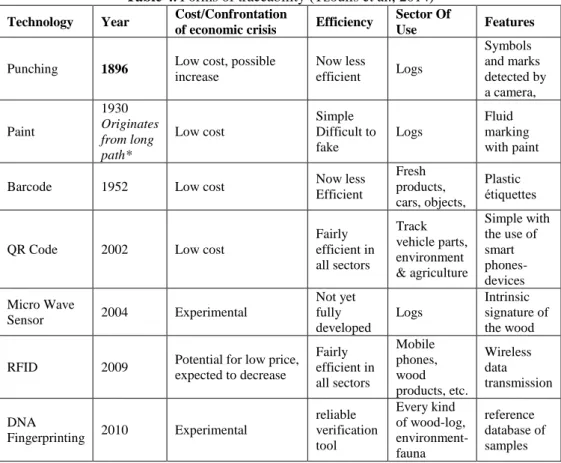
Modern innovative wood traceability systems certify the supplier and the buyer that wood comes from sustainable sources and is a successful way to fight illegal logging. Information systems include data on the origin and movement of wood throughout the collection area to its final destination, ie throughout the supply chain of wood. The most common traceability systems in timber trade also include the traditional methods such as stamping / punching, the color marking, barcodes (barcodes), the engraving dimensional code QR (quick response code), Micro Wave Sensor , microchip RFID sensors, innovative digital DNA of the cluster, etc.. These traceability and tracking systems are quoted in recent research (Tzoulis & Andreopoulou, 2013, Tzoulis et al., 2014).
It should be mentioned that the traditional labeling with a metal plate label including basic trade and production data is widely used still in Greece. Various innovative methods, such as satellite systems and remote sensing systems, have been proposed in international level and other are still under research (Brack et al., 2002). The wood certification and traceability systems are summarized in Table 4, where is also presented the cost impact of the technology, the efficiency, the sector of use and the features.
The web-database technologies are also utilized in the marketing of wood, for example in a DB for European and tropical woods, which lists the species of wood, the physical and chemical properties and their characteristics and their potential uses (Tzoulis et al., 2014a). Specifically, in the modern competitive timber business, integrated digital management systems utilize databases incorporated in governance and automated management systems. The business environment requires fast, efficient and reliable management of huge amounts of information on timber for products, suppliers, customers, materials, machinery, facilities, financial-accounting firm, office support and many more items (Tzoulis et al., 2014a).
4. Conclusion
Table 4. Forms of traceability (Tzoulis et al., 2014)
Technology Year Cost/Confrontation
of economic crisis Efficiency
Sector Of
Use Features
Punching 1896 Low cost, possible increase
Now less
efficient Logs
Symbols and marks detected by a camera, Paint 1930 Originates from long path* Low cost Simple Difficult to fake Logs Fluid marking with paint
Barcode 1952 Low cost Now less
Efficient Fresh products, cars, objects, Plastic étiquettes
QR Code 2002 Low cost
Fairly efficient in all sectors Track vehicle parts, environment & agriculture Simple with the use of smart phones-devices
Micro Wave
Sensor 2004 Experimental
Not yet fully developed Logs Intrinsic signature of the wood
RFID 2009 Potential for low price, expected to decrease
Fairly efficient in all sectors Mobile phones, wood products, etc. Wireless data transmission DNA
Fingerprinting 2010 Experimental
reliable verification tool Every kind of wood-log, environment-fauna reference database of samples
In trade, the species derived from the Greek forests are mostly fir, beech, black pine and poplar (plantation), while up to that time there was ample production amounts and from other wood species such as, walnut, chestnut, cypress, ash (ash, honey), elm (elm), pine vitiligo (robolo), juniper (cedar), maple and linden. There are multiple social and economic problems arisen because of the economic crisis impact on forests and wood trade in our country. People while in economic crisis usually destroy forests but they can also recover later. It is important to adopt the adequate both to confront the threat and take advantage of on the opportunity. Therefore, the adoption of new technological solutions and innovative digital management practices of all data is required, that will provide flexibility, immediate feedback and fast decision making.
References
ACE UK 2012 ’Natural and renewable, traceability’. http://www.ace-uk.co.uk/natural/traceability
Auld, G, Gulbrandsen, L, & McDermott, C. L 2008 ’Certification schemes and the impacts on forests and forestry’. Annual review of environment and resources, vol. 33, no 1, pp. 187., doi:
10.1146/annurev.energy.33.013007.103754
Andreopoulou, Z, Manos, B, Viaggi, D, & Polman, N 2011 ’Governance, and Management: Emerging Research Applications’. Agricultural and Environmental Informatics. IGI Global. USA.
Andreopoulou, Z, Cesaretti, G, & Misso, R 2012 ’ Sostenibilita dello sviluppo e dimensione territoriale’.
Development Sustainability And Territorial Dimension: The Role Of Regional Systems With Rural Vocation,
Eds. FrancoAngeli, Italy.
Brack, D, Gray, K, & Hayman, G 2002 ’ Controlling The International Trade In Illegally Logged Timber And Wood Products’. Sustainable Development Program. Royal Instituteof International Affairs.
Hall, J. P 2002 ’Sustainable production of forest biomass for energy’. The Forestry Chronicle, vol 78, no 3, pp. 391-396., doi: 10.5558/tfc78391-3
Kastner, T, Erb, H, & Nonhebel, S 2011 ’International wood trade and forest change: A global analysis’. Global Environmental Change, vol 21, no 3, pp. 947-956., doi: 10.1016/j.gloenvcha.2011.05.003
Kastner, T, Kastner, M, & Nonhebel, S 2011 ’Tracing distant environmental impacts of agricultural products from a consumer perspective’. Ecological Economics, vol 70, pp. 1032–1040., doi:
10.1016/j.ecolecon.2011.01.012
Kompelitou, M, & Koskina, E 2004 ’Energy use of biomass from wood’, pp. 32-33. Korsnas, 2012 ’Traceability of wood’. http://www.korsnas.com/fr/Om-
Korsnas/Forestry/Miljoarbetet/Traceability-of-wood/.
Ministry Of Agriculture, 1992 ’Results of the First National Inventory of Forests’.
Gen. Sec. Forestry and CB (MoA), General. N / Department of Forestry and VAT, Athens, pp. 135.
MPREE, 2011 ’Ministry of Productive Reconstruction, Environment and Energy’. ΥΠΕΚΑ, 2011. Development of Forest Resources Division: Business Review Forest year service 2009. Athens 2011,
http://www.ypeka.gr/LinkClick.aspx?fileticket=eACSoTp6bFY%3D&tabid=813&language=el-GR
Stevens, J, Ahmad, M, & Ruddell, S 1998 ’Forest Products Certification: A survey of manufacturers’. Forest Products Journal, vol 48, no 6.
Töyrylä, I, 1999 ’Realizing the potential of traceability- A case study research’, Helsinki University of technology, Espoo, Finland. Doctoral thesis.
Tzoulis, I, & Andreopoulou, Z 2013 ’Emerging traceability technologies as a tool for quality wood trade’. Procedia Technology, vol. 8, pp. 606-611., doi: 10.1016/j.protcy.2013.11.087
Tzoulis, I, Andreopoulou, Z, Koliouska, C, Tsekouropoulos, G, Samathrakis, V 2013 ’WooDB: a DBMS approach as a marketing tool for wood entrepreneurship’. Procedia Technology, vol. 8, pp. 275-284., doi:
10.1016/j.protcy.2013.11.037
Tzoulis, I, Andreopoulou, Z, & Voulgaridis, E 2014 ’Wood Tracking Information Systems to Confront Illegal Logging’. International Journal of Agricultural Informatics, vol 5, no.1, pp. 9-17., doi:
10.17700/jai.2014.5.1.130
Tzoulis, I, Andreopoulou, Z, Koliouska, C, Tsekouropoulos, G, Samathrakis, V 2014a ’Database management systems in wood entrepreneurship and marketing’. International Journal of Agricultural Resources, Governance and Ecology, vol. 6, no. 10(2), pp. 190-202., doi: 10.1504/ijarge.2014.063578
Tsoumis, G, 1983 ’Structure, Properties and Utilization of Wood’. Science and Technology of Wood. Thessalonica
Voulgaridis, E, 1996 ’Maintenance and improvement of Wood’. University courses. Publications Service, AUTH, Thessaloniki.