Lucrări ştiinţifice Zootehnie şi Biotehnologii, vol. 40(2), (2007), Timişoara
STUDY ON EMBRYO DEVELOPMENT IN ZEBRA FISH
(
Danio rerio
) DEPENDING ON DIFFERENT pH LEVELS
STUDIU ASUPRA DEZVOLT
Ă
RII EMBRIONARE LA
PE
Ş
TELE ZEBR
Ă
(
Danio rerio
) ÎN FUNC
Ţ
IE DE
DIFERITE VALORI ALE pH-ULUI
BĂDILIŢĂ MIHAELA*, GROZEA A.**, BĂNĂŢEAN-DUNEA I.*
*Faculty of Agriculture, Timişoara, România
** Faculty of Animal Sciences and Biotechnologies, Timişoara, România
The aim of this paper is to emphasize the main aspects of the ways in which different pH levels influence the development of zebra fish (Danio rerio) embryos. During the experiments there have been used 6 variants with different pH levels in order to monitor the development of zebra fish embryos in 40 ml Nunk culture dishes at optimum density (1 embryo/ 3 ml) and at an optimal temperature of 28.5oC.
It could be noticed that most embryos died in a pH=6 medium (70%). This means that such a medium is not suitable to embryo’s development. For the control variant (pH=7) it has been recorded the lowest mortality rate of only 23% and in the case of other variants the mortality was of 30-40%.
The studies of the pH influence upon the zebra fish embryo development have underlined the fact that little digressions from the optimal conditions can led to irreversible modifications within the roe which sometimes are even lethal.
Key words: zebra fish, embryo development, pH.
Introduction
The zebra fish (Danio rerio, Cyprinidae fam.) is worldwide used in many laboratory tests and in researches referring to the biology of development, to the molecular genetics and in ichthyologic studies. All these tests recommend the
Danio rerio species as research model not only for the ontogenetic development study, but also for the study of the physiological and reproductive processes.
States. The Romanian technical literature contains very few data regarding the development biology of this species and even less data regarding the way in which different chemical factors influence the embryo development.
This paper’s aim is to point out the most important aspects of the way in which one of the chemical factors of the water medium, the pH (the chemical reaction), influences the zebra fish embryo development.
Materials and Methods
For the experiment there have been used 6 variants of different chemical reactions: a control variant (V3) where pH=7 and the other five with different pH levels: pH=8 (V1); pH=7,5 (V2); pH=6,5 (V4); pH=6 (V5); pH=5,5 (V6). In order to obtain these mediums there has been used the purified water (18.2 M - cm at 25°C, microorganism ≤1ucf/ml, particles 0.22 m <1/ml) obtained by using the
SIMPLICITY 185 – MILLIPORE CO. Water Purification System and HCl for reducing the pH level, respectively NaOH for increasing the pH level. The pH level determination has been done with the electronic pH meter with proof stick.
In each medium prepared in this way have been introduced each 10 fecundated zebra fish roes for each repetition and for each variant. The embryo cultivation has been done in 40 ml NUNK culture dishes. In each culture dish have been introduced 30 ml medium and 10 fecundated roes, meaning 1 roe/ 3 ml medium.
Three repetitions have been done for each test, so that 30 embryos have been studied for each variety.
The monitoring has been done once an hour during the first stages - the cleavage and blastula stages – and the results have been read once in three hours (the gastrulae and segmentation period). During the last development periods (pharyngula and hatching period) the monitoring has been done each hour and all the examinations have been done by using a NIKON magnifying glass.
Results and Discussions
The researches regarding the pH influence upon the zebra fish embryo have underlined the fact that little digressions from the optimal conditions may lead to irreversible modifications within the roe which sometimes are even lethal.
Figure 1. The pH levels influence on the zebra fish embryo development 12 hours after the fecundation
Figure 2. The pH levels influence on the development of zebra fish embryos 33 hours after the fertilization
p H = 8
4 0 %
6 0 %
p H = 7 ,5
4 0 %
6 0 %
p H = 7
2 4 %
7 6 %
p H = 6 ,5
6 0 % 4 0 %
p H = 6
3 0 %
7 0 %
p H = 5 ,5
3 0 %
7 0 %
pH = 8
40%
0% 60%
p H =7 ,5
4 0 %
0 % 6 0 %
p H = 7
2 3 % 0 %
7 7 %
p H =6 ,5
3 0 %
p H =6
40 %
p H = 5 ,5
3 0 %
p H =7 ,5
33%
47% 0%
20% 0%
p H =8
40%
53% 7%
0% 0%
p H =6 ,5
6 0% 4 0%
0% 0% 0%
p H =6
30%
40% 20%
10% 0%
p H =5,5
30% 20% 10% 20% 20% pH =7 23% 47% 10% 10% 10%
Undeveloped (death) Bud stage 2-somite stage 4- somite stage 6-somite stage
The data presented in Fig. 1 show the fact that, 12 hours after the fecundation, the mortality percent has increased (up to 40% for V1 and up to 60% for V4) in the case of 5 from the 6 variants. Most of the viable embryos from the first three variants are now in bud stage (47-53%) that is at the end of gastrula stage. The rest pass to the segmentation stage. The most advanced stage is the V6 (pH=5,5), where 20% of the embryo have 6 somite. Probably the acid water reaction accelerated the development of the viable embryos.
After 33 hours, Figure 2, it seems that the most favourable mediums continue to be those having a pH level of 7, 6, respectively 5,5. There have survived and have developed themselves 70%, respectively 76% embryos. Those embryos are in the pharyngula stage, having pigmented body and eyes. One can notice that the highest percentage of mortality appears in the case of V4 variant, where the medium is light acid and the mortality percentage is of 60%.
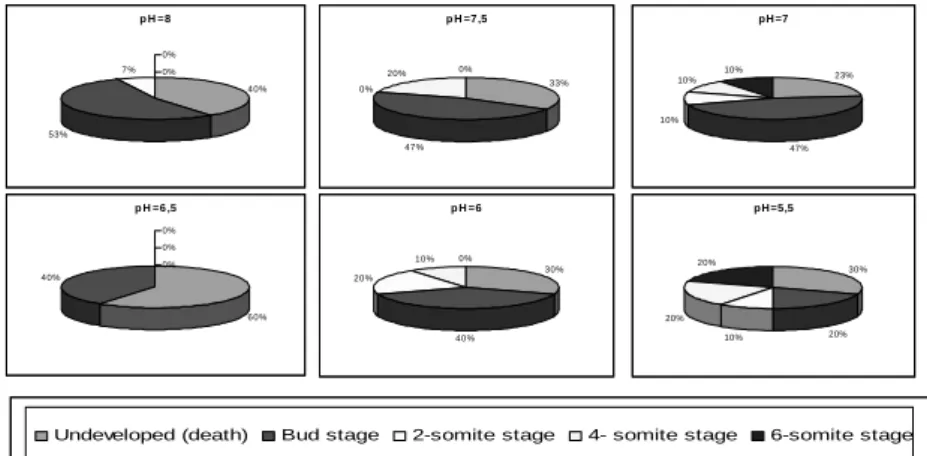
53 hours after the beginning of the experiment – this actually being the last data reading (Fig. 3) – there has been noticed that the mortality rate has been of 23% in case of the control variant having a pH level of pH=7; of 30% in the case of the variant having the pH level of pH=5,5; of 40 % in case of the variant having the pH levels 8; 7,5; and 6. The highest percentage of dead embryos have been found for the variant having the pH level pH=6,5 (70%).
The highest mortality rate has been recorded during the first embryo stages, the cleavage and blastula stage, and a little bit reduced during the hatching period.
These results suggest that the pH level from the incubation medium influences the zebra fish embryo development when they pass towards acid or basic levels, which is relevant for the mortality percentage.
Conclusions
The researches regarding the pH influence on the zebra fish embryos have pointed out the fact that little digressions from the optimal conditions can led to irreversible modifications within the roe which sometimes are even lethal.
The first embryo development period is very sensible at more acid pH levels, which can be noticed because of the undifferentiated aspect of the embryos.
Bibliography
1. Grozea, A., M., Bura, I., Bănăţean-Dunea, Gh., Ghişe, V., Carabă, Daniela Ilie, R., Muscalu, Mihaela Bădiţă (2003) – Aspects of young embryos development in Danio rerio species, Lucrări ştiinţifice Zootehnie
şi Biotehnologii, Vol. XXXVI
2. Kimmel, C.B., W.W., Ballard, S.R., Kimmel, B., Ullmann, T.F., Schilling (1995) - Zebrafish development, preluat de pe adresa internet http://anatomy.med.unsw.edu.au/cbl/embryo/OtherEmb/Zebfish.htm accesat în 04.09.2002.
3. Moorman, S.J. (2000) - Anatomical nomenclature for zebrafish, Case Western Reserve Univ., Cleveland.
STUDIU ASUPRA DEZVOLT
Ă
RII EMBRIONARE LA
PE
Ş
TELE ZEBR
Ă
(
Danio rerio
) ÎN FUNC
Ţ
IE DE
DIFERITE VALORI ALE pH-ULUI
BĂDILIŢĂ MIHAELA*, GROZEA A.**, BĂNĂŢEAN-DUNEA I.*
*Faculty of Agriculture, Timişoara, România
** Faculty of Animal Sciences and Biotechnologies, Timişoara, România
Scopul acestei lucrări este de a evidenţia cele mai importante aspecte ale modului în care pH–ul influenţează dezvoltarea embrionilor de peşte zebră (Danio rerio).
În cadrul experimentului s-au folosit 6 variante cu diferite valori ale pH-ului şi s-au monitorizat embrionii de peşte zebră în plăcuţe de cultură Nunk de 40 ml, la o densitate optimă de 1 embrion/3 ml şi o temperatură optimă de 28,5 oC.
S-a putut concluziona că cei mai mulţi embrioni au murit în mediul cu pH=6,5 (70%). Asta a însemnat că acest mediu nu este potrivit pentru dezvoltarea embrionilor. În varianta martor (pH=7 )a fost înregistrată cea mai scăzută rată a mortalităţii de numai 23%, iar în celelalte variante mortalitatea a fost de 30-40%.
Studiul influenţei pH-ului asupra dezvoltării embrionare la peştele zebră au scos în evidenţă faptul că abateri mici de la optim pot duce la modificări ireversibile în interiorul icrei, uneori chiar letale.