Iran University of Medical Sciences
____________________________________________________________________________________________________________________
1. (Corresponding author) PhD Student of Exercise Physiology, Exercise Physiology Department, University of Tabriz, Tabriz, Iran.
[email protected] or [email protected]
2. Associate Professor of Sport Physiology, Department of Physical Education, University of Tabriz, Tabriz, Iran. [email protected] 3. Associate Professor of Biochemistry, Department of Biochemistry, University of Tabriz, Tabriz, Iran. [email protected] 4. Department of Sport Physiology, Faculty of physical education and sport sciences, Islamic Azad University, Karaj, Iran.
L.Abdizadeh @yahoo.com
Effect of coenzyme Q10 supplementation on exercise-induced
response of inflammatory indicators and blood lactate in
male runners
Mostafa Armanfar1, Afshar Jafari2, Gholam Reza Dehghan3, Leila Abdizadeh4
Received:6 October 2014 Accepted:20 December 2014 Published:20 April 2015
Abstract
Background: Heavy exercise cause muscle damage associated with production of inflammatory agents. The purpose of present study was to determine the effect of acute and 14-day Coenzyme Q10 supplementation on inflammatory, blood lactate and muscle damage in male middle-distance run-ners.
Methods: Eighteen male middle-distance runners in a randomized and quasi experimental study were allocated into two equal groups: supplement group (n=9, Coenzyme Q10: 5mg/kg/day) and placebo group (n= 9, Dextrose: 5mg/kg/day). After acute (1day) and 14-day supplementation, all subjects were participated in a training like running (competitive 3000 meters). Blood samples were obtained in the four phases: one hour before and 18-24 hours after two running protocols. Lactate, serum interleukin-6 (IL-6), tumor necrosis factor-alpha (TNF-alpha), C-reactive protein (CRP) and creatine kinase (CK) were analyzed. Repeated ANOVA and Bonferuni as a post hoc tests were used to determine the changes in four stages. Differences between groups were determined by t-test.
Results: The results showed that acute and short-term Coenzyme Q10 supplementation had not significant effect on basal parameters. The acute coenzyme Q10 supplementation attenuated only the exercise-induced increase in response of the plasma CRP. The short-term (14-day) coenzyme Q10 supplementation attenuated the exercise-induced increase in response of the lactate, serum interleu-kin-6, tumor necrosis factor-alpha, and CRP in male middle-distance runners. However, the acute and short-term coenzyme Q10 supplementation had not any significant effect on the exercise-induced increase response of total serum creatine kinase.
Conclusion: Based on the present results, it can be concluded that the 14-day coenzyme Q10 sup-plementation (5mg.kg-1.day-1) is more effective than the acute supsup-plementation to overcome the exercise-induced adverse responses in some oxidative, inflammatory and biochemical parameters. Therefore, short-term coenzyme Q10 supplementation is recommended to reduce exercise-induced adverse consequences.
Keywords: Runners, Coenzyme Q10, Inflammatory, Lactate, Muscle damage.
Cite this article as:Armanfar M, Jafari A, Dehghan Gh.R, Abdizadeh L. Effect of coenzyme Q10 supplementation on exercise-induced response of inflammatory indicators and blood lactate in male runners.Med J Islam Repub Iran2015 (20 April). Vol. 29:202.
Introduction
The health benefits of systematic and regular exercise training in reducing the risk of some diseases such as cancer, diabe-tes, obesity, hypertension, and sudden death, is well established (1). Yet, exhaus-tive exercise training especially in
non-professional and untrained athletes cause oxidative stress associated with inflamma-tory response s, which is the cause for the muscle cell membrane damage observed in this sort of high-intensity and exhaustive activity and exercise (2, 3). It is well known that exhaustive exercise result membrane
muscle damage and thus they will be bene-ficial for these athletes. The coenzyme Q10 (CoQ10) is a such compound due to its well-known antioxidant and anti-inflammatory effects (6, 7). Therefore, muscle damage might be prevented by op-timizing nutrition, especially via increasing the nutritional content of dietary antioxi-dants (8).
Mechanical and metabolic stresses caused by vigorous training and competitive long-distance running and swimming endurance may result to fatigue (increased lactate) and change in some biochemical indicators in-clude enzymes (e.g., creatine kinase) to the serum (9).
Given the significance of oxidative stress, inflammation, and muscular damage related with high-intensity exercise, it would be interesting to evaluate the influence of oral supplementation with an antioxidant sub-stance able of diminishing muscular dam-age, free radicals production, and inflam-matory signaling associated with this per-formance. CoQ10, an indispensable part of the mitochondrial electron transport chain is necessary for ATP production, especially in muscle cells with high metabolic re-quirement including muscle cells over high-intensity and intensive exercise. CoQ10 acts as a redox electron carrier and transporter into the mitochondria (6). For many years, CoQ10 has been used as a die-tary supplement intended to promote opti-mal health by trapping free radicals and the interest for this molecule obtained from the fact of this role as a redox link in the
mito-flammatory signaling. Therefore, the pur-pose of the present study was to determine the effect of acute (one day) and short-term (14day) CoQ10 (5mg/kg body weight/day) supplementation (10) in response to exer-cise muscle damage, inflammation and fa-tigue, inflammatory markers in men run-ners in the middle-distance (following a competition run 3000 meters) in form of a two-group design. A double-blind repeated measures was performed.
Methods
Data
Eighteen male middle-distance runners (mean±SD age of 19.9 ± 2.64years; mean±SD height of 177.6 ± 2.3cm; mean±SD of VO2max 60.6 ± 3.9) in a
ran-domized and quasi experimental study were allocated in two equal Q10 supplement and placebo group. All subjects eligible to par-ticipate in the study completed a familiari-zation session where they were provided information regarding the study design, testing and supplementation protocols. None of the subjects had ingested CoQ10, or any other dietary supplements before initiation of the study. In addition, they had no past history of heart or kidney diseases, diabetes or any physical damage and prob-lems. Study was approved by the Research Ethics Committee of Tabriz University of Medical Sciences. Sample size for each of the two groups with regard to study design and results of previous studies, was esti-mated as seven (11, 12). However, in order to prevent possible losses during the
cess of research subjects and the anthropo-metric indices and aerobic power, sample size for each group increased to 9.
Finally, with regard to maximal oxygen consumption test (Bruce), percentage of body fat and some blood parameters (he-moglobin and hematocrit), subjects were divided into nine groups matched in ho-mogenized supplement.
The subjects were randomly assigned to either the CoQ10 (5 mg per kg per day Q10) or placebo (5 mg per kg per day dex-trose). Both treatments were effervescent capsules, pre- packaged to be identical in taste and appearance. Each group ingested one capsule three times per day at regular interval (breakfast, lunch and dinner) for one day and 14days. (9) The CoQ10 dosage was based on previous studies and least amount of CoQ10 plasma levels required for promotion or deal with the loss of a rel-atively intense aerobic activity (11, 13).
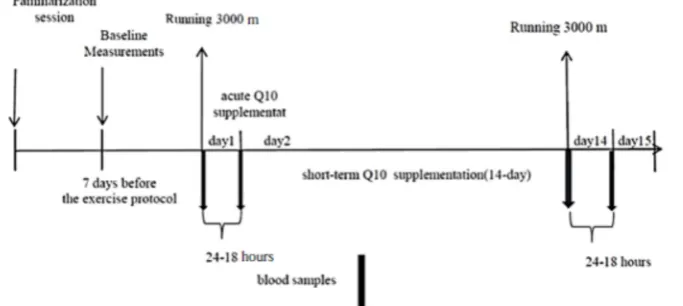
An outline of the study design is shown in Fig. 1. After acute (1day) and 14-day sup-plementation periods, all subjects were par-ticipated in a training like running (compet-itive 3000 meters). A three thousand com-petitive running was performed after a gen-eral warm-up. In addition, it was assumed that running the 3000 meters running com-petition with relatively high intensity and hard work as a fuel pressure should cause significant changes in markers of inflam-mation in the male distance runners (14).
Plasma lactate were obtained in the two phases: before and immediately after two running protocols. Blood samples were obtained in the four phases: one hour be-fore and 18-24 hours after two running pro-tocols. Blood samples were obtained from subject’s antecubital vein using venipunc-ture (5 ml; made by SUHA Co) before and 24-18 hours after acute (one day) and short-term (14day) supplementation protocol. All were measured during 12-9pm, the temper-ature of 28-23°C, humidity 65-50%, and identical ventilation and lighting. In addi-tion, subjects performed 24hours before the test, avoided doing any heavy physical ac-tivity with similar meal (breakfast) before the test. In addition, prior to the second blood sampling, subjects' diet was con-trolled using 24hour dietary recalls (11).
Statistical Analysis
The normality assumption for variables was tested by the Kolmogorov–Smirnov test. Descriptive statistics were expressed as mean ±SD. Repeated ANOVA and Bon-feruni as a post hoc test were used to de-termine the changes in four stages. Differ-ences between groups were determined by t-test. All statistical analyses were per-formed using SPSS 18. The significance level was considered at less than 0.05.
Results
The mean and standard deviation of
in-Fig.1.Training protocol and supplementation of CoQ10
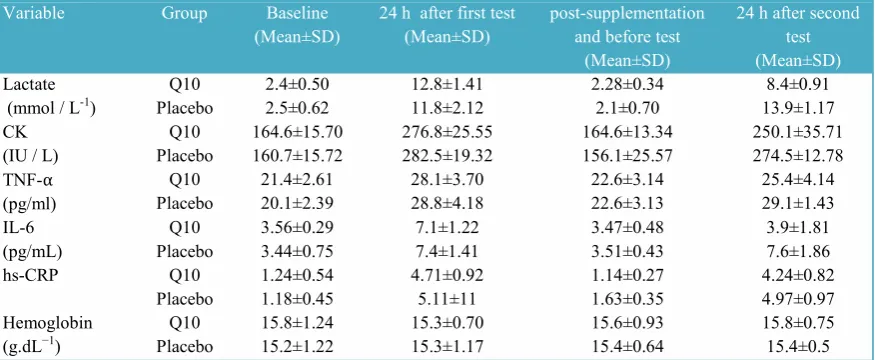
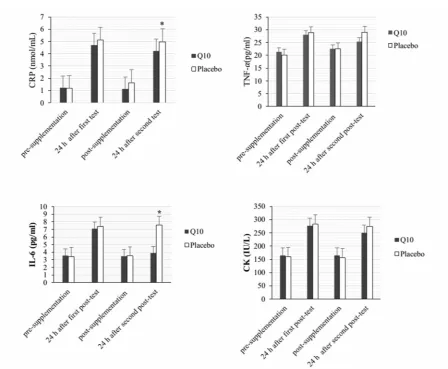
dividual characteristics and hemodynamic parameters in both groups before the exer-cise protocol are shown in Table 1. All sub-jects reported adherence to the experi-mental protocol and complete ingestion of the supplement. There were no differences among groups at the beginning of the study for physical characteristics (Table 1) and biochemical and hemodynamic variables (Table 2) (p>0.05). Acute and short-term supplementation had no significant effect on the variables in baseline levels (p>0.05). Acute supplementation had no significant effect on variables changes ranges after ex-ercise protocol (p>0.05). Also, lactate, IL-6, tumor necrosis factor-alpha, and CRP (p= 0.112; p= 0.21; p= 0.614; p= 0.12; p= 0.51, respectively) were not significantly increased following the short-term supple-mentation (Table 2 and Fig. 2). In other word, compared with the placebo group, inflammatory markers were significantly
lower in the group of CoQ10. In contrast, levels of serum CK in CoQ10 group was significantly increased following the short-term supplementation and running 3000 meters like-competitive (Table 2) (p=0.073).
Discussion
Acute CoQ10 supplementation increased lactate, IL-6, TNF-alpha, CRP and creatine kinase in male middle-distance runners af-ter the race, but did not prevent running 3000 meters. However, CoQ10 supplemen-tation could prevent increase inflammatory markers and lactate after running 3000 me-ters competition. However, total serum cre-atine kinase response was not affected after the 3000 meter race running in acute and short-term supplementation of CoQ10.
Robust evidence exists to demonstrate that exhaustive and high intensity exercise result oxidative stress and muscle cells
Variable Group Baseline
(Mean±SD) 24 h after first test(Mean±SD) post-supplementationand before test (Mean±SD)
24 h after second test (Mean±SD) Lactate
(mmol / L-1) PlaceboQ10 2.4±0.502.5±0.62 12.8±1.4111.8±2.12 2.28±0.342.1±0.70 13.9±1.178.4±0.91 CK
(IU / L) PlaceboQ10 164.6±15.70160.7±15.72 276.8±25.55282.5±19.32 164.6±13.34156.1±25.57 250.1±35.71274.5±12.78 TNF-α
(pg/ml) PlaceboQ10 21.4±2.6120.1±2.39 28.1±3.7028.8±4.18 22.6±3.1422.6±3.13 25.4±4.1429.1±1.43 IL-6
(pg/mL) PlaceboQ10 3.56±0.293.44±0.75 7.1±1.227.4±1.41 3.47±0.483.51±0.43 3.9±1.817.6±1.86
hs-CRP Q10 1.24±0.54 4.71±0.92 1.14±0.27 4.24±0.82
Placebo 1.18±0.45 5.11±11 1.63±0.35 4.97±0.97
Hemoglobin
(g.dL−1) PlaceboQ10 15.8±1.2415.2±1.22 15.3±0.7015.3±1.17 15.6±0.9315.4±0.64 15.8±0.7515.4±0.5 hs-CRP, high sensitivity CRP; TNF-α, Tumor necrosis factor-α; IL-6, interleukin 6; CK, creatine kinase.
damage as evidenced by an increase in the plasma levels of enzymes. (15) The signifi-cance of inflammation in the muscle to in-crease muscle generation after skeletal muscle damage or exercise (16) and limited oxidative stress might in the long run be beneficial for optimal skeletal muscle func-tion. The use of anti-inflammatory dietary supplements or drugs after exercise and the use of antioxidant dietary supplements be-fore moderate or vigorous exercise have therefore been questioned (16, 17). Moreo-ver, it has been suggested that CoQ10 may act not only as an antioxidant but also may have a pro-oxidant function (19). This could be an alternative mechanism by which CoQ10 supplementation in theory could improve exercise capacity.
Elevated levels of CK acts as an indicator
of skeletal muscle damage. There was a muscular effect of the exhaustive tests measured as an increased CK concentration on day 2 of each test period. However, there was no difference between the inter-vention and placebo groups. In fact, the in-crease over time in CK was lower in the CoQ10 group, although the statistical test for difference was not significant.
Doses as high as 3000 mg have been used to safe the tissue uptake of CoQ10. (18) The present study was designed to repre-sent the dosage commonly used and rec-ommended by the CoQ10 manufacturer. In adaption, 90 mg of CoQ10 has been shown to be sufficient to increase plasma concen-trations (18, 19).
Research have shown that CoQ10 sup-plementation in situations such as heavy or
Fig. 2. Effects of CoQ10 supplementation on inflammatory indexes in exercise-trained middle distance runner before (pre) and after (post) first and second running 3000 meters like-competitive, following acute (1 day) and short term (14 days) treatment with CoQ10 or placebo.
in other studies (7) and would explain also the lower antioxidant production before the physical test, because this would act as an essential antioxidant and assisting in the regeneration of other antioxidants (7). On the other hand, there would be a lower free radicals production during the run in the CoQ10 supplemented group (22).
As it has been mentioned above, acute exercise causes oxidative stress, particular-ly when the exercise is intense and vigor-ous; the fact that can be related with the increase of inflammatory cytokines include IL-12 and IL-6, TNF-a, and CRP (5). It has been demonstrated that exogenous and oral intake of CoQ10 leads to a substantial de-cline in oxidative stress because of its abil-ity to scavenge hydroxyl radicals and pro-inflammatory cytokines (23). According to this, our results showed a reduction in in-flammatory parameters and a modulation of inflammatory signaling.
Plasma IL-6 increases in a progressively fashion with exhaustive activity and is as-sociated to exercise intensity, duration, mass of muscle involved, and muscular en-durance capacity (24). This study has shown that a significant increase in IL-6 concentrations cytokine related with physi-cal activity in both groups. CoQ10 supple-mentation was able to decrease the levels of IL-6 after the run. This effect on IL-6 levels is in accordance with that found for other authors after supplementation with CoQ10 but in different conditions (25, 26).
Generally, the supplementation effects on the TNF-α pathway. We found a significant
TNF-α can be associated with muscle re-generation,(28) normally produced by mus-cle cells, or inhibits myogenesis by activat-ing NF-kB. In addition, this cytokine is known to inhibit contractile function of skeletal muscle, and it may be related to NO production (29) and increased mito-chondrial production of ROS that in turn regulate TNF-α/ NF-kB signaling (28).
Conclusion
CoQ10 short-term supplementation at a dose of 5 mg/kg/d (14-day) can decrease inflammation (TNF-α, CRP and IL-6) in male middle-distance runners. However, acute and short-term supplementation can-not decrease CK after the high-intensity exercise compared with the placebo group. We believe a higher dose of CoQ10 sup-plements (>5mg/kg/d) might provide sus-tainable anti-inflammatory in middle-distance runners. However, further study is needed to demonstrate whether a high dose of CoQ10 correlates with health benefits.
References
1. Siddiqui N, Nessa A, Hossain M. Regular physical exercise: way to healthy life. Mymensingh Medical Journal 2010;19(1):154.
2. Suzuki K, Yamada M, Kurakake S, Okamura N, Yamaya K, Liu Q, et al. Circulating cytokines and hormones with immunosuppressive but neutrophil-priming potentials rise after endurance exercise in humans. European Journal of Applied Physiology. 2000;81(4):281-7.
3. Powers SK, Jackson MJ. Exercise-induced oxidative stress: cellular mechanisms and impact on muscle force production. Physiological Reviews.
2008;88(4):1243-76.
4. Gomez‐Cabrera MC, Borrás C, Pallardó FV, Sastre J, Ji LL, Viña J. Decreasing xanthine oxidase‐
mediated oxidative stress prevents useful cellular adaptations to exercise in rats. The Journal of Physiology. 2005;567(1):113-20.
5. Kasapis C, Thompson PD. The Effects of Physical Activity on Serum C-Reactive Protein and Inflammatory MarkersA Systematic Review. Journal of the American College of Cardiology. 2005; 45(10):1563-9.
6. Zhou S, Zhang Y, Davie AJ, Marshall-Gradisnik SM, Hu H, Wang J, et al. Muscle and plasma coenzyme Q10 concentration, aerobic power and exercise economy of healthy men in response to four weeks of supplementation. The Journal of Sports Medicine and Physical Fitness. 2005;45(3):337-46.
7. Ochoa JJ, Quiles JL, Huertas JR, Mataix J. Coenzyme Q10 protects from aging-related oxidative stress and improves mitochondrial function in heart of rats fed a polyunsaturated fatty acid (PUFA)-rich diet. The Journals of Gerontology Series A: Biological Sciences and Medical Sciences. 2005;60(8):970-5.
8. VinÑa J, Gomez‐Cabrera MC, Lloret A, Marquez R, Miñana JB, Pallardó FV, et al. Free radicals in exhaustive physical exercise: mechanism of production, and protection by antioxidants. IUBMB Life. 2000;50(4‐5):271-7.
9. Cooke M, Iosia M, Buford T, Shelmadine B, Hudson G, Kerksick C, et al. Effects of acute and 14-day coenzyme Q10 supplementation on exercise performance in both trained and untrained individuals. Journal of the International Society of Sports Nutrition. 2008;5(1):1-14.
10. Kaikkonen J, Tuomainen T-P, Nyyssönen K, Salonen JT. Coenzyme Q10: absorption, antioxidative properties, determinants, and plasma levels. Free Radical Research. 2002;36(4):389-97.
11. Gibson RS. Principles of nutritional assessment: Oxford University Press; 2005.
12. Medicine ACoS. ACSM's health-related physical fitness assessment manual: Lippincott Williams & Wilkins; 2013.
13. Leelarungrayub D, Rawattikanon A, Klaphajone J, Pothongsunan P, Bloomer RJ. Coenzyme Q10 supplementation decreases oxidative stress and improves physical performance in young swimmers; a pilot study. The Open Sports Med J. 2010;4:1-8.
14. Thompson WR, Gordon NF, Pescatello LS. ACSM's guidelines for exercise testing and prescription: Hubsta Ltd; 2009.
15. Armstrong R. Mechanisms of exercise-induced delayed onset muscular soreness: a brief review. Medicine and Science in Sports and Exercise. 1984;16(6):529-38.
16. Ambrosio F, Kadi F, Lexell J, Fitzgerald GK,
Boninger ML, Huard J. The effect of muscle loading on skeletal muscle regenerative potential: an update of current research findings relating to aging and neuromuscular pathology. American Journal of Physical Medicine & Rehabilitation. 2009; 88(2):145-55.
17. Gomez-Cabrera M-C, Domenech E, Viña J. Moderate exercise is an antioxidant: upregulation of antioxidant genes by training. Free Radical Biology and Medicine. 2008;44(2):126-31.
18. Bhagavan HN, Chopra RK. Plasma coenzyme Q10 response to oral ingestion of coenzyme Q10 formulations. Mitochondrion. 2007;7:S78-S88.
19. Malm C, Svensson M, Ekblom B, Sjödin B. Effects of ubiquinone‐10 supplementation and high intensity training on physical performance in humans. Acta Physiologica Scandinavica. 1997; 161(3):379-84.
20. Kon M, Kimura F, Akimoto T, Tanabe K, Murase Y, Ikemune S, et al. Effect of Coenzyme Q10 supplementation on exercise-induced muscular injury of rats. Exerc Immunol Rev. 2007;13:76-88.
21. Littarru GP, Tiano L. Bioenergetic and antioxidant properties of coenzyme Q10: recent developments. Molecular Biotechnology. 2007;37(1):31-7.
22. Sohet FM, Neyrinck AM, Pachikian BD, de Backer FC, Bindels LB, Niklowitz P, et al. Coenzyme Q10 supplementation lowers hepatic oxidative stress and inflammation associated with diet-induced obesity in mice. Biochemical Pharmacology. 2009;78(11):1391-400.
23. Tsuneki H, Sekizaki N, Suzuki T, Kobayashi S, Wada T, Okamoto T, et al. Coenzyme Q< sub> 10</sub> prevents high glucose-induced oxidative stress in human umbilical vein endothelial cells. European Journal of Pharmacology. 2007;566(1):1-10.
24. Pedersen B, Steensberg A, Fischer C, Keller C, Keller P, Plomgaard P, et al. The metabolic role of IL-6 produced during exercise: is IL-6 an exercise factor? Proceedings of the Nutrition Society. 2004; 63(02):263-7.
25. Gökbel H, Gergerlioğlu HS, Okudan N, Gül İ, Büyükbaş S, Belviranlı M. Effects of Coenzyme Q10 supplementation on plasma adiponectin, interleukin-6, and tumor necrosis factor-α levels in men. Journal of Medicinal Food. 2010;13(1):216-8.
26. Bessler H, Bergman M, Blumberger N, Djaldetti M, Salman H. Coenzyme Q10 Decreases TNF-. ALPHA. and IL-2 Secretion by Human Peripheral Blood Mononuclear Cells. Journal of Nutritional Science and Vitaminology. 2010; 56(1):77-81.
27. Reid M, Li YP. Cytokines and oxidative signalling in skeletal muscle. Acta physiologica scandinavica. 2001;171(3):225-32.
28. Kuru S, Inukai A, Kato T, Liang Y, Kimura S, Sobue G. Expression of tumor necrosis factor-α in regenerating muscle fibers in inflammatory and