Strategic Modeling of Information Sharing Among Data Privacy Attackers
Quang Duong, Kristen LeFevre and Michael P. Wellman Computer Science & Engineering
University of Michigan
Ann Arbor, MI 48109-2121 USA
E-mail: {qduong,klefevre,wellman}@umich.edu
Keywords:data privacy, game theory, attacker model
Received:September 7, 2009
Research in privacy-preserving data publishing has revealed the necessity of accounting for an adversary’s background knowledge when reasoning about the protection afforded by various anonymization schemes. Most existing work models the background knowledge of one individual adversary or privacy attacker, or makes a worst-case assumption that attackers will act as one: colluding through sharing of background information. We propose a framework for modeling multiple attackers with heterogeneous background knowledge, supporting analysis of their strategic incentives for sharing information prior to attack. The framework posits a decentralized mechanism by which agents decide whether and how much information to share, and defines a normal-form game representing their strategic choice setting. Through a simple example, we show that the efficacy of database generalization operations depends on the information-sharing strategies adopted by the attackers. Through analysis of the underlying game model, a database publisher can adopt a generalization level geared to the level of sharing expected among rational attackers. Povzetek: Predstavljen je model napadov na privatnost s heterogenim ozadjem.
1 Introduction
Many organizations publish non-aggregate personal data, for research purposes including social science, public health, and marketing. At the same time, high-profile in-cidents have underscored the importance of taking steps to protect individual privacy. In one compelling demonstra-tion, Sweeney (17) showed that by cross-referencing a pub-lic voter registration list and a published database of health insurance information, using the combination of birth date, gender, and zip code attributes, an attacker could locate the medical record of the Governor of Massachusetts.
Over the past several years, research in data privacy has sought to provide tools to guard againstidentity disclosure
andattribute disclosureunder this so-calledrecord linkage
attack model, while preserving the utility of the resulting data. Informally, identity disclosure refers to the ability of an attacker to locate a target individual in the published data, and attribute disclosure refers to the attacker’s ability to determine the value of some sensitive attribute associ-ated with a target individual.
One of the principal approaches employed for this pur-pose isgeneralization, which is best illustrated with a sim-ple examsim-ple. Consider the input data set shown in Fig-ure 1(a), and consider an attacker who is interested in learn-ing information about Alan. Suppose that the attacker al-ready knows Alan’s age, gender, and zip code. Even if the name identifiers are removed from the published data set, the attacker can identify Alan’s record (assuming that Alan is included) using this combination of attributes
(com-monly calledquasi-identifiers). In the generalized data set of Figure 1(b), however, attribute values are abstracted into coarser-grained equivalence classes. In this instance, the attacker cannot tell which of the first two records is Alan’s. Thus, the attacker is also unable to determine whether Alan’s disease is AIDS or flu.
In addition to quasi-identifier information, it is also com-mon for an attacker to have access to other instance-level
background knowledge. In our simple example, suppose that, in addition to Alan’s age, gender, and zip code, the attacker also knows that Alan does not have the flu. Using this additional knowledge, in combination with the gener-alized database, the attacker can determine that Alan has AIDS.
Recent work has proposed incorporating an attacker’s background knowledge into the data publication scheme, adoptingworst caseassumptions (3; 15). This is motivated by the practical difficulty for the person deciding what in-formation to publish (thedatabase publisher) of modeling the exact information available to an attacker (e.g., “Alan does not have flu”). Further, there may be multiple at-tackers, each with different background knowledge. Thus, these protocols instead seek to publish generalized data sets that are robust to a certainamountof structured background knowledge of a certain form, in the worst case, regardless of the specific content of the knowledge.
pub-Name Age Gender Zipcode Disease
Alan 20 M 12345 AIDS
Bob 24 M 12344 flu
Carol 32 F 12455 flu
Dana 35 F 12411 cancer
Erin 30 F 12455 AIDS
(a) Original data set
Age Gender Zipcode Disease
(Alan) 2* M 1234* AIDS
(Bob) 2* M 1234* flu
(Carol) 3* F 124** flu
(Dana) 3* F 124** cancer
(Erin) 3* F 124** AIDS
(b) Generalized data set
Figure 1: Simple attribute disclosure example
lisher often knows very little about potential attackers, so even estimating these background knowledge parameters can be challenging. (This problem is analogous to the task of setting parameterkink-anonymity (17), a related data privacy requirement.)
When considering the quantities of background knowl-edge available to an individual attacker, it is helpful for the database publisher to consider two categories of knowl-edge. First, there are some background facts that are known individually to the attacker. However, the attacker may ob-tain additional information by colluding (sharing informa-tion) with other attackers. At one extreme, the database publisher might optimistically assume that the attackers do not share information, in which case the amount of infor-mation available to any particular attacker is relatively low. At the opposite pessimistic extreme, the publisher might assume that attackers share all of their information with one another; thus each has available the collective information originally possessed by individual attackers.
The purpose of this paper is to initiate a study of how information is shared among strategic attackers, which in-fluences how a database publisher should select a data set for publication. In particular, we investigate several possi-ble scenarios of information sharing, and observe that the model of information sharing significantly influences the privacy-preserving data publishing problem.
Paper overview
– We review the idea of generalization-based privacy-preserving data publishing in Section 3. This section illustrates in particular the importance of accounting for attackers’ background knowledge when reasoning about privacy.
– We present the motivation and observations support-ing our approach to strategic modelsupport-ing of data privacy attacks in Sections 4 and 5.
– Our empirical study in Section 6 illustrates how to construct and analyze the strategic model as a way of evaluating a database publisher’s decision about gen-eralizing and publishing sensitive data.
– This pilot study illustrates how the optimal data gen-eralization policy depends on the attacker model em-ployed, and how strategic analysis can inform the pub-lication decision process.
2 Related work
Recent work has proposed using game theory to model attacker behavior in a variety of security-related applica-tions. In network security, Xu and Lee (18) use game the-ory to model the network of botnet attackers and defend-ers for analyzing the performance of a proposed defense system and guiding its design. Kunreuther and Heal (12) define a generic model of interdependent security games, where players make individual decisions to invest in secu-rity measures, but the resultant secusecu-rity risks depend on in-vestments by all the players. Kearns and Ortiz (9) develop algorithms tailored to solving such games, and apply them to a scenario about the airline adoption of baggage screen-ing technology (8). Perhaps the most prominent example is the ARMOR system deployed at Los Angeles International Airport (16), which models security resource scheduling and terrorist attack decisions as a Stackelberg game. Com-putational advances in game solving are facilitating the ap-plication of this approach to increasingly complex models (10).
A second relevant body of research addresses the prob-lem of modeling information sharing activities and the associated incentives and disincentives in these multia-gent systems. Kleinberg et al. (11) examine different information-exchange scenarios and measure the partici-pants’ willingness to share information using solution con-cepts of the coalition games. Agrawal and Terzi (1) in-troduce a database-related information sharing scenario, in which private database owners reveal information to others in order to improve their query-answer capability.
Economics has become an increasingly important tool for information security analysis, as attackers have become increasingly motivated by financial profits over the years (5).This has led to research relying on the observation that economic incentives play a significant role in the strategies of attackers and potential victims. For example, the study by Grossklags et al. (6) focuses on economic outcomes in modeling security investment decision-making by potential victims to protect themselves against malicious Internet at-tacks.
3 Data generalization background
generalization methodAtoD, obtaining a generalized ver-sionDA, which it publishes instead ofDin order to protect
the privacy of people whose information is contained in the data set. Figure 1 illustrates an example original data set and its generalized version. As explained above, despite generalization, privacy attackers may be able to derive sen-sitive information fromDAif they possess sufficient
back-ground knowledge (3; 15; 14).
We denote byt sometarget individualwhose sensitive value σt ∈ Σt is of interest to attackers. Chen et al. (3)
propose to classify background knowledge regarding a par-ticular target t into three categories of facts, represented by sets L,K, andM. Each fact is a stylized ground ex-pression. Lcomprises information about sensitive values
σ0
t6=σtthat targettdoes not have, for instance “Alan does
not have flu”. Kis a set of facts about sensitive values for other individualst0 6=t, for example “Bob has flu”. Facts inM specify the relationships betweentand other individ-uals, such as “if Erin has AIDS then Alan has AIDS”.
Given this classification, the tupleB = (L, K, M)fully describes an attacker’s background knowledge and thus in-directly specifies her ability to successfullybreacha pub-lished data set. We say that DA has been breached if an
attacker can deduce the target’s sensitive valueσt.1
For many applications, it may be advantageous to adopt a more abstract and compact specification of background knowledge, rather than enumerating it explicitly. Chen et al. (3) propose a summary representation that replaces the specific instances with counts of the number of facts in the respective categories. In this scheme, background knowledge B = (L, K, M)is summarized by the tuple of quantitiesb = (|L|,|K|,|M|). This abstraction relaxes the requirement to reason about instance-specific knowl-edge of attackers, and is exponentially more compact. Al-though it discards instance-specific information, the sum-mary still enables a designer to reason about the degree of generalization required to thwart breach of the data set in the worst case. Given our examination of small examples in this study, however, we retain the full specification of background knowledge,B, for the remainder of this paper.
4 Information sharing among
attackers
We examine a network ofnattackers who seek to discover the target individual t’s sensitive valueσtin the data set
DA. These attackers may exchange background
informa-tion with one another prior to launching their attacks, in or-der to improve their prospects for compromisingDA. The
1The concept of breach could be treated more generally. Past work has
sought to model an attacker’s uncertainty about sensitive facts (for exam-ple, using a distribution over possible worlds (3; 15)), and then defined the idea of breach incorporating this uncertainty. For example, we might instead say thatDAhas been breached if an attacker can determineσt with certainty exceeding some thresholdc. However, in the interest of simplicity, we fixc= 1.
attacker faces a fundamental tradeoff in its incentives for sharing information:
– Acquiring relevant background facts generally im-proves the ability of an individual attacker to breach the target data set, which in turn generates value for the attacker.
– Revealing relevant information also improves the like-lihood that other attackers will successfully breach the data set. As more attackers succeed, the value of the breached information typically declines for each at-tacker. For example, the price an attacker could obtain by selling the sensitive information would decrease to the extent it is commonly available.
Each attackeristarts with some prior knowledge,Bi=
(Li, Ki, Mi). From the perspective of the database
pub-lisher and other attackers, the background knowledge of attacker i is uncertain, drawn from some distribution β, which can be modeled using various approaches (13).
4.1 Information sharing mechanism
We describe a simple mechanism by which the attackers share information. Although in practice we cannot man-date the process whereby attackers will coordinate in this way, defining some specific process is necessary to frame the strategic environment in which the attackers operate. The sharing mechanism we assume relies on a principle of reciprocity to induce mutually beneficial sharing. That is, one attacker provides information to a neighbor on the at-tacker network only to the extent that this neighbor pro-vides information in return. Specifically, the number of facts in each category transferred between two attackers is the same in each direction. For simplicity, we also assume that information exchanged among the attackers is accu-rate; that is, attackers do not distort information that they share with others.
The basic decision made by each attacker is which facts to offer to share. That is, given prior knowledge Bi =
(Li, Ki, Mi), the set of available information-sharing
ac-tionsSi for attackericomprises all si = (sl,i, sk,i, sm,i)
such that sl,i ⊆ Li,sk,i ⊆ Ki, andsm,i ⊆ Mi. Given
the categoryLsharing offerssl,iandsl,j of two
neighbor-ing attackers, the number of facts shared in that category is thereforemin(|sl,i|,|sl,j|). CategoryK andM sharing
operates identically. The sharing mechanism thus deter-mines the quantities of facts to be shared for each pair of connected attackers, for each category. In each case, when the number of facts to be shared is fewer than the number offered by one party, the subset of offered facts actually transmitted to the other is selected randomly.
4.2 Attacker utility
(e.g., by selling) the sensitive information σt. The more
attackers who have this piece of information, the less valu-able it is to each attacker. As a result, the reward each at-tacker receives decreases with the number of atat-tackers suc-cessfully compromising the target data set. Specifically, if there are µsuccessful attackers, we assume that each at-tacker who obtainst’s sensitive value receives reward rt
µ2.
According to this utility function, a successful attacker’s reward deteriorates faster asµincreases.
Attackers need to make decisions about how much infor-mation they would like to share with others in order to max-imize their rewards. Since we consider scenarios with only one target, without loss of generality we can setrt= 1.
Given a strategy profile (sharing decision for each at-tacker)s = (s1, . . . , sn), we can calculate the amount of
knowledge each attacker obtains from sharing information. From this information and the specifications of the general-ized database and distribution of prior knowledge, we can evaluate each attacker’s prospects for compromising the target database, and consequently their expected reward, or utility. The utility to attacker iplaying strategy si when
other agents play their strategies collectively denoted s−i
is given byui(si, s−i).
Example 1. Consider the scenario specified in Figure 1. Three privacy attackers X, Y, and Z would like to know Alan’s disease, denoted asDisease[Alan]. X knows
Disease[Alan] 6= cancer andDisease[Dana] = cancer. Y knowsDisease[Bob] = fluandDisease[Carol] =flu. Z knows ifDisease[Erin] = AIDS thenDisease[Alan] = AIDS, andDisease[Erin]6=cancer. Suppose that X wants to share Disease[Dana] = cancer and Y wants to share thatDisease[Bob] = flu. After sharing information with X, Y now knowsDisease[Dana] = cancer, in addition to her initial background knowledge. Y therefore can infer
Disease[Alan] and consequently collect a reward of1 if she is the only attacker capable of discovering his disease. If X, Y, and Z succeed in discoveringDisease[Alan], each would then collect a reward of1
9 instead.
4.3 Database publisher
In privacy-preserving data publishing, the database pub-lisher typically strives to strike a balance between protect-ing individual privacy and maintainprotect-ing the published data’s value (minimizing information loss) when choosing her generalization strategy (3; 15; 14). We incorporate both information loss and privacy breach risk when computing the publisher’s utilityud.
We denote bysdthe publisher’s strategy for
anonymiz-ing the released data set. Formally,sdfully describes the
resulting generalized data set, which we denoteDsd. Thus
sd can be of different formats, depending on the chosen
generalization method. In our example in Figure 1, the publisher’s data generalization action that transforms that original data set to the generalized data set can be fully specified bysd = (sd,1, . . . , sd,|D|) = (1,1,2,2,2). In this particular representation,sd,i=sd,jfori, j∈[1,|D|]
indicates that the two recordsiandjare “generalized" so that inDsdthey are indistinguishable based on other non-sensitive attributes.
We first quantify the generalization-induced information loss of the generalized data setDsd, given the publisher’s actionsd. For simplicity, out of many previously proposed
measures of information loss, we adopt a variation of the “discernibility penalty" proposed by Bayardo and Agrawal (2). For each recordein generalized data setDsd, we
de-fine the equivalence class π(e, Dsd), which is the set of
records inDsdthat are indistinguishable fromeon
quasi-identifier attributes due to generalization. The intuition is to assign each record a penalty based on the size of its equiv-alence class. Thus, the information loss is quantified as
il(sd) = 1
ZD X
e∈Dsd
|π(e, Dsd)|,
whereZD is the largest information loss possible for any
data set ofD’s size, and thus is constant for a fixed-size data set. This normalization factor allows us to discount the effect of the data set’s size on our measure of information loss.
The second factor in the publisher’s utility is the prospect for data privacy breach. We capture this in a random variablebr, whose probability distribution depends on the strategies of attackers as well as the publisher. The vari-able takes value one if the sensitive data is breached, zero otherwise.
We formulate the publisher’s payoffud(sd, s)such that
it is normalized on [0,1], decreasing with privacy breach and information loss. There are many possible ways to in-tegrate these factors in an overall utility function. The sim-plest is to linearly combine information loss and privacy breach, weighted by parameterw:
ud(sd, s) = 1−[w×il(sd) + (1−w)×br(sd, s)]. (1)
4.4 Privacy breach
Suppose that the database publisher chooses action sd,
the attackers’ initial background knowledge is B = (B1, . . . , Bn), and their strategy profile is s. As
de-scribed in Section 4.1,s determines the attackers’ result-ing posterior knowledge, collectively denoted as B0 =
(B0
1, . . . , B0n). In order to calculate their final reward, we
need estimate the likelihood that each can breach the data setDsdgiven their posterior knowledgeB
0.
For each attackeri, with posterior knowledgeB0
i, we can
reason logically about the sensitive valuesican eliminate when attempting to deducet’s sensitive value fromDsd. The payoff ui(s, sd) to this attacker is calculated as
de-scribed previously. Applying this reasoning to all attackers, we can calculate the numberµthat are successful for any configuration of posterior knowledge among the attackers. For this configuration, we then concludebr(sd, s) = 1if
Given a distributionβ over attackers’ prior background knowledge B, and a profile of attacker strategies s, we can further compute a distribution over attackers’ posterior background knowledgeB0. These elements are therefore sufficient to calculate expected utilities for all agents (pub-lisher and attackers), using the definitions specified above.
5 Game-theoretic modeling
We model the strategic environment withnprivacy attack-ers plus the database publisherdas a game, employing the strategy sets and utility functions defined above. The game plays out in two stages:
1. The database publisher first chooses her actionsdand
publishes the data setDsd.
2. The attackers observe the publisher’s action. They then choose their actions s, exchange background knowledge, attack the data set, and collect reward if they succeed.
Because the publisher moves first, we can characterize her problem as optimizing the database design, subject to the outcome of the information-sharing subgame played among the attackers conditional on this design. We thus focus on defining and analyzing this attacker subgame.
5.1 Information-sharing subgame
Technically, the information-sharing game among the at-tackers is a game of incomplete information, with infor-mation structure defined by the distribution β over prior background knowledge. Each agent’s strategy in the incomplete-information game is a mapping from its own type (assignment of prior knowledge) to a sharing offer. Here we simplify the model structure by translating to nor-mal form, explicitly constructing the payoff for every com-bination of attacker strategies.2
Recall our subgame is conditioned on the publisher’s actionsd selected in the first stage. A given sd and the
distributionβ of background facts among privacy attack-ers defines the expected payoff for any profile of attacker strategies. We can calculate these payoffs by Monte Carlo sampling, given a budget ofH samples. To estimate the expected payoff of attacker strategy profiles:
1. Draw a background knowledge configuration B = (B1, . . . , Bn), according to the distributionβ.
2. Calculate the distribution of privacy breach events givensd,B, ands, based on the sharing mechanism
described in Section 4.1.
3. Tally the expected payoffsuifor each attacker as well
as the expected value of publisher’s privacy breachbr based on the results for this configuration.
2In practice, this will generally entail restrictions on the flexibility of
attacker strategies, particularly in how they are conditioned on the realiza-tion of prior background knowledge.
4. Repeat steps 1–3H times.
5. Average over the sampled ui andbr values to
con-struct estimated expected values.
We can construct the complete expected payoff matrix of the game by repeating the above procedure for each at-tacker strategy profilesand each database publisher’s ac-tionsd. In practice, we will not be able to do so
exhaus-tively, but instead would focus on a salient subset of strat-egy combinations and induce a game model that best cap-tures structure in the payoff function (7)
5.2 Solution concepts
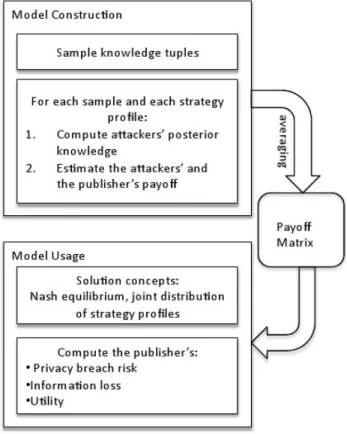
Figure 2: Overview of the strategic model of privacy at-tackers and database publisher.
Given a subgame form constructed as specified above, we are interested in identifying the Nash equilibria (NE).
Definition 1. A strategy profile s∗ is a Nash equilibrium
if no unilateral deviation in strategy by any single player is beneficial for that player given the others’ designated strategies. That is,∀i, s0
i∈Si. ui(s∗i, s∗−i)≥ui(s0i, s∗−i).
If all agents play pure (non-probabilistic) strategies in
s∗, thens∗is apure-strategy NE(PSNE).
Definition 2. Playeri’sregret,²i(s), represents the
maxi-mum gain in payoffican obtain through unilaterally recon-sidering its own strategysigiven others’ strategiess−i.
²i(s) = max s0
i∈Si
ui(s0i, s−i)−ui(si, s−i).
A profile’s regret²(s)is defined as
²(s) = max
By these definitions, if profile s∗is an NE, strategys∗
i
is playeri’sbest responseto others’ plays∗
−iand therefore
induces zero regret (²i(s∗) = 0). All else equal, profiles
with zero (or small) regret are considered more likely to be played by rational agents, as high-regret profiles offer some agent a large incentive to deviate. Thus, a database pub-lisher may wish to choose a designsd that performs well
when attackers follow equilibrium strategies conditional on that design. Figure 2 summarizes the game-theoretic mod-eling and analysis process as applied to our data privacy attack scenario.
6 Illustrative example and analysis
In this section we present a toy example illustrating how our game model can be used to analyze a privacy-preserving publishing scenario.
6.1 Example
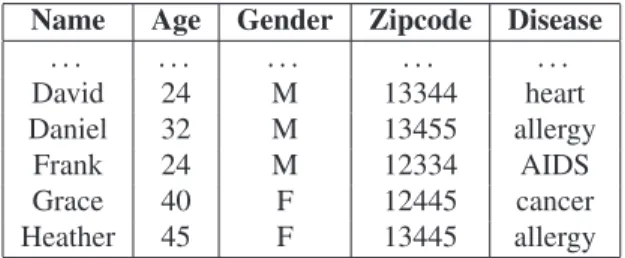
The original data set D for our example comprises the records in Figure 1(a), plus the set of records specified in Figure 3.
Name Age Gender Zipcode Disease
. . . .
David 24 M 13344 heart
Daniel 32 M 13455 allergy
Frank 24 M 12334 AIDS
Grace 40 F 12445 cancer
Heather 45 F 13445 allergy
Figure 3: Additional records appended to Figure 1(a) to define the original data setDfor the example.
There are three attackers (n = 3) in this example who are interested in identifying Alan’s disease. Moreover, it is common knowledge that each person’s disease can be either heart, allergy, AIDS, cancer, or flu. Although this would never be the case for realistic data sets, our toy ex-ample is sufficiently small that we can exactly account for all possible background knowledge instances in all three categories. In this case, there are four instances of typeL, and nine each of typesKandM. We further restrict that each attacker initially starts with only one instance of each category, which means|Li|=|Ki|=|Mi|= 1. The
dis-tribution of prior background knowledgeβ draws a fact in each category with equal probability for each attacker.
Given this configuration of prior knowledge, an attacker needs to decide whether or not to share her available fact for each knowledge category. We assume that attackers make this decision unconditional on the particular fact drawn for the respective categories, which results in a total of eight possible strategies. For example, one possible strategy is to share one’sLandKfacts, but not theM fact.
The database publisher’s strategysd can be represented
by a ten-element array of equivalence-class indices,
follow-ing the format described in Section 4.4. The strategy spec-ifies to which class each record belongs as a result of the publisher’s data generalization method.
Since there are too many possible publisher actions (168,440 even for this small data set) to evaluate them all, we identified a select set of ten candidate strategies, spread out in the design space. We deliberately selected these ten candidates from a set of more than a hundred designs sam-pled from the publisher’s strategy space, to ensure that in-formation loss is spread relatively uniformly over the possi-ble range. For each design, we constructed the correspond-ing normal-form information-sharcorrespond-ing subgame, uscorrespond-ing the procedure detailed in Section 5.1. Our Monte Carlo budget wasH = 5000, a sufficient number of samples to render negligible the variance in expected payoff calculations for the attackers.
For each profile of attacker strategies, we record the at-tacker payoffs as well as the probability of privacy breach. From this we can calculate database publisher’s utility us-ing Equation (1). We set the publisher’s tradeoff weight
w= 0.25, implying that the publisher values lowering the probability of privacy breach by a given increment three times as much as lowering information loss by that same increment on the specified scale.
6.2 Empirical results
For each publisher strategy, we evaluate the outcome achieved under three different assumptions about attack-ers’ behavior:
Scenario Assumption
No No attackers share any information. NE Attackers play a PSNE profile.
All All attackers share all information.
The No scenario is a best-case assumption: attackers are unable or unwilling to share information, for what-ever reason, thus they attack based only on their individ-ual information. Allis the worst-case scenario for the pub-lisher. UnderNE, the attackers are treated as rational strate-gic players, predicted to play an equilibrium profile of the information-sharing subgame. In general these subgames may have multiple equilibria. Our analysis identifies all the PSNE, and defines theNEscenario as an equiprobable selection among these.
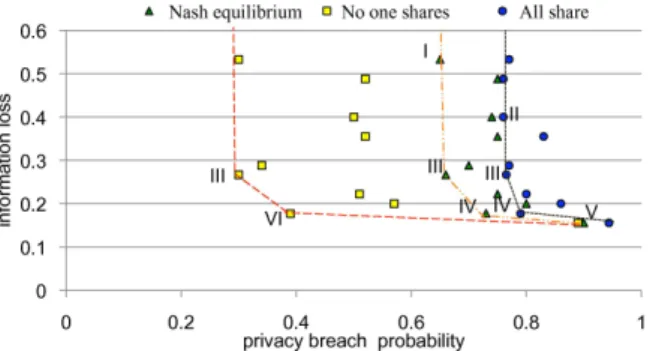
Figure 4 presents the information loss and expected pri-vacy breach for each of the ten selected publisher strate-gies, under each of the attacker behavior assumptionsNo, NE, andAll. Since information loss does not depend on the attackers’ actions, a given publisher action is repre-sented by three points at the same y-axis level, associated with the respective attackers’ behaviors. The separation of these points on the x-axis confirms that attackers’ behavior in equilibrium is generally different from all-or-none infor-mation sharing.
Figure 4: Expected privacy breach and information loss un-der various generalization actions and attacker behaviors.
is worse on both information loss and privacy breach than some other available publisher strategy or convex combi-nation of strategies, under the same assumption on attacker behavior. Accordingly, in the figure we draw piecewise-linear curves for each attacker scenario, connecting the frontier of non-dominated publisher strategies. Given any weight parameter for publisher utility (1), the optimal gen-eralization design (among the ten evaluated here) lies on this non-dominated frontier. We label the non-dominated actions with roman numerals.
As expected, generalization actions that induce greater information loss generally partition the original data set into fewer groups and/or generalize more records in the same group. For instance, action I partitions the original ten records into two groups of three and seven, whereas action V divides them into four smaller groups.
The distinction in composition and shape among the frontiers for the three behavior scenarios confirms the pos-sibility that the publisher’s optimal choice will be different under the respective assumptions. For instance, a publisher that pessimistically assumes that all attackers share infor-mation (All) may pick action II. However, this strategy is dominated under theNEorNoassumptions.
Figure 5: Database publisher’s utility (w = 0.25) under different generalization actions and scenarios for attackers’ behavior.
Given a particular weight for trading off information loss
and privacy risk, we can identify the publisher’s optimal choices. Figure 5 plots the publisher’s utility for its non-dominated actions, at tradeoff weightw= 0.25, under each of the attacker behavior scenarios. This chart reveals that the worst-case assumption (All) that all share everything in-deed leads to choosing action IV, which is suboptimal un-der theNEmodel.
Like in most multiagent-system models, the solutions generated from our models are sensitive to the choice of attackers’ utility function described in Section 4.2. In par-ticular, higher powers ofµin the attacker’s utility function (i.e., reward dropping off faster than the square of num-ber of successful attackers) may lead to overoptimistic es-timates of the risk of privacy breach. Further, the choice of utility function can vary considerably with specific data publication scenarios.
7 Conclusions and future work
Past research in privacy-preserving data publishing has demonstrated the importance of accounting for an at-tacker’s background knowledge. A variety of generaliza-tion tools have been developed, but at a minimum these still require the database publisher to know the amount of background knowledge available to attackers (3; 15). The presence of multiple attackers with capabilities for pooling background knowledge significantly magnifies this uncer-tainty, absent a model of how attackers will actually share information.
This paper initiates a game-theoretic study of privacy at-tackers as a knowledge-sharing network. Rather than sim-ply guessing about attackers’ information-sharing behav-ior, we propose a grounded framework for reasoning about attackers’ interactions, which in turn assists the data pub-lisher in choosing a generalized data set to publish. Our empirical study demonstrates that attacker incentives (and their resulting behavior) can influence the database pub-lisher’s optimal strategy.
Whereas this paper illustrates the importance of reason-ing about attackers’ incentives when choosreason-ing a data pub-lishing strategy, our initial models by no means cover all attack scenarios. Future work should refine these mod-els based on behavioral observations to enrich the data publisher’s limited information about attackers’ knowledge and behavior.
In addition, representing the full content of attackers’ background knowledge as we did for this initial study will not remain feasible as we scale the resulting model to larger networks of attackers. Thus, it is also important to adopt a more compact representation of background knowledge, such as the quantified summaries of background knowledge proposed by Chen et al. (3) and Martin et al. (15).
accu-rately captured by the model. Graphical multiagent mod-els (GMMs) are designed to support integration of game-theoretic and other sources of knowledge about multiagent behavior (4). Like other graphical models, GMMs also take advantage of locality in agent interactions (e.g., structure in the information-sharing network), and provide a compact representation for efficient computation of joint distribu-tions over agent behavior.
Finally, we are interested in applying a similar frame-work to study privacy protection mechanisms other than generalization (e.g., input and output perturbation tech-niques for statistical databases).
References
[1] Rakesh Agrawal and Evimaria Terzi. On honesty in sovereign information sharing. InTenth Interna-tional Conference on Extending Database Technol-ogy, pages 240–256, Munich, 2006.
[2] Roberto J. Bayardo and Rakesh Agrawal. Data pri-vacy through optimalk-anonymization. In Twenty-first International Conference on Data Engineering, pages 217–228, Tokyo, 2005.
[3] Bee-Chung Chen, Kristen LeFevre, and Raghu Ra-makrishnan. Privacy skyline: Privacy with multi-dimensional adversarial knowledge. InThirty-Third International Conference on Very Large Data Bases, pages 770–781, Vienna, 2007.
[4] Quang Duong, Michael P. Wellman, and Satinder Singh. Knowledge combination in graphical multi-agent models. InTwenty-Fourth Conference on Un-certainty in Artificial Intelligence, pages 153–160, Helsinki, 2008.
[5] Jason Franklin, Vern Paxson, Adrian Perrig, and Ste-fan Savage. An inquiry into the nature and causes of the wealth of Internet miscreants. InFourteenth ACM Conference on Computer and Communications Secu-rity, Alexandria, VA, 2007.
[6] Jens Grossklags, Nicolas Christin, and John Chuang. Secure or insure?: A game-theoretic analysis of infor-mation security games. InSeventeenth International Conference on World Wide Web, pages 209–218, Bei-jing, 2008.
[7] Patrick R. Jordan and Michael P. Wellman. General-ization risk minimGeneral-ization in empirical game models. In Eighth International Conference on Autonomous Agents and Multi-Agent Systems, pages 553–560, Bu-dapest, 2009.
[8] Michael Kearns. Economics, computer science, and policy. Issues in Science and Technology, 21(2):37– 47, 2005.
[9] Michael J. Kearns and Luis E. Ortiz. Algorithms for interdependent security games. Advances in Neural Information Processing Systems, 16, 2004.
[10] Christopher Kiekintveld, Manish Jain, Jason Tsai, James Pita, Fernando Ordóñez, and Milind Tambe. Computing optimal randomized resource allocations for massive security games. InEighth International Conference on Autonomous Agents and Multi-Agent Systems, pages 689–696, Budapest, 2009.
[11] Jon Kleinberg, Christos H. Papadimitriou, and Prab-haka Raghavan. On the value of private information. InEighth Conference on Theoretical Aspects of Ra-tionality and Knowledge, pages 249–257. San Fran-cisco, 2001.
[12] Howard Kunreuther and Geoffrey Heal. Interdepen-dent security. Journal of Risk and Uncertainty, 26: 231–249, 2003.
[13] Tiancheng Li, Ninghui Li, and Jian Zhang. Mod-eling and integrating background knowledge in data anonymization. InTwenty-Fifth International Con-ference on Data Engineering, pages 57–66, Shanghai, 2009.
[14] Ashwin Machanavajjhala, Daniel Kifer, Johannes Gehrke, and Muthuramakrishnan Venkitasubrama-niam.l-diversity: Privacy beyondk-anonymity.ACM Transactions on Knowledge Discovery from Data, 1 (1), 2007.
[15] David J. Martin, Daniel Kifer, Ashwin Machanava-jjhala, Johannes Gehrke, and Joseph Y. Halpern. Worst-case background knowledge in privacy. In
Twenty-Third International Conference on Data En-gineering, pages 126–135, Istanbul, 2007.
[16] James Pita, Manish Jain, Janusz Marecki, Fernando Ordóñez, Christopher Portway, Milind Tambe, Craig Western, Praveen Paruchuri, and Sarit Kraus. De-ployed ARMOR protection: The application of a game theoretic model for security at the Los Angeles International Airport. InSeventh International Con-ference on Autonomous Agents and Multiagent Sys-tems, pages 125–132, Estoril, Portugal, 2008.
[17] Latanya Sweeney. k-anonymity: A model for pro-tecting privacy. International Journal of Uncertainty Fuzziness and Knowledge-based Systems, 10(5):557– 570, 2002.