Separating Interleaved HTTP Sessions Using a Stochastic Model
Marko Poženel, Viljan Mahniˇc and Matjaž Kukar Faculty of Computer and Information Science University of Ljubljana
Tržaška cesta 25, SI-1000 Ljubljana, Slovenia
E-mail: {marko.pozenel, viljan.mahnic, matjaz.kukar} @fri.uni-lj.si Corresponding author: [email protected]
Keywords:Markov model, clickstream analysis, Web user behavior
Received:October 30, 2009
We describe a novel method for interleaved HTTP session reconstruction based on first order Markov model. Interleaved session is generated by a user who is concurrently browsing a web site in two or more web sessions (browser windows). In order to assure data quality for subsequent phases in analyzing user’s browsing behavior, such sessions need to be separated in advance. We propose a separating process based on trained first order Markov chains. We develop a testing method based on various measures of reconstructed sessions similarity to original ones. We evaluate the developed method on two real world clickstream data sources: a web shop and a university student records information system. Preliminary results show that the proposed method performs well.
Povzetek: V ˇclanku predstavljamo metodo za razpletanje prepletenih HTTP sej s pomoˇcjo markovskega modela.
1 Introduction
In the past decades World Wide Web (WWW) has become one of the main sources of information. It has enabled unprecedented exchange of data between different parties. Companies need web sites to reach customers and sell their products, institutions furnish information about their ser-vices, individuals can effectively access various services over Internet. With the growing number of web pages and documents, web sites are coping with stronger com-petition. It is difficult to attract new customers and retain the existing ones. Under such circumstances only the web sites that understand the needs of their customers will pre-vail. Analysing users’ behavior has become an important part of web page data analysis. Clickstream data repre-sent the main data source for the analysis of user behavior (11). A sequence of clicks that a user makes while brows-ing through a website is called a clickstream. Analysis of web data such as clickstreams entails certain problems with availability and quality of data (7).
Data about behaviour of web site visitors have become one of the most important sources of information in most web-aware companies. They play an important part in daily transactions and important business decisions. It is essen-tial to get reliable data analyses, which require both appro-priate methods and data. The quality of the the patterns discovered in data analysis depends on the quality of the data on which data mining is performed. Auser sessionis represented by one visit of a user to a web site. For better web usage mining results we need reliable sessions. Click-stream data from a normal website are noisy, page events
are often not explicitly linked to page requests. The pre-processing phase is therefore prone to errors. Although many methods for sessions reconstruction have been de-vised (1; 13), reliable session reconstruction still remains a challenge.
Especially really interested and capable users often browse the same web site with multiple browser windows opened. In each web browser they perform actions to com-plete a certain task. Typically, users switch between brows-ing tasks so that they work on a task only for a certain time period. Even if only one user is currently active, we ac-tually have concurrent sessions, each for one web browser window (i.e. task). In a web server log file all concurrent sessions will be seen as a single long session. We call such sessionsinterleaved sessions. They cannot be easily sep-arated without some kind of context help. Such sessions have negative effect on data quality so we have to deal with the issue. We have three choices: (i) neglect the problem, (ii) simply abandon such sessions, (iii) try to separate them. The first choice is bad for data quality since such sessions can affect web usage analysis results. If we abandon such sessions we also abandon useful knowledge about web site usage. Such sessions are usually generated by advanced users whose behaviour colud be potentially extremly valu-able to us. Therefore we decided to develop a method for separating interleaved sessions.
in Web mining, with the only exception being Viermetz et al. (14) who use an entirely different approach based on building a clicktree. This clicktree contains all possi-ble paths a user could have taken through a website map. While their approach is dedicated to better understanding of actual user behavior, our approach is focused on separa-tion process. Based on training first-order Markov model on validated (clean) sessions, our approach is very effective in deinterleaving process (with linear complexity). We in-troduce a special purpose methodology for evaluation of separation process, evaluate our method on clickstreams from different sources, and present preliminary results.
2 Methods
2.1 Clickstream
In order to attract more visitors to our web site we have to know who our visitors are, what they do on our site, and what they would like to be changed. A great aid in achiev-ing this goal is clickstream data. Clickstream is a sequence of clicks or pages visited as a visitor explores a particular Web site. Clickstream data are often large, inadequately structured, and show incomplete picture of users’ activity. For example, server side log data do not involve browser and e.g., network caching (’Back’ browser actions or re-questing pages in intermediate server’s cache) (7).
Clickstream data needs to be gathered, preprocessed and cleaned prior to the analysis. This step depends on the type and the quality of data. Work done in this phase affects the quality of results of further analyses.
The basic form of clickstream data from a Web server is stateless – no session identifier is logged. This is the consequence of the fact that the HTTP protocol is state-less. Each line in the log file shows an isolated resource retrieval event, but does not provide a link to other events in a user session. Since we are interested in all user actions in a certain period of time, we have to gather all individual events in a user session. The process is called sessioniza-tion. Without some context help it is hard or impossible to reliably identify complete user session. Berendt et al. (1) report that these sessionization tools are based on heuristic rules and assumptions about the site’s usage and are there-fore prone to errors.
2.2 Discrete Markov models for clickstream
analysis
Markov chain is defined as follows. We havea set of states
S = {s1, s2, ..., sN}, where N denotes the number of
states. The process starts in one of the states and moves forward from one state to another at regularly spaced dis-crete times. For example, the chain is currently in the state
si and it moves next to sj with thetransition probability pij. The starting state is defined by a probability
distri-bution. We denote the steps in which the process changes
states ast= 1,2, ...nand the state at timetasqt.
Associ-ated with each state is a set of transition probabilitiespij,
where
pij =P(si →sj) =P(qt=sj|qt−1=si) (1)
that is, given the present state, the future and the past states are independant. This paper focuses on time-homogenous Markov chains, in which
∀t:P(qt+1=si|qt=sj) =P(qt=si|qt−1=sj) (2)
for all t, meaning that the transition probabilities do not change with time. We restrict our discussion to Markov chains defined on a finite state-space. The probability of transition between states in a single step can be written as
transition probability matrixT:
T =
p11 · · · p1N
..
. . .. ...
pN1 · · · pN N
, X
j
pij = 1 (3)
The final parameter of a Markov chain is thestarting state, which can either be a predefined fixed state or can be cho-sen from a probability distribution on a set of states given in the form of a probability vectorπ,
π= (π1, π2, π3, . . . , πN) (4)
whereπidenotes the probability that statesiis initial and N denotes number of states.
πi=P(q1=si),1≤i≤N (5)
Given a sequence of states(q1, q2, . . . , qk)we can calculate
the probability of the sequence by multiplying the probabil-ity of the initial stateP(q1)with the probability of
transi-tions to the successive state as follows:
P(q1, q2, . . . , qk) =P(q1)·
k
Y
i=2
P(qi−1→qi) (6)
In the first-order Markov chain the next step depends only on current state. If the step depends on the current and the previous state, we get a somewhat more complicated second-order Markov model. Its states correspond to all possible pairs of actions that can be performed in a se-quence. We can generalize this approach to the Kth-order Markov model, which computes the predictions by look-ing at the lastKactions performed by the user, leading to a state-space that contains all possible sequences ofK ac-tions (6).
2.3 Related work
Colley et al. (3) proposes a series of steps for data pre-processing for web usage mining. These include data cleaning, user identification, session identification and data formatting. Zhang et al. (13) improved statistical-based time oriented heuristics for the reconstruction of user ses-sions. They used statistical analysis and usage mining tech-niques to improve time-oriented heuristics. Ting et al. (11) developed the Pattern Restore Method (PRM) algorithm, which attempts to reconstruct missing server-side click-stream data based on referring site information and the Website’s link structure. Berendt et al. (1) used the web site structure to reconstruct incomplete sessions.
Markov models have also been used in the clickstream analysis area. Many approaches have been proposed. In (2) the authors primarily focus on visualization aspects of website navigation patterns. Model-based clustering (using finite mixtures of Markov models) is used to assign users to clusters. Sarukkai (10) employs Markov chains to both predict the most likely sites that a user will visit next and generate tours (sequences of websites) that a user might be interested in according to his or her current browsing history. The model can be continuously updated with data provided by new users of the websites it covers.
In (6) authors look at the ways of reducing the state-space complexity of higher order Markov models, while re-taining their high coverage. This is achieved by first build-ing a full model from some of the trainbuild-ing data, then prun-ing it with the rest. The results show that these methods can greatly reduce the state-space complexity while generally improving its accuracy. Ypma and Haskes (12) expanded the work done by Cadez and Heckerman by using mixtures of Hidden Markov models. This enabled them to process the dataset without first grouping actual URI requests into page categories. Their work shows that even without ar-tificially categorized webpages, a mixture of HMMs will generate classes of pages with similar characteristics.
2.4 Separating interleaved sessions with
Markov model
The process of separating interleaved sessions is one of the phases in data pre-processing. First, clickstream data has to be cleaned and sessionized. We refer to sessions, that have been restored without deficiencies, asclean ses-sions. Durring the sessionization process we detect inter-leaved sessions which we cannot separate at that time ei-ther by using some background knowledge, or by applying a pre-trained Markov model (MM). Interleaved sessions are separated from clean sessions and are additionally pro-cessed. The separation process is based on stochastic meth-ods which have been used to solve some other issues related to cliskstream. Because of generality and simplicity we de-cided to use first-order Markov model. We build a Markov model and train it with data from clean sessions. Train-ing proceeds as follows. If there is a transitionsi →sjin
training data, the frequency counternij is incremented by
one. We can use last pre-processing clean sessions or clean
sessions from last few pre-processings. Trained markov model is then used to separate interleaved sessions. In case of more than two interleaved sessions only the first one is considered as clean, and the second one is submitted to fur-ther separation. This results in more reliable pre-processed user behavior data. The last step in a analysis is evaluation of separated sessions with several methods.
For separating interleaved sessions we use a trained first-order MM. We utilize site map data as background knowl-edge. Site map consists of links between pages that are ex-plicitly connected with hyperlinks. A link between pages
S1 andS2in a site map means higher prior probability of
transition between these two pages than if there were no link in a site map. When we train the MM we also use the web site map. Based on links between page sites we calcu-late initial transition probability between pagesp(0)ij , where
i,jdenotes source and target state. Formula for calculating
p(0)ij :
p(0)ij = 1−P
(ij)
A (N−nt)
nt , nt≥1 (7)
wherej denotes all states that are connected to statei,N
denotes number of states,ntnumber of outgoing links from
state i1 andP(ij)
A = 1/N2 an uninformed probability of
transition between any two states. If there is no connection betweeniandj, probabilityPA(ij)is assigned. Parameter
PA(ij)determines the prior probability of transition between arbitrary two pages in the site map.
Let each session be represented as sequence of pages
S = {q1, q2, . . . qn} wheren denotes length of session. q1denotes the entry page andqnthe last page the user
vis-ited in this session. For a transition from qi−1 = sj to qi =sk, training data site map data can be combined with
m-estimate(5):
P(sj→sk) =pjk=
(njk+mp(0)jk)
nj+m (8)
wherenjkdenotes number of transitions from statejtok,
which we got from training data.nj is number of visits of
statej. mdenotes the weight which presents the ratio be-tween prior (web site map) and posterior knowledge. p0
jk
denotes transition probability based on web site map. Pa-rametermrepresents the importance rate of prior knowl-edge. The higher them is, the more important the prior knowledge is. Ifm = 0, then we completly neglect the meaning of prior knowledge. In that case m-estimate con-verts to relative frequencypjk=njk/nj.
2.5 The separation process
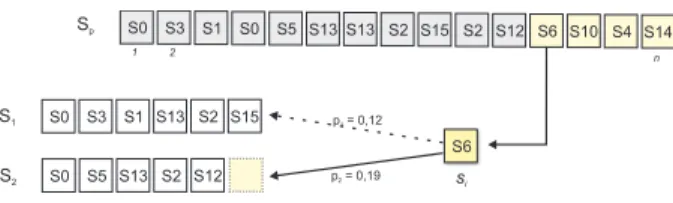
Separating interleaved session is based on a fact that a tran-sition between sitesqi →qi+1is more likely to belong to
one of the consisting sessions. If we have interleaved ses-sionSp = [q1, q2, . . . , qn]that consists of two clean
ses-sions lengthn1andn2, wheren1+n2=n. The number of
possible different separations isC =¡n1+n2
n1
¢
=¡n1+n2
n2
¢
. Let us say that the last page of the first session that we al-ready managed to separate isS1i. Similarly for the second
session we denote the last page asS2i. For each pageSiin
an unprocessed interleaved session, we check what is the transition probability from last page of separated session to current pageSi. IfP(S1i →Si)> P(S2i →Si)we add
pageSito the first separated session, otherwise to the
sec-ond one. Until both of the separated sessions get the first element (entry page), we have to check whetherSi is an
entry page for second session. Separating process can be seen on Figure 1.
Sp S0 S3 S1 S0 S5 S13 S13 S2 S15 S2 S12 S6 S10 S4 S14
S0 S0 S3 S5 S1 S13 S13 S2 S2 S12 S15 S6
p = 0,121
p = 0,192
S2 S1
1 2 n
si
Figure 1: Figure shows simple process of separating inter-leaved session.
2.6 Evaluation of separating process
Separated sessions needs to be evaluated to see how suc-cessful our method was. Each session is represented as a sequence of pages. Evaluating quality of separated sessions can be viewed as evaluating their similarity. Determining the similarity between sequences is one of the basic tasks in machine translation as well as in computational biology (8). Basically, two sequences are more similar if they have more symbols in common and the symbols’ order is similar. There are many methods of measuring similarity between two sequences. We use several more or less strict meth-ods based on: perfect match, Levenshtein distance, longest common subsequence (LCS) and weighted longest com-mon subsequence (9).
Perfect matchis a simple method where only sequences
that perfectly match contribute to the end result.
Alternative approach to measure sequence similarity is based on sequence distance, namededit distance. The dis-tance between two sequences is defined as the smallest sum of edit operations’ costs that transforms one sequence to another. If we have only three edit operations: inserting, deleting and swapping symbols, and all have the cost of 1, we getLevenshtein distance.
A sequenceZ = [z1, z2, ..., zn]is a subsequence of
an-other sequence of sequenceX= [x1, x2, ...xm]if there
ex-ists a strict increasing sequencei1, i2, ...ik inX such that
for allj = 1,2, ..., kwe have xij = zj (4). If we have
sequencesX andY, the longest common subsequence of
X andY is a common subsequence with the maximum length. The longer the common subsequence, the more two sessions are similar to each other. One advantage of LCS is that it does not require consecutive matches but
isequence matches that reflect level element order as n-grams. Deficiency of LCS is that it only counts the main in-sequence elements. Other common subin-sequences are not reflected in a result (8). We estimated these methods are apropriate for evaluation of separating process.
We can improve LCS method to differentiate LCS in re-lation to other elements in the sequence. Chin et al. (9) called this methodweighted LCS(WLCS). They also pro-pose the use of F-measure to estimate the similarity be-tween two sequences X of length mandY of lengthn. We decided to use F-measure for presenting end results.
3 Materials
3.1 Synthetic data
First we created a test environment that is similar to real one but is not as complex. We checked what is the average HTTP session length on a local web server. For testing we fixed the number of Web pages to 30. We created an artifi-cial web site map that represented links with higher prob-ability. According to the site map we generated a number of sessions that were used for MM training data, and some of them for creating interleaved sessions. After training MM, we applied the process for separating interleaved ses-sions and verified the results. About 48% of interleaved sessions were separated 100% correctly, which encouraged us to proceed to real data.
3.2 Real-world data
We applied the interleaved session separating process on two real clickstream sources. The first clickstream origi-nates from log files of university student records informa-tion system. It has been used by 16 member instituinforma-tions. It has approximately 300 different pages. Each state in MM corresponds to an individual page. Typical user paths are well defined. Users have to be logged on in order to use the system. Sometimes they are logged on with different user roles at the same time, and this creates interleaved sessions. Since users have to be logged on we can always determine the session entry point. The Web server log files use the ba-sic CLF format. Clickstream data was taken for 4 months of use, which resulted in 150.000 user sessions.
0 0.1 0.2 0.3 0.4 0.5 0.6 0.7 0.8 0.9 1
0
10000
20000
30000
40000
50000
Session similarity
Numberofsessions
0 0.1 0.2 0.3 0.4 0.5 0.6 0.7 0.8 0.9 1
0
10000
20000
30000
40000
50000
Session similarity
Numberofsessions
0 0.1 0.2 0.3 0.4 0.5 0.6 0.7 0.8 0.9 1
0
10000
30000
50000
LCS, N = 96655
Session similarity
Numberofsessions
0 0.1 0.2 0.3 0.4 0.5 0.6 0.7 0.8 0.9 1
0
10000
20000
30000
40000
50000
WLCS, N = 96655
Session similarity
Numberofsessions
Figure 2: Results of separating for Student records IS clickstream. R denotes weighted average of session similarities.
0 0.1 0.2 0.3 0.4 0.5 0.6 0.7 0.8 0.9 1
0
5000
10000
15000
20000
Session similarity
Numberofsessions
0 0.1 0.2 0.3 0.4 0.5 0.6 0.7 0.8 0.9 1
0
1000
2000
3000
Session similarity
Numberofsessions
0 0.1 0.2 0.3 0.4 0.5 0.6 0.7 0.8 0.9 1
0
1000
2000
3000
4000
5000
LCS, N = 24730
Session similarity
Numberofsessions
0 0.1 0.2 0.3 0.4 0.5 0.6 0.7 0.8 0.9 1
0
1000
2000
3000
4000
WLCS, N = 24730
Session similarity
Numberofsessions
For both clickstreams we took the same steps as with artificially generated data. Initial clean sessions, used for learning, were generated during the sessionization process of clickstream data. During the sessionization we applied all the neccessary steps in order to remove noisy data. We analysed what a typical user session looks like and removed all sessions that did not meet the rules (e.g. too short or too long sessions). 70% of clean sessions were used as a train-ing set for MM, and the rest were used to generate inter-leaved sessions in order to evaluate the separation process. After separating interleaved sessions we evaluated results with evaluation methods that we presented earlier.
4 Results
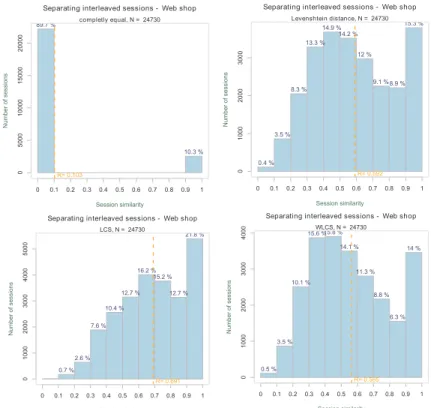
In Figures 2 and 3 we can see graphs for evaluation meth-ods and source of clickstream. Each graph corresponds to one evaluation method. TheXaxis shows intervals for F-measure based similarity and theY axis shows number of sessions that fall in that interval. Figure 2 reports results for student IS clickstream.96655interleaved sessions have been created and separated. On the first graph we see that 43% sessions have been separated 100% correctly (session sequence similarity = 1). This result is much better in com-parison with Web shop. Other three graphs on at Figure 2 depict how well the sessions have been separated accord-ing to evaluation method. LCS and WLCS graphs show that majority of sessions are more than 50% similar to the original ones.
If we look at Figure 3 we see results for Web shop.
24730 interleaved sessions have been created and
sepa-rated. Looking at the first graph in that Figure, one sees how many sessions have been separated 100% correctly. For web shop this percentage is a little more than 10%, which is quite low. However even 10% is better than throw-ing away all interleaved sessions. One of the reasons is that grouping pages together affects the results. Since the site map is larger, there may be numerous user paths, what also affects the results. User can enter the web shop at almost any page, so it is harder to detect where the second ses-sion in interleaved sesses-sion starts. Results on a graph that show LCS seem better, since LCS is a less strict method of evaluation than WLCS.
5 Conclusion
We propose a new method for improving the quality of clickstream data in pre-processing phase that is based on a first-order Markov model. To the very best of our knowl-edge, the Markov approach has not been used for this pur-pose before. Propur-posed method is very effective in deinter-leaving sessions (linear complexity). We present the mo-tivation that led us to implementation and have applied method on two real data clickstreams. The presented sults show that in certain cases method gives promising re-sults. We analysed the domain and detected possible causes
of worse results. In order to minimize method deficien-cies we plan to work on the issues we presented. First we have to improve the method for detecting interleaved ses-sion starting pages. We are also planning to use second-order Markov model and Hidden Markov Model (HMM) for separating process.
References
[1] Bettina Berendt, Bamshad Mobasher, Miki Naka-gawa, and Myra Spiliopoulou. The impact of site structure and user environment on session reconstruc-tion in web usage analysis. In WEBKDD - KDD
Workshop on Web Mining and Web Usage Analysis,
pages 159–179, 2002.
[2] Igor Cadez, David Heckerman, Christopher Meek, Padhraic Smyth, and Steven White. Model-based clustering and visualization of navigation patterns on a web site.Data Min. Knowl. Discov., 7(4):399–424, 2003.
[3] Robert Cooley, Bamshad Mobasher, and Jaideep Sri-vastava. Data preparation for mining world wide web browsing patterns. Knowledge and Information Sys-tems, 1:5–32, 1999.
[4] T. H. Cormen, C. E. Leiserson, and R. L. Rivest.
Introduction to Algorithms. The MIT Press and
McGraw-Hill Book Company, 1989.
[5] S. Džerovski, B. Cestnik, and I. Petrovski. Using the m-estimate in rule induction.J. Comput. Inf. Technol., 1(1):37–46, 1993.
[6] Mukund Deshpande and George Karypis. Selective markov models for predicting web page accesses.
ACM Trans. Interet Technol., 4(2):163–184, 2004.
[7] Ron Kohavi. Mining e-commerce data: The good, the bad, and the ugly. In Foster Provost and Ramakr-ishnan Srikant, editors, Proceedings of the Seventh ACM SIGKDD International Conference on
Knowl-edge Discovery and Data Mining, pages 8–13, 2001.
[8] G. Leusch, N. Ueffing, and H. Ney. A novel string-to-string distance measurewith applications to machine translation evaluation. InIn Proceedings of MT
Sum-mit IX, pages 240–247, 2003.
[9] C-Y. Lin and F. J. Och. Automatic evaluation of ma-chine translation quality using longest common sub-sequence and skip-bigram statistics. In ACL ’04: Proceedings of the 42nd Annual Meeting on
Associa-tion for ComputaAssocia-tional Linguistics, page 605,
Morris-town, NJ, USA, 2004. Association for Computational Linguistics.
[10] R. R. Sarukkai. Link prediction and path analy-sis using markov chains. In Proceedings of the 9th international World Wide Web conference on Computer networks : the international journal of
computer and telecommunications netowrking, pages
[11] I-Hsien Ting, Chris Kimble, and Daniel Kudenko. A pattern restore method for restoring missing patterns in server side clickstream data.Lecture Notes in
Com-puter Science, 3399:501–512, March 2005.
[12] Alexander Ypma and Tom Heskes. Automatic cate-gorization of web pages and user clustering with mix-tures of hidden markov models. InWEBKDD, pages 35–49, 2002.
[13] J. Zhang and A.A. Ghorbani. The reconstruction of user sessions from a server log using improved time-oriented heuristics. InCommunication Networks and Services Research, 2004. Proceedings. Second
An-nual Conference on, pages 315–322, May 2004.
[14] M. Viermetz, C. Stolz, C. Gedov, and M. Skubacz. Relevance and Impact of Tabbed Browsing Behavior on Web Usage Mining. InWeb Intelligence, 2006. WI 2006, 2006. Proceedings. IEEE/WIC/ACM