Web-enabling Cache Daemon
for Complex Data
Ivan Voras and Mario
Zagar
ˇ
Faculty of Electrical Engineering and Computing, University of Zagreb, Croatia
One of the most common basic techniques for improving the performance of web applications is caching fre-quently accessed data in fast data stores, colloquially known as cache daemons. In this paper we present a cache daemon suitable for storing complex data while maintaining fine-grained control over data storage, re-trieval and expiry. Data manipulation in this cache daemon is performed via standard SQL statements so we call it SQLcached. It is a practical, usable solution already implemented in several large web sites.
Keywords: web cache, data cache, database cache, SQL, database, memory database
1. Introduction
A quick survey (which does not attempt to
be comprehensive) of Internet’s most popular “generic” web applications and high-volume dynamic web sites confirms that most of them rely extensively on data cache daemons to help them achieve their high performance1. The re-sults of this survey(from October 2007)are in Table 1.
We also observe that all of these web sites except Google use some of the rapid web application development languages and frameworks such as PHP, Python or Ruby, and have begun to rely on advanced caching techniques to maximize their performance. The popularity ofMemcachedin this survey, used by most large web sites with-out a major corporate backing, can be easily explained by the fact that it was the first Open
Web site Cache engine used
Slashdot
(http://slashdot.org) memcached[1]
Wikipedia
(http://wikipedia.org) memcached[1]
LiveJournal
(http://livejournal.com) memcached[1]
SourceForge
(http://sourceforge.net) memcached[1]
(http://google.com) BigTable[2]
YouTube
(http://youtube.com) BigTable[2]
Table 1.Survey of cache engine usage on large Internet web sites.
Source cache daemon to provide generalized and consistent interfaces to most popular pro-gramming languages.
Out of a need to to increase performance in a complex web application developed at our Faculty2, we first created a cache layer based on Memcached, with which we observed sig-nificant performance improvements. However, during the implementation and usage we found that many common operations were not per-formed efficiently. These operations included: complex conditional data retrieval, complex cache expiry rules, and reduced need for se-rializing and unsese-rializing data to and from strings. The lack of flexibility in the imple-mented solution (which only offers a simple key-value database)led us to consider a
differ-1Note that this is different from generalized “HTTP cache” and "web acceleration" applications which cache resulting HTML and other content and act as a "black box" between the web server and its end users.
ent approach. Finally, a project was started to implement a new cache daemon which could provide these features in a uniform and con-sistent way, with server-side implementation of most of the complex rules. The result was the
SQLcached, whose architecture and implemen-tation we present in this paper.
2. Data Caching in Currently Common Web Applications
The basic idea behind using cache daemons in web applications is to skip repetitive CPU- and IPC- intensive steps by generating data only once and then storing it in a high-performance cache store, from where it can be retrieved as needed. A very common application of this idea is skipping the repetitive execution of complex or large SQL queries by integrating a cache layer between the web application and the database interface (library). This cache layer will com-monly check if the result of the passed SQL query exists in the cache and if it does, it will return the data directly from the cache instead of passing the query for execution to the database. In this simple form, the simplest kind of directly addressable data store is enough to satisfy the required functionality.
Common web cache daemons are essentially memory databases that offer a simple interface for storing and retrieving key-value records, with some “bonus” features like simple arith-metic operations (increment and decrement) for well-formed numeric values in the cache, simple atomic operations (get- and set-if-not-changed) and data expiry (an optional expiry timestamp attached to each key-value pair). A typical cache layer in web applications builds a key-value pair by hashing SQL query strings to form the key string and serializing database results to form the value string. Since the cache daemon often implements data expiry directly, it is enough for the application to check if the hashed SQL string exists in the cache and then either return the cached result (if it exists), or execute the query, store the result in the cache, and then return it.
2.1. Design ofMemcached
One of the most common cache daemons in
use on the web is Memcached, whose design
is classical and straightforward. Since it’s in-fluenced the creation of SQLcached, we will present some of its major features here.
The architecture of Memcached makes it very efficient in the common case[3]. The cache dae-mon is implemented as a single executable that is resident (as its name implies) as a daemon process on a network-enabled server. It is cre-ated in C for POSIX environments and is most commonly deployed on Linux and other Unix-like operating systems. Applications commu-nicate with the cache daemon using a simple text-based protocol (modelled after early TCP
protocols like SMTP) which is implemented
over TCP or UDP, with the TCP version be-ing preferable. This protocol is easily imple-mented in practically any programming lan-guage, which has greatly helpedMemcached’s popularity. The cache daemon uses a low-latency, asynchronous method of acquiring and handling network connections. The data store
(key-value pairs) is organized as a dynami-cally sized hash table structure optimized for fast reading. The hash table size can only be increased (the condition for this is when the number of items in any hash bucket gets larger than two thirds of the base-two logarithm of the number of buckets). Memory for the hash table items is allocated using an internal slab allo-cator [4] whose purpose is to reduce memory fragmentation[5].
Memcachedis a single-threaded daemon which handles network requests sequentially (at any given time, the cache daemon is actively work-ing only on one request). This makes for a simple and efficient implementation, at the ex-pense of not allowing it to scale on multi-CPU systems. However, because the execution of in-dividual requests is very fast and the operating system handles network data transmission asyn-chronously while requests are being executed, the overall performance ofMemcachedis often more than sufficient for its purpose.
2.2. Shortcomings ofMemcached
and the Design ofSQLcached
and speed of operation. The purpose of this pa-per is not to discourage its use, but to point out some additional features that are generally use-ful for applications but which are not addressed inMemcachedand to provide an alternative so-lution that does implement them. These features are:
1. The ability to store complex data without ex-cessive serialization. While some forms of data conversion is always necessary to trans-late the data representation from the one used in the web application(e.g. in PHP) to the one used in the cache daemon, serialization in dynamic languages can be slow. We have observed that in PHP, theserialize()function is 1.5 times slower than a na¨ıve approach when converting simple integer values, and up to 20 times slower when converting sim-ple structures. Our analysis shows that much of this difference results from taking advan-tage of the programmer’s knowledge of data types and structure layouts in the second case, versus the generality of the serialize()
call. This approach cannot be used with a simple key-value database.
2. The ability to retrieve data sets based on complex criteria. Many cache daemons, in-cludingMemcached, offer some way of re-trieving a list of cached data records based on a provided list of keys, but retrieving keys based on a complex criteria such as “wild-card” matching of key strings, retrieving all cache items pertinent to a certain web page ID, etc. is not supported. Due to the inher-ent nature of the storage structure, hash ta-bles(while very efficient at key-value pairs)
cannot support many of the complex queries. 3. The ability to expire data sets based on com-plex criteria. Without additional metadata support, cache record expiry can commonly be performed either per-record (for each record individually)or in bulk (all records at once). Fine grained expiry would allow expiry only of certain data, for example all data pertinent to a web page ID.
4. The ability to do complex operations on the data (both data-processing and algebraic).
This is a non-critical ability and is in any case more a convenience than a necessity. With a complex data model it should be pos-sible to, for example, extend the expiry time
(“time to live”)of cached data items, or up-date only certain portions of the data, further increasing the cache efficiency when there are a lot of cached records or when the data generation is particularly slow.
Many of these features stem from the fact that most modern dynamic web pages are, as a rule, constructed of several individual elements. A simple example is a web page consisting of a header, a footer, a site navigation bar and the contents, each of which may have complex re-lationships with other elements on this and other pages. For example, the page’s header and nav-igation bar can be common for all pages, while the content is changed by the administrators, and the footer contains the timestamp of the last change in the content. Adding a new page to the site means only the navigation bar is changed
(for all pages). To support modern interac-tive sites (let’s call them “Web 2.0” sites, for a lack of a better common name), individual users might have customized views of the same content, multiplying most of the cacheable ele-ments per the number of users.
The lack of fine-grained control over data re-trieval and expiry results in inefficient use of the cache. This inefficiency can be manifested by either of the two following scenarios. First, keeping too much logic and data in the appli-cation to avoid retrieving or expiring too many records is slow if the application is written in an interpreted language, and can result in many IPC calls to the cache to gather all needed data from the cache. Second, by considering the data at a too coarse granularity, keeping it in few large structures which are generated and transferred to and from the cache in bulk, or expiring all data from the cache when a critical piece of user-visible data changes(versus expir-ing only the data pertinent to a certain user or to a certain web page), significant spikes in server load can be observed when new data is gener-ated, which can sometime reduce the beneficial effects of having a cache. In our experience, this latter form of inefficiency is more danger-ous to a smooth user experience(and a smooth and predictable server load).
features can be emulated to an extent by fold-ing data qualifiers into key strfold-ings, which was used by an early version of our web applica-tion. Our experience from the implementation was that such substitute techniques are often difficult to implement and negatively impact the overall performance of the system, as compared to what it could have been without them. This experience has motivated us to seek a different solution for the data cache.
Several different approaches were considered for the improvement of the overall system,among which are: modification ofMemcachedto better suit our data model, creation of a similar cache daemon which allows data to be properly sep-arated into multiple independent domains (that can be expired separately), and creation of a complex caching daemon with the features of generic tabular database.
After weighing the benefits that each approach could bring to the system and the complexities of each implementation, the third option was chosen. Adding special support for our needs to
Memcached would limit its usability when the needs change, and while separating keys into independent domains can help with expiry, re-taining any form of key-value database doesn’t do any help with storage of complex data. After the decision to implement a tabular mem-ory database, we considered an interface to the cache daemon. In the spirit of making it simple, a text interface was chosen. It was soon obvious that the most convenient (and easiest to learn)
interface to the cache engine is a subset of SQL. In order not to duplicate work and create yet another SQL database, it was decided to base the new cache engine on SQLite[6].
3. Implementation of SQLcached
The new cache engine, which we named
SQL-cached, uses SQLite as its underlying stor-age engine. SQLite is a small, embeddable, serverless relational database with an interface that makes it usable for seamless integration into larger applications. At the time of this project’s creation, two SQLite versions were in widespread use: version 2.8.17, a stable and mostly obsolete version, and version 3.3.5, with a newer architecture. Preliminary tests showed a significant difference in performance between
the versions [7] in favour of the older version. Because of this, we have used version 2.8.17.
SQLcachedis written in C and is designed as a daemon process for POSIX environments. Ap-plications communicate with it via either the TCP or the “Unix sockets” interface (both can be used at the same time), using a simple text-based protocol. Network operations (reading, writing and connection handling) are imple-mented in an asynchronous way so that mul-tiple simultaneous connections are handled ef-ficiently, but only one request can be processed at the same time. The asynchronous requests are handled using the standard POSIXpoll()
in-terface. SQLcached can be deployed on more
than one server to create a load-balancing setup.
The network protocol used by SQLcached
of-fers the clients an almost complete set of SQL statements supported by SQLite, including re-lational features like n-way joins(though they may not be directly usable in a cache daemon, for performance reasons).
The SQLite backend is used as a memory-only database, and no data is ever committed to per-manent storage. Indices can be created on ap-propriate database fields to speed up data re-trieval. Both data and index structures are inter-nally stored in dynamically balanced B-trees.
4. SQLcached Features
The following sections describe howSQLcached
implements features enumerated in Section 2.2.
4.1. Support for Storing Arbitrary Data without Excessive Serialization
4.2. Support for Retrieving Data Sets Based on Complex Criteria
The flexibility of SQL allows applications us-ing SQLcached to store and retrieve data us-ing complex criteria. The ability to cache data per-user, per-page or per-application (with the same keys in each of the domains) can have a huge influence on efficiency of the cache layer, which doesn’t have to fold all the data into a sin-gle namespace and can issue relatively complex queries to store and extract only the needed parts of complex structures. It also means that the us-age of SQLcached is not limited to caching of opaque objects such as entire results of database queries, but allows a different approach in which applications can now cache their internal, al-ready processed data. In addition to increasing efficiency and flexibility, this approach opens new possibilities for applications. SQLcached
can be used for operations that would normally overtask the main database due to the high vol-ume of data writes they generate, such as track-ing of individual users’ statistical information and presence (current web page or object they are interacting with).
4.3. Support for Data Expiry Based on Complex Expiry Rules
Data expiry inSQLcachedcan be performed ei-ther automatically or initiated by applications. Automatic data expiry can be triggered by one of three conditions, configurable by the appli-cations: data age, number of records in the table and number of cache operations. Using these conditions, the data cache can be effectively limited in size and remain fresh enough for ap-plications to use.
Applications that need more complex expiry can issue appropriate SQL commands with arbitrar-ily complex conditions, which can (for exam-ple) delete data cached per-user, per-page or per-application.
4.4. Support for Complex Operations on Cached Data
Applications using SQLcached have access to operators and functions supported by SQLite, which include basic arithmetic and
compari-son operators, simple numerical functions(e.g. ABS), data manipulation functions (e.g. UP-PER)and aggregate functions(e.g. MIN, MAX).
5. Usability and Performance of
SQLcached
The proper application of SQLcached in web
application requires a step away from the tra-ditional design where the cache is used as a single-purpose key-value database. Instead, we propose a design where the applications exhibit more fine-grained control over the data and co-operate with the cache daemon to make the best use out of the rich set of features it offers.Using
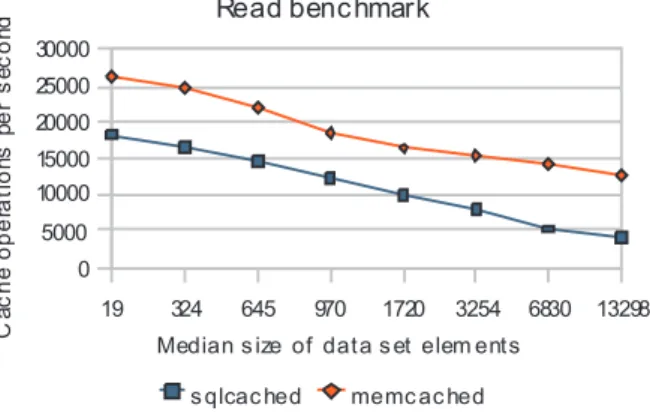
SQLcached as a simple key-value database is suboptimal, as shown in Figure 1, presenting
results of benchmarkingSQLcached and
Mem-cached in a situation where the data records are simple key-value pairs with value sizes con-forming to a geometric distribution3. In case ofSQLcached, a single table was created with three columns: key, value, and time. Analo-gous write benchmarks follow the same trends and relations between the results.
Figure 1.Results of simple key-value read benchmarks.
However,SQLcachedoffers features not present inMemcached, such as fine-grained data expiry. We have performed benchmarks on a data set of 100,000 records in 30,000 pages and 1000 users simulating cached data according to the exam-ple web site described in section 2.24( appropri-ate indexes were creappropri-ated in the cache database schema). Table 2 contains results of forced data
expiry benchmarks. Forced data expiry is fre-quently used when new content is posted which immediately obsoletes previously cached data
(because users want to immediately see the ef-fects of their actions).
Cache daemon operation Time
Memcached
(expire entire set at once) 1000.0 ms
SQLcached
(expire cached data, a single page) 0.2 ms
SQLcached
(expire cached data, a single user) 6.1 ms
Table 2. Effectiveness of fine-grained forced data expiry.
By employing fine-grained expiry of the cached data in the web CMS application used at our Faculty, we have observed up to 30% improve-ment in overall performance at periods of inten-sive content creation and significant reduction of load spikes in IO and CPU on the server, resulting in a more smooth and predictable op-eration. We believe that offloading more data operations from the cache layer in the applica-tion(written in PHP)toSQLcachedcould yield even better results.
6. Conclusion
This paper presented theSQLcachedcache dae-mon, a network-enabled memory database in-tended to be used for caching frequently gen-erated data in web applications. Development of SQLcached was motivated by the desire to increase performance in a real, production web application, in a way that could not be done with the most popular open-source cache dae-mon,Memcached.
SQLcached offers a highly flexible interface to client applications, based on a subset of SQL. This allows applications to perform complex operations on the cached data such as storage, retrieval and data expiry, using complex rules, which results in a more efficient use of the cache. To gain maximum benefits from the advanced features of the cache database, ap-plications using it must be modified not to treat cached data as simple binary strings, but as com-plex objects with arbitrary properties which can be used to increase efficiency. SQLcached is
successfully implemented in our web applica-tion where it has satisfied all our requirements for a flexible cache database.
The source code ofSQLcached is published as Open source and is available athttp://www.sf. net/projects/sqlcached.
7. Acknowledgments
This work is supported in part by the Croatian Ministry of Science, Education and Sports, un-der the research project “Software Engineering in Ubiquitous Computing”.
References
[1] B. FITZPATRICK, “Memcached: users”, http:// www.danga.com/memcached/users.bml,
retri-eved 2007-10-14
[2] Wikipedia, “BigTable”, http://en.wikipedia. org/wiki/Bigtable, retrieved 2007-10-14
[3] B. FITZPATRICK, A. VOROBEY and others: Mem-cached source code, http://www.danga.com /memcached/, retrieved 2007-10-01
[4] J. BONWICK, “The Slab Allocator: An Object-Caching Kernel Memory Allocator”,USENIX Sum-mer 1994 Technical Conference, 1994.
[5] A. VOROBEY, “Memory management”, Memcached technical documentation distributed with mem-cached source.
[6] D. R. HIPP, “SQLite Documentation”, http:// www.sqlite.org/docs.html, retrieved 2007-10-02
[7] I. VORAS, “SQLite: memory: performance dif-ference between v2 and v3”, Public communica-tion (mailing list), archived at http://www.mail-archive.com/[email protected]/ msg14868.html, retrieved 2007-10-02
Received:June, 2008 Accepted:September, 2008
IVANVORASwas born in Slavonski Brod, Croatia. He received B.Sc. in computer engineering(2006)from the Faculty of Electrical Engi-neering and Computing(FER)at the University of Zagreb, Croatia. Since 2006 he has been employed by the Faculty as an Internet Services Architect and is a graduate student(PhD)at the same Faculty, where he has participated in research projects at the Department of Control and Computer Engineering. His current research interests are in the fields of distributed systems and network communications, with a spe-cial interest in performance optimizations. He is an active member of several Open source projects and is a regular contributor to the FreeBSD operating system.
MARIOZˇAGARis a professor of computing at the University of Zagreb, Croatia. He received B.Sc., M.Sc.CS and Ph.D.CS degrees, all from the University of Zagreb, Faculty of Electrical Engineering and Com-puting(FER)in 1975, 1978, 1985 respectively. M.Zagar joined FERˇ in 1977 and since then has been involved in different scientific projects and educational activities.
He received British Council fellowship(UMIST - Manchester, 1983)
and Fulbright fellowship(UCSB - Santa Barbara, 1983/84). His cur-rent professional interests include: computer architectures, design au-tomation, real-time microcomputers, distributed measurements/ con-trol, ubiquitous/ pervasive computing, open computing(JavaWorld, XML,. . .).