45
The Effect Parsley (Petroselinum crispum) Diet on
Receptivity of Does
Martin Fik
Department of Poultry Science and Small Farm Animals, Faculty of Agrobiology and Food Resources, Slovak University of Agriculture, Nitra, Slovakia
Abstract
The aim of the work is focused on parsley (Petroselinum crispum) and the effect on the receptivity in young female
broiler rabbits. Nulliparous females of broiler hybrid HYCOLE (age 4-5 months, weight 3.5-3.8 kg) were used for this experiment. Experiment was conducted twice, in half of November (35 females) and in half of February (36 females). Females were laid individually in cages. Females were fed with granulated feed. Parsley garden (root parsley - 50g / female) was given over three days period (day 1, day 2, day 3). Before and after the experiment we recorded the state of receptivity in females with coloration of vulva. The state of receptivity was determined from 1 for 4 color of vulva. We detected positive state of parsley diet, on the receptivity. In November before the experiment was conducted the average of receptivity was 1.74 and after the experiment it was 2.11. The state of receptivity will be improved in 10 females (28.57 %). The state of receptivity wasn´t changed in 25 females (71.43 %). In February before the experiment was conducted the average of receptivity was 2.13 and after the experiment it was 2.72. The state of receptivity was improved in 18 females (50.00%). The state of receptivity wasn´t changed in 18 females (50.00 %).
Keywords: coloration of vulva, estrus, rabbit, receptivity, parsley.
1. Introduction
In France, today, the fertility (kindling rate) is high (77% on average), but farmers use different hormonal treatments, sometimes combined with other methods not yet validated, such as feed flushing, a short separation between the mother and her litter, vitamin supplements in the drinking water or in food, lighting programs [1]. Receptivity, measured by a test in the presence of a male or by observation of the colour and turgescence of the vulva, reflects the state of oestrus or dioestrus of does at insemination [2,3]. Before artificial insemination, it is necessary to use oestrus synchronization in females. The most common methods of estrogen synchronization
* Corresponding author: Martin Fik,
46 the same experimental conditions, [10] did not show any improvement of fertility when the dose injected increased from 20 to 40 IU. [11, 12] more than 20 years ago, described the disadvantages of using PMSG in rabbit reproduction. [12] states that doses of PMSG on rabbit farms usually exceed the recommended dose. [13] states that the use of exogenous hormones reduces the natural quality of rabbit meat and is contrary to welfare. The influence of the seasons on reproduction of broiler rabbits is described [14]. Non-hormonal alternative methods applied immediately before insemination should be easy to use, inexpensive, compatible with the animal welfare and well adapted to cyclic production. Until recently, different techniques have been tried such as the handling of animals, a short separation of the mother and her litter, feeding programmes, lighting programmes and male proximity. Indeed, the environmental modifications such as the length of daily lighting, temperature, food, stress, auditive or olfactive stimulations can modify the endocrinal balance of the doe and vary the reproductive performance. Indeed, the environment plays an important role in the regulation of the reproductive function via the nervous system and the hypothalamo-pituitary axis [1]. Receptivity is a key element which greatly affects both productive and reproductive traits of rabbit does, so that poor rates of receptive does during insemination result in a less successful insemination process [15]. Stimulation with an increase in pre-mating energy intake has a positive effect on receptivity and fertility on many farm animals, however, food restriction has a detrimental effect on sexual receptivity and litter weight. [16] describes the influence of feed restriction (16-hours feed restriction before AI) for oestrus in nulliparous does of broiler rabbits. Author [17] showed the increased receptivity was observed after the group housing of does (2.74 contra 2.20). The group housing increased the receptivity in 46.88 % of does. The receptivity of 50 % of does remained unchanged and the receptivity of 3.12 % does was reduced. The increased values were observed after hormonal treatment (PMSG) of does (2.30 contra 2.10). The hormonal treatment increased the receptivity in 21.59 % of does. The 76.14 % of does remained unchanged and the receptivity of 2.27 % of does was reduced. [18] proved the continuity of coloration of the rabbit female's vulva and the
47 refuse to refuse the male will begin to be receptive after parsley diet. In recent years, great efforts have been made to find alternative methods of synchronizing rabbit oestrus.
The aim of the work is focused on parsley
(Petroselinum crispum) and the effect on the
receptivity in young female broiler rabbits.
2. Materials and methods
The experiments were carried out under the conditions of a private rabbit farm. The females were housed (one per cage) in a hall with a partially controlled microclimate. Photoperiod mode was natural. We used nulliparous females of broiler hybrid Hycole (age 4-5 months, weight 3.5-3.8 kg). Experiment was realized twice, first in half of November (35 females), second in half of February (36 females). Fresh parsley (roots only) was added for three consecutive days (50 g per
female). Before and after (day 1; 2 and 3)
experiment with the addition of parsley
(Petroselinum crispum) to the feed dose of the
does we detected state of receptivity in females with coloration of vulva. The state of receptivity was determined from 1 for 4 colour of vulva. (Table 1).
Table 1. Distribution of state receptivity
The status of the vulva receptivity Description
signs of receptivity
Anemic not swollen vulva 1
Slightly swollen pink vulva 2
Markedly swollen red vulva 3
Markedly swollen violet vulva 4
The observed results were statistically processed by using the program Microsoft Excel and differences between groups were compared of paired t-test.
3. Results and discussion
A positive effect (on receptivity does) of the
addition of parsley (Petroselinum crispum) to the
feed dose of the females was found. In November
before experiment was average of receptivity 1.74, after transport 2.11. - In November before the experiment was conducted the average of
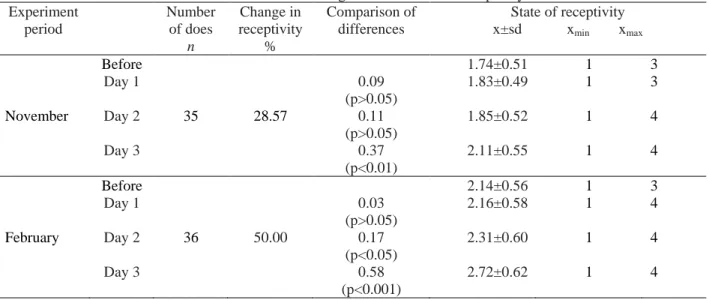
receptivity was 1.74 and after the experiment it was 2.11. The state of receptivity will be improved in 10 females (28.57 %). The state of receptivity was improved in 10 females (28.57 %). The state of receptivity wasn´t changed in 25 females (71.43 %). In February before the experiment was conducted the average of receptivity was 2.13 and after the experiment it was 2.72. The state of receptivity will be improved in 18 females (50.00 %). The state of receptivity wasn´t changed in 18 females (50.00
%). The results are shown in Table 2.
48 Gosalvez and collaborators [31] improved the percentage of ovulating does (at the age of 17 weeks) after flushing, 4 days before LHRH injection. Brecchia and collaborators[32] studied the effects of 24 and 48 hours of fasting followed by a stimulation that consisted in feeding the does again 2 hours before insemination. When comparing with controls fed ad libitum, the food
flushing was not sufficient to improve the reproduction performances of the does. On the physiological level, these authors showed that this food programme reduced the expression of the oestradiol-17b receptors in the hypothalamus-pituitary complex, the frequency and amplitude of oestrogen secretion, LH peak and leptin concentration in the plasma.
Table 2.Results of changes in rabbit female receptivity Experiment
period
Number of does
n
Change in receptivity
%
Comparison of differences
State of receptivity x±sd xmin xmax
Before 1.74±0.51 1 3
Day 1 0.09
(p>0.05)
1.83±0.49 1 3
November Day 2 35 28.57 0.11
(p>0.05)
1.85±0.52 1 4
Day 3 0.37
(p<0.01)
2.11±0.55 1 4
Before 2.14±0.56 1 3
Day 1 0.03
(p>0.05)
2.16±0.58 1 4
February Day 2 36 50.00 0.17
(p<0.05)
2.31±0.60 1 4
Day 3 0.58
(p<0.001)
2.72±0.62 1 4
Before - before the addition of parsley
Day 1 - Day 1 after the addition of parsley Day 2 -Day 2 after the addition of parsley Day 3 - Day 3 after the addition of parsley
4. Conclusions
Biostimulation is a non-hormonal and practical technique that has not yet been widely utilised when applied immediately before insemination to improve reproductive efficiency in does. This results also support the notion that biostimulation protocols might enhance or strengthen the results of routine PMSG injection on receptivity of does. This study provides more light on the complexity of doe receptivity without hormonal treatment.
The observed differences were statistically significant (November p<0.01; Februar p<0.001).
Based on the results we can recommend this method especially for smaller breeds of rabbits.
Acknowledgements
This work was financially supported by the project VEGA 1/0511/15 and VEGA 1/0625/15.
References
1. Theau-Clément, M., World Rabbit Sci., 15, 2007, 61 – 80
2. Moret, B., Comportement d’oestrus chez la lapine. Cuniculture n°33, 7, 1980, 159-161.
3. Gosalvez, L.F., Rodriguez, J.M., Diaz P. Comportamiento sexual de la coneja en post parto.In Proc.: X Symposium Cunicultura, Barcelona, 1985, 29-43.
4. Maertens, L., Luzi, F., Zapletal, D., Vplyv aplikace některých exogenních hormonu na reprodukční ukazovatele brojlerových králic. Zborník prednášok z 23. konferencie Aktuálne smery v chove brojlerových králikov, Nitra, 2006, 67.
5. Castellini, C., Recent advances in rabbit artificial insemination, 6th World Rabbit Congress. Toulouse: WRSA publ., 1996, 13-26.
49
7. Theau-Clément M., World Rabbit Sci. 152007, 61 – 80 8. Bonanno, A., Alabiso, M., Alicata, M.L. Effetti del trattamento sincronizzante con PMSG su coniglie inseminate artificialmente. Riv. Coniglicoltura, 28, 1991, 29-32
9. Bonanno, A., Budetta, G., Alabiso, M., Alicata,
M.L., Effetti del trattamento PMSG-GnRH
sull’efficienza ovulataria delle coniglie. Acta Medica Veterinaria, 36, 1990, 441-451
10. Alabiso, M., Bonanno, A., Alicata, M.L., Portalano, B., Trattamento “differenziato” con PMSG su coniglie inseminate artificialmente. Riv. di Coniglicoltura, 31, 1994, 25-30
11. Boiti, C., Castellini, C., Canali, C., Monaci, M., Long term effect of PMSG on rabbit does reproductive performence, World Rabbit Sci., 3, 1995, 51-56. 12. Theau-Clément, M., Boiti, C., ,,Biostimulation methods´´ for breeding rabbit does: synthesis of the first results. World Rabbit Sci., 6, 1998, 205-208. 13. Bonanno, A., Alabiso, M., Di Grigoli, A., Alicata, M. L., Effect on change of cage and/or mother-litter separation on pruductivity of non-receptive lactating rabbit does. Preliminary investigations, World Rabbit Sci., 1999, 107-111
14. Bonanno, A., Alabiso, M., Di Grigoli, A., Alicata, M. L., Montalbano, L., Effect of a 48-hour doe-liter separation on performance of free or controlled nursing rabbit does. 7th World Rabbit Congress, 2000,
15. Theau-Clément, M., Sécula, A., Saleil, G., Monniaux, D., Brecchia, G., Boiti, C., Bodin L., Brun, J.M., Genetic and Non-Genetic Factors Affecting Rabbit Doe Sexual Receptivity as Estimated from One Generation of Divergent Selection.
World Rabbit Sci., 23, 2015, 171-179
16. Tůmová, E., Valášek, V., Tůma, J., Effect of season on reproductionin broiler rabbits. First international scientific poultry days. Book of Abstract. Nitra. 2005, 87
17. Ladyková, M., Bulla, J., Rafay, J., Ondruška, Ľ., Lukáč, N., Fik., The influence of feed restriction for oestrus in nulliparous does. 2nd international scientific poultry days. Book of Abstract. Nitra. 60
18. Fik, M., Effect of hormonal treatment and group housing system of does on vulva coloration before artificial insemination. Acta fytotechnica et zootechnica, 2010. 92-95
19. Moddy, I. G., McNitt, J. I., Vulva color in rabbit as an indificator of probable reproductive performance. Anim. Sci., 1988, 67
20. Theau-Clément, M., Roustan, A., A study on relationships between receptivity and lactation in the doe, and their influence on reproductive performances. J. Appl. Rabbit Res., 1992, 412-421
21. Gómez, R. b., Becerril, P. C. M., Torres, H. G., Pró, M. A., Rodrígues de Lara, R. Relationship among feeding level, change of cage and fasting with vulva colour and sexual receptivity in New Zealand white and Californian nulliparous does. 8th World Rabbit Congress (Puebla City Mexico), 2004, 270- 275. 22. Duperray, J., Eckenfeld, B., Thebault, T., Provost, J. P., Effet du regroupement des lapines avant ľinsémination sur leurs performances de reproduction. Proceedings of the Eight Émes Journ. Recherche Cunicole, Paris, 1999, 167 -170.
23. Fiková, M. Biostimulácia estra králikov a možnosti zvyšovania produkcie mäsa. Doktorandská dizertačná práca. Katedra fyziológie živočíchov. Nitra, SPU, 2009.
24. Fik, M., Dubec, J., Výsledky synchronizácie ruje pomocou spoločného ustajnenia samíc pred insemináciou. Chovateľ, 2010, 9.
25. Gosalvez L.F., Alvariño J.M.R., Diaz P., Tor M. , Influence of age, stimulation by PMSG or flushing on the ovarian response to LHRHa in young rabbit females. World Rabbit Sci., 1995, 2, 4145..
26. Fik, M., Hrnčár C, Arpášová H, Gašparík J., Invocation Receptivity in Female of Rabbit , Scientific Papers: Animal Sciences and Biotechnologies, 2017, 50 (1) 216-219
27. El-Azzazi F. E., Hegab I.M., Hanafy
A.M.,Biostimulations and reproductive performance of artificial inseminated rabbit does (oryctolagus Cuniculus), World Rabbit Sci., 25, 2017, 313-321 28. Fortun-Lamothe L., 1998. Effects of pre-mating energy intake on reproductive performance of rabbit does. Anim. Sci., 66, 263269.
29. Maertens L., Effect of flushing, mother-litter separation and PMSG on the fertility of lactating does and the performance of their litter. World Rabbit Sci., 6, 1998, 185-190.
30. Luzi F., Barbieri S., Lazzaroni C., Cavani C., Zecchini M., Crimella C., Effets de l’addition de propylène glycol dans l’eau de boisson sur les performances de reproduction des lapines. World Rabbit Sci., 9, 2001, 15-18.
31. Gosalvez L.F., Alvariño J.M.R., Diaz P., Tor M., Influence of age, stimulation by PMSG or flushing on the ovarian response to LHRHa in young rabbit females. World Rabbit Sci., 2, 1995, 4145.