VOLUME XIV (2016), Page 29 - 38
SUSTAINABLE WELL-BEING: AN EMPIRICAL EXPLORATION ON HUMAN NEEDS AND HUMAN INTERDEPENDENCY
Aisyah Abu Bakar1, Mariana Mohamed Osman2, Syahriah Bachok3, Mansor Ibrahim4 & Muhammad Faris Abdullah5
1,2,3,4,5
Kulliyyah of Architecture and Environmental Design
INTERNATIONAL ISLAMIC UNIVERSITY MALAYSIA
Abstract
This study is a part of an ongoing research to discover subjective indicators of sustainable well-being for Malaysia. Initial findings recognized two important notions of subjective measures of sustainable well-being. The first notion suggested that sustainable well-being manifested in human interdependency. The second notion suggested that human interdependency is attained when human needs are fulfilled. Maslow’s Hierarchy of Needs was adopted to indicate the stages and examples of each needs. There were eight stages of human needs which were adapted into 24 common human needs substituted under eight components of three human needs dimensions. The dimensions were (i) basic necessities, (ii) complimentary needs, and (iii) desired opportunities. It was hypothesized that human needs influence the level of human interdependency. This paper delivers an empirical analysis testing the effects of human needs on human interdependency. The study intends to determine the influence of human needs on human interdependency. Questionnaire survey was conducted and 894 reliable samples were gathered. 192 Independent Sample T-Tests were conducted to determine statistical difference in levels of eight components of human interdependency, between respondents who claimed difficult and respondents who claimed easy to attain 24 human needs in the past year. There were statistically significant differences in most of the components of human interdependency between groups of 24 human needs. The empirical study conducted in the central regions of a developing and multicultural country, Malaysia, is a useful reference to subjective well-being studies piloted in areas of similar characteristics.
INTRODUCTION
Human interdependency (HI) is growingly discussed in the field positive psychology as a strong determinant to sustainable well-being (Kjell, 2011; O’Brien, 2012). HI place attention on the change in one’s well-being resulting from one’s intentional and unintentional contribution to others well-being. Two recognized dimensions of human interdependency are (i) human interdependence with other humans (HIH), and (ii) human interdependence with the environment (HIE) (Bakar et al., 2015a, 2015b, 2015c). The concept of HI is similar to self-actualization and self-transcends of Maslow’s Hierarchy of Needs (MHON) (Tay & Diener, 2011; Kjell, 2011).
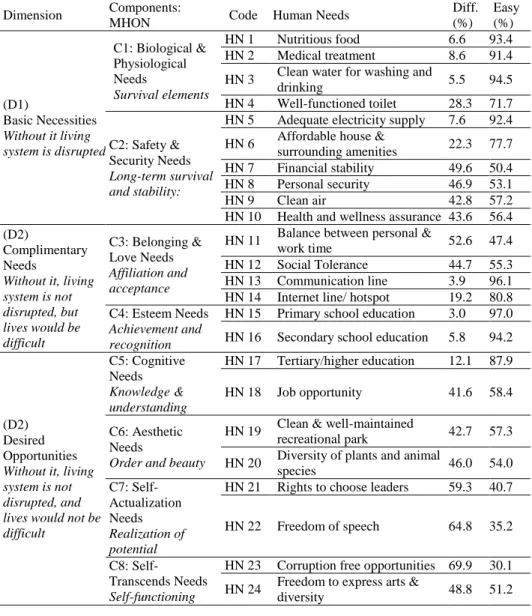
MHON which often depicted in hierarchical pyramid was first introduced in 1943 to recognize pattern of human motivation in fulfilling human needs. The most urgent needs were placed at the bottom of the pyramid. In order for a person to be motivated in achieving higher needs, the lower needs must be fulfilled (Geller, 2015; Tay & Diener, 2011). The MHON was adopted in this study to indicate examples of human needs to represent every stage of MHON. 24 common human needs were identified and substituted under eight components of three human needs dimensions (refer to Table 2). Basic necessities represent survival factors that meant without it living system is disrupted. Complimentary needs comprise of needs which may cause difficulties in life if they were not met. Desired opportunities represent human needs that fulfil human potential, although without them lives would not be difficult. It was hypothesized that human needs influence the level of human interdependency (Tay & Diener, 2011).
METHODOLOGY
Table 1 Dimensions and Components of Human Needs – Independent Variables
Dimension Components:
MHON Code Human Needs
Diff. (%) Easy (%) (D1) Basic Necessities Without it living system is disrupted
C1: Biological & Physiological Needs
Survival elements
HN 1 Nutritious food 6.6 93.4
HN 2 Medical treatment 8.6 91.4
HN 3 Clean water for washing and
drinking 5.5 94.5
HN 4 Well-functioned toilet 28.3 71.7
C2: Safety & Security Needs Long-term survival and stability:
HN 5 Adequate electricity supply 7.6 92.4
HN 6 Affordable house &
surrounding amenities 22.3 77.7 HN 7 Financial stability 49.6 50.4 HN 8 Personal security 46.9 53.1
HN 9 Clean air 42.8 57.2
HN 10 Health and wellness assurance 43.6 56.4 (D2)
Complimentary Needs
Without it, living system is not disrupted, but lives would be difficult
C3: Belonging & Love Needs Affiliation and acceptance
HN 11 Balance between personal &
work time 52.6 47.4
HN 12 Social Tolerance 44.7 55.3 HN 13 Communication line 3.9 96.1 HN 14 Internet line/ hotspot 19.2 80.8 C4: Esteem Needs
Achievement and recognition
HN 15 Primary school education 3.0 97.0
HN 16 Secondary school education 5.8 94.2
(D2) Desired Opportunities Without it, living system is not disrupted, and lives would not be difficult
C5: Cognitive Needs Knowledge & understanding
HN 17 Tertiary/higher education 12.1 87.9
HN 18 Job opportunity 41.6 58.4
C6: Aesthetic Needs
Order and beauty
HN 19 Clean & well-maintained
recreational park 42.7 57.3
HN 20 Diversity of plants and animal
species 46.0 54.0
C7: Self-Actualization Needs Realization of potential
HN 21 Rights to choose leaders 59.3 40.7
HN 22 Freedom of speech 64.8 35.2
C8:
Self-Transcends Needs Self-functioning
HN 23 Corruption free opportunities 69.9 30.1
HN 24 Freedom to express arts &
diversity 48.8 51.2
Table 2 Human Interdependency – Dependent Variables
Human Interdependency (HIH)
Code Components of Human Interdependency
Mean
Human Interdependence with other Humans
(HIH)
PE Personal Empowerment PR Positive Relations
Human Interdependence with the Environment
(HIE)
IN Interaction with Nature
AP Attitude and Pro-Environmental Behaviour
EC External Condition to Behaviour
Independent sample t-tests were conducted to determine the levels of human interdependency (HI) of four components of HIH and four components HIE (refer to Table 1) between respondents who claimed ‘easy’ and respondents who claimed ‘difficult’ to fulfil 24 human needs (HN). The Independent T-Test assumed that the variance of the two groups being compared to be equal. The homogeneity of variance was tested using Levene's Test for Equality of Variances. It is to be observed that for some of the HNs, the number of respondents who claimed ‘difficult’ and the number of respondents who claimed ‘easy’ extremely differ. Thus violate the assumption of homogeneity and the tests can result to Type 1 error. In order to overcome the violation of the homogeneity assumption, the Welch-Satterthwaite method were used to adjust the degree of freedom (df) and resulted to increased p-value above the significance level of 0.05.
EMPIRICAL FINDINGS
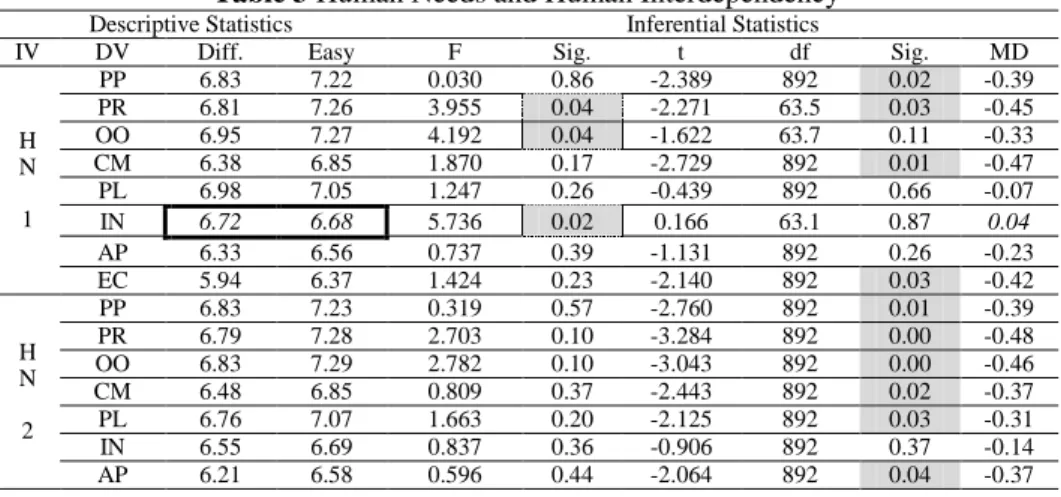
Descriptive statistics in Table 3 indicated that the mean of all components of HIH was higher for respondents who claimed easy than those claimed difficult in fulfilling all of the HNs. Almost all mean of HIE components were higher for respondents who claimed easy than those claimed difficult in fulfilling all of the HNs. A few outputs yielded intriguing descriptive statistics for HIE components (HN 1, IN; HN 3, PL; HN 13, IN; HN 15, EC and AP).
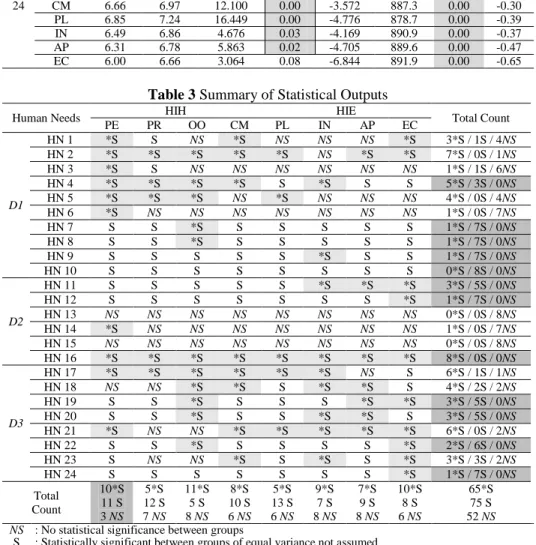
Out of 192 statistical analyses conducted, 140 of them yielded significant outputs (p < 0.05). Thus implied that HI significantly differ between groups of HNs. Out of the 140 significant outputs, 65 of the tests were between groups of equal variance (p > 0.05) and 75 of the tests were between groups of unequal variance (p < 0.05) based on the Levene’s Tests of Equality of Variance (refer to Table 3). The analyses on HIH components yielded slightly more significant statistical results (72 tests) compared to HIE components (68 tests) (refer to Table 4).
speech (C7, D3); and finally, HN 24, freedom to express arts and diversity (C8, D3). Among the 12 HNs mentioned, one in particular (HN 16, secondary school education) had equal variance between groups in all of the tests. Overall, the results implied that the mean of HIH and HIE were statistically higher for respondents who claimed that attaining the mentioned human needs were easy compared to those who claimed difficult.
The mean of PE (personal empowerment) in particular significantly differ between groups of 21 HNs. 10 of the statistical tests had groups of equal variance. The HNs were HN 1, nutritious food (C1, D1); H2, medical treatment (C1, D1); HN 3, clean water for washing and drinking (C1, D1); HN 4, well-functioned toilet (C1, D1); HN 5, adequate electricity supply (C2, D1); HN 6, affordable houses and surrounding amenities (C2, D1); HN 14, internet line or hotspot (C3, D2); H16, secondary school education (C4, D2); HN 17, tertiary or higher education (C5, D3); HN 21, rights to choose leaders (C7, D3). The results implied that the level of personal empowerment was statistically higher for respondents who claimed that attaining the mentioned human needs were easy compared to those who claimed difficult.
The analysis yielded intriguing outputs for HN 13 and HN 15. There were no statistical differences in levels of all HIH and HIE components between groups of HN 13 (communication line) and HN 15 (primary school education). Similarly, HN 14 (internet connection or hotspot) and HN 6 (affordable house and surrounding amenities) also had only one significant statistical effect on PE. D2 represents HN 13, HN 14 and HN 15, which meant without these needs, living system would not be disrupted but lives would be difficult. HN 6 belongs in D1 which suggested that without it, living system would be disrupted. The results suggested that the level of HIH and HIE was relatively independent from fulfilment of (i) affordable house, (ii) communication line, (iii) internet connection, and (iv) primary school education.
Table 3 Human Needs and Human Interdependency
Descriptive Statistics Inferential Statistics
IV DV Diff. Easy F Sig. t df Sig. MD
H N
1
PP 6.83 7.22 0.030 0.86 -2.389 892 0.02 -0.39 PR 6.81 7.26 3.955 0.04 -2.271 63.5 0.03 -0.45 OO 6.95 7.27 4.192 0.04 -1.622 63.7 0.11 -0.33 CM 6.38 6.85 1.870 0.17 -2.729 892 0.01 -0.47 PL 6.98 7.05 1.247 0.26 -0.439 892 0.66 -0.07
IN 6.72 6.68 5.736 0.02 0.166 63.1 0.87 0.04
AP 6.33 6.56 0.737 0.39 -1.131 892 0.26 -0.23 EC 5.94 6.37 1.424 0.23 -2.140 892 0.03 -0.42
H N
2
EC 5.99 6.37 1.860 0.17 -2.194 892 0.03 -0.38
H N
3
PP 6.76 7.22 0.088 0.77 -2.615 892 0.01 -0.46 PR 6.82 7.26 7.333 0.01 -1.964 51.5 0.06 -0.44 OO 7.12 7.26 1.592 0.21 -0.758 892 0.45 -0.14 CM 6.64 6.83 1.115 0.29 -1.003 892 0.32 -0.19
PL 7.16 7.04 0.007 0.93 0.671 892 0.50 0.12
IN 6.62 6.69 3.132 0.08 -0.356 892 0.72 -0.07 AP 6.42 6.56 0.592 0.44 -0.600 892 0.55 -0.13 EC 6.17 6.35 2.958 0.09 -0.828 892 0.41 -0.18
H N
4
PP 7.03 7.26 0.325 0.57 -2.491 892 0.01 -0.22 PR 7.04 7.31 0.148 0.70 -2.884 892 0.00 -0.26 OO 7.09 7.32 0.340 0.56 -2.385 892 0.02 -0.22 CM 6.53 6.93 3.985 0.05 -4.227 892 0.00 -0.40 PL 6.80 7.15 12.964 0.00 -4.129 536.6 0.00 -0.35 IN 6.46 6.77 0.055 0.82 -3.207 892 0.00 -0.32 AP 6.25 6.66 3.870 0.04 -3.887 526.0 0.00 -0.41 EC 5.95 6.49 4.090 0.04 -5.233 512.4 0.00 -0.54
H N
5
PP 6.83 7.22 1.670 0.20 -2.579 892 0.01 -0.39 PR 6.60 7.29 0.064 0.80 -4.410 892 0.00 -0.68 OO 6.81 7.29 0.252 0.62 -2.993 892 0.00 -0.48 CM 6.73 6.83 0.126 0.72 -0.610 892 0.54 -0.10 PL 6.69 7.08 2.672 0.10 -2.463 892 0.01 -0.38 IN 6.39 6.71 0.047 0.83 -1.865 892 0.06 -0.31 AP 6.26 6.57 1.695 0.19 -1.601 892 0.11 -0.31 EC 6.10 6.36 4.070 0.04 -1.591 83.6 0.12 -0.25
H N
6
PP 7.04 7.24 0.023 0.88 -2.084 892 0.04 -0.20 PR 7.11 7.27 0.826 0.36 -1.596 892 0.11 -0.16 OO 7.22 7.26 0.348 0.56 -0.348 892 0.73 -0.04 CM 6.72 6.85 0.269 0.60 -1.211 892 0.23 -0.13 PL 6.91 7.09 1.003 0.32 -1.761 892 0.08 -0.17 IN 6.72 6.67 0.004 0.95 0.505 892 0.61 0.05 AP 6.43 6.58 4.045 0.04 -1.362 354.9 0.17 -0.16 EC 6.28 6.35 7.279 0.01 -0.702 371.5 0.48 -0.08
H N
7
PP 7.06 7.33 9.347 0.00 -3.424 883.1 0.00 -0.27 PR 7.12 7.35 8.972 0.00 -2.818 886.1 0.01 -0.23 OO 7.11 7.40 3.436 0.06 -3.432 892 0.00 -0.29 CM 6.61 7.02 9.828 0.00 -4.799 878.8 0.00 -0.41 PL 6.89 7.21 9.380 0.00 -3.890 883.8 0.00 -0.32 IN 6.54 6.82 7.361 0.01 -3.239 882.4 0.00 -0.29 AP 6.32 6.77 6.591 0.01 -4.531 880.9 0.00 -0.46 EC 6.02 6.65 12.635 0.00 -6.662 879.6 0.00 -0.64
H N
8
PP 7.00 7.36 8.750 0.00 -4.500 891.7 0.00 -0.36 PR 7.10 7.36 6.277 0.01 -3.166 891.5 0.00 -0.26 OO 7.12 7.37 1.903 0.17 -3.049 892 0.00 -0.26 CM 6.64 6.98 9.011 0.00 -3.952 891.9 0.00 -0.34 PL 6.83 7.24 6.704 0.01 -5.131 891.0 0.00 -0.42 IN 6.50 6.84 4.397 0.04 -3.874 891.7 0.00 -0.34 AP 6.31 6.75 3.968 0.04 -4.383 891.9 0.00 -0.44 EC 6.07 6.57 15.110 0.00 -5.186 889.2 0.00 -0.50
H N
9
H N
10
PP 7.04 7.31 11.697 0.00 -3.330 880.8 0.00 -0.26 PR 7.08 7.35 13.156 0.00 -3.394 884.7 0.00 -0.28 OO 7.04 7.42 8.981 0.00 -4.514 867.3 0.00 -0.38 CM 6.58 7.01 21.280 0.00 -5.170 889.7 0.00 -0.43 PL 6.76 7.27 15.788 0.00 -6.364 883.1 0.00 -0.51 IN 6.53 6.80 7.946 0.01 -3.071 879.6 0.00 -0.27 AP 6.28 6.75 7.156 0.01 -4.665 873.9 0.00 -0.47 EC 6.00 6.60 5.128 0.02 -6.342 867.0 0.00 -0.61
H N
11
PP 7.08 7.33 6.566 0.01 -3.101 862.6 0.00 -0.25 PR 7.13 7.34 4.938 0.03 -2.528 871.8 0.01 -0.21 OO 7.11 7.41 5.203 0.02 -3.557 871.6 0.00 -0.30 CM 6.65 7.01 10.794 0.00 -4.211 856.0 0.00 -0.36 PL 6.86 7.26 8.756 0.00 -4.935 851.3 0.00 -0.41 IN 6.54 6.84 1.286 0.26 -3.389 892 0.00 -0.30 AP 6.26 6.87 0.626 0.43 -6.113 892 0.00 -0.61 EC 6.02 6.69 0.342 0.56 -6.895 892 0.00 -0.66
H N
12
PP 7.07 7.29 9.487 0.00 -2.810 887.5 0.01 -0.22 PR 7.12 7.33 9.411 0.00 -2.501 883.0 0.01 -0.20 OO 7.12 7.36 10.817 0.00 -2.916 882.1 0.00 -0.24 CM 6.60 6.99 13.523 0.00 -4.605 888.5 0.00 -0.39 PL 6.81 7.24 20.994 0.00 -5.287 891.2 0.00 -0.43 IN 6.59 6.76 9.432 0.00 -1.991 883.3 0.04 -0.18 AP 6.30 6.75 4.017 0.04 -4.433 880.0 0.00 -0.45 EC 6.02 6.59 1.282 0.26 -5.893 892 0.00 -0.57
H N
13
PP 6.99 7.20 0.018 0.89 -1.026 892 0.31 -0.21 PR 6.93 7.25 0.843 0.36 -1.475 892 0.14 -0.31 OO 7.14 7.26 0.179 0.67 -0.518 892 0.60 -0.11 CM 6.55 6.83 0.092 0.76 -1.278 892 0.20 -0.28 PL 6.91 7.05 0.343 0.56 -0.666 892 0.51 -0.14
IN 6.72 6.68 0.329 0.57 0.157 892 0.88 0.04
AP 6.22 6.56 0.509 0.48 -1.297 892 0.20 -0.34 EC 6.29 6.34 0.271 0.60 -0.192 892 0.85 -0.05
H N
14
PP 6.83 7.28 1.015 0.31 -4.510 892 0.00 -0.46 PR 7.22 7.24 4.407 0.04 -0.181 240.9 0.86 -0.02 OO 7.11 7.29 3.754 0.05 -1.682 892 0.09 -0.18 CM 6.71 6.84 0.474 0.49 -1.193 892 0.23 -0.13 PL 6.84 7.10 12.024 0.00 -2.255 234.1 0.03 -0.26 IN 6.56 6.71 0.439 0.51 -1.290 892 0.20 -0.15 AP 6.51 6.56 0.619 0.43 -0.339 892 0.74 -0.04 EC 6.26 6.36 1.343 0.25 -0.772 892 0.44 -0.10
H N
15
PP 6.90 7.20 0.059 0.81 -1.285 892 0.20 -0.30 PR 6.84 7.25 0.024 0.88 -1.677 892 0.09 -0.40 OO 6.94 7.26 0.410 0.52 -1.280 892 0.20 -0.32 CM 6.75 6.82 1.425 0.23 -0.271 892 0.79 -0.07 PL 6.96 7.05 1.942 0.16 -0.363 892 0.72 -0.09 IN 6.57 6.69 1.881 0.17 -0.457 892 0.65 -0.12
AP 6.69 6.54 0.538 0.46 0.501 892 0.62 0.15
EC 6.57 6.33 1.003 0.32 0.849 892 0.40 0.24
H N
16
N
17
PR 6.67 7.31 0.025 0.88 -5.162 892 0.00 -0.65 OO 6.70 7.33 0.973 0.32 -4.898 892 0.00 -0.63 CM 6.43 6.87 0.946 0.33 -3.374 892 0.00 -0.44 PL 6.72 7.09 0.042 0.84 -2.983 892 0.00 -0.38 IN 6.41 6.72 0.121 0.73 -2.297 892 0.02 -0.31 AP 6.40 6.57 2.132 0.15 -1.046 892 0.30 -0.16 EC 5.97 6.39 8.157 0.00 -3.096 147.4 0.00 -0.42
H N
18
PP 7.12 7.25 1.423 0.23 -1.635 892 0.10 -0.13 PR 7.14 7.30 0.001 0.98 -1.917 892 0.06 -0.16 OO 7.11 7.35 2.769 0.10 -2.874 892 0.00 -0.25 CM 6.67 6.92 3.705 0.06 -2.901 892 0.00 -0.25 PL 6.85 7.19 5.621 0.02 -4.054 839.2 0.00 -0.33 IN 6.59 6.75 1.041 0.31 -1.821 892 0.07 -0.16 AP 6.40 6.65 2.947 0.09 -2.494 892 0.01 -0.26 EC 6.05 6.55 5.666 0.02 -5.171 830.6 0.00 -0.50
H N
19
PP 7.04 7.31 4.560 0.03 -3.445 852.2 0.00 -0.28 PR 7.01 7.40 4.740 0.03 -4.669 844.4 0.00 -0.38 OO 7.05 7.41 1.750 0.19 -4.238 892 0.00 -0.36 CM 6.58 7.00 6.378 0.01 -4.887 858.4 0.00 -0.41 PL 6.88 7.18 19.493 0.00 -3.699 883.4 0.00 -0.30 IN 6.50 6.82 4.231 0.04 -3.620 862.0 0.00 -0.32 AP 6.23 6.78 0.250 0.62 -5.419 892 0.00 -0.55 EC 5.89 6.68 3.949 0.04 -8.321 844.1 0.00 -0.79
H N
20
PP 7.09 7.28 4.878 0.03 -2.412 884.6 0.02 -0.19 PR 7.04 7.40 6.570 0.01 -4.443 886.4 0.00 -0.36 OO 7.08 7.40 1.480 0.22 -3.689 892 0.00 -0.31 CM 6.57 7.03 4.943 0.03 -5.430 877.6 0.00 -0.46 PL 6.91 7.17 14.561 0.00 -3.236 891.7 0.00 -0.26 IN 6.48 6.86 1.073 0.30 -4.268 892 0.00 -0.38 AP 6.30 6.76 1.329 0.25 -4.462 892 0.00 -0.45 EC 5.93 6.69 4.667 0.03 -8.070 883.4 0.00 -0.76
H N
21
PP 7.12 7.30 8.060 0.01 -2.097 734.9 0.04 -0.17 PR 7.19 7.30 2.091 0.15 -1.389 892 0.17 -0.12 OO 7.20 7.33 4.430 0.04 -1.486 743.0 0.14 -0.13 CM 6.70 6.99 3.093 0.08 -3.267 892 0.00 -0.28 PL 6.91 7.25 3.017 0.08 -4.118 892 0.00 -0.34 IN 6.60 6.80 1.449 0.23 -2.203 892 0.03 -0.20 AP 6.40 6.76 6.011 0.01 -3.375 725.5 0.00 -0.36 EC 6.12 6.66 0.113 0.74 -5.474 892 0.00 -0.54
H N
22
PP 7.06 7.43 9.705 0.00 -4.281 596.1 0.00 -0.37 PR 7.15 7.39 5.567 0.02 -2.707 606.3 0.01 -0.24 OO 7.15 7.44 5.340 0.02 -3.152 607.2 0.00 -0.28 CM 6.71 7.02 4.337 0.04 -3.418 597.1 0.00 -0.31 PL 6.88 7.35 8.468 0.00 -5.337 579.8 0.00 -0.47 IN 6.56 6.91 4.448 0.04 -3.753 596.7 0.00 -0.36 AP 6.39 6.84 6.582 0.01 -4.083 586.7 0.00 -0.45 EC 6.09 6.80 3.791 0.05 -7.186 892 0.00 -0.72
H N 23
PP 7.12 7.37 5.828 0.02 -2.764 476.4 0.01 -0.25 PR 7.20 7.31 3.730 0.05 -1.255 892 0.21 -0.11 OO 7.22 7.33 6.034 0.01 -1.211 473.3 0.23 -0.12 CM 6.76 6.95 1.876 0.17 -2.056 892 0.04 -0.19 PL 6.98 7.21 8.905 0.00 -2.490 452.1 0.01 -0.24 IN 6.61 6.85 1.549 0.21 -2.445 892 0.02 -0.24 AP 6.46 6.76 8.832 0.00 -2.553 448.3 0.01 -0.30 EC 6.20 6.67 1.381 0.24 -4.476 892 0.00 -0.47 H
N
24 CM 6.66 6.97 12.100 0.00 -3.572 887.3 0.00 -0.30 PL 6.85 7.24 16.449 0.00 -4.776 878.7 0.00 -0.39 IN 6.49 6.86 4.676 0.03 -4.169 890.9 0.00 -0.37 AP 6.31 6.78 5.863 0.02 -4.705 889.6 0.00 -0.47 EC 6.00 6.66 3.064 0.08 -6.844 891.9 0.00 -0.65
Table 3 Summary of Statistical Outputs
Human Needs HIH HIE Total Count
PE PR OO CM PL IN AP EC
D1
HN 1 *S S NS *S NS NS NS *S 3*S / 1S / 4NS
HN 2 *S *S *S *S *S NS *S *S 7*S / 0S / 1NS
HN 3 *S S NS NS NS NS NS NS 1*S / 1S / 6NS
HN 4 *S *S *S *S S *S S S 5*S / 3S / 0NS
HN 5 *S *S *S NS *S NS NS NS 4*S / 0S / 4NS
HN 6 *S NS NS NS NS NS NS NS 1*S / 0S / 7NS
HN 7 S S *S S S S S S 1*S / 7S / 0NS
HN 8 S S *S S S S S S 1*S / 7S / 0NS
HN 9 S S S S S *S S S 1*S / 7S / 0NS
HN 10 S S S S S S S S 0*S / 8S / 0NS
D2
HN 11 S S S S S *S *S *S 3*S / 5S / 0NS
HN 12 S S S S S S S *S 1*S / 7S / 0NS
HN 13 NS NS NS NS NS NS NS NS 0*S / 0S / 8NS
HN 14 *S NS NS NS NS NS NS NS 1*S / 0S / 7NS
HN 15 NS NS NS NS NS NS NS NS 0*S / 0S / 8NS
HN 16 *S *S *S *S *S *S *S *S 8*S / 0S / 0NS
D3
HN 17 *S *S *S *S *S *S NS S 6*S / 1S / 1NS
HN 18 NS NS *S *S S *S *S S 4*S / 2S / 2NS
HN 19 S S *S S S S *S *S 3*S / 5S / 0NS
HN 20 S S *S S S *S *S S 3*S / 5S / 0NS
HN 21 *S NS NS *S *S *S *S *S 6*S / 0S / 2NS
HN 22 S S *S S S S S *S 2*S / 6S / 0NS
HN 23 S NS NS *S S *S S *S 3*S / 3S / 2NS
HN 24 S S S S S S S *S 1*S / 7S / 0NS
Total Count
10*S 11 S 3 NS
5*S 12 S 7 NS
11*S 5 S 8 NS
8*S 10 S 6 NS
5*S 13 S 6 NS
9*S 7 S 8 NS
7*S 9 S 8 NS
10*S 8 S 6 NS
65*S 75 S 52 NS NS : No statistical significance between groups
S : Statistically significant between groups of equal variance not assumed *S : Statistically significant between groups of equal variance assumed
SUMMARY AND CONCLUSION
There were three general yet inquisitive findings recognized from the statistical results. The following points summarized these findings.
1. The descriptive statistics suggested that fulfilments of HN 1 (nutritious food), HN 3 (clean water for washing and drinking), HN 13 (communication line) and HN 15 (primary school education) were likely lowering the levels of HIE. Yet the mean differences were trivial and the analyses did not yield significant statistical results.
MHON, which is closer to the rest of the needs compared self-transcend (refer to Table 2).
3. HIH and HIE were almost independent from HN 6 (affordable housing and surrounding amenities), HN 13 (communication line), HN 14 (internet connection or hotspot) and HN 15 (primary school education). That is, neither difficulties nor ease in fulfilling the mentioned HNs were strongly influencing levels of HIH and HIE.
The future direction of the research is to empirically model HIH and HIE with items representing subjective well-being (SWB) using Structural Equation Modelling. The research will also explore the variance of HIH and HIE between groups of HNs through more robust statistical model.
ACKNOWLEDGEMENT
This research was supported by MyGRANTS.
REFERENCES
Bakar, A. A., Osman, M. M., Bachok, S. & Ibrahim, M. (2015a). An Exploratory Review: Human Interdependence with Environment. In Asia Pacific International Conference on Environment-Behaviour Studies.
Bakar, A. A., Osman, M. M., Bachok, S. & Abdullah, A. (2015b). An Exploratory Review: Human Interdependence with Environment. In Asia Pacific International Conference on Environment-Behaviour Studies.
Bakar, A. A., Osman, M. M., Bachok, S. & Ibrahim, M. (2015c). Sustainable Well-being Subjective Indicators: Human Interdependencies with other Humans and with the Environment. In 6th International Conference on Sustainable Future for Human Security.
Geller, E. S. (2015). Why we need Humanistic Behaviorism. ISHN, 49(10), 52.
Kjell, O. N. (2011). Sustainable well-being: A potential synergy between sustainability and well-being research. Review of General Psychology, 15(3), 255-266.
O’Brien, C. (2012). Sustainable happiness and well-being: Future directions for positive psychology. Psychology, 3(12), 1196-1201.