Putting the “Global” Back in Global Public Health Education: Designing
an Inclusive and Relevant Global Health Curriculum for Public Health
Professionals around the World
By
Rohit Ramaswamy
A Master’s Paper submitted to the faculty of
The University of North Carolina at Chapel Hill
in partial fulfillment of the requirements for
the degree of Master of Public Health in
the Public Health Leadership Program
Chapel Hill
2007
______________________
Advisor
______________________
Second Reader
______________________
ABSTRACT
In this age of globalization, global public health has become a topic of vital importance and interest, involving superstars such as Jeffrey Sachs and Paul Farmer, who are shaping the debate about the best approaches for meeting critical health needs around the world
.
This surge in interest in global health has created a demand for educating public health professionals who can be leaders in designing and implementing successful health programs around the world. Many schools of public health have created global health programs to meet this demand. However, much of the funding, research and training programs in global health are based in universities in wealthier countries and are focused on educating students from these countries who want to work in the international health field.Public health is an interdisciplinary community-based field that depends strongly on knowledge of local conditions for its success. Even the best intervention approaches based on solid research may not be effective in the field if they are not specifically tailored to the social, economic, environmental or demographic conditions of the local community
1. Introduction
In this age of globalization, global public health has become a topic of vital importance and interest, involving superstars such as Jeffrey Sachs and Paul Farmer, who are shaping the debate about the best approaches for meeting critical health needs around the world. The entry of Bill and Melinda Gates into this field has substantially increased the amount of funds available for tackling global health issues, and has introduced much-needed discussion about
accountability, effectiveness and return on investment in international programs.
This surge in interest in global health has created a demand for educating public health professionals who can be leaders in designing and implementing successful health programs around the world. Many schools of public health have created global health programs to meet this demand. However, much of the funding, research and training programs in global health are based in universities in wealthier countries and are focused on educating students from these countries who want to work in the international health field. For example, the website of the International Health department at Johns Hopkins University states that its degree programs “train students for leadership roles in international agencies, such as UNICEF and the World Bank, national assistance organizations such as the U.S. Agency for International Development, ministries of health, research institutions, private foundations and volunteer organizations (Johns Hopkins University, 2007).
address. According to the World Health Organization, in a self-administered survey of ten European research institutions, six stated that collaborative research ventures with developing countries were mostly designed and funded by affluent countries (Edejer, 1999).
This system of educational leadership from Western universities is not unique to public health. There are many disciplines in which graduate students from all around the world study in U.S. or European universities and acquire and expand the knowledge base of these disciplines. In many of these fields, such as engineering or basic sciences or medicine, the concepts and
applications taught in western universities are generally applicable around the world. By contrast, public health is an interdisciplinary community-based field that depends strongly on knowledge of local conditions for its success. Even the best intervention approaches based on solid research may not be effective in the field if they are not specifically tailored to the social, economic, environmental or demographic conditions of the local community (Abelson, 2001). The most successful programs are those that integrate the knowledge of local experts with the research knowledge and global experience of well known academic institutions.
A truly “global” public health curriculum that serves practitioners worldwide needs to find a way to integrate research with the knowledge that is needed for successful implementation of programs on the ground. Such a curriculum should allow public health professionals from around the world to get trained on skills and methods that will be useful to them in their day-to-day work, but at the same time, should also allow them to share their perspectives and
The hypothesis of this paper is that a global health program that is designed to accomplish this will not only be beneficial to practitioners around the world, but could also provide a competitive edge for a university that offers such a program. The objective of this paper is to design a curriculum for such a program.
2. Approach
This paper is the first part of a two-part initiative aimed at defining appropriate content for a distance learning global health curriculum. This paper lays out the conceptual design for the curriculum based on an identification of public health issues of global importance and the
competencies that experienced public health professionals from around the world need to have to deal with these issues. These issues and the competencies are identified through a review and synthesis of the literature.
The second part of the curriculum design initiative will validate the concepts of this paper with data collected by interviewing potential program participants and opinion leaders to ensure that the curriculum is aligned with their skill-enhancement needs. This data will be used to modify the curriculum developed in this paper as needed and to develop a business plan to implement the curriculum.
A step-by-step approach is taken to create the curriculum in this paper. The approach answers the following questions in sequence:
1. How should “global health” be defined to include the needs of public health professionals from around the world?
2. What are the essential functions that global public health professionals should perform as part of their jobs?
4. What curriculum is needed for public health professionals to acquire these competencies without a multiple year commitment?
5. What kind of instructional design will enable the curriculum to be administered through distance learning and still allow participants to share their expertise? The sequence of the above questions is important because we first need to define our objectives before we begin to develop solutions. The global health definition establishes the vision and principles for the program. The list of functions defines the scope of the program. The competencies describe the skills that are needed to address the scope. The curriculum represents the knowledge base needed to acquire these skills. The instructional design identifies an effective method to impart this knowledge and to allow the sharing of expertise. The sequential nature of our analysis is also reflected in the structure of this paper. The sections of this paper and the contents of each section are presented in Table 1.
3. Definitions and Principles
Definition of “Global Health”
Since the objective of this paper is to develop a curriculum for global health, an appropriate definition of global health is an important first step. A good starting point is to examine the common definitions of global health that currently exist in the literature.
Unfortunately, the literature provides few concrete definitions of global health. The WHO and the Global Health Council use the term liberally in their publications and websites but do not define it.
theoretical and practical associations with the concept of “global health”. Their conclusion was that the term “global” emphasized the interconnectedness of health issues, while “international” had connotations of constraints imposed by boundaries between nations or states.
The notion of interconnectedness is evident in the view of the Institute of Medicine (IOM), which, in its 1997 report, refers to global health as “health problems, issues, and
concerns that transcend national boundaries, may be influenced by circumstances or experiences in other countries, and are best addressed by cooperative actions and solutions” (Institute of Medicine, 1997). In a more recent report (Institute of Medicine, 2003), the IOM defines global health as a critical content area for public health education and states that “public health professionals must understand global issues and their determinants; they must understand how local actions can have health impacts across the globe”.
Bunyanovich and Walkup (2001) believe that this broad definition of global health is supplanting a narrower definition such as the one used by Akbar et al. (2005) in their paper identifying competencies for Australian health professionals working in international health. Akbar and her colleagues define the Australian international health force as “Australians undertaking work related to, or in, a developing or resource poor country”.
To what extent do these two definitions assist in the development of a global health curriculum? Neither of these definitions is directly helpful. On one hand, the IOM definition is complex and broad, and it is difficult to see how a practical curriculum can be derived from it. On the other, the Australian definition is narrow and one-dimensional. For the purposes of this paper, a different definition of global health is required.
global disease because of its geographic prevalence, but for a health administrator responsible for spraying operations in an African city, it is a very local problem. Similarly, a health policy analyst in the US might consider the problem of unaffordable health costs to be a characteristic of US health policies and politics, but a policy analyst in India might view the widening gap in health care access between the rich and the poor in that country to be a result of globalization, and therefore an issue of global consequence.
Given these relativistic difficulties, it is necessary to develop an operational definition of global health that is practical and that directly pertains to competencies and skills. Ultimately, all public health professionals around the world are engaged in activities to improve and sustain the health of populations. Most public health professionals face significant challenges in their job that they often tackle on their own, with few resources. The greater the global connectivity of public health professionals around topics of mutual interest, the better their ability to learn about common challenges and to share and explore collaborative solutions. Our definition of global health needs to include this idea of global sharing. For the purposes of this paper, we define global health as “a collection of issues, topics and challenges that are commonly faced by public health professionals around the world, which, if collaboratively addressed through international
educational programs, can result in innovative local solutions to improve health outcomes and
help to create a more skilled and interconnected global workforce”. This definition recasts the
Identifying the Target Audience
The next step is to determine the potential target audience for a global health curriculum based on the above definition. A good starting point, once again, is to review the literature. The IOM report from 2003 (Institute of Medicine, 2003) defines a public health professional as “a person educated in public health or a related discipline who is employed to improve health through a population focus”. The Public Health Workforce Enumeration Report produced by the National Center for Health Workforce Information and Analysis (NCHWIA, 2000) classifies health care occupations into the four standard categories utilized by the U.S. Office of Personnel Management: Administrative, Professional, Technical and Clerical/Support. This classification is based on salaried positions in federal and state public health agencies, and on salaried and volunteer personnel in a few non-profit organizations. Kennedy et al. (1999) provide a broader categorization and divide the workforce involved in public health into population-based service providers and institutional service providers. The former include federal and state public health agencies, other supporting government agencies such as Departments of Agriculture, Human Services or Public Safety, non-profit groups such as the International Red Cross or the March of Dimes and community-based organizations. The latter include hospitals, large workplaces and educational institutions.
organizations who work in the health sectors, or those working in advocacy and human rights related fields who have to address health challenges will find the program useful. Researchers and analysts who work in think tanks or universities will benefit from a program that connects them directly to practitioners from around the world.
Defining the target audience for a global health curriculum too narrowly reduces the opportunity to bring together people of diverse backgrounds but with common interests. Politics, funding sources and differing priorities and agendas have tended to separate those who work on the social side of public health (government agencies, NGOs) from those who work on the industrial side (for-profit hospitals, insurance, pharmaceutical companies). Similar walls exist between researchers and practitioners in public health. A key objective of the global health curriculum proposed in this paper is to be able to break down these walls by providing a vehicle for diverse practitioners and researchers around the world to connect with one another and to take advantage of collective skills and experiences to jointly explore solutions to global health problems of mutual relevance.
Design Principles for the Global Health Curriculum
These principles are characteristics that the curriculum should have to satisfy the scope and objectives laid our earlier. These principles will serve as guidelines for the specifics of the curriculum formulated in later sections of this paper.
The key design principles are as follows:
1. The program should last no more than a year, and therefore the curriculum should consist of no more than courses. The curriculum should be offered as a new program focused on senior professionals from around the world.
2. The target audience should consist of experienced administrators and professionals in the U.S. and abroad who have common interests and challenges in their work dealing with health issues. The target audience should be broad, focusing not only on traditional population and institutional service providers, but also on directors and managers of NGOs, researchers and analysts in policy think tanks and universities and executives in ancillary industries such as health insurance and pharmaceuticals.
3. The program should primarily be marketed as a prestigious global health specialty certificate to experienced professionals, with an emphasis on collaborative problem solving and global connectivity. Some potential models are executive MBA programs or leadership programs offered by organizations such as the World Bank Institute.
4. The final program design should ensure alignment with any existing global health programs in the school of public health through which the program is offered.
6. The curriculum should emphasize two-way transfer of knowledge – focusing on the application of research to practice as well as on bringing the local knowledge and experience of communities to the educational sphere.
7. The curriculum should emphasize “horizontal” knowledge sharing (among participants of the program) as well as “vertical” education (traditional academic education).
4. Essential Public Health Functions to be Included in a Global Health Curriculum A successful global health curriculum targeted at international participants should ensure that skill enhancements are focused on activities that have a common relevance to public health professionals around the world. One way to identify these activities is to look at “core” or “essential” public health functions. These are defined in the literature (see, for example, Yach (1996)) as “a set of fundamental activities that address the determinants of health, protect a population’s health, and treat disease.” Core or essential functions answer the question: what does a public health professional do? In this section, we create a list of these functions from different sources in the literature and then select the functions that could be of common interest to a global community of practitioners. These functions will help to define a list of competencies that must be addressed by a global health program designed for this community
Essential Public Health Functions: International Perspectives
In the following pages, we compare core public health functions from the perspective of three countries and of the WHO. These perspectives are summarized in Table 2.
National Association of County and City Health Officials, National Association of State Alcohol and Drug Abuse Directors, National Association of State Mental Health Program Directors, Public Health Foundation, U.S. Public Health Service) defined the following ten essential public health services (Public Health Functions Steering Committee, 1994):
Monitor health status to identify community health problems
Diagnose and investigate health problems and health hazards in the community
Inform, educate, and empower people about health issues
Mobilize community partnerships to identify and solve health problems
Develop policies and plans that support individual and community health efforts
Enforce laws and regulations that protect health and ensure safety
Link people to needed personal health services and assure the provision of health care when otherwise unavailable
Assure a competent public health and personal health care workforce
Evaluate effectiveness, accessibility, and quality of personal and population-based health services
Research for new insights and innovative solutions to health problems
Australia: In Australia, the National Public Health Partnership, which is an
intergovernmental body “responsible for identifying and developing strategic and integrated response to public health priorities in Australia” (NPHP, 2007) developed a list of core functions for public health based on a national Delphi study, which surveyed a cross-section of public health practitioners, policy makers and researchers. Based on this study, the following core functions were identified (National Public Health Partnership, 2000):
Prevent and control communicable and non-communicable diseases and injuries through risk factor reduction, education, screening, immunization and other interventions.
Promote and support healthy lifestyles and behaviors through action with individuals, families, communities and wider society.
Plan, fund, manage and evaluate health gain and capacity building programs designed to achieve measurable improvements in health status, and to strengthen skills,
competencies, systems and infrastructure.
Promote and support healthy lifestyles and behaviors through action with individuals, families, communities and wider society.
Strengthen communities and build social capital through consultation, participation and empowerment.
Promote, develop, support and initiate actions which ensure safe and healthy environments.
Promote, develop and support healthy growth and development throughout all life stages.
Promote, develop and support actions to improve the health status of Aboriginal and Torres Strait Islander people and other vulnerable groups.
United Kingdom: In a document detailing the reforms needed at the National Health Service, the British Department of Health identified the following items as the scope of a modern public health system (Department of Health, 2001):
Health surveillance, monitoring and analysis
Investigation of disease outbreaks, epidemics and risks to health
Enabling and empowering communities and citizens to promote health and reduce inequalities.
Creating and sustaining cross-governmental and inter-sectoral partnerships to improve health and reduce inequalities
Ensuring compliance with regulations and laws to protect and promote health.
Developing and maintaining a well-educated and trained, multidisciplinary public health workforce
Ensuring the effective performance of NHS services to meet goals in improving health, preventing disease and reducing inequalities
Research, development, evaluation and innovation
Quality assuring the public health function
World Health Organization: The World Health Organization has conducted several studies aimed at defining core functions for public health. A Delphi study involving 145
respondents in 67 countries was sponsored by the WHO (Bettcher, Sapirie, & Goon, 1998). The WHO’s Western Pacific Region combined the results of this study with the public health
function lists presented above from the US and Australia, and developed the following list of
essential public health functions(World Health Organization, 2003):
Health situation monitoring and analysis
Epidemiological surveillance/disease prevention and control
Development of policies and planning in public health
Strategic management of health systems and services for population health gain
Regulation and enforcement to protect public health
Health promotion, social participation and empowerment
Ensuring the quality of personal and population-based health services
Research, development and implementation of innovative public health solution
Synthesis and Analysis
Our purpose in doing this detailed review of the essential functions from around the world is to create our own list of functions relevant to global health. We do this in three steps. The first step is to synthesize and consolidate the lists summarized in Table 2. The first column in Table 3 shows this list. Since detailed descriptions for the functions were not always
available, judgment was used to create the integrated list. There may be some overlap among the functions in the list, but overall the integrated list reflects a set of distinct core public health functions defined in the literature.
and is less likely to be of interest to a global community. For our curriculum, we will only focus on the public health functions that are classified as “global” in Table 3.
At this point, this classification is based on our judgment. We need to collect data from stakeholders and potential participants to determine whether our assumptions about global and local relevance need to be modified.
The third step is to add any additional functions that are not covered in the literature but that are of relevance to global health practitioners today. The research studies from which the lists in Table 2 were created are at least 10 years old, and new functions or viewpoints have emerged since then. There are three specific functions that are not in Table 3 that should be part of any global health curriculum today. We discuss these below:
Public health leadership: The wording for the description of the functions in the first column of Table 3 has been kept as close as possible to the actual wording used in the four lists we analyzed. Note that many of the “action words” describing the functions are “promote”, “build”, “empower” or “manage”. These are typically words used by those who see themselves less as leaders and more as implementers or facilitators. The descriptions of the functions neither project an inclination to advocate for solving complex public health problems nor do they reflect a strong commitment to bringing about change through leadership. It is useful to contrast these descriptions for public health core functions with the following six essential functions of a business leader (Brodie, 2007):
Providing overall direction
Selecting the right strategies
Making things happen
Motivating others
People development
It is a matter of concern that none of the definitions for public health functions includes words that convey leadership activities, such as strategy setting, decision making, alignment and motivation. Empowering and partnering are important, but these are weaker words that carry less impact. Making strategic decisions in a leadership role to bring about change should be an
essential public health function in any global health curriculum.
Quality improvement: All lists that include quality as a core function in the literature present it in the context of evaluation and assurance. There is no doubt that quality assurance is important and that regular monitoring and evaluation of the outcome of public health programs is necessary. But the strict definition of quality assurance is merely ensuring compliance to
standards. It is impossible to ensure ongoing excellence or innovation in public health without coupling assurance to a quality improvement program that uses systematic methodologies such as Continuous Quality Improvement (McLaughlin& Kaluzney, 2006) or Six Sigma (Pande, Neuman & Cavanagh, 2000).
have documented the linkages between adverse health conditions and the forces of poverty and exclusion (see, for example, the paper by Elstad & Krokstad (2003) about the relationship between poor health and employment status). In a recent editorial, Jacob (2007) argues that in countries such as India, the context for public health differs significantly from that in the west. In his paper, he states that the use of western models of public health in India has resulted in short term curative fixes and a bio-medical perspective. The real issues that need to be addressed by public health programs are that water, sanitation, housing, education and nutrition cannot be counted upon as basic needs, or that social inequality creates large gaps between those who have the possibility of good health outcomes and those who don’t. The role of public health in
addressing these complex social, cultural and economic issues should be an important component of our global health curriculum.
Core Functions for a Global Health Curriculum
Based on the analysis in the previous section, the global health curriculum should include the following functions:
Those classified as “global” in Table 3
The three additional functions discussed above These are summarized in Table 4.
Many of the functions listed in Table 4 may be activities that public health professionals around the world currently do as part of their jobs. The curriculum that we are developing for the global health certificate should allow the participants to think about these functions in new way that allows change and innovation in public health to take place. Globalization has brought additional complexity to the public health landscape, but also opportunities for professionals scattered around the world to connect with and learn from each other. Our vision is to be able to take advantage of these opportunities to stimulate different ways of thinking and acting that can bring about faster and more substantial changes to the health of populations around the world.
This section has analyzed the core functions of public health as defined in the literature, and has identified a list of existing and new functions that should be addressed by a global health curriculum. We will address competencies required in the next section. It is important to reiterate that at this point, these are hypotheses based on a synthesis of research. Before implementing the curriculum, it is important to test the relevance and importance of these functions to public health professionals around the world.
5. Key Competencies for a Global Health Curriculum
In this section, the specific skills or competencies that should be covered by the curriculum are described.
Definition of Competency
The notion of competencies first gained prominence through the work of psychologist David McClelland (1973), who argued that traditional intelligence and aptitude tests are not good predictors of practical life outcomes, and recommended that attributes such as knowledge, skills or abilities are more relevant for predicting real life success. His conclusions have been
defining competencies has become an important requirement for curriculum or job design, especially since Prahalad and Hamel (1990) popularized the strategic concept of an
organization’s core competencies.
Strangely, there is still no single agreed-upon definition for “competency”. A task force sponsored by the Society for Industrial and Organizational Psychology to define competency and competency modeling (Shippman et al., 2000) found no definition that could be used as a “gold standard”. The American Compensation Association (ACA, 1996) defines competencies as "individual performance behaviors that are observable, measurable and critical to successful individual or corporate performance". In the public health literature, the Public Health Competency Handbook published by the Rollins School of Public Health at Emory University (Nelson, Essien, Loudermilk, and Cohen, 2002) defines competencies as “the knowledge, skills
and abilities and behavioral objectives demonstrated by organization or system members that
are critical to the effective and efficient function of the organization or system”. The CDC definition, from the CDC/ATSDR Task Force Report on Public Health Workforce Development (CDC, 1999) is “knowledge, skills and abilities which are required to accomplish the desired
outcomes, generally accepted but may be exceptions for individual jobs depending on actual job
requirements”.
There are three points to note in the above definitions. First, competencies are skills
acquired at the individual level but applied at the organizational level. Individual competencies have limited value unless they are used to achieve organizational goals or to improve
In order to develop a definition of competencies relevant for our purposes, it is useful to apply the above points to a global health program. First, should build skills for global health professionals that can be used in organizations around the world. Second, we should not only cover concepts and tools but should also foster behaviors that will lead to collaboration and innovative problem solving. Finally, our curriculum should develop competencies that enable the participants to bring about observable and measurable change in public health behaviors and outcomes in their communities. The following definition embodies these principles:
“Competencies for a global health curriculum should be observable and measurable
knowledge, skills, abilities and behaviors that will enable public health practitioners
from around the world to collaboratively design and implement innovative solutions to
commonly faced health problems and to transform public health practice worldwide”.
Review of Existing Public Health Competency Sets
There are many competency sets for public health practitioners in the literature. The most well-known sets are reviewed here, and their relevance to the goal of this paper is assessed. Based on this review and assessment, the key competencies that need to be included in a global heath program are identified.
accredited US schools of public health to assess the extent to which the IOM recommendations were reflected in university curricula (Shortell et al., 2004). According to the study, more than 75% of the schools offered an entire course on communication, ethics, law, policy and global health. A lower percentage offered content in community based participatory research, genomics and informatics. Seventy nine percent of the schools offered specializations in policy, and 61% in global health. These results indicate that content for most of the competencies recommended by the IOM is already available. The challenge is to package and focus this content to achieve the desired objectives identified in our definition.
Council on Linkages Core Competencies for Public Health: The Council on Linkages between Academia and Public Health Practice is comprised of leaders from national public health agencies and academic institutions. The mission of the council is to improve connections
between public health practice and education. The council developed a set of core competencies for public health professionals (Council, 2005) linked to the ten essential public health services developed by the Public Health Functions Steering Committee (1994), and described in Section 4. The Council categorized the competencies into the following eight domains:
Policy Development/Program Planning Skills
Analytical/Assessment Skills
Communication Skills
Cultural Competency Skills
Community Dimensions of Practice Skills
Basic Public Health Sciences Skills
Financial Planning and Management Skills
Specific competencies for each domain as well as expected level of skills for different job functions are found in http://trainingfinder.org/competencies/list.htm. These competencies are further disaggregated by three skill levels: Aware, Knowledgeable and Advanced, and by three job categories: Front Line Staff, Senior Level Staff, Supervisory and Management Staff. The last category is the target audience for the curriculum we are designing in this paper, and the Council recommends advanced skill levels for all the competency domains for this category of workers.
National Center for Healthcare Leadership Competency Model: The mission of The National Center for Healthcare Leadership (NCHL) is to improve the quality of leadership in the medical, nursing and healthcare administration professions. The NCHL has developed a
competency model for leaders in healthcare that identifies 26 competencies in three domains (National Center for Healthcare Leadership, 2005). The three domains are transformation (the ability to envision and lead a change process to define new models of healthcare), execution (the ability to translate the vision into organizational reality) and people (creating an organization that values people). Within these domains, eight technical competencies and eighteen behavioral competencies are defined.
Core Competencies for Public Health in Canada: The Public Health Agency of Canada has created a list of 36 core competencies organized under the following seven categories (Public Health Agency of Canada, 2007):
Public Health Sciences
Assessment and Analysis
Policy, Program Planning, Implementation and Evaluation
Partnerships, Collaboration and Advocacy
Communication
Leadership
National Public Health Leadership Development Network Competency Framework: The National Public Health Leadership Development Network began in 1994 as a cooperative
enterprise between the Association of Schools of Public Health and Saint Louis University, in collaboration with the Missouri Department of Health. It is now a consortium of academic institutions, national and international organizations, and local, state, and federal agencies and has a mission to build capacity of public health leaders.
The network has developed a competency framework for public health leaders (Wright et al., 2000) that identifies four categories of competencies:
Transformational competencies, which include systems thinking, visioning, leading change communicating;
Political competencies, including an understanding of political processes, ability to negotiate, and understanding issues of ethics and power;
Trans-organizational competencies, involving an understanding of organizational dynamics and mechanisms for inter-organizational collaboration, and
Team-building competencies, with an ability to create, facilitate, mediate, lead and participate in teams.
Other competency frameworks: Several other competency sets have been developed by different organizations. The most important of these is the core competency framework
and Social and Behavioral Sciences) and seven interdisciplinary competencies (Communication and Informatics, Diversity and Culture, Leadership, Professionalism, Program Planning, Public Health Biology and Systems Thinking). This competency framework has not explicitly been included in this paper because it is intended for MPH students. The target audience for the proposed program is assumed to already have acquired the core competencies through formal education or experience. The objective of the curriculum developed in this paper is to enhance the interdisciplinary competencies, especially in the areas of program planning, leadership and systems thinking.
Other competency frameworks in the literature focus on particular disciplines and job functions such as public health nursing or environmental health inspectors. In 2001, the CDC Office of Workforce Policy and Planning created a list of competency sets for public health-related occupations that is posted on many websites (see, for example,
www.ahec.wisc.edu/EdTRAC/compgrid.pdf). These sets have been divided into the following
categories:
Core – Basic Public Health (essential services of public health)
New Topical Areas (emergency, response, genomics, law)
Functional Areas (leadership, management, supervisory, secretarial)
Discipline Specific (Epidemiology, Informatics, Environment)
Other Topics (STD/HIV, Maternal and Child Health etc.)
Developing Competencies for a Global Health Curriculum
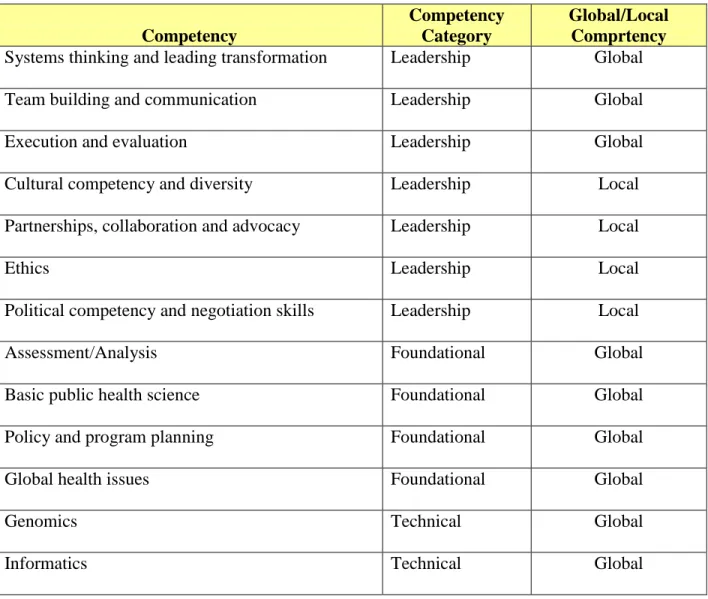
functions. The first step is to synthesize and consolidate the competency sets in the literature. The first column in Table 5 shows this list.
The second column of Table 5 categorizes the competencies into three groups. The first group, foundational competencies, are the “nuts and bolts” that every experienced public health
professional should be expected to have. These represent the “nuts and bolts” competencies such as a basic knowledge of public health science, the skills to assess community health needs, and the abilities to develop programs and policies to meet these needs. The next group (genomics and informatics) reflects specialized technical competencies. The last group is leadership
competencies, which deal with the ability of public health professionals to create a vision for the organization, to build teams, to communicate and motivate people, to build partnerships and coalitions and to deal with political and cultural issues.
The next step is to review the list of competencies in Table 5 and to select those that should be part of a global health certificate curriculum. The criteria we use are the following:
1. Since the program is intended for experienced public health professionals, the emphasis should not be on foundational skills, but on the leadership skills focused around global health issues that will enable the participants to use their foundational knowledge more effectively to bring about innovation and change. The curriculum should therefore focus less on basic assessment, program planning skills or technical skills, and more on how these skills can be combined with leadership skills to achieve more effective outcomes.
to commonly faced health problems”. Therefore the program should focus on competencies that can be learned and applied globally rather than on skills that are unique to local contexts. In the third column of Table 5, we have made an initial attempt to classify the competencies as global or local. Foundational and technical skills are scientific or analytically based, and so are globally applicable. Leadership requires a combination of analytical skills (such as systems thinking, the ability to strategize, and the ability to execute), communication and team building skills and political and cultural skills. We assume that the political and cultural skills are more likely to be dependent on local context and circumstances. Our initial curriculum design in this paper will focus on the competencies listed as “global” in the third column of Table 5. These should be validated and modified with market data.
Based on these criteria, the curriculum that we are designing for a global health program will focus on the following six leadership competency areas:
Systems thinking around global health issues
Guiding organizational transformation
Communication
Team building
Execution
Evaluation
therefore it can be assumed that we have defined a comprehensive list of competencies. We can now begin the design of the curriculum which is the topic of the next section.
6. Designing a Curriculum for a Global Health Certificate
In this section, we translate the competencies identified in the previous section to a curriculum for the certificate in global health. We propose four courses to address the skills and knowledge requirements specified by the competencies, provide a brief description of each course and list analogous courses from several universities that can be used as benchmarks when these courses are designed in more detail.
Definition and Approach
To design the curriculum, we use elements of the approach described in the competency-to-curriculum toolkit developed by the Center for Health Policy at Columbia University (Gebbie, 2004). This toolkit provides a detailed step-by-step methodology to create learning objectives, evaluation procedures, content and instructional approaches for a given competency. In this paper, we will not use the methodology in its entirety since we are designing the details of each course. The toolkit will be used more as a framework to guide the proposed course descriptions and instructional design.
The toolkit defines a curriculum as follows (Gebbie, 2004):
A curriculum is a complete set of learning experiences, including classroom, experiential
and self-guided, that taken altogether lead to the achievement of a desired set of
competencies. Any one competency, if complex, may require several learning experiences
to achieve mastery. Any one course or learning experience may be directed at learning
Note that the definition integrates content (the course material itself) and its delivery (the instructional method) into the joint concept of the “learning experience”. This means that there is a connection between what is taught and how it is taught, especially for a curriculum that is delivered through distance learning. We need to ensure that the curriculum is designed in a way that supports distance education.
The toolkit recommends the following process for developing curricula from competencies:
Step 1: Select a competency
Step 2: Define key words or phrases within the competency statement
Step 3: Describe the target audience for the education program
Step 4: Sequentially separate all required sub-competencies
Step 5: Develop objectives (the desired learner behavior or state) for each
sub-competency
Step 6: Relate an evaluation procedure to learning objectives
Step 7: Provide an example of relevant literature (content) from theory and
practice for each sub-competency
Step 8: Plan specific classroom or other learning experiences that encompass all identified
learning objectives
Finally, we will not address learning objectives and evaluation criteria, because these are more appropriate at a different level of detail than is addressed in this paper.
In summary, we will not address steps 4, 5 and 6 of the approach. Steps 1 and 3
(competencies and target audience) have already been covered in previous sections. This section will address Steps 2 and 7 (writing competency statements and defining initial content). Step 8 (planning classroom experience) is the topic of the next section.
Competency Statements
The toolkit recommends that any competency statement should have the following elements: action verb(observable or measurable performance of a worker), content(subject matter, type of performance, specific task) and context(limitations or conditions of work environment) (Gebbie, 2004). The following example illustrates these elements:
Public health supervisory and management staff are competent to translate [the action]
policy [the content] into organizational plans, structures, and programs [the context].
Following this pattern, we can create the following competency statements for our six competencies from the previous section:
1. Systems thinking: Global public health leaders are able to analyze how health issues in their countries or jurisdictions are connected to social, economic, environmental and biological factors influencing health of populations around the world.
3. Communication: Global public health leaders are able to communicate the vision and plan for change within and outside the organization in ways that clearly demonstrate how changes in local behaviors and policies can have an influence on the health of global populations.
4. Team building: Global public health leaders are able to build and participate in flexible teams and networks to address health issues in their countries and
jurisdictions that take advantage of the global interconnectedness of public health professionals.
5. Execution: Global public health leaders are able to translate their strategic plans and visions into local solutions to health problems in their countries or jurisdictions that take advantage of global best practices and innovation.
6. Evaluation: Global public health leaders are able to evaluate the quality of outcomes and processes of the public health activities in their countries and jurisdictions using global benchmarks and are able to improve the quality of their public health activities using formal, well established continuous improvement methodologies.
Content Descriptions
Course 1: Critical Issues in Global Public Health
This course will teach systems thinking by exploring how social, political, economic and environmental factors around the world affect the health of populations. Each lecture will cover one critical global health topic primarily using case studies, supported by readings from the literature. Students will be asked to analyze the implications of these complex global interactions on local health issues, especially as they pertain to the following core public health functions: investigation of community health problems, preventing and controlling disease, conducting research and innovation, assessing community needs, promoting healthy environments, continuous improvement and focusing on vulnerable populations. A sample of benchmark courses with content relevant to this course is shown in Table 8.
Course 2: Strategic Management and Execution of Public Health Programs: A
Global Perspective
Leaders who are effective at bringing about change and innovation to organizations distinguish themselves through who they are and what they do. This course focuses on the “action” part of leadership. Much has been written about the need for leaders to create and communicate a vision (see, for example, Shaw (2006)). But for organizational transformation to take place, leaders must be able to bring this vision to fruition through strategic planning and execution. A recent article in the Harvard Business Review (Breene, Nunes, & Shill, 2007) describes this role as that of a Chief Strategy Officer (CSO) in an organization. This article describes the CSO as a réalisateur, i.e. someone who can “make strategy happen” by balancing
The course will draw from resources such as the programs offered by the Management Academy of Public Health (http://www.maph.unc.edu), the National Public Health Leadership Institute (www.phli.org) and the Executive Doctoral Program in Public Health
(www.sph.unc.edu/hpaa) at the University of North Carolina at Chapel Hill. The focus of this course will be on important cross-cutting issues in international public health such as access to health care, effect of gender gaps and economic inequity, emergency preparedness, strengths and weakness of different local community-based approaches to public health and health education and capacity building. The course will address the following core public health functions: promoting healthy lifestyles, building public health workforce skills, preventing and controlling disease, assessing community needs, promoting healthy environments, leading change, continual improvement and focus on vulnerable populations. A sample of benchmark courses with content relevant to this course is shown in Table 9.
Course 3: Global Public Health Leadership: Teams and Communications for
Change
The previous course dealt with the analytical side of global public health leadership. This course deals with the people side. Most public health leaders work with a wide variety of
stakeholders: governments, community organizations, media, NGOs, international donor organizations, research institutions, universities etc. The specific nature of the partnerships established among organizations interested in public health may vary according to local contexts, but the ability to build formal and informal teams to communicate externally and internally is a universal competence for public health leaders. This course will draw on principles from the fields of organizational development, leadership behaviors, change management,
government, civil society and communities to promote healthy behaviors, building cross-organizational emergency preparedness plans and incorporating health interventions into broader, multi-sectoral development initiatives. The core functions addressed are: promoting healthy lifestyles, building public health workforce skills, preventing and controlling diseases, promoting healthy environments, leading change and continual improvement. A sample of benchmark courses with content relevant to this course is shown in Table 10.
Course 4: Evaluation and Continuous Improvement of Public Health Programs Worldwide
The ability to effect rapid changes in global health outcomes requires the capacity to continually improve processes and to identify practices that work so that they can be quickly shared worldwide. This course focuses on quality assurance and improvement methods such as CQI (Continuous Quality Improvement), Six Sigma and Lean, and on the use of quantitative and qualitative evaluation methods to assess the effectiveness of processes and outcomes. The emphasis is not on theory but on learning the principles of evaluation through the use of practical applications and case studies, so that the complexities and nuances of context, culture and
circumstances that influence sustainability and transferability of interventions can be surfaced and discussed. The core functions covered are: monitoring community health status, evaluating quality of services, research and innovation, continually improving and focusing on vulnerable populations. A sample of benchmark courses with content relevant to this course is shown in Table 11.
In the next section, we present ideas for the delivery of the curriculum that supports interaction, application and knowledge sharing.
The design principles outlined in Section 2 of this paper identify collaborative problem solving, global connectivity, two-way transfer of knowledge and horizontal (peer-to-peer) knowledge sharing as distinguishing requirements for the curriculum. In this section, we use a model for knowledge creation and sharing to generate ideas for the instructional design of a program that supports these requirements. These ideas can be elaborated and validated during the detailed design of the curriculum.
SECI model for Knowledge Creation and Sharing
In 1991, Ikijuro Nonaka, a professor at the University of California in Berkeley, published an article in the Harvard Business Review (Nonaka, 1991) describing a dynamic model of knowledge creation and transfer. This model, shown in Figure 1, is referred to as the SECI model (for the initials of the four quadrants: Socialization, Externalization, Combination, Internalization). In a famous book entitled The Knowledge Creating Company published by Nonaka and his colleague Hirotaka Takeuchi (Nonaka & Takeuchi, 1995) described how the model was used to create and share knowledge needed to drive innovation in large Japanese corporations such as Honda, NEC, Canon, Matsushita and Nissan.
other public vehicles and that is commonly held by all members who have participated in the dissemination process. Tacit knowledge, referred to as “know-how” is the personal knowledge that comes from infusing explicit knowledge with a person’s culture, contexts, experience and personality. In a simplistic sense, tacit knowledge can be thought of as explicit knowledge that is enriched, deepened and internalized through personal experience.
Innovative solutions based on successful knowledge leverage both kinds of knowledge. Explicit knowledge provides the knowledge base, which refers to the common background, curriculum, body of knowledge, language and conventions that are needed for practitioners to interact effectively. Tacit knowledge is the practice of explicit knowledge in different contexts, and provides insights on how the knowledge can be used to achieve desired outcomes. This interaction between explicit and tacit knowledge is captured in the SECI model.
Each quadrant of the SECI model represents one type of knowledge transfer. For example, the internalization quadrant represents a tacit-to-tacit knowledge transfer. In addition, each quadrant in Figure 1 also shows the primary players who interact in each type of knowledge transfer. The internalization quadrant primarily represents knowledge transfer between
individuals.
In order to explore the process of knowledge transfer described in the SECI model, let us start with the combination quadrant. In this quadrant, the transfer of explicit to explicit
knowledge takes place. As Figure 1 shows, this transfer is typically between an organization and groups of practitioners engaged in similar functions (for example, public health professionals). In the context of international global health education, the externalization process represents the typical educational model where students learn a documented and pre-defined body of
explicit knowledge with existing knowledge that they already have. This is a conscious, analytical process.
Moving clockwise through the model, the next quadrant is internalization and reflects a transformation of explicit to tacit knowledge. In this quadrant, practitioners who have acquired explicit knowledge construct their own experience of this knowledge through its application in their own work sites. As a result of this application, the generic explicit knowledge that they learned becomes personalized and contextual. The end of the internalization process results in a broadening of personal expertise.
This expertise is deepened through peer to peer interactions in the socialization quadrant. This happens when practitioners interact in informal social or professional settings, such as at lunch or after-work events. In these events, conversations about life on the job, war stories, anecdotes and other practice-related topics help practitioners reinforce their own expertise. Learning through this process is social and unconscious, and focuses on practice, as described by John Seely Brown of Xerox Corporation in his book The Social Life of Information (Brown & Duguid, 2002).
Finally, in the externalization quadrant, the tacit knowledge gained through application and strengthened by socialization is shared with peer groups and the broader organization and made explicit. This transfer from tacit to explicit knowledge adds to the knowledge base of the organization. This “new” knowledge, combined with any additional knowledge acquired from the literature and other external sources, feeds the next cycle of dissemination.
readings, apply the concepts from these readings to practical situations they face in their work, and meet synchronously in an on-line discussion forum once a week. As experienced
professionals, the students bring their own expertise into the program. This expertise is combined with the new material they learn through the readings, and this expands their individual body of knowledge. This is the combination step. As they acquire this new knowledge, they use it in the context of their day-to-day work. This results in a deepening of their base of expertise through the process of internal reflection. This is the internalization step. During their participation in the on-line sessions, the students discuss their views on the material in a moderated on-line video conference. This externalization process is a reflection on the reading material. If transcripts or recordings of this discussion session are made available to future students for review, the knowledge base is expanded through externalization.
If these were the only interactions that took place, the overall knowledge base would still be enhanced, but the personal connections that give knowledge meaning and richness would be missing. This is what the socialization step provides. During the discussion session, socialization takes place in the chat window through which students talk to each other. In these sessions that take place synchronously with the “official” discussion, personal stories get shared, digressions and elaborations about the reading material take place, and personal observations about the readings get articulated. At different points in time during the discussion session, relevant pieces of knowledge get “externalized” from the chat room dialog, as the informal conversations create new revelations worthy of sharing with the larger group. This simultaneous process of
principles to be tested, and personal feelings to be shared. The “sharable” outcomes of these conversations are rich, nuanced and contextual descriptions of the knowledge.
According to Nonaka and Takeuchi, the transfer of explicit to tacit knowledge and back again is a necessary condition for innovation. This is because this process allows “textbook” knowledge to be tested through application, and the insights learned from this application to be reinforced and validated through interactions with supportive peers. This newly forged
knowledge serves to expand the entire know-how of the organization through the externalization process.
The SECI model has been criticized by several authors, who claim that it is empirically unsound and does not apply in all cultural contexts (see, for example, Gourlay (2003) or Roy & Gupta (2007)). Despite these criticisms, the model serves as a good framework for the
instructional design of our curriculum. This is because the activities in the four quadrants make logical sense even if the process outlined in the model is not always applicable. Our instructional design must provide opportunities for participants in the certificate program to engage in the activities of each quadrant. Ideas for how this can be done are now presented.
Implications for Instructional Design
Each of the four quadrants of the SECI model can be translated into a requirement for a distance learning offering. The combination quadrant is a requirement that some sort of
instruction or knowledge transfer take place. The internalization quadrant is a requirement for
receive knowledge, but should also share what they know and what they have learned with their peers and with the broader public health community.
Many distance learning programs try and design their offerings to meet these
requirements. Case studies or exercises that require students to think about the application of classroom concepts to their own work encourage application. Work in small groups or face-to-face team building exercises are designed to increase the level of interaction among students. Developing presentations in small groups that are posted on a bulletin board for a larger group to view and/or critique is a way of stimulating sharing.
Despite these efforts, a real application of the SECI model in typical distance learning applications remains superficial. The loop from explicit to tacit knowledge needs to be deep in order for innovation to take place. In many classroom settings, students rarely reach deeply into their pool of personal experience. Despite opportunities to apply, interact and share, much of the output that typically gets produced in traditional curricula is a modification or superficial
application of classroom concepts.
There are several reasons for this. First, the primary objective of many traditional
classroom based distance education program is to teach students, and not to solve real-life public health problems that the students may face in their work. Second, the constant pressure to
The curriculum that we are designing has a broader objective than just providing an education since it is intended to support the development of solutions to global public health problems. The certificate program should therefore be designed to be a crucible for innovation in which the participants work together for a year to produce new ideas, methods and solutions. We present some ideas for how the program can be implemented to achieve this objective. Not all of these ideas may be part of the ultimate design but they provide a set of options from which a viable program can be created.
Implementing the Curriculum – Key Concepts
1. Keep the cohort size small, no more than 12-15 per year.
2. Use a dual selection procedure for admission. Select two-thirds of the participants from an applicant pool and invite the remaining third based on experience, vision, or need.
3. Base each year on a particular global health theme, and invite participants who are working on that theme to apply to the program (e.g. access to health care, sexual and reproductive health, emerging infectious diseases, gender issues in global health etc.) 4. Require applicants to submit a proposal that outlines their current work, and a public
health problem that they would like to address during the course of the program as part of the application procedure. This problem then becomes the focus of their work for the entire program as they work with their peer-group to seek solutions.
5. Divide the participants into triads, based on commonality of interest and on
information and connect over VoIP. If VoIP is not feasible, we need to work out a method for audio communication among the triad members.
6. Require each triad to maintain a blog that will be open to all current and past program participants, to the SPH faculty and to the council of advisors (see below). The blog, which should be updated at least once a week, should provide a running log of the triad’s progress, issues, questions and concerns. Multimedia submissions (photos, video clips, recordings of conference calls etc.) that provide additional context and depth to the discussion should be encouraged. Peers from the current and past cohort should be able to contribute to the blog to provide answers to questions or to post ideas, as will SPH faculty and the council of advisors.
7. Form and sustain a global “council of advisors” for the program. This council should consist of public health professionals who make themselves available to support the participants of the program by providing technical advice when requested. Their role will primarily be a passive one, but they should be available to the program members as a resource if they need access to expertise. Upon admission, each program
professionals, government officials, civil society members, donor organizations, international NGOs, industry leaders and others who are active participants in the public health sphere. From the broader council, a smaller advisory group should be assigned to each triad to serve as the members’ own personal advisory council. 8. Assign a faculty advisor for each triad to monitor its progress. At the beginning of
the program, the triad members should develop a rolling work plan for the year with the faculty advisor. In the first meeting, the plan should outline the public health issue they want to work on, a brief description of the questions they expect to jointly address, a description of their approach and activities for the first month. Once a month, the triad members participate in a conference call (with on-line support) with the faculty advisor to discuss progress, request resources and to plan the next month of activities. If the cohort size is small, there will be no more than 4-5 triads, and a faculty advisor should only have responsibility for one triad. This will allow for sustained interaction, and will reduce the burden on the faculty advisor.
9. At the beginning of the program, organize a face-to-face orientation session if
possible. This will be complicated to organize, and creative solutions will be needed. Selecting triad members who are geographically proximal, having regional satellite centers where face-to-face meetings can be held, using regional representatives for the program who can stand in for faculty advisors and other solutions need to be explored in greater detail.
10. Because of the complexity associated with connecting a global audience, deliver most of the lecture material asynchronously (recorded lectures, videos, readings).
conference calls with the faculty advisor, organize two synchronous sessions during each course, one in the middle and one at the end. The sessions lasting 90-120 minutes each should be moderated consulting/Q&A sessions, with a panel consisting of the faculty members teaching the course and any relevant guests. The objective of these sessions should be to allow participants to ask questions related to the course content, discuss their experiences with implementing the course content to their work, ask for additional references or resources, and seek peer help. These can be
supplemented with additional questions posed by the moderator if needed. The objective of these sessions should be to focus on applying the concepts in the courses to the participants’ work.
11. To avoid excessive focus on assignment completion and grades, emphasize application rather than just a demonstration of understanding of content for
12.Create a journal in which the papers can be published. This journal will be the formal output of the program. The journal should be an open access, peer reviewed,
community journal that is available on-line to the global public health community. The Knowledge Management for DevelopmentJournal can serve as a model for this journal (http://www.km4dev.org/journal/index.php/km4dj). If the program is designed to be theme based, then the journal can present a collection of papers on a given theme. If not, then the journal issue should reflect the contributions to global public health practice made by the participants in that cohort. There will one issue of the journal each year containing 10-12 submissions. Each issue should have a keynote or capstone article written by a person of renown in global public health as a way of affirming the value of the contribution made to global health by the participants of the program.
The ideas presented above attempt to address all aspects of the SECI model. Having the participants working in triads for an entire year builds the social relationships that are necessary for informal socialization of ideas. The council of advisors and the peer review encourage externalization of applied knowledge through a reflective process. The requirement to select a practical issue and to work on it for a year forces internalization of the theoretical concepts learned in the program. Finally, developing a work plan monthly with the faculty advisor allows the participants to explore how the explicit knowledge from the program can be combined with their own knowledge to create a roadmap for application.
9. Conclusions
In recent years, global health has become an important public health topic and is generating a lot of interest among students and practitioners. The Institute of Medicine (IOM) report Who Will Keep the Public Healthy? lists global health as an emerging area where public health professionals need to be trained. The report identifies the following key contributors to global health challenges: (a) immigration; (b) poverty; (c) overpopulation; (d) pollution; (e) changing food habits and (f) bioterrorism. In response to these challenges, the IOM Committee on Educating Public Health Professionals has stated that “public health must be prepared to work with individuals from other countries to solve the problems facing our global economy” (IOM 2003).
Many universities have risen to this challenge and the number of global health programs offered by universities in the U.S. and Europe has proliferated. Many universities have
established global health institutes dedicated to research in global health. Yet, for the most part, the educational programs provided by the universities are designed to train western and
international students on working with international organizations in developing countries. The focus of global health programs has been on the one-way transfer of knowledge from the west, or on local capacity building based on models and training programs designed in the west.