Activities of nine local health departments in implementing a community health improvement tool
by Nancy Pullen November 21, 2003
A paper submitted to the faculty of the University of North Carolina at Chapel Hill in partial fulfillment of the requirements fot the degree of Master of Public
Health in the School of Public Health
Approved by:
Introduction
The Institute of Medicine defines the mission of public health as
"society's interest in assuring the conditions in which people can be healthy" and outlines the core functions of assessment, policy and assurance as a framework for public health work at the federal, state and local levels (Institute of Medicine, 1988). In the area of assessment the Institute of Medicine calls for public health agencies at all levels to "regularly and systematically collect, assemble, analyze and make available information on the health of the community, including statistics on health status, community health needs and epidemiologic and other studies of health problems" (p.7). For local health departments, the Institute of Medicine describes the need for "assessment, monitoring and surveillance oflocal health problems and needs and of resources for dealing with them" (p. 7). Local public health agencies are also charged to provide "policy development and leadership that foster local involvement and a sense of ownership, that emphasize local needs, and that advocate equitable distribution of public resources and complementary private activities commensurate with community needs" (p. 7).
The community health assessment process, the focus of this paper, requires community engagement and provides valuable information to create a picture of the health of a population, identify areas of concern and suggest appropriate areas for improvement. (Halverson & Mays, 2001 ). This paper describes the process of implementing a new community health improvement tool, Mobilizing for Action through Planning and Partnerships (MAPP), for nine local public health agencies. While many factors such as organization size,
=
i
L
L
setting, budget and population size could conceivably influence the
implementation process they are not within the scope of this paper. Presented here is a framework that compares the experiences ofthe nine sites using four common themes identified through the interview process. Concrete examples will show how sites provide leadership for MAPP, organize partners, mobilize internal and community resources to enhance the public health infrastmcture and system, and use the MAPP website.
To set the context, a review of select assessment tools will explain the
= origins and rationale for MAPP. A description and justification for the use of
L
qualitative data to study MAPP's implementation process follows. A table and more in-depth description will be used to explain findings and lead to discussion. The paper concludes with a summary oflimitations and implications for
practitioners.
Review of select assessment models
Assessment data may be used to guide program planning, budget
decisions, evaluation and inspire policy action. The data collection process can be conducted with the use of databases, interviews or other methods. The data typically include morbidity and mortality statistics but may also cover a myriad of other indicators. Data sources may include surveys, vital statistics, registry and program reports at the state or local level and healthcare organization information relating to specific diagnoses (Halverson & Mays, 2001 ).
assessment tool helps ensure a comprehensive method to create the most complete picture of a community's health. It also gives continuity to the assessment
process from year to year.
In the last twenty years, a variety of assessment tools have been developed. The experiences of communities that used tools such as PATCH, APEXIPH,.CATCH, Healthy Communities and CHIP helped shape MAPP. The implementation of these tools in practice pointed towards processes that worked well and areas in which the tools could be strengthened.
In the mid 1980s, the development of the Plarmed Approach to
Community Health (PATCH) by the Centers for Disease Control, local and state health departments and community groups offered a planning and implementation tool for community-level health promotion. (U.S. Department of Health and Human Services, n.d.). The PATCH model aims to assist in identifying health problems, prioritizing and planning appropriate interventions to address the highest priority concerns. This model presents a framework requiring community involvement and the use of a single standardized assessment (the Behavioral Risk Factor Survey) for implementation across agencies.
The Assessment Protocol for Excellence in Public Health (APEX/PH), developed by the American Public Health Association, Association of Schools of Public Health, Association of State and Territorial Health Officials, Centers for Disease Control, National Association of County Health Officials & United States Conference of Local Health Officers, focuses on improving local health
t--assessment ofthe local health department's capacity is followed by community assessment and a cycle for fulfilling the core functions in the areas identified by internal and community assessment work (American Public Health Association, et a!., 1991).
In the early 1990s, researchers at the University of South Florida School
of Public Health introduced the Comprehensive Assessment for Tracking
Community Health (CATCH) intended to identify key health indifators from ten major areas to inform a community's prioritization of health problems. An effort was made to empirically determine the influences of different indices on health (Studnicki, Luther, Kromrey, & Meyers, 2001). The system allows for
t
;
comparison of indicators across communities through the use of a standardizedtool and provides a way to evaluate the effect ofhealthcare spending on health status (Studnicki, Steverson, Myers, Hevner, and Berndt, 1997). CATCH introduced the use of population-based data sets for assessment in contrast to the use of individual-level data such as that used by PATCH.
The American Public Health Association introduced Healthy
Communities 2000: Model Standards to assist communities in tying together local prioritization and the Healthy People 2000 objectives. The eleven step process, designed to be used in conjunction with APEX/PH or PATCH, brought a renewed emphasis on the importance of community involvement including an expanded recognition of the role of community in the identification and shared
In 1997, the Institute of Medicine proposed the Community Health
Improvement Process (CHIP), emphasizing a community-wide responsibility for
health and the use of performance monitoring to measure progress and ensure
accountability (Institute of Medicine, 1997). Instead of providing a process to
focus on just a few identified health concerns such as with the PATCH model, the
CHIP process assumes that work on multiple health problems occurs at the same
time. The model includes a problem identification and prioritization cycle,
followed by an analysis and implementation cycle for each identified health issue.
The creation of a new assessment tool, MAPP, offers the opportunity to
cull from all of these assessments and create the "next generation" model, rolling
together the most important parts of previous models and addressing gaps
MAPP, designed by the National Association of County and City Health
Officials and the Centers for Disease Control and Prevention in 2000, is a
"community driven and community owned approach" to assessment and
community health improvement (National Association of County and City Health
Officials, Elements ofMAPP, para. 1). Two unique underpinnings ofMAPP
include an emphasis on systems thinking and the use of dialogue. These
principles promote the engagement of a diverse set of community members and
groups in open conversation to address health problems from a community-wide
perspective.
MAPP sets itself apart from previous tools by including multiple
assessments and using a web-based format that provides users with overviews,
vignettes and tools such as tip sheets, checklists and indicators of success to help
L
t-guide each phase of the process. The model includes the phases of recruiting, conducting assessments, prioritizing and planning for identified community concerns and an action cycle for implementation and evaluation. (National Association of County and City Health Officials, n.d.)
Using a standardized process of health status assessment allows MAPP users to compare themselves to other communities and- across time- to themselves. MAPP includes four assessments. The Community Health Status Assessment uses population-based health measures based on the use of similar indices in the CATCH model. APEX/PH highlighted the importance of health department capacity which MAPP also measures. The Local Public Health System Assessment allows the local system to rate the provision of the Essential Public Health Services. This assessment is an expansion of the APEX/PH model's focus on internal capacity that uses criteria related to administrative capacities, such as questions about the budget. The Forces of Change Assessment offers an opportunity for communities to consider what broader environmental conditions exist that may influence community health. Finally, the Community Themes and Strengths Assessment aims to capture the perceptions of residents regarding assets and issues for their community. Taken together, this group of assessments offers a more comprehensive view of community health, resources, capacity and challenges than other assessment tools.
especially those that have not traditionally been involved in public health such as businesses.
Finally, MAPP, like CHIP, is designed with the assumption that a community might identify several issues to concentrate on at one time. The MAPP model includes the identification of strategic issues and an "action cycle" for addressing identified concerns.
Qualitative evaluation of MAPP demonstration sites
The development of a new tool calls for an evaluation to determine whether desired outcomes are met. Qualitative study is an appropriate way to examine processes such as MAPP because, "depicting process requires detailed description; the experience of process typically varies for different people; process is fluid and dynamic; and participants' perceptions are a key process consideration" (Patton, 1990, p.95) which establishes " ... a strong handle on what 'real1ife' is like." (Miles and Huberman, 1994, p.10).
One purpose of qualitative study is for evaluation (Denzin & Lincoln, 1994, Patton, 1990). The examination ofMAPP demonstration sites seeks to understand how MAPP was implemented and, in particular, to describe the degrees of activity that occurred in each site around four main themes.
implementation." (Patton, 1990, p. I 05). Understanding how a model or theory is implemented is necessary because it "permits judgments to be made about the extent to which the program or organization is operating the way its supposed to be operating, revealing areas in which relationships can be improved as well as highlighting strengths of the program that should be preserved." (Patton, 1990, p. 95).
Methods
NACCHO, recognizing the need to examine the utility of the MAPP model, contracted with the University of North Carolina at Chapel Hill's School of Public Health Leadership Program to lead an evaluation. The evaluation team designed a three-pronged approach that included: a) a participant survey to evaluate the training provided to new MAPP users; b) a web-based survey of local public health agencies to ascertain the extent of awareness and use ofMAPP and c) interviews and a focus group of demonstration sites that pilot-tested the model.
Nine demonstration sites initiated the MAPP process and documented their progress. At the end of the first year of implementation, the local public health agency representative at each site participated in a telephone interview and a focus group. The data examined in this paper come from the telephone
interviews conducted with the demonstration sites.
NACCHO staff notified demonstration sites about the forthcoming
interview process after which the evaluators scheduled a telephone interview with
each demonstration site representative. At sites where more than one person
coordinated the implementation process, all parties were included on the
interview call. To ensure face validity, the evaluation team used a semi-structured
survey that had been written and revised based on feedback from a group of
MAPP developers and a beta-test of the survey. See Appendix A for a list of the
interview questions. Institutional Review Board guidelines were followed to
ensure informed consent and protection of confidentiality.
For the interview, a team of the same two evaluators spoke with each lead
demonstration site representative by phone. The use of two evaluators allowed
one to ask questions while the other took notes on a laptop computer. For
record-keeping, a tape recorder linked to the phone line recorded the interview. The
interviewers asked the site representatives for permission to use the recorder and
stated that the representatives could ask for the tape to be turned off at any time.
Generally, each interview lasted one hour. After the interview, the taped
version was used to add and make corrections to the typed notes. To gain
feedback and check for accuracy, each demonstration site member reviewed his or
her interview transcript. The evaluation team made changes based on the
feedback received.
To ensure internal validity, the two evaluation team members
independently read and coded each transcript. Subsequently, the evaluators
list of standard codes. These codes were used to establish common patterns or themes. Reports with illustrative examples and discussions of each theme were provided to demonstration sites and the MAPP workgroup evaluation
subcommittee. The coding process was conducted because, as Mishler states, "qualitative studies ultimately aim to explain (at some level) a pattern of
relationships, which can be done only with a set of conceptually specific analytic categories." (as cited in Miles & Huberman, 1994)
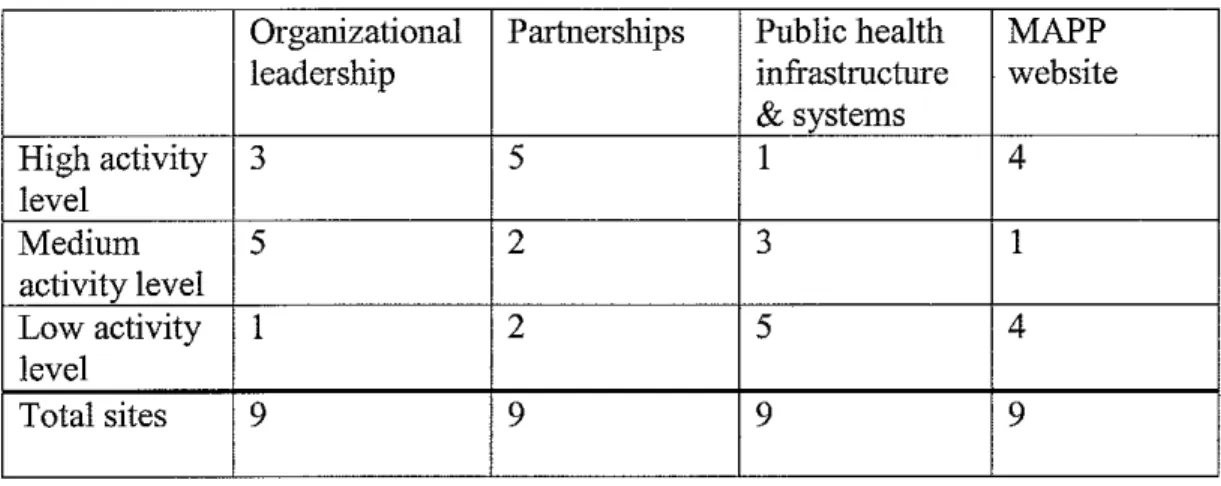
Four themes arose from this data collection: organizational leadership, partnerships, public health infrastructure and systems and use of the MAPP website. The evaluation team members noticed that the demonstration sites reported a range of degrees of activity in each area.
Using ATLAS.ti, a qualitative data analysis software package, deeper analysis ofthe data took place in an effort to flesh out the variations in activity around each theme among the demonstration sites. First, each demonstration site
interview was reviewed. Then, each theme was examined across demonstration L sites in order to understand "the conditions under which a particular finding
appears and operates; how, where, when and why it carries on as it does." (Huberman & Miles, 1994, p. 441).
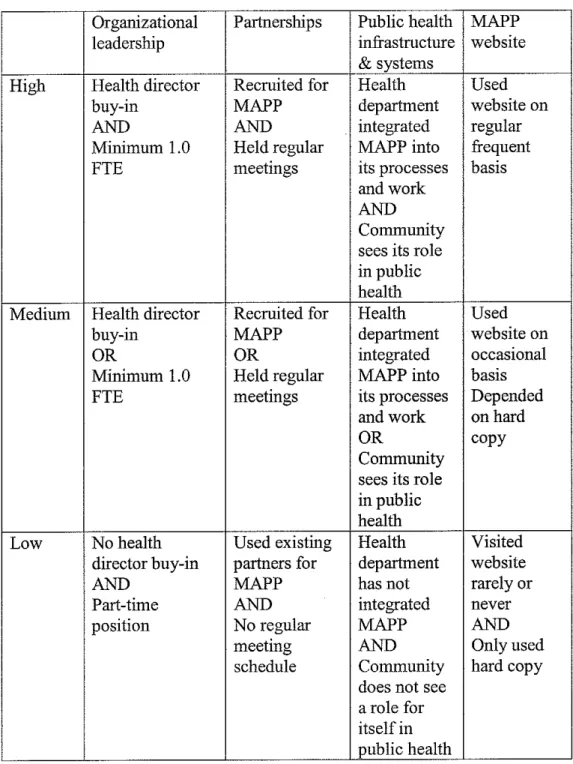
The clusters were organized into low, medium and high activity levels for each theme such that each demonstration site could be assigned to one of these levels. Common elements described within each theme were used to construct a definition for each level.
Decisions regarding what to include as criteria for each theme were driven by two factors. First, the evaluators sought to identify key elements that
represented the theme. Second, the criteria could only include elements discussed by every site. As a result, data availability helped shape the criteria and assured that all the sites were represented in the analysis.
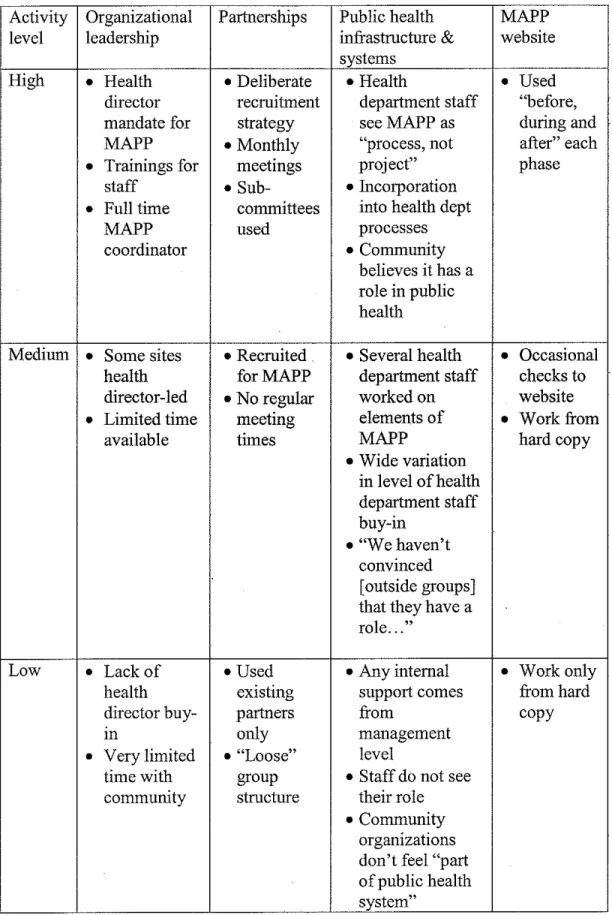
Relevant data from each site for a particular theme and level were placed in a table so that each cell of the table included a combination of data from all sites that had an example of the particular activity level within a given theme.
Those cases with a similar activity level for a particular theme were then studied and described as a group in order to portray that activity level. The combined data allowed the researcher to characterize the most common "look" or "process" for a site in that activity level because combining similar demonstration site data means that "the details of any specific case recede behind the broad patterns found across a wide variety of cases ... " (Miles and Huberman, 1994, p.
174)
In the analysis, evaluators looked at patterns across themes to determine whether sites had similar or different activity levels.
Findings
r
I
Table 1: Number of sites in each level by theme
Organizational Partnerships Public health MAPP
leadership infrastructure website
&systems
High activity 3 5 1 4
level
Medium 5 2 3 1
activity level
Low activity 1 2 5 4
level
Total sites 9 9 9 9
L
~-Table 2: Criteria for activity levels by theme
Organizational Partnerships Public health MAPP
leadership infrastructure website
& systems
High Health director Recruited for Health Used
buy-in MAPP department website on
AND AND integrated regular
Minimum 1.0 Held regular MAPP into frequent
PTE meetings its processes basis
and work AND Community sees its role in public health
Medium Health director Recruited for Health Used
buy-in MAPP department website on
OR OR integrated occasional
Minimum 1.0 Held regular MAPPinto basis
PTE meetings its processes Depended
and work on hard
OR copy
Community sees its role in public health
Low No health Used existing Health Visited director buy-in partners for department website
AND MAPP has not rarely or
Part-time AND integrated never
position No regular MAPP AND
meeting AND Only used
schedule Community hard copy does not see
a role for itself in public health
Organizational leadership
The activity levels for organizational leadership, determined by each site's characteristics related to the criteria, are considered indicative of the willingness of health department leaders to engage in the MAPP process.
For high activity level sites, the health director either mandated the use of MAPP or demonstrates buy-in for its implementation. At one site, the director encourages MAPP training for staff as part of workforce-competency related continuing education offerings. Another health department includes partnership work as part of management staffs performance evaluations, thus encouraging
Those health departments with high organizational leadership activity
I
involvement in MAPP.sometimes note having additional resources, such as regular assistance from other health department staff, meeting refreshments or money to cover printing and postage costs. However, having additional resources is not unique to high level sites.
Some medium activity sites describe limitations about the time staff could put towards MAPP such as one that allocated fifteen percent of an FTE for MAPP in the first year, but in the second year has only two percent of a position because, "that's as much time as we have to devote to it." One person, who was only able to spend a few hours per week on MAPP laments, "that's the problem ... just me." Another part-time coordinator states that MAPP, "really does take some
designated time of a person ... "
The low level organizational leadership site lacks both health director buy-
.
h
in and full-time staffing for MAPP. The low level sites, such as those described
'[__
F
L
as medium level, experienced health director turnover that requires,
"re-establishing, working with the new [director] and others to get buy-in." However, unlike medium level sites, the MAPP coordinator only works on MAPP part-time. The coordinator, previously having more hours to dedicate to MAPP, had to greatly narrow involvement with community around the MAPP process. Partnerships
High partnership activity sites recruited speCifically for the MAPP group and hold regularly scheduled meetings. High partnership sites were deliberate in whom they recruited. For example, one "tried to identify all of the city
departments, other governmental agencies, community based organizations, professional groups, businesses and other entities that impacted our community health" while another went through many versions of a potential member list to create one "that was truly representative of the community and looked like the community."
High partnership level sites report gathering recommendations from health department staff and existing partners to determine who to invite to participate. At sites in both high and medium levels, the steering group was asked, "who is not here that ought to be here?''
High level site steering groups meet monthly, but sub-committees often meet more often. Medium partnership activity level sites do not hold MAPP-designated meetings on a regular basis, but recruitment specifically for MAPP did occur. One site, explaining the reason for the lack of regular meetings, recounted that "we promised [the MAPP group] that we would not call them together unless we had real work for them to do." The representative notes that no regular meeting schedule "may or may not have been the smartest idea ... because [when] you don't meet regularly, you don't get consistent attendance [when meetings are called]."
group. One site initially had, "lots of wrangling back and forth about whether [the steering group members] were actually willing to do [MAPP]," and has now "really fallen apart." Another site meets other MAPP committee members "at another meeting and [we] talk a little about the MAPP process."
Public health infrastructure & systems
Public health infrastructure and systems describes the degree to which sites succeeded in creating a community-wide public health system. A desired outcome ofMAPP is to enhance public health infrastructure and support a community-wide view of the public health system. In order for this to occur, local health departments and communities would embrace the MAPP process and
The high public health infrastructure and systems activity level user
i
recognize their shared responsibility for public health.~
f--assessment and analysis, getting the information back to community in a way that's understandable. [We're] also seeing a re-emphasis in looking at the community's perception of an issue ... the biggest benefit for us is that [MAPP] is a community driven process. I think this message is finally getting through to some of our key leaders."
Outside the health department at the high public health infrastructure and system activity level site, the community sees a role for itself in public health. A health-department sponsored training on dialogue helped to spark community member interest and understanding of the system perspective. This same site has strong support for MAPP from the mayor's office. A media campaign and executive order provided a kick-off for the MAPP assessments. MAPP became, "a city-wide effort and other departments within the city would have to support it because it's the mayor's effort and not [the health department's] effort."
MAPP is embraced by this health department but has yet to be fully understood by the community. MAPP group members do not have interest in understanding the model because, "many community partners don't want to get that invested; reading the model, having a really process-oriented kind of endeavor. They want to get to the data." The site representative at times feels "like I'm dragging them along." In addition, the promise of community
mobilization is difficult for community partners to believe. Community members "didn't want to hear about the model...residents and youth weren't interested in that level of conversation, they just wanted to do something."
In describing the lack of a community-wide view of the public health
system, another medium-level site notes that, "we'll have to do a better job with the groups that affect the determinants of health such as police, EMS---groups that don't think they have an effect on public health but they do ... some of them have been invited but we haven't convinced them yet that they have a role." To increase community commitment, the site representative makes an effort to "play down the importance of the health district in this effort because I want everyone to take ownership of the issues and not leave it up to the local health department to do it all."
In low public health infrastructure and systems activity level sites, MAPP
is sequestered within a certain division of the organization and community
members and organizations do not see a role for themselves in public health.
Within the health departments of some sites, the health director is supportive, but
other staff members are not. In these cases, often MAPP is seen as a project
falling under the purview of the MAPP coordinator instead of a way for the
overall organization to do business. As one site representative states, "they still
see it as my function which is a separate function. They don't get it, that this is
public health." Another site notes that staff, "associate it more with strategic
planning and evaluation."
At one low public health infrastructure and systems activity site, there is a
purposeful decision to limit health department staff involvement in the MAPP
group so as not to overpower other organizations but it is felt that this is, "part of
the reason why we don't have a strong sense ofMAPP in our organization ... "
Another site noted this same lack of staff involvement in MAPP and attributed it
to budget cuts that limited staff time.
At low public health infrastructure and systems activity levels, the
community does not see a role for itself in public health. At one site, any attempt
to engage community "was disappointing and not unique to MAPP, people don't
participate here." Other sites explain that community members have many
competing demands such that "people are stretched so far. We want people to
participate in the [steering group] and we still want people to realize it's the
L
asthma and diabetes ... but I don't know how much more I can ask them to do for nothing."
Website
MAPP is designed as a web-based tool and is intended to be used online. This allows information to be updated and the addition of real-world examples to enhance implementation in other sites. Those sites that choose not to use the website are therefore at a disadvantage of not having access to new information.
High website activity users describe accessing the site "consistently r--throughout the process." Before each phase, users would "read over everything
that is applicable." Another site describes not only reading and reviewing, but also summarizing the information, "so we could pass it on to the different committees that were going to be working on [that phase ofMAPP]."
Completion of a MAPP phase includes using the "indicators of success to assure that we completed each of the phases and completed everything we needed to do at each phase."
Irregular, occasional use of the website characterizes medium website activity use. For one site, the hard copy is "easier to use rather than going to the website and printing information I already have."
Table 3: Summary descriptions of activity levels for identified themes
Activity Organizational Partnerships Public health MAPP
level leadership infrastructure & website
systems
High • Health • Deliberate • Health • Used director recruitment department staff "before, mandate for strategy seeMAPP as during and MAPP • Monthly "process, not after" each • Trainings for meetings project" phase
staff • Sub- • Incorporation
•
Full time committees into health deptMAPP used processes
coordinator • Community
believes it has a role in public health
Medium
•
Some sites • Recruited • Several health • Occasional health forMAPP department staff checks to director-led • No regular worked on website • Limited time meeting elements of • Workfromavailable times MAPP hard copy
• Wide variation in level of health department staff buy-in
• "We haven't convinced [outside groups) that they have a role ... ,
Low • Lack of • Used • Any internal • Work only
health existing support comes from hard
director buy- partners from copy
Ill only management
• Very limited • "Loose" level
time with group • Staff do not see community structure their role
Patterns across themes
After each activity level of every theme was described, the evaluators
looked for patterns across themes. See Table 3 for the activity level of each site
by theme.
Table 3: Activity level for each site
High c•+ c • •
••
c• + +•
Medium
•
1:1 + c••
c• 1:1 c•Low
•••
A B
c
Organizational leadership c Partnerships •
D
S1te
Public health infrastructure and systems • Website use+
+
•
•
•
1:1 • •••
E F G H I
Of the three sites with high organizational leadership, all of the sites also
have high activity levels for partnerships, are either medium or high activity in
regards to public health infrastructure and systems and are divided on website use,
with one site never accessing the site, one site occasionally going to it and one site
often using the website.
For those sites with medium level organizational leadership, (i.e. having
either health director support or a full time MAPP position, but not both) most
have health director support. In these sites, partnerships tend to be low or
medium activity level. Almost all of these sites have low levels of public health
infrastructure and systems activity while website use is again split
r:_·
r
t
"
The single low organizational leadership site has a high level of partnership activity, but low activity levels in public health systems and infrastructure and website usage.
For sites with a high activity level for the partnership theme, most also have high organizational leadership but are divided in website use and public health infrastructure and systems.
Medium-level partnership sites are low or medium for organizational leadership and public health infrastructure and systems and are split on website use, with one never using the site, one occasionally accessing the site and one regularly using the site.
The high public health infrastructure and systems activity site is medium or high activity in all other themes. Medium public health infrastructure and systems sites are medium or high in organizational leadership, split on partnerships and split on use of the website.
For website use, high, medium and low users are split in their activity levels for organizational leadership, partnerships and public health infrastructure and systems.
Discussion
meetings, both necessary in building strong community partnerships (the criteria used for partnerships). With medium organizational leadership level sites, where a full-time position is usually absent, lower activity levels for partnerships and public health infrastructure and systems exist than in high organizational leadership sites. This pattern could also be explained if those sites high in organizational leadership represent "high performers" that already have the capacity necessary to incorporate and use the MAPP process.
However, the one low organizational leadership site goes against the pattern seen in the high and medium levels in that it is able to have regular
meetings and recruited members specifically for MAPP (i.e. high activity level of partnership) without a full time position or health director buy-in. This may have been because this site previously had a supportive health director and during that time partnership work was accomplished that had a carry-over effect when the new director took over. This site also works with existing neighborhood groups that have interest in working on MAPP, even though the site representative contends that overall integration of MAPP into the community does not exist.
Those sites where MAPP is added to the duties of the health director generally have very little FTE associated with implementation and often describe a shortage oftime and resources for MAPP. These sites describe difficulties with implementation and one site representative states that MAPP "really does take some designated time of a person ... someone in a leadership role, maybe not the director of health, but maybe a deputy, a health educator ... "
f
Looking at internal integration ofMAPP (the first of two criteria for
public health infrastructure and systems), reveals that MAPP users are able to
make imoads into the community without health director in, but internal
buy-in for these organizations remabuy-ins stunted.
In some sites, it appears that organizational integration ofMAPP has not
occurred because the site representative has not taken action to facilitate that
process. In other settings, the lack of internal support and restrictive job roles
inhibit MAPP work within the organization.
'
In sites where the public does not see a role for itself in public health (the c f
second criteria for public health infrastructure and systems), a few sites note that
community members have a difficult time understanding MAPP at a
conceptual-level and the whole idea of a "system" remains foreign to them. The model may
need to be strengthened to help sites increase community understanding.
The website, which ranges from not being used at all to being used during
each phase ofMAPP, does not appear to be associated with activity levels in other
L
areas. An examination of high level website users compared to low level website
users did not reveal any patterns. This may be because the website changed very
little during the demonstration site's implementation period meaning those that
used a hard copy had access to virtually the same information as website users. If
the MAPP website is regularly updated in the future and "chat" options that allow
information exchange among users are utilized, there may be a discernible change
in its usage.
The use of demonstration sites provides a way to see how MAPP works in a real-life setting with the less than ideal circumstances that invariably present themselves. Demonstration sites also offer a variety of settings in which to see the tool used.
The use of a small purposefully selected sample has inherent bias and means that conclusions cannot be drawn about how MAPP might be implemented elsewhere.
When gathering data, evaluators depended on site representative report to }---understand what occurred at each site and therefore data gathered was limited by
L
what that site representative discussed. Other individuals involved in the MAPP process at a particular site might have had a very different interpretation the experience of using MAPP.
Incorrect interpretations of site representative statements may have led to inappropriate identification of themes. The evaluators were limited by data availability when they designed criteria to designate levels of activity for each theme. As a result, definitions of each category were limited and may have inaccurately represented each site's true activity level in a certain theme. Use of different criteria might have resulted in the assignment of other levels for sites leading to a change in the patterns seen across sites and themes.
In addition, all of the demonstration sites had been reviewers of the
original MAPP model and may have previously taken leadership roles around new public health initiatives. As a result, these sites are not "typical" public health agencies and their experiences with MAPP could be exceptional.
This paper focused on four themes identified through coding of interview transcripts. Many other variables not addressed here may influence the
implementation process such as the rural or urban nature of the community and population size.
Implications for the practitioner
For practitioners who are considering or are using MAPP, these sites' experiences offer examples of what different levels and types ofMAPP activity look like. These findings may also assist users looking for concrete illustrations of how to improve their implementation ofMAPP.
For those considering MAPP, this evaluation may inform users as to what might be required to implement MAPP in the future. This could assist an agency in making a decision to adopt MAPP. It could also serve as a way for an agency to compare MAPP to a currently used tool.
For researchers with interest in developing assessment tools, the
influence the implementation of a tool such as MAPP including organizational and community characteristics such as budget and population size. Some of these other factors could be explored for potential associations with MAPP's use. Summary
This paper has attempted to describe the degrees of activity conducted by nine local public health agencies during a pilot implementation of the MAPP process. Four themes, based on previously conducted analysis, provided the framework to establish activity levels for each site per theme. Combining data from multiple demonstration sites in a common activity level allowed for the characterization of that particular level. An examination of each level of activity across sites by themes rendered important insights to inform current and potential future users in regards to variations in implementation ofthe MAPP model.
Findings suggest that those sites with health director buy-in and full time coordination for MAPP had high levels of partnerships. They also hint that the website, in its current state, does not provide an advantage over use of a printed copy ofMAPP. To assist MAPP users to address internal integration ofMAPP and community-wide perception of public health, the model could be
References
American Public Health Association. (1991). Healthy communities 2000: Model
standards (3'd ed.). Washington, DC: American Public Health Association. American Public Health Association, Association of Schools of Public Health,
Association of State and Territorial Health Officials, Centers for Disease Control, National Association of County Health Officials & United States Conference of Local Health Officers. (1991 ). Assessment protocol for
excellence in public health (APEX/PH). Washington, DC: National Association of County Health Officials.
Conunittee on Using Performance Monitoring to Improve Conununity Health, Institute of Medicine. (1997). Improving health in the community: A role
for performance monitoring. Washington, DC: National Academy Press Denzin, N.K., & Lincoln, Y.S. (1994). Introduction. In N.K. Denzin & Y.S.
Lincoln (Eds.), Handbook of qualitative research (pp.l-17). Thousand Oaks, CA: Sage.
Halverson, P.K. & Mays, G.P. (2001). Public health assessment. In L.F. Novick & G.P. Mays (Eds. ), Public health administration: Principles for
population-based management (pp.266-299). Gaithersburg, MD: Aspen. Huberman, A.M., & Miles, M.B. (1994). Data management and analysis
methods. In N.K. Denzin & Y.S. Lincoln (Eds.), Handbook of qualitative
research (pp.428-444). Thousand Oaks, CA: Sage.
Institute ofMedicine. (1988). The future of public health. Washington, DC: National Academy Press.
Miles, M.B., & Huberman, A.M. (1994). Qualitative data analysis. Thousand Oaks, CA: Sage.
National Association of County and City Health Officials. (n.d.). Introduction. Retrieved September 10, 2003 from
http://maop.naccho.org/mapp introduction.asp
Patton, M.Q. (1990). Qualitative evaluation and research methods. Newbury Park, CA: Sage.
Studnicki, J.S., Luther, S.L., Kromrey, J., & Meyers, B. (2001). A minimum data set and empirical model for population health status assessment. Am J
Prev Med 20(1), 40-49.
I-I
L +::.
Studnicki, J., Steverson, B., Myers, B., Hevner, A.R., & Berndt, D.J. (1997). A community health report card: comprehensive assessment for tracking community health (CATCH). Best Pract Benchmarking Healthc 2(5), 196-207.
U.S. Department of Health and Human Services. (n.d.). Planned approach to community health: Guide for the local coordinator. Atlanta, GA: U.S. Department of Health and Human Services, Centers for Disease Control and Prevention, National Center for Chronic Disease Prevention and Health Promotion.
t
Appendix A
Interview questions asked of lead representatives in each of the MAPP demonstration sites include:
1. Who is the lead agency?
2. Who are the lead implementers ofMAPP? Position
Agency Total FTEs
3. Can you describe for me how you established buy-in within your organization?
Was the overall organization supportive ofMAPP? How have you incorporated MAPP into existing work?
What existing systems and/or processes support MAPP in your organization? Can you describe for me what resources have been utilized at your organization?
4. What competencies does staff need to implement MAPP? 5. Please describe the structure of your MAPP group.
Subcommittees? If so, how was work divided? How did you get work done?
6. How did you recruit participants?
What were barriers to recruitment and/or participation? Were you successful?
7. What agencies, areas, individuals & groups were represented? Not represented?
Was the steering group membership based off of any previous group formation?
8. How did you establish participation from the community? What existing systems and/or processes support MAPP in your community?
Did group participation increase/decrease over time? If lost participants, why?
9. How many FTEs & volunteers are represented in your group? Participants who are professionally supported versus community supported?
10. How often did the group meet?
11. Was any orientation or training on MAPP provided to the participants? If so, describe.
12. What were the methods and patterns of communication among the organizers?
13. What improvements could/should be made?
14. Can you describe for me how you have or have not used the website? Which parts?
When? What helped?
Parts not used -why? Barriers?
Motivators? Navigation ease?
We noticed that the bulletin board has not been used much. What's your opinion on why this has not been utilized? Are there ways we could make it more appealing?
15. Is there further web-based technical assistance you would prefer or recommend?
16. Which tools did you use? (indicators of success, vignettes, tip sheets ... ) Where did you get the tools that you used?
Was anything particularly helpful?
Were there things that were not helpful? If so, what changes do you suggest?
Did you customize any of the tools? If so, how? Did you create entirely new tools? What were they? 17. Did you have other tools already and use them instead? 18. For ones not used, why?
19. Were you offered support with MAPP? If so, from whom or where?
Did you get what you needed? 20. Did you seek support with MAPP?
If so, from whom or where?
Did you get what you needed?
21. Thinking back on your experience, are there other resources that would have assisted your work? (documents, support, training, tools)
22. How can NACCHO best support new users? Marketing?
Materials?
Technical assistance? Training?
23. What are the benefits to using MAPP? Please provide specific examples, concrete information.
Who benefits? (community, lead organization or health department?) What were the benefits?
Changes in processes and partnerships attributed to MAPP?
L