Vol. 1, No. 4, pp 318-344 Winter 2008
Machine Cell Formation Based on a New Similarity Coefficient
Ibrahim H. Garbie1*, Hamid R. Parsaei2 and Herman R. Leep31
Department of Mechanical Engineering, Helwan University, Helwan, Cairo, 11792, EGYPT. [email protected]
2
Department of Industrial Engineering, University of Houston, Houston, TX, 77204, USA.
3
Department of Industrial Engineering, University of Louisville, Louisville, KY, 40292, USA. ABSTRACT
One of the designs of cellular manufacturing systems (CMS) requires that a machine population be partitioned into machine cells. Numerous methods are available for clustering machines into machine cells. One method involves using a similarity coefficient. Similarity coefficients between machines are not absolute, and they still need more attention from researchers. Although there are a number of similarity coefficients in the literature, they do not always incorporate the important properties of a similarity coefficient satisfactorily. These important properties include alternative routings, processing time, machine capacity (reliability), machine capability (flexibility), production volume, product demand, and the number of operations done on a machine. The objectives of this paper are to present a review of the literature on similarity coefficients between machines in CMS, to propose a new similarity coefficient between machines incorporating all these important properties of similarity, and to propose a machine cell heuristic approach to group machines into machine cells. An example problem is included and demonstrated in this paper.
Keywords: Cellular manufacturing, Similarity coefficients, Machine cells 1. INTRODUCTION
Cluster analysis has been used to study similarity measures and coefficients. Similarity coefficient approaches, which were used in grouping machines into cells, have received considerable attention in the literature. The machine–part incidence matrix is the input for most problems involving machine clustering. The machine-part incidence matrix is a zero-one matrix, [A], where element
ij
a =1 indicates that part j is processed on machine i. Although several methods are available in the
literature to cluster machines into machine cells, similarity coefficient approaches represent a well-known methodology in grouping machines, and they are more flexible in incorporating various types of manufacturing data. A wide range of similarity coefficient measures between machines will be explained in the review.
This paper is structured as follows. Section 2 reviews most of the papers published in the area of similarity coefficients between machines. Section 3 presents the proposed similarity coefficient between two machines. The heuristic approach which was used to group machines into machine
*
cells is presented in Section 4. Section 5 describes the analytical example. Section 6 presents the conclusion.
2. LITERATURE REVIEW
This section presents a comprehensive review of the research work of similarity coefficients between machines are related to the problem of finding similarity between two machines.
Viswanathan (1996) proposed similarity coefficient between two machines for P-median formulation as follows:
∑
=
=
n kjk ik
ij
a
a
S
1
,
)
(
δ
(1)2
)
(
a
ik,a
jk=
δ
, if elementa
ik=
a
jk=
1
1
)
(
a
ik,a
jk=
−
δ
, ifa
ik≠
a
jk0
)
(
a
ik,a
jk=
δ
, otherwisek = subscript of part, k = 1,…, n (parts)
Viswanathan (1996) used positive and negative values, revealing the extent of similarity as well as dissimilarity. The machines were first clustered by solving for the P-median, and then the parts were assigned to the cells so as to minimize the number of voids inside the cells and the number of ones outside the cells. In this case, he ensured that each cell has at least two parts and two machines. Jaccard’s similarity coefficient equation (McAuley, 1972) is defined as follows:
ij j
i
ij ij
N N
N N S
− +
= (2)
ij
S
similarity coefficient between machines i and j.ij
N
number of common parts processed by both machines i and j.i
N
number of parts processed by machine i only.j
N
number of parts processed by machine j only.Aljaber et al. (1997) modified Jaccard’s similarity measure (McAuley, 1972) between two machines by subtracting it from its upper bound of 1, and it can be defined as follows:
ij j i
ij ij
N N N
N S
− + −
Won and Kim (1997) modified Jaccard’s similarity coefficient between two machines to produce a generalized similarity coefficient including alternative routings (process plans) of parts. They
defined the generalized machine similarity coefficient between two machines i and j as follows:
ij j i
ij ij
gsc
δ δ δ
δ
− +
= (4)
ij
gsc
generalized similarity coefficient between machines i and j.ij
δ
number of common parts with multiple process routings processed by both machines iand j. i
δ
number of parts with multiple process routing processed by machine i only.j
δ
number of parts with multiple process routing processed by machine i only.∑
=
= n k
i i k
1
) , (
α
δ ,
∑
=
= n k
j j k
1
) , (
α δ
1
)
,
(
i
k
=
α
ifa
ikr=
1
for somer
∈
R
k0
)
,
(
i
k
=
α
otherwise1
)
,
(
j
k
=
α
ifa
jkr=
1
for somer
∈
R
k0
)
,
(
j
k
=
α
otherwisek = 1,…, n (parts)
k
R
set of process routings of part k∑
=
= n
k
ij Bi jk
1
) , , (
δ
1
)
,
,
(
i
j
k
=
B
ifa
ikr=
a
jkr for somer
∈
R
k,i
≠
j
0
)
,
,
(
i
j
k
=
B
otherwiseYin and Yasuda (2002) modified the similarity coefficient of Won and Kim (1997) by incorporating
a sequence ratio (SRij ) and machine load ratio (MLRij) into equation (4). Then, they defined a new
similarity as follows:
ij ij ij j i
ij
ij SR MLR
gsc * *
δ
δ
δ
δ
− +
= (5)
ij
SR
sequence ratio =ij ij
D X
ij
MLR machine load ratio =
ij ij
E Y
ij
X
number of actual movements of parts between machines i and jij
D
number of possible movements of parts between machines i and jij
Y
minimum production volume factor between machine i and jij
Yin and Yasuda (2002) suggested also another similarity coefficient between machine cells (P and
Q) as follows:
Q P
P
i j Q
ij PQ
NM
NM
gsc
S
×
=
∑∑
∈ ∈(6)
P
NM
number of machines in cell P.Q
NM number of machines in cell Q.
Won (2000) suggested two similarity coefficients between two machines for the P-median of machine cell formation under the assumption that each part may be processed by alternative process
plans. The first coefficient reflects the extent of similarity between machines i and j, and it is
defined as follows:
∑
=
= n
k
ij i j k
S 1 1
) , , (
α (7)
if
i
≠
j
, i , j = 1,…, m0
1
=
ij
S
otherwise1
)
,
,
(
i
j
k
=
α
, ifa
ikr=
a
jkr=
1
for somer
∈
R
k k = 1,…, nα
(
i
,
j
,
k
)
=
0
, otherwiseThe second coefficient reflects the extent of similarity as well as dissimilarity between two machines as follows:
∑
=
= n
k
ij i j k
S
1 2
) , , (
β (8)
if
i
≠
j
, i, j = 1,…, m 02 =
ij
S otherwise
n
k
j
i
,
,
)
=
(
β
ifa
ikr=
a
jkr=
1
for somer
∈
R
k1
)
,
,
(
i
j
k
=
−
β
ifa
ikr≠
a
jkr for allr
∈
R
k0
)
,
,
(
i
j
k
=
β
if otherwisen number of parts, m = number of machines
Nair and Narendran (1998) defined a new similarity coefficient and incorporated production
sequence and product volume to form cells. Then, the similarity coefficient between machines i and
j can be described as the ratio of the sum of the moves common to machines i and j, and the sum of
the total number of moves to and from machines i and j as follows:
j i
j i ij
t t
C C S
+ + =
) 0
∑ ∑
= ==
nk n
p
kip k i
iki
t
w
t
1 1
,
∑∑
= =
=
nk n
p kjp k j
kj
t
w
t
1 1
,
∑∑
= =
= n
k n
p kip k i
ki c w C
1 1
,
∑∑
= =
= n
k n
p
kjp k j
kj c w C
1 1
i
t
accounts for the total number of moves to and from machine i by components whichvisit it. j
t
accounts for the total number of moves to and from machine j by components whichvisit it. i
C
takes into account the total number of moves to and from machine i made by allcomponents which visit machines i and j.
j
C
takes into account the total number of moves to and from machine j made by allcomponents which visit machines i and j.
0
=
kip
t
ifb
kip=
0
1
=
kip
t
ifb
kip=
1
orr
k2
=
kip
t
otherwise0
=
kjp
t
ifb
kjp=
0
1
=
kjp
t
ifb
kjp=
1
orr
k2
=
kjp
t
otherwise0
=
kip
c
ifb
kip=
0
orb
kjp=
0
1
=
kip
c
ifb
kip=
1
orb
kjp=
1
orr
k2
=
kip
c
otherwise0
=
kjp
c
ifb
kip=
0
orb
kjp=
0
1
=
kjp
c
ifb
kip=
1
orb
kjp=
1
orr
k2
=
kjp
c
otherwisek
w
weight of component kn number of parts, m = number of machines
k
r
maximum number of operations for component kkip
b
operation sequence number if the kth (1≤k ≤n) component visits the ith (1≤i≤m)machine for the pth (
1
≤
p
≤
n
ki) time, zerokjp
b
operation sequence number if the kth (1≤k≤n) component visits the jth (1
≤
j
≤
m
)machine for the pth (
1
≤
p
≤
n
ki) time, zeroki
n
number of times the kth component visits the ith machineki
Probhakaran et al. (2002) proposed a combined dissimilarity coefficient measure by mixing a SINE dissimilarity coefficient with the sequence similarity coefficient which was created by Nair and
Narendran (1998) (see equation (9)). The SINE dissimilarity coefficient between machines i and j
(
S
ij(
r
)
) is defined as the SINE of the angle between the pair of vectors that represent the machinesas follows:
2 1
))
(
1
(
)
(
)
(
ijθ
2ijθ
ij
r
Sin
Cos
S
=
=
−
(10)| | . | |
. ) (
j i
j i Cosij θ =
From equation (9) we have
j i
j i ij
t
t
C
C
S
+
+
=
)
0
(
.The combined dissimilarity coefficient for a pair of machines i and j is defined as follows:
) 0 (
) (
ij ij ij
S j
r S S
+
= (11)
Seifoddini and Wolfe (1986) suggested a similarity coefficient. Their similarity coefficient can be described as follows:
NOR HAND
Sij = (12)
NOR and NAND number of non-zero bits in MVO and MVA, respectively
MVO MVi OR MVj
MVA MVi AND MVj
MVi machine vector i
MVj machine vector j
Seifoddini and Djassemi (1991 and 1996) compared the performance of Jaccard’s similarity
coefficient with the performance of a production-data-based similarity coefficient by using intercellular and intracellular material handling costs and group efficiencies. Jaccard’s similarity coefficient is given as follows:
∑
∑
= =
= n
k ijk n
k
ijk
ij
Y X S
1
1 (13)
∑
∑
= =
= n
k
ijk k n
k
ijk k ij
Y V
X V S
1
1 (14)
ij
S
similarity coefficient between machines i and jk
V
production volume for part type kn number of part types
1
=
ijk
X
if part type k visits both machines i and j0
=
ijk
X
otherwise1
=
ijk
Y
if part type k visits either machine i or j0
=
ijk
Y
otherwiseSeifoddini and Tjahana (1999) modified the production-data-based similarity coefficient (equation
(14)) between two machines i and j based on the batch size. This similarity coefficient (
BS
ij) canbe described as follows:
∑
∑
= =
= n
k
ijk k
k n
k
ijk k
k
ij
Y b V
X b V BS
1 1
* ) (
* ) (
(15)
ij
BS
batch similarity coefficientk
b
batch sizeSeifoddini (1988)modified the similarity coefficient between machines i and j as follows:
∑
∑
= =
=
nk
k k k n
k
k k k ij
Y
n
m
X
n
m
S
1 1
(16)
ij
S
similarity coefficient between machines i and jn number of parts
k
m
production volume of part type kk
n
number of times part type k moves between machines i and jk
X
numerator entry (0 or 1) in vectorV
ijK
Y denominator entry (0 or 1) in vector
V
ij\ij
\
ij
V
vector containing information on parts visiting either machine i or jGupta (1991) and Gupta and Seifoddini (1990) created a similarity coefficient between two
machines i and j as follows:
∑
∑
∑
∑
= = = = + + + = n k k k n o ko k ij k n k k n o ko k ij k ij m Y Z t X m Z t X S k k 1 1 1 1 ] [ ] [ (17) ijS
similarity coefficient between machines i and jk
m
planned production volume during a period for part type k∀
k, k = 1,…, nk
n
number of times part type k visits machines i and j consecutively1
=
k
X
if part type k visits both machines i and j0
=
k
X
otherwise1
=
k
Y
if part type k visits either machine i or j0
=
k
Y
otherwise1
=
k
Z
if part type k visits both machines i and j consecutively0
=
k
Z
otherwise) , ( max ) , ( min 1 1 1 1
∑
∑
∑
∑
= = = = = ki ki kj ki n o kj n o ki n o kj n o ki k ij t t t t t k ijt ratio of smaller unit operation time to larger unit operation time for machine pair i,j
ki
n
number of visits part type k makes to machine ikj
n
number of visits part type k makes to machine jki
t
unit operation time for part type k on machine i during oth visitkj
t
unit operation time for part type k on machine j during oth visitSeifoddini (1989) proposed a similarity coefficient to eliminate improper machine assignment by assigning a higher weight to parts having common operations on both machines. This similarity coefficient is defined as follows:
∑
∑
∑
= = = + = n k n k ijk ek ijk bk n k ijk bk ij Y f X f X f S 1 1ij
S
similarity coefficient between machines i and jn total number of parts
ijk
X
= 1 if part type k visits both machines i and jijk
X
= 0 otherwiseijk
Y
= 1 if part type k visits either machine i or jijk
Y
= 0 otherwisebk
f
weighting factor for parts visiting both machines i and jek
f
weighting factor for parts visiting either machine i or j, but not bothGupta (1993) modified his previous similarity coefficients Gupta (1991) and Gupta and Seifoddini (1990) to incorporate an alternative routing sequence in addition to production volumes and operation times for each part in the formation of part families and machine cells as follows:
(
)
(
)
kn k r r kr kr kr kr kr n k k r r kr kr kr kr ij m P Y n t X m P n t X S k k
∑ ∑
∑ ∑
= = = = ⎥ ⎦ ⎤ ⎢ ⎣ ⎡ + + ⎥ ⎦ ⎤ ⎢ ⎣ ⎡ + = 1 11 1 (19)
k
r
number of alternative routes for part type kkr
P
usage factor of route r for part type kkr
n
number of trips part type k makes between machines i and j for consecutive operationson the rth route
Lee et al. (1997) and Luong et al. (2001) proposed a similarity coefficient between machines. They
called it a machine chain similarity coefficient (
MCS
ij) between machines i and j depending on theprocessing sequences, production volumes, and alternative routing.
(
)
∑∑
∑
∑
∑
= = = = = + ⎟ ⎠ ⎞ ⎜ ⎝ ⎛ = m l n k kl kl m l n k k jl n k k il ij V V P P MCS 1 1 '1 1 1
) , ( min (20) kl
V
number of units of k coming from machine l'
kl
V
number of units of part type k going to machine ln number of parts, m = number of machines
l i if l and i machines between moved k part of units of l i if l and i machines between moved k part of units of Pk il = ≠ = # # l j if l and j machines between moved k part of units of l j if l and j machines between moved k part of units of Pk jl = ≠ = # #
Mosier (1989) developed three different types of similarity coefficients between machines. The first
similarity coefficient between machines i and j can be described as follows:
ij ij ij ij ij ij ij ij c b d a c b a S + −
= (21)
The second similarity coefficient is as follows:
)
(
)
(
)
(
)
(
ij ij ij ij ij ij ij ij ijc
b
d
a
c
b
d
a
S
+
+
+
+
−
+
=
(22)The last similarity coefficient is as follows:
( )
( )
122 1 ij ij ij ij ij ij ij ij ij d a c b a d a a S + + + +
= (23)
ij
a
count of parts processed on machines i and jij
d
number of parts processed on neither machine i or jij
b
andc
ij number of parts processed on machine i only, and machine j only, respectivelyIslam and Sarker (2000) modified similarity coefficient (23) to form machine cells (equation (23))
by adding the new term
d
ijin the denominator to form cohesive cells. It is defined as follows:( )
( )
12 2 1 ij ij ij ij ij ij ij ij ij ij d a d c b a d a a S + + + + += (24)
Gunasingh and Lashkari (1989) proposed a similarity coefficient between two machines based on
the similarity in the processing of parts. The similarity coefficient
S
ij between machines i and j canbe described as follows:
[
]
[
]
∑
∑
+ + = ∈nk kj ki cp k kj ki ij NCT NCT NCT NCT
S ij (25)
ki
NCT
number of common tools between part k and machine ikj
NCT
number of common tools between part k and machine jij
cp
set of parts requiring both machines i, jWaghodekar and Sahu (1984) proposed three similarity coefficients between machines i and j. The first one was for the additive type, and it will be described as follows:
ij j
i
ij ij
NCC TNC
TNC
NCC SC
− +
= (26)
ij
NCC
number of common components using both machines i and ji
TNC
total number of components using machine ij
TNC
total number of components using machine jThe second similarity coefficient was used for product type based on the total number of
components processed by each machine i and machine j as follows:
j i
ij ij
ij
TNC TNC
NCC NCC
PSC
× ×
= (27)
The last coefficient was based on total flow of common components processed by a machine as follows:
j i
ij ij
ij
TFC TFC
NCC NCC
SCTF
× ×
= (28)
i
TFC
total flow of common components processed by machine ij
TFC
total flow of common components processed by machine j∑
=
= n
k ij i NCC
TFC 1
,
∑
=
= n
k ij j NCC
TFC 1
for i # j
Leem and Chen (1996) used a similarity coefficient between two machines to form machine cells based on a fuzzy set approach. The new similarity coefficient can be described as follows:
(
)
(
)
∑
∑
= =
= n
k
jk ik
n k
jk ik
ij
S
1 1
μ μ
μ μ
U
I (29)
1
0≤ μik ≤ and 0 ≤μjk ≤1
∑
=
n k
ik
1
0
f
μ for i = 1,…, n ;
∑
=
n k
jk
1
0
f
μ for j = 1,…, n ; for i and j = 1,…, n
n number of parts
Ponnambalam and Aravindan (1994) used a similarity coefficient between two machines i and j as
∑
=
= n
k k
ij d
S
1
(30)
1
=
k
d
ifa
ik=
a
jk0
=
k
d
otherwise0
=
jj
S
if k = index for part, k = 1,…, nLuong (1993) proposed a similarity coefficient which considered the similarity between machines cells rather than individual machines. The new similarity coefficient will be described as follows:
) , min(
1 1
m n
Y X S
q p
m
i m
j
j i
PQ
∑ ∑
= =
= (31)
PQ
S
similarity coefficient between machine cells P and Q.1
=
j i
Y
X
ifX
i=
Y
j ;X
iY
j=
0
, ifX
i≠
Y
jp q
p
m
m
m
,
)
=
min(
,ifm
p<
m
q;min(
m
p,
m
q)
=
m
q ifm
p>
m
q pm
number of machines in cell Pq
m
number of machines in cell QNazarlo and Ramirez (2000) proposed a new similarity coefficient between two machines. The proposed similarity coefficient can be defined as follows:
(
)
(
ij)
e Sij = Πi −Π j ∗ 1+ −δ4 1
(32)
ij
S
similarity coefficient between machines i and ji
Π
proportion of common time that parts spend on machine ii
Π
=∑
∑
∈ ∈
B k
ik A k
ik
P P
j
Π
proportion of common time that parts spend on machine jj
Π
=∑
∑
∈ ∈
C k
ik A k
ik
P
P
A set of parts that are processed on machines i and j
C set of parts that are processed on machine j
ik
P
processing time of part k on machine iij
δ
distance proportion between machines i and jH
h
ij ij=
δ
H max {
h
ij}, ifh
ij ≠0H=1 if
h
ij= 0ij
h
distance between machines i and j (assume locations of machines i and j are known).Chang and Lee (2000) suggested a similarity coefficient between two machines i and j as follows:
∑
=
− − = N
k
jk ik
ij a a
S 1
) 1
( if i≠j (33)
0 = ij
S , if i = j
Lozano et al. (2001) suggested a similarity coefficient between two machines i and j as follows:
ji ij
ij
n
n
S
=
+
(34)ij
n
total number of part movements from machine i to machine jji
n
total number of part movements from machine j to machine iij
n
=∑ ∑
=
n k
o l
ijkl k
j
D 1
δ
k
D
demand for part type kijkl
δ
=1 ifm
kl=
1
ijkl
δ
=0 otherwisekl
m
machine on which operation l of part type k is performedYasuda and Yin (2001) proposed a system representing the dissimilarity of a pair of machine groups and part families based on the calculation of an average voids value (AVV).
j M
n
jn i jn
i M
m
im j im
M vc vc M
vc vc
AVV
j i
∑
∑
= =
− +
−
= 1 1
) (
) (
(35)
i
c
machine group i in the problemim
c
machine m ofc
ij im
c machine m of
c
i in cijim
j im
vc number of voids produced by machine m of
c
iin cijjm
vc
number of voids produced by machine m ofc
ji jm
vc number of voids produced by machine m of
c
jini j
c
ji
c =
c
ji (the machine group formed byc
iandc
j)i
M
number of machines inc
ij
M
number of machines inc
jm subscript of machine in
c
in subscript of machine in
c
jShaferm and Rogers (1993) suggested a similarity coefficient between two machines as follows:
max ij , ij
ij
i j
M M MAX SC
M M
⎡ ⎤
= ⎢ ⎥
⎢ ⎥
⎣ ⎦ (36)
ij
M
number of components that visit both machine types i and ji
M
number of components that visit machine type ij
M
number of components that visit machine type j3. THE PROPOSED SIMILARITY COEFFICIENT BETWEEN MACHINES
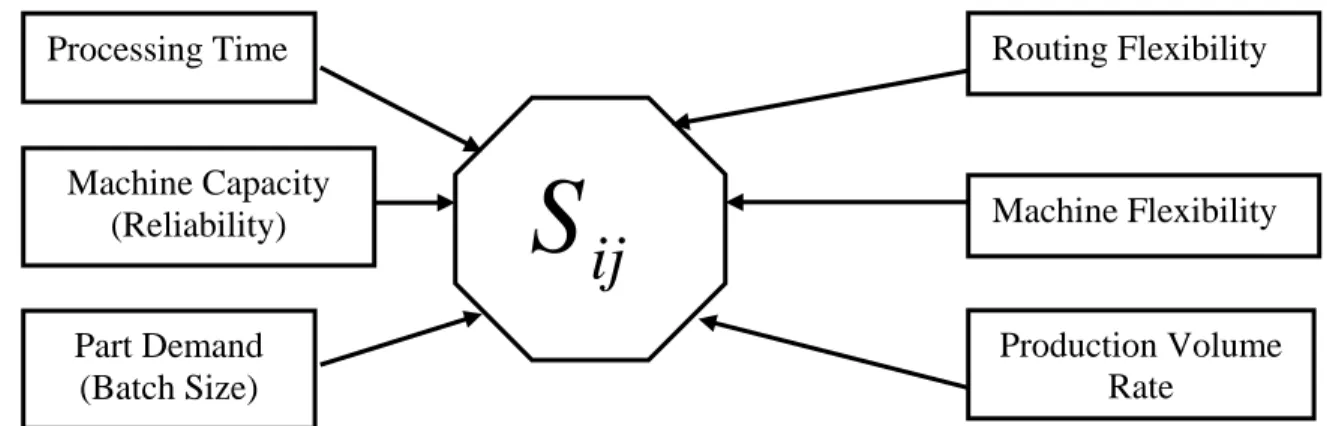
A comprehensive new similarity coefficient between machines will be created by considering alternative routings, processing time, machine capacity (reliability), machine capability (flexibility), production volume, product (part) demand, and number of operations done on each machine (figure 1). A relationship between machines can be calculated by using their similarity coefficient. The relationship between machines usually ranges from 0 to 1, as most researchers range as a function of the definition of a coefficient. As the value of the similarity coefficient approaches 1 , the two machines become more similar. If this value is equal to 0, there is no similarity between them. The main objective for creating the new similarity coefficient between machines is to take both direct and indirect relations between them into consideration.
The mathematical expression for the new similarity coefficient between machines i and j, which was based on machine capacity, machine flexibility (maximum number of operations available per machine), part (product) volume and demand, number of operations performed by machines, and processing time, will be explained as follows (see equations (37) and (38)).
Assumptions:
The model assumes that the following information has been collected and screened for accuracy or specified by the user.
1. The processing times for all part type operations with associated process plans on different
machine types are known.
3. The capability of each machine type is also known and constant over time.
4. Each machine type can perform one or more operations.
5. The production volume of each part type in a specific period is known.
6. The demand for each part type in the specific period is also known.
7. The production volume per part is greater than part demand.
Figure 1. Issues that will be used to create a new similarity coefficient between machines.
max max
/
max max max
1 max , max , X ijkr j i i j j i i
i j i
n R
o o kjr
kir k
ijkr
i o j o k
k r ki and r kj ij
R R
o
o kjr o kjr
kir k kir
ijkr
i o j o k i o j
r ki r ki
and or
r kj r kj
n
n t
t V
X
C N C N D
S
n
n t n t
t V t
X OR
C N C N D C N C
= ∈ ∈ ∈ ∈ ∈ ∈ ⎡ ⎛ ⎞ ⎤ ⎢ ⎜ × × ⎟ ⎥ ⎜ ⎟ ⎢ ⎝ ⎠ ⎥ ⎣ ⎦ = ⎡ ⎛ ⎞ ⎤ ⎢ ⎜ × × ⎟ ⎥ + × ⎜ ⎟ ⎢ ⎝ ⎠ ⎥ ⎣ ⎦
∑ ∑
∑
∑
max 1 1Xijkr Xijkr
j j X ijkr
n n n
o k
ijkr
o k
k k n
n V Y N D − = = + ⎡⎛ ⎞ ⎤ ⎢⎜ × ⎟ ⎥ ⎜ ⎟ ⎢⎝ ⎠ ⎥ ⎣ ⎦
∑
∑
(37) or(
)
(
)
(
)
∑
∑
∑ ∑
∑∑
= − + = ∈ ∈ ∈ ∈ = ∈ ∈ ⎥ ⎥ ⎦ ⎤ ⎢ ⎢ ⎣ ⎡ ⎟ ⎟ ⎠ ⎞ ⎜ ⎜ ⎝ ⎛ × × + ⎥ ⎥ ⎦ ⎤ ⎢ ⎢ ⎣ ⎡ ⎟ ⎟ ⎠ ⎞ ⎜ ⎜ ⎝ ⎛ × × ⎥ ⎥ ⎦ ⎤ ⎢ ⎢ ⎣ ⎡ ⎟ ⎟ ⎠ ⎞ ⎜ ⎜ ⎝ ⎛ × × = ijkrX Xijkr
ijkr X j j i i j j i i ijkr X j j i i n k k n n n k ijkr o o j kjr o o i kir R kj r orrki k ijkr o o j kjr o o i kir R kj r andki r n k k ijkr o o j kjr o o i kir R kj r andki r ij BS Y N n C t OR N n C t BS X N n C t N n C t BS X N n C t N n C t S 1 1 1 max max / max max max max , max , max (38) ij
S
similarity coefficient between machines i and jkir
t processing time part k takes on machine i including setup time with process plan r
kjr
t processing time part k takes on machine j including setup time with process plan r
i
o
n number of operations done on machine i
j
o
n number of operations done on machine j
max
i
o
N
maximum number of operations available on machines imax
j
o
N
maximum number of operations available on machine jij
S
Processing Time
Production Volume
Rate
Machine Capacity
(Reliability)
Routing Flexibility
Part Demand
(Batch Size)
Machine Flexibility
i
C
capacity of machine ij
C
capacity of machine jk
V
part volume of part type k per periodk
D
part demand of part type k per periodk
BS
batch size of part kijkr
X
=1 if part type k visits both machines i and j with process plan rijkr
X
=0 otherwiseijkr
Y =1 if part type k visits either machine i or machine j with process plan r
ijkr
Y =0 otherwise
k = 1,…, n (parts), l = 1,…, m (machines), r = 1,…, R (routings)
R
number of part routings that can be processed on both machines i and j\
R
number of part routings that can processed on either machine i or machine jm number of machines in the machine-part incidence matrix.
n number of parts R in the machine-part incidence matrix.
ijkr
X
n number of parts that can visit both machines i and j with process routings r
i kir
C t
fraction of processing time which part k will take from the capacity of machine i
j kjr
C
t
fraction of processing time which part k will take from the capacity of machine j
max
i i
o o
N
n
number of operations done on machine i with respect to the maximum number of
operations available on that machine. This term represents the flexibility of machine i
max
j j
o o
N
n
number of operations done on machine j with respect to the maximum number of
operations available on that machine. This term represents the flexibility of machine j
k k
D V
ratio of production volume rate to demand per part
4. HEURISTIC APPROACH FOR MACHINE CELL FORMATION
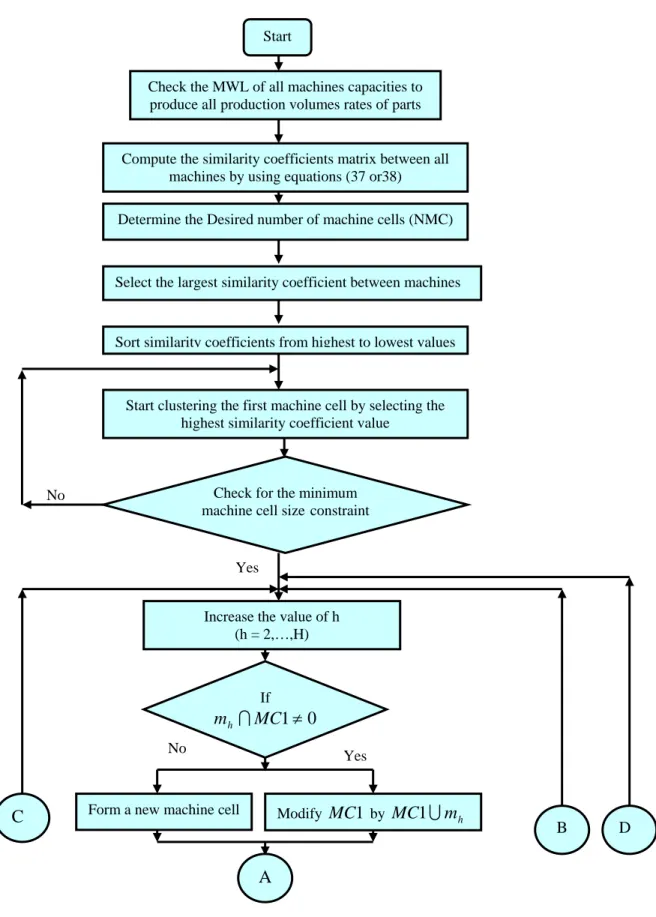
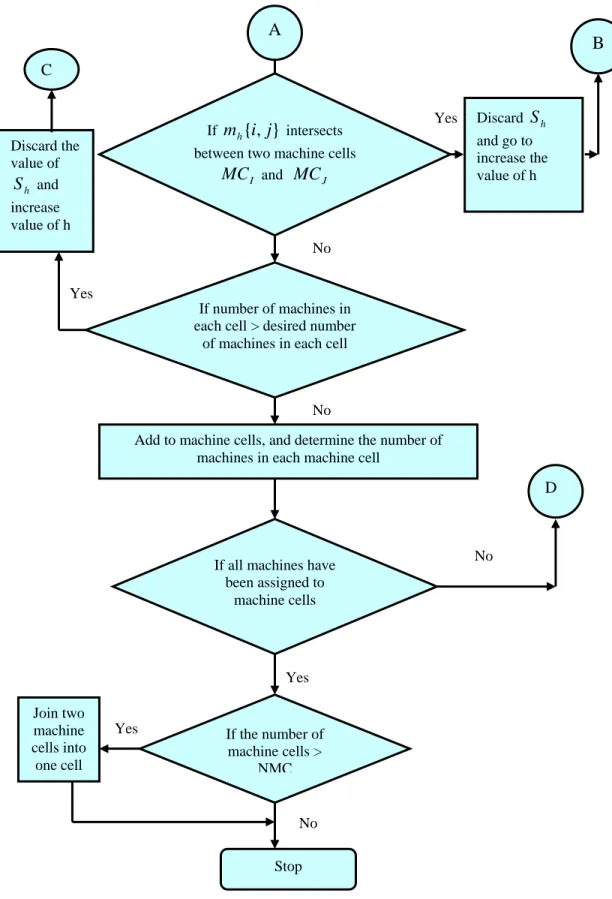
Machines are assigned to machine cells based on our new similarity coefficient. The procedure to group machines into cells is given by the following steps:
Step 1: Check the Machine Work Load (MWL) of each machine type capacity (
C
i,...,
C
m) toproduce all production volumes for all parts (
V
1,...,
V
n) by these machines in themachine-part incidence matrix. The MWL of machine i is based on production volumes and
processing times of all parts assigned to machine i. The equation for computing the MWL
(
)
∑ ∑
= ∈ ⎟
⎟ ⎠ ⎞ ⎜
⎜ ⎝ ⎛
+ + + = n
k
k ki k
ki k ki k
ki r r r
i t V t V t V
MWL
r r r
r r
ir
r 1 , ,
... max
2 1 2
1
(39)
Step 2: Compute the similarity coefficient matrix between all machine pairs according to equations (37) and (38).
Step 3: Determine the desired number of machines cells (NMC) by the following equation:
max
m
m
NMC
≥
m number of machines in machine-part incidence matrix.
max
m
pre-determinable maximum number of machines in the machine cell (at least twomachines per cell)
Step 4: Select the largest similarity coefficient between machine i and machine (j,…,m) from the similarity coefficient matrix in each row directly.
Step 5: Sort the similarity coefficients from highest to lowest value and record the values of
S
h andthe corresponding sets of
m
h{
i
,
j
}
, where h represents the level of the similarity value.Step 6: Start forming the first machine cell MC1 by selecting the highest similarity coefficient.
valueS1. Then, this pair of machines m1{i, j}will be clustered into the first machine cell.
Step 7: Check the minimum machine cell size constraint (at least two machines per cell).
Step 8: Increase the value of h (h = 2,…, H).
Step 9: If
m
hI
MC
1≠
0
. Then, modify MC1 by the newMC
1=
MC
1U
m
h.Otherwise, form a new machine cell
MC
n(
n
=
2
,...,
NMC
)
.Step 10: If any set
m
h intersects two cells MCI andMC
J, then, discard the correspondingS
h and go back to Step 8.Step 11: Check for the maximum number of machines allowed in a machine cell.
If the number of machines in this machine cell does not exceed the desired number of machines, then, add to this cell.
Otherwise, stop adding to this cell and go back to Step 8.
Step 12: If all the machines have not been assigned to machine cells, go back to Step 8. Otherwise, go to Step 13.
Step13: If the number of machine cells formed exceeds the desired number of machine cellsNMC, join two machine cells into one machine cell. All these steps will be shown in Figures 2 and 3.
5. ANALYTICAL EXAMPLE
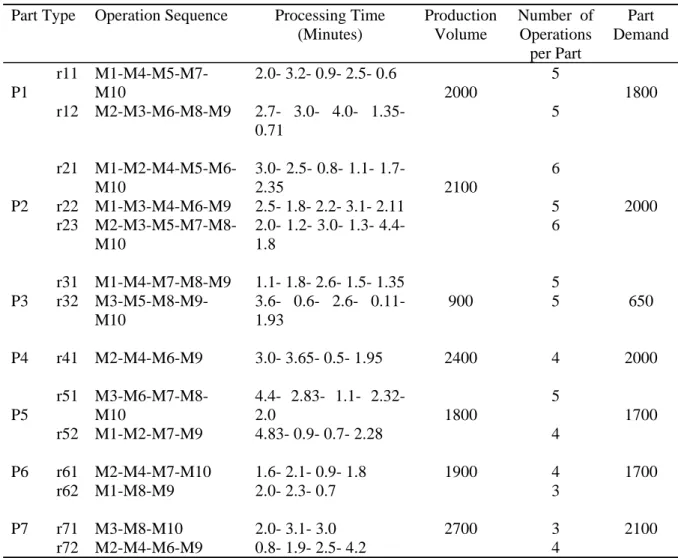
In order to demonstrate the proposed approach, the following numerical example will illustrate the procedure, including the similarity coefficients and formation of machines into machine cells. It is composed of 10 types of machines and seven types of parts with different process plans. The incidence matrix between machines and parts is presented in table 1. The part information including operation sequence and processing times for each process plan, and production volume and part demand is also presented in table 2. Information about machine availability, including the capacities of the machines, number of operations that will be done on machines, and maximum number of operations available on machines, is shown in table 3.
Table 1. Incidence matrix between machines and parts.
Machine
Parts
P1 P2 P3 P4 P5 P6 P7
r11 r12 r21 r22 r23 r31 r32 r41 r51 r52 r61 r62 r71 r72
M1 1 0 1 1 0 1 0 0 0 1 0 1 0 0
M2 0 1 1 0 1 0 0 1 0 1 1 0 0 1
M3 0 1 0 1 1 0 1 0 1 0 0 0 1 0
M4 1 0 1 1 0 1 0 1 0 0 1 0 0 1
M5 1 0 1 0 1 0 1 0 0 0 0 0 0 0
M6 0 1 1 1 0 0 0 1 1 0 0 0 0 1
M7 1 0 0 0 1 1 0 0 1 1 1 0 0 0
M8 0 1 0 0 1 1 1 0 1 0 0 1 1 0
M9 0 1 0 1 0 1 1 1 0 1 0 1 0 1
Figure 2. Flow chart of grouping machines into machine cells (Part 1).
Check the MWL of all machines capacities toproduce all production volumes rates of parts
Compute the similarity coefficients matrix between all machines by using equations (37 or38)
Determine the Desired number of machine cells (NMC)
Select the largest similarity coefficient between machines
Start clustering the first machine cell by selecting the highest similarity coefficient value
Sort similarity coefficients from highest to lowest values
Check for the minimum machine cell size constraint No
Yes
Increase the value of h (h = 2,…,H)
Form a new machine cell If
0
1
≠
MC
m
hI
Modify MC1 by
MC
1
U
m
hYes No
D
Start
A
B
Figure 2. Flow chart of grouping machines into machine cells (Part 2).
NoYes
Yes
No
No
Yes
No Yes
Join two machine cells into one cell
Stop
Discard
S
hand go to increase the value of h If
m
h{
i
,
j
}
intersectsbetween two machinecells
I
MC and
MC
JIf number of machines in each cell > desired number
of machines in each cell
C
Add to machine cells, and determine the number of machines in each machine cell
If all machines have been assigned to
machine cells
D
If the number of machine cells >
NMC Discard the
value of
h
S
and increase value of hA
Table 2. Parts information.
Part Type Operation Sequence Processing Time
(Minutes)
Production Volume
Number of Operations per Part
Part Demand
P1
r11 M1-M4-M5-M7-M10
2.0- 3.2- 0.9- 2.5- 0.6
2000
5 1800
r12 M2-M3-M6-M8-M9 2.7- 3.0- 4.0- 1.35- 0.71
5
P2
r21 M1-M2-M4-M5-M6-M10
3.0- 2.5- 0.8- 1.1- 1.7-
2.35 2100
6 2000
r22 M1-M3-M4-M6-M9 2.5- 1.8- 2.2- 3.1- 2.11 5
r23 M2-M3-M5-M7-M8-M10
2.0- 1.2- 3.0- 1.3- 4.4- 1.8
6
P3
r31 M1-M4-M7-M8-M9 1.1- 1.8- 2.6- 1.5- 1.35
900
5 650
r32 M3-M5-M8-M9-M10
3.6- 0.6- 2.6- 0.11- 1.93
5
P4 r41 M2-M4-M6-M9 3.0- 3.65- 0.5- 1.95 2400 4 2000
P5
r51 M3-M6-M7-M8-M10
4.4- 2.83- 1.1- 2.32-
2.0 1800
5 1700
r52 M1-M2-M7-M9 4.83- 0.9- 0.7- 2.28 4
P6 r61 M2-M4-M7-M10 1.6- 2.1- 0.9- 1.8 1900 4 1700
r62 M1-M8-M9 2.0- 2.3- 0.7 3
P7 r71 M3-M8-M10 2.0- 3.1- 3.0 2700 3 2100
r72 M2-M4-M6-M9 0.8- 1.9- 2.5- 4.2 4
Table 3. Machine information. Machine
Type
Capacity of machine
(Hours)
Number of Operations done on
machine (
n
o)Maximum number of operations available on machine
(
N
max)1 2400 6 6
2 2000 7 7
3 2300 6 6
4 3000 7 10
5 1800 4 4
6 1900 6 9
7 2700 6 8
8 1300 7 10
9 2500 8 9
5.1. Similarity Coefficient between Machines
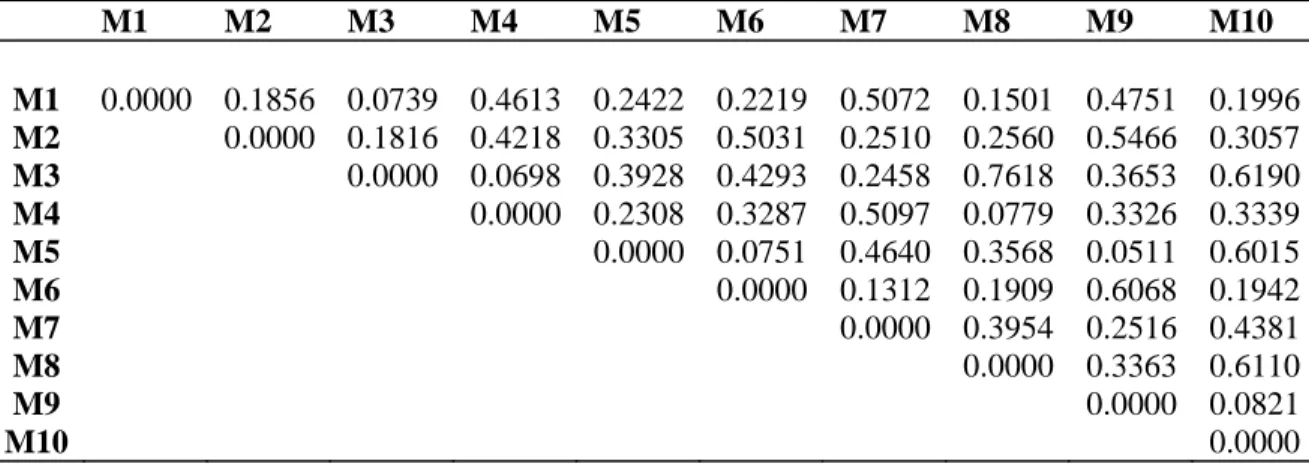
The similarity coefficient between machines has been coded in the C programming language and executed on a Pentium IV processor. The result of similarity coefficients between machines is illustrated in table 4.
5.2. Machine Cells Formation
Step 1: Check the capacity of each machine type (availability of time per machine) to produce all parts that require processing on the machine.
For machine one (M1), the capacity for M1 equals 2400 hours. The total consumed time taken from M1 will be calculated as follows:
hours 4 . 396 60
784 , 23
)] 1900 ( 0 . 2 ) 1800 ( 83 . 4
) 900 ( 1 . 1 ) 2100 ( 5 . 2
) 2100 ( 0 . 3 max[ ) 2000 ( 2
60
1 = =
⎥ ⎥ ⎥ ⎦ ⎤ ⎢
⎢ ⎢ ⎣ ⎡
+
+ +
+ +
The slack of time on machine (M1) is 2400-396 = 2004 hours. So, M1 is OK. The slack of time on machine (M2) is 2000-412 = 1588 hours. So, M2 is OK. The slack of time on machine (M3) is 2300-439 = 1861 hours. So, M3 is OK. The slack of time on machine (M4) is 3000-509 = 2491 hours. So, M4 is OK. The slack of time on machine (M5) is 1800-144 = 1656 hours. So, M5 is OK. The slack of time on machine (M6) is 1900-453 = 1447 hours. So, M6 is OK. The slack of time on machine (M7) is 2700-229 = 2471 hours. So, M7 is OK. The slack of time on machine (M8) is 1300-440 = 860 hours. So, M8 is OK. The slack of time on machine (M9) is 2500-475 = 2025 hours. So, M9 is OK. The slack of time on machine (M10) is 2100-383 = 1716 hours. So, M10 is OK. The capacities of all machines are satisfy to all production volumes for all parts.
Step 2: Compute the similarity coefficient matrix between all machines according to the similarity coefficient (37).
Table 4. Similarity coefficients between machines.
M1 M2 M3 M4 M5 M6 M7 M8 M9 M10
M1 0.0000 0.1856 0.0739 0.4613 0.2422 0.2219 0.5072 0.1501 0.4751 0.1996
M2 0.0000 0.1816 0.4218 0.3305 0.5031 0.2510 0.2560 0.5466 0.3057
M3 0.0000 0.0698 0.3928 0.4293 0.2458 0.7618 0.3653 0.6190
M4 0.0000 0.2308 0.3287 0.5097 0.0779 0.3326 0.3339
M5 0.0000 0.0751 0.4640 0.3568 0.0511 0.6015
M6 0.0000 0.1312 0.1909 0.6068 0.1942
M7 0.0000 0.3954 0.2516 0.4381
M8 0.0000 0.3363 0.6110
M9 0.0000 0.0821
Step 3: Determine the desired number of machine cells, NMC. The maximum number of machines assigned to cells ranged from 3 to 7 machines (Wilhelm et al. 1998) and from 5 to 10 machines (Ramabhatta and Nagi 1998). Four machines per cell are recommended for easy management and control.
5
.
2
4
10
≥
≥
NMC
. Therefore, the number of machine cells can start with three cells.Three machine cells will be chosen.
Step 4: Select the largest similarity coefficient between machine i and machine (j,…,m) from Table 4 as follows:
7 1
m
m
−
0.50729 2
m
m
−
0.54668 3
m
m
−
0.76187 4
m
m
−
0.509710 5
m
m
−
0.60159 6
m
m
−
0.606810 7
m
m
−
0.438110 8
m
m
−
0.611010 9
m
m
−
0.0821Step 5: Sort the similarity coefficients from the highest to lowest value and record the values of
S
hand the corresponding sets of
m
h{
i
,
j
}
H
m
h{
i
,
j
}
S
h____________ ______
1
m
3−
m
8 0.76182
m
8−
m
10 0.61103
m
6−
m
9 0.60684
m
5−
m
10 0.60155
m
2−
m
9 0.54666
m
4−
m
7 0.50977
m
1−
m
7 0.50728
m
7−
m
10 0.4381Step 6: For S1= 0.7618 (between Machines 3 and 8).
Step 7: Check the minimum machine cell size constraint (at least two machines per cell).
Step 8: S2= 0.6110 (between Machines 8 and 10).
2
m = {8, 10}
Step 9: There is an intersection between Machine 8 andMC1.
The new machine cell isMC1Um2.
Then, the revised machine cell MC1= {3, 8, 10}
3
S
=0.6068 (between Machines 6 and 9)3
m
= {6, 9} andMC
1I
m
3=
0
3
S
does not intersect with MC1Then, form a new machine cell MC2= {6, 9}
4
S = 0.6015 (between Machines 5 and 10)
4
m = {5, 10}
There is an intersection between Machine 10 andMC1, but there is no intersection withMC2.
The new machine cell isMC1Um4.
Then, the revised machine cell
1
MC = {3, 5, 8, 10}
Step 10: Check for the maximum number of machines a machine cell.
Machine Cell 1 contains four machines. Therefore, no more machines are added to MC1.
5
S
= 0.5466 (between Machines 2 and 9)5
m
= {2, 9}There is an intersection between Machine 9 andMC2, but this is no intersection withMC1. The
new machine cell is
MC
2U
m
5.Then, the revised machine cell MC2= {2, 6, 9}
6
S
= 0.5092 (between Machines 4 and 7)6
m
={4,7},MC
1I
m
6=
0
,andMC
2I
m
6=
0
There is no intersection between Machines 4 or 7 with eitherMC1 orMC2.
Then, forms a new machine cell
MC
3= {4, 7}7
S
= 0.5072 (between Machines 1 and 7)7
m
= {1, 7}There is an intersection between Machine 7 and
MC
3, but this is no intersection with MC1orMC2. The new machine cell is
MC
3U
m
7.Then, the revised machine cell
MC
3= {1, 4, 7}Machine Cells are as follows:
1
MC = {3, 5, 8, and 10} 2
MC = {2, 6, and 9} 3
MC
= {1, 4, and 7}6. CONCLUSIONS
This paper proposed a new similarity coefficient for grouping machines into machine cells. Similarity coefficients between machines were reviewed through this paper. These similarity coefficients show that there are several factors or issues to be used in determining the similarity between machines. Some of them concentrated on the machine–part incidence matrix, and the rest of them depend on one or two production and/or flexibility issues like production volume, operation sequence, part demand, and number of intercellular moves. This variation will lead to suggest a new comprehensive similarity coefficient between machines including the most important production and flexibility issues. The main difference between the proposed similarity coefficient and those which already existed in the literature is the lack of them to incorporate all the real world issues. The results in table 4 showed how each value of the similarity coefficient is different. The heuristic based similarity approach was used to group machines into machine cells.
REFERENCES
[1] Aljaber N., Baek W., Chen C.L. (1997), A Tabu search approach to the cell formation
problem; Computers & Industrial Engineering 32; 169-185.
[2] Chang P. T., Lee E.S. (2000), A multisolution method for cell formation-exploring practical
alternatives in group technology manufacturing; Computers and Mathematics with
Applications 40; 1285-1296.
[3] Gunasingh K.R., Lashkari R.S. (1989), Machine grouping problem in cellular manufacturing
systems: An integer programming approach; International Journal of Production Research
27; 1465-1473.
[4] Gupta T. (1991), Clustering algorithms for the design of a cellular manufacturing system-An
analysis of their performance; Computers & Industrial Engineering 20; 461-468.
[5] Gupta T. (1993), Design of manufacturing cells for flexible environmental considering
alternative routing; International Journal of Production Research 31; 1259-1273.
[6] Gupta T., Seifoddini H. (1990), Production data based similarity coefficient for
machine-component grouping decisions in the design of a cellular manufacturing system; International
Journal of Production Research 28; 1247-1269.
[7] Islam K.M.S., Sarker B.R. (2000), A similarity coefficient measure and machine-parts
grouping in cellular manufacturing systems; International Journal of Production Research
38; 699-720.
[8] Lee M.K., Luong H.S., Abhary K. (1997), A genetic algorithm based cell design considering
[9] Leem C.-W., Chen J.J. G. (1996), Fuzzy-set-based machine-cell formation in cellular
manufacturing; Journal of Intelligent Manufacturing 7; 355-364.
[10] Lozano S., Canca D., Guerrero F., Garcia J.M. (2001), Machine grouping using sequence
based similarity coefficients and neural network; Robotics and Computer Integrated
Manufacturing 17; 399-404.
[11] Luong L.H.S. (1993), A cellular similarity coefficient algorithm for the design of
manufacturing cells; International Journal of Production Research 31; 1757-1766.
[12] Luong L.H.S., Kazerooni M., Abhary K. (2001), Genetic algorithms in manufacturing system
design. In Computational Intelligence in Manufacturing Handbook, edited by Jun Wang et
al., Boca Raton, FL (CRC Press LLC).
[13] McAuley J. (1972), Machine grouping for efficient production; The Production Engineer 52;
53-57.
[14] Mosier C. (1989), An experiment investigating the application of clustering procedures and
similarity coefficients to the GT machine cell formation problem; International Journal of
Production Research 27; 1811-1835.
[15] Nair G.J., Narendran T.T. (1998), CASE: A clustering algorithm for cell formation with
sequence data; International Journal of Production Research 36; 157-179.
[16] Nazarlo D., Ramirez B. (2000), Application of mixed integer programming to cellular
manufacturing; Engineering Valuation and Cost Analysis 2; 373-386.
[17] Ponnambalam S.G., Aravindan P. (1994), Design of cellular manufacturing systems using
objective functional clustering algorithms; International Journal of Advanced Manufacturing
Technology 9; 390-397.
[18] Probhakaran G., Janakiraman T.N., Sachithanandam M. (2002), Manufacturing data-based
combined dissimilarity coefficient for machine cell formation; International Journal of
Advanced Manufacturing Technology 19; 889-897.
[19] Ramabhatta V., Nagi R. (1998), An integrated formulation of manufacturing cell formation
with capacity planning and routing; Annals of Operations Research 77; 79-95.
[20] Seifoddini H. (1988), Incorporation of the production volume in machine cells formation in
group technology applications. Recent Developments in Production Research, edited by A. Mital, (Elsevier Science Publishers B.V., Amsterdam), 562-570.
[21] Seifoddini H. (1989), A probabilistic approach to machine cell formation in group
technology. International Conference of Institute of Industrial Engineers, Toronto, Ontario, Canada, May 14-17, 625-629.
[22] Seifoddini H., Djassemi M. (1991), The production data-based similarity coefficient versus