Rosa E. Goetz. A Profile of Scholarly Communications Innovations: Looking at the Faculty Profile System and its Role in the Changing World of Scholarly Communications. A Master’s Paper for the M.S. in L.S degree. April, 2018. 71 pages. Advisor: Stephanie W. Haas
In her 1997 article ‘Scholarly Communication—Historical Developments and New Possibilities’, Nancy Fjällbrant noted that “we are on the greatest change in scholarly communication and knowledge transfer the world has ever seen”. 20 years later, the world of scholarly
communications is still in a period of rapid change. I focused on one scholarly communication tool, the scholarly profile system, and examined first the theoretical possibility of this tool to replace scholarly journals (through the lens of Bijker and Pinch’s social construction of technology) and then I interviewed users to examine uses, trends and issues with the scholarly profile system. I ultimately concluded that although the system is functional in the current climate of scholarly communications, it will have to answer questions about access, use and outcomes in order to continue meeting the needs of scholars and researchers.
Headings:
A PROFILE OF SCHOLARLY COMMUNICATIONS INNOVATIONS: LOOKING AT THE FACULTY PROFILE SYSTEM AND ITS ROLE IN THE CHANGING
WORLD OF SCHOLARLY COMMUNICATIONS
by Rosa E. Goetz
A Master’s paper submitted to the faculty of the School of Information and Library Science of the University of North Carolina at Chapel Hill
in partial fulfillment of the requirements for the degree of Master of Science in
Library Science.
Chapel Hill, North Carolina July 2018
Approved by
Table of Contents
1. Introduction ... 2
2. Literature review ... 5
2.1 Scholarly Communications ... 7
2.2 Open Access ... 9
2.3 Institutional Repositories ... 11
2.4 Impact Factor and Metrics ... 14
2.5 The Current Landscape ... 18
2.6 Conclusion ... 22
3. Program Overview andComparison ... 24
3.1 Social Media Tools ... 25
3.2 Resource Management Tools ... 27
3.3 Institutional Repositories ... 30
4. Methodology ... 34
5. Results ... 38
5.1 Administrative/institutional Involvement ... 39
5.2 Existing Data ... 42
5.3 Faculty Involvement and Participation ... 45
5.4 Scholarly Communication Trends ... 47
6. Discussion ... 51
6.1 Faculty Interaction and User Feedback ... 51
6.2 Administrative Differences ... 54
6.3 Advancement of Scholarly Communications ... 57
7. Conclusion ... 60
Appendix 1 ... 62
1. Introduction
Sometime in 2015, the Wiggins Library at Campbell University received a request from a faculty member in the Health Sciences Department: would the library be willing to start and maintain an intuitional repository and faculty profile system? It was an unusual request for a library at a small, southern Baptist university in rural North Carolina to receive. However, within the context of current trends in scholarly
communication, it was perhaps not an immodest one. Duke University, an R1university about an hour away, had both, and other research-oriented universities seemed to be picking up the trend. The technical staff at Campbell’s Wiggins Library, with its recent push to establish a reputation as a serious research university in STEM fields, began examining ways to fulfill it. Although Campbell is somewhat late to jump on the wagon, it is only one of the more recent converts to a set of databases known as scholarly profile systems.
At its most basic, these scholarly profile systems are a collection of profiles of entities (faculty as well as departments and individual objects, such as scholarly works), that are connected with a specific ontology that allows the programmer to specify how these profiles are connected. The primary goal, as expressed on the Wiki page of one scholarly profile system (VIVO), is “sharing information about the research activities and outputs of university and government researchers around the world”.1 As Givens, a
librarian at Duke University expressed, a primary use of these scholarly profile systems is to enable researchers in different departments and institutions to connect with each other via these profiles, which highlight research interests and scholarly work.2 This is a definite advantage at a time when researchers are being encouraged to pursue more multidisciplinary and interdisciplinary research. It also mimics wildly popular social media applications such as Facebook in its organization of information into profiles. There are a number of scholarly profile systems, which vary in origin and purpose— some, like VIVO and Bepress’ Digital Commons, are controlled by an individual institution. Other websites such as ResearchGate and Mendeley rely on individual scholars creating profiles and populating them. However, all of these new tools are readily available on the market, and advertise themselves as being poised to meet the changing communications needs of scholars and researchers. The first challenge for the librarian in charge of implementing a scholarly profile system is which path to take.
Fjällbrant takes the idea of the social construction of technology from two other researchers, Bijker and Pinch, and applies it to the field of scholarly communications.34 She argues in her paper on the topic that scholarly journals, which had previously been the foremost method of scholarly communication, are currently failing to meet the needs of researchers and scholars. Using Bijker’s concept of the social construction of
technology, she argues that, since scholarly journals have been established by the field as being unable to meet current needs, a wealth of new tools will be developed and
discarded, until another tool is found that meets the needs of the group as a whole—at
2Givens, Macklin, and Mangiafico, “Faculty Profile Systems.”
which point it will be adopted as the foremost method of scholarly communication. The wealth of tools and programs currently available for the purpose of scholarly
communication make Fjällbrant’s (and by extension Bikjer’s) postulation prescient. Although scholarly profile systems are only one of these tools, they are highly versatile and have potential to be paired with other programs to create a system that fulfills most scholarly communication needs.
My thesis examines how these scholarly profile systems meet the evolving needs of scholarly communication and if they may be poised to continue to do so in the future. Specifically, I looked at how these programs are seen and assessed by the academic institutions that use them. To that end I conducted a number of interviews with people currently running a scholarly profile system. I asked about their reasons for implementing the program, how it fits into their institution and fills established needs, and their
perceptions of scholarly communication trends. I hoped to gather qualitative data from established users in order to determine general trends among users of scholarly profile systems, and perhaps trends in the field of scholarly communications as a whole,
2: Literature Review
The emergence of the scholarly profile system is the result of numerous
intersections, not only of scholarly communications trends, but also trends within society at large. Regarding scholarly communications, the rise of the internet means that we, as scholars and researchers, have changed the way that we acquire, organize and output information. It is hard to fully articulate the many ways in which the rise of the internet has shaped both scholarly communications and the greater world, but it is clear that the overall change is drastic. As one of the objectives of librarians, especially those in
academic libraries, is to facilitate the acquiring and organizing of information, this means that the library profession must also change, to reflect these changes, and to encourage the use of tools that perform best.
One class of these tools is called ‘research networking tools’—internet tools used to discover and organize scholarly information about not only information objects (such as articles), but also about people.5 Many of the tools recently developed for use in scholarly communications are either tools for research networking, or tools to facilitate research networking. For instance, institutional repositories are an attempt to gather all of an institution’s scholarly output into one easily accessible and searchable place. The recent field of altmetrics builds off of traditional citation networks, in that it attempts
5“Comparison of Research Networking Tools and Research Profiling Systems,”
Wikipedia, December 5, 2017,
to measure the reach of a particular set of ideas. But altmetrics goes a step further in that it attempts to put a specific measure of reach and influence onto a scholar. Alongside these variations on research networking, there are scholarly profile systems, or faculty profile networks—the two terms are synonymous, as Givens explains in her work on Duke’s VIVO implementation.6 She defines these systems as those which “collect and store structured data about faculty publications, research and scholarly activities”. This is a narrower subset than research networking, in that it is more structured, and also
specifically refers to academic research. Many of these faculty profile systems, as the name might suggest, use ‘profiles’ of researchers, as well as research information, to organize their data. Although this definition has led people to call VIVO ‘Facebook for academics’, Carey disputes this. Instead, in his article on scholarly networking, he quotes an older VIVO plan which describes the tool as creating “a single point of access for scholarly communication”.7 In this way, Carey hints at the potential use of VIVO, not simply as a research networking tool, but as a way to combine multiple tools and grant, as he says, a single point of access to scholarly research and networking.
This literature review goes briefly into the history of scholarly communication and the way that recent events have allowed for a variety of new tools to emerge. I will then discuss the serials crisis and the open access movement, to give further context to the ways that the internet has shaped current scholarly communications thought. I will then go into more detail about several tools concurrent to the faculty profile system, including institutional repositories, before ending with a general look at the current
6Givens, Macklin, and Mangiafico, “Faculty Profile Systems.”
7“Faculty of 1000 and VIVO: Invisible Colleges and Team Science,” accessed January
landscape of scholarly communications and how the concept of the scholarly profile system fits into this landscape.
2.1: The Field of Scholarly Communications
Although the specific idea of VIVO, and scholarly profile systems as a whole, is relatively new, the forces driving it are not. Nancy Fjällbrant states that scholarly communication, defined in her work as the way that researchers spread and share information, has been a known phenomenon since the rise of scholarly societies and journals in the 1700s.8 She cites David Kaufer and Kathleen Carley’s book
Communication at a Distance to describe reasons that researchers engage in this communication. These are: ownership of ideas, societal recognition of authorship,
claiming of a discovery, and the establishment of an accredited community of authors and readers.9
Fjällbrant begins with the origin of the scholarly journal in the early 1700s and points out the ways that different methods of communication among scholars coalesced into a formal method of scholarly communication—i.e., the scholarly journal. The wider spread of journals helped to establish a community, as well as grant recognition to authors for specific achievements and discoveries. She goes briefly into the origins of copyright law, the establishment of faster printing presses, and the rise of scientific societies as additional catalysts for the rise of the journal. Ultimately, however, she argues that the journal article has outlived its usefulness in today’s world. Fjällbrant’s
conceptualization of the rise of the scholarly journal, and her prediction of its fall, is shaped by Bijker and the concept of the social construction of technology. Specifically, Fjällbrant relies on their idea that there are set stages to establishing technological solutions. The first stage is that, when a need has been expressed, a number of technological tools will be invented and become available. These tools will then be judged by the community as to how they best meet the expressed need. Ultimately, in Bijker and Pinch’s work The Social Construction of Technological Systems, they imply that one superior technology will be widely used by society, and the rest will be
discarded.10 Fjällbrant incorporates the concept of social construction of technology with her historiography of the field of scholarly communication to state that, according to Bijker’s and Pinch’s theory, the scholarly journal was one option among many, but was then chosen as the most useful method of scholarly communication, based on the needs of researchers that Kaufer and Carley outlined. Because of the failures of these traditional methods of scholarly communication to meet the needs of today’s scholars, Fjällbrant then argues that Bijker’s notion of the social construction of technology has become newly applicable. She believes that there is an opening for different methods and technologies to rise to prominence, and a new form of scholarly communication to be established by the academy as a whole. That being said, few people have examined either the gap that Fjällbrant has postulated, or the ways in which the social construction of technology is playing out today. Fjällbrant places emphasis on the rise of the internet and the effect it has had of creating of new methods of publishing, which appears accurate 20 years on. This is, as I described earlier, important to note for how scholarly profile
systems might potentially fit into Fjällbrant’s concept of the social construction of
technology. If we are to take Fjällbrant’s theory at face value, these systems are currently one of many scholarly communication tools which have arisen to fulfill an expressed need. However, there are many tools currently available, some of which overlap or fulfill multiple needs.
2.2: Open Access
In her article, Fjällbrant had numerous thoughts on why journal articles have fallen by the wayside as an effective tool of scholarly communication. She argues that journal articles take too long to publish and thus potentially retard, rather than expedite, scholarly communication. She also cites issues with the notion of peer review as further making journals ineffective in refereeing scholarship. However, the main cause might be that the expense of these articles has risen. This means that libraries, which Fjällbrant acknowledge as facilitators of scholarly communication, are potentially unable to purchase and thus distribute important research. The exponential rise of the cost of journals is documented by Panitch and Michalak to have been about a 215% increase in price over 17 years.11 As they write, the situation is untenable. However, they list several possible solutions to the serials crisis and related concerns, all based around the idea of the internet as providing an open source of information. The most promising of these may be Open Access, which Panitch and Michalak define as an attempt to make scientific and scholarly information freely available via the internet.
11 Judith M. Panitch and Sarah Michalak, “THE SERIALS CRISIS A White Paper for the
Peter Suber, Director of the Harvard Office of Scholarly Communication, defines Open Access literature as being digital, online, free of charge and most copyright and licensing restrictions.12 The raising of price barriers and permission barriers, as Suber states, are the key points that define open access, although there are numerous ways to raise these barriers.13 Open access (OA) requires a change in the concept of copyright within the world of scholarly journals, largely that authors retain some copyright over their articles. This, and a change in pricing and payment, tends to define open access. Suber states that there are two methods for open access, OA Journals (“Gold OA”) and OA Repositories (“Green OA”). Journals that are open access have articles that are freely available to the public, rather than placed behind paywalls or only available through a scholarly institution such as an academic library. The most infamous way of enabling this is through author pay, where the author pays a fee to have their research disseminated in an OA journal. Although numerous authors such as Bohannon have dismissed such methods as opening the door to predatory publishing, Suber argues both that author pay models are not inherently predatory, and also that this is not the only method of ensuring open access articles. Although open access journals are important, particularly in
response to the serials crisis and what many see as unethical business practices by established publishers such as Elsevier, there are others who argue that open access repositories are more important in disseminating and preserving scholarly work. Open access repositories are defined by Suber as places where scholars can make their research freely available to the world.14 Proponents argue that they contribute to the field of
scholarly communications by bringing enhances exposure to researchers, while also having the potential to preserve these works and thus ensure a longer span of time where this research can be influential. But, although there has been research done on open access in general, and repositories in particular, it has not come to any grand conclusion. It is generally agreed that open access has the potential to allow for the field of scholarly communication to change, and to change in favor of libraries and academics. But there has not been much evidence to prove this. The articles that have looked at open access carefully and clearly have concluded that it requires more support and more followers to truly be established. But despite that, many proponents of open access are hopeful about the future of the movement. The idea of open access can be seen as a key proponent of several scholarly profile systems, such as ResearchGate and Academia.com, which encourage free sharing of academic articles by authors. The program VIVO goes a step further and is itself open source (a form of open access), with anyone able to access and download the code via the website Github.
2.3: Institutional Repositories
Much of scholarly communications has recently been focused on the promise of open access—specifically for academics, open access repositories. Open access
repositories go hand-in-hand with another trend among scholarly communication, that of the institutional repository. Institutional repositories are defined by Raym Crow as ‘digital collections capturing and preserving the intellectual output of a single or multi-university community’.15 Although they are not the same as OA repositories, institutional
repositories could easily function as open access repositories. The difference is that institutional repositories do not necessarily have to function in a way that promotes open access by all, although they often do. They also tend to be linked to, as the definition states, one or more institutions. Crow states that institutional repositories can only successfully function if they are easily accessible and interoperable, thus laying the foundation for an argument that institutional repositories should be open access by default. He also writes that institutional repositories could elevate the prestige of universities or university systems, by directly tying scholarly output to the university brand and thus demonstrating the scientific and scholarly value that the university continues to hold. The open nature of institutional repositories could also widen readership of scholarly material, thus bringing allowing universities to claim to bring intellectual benefit not just to their direct users, but to a wider audience. Cullen and Chawner both argue that the greatest advantage of open access in general, including repositories, is the greater exposure that they could bring to academic scholarship.16
However, Cullen and Chawner also argue that many academics are unaware of or unwilling to contribute to an institutional repository, for a variety of reasons.17 They state that the early success of these repositories may have been due to the intake of previously published and easily available work, as well as motivated researchers and certain fields leading the way. Other academics who are more used to the traditional scholarship
16 Rowena Cullen and Brenda Chawner, “Institutional Repositories, Open Access, and
Scholarly Communication: A Study of Conflicting Paradigms,” The Journal of Academic Librarianship 37, no. 6 (December 1, 2011): 460–70,
https://doi.org/10.1016/j.acalib.2011.07.002.
17 Cullen and Chawner, “Institutional Repositories, Open Access, and Scholarly
methods, such as scholarly journals, may be unwilling to use an institutional repository to store their work. Additionally, Cullen and Chawner identify numerous points where lack of information or widespread misinformation may mean that scholars are unaware of the full benefits of a repository, believe that repositories will not benefit or may even actively harm their academic standing, or simply don’t know how to go about using or depositing in one. Additionally, the survey of New Zealand universities that Cullen and Chawner conducted indicated that the main reason why academic faculty might contribute to a repository is not from self-motivation, but rather because they were asked by their institution to do so. Looking at Cullen and Chawner’s conclusion, one might infer that increased use of institutional repositories might be stifled by the rigidity of the traditional university structure, perhaps especially by the tenure system. They also argue that many repositories lack a system of ‘registration’, identifying the owner of an intellectual property, and ‘certification’, establishing the quality of the research. They ultimately decide that repositories may be more successful if they instituted a process of peer review or an equivalent measure.
However, Crow, in his paper on institutional repositories, argues that institutional repositories can operate alongside traditional scholarly communication methods.18 In fact, he argues that IRs should be presented to faculty as a complementary structure to
traditional publishing methods, rather than their sole means of scholarly communication. The emphasis on wider readership could also be used to persuade reluctant faculty. But Crow also expressed hope that institutional repositories can also change the way that scholarship is produced, distributed and stored, thus potentially breaking the hold of
commercial publishers on scholarly communication. Beyond Crow’s arguments for the present value of institutional repositories, Lundell argues that institutional repositories could be ideally placed to offer long-term preservation of scholarly objects.19 Therefore, the value of the institutional repository is not only that it collects scholarly work in one distinct place, but that it is in a position to preserve this work. Cullen and Chawner echo this, stating in their conclusion that despite tepid acceptance by academics, institutional repositories are valuable for the pressure they place on traditional publishers.
Additionally, by allowing for open access—including long-term preservation of work— institutional repositories have the option to provide more content for a longer period of time. One concern in the age of the internet is that publishers do not necessary promise constant availability or access to a journal or article. Access to an article could easily be lost if a URL changes or a document becomes corrupted. In contrast, many institutional repositories have systems in place to ensure that the document remains uncorrupted and the access constant. Compared to scholarly journals, however, which originated in the 1700s, institutional repositories are a recent addition to the field of scholarly
communications, and the power for these repositories to shape the field may be some time away. It seems more likely that IRs will be one of a number of new programs—or rather, tools—to influence the field, much like scholarly profile systems. Another such tool, which fits well with the widespread reach of institutional repositories, is the notion of an impact factor.
2.4: Impact Factor and Metrics
The notion of the impact factor began in the early 20th century, but as Pendlebury notes, this concept was actualized in 1963 by Eugene Garfield.20 It was originally meant to show which journals were most influential in their various fields of scholarship . The impact factor was designed to assess research in various fields based on data such as citation information. As time went on, however, Pendlebury notes that the concept of the impact factor shifted from measuring only journal statistics to being applied to individual papers and authors. Pendlebury marks 2004 as a year of ‘sea change’, as Google and Elsevier adopted methods of gauging impact metrics, and programs such as Google Scholar to do this. Since this time, the field of bibliometrics, or the study of citation analysis, has expanded to use different data than Garfield originally included, and different programs to calculate these different values. In many cases, these are used to ‘score’ individual papers and scholars. However, Pendlebury warns that numbers alone are a dangerous way to gauge quality, as numbers ‘have the appearance of being authoritative’ when other methods might present a more nuanced view. Despite this warning, Roemer and Borchardt write that the field of bibliometrics has only become larger with the rise of the internet.21 In fact, Roemer states that the different methods of scholarly communication arising from the internet, such as blog posts and social media, have brought about a related field to bibliometrics, altmetrics. The difference between the two is that while bibliometrics tends to focus on traditional methods of citation in order to gauge impact, altmetrics attempts to gauge impact through a variety of means, such as
social media mentions. In short, while bibliometrics focuses on the measuring of formal methods of scholarly communication, altmetrics attempts to measure both formal and informal methods.
In truth, the very field of altmetrics is indicating a narrowing of the differences between formal and informal scholarly communication. Formal scholarship, as defined by Barjak, is impersonal and takes place largely through monographs and journal
articles.22 Informal scholarly communication, to contrast, takes place within networks of scholars and involves personal relationships wherein scholarly information is exchanged. Fjällbrant, in her discussion of scholarship in the early 1700s, distinguished between the informal letter-writing that scholars practiced and the more formal business of articles and scholarly.23 But Barjak argues, in contrast, that it is impossible to view formal scholarship methods without an understanding of the informal processes that shaped them. As an example he brings up concepts such as the ‘invisible college’—a term used to describe the informal networks of similarly research-minded peers, usually occurring in reference to academia.24 Although Barjak hypothesized that the rise of the internet would equalize information access, he discovered that the internet in fact largely upheld existing communication structures already occurring within networks of academic scholars. Barjak also noted that although scholars who were deeply involved in formal
22 Franz Barjak, “The Role of the Internet in Informal Scholarly Communication - Barjak
- 2006 - Journal of the Association for Information Science and Technology - Wiley Online Library.”
23Fjällbrant, “Scholarly Communication - Historical Development and New
Possibilities.”
24 Franz Barjak, “The Role of the Internet in Informal Scholarly Communication - Barjak
academic processes tended to be less involved in informal communication methods, those who were moderately involved in formal methods were also more involved in informal structures. This seems to indicate that, although there is something of a bell curve, most scholars who are involved in formal methods of scholarship such as paper-writing are also invested in informal methods, such as Twitter.
In line with Barjak’s examination of the internet and scholarly communication, Sugimoto argues that the field of altmetrics is entirely reliant on the new development of social media and other networking tools.25 She also argues that altmetrics is essentially a method of gauging ‘returns’ for investment into research for various stakeholders, hence the popularity and widespread use of altmetrics to gauge academic reach. But she also notes discrepancies in altmetric aggregation—for instance, she points out that sites which use DOIs (Digital Object Identifiers) to identify different journal articles might miss articles published without DOIs, typically in the social sciences and humanities.
Similarly, different academic disciplines such as the sciences might place more emphasis on altmetrics. This echoes findings by Cullen and Chawmer regarding questions of which academics are more invested in depositing in intuitional repositories.26 But Sugimoto also warns that the technological field is changing so quickly as to possibly render her
hypothesis void within the next few years. In her analysis of social media scholarship, she provides a breakdown of different ‘groups’ of sites or programs and how they are being used by academics. Sugimoto lists the scholarly profile system VIVO alongside
Facebook and Academia.edu as a social networking site, which she defines as web-based
25 Sugimoto et al., “Scholarly Use of Social Media and Altmetrics.”
26Cullen and Chawner, “Institutional Repositories, Open Access, and Scholarly
services that allow users to create public or semi-public profiles, articulate other users with which they have connections, and view and traverse their lists and others made within the system. These sites, she noted, are not only used to find and connect with other researchers, but also used by academics for professional branding. The use of these sites, then, is perhaps not so much dedicated to professional reviews of articles, so much as individual promotion and professional identity formation.
One scholarly profile system in particular highlights this use as a ‘business card’. ORCID is a program which functions like Google Scholar or ResearchGate, in that it encourages scholars to input their research information and display it within a profile. However, the main feature of ORCID is that it grants every researcher who registers a unique ID number. In this way scholars can be more immediately identified and
differentiated. This functions also as a URL that brings the user to the researcher profile page.27 This is a unique solution to one of the problems that Google Scholar, for
instance, faces—the need to differentiate different researchers, and the potential difficulty in doing so. It also would then make altmetrics more reliable and therefore more useful. But ORCID has flaws—namely, that users must register and input their own information. In addition, as controversial as notions such as altmetrics are, there is little research done into whether a scholar tweeting more will truly lead to greater exposure of their work. Before one dismisses or embraces altmetrics, more research should without doubt be done. There are questions about the reliability of several sites known for aggregating altmetrics. But, perhaps combined with other tools, they could be of some use.
2.5: The Landscape of Scholarly Communications
In the previous sections, I have laid out brief descriptions of the previous methods of scholarly communications, the open access movement and its contributions to recent changes in scholarly communications, and finally two tools, institutional repositories and altmetrics, which are directly tied to changes in the field of scholarly communications. If we were to return to Bijker’s social construction of technology theory, one of these methods of facilitating scholarly communication will ultimately triumph over the others. Fjällbrant notes that some characteristics may be seen as vital—for example, in any discussion of scholarly communications one of the main issues is the dissemination of ideas and articles.28 But, as Fjällbrant continued to note, there were several easily described needs that were easily answered by the emergence of the scholarly journal. Other methods, such as the passing around of relevant scholarly work, were simply insufficient.
Although the main objectives of scholarly communication—ownership, recognition, acknowledgment, and the formation of a community are the four that Fjällbrant notes—are still present, there may be different ways that they play out, or additional needs that are present in our current scholarly communication landscape. For instance, preservation of ideas may be a need that is newly relevant, since the internet is a far more quickly changing environment than a paper journal. What’s also notable,
looking at the array of tools which have cropped up, is the diversity of the needs they
28Fjällbrant, “Scholarly Communication - Historical Development and New
serve. Institutional repositories, altmetrics aggregators and scholarly profile systems all have very different structures and uses. Unlike the examples Fjällbrant notes as pre-journal methods of scholarly communications, there seems to be a very diverse set of needs to be met. Ultimately, although I still believe that Bijker’s theory of the social construction of technology will hold true, I believe the true successor to the scholarly journal will be, not one tool, but numerous interconnected tools.
For instance, Givens et al. suggest institutional repositories will operate best alongside complementary programs such as scholarly profile systems. Givens relies on findings by Gibbons and Foster on faculty reactions to institutional repositories. In their research they found that one of the key services faculty wanted an IR to provide was that other people were able to consistently find and use the research they were placing in them.29 Givens argues that pairing a repository with a scholarly profile system may be an ideal solution. They are designed in such a way that each faculty member has a ‘profile’ through which their scholarly work can then be accessed. This, Givens seems to argue, can give a wider scope and context to scholarly work stored in an institutional repository.
To argue her point about the necessity of scholarly profile systems, Givens tells the story of Duke’s attempt to set up a coalition of scholars wanting to contribute after the earthquake in Haiti in 2010. Givens says that this attempt to create a Humanities lab failed miserably, largely due to the Duke scholars' inability to find peers with relevant research interests or scholarly publications that they did not already know within a specific discipline. Givens’ claim that many professors do not know what their peers in
29Foster and Gibbons, “Understanding Faculty to Improve Content Recruitment for
the next office over are doing might be a stretch. But by using the example of the failed humanities lab, Givens paints a compelling picture of need: academics and researchers willing to reach out and create interdisciplinary coalitions, but lacking the basic tools to even find interested peers to do so. The thought behind the emerging field of Digital Humanities is partly that academia is not solidly rooted in past practice and tradition, and that the inclusion of new technology and processes can provide insight and new
approaches that would be previously unthought. If the goal of the librarian is to provide academics and researchers with the resources they need to output scholarly research, then librarians must also reckon with these new tools and approaches, and provide the best resources possible. It would be easy for Givens to argue that there is one best resource available, but that would go against the primary argument of her entire article—that neither IRs nor scholarly profile systems will function as well without the other. Her article does not entirely refute the social construction of technology theory, but it does present the contrasting idea that the best tool may not simply be one tool, but a series of interconnected ones.
repositories. Givens points out that libraries already do much of the work of operating, maintaining and making an Institutional Repository useful. If faculty profile systems are a co-program with Institutional Repositories, which libraries already operate, then it makes some sense for libraries to also take over the management of these scholarly profile systems. More broadly, Givens implies that libraries are already doing a good deal of work relevant to scholarly communications. Beyond simply offering resources to faculty, the serials crisis seems to have inspired many libraries and universities as a whole to take a more direct role in managing research materials. Profera et al. argue this further, that the role of libraries is to provide access to scholarly materials.30 They argue that to fulfill this, libraries must become more actively user-centric. The basic premise of Givens is that libraries are best positioned to recognize a need of scholars for greater materials and resources, including ways of connecting with other scholars and greater access to articles. Therefore, libraries are also best positioned to meet a need, whether by institutional repositories, faculty profile systems, or anything else. This is also
emphasized by the longstanding position of libraries as a ‘middleman’ between
publishers and scholars, and their role in both facilitating research and providing access. Givens does not make it absolute that libraries must provide this service. However, it fits within what many libraries are already providing to their patrons. In addition, many tools such as institutional repositories are specifically tailored to be used by academic
institutions, by knowledge managers such as librarians.
30Profera, Jefferson, and Hosburgh, “Personalizing Library Service to Improve Scholarly
2.6: Conclusion
The notion of the scholarly profile system is a product of many centuries of scholarly communication work, as well as more recent technologically driven changes to the field. It has roots in the sudden explosion of social media sites and their rising
prominence in the academic world. It also can be connected to the emergence of the field of altmetrics and its renewed importance to today’s scholars. Finally, these systems are also an outgrowth of the ‘serials crisis’, as Givens claims it can be ideally paired with institutional repositories.31 These came about as a direct result of the rising cost of journal articles, and the open access movement, which encourages universities to take charge of storage and dissemination of articles via openly accessible intuitional repositories. As mentioned, the scholarly profile system is one of several tools for ‘research networking’, or the finding of not just information objects, but scholars and researchers. Givens argues that these scholarly profile systems work well with institutional repositories, and the faculty profile system can be used as a tool for measuring altmetrics, a way of formally measuring the output of scholars and researchers. But scholarly profile systems, in order to be a successful tool for scholarly communication, must also function within the four areas that Fjällbrant mentions as important. They must acknowledge ownership of ideas, allow for societal recognition of authorship and/or the claiming of a discovery, and work to enable an established community of authors and readers.32 The success of various scholarly profile systems and related systems in these efforts.
31Givens, Macklin, and Mangiafico, “Faculty Profile Systems.”
32Fjällbrant, “Scholarly Communication - Historical Development and New
3: Program Overview and Comparison
Although I have been discussing scholarly profile systems in a general sense, there are numerous programs which fit that descriptor but operate in different ways. As Fjällbrant predicted, the ‘opening’ of the world of scholarly communications has allowed multiple different websites and scholarly communication tools to be created and used.33 Sugimoto, as previously mentioned, examines these tools and divides these tools by function and by specific label. Her categories include social media sites, resource
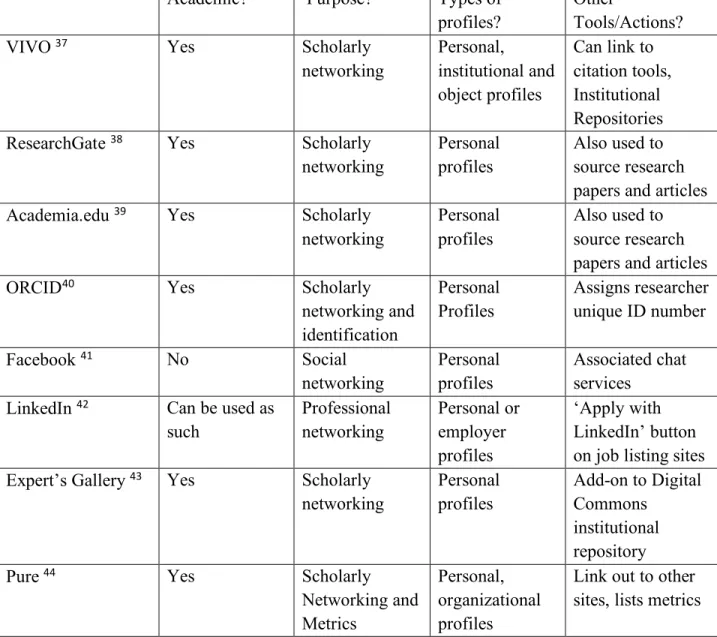
management sites, data sharing sites, and other sites devoted to internet activities such as blogging or wiki pages. However, she ignores that several of these tools overlap into different spheres.34 For instance, she lists the scholarly profile system VIVO as a social media site, since it focuses primarily on social interactions. But it is also a potential aggregator of citations and citation metrics, and can be combined with an institutional repository to act as a resource management system. The VIVO website classes itself as “an open source, member-supported application that enables the discovery of research and scholarship across disciplines at a particular institution”.35 Although the mission is somewhat vague, there are several foci: interdisciplinary research, discovery, and a focus on the institution. This does little to differentiate this particular program from any other scholarly profile system. Table 1 lists different scholarly profile systems and examining
33 Fjällbrant.
the different uses and functions that they have. This includes not only VIVO, but other programs such as Bepress and Pure, as well as websites such as Academia.edu and ResearchGate.
3.1: Social Media Tools
Alongside VIVO, Sugimoto lists several general social media sites (Facebook, Google+, LinkedIn) and several more academic (Academia.edu, ResearchGate). All of these sites have users construct a profile, determine links of connections, and traverse these links between profiles.36 Table 1 shows the programs that Sugimoto describes as social media tools, although we can see from the chart that there are three major camps. Facebook and Twitter (which Sugimoto describes as a microblog site) can be used for interactions of all kinds. Academics might utilize them for scholarly networking, but that is not their intended purpose. Academia.edu, ResearchGate and ORCID are different, in that their aim is specifically scholarly. All of these encourage scholars to make their own profiles—Academia.edu and ResearchGate also encourage scholars to upload PDFs of their work. ORCID instead assigns researchers a unique ID number for use identifying their scholarly work around the web. But for these sites, the scholar must go in and personally create a profile, and it is their responsibility to list citations and upload files. The third camp, then, holds VIVO, Bepress’ Expert’s Gallery, and Pure. The Experts Gallery and Pure are both owned by Elsevier, but the two programs have different goals. The Experts Gallery, although it can potentially stand alone, is primarily meant to act as an access point to the institutional repository.
Table 1: Social Media and Profile Tools
Academic? Purpose? Types of profiles?
Other
Tools/Actions?
VIVO 37 Yes Scholarly
networking
Personal, institutional and object profiles
Can link to citation tools, Institutional Repositories ResearchGate 38 Yes Scholarly
networking
Personal profiles
Also used to source research papers and articles Academia.edu 39 Yes Scholarly
networking
Personal profiles
Also used to source research papers and articles
ORCID40 Yes Scholarly
networking and identification
Personal Profiles
Assigns researcher unique ID number
Facebook 41 No Social
networking
Personal profiles
Associated chat services
LinkedIn 42 Can be used as
such Professional networking Personal or employer profiles ‘Apply with LinkedIn’ button on job listing sites Expert’s Gallery 43 Yes Scholarly
networking
Personal profiles
Add-on to Digital Commons
institutional repository
Pure 44 Yes Scholarly
Networking and Metrics
Personal, organizational profiles
Link out to other sites, lists metrics
37 “VIVO | Connect - Share - Discover.”
38 “ResearchGate | Share and Discover Research.” 39 “Academia.Edu | About.”
40 orcid_about, “Our Mission.” 41 “Facebook.”
42 “About LinkedIn.”
43 “Why Expert Gallery Suite.”
I was unable to tell whether Pure included PDF links to articles, but it is heavily focused on metrics—it lists citations, tweets, and aggregates information from other sites which measure article metrics. Pure and VIVO both contain multiple profile types. Although we see that these programs all fulfill Fjällbrant’s requirement of a creation of a societal network, there are other factors to consider, such as dissemination of ideas and acknowledgment of ownership.
3.2: Resource Management Tools
Academics besides Sugimoto have argued that ResearchGate and Academia.edu serve a similar purpose to institutional repositories, in that they aggregate and
disseminate papers. Academia.edu specifically says on their ‘About’ page that their mission is to assist researchers in sharing their scholarly work.45 While ResearchGate is less clear, they do claim that their mission is to help researchers read and discuss the papers they need to.46 ResearchGate also has as a stated advantage exposure of research papers to the wider world. Both also offer as a product analytics and metrics of the researcher’s work. Lovett wrote that sites such as ResearchGate share a stated objective with institutional repositories, and were at potential risk of ‘poaching’ papers and researchers who should have instead subscribed to the IR. However, in her research she in fact found that the professors who uploaded papers on ResearchGate tended to also deposit their papers in the institutional repository.47 The emphasis, it seemed, was not on one website over the other, but rather on the sharing of research with the wider world.
45 “Academia.Edu | About.”
46 “ResearchGate | Share and Discover Research.”
However, there is a downside to sites such as ResearchGate and Academia.edu—Jamali found that over half of the research articles uploaded on ResearchGate violated copyright laws.48 After further investigation he determined that many of these copyright violations were because authors uploaded the publisher’s version of their articles, rather than the pre-publication copies. Jamali concluded that these violations could be largely due to ignorance of copyright law, rather than a deliberate break of copyright law.49 Despite this, ResearchGate has recently drawn the ire of a group of publishers including Elsevier, who have insisted that ResearchGate take action against articles published from in their journals that are in violation of copyright.50 Institutional repositories may ultimately be a more successful venture, as they are not typically researcher-driven, but instead use librarians as gatekeepers. However, there is an element that ResearchGate and Academia.edu have that most IRs do not, and that is metrics. Despite Pendlebury’s warning about the seeming authority of numbers, bibliometrics and altmetrics are on the rise.51 ResearchGate and Academia.edu echo the trend by offering metrics on articles uploaded.52 Other companies and programs have joined in to offer citation metrics and reference management. Mendeley is less of a website than a downloadable app, which is used on an individual basis by researchers. In addition, Mendeley offers papers by the same method as ResearchGate and Academia.edu, researcher submission.53 SCOPUS and
48 Jamali, “Copyright Compliance and Infringement in ResearchGate Full-Text Journal
Articles.”
49 Jamali.
50 “Publishers Push ResearchGate Harder in Copyright Battle.”
51 Pendlebury, “The Use and Misuse of Journal Metrics and Other Citation Indicators.” 52 “ResearchGate | Share and Discover Research”; “Academia.Edu | About.”
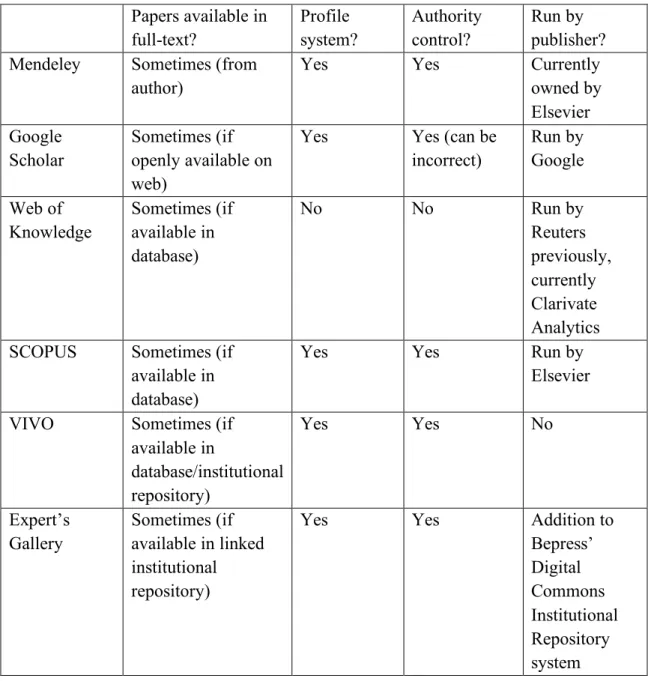
Web of Knowledge are owned by publishers, Elsevier and Reuters respectively.54 In Table 2 below, I have noted some of the features that each resource management system offers, and attempted a comparison between them.
Table 2: Citation and Reference Management Tools
Papers available in full-text? Profile system? Authority control? Run by publisher? Mendeley Sometimes (from
author)
Yes Yes Currently
owned by Elsevier Google
Scholar
Sometimes (if openly available on web)
Yes Yes (can be incorrect) Run by Google Web of Knowledge Sometimes (if available in database)
No No Run by
Reuters previously, currently Clarivate Analytics SCOPUS Sometimes (if
available in database)
Yes Yes Run by
Elsevier
VIVO Sometimes (if available in
database/institutional repository)
Yes Yes No
Expert’s Gallery
Sometimes (if available in linked institutional repository)
Yes Yes Addition to
Bepress’ Digital Commons Institutional Repository system
54 “Scopus | The Largest Database of Peer-Reviewed Literature | Elsevier”; “Web of
Although Google is not technically a publisher, it can be listed similarly—Google
Scholar is another way that many researchers access papers. All of these sites but Web of Knowledge have systems of profiles, although since their main function is not connection of these profiles, they are not included in Sugimoto’s list of social media sites. However, as we have discussed, these profiles offer a handy method to access articles. In addition, these profiles are the best method of offering metrics on individual scholars. Similarly, authority control, or the differentiation of objects by use of a unique name, is a valuable tool in offering accurate metrics. Google Scholar does not do this well—a simple search for a name will reveal that their search functions similarly to a typical Google search, in that related terms and names will be included with the accurate articles. Orduna-Malea et al. noted that specifically with regard to university branding, Google Scholar was not as accurate as one could have hoped.56 In this VIVO and Bepress, which are run by a specific institution, may triumph, simply due to the branding and institute-specific nature of the program. That being said, VIVO does not yet have a specific metric system itself (it can link out to Web of Knowledge), and it also does not have a specific database it draws on in the same way that the Experts Gallery does.
3.3: Institutional Repositories
Much as the Experts Gallery is currently linked to the Digital Commons, VIVO has strong potential to be paired with a program for an institutional repository. VIVO is associated with DSpace, a program for the building of an intuitional repository, under the umbrella company of Duraspace. Duraspace’s main mission, as stated on their website, is
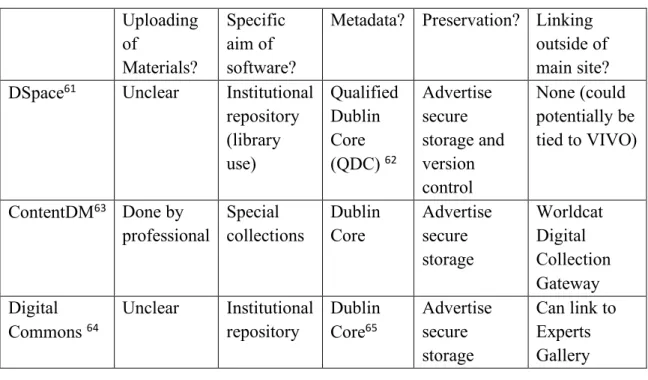
to provide long-term access to digital assets, as well as providing discoverability.57 Although the primary aim appears to be preservation, there is also a strong emphasis on access and scholarly communication evident in the mission statement—for instance, their emphasis of discovery of digital assets as well as ‘durable access’, and their specific notes of collaborations with VIVO, DSpace and Fedora. Although VIVO and Duraspace have separate origins, they have partnered in order to encourage an ‘open community’ of researchers and scholars focused on research networking and resource discovery.58 This organization echoes the claims of Givens et al. that a faculty profile system such as VIVO is an ideal pairing to an institutional repository, which DSpace is.59 However, it should be noted that as of 2017 the two are still entirely separate programs, merely under the same umbrella group. Other programs for IRs include ContentDM, from OCLC, and Digital Commons, from Bepress. All institutional repository systems in the table include a version of the Dublin Core metadata schema, and all at least advertise some form of secure storage and preservation, although perhaps not to Lundell’s specifications. Although all are capable of being used for institutional repositories, ContentDM specifically advertises itself as being for the digitization of library special collections.60 ContentDM is also the only program that specifically allows access from a more open gateway site.
57 “About | DuraSpace.”
Table 3: Institutional Repository Tools Uploading of Materials? Specific aim of software?
Metadata? Preservation? Linking outside of main site? DSpace61 Unclear Institutional
repository (library use) Qualified Dublin Core (QDC) 62
Advertise secure storage and version control None (could potentially be tied to VIVO)
ContentDM63 Done by
professional Special collections Dublin Core Advertise secure storage Worldcat Digital Collection Gateway Digital
Commons 64
Unclear Institutional repository Dublin Core65 Advertise secure storage
Can link to Experts Gallery
However, White and Ohira argue that the gateway site is only as successful as it is widely used. They argue that ContentDM’s gateway site is not popular or widely used, therefore ContentDM is not successfully able to connect to the wider world.66 Dspace and Bepress’ Digital Commons are perhaps the most useful institutional repositories when it comes to this outer connection, largely because of the potential for connection to a faculty profile system.
Although many of these programs function as scholarly profile systems, they in fact are multifunctional. Even sites such as ResearchGate provide PDFs of articles, allow
61 “About DSpace | DSpace.”
62 “Technical Specifications | DSpace.” 63 “CONTENTdm.”
64 “Why Digital Commons.”
65 White and Ohira, “Creating Green Open Access to Institutional Scholarship Using
Digital Commons.”
scholars to create profiles, and aggregate metrics based on these. Larger, institution-led programs such as Bepress and VIVO are tied to institutional repositories which store and preserve the scholarly output of that institution. In this way, Fjällbrant’s assumption that one program will rise up and fulfill all of the needs of the scholarly community may not have anticipated the diverse range of needs that the scholarly community currently has.67 The lesson of the serials crisis might indicate that in this day and age, it is best that there always be multiple tools available for use, rather than allowing one particular scholarly communication tool to dominate the market. But the fact is, the world of scholarly communications, and technology in general, is shifting so much that is difficult to anticipate what the needs of scholars might be in 10 or even 5 years. From the review of the literature and currently available tools, it seems that there are similarities to many of these tools: many include some element of social interaction in their program, as well as a way of allowing researchers to disseminate articles and acknowledge ownership of their work. This fulfills two points that Kaufer and Carley said were crucial to the success of scholarly communication tools.68 What the tables also show, however, it is also clear that no single program includes all of the potentially relevant functions. There is despite that a focus on collaboration and combination, in a way that may provide all of the functions that Kaufer and Carley noted and more besides. However, Kaufer and Carley also wrote their work in 1993. Scholars and researchers working today may have different
requirements of functions for their scholarly communication tools, as well as different needs.
67 Fjällbrant, “Scholarly Communication - Historical Development and New
Possibilities.”
4: Methodology
The primary goal of my research was to examine scholarly communication tools, and more specifically how scholarly profile systems are meeting or poised to meet the needs of scholars, researchers and librarians. My aim was to do qualitative research on general trends in scholarly communications tools. I sought to examine the landscape of scholarly communications, identify changes in practice, find gaps in current practice and function, and examine information from one group of professionals to learn about their experiences and how it is currently or might eventually satisfy a scholarly communication need. I determined that the best people to assist in this assessment are the academic institutions that use and work with VIVO. VIVO was most convenient for my needs because it had both an easily accessible listserv of participants and users, and it so happened that the yearly conference on VIVO was within easy driving distance. My general questions were not whether they prefer one program over another, but whether the program met their stated goals and how. More broadly, I wanted to know their thoughts on the program as it might serve to fill the established ‘gap’ in scholarly communications. using VIVO as an example and possibly a predictor of these trends. I did not wish to conduct a quantitative assessment of the VIVO program..
a scholarly profile system. In addition, other programs operate VIVO as a closed system, available only for their university faculty, which is a very different use of the program. I particularly wanted to look at institution which was not a university, in order to assess whether scholarly communications trends were different outside of universities. I did, however, restrict my interviews to U.S. Institutions. I believe that different countries might have different variables regarding scholarly communications that I would not aware of and that could potentially have influenced results.
I focused primarily on VIVO users simply out of convenience of first their listserv and then their conference, although I hope to apply the lessons learned more broadly, to scholarly profile systems as a whole. There were three themes in the interview questions. I asked about the implementation of the scholarly profile system, such as important factors and other scholarly communication tools the institution employed. I then asked about the actualization of the profile system, such as whether it was being seen to meet needs and how involved faculty members were. I then asked how the respondents felt that the scholarly profile system fit into institutional goals for scholarly communication, and whether they thought it fit into broader scholarly communication themes. There were two recruiting methods used: A Listserv of institutions interested in or maintaining a VIVO program, and the VIVO Conference in Durham.69 I determined the listserv to be a method to reach a large number of users of a scholarly profile system, albeit a specific one. I recruited respondents in two different rounds of emails sent to the VIVO listserv, one in March and the other in May. In addition, I recruited one non-VIVO user through
69 The VIVO Conference was held at Duke University June 6-8, 2018, and sponsored by
professional connections. I did not identify particular positions or responsibilities for recruitment, as different institutions had very different setups of who was in control of the scholarly profile system, but merely sought to speak to the people who were most involved in the creation and adoption of their institution’s scholarly profile system. In addition to recruitment through emails, I attended the VIVO Conference in Durham, North Carolina that was held in June. In addition to conducting two interviews at the conference, there were a number of panels and discussions which informed my understanding of the VIVO program and other scholarly profile systems.
The interview process was arranged primarily for the greatest convenience of the respondents. In-person interviews, when possible, were preferred. Otherwise interviews were conducted through phone or video calls, according to the preference of the
respondent. When possible, the interviews were recorded, although respondents were allowed to opt out and one interview could not be recorded due to technological difficulties. These recordings were then transcribed, supplementing notes taken
contemporaneously. All of the information was then coded and analyzed. The interviews were ten questions, with follow-up questions when appropriate.
understanding that it would be an opportunity for research. This study was approved by the University of North Carolina at Chapel Hill Institutional Review Board.
5: Results
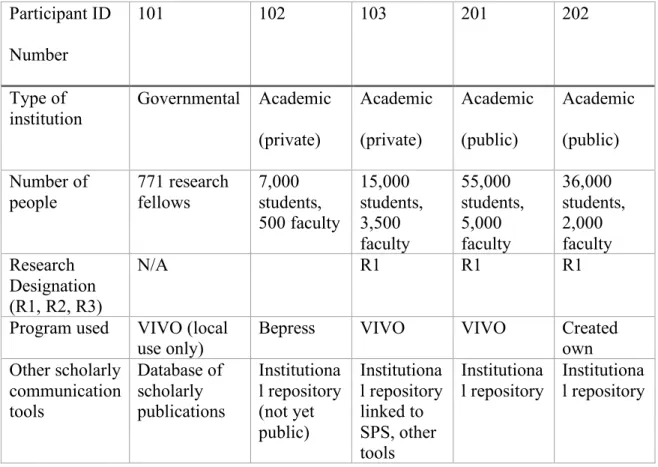
I interviewed five people from five different institutions. Four were recruited via the VIVO Listserv, one through personal connections. Three were interviewed prior to the VIVO Conference, while I conducted two interviews during the conference. In addition to the information in the interviews, I also gained information from the conference sessions that I attended.
Table 4: Characteristics of Participants Institutions
Participant ID Number
101 102 103 201 202
Type of
institution Governmental Academic (private) Academic (private) Academic (public) Academic (public) Number of people 771 research fellows 7,000 students, 500 faculty 15,000 students, 3,500 faculty 55,000 students, 5,000 faculty 36,000 students, 2,000 faculty Research Designation (R1, R2, R3)
N/A R1 R1 R1
Program used VIVO (local use only)
Bepress VIVO VIVO Created
own Other scholarly communication tools Database of scholarly publications Institutiona l repository (not yet public) Institutiona l repository linked to SPS, other tools Institutiona
l repository Institutional repository
created their own program for the scholarly profile system at their institution, but then had become part of a broader, national scholarly communications network which used VIVO. Of the three who used VIVO, one used it locally, with only affiliates of their institution able to access it or even see it. Four of the respondents belonged to academic universities, the other respondent worked for a government entity. Of the four
universities, two were private universities and two public. Three of these are classified as ‘R1’ universities, meaning that they are acknowledged to have a high level of research activity that their faculty and students engage in. These basic statistics proved useful in further analyzing the data received from interviews, and helped me distinguish themes. Although I interviewed people at a variety of institutions, there were four themes which occurred during the interviews, which were supplemented by findings from conference panels. The first was that the amount of effort that an administration decided to employ was crucial, as was the amount of information easily on hand to be used by a scholarly profile system. There was an additional understanding that this effort would be beneficial to faculty members, and to the greater scholarly community as a whole. And finally, everyone I interviewed affirmed a commitment to openness and the free spread of information.
5.1Administrative/institutional Involvement
and communicate research more effectively. But the amount of effort and funding required to build and maintain a scholarly profile system might make it difficult for schools without the funding (or the research to justify funds) to maintain a program on the level of these universities.
The need for institutional support and funding was something that became strongly apparent in one interview. Respondent 202 stated that their institution had been among the first in the nation to notice the need for a scholarly profile system and had at first had success in building one. However, after a change in administration the project was given far less priority, and the respondent described its current state as their ‘pet project’. When I asked whether it might ever make a comeback, they indicated that “whether the profile system grew or changed was largely in the hands of the administration.” The respondent implied that, as with many aspects of any large
institution, what is given priority and funding depends on who is willing to advocate for it. However, Respondent 201 felt strongly that a scholarly profile system was an
they wanted to strengthen, and to encourage faculty who had complementary interests to work together. The importance of metrics and data from a scholarly profile system was echoed by Respondent 101, who mentioned the usefulness of having a ‘registry’ of scholars affiliated with their institution. Respondent 101 belongs to a governmental institution with a loose network of affiliated researchers, and having a place to store data about these researchers and be able to aggregate general statistics is very helpful for them.
5.2 Existing Data
had a far easier time populating their profile system than the first university, which is still struggling to manually enter data. However, Respondent 103 had an even easier time setting up their scholarly profile system. When the project lead was tasked with setting up a university-wide profile system, it so happened that two schools within the university, one of which was the medical school, already had working profile systems. The project lead simply incorporated this data into one large system and scraped additional data from other sources. This respondent also told me that they had tapped into a database kept by the Human Resources department of the university to quickly and easily populate information such as title and department. This was also brought up in the VIVO Conference as a sound method of filling out profiles.
Although four out of five respondents answered that they did have an institutional repository, and one had a program in beta mode, the connection between an institutional repository and a scholarly profile system seems less than anticipated. Respondent 202 described the usage of an Institutional Repository at his institution as ‘spotty’, whereas Respondent 201 stressed to me that an institutional repository had no relevance to a scholarly profile system. This was largely, this respondent said, because very little scholarly work ended up in the average institutional repository, although the respondent seemed to think that openness in general was a positive. Respondent 102 had not yet populated an institutional repository. They wished to, but had several worries about the realities of one, including potential copyright violations and the difficulty of getting faculty to submit to one.
At the VIVO Conference Damaris Murry and Paolo Mangiafico of Duke
so that when a professor added or approved a citation they were also invited to submit a ‘prepub’ PDF, or vice versa.70 This seemed to be a way to both support the scholarly profile system while also encouraging professors to submit more work to an institutional repository. However, in this vein, Duke also demonstrated during this same presentation that their VIVO system required a large number of other programs to make it run with the speed, success and connectivity that it had. Murry and Mangiafico noted that they had incorporated a tool called Elements to search the web for relevant citations and ‘scrape’ them from these sources to be used in the scholarly profile system.71 There was the institutional repository and the program that linked it to the profile system as well. Underlying all of this was yet another program which allowed these to function in such a way that these uploads or changes could be done in minutes rather than hours. Although within the context of the presentation it seemed to be a brilliant setup, it was also one that seemed to require time, effort and coding skills. One of the slides they showed was simply an image of a web of all of the different programs that they utilized, in order to give their scholarly profile system the functionality desired of it. In addition, the
Elements program was scraping data from publisher-owned databases such as SCOPUS, PubMed and Web of Knowledge. Although it seems that many universities have a
subscription to at least one of these, they might not have access to all of them, or even the one with their researcher’s data in it. Again, the amount of time, resources and funds that
70 Damaris Murry and Paolo Mangiafico, “Improving Integration: Elements, DSpace, and
VIVO at Duke University.”
71 Elements is described as “an online service provided by Duke Libraries to help Duke