Reliability based maintenance and human resources work-rest
scheduling in manufacturing system
Rasoul Jamshidi1*, Mansooreh Moadi1
1
Department of Industrial Engineering, College of Engineering, Damghan University
[email protected], [email protected]
Abstract
In today's competitive market, all manufacturers attempt to improve their maintenance policy in order to decrease the cost of failure and increase the quality of products, but most of these attempts do not consider the role of humans involved in a manufacturing system. Human resources are the main factor in manufacturing that has an undeniable effect on products quality, machines reliability, safety and maintenance policy. In this paper we propose a nonlinear mathematical model that optimizes the maintenance policy considering the humans fatigue to investigate its effects on reliability and associated Costs in manufacturing system. That is to say, the model is a reliability based maintenance optimization that aims to maintain the reliability of machines and their human resources in a proper predetermined interval. The performance of the proposed model was examined by some instances and the obtained results indicated this model can provide effectiveness maintenance policy for manufacturing systems.
Keywords: Maintenance, human resource, fatigue, optimization, reliability, production, scheduling
1- Introduction
Many researchers believed human resource is the main factor in all manufacturing system. Both human and manufacturing system influence each other, according to this fact, researchers aim to investigate the human performance in manufacturing systems and the effects of manufacturing system on human.
There are useful papers that investigated on considering human effects in manufacturing system (Godwin and Aniekan 1999; Baines, Asch, Hadfield, Mason, Fletcher and kay 2005; Mason, Baines, Kay, Ladbrook 2004; Dawson 2011) but few of them studied the interaction between human and manufacturing system. MacCarthy and Wilson (2001) have edited a book considering human factors in scheduling and planning, but did not really consider the interaction between human and manufacturing factors and interpretation of factors affecting human performance.
The role of human resource in manufacturing system has been investigated in some aspects such as scheduling, maintenance and reliability.
*Corresponding author.
ISSN: 1735-8272, Copyright c 2017 JISE. All rights reserved
Journal of Industrial and Systems Engineering
Vol. 10, special issue on Quality Control and Reliability, pp 109-124 Winter (February) 2017
Lodree et al. (2009) proposed that the interface between scheduling and human resources can be observed in three primary areas of research: (i) job rotation scheduling, (ii) work–rest (or rest break) scheduling, and (iii) shift work scheduling. Job rotation is a management technique that assigns employees to various jobs and departments over a period of time (Hsieh and Chao 2004). The aim of work–rest scheduling is to optimize the number, placement and duration of rest times during manufacturing period (Bechtold 1984; Bechtold, Janaro and Sumners 1984; Bechtold and Sumners 1988). Shift scheduling involves the assignment of human resources within a given period of time based on work volume and work force in each shift period.
Since in all manufacturing systems humans and machines work together, some papers studied the human resources scheduling and machines scheduling problem with consideration of three categories proposed by Lodree et al.(2009). Mahdavi et al. (2010) proposed a mathematical model for a dynamic cellular manufacturing systems considering production planning and worker assignment, in this paper human resources constraints change the optimal assignment of works to cells. Cappadonna et al.(2013)addressed the unrelated parallel machine scheduling problem with limited human resources. They proposed how both the number of human resources and the number of machines employed within the manufacturing system, play a key role in minimizing makespan value.
Researchers also investigated on maintenance and its interaction with human resources. Martorell et al. (2010) proposed that appropriate development of each maintenance strategy depends on the resources scheduling such as human and material. Taylor (2000) studied the human as an important resource in maintenance actions. He believed that maintenance resources scheduling is a part of maintenance human factors which addresses the issues of management. The interface between human scheduling and maintenance is mostly considered in maintenance resource management (MRM) (Siddiqui, Iqbal and Manarvi 2012).
Human scheduling affects on manufacturing system reliability. Many stress factors such as fatigue can reduce the reliability of human, if there is no proper work-rest schedule for all involved human resources in manufacturing system. Although some papers proposed the best work-rest schedule for human resources, few of them considered machines scheduling or system reliability. Nader Azizi et al. (2013) focused on effect of fatigue on human performance and proposed the best work-rest schedule for each human resource. Jamshidi and Seyyed Esfahani (2013) proposed a mathematical model that obtains the optimal work and rest schedule based on reliability of each worker.
Although there are researches that studied on human scheduling, production scheduling and maintenance scheduling but there are no outstanding researches in which scheduling of human resources, production and maintenance have been studied simultaneously.
In this paper we focused on scheduling the human resources, production and maintenance based on reliability of manufacturing system. Work and rest and maintenance for human resources and machines are scheduled based on humans' fatigue and machines reliability. We proposed a mathematical model to provide the optimal production schedule, optimal scheduling of work and rest for each worker and optimal maintenance policy. In the proposed model we assumed that machines reliability and humans fatigue effect on total reliability of manufacturing system. If the total reliability is not in a proper interval, cost of low product quality is imposed to the manufacturing system. We used some examples to show that the model can obtain the optimal results effectively.
The rest of the paper is organized as follows: Section 2 presents the models of fatigue and recovery. Section 3 describes the maintenance and reliability function. Section 4 proposes the problem statement and its assumptions. Section 5proposes the linearized model and section 6presents some instances with computational results to validate and verify the proposed model and finally section 7 concludes the paper.
2- Fatigue and recovery models
In real world we face many forms of fatigue such as tardiness, physical discomfort, lack of motivation and sleepiness. The effect of fatigue on human performance has been investigated in many
manufacturing systems and the obtained results indicates that the loss of throughput (Wang and Hu 2010), human fault increasing (Kopardekar and Mital 1994), job dissatisfaction (Jiang, Baker and Frazier 2009), performance decrement (Koo, Kim and Kim 2014; Griffith and Mahadevan 2011) and injuries (Guadalupe 2003) are the harmful effects of human fatigue.
There a many models for fatigue and recovery but in this paper we use the fatigue and recovery model proposed by Konz (1998), this model assumes that fatigue and recovery can be formulated as follows.
= 1 − . (1)
= (2)
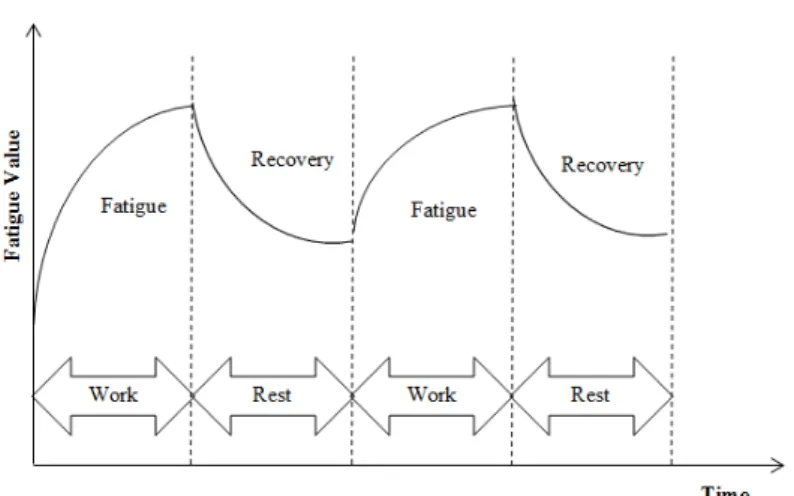
Where F(t) is the fatigue accumulated by time t, is the residual fatigue after a rest break of length . And , are fatigue rate and recovery rate, respectively.Figure1 shows the trend of fatigue for a worker based on equation 1 and 2.
Figure 1. The trend of the fatigue and recovery over time position
As proposed by Jaber et al. (2013), in practice, rest breaks during work cycles are usually short and cannot retrieve the fatigue perfectly, thus human faces with residual fatigue after improper rest time. The residual fatigue, carried forward into cyclei+1 and equation I can be re-written as follows.
= + 1 − . 1 − (3)
Where tuis the production time of the cycle i and ti is determined by projecting the value of on
the fatigue curve as follows.
= −ln 1 − / (4)
Since in the proposed model, the production period is divided into equal time positions, the value of (tu-ti) is equal to one unit of time position, thus equation 3 can be re-written as follows.
Also the equation 2 should be developed to obtain the residual fatigue according to workers status in each time position. This relation is described in next section.
3- Reliability and maintenance of machine
According to Smith (1976) the reliability function for an element with failure rate λ(t) is calculated as follows:
= "%$ # (6)
Relation 7 can be derived from relation 6, if the failure rate is constant.
= (7)
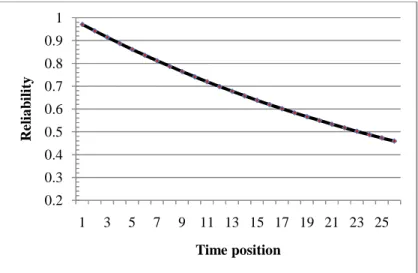
The reliability decreases during useful life of an element. Figure 2 shows the reliability trend of an element with constant failure rate 0.03.
Figure 2. The reliability trend for an element with constant failure rate
In this paper the machine reliability decreases, if it works without stopping and maintenance action. Maintenance can retrieve the reliability of a machine by decreasing the failure rate. Fig.3 shows the reliability trend with maintenance for an element.
Figure 3. Recovery of reliability by each repair action
0.2 0.3 0.4 0.5 0.6 0.7 0.8 0.9 1
1 3 5 7 9 11 13 15 17 19 21 23 25
R
el
ia
b
il
it
y
Time position
0.2 0.3 0.4 0.5 0.6 0.7 0.8 0.9 1
1 2 3 4 5 6 7 8 9 10 11 12 31 14 15 16 17 18 19 20 21 22 23 24 25 26
R
el
ia
b
il
it
y
As can be seen in figure3 since the element is repaired in time positions 10 and 20 the reliability increases and returns to its primary value. That is to say, maintenance keeps the reliability of an element in a proper interval.
4- Problem statement
In this section, we formally describe the considered problem and its assumption. The aim of proposed model is to determine the optimal policy for human resources work-rest schedule, production schedule and maintenance action schedule based on six cost components.
Idleness cost of machines Idleness cost of human resources Cost of unpredictable failure Cost of corrective maintenance Cost of poor quality product Unavailability cost of machines
The main advantage of this model is to use the reliability as a main decision variable for maintenance of machines and rest of human resources. In fact the proposed model is a reliability based model for scheduling of human, production and maintenance. In this model each machine and human resource has a special impact on total reliability of manufacturing system. If the maintenance of machine and rest of human resources are postponed, the total reliability decreases and as a result manufacturing system cannot produce quality products and cost of poor quality products is imposed on the manufacturer. Since the proposed model is a nonlinear one, we then linearize such model in next subsection. Other assumptions made in the model are proposed in next subsection.
4-1-Assumptions
• The demand of each product is known
• Operation time to produce each product is known
• Each machine can produce only one type of products
• Each human has a special impact on total reliability of manufacturing system
• Each machine has a special impact on total reliability of manufacturing system
• The reliability of each machine must be greater than a predetermined value in each time position
• Every machine has one worker and the worker won’t work on other machines.
• Each human has a specific maximum fatigue value and cannot work with a fatigue value greater than this fatigue limit.
• Humans' reducing rate of fatigue in idle status and rest status are not equal.
• The fatigue of human resources decreases in proportion with rest duration.
• The maintenance actions decrease machine failure rate.
• The planning horizon is equal to the required time to produce the entire products. Notations
4-1-1- Subscripts
i Index for machine and its worker (i=1, 2,…I)
4-1-2- Input parameters
Li Process time of machine i
CHi The unitary cost of idleness for the worker of machine i
CMi The unitary cost of machine i idleness
CFi The unpredictable failure cost for machine i
CRi The unitary cost maintenance for machine i
CQi The unitary cost of poor quality for machine i
CAi The unavailability cost for machine i
DEMi The demand must be supplied by machine i
PRi The primary reliability for machine i
HEXUSi Fatigue upper limit for the worker of machine i
MEXUSi Fatigue lower limit for the worker of machine i
MRNEi Minimum reliability required for machine i
PEXUSi Primary fatigue for the worker of machine i
λi The failure rate of machine i
λpi The fatigue rate for worker of machine i
σi The impact of machine i on total reliability of manufacturing system σpi The impact of worker i on total reliability of manufacturing system µi Fatigue decreasing rate for worker i per unit of rest time
µpi Fatigue decreasing rate for worker i per unit of idle time
4-1-3- Decision variables
xi,k 1 if the machine i is available in position k; =0 otherwise
xpi,k 1 if the worker of machine i is available in position k; =0 otherwise
zi,k 1 if the machine i works in position k; =0 otherwise
nri The number of time positions that machine i is unavailable
ri,k The reliability of machine i in position k
tri,k The total reliability value for worker-machine i in position k
exusi,k The fatigue of worker i in position k
rexusi,k The residual fatigue for worker i in position k
With respect to the above notations, the mathematical model can be formulated as mentioned in next subsection.
4-2- The mathematical model
min (: * * +, . - ,.. 1 − /,. 0
.1 2 1
+ * * +3 . -,.. 1 − /,. 0
.1 2 1
+ * * + 0 .1
. 1 − 4,. 2
1
+ * + . 54 + * +6 . 787 + * 9+: . * 1 − 4,. . /,. / ; . <=3 0
.1
> 2
1 2
1 2
1
(8)
s.t.
* /,. 0 .1
= ; . <=3 ∀@; (9)
/,. ≤ -,. ∀C, D; (10)
/,. ≤ - ,. ∀C, D; (11)
4, = E ∀C (12)
4,. = . /,. . 4,. + . 1 − -,. . 4,.
+ 1 − /,. . -,. . 4,. ∀C, D ≥ 2;
(13)
787 = 1 − 54 / ; . <=3 ∀C (14)
4,. = H . 4,.+ H . 1 − -IJ,. ∀C, D; (15)
-IJ,. ≤ ,=KLM ∀C, D; (16)
3 N= ≤ 4,. ∀C, D; (17)
4,. ≤ 1 ∀C, D; (18)
3 N= − 4,. ≤ 1 − -,. ∀C (19)
4 -IJ, = E=KLM ∀C (20)
4 -IJ,. = . -IJ,. . 1 − - ,.
+ . -IJ,. . 1 − /,. . - ,. + -IJ,. . /,.
∀C, D ≥ 2; (21)
54 = * 1 − -,. 0
.1
∀C (23)
/,., -,., - ,. ∈ P0,1R ∀C, D; (24)
54 , 4,., -IJ,., 4 -IJ,., 787 ≥ 0 ∀C, D; (25)
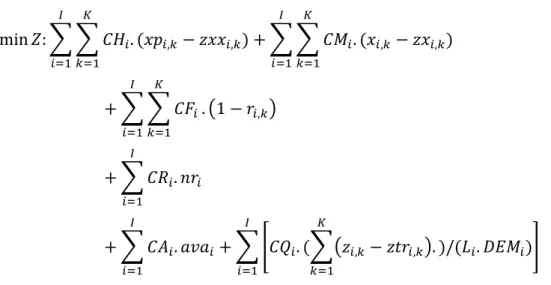
Objective function (8) consists of six cost components. First component calculates the workers idleness. Similarly, the second component shows that if machine is available but does not work, manufacturing system faces with machine idleness cost. The third component considers the cost of unpredictable maintenance action. The cost of unpredictable maintenance increases in proportion with the difference between reliability value and ideal reliability (100%).In fact, this component tries to keep the total reliability in a proper interval. The fourth component computes the maintenance cost based on the number of time positions that machines are maintained. The unavailability cost of machines is calculated in fifth component. The last component calculates the quality cost. This component shows that quality cost is calculated based on proportion of work time that total reliability of worker-machine system is not ideal. Relation (9) assures that the total working time of a worker-machine system is equal to required time to produce all demand. Relations (10-11) show that worker-machine system can work if both worker and machine are available. Relation (12) shows that the reliability of each machine in first time position is equal to machine primary reliability. Relation (13) calculates the reliability of each machine in each time position based on its status in prior time position. Relation (14) calculates the availability of each machine. Relation (15) computes the total reliability of worker-machine system. Relation (16) sets a maximum limit on workers fatigue. Relation (17) sets a lower limit for machines reliability. Relation (18) indicates that reliability cannot be greater than 100%. Relation (19) shows that if the reliability of a machine is less than minimum required reliability, the machine should be maintained and cannot be available to work. Relation (20) shows that the residual fatigue of each worker in first time position is equal to worker primary fatigue value. Relation (21) calculates the residual fatigue for each worker in each time position also relation (22) computes the fatigue value, based on residual fatigue of worker in each time position. Relation (23) obtains the number of time positions that machine is unavailable and relations (24-25) determine the type of variable.
As mentioned in the previous paragraph, relation (18) calculates the reliability value for each machine in time positions. Each machine has three statuses in each time position, work, idleness and unavailability. If a machine works in previous time position, its reliability decreases. If machine is available and idle, its reliability does not alter and is the same as reliability of previous time position, also if machine is unavailable because of maintenance action, its reliability increases in comparison with previous time position.
5- Linearization of proposed model
Since the objective function and relations (13),(21),(22) are nonlinear; in this section an attempt is made to linearize the proposed model.
The nonlinear terms of the relation (13) could be linearized via three transformations. We have extended this relation as follows:
4,. = . /,. . 4,. + . 4,. − -,. . 4,. + -,. − /,. . -,. . 4,. (26)
To linearize the relation (26) we should define four auxiliary variables and their related constraints. The first variable is -4,. = -,.. 4,.,the second is/4,.= /,.. 4,.and the third is /-,.= /,.. -,..These variables used with constraints (17-19), (20-22), (23-25) respectively.
-4,.≤ 4,.+ 6 1 − -,. ∀C, D; (27)
-4,.≥ 4,.− 6 1 − -,. ∀C, D; (28)
-4,.≤ - ,. ∀C, D (29)
/4,. ≤ 4,.+ 6 1 − /,. ∀C, D; (30)
/4,. ≥ 4,.− 6(1 − /,.) ∀C, D; (31)
/4,. ≤ /,. ∀C, D (32)
/-,. ≤ /,.+ 6(1 − -,.) ∀C, D; (33)
/-,.≥ /,.− 6(1 − -,.) ∀C, D; (34)
/-,.≤ /,. ∀C, D (35)
The fourth auxiliary variable is /-4. = /-,.. 4,. that added to model with the following constraints.
/-4,. ≤ 4,.+ 6(1 − /-,.) ∀C, D; (36)
/-4,. ≥ 4,.− 6(1 − /-,.) ∀C, D; (37)
/-4,. ≤ /-,. ∀C, D (38)
Considering these variables with their related constraints we have
4,. = . /4,. + . (4,. − -4,. ) + (-4,. − /-4,. ) (39)
By considering relation (10),it can be proved that /-4. = /4,. and we can eliminate zxr and use zr
instead of it. Consequently relations (36-38) should be removed from linear model. Based on this fact, the relation (6) can be replaced by following relation.
4,. = . /4,. + . (4,. − -4,. ) + (-4,. − /4,. ) (40)
To linearize the relation (14) three auxiliary variables should be defined. The first variable is
--.= -IJ,.. - ,. by using this variable; relation (21) turns into relation (41)
4 -IJ,. = . -IJ,. − --,. + . --,. − --,. . /,.
+ -IJ,. . /,.
(41)
The second auxiliary variable is --/,. = --,.. /,.. This variable changes relation (41) to relation (42)
4 -IJ,. = . -IJ,. − --,. + . --,. − --/,.
+ -IJ,. . /,.
(42)
The last variable utilized to linearize relation (31) is -/. = -IJ,.. /,.. By using this variable relation (42) can be replaced by relation (43).
Considering relation (11) it can be proved that exz is always equal to exxz, we can replace variable
exxz by exz and eliminate the related constraints to exxz. Based on this fact the linear relation for
residual fatigue and its constraints are as follows.
4 -IJ,. = . -IJ,. − --,. + . --,. − -/,. + -/,. (44)
--,. ≤ -IJ,.+ 6 1 − - ,. ∀C, D; (45)
--,. ≥ -IJ,.− 6 1 − - ,. ∀C, D; (46)
--,. ≤ - ,. ∀C, D (47)
-/,. ≤ -IJ,. + 6 1 − /,. ∀C, D; (48)
-/,. ≥ -IJ,. − 6(1 − /,.) ∀C, D; (49)
-/,. ≤ /,. ∀C, D (50)
After linearizing the residual fatigue we have to eliminate the nonlinearity of relation (22). In this case we substitute rexz for rexus.zin relation (22) and add constraints (51-54) to linear model, we have.
-IJ,. = 4 -IJ,.+ (1 − ). /,.− 4 -/,. (51)
4 -/,. ≤ 4 -IJ,.+ 6(1 − /,.) ∀C, D; (52)
4 -/,. ≥ 4 -IJ,.− 6(1 − /,.) ∀C, D; (53)
4 -/,. ≤ /,. ∀C, D (54)
After linearizing all constraint, we introduce two auxiliary variables to linearize the objective function and propose the linear mathematical model. In objective function we have two nonlinear cases, thus two auxiliary variables zxx=xp.z and ztr=z.tr are introduced to make them linear, also constraints (55-60) will be added to linear model.
/--,. ≤ - ,.+ 6(1 − /,.) ∀C, D; (55)
/--,. ≥ - ,.− 6(1 − /,.) ∀C, D; (56)
/--,. ≤ /,. ∀C, D (57)
/ 4,. ≤ 4,.+ 6(1 − /,.) ∀C, D; (58)
/ 4,. ≥ 4,.− 6(1 − /,.) ∀C, D; (59)
/ 4,. ≤ /,. ∀C, D (60)
According to all the introduced auxiliary variables and their related constraints, the linear mathematical model is as follows:
min (: * * +, . - ,. − /--,. 0
.1 2 1
+ * * +3 . -,.− /-,. 0
.1 2 1 + * * +
0 .1
. 1 − 4,. 2
1
+ * + . 54 2
1
+ * +6 . 787 + * 9+: . * /,.− / 4,. . / ; . <=3 0
.1
> 2
1 2
1
(61)
Subject to constraints (9)−(12), (14)−(20), (23)−(25), (27)−(35), (40), (43), (44)−(50), (51-54), (55-60).
6- Numerical illustration
In this section we use the proposed mathematical model to determine the optimal work-rest schedule for human resources, maintenance schedule for machines and optimal production schedule for manufacturing system in some instances and report computational results to evaluate the effectiveness of the proposed model. Five instances are solved by branch-and-bound (B&B) method using Gams software on a PC including Intel®Core i5 and 2 GB of RAM. The instances designs are detailed in Table 1.
Table 1. Instances design
Instance 1 Instance 2 Instance 3 Instance 4 Instance 5
Machine
no. M1 M2 M1 M2 M1 M2 M3 M1 M2 M3 M4 M1 M2 M3 M4 M5
Li 2 3 4 5 4 5 3 3 5 4 6 2 3 5 3 4
CHi 20 30 25 20 30 32 26 27 35 30 32 22 26 27 23 21
CMi 40 60 55 45 30 42 50 60 33 47 33 60 58 38 49 32
CFi 35 45 40 40 36 35 30 32 32 40 41 38 37 33 38 39
CRi 75 64 70 76 70 76 63 66 69 72 76 72 63 64 63 71
CQi 34 26 32 35 40 30 25 30 39 38 39 35 39 34 33 25
CAi 28 30 30 37 40 35 36 28 38 36 32 30 29 40 35 33
DEMi 9 10 12 16 15 10 12 13 16 15 10 13 11 12 13 10
PRi 0.8 0.8 0.85 0.85 0.75 0.8 0.7 0.72 0.74 0.82 0.83 0.72 0.83 0.84 0.75 0.75
HEXUSi 0.6 0.7 0.6 0.6 0.65 0.7 0.6 0.62 0.65 0.63 0.64 0.65 0.68 0.68 0.70 0.69 MEXUSi 0.2 0.2 0.3 0.3 0.25 0.25 0.25 0.2 0.2 0.2 0.2 0.21 0.28 0.29 0.25 0.27
MRNEi 0.4 0.4 0.5 0.5 0.5 0.55 0.5 0.45 0.47 0.48 0.50 0.47 0.55 0.41 0.50 0.49
PEXUSi 0.3 0.35 0.32 0.32 0.3 0.3 0.3 0.27 0.38 0.27 0.27 0.35 0.29 0.32 0.34 0.32
λi 0.03 0.04 0.035 0.021 0.02 0.01 0.02 0.01 0.01 0.02 0.03 0.02 0.01 0.02 0.03 0.02
λpi 0.035 0.025 0.03 0.03 0.015 0.02 0.03 0.02 0.02 0.03 0.02 0.03 0.02 0.02 0.03 0.03
σi 0.6 0.55 0.5 0.5 0.5 0.5 0.5 0.5 0.6 0.5 0.6 0.52 0.55 0.57 0.55 0.50
σpi 0.4 0.45 0.5 0.5 0.5 0.5 0.5 0.5 0.4 0.5 0.4 0.48 0.45 0.43 0.45 0.5
µi 0.03 0.03 0.03 0.03 0.04 0.03 0.035 0.03 0.04 0.04 0.04 0.03 0.03 0.03 0.03 0.03
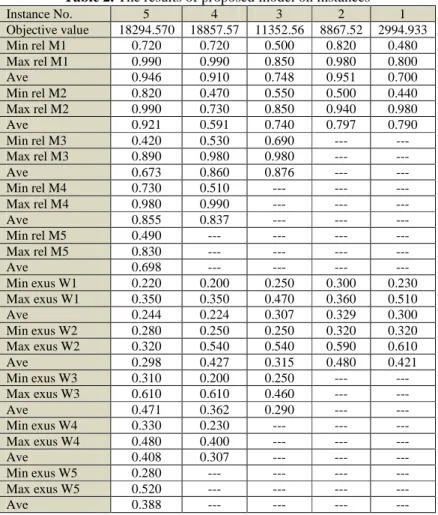
Table 2 shows the objective function values and the minimum and maximum reliability of machines for each instance. The values for human resources indicate that fatigue of workers does not exceed the maximum fatigue limit and the proposed model maintains the total reliability of manufacturing system in a proper interval.
Table 2. The results of proposed model on instances
Instance No. 5 4 3 2 1
Objective value 18294.570 18857.57 11352.56 8867.52 2994.933
Min rel M1 0.720 0.720 0.500 0.820 0.480
Max rel M1 0.990 0.990 0.850 0.980 0.800
Ave 0.946 0.910 0.748 0.951 0.700
Min rel M2 0.820 0.470 0.550 0.500 0.440
Max rel M2 0.990 0.730 0.850 0.940 0.980
Ave 0.921 0.591 0.740 0.797 0.790
Min rel M3 0.420 0.530 0.690 --- ---
Max rel M3 0.890 0.980 0.980 --- ---
Ave 0.673 0.860 0.876 --- ---
Min rel M4 0.730 0.510 --- --- ---
Max rel M4 0.980 0.990 --- --- ---
Ave 0.855 0.837 --- --- ---
Min rel M5 0.490 --- --- --- ---
Max rel M5 0.830 --- --- --- ---
Ave 0.698 --- --- --- ---
Min exus W1 0.220 0.200 0.250 0.300 0.230
Max exus W1 0.350 0.350 0.470 0.360 0.510
Ave 0.244 0.224 0.307 0.329 0.300
Min exus W2 0.280 0.250 0.250 0.320 0.320
Max exus W2 0.320 0.540 0.540 0.590 0.610
Ave 0.298 0.427 0.315 0.480 0.421
Min exus W3 0.310 0.200 0.250 --- ---
Max exus W3 0.610 0.610 0.460 --- ---
Ave 0.471 0.362 0.290 --- ---
Min exus W4 0.330 0.230 --- --- ---
Max exus W4 0.480 0.400 --- --- ---
Ave 0.408 0.307 --- --- ---
Min exus W5 0.280 --- --- --- ---
Max exus W5 0.520 --- --- --- ---
Ave 0.388 --- --- --- ---
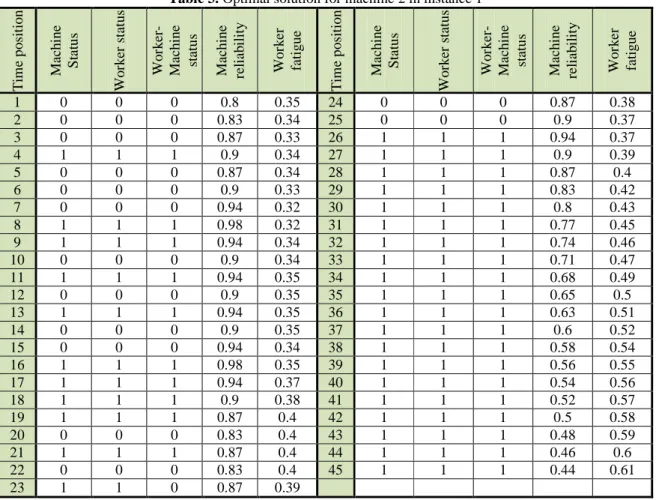
Using the solutions obtained by proposed model, we have the optimal work-rest schedule and maintenance schedule. Table 3 shows the optimal scheduling for machine 2 and its worker in instance1.
Table 3. Optimal solution for machine 2 in instance 1 T im e p o si ti o n M ac h in e S ta tu s W o rk er s ta tu s W o rk er -M ac h in e st at u s M ac h in e re li ab il it y W o rk e r fa ti g u e T im e p o si ti o n M ac h in e S ta tu s W o rk er s ta tu s W o rk er -M ac h in e st at u s M ac h in e re li ab il it y W o rk e r fa ti g u e
1 0 0 0 0.8 0.35 24 0 0 0 0.87 0.38
2 0 0 0 0.83 0.34 25 0 0 0 0.9 0.37
3 0 0 0 0.87 0.33 26 1 1 1 0.94 0.37
4 1 1 1 0.9 0.34 27 1 1 1 0.9 0.39
5 0 0 0 0.87 0.34 28 1 1 1 0.87 0.4
6 0 0 0 0.9 0.33 29 1 1 1 0.83 0.42
7 0 0 0 0.94 0.32 30 1 1 1 0.8 0.43
8 1 1 1 0.98 0.32 31 1 1 1 0.77 0.45
9 1 1 1 0.94 0.34 32 1 1 1 0.74 0.46
10 0 0 0 0.9 0.34 33 1 1 1 0.71 0.47
11 1 1 1 0.94 0.35 34 1 1 1 0.68 0.49
12 0 0 0 0.9 0.35 35 1 1 1 0.65 0.5
13 1 1 1 0.94 0.35 36 1 1 1 0.63 0.51
14 0 0 0 0.9 0.35 37 1 1 1 0.6 0.52
15 0 0 0 0.94 0.34 38 1 1 1 0.58 0.54
16 1 1 1 0.98 0.35 39 1 1 1 0.56 0.55
17 1 1 1 0.94 0.37 40 1 1 1 0.54 0.56
18 1 1 1 0.9 0.38 41 1 1 1 0.52 0.57
19 1 1 1 0.87 0.4 42 1 1 1 0.5 0.58
20 0 0 0 0.83 0.4 43 1 1 1 0.48 0.59
21 1 1 1 0.87 0.4 44 1 1 1 0.46 0.6
22 0 0 0 0.83 0.4 45 1 1 1 0.44 0.61
23 1 1 0 0.87 0.39
Number 0 in machine status shows that machine is under maintenance action and for worker status shows that worker rests to retrieve his fatigue level, by contrast, number 1 shows that machine and its worker are available to work. The model aims to synchronize the time of machine maintenance and rest time of its worker to minimize the idleness of both machine and its worker.
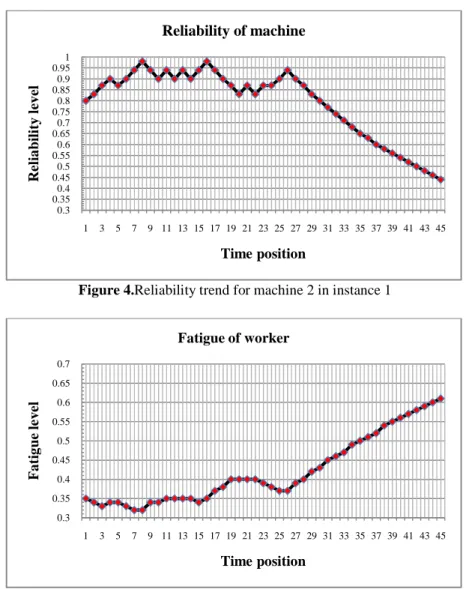
The figure 4 and figure 5 also show the trend of machine 2 reliability and fatigue of its worker in instance 2.It should be noted that the minimum reliability in entire positions time is larger thanminimum required reliability, this fact also holds for worker fatigue.
Figure 4.Reliability trend for machine 2 in instance 1
Figure 5. Fatigue trend for worker of machine 2 in instance 1
7- Conclusions
This paper presented a novel integer nonlinear model to optimize the human resource scheduling, production scheduling and maintenance policy considering machines reliability and fatigue of workers, as two main factors in manufacturing system. The proposed model aims to minimize the machines idleness, workers idleness, unpredictable failure cost, maintenance cost, unavailability cost and quality cost. The machines ‘reliability and workers' fatigue have an effect on the total reliability of manufacturing system. If the total reliability is not in a proper interval, manufacturing system produces poor quality products, considering this fact the proposed model obtains the optimal work-rest schedule for each worker and best maintenance schedule for each machine to maintain the total reliability in a proper interval. Given the complexity of proposed model, we used the linearization technique to convert it to linear form and decrease the solving time. The performance of proposed model was examined by five instances and the provided results indicated the model can obtain efficient and effective work- rest schedule and maintenance schedule.
0.3 0.35 0.4 0.45 0.5 0.55 0.6 0.65 0.7 0.75 0.8 0.85 0.9 0.95 1
1 3 5 7 9 11 13 15 17 19 21 23 25 27 29 31 33 35 37 39 41 43 45
R
el
ia
b
il
it
y
l
ev
el
Time position
Reliability of machine
0.3 0.35 0.4 0.45 0.5 0.55 0.6 0.65 0.7
1 3 5 7 9 11 13 15 17 19 21 23 25 27 29 31 33 35 37 39 41 43 45
F
a
ti
g
u
e
le
v
el
Time position Fatigue of worker
Reference
Azizi, N., Liang, M. and Zolfaghari, S. (2013), ‘Modeling Human Boredom at Work: Mathematical Formulations and a Probabilistic Framework’, Journal of Manufacturing Technology Management, 2013, 24 (5), 711-746.
Baines, T.S., Asch, R., Hadfield, L., Mason, J.P., Fletcher, S. and Kay, J.M. (2005), ‘Towards a theoretical framework for human performance modeling within manufacturing systems design’, Simulation Modeling Practice and Theory, 13(6), 486-504.
Bechtold, S.E. (1991), ‘Optimal work-rest schedules with a set of fixed-duration rest periods’, Decision Sciences, 22, 157–170.
Bechtold, S.E. and Sumners, D.L. (1988), ‘Optimal work–rest scheduling with exponential work-rate decay’, Management Science, 34(4), 547–552.
Bechtold, S.E., Janaro, R.E. and Sumners, D.L. (1984), ‘Maximization of labor productivity through multi-rest break scheduling’, Management Science, 30, 1442–1458.
Cappadonna, F.A., Costa, A. and Fichera S. (2013), ‘Makespan Minimization of Unrelated Parallel Machines with Limited Human Resources’, Procedia CIRP, 12, 450-455.
Dawson, D., Noy, Y.I., Härmä M., Åkerstedt, T. and Belenky, G. (2011), ‘Modeling fatigue and the use of fatigue models in work settings’, Accident Analysis & Prevention, 43(2), 549-564.
Godwin, G.U. and Aniekan, A.E. (1999), ‘Human factors affecting the success of advanced manufacturing systems’, Computers & Industrial Engineering, 37, 297-300.
Griffith, C.D. and Mahadevan, S. (2011), ‘Inclusion of fatigue effects in human reliability analysis’, Reliability Engineering & System Safety, 96(11), 1437-1447.
Guadalupe, M. (2003), ‘The hidden costs of fixed term contracts: the impact on work accidents’, Labour Economics, 10(3), 339-357.
Hsieh, A. and Chao, H. (2004), ‘A reassessment of the relationship between job specialization, job rotation and job burnout: Example of Taiwan's high-technology industry’, The International Journal of Human Resource Management, 15(6), 1108-1123.
Jaber, M.Y., Givi, Z.S. and Neumann W.P. (2013), ‘Incorporating human fatigue and recovery into the learning–forgetting process’, Applied Mathematical Modeling, 37(12–13), 7287-7299.
Jamshidi, R. and Seyyed Esfahani, M. M. (2013), ‘Human resources scheduling to improve the product quality according to exhaustion limit’, Top, Article in press.
Jiang, B., Baker, R.C. and Frazier, G.V. (2009), ‘An analysis of job dissatisfaction and turnover to reduce global supply chain risk: Evidence from China’, Journal of Operations Management, 27(2), 169-184. Konz, S. (1998), ‘Work/rest: part II – the scientific basis (knowledge base) for the guide’, International Journal of Industrial Ergonomics, 22 (1–2), 73–99.
Koo, J., Kim, B.I. and Kim, Y.S. (2014), ‘Estimating the effects of mental disorientation and physical fatigue in a semi-panic evacuation’, Expert Systems with Applications, 41(5), 2379-2390.
Kopardekar P. and Mital, A. (1994), ‘The effect of different work-rest schedules on fatigue and performance of a simulated directory assistance operator’s task’, Ergonomics, 37 (10), 1697–1707.
Lodree, E.J., Geiger, C.D. and Jiang, X. (2009), ‘Taxonomy for integrating scheduling theory and human factors: review and research opportunities’, International Journal of Industrial Ergonomics, 39, 39–51. MacCarthy, B.L., and Wilson, J.R. (2001), ‘Human performance in planning and scheduling. London’, Taylor and Francis.
Mahdavi, I., Aalaei, A., Paydar, M.M. and Solimanpur, M. (2010), ‘Designing a mathematical model for dynamic cellular manufacturing systems considering production planning and worker assignment’, Computers & Mathematics with Applications, 60(4), 1014-1025.
Martorell, S., Villamizar, M., Carlos, S. and Sánchez A. (2010), ‘Maintenance modeling and optimization integrating human and material resources’, Reliability Engineering & System Safety, 95(12), 1293-1299. Mason, S., Baines, T., Kay, J.M. and Ladbrook, J. (2004), ‘Improving the design process for factories: Modeling human performance variation, Journal of Manufacturing Systems’, 24(1), 47-54.
Siddiqui, M.H., Iqbal, A. and Manarvi, I.A. (2012), ‘Maintenance Resource Management: A key process initiative to reduce human factors in aviation maintenance’, Aerospace Conference, IEEE, 1(7), 3-10.
Smith, Ch.O. (1976), ‘Introduction to Reliability in Design’, McGraw-Hill, 1976.
Taylor, J.C. (2000), ‘The evolution and effectiveness of Maintenance Resource Management (MRM)’. International Journal of Industrial Ergonomics, 26, 201-215.
Wang, H., and Hu, S.J. (2010), ‘Manufacturing complexity in assembly systems with hybrid configurations and its impact on throughput’, CIRP Annals - Manufacturing Technology, 59 (1), 53–56.