1
The Evolving Policy Framework and Historical Trends in Female
Circumcision Provider by Circumcision Year, Region, and Wealth:
Secondary Data Analysis of the 2008 Egypt Demographic and Health Survey
by Kristen N. Brugh
A paper presented to the faculty of The University of North Carolina at Chapel Hill in partial fulfillment of the requirements for the
degree of Master of Public Health
in the Department of Maternal and Child Health.
Chapel Hill, N.C.
April 18, 2011
2
Abstract
Objectives. Egyptian national policies have historically focused on the ‘medicalization’ of female circumcision (FC). This study aimed to determine if circumcision year, region, and wealth were associated with differential FC provider utilization patterns.
Methods. Data were from the 2008 EDHS Ever-Married Women Questionnaire (N=13,650). The outcome variable was the provider who performed the circumcision, and key independent variables were circumcision year, region, and wealth.
Results. Regression results indicate that women in rural Upper Egypt and in the poorest wealth quintile are the most likely to be circumcised by a daya, while women in urban areas and the richest wealth quintile are the most likely to be circumcised by a professional provider; utilization of professional providers increased over time.
3
Table of Contents
Introduction ... 5
Literature Review... 6
Female Circumcision: Scope, Social Context, and Severity ... 6
Health Policy Initiatives ... 10
Prior Research ... 14
Research Questions... 15
Methods ... 16
Data Sources ... 16
Measures ... 18
Statistical Analysis ... 20
Results... 21
Descriptive Statistics and Bivariate Analysis Results ... 21
Associations Among Region, Wealth, and Circumcision Provider... 25
Associations Among Circumcision Year, Region, Wealth, and Circumcision Provider ... 33
Discussion ... 37
Strengths and Weaknesses ... 40
Future Research/Future Directions ... 43
Conclusions ... 43
References ... 46
Acknowledgements... 51
Appendices ... 52
Appendix A: Human Rights Instruments Relevant to Female Circumcision ... 52
4
Figures
Figure 1. Historical Prevalence of Female Circumcision in Egypt ... 10
Figure 2. Hypothesized Analytic Model ... 16
Figure 3. Study Sample Selection, Egypt DHS, 2008 ... 20
Figure 4. Distribution of Wealth Quintile by Current Region ... 26
Figure 5. Probabilities Predicted From Multinomial Logistic Regression Model ... 35
Figure 6. Distribution of Annual Incidence of Circumcision by Provider ... 36
Tables
Table 1. 2008 EDHS Governorate Domain Sample Stratification ... 17Table 2. Bivariate Associations Between Age, Region, Wealth Index, and Provider... 22
Table 3. Continuous Distribution Trends for Current Age, Circumcision Age, and Year of Circumcision ... 25
Table 4. Crude and Adjusted Odds Ratios for Differential Regional and Wealth Quintile Provider Selection ... 27
5
The Evolving Policy Framework and Historical Trends in Female
Circumcision Provider by Circumcision Year, Region, and Wealth:
Secondary Data Analysis of the 2008 Egypt Demographic and Health Survey
Kristen N. Brugh
Introduction
This research manuscript examines the case of female circumcision (FC) in Egypt, considering the history and scope of the practice; the inspiration, articulation, implementation, and enforcement of national policies to regulate FC; and employs secondary data analysis of the 2008 Egypt Demographic and Health Survey (2008 EDHS)1 to study the trends and associations among current region, current wealth index, and year of circumcision with the type of provider who performed the circumcision procedure.
6
Literature Review
Female Circumcision: Scope, Social Context, and Severity
Much like the name, the nature of FC procedures varies in extent and severity from a nicking of the clitoris to the complete removal of all external female genitalia. WHO defines ‘female genital mutilation’ as “all procedures involving partial or total removal of the external female genitalia, or other injury to the female genital organs for non-medical reasons,” and has categorized the different forms of FC into four distinct groupings5:
- Type 1: Clitoridectomy; partial or total removal of the clitoral hood (Type 1A) or prepuce (Type 1B) only.
- Type 2: Excision; partial or total removal of the clitoris and the labia minora with or without excision of the labia majora. Type 2A entails removal of only the labia minora; Type 2B partial or total removal of the labia minora and the clitoris; Type 2C partial or total removal of the clitoris, labia minora, and labia majora.
- Type 3: Infibulation; narrowing the vaginal cavity through creation of a covering seal by cutting and sewing together the labia minora and/or the labia majora, with or without excision of the clitoris. Type 3A, removal and apposition of labia minora; Type 3B, removal and apposition of labia majora. Type 3 also includes refibulation, a procedure to recreate infibulations, often after defibulation during childbirth.
7 urine retention due to swelling, obstruction, or fear of pain. Recurrent urinary tract and other chronic pelvic infections are common. Girls may experience obstruction of menstrual flow, and discharge backup has been shown to distend the uterus. Long-term consequences include chronic pain and infection, pain at first intercourse, sexual dysfunction, and psychological risks. FC also has health implications for pregnancy and childbirth as vaginal and urinary tract infections have the potential to contribute to miscarriage. A skilled birth attendant with knowledge and training in FC deliveries must be present during childbirth to cut the scar tissue across the vaginal opening (in instances of infibulations), and to then reinfibulate – sew the tissue back together post-delivery. Without assistance in cutting the scar tissue, obstructed labor often occurs, leading to neonatal death and vasicovaginal fistulae.4,7 Findings from a WHO multi-country study that sampled over 28,000 women confirmed that, compared to women who were not cut, women who had undergone FC had significantly increased risks for adverse events for both mother and baby during childbirth. In women with FC types 1-3, higher incidence of caesarean section and post-partum hemorrhage were reported, with risk increasing with the severity of the FC
procedure. The study also estimated that an additional one to two babies per 100 deliveries die as a direct result of FC, with death rates among babies during and immediately prior to birth 15% higher for mothers with Type 1 FC, 32% higher for mothers with Type 2, and 55% higher for mothers with Type 3 FC.8
8 is still widely continued are multifaceted.10 The ultimate goal of FC is to make the girl a desirable bride; FC is thought to curb the woman’s sexual promiscuity and thereby assure sexual purity, including virginity at marriage and faithfulness after marriage. These fears feed off of the concept of ‘bride wealth’, which stresses bridal purity so that the family receives a high bride price. Every society that practices FC also adheres to customs of bride wealth, and it has been found that women who have not undergone FC are unlikely to be married, or obtain very low bride prices if married. Other forces propelling the continuation of the practice include tradition and fear of losing cultural identity, and culture inhibition syndrome, whereby societies continue a practice to maintain and emphasize their distinctiveness. In these highly patriarchal societies, FC is also promoted to increase male sexual pleasure. Despite the lack of justification for FC within Muslim, Christian, or Jewish texts, many followers and practitioners believe that their religions require this rite; Islam has perhaps the most well-known and widespread instances of incorporating the practice into its religious worldview. 2,10
9 precondition for bearing children, and the primary roles of mother and wife are socially and culturally expected primary goals of a woman’s life.
Despite international efforts to end FC, there has been little significant evidence of its global decline. Estimates from 2006 reports indicate that worldwide, between 100 million and 140 million girls and women alive today have undergone FC, and that about 3 million girls, the majority of whom are under age 15, undergo the procedure every year.11 FC is a common practice in many societies in Arab and African countries12-14; approximately 70 million girls and women ages 15-49 in 27 countries of Africa and the Middle East have undergone FC, with half of these women living in just two countries – Egypt and Ethiopia.11,15 The practice of FC has been an Egyptian tradition since the Pharaonic period.1,6 Although various forms and practices of FC have been illegal in Egypt for over 50 years, with laws increasing in their stringency from 1956 to 1997 to 2007, observance of the custom remains widespread, particularly because the perpetuation of the practice of FC preserves group identity and is viewed as a cultural indicator of femininity, purity, cleanliness, and assurance of a woman’s marriageability.1,6,14,15 While many African
countries have experienced a decline in FC incidence over the past 20 years, Egypt has maintained a very high prevalence – nearly universal – of the practice.13 A recent UNICEF report indicates that the percentage of girls and women ages 15-49 that underwent FC between 2002-2007 in Egypt was 96%, disaggregated to 92% urban and 98% rural, and second only to Somalia’s 98%.15 Results from Egypt Demographic and Health Survey (EDHS) data show no significant decline in the practice from the 1995 to 2000 to 2005 reports, indicating that 97% of Egyptian women
10
Figure 1. Historical Prevalence of Female Circumcision in Egypt1
Health Policy Initiatives
Initial campaigns to eliminate the practice of FC focused on associated health risks. However, health information delivered in anti-FC campaigns was frequently exaggerated and drawn from medical case studies of infibulations with extreme complications. Discrepancies between medical propaganda and the real-life experiences of FC populations grew, and campaign credibility was subsequently undermined. As a result, FC was reframed as a rights issue; beginning in the early 1990s, the anti-FC campaign worked to distance itself from health message and instead adopted a human rights framework.9 Beginning in the mid- to late-1990s, initiatives to end FC once again switched messages, but this time incorporated a more comprehensive strategy of maintaining human rights arguments against FC while also promoting awareness of the
morbidities and mortalities associated with the continuance of the practice.
The World Health Organization, World Health Assembly, multiple United Nations bodies, governments, and international advocates and scholars claim that FC of any type is a violation of the human rights of girls and women. Frequently cited rights include (Appendix A): the right to nondiscrimination based on sex; the rights of the child; the right to the highest attainable standard of health; the right to life when the procedure results in death; and the right to be free from torture or cruel, inhuman, or degrading treatment or punishment.5 Several of the UN human
0.0 20.0 40.0 60.0 80.0 100.0
% women aged 15-49 who have been
circumcised
% of girls expected to be circumcised
by age 18
11 rights treaty monitoring bodies have addressed FC in observations of State treaty obligation fulfillments; the Committee on the Elimination of All Forms of Discrimination against Women [CEDAW], the Committee on the Rights of the Child, and the Human Rights Committee have all been very active in condemning the practice of FC. The CEDAW Committee issued General Recommendation No. 14, which calls upon states to take “appropriate and effective measures with a view to eradicating the practice” and requests the provision of information related to state measures taken to eliminate FC in their Committee reports.7 The 4th World Conference on Women, held in Beijing in 1995, also called for the elimination of FC in its declaration and platform for action.10
Cultural relativism is of particular salience to the issue of FC given the deeply ingrained history of the practice in cultural tradition, and is also of paramount importance when considering the Egyptian context given the prominence of Islam in Egypt. Although Egypt has signed and ratified a number of human rights treaties, it frequently inserts a blanket reservation into ratification agreements: “…taking into consideration the provisions of Islamic Sharia and the fact that they do not conflict with the text of the instrument, we accept, support, and ratify it.” Egypt was an original member of the United Nations, and, relevant to FC, has ratified the ICCPR, ICESCR, CEDAW, and the Convention on the Rights of the Child; Egypt has not, however signed or ratified the Convention against Torture. Egypt is also a member of the African Union, an
intergovernmental organization with 53 member states, and ratified the Banjul Charter (African Charter on Human and Peoples’ Rights) in 1981, the Children’s Charter in 2001, but has not signed or ratified the Maputo Protocol, which is the protocol to the Banjul Charter guaranteeing
12 One of the primary aims of human rights instruments is to inspire codification of
internationally recognized rights at national levels. There was early movement in Egypt in the 1950s – around the time of Egypt’s independence from the British government – to grant rights to women and curb the practice of FC, with the 1956 Egyptian Constitution granting full political rights to women,17 and the issuance of a 1959 Ministry of Health decree forbidding infibulations and restricting the practice of FC to medical personnel. This decree was not enforced, and FC became a taboo subject with minimal public discussion, resulting in FC becoming an underground practice performed in the home by dayas and barbers.18,19
The issue resurfaced in the early 1990s, but most of the information was confusing, contradictory, and at times inaccurate, including over-exaggeration of medical harms. These campaigns had the unintended effect of creating suspicion among families and communities and fueling accusations of Western conspiracies against Egyptian traditions and values, exaggerating Egyptian reluctance to stop FC. The mid-1990s marked a turning point for women’s rights and Egyptian policy attentions to FC. Cairo hosted the 1994 UN International Conference on Population and Development (ICPD, the Cairo Conference). CNN (Cable News Network)
13 response to government denunciation of FC, Al Azhar University issued a religious decree in support of FC as a religious practice; the government initially responded by extending the 1959 health decree to ban FC in public hospitals, but religious criticisms again led the government to flounder, and the Egyptian Health Minister announced a new compromise policy – one that reversed a 35-year old government ‘ban’ - which set aside one day a week for public hospitals to perform female circumcisions in the hopes of making the practice more hygienic. The Ministry of Health justified this policy to the international community with assurances that as people came to the hospitals for FC procedures, doctors would provide public health information that would persuade families not to circumcise their daughters. Five months later, it was publicized that hospitals were performing FC operations daily, and that physicians were actually competing for the procedures to collect fees. Once again, the Ministry of Health changed position, and forbade the performance of FC in any government medical facility. As was the case prior to the 1990s, legislative and judicial enforcement was lacking.18,19
In 2002, the Egyptian government again advocated the cause of FC abandonment at the national level, but failed to enact serious legislation until 2007, when the Ministry of Health and Population issued Ministerial Decree No. 271, banning doctors, nurses, service providers, and others from practicing any form of FC under any circumstances and in any setting. This decree held violators liable to administrative and criminal penalties. In 2008, the Egyptian Parliament banned FC performed on girls and women of all ages by amending the national penal code to apply articles addressing deliberate bodily injury to FC, and amended the Child Law, calling for the establishment of governorate and district level child protection committees that would be
14
Prior Research
Prior research has found that girls residing in the Urban Governorates and in urban Lower Egypt are less likely to be circumcised than girls who live in rural Upper Egypt, even after
controlling for other socioeconomic variables,6 and that lower wealth status is a strong predictor of both maternal circumcision and maternal intention to continue female circumcision in
15 has also documented limited labor and wealth mobility within the Egyptian population,
particularly for women.25 For the purposes of this study, given the low historical rates of regional and wealth mobility within the female Egyptian population, regional and wealth data from the 2008 EDHS are considered to be representative of women’s childhood wealth and regional status.
Research Questions
The purpose of this secondary data analysis study is twofold: (1) to examine the
associations among region, wealth, and the provider who performed a woman’s circumcision; and (2) to analyze the historical trends in circumcision incidence by year and provider type. It is important to understand patterns in circumcision incidence over time and by provider in the context of Egyptian FC policy initiatives – and to compare patterns among different regional groupings and wealth strata – in order to assess the relative impacts of health legislation and enforcement efforts on changes in population health behaviors.
16
Figure 2. Hypothesized Analytic Model
From this conceptual framework, three key hypothesized associations were tested:
(1) Residence in rural Upper Egypt was hypothesized to be associated with increased odds of circumcision by a non-professional provider (daya, barber, ghagaria), while residence in the Urban Governorates and urban Lower Egypt was hypothesized to be associated with increased odds of circumcision by a professional provider (doctor, trained nurse/midwife). (2) Higher wealth is hypothesized to be associated with increased odds of circumcision by a
professional provider.
(3) The proportion of annual circumcisions completed by professional providers is hypothesized to increase over time.
Methods
Data Sources
17 and Module 2. Female Circumcision), which is comprised of a nationally representative cross-sectional sample of 16,527 ever-married women, ages 15-49, inclusive. The 2008 EDHS Female Circumcision module collected information from all survey respondents on their circumcision status; all women who were circumcised were asked about their age when they were circumcised and the type of person who performed the circumcision.1
The 2006 Egypt Population Census was used to plan the 2008 EDHS sample frame. A three-stage probability sample was designed, with a target number of households set at 19,500, and the minimum allocation per major domain set at 1,000 households. Household stratification was distributed by governorates within four major domains (Urban Governorates, Upper Egypt, Lower Egypt, and Frontier Governorates), as illustrated in Table 1. The sample design for 2008 EDHS further stratified these domains into six major subdivisions ((Upper Governorates, urban Lower Egypt, rural Lower Egypt, urban Upper Egypt, rural Upper Egypt, and the Frontier
Governorates). The ever-married women response rate was near universal (99.7%), with stratified response rates as follows: urban 99.7%; rural 99.8%; Urban Governorates 99.9%; Lower Egypt 99.9%; Upper Egypt 99.7%; and Frontier Governorates 98.5%. Study participants were not compensated.1
Table 1. 2008 EDHS Governorate Domain Sample Stratification1 Urban Governorates Yellow Lower Egypt Red Upper Egypt Green Frontier Governorates Blue
Adapted from data in the Egypt DHS 2008
Cairo Damietta Giza Red Sea
Alexandria Dakalhia Beni Suef New Valley
Port Said Sharkia Fayoum Matrouh
Suez Kalubia Minya North Sinai
Kafr El Shiek Assiut South Sinai Gharbeya Aougah
Menoufia Qena
Behira Aswan
18
Measures
Dependent Variable. The dependent variable (outcome) was the type of person who performed
each respondent’s circumcision. Data for this variable were collected from the Female
Circumcision module, question 903, “Who performed the circumcision?” Response options were categorical, and included: doctor, nurse/other health provider, daya (traditional birth attendant), barber (traditional practitioner – typically male – who performs both male and female
circumcisions), ghagaria (Gypsies),26 other, and don’t know. Respondents who answered “don’t know” or did not provide a response were dropped from the study sample (Figure 3). Seven versions of the dependent variable were created and modeled: six for the binary logistic
regressions (one per provider type), and one for the multinomial logistic regression (with daya as referent group).
Independent Variables. Region and wealth index were analyzed as key independent variables in a
multiple logit model; year of circumcision was analyzed as the key independent variable in a multinomial logit model, with region and wealth factor score included as potential predictors.
Region. Place of residence data were recoded from the 2008 EDHS variable v024(region), and provide information on current place of residence. This variable was a categorical response variable with six options: urban Lower Egypt, rural Lower Egypt, urban Upper Egypt, rural Upper Egypt, Urban Governorates, and Frontier Governorates. Original value categories were recoded to position rural Upper Egypt as the first category to ease the generation of dummy variables for logistic regressions.
19 factor score generated through principal component analysis, and the resulting asset scores were standardized. Each 2008 EDHS household was assigned a standardized score for each asset, with scores varying if households did or did not own an asset. Scores were then summed by household and divided into population quintiles – five groups of equal sample size – and individuals were ranked according to their household score.1 Each respondent was assigned a continuous wealth factor score and an ordinal (poorest, poorer, middle, richer, and richest) wealth index score.
20
Statistical Analysis
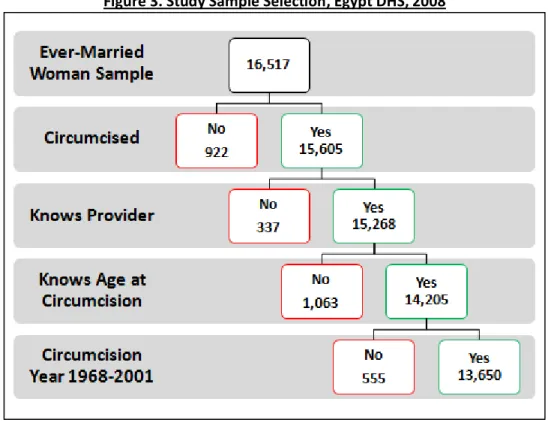
Subjects were dropped from study analysis if they were not circumcised (n=922), did not know which type of provider performed their circumcision (n=337), did not know the age at which they were circumcised (n=1,063), and were circumcised before 1968 or after 2001 (n=555); the final study sample size was N=13,650 (Figure 3).
Figure 3. Study Sample Selection, Egypt DHS, 2008
21 regression coefficients were calculated to assess the relationship between circumcision year and circumcision provider, and adjusted coefficients were computed after controlling for region and wealth factor score. A significance level of α=0.05 was employed in all statistical tests. Lastly, annual circumcision incidence rates were calculated for all circumcision years using the following equation (Incidence Rate year j = IRj:
IR
j=
# individuals circumcised year
j[
∑
# individuals in birth year
(0…j)] – [
∑
# individuals circumcised year
(0…j-1)]
Data analysis was performed using Stata 11 (StataCorp LP, College Station, TX, USA) for all statistical calculations except for annual circumcision incidence rates, which were calculated and graphed using Microsoft Excel (2010).
Results
Descriptive Statistics and Bivariate Analysis Results
22 circumcision (N=14,205). Results indicate that the study sample of women circumcised between 1968-2001 was statistically significantly different with respect to age distribution from the population of women circumcised within the entire 2008 EDHS time span (1958-2007); there was no statistically significant difference in regional, wealth, or provider distribution between the study sample (N=13,650) and the sample containing women circumcised before 1968 and after 2001. Table 2 presents the descriptive statistics and significance test results for age strata, region, wealth index, and provider groups.
Table 2. Bivariate Associations Between Age, Region, Wealth Index, and Provider
Characteristic
Female Circumcision Provider N
(%) Daya (%) Doctor (%) Trained Nurse/ Midwife (%) Barber (%) Ghagari a (%) Other/ Unspecifie d (%) Age 5-Year Groups
15-19*
465
(3.41) 54.41 36.34 6.45 2.37 0.43 0
20-24*
2,223
(16.29) 57.53 31.40 9.04 1.48 0.54 0
25-29*
2,854
(20.91) 63.56 24.53 8.86 2.21 0.81 0.04
30-34*
2,319
(16.99) 72.01 17.12 8.11 1.85 0.82 0.09
35-39*
2,238
(16.40) 78.19 11.04 7.02 2.23 1.34 0.18
23 (14.89)
45-49*
1,519
(11.13) 83.74 6.98 4.81 1.84 2.44 0.2
Region
Upper Egypt Rural
4,055
(29.71) 76.4 16.77 3.85 2.29 0.59 0.1
Upper Egypt Urban
1,525
(11.17) 67.15 24.52 7.15 1.05 0.07 0.07
Lower Egypt Rural
4,052
(29.68) 72.38 15.47 7.77 2.17 2.2 0
Lower Egypt Urban
1,435
(10.51) 60.42 22.44 13.31 2.72 1.11 0
Urban Governorates
1,990
(14.58) 68.29 18.44 10.6 1.46 1.01 0.2
Frontier Governorates
593
(4.34) 69.31 18.55 8.43 1.18 2.02 0.51
Wealth Index
Poorest
2,833
(20.75) 82.17 9.88 3.25 2.79 1.76 0.14
Poorer
2,782
(20.38) 77.39 13.59 5.32 1.98 1.73 0
Middle
2,886
24 Richer
2,738
(20.06) 64.43 22.02 10.88 1.9 0.66 0.11
Richest
2,411
(17.66) 54.25 30.98 12.65 1.53 0.46 0.12
Provider Total 13,650
9,692 (71.00)
2,480 (18.17)
1,032 (7.56)
272 (1.99)
162
(1.19) 12 (0.09)
*statistically significantly different (p<0.05) from 1958-2007 population proportions (N=14,205)
25 inversely associated with circumcision by a daya and directly associated with circumcision by a professional provider.
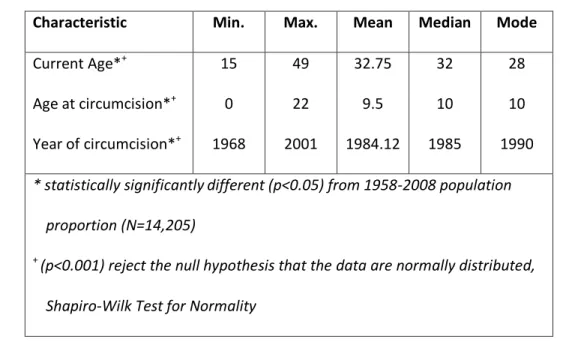
Table 3 presents the descriptive statistics for the primary continuous independent variables relevant to the study: age, age at circumcision, and year of circumcision. On a
continuous scale, the average age was found to be approximately 33 years, compared to a mode of 28 years. The average age of circumcision was 9.5 years, and the average year of circumcision was 1984. All three variables were found to be statistically significantly different between the study population and the 1958-2007 circumcision population. The Shapiro-Wilk test for normality was conducted for each variable to determine sample distribution tendencies; none of the continuous variables were found to be normally distributed. Graphical representations of each distribution are presented in Appendix B.
Table 3. Continuous Distribution of Current Age, Circumcision Age, and Year of Circumcision Characteristic Min. Max. Mean Median Mode
Current Age*+ 15 49 32.75 32 28
Age at circumcision*+ 0 22 9.5 10 10
Year of circumcision*+ 1968 2001 1984.12 1985 1990 * statistically significantlydifferent (p<0.05) from 1958-2008 population
proportion (N=14,205)
+ (p<0.001) reject the null hypothesis that the data are normally distributed,
Shapiro-Wilk Test for Normality
Associations Among Region, Wealth, and Circumcision Provider
26 assessed using the Kruskal-Wallis equality of populations rank test; the Kruskal-Wallis rank test is a nonparametric method for testing the equality of population medians among groups, and is appropriate for use with a categorical independent variable (region) and an ordinal dependent variable (wealth index). The Kruskal-Wallis equality of populations rank test results indicated that, with or without ties, there was a statistically significant difference in wealth index scores among the study populations in the different regions (Chi-squared(5) = 4822.948, p<0.001; Chi-squared with ties(5) = 5026.199, p<0.001).
Figure 4 presents the distribution of wealth index by current region; Upper Egypt contains the highest proportion of the poorest and poorer wealth quintiles, Lower Egypt has the largest proportion of study subjects in the middle wealth quintile, the Urban Governorates have the largest proportion of the richest subjects, and the Frontier Governorates have an approximately even study population distribution of wealth quintiles.
Figure 4. Distribution of Wealth Quintile by Current Region (N=13,650)*
0 10 20 30 40 50 60 70 Upper Egypt Rural Upper Egypt Urban Lower Egypt Rural Lower Egypt Urban Urban Governorates Frontier Governorates P e rc e nt ag e of W e al th Q ui nt ile
Distribution of Wealth by Region (N=13,650)
poorest poorer middle richer richest
*The bars of each wealth quintile sum to 100%
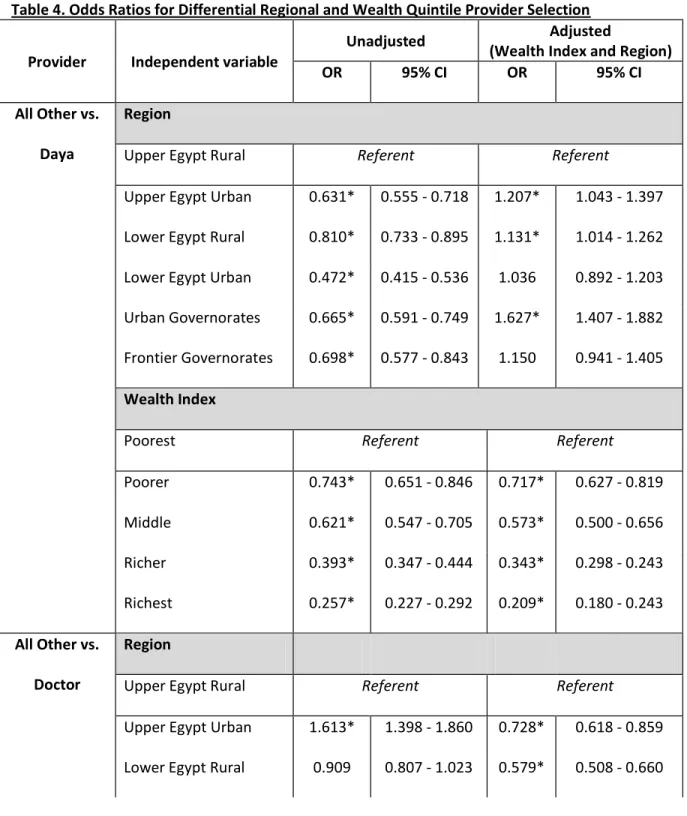
27 of the study population by region, multiple logistic regression models were computed to assess the associations between current region and circumcision provider and current wealth index and circumcision provider. Each model was adjusted for wealth or region, with the base category (rural Upper Egypt and poorest) serving as the adjustment referent group (Table 4).
Table 4. Odds Ratios for Differential Regional and Wealth Quintile Provider Selection
Provider Independent variable
Unadjusted Adjusted (Wealth Index and Region) OR 95% CI OR 95% CI All Other vs.
Daya
Region
Upper Egypt Rural Referent Referent
Upper Egypt Urban 0.631* 0.555 - 0.718 1.207* 1.043 - 1.397 Lower Egypt Rural 0.810* 0.733 - 0.895 1.131* 1.014 - 1.262 Lower Egypt Urban 0.472* 0.415 - 0.536 1.036 0.892 - 1.203 Urban Governorates 0.665* 0.591 - 0.749 1.627* 1.407 - 1.882 Frontier Governorates 0.698* 0.577 - 0.843 1.150 0.941 - 1.405
Wealth Index
Poorest Referent Referent
Poorer 0.743* 0.651 - 0.846 0.717* 0.627 - 0.819
Middle 0.621* 0.547 - 0.705 0.573* 0.500 - 0.656
Richer 0.393* 0.347 - 0.444 0.343* 0.298 - 0.243
Richest 0.257* 0.227 - 0.292 0.209* 0.180 - 0.243
All Other vs. Doctor
Region
Upper Egypt Rural Referent Referent
28 Lower Egypt Urban 1.436* 1.237 - 1.666 0.550* 0.462 - 0.655 Urban Governorates 1.122 0.976 - 1.291 0.386* 0.325 - 0.458 Frontier Governorates 1.130 0.905 - 1.413 0.595* 0.469 - 0.755
Wealth Index
Poorest Referent Referent
Poorer 1.434* 1.216 - 1.690 1.646* 1.392 - 1.946
Middle 1.783* 1.522 - 2.089 2.345* 1.982 - 2.773
Richer 2.575* 2.210 - 3.001 3.885* 3.265 - 4.624
Richest 4.093* 3.521 - 4.758 6.666* 5.559 - 7.993
All Other vs. Trained
nurse/ midwife
Region
Upper Egypt Rural Referent Referent
Upper Egypt Urban 1.924* 1.495 - 2.476 1.165 0.885 - 1.533 Lower Egypt Rural 2.107* 1.730 - 2.566 1.581* 1.281 - 1.951 Lower Egypt Urban 3.837* 3.077 - 4.786 2.070* 1.606 - 2.668 Urban Governorates 2.964* 2.392 - 3.673 1.524* 1.184 - 1.961 Frontier Governorates 2.301* 1.653 - 3.204 1.541* 1.092 - 2.174
Wealth Index
Poorest Referent Referent
Poorer 1.674* 1.284 - 2.183 1.481* 1.130 - 1.943
Middle 2.088* 1.618 - 2.694 1.683* 1.286 - 2.203
Richer 3.639* 2.862 - 4.626 2.707* 2.072 - 3.536
Richest 4.315* 3.394 - 5.485 3.250* 2.464 - 4.286
29
Barber Upper Egypt Rural Referent Referent Upper Egypt Urban 0.452* 0.265 - 0.770 0.565* 0.322 - 0.991 Lower Egypt Rural 0.946 0.704 - 1.270 1.138 0.827 - 1.566 Lower Egypt Urban 1.190 0.815 - 1.738 1.597* 1.014 - 2.514 Urban Governorates 0.630* 0.414 - 0.959 0.854 0.519 - 1.404 Frontier Governorates 0.509 0.235 - 1.102 0.605 0.276 - 1.326
Wealth Index
Poorest Referent Referent
Poorer 0.703* 0.496 - 0.996 0.676* 0.472 - 0.967
Middle 0.602* 0.420 - 0.863 0.572* 0.388 - 0.843
Richer 0.675* 0.474 - 0.962 0.629* 0.414 - 0.954
Richest 0.543* 0.366 - 0.806 0.553* 0.343 - 0.891
All Other vs. Ghagaria
Region
Upper Egypt Rural Referent Referent
Upper Egypt Urban 0.110* 0.015 - 0.815 0.225 0.030 - 1.671 Lower Egypt Rural 3.772* 2.398 - 5.933 5.895* 3.674 - 9.459 Lower Egypt Urban 1.894* 1.003 - 3.575 5.987* 2.974 - 12.054 Urban Governorates 1.705 0.940 - 3.094 5.786* 2.963 - 11.300 Frontier Governorates 3.469* 1.725 - 6.975 5.967* 2.937 - 12.120
Wealth Index
Poorest Referent Referent
Poorer 0.977 0.655 - 1.457 0.636* 0.420 - 0.962
30
Richer 0.368* 0.214 - 0.633 0.169* 0.093 - 0.306
Richest 0.255* 0.133 - 0.491 0.123* 0.059 - 0.255
All Other vs. Other/ unspecified
Region
Upper Egypt Rural Referent Referent
Upper Egypt Urban 0.665 0.074 - 5.950 0.610 0.056 - 6.660
Lower Egypt Rural - - - -
Lower Egypt Urban - - - -
Urban Governorates 2.040 0.510 - 8.164 1.717 0.267 - 11.048 Frontier Governorates 5.150 1.150 - 23.066 4.698 0.871 - 25.331
Wealth Index
Poorest Referent Referent
Poorer - - - -
Middle 0.490 0.090 - 2.680 0.670 0.109 - 4.121
Richer 0.776 0.173 - 3.469 0.891 0.143 - 5.567
Richest 0.881 0.197 - 3.941 0.777 0.111 - 5.439
*statistically significant (p<0.05)
31 likely (1.627 times more likely than the poorest respondents in rural Upper Egypt) to have been circumcised by a daya. The trends in risk of having been circumcised by a daya by wealth quintile maintain the same pattern after controlling for region. All odds ratios calculated for unadjusted region and wealth and adjusted risk by wealth quintile are statistically significant for women circumcised by dayas, but calculations for urban Lower Egypt and the Frontier Governorates are not statistically significant after adjusting for wealth.
Multiple logistic regression results for women circumcised by a doctor indicate that women residing in urban Upper Egypt and women in the richest wealth quintile are the most likely to have been circumcised by a doctor. After adjusting for wealth, results indicate that poorest women living in the Urban Governorates are the least likely to have been circumcised by a doctor; results adjusted for region indicate that, of women residing in rural Upper Egypt, the richest are significantly more likely (OR=6.666) to have been circumcised by a doctor, and as wealth decreases, so too do the odds of having been circumcised by a doctor. The multiple logistic regression model for unadjusted wealth index and both adjusted models appear to be statistically significant models, whereas the majority of odds ratios calculated for the unadjusted region model are not statistically significant.
32 Most of the crude and adjusted multiple logistic regression results for women circumcised by a barber by region were not statistically significant, whereas all regression results for wealth index were statistically significant. The poorest quintile was most likely to have been circumcised by a barber compared to all other wealth quintiles, and as wealth increased, the odds of having been circumcised by a barber decreased. After controlling for region, the poorest were still the most likely and the richest were the least likely to have been circumcised by a barber, but rankings within the middle wealth quintiles were reversed.
Women living in rural Lower Egypt were found to be the most likely (OR=3.772 compared to rural Upper Egypt) to have been circumcised by a ghagaria, and women living in urban Upper Egypt were least likely (OR=0.011) to have been circumcised by a ghagaria. After controlling for wealth, women living in urban Upper Egypt were still the least likely (OR=0.225) to have been used a ghagaria, but women living in urban Lower Egypt were more the most likely to have been circumcised by a ghargaria. Four out of five crude and adjusted odds ratios were statistically significant for women circumcised by a ghagaria by region. Results indicate that, for both crude and adjusted models, women in the poorest quintile were most likely to have been circumcised by a ghagaria, and as wealth increases, the odds of having been circumcised by a ghagaria decrease.
33
Associations Among Circumcision Year, Region, Wealth, and Circumcision Provider
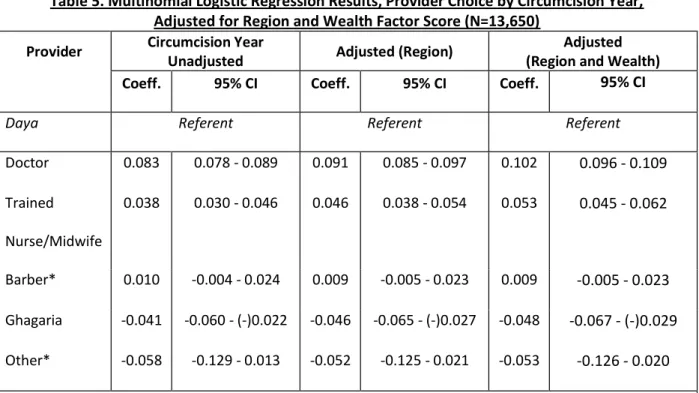
A multinomial logit model was used to predict the probabilities of having been circumcised by one of the six options of provider, given circumcision year, region, and wealth factor scores; results are presented in Table 5. Even after adjustment for region and wealth, the multinomial logistic regression equations calculated for ‘barber’ and ‘other/unspecified’ were not statistically significant models.
For one unit increase in circumcision year, the log of the ratio of the two probabilities, P(provider=Doctor)/P(provider=daya), will be increased by 0.083. The log of the ratio increases after adjusting for both region and wealth, and so – with all other variables held constant – for every one year increase in circumcision year, women were 1.11 times more likely (relative risk = exp(0.102)) to have been circumcised by a doctor than by a daya. This indicates that as time progressed in the circumcision year time frame (1968-2001), the probability of having been circumcised by a doctor increased relative to a decreasing probability of having been circumcised by a daya.
The multinomial logistic regression coefficients for trained nurse/midwife vs. daya are roughly half the values of the doctor vs. daya coefficients. As with the doctor vs. daya trends, regression coefficient values increase as region and region + wealth are adjusted in the model. In the final adjusted model, for every one year increase in circumcision year, women were 1.05 times more likely to have been circumcised by a trained nurse/midwife than by a daya, indicating that, as with doctors and dayas, women had an increased probability of having been circumcised by a trained nurse/midwife rather than a daya as time increased.
The multinomial logistic regression model for ghagaria is the only model to yield
34 progressed, women were less likely to have been circumcised by a ghagaria compared to a daya. In the final adjusted model, for every one year increase in circumcision year, the relative risk of having been circumcised by a ghagaria over a daya (OR=0.94) decreased by approximately 6%.
Table 5. Multinomial Logistic Regression Results, Provider Choice by Circumcision Year, Adjusted for Region and Wealth Factor Score (N=13,650)
Provider Circumcision Year
Unadjusted Adjusted (Region)
Adjusted (Region and Wealth)
Coeff. 95% CI Coeff. 95% CI Coeff. 95% CI
Daya Referent Referent Referent
Doctor 0.083 0.078 - 0.089 0.091 0.085 - 0.097 0.102 0.096 - 0.109 Trained
Nurse/Midwife
0.038 0.030 - 0.046 0.046 0.038 - 0.054 0.053 0.045 - 0.062
Barber* 0.010 -0.004 - 0.024 0.009 -0.005 - 0.023 0.009 -0.005 - 0.023 Ghagaria -0.041 -0.060 - (-)0.022 -0.046 -0.065 - (-)0.027 -0.048 -0.067 - (-)0.029 Other* -0.058 -0.129 - 0.013 -0.052 -0.125 - 0.021 -0.053 -0.126 - 0.020
*results are not statistically significant (p≥0.05), even when adjusted for region and wealth
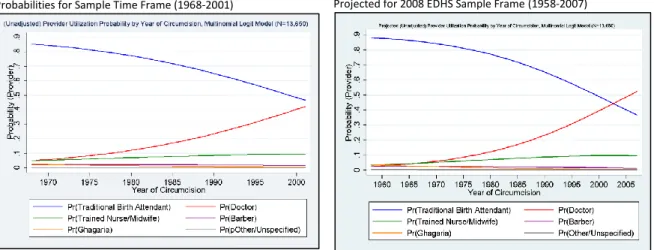
The multinomial logistic regression equations for each unadjusted relationship between circumcision year and provider were used to generate probability estimates for each provider type per year; these probability trends are displayed in Figure 5. The model was expanded to include trends from before 1968 and to project trends past 2001. As expected from the multinomial logit model coefficients, the probability of having been circumcised by a daya
35 expanded model (B), the probability of having been circumcised by a doctor begins to exceed the probability of having been circumcised by a daya in approximately 2003.
Figure 5. Probabilities Predicted from Multinomial Logistic Regression Model (Traditional Birth Attendant is the same as Daya)
Probabilities for Sample Time Frame (1968-2001) Projected for 2008 EDHS Sample Frame (1958-2007)
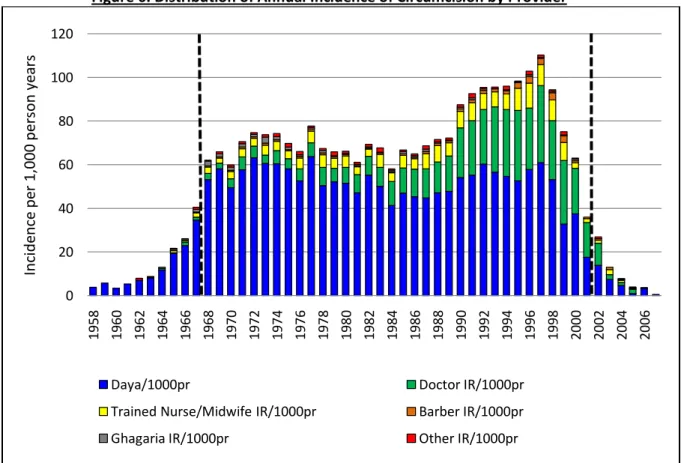
Lastly, annual circumcision incidence rates were calculated and stratified by provider (Figure 6). In order to calculate incidence rates for the entire 1968-2001 study population, sample data from respondents circumcised prior to 1968 had to be included to establish the number of women at risk of circumcision in each study year. As previously discussed in the methods section, women born in 1958 did not, on average, ‘age into’ the circumcision-risk population until 1968; and thus the inclusion of women circumcised prior to 1968 and after 2001 in Figure 6 illustrates the downward bias that these years introduce to the dataset; when the entire 50 year
circumcision window is included, a spurious quartic relationship emerges in the annual incidence distribution. The two vertical dashed black lines indicate the 1968-2001 study sample parameters.
36 began to rapidly increase to a maximum approximately 110 per 1,000 person years in 1997, after which rates sharply began to decline again. Over the course of time, between 1968 and 2001, the proportion of circumcisions performed by doctors significantly increased, with the most drastic increases beginning around 1990. Likewise, the proportion of circumcisions performed by trained nurses/midwives relative to all circumcisions performed also began to increase around 1990. The proportions of circumcisions performed by dayas appear to follow the pattern of circumcision incidence as a whole until 1990, when the proportion of circumcisions performed by dayas began to decrease.
Figure 6. Distribution of Annual Incidence of Circumcision by Provider
The area between the vertical dashed lines represents the study population (N=13,650), circumcised between 1968 and 2001.
0 20 40 60 80 100 120
1958 1960 1962 1964 1966 1968 1970 1972 1974 1976 1978 1980 1982 1984 1986 1988 1990 1992 1994 1996 1998 2000 2002 2004 2006
In ci de nce pe r 1, 00 0 pe rs on ye ar s
Daya/1000pr Doctor IR/1000pr
Trained Nurse/Midwife IR/1000pr Barber IR/1000pr
37
Discussion
Study results are consistent with the existing literature and the study analytic model with regards to the associations among residence, wealth, circumcision year, and provider utilization; while none of the study hypotheses were rejected, multiple logistic regression did generate several surprising results, particularly when regional associations were adjusted for wealth.
In general, unadjusted results indicate that women residing in urban Upper and Lower Egypt were more likely to have been circumcised by a professional provider (women in urban Upper Egypt were most likely to have been circumcised by a doctor, uOR=1.613; women in urban Lower Egypt were most likely to have been circumcised by a trained nurse or midwife,
uOR=3.837), as indicated by bivariate results. Dayas, who have historically performed the majority of female circumcision procedures in Egypt, had the greatest odds of having performed
circumcision for women in rural Upper Egypt, which is consistent with the study’s first hypothesis and with bivariate analysis results. Women in Lower Egypt, however, were the most likely to have been circumcised by barbers (urban Lower Egypt, uOR=1.190, aOR=1.597) and ghagaria (rural Lower Egypt uOR=3.772, urban Lower Egypt aOR=5.987).
Provider utilization patterns analyzed by wealth index category were consistent with hypothesized results, both in the crude and adjusted model, with women in the richest wealth category the most likely to have been circumcised by professional providers, and women in the poorest wealth categories the most likely to have been circumcised by non-professional
non-38 professional providers, with the poorest women most likely to have been circumcised by a daya, barber, or ghagaria, and risk of circumcision by a non-professional provider decreasing as wealth increased.
Regional multiple logistic regression results showed a wide degree of variability after adjusted for wealth, whereas provider odds ratios by wealth quintile maintained consistent trends in both the crude and adjusted models, suggesting that wealth is a stronger predictor of
39 countries with better health outcomes). The burden of ill-health disproportionately affects the poor, and health provision remains inadequate, even in urban areas, amongst the poor.28
These results have important implications for policies aimed at distribution of health providers and access to health services, particularly for poorer Egyptians. That the richest Egyptians were the most likely to utilize professional circumcision providers is indicative of the cost prohibitive nature of accessing a doctor or trained nurse/midwife. Wealth index and adjusted regional results show that the richest are accessing professional providers, no matter which region they are in, whereas the poorest are the least likely to use professional providers and the most likely to use non-professional providers, particularly in more affluent regions such as the Upper Governorates and urban Lower Egypt. Women residing in urban regions were found to have been the most likely to have been circumcised by professional providers, which is consistent with earlier research demonstrating that urban centers have a disproportionately greater share of health services than do rural areas.23,24 Another recent study found that not only are women in the lowest wealth quintiles the most likely to be circumcised, but that lowest wealth quintile was shown to be a strong predictor of maternal intention to continue FC in daughters.22 While it is encouraging that the Egyptian government has bolstered both its legislative and enforcement supports for promoting the discontinuance of FC, policymakers and advocacy groups must ensure that women across all regions and wealth quintiles – regardless of which providers they do and do not have access to – are moving towards the abandonment of FC. Health policy must also strive to provide equal access to professional health providers in rural areas and for the poor across the nation.
40 by a daya also increased, while the percentage circumcised by a doctor or trained nurse/midwife decreased. Results from the multinomial logit model, the multinomial probability functions, and annual circumcision incidence trends across time all show an increase in the utilization of professional providers (doctors and trained nurses and midwives) throughout the progression of the study time frame. These findings are consistent with a 2002 study that reported substantial increases in “medicalization” trends in which women were more likely to report circumcision by a physician or nurse rather than a traditional practitioner than earlier cohorts of Egyptian women.6 These findings begin to suggest that, while circumcision rates remained near-universal in Egypt over the course of the study time frame, parents were choosing to minimize the potential morbidities and mortalities associated with FC by utilizing professional rather than non-professional providers. These changes were the most pronounced in urban areas, which is consistent with theories of greater access to professional services, as well as greater access to health information and behavioral change campaigns.6
Strengths and Weaknesses
41 circumcision among all ever-married women across Egypt. Lastly, the utilization of a constructed wealth index – a relative measure of wealth specific to the context of Egypt – is preferable than an absolute wealth measurement for evaluating associations among poverty and health service access and utilization patterns. Household income is difficult to measure, particularly within the confines of the Demographic and Health Survey questionnaire methodology; income is volatile and for most earners, varies daily, weekly, or seasonally, and many, if not most, people do not know their income. Also, there may be multiple family members contributing to household income. The DHS measure of wealth is easier to measure, as only a single household respondent is needed, and the measurement of net assets (goods and services) is representative of a more “permanent” status than income. Health outcomes and behaviors are thought to be more related to “permanent income” than current income, suggesting preference for a wealth index, and a 2001 World Bank study concluded that the DHS wealth index performed better than traditional consumption expenditure indices in explaining differential access to health and education services.29 This historical analysis provides a greater depth of knowledge for how FC provider choices have changed across time, as well as insight into key regional and wealth differentials, and will allow for better targeting for interventions, health promotion campaigns, and legislative enforcement efforts to further stem the tide of FC in Egypt.
42 the sample of eligible women circumcised across the 2008 EDHS timeframe limit the
generalizability of study results, both among regions and across the nation as a whole. Due to the nature of 2008 EDHS sampling age frames (15-49 years of age as of 2008), the study design was only able to include women circumcised between 1968-2001, excluding key the Egyptian FC policy years in the 1950s and 2000s. Previous research found a slight temporal association between the decline in FC and the 1994 International Conference on Population and Development (ICPD) in Cairo,6 but this study was unable to detect such a trend.
43 B), which was calculated based upon reported (recalled) age at circumcision. The distribution pattern is consistent with reporting error (e.g., heaping on years ending in 0 and 5).
Future Research
Upcoming EDHS Female Circumcision modules should determine the prevalence of married women of reproductive age in the Egyptian national population to determine if never-married women represent a statistically significant proportion of the reproductive age
demographic, and to what extent their circumcision histories and trends differ from those of the general and ever-married populations. These modules should also collect childhood wealth and regional information. Future studies employing the EDHS dataset should be structured to employ sample weighting, and should include statistical analysis of daughters’ circumcision history. It is also important to extend the timeframe of the current study design; because the EDHS FC data are constrained to women ages 15-49, future research should derive a method that integrates information from all EDHS FC datasets (The 1995 EDHS was the first in the series to include the Female Circumcision module). This would allow for a birth cohort (women of reproductive age) beginning in 1945, ageing into circumcision during the first key Egyptian FC policy years, and extending (utilizing future EDHS data) through policy initiatives around 2007. Lastly, alternate modes of collecting FC information should be explored, including medical records, to monitor current and future trends in FC and insure that incidence is actually decreasing, rather than the process being driven back underground to non-professional providers.
Conclusions
The 2008 EDHS demonstrated, for the first time, a decline in the incidence of FC in Egyptian girls, reflecting the positive impact of governmental efforts to eliminate the practice. A representative from the Egyptian Ministry of Health announced at the 55th Session of the
44 the 2008 EDHS was conducted, particularly as the Egyptian government has worked to codify and enforce more stringent penalties both against providers who perform FC operations and for adults who subject children to the practice.31 Although 2008 data do confirm a decline in the practice, the majority of younger girls still undergo FC, necessitating continued efforts to abandon the practice. The continued widespread incidence of FC is indicative of persistent gender
inequality within Egypt. In 2008, Egypt had a Gender Inequality Index score of 0.714 and ranked 120 out of 128 countries in terms of gender gap. The Gender Inequality Index is a component of the Human Development Index, and reflects women’s loss in achievements along three
dimensions of human development: reproductive health, empowerment, and labor market access and participation (using indicators of maternal mortality, adolescent fertility, parliamentary representation, educational attainment, and labor force participation). The index ranges from zero (women and men fare equally along all measured dimensions) to one (women fare more poorly than men along all measured dimensions).32 Although Egypt has already achieved the Millennium Development Goals related to the enrollment of girls in secondary education and 56% of 2010 university graduates were women, the country has one of the lowest female labor
participation rates (18.5%) in the world, a rate that is partially driven by cultural norms. The Egyptian Constitution extends equal rights to women, yet women and girls still experience
difficulties in accessing economic opportunities, education, and health services, and have severely limited participation in politics.33 In addition to continued enforcement of legislation banning the practice of FC, enhanced efforts must be made to improve upon all facets of gender
45 – the rural poor – is inextricably linked to the successes of promotion for all other indicators of gender equity.
46
References
1. El-Zanaty F, Way A. Egypt Demographic and Health Survey 2008. Cairo, Egypt: Ministry of Health, El-Zantay and Associates, and Macro International. 2009. Available from:
http://www.measuredhs.com/pubs/pdf/FR220/FR220.pdf. Accessed October 9, 2010.
2. Genital cutting and transnational sisterhood: Disputing U.S. polemics. Urbana and Chicago, Illinois: University of Illinois Press; 2002.
3. Gallo PG, Tita E, Viviani F. At the roots of ethnic female genital modification. In: Denniston GC, Gallo PG, Hodges FM, Milos MF, Viviani F, eds. Bodily integrity and the politics of circumcision: Culture, controversy, and change. New York, NY: Springer; 2006:49.
4. Gruenbaum E. The female circumcision controversy: An anthropological perspective. Philadelphia, Pennsylvania: University of Pennsylvania Press; 2001.
5. WHO. Global strategy to stop health-care providers from performing female genital mutilation. 2010;WHO/RHR/10.9.
6. El-Gibaly O, Ibrahim B, Mensch BS, Clark WH. The decline of female circumcision in Egypt: Evidence and interpretation. Soc Sci Med. 2002;54(2):205-220.
7. WHO. Eliminating female genital mutilation: An interagency statement UNAIDS, UNDP, UNECA, UNESCO, UNFPA, UNHCHR, UNHCR, UNICEF, UNIFEM, and WHO. 2008.
47 8. WHO. Female genital mutilation and obstetric outcome: WHO collaborative prospective study in six African countries. The Lancet. 2006;367:1835-1841.
9. Shell-Duncan B. From health to human rights: Female genital cutting and the politics of intervention. American Anthropologist. 2008;110(2):225-236.
10. Billet BL. Cultural relativism in the face of the West: The plight of women and female children. New York, NY: Palgrave Macmillan; 2007.
11. WHO. Progress in sexual and reproductive health research: Female genital mutilation - new knowledge spurs optimism. 2006;No. 72.
12. Afifi M. Women's empowerment and the intention to continue the practice of Female Genital Cutting in Egypt. Archives of Iranian Medicine. 2009;12(2):154-160.
13. Yoder PS, Abderrahim N, Zhuzhuni A, MEASURE ORCM. Female genital cutting in the
Demographic and Health Surveys: A critical and comparative analysis. 2004. Calverton, Maryland: ORC Macro.
14. Afifi M. Egyptian ever-married women’s attitude toward discontinuation of female genital cutting. Singapore Med J. 2010;51(1):15-20.
15. UNICEF. The state of the world's children 2009: Maternal and newborn health. 2008.
48 17. Burke R. Chapter 5: "According to their own norms of civilization": The rise of cultural
relativism and the decline of human rights. In: Decolonization and the evolution of international human rights. Philadelphia, Pennsylvania: University of Pennsylvania Press; 2010:112.
18. Boyle EH, Songora F, Foss G. International discourse and local politics: Anti-female-genital-cutting laws in Egypt, Tanzania, and the United States. Social Problems. 2001;48(4):524.
19. Sayed G, El-Aty M, Fadel K. The practice of female genital mutilation in Upper Egypt. International Journal of Gynecology & Obstetrics. 1996;55(3):285-291.
20. UNICEF Innocenti Research Center. The dynamics of social change: Towards the abandonment of Female Genital Mutilation/Cutting in five African countries. 2010. http://www.prod.unicef-irc.org/publications/pdf/fgm_insight_eng.pdf. Accessed November 18, 2010.
21. UNICEF. Changing a harmful social convention: Female genital mutilation/cutting. 2005. http://www.unicef-irc.org/publications/pdf/fgm_eng.pdf. Accessed October 12, 2010.
22. Afifi M. Wealth Index association with gender issues and the reproductive health of Egyptian women. Nurs Health Sci. 2009;11(1):29-36.
23. Zohry A. The development impact of internal migration: Findings from Egypt. 2009. http://iussp2009.princeton.edu/download.aspx?submissionId=90245. Accessed February 21, 2011.
49 25. Assaad R, Arntz M. Constrained geographical mobility and gendered labor market outcomes under structural adjustment: Evidence from Egypt. World Dev. 2005;33(3):431-454.
26. El-Zanaty F, Hussein EM, Shawky GA, Way AA, & Kishor S. Egypt Demographic and Health Survey 1995. Cairo, Egpyt: National Population Council, and Macro International Inc. September 1996. Available from: http://www.measuredhs.com/pubs/pdf/FR71/00%20Front%20Matter.pdf. Accessed October 9, 2010.
27. Rannan-Eliya RP, Blanco-Vidal C, & Nandakumar AK. The distribution of health care resources in Egypt: Implications for equity. An analysis using a national health accounts framework. 1999. Boston, MA, Data for Decision-Making Project, International Health Systems Group, Harvard School of Public Health. Available online at
http://www.hsph.harvard.edu/ihsg/publications/pdf/No-81.PDF. Accessed March 31, 2011.
28. United Nations Development Programme. Egypt human development report 2005. Choosing our future: towards a new social contract. 2005. Human Development Project, Institute of National Planning, Egypt. Available online at
http://hdr.undp.org/en/reports/national/arabstates/egypt/egypt_2005_en.pdf. Accessed March 31, 2011.
29. Rutstein SO, Johnson K, & MEASURE ORC Macro. DHS comparative reports no. 6. The DHS wealth index. Calverton, Maryland: ORC Macro.
50 31. Italian Permanent Mission to the United Nations. Female Genital Mutilation/Cutting. 55th Session of the Commission on the Status of Women, United Nations Headquarters, New York, NY. February 24, 2011.
32. United Nations Development Programme. International human development indicators. Egypt: Country profile of human development indicators. 2010. Available online at
http://hdrstats.undp.org/en/countries/profiles/EGY.html. Accessed March 31, 2011.
33. United Nations Development Programme. Egypt human development report 2010. Youth in Egypt: Building our future. Human Development Project, Institute of National Planning, Egypt. Available online at
51
Acknowledgements
First Reader – Dr. Claudia Fernandez, DrPH
Clinical Assistant Professor, Department of Maternal and Child Health
Second Reader – Dr. Jon Hussey, PhD
52
Appendices
Appendix A: Human Rights Instruments Relevant to Female Circumcision International Treaties
Universal Declaration of Human Rights 1948
Convention relating to the Status of Refugees 1951/1954
Protocol relating to the Status of Refugees 1967
International Covenant on Civil and Political Rights 1966/1976
International Covenant on Economic, Social and Cultural Rights 1966/1976
Convention on the Elimination of all Forms of Discrimination against Women 1979/1981
Convention against Torture and Other Cruel, Inhuman or Degrading Treatment or Punishment
1984/1987
Convention on the Rights of the Child 1989/1990
Committee on the Elimination of All Forms of Discrimination against Women. General
Recommendation No. 14, 1990, Female circumcision; General Recommendation No. 19, 1992, Violence against women; and General Recommendation No. 24, 1999, Women and health.
Human Rights Committee. General Comment No. 20, 1992. Prohibition of torture and cruel treatment or punishment.
53 Committee on Economic, Social and Cultural Rights. General Comment No. 14, 2000. The right to the highest attainable standard of health.
Committee on the Rights of the Child. General Comment No. 4, 2003. Adolescent health and development in the context of the Convention on the Rights of the Child.
Regional Treaties
European Convention for the Protection of Human Rights and Fundamental Freedoms
1950/1953
American Convention on Human Rights 1978
African Charter on Human and Peoples’ Rights (Banjul Charter) 1981/1986
African Charter on the Rights and Welfare of the Child 1990/1999
Protocol to the African Charter on Human and Peoples’ Rights on the Rights of Women in Africa
2003/2005
Consensus Documents
United Nations General Assembly, Declaration on the Elimination of Violence against Women
1993
World Conference on Human Rights, Vienna Declaration and Plan of Action 1993
54 Beijing Declaration and Platform for Action of the Fourth World Conference on Women, Beijing, China, 4−15 September 1995
UNESCO Universal Declaration on Cultural Diversity 2001
Convention on the Protection and Promotion of the Diversity of Cultural Expressions 2005/2007
United Nations Economic and Social Council (ECOSOC), Commission on the Status of Women. Resolution on the Ending of Female Genital Mutilation.
55