Kai Ewing. LGBTQ Center Resource Library Access: A Case Study. A Master’s Paper for the M.S. in L.S degree. April, 2015. 60 pages. Advisor: Sandra Hughes-Hassell.
This case study discusses why LGBTIQ collections are important, LGBTIQ people and their needs, a brief history of UNC and the LGBTQ Center, and work done at the LGBTQ Center’s Resource Library. This included inventorying and cataloging the collection as well as working on the Resource Library webpage. Finally, the study addresses results of the reorganization process, limitations faced in this particular setting, and lists recommendations for other LGBTIQ groups, organizations, offices, and centers looking to increase the visibility of their collections.
By conducting and writing the results of this case study, I hope to contribute to the
literature on how LGBTIQ organizations on college and university campuses develop and promote their collections. In particular, I hope to create a template LGBTIQ-focused organizations, centers, and offices can employ to build representative collections and represent their existing resource library in their institution’s online catalog.
Headings:
Library reorganization
LGBT libraries
LGBTQ CENTER RESOURCE LIBRARY ACCESS: A CASE STUDY
by Kai Ewing
A Master’s paper submitted to the faculty of the School of Information and Library Science of the University of North Carolina at Chapel Hill
in partial fulfillment of the requirements for the degree of Master of Science in
LibraryScience.
Chapel Hill, North Carolina
April 2015
Approved by
Table of Contents
Introduction ... 2
Literature review ... 5
The LGBTIQ Community and Their Needs ... 5
Libraries and LGBTIQ-Identified People ... 8
Background ... 11
Case Study Site ... 11
Process ... 17
Reorganization Results to Date ... 29
Limitations ... 34
Recommendations ... 38
Conclusion ... 41
Bibliography ... 42
Appendix A ... 47
Appendix B ... 50
1. Introduction
Lesbian, gay, bisexual, transgender, intersex, and queer/questioning (LGBTIQ1)
people are an often-overlooked and marginalized segment of the population with specific
needs that libraries and library literature all too often fail to address (Garnar, 2000; Mehra
& Braquet, 2011; Jardine, 2013). Although society is slowly becoming more accepting,
LGBTIQ people still face discrimination, harassment, and even violence for their
identities (Vaillancourt, 2013). In 2007, 1,265 LGBTIQ-identified people reported
hate-based crimes to the FBI while in 2012, there were 2,016 reported cases. In each case, this
was a 6% and 4% increase from previous years, respectively (Marzullo, 2009; National
Coalition of Anti-Violence Programs, 2013). So although public opinion has changed on
some topics, such as gay marriage (with approval ratings for 18-29 year-olds at 78% and
the national average at 55% in the U.S.), violence and harassment is still a prevalent and
very real issue for many LGBTIQ-identified people (McCarthy, 2014). This reality is
framed by an invisible but ubiquitous social framework of heteronormativity, a term
which means that heterosexuality is “embedded as a normative principle in social
institutions and theory” as the norm and which assumes dimorphic sexual difference
(only two sexes exist), biological essentialism (male and females are functionally
different), and mimetic sex/gender relationship (anatomy is always linked to psychosocial
traits) (Weiss, 2008). This is “instilled early in our socialization” and is reinforced
through cultural, political, educational, and legal means (Gough & Greenblatt, 1992).
Because of heteronormative views and their violence-spurring effects, it is important that
libraries provide support, information, and a safe space for this underrepresented
population (Vaillancourt, 2013).
College can be a time of self-discovery and revelations, particularly for LGBTIQ
students (Howard & Stevens, 2000; Windmeyer, 2006); for many it is the first time away
from family and the expectations that come with life at home. This can be an opportunity
for students to explore sexual orientation, gender identity, or other facets of themselves
that they might not have felt free to examine under their parents’ roof. However, if
students feel they are not aligned with their university, and by extension its library or
libraries, they will lose confidence in themselves and their ability to transition into
college life (Stagg, 2014). Due to the transitory nature of this period, it is vital that
up-to-date and relevant materials be made available and visible for LGBTIQ-identified students
to feel that their identities are recognized and validated. A diverse print collection as well
as a developed online resource collection is “crucial” to fully supporting LGBTIQ
research and issues (Ciszek, 2011). However, promoting, representing, and supporting
effective use of these collections is just as important as owning and developing the
collections. Libraries are seen as being one of the most important avenues for LGBTIQ
people to learn about non-normative sexual orientations and gender identities (Buschman
& Leckie, 2007; Howard & Stevens, 2000). If students do not know their library or
LGBTIQ office, center, or organization offers LGBTIQ library materials, this removes
So how are organizations that offer LGBTIQ library materials on college and
university campuses developing and promoting their collections? This case study will
examine one such example, an LGBTIQ center at a major Southern university’s efforts.
Specifically, the study will examine past methods of library material discovery and
checkouts to provide a long-awaited renovation, facilitating greater visibility of resources
and the Resource Library as a whole. The actions taken in the revamping process will
hopefully act as a template or set of methods LGBTIQ-focused university organizations
and centers can employ to build and offer visibility for their existing resource library.
The structure of this paper will be as follows: an analysis of contemporary
literature will inform the reader and the research to follow; next will come a brief
background and step-by-step description of steps taken in the case study; and finally, a
discussion of the results, limitations, and the implications of this study for practice and
2. Literature Review
The LGBTIQ Community and Their Needs
Before going any further, I feel it is pertinent to try and define this community,
bring up the different segments and needs of the LGBTIQ population, address alternate
spellings, and point out the reason for inclusion of so many different types of gender and
sexual diversity (GSD), which can be seen “as an inclusive continuum” (Hitch, Yates, &
Yates, 2011), in this study.
LGBTIQ, as mentioned in the introduction, is an acronym for the lesbian, gay,
bisexual, transgender, intersex, and queer/questioning community. This is a community
of people who experience many variations of gender and sexuality, and therefore have a
wide variety of unique needs, meaning “health… legal, financial, social, cultural,
interpersonal, and religious information needs” faced solely by LGBTIQ-identified
people (Gough & Greenblatt, 1992). Susann Schaller’s and Fiona Jardine’s research
point out that the needs of the LGBTIQ community vary based on the stage each
individual is experiencing in the “coming out” process (Schaller, 2011) and their position
in the LGBTIQ community (Jardine, 2013), so it is important to try and meet these
evolving needs. That is, at earlier stages, before an individual is comfortable with their
own gender and/or sexuality, they may experience more of a need for privacy and
confidentiality than an individual who is already “out” (Schaller, 2011), so one must take
Different subsets of the LGBTIQ population also have particular information
needs and take their own trajectory. For example, transgender individuals often have
early information needs to try and understand or come to terms with their identity, which
may include information about experiences of other transgender people (Jardine, 2013).
They also may have recurring information needs after reaching self-acceptance, possibly
including information about workplace discrimination, healthcare, legal name change
processes, or other transgender-specific issues. As Jardine points out in her research
(2013), the transgender population is different than the population in the LGBIQ-segment
of the community. They statistically experience much greater chances of violence and
discrimination, especially transgender women of color, so they may require even more
privacy than others in the LGBTIQ community.
Although there is wide variation in the experiences and information needs of the
LGBTIQ community, they are brought together by the mutual oppression they share at
the hands of heteronormative beliefs. As briefly discussed earlier, heteronormativity is
the belief in the inherent “rightness” of heterosexual preferences, the belief in a rigid
male/female dichotomy, and the belief that these qualities deserve to be dominant in
society (Weiss, 2008). It is hard for many to question this belief as it is reinforced as
truth from a young age by every cultural medium, hard-wired into the minds of the
masses (Gough & Greenblatt, 1992).
Because of this prejudicial grooming, sexism and genderism are regrettably quite
common in this day and age, and these commonly-held beliefs have a large impact on the
lives of LGBTIQ people (Greenblatt, 2005). Homophobic and transphobic slurs still run
negative biases are invisible to those outside the LGBTIQ community because of
misinformation and prejudice (Greenblatt, 2003). It seems acceptable to make
homophobic/transphobic assumptions and jokes because prevailing heteronormative
standards for behavior assume that it is perverse or inherently wrong to be different than
the “normal” – meaning cisgender (identifying with one’s gender assigned at birth) and
heterosexual.
In an effort to include everyone who is negatively affected by the prevalence of
heteronormative social structures, in recent years the GSD community has begun
welcoming all people with genders and sexual orientations that are seen as being different
from the “norm.” This means that what was originally a community of gays and lesbians
soon expanded to include bisexuals, transgender people, intersex people, asexuals, queer
and/or questioning people, and many more. This led to a transformation of acronyms to
represent the community, changing gradually from LGBT to LGBTQ, from LGBTIQ to
LGBTQQIA, and so on. The arrangement of the letters also changes depending on which
segment the author or organization wishes to prioritize: GLBT, QITBGL, BGLT, and
other variations are also acceptable and recognized acronyms for the GSD community.
However, none of these acronyms encompass all people who may identify under their
umbrella; for example, a pansexual (a person attracted to people of all genders),
polyamorous individual who identifies as agender (meaning they have no gender) and not
transgender would have no representation in the LGBTIQ acronym. Nevertheless, since
the term “gender and sexually diverse” currently has little representation in mainstream
research and writings, and variations of the LGBT-based acronym are more readily
Libraries and LGBTIQ-Identified People
LGBTIQ accessibility case studies are quite common in the LGBTIQ subset of
the library literature. From topics such as expanding lesbian fiction holdings, young
people’s access to LGBTIQ materials, and LGBTIQ fiction access for teens in Canada to
an inductive evaluation of a public library’s holdings and LGBTIQ-themed materials in
Turkish public libraries, quite a few examples exist of researchers and/or practitioners
basing accessibility decisions on actual data collected (Boon & Howard, 2004; Clyde &
Lobban, 2001; Lee, 2010; Moss, 2008; Yılmaz, 2014). This is known as evidence-based
practice (EBP), and it is a popular approach because by nature, it uses gathered and
analyzed data to make sound decisions for the future. Researchers have spent a lot of
effort and time evaluating and tweaking the evidence-based practice process, including
identifying barriers to EBP, assembling tools for research upon which EBP can be based,
and making the case for EBP in the library literature (Bates, McClure, & Spinks, 2010;
Booth, 2011; Valenza, 2015).
However, let us momentarily backpedal to the LGBTIQ subset of the library
literature; when did the literature first allow its focus to include LGBTIQ matters? In his
research, Matthew Ciszek (2011) argues that a focus on services to LGBTIQ-identified
patrons within the literature arguably began to emerge with the publication of Gay and
lesbian library service in 1990, which outlined ways to serve and collect for gay and
lesbian patrons in a variety of library types, from school to academic libraries (Gough &
Greenblatt, 1990). Since then, the library literature has evolved to become more
inclusive of the bisexual, transgender, intersex, and queer/questioning portions of the
identifying and eliminating barriers for transgender patrons, and small-scale studies of the
information needs of LGBTIQ college students, to name just a few (Greenblatt, 2011;
Jardine, 2013; Johnson, 2010; Schaller, 2011).
Nevertheless, despite a growing number of libraries actively trying to make their
spaces more LGBTIQ-friendly, many people from this community still face a number of
barriers inside and outside the library. In particular, stemming from pervasive
heteronormative prejudices, it is perceived and realized conservative ideals; a lack of
representation in school, the media, and in dominant culture; and a lack of quality
information that serve as the largest barriers to the LGBTIQ student community (Mehra
& Braquet, 2007). In Bharat Mehra and Donna Braqet’s research (2007), they state that
one must increase visibility and awareness of the population and their needs, develop safe
spaces and take action against those who discriminate against LGBTIQ individuals, and
develop accurate LGBTIQ information resources and collections to overcome these
barriers. These barriers and proposed solutions highlight the need for a safe space where
LGBTIQ-identified students can explore their gender and/or sexuality on their own time
without fear of violence and discrimination.
As mentioned earlier, trans people2, particularly trans women of color, may
require more safe spaces and/or privacy due to their increased risk for violence and
discrimination. If an LGBTIQ-focused collection is being separately housed in an
institution’s LGBTIQ office or center, this may or may not be an issue, as the space is
presumably trans-friendly. If integration with the main library system is possible, some
ways libraries have tried to provide this privacy include self-checkout stations, interfiling
trans materials to avoid creating a targetable trans-specific section, and use of a virtual
reference desk (Jardine, 2013).
On the subject of separately-held collections, library-related LGBTIQ research is
still too new to have produced conclusive answers on whether housing queer materials in
a separate, explicitly LGBTIQ space is helpful or harmful for students in the long run, but
evidence of student demand for supplemental “information resource” collections outside
the library does seem to exist (Helton, 2010; Mehra & Braquet, 2007). At least currently,
it appears students want a place to browse accessible resources without feeling like they
have to ask for materials or help regarding their identities (Helton, 2010).
Given the information collected about evidence-based practice in the library
literature, barriers to LGBTIQ access, and student demand for LGBTIQ-friendly spaces
with library materials, we now shift our focus back to the goal of this paper: to use
evidence from this case study to create a model LGBTIQ-focused university
organizations and centers can follow to make their resource libraries available and visible
3. Background
Case Study Site
This case study will examine the LGBTQ Center at the University of North
Carolina at Chapel Hill (UNC), specifically the Resource Library within the LGBTQ
Center. Before doing so, however, a brief description of UNC is in order.
UNC was chartered in 1789 and became America’s first public university in 1795.
It has earned a reputation for being one of the best research universities in the world,
according to the school’s About page (“About UNC,” n.d.). UNC claims to pride itself
on a “strong, diverse student body,” and its mission is to “serve as a center for research,
scholarship, and creativity and to teach a diverse community of undergraduate, graduate,
and professional students to become the next generation of leaders” (“About UNC,” n.d.).
Therefore at least publicly, the university supports and encourages diversity; though the
institution does not define “diversity” in this context, it will be assumed that LGBTIQ
people would be a part of this definition.
As for the LGBTQ Center, according to their History webpage, the Center has not
always been the LGBTQ Center in its current incarnation (“Center History,” n.d.). Many
increasingly-inclusive LGBTIQ-focused groups led the way for the Center to be able to
gain acceptance on campus. The first LGBTIQ organization at UNC was the Carolina
Gay Association (CGA), first recognized in 1974. In 1985, the CGA decided to expand
to become the Carolina Gay and Lesbian Association (CGLA). After that, in 1992 a new,
Allies for Diversity. The last group to form before the Center came into existence was
the Gay, Lesbian, Bisexual, Transgender, Straight Alliance, formed in 2002 (Center
History Project, 2009).
The previous year, in 2001, the Report of the Provost’s Planning Committee on
LGBTQ Climate published their vision for a “Center for LGBT Life and Studies” (Center
History Project, 2009). However, it would still be a couple years after this vision was
published until the LGBTQ Office was established as a part of the Dean of Students
Office in spring 2003. It operated in this manner until July 2006 brought with it two
newly-assigned full-time staff members (a director and assistant director) and the
opportunity to become an administratively-separate entity. This, plus the move from
Steele Building to the current location in Student Academic Services Building (SASB)
North and the hiring of Terri Phoenix as Director in 2007, established the LGBTQ Center
as we know it today.
The LGBTQ Center offers a variety of services and resources for
LGBTIQ-identified users and allies alike. The services offered include events such as Lavender
Graduation (a ceremony for graduating students who identify as LGBTIQ); programs
such as SafeZone Training (training which attempts to equip attendees with concrete
skills and resources to be good allies to LGBTIQ people), Trans Talk Tuesdays (a
trans-specific discussion group which meets every other Tuesday), Q Group (an LGBTIQ
discussion group which meets every Tuesday night), Final Friday (an informal gathering
of LGBTIQ people and allies to eat snacks, play games, and socialize on the final Friday
of each month), and the Graduate Speaker Series (a speaker series which spotlights
a Healthy Relationships module (where one can learn about healthy relationships and
interpersonal violence cues in an LGBTIQ-specific setting), drop-in hours with the
Gender Violence Services Coordinator (GVSC) from the Carolina Women’s Center, and
social programs/theme weeks where the Center “sponsors programs such as monthly
social events, major speakers and film screenings” (“LGBTQ Center,” n.d.).
The Center also offers many resources including the LGBTQ Resource Library;
local/national resource guides; Frequently Asked Questions (FAQs); the 2011 Campus
Climate Survey Executive Report; information about the Queer Faculty and Staff
Network; a list of gender non-specific restrooms on campus; a list of LGBTIQ
scholarships, fellowships, grants, awards; and a list of undergraduate/graduate LGBTIQ
student organizations. Finally, they offer resources on specific topics including but not
limited to: coming out, families, domestic partnership benefits, and exploring identities
(“LGBTQ Center,” n.d.).
In July 2104, I came to work as the Library Coordinator at the LGBTQ Center
through a field experience opportunity. I needed course credit and the LGBTQ Center
was looking for someone with library knowledge and expertise to help them catalog the
contents of their resource library and increase visibility of the collection. After five
months, it became apparent that the task at hand was much too large to complete in one
semester, so the LGBTQ Center agreed to keep me on as Library Coordinator for one
more semester of work for a total of nine months.
The following paragraphs outline the state of affairs of the Resource Library
before the Library Coordinator position was established. Keep in mind that all decisions
fallings are due to budget constraints, limited staffing, and lack of trained library
expertise which cannot be attributed to negligence or lack of respect/regard for the library
or its users.
The only record of the 2,000+ items in the collection was stored in an Excel
spreadsheet on a shared drive, stored on the University’s servers, which centralized
information for LGBTQ Center staff. This file was also downloadable on the LGBTQ
Center’s Resource Library webpage
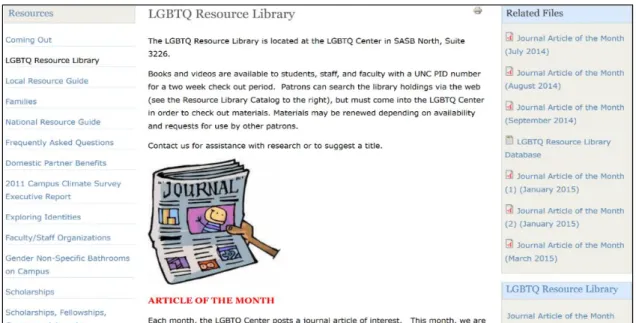
(http://lgbtq.unc.edu/resources/lgbtq-resource-library) (see Figure 1). No reference to the Center’s collection existed in the online UNC
library catalog, and no official ties had been forged between the main library system and
the LGBTQ Center. The Excel spreadsheet was semi-recently maintained
(approximately two years ago, according to LGBTQ Center staff) by work study students,
who were all undergraduates of varying majors, who used a print copy of a previous
version of the Excel spreadsheet and compared it to the physical collection. Materials not
on the list were written in by hand using only the title and author last name, and frequent
errors/omissions occurred.
Physical space was delineated by subjectively-chosen topics rather than using
Library of Congress call numbers, the standard for the University Library system, and
books were often misplaced or mis-shelved. No official policy documentation existed to
speak of, which meant that the policies were unclear on anything but checkout
check materials out, and renewal procedures were loosely defined on the Resource
Library website (see Figure 1).
Figure 1: Screenshot of the LGBTQ Resource Library webpage.
Considering these factors, my goals and plans for working at the Center were as
follows:
Create an Access database from the Excel spreadsheet to make a
searchable in-house catalog with an easy item addition form for future
purchases.
Correct mistakes copied over from the original Excel database.
Update Access database with a real-time list of materials (and helpful
headings) for the main library’s Resource Description and Management
(RDM) team to take over cataloging once I have graduated.
Perform copy cataloging on items UNC libraries already own.
Perform occasional unique cataloging under the supervision of the Special
Draft a policy manual document and workflow document for adding items
to the Access database and catalog.
Train work study students to find items, re-label items using Library of
Congress (LOC) call numbers, and shelve/find books using LOC call
numbers.
Update the LGBTQ Resource Library webpage to be more helpful for
users.
The justification for these plans are as follows: originally this was believed to be a
short-term project (six months to complete the Access database to pass off to the RDM
department catalogers), so I chose to create an Access database to include as much
relevant information as possible to aid library catalogers in cataloging the Resource
Library’s collection off-site. I also had no experience cataloging at the start of the
project, so the copy cataloging method was chosen as the primary approach for reasons
expressed in the next section. Policy and workflow documents were created to help
future staff members work on anything library-related (such as adding newly-bought
materials, deselecting items for condition, etc.) once I leave the Center. Work study
students were trained to help expedite the processing of materials while updating the
Access database to properly reflect the current collection. Finally, the website was
updated to include an exported Excel spreadsheet version of the latest Access database
catalog (for unmediated visibility of all titles in the collection, regardless of the status of
the cataloging process) and information about non-UNC affiliates using materials in the
library, an important piece of information for community members seeking access the
4. Process
This section will detail the exact steps taken during my field experience and the
subsequent three months. This is being done for two reasons: first, for the sake of
accuracy and completeness of the data; and second, for other LGBTIQ university
organizations and centers/offices, who want to make their collections more visible to the
campus, to follow at their discretion.
First, the UNC library staff was contacted in order to get the process started. The
LGBTQ Center had the main library’s Collections Management Officer on file as their
contact at the main library, so he was the first person I contacted via email. He
recommended contacting the Associate University Librarian for Technical Services and
Systems, who met with me and gathered necessary information (such as collection size,
annual growth, project contacts, etc.) for the Head of Resource Description and
Management to help get the project started. She referred me to the Authority Control and
Database Management Librarian, who helped get the Center’s Millennium code assigned,
which would allow the process of obtaining logins, software, and training to begin.
Innovative Interfaces Inc. (III)’s Millennium software was chosen because it is the
integrated library system (ILS) used by all of UNC’s libraries. Millennium, a common
ILS choice for public and academic libraries, was designed to “reliably support simple,
everyday library transactions while at the same time meeting the demands of the most
This system will differ depending on the home institution, so communication with the
main library staff is crucial to determine which system should be used.
In the meantime, I began building a more user-friendly Access database from the
Excel spreadsheet on the staff’s shared drive. The Excel spreadsheet, presumably created
by work study students who inventoried the existing collection to the best of their
abilities, was imported into a blank database using the Import Spreadsheet Wizard to
create a table called “Library Catalog.” Extra columns were added at the discretion of the
Special Projects Coordinator, who became my trainer in Millennium cataloging software
and helped choose the best workflow for the limited time period. She advised me to add
columns that would help catalogers in her department (RDM) to catalog items remotely.
Once completed, the table included the following columns: Subject Category, Call
Number, Title of Work, First Author or Editor, Second Author or Editor, Third Author or
Editor, Edition, Publisher (and location, if not US), Publication Date, Copy Number,
OCLC Number, ISBN/ISSN, Location, Additional Notes, and Last Edited. Each field’s
justification is as follows:
Subjectcategory was used to find books by topic and/or locate books not
yet cataloged.
Call number was for cataloged items, so only cataloged items which had
been assigned a Library of Congress call number had something stored in
this field; this helped me (and will help RDM once they take over the
project) distinguish between items which have and have not been
The title of work and author/editor fields should be apparent, as they
detail the most important features of each material and are crucial for
description.
The second and third author/editor fields are for items with multiple
authors. It is recommended that if a similar system is adopted at another
institution, one also build this feature into the system since many
LGBTIQ-related items in the Resource Library had multiple authors
(meaning this will likely be a common feature in comparable LGBTIQ
collections).
The edition statement, publisher, and publication date are important for
distinguishing which published copy or copies are held. Books are
frequently re-published – sometimes multiple times, sometimes through
different publishers – so using date, edition, and publisher name will often
made copies distinct from one another.
Copy number was used to give each individual item its own record; this
way, if there were multiple copies of an item, one could signify this by
assigning each item an ascending ordinal number, starting with one.
OCLC number was used to refer to each item’s corresponding OCLC
record, which will be helpful for RDM when they are cataloging the
collection remotely and need accurate, reliable information on every item.
ISBN/ISSN was a feature to help distinguish physical copies, but
according to my trainer, ISBN and ISSN numbers can be unreliable
for hardback and softcover editions. However, it was left in the Access
database for additional information in case someone had a difficult time
distinguishing physical copies from one another.
Location was a formality for the RDM department; in case the LGBTQ
Center ever gains a second location for any of its materials, they wanted
this field in the database, but for this project, the location was always
“LGBTQ Center Library,” the Resource Library’s assigned code.
The additional notes field was a catch-all field for oversize designations,
damage notes, special notes (such as autographed copies), and any other
information that might be helpful for users to know.
Finally, last edited was added after a conversation with RDM about
continued cataloging, once the existing collection has been fully
cataloged. The sustainability plan is for the Center to export an Excel
spreadsheet version of the most updated Access catalog and upload it to
the website every semester so the RDM team can download it and look for
items that may have been purchased and added since the last update. They
thought this would be the easiest method of keeping the collection
cataloged; however, other solutions may work better in other institutions,
so it is recommended to consider all the options before deciding an
ongoing plan.
Most of the information for each item was determined from both physical and
digital sources. In training, the Special Projects Coordinator advised me to use the
first source of information about the item. The title page, book cover, or audio/visual
item itself may also have relevant data, so if the necessary information is not listed on the
copyright page (or covers for A/V materials), one may use the secondary source. Once
the physical source has provided the necessary information, the digital source should be
consulted: the bibliographic record in OCLC’s Worldcat, a worldwide online catalog.
This step is to ensure accuracy and to locate the OCLC number for the relevant column in
the Access table. This can be done three different ways: one, through OCLC Connexion,
a proprietary resource which may be available to use through the main library if they can
grant access; two, using institutional access to Worldcat, usually available to all faculty
and students through the main library website; or three, for free through the Worldcat
website (http://www.worldcat.org/).
The newly-created Access table became the catalog and a data entry form was
created to go along with it. This data entry form was created using the Form Wizard to
ensure easy addition of newly-purchased items or items that were not yet represented in
the catalog. Later a second table was added, a table which stored library checkouts and
had a complimentary data entry form as well; this was done to guarantee that the Access
database would remain relevant after the project. LGBTQ Center staff appeared more
comfortable using Access software than Millennium software for pulling a list of held
items, so I wanted to ensure that they would be able to use the software which they could
easily use without assistance.
Once the Access database was created and relevant and descriptive headers were
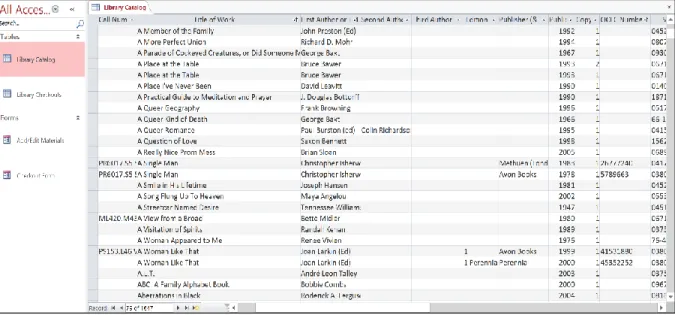
developed, I began the laborious task of correcting records in the database (see Figure 2).
contained in the Excel spreadsheet was outdated and incorrect in many data fields. One
attempt had been made to update the records in 2012, but three large issues existed with
this attempt: it was also done by work study students; it consisted of a printed list of
items from the Excel spreadsheet, with handwritten title/author entries scrawled for books
not on the list but present in the physical collection; and the information gathered from
this update attempt was never applied to the Excel spreadsheet. Therefore I had to add
the data gathered from this past attempt’s printed list before correcting existing errors
from the Excel spreadsheet, done by individually going through each book and copying
information to the Access catalog. I was also told by RDM to represent each copy of
each item on its own line in the Access database, so each record which showed multiple
copies had to be disambiguated into separate records (with a column to denote copy
number).
Figure 2: Screenshot of records being corrected in the Access database catalog.
At this point, the Resource Library’s location code was assigned by the main
a time for training and installing the necessary software on one of the LGBTQ Center’s
computers. She first installed Millennium on the Center computer with express
instructions to remove the program from the computer once the project was completed.
She then taught me how to perform copy cataloging, import a record using the Z39.50
option, and use the library-created template in Millennium.
During the training session, the trainer expressed her preference for copy
cataloging because I had no previous cataloging training. She felt that original cataloging
was tricky for a beginner and articulated that she would only feel comfortable with me
performing this type of cataloging if she were there to supervise. Therefore it was agreed
that I would use copy cataloging as much as possible for the duration of the project, then
pass the remainder of the cataloging work to the Resource Description and Management
department due to time constraints. It was also decided that checkouts would be done
solely through the LGBTQ Center. That is, barcodes and the barcode field would not be
added to items in the collection or the LGBTQ Center’s Millennium template because
Center staff did not feel comfortable with checking out materials through Millennium.
They did not want Millennium to automatically charge late fees and they worried about
the privacy of students. They felt that users would be more comfortable with the Center
being the only storage site for their circulation data rather than having it recorded in the
library system’s database because no explicit federal protection exists, state laws vary,
and the official rules from the American Library Association (ALA) on how checkout
data is stored and used are vague (American Library Association, 2014). This increased
need to protect the privacy of Resource Library users is due to a phenomenon known as
desire for privacy and confidentiality exists” (Schaller, 2011). That is, some users may
fear asking for materials, checking out materials, or even publicly reading materials
because they worry that their LGBTIQ identity may be compromised.
Using knowledge gained from the training session, I began cataloging items in the
collection while simultaneously correcting records in the Access database. Cataloged
materials were assigned Library of Congress call numbers during this process for two
reasons: to match the existing call number format used by the main libraries, and to
hopefully instill information literacy skills in library users by teaching them to use LOC,
thereby improving their future library experiences. Since I was using the copy cataloging
method, the LOC call numbers were assigned based on the call numbers from existing
item records (using items held by other libraries around campus) whenever possible.
However, for some items, particularly medical items held by the Health Sciences Library
using the National Library of Medicine (NLM) classification system and children’s items
held by the Information and Library Science Library using the Dewey Decimal System,
Library of Congress call numbers were not available to use when cataloging the Center’s
copies. In these cases, I either referred to OCLC Connexion for the full OCLC record
and its suggested LOC call number or asked the Special Projects Coordinator for
assistance. Due to the fact that cutters are not nearly as important for the Resource
Library’s collection as they would be in one of the main libraries or other large academic
libraries, the author did not foresee any issues with using call numbers from OCLC
records.
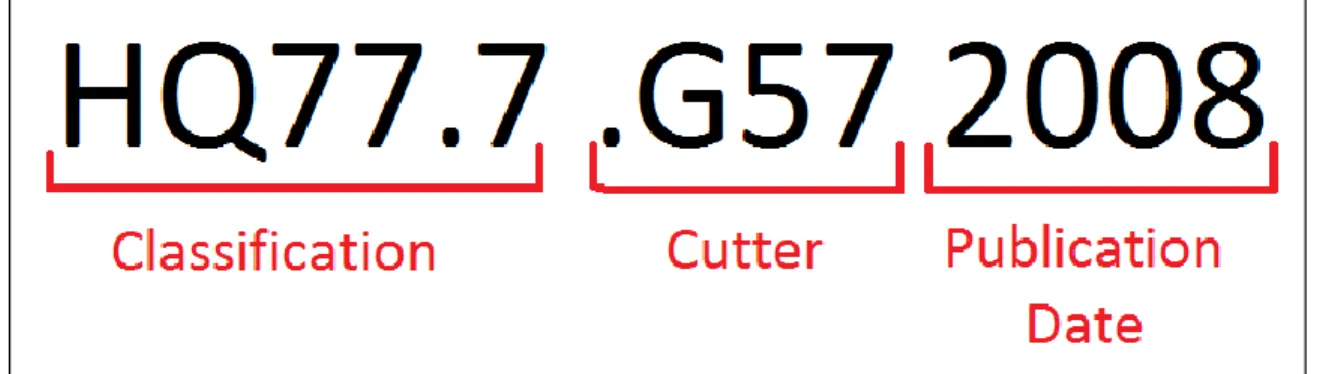
According to Taylor’s Introduction to Cataloging and Classification, cutters are
call number (2006). The first part, the “classification notation portion,” groups similar
materials together, while the second part uniquely identifies different works of the same
type (see Figure 3); traditionally, this second segment is based off the main entry
determined through descriptive cataloging work choices (Taylor, 2006).
Figure 3: Basic anatomy of an LOC call number.
Cutters are often used to “bring out a more precise aspect of the subject,” (“LOC
Classification Overview,” n.d.). However, when collections are large enough, cutters can
be used to “distinguish items with the same classification number in order to maintain the
alphabetical order (by author, title, or other entry) of items on the shelves” (Taylor,
2006). LGBTIQ organizations’ may not have enough materials to necessitate using
unique cutters within the collection, but nevertheless, I recommend asking about the
library’s classification protocol to see if the university libraries have a preference when
converting a collection to the same call number system.
Converting a collection to a new classification system takes a substantial amount
of work that cannot be handled by one person alone, so I recruited and trained work study
students working for the LGBTQ Center to help re-label items according to their new call
numbers and integrate them back into the collection. This often involved teaching
writing call numbers, shelving materials in the correct order, and understanding how call
numbers correspond to topics (implying topical proximity). Originally materials were
re-shelved according to the subject area they were previously assigned (so a book from the
“Fiction Anthology” section would be pulled, cataloged, re-labeled with an LOC call
number, and re-shelved at the beginning of the “Fiction Anthology” section). It was
thought that this would facilitate browsing for users while the collection was being
reclassified and cataloged. Unfortunately this added an extra, unforeseen barrier because
if a user was looking for a specific item, the Access database was the only place which
had both the subject label and the call number, and the most-updated Access database at
any one time was usually available only to LGBTQ Center staff with access to the shared
drive. The catalog link on the Resource Library website was updated every few months
by exporting the Library Catalog table to an Excel spreadsheet, then updating the existing
link with the new file. However, this was not done frequently enough due to a lack of
staffing and time, so I felt it was necessary to create a new section for the re-classified
items so that users looking for a specific item could find the correct call number in the
online catalog and go to the re-classified section to find it. Users wishing to browse the
collection could still do so in both the old subject areas and the re-classified section.
Nevertheless, no action comes without consequences, and it was soon discovered
that creating a new section using only existing bookshelves added an extra ongoing step
to the process: once a sufficient amount of items were cataloged, classified, and
re-labeled, the new section had to be expanded by shifting the rest of the collection to make
room. Materials were squeezed together at the beginning and middle of the collection
Library of Congress call numbers. The idea was that the old subject sections would
dwindle while the LOC section would expand until the entire collection was re-classified.
This required extra work during the project, but I felt it was necessary to facilitate
browsing and searching for all users, so the new step was added to the process.
Using information gathered from the Director, through email conversations with
the main library, and from the LGBTQ Center Resource Library webpage, I drafted one
policy manual and one workflow document (see Appendices B & C). The policy manual
was intended to inform LGBTQ Center staff and users’ actions and reduce checkout
procedure ambiguities by clearly outlining expectations for library procedures and
functions such as check-out, selection/de-selection, gifts, staffing, confidentiality, and
more. The workflow document was intended to aid Center staff by providing exact steps
and rules to follow when adding new items to the collection once I leave.
Deselection decisions were made based on the drafted policy document, and five
books were removed due to extensive damage and staining. The author wanted to also
deselect all health materials more than ten years old, since this is an area where
information is updated frequently and ten years is enough time for information to be
dangerously incorrect or out of date. However, the Director felt these materials were
useful for reference and historical research purposes, so the items were left in the
collection and a quarter sheet was developed to go in health-related items warning users
about the potential unreliability of older health information.
Finally I created a wish list of items for the LGBTQ Center to buy when money is
approved in the budget for purchases. Using participant observation techniques where I
directly-requested materials (such as Trans Bodies, Trans Selves: A Resource for the Transgender
Community and Redefining Realness: My Path to Womanhood, Identity, Love & So Much
More) and topics which were determined to be important to users and staff through
observed conversations. These topics include biographies, asexuality resources,
transgender resources, intersex resources, and spirituality resources. The wish list was
compiled using the ALA’s Gay, Lesbian, Bisexual, and Transgender Round Table’s
(GLBTRT) 2015 Over the Rainbow List for Adult Readers
(http://www.glbtrt.ala.org/overtherainbow/archives/511) and Stonewall Book Awards
(http://www.ala.org/glbtrt/award/honored), the San Francisco Public Library’s
“TRANScending Identities” list (http://sfpl.org/index.php?pg=2000108901), Rider
University’s LGBTQIA Resources and Research Guide (http://guides.rider.edu/lgbtqia),
and, sparingly, relevant Amazon customer reviews. This last source was used because
the LGBTQ Center could only buy books from places with whom they had a tax
exemption agreement, and Amazon was one of those sellers, so I included an “Available
on Amazon: Y/N” qualifier for each item and occasionally used reviews which seemed to
come from reputable (preferably LGBTIQ) sources.
Given the steps detailed in this section, I will now assess the results of the
reorganization process as of March 2015. The project is still ongoing, as I still have
approximately two months remaining as of writing this paper, so it is possible that more
positive changes could occur in that time. Unfortunately, due to time constraints I had to
cut off the data collection process, so the last two months of work will not be included in
5. Reorganization Results to Date
Before the reorganization process, the Center received occasional phone calls and
emails and saw more walk-ins than checkouts. After the process was started, walk-ins
decreased, as did emails and phone calls, but checkouts slightly increased. This could be
due to the fact that before updating the catalog on the Resource Library website and
representing materials in the UNC online catalog, people had no idea what was in the
collection before they came to the Center. However, this could also be a problematic
assumption because the items have no availability status in either the Access or online
catalog, and the Notes (500) field for each item lists contact information so that users can
contact the Center via email or phone to inquire about availability. So if phone calls and
emails are down as well, does this mean people are just risking the chance that the item
they want is checked out and coming to the Center anyway? Or are they just coming to
browse and coincidentally have found more items they would like to take than before?
More time and data would be necessary to satisfactorily answer these questions, so I can
merely speculate at this point in time.
As mentioned before, the total number of checkouts slightly increased since the
revamping process began. During the 2013-2014 year, the year before I was hired,
twenty-three checkout transactions occurred and forty books were checked out. During
the 2014-2015 year, from August 2014 to March 2015, in two months’ less time,
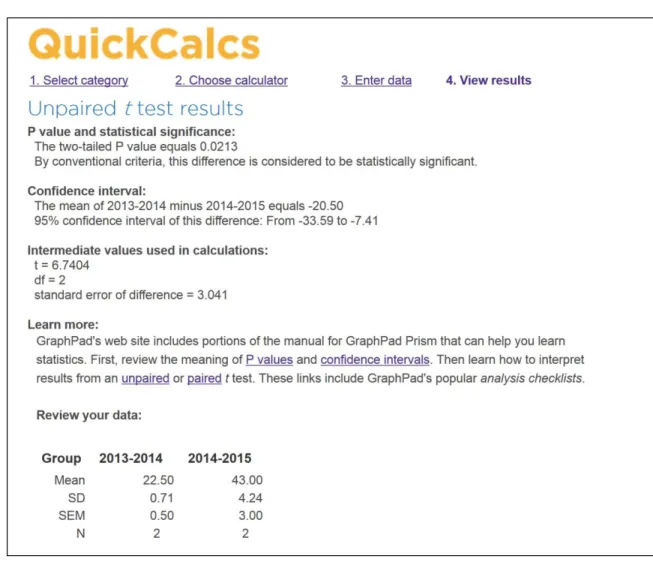
unpaired t-test using the online t-test calculator QuickCalcs from GraphPad3, it was
determined that there was a statistically significant change (p=0.0213) in checkouts
between the 2013-2014 school year and the 2014-2015 school year (see Figure 4).
Figure 4: Results of unpaired t-test using QuickCalcs.
Renewals went way up because they are now being officially tracked; they can
now present a more accurate representation of library usage. Before I started working at
the Center, there was no renewal column or note field in the spreadsheet used to check
items out to users. Library users were given their due date at checkout and may have
received a late notice email or phone call if a staff member had time to check (which was
not often the case, due to limited staffing). Now the Access database’s Library
Checkouts table has two additional columns which keep track of renewal data: Renewed
(# of times) and Renewal Due Date. Between December 2014, the addition of these
fields, and March 2015, the end of my data collection, ten renewals were recorded for this
three-month period. This tells me two things: one, users are being contacted and asked if
they would like to renew their items; and two, users enjoy being able to keep library
materials for longer than two weeks. Perhaps in the future the LGBTQ Center will be
able to provide multiple copies of all of their popular materials and thus be able to extend
the checkout period to three- or perhaps four-week checkouts, but this is currently not
feasible with the existing collection and budget.
Much like the addition of renewal data, the representation of materials in the UNC
online catalog (along with the downloadable catalog on the LGBTQ Center website) has,
at least anecdotally, been a success. Informally I heard from a small sample of users at
the LGBTQ Center that the online catalog method is more useful and helpful than the
downloadable spreadsheet catalog. More rigorous methods (such as interviews, focus
groups, or other qualitative instruments) would be necessary to gather concrete evidence
to back up a claim that including Resource Library materials in the online UNC catalog is
more helpful than the downloadable spreadsheet catalog.
Using the participant observation method where I acted as a user and an observer
in the Resource Library setting, I observed that after beginning the cataloging project,
students and staff were improperly shelving books with LOC call numbers. Work study
than doing it themselves. This led me to believe that the LOC classification system was
confusing for them without any proper training. My solution was twofold: I created LOC
“cheat sheets” with tips on how to read LOC call numbers and how to shelve them, and I
trained students one-on-one using real books from the collection to read call numbers,
re-label materials, and shelve items in the LOC section. Both are useful ideas for any
library using LOC classification schemes, as LOC can be a hard system to understand for
beginners. I would need more time to accurately assess the effectiveness of my
two-pronged solution, but so far I have noticed a decrease in the amount of piles left for me
by work study students, so I believe my training has done at least minimal good for the
work study students who have received it.
If I had more time to work on this project, I would hold information literacy
sessions at the Center during highly-populated times to teach everyone, including
visitors, staff, and students, about the new classification system, how to find and read call
numbers, and about the many subjects represented in our collection. This would
therefore instill our users with the knowledge to use both ours and the main library’s
collections.
As mentioned earlier, before my work at the Center, very little documentation
existed on library policies. What did exist was summarized on the library’s webpage in a
few short sentences. Now the new policy manual document (see Appendix B) covers all
eight policy areas deemed significant by myself and the Director: mission, scope,
lending, purchasing, deselecting, gifts/donations, confidentiality, and staffing. Plans are
in place to post this manual on the Resource Library page as a downloadable Word
The Director, Assistant Director, other staff members, and users seem to be happy
with the changes I have made, based on informal conversations. The Director’s goal was
to eventually catalog the entire collection in the UNC libraries’ catalog, so T4 was
extremely excited about the changes made so far. However, as with many of the other
conclusions reached in this section, I would need to use more rigorous qualitative
methods over a longer period of time to gather more reliable data on individual
opinions/needs and ensure that the project has led to positive results for everyone.
Now that the results have been discussed, let us move on to the limitations of this
case study, which will touch and/or expound upon on many of the points made so far.
6. Limitations
The largest limitation for this study was by far the limited time span; eight months
(July 2014 – March 2015) was not enough time to complete the enormous undertaking of
inventorying, classifying, cataloging, and re-labeling all 2,000+ materials in the
collection, along with other tasks that came up along the way. It also limited the amount
of time I could spend in the office in combination with my student status, which limited
me to twenty hours per week, and budgetary constraints, which further limited me to
fifteen hours per week, so I was in the office less than I would have preferred to be
efficient and to observe more interactions for user/staff requests. I also would have liked
to have followed up in a year or two to see how the system is going and if people are still
happy with it. Since I will unfortunately be graduating and may not be able to physically
visit for a follow-up, I will rule this out as a possibility for this particular study.
However, I would highly suggest checking in at least once after a set period of time when
replicating this study and/or these methods, as “iterative testing can find
misinterpretations of user needs and capture changes in user needs over time” (Laster,
Stitz, Bove, & Wise, 2011). That is, once methods are put in place, testing should be
conducted to ensure that user needs are actually being met and that the newly-created
system has not created a new set of problems.
The LGBTQ Center’s limited budget was also a large limitation for this project.
eight-month period I was there. It also, as mentioned before, limited the amount of time I
could spend at the Center each week.
My minimal cataloging experience also acted as a large limitation, and this
limitation led to the (primarily) pure copy cataloging method, with original cataloging
done afterwards by main library staff. This will likely be a common barrier, as few
LGBTIQ-specific offices, centers, and spaces have the funding to support a fully-trained
library professional, so do not be discouraged if this is the case at your institution.
Another limitation of this study is the fact that I did not start from scratch with the
collection. I had an existing Excel spreadsheet to consult; despite the fact that it was
incomplete and out of date, it significantly decreased the amount of leg work I would
have had to complete if the spreadsheet did not exist. This may or may not be the case at
other institutions, so if your organization or office does not have any existing
documentation of materials in your collection, you will have to set it up before following
the example set by this case study. This can be done in a variety of ways, using the
software and information most relevant for your organization. If you are unsure what
information you should store in your inventory documentation, contact your institution’s
library staff to see what they would recommend. I would at least recommend including
title, author(s), classification (subject designation, call number, or other self-chosen
delineation markers), and publication date.
Due to the limitations listed above and throughout the paper, I was unable to
follow through with some of the actions I would have liked to have taken. For example, I
feel it is more important to include unique items in the catalog that are not represented
anywhere else, rather than items already held by other libraries on campus.
I also would have liked to have given bibliographic instruction5 sessions at the
Center on a regular basis, perhaps monthly, using queer-specific research and search
terms. Some examples of the topics I would have covered include keyword searching,
evolving LGBTIQ vocabulary through time, using and finding online LibGuides,
reading/understanding LOC call numbers and subject headings (while addressing the
heterosexist assumptions underlying these classifications and subject headings), and
vetting online sources.
Next I would have liked to have more time to re-design the Center’s website;
though I updated some checkout policies and fixed the Resource Library page by
updating the Access database catalog link every few months, I would have liked to
re-design the “Journal Article of the Month” section, post the policy document for public
access, and put a banner for the Resource Library on the LGBTQ Center homepage for
more online visibility and traffic.
Related to putting a banner on the homepage for increased traffic, I would have
also liked to have done more collection promotion. I did not have much time for this step
and was only able to advertise the Resource Library in an informal way in the LGBTIQ
settings with which I am already familiar. However, if given the time and budget/tools, I
would have created flyers to post around campus, put promotional materials (such as
bookmarks or stickers) in all the libraries on campus, talked to the University Libraries
staff about adding descriptive information about the LGBTQ Center Resource Library to
the library hours/information page6, promoted the Resource Library at Center-sponsored
events, organized a Pit Sit7, or worked with CheckedOUT (the School of Information and
Library Science’s diversity organization) and other undergraduate/graduate groups which
address LGBTIQ issues to get the word out about the existence of the Resource Library.
Finally, as mentioned earlier, I would have followed up with the LGBTQ Center a
year or two later to inquire about how the project is going, if anything was
added/removed/adapted from my workflow and/or policy documents, and if people were
enjoying the new system. This would have allowed me or other LGBTQ Center staff
members to assess what has been done so far, assess reactions, and determine how to
move forward in the best manner possible.
Since I have now discussed exact steps taken, results of these actions, and
limitations of the project, I will now focus my attention on giving recommendations for
other institutions and LGBTIQ centers, offices, and organizations trying to increase
visibility of their collections.
6http://hours.lib.unc.edu/
7. Recommendations
This section will cover recommendations for other LGBTIQ centers, offices, and
organizations; these recommendations were developed through personal experiences (or
lack thereof) detailed in this case study and are intended to help others begin their own
visibility project. As with all recommendations, the ideas proposed in this section can be
applied as liberally (or conservatively) as necessary for the adopting institution; they can
also be adapted based on the needs of the organization.
If you have someone on your staff who understands Access, have them build you
a database and entry form so that anyone with any level of Microsoft Office familiarity
can add information on new materials with limited instruction necessary. This will help
keep inventory of items in a clear, understandable way and allow multiple people to work
on the project at once, if so desired. Another database software can be used, but Access
is the most commonly- and readily-available tool for most institutions, as it comes with
the Microsoft Office suite installed on most work computers.
Make connections with the main library staff as early as possible. If you facilitate
a good relationship with your main library, they will: a) likely be happy to help you
initiate and plan out your project, and b) be more willing to work with your organization
in the future. They also may be able to provide you with ILS software, logins, OCLC
Connexion access, and training.
Adopt the classification system of the main library system unless you have a good
main library uses (usually Library of Congress for academic institutions) and
additionally achieve consistency between libraries. Reasons for not adopting a new
system may include, but are not limited to: users express distaste or dislike for new
system and are unwilling to change; the local classification system is too well-established
and changing it would be too confusing or otherwise detrimental for staff/users; the
switch would be too labor-intensive and/or the staff is too small; or you/other staff have
understandable qualms with Library of Congress’s subject classification, which can be
ignorant at best (Johnson, 2010).
Catalog as many items as possible in the institution’s shared online catalog for
increased visibility of your collection. While doing this, make sure to evaluate your work
as you go; use interviews, surveys, or informal conversations to gather data on user
satisfaction and needs, make any necessary changes to the workflow, and continue.
Collaborate with main library staff to establish set procedures for your personal
workflow and for policy document creation as you go along. This way, if you ever leave
your position and need to train another person to catalog and inventory library materials,
others can easily follow in your footsteps.
Finally, promote the collection as much as possible around campus. Use any
method available, including but not limited to: distributing flyers; advertising in the
school newspaper, on university library websites, or through other means; hosting
events/programming in the collection’s physical space; holding instructions sessions;
talking to first-year seminar or LGBTIQ/Gender Studies professors about incorporating
information about the collection in their lectures; and holding a book drive, bake sale, or
collection, the better; it cannot benefit anyone if people do not know it exists, so take
steps to ensure its visibility whenever possible by advertising the collection in different,
8. Conclusion
In this case study, I discussed why LGBTIQ collections are important and gave a
background on LGBTIQ people and their needs. I also gave a brief history of UNC and
the LGBTQ Center. I then detailed the work I did at the LGBTQ Center’s Resource
Library, which primarily included inventorying and cataloging the collection. Next I
detailed the results of the reorganization process; pointed out limitations faced in this
case study; and gave recommendations to other institutions’ LGBTIQ groups,
organizations, offices, and centers looking to increase the visibility of their collections.
After the reorganization project was started, I began to see positive reactions.
People seemed excited about the project, checkouts went up, and renewals were
occurring at a rapid rate. However, more time, formal data collection methods, and
iterative testing would be necessary to document significant changes and/or shifting user
needs along the way.
By conducting and writing the results of this case study, I hoped to contribute to
the literature on how organizations which offer LGBTIQ library materials on college and
university campuses develop and promote their collections. In particular, I hoped to
create a template or set of methods LGBTIQ-focused university organizations, centers,
and offices can employ to build representative collections and offer visibility for their
existing resource library. It is my hope that future research will expand and improve
upon the methods detailed in this study, leading to a robust body of knowledge to which
References
About UNC. (n.d.). Retrieved from http://www.unc.edu/about/
American Library Association. (2014). Privacy: An Interpretation of the Library Bill of
Rights. Retrieved from
http://www.ala.org/advocacy/intfreedom/librarybill/interpretations/privacy
Bates, J., McClure, J., & Spinks, A. (2010). Making the Case for Evidence-Based
Practice. Library Media Connection, 29(1), 24-27. Retrieved from
http://web.b.ebscohost.com.libproxy.lib.unc.edu/ehost/detail/detail?vid=3&sid=ab12
8029-02df-4f05-93d1-e275582c4fb5%40sessionmgr198&hid=107&bdata=JnNpdGU9ZWhvc3QtbGl2ZSZ
zY29wZT1zaXRl#db=llf&AN=53847338
Boon, M. H., & Howard, V. (2004). Recent lesbian/gay/bisexual/transgender fiction for
teens: are Canadian public libraries providing adequate collections? Collection
Building, 23(3), 133-138.
Booth, A. (2011). Barriers and facilitators to evidence-based library and information
practice: An international perspective. Perspectives in International Librarianship,
Buschman, J., & Leckie, G. J. (2007). The library as place: history, community, and
culture. Westport, Conn.: Libraries Unlimited.
Center History. (n.d.). Retrieved from http://lgbtq.unc.edu/about-center/center-history
Ciszek, M. P. (2011). Out on the Web: The Relationship between Campus Climate and
GLBT-related Web-based Resources in Academic Libraries. The Journal of
Academic Librarianship, 37(5), 436.
Clyde, L. A., & Lobban, M. (2001). A door half open: young people's access to fiction
related to homosexuality. School Libraries Worldwide, 7(2), 17-30. Retrieved from
http://web.b.ebscohost.com/ehost/detail/detail?sid=28806981-6989-4131-88b2-4aa7e1a647f7%40sessionmgr114&vid=2&hid=107&bdata=JnNpdGU9ZWhvc3Qtb
Gl2ZSZzY29wZT1zaXRl#db=llf&AN=502876481
Gough, C., & Greenblatt, E. (1990). Gay and lesbian library service. Jefferson, N.C.:
McFarland.
Gough, C., & Greenblatt, E. (1992). Services to Gay and Lesbian Patrons: Examining the
Myths. Library Journal, 117(1), 63.
Greenblatt, E. (2003). Lesbian, gay, bisexual, transgender library users: Overcoming the
myths. Colorado Libraries, 29(4), 21-25.
Greenblatt, E. (2005). Exploring LGBTQ Online Resources. Journal of Library
Greenblatt, E. (2011). Serving LGBTIQ library and archives users: essays on outreach,
service, collections and access. Jefferson, North Carolina: McFarland & Company,
Inc., Publishers.
Helton, R. (2010). Diversity Dispatch: Reaching Out to LGBT Patrons. Kentucky
Libraries, 74(2), 14-16.
Hitch, G., Yates, H., & Yates, J. (2011). The evolution of A Gender Agenda: The
psychology of how Canberra's sex and gender diverse individuals are growing a
community organisation. Gay and Lesbian Issues and Psychology Review, 7(1), 77.
Howard, K., & Stevens, A. (2000). Out & about campus: personal accounts by lesbian,
gay, bisexual & transgendered college students (1st ed.). Los Angeles: Alyson
Books.
Jardine, F. (2013). Inclusive Information for Trans* Persons. Public Library Quarterly,
32(2), 262. doi:10.1080/01616846.2013.818856
Johnson, M. (2010). Transgender Subject Access: History and Current Practice.
Cataloging & Classification Quarterly, 48(8), 661-683.
Laster, S., Stitz, T., Bove, F. J., & Wise, C. (2011). Transitioning from
Marketing-Oriented Design to User-Marketing-Oriented Design: A Case Study. Journal of Web
Librarianship, 5(4), 299-321. Retrieved from
Lee, K. Y. (2010). Odd girl in: expanding lesbian fiction holdings at Barnard College.
Collection Building, 29(1), 22-26. doi:10.1108/01604951011015268
LGBTQ Center. (n.d.). Retrieved from http://lgbtq.unc.edu/
Library of Congress Classification Overview. (n.d.). Retrieved from
http://web.library.yale.edu/cataloging/LC-call-numbers-overview
Mehra, B., & Braquet, D. (2007). Library and Information Science Professionals as
Community Action Researchers in an Academic Setting: Top Ten Directions to
Further Institutional Change for People of Diverse Sexual Orientations and Gender
Identities. Library Trends, 56(2), 542-565.
Millennium. (n.d.). Retrieved from http://www.iii.com/products/millennium
Moss, E. (2008). An Inductive Evaluation of a Public Library GLBT Collection.
Collection Building, 27(4), 149-156.
Schaller, S. (2011). Information Needs of LGBTQ College Students. Libri, 61(2),
100-115.
Taylor, A. G. (2006). Introduction to cataloging and classification (10th ed.). Westport,
CN: Libraries Unlimited.
Vaillancourt, S. (2013, Libraries as Safe Spaces. American Libraries, 30.
Valenza, J. K. (2015). Evolving with Evidence. Knowledge Quest, 43(3), 36-43.