Oak Ritchie. Platform Algorithms and Their Effect on Civic and Political Arenas. A Master’s Paper for the M.S. in IS degree. April, 2015. 66 pages. Advisor: Dr. Zeynep Tufekci
The purpose of this research was to analyze the ways that social media platform algorithms affect user experience and thus, civic and political arenas. This paper analyzes literature on the topic that will illuminate specific ways that algorithms dictate to the user what is visible or invisible, considered “fresh” or “irrelevant” and the implications of such digital curating.
Headings:
Social Media Platforms Platform Algorithms Political Sphere Public Sphere
Algorithmic Curating Facebook
PLATFORM ALGORITHMS AND THEIR EFFECT ON CIVIC AND POLITICAL ARENAS
by Oak Ritchie
A Master’s paper submitted to the faculty of the School of Information and Library Science of the University of North Carolina at Chapel Hill
in partial fulfillment of the requirements for the degree of Master of Science in
Information Science.
Chapel Hill, North Carolina April 2015
Approved by
_______________________________________ Dr. Zeynep Tufekci
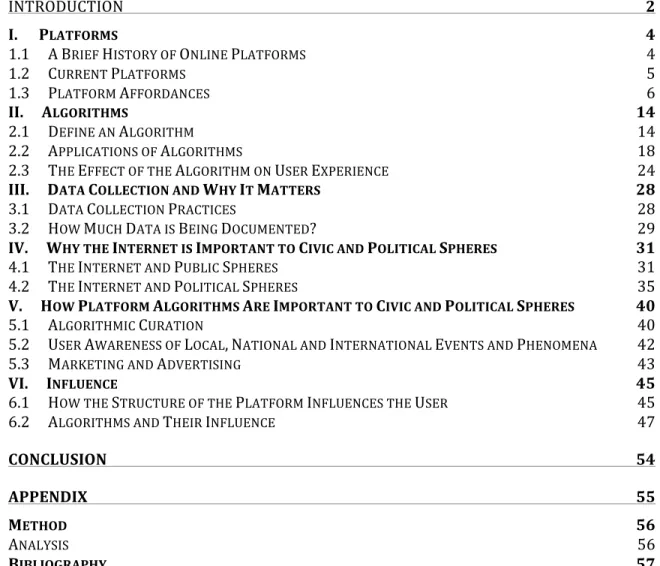
Table of Contents
INTRODUCTION 2
I. PLATFORMS 4
1.1 A BRIEF HISTORY OF ONLINE PLATFORMS 4
1.2 CURRENT PLATFORMS 5
1.3 PLATFORM AFFORDANCES 6
II. ALGORITHMS 14
2.1 DEFINE AN ALGORITHM 14
2.2 APPLICATIONS OF ALGORITHMS 18
2.3 THE EFFECT OF THE ALGORITHM ON USER EXPERIENCE 24
III. DATA COLLECTION AND WHY IT MATTERS 28
3.1 DATA COLLECTION PRACTICES 28
3.2 HOW MUCH DATA IS BEING DOCUMENTED? 29
IV. WHY THE INTERNET IS IMPORTANT TO CIVIC AND POLITICAL SPHERES 31
4.1 THE INTERNET AND PUBLIC SPHERES 31
4.2 THE INTERNET AND POLITICAL SPHERES 35
V. HOW PLATFORM ALGORITHMS ARE IMPORTANT TO CIVIC AND POLITICAL SPHERES 40
5.1 ALGORITHMIC CURATION 40
5.2 USER AWARENESS OF LOCAL, NATIONAL AND INTERNATIONAL EVENTS AND PHENOMENA 42
5.3 MARKETING AND ADVERTISING 43
VI. INFLUENCE 45
6.1 HOW THE STRUCTURE OF THE PLATFORM INFLUENCES THE USER 45
6.2 ALGORITHMS AND THEIR INFLUENCE 47
CONCLUSION 54
APPENDIX 55
METHOD 56
ANALYSIS 56
BIBLIOGRAPHY 57
INTRODUCTION
With the advent of the Internet came the ability to transmit messages around the globe, collaborate remotely, and share experiences and perspectives. This would have been considered a rarity, if not impossible, without such digital connectivity, and at present access to it remains reserved for the most powerful and wealthy. The scope of the technological structures for communication, collaboration, commerce, and entertainment that are being erected in this new landscape and how these spaces govern themselves bring challenges that require reflective thought and strong methodologies to solve effectively. Among the challenges for consideration is the human experience in digital spaces, and what tools will enhance and improve conditions for collective action.
The advancements in the iterative relationship between technology and the users of technology have produced complex systems that have become an
inextricable part of the landscape, from the expectation of a grandparent to be able to place a video call with their grandchild to impatience when sending a message that takes longer than a few seconds. Human interactions have increased in online spaces, and status updates and posting of pictures and other content are
mechanisms developed to construct them, bring with them benefits as well as challenges.
A twist to online spaces, such as social media, communications,
entertainment and education are often spaces in which algorithms are making decisions for us, such as “Based on your watching this movie, you might like…” or “Other users who bought this product also bought…” Sometimes, that voice feels prescient in its ability to evaluate interest about some elements of human behavior, and machines are increasingly used to make such predictions about us.
My research question investigated the interaction between platform affordances; through which users can signal their preferences and interests,
platform algorithms; through which content is made more visible or less visible; and how these policies and design choices impact political and civic arenas.
I.
Platforms
1.1 A Brief History of Online Platforms
The World Wide Web, which is an information system comprised of
connected hyperlinks that are accessed through the Internet, began in 1992 and was primarily a fairly limited space that institutions, like universities and governments, could use to transmit information back and forth as well as “browse” or “surf” using the hyperlinks and URLs available to them. The web, at that point had limited practical usefulness for an average user without some understanding of computing systems. By 2004, Web 2.0 had emerged with the capacity for users to interact with websites and other users in a more dynamic way. Instant messaging, e-‐commerce, search engines, and social media platforms grew with this development, and within a few short years the web became a public sphere where a user could generate, publish, share, and discuss content.
The advent of Web 2.0 brought with it access to a global public sphere where users have a basic understanding of the tools to browse and search could now find content of interest, communities with similar interests or ideals, and share content in a way that was previously limited by physical location. Communities grew in various spaces, and some users built spaces for specific communities to operate exclusively in political or non-‐political ways. Some non-‐political commercial
widely used to share content and interact in ways the platform made possible. Within these online spaces, there are users who are specifically motivated to enact change, be it political or non-‐political, and there are many who seek entertainment, social interaction, and comfort through funny memes, cute cat videos, or both (Zuckerman, 2014).
1.2 Current Platforms
A platform, in the broadest computing sense, is a framework upon which applications can run. A computing platform can be thought of as the environment in which the operating system, runtime libraries, and hardware architecture operate. In the context of the web, the framework allows for all manner of programs to be run within a space that is specified by a Uniform Resource Locator (URL), which is a unique location within the web that can be accessed by anyone who has the URL and is given access to its contents. On the web, the limits of what applications can link to outside of that platform are constraints of the platform itself. In the case of the Facebook platform, which was launched in May of 2007, an Application Program Interface (API) was made available to the public to create applications that fit its specifications to run “apps” that ran games, donate to other FB users, and send gifts among a wide berth of possibilities for developers. The data flows through that platform and user profiles operate within it.
platform, this could be more secure or less secure for the user. Some platforms provide user controls, or ways for the user to make choices about the settings of their account, as a part of the platform affordances offered.
1.3 Platform Affordances
In the context of the field of Human-‐Computer Interaction (HCI), which studies how humans use computing systems, artifacts and infrastructures, an affordance is a discoverable action that a user can engage. Ideally, affordances on whatever platform the user is engaging will be somewhat intuitive, at least the basic conventions of user controls that are familiar to the user. For instance, if an
experienced user of websites comes across a blank screen with one text word or a logo, they will instinctively attempt to engage that convention of browsing websites, which has come to imply the “Home” button. In order to clarify the concept of
platform affordances, the following section describes user controls for two commercial platforms, which are the platform affordances that individual users have the ability to access and manipulate from their point of access on the platform. 1.3.1 User Controls
The architecture and user controls that a platform offers shape what the user can effectively do on any given network. The buttons chosen, the freedom to
customize, a transparent policy on data gathered and how private, birthday
spaces. The values of the creators and designers, whatever they may be, can’t be divorced from the commercial products that they produce and maintain.
On Facebook, the primary user controls are the “Update Status” bar, the “Like” button, the “Comment” button, and the “Share” button (See Fig. 1). The “Like” (#1) button is a control to indicate some form of interest from one user to anyone with access to the network.
Fig. 1 Shows a typical 2015 Home Page, with controls as they were at that time.
As of this writing, on the desktop version of the site, the “status bar” (#4.) prompts the user to share with their network with this prompt: “What’s on your mind?” This bar gives the user the option to post a status update, post a photo or video and post a life event, which then offers a drop-‐down menu (See fig. 2) to choose between “Work & Education”, “Family & Relationships”, “Home & Living”, “Health & Wellness” and “Travel & Experiences”. Upon choosing “Work &
Relationships” option (See Fig. 2) prompts the user to share “First Met”, “New Relationship”, “Engagement”, “Marriage”, “Anniversary”, “Expecting a Baby”, “New Child”, “New Family Member”, “New Pet”, “End of Relationship”, “Loss of a Loved One” and “Create Your Own” as options. The “Home & Living”, the user can choose “Moved”, “Bought a Home”, “Home Improvement”, “New Roommate”, “New Vehicle” and “Create Your Own”, if one so chose. The “Health & Wellness” option prompts the user to share if they became an “Organ Donor”, “Overcame an Illness”, “Quit a Habit”, “New Eating Habits”, “Weight Loss”, “Glasses, Contacts, Other”, “Broken Bone”, “Removed Braces” and “Create Your Own” as options.
Fig. 2 The “life event” menu and options for sharing publicly or within network.
the web consists of users “volunteering” their information to the networks they want access to and, in so doing, giving significant amounts of granular data to the provider (Gillespie, 2015).
On either side of a user’s feed, there is an array of content displayed according to user preferences (See fig. 3) ranging from “Pages”, “Groups”, “Apps”, and so on. To a large extent, this content can be edited. On the far right, there is a stream of people in the network of the user prioritized from top to bottom by those who are online presently down to how many minutes it has been since a connection logged off of Facebook. Just above that in the same column is a running ticker of “Likes”, “Comments” and “Posts” that connections are making in real time.
Finally, the top bar of the user interface has 7 controls: The first displays the name of the user with a profile picture next to it, which will take the user to their home page with content that they posted most recently. The second will take them to the News Feed page. The third will display “friend requests”, indicating other users that wish to connect. The fourth is the messenger, where personal messages from other users are accessible. The fifth is for activity on the user’s page, such as “comments”, “likes” or any other user interaction with the home page. The sixth produces a drop down menu that displays the privacy setting options that the user has available to choose from. The last button allows the user to use Facebook as an administrator for any page that they are managing, as well as the following options: “Create Page”, “Manage Pages”, “Create Ads”, “Advertising on Facebook”, “Activity Log”, “News Feed Preferences”, “Settings”, “Log Out”, “Help” and “Report a Problem.”
contains “Trends”, which is a collection of popular hashtags and topics, indicated by the pound symbol (#) and followed by a stream of characters that have been used by users to describe a common event, person, idea or thing that is popular on the network at that time. The use of the “hashtag” in this way is something of a Twitter convention that users began employing, and the practice spread beyond that platform. Finally, there is a bar at the top of the interface with a “Home” button, “Notifications” button, “Messages” button, “#Discover” button, the Twitter logo, which upon selecting will refresh the Feed, a search bar, a “Profile and Settings” button, indicated by the user profile picture, the “Favorite” button and finally, the “Tweet” button, which allows the user to post to their feed.
The above examples are just two current designs that exist among many. How each platform is designed will dictate the usefulness of that platform for any specific task. Twitter, for instance, would have limited effectiveness in being used as a place to shop in comparison to a platform like Amazon.com or Ebay.com, which were constructed with finding and purchasing goods as the primary purpose of those platforms. Each user affordance is a prompt of what the designer intends for the user to accomplish on any platform, be it “Broadcast Yourself” (YouTube), “What’s on Your Mind?” (Facebook), or “What’s Happening?” (Twitter).
II. Algorithms
2.1 Define an Algorithm
Algorithms, according to one definition, can be thought of as “encoded procedures for transforming input data into a desired output, based on specific calculations” (Gillespie, 2014, p. 1). An algorithm can be coded to perform calculations, data processing, and automated reasoning among other things. The range of the scope of the design of an algorithm is virtually limitless, only to be subject to the constraints of its creation and production: budget, vision, and
expected deliverable date being a few common constraints. They can be designed to automate simple tasks like reporting and regulating the temperature in a room, or complex tasks like filtering the flow of information within a network of billions of users, as is the case with commercial online platforms.
Nicholas Diakopoulos (2014) categorized the specific technical decisions that algorithms make, and broke them down into four types: prioritization, classification, association and filtering. While any algorithm can be designed to make any
combination of these decisions, it is useful to consider the decisions separately. Prioritization describes the process by which data is included or excluded to get the results desired by the creator. What data is included or excluded for prioritization may make processes more efficient, more complete, and more detailed, depending on the needs of the intended design (Diakopoulos, 2014).
Classification involves the algorithm breaking each entity down into classes that it will fit the criteria for. A simple example of this would be an algorithm designed to separate a collection of text in to “positive” or “negative” terms. In the case of a list of movie reviews, a classification algorithm may be tasked with identifying which reviews are likely to be “positive” or “negative” based on the training data that it was given. A shortcoming of classification algorithms is that they produce a “false positive” or a “false negative”. A “false negative” is when the movie review had words that the algorithm was trained to see as “negative”, but some nuance of the use of words in the review made it into a “positive” review. A false positive is when the algorithm was trained to see the results as “positive”, but the review turned out to be negative (Diakopoulos, 2014).
consider items that their algorithm calculated were linked. One example of this was in 2012 when a group of scientists working for Target managed to design a system that could make associations from ordinary user purchases to predict certain changes in a user’s life. An angry father entered the store, furious that his High School aged daughter received coupons addressed to her for baby clothes and cribs from Target. A few days later, the father had apologized because his daughter was indeed pregnant. Associations between seemingly innocuous purchases, changes in schedule, or some other behavior the designers had considered to be predictors accurately identified a user to be pregnant before family members were aware of it (Duhigg, 2012).
One definition for filtering describes it in this way:
“Filtering involves including or excluding information according to various rules or criteria. Inputs to filtering algorithms often take prioritizing, classification, or association decisions into account. In news personalization apps like Flipboard, news is filtered in and out according to how that news has been categorized, associated to the person’s interests, and prioritized for that person. Filtering decisions exert their power by either over-‐emphasizing or censoring certain information” (Diakopoulos, 2014).
The algorithms used by an organization or platform will at times be publicly available, as is the case with Reddit and Hacker News. Conversely, as is the case with Facebook and Google, the algorithm is behind what is called a “black box”, which simply indicates the contents of some part or all of the algorithm are not visible. (Pasquale, 2015) Three clear reasons exist that some platforms and organizations claim when defending their decision not to make their algorithms transparent, or publicly available. One is security, which in the case of governmental institutions is a high priority. The second is competitive edge, which takes the stance that the
success of the platform is due to the unique qualities of their design, which would no longer be competitive if made publicly available. The third is to protect from
“gaming” of the system, in which users who know what an algorithm rewards or punishes in “attention”, traffic or exposure exploit that knowledge to the extent that the system can even become ineffective (Gillespie, 2014).
Algorithms can be constructed in any number of ways, and it is important to consider an algorithm’s coding in relation to the calculations it makes, the scope of users and how it might affect the user’s perception. For instance, an algorithm designed to predict some aspect of human behavior cannot possibly have the
entirety of the human experience inputted into it, nor could it presently be practical to attempt to do so. If the predictions are based on data from one subset of all of humanity, then the resulting output will predict based on that single subset.
Whatever percentage, in all the ways possible that humans can be different, that this data excludes makes predictions and assumptions as though the excluded
marketing and advertising, the effect of this exclusion is limited. If it is intended to serve a network of billions of users and determine what they deem important, can share readily or even be aware of, then the effect of any exclusion has manifold implications (Gillespie, 2014).
The algorithm can be designed to predict detailed and granular information about users depending on the data collected about them. This prediction is only as accurate as the data and programming permit, and there is almost always “a margin of error” for tools of this sort. In addition to the limitations of scope of input data and the decision to include and exclude certain populations in the data set, there is also this margin of error already present in the algorithm’s predictive capacity.
2.2 Applications of Algorithms
The application of algorithms can be seen in any virtual or physical space as well as any object that has a need for automation, calculation, or analysis for
processes that have a desired outcome for the creator. They can be underlying the processes of a simple calculator, a system analyzing large streams of data, or a program designed to compose collections of texts that are very difficult to discern from a human-‐generated work.
2.2.1 Narrative Science: A Case Study
In the fall of 2014, the Associated Press automated their system to publish 3,000 stories that a human hand did not interfere with directly. The company that designed the AP’s platform, Automated Insights, also has partnered with
participants saw a negligible difference between human-‐generated and software-‐ generated journalistic content:
“…the readers are not able to discern automated content from content written by a human. Some aspects of quality, such as being clear and being pleasant to read, received a slightly higher score for human-‐written content, but others, such as trustworthiness, informative, and objective, were higher for the automated content” (p. 11).
As was described earlier in this section, an algorithm requires data input to process and then output what the designer intends. In order for a system designed to reliably output sports reporting information, the scope of the data inputted is narrowed to include only useful information for that task. Steven Levy (2012) describes the steps that an algorithm designed to output sports reporting by a company called Narrative Science underwent. He shared that first, “it must amass high-‐quality data” and that then “the algorithms must fit that data into some
the adaptation of structure of writing and in order to construct sentences, “the algorithms use vocabulary compiled by the meta-‐writers. The company calls its finished product ‘the narrative.’” (Levy, 2012.)
During testing, this algorithm underwent a number of needed adjustments to avoid errors, not because of a flaw of the data inputted into the system, but rather in the emphasis and sentiment in the output from it to the audience it was designed to “report to.” If one team scores more points than the other, thus winning the game, doesn’t mean that the other team didn’t try hard or weren’t talented opponents. The input data early on in such algorithms had no concept of “sportsmanship”
programmed into them, thus the binary “winner/loser” report would be made, which had high potential to humiliate further the team that lost. In other cases, all errors that children made in a little-‐league game according to the data were reported, which didn’t meet the desired results with the parental audience.
Even engaging a relatively small phenomenon in the human experience, such as sports, the lack of nuanced capacity to recognize that social capital was also at stake in addition to the benefits to winning and drawbacks to losing. A human news reporter is often trained to recognize and respond to the sentiments that are
has projected that more than 90% of reporting of this type will be software-‐ generated.
While there are a number of questions that will be raised regarding the impact that these recent adoptions of algorithmically generated and disseminated content have, other questions come from systems and platforms that have a larger scope, as is the case with search engines and commercial platforms, such as
Facebook.
2.2.2 Facebook Case Studies
Facebook is a platform with a scope that encompassed over a billion users at the time of this writing. Among the user controls that have been used in relation to data analysis and algorithms is the “Like” button, which signals a vast number of things because it is grossly simplified. With “like” as the only option for rating
something on this platform, the user has no way to clearly signify whether they “like the content” in question, “don’t like it, but think others should see it,” “saw this post,” or a number of coded meanings that can result from such a limited option.
It was discovered in 2014 that 62.5% of Facebook users were entirely unaware or unsure that anything specific was governing their feeds (Matias, 2014). Facebook has long been experimenting regularly on the algorithms employed that govern what is now known as the “News Feed” for users. This affects everything about the experience from what connections one might see to what advertisements will be visible to a particular user (Tufekci, 2014).
which they were able to test if people’s reactions to happy posts from friends of Facebook produced “happier” or more “depressed” posts from people on their network. The study determined that happy posts brought forth more happy posts from others on their network.
“The results show emotional contagion. As [graph] illustrates, for people who had positive content reduced in their News Feed, a larger percentage of words in people’s status updates were negative and a smaller percentage were positive. When negativity was reduced, the opposite pattern occurred. These results suggest that the emotions expressed by friends, via online social networks, influence our own moods, constituting, to our knowledge, the first experimental evidence for massive-‐scale emotional contagion via social networks, and providing support for previously contested claims that emotions spread via contagion through a network” (Kramer, 2014).
A major issue with this was, until that point, it had not previously been common knowledge that anyone or anything was curating information and could so masterfully conduct such an experiment without permission or warning. As a result, the scientists experienced a severe backlash including physical threats because of the perceived breach of privacy that Facebook users expressed (Goel, 2014).
“We developed a system, FeedVis, to reveal the difference between the algorithmically curated and an unadulterated News Feed to users, and used it to study how users perceive this difference. Participants were most upset when close friends and family were not shown in their feeds. We also found participants often attributed missing stories to their friends’ decisions to exclude them rather than to Facebook News Feed algorithm. By the end of the study, however, participants were mostly satisfied with the content on their feeds. Following up with participants two to six months after the study, we found that for most, satisfaction levels remained similar before and after becoming aware of the algorithm’s presence, however, algorithmic
awareness led to more active engagement with Facebook and bolstered overall feelings of control on the site” (Eslami, 2015).
These case studies offer some factors to consider. One might be compelled to question the lack of transparency at the outset of the deployment of these
the platform they engage after understanding some factors of the algorithmic curation, why not make universally known the extent to which machine learning algorithms are part of the environment they occupy and how?
2.3 The Effect of the Algorithm on User Experience
2.3.1 Time and Value on Facebook
Digital mediums can be experienced individually, and at any time. On Netflix or YouTube, for instance, a user can watch any episode of any programming that is present in their database at will, making the events or programming no longer inextricably tied to an “air date” or “air time,” which is a significant departure from previous models of media. This departure from a chronological orientation,
combined with the algorithms that are coded to curate content based on specific criteria, can alter the perception of time differently. Past, present and future events can all be seen virtually at any time on Facebook, but the algorithm will determine what users can see and from what time.
One study on a Facebook fan page for a German radio station that had shut down in 1993, DT64, found that the algorithm active during the time of their study rewarded new content over archival content (Kaun & Stiernstedt, 2014). If
administrators wanted content to show up on a user’s newsfeed, they had to continually post new material rather than simply keep a conversation going in an “older” thread on a post from a week in the past. This imposes an orientation surrounding “liveness” of the interaction that the user is forced to adapt to. In the study, the researchers stated:
“As Taina Bucher (2012) demonstrated, the EdgeRank algorithm is
constructed out of three components: affinity, weight, and time decay. The visibility of content in the newsfeed stream is decided based on the closeness of the relationship between users, the importance of the interaction, and the currency of the post.
In August of 2013, it was disclosed that the Edge Rank algorithm described above no longer exists in the form as it was, but has been integrated into a ranking algorithm that is far more complex, and is based on machine learning.
“Lars Backstrom, Engineering Manager for News Feed Ranking at Facebook, estimated that there are as many as ‘100,000 individual weights in the model that produces News Feed.’ The three original EdgeRank elements — Affinity, Weight and Time Decay — are still factors in News Feed ranking, but ‘other things are equally important’” (McGee, 2013).
Some of the important factors that the more recent algorithm considered were shared by representatives from Facebook. One is relationship settings, which are volunteered declarations of relationship strength by choosing a setting
last 50 interactions of a user will rotate, thus factoring out certain interactions once 50 other interactions have taken place.
III. Data Collection and Why It Matters
3.1 Data Collection Practices
The user-‐generated content phase of the web consists of users providing their information to the networks they want access to and, in so doing, giving significant amounts of granular data to the provider (Gillespie, 2015). A detail to note is that if the user relinquishes their “ownership” of the data that is amassed on that platform through its user agreement, which is a requirement to “sign” or
consent to in some way that is legally binding, then they are no longer able to access that data in any way not required by that agreement.
It is known that every “like,” “comment,” “share,” “message” or other platform affordances have the capacity to inform those looking at the data about specific characteristics of the user. One study showed that researchers clearly could predict with 85% accuracy or more an individual’s sexual orientation, race and party affiliation of an individual user just gleaning from “likes” on Facebook. With sufficient crafting of a model, one can reliably determine a user’s “sexual
commercial platforms like Facebook collect, individual profiles can be generated and catered to based on aspirations, fears, motivations and circumstances that are accurately predictable. One potential application of this modeling is described here:
“By modeling individual psychologies through computational methods applied to big data, a political campaign hoping to garner votes of a
conservative candidate can plausibly (and relatively easily) identify voters that were more likely react to fear by voting conservative and vulnerabilities (for example, scares about children for parents; about suffered from
accidents; and terrorism, health, or petty crime) while bypassing individuals on whom fear-‐mongering would not have the desire effect, perhaps even the opposite of the desired one” (Tufekci, 2014).
Thus, “traditional” data gathering, which previously only occurred mainly through mailings, surveys, credit card usage, demographic information and so on, now can be used to cater specific messages to specific users based on this granular data. This greatly increases the likelihood of anticipating the messages that would appeal to individuals across large networks.
3.2 How Much Data is Being Documented?
How much data commercial platforms that have large numbers of users will vary
greatly based on the architecture of the platform. Reddit, for instance, uses mostly
hyperlinks to information as the means of sharing. As a result, they’ve reported to be
consuming about 2 terabytes of storage total. At an event in August 2012, Facebook
500+ terabytes of data each day. It’s pulling in 2.7 billion ‘Like’ actions and 300 million photos per day, and it scans roughly 105 terabytes of data each half hour”, and that “over 100 petabytes of data are stored in a single Hadoop disk cluster” (Constine, 2012). In order to consider the size of data that is being described, one terabyte is 1,000 gigabytes, and one petabyte is 1,000 terabytes. For comparison, the average full-‐length feature film in Blue-‐Ray quality can fit comfortably into a 3 gigabyte file. One estimate made based on calculations from published information is that YouTube is storing around 45 Petabytes per day (Srinivasan, 2014).
IV. Why the Internet is Important to Civic and Political
Spheres
4.1 The Internet and Public Spheres
The content generated in and activities facilitated through this global public sphere are as diverse as the users that exist in these spaces. There are benefits and difficulties that come with this. A study from 2014 reports that 67% of the
participants had been exposed to hate material online, with 21% of the participants in the study having absorbed and adopted the ideologies of hate groups, the
propaganda of which primarily is available on Facebook or YouTube (Oksanen, 2014). A study on mental health found that online support groups are useful for emotional support for the patients as well as assisting healthcare workers in
understanding and identifying with patients (Chung, 2014). Events during the Arab Spring were in part coordinated and facilitated effectively through various
commercial platforms in addition to the local meetings and operations offline and on the ground to achieve the results that occurred (York, 2012).
4.1.1 Solidarity and Activism
physical location. This benefit also extends to those who wish to be aware of and support in some way groups who experience oppression or who have decided to take action in some way counter to a social institution that they either feel is unjust or not something they can support or identify with. A few international examples embody such solidarity or activist movements that made use of commercial platforms to share a message with each other, and in so doing to a global public sphere, a global audience.
Invisible Children’s KONY 2012 video, which was produced to make an appeal for attention and aid for child soldiers being abducted in Uganda, received attention and achieved numbers that many had not considered possible. Prior to that video, the most popular YouTube videos for films were at around 200,000 to 300,000 hits, and KONY 2012 reached 43,000,000 hits within 72 hours (Chalk, 2012). The proliferation of cell phone cameras and access to platforms like Twitter to publish content enabled the minority population of Ferguson, Missouri, to expose a systemic oppression and corruption on the part of the police and other
governmental institutions in Ferguson, the results of which were later released in a document generated by the State Department of the United States.
Many more examples exist of civic engagement on various platforms in different ways and for different reasons depending on the architecture and user affordances.
4.1.2 Identity and Anonymity
present a direct duplicate of their offline persona, but the policies of various online spaces may or may not allow this to be decided by the user. There are various reasons for employing anonymity; such as working as a journalist or activist, where personal well-‐being and the well-‐being of family can be put in danger as a result of such exposure; or an assumed identity protects a person from reprisals from their local community for having different interests, ideas or beliefs.
The topic of anonymity and identity has been a point of challenge and conflict for centuries. Classic literary works, such as Robinson Crusoe, Pride and Prejudice and Frankenstein were published anonymously for a variety of reasons. Charles Lutwidge Dodgeson was so shy that he wrote Alice in Wonderland under the pen name of “Lewis Carroll.” Some legitimate reasons could be spiritual choices, where a person having their name be praised, instead of God is undesirable. There are
women who chose to publish under a male name so that the work would be read without gender bias as well as many authors that felt that the frankness and honesty of their writing would cause trouble with the governmental forces of the time
(Stryker, 2012).
has shifted to a name other than their government-‐issued identification card. An issue arose in October of 2014, when members of the LGBT community attempted to use their most common and preferred identity for their account and were denied. Facebook has since “apologized to the drag queens and the broader queer
community supporting them. Their policy of requiring only ‘real names’ in users’ profiles will now allow whatever “authentic name they use in real life” (Gillespie & Lingel, 2014).
A phenomenon directly related to issues of identity and anonymity online is the concept of “trolling”, which has been said to have been invented and popularized on a space on the web called “4Chan,” in a particular subdirectory where a variety of content is shared and people gather (Stryker, 2012). The definition of the act of trolling varies somewhat, but as this definition states:
“Trolling is a game about identity deception, albeit one that is played without the consent of most of the players. The troll attempts to pass as a legitimate participant, sharing the group’s common interests and concerns [...] A troll can disrupt the discussion on a newsgroup, disseminate bad advice, and damage the feeling of trust in the newsgroup community” (Karppi, 2013).
user statuses in order to send the message that “No one likes” their status. While the members of the drag community argued that their adopted identities were in fact how they identified themselves in real life, preventing trolling behavior falls directly under the sentiment behind this Facebook policy:
“We believe that using your real name, connecting to your real friends, and sharing your genuine interests online create more engaging and
meaningful experiences. Representing yourself with your authentic identity online encourages you to behave with the same norms that foster trust and respect in your daily life offline. Authentic identity is core to the Facebook experience, and we believe that it is central to the future of the web. Our terms of service require you to use your real name and we encourage you to be your true self online, enabling us and Platform developers to provide you with more personalized experiences” (Karppi, 2013).
The conversation about identity and anonymity is central to how the public sphere is observed from within and without. If all accounts, pictures, travel dates, Instagram tags, credit card purchases, GPS searches and status updates match up with the account name, there’s a digital coherence that can be attained to gather a clear snapshot of each individual user.
4.2 The Internet and Political Spheres
1.39 billion users, Twitter reports 288 million monthly active users, and YouTube reports over 1 billion users with hundreds of millions of hours watched daily, which is just to name three of the more visible commercial platforms where people gather in this online public sphere.
Public spheres where citizens gather, wherever that may be, is of interest to governmental institutions, be they just to remain in touch with the sentiment of the people they govern, or to engage in surveillance to collect data. Governments have been known to shut down certain sites, such as DailyMotion in Tunisia in 2007, but there is collateral damage that creates a dilemma. Ethan Zuckerman coined “The Cute Cat Theory of Digital Activism” in 2007 to describe a public platform that is difficult to censor without also censoring non-‐political content, which makes the use of non-‐political platforms for activism and political activity less likely to be censored in such public spaces, which would bring public attention to such censorship
(Zuckerman, 2014). Though his description was not specifically limited to online platforms, Clay Shirky’s (2011) description of this phenomenon is apt:
enforced silence of the citizens. The state will censor critics or produce propaganda as it needs to, but both of those actions have higher costs than simply not having any critics to silence or reply to in the first place. But if a government were to shut down Internet access or ban cell phones, it would risk radicalizing otherwise pro-‐regime citizens or harming the economy” (p. 6).
4.2.1 Voting Behavior
One study concluded that specific age groups form their opinions and preferences on Facebook and Twitter, and political candidates should develop a capacity to effectively use multiple platforms to “triangulate opinions on the way to the voting booth” as a political strategy. (Peterson, 2012) In a 2014 study, The Pew Research Center stated:
“The proportion of Americans who use their cell phones to track political news or campaign coverage has doubled compared with the most recent midterm election: 28% of registered voters have used their cell phone in this way during the 2014 campaign, up from 13% in 2010. Further, the number of Americans who follow candidates or other political figures on social media has also risen sharply: 16% of registered voters now do this, up from 6% in 2010.”
Candidates that don’t post information to potential voters with regularity and in the spaces that are being occupied by them on these commercial platforms, they are at risk of losing elections as a result. Governments have to spend significant resources to continue to be current with the spheres where the most genuine conversations are being had in order to maintain an understanding of citizens.
The political sphere is also subjected to public scrutiny and being quickly put in the spotlight. Legislations and activities that might have been limited in view from the traditional media outlets of newspaper and network news before the advent of the Web now can be broadcast to a global audience in a short time. Online activism has an influence on this sphere when it comes to public information, networks and opinion. In May 2011, the Protect IP Act (PIPA), was proposed by a Vermont senator with 11 cosponsors to the US Senate. The bill was also officially known as “the
Preventing Real Online Threats to Economic Creativity and Theft of Intellectual Property
Act” which as the title suggests, would enable various forms of enforcement and
accountability online to things considered to be proprietary. Through various channels,
online and offline, proponents of free speech, uncensored Internet, generators and
consumers of web content and many other groups began a campaign to publicly
broadcast the issues with such a legislation. Wikipedia, for instance, had a 24-hour
blackout on their website, and 8 million US visitors contacted their Congressional
representatives. Google had a petition to Congress against PIPA and SOPA, which was
signed by 4.5 million users. Within 8 months, the PIPA Act went from proposal to being
The 2012 Presidential Election demonstrated a clear shift in the political sphere in online spaces. Every statement has the potential to amplify and become the viral quote of the day on platforms that have billions of interconnected users. The following analysis describes pressure on political figures as a result:
“Now with online campaigns, perfection is not only needed when appearing on television, but at all times. The modern campaign requires constant composure on the part of the candidate because any slip up will be splashed across the headlines of a website instantly.
Online news has taken over politics and has allowed every voter the chance to become a political analyst. Mitt Romney discovered the instant backlash of online news after he made a comment about the 47% of
Americans who don’t pay income taxes, as well as his “binders full of women” remark. The immediate response came in tweets, comments, and Facebook posts, but the delayed reaction featured bloggers posting edited images mocking the Romney lines. An entire blog on Tumblr was devoted to featuring joking images of everyone’s interpretations of binders full of women” (Dalton-‐Hoffman, 2013).
V.
How Platform Algorithms Are Important to Civic and
Political Spheres
5.1 Algorithmic Curation
Algorithmically curating human preferences has been noted to be a problematic, albeit convenient, solution to engaging a diverse audience with a common experience. The frequency with which a Facebook Newsfeed displays a baby picture, something from yesterday, something from a close friend, a distant relative, something from another country; all of these decisions are computer-‐ generated. The data is inputted by humans and the programming is generally done by humans, but the calculations made by the algorithm, the output, can have some damaging unintended consequences. Alex Leavitt (2014) describes the emotional pain of a friend who was presented with a picture of his daughter who had died that year, prominently displayed as the cover photo for his Facebook “Year in Review” video. The video came with a tag-‐line, “It’s been a great year! Thanks for being part of it.” The author noted his own emotional struggles with depression and how
attention are considered to be “more important” or even “preferable” to less sensational moments. He describes some events that had been chosen in the past:
“Not surprisingly, the 20 most important events of my year were vacations and photos with celebrities — the events that received the most likes and comments from my Facebook friends and subscribers. I did notice that my events were present-‐heavy — four events from the past week made my Year in Review” (Leavitt, 2014).
Another author who is an active Twitter user critiqued a proposed algorithmically curated Twitter Feed, which would replace the chronological timeline that hasn’t changed since Twitter launched, and would be a change to the core of the platform experience. She went on to explain that, admittedly, this change would likely reward her as a long-‐standing user with a wide network as far as how visible she might be on an algorithmically curated feed. Her objections to the change, however, were because it would remove a human-‐interpretation element mixed with the setting of a wide network that could extrapolate unexpected things from “networked intelligence,” and deliver little more than any other popular media outlet. To highlight the contrast in approach, she describes what could be lost from a curated feed:
“But the bigger loss will be the networked intelligence that prizes emergence over engagement and interaction above the retweetable— which gets very boring very quickly. I know Twitter thinks it may increase
5.2 User Awareness of Local, National and International Events
and Phenomena
Algorithmic filtering, as was described above, will output either over-‐ emphasis on one type of content or suppress another kind, depending on the
categorization of interests and priorities of the user and designer. The weight of that categorization in opaque algorithms is difficult to know with certainty. In the case of Ferguson, Missouri, after an unarmed young man named Michael Brown was killed by a police officer in August of 2014. There were protests for many days. Twitter activity picked up that these protests were occurring, and video footage and on-‐the-‐ ground commentary began circulating. At the same time, many users were looking for mention of this event on Facebook and found none. A likely scenario is that Facebook’s algorithm hadn’t yet made associations with mentions of “Ferguson” or “Michael Brown” as newsworthy or worthy of attention (Tufekci, 2014).
This event, and other local, national and international events that occur may not register as “important”, “newsworthy” or “exciting” by the standards of certain portions of the population. One of the most powerful things about a global
community meeting in spaces together is the “networked intelligence”, or the collective strengths that individuals within a network experience when pooling together their collective knowledge, that comes from the collective power of