Shape Up Somerville Case Study
An evaluation of community engagement strategies to prevent disease and promote health equity
Abstract
This qualitative case study explores promising community-based strategies for preventing disease among vulnerable populations. The author conducted
semi-structured interviews with thirteen community leaders who participate in cross-sectoral collaborations and/or serve vulnerable communities in Somerville, Massachusetts. Interview questions focused on community engagement strategies and their outcomes, including direct outreach to individual community members and collaboration with community-based nonprofit organizations that have on-going contact and personal relationships with individual community members. Results are consistent with
previous evidence that successful community engagement can improve health initiative implementation and outcomes. Interview responses revealed that successful
community engagement is characterized by: shared resources and decision-making power, overlapping goals, face-to-face interaction, trust, cultural sensitivity, celebration of strengths, mutual support and respect for unshared priorities, and a popular
education approach. Responses also revealed deep concern for social determinants of health and opportunities for cross-sectoral collaboration to promote health through social, economic, and environmental change.
Keywords: Immigrant Health – Disease Prevention – Community Engagement –
Introduction
Shape Up Somerville (SUS), which began in 2002 as a community-based participatory research collaboration between Tufts University, municipal agencies in the City of Somerville, and community-based organizations, was the first community-wide intervention in the nation to achieve a documented reduction in childhood obesity (Economos, Hyatt, Goldberg, Must, Naumova, Collins, & Nelson, 2007). This achievement was noteworthy because it offered hope for reversing the trend of rapidly-rising obesity and chronic disease rates – and the study results were widely documented because of increasing national attention to the issue of childhood obesity. The achievement was made possible through the coordination of health programming and resources offered by public, nonprofit and private agencies, education and outreach to children and parents, and changes in the environment to facilitate healthy eating and active living.
Since the end of the research intervention period, the City of Somerville Health
Department has taken lead on providing financial and staffing support to maintain the collaboration. During this time, the collaboration’s mission has broadened; most of the original child-focused initiatives still exist, and they are now complemented by new strategies intended to promote a range of healthy behaviors among all individuals who live, work, or play in Somerville.
Shape Up Somerville’s success has inspired communities around the nation to develop similar community-based disease prevention initiatives. Community engagement, defined as strategies to involve community members in the program development process, is a cornerstone of this work. Community member participation in the program planning process helps to ensure that the programs being developed will match the priorities and preferences of the target population, leading to improved implementation and outcomes; it also serves as a motivator for individual change (Economos & Irish-Hauser, 2007). Community participation in public health initiatives is especially important for campaigns aimed at the whole population, rather than just children, because adults typically have less access to traditional public systems of support for healthy behavior, such as schools. The Shape Up Somerville goal to promote health among adults necessitates great community participation.
populations at highest risk of obesity in Massachusetts are those who identify as Black or Hispanic. The demographic breakdown of childhood overweight in Somerville suggests that without intervention, the elevated obesity risk would hold true for future generations of Black and Hispanic adults in Somerville (Chomitz, Chui, Corliss,
Garnett, Arsenault, Economos, 2013).
One potential method for improving participation rates among members of vulnerable populations is to reach out to them through community-based nonprofit organizations that work deeply and broadly with them. There are many agencies that offer dedicated services to specific vulnerable populations; unfortunately, such agencies are often
underrepresented in community-based health collaborations. Shape Up Somerville is no exception; an investigation of SUS conducted in 2009-2010 found that leaders and
participants of its various programs and campaigns were overwhelmingly white (Porter, 2013). Since that time, however, the municipal agents supporting SUS collaborations have begun employing new strategies to engage a wide range of community based organizations in the collaboration. Now, community-based
nonprofits serving vulnerable populations are among the closest SUS collaborators. The goal of this case study is to outline the current engagement strategies, examine the strategies’ success-level at promoting organizational collaboration and community member participation in SUS program development, and evaluate the impact on health determinants and outcomes in vulnerable populations. Because Somerville’s vulnerable populations largely comprise Haitian and Latino immigrants (American Community Survey 3-year estimates), this study will also examine cultural influences on health behavior.
Methods
Participants
Thirteen community leaders who work with diverse populations in Somerville, Massachusetts participated in semi-structured formal interviews during October and November of 2013. Many of the study participants were recruited because of their extensive experience collaborating with Shape Up Somerville and/or their rich history of serving specific vulnerable populations in the community; others, without strong ties to Shape Up Somerville or specific vulnerable populations, were recruited for diversity of perspective regarding health determinants and community engagement strategies. Study protocol was approved by the University of North Carolina Chapel Hill
Institutional Review Board.
Recruitment
Seven of the study participants are Shape Up Somerville collaborators and professional contacts of the author of the study; these participants were recruited through phone call or email, depending on their preferred mode of communication. Two more participants were recruited after interviewees referred them to the author. Four additional
participants were recruited through cold-calling to municipal and nonprofit leaders.
Interview Procedure
The author conducted semi-structured interviews in a private location of the study participant’s choosing. Development of the interview questions was informed by scholarly literature on immigrant health and community engagement as well as the author’s fieldwork experience. Interviews lasted between 45 minutes and 1 hour 45 minutes.
Data Analysis
The author audio-recorded each interview using a Voice Memo application on the iOS 7 operating system and then transcribed it with the participant’s consent. Each
participant had the opportunity to review the transcript of his or her interview for accuracy. The author, who is trained in qualitative data analysis, then coded the transcripts in Atlas.ti using a constant comparative approach to identify themes and sub-themes (Boeije H, 2002). The data are presented in this article, along with direct quotes to illustrate the findings.
Limitations
small sample and low number of CBO leaders unaffiliated with SUS, the data may not reflect the full range of perspectives on SUS community engagement strategies.
Results
For the remainder of this article, the term “Shape Up Somerville (SUS)” will refer to the collection of municipal agencies, community based nonprofit organizations, and
businesses who work together to coordinate their diverse offerings of health programs and services throughout the city. This term is distinct from “Shape Up Somerville Municipal Partners (SUS-MP),” referring to the municipal agents who are salaried to facilitate coordination of the collaboration. Community-based organizations will be referred to as CBOs.
Sample Characteristics
The study participants are leaders within agencies that serve a range of populations, including immigrants (n=6), older adults (n=1), low-income populations (n=3) and the general public (n=3). Their agencies’ level of involvement in SUS ranges from very deep (those who are involved in multiple SUS initiatives simultaneously, n=5), to moderate (those who have been involved with a sprinkling of SUS initiatives over the
collaboration’s 10-year history, n=5), and distant (those who have little to no history of involvement, n=3). The majority of agencies represented in the study (n=8) have a mission to serve the general priorities of a specific vulnerable population, and the rest (n=5) have a mission to provide specific services to a more diverse range of people (n=5).
Categorization of Responses
The interview questions focused on three main topics: 1) overall health determinants in the client populations, 2) the impact of community engagement, including cross-sector collaboration and community member participation, on the implementation and outcomes of health-related initiatives, and 3) barriers and facilitators to cross-sector collaboration and community participation. The following sections describe the themes that emerged in study participants’ responses to these questions, as well as one theme that arose independently.
1. Health Determinants in Vulnerable Populations
status, access to transportation, cultural identity, education, social capital and social inclusion (where social capital refers to support system, the opposite of isolation; and social inclusion refers to sense of social and cultural belonging, as opposed to rejection, racism, etc).
“The majority of immigrant who come to US don't have enough education. Very small percent has education. That's why we have disparity. They come from setting no comparable to this one, difficult for them to provide opportunity...”
“I think there are a lot of cultural traditions that people should follow to feel … It’s an opening to receive those communities, have them share their traditions, and I think that’s a good thing. And definitely keeps people mentally healthy. “
“I think control over their own life and self-esteem is huge. I’m not a psychologist but I think people who have low self-esteem tend to bring on negative behavior. They feel like they have no self-worth. “
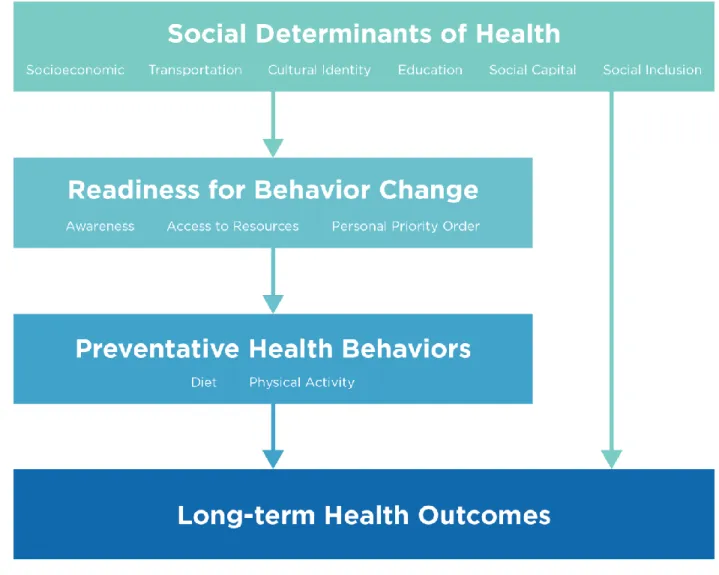
These social determinants were sometimes discussed in terms of their influence on behavioral determinants (e.g., people working multiple part-time jobs have such extreme time-scarcity that they are unable to prepare and consume healthy food), and they were sometimes described as direct influences on a person’s long-term health (e.g., the physical effect of long-term stress due to social isolation). Notably, when the social determinants were discussed in terms of their influence on behavior, they were
described as affecting one of three aspects of personal readiness for behavior change: 1) awareness of health-related resources or recommendations, 2) access to health-related resources and opportunities, or 3) the personal perception of the priority-level of the behavior. For example, education directly affects one’s awareness of health
recommendations, transportation directly affects access to resources such as healthy food, and socioeconomic status directly affects personal order of priority.
“People are struggling to eat. Most of the time for many people, it’s not that much about the quality of food that they’re eating, it’s ‘I need to eat to survive.’”
2. Theoretical Framework
The three aspects of personal readiness for behavior change listed above correspond loosely to stages within the Transtheoretical Model of behavior change (Prochaska J, Velicer W, 1997). Interestingly, social determinants’ effects on personal order of priorities reflect the natural tendency toward temporal discounting, which may be magnified in people without a personal sense of power (Joshi, Fast, 2013). Although health is at the same level within the hierarchy of needs (referred to as “Safety” needs) as employment, resources, and housing, loss of the latter three is often a more
immediate risk than that of chronic disease. In other words, because members of vulnerable populations often have to focus their immediate attention on maintaining housing/ employment/ healthcare/ etc., they tend to perceive preventative health
behaviors - whose outcomes will, by definition, occur at a later point in time - as a lower priority.
“ Sometimes we say people should automatically do it because it benefits their health but most people aren’t able to see the connection. The connection is so long-term that you don’t see immediate benefits and it’s harder to connect them.”
Figure 1. Theoretical framework of health determinants described by study participants.
3. The effects of community engagement on SUS initiatives
3a: Impact of community member participation on the implementation of an initiative As discussed in the Background section above, engaging community members in planning and implementing a health initiative is thought to be a crucial strategy for maximizing the initiative’s cultural appropriateness for, and desirability to, the target population. Study participants’ discussion of various examples of strong community engagement supported this theory. Several participants recalled instances when input from target population members improved the design of a health intervention.
Community-member participation has a clear direct effect on the quality of the
intervention. The following quote describes a boy whose input shaped the development of the SUS food access initiative, a Mobile Food Truck:
“Then sometime after that there was another meeting and they wanted youth perspective on how to get people from the Mystic to visit Union Square and Davis Square farmers markets… One of the youth who was from Portugal originally but had lived in Brazil, when asked that question said well why don’t you do what they do in my home country? In my country they have people that walk around with food carts, delivering food in neighborhoods. Instead of trying to get all the people from the Mystic to go to Union Square and Davis Square, why don’t you create something in Mystic where they walk around.”
3b. Impact of public-nonprofit collaboration on the implementation of an initiative Collaborations between municipal agencies and CBOs combine the resources and political will of the municipality with the community-based expertise of a CBO. These collaborations are a second potential way to increase the cultural appropriateness of an intervention, because CBO staff members often have more first-hand knowledge of community members and can therefore play a role in making the intervention design more culturally appropriate. CBOs whose mission is to provide multiple services for a specific population have especially deep knowledge about their target population, because they have direct contact with community members in multiple contexts.
“I will say in Haitian families women play some sort of leadership role. When they are there, they pass the information. They have some
information, they won’t keep the information to themselves - they will spread the word, they will share the information.”
Secondly, community members become more interested and likely to participate in the development or implementation of an initiative if they trust the organizations involved. When an organization seeks to develop a new health initiative for a target population with which it has had little or no direct contact, community members will have more trust in the validity of the work and organizational follow-through if the organization is associated with or endorsed by a CBO that specifically serves the target population.
“…they see that Shape Up Somerville is working with us... [Community members think] ‘That’s our organization, we know them - we are student, we are member, at some point they help us or help somebody that I know - therefore it’s an organization that I trust.’”
Finally, cross-sector collaborations can also have benefits for the CBOs, such as access to resources (if they are being funded for the work) and increased capacity (for example, access to health resources or knowledge of health issues). However, it must be noted that CBOs who provide multiple services to members of a specific population typically have their priorities aligned with the priorities of the members of the population. In the case of a vulnerable population, if the first priority of the members is to secure stable housing or employment, that will likely remain the first priority of the CBO. There should be no expectation that funding for health-related work will obligate CBOs to divert attention from their previous work, because such a “mission-drift” could damage the reputation and capacity of the CBO.
3c. The effects of overall community engagement on health outcomes
A few study participants noted that although community member participation in health-related initiatives often results in positive behavior change, behavior change shouldn’t always be the expectation or the measured outcome of a health initiative. Consistent with the Transtheoretical Model of Change, community members who were unaware of health-related recommendations prior to an intervention will travel further along the path toward behavior change when they become aware of those
recommendations, even if they do not actually reach the step of behavior change. So a health initiative that can document an increase in awareness of health recommendations or access to health resources should also be considered a success. Similarly, an initiative that achieves no change in health behavior but that has an impact on social
determinants of health can also be considered successful. In this light, successful community engagement can be seen as more than a means to an end; participation in health collaborations may be an invaluable form of social capital for community members, and therefore an end unto itself.
“We’re trying to get healthcare provider to come here. It’s not the services that provide it’s the day that’s important. It’s the relationship we want to establish for the community. When they come here, they know they exist, they know what kind of services are provided.”
Barriers and Facilitators to Community Engagement
1. Barriers and Facilitators to Public-Nonprofit Collaboration
When discussing barriers and facilitators to cross-sector collaboration, study
participants generally spoke within the framework of inter-organizational relationships.
“As I said to you every relationship is always based on trust, on communication. Also what makes the place with SUS work is the fact that we feel we are a part of it. I’m put a voice I’ve been valued. We feel that we are an equal partner. And that’s how it should be.”
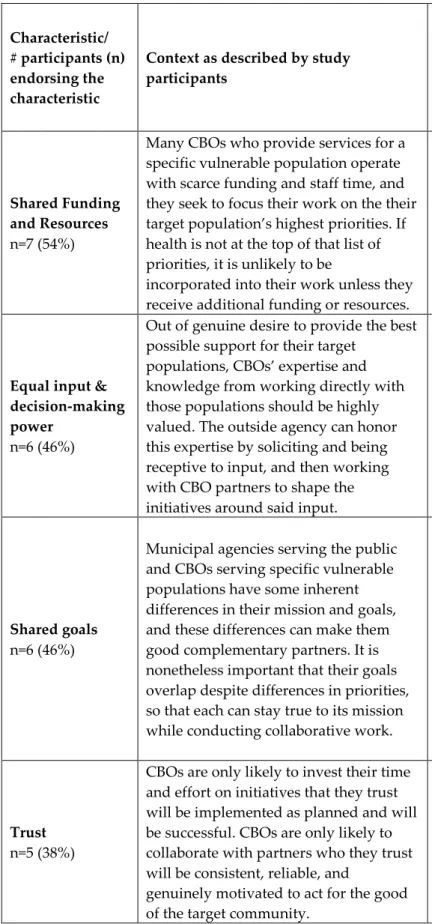
Table 1. Important characteristics of cross-sector collaborative relationships
Characteristic/ # participants (n) endorsing the characteristic
Context as described by study participants
Shape Up Somerville’s
performance as described by study participant
Shared Funding and Resources
n=7 (54%)
Many CBOs who provide services for a specific vulnerable population operate with scarce funding and staff time, and they seek to focus their work on the their target population’s highest priorities. If health is not at the top of that list of priorities, it is unlikely to be
incorporated into their work unless they receive additional funding or resources.
Study participants indicated that SUS-MP allocates funding to several of its CBO partners, which is helpful to them. However, they also expressed that more funding would further enhance their capacity to successfully implement health-related initiatives.
Equal input & decision-making power
n=6 (46%)
Out of genuine desire to provide the best possible support for their target
populations, CBOs’ expertise and knowledge from working directly with those populations should be highly valued. The outside agency can honor this expertise by soliciting and being receptive to input, and then working with CBO partners to shape the initiatives around said input.
Study participants expressed that SUS-MP has not been entirely consistent about soliciting CBO input over SUS’s 10-year history, but in recent years has done very well. However, some partners feel that the extent to which their input shapes decision-making is still unclear, due to an ambiguous decision-making structure.
Shared goals
n=6 (46%)
Municipal agencies serving the public and CBOs serving specific vulnerable populations have some inherent differences in their mission and goals, and these differences can make them good complementary partners. It is nonetheless important that their goals overlap despite differences in priorities, so that each can stay true to its mission while conducting collaborative work.
Study participants expressed the belief that promoting health within their target population supports their mission, even if not expressly stated therein. This belief is why they are willing to collaborate with SUS-MP on health-related initiatives. However, some partners mentioned that SUS-MP should in turn consider
collaborating on non-health-related CBO initiatives, because many of those initiatives directly impact social determinants of health.
Trust
n=5 (38%)
CBOs are only likely to invest their time and effort on initiatives that they trust will be implemented as planned and will be successful. CBOs are only likely to collaborate with partners who they trust will be consistent, reliable, and
genuinely motivated to act for the good
Cultural sensitivity
n=3 (23%)
Beyond showing cultural sensitivity to the target populations, municipal agencies should also demonstrate cultural sensitivity in their collaborations with CBOs who serve culturally-diverse populations. Many CBO staff members are members of the same population they serve, and many cultural minorities are underrepresented in city
government. Therefore, the institutional norms of the CBO, which may be informed by grassroots operating principles and the culture of its target population, may differ greatly from the institutional norms of the city
government. A city government that adjusts to the institutional norms of a CBO with which it is partnering may alleviate the power differential between the dominant culture (which is
overrepresented in civic leadership) and the minority culture (which is
underrepresented in civic leadership).
The biggest difference that study participants cited between institutional norms of city government versus CBOs is the decision-making structure. CBOs that work with vulnerable populations often have a democratic structure in which, for example, the Director represents and serves interests expressed by the people. In contrast, Somerville city government has a more hierarchical structure in which the mayor has great authority over implementation of programs and institutional priorities. Historically, the institutional priority of SUS-MP has been to promote healthy eating and active living, and city government has, on some occasions, been insufficiently willing to support other health-related priorities of the target population.
Inclusive Messaging
n=3 (23%)
CBOs who have been members of the SUS collaboration since it began, who are deeply involved in SUS program
implementation, and who serve on the Steering Committee are considered equal partners in the work. However, SUS-MP staff are able to dedicate more time than CBO partners to the reporting and presenting of SUS initiatives because their salaries rely less heavily on grant funding, which typically includes various stipulations regarding use of staff time.
Study participants note that CBO partners within SUS are not afforded many
opportunities to shape or provide input on messaging strategies. Although published reports of SUS work mention the existence of CBO partners, the CBOs’ individual contributions are not always recognized. Study participants indicate that this is in contrast to extensive descriptions of the contributions of the Mayor and the city staff members whose positions are dedicated to SUS. This, alongside the habit of referring to all health-related work done by SUS
collaborators as part of the SUS initiative, and careless use of first and third
Finally, study participants also noted that good communication, a strengths-based as opposed to needs-based lens, and a “popular education” or “community of learning” capacity-building approach are also important to collaboration. There was limited reference to SUS-MP’s performance in these areas.
“Popular education turns the usually educational model upside down. It assumes that people actually possess a great deal of knowledge about themselves, their environment, and in most cases what it actually takes to make their lives healthy and successful. That knowledge is often occluded by the circumstances - in our instance of language capacity, racism, and a whole range of other obstacles which makes it hard to access things
2. Barriers and facilitators to community member participation
When discussing barriers and facilitators to community member participation in the development and implementation of health-related initiatives, study participants generally framed the conversation in terms of the organizational approaches to communication, outreach, and decision-making. Study participants characterized
successful communication, outreach, and decision-making strategies as being: culturally sensitive (n=9), supportive and respectful of community members’ personal priorities (n=7), proactive in the creation of capacity-building opportunities for community members (n=7), celebratory (n=7), involving regular face-to-face contact between staff and community members (n=6), and solicitous about /receptive to community member input (n=5).
Study participants noted that SUS-MP has made a strong effort to be culturally sensitive by doing such things as translating program materials into the languages spoken by Somerville’s three largest non-English speaking populations and hiring cultural
liaisons, members of target immigrant populations who work out of city hall to bridge the gap between city government and said populations. However, they noted that in a city as diverse as Somerville - with a constantly-evolving demographic profile - it is impossible to conduct that same level of communication and outreach with other non-English speaking populations.
members’ priorities related to the social determinants of health. For example, several participants suggested that the city should host or promote cultural celebrations to support immigrants’ cultural identity and social capital. Interestingly, some community engagement strategies that were described as “incentives” for participation, such as offering food or free dental care at the event where participation is desired, relate directly to the social determinants of health (in this example, access to healthcare and food).
Finally, study participants noted that in recent memory, SUS-MP has proactively sought out opportunities to make deeper personal connections with community members and to solicit their input. However, just because an organization actively seeks input from community members does not mean that their input will influence the organization’s decisions about implementation design.
“How are decisions made and who's making them? I think that hasn't always been clear, or it's changed some times...there isn't necessarily clarity about who should do what and about who's accountable to what.”
This again brings the conversation to the issue of priorities: when the community members’ input indicates that they are more concerned with social determinants of health than with behavioral health, but the municipal agency’s standard disease prevention strategy is to promote healthy behavior, it is unclear how a community member input should shape or alter initiative plans. The agency’s greater resources and power can, intentionally or unintentionally, cause the development of the intervention to sway toward its own set of priorities.
“A true sharing of responsibility and I guess of power, which means you don’t always get what you want. So if you’re the city, and you’re the mayor, it is giving up a little bit of control. You can’t just say I want this to happen and it happens. I don’t know if it’s real, but if you’re going to call it a collaboration or a steering committee, that’s what it means to me. To the extent that we’re portraying it as a community strategy, then there are partners in that strategy.”
3. Changes in SUS-MP community engagement strategies since 2010
began offering more funding to CBOs who could support SUS-MP’s goal of promoting health in vulnerable populations. Secondly, SUS-MP made a renewed effort to solicit input from CBO leaders and community members and share decision-making power through the expansion of the SUS Steering Committee. Thirdly, SUS-MP staff members have spent more time visiting CBOs in person to develop stronger relationship with CBO leaders and the individuals they serve. Finally, the increases in community
engagement may also reflect a greater alignment of MP goals and CBO goals; SUS-MP is now less focused on achieving healthy changes to the environment and more focused on promoting health through education, outreach and leadership development programming. Synergistically, these changes could have indicated a shift in power dynamics, making CBO leaders and members of vulnerable populations feel more highly valued and willing to collaborate
.
Youth as Cultural Brokers and Early Adopters
Almost half of the study participants brought up the role of youth in health-related interventions, without any prompting from the interviewer. Younger generations of immigrant communities often become cultural brokers, because children and teenagers learn new languages quickly and their enrollment in the public school system gives them greater exposure to unfamiliar cultural practices than adults typically have. They learn cultural norms more quickly than older generations, and are then able to teach the norms to older generations. They learn about their new culture quickly and then teach their parents. Additionally, youth receive behavioral-health education in multiple settings, and often adapt their behavior to follow health recommendations. After youth members become early adopters of behavior change due to their education, some of them subsequently relay health information and recommendations back to their parents in their role as cultural broker.
Discussion
The aim of this study was to outline methods that governmental agencies can use to effectively promote healthy behaviors that prevent chronic diseases in vulnerable adult populations. The study participants offered insight on this area, but also broadened the discussion by highlighting the impact of social, economic, and environmental factors on a person's readiness to change, including his or her awareness of, access to, and
priority-level for healthy decision-making. The links between socioeconomic forces and long-term health are undisputed; in fact, promotion of community health through targeted improvements to socioeconomic forces is a major principle of the National Prevention Strategy. Therefore, agencies whose mission is prevent disease are
wage, affordable housing, good education and public transportation. In fact, a government agency that is willing to lend support to social determinant-related
priorities of its CBO partners may find that those CBOs are more likely to lend support to the government agency’s behavioral health priorities in return, bringing greater success all around.
Community-based initiatives whose work remains within a more limited scope of health promotion often target one of the three aspects of readiness for behavior change. Successful community engagement strategies for such initiatives can not only improve implementation and increase the success-level of the initiative, but may independently have a positive impact on readiness to change due to the social capital that emerges within civically-engaged communities. Community engagement is especially important for achieving public health goals in vulnerable populations from a non-dominant
culture, because it enables much more accurate tailoring of an initiative and improves the likelihood that the initiative will seem relevant and desirable to the target
population.
Reaching out to community members through the community based organizations that already provide direct services or have some type of other direct contact with them is a key community engagement strategy because it establishes a level of trust and personal connection that a municipal agency would be unlikely to achieve on its own. However, development and maintenance of public-nonprofit collaborations can be a delicate balancing act due to the inherent power differential between the large public agency and the CBOs, whose staff and budget are often much smaller. To achieve an effective collaboration, in which the all collaborating agencies are invested in the success of the initiative and have sufficient capacity to conduct, the agency who is contributing more resources to the work must be willing to share those resources without assuming greater authority than other partners over the direction of the work.
References
Association of Schools of Public Health. (2005). 2004 annual report data. Washington, DC
Boeije H. (2002) A purposeful approach to the constant comparative method in the analysis of qualitative interviews. Quality and Quantity, 36, 391–409.
Chomitz V, Chui K, Corliss J, Garnett B, Arsenault L, Economos C. (2013). A decade of shape up somerville: Assessing child obesity measures 2002-2011.
Economos, C., Hyatt, R., Goldberg, J., Must, A., Naumova, E., Collins, J., & Nelson, M. (2007). A community intervention reduces BMI z-score in children: Shape up somerville first year results. Public Health and Public Policy, 15(5), 1325-1336.
Economos, C., & Irish-Hauser, S. (2007). Community interventions: A brief overview and their application to the obesity epidemic. Journal of Law, Medicine & Ethics, Spring, 131-137.
Joshi PD, Fast NJ. (2013). Power and reduced temporal discounting. Psychological Science,
24(4):432-8. doi: 10.1177/0956797612457950. Epub 2013 Feb 12.
Marin, G., Burhansstipanov, L., Connell, C., Gielen, A., Helitzer-Allen, D., Lorig, K., . . . Thomas, S. (1994). A research agenda for health education among underserved populations. Health Education & Behavior, 22(3), 346-363. doi:10.1177/109019819402200307
Porter, C. (2013). Community action to prevent childhood obesity: Lessons from three US case studies. Childhood Obesity, 9(2), 164-174. doi:10.1089/chi.2012.0018
Prochaska J, Velicer W. (1997). The Transtheoretical Model of Health Behavior Change. American Journal of Health Promotion, 12(1), 38-48.