arXiv:1812.11812v2 [math.NT] 27 Dec 2020
On inverse of permutation polynomials of small degree
over finite fields, II
✩Yanbin Zhenga, Yuyin Yub
a
School of Mathematical Sciences, Qufu Normal University, Qufu 273165, China b
School of Mathematics and Information Science, Guangzhou University, Guangzhou 510006, China
Abstract
We investigate the permutation property of polynomials of the form xr(xs−a)t, and give the expressions of their inverses. In particular, explicit expressions of inverses of permutation polynomialsx(x3−a)2 andx(x2−a)3 onF
7n are presented. Then, using
some known results, we obtain the inverses of all permutation polynomials of degree 6,7,8 over finite fields.
Keywords: Finite fields, Permutation polynomials, Inverses 2010 MSC: 11T06, 11T71
1. Introduction
Forqa prime power, letFq denote the finite field withqelements,F∗q =Fq\ {0}, and Fq[x] the ring of polynomials over Fq. A polynomial f ∈ Fq[x] is called apermutation
polynomial(PP) ofFqif it induces a bijection fromFqto itself. For any PPf ofFq, there
exists a polynomialf−1∈F
q[x] such thatf−1(f(c)) =c for eachc∈Fq or equivalently
f−1(f(x))≡x (modxq−x), and the polynomialf−1is unique in the sense of reduction
moduloxq−x. Hencef−1is defined as thecomposition inverse off, and we simply call
it theinverse off onFq.
A polynomial overFq is called anexceptional polynomial overFq if it is a PP ofFqn
for infinitely many positive integersn. Two polynomialsf andgoverFq are calledaffine
equivalence ifg(x) =αf(βx+γ) +δfor someα, β∈F∗q andγ, δ∈Fq. Affine equivalent
f andg share the same degree, andf is a PP ofFq if and only if so isg.
The classification of PPs of finite fields has a long history. In 1896, Dickson [9] obtained all normalized PPs of degree ≤ 5 of Fq for all q, and classified all PPs of
degree 6 ofFq for odd q. In 2010, a complete classification of all PPs of degree 6 or 7 of F2n was settled in [15], up to affine equivalence and a special transformation. However,
each class of resulting PPs is invariant under the special transformation [10]. For a verification of the classification of normalized PPs of degree 6 of Fq for all q, see [25].
More recently, under affine equivalence, Fan [10–12] gives a complete classification of all PPs of degree 7 ofFqfor oddqand degree 8 ofFq for allq. All such PPs of degree≤8 can
be divided into two classes: exceptional and non-exceptional. According to the results in the above literature, a non-exceptional PP of degree≤8 overFq exists only ifq <64.
The inverses of all normalized PPs of degree ≤5 were listed in [38]. In this paper, we consider the inverses of all PPs of degree 6,7,8. For non-exceptional PPs of degree
6,7,8 ofFq, since q <64 is very small, one can use the Lagrange interpolation formula
to compute their inverses, i.e.,
f−1(x) = X c∈Fq
c 1−(x−f(c))q−1
. (1)
But for exceptional PPs of degree 6,7,8 of Fqn with infinitely many n, finding explicit
expressions of their inverses onFqn is not an easy problem.
There are several papers on the inverses of some classes of PPs, see for example [24,32,34] for linearized PPs, [18,21,29,39] for PPs of the formxrh(x(q−1)/d), [6,23,36] for involutions over F2n, [30, 39] for generalized cyclotomic mapping PPs, [37, 39, 40]
for more general piecewise PPs, [22,27, 28] for PPs constructed by the AGW criterion. The results in [22, 27, 28] contain some concrete classes such as bilinear PPs [8, 33], linearized PPs of the formL(x) +K(x)[24], and PPs of the formx+γf(x) [14]. For a brief summary of the results concerning the inverses of PPs, we refer the reader to [38] and the references therein.
In this paper, we study the PPs of the formf(x) =xr(xs−a)tonF
qn, wherea∈F∗qn, st = qm−1, r ≡ 1 (modℓ) and ℓ = (qn−1)/(s, qn−1). According to the Akbary-Ghioca-Wang (AGW) criterion [1], f is a PP of Fqn if and only if (r, s, qn−1) = 1
and another polynomial g(x) :=x(x−a)st permutes the subset (F∗
q)s. By solving the equation g(x) = c for any c ∈(F∗q)s, we find the inverseg−1 of g on (F∗q)s, and prove
that g permutes (F∗q)s if and only if aℓ 6= 1. Substituting g−1 into a slightly modified
version of a result in [22] concerning the inverse of more general PP xrh(xs), we obtain an expression of the inverse off onFqn.
By considering special cases such asm=n,q(m,n)−1|s, andt= 2 or 3, we get some
new classes of PPs and their inverses. In particular, explicit expressions of inverses of exceptional polynomialsx(x3−a)2andx(x2−a)3 onF
7n are given. Then, based on the
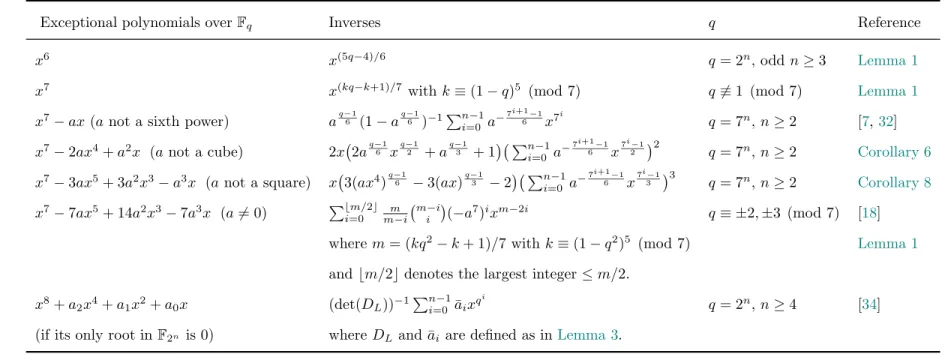
known formulae for the inverses of Dickson PPs and linearized PPs, we find the inverses of all exceptional polynomials of degree 6,7,8; seeTable 1.
In summary, under affine equivalence,Table 1and [38, Tabel I] list the inverses of all PPs of degree≤8 over all finite fields, except for the inverses of non-exceptional PPs of degree 6,7,8 which can be obtained by(1).
Some notations of this paper are as follows. The sets of integers and positive integers are denoted by Z and N respectively. The greatest common divisor of two integers m
andn is written as (m, n). Fora∈Fqn andd|n, the norm ofaover Fqd is defined by
Nqn/qd(a) =a(q
n−1)/(qd−1)
Table 1: All exceptional polynomials of degree 6,7,8 and their inverses
Exceptional polynomials overFq Inverses q Reference
x6 x(5q−4)/6 q= 2n, oddn≥3 Lemma 1
x7 x(kq−k+1)/7 withk≡(1−q)5 (mod 7) q6≡1 (mod 7) Lemma 1
x7−ax (anot a sixth power) aq−1
6 (1−a q−1 6 )−1Pn−1 i=0 a− 7i+1 −1 6 x7i q= 7n,n≥2 [7,32] x7−2ax4+a2x (anot a cube) 2x 2aq−1 6 x q−1 2 +a q−1 3 + 1 Pn−1 i=0 a− 7i+1−1 6 x 7i−1 2 2 q= 7n,n≥2 Corollary 6 x7−3ax5+ 3a2x3−a3x (anot a square) x 3(ax4)q−1 6 −3(ax) q−1 3 −2 Pn−1 i=0 a− 7i+1−1 6 x 7i−1 3 3 q= 7n,n≥2 Corollary 8 x7−7ax5+ 14a2x3−7a3x (a6= 0) P⌊m/2⌋ i=0 m m−i m−i i (−a7)ixm−2i q≡ ±2,±3 (mod 7) [18] wherem= (kq2−k+ 1)/7 withk≡(1−q2)5 (mod 7) Lemma 1 and⌊m/2⌋denotes the largest integer≤m/2.
x8+a
2x4+a1x2+a0x (det(DL))−1Pni=0−1a¯ixq i
q= 2n,n≥4 [34] (if its only root inF2n is 0) whereDL and ¯ai are defined as inLemma 3.
†This list is complete up to affine transformations: g(x) =αf(βx+γ) +δwithα, β, γ, δ∈F
q andαβ6= 0.
‡All non-exceptional permutation polynomials of degree 6,7,8 are listed in [10–12, 15, 25], and all of them are over small fields F
q with q≤64. Hence their inverses can be obtained by the Lagrange interpolation formula.
2. Permutation polynomials of small degree and their inverses
Since the inverses of all normalized PPs of degree ≤ 5 were listed in [38], we only consider the PPs of degree 6,7,8 which can be divided into two classes: exceptional and non-exceptional. Combining the results in [4,10–12,15,25] gives the following theorems. Theorem 1. A non-exceptional PP of degreem∈ {6,7,8}overFq exists if and only if
one of the following conditions holds: (i) m= 6 andq∈ {8,9,11,16,27,32};
(ii) m= 7 andq∈ {9,11,13,16,17,19,23,25,27,31,49}; (iii) m= 8 andq∈ {11,13,16,19,23,27,29,31,32,64}.
Under affine equivalence, all such PPs are explicitly listed in [10–12,15,25].
Theorem 2. Each exceptional polynomial of degree 6,7,8 is affine equivalent to one of the following:
(i) x6 overF2nwith odd n≥3;
(ii) x7 overF
qwith q6≡1 (mod 7); (iii) x7−axoverF
7nwithanot a sixth power inF7n, i.e.,a∈F∗7nsuch thata(7 n−1)/6
6
= 1; (iv) x(x3−a)2 overF
7nwith anot a cube in F7n, i.e.,a∈F∗7nsuch that a(7 n−1)/3
6
= 1; (v) x(x2−a)3overF
7nwithanot a square inF7n, i.e.,a∈F∗7nsuch thata(7 n−1)/2
6
= 1; (vi) x7−7ax5+ 14a2x3−7a3xwitha∈F∗
qandq≡ ±2,±3 (mod 7); (vii) x8+a2x4+a1x2+a0xoverF
2nif its only root in F2nis0.
The inverses of PPs inTheorem 1can be obtained directly by the Lagrange interpo-lation formula (1)due toq < 64. To obtain the inverses of PPs inTheorem 2, we need the following results.
Lemma 1. Let m, ℓ∈Nand(m, ℓ) = 1. Then an inverse ofmmodulo ℓis(kℓ+ 1)/m,
wherek≡ −ℓφ(m)−1 (modm)andφis Euler’s totient function.
Proof. Clearly,kℓ+ 1≡1−ℓφ(m)≡0 (modm) andm(kℓ+ 1)/m−kℓ= 1. Therefore,
(kℓ+ 1)/mis an inverse of mmoduloℓ. Lemma 2([7,32]). LetL(x) =xqm
−ax, wherea∈F∗qn andm, n∈N. ThenLis a PP
of Fqnif and only if Nqn/qd(a)6= 1, where d= (m, n). In this case, its inverse onFqn is
L−1(x) = Nqn/qd(a) 1−Nqn/qd(a) n/d X i=1 a−qim−1 qm−1xq (i−1)m . Lemma 3. Let L(x) =Pn−1 i=0 aixq i
∈Fqn[x]. Then Lis a PP of Fqnif and only if
DL:= a0 a1 · · · an−1 aqn−1 aq0 · · · aqn−2 .. . ... ... ... aqn−1 1 a qn−1 2 · · · a qn−1 0
is nonsingular [20, Page 362]. In this case, its inverse was given in [34]by
L−1(x) = 1 det(DL) n−1 X i=0 ¯ aixq i ,
where¯ai is the (i,0)-th cofactor of DL, i.e., det(DL) =a0¯a0+Pni=1−1a
qi
The Dickson polynomial Dn(x, a) of degreenwith parametera∈Fq is given as Dn(x, a) = ⌊n/2⌋ X i=0 n n−i n−i i (−a)ixn−2i,
where⌊n/2⌋denotes the largest integer≤n/2. Fora∈F∗q,Dn(x, a) is a PP ofFq if and
only if gcd(n, q2−1) = 1. Its inverse is determined in [18] by the next lemma.
Lemma 4([18, Lemma 4.8]). Leta∈F∗q andm, n∈Nbe such thatmn≡1 (modq2−1).
Then the inverse of Dn(x, a)on Fq isDm(x, an).
The PPx7−7ax5+ 14a2x3−7a3xinTheorem 2is the Dickson polynomialD7(x, a)
and, byLemma 4, its inverse isDm(x, a7). ByLemma 1, an inversemof 7 moduloq2−1
can be written asm= (kq2−k+ 1)/7, wherek≡(1−q2)5 (mod 7).
The inverses of PPsx6,x7,x7−axandx8+P2
i=0aixiinTheorem 2can be obtained
directly byLemmas 1 to 3. The inverses of PPs x(x3−a)2 and x(x2−a)3 onF 7n are
given byCorollaries 6and8 inSection 5respectively.
In short, the inverses of all the PPs inTheorem 2are known now. For convenience, all the PPs inTheorem 2and their inverses are listed inTable 1.
3. Large class of PPs and its inverse
In this section we slightly modify a known expression of the inverse of PP xrh(xs). Moreover, we investigate the permutation properties ofx(x−a)ston (F∗
qn)sandxr(xs−a)t
onFqn, and obtain their inverses. The following lemma will be needed.
Lemma 5 ([1, Proposition 3.1]). Let f(x) = xrh(xs), where h∈ F
q[x] and r, s ∈ N. Then f is a PP ofFq if and only if (r, s, q−1) = 1andg(x) :=xrh(x)spermutes(F∗q)s.
The problem that when special classes of g permuting (F∗q)s has been extensively
studied, see for example [3,5,13,16,17,19,26,35]. For a recent survey of this problem, we refer the reader to [31] and the references therein.
The inverse off in terms of roots of unity overFq was given in [29,39]. Letg1∈Fq[x]
be such thatxk1◦g1=g◦xk1, wherek1=s/(s, q−1). The inverse off in terms of the inverse ofg1on (F∗
q)swas given in [18] when (r, q−1) = 1, and given in [22] for allr∈N. Using the method in [22], we obtain the following equivalent version of the inverse off, which is expressed in terms of the inverse ofg on (F∗q)s.
Theorem 3. Let f(x) =xrh(xs), where h∈Fq[x] andr, s∈N. Let s¯= (s, q−1) and
k be an inverse of s/s¯modulo (q−1)/¯s. If f is a PP of Fq and g−1 is the inverse of
g(x) :=xrh(x)s on(F∗
q)s. Then the inverse off on Fq is
f−1(x) =xb h(g−1(xs))−b
g−1(xs)ck
,
whereb, c∈Zsatisfy br+cs¯= 1.
Proof. We prove it by using the method in [22, Theorem 3.2]. Since the theorem holds forx= 0, we only considerx∈F∗q. Letφ(x) = (xr, xs) andψ(y, z) = (yrh(z)r, g(z)). It
is easy to verify thatψ◦φ=φ◦f, i.e., the following diagram is commutative:
F∗q f // φ F∗q φ φ(F∗q) ψ //φ(F∗ q). 5
Iff is a PP, then, byLemma 5, (r,s¯) = 1 andgpermutes (F∗q)s. Assumebr+c¯s= 1
andk(s/¯s) +v(q−1)/¯s= 1 for someb, c, k, v∈Z. Then
c¯s=cs¯(k(s/s¯) +v(q−1)/s¯) =cks+cv(q−1),
and so, for anyx∈F∗q,
(xr)b(xs)ck=xbr+cksxcv(q−1)=xbr+cks+cv(q−1)=xbr+cs¯=x. (2)
Henceφis bijective andφ−1(y, z) =ybzck.
Sincef is a PP ofFq andφis bijective,ψis also bijective. For (y, z)∈φ(F∗q), assume
thatψ(y, z) = (α, β) for some (α, β)∈φ(F∗q), i.e.,
yrh(z)r=α and g(z) =zrh(z)s=β.
Because z, β∈(F∗q)s and g permutes (F∗q)s, we obtainz =g−1(β). Denoteα=xr0 and
β =xs
0 for some x0 ∈F∗q. Then αbβck = x0 by(2), and so αbβckh(z)−1
r
h(z)r =α. Sinceψis bijective, we havey=αbβckh(z)−1. Hence,
ψ−1(α, β) = (y, z) = (αbβckh(g−1(β))−1, g−1(β)).
Substituting φ, φ−1, ψ−1 intof−1=φ−1◦ψ−1◦φgives the desire result.
The key step inTheorem 3 is to find the inverse of g on (F∗q)s, which is possible to
be done for special classes ofg, as for instance in the following result. Lemma 6. Let a∈F∗qnand s|qm−1. Then g(x) =x(x−a)q
m−1
permutes (F∗qn)s if
and only if aℓ6= 1, whereℓ= (qn−1)/(s, qn−1). In this case, its inverse on (F∗
qn)sis g−1(x) =(a−1x) qn−1 qd−1 −1 n/d X i=1 a−qimqm−−11x q(i−1)m−1 qm−1 −1 +a, whered= (m, n).
Proof. Since the multiplicative group ofFqnis cyclic, we can verify (F∗qn)s= (F∗qn)(s,q n−1)
. Thusa∈(F∗
qn)s if and only ifaℓ = 1. If aℓ = 1, then a∈(F∗qn)s, and so g has root in
(F∗qn)s. Hencegdoes not permute (F∗qn)s. Next we only consideraℓ6= 1 andx∈(F∗qn)s.
Since g introduces a mapping from (F∗qn)s to itself, we need only show that, for any y∈(F∗qn)s, the equationg(x) =y has exactly one solutionxandx=g−1(y).
Since aℓ 6= 1, we have x−a 6= 0 for any x ∈ (F∗
qn)s. Let z = (x−a)−1. Then x−a=z−1andx=z−1+a. Substituting them intog(x) =y yields
(z−1+a)z1−qm =y, i.e., zqm−(a/y)z= 1/y. (3)
Recall thatd= (m, n) andℓ= (qn−1)/(s, qn−1). Letqm−1 =st. Then
qd−1 =q(m,n)−1 = (qm−1, qn−1) = (st, qn−1) = (s, qn−1)(t,(qn−1)/(s, qn−1))
= (s, qn−1)(t, ℓ),
and so qqnd−−11(t, ℓ) =ℓ. Sinceaℓ6= 1 andy∈(F∗qn)s, we have
Nqn/qd(a/y)
(t,ℓ)
= (a/y)qnqd−−11
(t,ℓ)
Therefore,
Nqn/qd(a/y)6= 1. (4)
It follows fromLemma 2and(3) that
z= Nqn/qd(a/y) 1−Nqn/qd(a/y) n/d X i=1 (a/y)−qim−1 qm−1(1/y)q (i−1)m = Nqn/qd(y/a)−1 −1 n/d X i=1 a−qimqm−−11y q(i−1)m−1 qm−1 . (5)
Substituting (5)intox=z−1+agivesx=g−1(y).
After these preparations, we can now give the main theorem. Theorem 4. Let f(x) = xr(xs−a)t, where a ∈ F∗
qn and r, s, t ∈ N are such that st=qm−1 andr≡1 (mod ℓ)with ℓ= (qn−1)/(s, qn−1). Then f is a PP of F
qn if
and only if (r, qn−1) = 1andaℓ6= 1. In this case, the inverse off onF qn is
f−1(x) =xu(G(x)H(x))tu, (6)
whereuis an inverse of r moduloqn−1,
G(x) = (a−1xs)qn−1 qd−1 −1 −1 , (7) H(x) = n/d X i=1 a−qim−1 qm−1x q(i−1)m−1 t , andd= (m, n). (8)
Proof. FromLemma 5,f is a PP if and only if (r, s, qn−1) = 1 andg(x) :=xr(x−a)st permutes (F∗q)s. Sincer≡1 (modℓ), we havexr=xand sog(x) =x(x−a)st for any
x∈(F∗q)s. ByLemma 6, g permutes (F∗q)s if and only if aℓ6= 1. It follows from r≡1
(modℓ) that (r, ℓ) = 1, and so (r, s, qn−1) = 1 if and only if (r, qn−1) = 1.
Letru+ (qn−1)v= 1 for someu, v∈Z. Thenru+ (ℓv)¯s= 1, where ¯s= (s, qn−1). For anyx∈F∗qn, we haveg−1(xs)∈(F∗q)s, and so (g−1(xs))ℓ = 1. Substitutingb :=u, c:=ℓv andg−1in Lemma 6intoTheorem 3gives the expression off−1.
The following are two examples ofTheorem 4where r2≡1 (mod qn−1). Example 1. Let f(x) =xr(x3+a)5, where a∈F∗
28andr≡1 (mod 85). Then f is a PP ofF28 if and only if (r,3) = 1and a856= 1. In this case, its inverse on F28 is
f−1(x) =xr(x51+a17)−5r(x3+a16)5r.
Example 2. Let f(x) =xr(x16−a)5, where a∈F∗
36andr≡1 (mod 91). Then f is a PP ofF36 if and only if (r,8) = 1anda916= 1. In this case, its inverse on F36 is
f−1(x) = (1−a91)−5rxr a90+a9x16+x5845r
.
4. Simplified versions of the main theorem
In this section we aim to simplify the expressions of GandH inTheorem 4. On the one hand, we consider small n/(m, n) which is the number of the terms of H. On the other hand, we study the casesqd−1|sandqd−1|t, in whichGandGtare reduced to constants respectively.
4.1. The case H is a constant
ApplyingTheorem 4tom=n, we obtain thatG(x) =a(xs−a)−1andH(x) =a−1.
Hence we arrive at the following result.
Corollary 1. Let f(x) = xr(xs−a)t, where a ∈ F∗
q, st = q−1 and r ≡ 1 (modt). Then f is a PP ofFq if and only if (r, q−1) = 1 andat6= 1. If f is a PP of Fq andu
is an inverse of rmodulo q−1, then its inverse on Fq is
f−1(x) =xu(xs−a)−tu.
The binomialxs−ainCorollary 1can be generalized toH(xs) which has no nonzero root inFq; see the next theorem.
Theorem 5. Let f(x) =xr(h(xs))t, where h∈Fq[x]andst=q−1. Thenf is a PP of
Fq if and only if(r, q−1) = 1andh(xs)has no nonzero root inFq (see [2, Corollary 3.2]).
If f is a PP ofFq andr≡1 (mod t), then its inverse onFq is
f−1(x) =xu(h(xs))−tu,
whereuis an inverse of r moduloq−1.
Proof. The permutation part is [2, Corollary 3.2]. Letr=kt+ 1 for somek∈Z. Then
rs= (kt+ 1)s=kst+s≡s (modq−1).
Now it is easy to verify thatf−1(f(e)) =efor anye∈Fq. This completes the proof.
4.2. The case GorGt is a constant
Iff in Theorem 4is a PP, then(4) holds, and soG(c)∈F∗
qd for anyc∈Fqn. Hence G(x)t= 1 whenqd−1|t. Moreover, ifqd−1|s, then Nq
n/qd(cs) = 1 for anyc∈F∗qn.
ThusGis reduced to a constant. The argument above gives the following theorem. Theorem 6.With the same notation and hypothese as in Theorem 4, letf be a PP of Fqn.
(i) If qd−1|t, thenf−1(x) =xu(H(x))tu.
(ii) If qd−1|s, thenf−1(x) =xu(AH(x))tu, whereA= a−qnqd−−11−1 −1
.
Recall that d = (m, n) andqm−1 =st. The conditions qd−1 | s or qd−1 |t in Theorem 6 are easy to satisfied, because
st=qm−1 = (qd−1)(1 +qd+q2d+· · ·+qm−d). (9)
For instance, takingt= 1 andn= 2mleads toqd−1 =qm−1 =sandn/d= 2. Hence
H(x) =a−1+a−(qm+1) xqm−1
. Then substitutingq forqmyields the following result. Corollary 2. Let f(x) =xr(xq−1−a), where a∈F∗
q2 andr≡1 (mod q+ 1). Then f is a PP of Fq2 if and only if (r, q2−1) = 1 andaq+16= 1. If f is a PP of Fq2 anduis an inverse of rmodulo q2−1, then its inverse onF
q2 is
f−1(x) = (1−aq+1)−u(aqx+xq)u.
Next we give another example of the caseqd−1 =soverF
Corollary 3. Let f(x) = xr(x3+a)5 where a ∈ F∗
2n, n is even, r ≡ 1 (mod ℓ) and ℓ= (2n−1)/3. Thenf is a PP ofF
2n if and only if (r,2n−1) = 1andaℓ6= 1. Iff is
a PP ofF2n andn≡2 (mod 4), then its inverse onF2n is
f−1(x) =aℓuxu n/2 X i=1 a−16i−1 15 x 16i−1−1 5 5u ,
whereuis an inverse of r modulo2n−1.
Proof. The permutation part is a direct consequence ofTheorem 4. Let ω =aℓ. Then
ω3= 1 and, by ω6= 1,ω2+ω+ 1 = 0. Thusω/(1 +ω) =ω−1 andω−5 =ω. Inserting
them intoTheorem 6gives the above expression off−1.
The next corollary is an example of the caseqd−1 =t and 2n= 3m. Corollary 4. Let f(x) =x(xq+1−a)q−1, where a∈F∗
q3 andq is odd. Thenf is a PP of Fq3 if and only ifa(q
3−1)/2
=−1. In this case, its inverse on Fq3 is
f−1(x) =x aq2+q+aqxq+1+xq2+q+2q−1
.
5. Permutation trinomials and tetranomials
Applying the main theorem to t= 2, 3, we can obtain some permutation trinomials and tetranomials and their inverses, which contain two classes of exceptional polynomials inTheorem 2. First, we give a simple lemma.
Lemma 7. Let a be odd, m, n∈N and d= (m, n). Then(am−1)/(ad−1) and m/d
have the same parity, and
(am−1)/2, an−1 = ( ad−1 if m/dis even, (ad−1)/2 if m/dis odd. Proof. Since (am−1)/(ad−1) = Pm/d i=1(ad)i−1 and a is odd, (am−1)/(ad−1) is an
integer with the same parity asm/d. Then 2 (am−1)/2, an−1 = am−1,2(an−1) = (am−1, an−1) am−1 (am−1, an−1), 2(an−1) (am−1, an−1) = (am−1, an−1) am−1 (am−1, an−1),2 = (ad−1) am−1 ad−1,2 = (ad−1)(m/d,2).
ApplyingTheorem 4tor= 1 and t= 2, we derive the following result. Theorem 7. Let f(x) =xqm −2axqm2+1 +a2x, wherea∈F∗ qn, qis odd and m, n∈N. Let d= (m, n),c=a(qn−1)/(qd−1) and H2(x) =x n/d X i=1 a−qim−1 qm−1x q(i−1)m−1 2 2 . 9
(i) If m/dis even, thenf is a PP of Fqnif and only if c6= 1. In this case, f−1(x) =c2(1−c)−2H2(x).
(ii) If m/dis odd, then f is a PP of Fqnif and only if c26= 1. In this case,
f−1(x) =c2(1−c2)−2 2cxqn−1
2 +c2+ 1H2(x). (10)
Proof. Note that f(x) =x(xqm−1
2 −a)2. In the notation of Theorem 4, we have t = 2 and s = (qm−1)/2. If m/d is even, then (s, qn −1) = qd −1 by Lemma 7, and
ℓ= (qn−1)/(qd−1). According to Theorem 4,f is a PP ofF
qn if and only ifc6= 1. It
is easy to verifyf−1(f(0)) = 0. Next we only considerx∈F∗
qn for computing f−1(x). Sinceqd−1|s, we have (xs)qn−1 qd−1 = (xq n−1 )qds−1 = 1 (11)
for anyx∈F∗qn. Substituting(11)into(7), we obtain
G(x) =c(1−c)−1. (12)
Ifm/dis odd, then (s, qn−1) = (qd−1)/2 byLemma 7, andℓ= 2(qn−1)/(qd−1). According to Theorem 4, f is a PP of Fqn if and only if c2 6= 1. If m/d is odd, then
(qm−1)/(qd−1) is also odd byLemma 7, and so (xs)qn− 1 qd−1 =x qm−1 2 · qn−1 qd−1 =x qn−1 2 · qm−1 qd−1 =x qn−1 2
for anyx∈F∗qn. Since
1−c2= xqn−1 2 2−c2= x qn−1 2 +c x qn−1 2 −c. We have xqn−1 2 −c−1= 1−c2−1 x qn−1 2 +c. (13) Note thatc=a(qn−1)/(qd−1)
. Inserting(13)into (7), we obtain
G(x) =c(1−c2)−1(xqn−1
2 +c). (14) Then, for anyx∈F∗qn,
xqn−1
2 +c2= 2cx
qn−1
2 +c2+ 1. (15) Substituting (12),(14)and(15)into Theorem 4gives the desire result.
Takingqm= 5,7,9 inTheorem 7leads to the following corollaries. Corollary 5. Let f(x) =x5−2ax3+a2x, wherea∈F∗
5n andn∈N. Thenf is a PP
of F5n if and only if a(5 n−1)/2
=−1. In this case, the inverse of f onF5n is
f−1(x) = 2a5n−1 4 x 5n+1 2 n−1 X i=0 a−5i+1−1 4 x 5i −1 2 2 .
Corollary 5is essentially [38, Theorem 8] or [18, Lemma 4.9]. Corollary 6. Let f(x) =x7−2ax4+a2x, wherea∈F∗
of F7n if and only if a(7 n−1)/3
6
= 1. In this case, the inverse of f onF7n is
f−1(x) = 2x 2a7n−1 6 x 7n −1 2 +a 7n −1 3 + 1 n−1 X i=0 a−7i +1 −1 6 x 7i −1 2 2 .
Proof. The permutation part is a direct consequence ofTheorem 7. Letω =a(7n−1)/3
. Then ω3 = 1 andω 6= 1 if f is a PP. Henceω2+ω+ 1 = 0, and so (1−ω)2 =−3ω.
Inserting them into(10)gives the above expression off−1.
Corollary 7. Let f(x) =x9+ax5+a2x, wherea∈F∗
3n andn∈N.
(i) If n is odd, thenf is a PP of F3n if and only if a(3 n−1)/2
=−1. In this case, the inverse of f onF3n is f−1(x) =x n−1 X i=0 a−9 i+1 −1 8 x 9i−1 2 2 .
(ii) If n is even, then f is a PP of F3n if and only if c26= 1, where c=a(3 n−1)/8
. In this case, the inverse off onF3n is
f−1(x) =x c5x3n−1 2 +c2+ 1 n/2 X i=1 a−9i−1 8 x 9i−1−1 2 2 . (16)
Proof. We only verify(16), because the rest parts are direct consequences ofTheorem 7. Letω=c2=a(3n−1)/4
. Thenω4= 1 andω6= 1 iff is a PP. Thusω3+ω2+ω+ 1 = 0,
and so (1−ω)2 = 1 +ω +ω2 = −ω3 in F
3n. Then ω/(−ω3) = −ω−2 = −ω2 and
−ω2(ω+ 1) =ω+ 1. Inserting them into(10)gives(16).
ApplyingTheorem 4tor= 1,t= 3 and qm= 7 gives the following corollary. Corollary 8. Let f(x) =x7−3ax5+ 3a2x3−a3x, where a∈F∗
7n and n∈N. Thenf
is a PP ofF7n if and only ifa(7 n−1)/2
=−1. In this case, its inverse on F7n is
f−1(x) =x 3(ax4)7 n −1 6 −3(ax) 7n−1 3 −2 n−1 X i=0 a−7 i+1 −1 6 x 7i−1 3 3 .
Proof. Clearly, f(x) = x(x2−a)3, and so s = 2, t = 3, ℓ = (7n−1)/2,m = d = 1. FromTheorem 4,f is a PP ofFqn if and only ifa(7
n−1)/2
=−1. It is easy to verify that
f−1(f(0)) = 0. Next we only considerx∈F∗
qn for computingf−1(x). Note that
2 = 1−a7 n −1 2 = x 7n −1 3 3− a 7n −1 6 3= x 7n −1 3 −a 7n −1 6 λ(x), where λ(x) =x2(7 n −1) 3 +a 7n −1 6 x 7n −1 3 +a 7n −1 3 . Therefore, x7 n −1 3 −a 7n−1 6 −1= 4λ(x). (17) Inserting(17)into (7)yieldsG(x) = 4a7n−1
6 λ(x).Then, for anyx∈F∗ qn, G(x)3=−λ(x)3= 3(ax4)7 n −1 6 −3(ax) 7n−1 3 −2. (18) Substituting (18)into Theorem 4gives the desire result.
References
[1] A. Akbary, D. Ghioca, Q. Wang, On constructing permutations of finite fields, Finite Fields Appl. 17 (2011) 51–67.
[2] A. Akbary, Q. Wang, On polynomials of the formxrf(x(q−1)/l), Int. J. Math. Math. Sci.
2007 (2007) 1–7, article ID 23408, doi:10.1155/2007/23408.
[3] D. Bartoli, Permutation trinomials overFq3, Finite Fields Appl. 61 (2020) 101597.
[4] D. Bartoli, M. Giulietti, L. Quoos, G. Zini, Complete permutation polynomials from ex-ceptional polynomials, J. Number Theory 176 (2017) 46–66, doi:10.1016/j.jnt.2016.12.016. [5] X. Cao, X.-D. Hou, J. Mi, S. Xu, More permutation polynomials with Niho exponents
which permuteFq2, Finite Fields Appl. 62 (2020) 101626.
[6] P. Charpin, S. Mesnager, S. Sarkar, Involutions over the Galois FieldF2n, IEEE Trans. Inf. Theory 62 (4) (2016) 2266–2276.
[7] R. Coulter, M. Henderson, A note on the roots of trinomials over a finite field, Bull. Aust. Math. Soc. 69 (2004) 429–432.
[8] R. S. Coulter, M. Henderson, The compositional inverse of a class of permutation polyno-mials over a finite field, Bull. Aust. Math. Soc. 65 (2002) 521–526.
[9] L. E. Dickson, The analytic representation of substitutions on a power of a prime number of letters with a discussion of the linear group, Part I, Ann. Math. 11 (1896) 65–120, https://www.jstor.org/stable/1967217.
[10] X. Fan, A classification of permutation polynomials of degree 7 over finite fields, Finite Fields Appl. 59 (2019) 1–21.
[11] X. Fan, Permutation polynomials of degree 8 over finite fields of characteristic 2, Finite Fields Appl. 64 (2020) 101662.
[12] X. Fan, Permutation polynomials of degree 8 over finite fields of odd characteristic, Bull. Aust. Math. Soc. 101 (1) (2020) 40–55.
[13] X.-D. Hou, Z. Tu, X. Zeng, Determination of a class of permutation trinomials in charac-teristic three, Finite Fields Appl. 61 (2020) 101596.
[14] G. M. Kyureghyan, Constructing permutations of finite fields via linear translators, J. Combin. Theory Ser. A 118 (2011) 1052–1061.
[15] J. Li, D. B. Chandler, Q. Xiang, Permutation polynomials of degree 6 or 7 over finite fields of characteristic 2, Finite Fields Appl. 16 (2010) 406–419.
[16] K. Li, L. Qu, C. Li, H. Chen, On a conjecture about a class of permutation quadrinomials, Finite Fields Appl. 66 (2020) 101690.
[17] K. Li, L. Qu, Q. Wang, New constructions of permutation polynomials of the form
xrh(xq−1) overFq2, Des. Codes Cryptogr. 86 (2018) 2379–2405.
[18] K. Li, L. Qu, Q. Wang, Compositional inverses of permutation polynomials of the form
xrh(xs) over finite fields, Cryptogr. Commun. 11 (2019) 279–298.
[19] N. Li, T. Helleseth, New permutation trinomials from Niho exponents over finite fields with even characteristic, Cryptogr. Commun. 11 (1) (2019) 129–136.
[20] R. Lidl, H. Niederreiter, Finite Fields, Cambridge Univ. Press, 1997.
[21] A. Muratovi´c-Ribi´c, A note on the coefficients of inverse polynomials, Finite Fields Appl. 13 (2007) 977–980.
[22] T. Niu, K. Li, L. Qu, Q. Wang, A general method for finding the com-positional inverses of permutations from the AGW criterion, arXiv:2004.12552, https://arxiv.org/abs/2004.12552v1, 2020.
[23] T. Niu, K. Li, L. Qu, Q. Wang, New constructions of involutions over finite fields, Cryptogr. Commun. 12 (2020) 165–185, doi:10.1007/s12095-019-00386-2.
[24] L. Reis, Nilpotent linearized polynomials over finite fields and applications, Finite Fields Appl. 50 (2018) 279–292.
[25] C. J. Shallue, I. M. Wanless, Permutation polynomials and orthomorphism polynomials of degree six, Finite Fields Appl. 20 (2013) 84–92.
[26] Z. Tu, X. Liu, X. Zeng, A revisit to a class of permutation quadrinomials, Finite Fields Appl. 59 (2019) 57–85.
[27] A. Tuxanidy, Q. Wang, On the inverses of some classes of permutations of finite fields, Finite Fields Appl. 28 (2014) 244–281.
[28] A. Tuxanidy, Q. Wang, Compositional inverses and complete mappings over finite fields, Discrete Appl. Math. 217 (2017) 318–329.
[29] Q. Wang, On inverse permutation polynomials, Finite Fields Appl. 15 (2009) 207–213. [30] Q. Wang, A note on inverses of cyclotomic mapping permutation polynomials over finite
fields, Finite Fields Appl. 45 (2017) 422–427.
[31] Q. Wang, Polynomials over finite fields: an index approach, in: K.-U. Schmidt, A. Winter-hof (Eds.), Combinatorics and Finite Fields: Difference Sets, Polynomials, Pseudorandom-ness and Applications, 319–346, doi:10.1515/9783110642094-015, 2019.
[32] B. Wu, The compositional inverses of linearized permutation binomials over finite fields, arXiv:1311.2154v1,https://arxiv.org/abs/1311.2154, 2013.
[33] B. Wu, Z. Liu, The compositional inverse of a class of bilinear permutation polynomials over finite fields of characteristic 2, Finite Fields Appl. 24 (2013) 136–147.
[34] B. Wu, Z. Liu, Linearized polynomials over finite fields revisited, Finite Fields Appl. 22 (2013) 79–100.
[35] Z. Zha, L. Hu, Z. Zhang, Permutation polynomials of the form x+γTrqn
q (h(x)), Finite Fields Appl. 60 (2019) 101573.
[36] D. Zheng, M. Yuan, N. Li, L. Hu, X. Zeng, Constructions of involutions over finite fields, IEEE Trans. Inf. Theory 65 (12) (2019) 7876–7883, doi:10.1109/TIT.2019.2919511. [37] Y. Zheng, F. Wang, L. Wang, W. Wei, On inverses of some permutation
polynomi-als over finite fields of characteristic three, Finite Fields Appl. 66 (2020) 101670, doi:
10.1016/j.ffa.2020.101670.
[38] Y. Zheng, Q. Wang, W. Wei, On inverses of permutation polynomials of small degree over finite fields, IEEE Trans. Inf. Theory 66 (2) (2020) 914–922, doi:10.1109/TIT.2019.2939113. [39] Y. Zheng, Y. Yu, Y. Zhang, D. Pei, Piecewise constructions of inverses of cyclotomic
mapping permutation polynomials, Finite Fields Appl. 40 (2016) 1–9.
[40] Y. Zheng, P. Yuan, D. Pei, Piecewise constructions of inverses of some permutation poly-nomials, Finite Fields Appl. 36 (2015) 151–169.