Tylophorine Analogs Allosterically
Regulates Heat Shock Cognate
Protein 70 And Inhibits Hepatitis C
Virus Replication
Ying Wang
1,2, Sangwon
Lee
1, Ya
Ha
1, Wing
Lam
1, Shao-Ru
Chen
2, Ginger E.
Dutschman
1,
Elizabeth A. Gullen
1, Susan P. Grill
1, Yao
Cheng
1, Alois
Fürstner
3, Samson
Francis
4, David C.
Baker
4, Xiaoming
Yang
5, Kuo-Hsiung
Lee
5,6& Yung-Chi
Cheng
1Tylophorine analogs have been shown to exhibit diverse activities against cancer, inflammation, arthritis, and lupus in vivo. In this study, we demonstrated that two tylophorine analogs, DCB-3503 and rac-cryptopleurine, exhibit potent inhibitory activity against hepatitis C virus (HCV) replication in genotype 1b Con 1 isolate. The inhibition of HCV replication is at least partially mediated through cellular heat shock cognate protein 70 (Hsc70). Hsc70 associates with the HCV replication complex by primarily binding to the poly U/UC motifs in HCV RNA. The interaction of DCB-3503 and rac -cryptopleurine with Hsc70 promotes the ATP hydrolysis activity of Hsc70 in the presence of the 3′ poly
U/UC motif of HCV RNA. Regulating the ATPase activity of Hsc70 may be one of the mechanisms by which tylophorine analogs inhibit HCV replication. This study demonstrates the novel anti-HCV activity of tylophorine analogs. Our results also highlight the importance of Hsc70 in HCV replication.
Tylophorine analogs are a class of natural products first isolated from the plant Tylophora Indica1. Tylophora Indica and Tylophora Ovata were traditionally used for the treatment of asthma in India2 and arthritis in China3.
This group of analogs has also shown broad activities against cancer4, 5, inflammation5, 6, arthritis3, and lupus7 in vivo. Tylophorine analogs have been shown to reduce the rate of elongation of polypeptide chain to inhibit global protein synthesis8, which has a more profound effect on cellular regulatory proteins with short half-lives8.
No other known anticancer drug or protein synthesis inhibitors exhibits the same novel activity. Only vascular endothelial growth factor receptor 2 (VEGFR2) has been identified for the antiangiogenic activity of tylophorine9.
In addition, we recently identified that tylophorine analog DCB-3503 regulated translation of cyclin D1 through allosteric regulation of heat shock cognate protein 70 (Hsc70)10.
Hepatitis C virus (HCV) infects approximately 3% of the world’s population and is one of the top reasons for the development of liver cirrhosis and hepatocellular carcinoma11. The nonstructural (NS) proteins are
respon-sible for replication of HCV RNA and virus particle assembly and are primary antiviral targets12, 13. The initial
standard of care for HCV infection is peginterferon alpha combined with ribavirin for 48 weeks for HCV geno-type 1, or 24 weeks for HCV genogeno-types 2 or 3. Peginterferon treatment showed a sustained viral response (SVR) rate of less than 50% HCV genotype 1 infection, the most prevalent strain in Europe and North America11. The
recently developed direct-acting antivirals (DAAs) targeting against NS proteins significantly improved SVRs to as high as 99% and broadened the spectrum of patients to all genotypes as well as HCV with cirrhosis patients14–16.
However, the high cost of current treatment restricts broad patient access, especially to the DAAs. In addition, targeting host factors by small molecules could illustrate the important functions of host factors involved in viral replication and pathogenesis17.
1Department of Pharmacology, Yale University School of Medicine, New Haven, CT, 06520, USA. 2Institute of Chinese Medical Sciences and State Key Laboratory of Quality Research in Chinese Medicine, University of Macau, Macau, SAR, China. 3Max-Planck-Institut für Kohlenforschung, 45470, Mülheim/Ruhr, Germany. 4Department of Chemistry, The University of Tennessee, Knoxville, TN, 37996, USA. 5Natural Products Research Laboratories, Eshelman School of Pharmacy, University of North Carolina, Chapel Hill, NC, 27599, USA. 6Chinese Medicine Research and Development Center, China Medical University and Hospital, Taichung, Taiwan. Correspondence and requests for materials should be addressed to Y.W. (email: [email protected]) or Y.-C.C. (email: [email protected]) Received: 9 June 2016
Accepted: 19 July 2017 Published: xx xx xxxx
www.nature.com/scientificreports/
Tylophorine analogs inhibit selected set of protein syntheses by inhibiting the elongation step8. Both HCV
replication and protein synthesis take place on the endoplasmic reticulum (ER). Therefore, we explored whether tylophorine analogs could inhibit replication of HCV. We hypothesized that DCB-3503 inhibits elongation by interacting with host factors; thus we aimed to identify cellular target(s) of the tylophorine analogs regu-lating translation and viral replication. Using biotinylated-DCB-35034 and -rac-cryptopleurine18, we identified
heat shock cognate protein 70 (Hsc70) as one of the cellular targets of tylophorine analogs. Hsc70 is a consti-tutively expressed heat shock protein family member with an ATPase N-terminal nucleotide-binding domain (NBD) and a C-terminal substrate-binding domain (SBD)19. The ATPase activity of Hsc70 could be regulated by
small-molecule inhibitors and/or cochaperone proteins20.
In this study, we demonstrated that DCB-3503 and rac-cryptopleurine potently inhibit HCV replication. They both exhibit anti-HCV activity by promoting the ATP hydrolysis activity of Hsc70 through binding to the 3′ poly U/UC motif of HCV RNA. This allosteric regulation of Hsc70 function alters the interaction between Hsc70 and its associated HCV protein and RNA, and also perturbs the homeostasis of the HCV replication complex, thus inhibiting translation of HCV RNA.
Results
Tylophorine analogs exhibit anti-HCV activity in HCV genotype 1b replicon cells.
We previously demonstrated that DCB-3503 and its analogs inhibit protein synthesis8, 21. Protein synthesis is one of the mostcritical steps in HCV replication11; therefore, we examined the anti-HCV activity of the tylophorine analogs,
DCB-3503 and rac-cryptopleurine8, 21–23 in Huh-luc/neo-ET cells harboring the HCV genotype 1b Con 1 isolate.
Treatment with DCB-3503 and rac-cryptopleurine decreased HCV RNA levels (Fig. 1a and b) and the expression of NS3 and NS5A proteins in a dose-dependent manner (Fig. 1c and d). No resistant clones could be isolated after selection with a 10-fold EC50 concentration of DCB-3503 (300 nM) and rac-cryptopleurine (30 nM) for
three weeks (Figure S1a). While resistant clones emerged under the selection of a 10-fold EC50 concentration of
meso-tetrakis-porphyrin compound 6 (200 nM), a potent HCV inhibitor developed in our laboratory that targeta viral protease (Figure S1a)24.
Tylophorine analog specifically interacts with Hsc70.
Since we could not isolate resistant clones to DCB-3503 or rac-cryptopleurine, we hypothesized that tylophorine analogs may inhibit viral replication by affecting host factors. Biotinylated DCB-3503 and rac-cryptopleurine were synthesized to determine the molec-ular target(s) of the tylophorine analogs. The tethered biotin group was connected to the 3-position on the tylo-phorine backbone as directed by our structure–activity relationship study8, 10, 21–23 (Figure S1b). The anti-HCVactivity and cytotoxicity of both parental compounds and biotinylated derivatives are shown in Table S3. The flow chart of affinity purification was shown in Figure S1c. The proteins bound to biotinylated-DCB-3503 and
-rac-cryptopleurine were separated by SDS-PAGE and visualized by silver staining. Proteins that specifically eluted by rac-cryptopleurine were identified by LTQ Orbitrap mass spectrometry10. Western blot analysis results
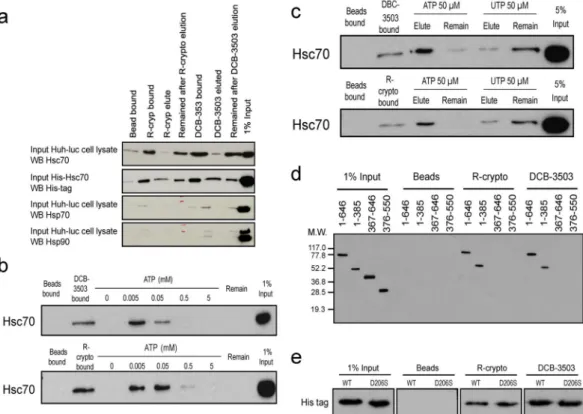
revealed that biotinylated DCB-3503 and rac-cryptopleurine bound to Hsc70 when Huh-luc/neo-ET cell lysate or recombinant polyhistidine (His)-tagged Hsc70 was run through the compound matrix column (Fig. 2a). Hsp70 or Hsp90 did not bind to the affinity matrix under the same conditions (Fig. 2a). Increasing concentration of ATP (Fig. 2b) but not UTP (Fig. 2c) eluted the compound-bound Hsc70. The binding was also dependent on ionic strength: 0.4 M NaCl eluted the bound Hsc70 from the affinity matrix (Figure S1d). Western blot results showed that both DCB-3503 and rac-cryptopleurine bound to the NBD of recombinant Hsc70 (residue 1–385) (Fig. 2d). The binding affinity of DCB-3503 and rac-cryptopleurine to Hsc70 did not change when a D206S mutation was introduced into the ATPase pocket in the NBD of Hsc70 (Fig. 2e)25. In order to determine antibody specificity,
we expressed and purified recombinant Hsp70. Western blot results indicated that the Hsc70 antibody we used recognized only recombinant Hsc70 but not Hsp70 (Figure S1e). Isothermal titration calorimetry (ITC) revealed that DCB-3503 and rac-cryptopleurine showed similar binding affinities to the full length (FL) and the NBD of Hsc70 (Table 1 and Figure S1f). The protein level of Hsc70 remained unchanged throughout the treatment with
DCB-3503 or rac-cryptopleurine for up to 72 hours (Figure S1g).
Figure 2. Tylophorine analogs interact with Hsc70. (a) Hsc70, but not Hsp70 or Hsp90, bound specifically
to rac-cryptopleurine or DCB-3503 affinity resin. (b) Bound recombinant Hsc70 was eluted with increasing concentrations of ATP. The Hsc70 in each fraction was resolved by Western blot. (c) Bound recombinant Hsc70 was eluted with 50 µM ATP or UTP. Hsc70 in each fraction was resolved by Western blot. (d) His-tagged different fragments of Hsc70 were incubated with streptavidin-agarose beads coated with biotinylated-rac -cryptopleurine or -DCB-3503. Bound proteins were immunoblotted with anti-His tag antibody. (e) His-tagged Hsc70 protein harboring D206S mutation was incubated with streptavidin-agarose beads pre-bound to biotinylated-rac-cryptopleurine or -DCB-3503. Bound proteins were immunoblotted with anti-His tag antibody. Results are representative of at least three independent experiments.
Compound Protein n Kd (M) ΔH (kCal/mol) ΔS (cal/(mol·K))
DCB-3503 Hsc70 FL 0.41 2.8 ± 0.5 3079 35.7
DCB-3503 Hsc70 NBD 0.49 4.4 ± 0.9 5135 41.7
rac-Cryptopleurine Hsc70 FL 0.57 3.1 ± 0.33 2019 32.0
rac-Cryptopleurine Hsc70 NBD 1.06 2.7 ± 0.48 1905 31.9
Table 1. Thermodynamic parameters obtained from the ITC measurement of the binding between tylophorine
www.nature.com/scientificreports/
Hsc70 is involved in the anti-HCV activity of DCB-3503.
We constructed an Hsc70overexpres-sion plasmid with silent mutation on the shRNA targeting sites (rHsc70-1, and rHsc70-2, Fig. 3a) to deter-mine the off-target effect of shRNA. Down-regulation of Hsc70 with shRNA reduced HCV RNA replication and suppressed expression of NS3 and NS5A (lanes 3 and 5 in Fig. 3b). The RNAi phenotype was partially res-cued by over-expressing HA-rHsc70s (Fig. 3b), suggesting that suppression of Hsc70 was responsible for the down-regulation of HCV replication. Transfection of wild type (WT) HA-tagged Hsc70 also inhibited HCV RNA replication (Fig. 3b, quantitative results of protein expression are shown in Figure S2a). shRNA knockdown of Hsc70 for 48 hours enhanced the anti-HCV activity of DCB-3503 as reflected by the resultant decrease in HCV RNA, NS3, and NS5A levels (Fig. 3c, quantitative results of protein expression were shown in Figure S2b). Reduced expression of Hsc70 by shRNAs did not significantly affect cell growth (Figure S2c). Complete knockout of Hsc70 with combination of two shRNAs is lethal to cells; thus, a more significant anti-HCV effect could not be
Figure 3. Tylophorine analogs exhibit anti-HCV activity via interaction with Hsc70 in HCV genotype 1b
demonstrated. Overexpression of either WT or D206S mutant HA-tagged Hsc70 inhibited expression levels of HCV RNA and NS proteins, and further enhanced the anti-HCV effect of DCB-3503 (Fig. 3d, quantitative results of protein expression are shown in Figure S2d) without changing the cell growth curve (Figure S2e). Treatment with DCB-3503 inhibited translation of HCV in vitro (Figure S2f), and pretreatment of HLN-cured cells with 30 nM DCB-3503 for 24 hours reduced the cells’ ability to support HCV replication by about 2-fold (Figure S2g). Furthermore, the replication rate of HCV RNA transfected into HLN-cured cells with reduced Hsc70 expres-sion by shRNA was about 3-fold slower than those HLC-cured cells without Hsc70 shRNA treatment (Fig. 3e). The Hsc70 expression levels are shown in Figure S2h. Alteration of expression of Hsc70 is related to HCV RNA replication.
Hsc70 is associated with the HCV replication complex.
Hsc70 exhibits its function via association with different cellular complexes26. We thus examined whether Hsc70 is associated with the HCV replicationcomplex. Post-nuclear supernatant of untreated, DCB-3503-treated or rac-cryptopleurine-treated Huh-luc/ neo-ET cells were fractionated on continuous optiprep iodixanol density gradients (Figs 4a–c, S2i). The optiprep density gradients separated membrane vesicles (Alix and Hrs as markers in fractions 1–6, and GRP 78 as marker in fractions 1–2), and endoplasmic reticulum (ER) (GRP78 and Calenxin as markers in fractions 7–11) (Fig. 4a). In untreated control cells, HCV RNA, NS3, and NS5A exhibited the same sedimentation with the membrane vesicles and ER in fractions 5–11 (Fig. 4a and b), a result consistent with the density reported earlier27. In cells
treated with DCB-3503 or rac-cryptopleurine; however, HCV RNA, NS3, and NS5A agglomerated with the ER in fractions 8–11 (Fig. 4a and b). Hsc70 showed the same sedimentation shift with the membrane vesicles (fractions 1–3) and ER (fractions 7–11) in both untreated control and drug-treated cells (Fig. 4a). DCB-3503 accumulated in the first two fractions with 60–80 nM concentration where Hsc70 was primarily located (Fig. 4c). In addition, DCB-3503 was found in fractions 3–12 at around 1 nM concentration (Fig. 4c). The amount of rac-cryptopleurine in the fractions was too low to detect with LC/MS/MS. The cosedimentation of Hsc70 with HCV NS3, NS5A, and ER marker Calnexin was disrupted when the cytoplasmic fraction was treated with 0.5 M NaCl or RNase
Figure 4. Hsc70 associates with HCV replicon complex. (a) Partition of NS3, NS5A, Hsc70, Calnexin, GRP78,
www.nature.com/scientificreports/
A before centrifugation to isolate crude HCV replicon (Fig. 4d). All the examined proteins were found only in the supernatant fraction with addition of 0.1% SDS (Fig. 4d). NS3 and NS5A remained in the membrane-rich pellet fraction when ionic strength was changed with NaCl, or when the RNA was depleted with RNase treatment (Fig. 4d). However, addition of 0.5 M NaCl or 0.1 μg/μl of RNase released Hsc70 from the membrane-rich pellet fraction to the supernatant (Fig. 4d). Addition of 0.1% SDS totally disrupted the membrane structure and released NS3, NS5A, and Hsc70 to the supernatant (Fig. 4d).
Treatment with DCB-3503 promotes binding of Hsc70 to HCV RNA.
Given the result of theco-sedimentation of Hsc70 with HCV NS proteins and RNA, we further examined the association of Hsc70 with HCV replication complex. Real-time PCR results showed that more than 30% of HCV RNA was present in the Hsc70 immunoprecipitated complex (Fig. 5a). The level of HCV RNA in the input and Hsc70-associated complex did not change significantly after treatment with up to100 nM DCB-3503 for 6 hours. However, the amount of Hsc70-associated NS5A and NS5B were reduced with treatment of 30 nM and 100 nM of DCB-3503 for 6 hours (Fig. 5a). NS3/4 A, NS4B, or host RNAs (β-actin and survivin) did not bind to Hsc70 under the same conditions (Figs 5a and S3a,b). RNase A treatment decreased the amount of NS5A and NS5B associated with Hsc70 (Figure S3c). We then analyzed the association between NS5B and Hsc70 and between HCV RNA and NS5B using a co-immunoprecipitation method. DCB-3503 treatment reduced the amount of Hsc70 bound to
Figure 5. Tylophorine analogs stimulated the ATP hydrolysis function of Hsc70 modulating its association
with HCV RNA. (a) Hsc70-associated HCV RNA and protein was immunoprecipitated with Hsc70 antibody. The level of HCV RNA was examined by real-time PCR. Protein levels of NS3, NS5A, NS5B, and Hsc70 were analyzed by Western blot. (b) The schematic graph showed the RNA sequences used in Fig. 5c,d. Nucleotide positions correspond to the HCV genotype 1b complete genome isolate Con1 (GI 5420376). (c) Either streptavidin beads alone or in vitro transcribed biotinylated RNA with the sequences shown in (b) were mixed with purified Hsc70 protein. RNA-bound Hsc70 was detected by Western blot analysis. (d) Unlabeled RNA was used to compete the binding with biotinylated short poly U/UC RNA for binding to Hsc70. (e) The schematic graph shows the poly U/UC region of HCV genotype 2a (JFH-1, GI 13122261). The binding assay was done as shown in (d). Results of (a)–(e) are representative from at least three independent experiments. Effect of (f) DCB-3503, (g) rac-cryptopleurine, or (h) 2-phenylethanesulfonamide (PES) on the Km of Hsc70 for ATP
binding in the presence or absence of short poly U/UC or poly C RNA. The concentration of generated ADP was analyzed and calculated based on the area under the curve (AUC). The Km and Vmax values were calculated
HA-tagged NS5B when immunoprecipitated with HA antibody (Figure S3d). The association of NS5B and Hsc70 to biotinylated HCV RNA was also decreased with addition of DCB-3503 (Figure S3e). Hsc70 can bind to the AU-rich elements in the 3′ untranslated region of Bim mRNA28. Thus, we generated constructs with different
specific motifs of the 3′ nontranslated region (3′ NTR) of HCV genotype 1b RNA to determine the Hsc70 binding RNA sequence (Fig. 5b)29. Hsc70 bound to all the biotinylated RNA fragments containing AUUUA and poly U/
UC sequences (Fig. 5c). Biotinylated RNA containing only the AUUUA sequence showed relatively weak asso-ciation with Hsc70 compared with poly U/UC RNA (Fig. 5d). Hsc70 was not associated with Poly A RNA under the same conditions (Fig. 5c). The association of short poly U/UC RNA with Hsc70 was comparable to that of other longer RNA fragments (Fig. 5c), which suggests that the poly U/UC sequence is essential but not necessarily sufficient for binding to Hsc70. The poly U/UC RNA below refers to the short form of HCV genotype 1b. Poly U/UC RNA did not bind to fragments of Hsc70 (Figure S3f) or Hsp70 (Figure S3g) under the same conditions. Addition of increasing concentrations of unlabeled poly U/UC or AU + UC RNA competed with the association of biotinylated poly U/UC RNA to Hsc70 in a dose dependent manner (Fig. 5d). As much as 9-fold of unlabeled AUUUA RNA could not compete with poly U/UC binding with the same efficiency (last three lanes, Fig. 5d). Deletion of the poly U/UC region in the 3′ NTR could not support HCV replication (Figure S3h). Since the poly U/UC region in the 3′NTR of the HCV genome is conserved through all genotypes29, we then generated the poly
U/UC region of HCV genotype 2a JFH1 clone (Fig. 5e) and performed the RNA-binding assay under the same conditions. Biotin labeled poly U/UC RNA of HCV genotype 2a also bound to Hsc70 and the increasing amount of unlabeled poly U/UC RNA decreased the association to Hsc70 (Fig. 5e) as poly U/UC RNA from HCV geno-type 1b (Fig. 5d).
Tylophorine analogs stimulate the ATPase activity of Hsc70 in the presence of poly U/UC
RNA.
The association between Hsc70 and interacting proteins or RNAs is primarily regulated by its ATPase activity19. We determined the ability of tylophorine analogs to regulate the ATPase activity of Hsc70.DCB-3503 and rac-crytopleurine stimulated ATP hydrolysis of FL Hsc70 only at relatively high concentrations (Figure S4a and b). Meanwhile, the Km of Hsc70 for ATP-binding was reduced to about 50% by DCB-3503 or
rac-cryptopleurine in the presence or absence of poly U/UC RNA (Fig. 5f and g). Addition of an equal amount of poly C RNA into the reaction did not change the Km for ATP-binding by DCB-3503 and rac-cryptopleurine
under the same conditions (Fig. 5f and g). Hsp70 inhibitor 2-phenylethanesulfonamide (PES)25 did not change Km (Fig. 5h), while PES inhibited hydrolysis of ATP by increasing Km for ATP-binding in the presence of poly U/
UC RNA (Fig. 5h). The Vmax of Hsc70 for ATP hydrolysis did not change significantly under the same conditions
by DCB-3503, or rac-cryptopleurine, or PES (Figure S4c–e).
Co-chaperone protein BAG1 is involved in the anti-HCV activity of tylophorine
ana-logs.
Co-chaperone proteins regulate the ATPase activity of Hsc70 by modulating the ATP/ADP hydrolysis cycle30. The co-chaperone protein BAG-1 is bound to a conserved BAG domain of Hsc70 that interacts with itsATPase domain30. To determine the function of BAG1 in the anti-HCV activity of the tylophorine analogs, we
constructed an HA-tagged BAG1 plasmid and transfected it into Huh-luc/neo-ET cells. The expression level of BAG1 was not affected by DCB-3503 treatment for up to 6 hours (Fig. 6a); however, the amount of BAG1 that bound to Hsc70 was decreased with the DCB-3503 treatment (Fig. 6a). Transfection of HA-tagged BAG1 enhanced the inhibitory activity of DCB-3503 and rac-cryptopleurine on HCV RNA replication, as well as expression levels of NS3 and NS5A (Fig. 6b,c). The expression level of HA-BAG1 was decreased with DCB-3503 and rac-cryptopleurine treatment for 48 hours (Fig. 6b,c).
Discussion
The tylophorine analogs have exhibited various activities, yet the only molecular target VEGFR2 revealed for this group of compounds was associated with their anti-cancer activities9. One report has suggested that
tylopho-rine or (–)-(R)-tylophorine attenuated HCV IRES-mediated translation by suppressing expression of cyclin A231.
However, results of our structure–activity relationship studies suggested that tylophorine was not a functional analog of DCB-3503 and rac-cryptopleurine8, 21–23. Our study revealed that DCB-3503 stimulated the ATPase
activity of Hsc70, thus inhibited translation of cyclin D1 mRNA10. In this study, we evaluated both five- and
six-membered E-ring tylophorine analogs as potent inhibitors of HCV replication (Figures 1 and S1a). No resist-ant clones could be isolated with either DCB-3503 or rac-cryptopleurine treatment (Figure S1a), suggesting that the tylophorine analogs inhibit HCV replication through modulation of the functions of the host’s factor(s).
Hsc70 is associated with the HCV replication complex.
Host chaperones and co-chaperones playimportant functions in the assembly of the viral replication complex and the replication of the viral genome. Hsc70 participated in the RNA-dependent replication of sindbis virus32, influenza virus33, rotavirus34, and dengue
virus35. Hsc70 also associated with lipid droplet in HCV-infected cells36. Suppression of Hsc70 expression using
shRNAs decreased the infectivity of the HCV J6/JFH virion36. DNAJC14 regulated the chaperone activity of
Hsp70; over-expression of DNAJC14 disrupted the stoichiometry of the chaperone/substrate and assembly of the yellow fever virus replication complex37.
www.nature.com/scientificreports/
UC RNA motif is critical for the efficient translation and replication of HCV RNA efficiently38, 39. Deletion of the
poly U/UC sequence inhibited replication of HCV in subgenomic replicon cells (Figure S3f)29, 38. An HCV viral
genome lacking this element was not infectious40. Therefore, we presume that DCB-3503 and rac-cryptopleurine
could also inhibit replication of other genotypes, for example HCV genotype 2a and its quasispecies that maintain the 3′NTR poly U/UC motif. Poly U/UC was essential for binding to replication factors like the FUSE binding protein41 and hnRNP A142. These RNA-binding proteins regulated translation through either stabilization of
RNA or promotion of RNA decay43. A single nucleotide base change sharply reduced the binding affinity between
Hsc70 and its associated AUUUA motif in the 3′ untranslated region of host mRNAs10. We found that
tylopho-rine analogs did not inhibit replication of HIV or HBV (results not shown). HIV and HBV have very different sequences from that of HCV, especially in that they do not contain the poly U/UC motif in the 3′NTR. These results suggest that Hsc70 is associated with HCV replication complex preferentially through binding to the uridine rich motif in the 3′NTR.
Two previous reports demonstrated that suppression of Hsc70 by using siRNAs or small molecule inhibitors did not affect HCV RNA replication but rather impacted on the release of virons36, 44. The conflict results may be
due to the genotype difference of the Con1 isolate used in the present study from that of the J6/JFH isolated with infectivity36, 44. In addition, sequence and structure differences in the regulatory elements of HCV, like 5′NTR
and 3′NTR may require different regulating elements that contribute to differential infectivity and replication45.
Therefore, it is reasonable that we obtained results there were different from the previous reports36, 44.
Hsc70 is involved in HCV replication through regulating the translation of HCV RNA.
Weiden-tified Hsc70 as one of the molecular targets of functional tylophorine analogs using biotinylated-DCB-3503 and -rac-crytopleurine (Figures 2 and S1). The function of Hsc70 is regulated by communications between NBD and SBD. The ATP-bound form of Hsc70 has a “loose” configuration with low affinity for substrates; the ADP-bound state of Hsc70 shows high affinity with associated proteins or RNA46, and favors degradation of substrates47. For
example, binding of Hsc70 but not Hsp70 to CHIP promoted its degradation through ubiquitination48. ATP
hydrolysis of Hsc70 NBD induces a conformational switch in the adjacent SBD that enhances its binding affinity to substrates.
The binding between Hsc70 and tylophorine was affected by ATP concentration (Fig. 2b,c). DCB-3503 and
rac-cryptopleurine bind to the D206S ATPase mutant form of Hsc70, suggesting that the functional ATPase pocket was not required for the interaction (Fig. 2e). Either attenuation of Hsc70 expression level or ectopic expression of the WT or D206S mutant form of Hsc70 enhanced the anti-HCV activity of DCB-3503 (Figs 3b– d and S2a,b, and d). The binding of DCB-3503 or rac-crytopleurine to Hsc70 stimulated its ATPase activity in the presence of the poly U/UC motif of HCV RNA (Fig. 5f,g) without affecting Hsc70 protein expression (Figure S1g). Over-expression of co-chaperone protein BAG-1, which regulates the chaperone activity of Hsc70
Figure 6. Co-chaperone protein BAG-1 regulate anti-HCV activity of tylophorine analogs. (a) DCB-3503
treatment decreased interaction of co-chaperone protein BAG-1 and Hsc70. Huh-luc/neo-ET cells were transiently transfected with HA- BAG-1 plasmid. The cells were treated with 30 nM DCB-3503 48 hours after transfection. Hsc70-associated HA-BAG-1 was immunoprecipitated with Hsc70 antibody as shown in Fig. 5a. Protein levels of HA-BAG-1 and Hsc70 were analyzed by Western blot. Huh-luc/neo-ET cells were transiently transfected in a six-well plate with 400 ng HA- BAG-1 plasmid or empty vector alone or in combination with (b) 30 nM DCB-3503, or (c) 3 nM rac-cryptopleurine for 36 hours. Levels of HCV RNA, NS3, NS5A, and HA-BAG-1 were analyzed by real-time PCR and Western blot, respectively. β-Actin served as the internal loading control. Results are representative of at least three independent experiments and presented as mean ± SD. P
by promoting ATP hydrolysis function of Hsc7049, significantly enhanced the anti-HCV activities of DCB-3503
and rac-cryptopleurine (Fig. 6b,c). Therefore, modulating the homeostasis of the ATP/ADP hydrolysis cycle of Hsc70 by tylophorine analogs is related to the inhibitory activity to HCV RNA replication. The HCV RNA asso-ciated to Hsc70 in the ADP binding state may be sent to degradation as other substrates of Hsc70. Suppression of Hsp70 expression by its inhibitor, quercetin, attenuated the IRES-mediated translation of HCV J6/JFH virus50.
It is also possible that perturbation of Hsc70 function markedly reduced the activities of NS5A and NS5B in the reduced level of free HCV RNA. The around 1 nM concentration of DCB-3503 accumulated in each fraction of fractions 5–12 (Fig. 4c) revealed that DCB-3503 could be associated with protein or a subcellular complex instead of existing in the free form. The concentration should be decreased sharply from fraction 3–12 if DCB-3503 was in the free form. Only co-localization of DCB-3503, NS proteins, and Hsc70 could make this possible. Regulating the ATPase activity of Hsc70 by DCB-3503 and rac-cryptopleurine may be one of the mechanisms by which these compounds modulate HCV replication.
Allosteric regulation of Hsc70 is an alternative strategy to regulate HCV replication.
ATPaseactivity of Hsc70 could be regulated by co-chaperones and/or small molecules, including the Bag (Bcl 2-associated athanogene) family of proteins30, 49, the Hsp40 family proteins51, the immunosuppressive agent
15-deoxyspergualin (DSG)52, or lycoricidine and analogs53, 54. DSG is associated with the EEVD domain in the
C-terminal of Hsc70 and Hsp9055. N-substituted benzyl matrinic acid derivatives, ( + )-lycoricidine and analogs
inhibited HCV replication through suppression of Hsc70 expression53, 54, 56.
Hsc70 is an abundant cellular protein; therefore, ectopic expression of Hsc70 could not suppress HCV repli-cation (Fig. 3b–d)57. Constitutive deletion of Hsc70 is embryonically lethal in mice, causing defects in multiple
organs58. We also observed that knockdown of Hsc70 by combined shRNAs induced cell death. Thus,
allosteri-cally modulating ATPase activity of Hsc70 could be a better option to perturb its function rather than decreasing its expression. DCB-3503 and rac-cryptopleurine binds to the NBD of Hsc70 but not HSP90 nor Hsp70 (Figures 2
and S1d) without changing the expression of Hsc70 (Figure S1g). Ectopic expression of BAG1, which promoted ATP hydrolysis activity of Hsc7030, significantly enhanced the anti-HCV activity of tylophorine analogs (Fig. 6).
The allosteric regulation of Hsc70 by DCB-3503 and rac-cryptopleurine is distinct from that of existing Hsc70 inhibitors and has not been reported previously. To our knowledge, the tylophorine analogs are the first known class of small molecules that associated with the NBD of Hsc70 and promote the hydrolysis of ATP (Fig. 5f and g). Taken together, we propose the following model for the mechanisms of action for the anti-HCV activity of functional tylophorine analogs. DCB-3503 or rac-cryptopleurine binds to the NBD of Hsc70 independent of the intact ATP pocket. The binding stimulates the ATP hydrolysis of Hsc70 in the presence of the poly U/UC motif of HCV RNA, and thus inhibits translation. The tylophorine analogs may be potentially used with other anti-HCV agents to attenuate HCV replication. We demonstrated that DCB-3503 exhibited anti-cancer and anti-arthritis activities4, 5, 10; therefore, this group of tylophorine analogs could have special advantages for the treatment of
can-cer and/or autoimmune diseases patients infected with HCV. However, many questions remain to be investigated. For example, the exact tylophorine binding site(s) of Hsc70 is (are) still unclear due to our failed attempt to deter-mine the Hsc70-DCB-3503 or Hsc70-rac-cryptopleurine complex by crystallography. Will the specific binding to the poly U/UC motif in HCV genotype 2a also be related to anti-HCV activity? And, the dynamic regulation by the tylophorine analogs of ATP/ADP turnover in Hsc70 remains unexplained.
Experimental procedures
Materials and reagents.
Cell culture media and fetal bovine serum (FBS) were purchased from Invitrogen. All reagents were purchased from Sigma-Aldrich (St. Louis, MO) except for those otherwise noted. The DCB series of compounds were synthesized in Dr. Baker’s laboratory. rac-Cryptopleurine and biotinylated-rac -cryp-topleurine were synthesized in Dr. Alois Fürstner’s laboratory. The YXM series of compounds were synthe-sized in Dr. Kuo-Hsiung Lee’s laboratory. The PA series of compounds were provided by Dr. Shishan Yu22.2-Phenylethanesulfonamide (PES) was purchased from Sigma–Aldrich. Information for plasmid construction and real-time PCR primers are provided in Tables S1 and S2, respectively.
Affinity purification.
The affinity purification method was adopted from a method reported by Emamiet al.59. Cells were lysed in protein-binding buffer [PBB, 20Mm Hepes, pH 7.9, 100 mM NaCl, 0.5 mM
EDTA, 0.5% Nonidet P-40, 6 mM MgCl2, 5 mM 2-mercaptoethanol, complete protease inhibitor (Roche)].
Biotinylated-rac-cryptopleurine and -DCB-3503 were bound overnight at room temperature to a 50% slurry of streptavidin–agarose beads (Invitrogen) in buffer containing 50% DMSO and 50% PBB. Beads were washed to remove unbound compound and then incubated with pre-cleared whole-cell lysates or recombinant protein in 2.5% BSA. Bound proteins were eluted, either specifically with rac-cryptopleurine or DCB-3503, or with a buffer specified in the figures. Proteins that remained bound to beads were eluted with SDS loading buffer. Samples were separated with SDS PAGE, and examined by Western blot or silver staining. Specific bands from silver-stained gel were analyzed by LTQ Orbitrap mass spectrophotometry (Yale University W.M. Keck Foundation Biotechnology Resource Laboratory).
Statistical analysis.
Data were analyzed by a two-tailed student’s t-test (Microsoft Office Excel). The differ-ence was considered to be statistically significant when p< 0.05.www.nature.com/scientificreports/
References
1. Chopra, R. N. L.-C., De, N. N. & Chakerburty, M. The pharmacological action of tylophorine: The alkaloid occurring in Tylophora Asthmaticus. Ind. J. Med. Res. 23, 263–269 (1935).
2. Raina, V. & Raina, S. The responsiveness of leukocyte adenyl cyclase to tylophorine in asthmatic subjects. Biochem. Biophys. Res. Commun. 94, 1074–1077 (1980).
3. You, X. et al. Effects of a novel tylophorine analog on collagen-induced arthritis through inhibition of the innate immune response.
Arthritis Rheum. 54, 877–886 (2006).
4. Gao, W. et al. Novel mode of action of tylophorine analogs as antitumor compounds. Cancer Res. 64, 678–688 (2004).
5. Shiah, H. S., Gao, W., Baker, D. C. & Cheng, Y. C. Inhibition of cell growth and nuclear factor-kappaB activity in pancreatic cancer cell lines by a tylophorine analogue, DCB-3503. Mol. Cancer Ther. 5, 2484–2493 (2006).
6. Yang, C. W., Chuang, T. H., Wu, P. L., Huang, W. H. & Lee, S. J. Anti-inflammatory effects of 7-methoxycryptopleurine and structure-activity relations of phenanthroindolizidines and phenanthroquinolizidines. Biochem. Biophys. Res. Commun. 354, 942–948 (2007). 7. Choi, J. Y. et al. Abrogation of skin disease in LUPUS-prone MRL/FASlpr mice by means of a novel tylophorine analog. Arthritis
Rheum. 54, 3277–3283 (2006).
8. Wang, Y., Gao, W., Svitkin, Y. V., Chen, A. P. & Cheng, Y. C. DCB-3503, a tylophorine analog, inhibits protein synthesis through a novel mechanism. PLoS One 5, e11607, doi:10.1371/journal.pone.0011607 (2010).
9. Saraswati, S., Kanaujia, P. K., Kumar, S., Kumar, R. & Alhaider, A. A. Tylophorine, a phenanthraindolizidine alkaloid isolated from Tylophora indica exerts antiangiogenic and antitumor activity by targeting vascular endothelial growth factor receptor 2-mediated angiogenesis. Mol. Cancer 12, 82 (2013).
10. Wang, Y. et al. Tylophorine analog DCB-3503 inhibited cyclin D1 translation through allosteric regulation of heat shock cognate protein 70. Sci. Rep. 6, 32832, doi:10.1038/srep32832 (2016).
11. Liang, T. J. & Ghany, M. G. Current and future therapies for hepatitis C virus infection. N. Engl. J. Med. 368, 1907–1917 (2013). 12. Phan, T., Kohlway, A., Dimberu, P., Pyle, A. M. & Lindenbach, B. D. The acidic domain of hepatitis C virus NS4A contributes to RNA
replication and virus particle assembly. J. Virol. 85, 1193–1204 (2011).
13. Stapleford, K. A. & Lindenbach, B. D. Hepatitis C virus NS2 coordinates virus particle assembly through physical interactions with the E1-E2 glycoprotein and NS3-NS4A enzyme complexes. J. Virol. 85, 1706–1717 (2011).
14. Zoulim, F. et al. Hepatitis C virus treatment in the real world: optimising treatment and access to therapies. Gut 64, 1824–1833 (2015). 15. Feld, J. J. et al. Sofosbuvir and Velpatasvir for HCV Genotype 1, 2, 4, 5, and 6 Infection. N. Engl. J. Med. 373, 2599–2607 (2015). 16. Foster, G. R. et al. Sofosbuvir and velpatasvir for HCV genotype 2 and 3 infection. N. Engl. J. Med. 373, 2608–2617 (2015). 17. Reiss, S. et al. Recruitment and activation of a lipid kinase by hepatitis C virus NS5A is essential for integrity of the membranous
replication compartment. Cell Host Microbe. 9, 32–45 (2011).
18. Furstner, A. & Kennedy, J. W. Total syntheses of the tylophora alkaloids cryptopleurine, (-)-antofine, (-)-tylophorine, and (-)-ficuseptine C. Chemistry 12, 7398–7410 (2006).
19. Chou, C. C. et al. Crystal structure of the C-terminal 10-kDa subdomain of Hsc70. J. Biol. Chem. 278, 30311–30316 (2003). 20. King, F. W., Wawrzynow, A., Hohfeld, J. & Zylicz, M. Co-chaperones Bag-1, Hop and Hsp40 regulate Hsc70 and Hsp90 interactions
with wild-type or mutant p53. EMBO J. 20, 6297–6305 (2001).
21. Wang, Y. et al. Cryptopleurine analogs with modification of e ring exhibit different mechanism to rac-cryptopleurine and tylophorine. PLoS One 7, e51138, doi:10.1371/journal.pone.0051138 (2012).
22. Gao, W. et al. Structure-activity studies of phenanthroindolizidine alkaloids as potential antitumor agents. Bioorg Med Chem Lett 17, 4338–4342 (2007).
23. Gao, W. et al. Structural analogs of tylophora alkaloids may not be functional analogs. Bioorg. Med. Chem. Lett. 18, 704–709 (2008). 24. Cheng, Y. et al. A novel class of meso-tetrakis-porphyrin derivatives exhibits potent activities against hepatitis C virus genotype 1b
replicons in vitro. Antimicrob Agents Chemother. 54, 197–206 (2010).
25. Leu, J. I., Pimkina, J., Frank, A., Murphy, M. E. & George, D. L. A small molecule inhibitor of inducible heat shock protein 70. Mol. Cell 36, 15–27 (2009).
26. Sharma, M., Burre, J. & Sudhof, T. C. CSPalpha promotes SNARE-complex assembly by chaperoning SNAP-25 during synaptic activity. Nature Cell. Biol. 13, 30–39 (2011).
27. Moradpour, D. et al. Membrane association of the RNA-dependent RNA polymerase is essential for hepatitis C virus RNA replication. J. Virol. 78, 13278–13284 (2004).
28. Matsui, H., Asou, H. & Inaba, T. Cytokines direct the regulation of Bim mRNA stability by heat-shock cognate protein 70. Mol. Cell
25, 99–112 (2007).
29. Schnell, G., Loo, Y. M., Marcotrigiano, J. & Gale, M. Jr. Uridine composition of the poly-U/UC tract of HCV RNA defines non-self recognition by RIG-I. PLoS Pathogens 8, e1002839, doi:10.1371/journal.ppat.1002839 (2012).
30. Briknarova, K. et al. Structural analysis of BAG1 cochaperone and its interactions with Hsc70 heat shock protein. Nat. Struct. Biol.
8, 349–352 (2001).
31. Pham, L. V., Ngo, H. T., Lim, Y. S. & Hwang, S. B. Hepatitis C virus non-structural 5B protein interacts with cyclin A2 and regulates viral propagation. J. Hepatol. 57, 960–966 (2012).
32. Gorchakov, R., Garmashova, N., Frolova, E. & Frolov, I. Different types of nsP3-containing protein complexes in Sindbis virus-infected cells. J. Virol. 82, 10088–10101 (2008).
33. Watanabe, K. et al. Hsc70 regulates the nuclear export but not the import of influenza viral RNP: A possible target for the development of anti-influenza virus drugs. Drug. Discov. Ther. 2, 77–84 (2008).
34. Gutierrez, M. et al. Different rotavirus strains enter MA104 cells through different endocytic pathways: the role of clathrin-mediated endocytosis. J. Virol. 84, 9161–9169 (2010).
35. Kakumani, P. K. et al. Dengue NS3, an RNAi suppressor, modulates the human miRNA pathways through its interacting partner.
Biochem. J. 471, 89–99 (2015).
36. Parent, R., Qu, X., Petit, M. A. & Beretta, L. The heat shock cognate protein 70 is associated with hepatitis C virus particles and modulates virus infectivity. Hepatology 49, 1798–1809 (2009).
37. Yi, Z. et al. Identification and characterization of the host protein DNAJC14 as a broadly active flavivirus replication modulator.
PLoS Pathogens 7, e1001255, doi:10.1371/journal.ppat.1001255 (2011).
38. Friebe, P. & Bartenschlager, R. Genetic analysis of sequences in the 3′ nontranslated region of hepatitis C virus that are important for RNA replication. J. Virol. 76, 5326–5338 (2002).
39. You, S. & Rice, C. M. 3′ RNA elements in hepatitis C virus replication: kissing partners and long poly(U). J. Virol. 82, 184–195 (2008). 40. Kolykhalov, A. A., Mihalik, K., Feinstone, S. M. & Rice, C. M. Hepatitis C virus-encoded enzymatic activities and conserved RNA
elements in the 3′ nontranslated region are essential for virus replication in vivo. J. Virol. 74, 2046–2051 (2000).
41. Zhang, Z., Harris, D. & Pandey, V. N. The FUSE binding protein is a cellular factor required for efficient replication of hepatitis C virus. J. Virol. 82, 5761–5773 (2008).
42. Kim, C. S., Seol, S. K., Song, O. K., Park, J. H. & Jang, S. K. An RNA-binding protein, hnRNP A1, and a scaffold protein, septin 6, facilitate hepatitis C virus replication. J. Virol. 81, 3852–3865 (2007).
44. Peng, Z. G. et al. Small molecular compounds that inhibit hepatitis C virus replication through destabilizing heat shock cognate 70 messenger RNA. Hepatology 52, 845–853 (2010).
45. Yanagi, M., St Claire, M., Emerson, S. U., Purcell, R. H. & Bukh, J. In vivo analysis of the 3′ untranslated region of the hepatitis C virus after in vitro cDNA clone. Proc. Natl. Acad. Sci. USA 96, 2291–2295 (1999).
46. Xu, Z. et al. Structural basis of nucleotide exchange and client binding by the Hsp70 cochaperone Bag2. Nat Struct Mol Biol 15, 1309–1317 (2008).
47. Young, Z. T. et al. Stabilizing the Hsp70-Tau complex promotes turnover in models of tauopathy. Cell Chem. Biol. 23, 992–1001 (2016). 48. Smith, M. C. et al. The E3 ubiquitin ligase CHIP and the molecular chaperone Hsc70 form a dynamic, tethered complex.
Biochemistry 52, 5354–5364 (2013).
49. Sondermann, H. et al. Structure of a Bag/Hsc70 complex: convergent functional evolution of Hsp70 nucleotide exchange factors.
Science 291, 1553–1557 (2001).
50. Gonzalez, O. et al. The heat shock protein inhibitor Quercetin attenuates hepatitis C virus production. Hepatology 50, 1756–1764 (2009). 51. Hartl, F. U. & Hayer-Hartl, M. Molecular chaperones in the cytosol: from nascent chain to folded protein. Science 295, 1852–1858 (2002). 52. Nadler, S. G. et al. Identification of a binding site on Hsc70 for the immunosuppressant 15-deoxyspergualin. Biochem. Biophys. Res.
Commun. 253, 176–180 (1998).
53. Chen, D. Z. et al. Evaluation of anti-HCV activity and SAR study of (+)-lycoricidine through targeting of host heat-stress cognate 70 (Hsc70). Bioorg. Med. Chem. Lett. 23, 2679–2682 (2013).
54. Chen, D. et al. Design, synthesis and structure-activity relationship optimization of lycorine derivatives for HCV inhibition. Sci. Rep.
5, 14972 (2015).
55. Nadler, S. G., Tepper, M. A., Schacter, B. & Mazzucco, C. E. Interaction of the immunosuppressant deoxyspergualin with a member of the Hsp70 family of heat shock proteins. Science 258, 484–486 (1992).
56. Du, N. N. et al. N-substituted benzyl matrinic acid derivatives inhibit hepatitis C virus (HCV) replication through down-regulating host heat-stress cognate 70 (Hsc70) expression. PLoS One 8, e58675, doi:10.1371/journal.pone.0058675 (2013).
57. Chen, Y. J. et al. Heat shock protein 72 is associated with the hepatitis C virus replicase complex and enhances viral RNA replication.
J. Biol. Chem. 285, 28183–28190 (2010).
58. Cazale, A. C. et al. Altered expression of cytosolic/nuclear HSC70-1 molecular chaperone affects development and abiotic stress tolerance in Arabidopsis thaliana. J. Exp. Bot. 60, 2653–2664 (2009).
59. Emami, K. H. et al. A small molecule inhibitor of beta-catenin/CREB-binding protein transcription. Proc. Natl. Acad. Sci. USA 101, 12682–12687 (2004).
Acknowledgements
We are indebted to Dr. Ralf Bartenschlager for the Huh-luc/neo-ET and Huh 9-13 replicon cell lines, and pFK I389 Lucubineo NS3-3′ plasmid. We thank Dr. Michael Gale Jr. for the pcDNA3.1 HCV NS3/4 A, pcDNA 3.1 HCV NS5A plasmids. We thank Dr. Baker and Yuri Ahuja for proofreading the manuscript. We thank Kathy Stone and Tom Abbott from the Yale Cancer Center Mass Spectrometry Resource and W.M. Keck Foundation Biotechnology Resource Laboratory for LTQ Orbitrap mass spectrometry analysis. We thank Ewa Folta-Stogniew at the Biophysics Resource of W.M. Keck Foundation Biotechnology Resource Laboratory for assistance with the ITC experiment. Dr. Yung-Chi Cheng is a fellow of the National Foundation for Cancer Research. This work was supported by grants CA177584-01 from National Institute of Health to KHL, PO1 CA154295 from National Cancer Institute, 5RO1 AI 038204 from National Institute of Health, and a gift from William H Prusoff Foundation to YCC, Macao Science and Technology Development Fund 041/2014/A1, Research Fund of the University of Macao MYRG2014-00161-ICMS-QRCM, MYRG2014-00153-ICMS-QRCM, and MYRG2016-00105-ICMS-QRCM to YW. The funders had no role in study design, data collection and analysis, decision to publish, or preparation of the manuscript.
Author Contributions
Y.W. designed and performed most of the experiments, wrote the manuscript, and provided financial support to the work. S.L. and Y.H. studied the interaction of Hsc70 and tylophorine analogs by ITC and crystallography. W.L. and S.R.C. designed and constructed the Hsc70 shRNAs, recombinant HSP70, and performed some of the experiments. G.E.D. performed the LC–MS/MS analysis of DCB-3503 and rac-cryptopleurine in cellular fractions. E.A.G., S.P.G., and G.E.D. screened tylophorine analogs against HCV, HIV, HBV, and different types of cancer cells lines. Y.C. selected drug resistant clones. A.F. synthesized rac-cryptopleurine and
biotinylated-rac-cryptopleurine. S.F. and D.C.B. synthesized DCB series of compounds. X.Y. and K.H.L. synthesized the rac -cryptopleurine and other related tylophorine analogs. Y.C.C. designed the experiments, wrote the manuscript, and provided financial support to the work.
Additional Information
Supplementary information accompanies this paper at doi:10.1038/s41598-017-08815-z
Competing Interests: The authors declare that they have no competing interests.
Publisher's note: Springer Nature remains neutral with regard to jurisdictional claims in published maps and
institutional affiliations.
Open Access This article is licensed under a Creative Commons Attribution 4.0 International
License, which permits use, sharing, adaptation, distribution and reproduction in any medium or format, as long as you give appropriate credit to the original author(s) and the source, provide a link to the Cre-ative Commons license, and indicate if changes were made. The images or other third party material in this article are included in the article’s Creative Commons license, unless indicated otherwise in a credit line to the material. If material is not included in the article’s Creative Commons license and your intended use is not per-mitted by statutory regulation or exceeds the perper-mitted use, you will need to obtain permission directly from the copyright holder. To view a copy of this license, visit http://creativecommons.org/licenses/by/4.0/.