A Framework for Supporting User-Centric
Collaborative Information Seeking
by Chirag Shah
A dissertation submitted to the faculty of the University of North Carolina at Chapel Hill in partial fulfillment of the requirements for the degree of Doctor of Philosophy in the School of Information & Library Science.
Chapel Hill 2010
Approved by:
Gary Marchionini, Advisor
Deborah Barreau, Committee Member
Susan Dumais, Committee Member
Diane Kelly, Committee Member
c
Abstract
CHIRAG SHAH: A Framework for Supporting User-Centric Collaborative Information Seeking.
(Under the direction of Gary Marchionini.)
Acknowledgments
I would like to thank all of the following people and organizations for their contributions to my research. Without them, this work would not exist.
• Gene Golovchinsky and Jeremy Pickens at FXPAL, California, for introducing me
to the area of collaborative information retrieval during my internship in summer 2007.
• The National Science Foundation, for funding my studies and research with IIS
grant # 0812363.
• SILS office staff, for timely processing required paperwork, including the IRB
applications, for my user studies.
• SILS library staff, for their kind support and cooperation during my laboratory study that lasted about three months.
• Rob Capra, Katrina Muller, Tessa Sullivan, and Heather Bowden, for helping me
pilot my laboratory study.
• All of the participants in my user studies, for investing time and energy in my
research.
my work, I could not have been able to even embark upon this journey presented here.
• The rest of my dissertation committee members - Diane Kelly, Barbara
Wilde-muth, Deborah Barreau, and Susan Dumais, for their highly valuable feedback and guidance throughout the process of this dissertation.
• My mother, father, and sister, for their constant love, kindness, and support, even
when they are all in different continents.
Table of Contents
Abstract iii
List of Figures x
List of Tables xv
1 Introduction 1
1.1 Research problem and questions . . . 4
1.2 Significance of the proposed research . . . 6
1.3 Summary . . . 8
2 Literature Review 10 2.1 Collaboration . . . 11
2.1.1 Definitions and models of collaboration . . . 11
2.1.2 Principles of collaboration . . . 17
2.1.3 Process of collaboration . . . 19
2.1.4 Limitations of collaboration . . . 22
2.1.5 Collaboration in the context of information science . . . 25
2.2 Information seeking . . . 29
2.3 Information filtering . . . 41
2.4.2 Explicitness of collaboration . . . 53
2.5 Social networking . . . 55
2.6 Collaborative Information Seeking (CIS) . . . 67
2.6.1 Space and time aspects of CIS . . . 68
2.6.2 User-source-time configuration for CIS . . . 69
2.6.3 Control, communication, and awareness in a CIS environment . 72 2.6.4 Co-browsing or collaborative/social navigation . . . 84
2.6.5 Collaborative IR . . . 87
2.6.6 Realization of a collaborative environment . . . 90
2.7 Evaluation . . . 93
2.8 Conclusion . . . 96
3 Design Investigations and System Development 102 3.1 Preliminary design of Coagmento . . . 103
3.2 Study-1: Personal interviews . . . 107
3.2.1 Instances of collaboration (What) . . . 109
3.2.2 Motivations for collaboration (Why) . . . 111
3.2.3 Methods for collaboration (How) . . . 113
3.2.4 Summary . . . 114
3.3 Study-2: Demonstrative walkthroughs . . . 119
3.4 Study-3: Pilot runs . . . 123
3.4.1 Procedure . . . 123
3.4.2 Data description . . . 125
3.4.3 Analysis . . . 136
3.5 Study-4: Participatory design . . . 139
3.5.1 Coming up with design specifications . . . 140
3.6 Improved Coagmento . . . 146
3.7 Conclusion . . . 148
4 Experiments and Results 152 4.1 Background . . . 153
4.2 Method . . . 154
4.2.1 Participants . . . 155
4.2.2 Conditions . . . 157
4.2.3 Sessions . . . 161
4.2.4 Tasks . . . 165
4.2.5 Evaluation . . . 167
4.2.6 Supervising the study . . . 174
4.3 Description of overall user activity . . . 175
4.3.1 Webpages and sources . . . 176
4.3.2 Search queries . . . 177
4.4 Analysis . . . 177
4.4.1 Effectiveness . . . 182
4.4.2 Efficiency . . . 183
4.4.3 Awareness . . . 186
4.4.4 Effort . . . 193
4.4.5 Ease of use and satisfaction . . . 195
4.4.6 Engagement . . . 196
4.5 Conclusion . . . 197
5 Discussion 201 5.1 Instances, motivations, and methods for collaboration . . . 202
5.3 Role of awareness in CIS environments . . . 205
5.4 Limitations . . . 208
5.5 A framework for CIS environments . . . 210
5.5.1 A model of collaboration . . . 211
5.5.2 A model of CIS . . . 212
5.6 Future work . . . 219
5.6.1 Extending the studies . . . 220
5.6.2 Theoretical issues . . . 220
Bibliography 223
A Definitions 238
B Study-1 Interview Questionnaire 240
C Laboratory Study Recruiting 242
D Laboratory Study Demographic Questionnaire 244
E Query Re-usage Analysis 246
List of Figures
1.1 Contextual depiction of Collaborative Information Seeking (CIS). . . . 9
2.1 A model showing steps to a meaningful collaboration. (Taylor-Powell, Rossing, and Geran, 1998) . . . 13
2.2 A set-based model of collaboration. An inner set is essential to or sup-ports the outer set. . . 13
2.3 Distinguishing communication, contribution, coordination, cooperation, and collaboration using different variables. A variable is represented with a bar going minimum to maximum from left to right. . . 18
2.4 Structure of messy problem solving (Denning and Yaholkovsky, 2008). . 22
2.5 Wilson’s model of information seeking (T. D. Wilson, 1997). . . 32
2.6 A comparison of Ellis’s and Kuhlthau’s frameworks (T. D. Wilson, 1999). 33 2.7 Wilson’s new model incorporating information behavior (T. D. Wilson, 1997). . . 33
2.8 Four layer model of information seeking centered around information access and organization. . . 35
2.9 Extension of the four layer model of information access and organization. 37 2.10 A model for Collaborative Information Seeking (CIS) extended from the model in Figure 2.8. . . 40
2.11 A typical scenario of information seeking in an IR environment. . . 42
2.12 Content-based information filtering. . . 44
2.13 Collaborative information filtering. . . 44
2.16 Looking at collaboration with the amount of explicitness or intention from user and system. . . 54 2.17 Looking at collaboration with space and time dimensions. (Twidale and
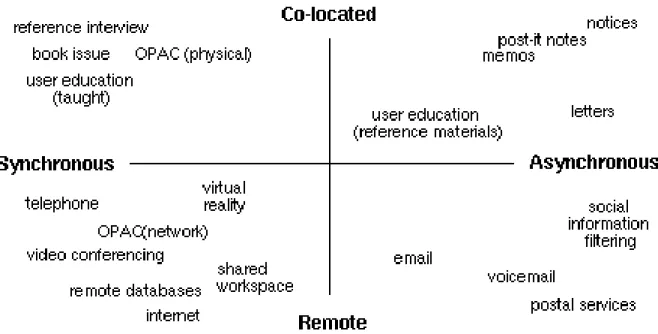
Nichols, 1996). . . 69 2.18 A classification space for CSCW systems (Rodden, 1991). . . 70 2.19 General awareness supporting serendipitous communication, division of
labor, and focused collaboration (Gaver, 1991). . . 77 2.20 A search visualization in Ariadne (Twidale et al., 1995). . . 80 2.21 Screenshot of SearchTogether. (a) integrated messaging, (b) query
aware-ness, (c) current results, (d) recommendation queue, (e)(f)(g) search but-tons, (h) page-specific metadata, (i) toolbar, (j) browser. (Morris and Horvitz, 2007). . . 81
3.1 Timeline for Coagmento design and development, along with the studies. 103 3.2 The main interface and its components in Coagmento. . . 105 3.3 Toolbar provided on top of the document being viewed with Coagmento. 107 3.4 Collaborative systems/methods organized according to time and space
aspects. . . 116 3.5 Query distribution for the individuals. Consecutive numbers are pairs
(e.g., 1-2, 3-4, etc.). . . 126 3.6 Query distribution for the groups. . . 126 3.7 Query distribution summary. . . 127 3.8 Viewed documents distribution for the individuals. Consecutive numbers
3.11 Saved documents distribution for the individuals. Consecutive numbers
are pairs (e.g., 1-2, 3-4, etc.). . . 130
3.12 Saved documents distribution for the groups. . . 131
3.13 Saved documents summary. . . 131
3.14 Snippets distribution for the individuals. Consecutive numbers are pairs (e.g., 1-2, 3-4, etc.). . . 132
3.15 Snippets distribution for the groups. . . 133
3.16 Snippets summary. . . 134
3.17 Chat messages distribution for the individuals. Consecutive numbers are pairs (e.g., 1-2, 3-4, etc.). . . 134
3.18 Chat messages distribution for the groups. . . 135
3.19 Chat messages summary. . . 135
3.20 Post-task questionnaire responses. . . 137
3.21 Exit questionnaire responses. . . 138
3.22 A screenshot of Coagmento with enhanced views of its toolbar and sidebar.147 3.23 Snippets window. . . 149
3.24 Annotations window. . . 149
4.1 Responses to demographic questions. . . 156
4.2 Interface for condition-1, baseline. . . 158
4.3 Interface for condition-2, personal peripheral awareness. . . 159
4.4 Interface for condition-3, group peripheral awareness. . . 160
4.5 Coagmento workspace during information seeking part. . . 162
4.6 Coagmento workspace during information compilation part. . . 162
4.7 Flow of the sessions. . . 163
4.10 Example sidebar showing supervisor’s message. . . 176
4.11 Source-wise query usage and overlap in aggregation. . . 181
4.12 Method for statistical analysis of the data. . . 183
5.1 A modified set-based model of collaboration. . . 212
5.2 A framework for CIS environments (part 1 of 2). . . 214
5.3 A framework for CIS environments (part 2 of 2). . . 215
C.1 Study recruiting page 1 of 2. . . 242
C.2 Study recruiting page 2 of 2. . . 243
E.1 Query re-usage in a given session for a given task. . . 246
E.2 Second session query and subquery re-usage rates from the first session. 248 E.3 Average query and subquery re-usage proportion for a participant with respect to other participants. . . 248
E.4 Edit Distance among the queries for Task-1. X-axis shows Edit Distance between a pair of queries, and Y-axis shows number of queries. . . 249
E.5 Edit Distance among the queries for Task-2. X-axis shows Edit Distance between a pair of queries, and Y-axis shows number of queries. . . 250
F.1 Interaction effects between tasks and sessions for post-task reported awareness questionnaire (measured by an index). No significance dif-ference between conditions. . . 251
F.2 Interaction effects between tasks and sessions for post-task reported cog-nitive load (measured by an index). No significance difference between conditions. . . 251
List of Tables
2.1 Various group activities and examples. . . 26
2.2 Information seeking strategies (Belkin et al., 1995). . . 51
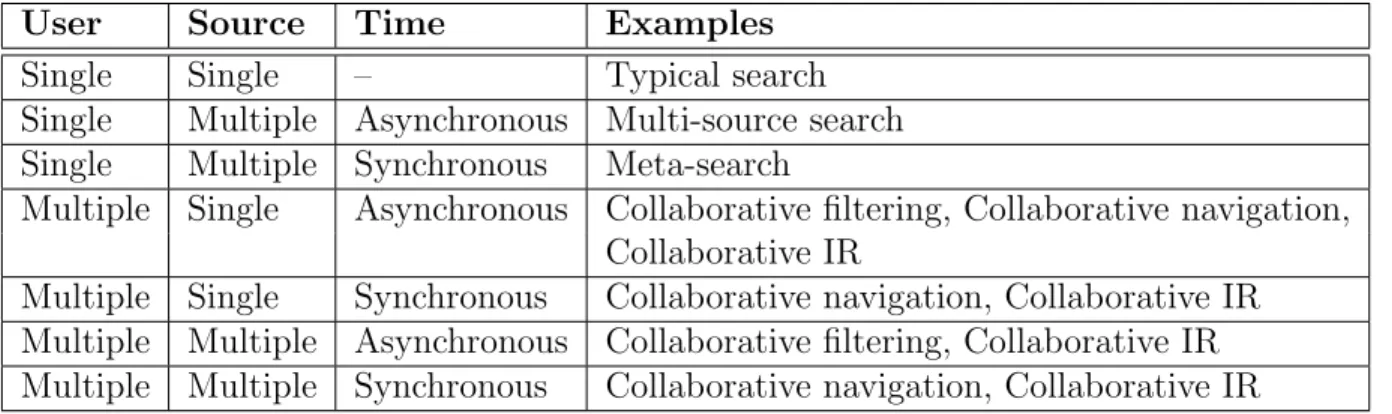
2.3 Different scenarios of collaborative information processing. . . 70
3.1 Pilot runs with Coagmento. . . 123
3.2 Feedback on Coagmento (version without collaboration support), aver-aged over eight responses. . . 144
4.1 Summary of constructs, their definitions, and evaluation measures. I = individual measure. G = group measure. . . 173
4.2 Hypotheses related to various constructs and conditions. . . 174
4.3 Top 40 sources for Task-1, economic recession. . . 178
4.4 Top 40 sources for Task-2, social networking. . . 179
4.5 Search services used for each session. . . 180
4.6 Usage of search services used for Task-1. . . 180
4.7 Usage of search services used for Task-2. . . 181
4.8 Quality of collected snippets as measured by recall and precision. For one-way ANOVA, between groups df = 2 and within groups df = 39. . 183
4.9 Summary statistics of different activities per person. For one-way ANOVA, between groups df = 2 and within groupsdf = 81. . . 184
4.10 Summary statistics of webpages overlapped between the collaborators in a given pair. For one-way ANOVA, between groups df = 2 and within groups df = 39. . . 184
4.12 Summary statistics for responses on perceived awareness questions at the end of each session. For one-way ANOVA on each question, between groups df = 2 and within groups df = 165. . . 187 4.13 Index for absolute difference between two collaborators’ reported
num-bers for group’s status. For one-way ANOVA on the index, df = 2 and within groups df = 165. . . 188 4.14 Average amount of time spent and messages exchanged by each
partici-pant while reporting project status. For one-way ANOVA on the index,
df = 2 and within groups df = 333. . . 189 4.15 Average difference between reported numbers and real numbers for
ques-tions on personal progress. For one-way ANOVA on each response,
df = 2 and within groups df = 333. . . 191 4.16 Average difference between reported numbers and real numbers for
ques-tions on group progress. For one-way ANOVA on the index, df = 2 and within groups df = 333. . . 191 4.17 Average number of times workspace accessed by each participant. For
one-way ANOVA on the index, df = 2 and within groupsdf = 81. . . . 192 4.18 Average number of key actions, chat actions, and combined actions taken
by each team. For one-way ANOVA on the index, df = 2 and within groups df = 39. . . 193 4.19 Index for cognitive load questionnaire filled by individuals. For one-way
ANOVA on the index, df = 2 and within groupsdf = 333. . . 195 4.20 Index for ease of use and satisfaction questions responded by individuals.
For one-way ANOVA on the index, df = 2 and within groups df = 165. 196 4.21 Index for engagement questions responded by individuals. For one-way
4.22 Summary of construct, hypotheses, and related findings. The best per-forming condition, if any, is given in bold letter. . . 200
5.1 Differentiating between intent and activeness. . . 216
Chapter 1
Introduction
It is natural for us to work with others, as people are social animals.1 There are several good reasons for this natural tendency. For one, sometimes a problem is just too complex for a single individual to tackle. Denning and Yaholkovsky (2008) regard such problems as “messy” or “wicked” and argue that collaboration is essential for resolving such messes. One of the issues with these messy problems is that sometimes people cannot even agree on what the problem is and no solution can make everyone happy (Denning, 2007). However, as we will see later, such a disagreement among the individuals becomes one of the strengths of collaboration. This brings us to another big appeal of collaboration: sometimes the whole can be greater than the sum of its parts (Aristotle, 2 BCb).
Several complex situations call for collaboration. When it comes to accessing or processing some information, it seems that in many situations, multiple people working together will be able to do abetterjob than any one of them individually. For instance, Olson, Olson, Storrsten, and Carter (1993) developedShrEdit, a shared text editor. To 1It was Aristotle who originally said (2 BCc), “Hence it is evident that the state is a creation of
their surprise, they discovered that the groups working with ShrEdit generated fewer designideas, but apparentlybetterones. They believed their tool helped the supported groups keep more focused on the core issues in the emerging design, to waste less time on less important topics, and to capture what was said as they went.
Taking a hypothetical example, imagine a group of students working on a research project for a class. They all have the same goal or information need. Following are some of the scenarios that they can follow.
• Divide up sources to explore among them and then combine and consolidate what
they found; this can save them time.
• They can also work independently and then compare the information that
over-lapped between their findings and evaluate commonality as well as contradictions.
• They can identify tasks for their project and assign different people different
roles to play in those tasks. For instance, a couple of group members can take responsibility for digging resources out from the library, another one can set up a meeting with a faculty advisor, and a couple of other members can sort, compare, and consolidate the findings. One of the team members can even be the coordinator.
• More interestingly, a subset of students can look at some information together and discuss on-the-fly; this can allow them to develop a better understanding of the information, refine their goals, and enhance further processing of the new information.
1. can accomplish more,
2. benefit from one another’s experience and expertise on the given topic, and
3. influence one another and develop a more profound understanding than when they are isolated.
This dissertation is an attempt to understand the situations where collaboration among like-minded people can benefit the collaborators, the tools and methods they use for collaboration, and the ways in which appropriate support can be provided for facilitating such collaboration. In the process, a framework is presented that explains collaborative processes in information seeking, and supports the development of better tools and techniques.
The fact that collaboration is not always desired or useful is acknowledged here. Even when collaboration is desired or encouraged, it could induce additional costs that include cognitive load and the cost to coordinate various events and participants. Working in a group may not be beneficial if the participants have conflicts of interest, they do not trust one another, or they do not intend to collaborate (London, 1995). Some of the tradeoffs for costs vs. benefits in collaboration are reviewed in Section 2.1. While the disadvantages and the costs of collaboration are important to acknowledge and study, for the most part in this dissertation it will be assumed that collaboration is intentional and mutually beneficial, and that the participants trust one another.
that help a set of users with a shared information goal to search and use information collaboratively. In order to validate this model, a set of specific situations that serve as instances of the model are presented. Together these instances formulate an overall re-search problem, which is presented in the following section, along with specific rere-search questions addressed in this dissertation.
1.1
Research problem and questions
Situation: Two or more people have the same information need and they are working together in the same timeframe2 to satisfy the need.
Examples:
• A group of students working on a class project.
• A couple looking to buy a house.
• A patron trying to find some information on a topic with the help of a librarian.
• A set of users watching the same video and commenting on or tagging it.
Difficulty:
There is a lack of specially designed tools to facilitate collaboration among a set of users for information seeking. Most search services and information synthesis tools are designed keeping single user environments in mind. People have been using general-purpose tools such as email and IM to collaborate online (Morris, 2008), and there is an absence of integrated environments that not only support search and communication, but also help the collaborators discover and learn about the information that they may not discover if they work in isolation.
2Note that these users do not need to work synchronously, nor do they have to be co-located.
The notion of collaboration itself is not well-understood. There is a lack of map-ping between people’s situations and motivations to collaborate, and the methods and systems that seamlessly support them.
Example:
Imagine a team of analysts surveying the market for a product. First, we do not want them to repeat each others’ efforts, unless it is for verification or training purposes. Secondly, given that we successfully distribute work among them, how do we combine and redistribute the results for their individual analysis? Should we divide the task, execute the requests, and distribute the results based on various aspects of the product? Or should this division be based on users’ expertise and role in the project? How do we organize all the information found and evaluate it for commonality and conflicts? How can we facilitate effective communication among the analysts?
Many of these questions are often addressed using ad-hoc methods and work-arounds, such as emails, IM, and meetings, as Morris (2008) showed in her survey of knowledge workers. There is a lack of systematic methods and specialized tools that could not only support these needs, but also enhance the experience of collaboration in information intensive domains.
The goal of the work presented here is to understand how users can effectively col-laborate, and based on this understanding to build systems that support an intentional (explicit) and interactive collaboration. In order to achieve this goal the following research questions (RQs) will be addressed.
3. How to measure costs and benefits in a user-centric CIS environment?
In order to address these research questions, this dissertation will present a series of studies, with the first two questions addressed in Chapter 3 through several design studies, and the last one addressed in Chapter 4 with a laboratory study.
1.2
Significance of the proposed research
In many social situations, it is very common to collaborate. These situations span cultural, gender, and age differences. Large, Beheshti, and Rahman (2002) reported results of a study into gender differences in collaborative web3 searching, conducted in a grade-six classroom of a Canadian elementary school. They demonstrated that their participants very often desired to collaborate on search tasks. Morris (2008) showed, from a survey of 204 knowledge workers, that the majority of them wanted to collaborate. Her further explorations (Morris, 2007b) also proved that collaboration in many situations is vital to the success of the process.
Similarly, when it comes to information seeking, collaboration could be a wise choice. Twidale and Nichols (1996) pointed out a problem - “The use of library resources is often stereotyped as a solitary activity, with hardly any mention in the substantial li-brary science and information retrieval literature of the social aspects of information systems.”They argued that introducing support for collaboration into information re-trieval systems would help users to learn and use the systems more effectively. Levy and Marshall (1994, p.163) noted that“...support for communication and collaboration is as important for information-seeing activities, and ... indeed, support for the former
3Throughout this dissertation, the lowercase ‘web’ will be used instead of the more formal version
is needed to support the latter.”Based on their extensive study with patent office work-ers, Hansen and Jarvelin (2005) also concluded that the assumption that information retrieval performance is purely individual needs to be reconsidered. Twidale, Nichols, and Paice (1997) showed that users often desire to collaborate on search tasks and ar-gued that it makes sense to consider browsing as a collaborative process unlike how it is presented by a majority of search engines, i.e., a single-user process. They suggested that a truly user-centered system must acknowledge and support collaborative interac-tions between users. Morris (2007b) proposed that four features of exploratory search experience - coverage, confidence, exposure, and productivity - could be enhanced by providing explicit support for collaborative search and subsequent sense-making pro-cesses.
The question is - are these potential benefits enough to motivate people to collabo-rate even for the tasks that are typically done in solitude? As discussed before, several works have shown that people want to collaborate in many situations (Morris, 2007a), and that it makes sense to work together to solve certain problems (Denning and Ya-holkovsky, 2008). However, either most systems do not support such collaboration explicitly or the users may not realize the value in collaborating. It is very important to identify these situations, inform the users about them, and provide support so the users can reap the benefits of collaborating.
to address this as one of the central issues. This will enable us to develop better CIS systems by leveraging the usefulness of awareness without burdening the users with unnecessary mental and/or physical load.
The findings of the research presented here will augment our understanding of the way collaboration works in the information seeking domain and general behavior of the users in a collaborative environment. In the course of conducting this research various systems and interfaces will also be developed that can serve as testbeds for further research. In addition to this, a contribution will be made to CIS through developing a method to study collaborative environments.
1.3
Summary
In this chapter a research problem that revolves around investigating instances, moti-vations, and methods of collaboration was identified. It is acknowledged that (1) while collaboration has its natural benefits, it may not always be useful or desired, and (2) the definition of collaboration presented here assumes it to be an intentional or explicitly specified, interactive, and mutually beneficial process that is carried out (most likely over several sessions) among the collaborators.
Figure 1.1: Contextual depiction of Collaborative Information Seeking (CIS).
On the other hand, a typical collaboration includes several parts, some of which may be related to information seeking. Thus, in this dissertation, CIS process is seen as a part of a larger context of collaboration. In addition, this CIS is seen as a user-driven (intentional), interactive, and mutually beneficial process.
Chapter 2
Literature Review
This work focuses on how people collaborate in information seeking tasks. In ad-dition to this, motivations and costs, as well as the tools and methods used for doing collaboration are reviewed. While the focus here is on studying collaboration in the information seeking process only, it is unlikely that people would collaborate simply for seeking some information without some shared goal. It is highly probable that the process of information seeking has a stage preceding it (e.g., an objective that produces the need for information), and a stage following it (e.g., organization and use of the information collected). In other words, it is difficult to study the act of collaboratively seeking information out of the context in which it is performed. Similarly, it is unrealis-tic to understand collaboration among users of an information seeking system without characterizing that underlying information seeking process. This realization has led me to study CIS from different points of view, allowing an investigation that starts from a broader aspect of various participants such as collaboration and information seeking, and narrows these views down to a more focused view of CIS.
The CIS related literature reviewed here emanates from five different and broad topics:
fields, along with the principles, processes, and limitations of collaboration.
2. Information seeking - literature covering a few important models of information seeking and how these models can be mapped to information seeking in collabo-ration.
3. Information filtering - literature relating to filtering information based on the given user’s and/or other people’s actions and behaviors in the past.
4. User and system interaction - literature relating to how humans connect with other humans or systems for interactively seeking information.
5. Social networking- literature covering social ties and interactions that could lead to potential stronger connections and collaborations.
2.1
Collaboration
This section is devoted to the discussion and review of the works relating to the general notion of collaboration, and also in the context of information science. Various defini-tions of collaboration, as well as its reladefini-tionship with cooperation and coordination are first presented. Next, some works from the literature that discuss the principles of col-laboration, the actual process of collaboration used, and the limitations of collaboration are reviewed.
2.1.1
Definitions and models of collaboration
stakeholders of a problem domain about the future of that domain.”Roberts and Bradley (1991, p.209) called collaboration “an interactive process having a shared transmuta-tional purpose.”
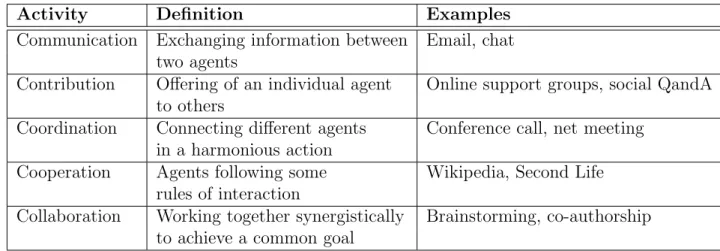
We often find people using the term ‘collaboration’ in various contexts and inter-changeably with terms such as ‘coordination’ and ‘cooperation’. It is very important that we first ground the meaning of the term ‘collaboration’ before addressing various issues regarding doing collaboration. Denning and Yaholkovsky (2008) suggested that coordination and cooperation are weaker forms of working together, and that all of these activities require sharing some information with each other. Taylor-Powell, Ross-ing, and Geran (1998) added another component to this - contribution, as they realized that in order to have an effective collaboration, each member of the group should make an individual contribution to the collaborative. Using communication, contribution, co-ordination, and cooperation as essential steps toward collaboration, they showed how a true collaboration requires a tighter form of integration (Figure 2.1).1
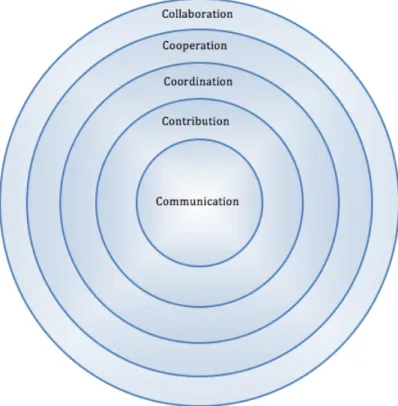
Based on these two works, a model of collaboration is synthesized and presented in Figure 2.2. This model has five sets: communication (information exchange), con-tribution,coordination, cooperation, andcollaboration. Considering notions of sets, the model shows which activity is supporting which other. For instance, coordination is a subset of collaboration, which indicates that, for a meaningful collaboration, we need to have some way of coordinating people and events. Collaboration is a superset of cooperation, which means in order to have a true collaboration, we need something more than cooperation. These five sets are described below in more details. To help explain these concepts, various activities in the context of a library will also be listed.
Figure 2.1: A model showing steps to a meaningful collaboration. (Taylor-Powell, Rossing, and Geran, 1998)
• Communication. This is a process of sending or exchanging information, which is one of the core requirements for carrying out collaboration, or maintaining any kind of productive relationship for that matter. For instance, there is a message on the local public library’s bulletin board about a book sale for charity the coming weekend. This is a way for the library to communicate with the visitors, which may result in some coordinated event.
• Contribution. This is an informal relationship by which individuals help each other in achieving their personal goals. For instance, Mark has some old books that he no longer needs, but they could be of use to others. He, therefore, asks the library if they would take those books. Upon the library’s approval (communication), Mark donates the books to the library.
• Coordination. This is a process of connecting different agents together for a harmonious action. This often involves bringing people or systems under an umbrella at the same time and place. During this process, the involved agents may share resources, responsibilities, and goals. For instance, Mark decides to study with his fellow student Richard in the library. They both get together at the library on a set day and study their own material. They both are in a way helping each other by keeping each other company (contribution), but they do not share a specific goal that they are working toward together.
collaboration is an active session of interaction in which both the parties worked together to solve a problem.
• Collaboration. This is a process involving various agents that may see different aspects of a problem. They engage in a process through which they can go be-yond their own individual expertise and vision by constructively exploring their differences and searching for common solutions. In contrast to cooperation, col-laboration involves creating a solution that is more than merely the sum of each party’s contribution. The authority in such a process is vested in the collaborative rather than in an individual entity.
For instance, Mark walks up to a reference librarian, Carol, in a public library. He is studying 20th century American poets and trying to find all the material that could be relevant. Carol helps him to locate the section of the library, where Mark can find the books on poetry. However, that would not be enough to be considered collaboration. Mark describes the scope of his study and that gives Carol information to start suggesting specific books to Mark. After skimming through those books over a couple of day’s time, Mark thinks he has a lot more material than he needed. He returns to Carol with this concern, and she suggests that he look at a book that is an anthology of American poets. This book not only helps Mark directly, but also lets Carol refine her suggestions as she also flips through it. Finally, Mark has good material on this topic that is not too general and covers most of the information that he would like to have.
while the rewards of this process were different for both the parties, it is important to note that they both worked together to solve the same problem.
In addition to this, we can hope that this solution is also a better one, since often a group of entities are found to create a much better solution than any individ-ual entity by itself (Surowiecki, 2004). Chrislip and Larson (1994, p.5) defined collaboration as a “mutually beneficial relationship between two or more parties [agents] who work toward common goals by sharing responsibility, authority, and accountability for achieving results.”Similarly, according to Gray (1989, p.5), col-laboration is “a process through which parties [agents] who see different aspects of a problem can constructively explore their differences and search for solutions that go beyond their own limited vision of what is possible.”
The difference among these five activities can be summarized using the following variables, which are also depicted in Figure 2.3.
1. Interaction. While communication is at the center of other activities, it is possible to have a very little amount of interaction while simply communicating. For instance, a system administrator sending an email to a user for his overused disk quota may not require any further interaction. The administrator may not even personally know or see the user. A typical collaboration, on the other hand, requires a high level of interaction among the participants.
2. Intent. Similar to interaction, a collaborative project requires much stronger intent compared to those tasks that are merely coordinating events or one entity cooperating with another.
4. Human involvement. A process of communication may not require much human involvement. For instance, posting a message on a noticeboard is an act of com-munication, but it does not require the poster or the readers of that message being involved with each other. Collaboration, on the other hand, requires the participants to be actively engaged in the project at hand.
5. Symmetry of benefits. The kind of collaboration considered here is by definition mutually beneficial. Thus, it benefits everyone involved in the process. The amount of benefit may vary depending on participants’ roles and responsibilities. In contrast, in a cooperative process, one party helps the other party in fulfilling their goals. A student gathering relevant literature for his supervisor is an act of cooperation, contributing to the supervisor’s goal. Co-authorship, on the other hand, is an act of collaboration, benefitting all the participants.
6. Level of awareness. For an interactive, intentional, and mutually beneficial collab-oration to be successful, it is imperative that all the participants be aware of each others actions and contributions. This also helps in establishing a level of trust among the participants. Provision of such awareness may not be a requirement for coordination or cooperation.
2.1.2
Principles of collaboration
Figure 2.3: Distinguishing communication, contribution, coordination, cooperation, and collaboration using different variables. A variable is represented with a bar going minimum to maximum from left to right.
Regarding democracy in collaboration, Flora, Flora, and Fey (2004, p.273) pointed out, “without community empowerment and broad participation in agenda setting, the decision-making process of discussion, debate, and compromise is relatively meaning-less.”Osborne and Gaebler (1992, p.269) also expressed their views against hierarchies by noting that centralized and hierarchical associations tend to be divided up into many layers and boxes. They recognized a difficulty in carrying out communication across units and between layers, thus inhibiting the real potential of collaboration.
Gray (1989) further claimed that collaboration could only be meaningful if the stakeholders are interdependent. She explained, “collaboration establishes a give and take among the stakeholders that is designed to produce solutions that none of them working independently could achieve.”
To spell out what situations could create a meaningful collaboration, Surowiecki (2004) presented four conditions for a successful collaboration.
1. Diversity of opinion. Each person should have some private information, even if it is just an eccentric interpretation of known facts.
2. Independence. People’s opinions are not determined by the opinions of those around them.
3. Decentralization. People are able to specialize and draw on local knowledge. 4. Aggregation. Some mechanism exists for turning private judgments into a
collec-tive decision.
Collaboration, in many situations, is a process that ties people of varying opinions and abilities together. However, the process may not necessarily lead to agreement on all issues. For instance, Gray (1989, p.25) acknowledged that not all collaborations lead to consensus, but added that, when agreements for action are reached, they are always done so by consensus. Denning and Yaholkovsky (2008) also noted that it is solidarity, not software, that generates collaboration.
2.1.3
Process of collaboration
1. What are the structural relationships between the parties and the possible power issues inherent in the collaborative arrangement?
2. Is there a clear understanding among all the parties of the respective goals of the other participants?
3. What form of leadership is required to facilitate the process?
4. Does the project have some form of integrating structure, such as a cross-section of steering committees, to facilitate and coordinate decision-making and imple-mentation?
5. Will the project be more effective with a neutral, third party mediator?
6. Should the media be involved?
7. Does the project have enough time, money, and staff support?
Such questions and considerations are useful to understand as collaboration may induce costs, and we many want to make sure that the given problem and circumstances do call for collaboration.
Let us now look at what collaboration involves. Collaboration is typically a complex process involving a number of phases, a variety of interactions, and other sub-processes. Gray (1989) identified three major phases of collaboration.
1. Pre-negotiation or problem-setting phase. This phase is often the most difficult, and involves six issues to be addressed.
(a) The parties must arrive at a shared definition of the problem, including how it relates to the interdependence of the various stakeholders.
(c) Other stakeholders must be identified whose involvement may be necessary for the success of the endeavor.
(d) The parties must acknowledge and accept the legitimacy of the other par-ticipants.
(e) The parties must decide what type of convener or leader can bring the parties together.
(f) The parties must determine what resources are needed for the collaboration to proceed.
2. Direction-setting phase. During this phase, the parties need to identify the inter-ests, which brought them together, determine how they differ from the interests of the others, set directions, and establish shared goals. This phase is characterized by six steps.
(a) Establishing ground rules
(b) Setting the agenda
(c) Organizing sub-groups (especially if the number of issues to be discussed is large or the number of stakeholders exceeds the twelve to fifteen member limit for effective group functioning)
(d) Undertaking a joint information search to establish and consider the essential facts of the issue involved
(e) Exploring the pros and cons of various alternatives
(f) Reaching agreement and settling for a course of action
(b) Parties garner the support of those who will be charged with implementing the agreement.
(c) Structures for implementation are established.
(d) The agreement is monitored and compliance is ensured.
Similar to these three phases of Gray, Denning and Yaholkovsky (2008) provided three main stages of solving a complex problem: design, collaboration, and follow-through (Figure 2.4). The authors defined the collaboration stage as a set of five specific sub-stages: (1) declare, (2) connect, (3) listen to and learn all perspectives, (4) allow a “we” to develop, and (5) create together.
Individual collaborative process will depend on various factors such as the nature of collaboration, the number of people or parties involved, the timeframe, and the resources at hand.
Figure 2.4: Structure of messy problem solving (Denning and Yaholkovsky, 2008).
2.1.4
Limitations of collaboration
London (1995) identified the following limitations of a collaborative process.
1. Collaboration is a notoriously time-consuming process and is not suitable for problems that require quick and decisive action.
2. Power inequalities among the parties can derail the process.
3. The norms of consensus and joint decision-making sometimes require that the common good take precedence over the interests of a few.
4. Collaboration works best in small groups and often breaks down in groups that are too large.
5. Collaboration is meaningless without the power to implement final decisions.
Gray (1989) listed five circumstances under which it is best not to collaborate:2 (1) when one party has unchallenged power to influence the final outcome; (2) when the conflict is rooted in deep-seated ideological differences; (3) when the power is unevenly distributed; and (4) when constitutional issues are involved or legal precedents are sought, and (5) when a legitimate convener cannot be found.
Sometimes we see collaboration forced on a group of people. Examples of such forced collaborations include the merger of two companies or instructor-enforced class groups. In such situations, the collaboration may start with acts of cooperation, where the participants are merely following a set of rules working with others in the group. Later, such cooperative events may result in collaboration as the participants take active part (intention) in driving the process of working together for a common goal. However, collaboration may still not be successful if the participants do not trust each other or if the power and benefits are unbalanced (London, 1995; Gray, 1989).
Collaboration can also have limited advantages if the costs and benefits are unevenly distributed among the participants. As one of the eight challenges of groupware system development, Grudin (1994) talked about disparities in benefits and responsibilities among the participants. He claimed that it is almost impossible to have a groupware system in which every participant does the same amount of work and/or benefits the same. His examples show how some participants of a groupware system have to do additional work while not getting equivalent benefits. Due to such inequality, the groupware application may become less and less useful and may even stop being used. While the kind of collaboration that is considered here (intentional and mutually beneficial) is slightly different than Grudin’s notion of groupware, and the discussed CIS systems are considerably different than the groupware systems Grudin talked about, several of the issues he raised and the recommendations he made are relevant.
For the above-mentioned challenge, Grudin’s recommendation for the system de-veloper was to make sure that the system benefits all the participants. At the same time, he identified the difficulties in doing so, because, while the managers or higher authorities are gaining more benefits, they are the decision makers. Pleasing the upper management personnel is equally important, if not more, as pleasing the rest of the participants who have to do additional work.
2.1.5
Collaboration in the context of information science
Table 2.1: Various group activities and examples.
Activity Definition Examples
Communication Exchanging information between Email, chat two agents
Contribution Offering of an individual agent Online support groups, social QandA to others
Coordination Connecting different agents Conference call, net meeting in a harmonious action
Cooperation Agents following some Wikipedia, Second Life rules of interaction
Collaboration Working together synergistically Brainstorming, co-authorship to achieve a common goal
fit around this understanding of collaboration. Austin and Baldwin (1991) noted that while there are obvious similarities between cooperation and collaboration, the former involves pre-established interests, while the latter involves collectively defined goals. Malone (1988, p.5) defined coordination as“the additional information processing per-formed when multiple, connected actors pursue goals that a single actor pursuing the same goals would not perform.” While this definition is close to the one we have seen about collaboration, one can argue that it still fits in the model described in Figure 2.2 since it says nothing about creating solutions. For instance, organizing a meeting involves coordinating among the attendees, but it is not a collaborating activity.
From the definitions and models described above, we can conclude that, in order to have a successful collaboration while seeking information, we need to create a supportive environment where:
1. The participants of a team come with different backgrounds and expertise.
3. The participants should be able to evaluate the discovered information without always consulting others in the group.
4. There has to be a way to aggregate individual contributions to arrive at the collective goal.
One important aspect of the above requirements that is missing is the kind of task. There may not be much point in collaborating for simple fact-finding information tasks. As Morris and Horvitz (2007) expressed, tasks that are exploratory in nature are likely to benefit from collaboration.
How the concept of collaboration relates to CIS
The notion of collaboration and the requirements to have a successful collaboration presented in this section will now be taken to propose (1) a set of conditions under which collaboratively seeking information is useful, and (2) a set of guidelines for building a successful CIS environment.
The conditions under which collaboratively seeking information is useful are given below. They are not very different from those of any other kind of collaborative process.
1. Common goal and/or mutual benefits
Robertson (1994). These systems are based on the assumptions that the people browsing the same websites may have the same information needs.
2. Complex task
Morris and Horvitz (2007) showed that there are not many benefits for collab-orating on simple tasks, such as fact-finding. Denning and Yaholkovsky (2008) also recognized the benefit of collaborating while solving “messy” or “wicked” problems. While listing the conditions under which it is not useful to collabo-rate, London (1995) argued that if a task is simple enough, there is no point in collaborating.
This may imply that the task should be exploratory in nature, and may span several sessions.
3. High benefits to overload ratio
Often, a simple divide and conquer strategy could make collaboration success-ful. However, such a process may have its overhead. London (1995) noted that collaboration is only useful if such an overhead is acceptable for the given situa-tion. Fidel, Pejtersen, Cleal, and Bruce (2004) showed that collaboration induces additional cognitive load, what they referred to as the collaborative load. The collaboration in question has to meet or exceed the benefits expectations for it to be viable with the cognitive load that it brings.
4. Insufficient knowledge or skills
The guidelines for building a successful CIS environment, following the discussion of the model in Figure 2.2, and derived from the discussion in this section, are given below.
1. A CIS system should provide effective ways for the participants to communicate with each other.
2. A CIS system should allow (and encourage) each participant to make individual contributions to the collaborative.
3. A CIS system should coordinate participant actions, information requests, and responses to have an active and interactive collaboration. This collaboration could be synchronous or asynchronous, and co-located or remote.
4. Participants need to agree to and follow a set of rules to carry out a productive collaboration. For instance, if they have a disagreement on the relevancy of an information object, they should discuss and negotiate; they should arrive at a mu-tually agreeable solution rather than continuing to dispute it. The system needs to support such a discussion and negotiation process among the participants.
5. A CIS system should provide a mechanism to let the participants not only explore their individual differences, but also negotiate roles and responsibilities. There may be a situation in which one participant leads the group and others follow (cooperate), but the real strength of collaboration lies in having the authority vested in the collective.
2.2
Information seeking
purpose-goes beyond simply retrieving information; it is usually associated with higher level cognitive processes such as learning and problem solving (Marchionini, 1989). Dervin and Nilan (1986) presented a view of information seeking that emphasized communi-cation and the needs, characteristics, and actions of the information seeker rather than mere representation, storage, and retrieval of information.
Several models have been proposed to understand and explain the information seek-ing process and information seekseek-ing behavior. Dervin (1977) presented a model with three phases of users facing and solving their information problems.
1. Situation. This phase establishes the context for the information need, called situation.
2. Gap. People often find that given the situation, there is a gap between what they understand and what they need to make sense of the current situation.
3. Use. Once this gap is realized, it is manifested by questions. The answers to these questions are put to use and then the user moves on to the next situation.
Belkin (1980) proposed a model of information seeking that focuses on information seekers’ anomalous states of knowledge (ASK). In this model, the information seekers do not have a clear understanding of the problem they are trying to solve or the information needed to do so. Information seekers have to go through the stage of articulating their search request, and the search system helps to refine that request. Thus, the ASK model serves as a theoretical basis for the design of interactive information systems.
based on empirical research and has been tested in various domains, most recently in the context of an engineering company (Ellis and Haugan, 1997). Kuhlthau, in her work (Kuhlthau, 1991) and (Kuhlthau, 1994), supplemented Ellis’ work by attaching to the stages what she called information seeking process, the associated feelings, thoughts and actions, and the appropriate information tasks. Her model’s stages were: Initia-tion, SelecInitia-tion, ExploraInitia-tion, FormulaInitia-tion, Collection and Presentation. Wilson (1999) presented a comparison of Ellis’ and Kuhlthau’s models (Figure 2.6): “...the two models are fundamentally opposed in the minds of the authors: Kuhlthau posits stages on the basis of her analysis of behaviour, while Ellis suggests that the sequences of behavioural characteristics may vary.”
Based on these works of information seeking, Wilson revised his model (Wilson, 1997) and extended it to incorporate information behavior (Figure 2.7). He proposed to fill the gap that Dervin labelled in her model by inserting a concept of activating mechanism. Wilson proposed to do this using the stress/coping model proposed by Miller and Mangan (1983).
Using the work by Belkin, Dervin, Ellis, and Kuhlthau as reported above, West-brook (1993) proposed a model that included stages such as “Need”. Her full set is:
Needing, Starting, Working, Deciding and Closing. Marchionini (1995) presented an information seeking model where the process of information seeking is composed of eight subprocesses which develop in parallel: (1) recognize and accept an information problem, (2) define and understand the problem, (3) choose a search system, (4) for-mulate a query, (5) execute search, (6) examine results, (7) extract information, and (8) reflect/iterate/stop.
Figure 2.6: A comparison of Ellis’s and Kuhlthau’s frameworks (T. D. Wilson, 1999).
extensions to CIS are outlined. As we can see, all of these models of information seeking incorporate various stages of an information seeker’s behavior. For the purpose of this dissertation, the focus is on how an information seeker can use various methods and tools to seek information that is mediated by computer(s), and what he3 does when/if information that he is looking for is found. Of course, the information that he is looking for may not exist and the seeker may not have a clear idea about the kind of information that may be useful for his task. Marchionini’s (1995) model incorporating eight subprocesses of information seeking can be useful for the purpose of defining such a process-based model for CIS. In order to map various processes in a CIS environment to Marchionini’s model, the focus will be on how two participants can seek and process information in collaboration.
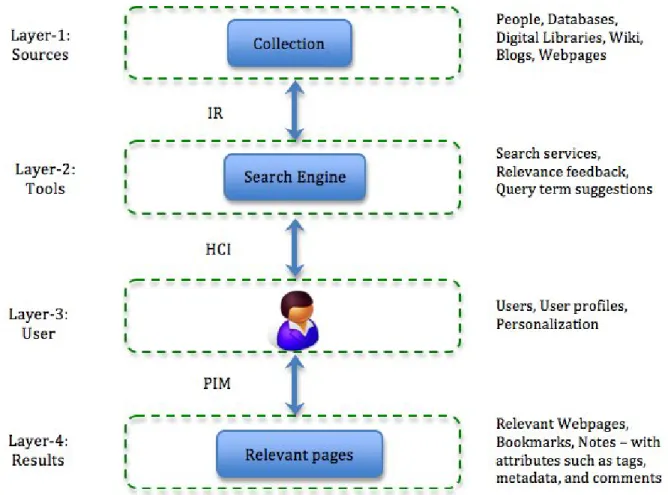
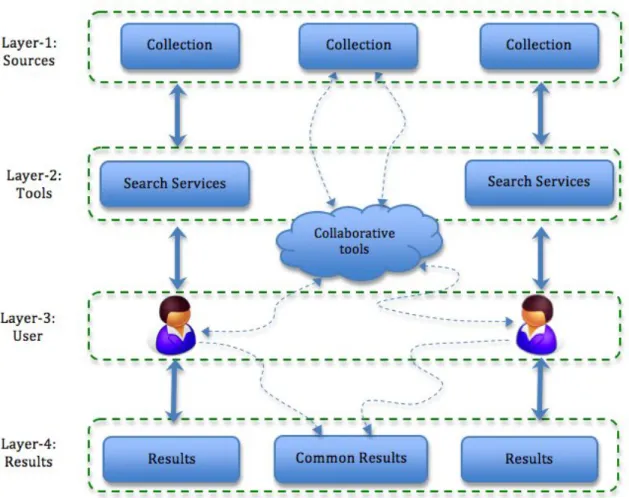
A four layer model of information seeking, centered around information access and organization is presented in Figure 2.8 to facilitate the discussion. On the left side, four layers are labeled; on the right side, examples are given for these layers; and in the middle, a typical scenario is presented. These four layers are described below in detail.
Layer-1: Sources
This layer contains information in various sources and formats (structured, semi-structured, and unstructured). The sources include digital libraries, wikis, blogs, databases, and webpages; formats include text, images, and videos. In fact, a person or a group of people could also act as a source.
Layer-2: Tools
This layer consists of tools and techniques a user can use to interface with the sources and access the information of layer-1. They include search services, relevance feedback mechanisms (Buckley, Salton, and Allen, 1994), and query term suggestions (Anick,
2003). In addition, since this layer also acts as a mediating layer between informa-tion sources and users, it includes a variety of user interfaces, starting from results as rank-lists to touch panels with mechanisms to visualize results. We can see that a large amount of research in IR is focused on the link between layer-1 and layer-2; that is, developing tools and services appropriate for retrieving information of various forms.
Layer-3: User
This layer consists of a user, who uses the tools in layer-2 to access the information in layer-1 and accumulate the knowledge in layer-4. We can see that the focus of Human-Computer Interaction (HCI) research has been on the link between layer-2 and layer-3; that is, presenting the information and the information access tools in effective ways to the user. This layer-3 also includes elements relating to a user, such as user profiles, which can be used for personalization (Teevan, Dumais, and Horvitz, 2005).
Layer-4: Results
The user of layer-3 accumulates the information relevant to him in layer-4. In the most basic sense, this could be a set of webpages that the user found relevant from his searches on the web. Extending this further, we can have bookmarks, notes, and other kinds of results, sometimes stored with attributes such as tags, metadata, and comments. At a more conceptual level, this layer consists of the knowledge that the user gained by his information seeking process. The focus of research in personal information management (PIM) (Dumais, Cutrell, Cadiz, Jancke, Sarin, and Robbins, 2003) has been on the link between layers 3 and 4, addressing the issues of information storage and organization by users.
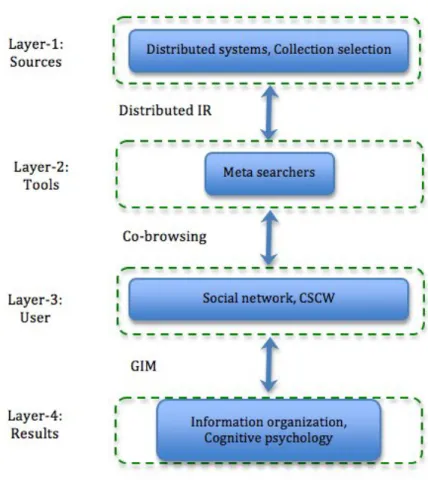
2.9).
Figure 2.9: Extension of the four layer model of information access and organization.
Layer-1. Combining various information sources is covered under shared resources and distributed systems. From the IR perspective, collection selection also becomes an important issue to address here.
Layer-2. Combining two or more search engines for search process creates meta-search process (Aslam and Montague, 2001). Clusty4 and Dogpile5 are good examples of such
4http://www.clusty.com
meta-search engines.
Layer-3. Putting more than two users together can create a workgroup. Users in a workgroup who access and explore some information together is studied as co-browsing or social navigation (Gerosa, Giordani, Ronchetti, Soller, and Stevens, 2004). Ex-tending the workgroup further with connections among users that exhibit some social characteristics, creates a social network. When multiple user profiles are considered as one entity to optimize the services for that group, personalization is transformed into
groupization (Morris, Teevan, and Bush, 2008).
Layer-4. Combining relevant information of various sorts falls under information orga-nization and cognitive psychology. Customizing information for a group of users is the topic of research named as Group Information Management (GIM) (Erickson, 2006).
Based on various combinations at individual layers and various kinds of interconnec-tions among these layers, we can imagine a large array of possible scenarios. Discussion on these scenarios is beyond the scope of this work. Instead, possible combinations at the user layer will be explored. There are several ways and reasons the users can connect with each other in an information seeking process. The kind of collaboration considered here isintentional, and interactive among users with the same information goal. In order to create and study such an environment, the general model of informa-tion access and organizainforma-tion given in Figure 2.8 will be used and stripped down to suit the needs.
by extending the original model of information access and organization for two users.6 These users can access and organize information individually, or decide to collaborate with each other. In the case of collaboration, they will have a way to communicate with one another. They may have a common or shared interface. They may also have a shared space where they can store and organize their results. In other words, collab-oration between these two users can occur at various levels: (1) while formulating an information request, (2) while obtaining the results, and (3) while organizing and using the results.
The model described above should help in clarifying the presented approach to CIS with the kind of information seeking process, centered around information access and organization. Later while discussing specific approaches to address various issues in CIS, we can revisit this model and see how those other works fit in here.
Looking back to the three phases of collaboration proposed by Gray (1989, p.57-94), and the eight subprocesses of information seeking proposed by Marchionini (1995), we can identify corresponding phases, adding a phase for aggregation, for a collaborative information seeking endeavor as given below.
1. Pre-negotiation or problem-setting phase
(i) Recognize and accept an information problem: this stage presumably brings a set of people together for a possible collaboration as they identify their common goals.
(ii) Define and understand the problem: the group can discuss the problem and if required, negotiate for a common understanding of the problem. (Figure 2.10,
6Considering only two users is merely for the simplicity; theoretically, the model can incorporate
Figure 2.10: A model for Collaborative Information Seeking (CIS) extended from the model in Figure 2.8.
Layer-3)
(iii) Choose a search system: the group can choose source(s) to use and if possible or desired, divide them up among themselves. (Figure 2.10, Layer-1)
2. Direction-setting phase
This is an important phase that is more specific to the collaboration. In this phase, the participants need to identify the interests which brought them together, determine how they differ from the interests of the others, set directions, and establish shared goals. (Figure 2.10, Layer-3)
(iv) Formulate a query: given the participants are allowed to work independently, each one formulates his/her search request. At this time, it is beneficial to be aware of the search requests formulated by other participants in the group (Morris and Horvitz, 2007). (Figure 2.10, Layer-3)
(v) Execute search: everyone executes his/her request on the source(s) being used. (Figure 2.10, Layer-2)
(vi) Examine results: participants can now examine their own results, and if required, results of the other participants. (Figure 2.10, Layer-4)
(vii) Extract information: required information is extracted. (Figure 2.10, Layer-4)
(viii) Reflect/interate/stop: participants can repeat steps (iv)-(vii) or stop. They may also choose to annotate the results.
(ix) Aggregate: this phase is more specific to the collaboration, in which the acquired information, processes, andknowledge are aggregated to create a shared information and understanding. (Figure 2.10, Layer-4)
2.3
Information filtering
Information filtering refers to a variety of processes involving the delivery of information to people who need it (Belkin and Croft, 1992). In other words, information filtering is a process through which information is derived based on relevance to a user as well as his preferences or past behavior. The manifestation of relevance, preferences, or the past behavior can be limited to the given user or can be extended to map to the same attributes about other users.
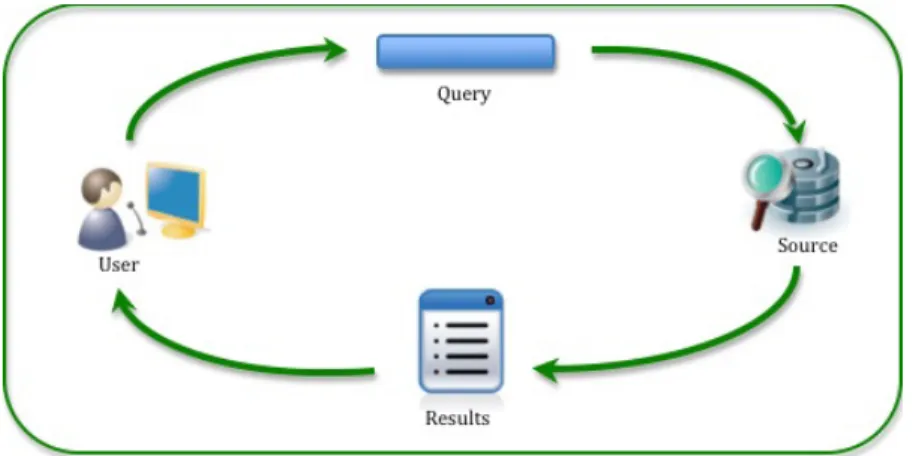
evaluates the results and keeps the ones that are relevant to him.
Figure 2.11: A typical scenario of information seeking in an IR environment.
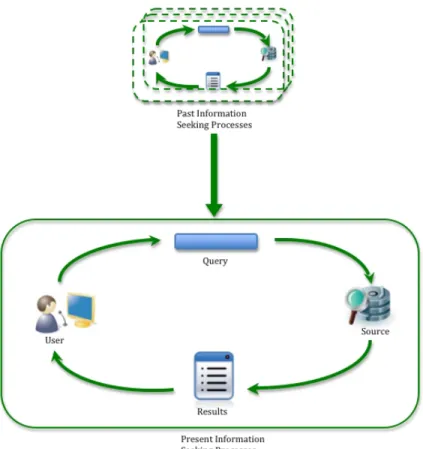
Now, if we had a “smart” system, it will monitor this user’s behavior over time and use it in new information seeking processes (Figure 2.12). The behavior refers to the kind of queries that the user submits, the results that he views, and the information that he saves. In other words, this smart system learns the user’s information seeking model and uses it to aid in future information seeking processes. An example is online movie renting services such as Blockbuster and Netflix. Based on the kind of movies a user has rented in the past as well as the ratings that he assigned, the system recommends new movies to him. In recommender systems literature such an approach is referred to as the content-based recommendations (Adomavicius and Tuzhilin, 2005). In such systems, the utilityu(c, s) of itemsfor user cis estimated based on the utilitiesu(c, si)
assigned by usercto itemssi ∈Sthat are “similar” to items. In our example of online
movie renting, in order to recommend movies to userc, the system tries to understand the commonalities among the movies userchas rated highly in the past (specific actors, directors, genres, subject matter, etc.).
Now let us extend the above scenario to incorporate multiple users. Such a scenario is depicted in Figure 2.13. As we can see, now the system uses the information seeking behavior of other users to aid the given user in his process of information seeking. Typ-ically, these mappings are done based on like-interests among the users. For instance, if users A and B both liked x, and if A liked y, there are good chances that B will also like y. Thus, the system will recommend y to B. In the literature, such kind of recommendation is called collaborative recommendation (Adomavicius and Tuzhilin, 2005).
It is also possible to combine the two kinds of approaches described above combined to create a hybrid approach.
As we saw earlier, collaboration among users based on common information need and asynchronous communication flow results in collaborative filtering. In other words, collaborative filtering refers to a process in which a user benefits from other users’ past actions on the same/similar information seeking tasks. In practice, this concept is re-alized as recommender systems. Examples of such applications include Amazon.com (Linden, Smith, and York, 2003), movies recommendations by MovieLens (Miller, Al-bert, Lam, Konstan, and Riedl, 2003), and news filtering by VERSIFI Technologies (Billsus, Brunk, Evans, Gladish, and Pazzani, 2002).
even though the users are benefitting from their own or other users’ past behavior (content-based or collaborative filtering), they are not collaborating in a strict sense.
Furnas (1985) demonstrated the power of community knowledge and collaborative filtering with his adaptive indexing scheme, which helps re-weight indexing terms by the past usage of more experienced users. Along the line of reformulating the queries, Hust, Klink, Junker, and Dengel (2002) showed how to use previously learned queries and their relevant documents for improving overall retrieval quality of an issued query. They do so by expanding the new query by extracting terms from documents which have been judged as relevant to previously learned queries. This approach is further formalized in (Hust, Junker, and Dengel, 2004), and (Hust, 2005). Once again, we see that objects and actions from the past are used to improve retrieval effectiveness, but the “interactions” among the users were asynchronous and unidirectional.
Similarly, Romano Jr., Roussinov, Nunamaker, and Chen (1999) presented Collab-orative Information Retrieval Environment (CIRE), a system architecture constructed using the user experiences with IR and Group Support Systems (GSS). Their proto-type system employed a client-server architecture, where the server was responsible for connecting the client requests to the AltaVista search engine and recording all the inter-actions as well as annotations by the participants. The executed queries, stored search results, annotations, and relevance judgments are shared among the group members to facilitate collaborative IR. This is similar to Smyth’s I-Spy system,7 in which the par-ticipants of a workgroup can benefit from others’ searches on the same/similar topics. Once again, such systems or environments facilitate collaborative filtering rather than an active and interactive collaboration among the information seeking participants.
It is important to note here that in many of these applications, a user receiving the recommendations may not know the other users in the network personally. Thus, a user is not intentionally and interactively engaged in a true collaboration with other users; he is merely getting filtered content based on other users’ actions on the similar information. There have been some applications that go beyond such a constraint and exploit more tightly connected social networks of a user instead of the entire network to filter and recommend information. For instance, Kautz, Selman, and Shah (1997) presented ReferralWeb, which was based on providing recommendations via chains of named entities instead of anonymous users in the network.
In addition to this difference, the goal of collaborative filtering systems is to use the opinions of a community of users to help individuals identify content of interest with ease from a potentially overwhelming set of choices (Resnick and Varian, 1997). Looking carefully, we can see that the flow of information and the direction of filtering at a given time is only one way (shown in Figure 2.13). Collaboratively seeking information, on the other hand, involves both the agents actively engaging in an information sharing situation; thus making the flow of information and filtering in both the directions at any given moment.
Another characteristic of a typical information filtering system is the asynchronous nature of user interaction. A user of an information filtering system is provided with the filtered information based on the actions that other users took in the past. In contrast, the focus of the work reported here is on active user interaction among the users of a system who are working in the same time frame.8
8It is not implied here that the interactions should be strictly synchronous; they simply need to be