Bayesian Latent Variable Methods for Longitudinal
Processes with Applications to Fetal Growth
James Christopher Slaughter
A dissertation submitted to the faculty of the University of North Carolina at Chapel Hill in partial fulfillment of the requirements for the degree of Doctor of Public Health in the Department of Biostatistics, School of Public Health.
Chapel Hill 2007
Approved by:
Amy H. Herring
ABSTRACT
James Christopher Slaughter: Bayesian Latent Variable Methods for Longitudinal Processes with Applications to Fetal Growth
(Under the direction of Dr. Amy H Herring)
We consider methods for joint models of exposure and response in epidemiologic
stud-ies. In particular, we show how latent variable methods provide a structure for obtaining
inference about multistate growth processes and multiple longitudinal and cross-sectional
outcomes. Each model utilizes underlying, subject-specific latent variables to account for
the correlation that arises from taking multiple observations on the same sampling unit.
We also consider latent variable mixture models in order to more flexibly model the latent
variable distributions and identify latent classes of subjects who are of particular
scien-tific importance. We apply our methods to applications in reproductive health, obtaining
interesting new insights while developing and applying statistical methodology.
We first consider the problem of estimating a multistate growth process with unknown
initiation time to determine individual early fetal growth. Using cross-sectional data, we
identify fetuses that have a latent tendency to grow relatively quickly and slowly and
show that slow growth early in pregnancy is associated with an increased risk of future
pregnancy loss. These results are important to researchers who use early ultrasounds to
date pregnancies under the assumption that there is no measurable variability in early
fetal growth.
of birth weight and gestational age. Using latent variable mixture models, we identify a
latent class of subjects who are more likely to deliver early and have low weight. We also
allow observed covariates to be associated with latent class membership. Our approach
provides researchers a new method for examining low birth weight and pre-term birth.
In paper three, we aggregate multiple ultrasound measurements on fetal size and
blood restriction using latent variables that follow mixture distributions to identify a
latent class of subjects who are growth restricted during pregnancy. We then consider a
joint model that examines the associations between covariates, early growth restriction,
and outcomes measured at birth. Our methods are able to identify a latent class of
subjects who have increased blood flow restriction and below average intrauterine size
ACKNOWLEDGMENTS
First, I would like to thank my advisor, Dr. Amy Herring, for her constant support
and guidance in writing this dissertation, and for being an excellent mentor in helping
me grow as a researcher and biostatistician. I appreciated the insightful comments and
suggestions of my committee members, Dr. Kathie Hartmann, Dr. Larry Kupper, and
Dr. Haibo Zhou, and Dr. Chirayath Suchindran, and their willingness to offer both
instruction and guidance throughout my education.
Finally, I would like to thank my family, friends, and fellow colleagues who have stood
TABLE OF CONTENTS
LIST OF TABLES viii
LIST OF FIGURES ix
LIST OF ABBREVIATIONS x
1 Introduction 1
1.1 Reproductive Health Applications . . . 3
1.1.1 Fetal Growth . . . 3
1.1.2 Fetal Development during Pregnancy . . . 5
1.1.3 Birth Weight . . . 7
1.2 Other Applications . . . 9
2 Latent Variable Methods for Longitudinal Data 13 2.1 Random Effects Models . . . 13
2.2 Latent Class Trajectory Models . . . 15
2.3 Structural Equation Models . . . 17
2.4 Bayesian Structural Equation Models . . . 20
2.5 Multistate Models . . . 21
3 Computation 24 3.1 Bayesian Methods for Data Analysis . . . 24
3.2 Identifiability . . . 26
3.3 Parameter Expansion . . . 27
3.4 Data Augmentation . . . 29
3.5 Multivariate Probit Models . . . 31
4 Bayesian Modeling of Embryonic Growth using Latent Variables 34 4.1 Abstract . . . 34
4.2 Introduction . . . 35
4.3.1 Data Structure . . . 39
4.3.2 Latent Variable Model . . . 40
4.3.3 Stochastic Model . . . 41
4.3.4 Fetal Growth Model . . . 42
4.4 Bayesian Analysis . . . 45
4.5 Application . . . 46
4.5.1 Dataset . . . 46
4.5.2 Bayesian Prior Specification . . . 47
4.5.3 Analysis . . . 49
4.6 Discussion . . . 52
5 A Mixture Model for Birth Weight and Gestational Age 62 5.1 Abstract . . . 62
5.2 Introduction . . . 63
5.3 Methods . . . 65
5.3.1 Statistical Methods . . . 65
5.4 Application . . . 68
5.4.1 Background . . . 68
5.4.2 Dataset . . . 68
5.4.3 Results . . . 69
5.5 Discussion . . . 73
6 A Bayesian Latent Variable Mixture Model with Covariates for Fetal Growth 85 6.1 Abstract . . . 85
6.2 Introduction . . . 86
6.3 Methods . . . 88
6.4 Application . . . 91
6.4.1 Model Description . . . 91
6.4.2 Measurement Models . . . 93
6.4.3 Mixture Distribution with Covariates . . . 95
6.4.4 Model Selection . . . 96
6.5 Results . . . 99
6.6 Discussion . . . 104
7 Conclusions and Future Directions 114
A Appendix for paper 1 117
B Appendix for paper 2 121
C Appendix for paper 3 127
LIST OF TABLES
1 Posterior summaries of the parameters characterizing the association be-tweenZ∗
and state transition probabilities . . . 55
2 Summary statistics for RFTS subjects . . . 77
3 Posterior summaries characterizing the association of a one standard de-viation increase in latent growth restriction with observed outcomes. . . . 78
4 Comparison of proposed latent class analysis with analyses that use pre-term and very pre-pre-term birth as the outcomes . . . 79
5 Descriptive statistics for the 522 PIN subjects studied . . . 107
LIST OF FIGURES
1 Prior probability of conception on a given day of the menstrual cycle, conditional on reaching that day of the cycle. . . 10
2 Early fetal pole visualization by ultrasound . . . 11
3 Definitions of birth weight, pre-term birth, and small for gestational age. 12
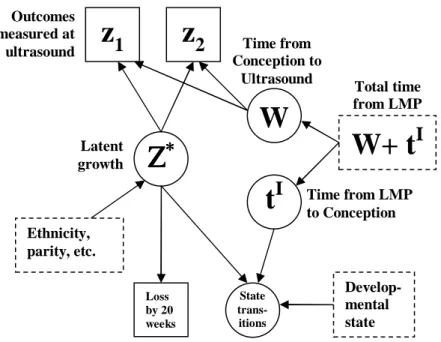
4 Timeline for a subject who has a fetal pole with normal heart rate at time W . . . 56 5 Path diagram illustrating the dependencies in the fetal growth with
un-known initiation times model . . . 57
6 Prior and posterior distributions of the probability of conception on a given day of the menstrual cycle, conditional on reaching that day of the cycle 58
7 Distribution of the posterior means of Z∗
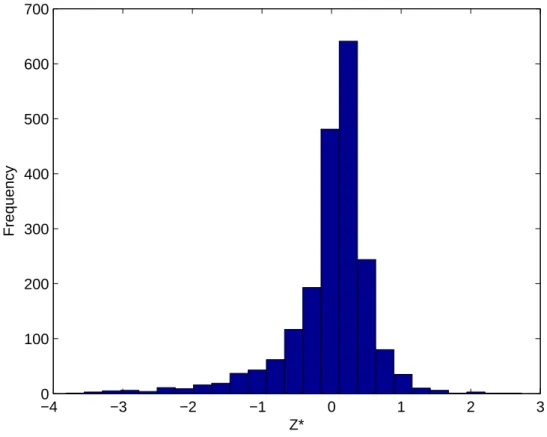
. . . 59
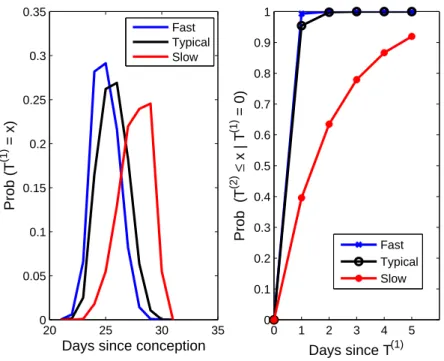
8 Discrete transition rates from a gestational sac to fetal pole (1 → 2, a) and cumulative probability of observing a normal heart rate (2 → 3, b) for three subjects. . . 60
9 Posterior prediction intervals and observed fetal pole lengths for 65 subjects. 61
10 Estimated probability density function for the predominant and residual components of latent immaturity distribution . . . 80
11 Path diagram representing dependencies in fetal development and birth outcomes model . . . 81
12 Probability of being growth restricted at birth for various ranges of early growth restriction . . . 82
13 Empirical and estimated cumulative distribution functions for gestational age at delivery, RFTS data . . . 83
14 Empirical and estimated cumulative distribution functions for birth weight, RFTS data . . . 84
15 Path diagram illustrating the dependencies in the proposed growth restric-tion and latent immaturity model . . . 109
16 Differences in ultrasound measurements of fetal size, blood restriction, and birth weight Z-scores for the restricted and normal latent classes . . . 110
17 Empirical and estimated cumulative distribution functions for gestational age at delivery, PIN data . . . 111
18 Empirical and estimated cumulative distribution functions for birth weight, PIN data . . . 112
LIST OF ABBREVIATIONS
AC Abdominal circumference
ARS Adaptive rejection sampling
BPD Biparietal diameter
BMI Body mass index
CDF Cumulative distribution function
CI Credible interval
CRL Crown-rump length
EM Expectation-Maximization
FL Femur length
GLM Generalized linear model
GLMM Generalized linear mixed model
HC Head circumference
LMP Last menstrual period
MCMC Markov chain Monte Carlo
MSD Mean (gestational) sac diameter
PI Pulsatility index
PIN Pregnancy, Infection and Nutrition
PTB Pre-term birth
RFTS Right from the Start
LIST OF ABBREVIATIONS
S/D Systolic-diastolic (ratio)
SAB Spontaneous abortion
SEM Structural equation model
1
Introduction
Longitudinal data, in which repeated measurements are taken on the same subject over
time, require special statistical methods because observations on the same subject tend to
be correlated. A variety of approaches have been considered to account for the correlation
(Diggle et al. 1994) with the random effects model being one of the most popular methods.
In random effects models, observations on the same subject are assumed to be correlated
due to the effect of some unobservable variables, called the random effects. The random
effects are a type of latent variable, and random effects models are a type of latent
variable method. We will consider several other types of models in which latent variables
are used to account for correlation in longitudinal processes.
Latent variables can be broadly classified into two concepts, latent predictor
vari-ables and latent response varivari-ables. Latent predictors (exogenous latent varivari-ables) are
determined outside of the model and can be related to mis-measured covariates. The
daily average of particulate matter measurement from several monitoring stations is an
example of error-prone realization of a latent true ambient particulate matter
concen-tration predictor variable. Latent responses, also known as endogenous latent variables,
are determined within the model. Latent responses include underlying variables that can
only be measured indirectly through multiple items and are often useful for reducing the
dimensionality of the data. For example, depression is a concept that cannot be
isolated response on the survey may not be very useful, latent variable methods provide a
natural way of aggregating multiple responses to determine an individual’s latent relative
depression level. In our reproductive health examples, we quantify the latent tendency
of an individual fetus to grow relatively quickly or slowly using information from a first
and second trimester ultrasound and his or her age and weight at delivery.
Latent variables are commonly found in structural equation models (SEMs) used in
the social sciences as a means of quantifying an unobservable concept based on
sev-eral observed variables (Joreskog 1970). SEMs consist of a latent variable model and a
measurement model. The latent variable model describes the association between latent
predictor variables and latent response variables. The second part of the model, the
measurement model, gives the relationship of measured outcomes and predictors with
latent outcomes and latent predictors.
Structural equations models provide a general modeling framework that can be used
for modeling several types of correlated data (Sanchez et al. 2005). Most work in this
area considers SEMs as a model for multivariate normal data, but they can be thought of
in a broader context. Ordinal data are directly incorporated into normal-theory models
by using threshold models. Threshold models are based on the idea that, for example,
the binary observed variableytakes on value one if some underlying continuous variable,
y∗
, is above a threshold value and zero otherwise. The latent y∗
then replaces y in the
SEM (Muthen 1983, 1984). Authors including Sammel et al. (1997) and Dunson (2000)
propose additional extensions that allow for observed outcomes to be in the exponential
family as in the generalized linear model.
disease. Many diseases can be thought of as moving through several latent health states
with the exact transition times between states unknown. Dunson and Baird (2002)
describe the progression of a chronic condition, uterine fibroids, as progressing from (1)
no disease, (2) preclinical disease, to (3) clinical disease. Information on the current
state as well as several indicators of disease progress can be used to estimate a severity
latent variable. This type of model can provide useful inference on the incidence and
progression of disease using cross-sectional data.
1.1
Reproductive Health Applications
Reproductive and perinatal health spans a broad area of research in maternal and infant
health including infertility, miscarriage, pregnancy complications, birth weight, pre-term
delivery, birth defects, childhood cancer, and child development (Bracken 1984; Kiely
1991). It has been long recognized that events preceding and during pregnancy can
influence the health and well being of both the mother and her child. Researchers have a
dual responsibility to contribute to the practical knowledge that improves health as well
as developing methodology so that we are better equipped to understand future health
problems.
1.1.1 Fetal Growth
During pregnancy, fetal development is traditionally dated from the first day of a woman’s
last reported menstrual period (LMP). The literature intermittently refers to this method
of dating as menstrual age and obstetricians often use the term gestational age
accurately begin growing at some later time point, which we will refer to as conception.
Conceptional age is also known as fetal age; for consistency, I will only use the terms
gestational age and conceptional age.
In clinical practice, the conceptional age is rarely known so it is estimated based on
the assumption of a midcycle ovulation (conceptional age = gestational age - 14 days).
Estimates of conceptional age are inaccurate due to variability in the follicular phase
distribution, which can vary both among women and within the same woman between
different cycles (Zhou 2006). This variability can be particularly troubling when studying
early fetal development because new structures appear every few days. Several studies,
such as the Early Pregnancy Study (Wilcox et al. 1988), have been conducted to precisely
date the time from LMP to clinical pregnancy. Using urinary biomarkers, Wilcox et al.
(2001) estimated that the probability of conception on a given day of the menstrual
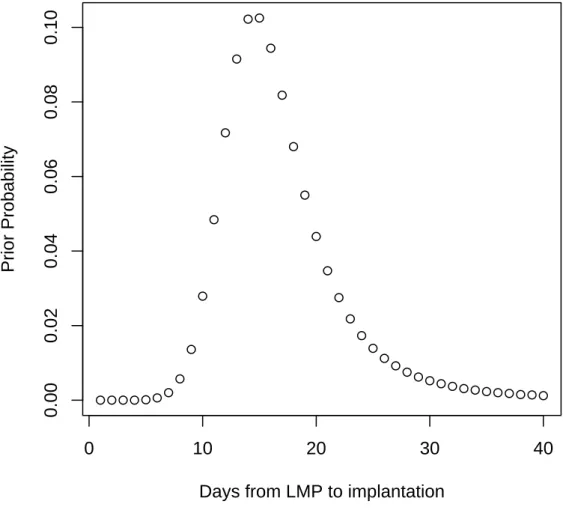
cycle, conditional on reaching that day of the cycle was greatest on day 13 (Figure 1).
The probability is less than 2% for each day before day eight and each day after day 21
of the cycle. Furthermore, the probability of clinical pregnancy on a given day can be
significantly modified by covariates. Wilcox et al. (2001) found the distribution of the
probability of clinical pregnancy by cycle day was more variable with a larger mode for
women with irregular compared to regular cycles.
In our first paper, we are interested in modeling early fetal development as a growth
process with an unknown initiation time. Conception, the unknown initiation time, is
known to occur after the LMP so we estimate the time from LMP to conception.
Individ-ual growth rates are estimated using a latent growth variable that allows individIndivid-uals to
on growth measured at birth using birth weight and gestational age. In that analysis,
we attempt to identify factors that are related to an individual’s underlying intrauterine
growth rate and a tendency to be born earlier than average. In paper three, we identify
growth restriction using multiple measurements of fetal size and blood flow restriction
collected at two time points during the second trimester. We then examine the
associa-tion between early growth restricassocia-tion and growth restricassocia-tion measured at birth. Papers
one and two are motivated by the Right From the Start (RFTS) study of early pregnancy
(Promislow et al. 2004), and paper three uses information from the Pregnancy, Infection,
and Nutrition (PIN) study (Savitz et al. 1999).
1.1.2 Fetal Development during Pregnancy
Human pregnancies are divided into three trimesters, each normally lasting
approxi-mately 12-14 weeks. In paper one, we are concerned with development within the first
trimester, specifically in the embryonic period which begins with fertilization and lasts
for eight weeks. During the embryonic period, the embryo proceeds through several
im-portant developmental stages. These stages can be defined by the presence or absence
of key features including the gestational sac, yolk sac, fetal pole, and cardiac activity.
Each of these features may be observed by a first trimester ultrasound depending on the
developmental progress of the pregnancy.
The gestational sac is the first structure visualized by sonography and can usually
be seen by the fifth gestational week. The average internal diameter of the gestational
sac is calculated as the mean of the anteroposterior diameter, the transverse diameter,
(MSD), provides a useful early estimator of age in a normal pregnancy. According to
Filly and Hadlock (2000), the gestational sac can be observed when it reaches 2 to 3 mm
MSD which occurs around 5 gestational weeks. MSDs up to 14 mm are very precise for
predicating gestational age in normal pregnancies, but become less reliable as pregnancy
progresses. According to Filly and Hadlock (2000), the predicted gestational age when
the MSD is 14 mm is 6.5 weeks (95%CI: [6.0, 7.0]). The yolk sac is usually observed
inside the gestational sac during the fifth gestational week. However, the dimensions of
the yolk sac do not significantly improve the ability to predict gestational age, so we do
not consider it in our analysis (Filly and Hadlock 2000).
After the gestational sac and yolk sac, the fetal pole is the next important structure
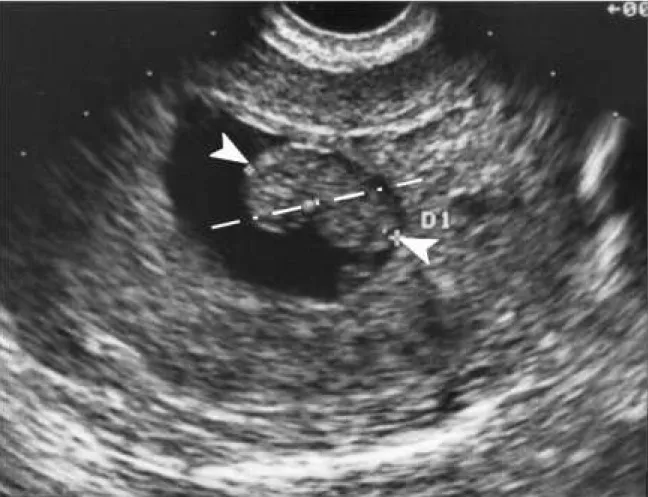
able to be detected by ultrasound (Figure 2). At this time, the crown-rump length (CRL;
also known as the fetal pole length) becomes the measurement of choice for estimating
gestational age. The fetal pole, without normal cardiac activity, can be visualized when
the CRL is as small as 2 mm, which occurs at 5.7 gestational weeks (95% CI: [5.2, 6.2]).
Normal cardiac activity begins a few days later, by the sixth gestational week (Filly
and Hadlock 2000). Hadlock et al. (1992) evaluated the association between CRL and
gestational age in 416 women with good menstrual dating. They used a fourth order
linear regression model in which CRL was able to predict 98.6% of the variation in the
natural logarithm of gestational age. Their results are similar to predictions reported
by other authors who often used only linear or quadratic CRL effects. An advantage of
the Hadlock study is that it included a relatively large sample with a greater range of
CRL measurements (from 2 mm to 120 mm) than other studies. The additional small
Researchers have conducted studies to determine if gestational sac diameters or crown
rump lengths measured by an early ultrasound are indicative of early pregnancy loss.
Nyberg et al. (1987) collected data on 83 women who had two sonograms performed
during the first trimester of pregnancy. The subjects were referred for a second ultrasound
due to bleeding or pelvic pain (64 cases) or to confirm the pregnancy (19 cases). They
found that gestational sac growth was significantly slower in women who eventually
had abnormal pregnancies compared to women with normal pregnancies. However, in
evaluating 254 viable singleton pregnancies, Brizot et al. (2001) were not able to confirm
this result. Mantoni and Pedersen (1982) examined 67 patients with threatened abortion
with regular, known menstrual cycles. They found that the crown rump length of these
fetuses was smaller than expected based on their gestational age. There was also some
evidence that the fetuses that eventually aborted had on average smaller crown rump
lengths. Again, Brizot et al. (2001) could not replicate this result. Rather than consider
gestational sac diameters and fetal pole lengths directly, we conceptualize that they are
indicators of underlying fetal growth. In paper one, we estimate an early fetal growth
latent variable and examine its association with the risk of pregnancy loss.
1.1.3 Birth Weight
Birth weight is an important predictor of perinatal, neonatal, and postnatal outcomes
(Shan and Ohlsson 2002). Poor growth during the intrauterine period is associated with
increased risk of perinatal and infant morbidity and mortality. Many epidemiological
studies have been conducted to elucidate some of the determinants of birth weight.
of low birth weight, and alcohol use are generally accepted as having a strong association.
Other studies have found various environmental and occupational exposures, caffeine use,
uterine fibroids, and stress may be associated with growth and require further research
(Shan and Ohlsson 2002).
Zhang and Bowes (1995) attempted to create a standard for identifying small for
gestational age (SGA) infants stratified on race, gender, and parity. Gestational age
was calculated using LMP data for more than 95% of all subjects, but in some cases a
clinician-based adjustment was needed to correct inaccurate LMPs. The authors do not
report statistical test results indicating if they found significantly different growth curves
by race, gender, or parity. However, they do provide graphs that indicate these covariates
may be associated with growth as measured by birth weight between 25 and 42 weeks
gestation. We will examine the association of race, gender, and parity with growth rate
during the first trimester.
Weight at birth is a function of both the amount of time from conception to birth and
the intrauterine growth rate of a fetus. Low birth weight can result from slow intrauterine
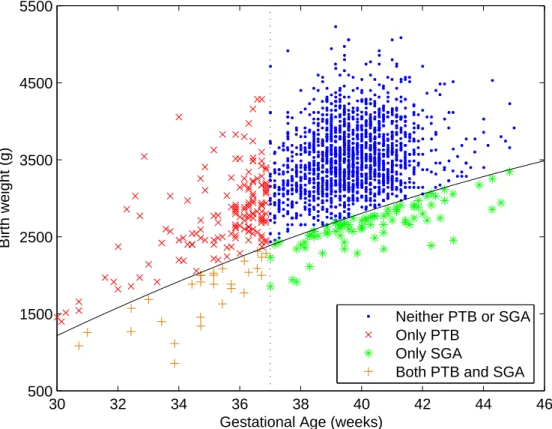
growth, early conceptual age, or a combination of the two. Figure 3 plots birth weight
versus gestational age to help describe the different type of outcomes that could be
observed in a population of newborns. Most newborns are normal age and weight, but
some will be born below the 10th percentile of weight for a given gestational age (small
for gestational age, SGA) and others may be born before the 37th week of gestation
(pre-term birth). Some newborns will be both pre-(pre-term and SGA. In papers two and three,
we capture the correlation between birth weight and gestational age using an immaturity
approach also allows us to identify a latent class of subjects with early gestational age
and low weight. In reproductive health, epidemiologists refer to these types of subjects
as belonging to the “residual” distribution (Wilcox et al. 2001), and they are of special
importance because they are at increased risk for mortality and other forms of morbidity
(Buekens et al. 2000). We attempt to find covariates that are associated with belonging
to the residual distribution.
1.2
Other Applications
Our research is motivated by an application in reproductive health, but the methods
we propose can be applied to other areas as well. We explain models using examples
from other disciplines throughout this dissertation, and provide a brief overview of the
most common applications here. SEMs are primarily found in the social sciences (Bollen
1989), and Sanchez et al. (2005) advocates their use in environmental epidemiology. In
the statistics literature, reproductive toxicology has been used to motivate both
multi-state growth models (Sternberg and Satten 1999) as well as mixed continuous and
dis-crete outcomes (Catalano and Ryan 1992). Other examples of multistate models come
from AIDS research (DeGruttola and Lagakos 1989), the development of uterine fibroids
0 10 20 30 40
0.00
0.02
0.04
0.06
0.08
0.10
Days from LMP to implantation
Prior Probability
Figure 1: Prior probability of conception on a given day of the menstrual cycle,
Figure 2: Early fetal pole visualization by ultrasound. The pole is indicated by the two
30 32 34 36 38 40 42 44 46 500
1500 2500 3500 4500 5500
Gestational Age (weeks)
Birth weight (g)
Neither PTB or SGA Only PTB
Only SGA
Both PTB and SGA
2
Latent Variable Methods for Longitudinal Data
Latent variable methods can capture many statistical concepts including random effects,
missing data, sources of variation in hierarchical data, finite mixtures, latent classes, and
clusters (Muthen 2002; Sanchez et al. 2005). In this section, we review several types of
latent variable methods for longitudinal data.
2.1
Random Effects Models
Random effects models are commonly used for longitudinal data in which repeated or
otherwise correlated measurements are taken on the same subject. The linear random
effects model as proposed by Laird and Ware (1982) is specified by
yi =Xiβ+Zibi+i, i= 1, ..., n (2.1)
where yi is ni ×1, Xi is an ni × p matrix of fixed predictors, β is a p×1 vector of
fixed effects, Zi a ni×q vectors of covariates for the q×1 vector of random effects bi,
and i is an ni ×1 vector of random errors. It is standard to assume thati and bi are
independent and both normally distributed
bi ∼Nq(0,D) (2.2)
and
so that, marginally,
yi|β,Ri,D∼Nni(Xiβ,Ri+Z 0
iDZi) (2.4)
Random effects models can also be specified for non-continuous outcomes. The
gen-eralized linear model (GLM) extends the methods of regression analysis to outcome
vari-ables that follow other distributions in the exponential family (McCullagh and Nelder
1989). For example, the binomial distribution is often used for binary outcomes and
the Poisson distribution for counts. The generalized linear mixed model (GLMM) is the
GLM generalization of the linear random effects model and is specified by Diggle et al.
(1994) as
• Given bi, the responses yi are mutually independent for each i and follow a GLM
with density f(yij|bi) = exp[{(yijθij − ψ(θij))}/φ +c(yij, φ)]. The conditional
moments µij = E(yij|bi) = ψ0(θij) and vij = Var(yij|bi) = ψ00(θij)φ, satisfy
h(µij) =x0ijβ+z 0
ijbi and vij =v(µij)φ whereh andv are known link and variance
functions, respectively, and zij is a subset of xij
• The random effectsbi are mutually independent with a common underlying
distri-bution,F
Frequentist likelihood-based estimation of the GLMM can be computationally difficult
because high dimensional integrals are needed to evaluate the marginal likelihood
(Bres-low and Clayton 1993). In contrast, likelihood-based Bayesian methods are relatively
straightforward to carry out using the Gibbs sampler because we can sample parameters
conditionally on the random effects (Gelfand and Smith 1990).
heterogeneity across individuals that can be represented in their regression coefficients.
Observations on the same individual are correlated due to sharing some unobservable
variables, bi. A model of this type is sometimes referred to as a kind of latent variable
model (Diggle et al. 1994) with the unobserved random effects being considered latent
variables.
2.2
Latent Class Trajectory Models
Growth models, which model the changes in individuals over time, are one traditional
application for random effects models. A growth model that allows for a quadratic effect
of time for subject i measurement j at age tij could be specified using the notation of
Laird and Ware by
yij = (β0+b0i) + (β1+b1i)tij+ (β2+b2i)t2ij+ij (2.5)
where bi ∼ N(0,D) and i ∼ i.i.d.Nni(0,Ini). An equivalent representation of this
model in terms of subject-specific latent variables η0i for the intercept, η1i for the linear
effect and η2i for the quadratic effect is
yij =η0i+tijη1i+t2ijη2i+ij (2.6)
where ηi ∼N([β0, β1, β2]0,D) and i ∼i.i.d.Nni(0,Ini).
It may be of interest how the shape of an individual growth trajectory, as measured
by the latent variables, is related to some outcome measure. For example, Muthen
and Shedden (1999) are interested in the association between the shape of an alcohol use
trajectory from ages 18-25 and the risk of alcohol dependence at age 30. Directly relating
because the meaning of a given ηi coefficient depends on the values of the other ηi
coefficients. For example, a subject with a positive linear slope (η1i > 0) could have
decreasing dependence over time (ifηi2 <0), a purely linear increase over time (ifηi2 = 0),
or increase very rapidly over time (ifηi2 >0). A better option is a latent class trajectory
model.
A latent class model summarizes shared features of the η coefficients using an
un-derlying categorical variable. Specifically, the mi-dimensional ηi are related to the
K-dimensional latent categories ci and p-dimensional covariates xi using
ηi =Aci+Γηxi+ζ, ζi ∼Nmi(0,Σ) (2.7)
with conforming parameter matrices A(mi×K) and Γη(mi×p). The latent categorical
variable, ci = (ci1, . . . , ciK) follows a multinomial distribution with cik = 1 if individual
i falls in class k and zero otherwise. A r-dimensional vector of observed dichotomous
outcome variablesuican then be related to the latent categories using a logistic regression
model
logit (Pr(uij= 1|ci)) =Λu,jci (2.8)
where eachΛu,jis an 1×K parameter matrix,j = 1, . . . , K. To complete the specification
of the model, Muthen and Shedden (1999) allow the categorical latent variablescto be
re-lated to covariatesxusing a multinomial logit model for unordered polytomous responses.
Defining πik = Pr(cik = 1|xi) and the logit(πi) = (log [πi1/πiK], . . . ,log [πi,K−1/πiK]),
logit(πi) = αc+Γcxi (2.9)
this specification, the conditional distributions of y and u given x are influenced by
parameters that vary across the categories of c.
Several recent articles have built on these results. Guo et al. (2006) extend the latent
class regression model so that it can include regression on latent predictors. Miglioretti
(2003) discusses additional challenges that arise when the longitudinal measurements are
mixtures of continuous, binary, and count data. Lin et al. (2000) use a latent class model
to uncover subpopulation structure for both biomarker trajectories and the probability
of disease outcome in highly unbalanced longitudinal data.
2.3
Structural Equation Models
SEMs are a flexible class of models originally proposed by Joreskog (1970) that allow
modeling of both multivariate data and multiple, closely related predictors. The SEMs
described in the book by Bollen (1989) incorporate a measurement model and a latent
variable model for multivariate normal data. Using the notation of Bollen, the latent
variable model is
η=Bη+Γξ+ζ, ζ ∼Nm(0,Σ) (2.10)
where η is and m×1 vector of latent responses, B an m×m coefficient matrix, and ξ
are latent predictor variables (n×1) with coefficient matrixΓ (m×n). The latent class
model given in (2.7) is a special case of (2.10) whereB =0,Γ= [A;Γη], andξ = [ci;xi].
The measurement model is then given by
y=Λyη+, ∼Np(0,Σy) (2.11)
The vectorsy(p×1) andx(q×1) are observed variables with coefficient matrices, referred
to as “factor loadings” in SEMs, Λy(p×m) and Λx(q×n) and with errors (p×1) and
δ(q×1), respectively. Identifiability is an important consideration in SEMs, and is often
accomplished by constraining covariance matrices to be diagonal, factor loading matrices
to be equal to one, and/or the variance of the latent variables to be unity (Bollen 1989).
Some researchers have given particular attention to models that contain observed
variables that are multiple indicators and multiple causes of a single latent response
variable (MIMIC) as we have in the early pregnancy example (Joreskog and Goldberger
1975). In the MIMIC model, Λy = Iq and the latent predictor variables are observed
without error (x=ξ) so thatη is a stochastic function ofxwith coefficients Γand error
component ζ1:
η =Γx+ζ1, ζ1 ∼N(0, σ2). (2.13)
We say thatηis affected by one or morexvariables and it is associated with one or more
y variables such that
y =Λyη+ (2.14)
with errors and factor loadings Λy. This model will be identifiable if there are at least
two y variables, at least one x, and η is provided a scale by either fixing the variance of
ζ1 or a factor loading term (e.g. ζ1 ∼ N(0,1) or λ1 = 1). Identifiability of these models
as well as more general models with multiple latent variables is often a concern and is
discussed by Stapelton (1977), Robinson (1974), and Bollen (1989) among others.
Mixed effects models are closely related to SEMs where the random effects are latent
sampling unit. While conceptually similar, there are some important differences in how
they specify the mean and covariance models. To clarify the differences, consider a
p-dimensional vector of responses yi = [yi1, yi2, . . . , yip]0 that has a linear relationship with
dose. A linear random effects model as in (2.1) could be fit
yij =β0j+β1j ∗dosei+bi1+bi2∗dosei+ij, ij ∼N(0, σ2) (2.15)
The same data could be analyzed with the SEM
yij = µj +λj∗ηi+ij, ij ∼N(0, σ2j) (2.16)
ηi = γ1∗dosei+δi, δi ∼N(0,1) (2.17)
The SEM estimates additional factor loading terms λj(λj ≥ 0) that multiply the latent
variable to allow for a non-exchangeable correlation structure as well as differences in
scale between the measured outcomes (Dunson 2006b). The correlation structure for the
random effects model is allowed to vary by dose, but for the control group (dose = 0)
simplifies to a compound-symmetric structure. In the SEM, the correlation between yij
and yij0 is given by
corr(yij, yij0) =
λjλj0
q λ2
j +σ2j
q λ2
j0+σj20
(2.18)
which can differ for different sets of outcomesj andj0
. A potentially important advantage
to the random effects model is that it allows heterogeneity in the regression coefficients
for dose across different responses. Models that combine the benefits of random effects
models and SEMs are an area of current research (Dunson 2006b). Lin et al. (2000)
and Roy et al. (2003) consider other approaches for allowing differences in scale when
While Bollen considers SEMs as models for multivariate normal data, they can be
considered in a wider context. Longitudinal data can be measured on binary scale,
cat-egorical (ordinal or nominal) scale, metric scale (discrete or continuous), or in various
combinations. Other researchers have considered latent variable models which allow
measured and latent variables to have a broader class of distributions. Dunson (2000),
Sammel et al. (1997), and Moustaki and Knott (2000) consider distributions in the
expo-nential family for modeling variables that are collected on a variety of scales. In papers
two and three, we relax the normality assumption and consider options including a latent
class model in which the latent variable follows a mixture distribution.
2.4
Bayesian Structural Equation Models
The majority of literature on SEMs using latent variables is frequentist in nature, but
Bayesian approaches have been proposed by several authors. There is a long history for
Bayesian analysis of factor models, which are a special case of SEMs, in the psychometrics
literature (Ansari and Jedidi 2000; Lee 1981; Martin and McDonald 1975). Early work
on more general SEMs was done by Lee (1992) and Bauwens (1984).
There are several important differences between a Bayesian and frequentist approach
to latent variable models. While frequentists usually assume normal distributions for
latent variables, Bayesians must specify prior distributions for all unknown parameters in
both the latent variable and measurement models. The priors allow for information from
previous studies or theory to inform about the nature of the structural relationships, or,
in the absence of such information, vague priors can be used. Computationally, Bayesian
computationally expensive but provide exact posterior distributions for functions of any
unknown parameters.
A Bayesian perspective allows us to estimate the posterior distribution of latent
vari-ables as well as parameters without making asymptotic assumptions. As pointed out by
Palomo et al. (2007), estimating the joint posterior of latent variables has several
advan-tages over a frequentist approach. For one, we can obtain point and interval estimate
of factor scores for each individual in the study. We can then compare different factor
scores among individuals (through posterior probabilities that, for example, one score is
higher than another) and if an individual’s factor score changes over time. We can also
identify outlying individuals who are at the tail of the distribution.
A downside of a Bayesian approach to SEMs is that high autocorrelations can lead
to slow convergence of the Gibbs sampler. It may take several hours of sampling until
the Monte Carlo error in sampling is negligible. Recent articles have focused on MCMC
methods to implement Bayesian analysis in complex cases including non-linear systems
(Arminger 1998; Lee and Song 2004) and multi-level data (Dunson 2000; Song and Lee
2004). We discuss computational issues in more detail in section 3.
2.5
Multistate Models
A multistate process is a stochastic process that can take on a finite number of states K
where each state describes the current condition (Jewell 2005; Kalbfleisch and Prentice
2002). In a general form where we allow time to be continuous, we define Y(t) to be the
state of the process at time t, Y(t)∈ {1,2, . . . , K} and t ≥0. A Markov process is the
with no covariates, the transition rate from state i toj for an individual who is in state
i at time t−
is given by
dΛij(t) = P
Y(t−
+dt) =j|Y(u),0≤u < t, Y(t−
) =i
= P
Y(t−
+dt) =j|Y(t−
) = i
for all Y(u),0≤u < t, j 6=i. The Markov assumption is that the process is memoryless
in that only the current occupied state is need to specify the transition rates. Transition
rates are allowed to depend on t, the amount of time since the beginning of the study.
In a general multistate model, subjects are allowed to transition from any state k to
another state k0
. Multistate growth models impose some restrictions on the multistate
model. For one, growth models are unidirectional. That is, state transitions occur in a
distinct order, only moving from statekto statek+1,k = 1, . . . , K−1. Also, all subjects
begin at the same initial state, k = 1. Traditional survival analysis, where subjects only
move from “at risk” to “failed” states is a simple example of a unidirectional multistate
process with K = 2.
In a regular Markov model, we are able to observe the states directly so that the state
transition probabilities are the only parameters of interest. In a hidden Markov model
the complete state history of a multistate processY(t) is not available at every time point
t, but variables that are influenced by the state are observed. The influencing variables
can be linked to underlying latent progress variables that are indicative of the waiting
time spent in a state (Dunson and Baird 2002). In a longitudinal study, the state may be
observed at several time points for each subject but the exact transition times are only
only available at one time point. We are concerned with the cross-sectional case where
state transition times are interval censored and developmental progress covariates are
measured once for each subject.
We consider multistate growth models where the moment the process begins, called
the initiation time, is not known. The earliest approaches for multistate models with
unknown initiation times relied on the restrictive Markov assumption (Kalbfleisch and
Lawless 1985), which is not appropriate in our application. Semi-Markov models for
fitting interval censored data with unknown initiation times (Satten and Sternberg 1999)
have been developed that allow transition rates to depend on the amount of time spent
in the state. In the fetal growth example, we consider the LMP date to be a known,
pre-initiation time and conception the unknown pre-initiation time. With this fixed time scale,
it would also be possible to use the semi-Markov methods of DeGruttola and Lagakos
(1989) or Sternberg and Satten (1999) by considering the pre-initiation time to be the
first stage in the network. If the waiting times in different states are independent, then
the semi-Markov assumption will hold. We avoid the semi-Markov assumption and allow
individual transition rates between states to be influenced by a subject-specific latent
3
Computation
When proposing structural equation models, it is particularly important to consider
which parameters in the model are identifiable and which must be constrained. In many
cases, the marginal likelihood can be examined to determine how the data informs about
each parameter. In a Bayesian analysis, fitting MCMC models can be somewhat of an art
form so that alternative strategies may be needed to achieve dependable results (Gelfand
and Sahu 1999). For example, including parameters that are non-identifiable, with
ap-propriately vague priors, can help improve convergence. In this section, we first provide a
brief introduction to Bayesian methods. We then define identifiability and Bayesian
iden-tifiability and explain one way in which including non-identifiable parameters in a model
can improve computational performance while introducing a more general class of
con-ditionally conjugate priors. This section is concluded by describing a data augmentation
algorithm useful for fitting probit and multivariate probit models.
3.1
Bayesian Methods for Data Analysis
Bayesian methods are a useful tool for the applied statistician with applications in a
wide range of areas due to the development of MCMC methods and the corresponding
expansion of computing power. The details of a Bayesian approach to data analysis
(Carlin and Louis 2000; Gelman et al. 2004) are well beyond the scope of this dissertation.
following sections.
The flexibility of the Bayesian framework allows it to deal with very complex
analyt-ical problems while using relatively simple conceptual methods. Bayesian methods are
based on estimating the posterior distribution of p parameters θ given the data x and
hyperparameters η, f(θ|x,η). Using Bayes’ Theorem,
f(θ|x,η)∝L(θ)π(θ|η) (3.1)
whereL(θ) =f(x,θ|η) represents the likelihood andπ(θ|η) the prior distribution onθ.
Inference is then based on the posterior distribution of parameters θi.
It is often difficult to directly calculate the complete joint posterior distribution,
f(θ|x,η), when p is not small. Gibbs sampling (Gelfand and Smith 1990; Geman and
Geman 1984) is a commonly used MCMC method to draw elements ofθindividually or in
small groups. The Gibbs sampler generates values from the joint posterior distribution by
iteratively drawing samples from the complete conditional distributions f(θi|θj,x,η, i6=
j) for each i = 1, . . . , p0
≤ p. After sufficient iterations, draws from the individual
complete conditionals will eventually converge to being draws from the desired posterior
distributionf(θ|x,η). When conjugate priors are chosen, it is often easy to sample from
the complete conditionals because they are of known forms. For complete conditionals
of unknown form, sampling can be done using the Metropolis-Hastings Algorithm (Chib
and Greenberg 1995; Hastings 1970) with proposal densities generated from adaptive
rejection samplings (ARS; Gilks and Wild 1992) or ARMS (ARS with a metropolis step;
Gilks et al. 1995. Iterations continue until the parameters are judged to converge by a
3.2
Identifiability
A parameter θ is (frequentist) identifiable by observations of a random vector y if
dis-tinct values for θ yield distinct distributions for y (Basu 1983). Bayesian identifiability
(Dawid 1979) focuses on the posterior distribution and is concerned with whether the
data and prior provide information about the parameters. Situations can arise where
parameters are not frequentist identifiable, but can identified in a Bayesian analysis that
uses informative priors. In these cases, parameters that are only Bayesian identifiable
need to be recognized and interpreted appropriately.
Specifying a proper prior ensures a proper posterior. However, improper priors are
often used to reflect ignorance of parameters or for mathematical convenience. Gelfand
and Sahu (1999) explore the use of improper priors for the generalized linear model and
developed the following theorem:
Consider the Gaussian linear model y = Xβ + with Xn×p, βp×1, with
rank(X) = r < p and ∼ N(0, σ2I). Suppose that the prior f(β, σ2) takes
the form f(β)f(σ2), where f(β) =f(γ), a proper prior on γ = Ωβ with Ωβ
estimable. Then f(β, σ2|y) is improper.
A proper prior will need to be specified on some non-estimable parameters for the
posterior to be proper. In the frequentist setting, this is usually accomplished by
con-straining certain parameters to be equal to some value (usually 0). Gelfand and Sahu
(1999) give a logistic growth curve example to illustrate that this is not an ideal
solu-tion when performing Gibbs sampling. They show that placing non-informative (but
signif-icantly decrease the autocorrelation of estimable parameters. The worst convergence of
the Markov chain is attained by imposing constraints. Gelman et al. (2003) also notes
for the generalized linear model more diffuse working prior densities improves mixing.
Recent papers on parameter expansion elaborate on these ideas.
3.3
Parameter Expansion
Parameter expansion adds new parameters that are not identifiable to a model. An
example is replacing a parameter θ by a product φψ so that inference can be obtained
only about the product and not the individual parameters. This technique has been
used to improve the convergence rate of the EM algorithm by Liu et al. (1998) in a
non-Bayesian setting. Gelman (Gelman 2004; Gelman et al. 2003) uses parameter expansion
as a computational aid within a Gibbs sampling framework, which we will find more
useful.
Gelman considers the following hierarchical model expressed as a regression with
coefficients in M batches.
y=
M
X
m=1
X(m)β(m)+ error
whereX(m)is themth submatrix of predictors andβ(m)is themth subvector of regression
coefficients. The Jm coefficients in each subvector β(m) have an exchangeable N(0, σm2)
prior distribution for j = 1, . . . , Jm. He uses this general notation to allow for several
different types of models. We are interested in a mixed effects model where, for the fixed
effects, σm =∞and, for the random effects, σm is estimated from the data.
This hierarchical model can become stuck when σm happens to be near 0. In the
updating stage of the Gibbs sampler, β(m) will be shrunk to 0, at the next update σ
will be near 0, and so on. Simulations show that it can take considerable time for the
Gibbs sampler to escape this situation (Gelman et al. 2003).
Gelman (2004) advocates using the following parameter-expanded model where each
component of the regression model is multiplied by a new parameter, α∗
m. Let the old
model be
y=
M
X
m=1
X(m)β(m)+ error
and the new, expanded model be
y = M X m=1 α∗ mX
(m)β∗(m)+ error
The estimable function |α∗ m|σ
∗
m in the new model maps to σm in the old model and
α∗ mβ
∗(m)
j from the new model maps toβ
(m)
j from the old model. The individual parameters
α∗ m, β
∗(m)
j , andσ ∗
m are not frequentist identifiable, but if proper priors are specified, they
will be Bayesian identifiable.
Gelman (2006) examines different choices for prior distributions in the hierarchical
model. He expands the family of conditionally-conjugate prior distributions by applying
a redundant multiplicative reparameterization to the general hierarchical model:
yij ∼ N(µ+ξηj, σy2)
ηj ∼ N(0, ση2)
There is an implicitly conditionally conjugate prior distribution on the random effects
standard deviation, σα = |ξ|ση. Using the usual conjugate priors for ξ (normal) and ση2
(inverse-gamma), σα has the distribution of the absolute value of a noncentral-t
special case of the folded non-central t, the half-t distribution. This half-t is appealing
because the distribution of ξ will be symmetric about 0, however the half-tfamily is not
conditionally conjugate.
In summary, Gelman’s findings and advice include:
• Start with a noninformative uniform prior density on the standard deviation σα
• For a non-informative but proper density, try a half-normal centered at 0, ξ ∼
N(0,1002)
• Avoid the usual inv-gamma(, ) priors on σ2
α especially when small values of σα
are possible. Inference is very sensitive to and the prior distribution is not
non-informative as desired.
• To restrict σα from large values, use a half-t family
We found these suggestions particularly helpful in the early fetal growth analysis.
Con-vergence rates were improved while using a less informative prior than the usual gamma
prior on precision parameters.
3.4
Data Augmentation
Data augmentation is a general scheme in which the observed data are enhanced so as
to make it easier to analyze. Dempster et al. (1977) popularized the method with their
paper on the EM algorithm for maximizing a likelihood function, but their approach
was not called “data augmentation” until Tanner and Wong (1987). From a Bayesian
observed data to calculate the posterior distribution of the parameters of interest (van
Dyk and Meng 2001). For observed binary data, data augmentation postulates the
existence of an underlying continuous variable such that the event is observed to occur if
the continuous variable is above some threshold value. Using this idea, we can use latent
variables to facilitate model computation for categorical outcomes.
The data augmentation algorithm outlined by Albert and Chib (1993) connects a
pro-bit regression model on an observed dichotomous outcome with a normal linear regression
model on a continuous latent outcome. Their algorithm involves sampling latent outcome
variables from the truncated normal distribution, with the truncation conditional on the
observed dichotomous outcome variable. Lety1, . . . , ynbe the observed dichotomous
out-come on subject i and y∗
i the underlying latent response, where y ∗
i are i.i.d. N(x 0 iβ,1).
Define yi = 1 if yi∗ > 0 and yi = 0 otherwise so that the yi are independent Bernoulli
random variables with P r(yi = 1) = Φ(x0iβ) where Φ(·) is the standard normal
cumula-tive distribution function. The complete conditional distribution of the latent y∗
i is then
given by
y∗
i|yi,xi,β∼
N1(x0iβ,1)I(y ∗
i >0) if yi = 1
N1(x0iβ,1)I(y ∗
i <0) if yi = 0
(3.2)
With a conjugate prior specification for β, Gibbs sampling can then be used to sample
from the posterior distribution of β using well known linear regression results. To
sim-plify subsequent notation, the general truncated normal distribution as given in (3.2) with
σ2 = 1 will be specified asT N(x0
iβ, σ2, yi). The underlying latent normal approach can
naturally be extended to the multinomial probit model (McCulloch and Rossi 1994) for
Green-berg 1998) for multivariate binary correlated outcomes.
3.5
Multivariate Probit Models
Chib and Greenberg (1998) detail an approach for modeling multivariate correlated
bi-nary data that is a natural extension of the univariate probit model framework. Let yij
be a binary response for theith observation unit andjth variable,j = 1, . . . , p. Chib and
Greenberg (1998) postulates the existence of an underlying multivariate normal random
vector
y∗
i ∼Np(Xβ,Σ) (3.3)
such that yij = I(yij∗ > 0) and Σ is a correlation matrix for identifiability. We can
then extend this representation for joint modeling of continuous and binary correlated
outcomes. Let zi1 be a p1-dimensional vector of observed normal continuous response
and zi2 a p2-dimensional vector of binary responses with underlying responses z∗i2. The
joint distribution of zi1 and z∗i2 is given by
zi1 z∗ i2
∼Np1+p2 Xβ,
Σ11 Σ12
Σ21 Σ22 (3.4)
where the diagonal elements of Σ22 are fixed at one for identifiability. The problem is
now reduced to modeling normally distributed correlated data using observed and latent
continuous random variables.
While the relatively direct probit model framework for analyzing mixed continuous
and discrete outcomes is conceptually appealing, it can be computationally demanding.
In a Bayesian analysis, high autocorrelations within parameters and cross correlations
number of approaches have been suggested to improve mixing and the convergence rates
of longitudinal models and the multivariate probit model that we may be able to adapt
for modeling mixed continuous and discrete outcomes.
Gelfand et al. (1995) presents hierarchical centering reparamaterizations that often
have improved convergence for a broad class of normal linear mixed models. Hierarchical
centering can be explained by considering the simple random effects model yij = µ+
bi1 +ij, where bi1 ∼ N(0, σb2) and ij ∼ N(0, σe2) i.i.d for each subject i and repeated
measurej. In order to create a better-behaved posterior surface, a second level hierarchy
is introduced by defining ηi = µ+ bi1 such that ηi|µ ∼ N(µ, σ2b). The hierarchical
centering transformation can break the high posterior correlations among parameters
that commonly occur in random effects models and greatly improve convergence of the
Gibbs sampler.
The benefits of blocking, which involves updating parameters in groups, in
hierarchi-cal longitudinal models are advocated by Chib and Carlin (1999). They also specifihierarchi-cally
consider longitudinal binary probit models of the form Pr (yij = 1|bi) = Φ(x0ijβ+z 0 ijbi)
where Φ is the standard normal CDF and bi ∼ Nq(0,D). Then the conditional
distri-bution of the latent outcome, yij =I(yij∗ >0), is given by y ∗
ij|bi ∼N(x 0
ijβ+z 0
ijbi,1). A
simple algorithm for sampling from the joint posterior that updates parameters one at a
time will include sampling (1) β|y∗
,b,D and (2) y∗
ij|yij,β,b,D as well as (3) b|y∗,β, D
and (4) D|b. Chib and Carlin (1999) refine this algorithm by marginalizing the
dis-tribution of y∗
i over the random effects so that y ∗
i ∼ Nni(Xiβ, Ini+ZiDZ 0
i). Steps
(1) and (2) of the simple algorithm are blocked so that we sample both β and y∗ i from
[β,y∗
i|y,D] by sampling (a) β|y,y ∗
,D and (b) y∗
approach and some similar variations significantly reduce autocorrelations for β, but are
less effective on improving convergence for the random effect variance,D.
Imai and Van Dyk (2005) and Nobile (1998) propose methods for improving the
convergence of the multinomial probit model. They realize that one of the reasons for
the poor convergence of probit models is the variance of the latent response variable is not
identifiable and is fixed at one by convention. Imai and Van Dyk (2005) introduce a new
latent variable ˜y∗ i =αy
∗
i so that ˜y ∗
i|β, α, yi ∼T N(αXiβ, α2,y). An inverse gamma prior
is specified for α2 and it is included as part of the Gibbs sampling algorithm. Nobile
(1998) develops a hybrid Markov chain in which a Metropolis step is performed after
each cycle of the Gibbs sampler to change the scale of the current state. Both methods
improve the computational efficiency of simulated data, with the more recent paper of
4
Bayesian Modeling of Embryonic Growth using
Latent Variables
4.1
Abstract
In a growth model, individuals move progressively through a series of states where each
state is indicative of their developmental status. Interest lies in estimating the rate of
progression through each state while incorporating covariates that might affect the
tran-sition rates. We develop a Bayesian discrete time multistate growth model for inference
from cross-sectional data with unknown initiation times. For each subject, data are
col-lected at only one time point at which we observe the state as well as covariates that
measure developmental progress. We link the developmental progress variables to an
underlying latent growth variable that can affect the transition rates. We also examine
the association between latent growth and the probability of future events. We use a
Markov chain Monte Carlo algorithm for posterior computation and apply our methods
to a novel study of embryonic growth and pregnancy loss in which we were able to find
evidence in favor of a previously hypothesized but unproven association between slow
4.2
Introduction
Fetal growth is important both clinically and in epidemiologic studies relating growth
to later pregnancy and developmental outcomes. To date, large cohort studies have
re-lied on the last menstrual period (LMP) and onset of bleeding to determine the time
of miscarriage. This approach is centrally flawed because it ignores the developmental
state of the fetus prior to the loss. Development may stop days to weeks prior to the
onset of bleeding so that, for example, a loss classified as a miscarriage in the 10th week
of gestation may have been the loss of an appropriately-grown 10 week fetus, or a fetus
with development arrested at 7 weeks. Coupling cross-sectional ultrasound information
with the ability to estimate growth provides an opportunity to estimate probable
devel-opmental state prior to miscarriage. This can help researchers more accurately identify
which insults must have occurred prior to the pregnancy loss and rule out exposures that
occur after development arrest but before the onset of bleeding.
Another complication in determining the miscarriage date is uncertainty in pregnancy
dating. After the occurrence of a positive pregnancy test, time of conception is
tradi-tionally dated as two weeks after the LMP. Such dating is notoriously imprecise due to
variation in follicular phase length, the time between menses and ovulation, and, in rarer
cases, missed menses (Kramer et al. 1988; Savitz et al. 2002). However, the distribution
of the follicular phase length has been well characterized (Wilcox et al. 2001) and can
be used to obtain more realistic estimates of the conception time. With these difficulties
in mind, our goal in the early pregnancy example analysis is two-fold: (1) to determine
varia-tion in growth exists, to determine if growth is associated with the probability of future
pregnancy loss. In particular, if (2) holds the current practice of using ultrasound dating
in early pregnancy loss studies may need to be re-evaluated.
This vexing problem can be posed statistically using a latent multistate growth process
with unknown initiation time. In a multistate model the current condition of a subject
is summarized by assignment to one of a finite number of K states (Jewell 2005). A
growth model assumes that all subjects begin at the same initial state and advance
unidirectionally through subsequent states. That is, all subjects progress in order from
state k to k+ 1, k = 1, . . . , K−1 without skipping any states or regressing to previous
states. This article focuses on the problem of estimating such models using cross-sectional
data in which transition times are not observed. For each subject, we have information
at one time point on the current state as well as measurements of developmental progress
that are surrogates of the amount of time spent in a state. Also, the moment the growth
process begins, referred to as the initiation time, is not known, though some time point
before initiation is known.
Multistate growth models with interval censored transition times appear in several
applications. Often the initiation time is also unknown but not considered in the analysis.
One example involves studying tumor growth in mice. Typically, a mouse is exposed to a
carcinogenic compound and a tumor may develop some time following the exposure. At a
later date, the mouse is sacrificed to determine how far the tumor has progressed (Albert
and Shih 2003; Dewanji and Kalbfleisch 1986; Ryan and Orav 1988). In these studies,
the investigators analyze time from exposure rather than time from tumor initiation. We
in our application, failing to account for the unknown initiation time can have a large
impact on the analysis. Other examples of multistate models include AIDS progression
(DeGruttola and Lagakos 1989), breast cancer (Duffy et al. 1995), and the development
of uterine fibroids (Dunson and Baird 2002). Our research is motivated by the Right
from the Start (RFTS) study of embryonic development.
RFTS is a prospective cohort study that identified women who were planning to
conceive or in early pregnancy (Promislow et al. 2004). Investigators enrolled women
when they had a positive pregnancy test, and then promptly provided an early first
trimester ultrasound. At the time of the ultrasound, each fetus was assigned to one of
three states based on the presence or absence of important developmental features: (1)
only gestational sac present, (2) fetal pole present without regular cardiac activity, and
(3) fetal pole with normal cardiac activity. Lack of cardiac activity is a natural state of
development that every fetus experiences for hours to days while the heart forms, becomes
detectable by ultrasound, and before a heart rate is established. It is not necessarily
indicative of a problem pregnancy. The ultrasound also provides two measurements of
developmental progress, the mean gestational sac diameter and fetal pole length. Both of
these covariates have been studied extensively and found to be strongly associated with
time since LMP (Filly and Hadlock 2000; Hadlock et al. 1992).
We develop a latent variable method for incorporating development progress variables
using structural equations (Joreskog 1970) in a multistate growth model. Our approach
differs from previous analyses that used developmental progress covariates directly. For
example, Albert and Shih (2003) jointly model tumor onset and growth after onset using
are available, previous direct approaches have attempted to categorize disease severity
into a set of levels (Craig et al. 1999). The number, volume and location of a tumor could
be used to assign subjects into severity levels ranging from high to low, although defining
the cut points for the levels may be unclear. Instead, we follow a latent variable approach
similar to Dunson and Baird (2002) that naturally combines multiple measurements of
developmental progress into the underlying latent growth concept. We allow the latent
variable to be continuous, which is more flexible than the direct approach in that it
does not pre-specify arbitrary severity boundaries in the classification procedure. We are
also able to consider associations between the latent variable and future outcomes. For
example, in our early pregnancy analysis we identify an important relationship between
latent growth and the risk of pregnancy loss by 20 weeks.
Bayesian methods are well-suited to the embryonic growth application because
abun-dant prior knowledge is available. We propose statistical models in a specific form that
allows prior information about the time from LMP to conception and time to state
transitions to be readily incorporated. Available methodology using Markov models
(Kalbfleish and Lawless 1985) would not be appropriate in our application because it
assumes that the transition rates are independent of the amount of time spent in state.
Semi-Markov models have also been developed for fitting interval censored data with
unknown initiation times. While Satten and Sternberg (1999) allow the transition rate
to depend on the time spent in the current state, they do not incorporate surrogates of
developmental progress that are functions of time since initiation in addition to state
membership. Bayesian methods that consider surrogates of developmental progress for
the developmental progress covariates to be functions of an unknown initiation time.
In addition, Dunson and Baird (2002) treat the multistate growth model as the primary
outcome of interest, while we additionally consider joint modeling of growth with a future
pregnancy outcome.
Section 4.3 describes the underlying data structure, the general stochastic and latent
variable models, and the specific models we used in the RFTS example analysis. In section
4.4 we provide a Bayesian approach to fitting such a model with the necessary conditional
distributions in Appendix A. Section 4.5 contains the application of our methods to a
study of early pregnancy and section 4.6 discusses the results.
4.3
Model Description
4.3.1 Data Structure
Suppose that aK state growth process has an unknown initiation time and some known
pre-initiation time as depicted in Figure 4 for a K = 3 state model. In our RFTS
example analysis, the date of the last menstrual period (pre-initiation) is known while
the subsequent time of conception (initiation) is unknown. Let tI
i be the time interval
between pre-initiation and initiation for subject i, i = 1, . . . , n. We then standardize
the time axis so that the initiation time is zero for each subject and measure other time
points relative to this zero point. On this scale, the pre-initiation time is−tI
i as indicated
in Figure 4. Let Ti(k) be the unobserved transition time from state k to k+ 1 with each
subject’s current state ascertained at time Wi. Wi is not known though the sumWi+tIi