ANOTHER KIND OF BEADS:
A FORGOTTEN INDUSTRY OF THE NORTH AMERICAN COLONIAL PERIOD
by
Duane Eugene Esarey
A dissertation submitted to the faculty of the University of North Carolina at Chapel Hill in partial fulfillment of the requirements for the degree of Doctor of Philosophy in the Department of Anthropology.
Chapel Hill 2013
Approved by:
C. Margaret Scarry
Kathleen A. Duval
Dale L. Hutchinson
Brett H. Riggs
© 2013
A
bstrActDUANE EUGENE ESAREY: Another Kind of Beads: A Forgotten Industry of the North American Colonial Period
(under the direction of C. Margaret Scarry).
This dissertation bears on a minor chapter in the colonial history of northeastern North America. My identification of 39 forms of marine shell ornaments as a unified industry foregrounds the presence of these products across 127 Historic Period archaeological sites in 18 states. I have designated this industry “Standardized Marine Shell” (hereafter SMS). Known almost entirely from archaeological specimens, the significance of these ornaments has proved approachable only through amassing a large analyzable inventory. When SMS is seen as a distinct product from both wampum and Native-modified marine shell ornaments, it can be perceived as a previously undefined industry spanning circa 1635–1710 A.D. The robust and varied SMS industry subsequently gives way to smaller and simpler shell ornament industries continuing into the late 19th century.
A
cknowledgmentsWhen a scholar embarks on a dissertation well into their career, they begin with a clear understanding of the impossibility of giving a detailed account of benefactors to the endeavor. Had I retained detailed notes over the last 35 years and thus now stood prepared to fully tabulate the debts, academic and other, that paved the road to this dissertation, I might write a complete set of acknowledgements. Of course, rendering the services due to detailed prose would set a tedious chore in set front of anyone sufficiently determined to penetrate the mundane record behind my long exploration.
(RMSC), Dale Henning (ISM), Eric Hollinger (NMNH-SI), Lee Meadows Jantz
(UT-Knoxville), Janet R. Johnson (PHMC), Kurt Jordan (Cornell), Andrea Lain (NYSM), Wayne Lenig (NYSM), Kerry Lippincott (Casper WY), Alison Mallin (North Museum), Adrian Mandzy (Morehead State), Charlie Manson (Arch. Soc. VA), Terrance Martin (ISM), Robert Mazrim (ISAS), Kevin McBride (MPMRC), Kathyrn Murano (RMSC), Paul Nevin (Soc. Pennsylvania Arch.), Pat Nietfeld (NMAI), Lynn Pietak (Edwards-Pitman), Brett H. Riggs (UNC-CH), Amy Rosebrough (WHS), C. Margaret Scarry (UNC-CH), Gerald Schroedl (UT-Knoxville), Martha Sempowski (RMSC), Valerie Sieberg (Hershey Museum), Lauren Sieg (NMAI), Vincas Steponaitis (UNC-CH), Lynne P. Sullivan (McClung), Dee Ann Watt (ISM), and Sharon White (RGA). Several tribal governments gave permission for examining curated collections contributing to this study. Specifically, I would like to thank The Peoria Tribe of Indians of Oklahoma, Tamara Francis (Delaware Nation CPO), and Sherry White (Stockbridge-Munsee THPO).
Riggs. Brett’s service went far beyond the role of dissertation committee member and can only be described as friend and benefactor. All of my committee enthusiastically counseled and guided me—few candidates anywhere could claim better support. Beyond this, the support of the Research Laboratories of Archaeology has been indispensable. In addition to Research Assistantships supplementing my other departmental assignments, the most essential component of this study (repository visits) would have been impossible without the 2010–2011 Timothy P. Mooney fellowship awarded through the RLA. All these various aids from the department and the RLA are translatable as further evidence of the support of my dissertation committee, and especially my advisor, C. Margaret Scarry.
My deepest appreciation is to my family. Many completing their dissertations
dedicAtion
t
Able ofc
ontentsLIST OF TABLES ...xii
LIST OF FIGURES ...xiii
CHAPTER 1 INTRODUCTION ... 1
Why Tell The Story of SMS? ... 8
The Setting: New Netherland Meets Greater Iroquoia ...9
New Netherland and Wampum ...16
What is Standardized Marine Shell? ... 18
SMS Distribution ... 20
2 EVIDENCE FOR A FORGOTTEN INDUSTRY ... 22
Archaeological Perspectives on SMS Origin ... 22
SMS Data and the Antiquarian Legacy ...25
3 TAKING DIRCTION FROM SMS ATTRIBUTES ... 27
Spatial and Temporal Distribution ... 27
Contemporary Documentation ... 30
Lack of Antecedents ... 34
Attributes of Production ... 43
4 UNTANGLING WAMPUM AND SMS ...54
An Instructive Contrast: SMS and the Wampum Industry ...55
European Entry into Shell Production ...58
Comparing SMS and the Nineteenth Century Shell Industry ...61
Pre-Analyses Overview ...65
5 MATERIALS AND METHODS ...68
SMS Standardization and Formal Categories ...69
Untracked Forms ... 72
Executing the Inventory ... 74
Repositories ...75
Repository Methods ...75
Documentation Procedures ... 77
The Master Inventory ... 78
Conditioning the Inventory for Analyses ...79
Questions Addressed by the Analyses ... 83
6 AN INITIAL EXPLORATION OF THE SMS INDUSTRY ...85
SMS Distribution—Where and When ...85
Geographic and Ethnic Distribution: An Initial Exploration ... 87
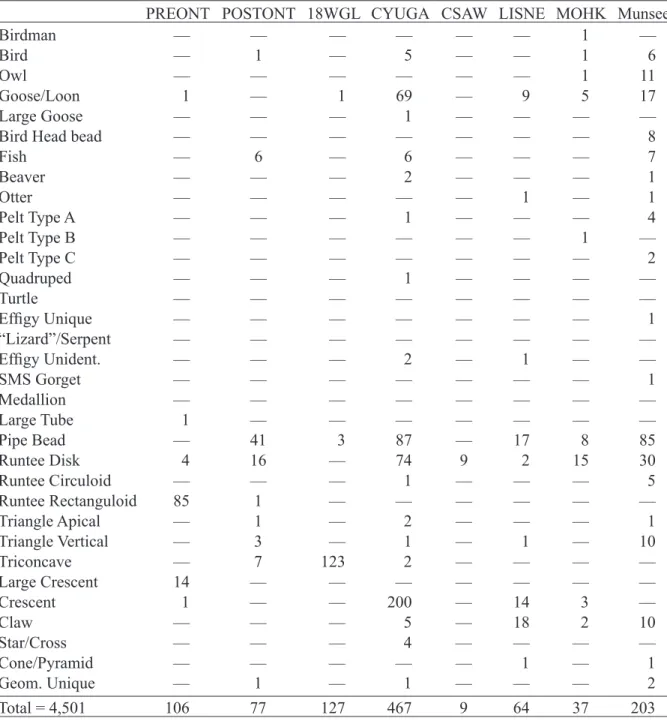
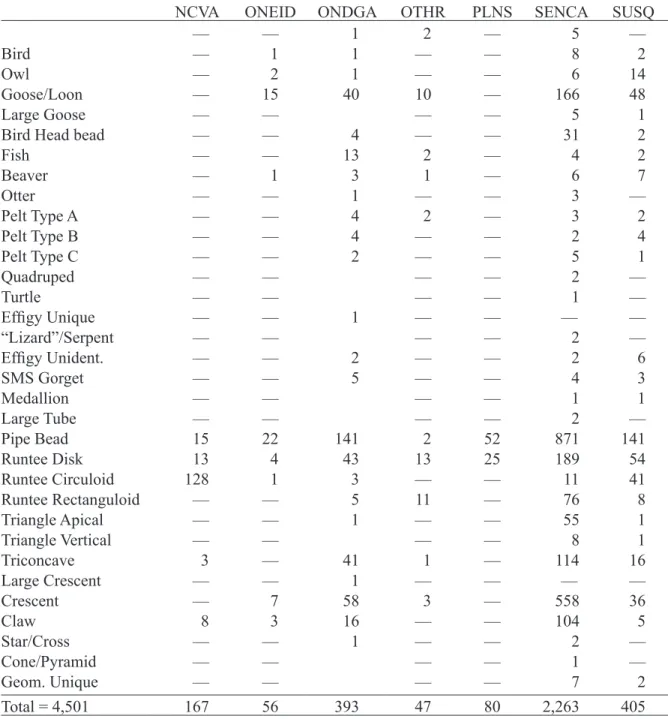
Exploring SMS Ornament Assemblages ...95
Regional Temporal Sequences ... 104
Summary of Exploratory Analyses ... 111
7 RECONSTRUCTING THE SMS INDUSTRY ... 113
SMS Sites and Chronology ... 113
Span Factored Annual Percentage (SFAP) Graphs ...115
8 A PROFILE OF THE NORTHEASTERN SHELL ORNAMENT INDUSTRIES ... 123
Early SMS (circa 1635–1655) ... 127
Starting Classic SMS (circa 1655) ...129
Ending Classic SMS (the 1680s) ... 133
Late SMS (1687 to circa 1710) ...135
The Albany-Montreal Shell Ornament Trade (circa 1710–1770) ... 137
The Plains Indian Shell Ornament Industry (circa 1770–1880s) ... 142
9 AN OVERVIEW OF THE SEVENTEENTH CENTURY MARINE SHELL TRADE ...145
Setting the Stage: Previous Marine Shell Trade ...145
The Northeast’s Shell Trade in the Middle and Late Seventeenth Century ...150
10 WHAT DOES SMS MEAN? ...152
Who Made SMS? ...154
SMS in the Colonial World ...156
A Note on Consumption and Appropriation ...158
A Note on Meaning ...162
APPENDIX A: Master Inventory of Standardized Marine Shell Ornaments ... 170 APPENDIX B: Inventory of Sites with Standardized Marine Shell Ornaments ...176 APPENDIX C: Sites with Standardized Marine Shell Ornaments
l
istoft
Ables1.1 List of Standardized Marine Shell (SMS) forms ... 7
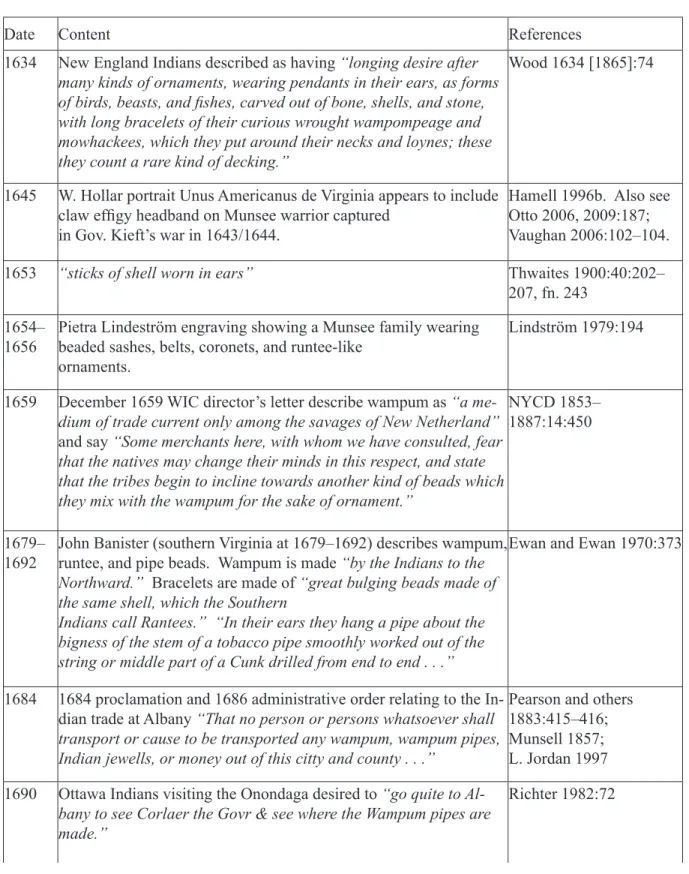
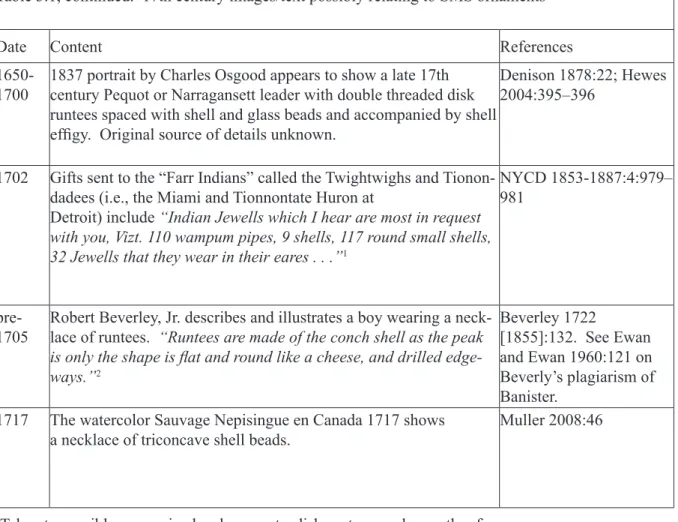
3.1 17th century images/text possibly relating to SMS ornaments ... 31
3.2 17th century records of marine shell imports to New Netherland ... 41
5.1 Inventory of Standardized Marine Shell ornaments by form ... 73
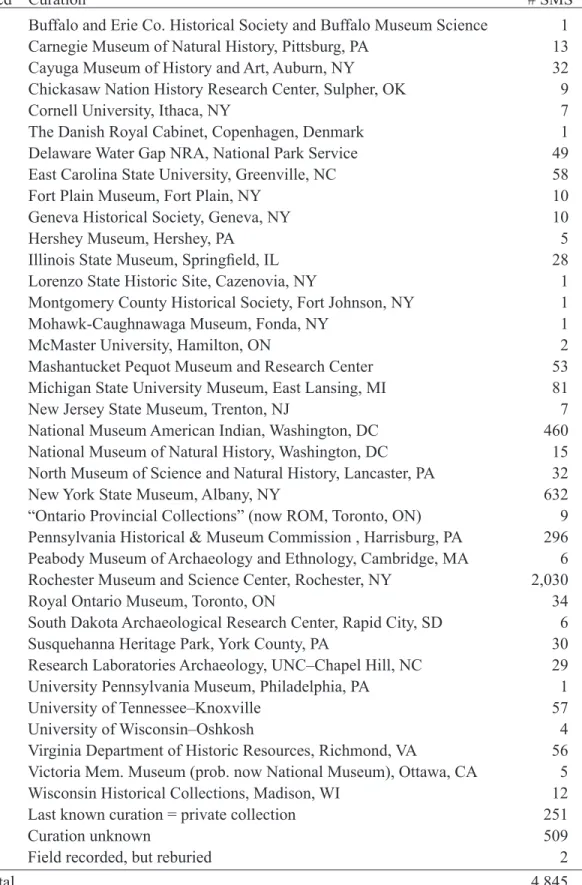
5.2 SMS ornament curation ...76
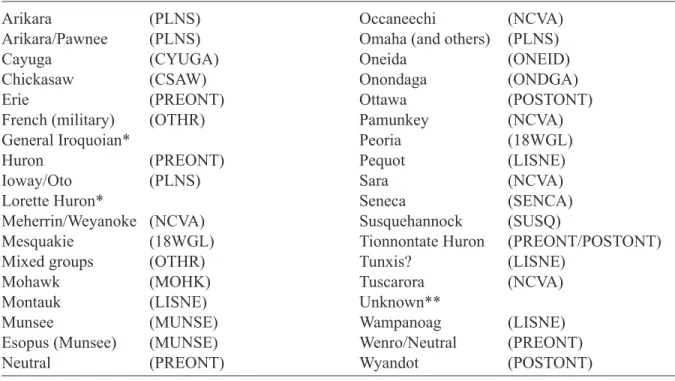
5.3 Ethnic affiliations and corresponding geographic/ethnic general affiliation category ... 81
6.1 Five Nations SMS distribution compared to Five Nations 1670s population ...90
6.2 Level 2 ornament forms by general affiliation category ... 100
8.1 Summary of sample data and chronological assignments for SMS forms ... 124
l
istoff
igures1.1 Examples of Standardized Marine Shell ornament forms ... 4
1.2 Examples of Standardized Marine Shell ornament forms ...5
1.3 Matched set of disk runtees from Galligan 2 site, Montgomery Co., NY ...6
1.4 Distribution of sites with Standardized Marine Shell ornaments ... 21
3.1 Northeastern settlement locales (1630–1680) and SMS distribution ...29
3.2 The only known non-archaeological examples of SMS ornaments ...35
3.3 Compass inscribed SMS decorations ...45
3.4 SMS decorations retaining pigments ...49
3.5 Matched, graduated, and socketed SMS ornaments ...50
4.1 Radiograph by Lynn Ceci ...62
5.1 Numbers of SMS ornaments in Level 1 form categories ... 80
6.1 Sites with 20 or more SMS ornaments ...86
6.2 Distribution of SMS ornaments by general affiliation ... 88
6.3 SMS distribution among Five Nations Iroquois sites compared to relative proportion of 1670s populations ...90
6.4 Sites with three or more Level 2 SMS forms ...97
6.5 SMS Level 2 form diversity by general affiliation ...98
6.6 Logged SMS ornament count, Level 2 forms, and sites per general affiliation category ... 102
6.7 Spans of dated sites with SMS ornaments ...105
6.8 Correspondence biplot SMS Level 2 forms by general affiliation ... 108
C
hapter1
I
ntroduCtIonIn December 1659 the directors of one of the world’s major corporations, the Dutch West
India Company, communicated a passing sense of doubt about the economic security of one
of their lesser colonies—New Netherland in northeastern North America (NYCD 1853–
1887:14:450). Their concern was motivated by reports that the Natives of New Netherland
might possibly change their mind about what kind of shell bead they most valued.
These master capitalists administered the business of what was then “the greatest trading nation in the world.” In doing so they controlled many of the most lucrative products of the vigorous Atlantic trade, such as the gold and slaves flowing from modern day Ghana (Boxer
1965; Klooster 2009; Postma 1990). Normally their thoughts would have been far removed
from a detail as miniscule as a shift in Native preferences from one bead type to another. Yet,
in examining the matter of New Netherland’s economy at the urging of Pieter Stuyvesant
(their local administrator) they found themselves considering exactly that.
Stuyvesant urgently desired that the company put the colony’s internal economic dealings
on a more secure footing by injecting currency to offset an overt dependence on wampum—
tiny marine shell beads then in circulation as the foremost exchange medium among New
Netherland colonists. The value of wampum ultimately rested its acceptability in barter to
By refusing Stuyvesant’s request, the Directors forced him to further devalue the
exchange rate of wampum—the only way to deal with a vast oversupply. If there was too
much wampum being made, then let it be devalued. The colonists would have to adjust. But
the directors’ response also acknowledged a much deeper fear—that wampum’s valuation
was inherently subject to capricious factors that should be watched closely. They finished
their communication saying “Some merchants here, with whom we have consulted . . . state that the tribes begin to incline towards another kind of beads which they mix with the wampum for the sake of ornament.”
The directors did not explain their comment. Nor did they describe this new kind of
bead or note where it came from. But one can easily imagine the logic of these distant lords
of world trade. Since New Netherland’s entire exchange system depended on something as
subjective as the North American Natives’ avid desire for a product very cheaply produced
in the colony itself (and for which the value might easily change), then what might keep the
colony’s entire economy from being subject to renegotiation? And were there not too many
furs available at the moment anyway? This colony had already cost them a great deal of
money to keep afloat. Might it just be better to let the entire “shell game” play out rather
than invest hard cash trying to keep such an inherently unstable enterprise afloat?
Wampum eventually regained its stability. The Native desire for these tiny
mass-produced beads persisted another two centuries. In contrast, New Netherland passed to
English rule in five more years. The West India Company directors’ obscure and distant
observation became one of the few documentary records that these once popular beads
the economic base of an entire colonial enterprise. My study is about this same obscure
subject—the now largely forgotten industry that produced “another kind of beads.”
In contrast to their fleeting documentary record, the beads that were becoming
increasingly popular by 1659 have been found in a large number of 17th century
archaeological sites. But in spite of their ubiquity, archaeologists have developed very little
evidence regarding their manufacture, distribution, and meanings. Unlocking the riddle
of these ornaments will expose and highlight hidden aspects of regional trade economies
and characterize northeastern colonial power relationships in the period before European
hegemonies were established. In this sense, my study will illustrate changing power
dynamics of the Northeast, bringing intercultural relations of the early colonial period into a
new focus via the lens of a little-known, yet powerfully visual material category.
Standardized Marine Shell (hereafter SMS) was a modest scale 17th century shell
ornament industry. Dimensional carvings and flattened outline forms of SMS appear in
both effigy and geometric shapes and sometimes constitute elaborate composite necklaces
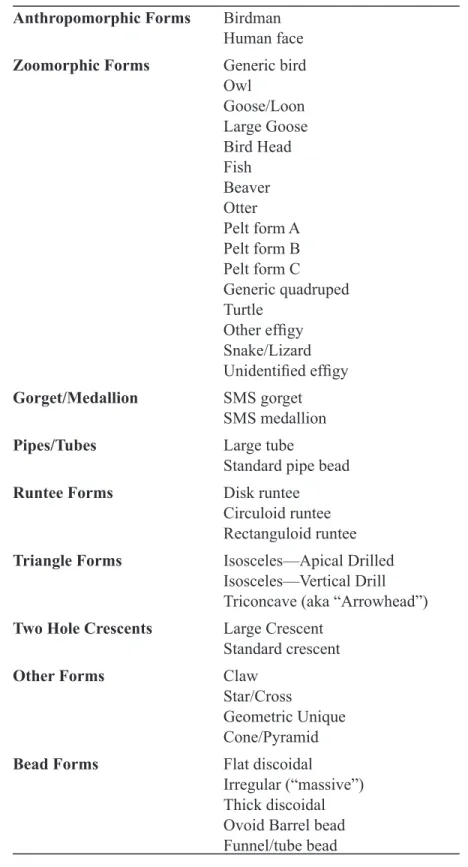
(Figures 1.1–1.3; Table 1.1). These ornaments are found at many aboriginal sites in New
York, Pennsylvania, New Jersey, and Southern Ontario starting during the second quarter
of the 17th century. The simultaneous appearance of distinctive standardized ornaments
at numerous archeological sites attributable to a variety of ethnicities begs an explanation
couched in the rapid political and economic changes taking place in the earliest decades of
the Northeast’s colonial period. Yet even their authorship has not been previously agreed
upon or supported by evidence.
Manufacture of these unique ornaments required use of metal drills. This new production
Figure 1.1.
Examples of Standardized Marine Shell ornament forms
a) Birdman; b) Mask; c–d) Birds; e) Owl; f) Large Goose; g) Goose/Loon; h) Otter; i) Beaver; j–l) Pelt Types A, B, and C; m) Fish; n) Large Tube; o) Pipe Bead;
p) SMS Gorget; q) Medallion; r–t) Disk Runtees
a
b
c
d
e
f
g
h
i
j
k
l
m
n
o
p
q
Figure 1.2.
Examples of Standardized Marine Shell ornament forms a–b) Bird Head; c–d) Irregular Massive; e) Thick Discoidal;
f) Flat Discoidal (with wampum); g) Circuloid Runtee; h) Rectanguloid Runtee; i) Claw; j) Vertical Drilled Triangle; k) Apical Drilled Triangle; l) Triconcave; m) Large Crescent; n) Standard Crescents (with wampum); o) Pyramid; p) Cross/Star
a
b
c
d
e
f
g
h
i
j
k
l
m
n
Figure 1.3.
Matched set of disk runtees from Galligan 2 site, Montgomery Co., NY
Table 1.1. List of Standardized Marine Shell (SMS) forms Anthropomorphic Forms Birdman
Human face Zoomorphic Forms Generic bird
Owl
Goose/Loon Large Goose Bird Head Fish Beaver Otter Pelt form A Pelt form B Pelt form C Generic quadruped Turtle
Other effigy Snake/Lizard Unidentified effigy Gorget/Medallion SMS gorget
SMS medallion
Pipes/Tubes Large tube
Standard pipe bead
Runtee Forms Disk runtee
Circuloid runtee Rectanguloid runtee Triangle Forms Isosceles—Apical Drilled
Isosceles—Vertical Drill Triconcave (aka “Arrowhead”) Two Hole Crescents Large Crescent
Standard crescent
Other Forms Claw
Star/Cross Geometric Unique Cone/Pyramid
Bead Forms Flat discoidal
technology, but European production mentalities and market strategies characterize the
organization of SMS manufacture. I will show that SMS ornaments are, in essence,
component parts within a persistent centralized production scheme. And yet, the entire
industry is closely related to Native senses of value and meaning. Significantly, SMS
ornaments appear soon after the first European settlers take residence in New Netherland.
SMS ornaments clearly represent some variety of early cross-cultural colonial
interaction—one that necessarily provides an interesting view into early relations between the
colonists and Native peoples. Although thousands of SMS ornaments have been collected by
antiquarians and in modern archaeological excavations, their poorly recorded contexts and
scattered distributions have made them difficult to understand. Without the most basic facts
about SMS, there has been no way to choose between possible interpretations. The primary
emphasis of my study is thus to assemble and analyze these materials in order to frame the
first comprehensive overview of the SMS industry and detail its place in the history of the
colonial Northeast.
Why Tell the Story of SMS?
Narratives of colonialism are inescapably told from a particular vantage point.
Perspective matters tremendously. Northeastern North America has had no shortage of
narratives about its colonial past. Earlier tellings generally attempted a unified story, tending
towards archetype and representing a Western cultural perspective. These were efforts to
tell the story, whether it be a narrative of triumphant conquest or indigenous tragedy, cross-cultural cooperation or conflict, heroic resistance and defense of identity, or progressive
More recently, narratives with multiple threads and an abundance of diverse cultural
agents populate more local, more ambiguous and, ultimately more enlightening vignettes of
social processes. Studies in colonial settings inherently involve cultural interactions, and,
if the setting is truly colonialism, must foreground power relations and processes of cultural
domination (Alexander 1998; Reinhard 2001). SMS ornaments reside in a set of social
relations sometimes seen as foundational to eventual power asymmetries. But over-emphasis
on subsequent power relations can drive undue efforts to identify antecedents. This is not a
goal here. In fact, production and distribution of SMS ornaments can be taken as evidence
of very different, albeit rapidly changing, power asymmetries, in as much as they represent
social relations during a time when Native viewpoints and desires were of paramount
interest.
The Setting: New Netherland Meets Greater Iroquoia
The emergence of SMS ornaments came quite early in the colonial period of the Northeast.
The ornaments that momentarily caught the attention of far off Dutch administrators in 1659
were indeed distinctive. Their story seems to be one of a specific economic opportunity—a
production strategy and market niche created by intertwining Native and European settler
economies in the early years of the New Netherland colony. Limited production scale and a
shared mental template resistant to idiosyncratic executions are characteristics of this industry,
which evolved in distinct stages and persisted for generations.
The first decades of the 17th century saw establishment of the earliest viable European
and much of the tenure of Standardized Marine Shell take place well before the trickle
of European settlers became a flood. These early beginnings help us avoid mistaking the
creation of a colony (which merely implies interaction) for the subsequent enactment of
hegemonic colonial power relations (Stein 2002).
Giving voice to an account of colonial interactions of the Northeast in which Native
populations manifest early evidence of subaltern status would be inaccurate, regardless of later
power differentials. Kurt Jorden (2009:32) drives this critical point home here in the Northeast.
Colonization is the planting of a colony. Colonialism is intercultural domination and it is only
one of many possible outcomes of colonization. The Dutch and subsequent English presence in
the Northeast certainly moved towards the latter condition, but the social and economic milieu
of the former condition still held sway in the mid-17th century. The story of SMS reveals far
more than the earliest evidence of a later condition.
Using DuVal’s (2006:5) terminology, the story of SMS ornaments unfolds on what was
predominately a “native ground”—a cultural landscape where Native peoples possessed
much political and economic power and would have seen little reason to accommodate
Europeans beyond what directly served their own interests. In such a setting the relatively
low numbers of newcomers were politically and economically vulnerable and far more
incentivized to develop useful and interactive knowledge about their Native neighbors than
their descendants eventually came to be.
This is an important distinction. If the beginnings of a colonial story are told in a way
that only illustrates seminal formations of eventual social asymmetries, then archaeologists
and historians become mere cataloguers of prologue. As such we might tend to ignore
as emergent and contingent, with disparate events containing the seeds for a multitude of
possibilities that did and did not come to fruition, best serves our desire to account for the
maximum numbers of actors and incentives. This is the relevance of localized histories.
SMS is just this kind of local story.
New Netherland as Part of the Dutch Atlantic World
The story of SMS is situated in approximately eight decades between the 1630s through
1710s, a period when the Dutch and their English successors conducted a brisk trade with the
native nations of the Hudson River Valley, the Susquehanna River Valley and the lower Great
Lakes region. This interaction was part of a much larger pattern of trade being enacted from
numerous European colonial nodes throughout the world.
Dutch colonial power rapidly expanded on a world-wide scale at the end of the 16th
century. Entry into the East Indies spice trade (at the expense of the Portuguese) initially
commanded much of the Dutch commercial and military/privateering interest. Dutch
colonial interests came only on the heels of the period when four other European maritime
powers (Spain, Portugal, France, and England) had already consolidated initial toe-holds
in the Atlantic World. Emulating the successful format of Portuguese and English colonial
endeavors, the Dutch established a rapidly growing and vigorous trade in textiles and metals
(copper, iron, gold) in the Atlantic by establishing and conquering posts sequentially in
West Africa, then the Caribbean and northern South America, and then in Brazil, by the
turn of the 17th century. The Dutch slave trade burgeoned several decades later, supplying
the brutal labor demands of the rapidly expanding Atlantic plantations. Early Dutch power
merchant ships and took their competitors’ colonial installations by force. In the 17th
century, the Dutch became the premier transporters and financial backers of the Atlantic
trade, rather than simply servicing their own colonies’ shipping needs. The hundreds of
ships, thousands of soldiers/sailors, and tens of thousands of traders, colonists, and company
employees in the Dutch corporate world colonial system help put the West India Company’s
concerns with the nascent colony of New Netherland in North America in perspective (Jacobs
2009a:20, 27–31; Klooster 2005, 2009). The tiny New Netherland colony was decidedly
peripheral to Dutch colonial and financial interests.
New Netherland’s history spans the 1620s through the middle 1660s, after which the colony
fell to English administration, albeit with notable cultural continuity from the Dutch period.
The history of colonial New Netherland has been told many times from many perspectives,
with the tone and focus of accounts largely driven by the available documents. Some aspects
of colonial New Netherland are well documented. Others remain virtually unknown. Although
many early Dutch West India Company records were subsequently destroyed or lost, large
portions of this particular colony’s internal administrative records did survive. Thousands of
pages of original papers were published as the New York Colonial Documents during the 19th
century, supporting many early synthetic treatments. New translations and the discovery of
new documents in recent decades have fueled a number of modern historiographies and topical
treatments for New Netherland (e.g., Bradley 2007; Gehring 2005; Goodfriend 2005; Jacobs
2009a, 2009b; Merwick 1999; Shorto 2004; Venema 2003).
Natives
The Natives of northeastern North America, and their contact with the various colonial
colonial New Netherland can be divided into two main groups. Algonquians (especially
the Munsee and related groups) were centered in modern-day New Jersey and the along
the Hudson River, with the Mahicans living in the middle reaches of the Hudson where
Fort Orange (Albany) was established. Far more numerous and economically powerful
were various Iroquoian-speaking peoples of upstate New York (the Five Nations) and the
Susquehannock who lived along the lower Susquehanna River (Bradley 2007; Grumet 2009;
Kent 1989; Otto 2009; Richter 1992, 2001; Trelease 1971; Williams 1995).
North and west beyond modern day New York and eastern Pennsylvania the vigorous trade
relations of the Susquehannock brought other Iroquoian-speakers (Huron, Petun/Tionnonate,
Neutral, Wenro, and Erie) into the early Dutch trade sphere as well. Although the Huron and
Tionnonate are better known for their trade connections to New France, SMS ornaments also
firmly link them to Dutch trade. These more westerly Iroquoian polities were progressively
broken up by attacks from the Five Nations collectively referred to as “disperals” in the late
1640s and early 1650s. Many members of these groups were alternately absorbed by their
attackers (Five Nations) or their allies (primarily the Susquehannock). Others survived by
taking refuge with the French or embarking on western diaspora. Collectively (and rather
imprecisely in the case of the Wenro and Erie, who contribute very few sites to this study)
these western Iroquoians will be referred to here as pre-dispersal and post-dispersal Ontario
groups (Garrad and Heidenreich 1978; Heidenreich 1978, 1990; Lennox and Fitzgerald 1990;
Ramsden 1990; Trigger 1976; White 1978a, 1978b).
The Five Nations Iroquois (Mohawk, Oneida, Onondaga, Cayuga, and Seneca) formed
the enduring core of New Netherland’s native peoples, remaining strong throughout
Netherland on Eastern Long Island and in Connecticut, Rhode Island, and Massachusetts
were other coastal Algonquians who will be seen below to have had only minimal
acquaintance with SMS ornaments. The same holds true for the Algonquians of the
Chesapeake, south of New Netherland’s boundaries, illustrating quite clearly that the story of
SMS is intimately connected to the history of New Netherland.
The Dutch Fur Trade
European trade with these native groups began well in advance of the founding of the
Dutch colony. Without doubt, trade in fur-bearing pelts, especially beaver, was the raison d’être for the colony. Although some factions of West India Company administration favored settlement, the fur trade both started and sustained New Netherland. Trade was the exclusive
interest of most of those who came with the hope of quick profit, and trade seduced many
others who ostensibly came with more domestic intents. Organized coastal trade by the
Dutch began in the first decade of the 17th century, predating actual settlement by some 15
years. The fur trade was primarily enacted at three locations in New Netherland (modern day
Albany, Manhattan, and Delaware Bay) but a great deal of economic activity took place “in
the woods,” to the persistent consternation of the colony’s administrators. Especially in the
early decades, openly or covertly engaging in the fur trade was perennially foremost in many
inhabitants’ minds (e.g., Bradley 2007).
The Dutch trade extended to a subset of the Northeast’s tribes. New Netherland was
ideally situated to tap those groups best positioned to obtain furs. Furs were exchanged not
just for “European trade goods” but many other materials—in fact furs were avidly traded
for almost anything that the traders or settlers could put their hands on to “earn a beaver.” A
early and middle 17th century interface between European traders, settlers, and Natives.
Although the colony began as a trade monopoly, sluggish growth and other factors caused the
company to open up aspects of the fur trade after 1639, encouraging growth (Bradley 2007;
Jacobs 2009a; Middleton 2005).
Settlement
New Netherland settlement began in the mid-1620s and increased only slowly until circa
1640. Many in the early population in the colony were company employees, but employees
had no right to engage in fur trade, manufacture, or follow any other incentive until the terms
of their contract expired, when they might return home or stay as free settlers. Those who
came as free settlers could trade and even manufacture certain kinds of goods. But numbers
of these settlers (mostly farmers) remained small because of restrictions on land ownership.
Population in New Netherland began to rise circa 1640. Rapid increase of the population
took place after 1649. Although the company very much desired to plant large colonies of
free settlers, Dutch citizens showed little inclination to migrate and many settlers in the early
period population were from other nations. Overall the colony persisted as descendants of a
wide variety of Europeans as well as a minority of mostly enslaved Africans (Gehring 2009;
Heywood and Thornton 2009; Jacobs 2009a:32–61, 2009b).
Artisanship and Manufacture
During the company’s trade monopoly period (pre-1639), local production of goods that
might otherwise be imported from Europe for trade to the Natives was tightly regulated,
increasing populations created sufficient markets for local goods and services. Even so,
many of the skilled artisans who arrived also entered the fur trade, which was especially
lucrative from the 1620s through the 1650s. Matson (2009:100) notes that by the late 1640s,
ships going from New Netherland to Virginia and the Caribbean carried local beer and
grain, but exports remained focused on furs for a number of decades. Further expansions
of craft guidelines and settlers’ rights took place in 1653 and 1657 (Maika 2005; Middleton
2005:136–140) finally establishing the vigorous internal crafts and domestic merchants that
had been notably absent in the early decades of the colony.
New Netherland and Wampum
Use of shell, especially marine shell, for ornaments is an ancient tradition throughout the
Americas and the world. In the colonial Northeast the introduction of metal tools provided
impetus for a fluorescence of marine shell bead-making by coastal Algonquian groups in
the Long Island region. Natives in that region made large quantities of wampum starting
circa 1605–1610 (Bradley 2011a). These tiny, relatively uniform shell beads very rapidly
became extremely popular among the tribes of the interior Northeast and eventually came to
be widely desired and employed by many other North American Native peoples throughout
the 17th, 18th, and early 19th centuries. The earliest wampum was produced by the coastal
Algonquians using tapered metal awls (muxes) received as trade items.
This unprecedented popularity was based on social practices far more substantial than
the mere inclinations that the Dutch West India Company directors perceived might change
according to the Native people’s sense of style. Value of marine shell in North America had
cultural superlatives—goodness, truth, light, and order (e.g., Brain and Phillips 1990; Hamell
1996a; Penny 1985; Phillips and Brown 1978). Marine shell was taken to be the proper
medium for expressing these themes, not just in the 17th century form of wampum beads, but
in a myriad of forms across many centuries and many cultures.
For Native peoples, wampum beads became highly valued not only for ornamentation, or
their convertibility in economic matters, but for their core symbolic associations. Because
they embodied nearly timeless qualities that could be extensively and elaborately conditioned
and nuanced, they very rapidly became the sine qua non for all formal expressions of
personal and corporate communication in the Iroquoian Northeast. Wampum beads testified
to good intent and truth relating to all social states of being. It was the persistent and
widespread Native use of wampum for enacting social relations that allowed its valuation
for other functions. Wampum took a place alongside beaver pelts as a primary medium of
exchange only because there was always great demand for these beads. This demand was
powered by elaborate social creativity energized by political and economic expansions.
Buoyed by the dependable accessibility and convertibility of wampum beads in trade
with the Native peoples, but lacking any other suitable exchange medium, fur traders,
administrators, and settlers in both New Netherland and New England adopted wampum
beads as a currency substitute, further enhancing its valuation and providing a cross-cultural
platform for exchange and communication. Wampum valuation and use persisted among
Native people throughout the 17th and 18th centuries, with its use for political speech and
as body decoration spreading as far as the western Plains in the early 19th century (Becker
2010; Bradley 2011a; Ceci 1977, 1980, 1982, 1986, 1990; Hamell 1996a, 1996c). At some
production has been suggested to shift from Native manufacture to a Colonial European
cottage industry. The manufacture of SMS ornaments originates somewhere within this
cross-cultural political and economic materiality and is intimately intertwined with wampum
production from the earliest days of the colony.
What is Standardized Marine Shell?
Standardized Marine Shell is a suite of North American marine shell ornaments most
commonly found in archaeological sites of the 17th century Northeast. To begin with, it
should be understood that the story of SMS that unfolds here is about an analytical category
generated entirely from archaeological contexts.
Colonial-era references to SMS ornaments are uniformly vague and vanishingly
rare. SMS has been repeatedly noted as distinctive, but these ornaments have nonetheless
frequently been considered part and parcel of the broader phenomenon of 17th century
marine shell trade and manufacture.
In this study, for the first time, SMS is defined as a restricted set of produced and
circulated ornaments (that is, its own industry). Also for the first time, this study amasses
a sufficient body of ornaments to make reliable comparisons across the geographic and
temporal range of the artifact type. As a body then, SMS ornaments are a largely unstudied
artifact class. Here we have a ubiquitous, but unexplained, ornament. The cultural contexts
where SMS ornaments are found tend to be discrete, short term occupations. These
associations will aid close examination of the industry’s history. As will be seen below, the
Technical and stylistic attributes unite the various forms of SMS. Although individually
crafted, SMS ornaments are characterized by stylistic uniformity through time and space, as
well as by the presence of cylindrical drilling by metal drills. Although my survey amasses
4,845 SMS ornaments, it divides them into a few dozen easily recognized forms.
These initial observations generate questions. When and why did SMS emerge and
what were its antecedents? Is SMS an entrepreneurial venture conceived of and initiated by
European settlers? How was its conception in the minds of its producers shaped and moderated
by existing mental templates of meaning in the minds of its consumers? How did this interplay
between producers and consumers unfold? Is SMS the result of an emergent form of cultural
hybridity—an early example of something entirely new made by people who do not easily fit
into pre-defined categories—ornaments created by people inhabiting innovative cross-cultural
contexts? Or is hegemonic effect or intent involved in the way SMS taps into the cultural
preferences of consumers? Does feedback from consumers play a part in the evolution of
the industry? Resolving these speculative questions hinges on observations not previously
organized and analyses of data not previously marshaled.
Marine shell ornaments have been produced and circulated among North Americans
for thousands of years, and their manufacture, possession, use, and ultimate disposal in
traditional contexts is enmeshed in ancient patterns with persistent symbolic referents (Brain
and Phillips 1996; Ceci 1989, Hamell 1992, 1996a; Holmes 1883; Reilly and Garber 2007;
Trubitt 2003). The clearest difference between SMS ornaments and older marine shell forms
is the appearance of standardization. SMS is typified by matched sets of ornaments (Figure
1.3). During previous centuries “horizon styles” and thematic similarities in marine shell can
2007). And matched sets of elaborate prehistoric marine shell ornaments were occasionally
produced (e.g., Polhemus 1987:2:Figure 11:11, Brain and Phillips 1996:217). But with the
advent of SMS we suddenly and routinely see matched ornament sets on necklaces, some of
which include scores of like items, sometimes produced and displayed in graduated sizes,
and showing no significant variation regardless of the ethnicity or geographic location of
their owner.
The employments and cultural contexts of SMS during the early colonial period give us
every reason to think that the deepest and most consistent past meanings of such ornaments
continued to hold sway. But SMS ornaments have a production-related sameness of both
theme and form, not seen in Native material culture. Early in the 17th century, and only
among specific sets of the Northeast’s Native peoples, marine shell ornaments suddenly show
a radical shift most easily indexed by standardization. It is from this simple observation that
this study proceeds.
SMS Distribution
SMS ornaments are distributed in 17th and early 18th century archaeological sites in a
broad pattern encompassing the Northeast, the mid-Atlantic, and the upper Midwest (Figure
1.4). This far flung pattern includes notable outliers in the Plains and Mississippi Valley. But
the vast majority of SMS ornaments have been found in 17th century sites in New Jersey,
Pennsylvania, New York, and Southern Ontario. A focus on the chronology and location of
SMS sites will provide the main evidence of the SMS industry and frame conditions for a
Following a review of previous research, I outline an extensive series of observations
relating to archaeological contexts and formal attributes of SMS. Since SMS has a long
history of being considered as much the same as wampum, I make special effort to extricate
these two shell industries into separate research problems. Notes on methodology and the
process of generating this large SMS inventory set the stage for an initial exploration of the
spatial and temporal attributes of SMS assemblages. The results of my exploratory analyses
will show that understanding SMS production is essentially a chronological problem. Many
questions about the place of SMS can be easily answered when the production history of
these ornaments is clarified. In turn, a detailed reconstruction of that history allows fresh
Figure 1.4.
C
hapter2
e
videnCeforaf
orgotteni
ndustryProduction and distribution of Standardized Marine Shell (SMS) is a forgotten industry.
There are very few historical records indicating the manufacture of shell ornaments that
arguably describe SMS forms, and only scant prior observations on the spatial-temporal
distribution and frequency of the archaeological examples of these ornaments. Similarly,
unlike wampum and other trade materials that repeatedly find voice in the descriptions of
colonial interactions of the Northeast, few specific contemporary records of SMS social
deployment can be found.
This hardly sets SMS apart from many other 17th century archaeological manifestations.
Despite copious records for some realms of the colonial Northeast’s record (Bradley 2007:3),
many aspects of early colonial history are handicapped by inadequate documentary and
archaeological records. An in-depth understanding of the parameters and meanings of SMS
can only be derived from inference, analogy, and analysis of the archaeological materials
themselves. These data consist largely of site attributions, excavation contexts, comments,
assumptions, and conclusions of excavators.
Archaeological Perspectives On SMS Origins
(Schoolcraft 1846:134–135, 1853:79, Plate 25; Shepard 1893). Holmes (1883:230) was
the first to note that they dated to the historic era, and typically, the earliest researchers
merely noted that historic period shell ornaments possessed signs that metal tools were used
in drilling and decoration. An intimate link to wampum production has been repeatedly
implied, but in no way demonstrated.
Investigations and Interpretations
Lynn Ceci’s dissertation (1977) and her subsequent studies (well-cited below) fleshed
out much of what is currently known about the history of wampum manufacture, bringing
a welcome sense of evidence to shell ornament study in the Northeast. A number of early
researchers implicated Europeans in the manufacture of the shell ornaments made with metal
tools (e.g., Beauchamp 1901; Holmes 1883:228, 260). Others just as confidently assigned
these same ornaments to the hands of Native peoples (Heye and Pepper 1915:14). Although
Kraft (1978:38) crisply noted that “such shell ornaments, runtees, hair pipes, and wampum
. . . were manufactured by the white settlers and traded to the Indians,” others have just as
confidently implied Native manufacture by sorting artifacts into “Native” and “European”
categories with SMS ornaments assigned to the former (e.g., Pietak 1996). Bradley, too
(2007:128) notes that the ornaments I have since designated SMS were probably made by
Europeans. Overall, SMS attributions are characterized by an absence of any systematic
overview of these unique ornaments and open admission that no evidence exists to inform
our suggestions.
Other researchers have merely pointed to the uniformity of historic period shell
the drilling of these items indicates that they were made “after the coming of the whites.”
Yet Arthur Parker was apparently the first to suggest the possibility that “commercial
manufacturers of wampum made some runtees and shell pendants, for there is a remarkable
similarity and almost mechanical likeness of certain patterns.”
Charles Wray (1973:16; also see Wray and Schoff 1953:58) listed many SMS forms as
traits and provided estimates of their placement in the Seneca sequence. Lynn Ceci (1986)
was beginning to focus on the central problems of marine shell ornament production,
including what I have termed SMS, at the end of her career.
Jim Bradley (1987:129) noted that some marine shell ornaments that emerged mid-17th
century were “highly stylized and probably mass-produced.” He suggested that many of
the Onondaga shell ornaments in 17th century sites were brought there in finished form, but
focused more attention on the significant fluctuations in amounts of marine shell flowing
into the Northeast during the Historic Period. Martha Sempowski (1989:90) quantified
these same shifts in the Seneca sequence and noted dramatic increases in marine shell
alongside “new types of more or less standardized artifacts.” This pointed to “a new
and abundant source of marine shell ornaments that were made elsewhere and traded as
finished products.” Sempowski’s observations (personal communication, 10 February 2010)
prompted me to term this ornament complex “standardized marine shell.” Standardization
refers to the fact that each SMS item is a free-hand execution of a mental template.
Recurring observations that SMS ornaments found on Iroquoian sites must have been
made “elsewhere” are echoed outside of upstate New York. Lynn Pietak (1996:150)
commented that the shell ornaments in Munsee sites were similar to those found in Iroquoia
groups. Kevin McBride (1993:70) noted that items “extremely similar if not identical” to the
shell effigies in a Pequot site (Long Pond) were found throughout the Northeast, particularly
in Seneca and Susquehannock sites. Barry Kent (1989:174) commented that marine
shell effigies in mid-17th century Susquehannock sites “have a decided European flavor,
suggesting that they were made by the colonial wampum manufacturers.”
To date, most speculations about SMS ornament origins end with this level of observation.
This is simply because no comparative data have been developed. Much of the problem is due
to scale and geographic scope. Sites with large SMS inventories extend as horizon markers
across geopolitical and ethnic affiliations. Like other goods distributed through the fur trade,
SMS data runs “across” rather than along the geographic expertise of most archaeologists.
Without a previous definition of SMS as a delimited topic, and without taking a broad
geographic and temporal overview, the question of SMS origins has remained in limbo.
SMS Data and the Antiquarian Legacy
My study represents the first attempt at a comprehensive inventory of SMS. Few SMS
ornaments have been recovered from scientific or well-controlled archaeological excavations,
and there have been even fewer formal site reports of the kind that include detailed
comparison. Instead, most of the SMS sample comes from poorly controlled excavations—
the kinds of site destruction typical of late 19th and early 20th century antiquarian pursuits.
Many such items subsequently found their way into current repositories decades after
being excavated by collectors with little or no regard for either Native sensibilities or the
survey are of this vintage and apparently these sources. Many are accompanied by relatively
little information beyond collector name and archaeological site attribution.
The absence of a detailed understanding about SMS can be partly accounted for by these
limitations. Beauchamp’s “Wampum and Shell Articles Used by the New York Indians” and
his unpublished “Antiquities of Onondaga” (compiled between 1876 and 1925) illustrate by
far the most extensive compendium of SMS ornaments prior to this inventory, in spite of the
intervening century (Beauchamp 1901, 1876–1925).
Significantly, the majority of SMS ornaments documented by Beauchamp were relocated
during my repository visits. Many of these ornaments are now housed at the New York State
Museum, the National Museum of the American Indian, and the Rochester Museum and
Science Center, where they came to rest after their original collectors parted with them.
Beauchamp’s notes clearly relate that the great majority of specimens he documented
were being amassed by private collectors destroying Native archaeological sites, especially
cemeteries. It is at least known that most of the mortuary ornaments were associated with
individuals as necklaces. My analyses are tailored to accommodate these deficits and thus
extract much of their information at the site and ethnic level of association. In sum, it
must be understood that not only do many of the existing examples of SMS have serious
contextual limitations, but that very little new or improved data to address this topic can be
C
hapter3
t
akingD
ireCtionfromSmS a
ttributeSThis inventory of SMS ornaments is accompanied by approximately a decade of
observations. My attention was originally drawn to these ornaments when I was called upon
to identify and explain the presence of examples far outside normal distributions in early
contact period sites of the Midwest and West. Applying to what was known of the context of
these distinctive ornaments in their “home” area showed me that there was little speculation
and no consensus as to the origins or unitary identity of what I have come to define as SMS.
My initial hope to elucidate down-the-line trade in European goods, track the Northeast’s
migrants and refugees, or emphasize cultural integration across North American contact
period cultures (Esarey 2007, 2009) gave way to more pragmatic concerns.
Over the course of the study I have accumulated qualitative observations about SMS that
frame an initial understanding of the industry. These observations condition the range of
possible interpretations and broadly dictate the analytical approach I take in this study.
Spatial and Temporal Distribution
A series of observations clarify that SMS is a uniquely American manifestation that
appears quite early in the Dutch colonial sphere and is largely limited to the Northeast’s
SMS Ornaments Are Restricted to Colonial North America
Examination of ship manifests, lists of trade goods, inventories of artifacts in 17th
century archaeological sites outside North America (and extensive web text and image
searches) yield no evidence of SMS ornaments outside North America. In addition
archaeological sites with SMS ornaments are highly concentrated in the Northeast (Figure
1.4), indicating a very specific core area.
SMS Is Strongly Associated with the Primary Clients of the Dutch Fur Trade
Most SMS ornaments are found in the archaeological sites of the participants of the 17th
century Dutch economic networks articulating with New Netherland (and it’s immediately
succeeding English administration). Specifically, SMS ornaments are most frequently found on
sites identified as pre-dispersal Huron, Tionnonate, and Neutral sites in southern Ontario as well
as Five Nations Iroquois, Susquehannock, and Munsee sites in New York, Pennsylvania, and
New Jersey. This constitutes the core area of SMS distributions (Figure 3.1).
It is notable that, with the exception of the Munsee, these groups are all Iroquoian
speakers. The Munsee were closest to New Amsterdam, but all these groups had at least
down-the-line economic intercourse with the Dutch colony from its earliest years (Bradley
2007; Grumet 2009; Otto 2006, 2009).
SMS Appears Relatively Early in New Netherland’s History
Certain forms of SMS ornaments are present in southern Ontario sites that terminated
with the diasporas of the Neutral, Huron, and Tionnonate (Petun) nations from the late
Figure 3.1.
Northeastern settlement locales (1630–1680) and SMS distribution
(after Bradley 2001; Brown and Sasso 2001; Grumet 1995; Heidenreich 1971, 1990; Lennox and Fitzgerald 1990; Milner, et al. 2001; Snow 2001a, 2001b; Tanner 1986;
Trigger 1976; and Ward and Davis 1993)
SMS core area
SMS outlier (pre-1720)
European settlement area ca. 1650 Native settlement area 1630–1680 Native settlement pre-1655 only
FIVE NATIONS
SUSQUEHANNOCK NEUTRAL
PETUN/HURON
1640s. The emergence and growth of the SMS industry must be framed quite early in the
Dutch colonial period.
Contemporary Documentation
One of the reasons so little attention has been given to SMS is that there is a marked lack
of contemporary documentation that would have put its production into known social context.
SMS was very common for several decades in the mid-17th century, but this was sufficiently
early that the artifact complex largely escaped ethnographic notice. SMS ornaments appear to
have been rapidly removed from circulation via attrition and placement in mortuary contexts.
Only a vanishing trace of it can be found as ethnographically curated objects.
Little Contemporary Evidence Documents SMS Ornaments
In contrast to thousands of contemporary references to wampum and the wide range
of physical forms and social formats in which it appears, there are very few unambiguous
notices relating to SMS ornaments (Table 3.1). Although fascinating in its implications the
December 1659 letter from the Directors of the West India Company to Stuyvesant stops
short of a clear identification of SMS as its subject matter. This ambiguity is repeatedly
the pattern with the few historical documents that seem to mention SMS. Another case
in point is a 1684 proclamation (and subsequent 1686 ordinance) restricting movements
of “wampum, wampum pipes, Indian jewells” from Albany. In all probability this refers inclusively to SMS but certainty is lacking.
Other than these kinds of vague clues, I have found little documentary trace of the SMS
Table 3.1. 17th century images/text possibly relating to SMS ornaments
Date Content References
1634 New England Indians described as having “longing desire after many kinds of ornaments, wearing pendants in their ears, as forms of birds, beasts, and fishes, carved out of bone, shells, and stone, with long bracelets of their curious wrought wampompeage and mowhackees, which they put around their necks and loynes; these they count a rare kind of decking.”
Wood 1634 [1865]:74
1645 W. Hollar portrait Unus Americanus de Virginia appears to include claw effigy headband on Munsee warrior captured
in Gov. Kieft’s war in 1643/1644.
Hamell 1996b. Also see Otto 2006, 2009:187; Vaughan 2006:102–104.
1653 “sticks of shell worn in ears” Thwaites 1900:40:202– 207, fn. 243
1654–
1656 Pietra Lindeström engraving showing a Munsee family wearing beaded sashes, belts, coronets, and runtee-like ornaments.
Lindström 1979:194
1659 December 1659 WIC director’s letter describe wampum as “a me-dium of trade current only among the savages of New Netherland” and say “Some merchants here, with whom we have consulted, fear that the natives may change their minds in this respect, and state that the tribes begin to incline towards another kind of beads which they mix with the wampum for the sake of ornament.”
NYCD 1853– 1887:14:450
1679–
1692 John Banister (southern Virginia at 1679–1692) describes wampum, runtee, and pipe beads. Wampum is made “by the Indians to the Northward.” Bracelets are made of “great bulging beads made of the same shell, which the Southern
Indians call Rantees.” “In their ears they hang a pipe about the bigness of the stem of a tobacco pipe smoothly worked out of the string or middle part of a Cunk drilled from end to end . . .”
Ewan and Ewan 1970:373
1684 1684 proclamation and 1686 administrative order relating to the In-dian trade at Albany “That no person or persons whatsoever shall transport or cause to be transported any wampum, wampum pipes, Indian jewells, or money out of this citty and county . . .”
Pearson and others 1883:415–416; Munsell 1857; L. Jordan 1997 1690 Ottawa Indians visiting the Onondaga desired to “go quite to
Al-bany to see Corlaer the Govr & see where the Wampum pipes are made.”
Table 3.1, continued. 17th century images/text possibly relating to SMS ornaments
Date Content References
1650-1700 1837 portrait by Charles Osgood appears to show a late 17th century Pequot or Narragansett leader with double threaded disk runtees spaced with shell and glass beads and accompanied by shell effigy. Original source of details unknown.
Denison 1878:22; Hewes 2004:395–396
1702 Gifts sent to the “Farr Indians” called the Twightwighs and Tionon-dadees (i.e., the Miami and Tionnontate Huron at
Detroit) include “Indian Jewells which I hear are most in request with you, Vizt. 110 wampum pipes, 9 shells, 117 round small shells, 32 Jewells that they wear in their eares . . .”1
NYCD 1853-1887:4:979– 981
pre-1705 Robert Beverley, Jr. describes and illustrates a boy wearing a neck-lace of runtees. “Runtees are made of the conch shell as the peak is only the shape is flat and round like a cheese, and drilled edge-ways.”2
Beverley 1722
[1855]:132. See Ewan and Ewan 1960:121 on Beverly’s plagiarism of Banister.
1717 The watercolor Sauvage Nepisingue en Canada 1717 shows
a necklace of triconcave shell beads. Muller 2008:46
1Taken to possibly mean pipe beads, gorgets, disk runtees, and one other form.
2Significant amounts of Beverley’s material is verbatim or only slightly altered from Banister (Ewen and Ewen 1970:121).
a regulated product, taxed good, inventoried store, requested or provided trade good, or
probated possession. This strongly conditions possible explanations of the industry’s origins.
Natives are apparently depicted with SMS ornaments in three portraits set in the 17th
century and two more in the 18th century (Table 3.1). Once again, the 17th century cases
remain ambiguous. In two portraits (by Hollar in 1645 and Lindstroom in 1654–1656)
Munsee subjects wear ornaments clearly reminiscent of SMS forms (claws and disk runtees,
The most clear and convincing image of SMS ornaments in a portrait (very clearly
depicting a two-strand mounting of two disk runtees and a vertically-drilled effigy) was long
thought to be a contemporary painting of the 17th century Narragansett leader Ninigret (e.g.,
Anonymous 1925:99–100; Denison 1878:22; Williams and Flinn 1990:10). However, this
portrait is now identified as the work of Charles Osgood and known to have been painted in
1837 from an unknown source. Speculation on the identity of the subject tends on focus on
Pequot or Narragansett subjects (Hewes 2004:395–396). We have no idea of how the details
of ornamentation came to be so accurate. It is noteworthy that no disk runtee has ever been
found among these two groups, or in fact, east of the Hudson River Valley.
Late in the 17th century, Banister described two SMS forms in southern Virginia. Pipe
beads were used as ear ornaments. ”Rantees” were “great, bulging beads.” These, he said,
were “made by the Indians to the Northward” although Banister himself never ventured north of the Richmond, Virginia area. Slightly later, Beverley (1722), who plagiarized
Banister (Ewan and Ewan 1970), unambiguously illustrated a boy wearing a necklace of
small circuloid runtees in Virginia, but made no comments about their origin. Significantly,
these circuloid runtees are found in southern Virginia, but only during Banister and
Beverley’s time.
Finally, a necklace of triconcave beads is very clearly represented in a 1717 French
watercolor of a Nipissing man (a portrait stylistically reminiscent of the 1710 Verelst “Iroquois
Kings” portraits, see Muller 2008:46). As noted by Timothy Kent (2001) necklaces of these
Ethnographic Specimens of SMS Are Exceedingly Rare
Only two known SMS specimens were collected directly from the people who used them.
One of these ethnographic items is a two-hole disc runtee on a wampum necklace held for
generations by the descendants of Okouandoron, a prominent 18th century Lorette Huron leader
(Figure 3.2a). In 1923 this necklace was among a set of Okouandoron’s possessions purchased
by the Heye Foundation, which eventually became the National Museum of the American Indian
(Orchard 1929:24, Plate IV; NMAI records for catalog 11-7512 through 11-7514).
A small wampum necklace (52 purple and white beads) and single unattached goose/
loon pendant (Figure 3.2b) have been held in the collections of the Danish Royal Cabinet
(catalog #Ehc21) and its predecessors for over 300 years. These probable mid-17th century
ornaments are without specific provenance and only broadly attributed to New Sweden
(Delaware Bay) or New Netherland (personal communication and image from George
Hamell 19 May and 24 June 2011. For general information see Jacobaeus 1710).
Lack of Antecedents
For the most part SMS forms show little connection to the earlier Native shell ornament
forms. The attributes of SMS shell ornament decorations and form that do connect back to
earlier times appear come after the SMS industry begins and are presumed to arise out of
feedback from the Native consumers of the ornaments.
Native Antecedents to SMS Ornament Forms Are Generally Lacking
I have defined 39 formal categories of SMS ornaments. Few SMS ornament forms have
Figure 3.2.
The only known non-archaeological examples of SMS ornaments.
a: Runtee and wampum necklace once owned by Okouandoron, prominent18th century Lorette Huron leader
(NMAI #11-7513; image after Orchard1929:Plate IV).
b: Small wampum necklace and single unattached goose/loon pendant. Collection of the Danish Royal Cabinet
(catalog EHc21; image and information, personal communication, George Hamell May 19 and June 24, 2011).
Figure 3.2
The only known non-archaeological examples of SMS ornaments.
a) Runtee and wampum necklace once owned by Ok8andoron, prominent 18th century Lorette Huron leader (NMAI #11-7513; image after Orchard
1929:Plate IV).
b) Small wampum necklace and single unattached goose/loon pendant. Collection of the Danish Royal Cabinet (catalog EHc21; image and
information, personal communication, George Hamell May 19 and June 24, 2011).
emerges out of specific Native tradition shell ornament forms. The following examples of
possible continuity illustrate the few possible exceptions to these general observations.
Pipe beads: Long tubular beads made from conch/whelk columella have a long history in
North America. Forms that closely resemble SMS pipe beads are well documented prior to
the 17th century. In contrast to SMS pipe beads, these earlier tubular beads generally retain
evidence of the whorled groove (i.e., the the columellar folds—see Price 2003) of the central
column of the whelk. Earlier pipe beads are shorter, but of similar diameter to SMS pipe
beads (that is 4–6 mm). All of the earlier pipe beads have tapering “stone-tool-drilled” bore
holes, presumably the factor that limits their overall length. Early pipe beads are known from
sites that pre-date European trade goods, such as the Phillips site in southwest Pennsylvania,
where they are said to be associated with “early wampum” (Gage 2008), or the 16th century
Shannon site in western Virginia (Benthall 1969).
Crescents: Two-hole SMS crescents initially appear in a rare large form that is replaced by
a very common “standard” form. The only possible antecedent is a thick, hollowed,
“canoe-shaped” form. Seven examples of this early non-standardized crescent have been found in five
locations in New York, Pennsylvania, and New Jersey (Schultz, Minisink Island, Cameron,
Adams, and Kienuka sites). They are firmly dated to the last quarter of the 16th century in the
Cameron, Adams, and Schultz sites (Wray et al. 1987:144; Wray et al. 1991:350).
Claws: Beads made of animal teeth and claws are common throughout time and space.
Imitation animal claws in bone or copper are also known from various times and places in
North America dating back several thousand years. Flat SMS marine shell effigies interpreted
as claws do not seem to have any specific antecedent, however. Three claws erroneously
referred to as “brooding bird” or “duck” pendants by Beauchamp (1901:361) and Wray
(1973:16).
Gorgets: Circular marine shell gorgets have been made in North America for at least
two thousand years (Phillips and Brown 1978:157–163). Ornate Mississippian period
marine shell gorgets are especially typical of the greater Southeast in North America. In late
prehistoric times, distributions of circular marine shell gorgets include parts of the Northeast
(Brain and Phillips 1996; Drooker 1997:Figure 8-16–8-17; Glanville 2010; Hoffman
1997). Although SMS gorgets can thus be said to have antecedents, this form appears in
standardized form only significantly after the SMS industry takes hold—suggesting that
SMS gorget production was informed by native consumers rather than derived from native
antecedents. Non-SMS gorgets continue to be found in 17th century sites in the Northeast
even during the tenure of SMS ornaments.
Stylistic Links to Native Symbolism Appear After the SMS Industry Emerges
SMS referents to native symbology apparently developed well after the inception of the
industry. Birdman themed art was a mainstay of late prehistoric symbolism (e.g., Phillips and
Brown 1978; Strong 1989). This uniquely Native symbol, as well as other SMS effigy forms
(anthropomorphic raptors, owls, fish) are certainly typical of prehistoric themes (Penny 1985;
Townsend, ed. 2004), but these are not the earliest forms of SMS. Rather all these forms appear
after the industry begins and are increasingly typical of later 17th century ornaments.
This is an important observation. Overall, SMS forms progress toward familiar themes
of Native symbolism. Like the SMS gorgets, most effigy forms seem to be introduced after
symbolic antecedents. The makers of early SMS forms were either less familiar with or less
interested in emulating Native symbolic forms than they were later.
Observations on Imported Shell
All wampum and many SMS ornaments are made out of either local purple (Mercenaria) and white whelk shell. Earlier SMS production seems to make more use of the attractive
purple Mercenaria than later. In producing millions of wampum beads over the decades, the wampum industry would have used tremendous amounts of local marine shell. Lynn
Ceci went to considerable lengths to describe the Long Island shell middens as related to
17th century wampum manufacture and considered the possibility of localized raw material
exhaustion. She noted that “medium-sized and lightweight univalves [Busycon] were particularly suitable for [wampum] bead manufacture, and their natural abundance in the coastal waters surrounding New York made this region especially favorable for wampum production by local Algonquian Natives.” (Ceci 1977:Appendix A, 262–263, 1980:840). SMS ornaments require larger pieces of raw marine shell than wampum manufacture.
A few of the SMS forms (for instance, pipe beads, gorgets, disk runtees, large effigies,
irregular/massive beads) require such large pieces of raw shell that assigning all raw material
for the forms as local is problematic. As Beauchamp (1901:329) noted “no New York shell was large enough for some beads found here.” Although a subsequent understanding of 16th century trade as coming from Chesapeake Bay sources has led to the general assumption that
SMS forms can be made from Atlantic coast marine shells, this is not be the case with at least