LINKING CONSERVATION GOALS AND OUTCOMES:
THE SOCIAL-ECOLOGICAL DYNAMICS OF DROUGHT RESOURCE MANAGEMENT IN EAST AFRICA
Brian William Miller
A dissertation submitted to the faculty of the University of North Carolina at Chapel Hill in partial fulfillment of the requirements for the degree of Doctor of Philosophy in the Curriculum for the Environment and Ecology.
Chapel Hill 2013
iii ABSTRACT
BRIAN WILLIAM MILLER: Linking Conservation Goals and Outcomes: The Social-Ecological Dynamics of Drought Resource Management in East Africa
(Under the direction of Paul W. Leslie)
The establishment of conservation areas is a widespread strategy for protecting the environment from human activities, and it is clear that conservation areas also have a variety of consequences for human communities. However, the ways in which the social effects of conservation then translate into environmental outcomes are not well studied. This dissertation illustrates one approach to studying these interactions by drawing on theory and methods from landscape, human, and political ecology.
iv
Conservation areas and land use changes have affected pastoralist access to
v
ACKNOWLEDGEMENTS
This endeavor was made possible by the educational, logistical, and personal support of many individuals and organizations, only some of whom are mentioned here.
Funding for this work was provided by a National Science Foundation Doctoral Dissertation Research Improvement (NSF DDRI) grant, as well as grants from the University of North Carolina (UNC) Graduate School, the UNC Center for Global Initiatives, and the Carolina Population Center (CPC). During my graduate career, I also benefited from multiple CPC training grants (i.e., an NSF Integrative Graduate Education and Research Traineeship (IGERT) and a National Institute of Child Health and Human Development (NICHD) Traineeship), as well as the efforts of the faculty and staff of the Curriculum for the Environment and Ecology.
This work would not have been feasible without the skills and expertise of Gabriel Ole Saitoti and Isaya Rumas. They were much more than field assistants, transitioning seamlessly between roles as diverse as navigator, mechanic, interpreter, diplomat, and friend. Thank you for providing such excellent company and maintaining your good humor, even while we measured rocks in the mid-day sun (“less than 2!”). I would also like to acknowledge the assistance of Abraham Lengine and Paulo
vi
Paul W. Leslie and J. Terrence McCabe laid the foundation for this research by forging collaborations, and offering equipment and logistical support. I am especially grateful to Paul, who provided advice and assistance throughout my time at UNC; thank you for giving me the balance of guidance and space during my graduate career. I also benefited greatly from Terry’s extensive experience working in East Africa, as well as Tim Baird’s more recent struggles and successes with fieldwork. I hope that all of us can share many more evenings by the fire.
Thanks to Colin West for our many mentoring sessions, which have been an indispensable part of my graduate career and I hope will continue. Many thanks to Aaron Moody, Martin Doyle, and Pam Jagger for your involvement in this project, from
research design to interpreting the results; this work is immeasurably stronger because of your insights.
vii
TABLE OF CONTENTS
LIST OF TABLES ... xi!
LIST OF FIGURES ... xiii!
CHAPTER ! 1. INTRODUCTION ...1!
1.1. Overview & Justification ...1!
1.2. Background ...4!
1.2.1. Landscape Ecology – Pattern & Process ...6!
1.2.2. Human Ecology – Pastoralist Livelihoods ...11!
1.2.3. Political Ecology – Degradation & Conservation ...18!
1.2.4. Literature Synthesis ...26!
1.3. Conceptual Framework ...29!
1.4. Research Approach ...32!
1.5. Study Site & Population ...34!
1.5.1. East African Rangelands ...34!
1.5.2. Maasai ...41!
1.6. Conclusion ...46!
2. THE DISTRIBUTION OF DROUGHT RESOURCE AREAS IN EAST AFRICA AND IMPLICATIONS FOR PASTORALIST LIVELIHOODS ...49!
2.1. Introduction ...49!
viii
2.3. Methods...54!
2.4. Results ...60!
2.4.1. Land Use/Land Cover Change ...60!
2.4.2. Drought Resource Areas ...62!
2.5. Discussion ...67!
2.6. Conclusion ...74!
3. COPING WITH NATURAL HAZARDS IN A CONSERVATION CONTEXT: RESOURCE-USE DECISIONS OF MAASAI HOUSEHOLDS DURING RECENT AND HISTORICAL DROUGHTS ...78!
3.1. Introduction ...78!
3.2. Study Area & Population ...81!
3.3. Methods...83!
3.4. Results ...87!
3.4.1. Household Demographics & Economics ...87!
3.4.2. Drought Resource Use ...89!
3.4.3. Regression Analysis ...95!
3.4.4. Qualitative Comparative Analysis ...100!
3.5. Discussion ...106!
3.5.1. Household Demographics & Economics ...106!
3.5.2. Resource-Use Decision Making ...107!
3.5.3. Resource Use & Tarangire National Park ...110!
3.5.4. Conservation Implications of Resource Use Practices ...112!
3.5.5. Limitations ...113!
ix
4. RANGELAND MANAGEMENT AND FLUVIAL
GEOMORPHOLOGY IN THE SIMANJIRO PLAINS ...118!
4.1. Introduction ...118!
4.2. Background ...120!
4.2.1. Fluvial Geomorphology ...120!
4.2.2. Study Area & Population ...123!
4.3. Methods...126!
4.3.1. Resource Management Institutions ...126!
4.3.2. Fluvial Geomorpohology ...127!
4.4. Results ...129!
4.4.1. Resource Management Institutions ...129!
4.4.1.1. Kikoti River ... 131!
4.4.1.2. Kiti Engare River ... 134!
4.4.1.3. Loiborsiret River ... 134!
4.4.1.4. Terrat River ... 136!
4.4.2. River Styles ...138!
4.4.3. Channel Dimensions & Bedload Material ...141!
4.4.4. Sediment Yield ...146!
4.5. Discussion ...147!
4.5.1. Resource Management Institutions ...147!
4.5.2. Geomorphology & Oral Histories of River Change ...150!
4.5.3. Limitations ...156!
x
5. SYNTHESIS AND CONCLUSION ...160!
5.1. Introduction ...160!
5.2. Findings & Relevance to the Literature ...161!
5.2.1. Three Ecologies ...161!
5.2.2. Conservation-Community Feedbacks ...164!
5.2.3. Social-Ecological Resilience ...166!
5.3. Opportunities for Further Research ...170!
5.4. Practical Relevance & Closing Thoughts ...171!
APPENDIX I. Thematic Land Cover Classification Error Analysis Results ...175!
II. Group Interview Guide ...178!
III. Household Survey ...180!
IV. Hydrologic Event Calendar ...190!
V. Institutional Interview Guide ...191!
VI. Drought and River History Interview Guide ...193!
xi
LIST OF TABLES
TABLE
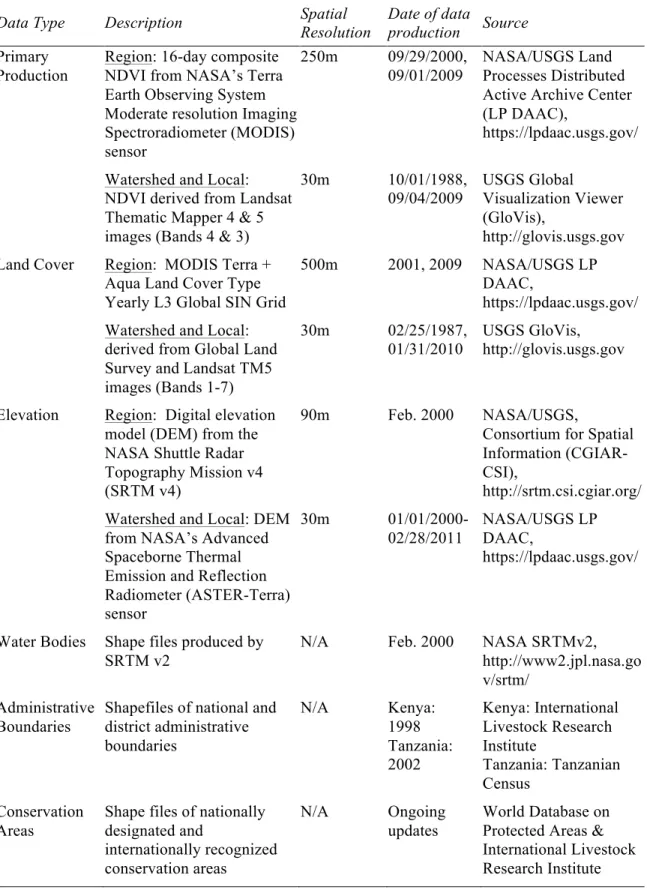
2.1. Geospatial data types, descriptions, and sources ... 59!
2.2. Land use/land cover change matrix for the local scale (1987-2010) ... 61!
2.3. Land use/land cover change matrix for the watershed scale (1987-2010) ... 61!
2.4. Land use/land cover change matrix for the regional scale (2001-2009) ... 62!
2.5. Total land area and mean NDVI change of cells in each DRA category ... 63!
2.6. Composite DRA land area as a proportion of the total area in each land use zone ... 66!
2.7. 250m resolution composite DRA distribution by 30m LULC category at the watershed scale ... 71!
3.1. Descriptive household demographic statistics ... 88!
3.2. Changes in perceived herd size ... 89!
3.3. Changes in perceived labor availability ... 89!
3.4. Primary watering site for cattle during historical droughts ... 92!
3.5. Primary watering site for cattle during 2009 drought ... 92!
3.6. Logistic regression models of the choice of water sources that cost money or diesel ... 97!
3.7. Logistic regression models of the choice of water sources that are near the village center ... 99!
3.8. Results of QCA analysis of the choice of free versus pay sources during the 2009 drought ... 102!
3.9. Factors affecting the choice of local versus distant water sources during the 2009 drought ... 103!
3.10. Factors affecting the choice of free versus pay water sources during historical droughts ... 104!
xii
3.12. Factors associated with decisions about water source location and cost during the 2009 drought ... 106! 3.13. Factors associated with decisions about water source location
and cost during historical droughts ... 106! 4.1. Area and estimated sediment yield of each land use/land cover type
xiii
LIST OF FIGURES
FIGURE
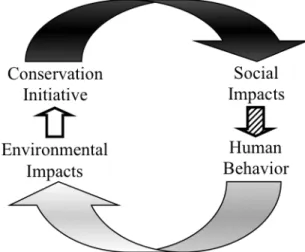
1.1. Research foci of political, human, and landscape ecology with respect to livelihoods ... 27! 1.2. Feedbacks between environmental conservation initiatives,
social dynamics, and the environment ... 31! 1.3. Conceptual framework ... 33! 1.4. Monthly Mean Rainfall (mm) for Narok, Kenya (1913-2003) ... 35! 1.5. Annual, long-term mean, and 3-year moving mean precipitation
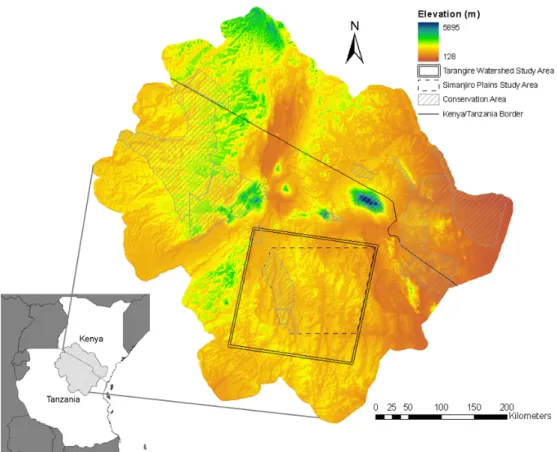
for Narok, Kenya (1914-1998) ... 36! 1.6. Approximate extent of contemporary Maasailand ... 42! 2.1. Regional study area highlighting the watershed and local scales of
analysis and major conservation areas ... 54! 2.2. Proportion of land area in each LULC class at three spatial scales ... 60! 2.3. DRA change (1988-2009) and LULC change (1987-2010) at the
watershed scale ... 64! 2.4. Composite DRA distribution by LULC category ... 65! 2.5. Mean slope angle of regional, watershed, and local composite
DRAs by zone ... 67! 2.6. Change in cultivated land area between 1987 and 2010 in the
northern portion of the Simanjiro Plains study area ... 69! 3.1. Map of study villages ... 81! 3.2. Box plot of Tropical Livestock Units per capita for each of the
four study communities ... 88! 3.3. The proportion of respondents in each village that used local or distant water sources during the 2009 drought and historical droughts ... 94! 3.4. The proportion of respondents in each village that used free or
xiv
4.3. Downstream trends in channel dimensions for the four study rivers ... 143!
4.4. Non-dimensional shear stress ... 144!
4.5. Bedload particle size associated with 84th, 50th, and 16th percentiles ... 145!
4.6. Proportion of bedload material in each size class ... 145!
4.7. Proportion of sediment in the 2-4mm size class as a function of drainage area ... 146!
CHAPTER 1
INTRODUCTION
1.1. Overview & Justification
“It’s like when you are moving livestock. When you want to do that, you first need to go there and see how much grass and water there is.”
– Maasai community leader, regarding the purpose of research
During the drought that afflicted East Africa in 2009, Maasai herders in search of water and grazing for their livestock had to contend with a variety of obstacles that affect natural resource availability in the Kenya/Tanzania border region, including local
resource use rules and national park boundaries. On the other hand, these
world-renowned conservation areas (e.g., Serengeti National Park) are coping with considerable challenges of their own; specifically, maintaining wildlife populations and tourism industries in the face of human activities that threaten to block wildlife migrations and increase their ecological isolation (Newmark 2008).
This situation illustrates that finding durable solutions for reconciling the concurrent, and sometimes conflicting, imperatives of environmental conservation and socio-economic development remains a substantial challenge (Adams et al. 2004). It is clear that humans affect their environment (e.g., deforestation), and that conservation initiatives can have substantial effects on local people (e.g., relocation). Less well
2
how conservation initiatives affect social changes that in turn impact the environments targeted by conservation efforts (Miller et al. 2012). My objective is to advance methods for studying these reciprocal impacts by examining the links between natural resource access, livelihood decisions, and resource use.
In particular, I focus on habitats that are critical for sustaining herding livelihoods and rangeland ecosystems: dry-season/drought resource areas. Rangelands cover more of the Earth’s terrestrial surface than any other land use (Asner et al. 2004), and are
characterized by spatial and temporal variability in rainfall and primary production. Rangelands also sustain areas of predictably higher productivity and water availability (e.g., riparian areas, highland forests). These dry-season/drought resource areas (DRAs) are important seasonal habitats for wildlife as well as herders and their livestock; however, the joint access of wildlife and pastoralists to these forage and water sources can be inhibited by agricultural development, privatization, and conservation area establishment. Exclusion from resource use has potentially far-reaching implications for the viability of herding livelihoods, which are considered more compatible with
migratory wildlife conservation than alternative land uses such as cultivation – an increasingly prominent feature of pastoralist production strategies.
3
1) What is the spatial distribution of DRAs in relation to conservation areas and agriculture development in the Kenya/Tanzania border region and more locally? 2) How have changes in access to DRAs influenced pastoralist livelihood decisions?
3) In the face of these livelihood decisions, how do Maasai communities manage available water resources, and what are the consequences for river systems?
I evaluate these questions with a mixed-methods approach, using quantitative and qualitative data that I collected in six study villages in the Simanjiro Plains, Tanzania (an area that serves as a seasonal wildlife dispersal zone for Tarangire National Park, TNP) that have varying levels of water development, natural resource availability, and distance from TNP. Addressing these research questions is meant to clarify the feedbacks between conservation initiatives and local land users by describing the influence of conservation on natural resource availability (question 1 above), the role of resource dislocation in livelihood change (question 2), and the relationship between these livelihood changes and the local institutions that are managing natural resources (question 3). At the same time, this study will also help fill several gaps in our understanding of social-ecological interactions, including the relative influence of access to natural capital in pastoralist livelihood decision making; and the social-ecological resilience of rangeland systems to conservation measures that alter drought resource access.
4
provide an overview of the study site and population. The following three chapters (chapters 2, 3, and 4) correspond to each of the three subquestions listed above; these are structured as standalone manuscripts, and therefore contain some redundancies. I
synthesize my findings in terms of their theoretical and practical relevance in the final chapter (chapter 5).
1.2. Background
Our understanding of ecological processes has advanced considerably since the introduction of the term ‘ecosystem’ by Tansley in 1935. Early studies, such as
Clements’ (1916) depiction of linear vegetation succession toward climax communities, Lotka’s (1925) and Volterra’s (1926) mathematical models of population interactions, and Lindeman’s (1942) descriptions of trophic dynamics informed later studies of energy and nutrient transfer within closed systems (i.e., ecosystem ecology - Odum 1969). These intellectual advancements laid the groundwork for current ecological inquiry and
contributed substantially to research in related fields.
5
Here I examine three ‘ecologies’ that have played important roles in challenging these misconceptions: landscape ecology, human ecology, and political ecology.
Landscape ecology offers a perspective for understanding the processes and patterns of environmental heterogeneity. These patterns are in part shaped by the activities of people who have developed sophisticated strategies for persisting within variable landscapes; production strategies and their interactions with biophysical and socio-cultural factors are central to human ecology. Political ecology emphasizes the influence of political and economic factors on livelihoods and resource use.
Although each of these fields is ostensibly interdisciplinary, their areas of
specialization are sometimes criticized as being too narrow, requiring greater engagement with either social or ecological theories and methods. Scholars have independently called for greater integration of the social sciences with landscape ecology (Wu 2006) and ecology more broadly (Lowe et al. 2009), further study of the political and economic factors affecting human-environment interactions (Scoones 2009), and additional attention to ecology within political ecology research (Walker 2005). These disciplinary challenges and shortcomings can instead be viewed as complementarities, particularly if one adopts the notion that social and ecological systems are inextricably linked (Berkes et al. 2000).
6
independently, but by employing their unique insights in combination. In line with resilience thinking, the three ecologies exhibit strong interdisciplinarity and emphasize the importance of including the perspectives of local land users in cross-scale research. Their literatures overlap substantially, and the following categorization is intended more as an organizational structure than an attempt to classify the literature cited. This
literature review focuses on rangeland ecosystems and pastoralist societies, particularly those in sub-Saharan Africa. Through this review I highlight the studies and research gaps that inform and motivate my study of the feedbacks between conservation areas and social-ecological systems.
1.2.1. Landscape Ecology – Pattern & Process
7
(e.g., nutrient availability), biotic processes (e.g., competition, dispersal) and disturbance regimes (e.g., fire) (Urban et al. 1987).
Environmental heterogeneity is an especially prominent theme in the literature on rangeland ecosystems, which are characterized by substantial spatial and temporal variability in primary production. Rangelands are areas that provide suitable habitat for herds of wild or domestic ungulates, and are typically characterized by an herbaceous understory dominated by grasses with varying levels of canopy cover1 (Pratt et al. 1966). The dynamic mosaic of rangeland vegetation communities is shaped by the interaction of climatic variability, geomorphology, herbivory, and fire. Climate, soils, and topography influence water availability, thereby affecting vegetation communities, primary
production, and forage quality (i.e., nutrient content and palatability). These
characteristics in turn affect the distribution of consumer populations and fuel loads, which further influence vegetation patterns through herbivory and fire (a more detailed treatment of the interaction of these variables is provided in the study site description below).
Accounts of ecosystem variability have been central to debates about whether rangelands are more accurately viewed as equilibrium or non-equilibrium systems (or a recent review, see Vetter 2005). Equilibrium theory adheres to Clements’ (1916) view that vegetation communities exhibit linear successional stages progressing towards a climax community. Each stage of plant succession, or species association, can support a certain number of consumers (i.e., the carrying capacity); in other words, the size of the
1
8
consumer population is linked to the resource base and is therefore density dependent. Exceeding the carrying capacity can shift the system to an earlier successional stage, and can even cause irreversible damage and population collapse. This model of herbivore-vegetation feedbacks implies that because herbivore-vegetation responds to grazing pressure, habitat condition can be altered through stocking rates.
Scholars have challenged the Clementsian view of plant community succession and community organization (Gleason 1926, Whittaker 1956), and the associated density-dependence of consumer populations (Davidson and Andrewartha 1948). This shift in thinking is especially evident in the literature on arid and semi-arid rangelands (Ellis and Swift 1988, Westoby et al. 1989, Behnke et al. 1993). Non-equilibrium theory posits that successional stages can be non-linear (i.e., non-sequential), and that stochastic abiotic factors (e.g., precipitation) have effects on vegetation and consumer populations that are independent of population density. High variability in rainfall drives frequent changes in primary production that cannot be tracked closely by herbivore populations; in other words, herbivore populations are not tightly coupled to their resource base and are therefore density-independent. Due to periodic droughts, for example, livestock populations rarely reach densities that are high enough to cause long-term vegetation degradation. By this logic, livestock can affect the vegetation but are not the primary drivers of vegetation change, and therefore, destocking or placing limits on stocking rates are ineffective tools for managing vegetation communities (Vetter 2005).
9
et al. 2003, Vetter 2005). Structural features such as biomass, and compositional features such as species abundance may exhibit temporal stability at different scales (Busing and White 1993). System characteristics also vary with timeframe; livestock populations may be dictated by density-independent factors (e.g., drought) during some periods, but regulated by density-dependent factors (i.e., stocking rates) in others (Scoones 1993, Desta and Coppock 2002). The mobility of consumer populations must also be considered, as livestock population dynamics are influenced by the opportunistic exploitation of spatially distributed resource patches (Scoones 1993).
Illius and O’Connor (1999) have suggested that even in highly variable systems, livestock populations are regulated by density-dependence due to limited dry season resources. In this view, key resource areas2 maintain livestock populations through periods of plant dormancy, and therefore regulate regional livestock population dynamics. In arid and semi-arid ecosystems, these are typically dry-season/drought resource areas (as opposed to winter pastures in more temperate areas). Soil infiltration and topographic features such as elevation gradients and drainage lines dictate the location of these habitats, which include swamps, highland forests, and riparian areas.
The physical and vegetation characteristics of riparian areas are a product of nutrient availability, water table characteristics, biotic processes, and disturbances such as floods and wildlife activity (Naiman et al. 1993, Naiman and Rogers 1997). These areas maintain vegetation communities and wildlife assemblages that are distinct from the surrounding landscape mosaics. For instance, East African riparian zones support remnants of tropical rainforest that became isolated and fragmentary due to climatic
2
Vetter (2005: 332) defines key resource areas as, “small, highly productive areas which make a
10
drying around 4000 YBP, and which intergrade with surrounding savanna communities (Medley and Hughes 1996). Dry-season water and forage availability makes them important habitats for consumers, and their spatial distribution structures wild ungulate migrations (Western 1975) as well as livestock movements (Coppolillo 2000).
Given these unique biophysical characteristics, it is not surprising that human populations use these areas extensively. East African riparian ecosystems face threats from resource extraction, damming, settlement, and agriculture development (Stave et al. 2001, Stave et al. 2003, Stave et al. 2007). There are conflicting findings about the impact of livestock on these systems, with some studies indicating negative grazing and browsing impacts (Mathooko and Kariuki 2000), others suggesting positive influences on tree regeneration and browse production (Reid and Ellis 1995, Oba 1998), and others reporting inconclusive findings (Stave et al. 2001). These mixed findings may be artifacts of inconsistent and poorly designed livestock exclosure research, which have yielded uncertainty in studies of western U.S. riparian systems (Sarr 2002).
Although researchers have documented these changes and described the
11
little attention to these ‘upstream’ influences on human use of the environment. The social and cultural factors influencing resource use are central to human ecology.
1.2.2. Human Ecology – Pastoralist Livelihoods
Human ecology is a broad body of research that ties together elements of ecology, anthropology, sociology, and geography to investigate human-environment interactions. It encompasses the approaches of cultural ecology, ecological anthropology, and human behavioral ecology. These subfields overlap considerably and are sometimes referred to interchangeably. I distinguish between them in order to briefly illustrate the development of human-environment research, which I collectively refer to as ‘human ecology’.
12
and the contextualization of these responses into wider and denser “complexes of causes and effects.” (Vayda 1983: 270) The investigation of individual behaviors is also central to human behavioral ecology, which employs an evolutionary perspective to study the flexibility and adaptive tradeoffs of cultural traits, biological characteristics, and behavioral patterns (Laland and Brown 2002). These ecological and evolutionary perspectives on human societies continue to inform a wide array of studies of the demographic, behavioral, health, land use, and cultural aspects of human-environment interactions.
Livelihoods, or the ways in which people make a living3, are a critical interface of people and their environment. The livelihoods approach maintains that households draw on assets (i.e., natural, social, human, physical, and financial capital) in order to engage in activities (e.g., farming, herding, wage labor). A household’s impact on the
environment is influenced by its access to these five types of assets, the accumulation and use of which are mediated by cultural, institutional, economic, and environmental factors (de Sherbinin et al. 2008).
Studying livelihoods is an approach that is employed across a variety of disciplines (e.g., sociology, anthropology, and economics), and is especially useful for examining resource use due to their interface with social factors and ecological dynamics. Livelihoods influence the functioning of social-ecological systems by altering population distributions (de Haan 1999), resource use (Chambers and Conway 1992), land cover (Birch-Thomsen et al. 2001), food security (McCabe 2003, Pedersen and Benjaminsen 2008), disease transmission (Masanjala 2007), and social structures (Bryceson 2002).
3
13
They offer a useful analytical perspective because they capture multiple aspects of living and working conditions beyond income, such as activities, resources, and social relations (Ellis 1998, Barrett et al. 2001); furthermore, the livelihoods approach accounts for salient differences in the origin and means of attaining household resources, which are characteristics that can be overlooked by metrics such as socioeconomic class (Birch-Thomsen et al. 2001). Research on production strategies has proven fruitful for exploring the dynamic interactions of social organization, economics, local knowledge, and
environmental constraints and opportunities (e.g., Netting 1993).
Livestock-based production strategies (i.e., pastoralism4) have allowed people to persist in arid and semi-arid environments around the world. Evans-Pritchard’s (1940) influential ethnography of the Nuer was at the forefront of the proliferation of literature on pastoralist societies. These studies reflect the great diversity, both within and across pastoralist groups, of social organizations, livestock species, diets, and involvement in alternative livelihoods (Dyson-Hudson and Dyson-Hudson 1980, for a recent review of African pastoralism, see Homewood 2008). Yet several elements of pastoralism are found across a variety of settings: mixed-species herding, mobility, and social institutions for resource management and exchange (e.g., Scoones 1995 - Zimbabwe, Little and Leslie 1999 - Kenya, Fratkin and Mearns 2003 - Mongolia and Tanzania, Baker and Hoffman 2006 - South Africa, McAllister et al. 2006 - Australia). These attributes allow herders to capitalize on the spatial and temporal variability in rainfall and primary
4
14
production that characterize arid and semi-arid rangelands (Coughenour et al. 1985, Ellis and Swift 1988).
Early studies emphasized the role of cattle as symbols of prestige and wealth (Herskovits 1926), and although cultural valuation of cattle may be an important aspect of livestock accumulation, there are ecologically rational reasons for this behavior as well. Not only do livestock allow for the exploitation of patchy resources, but cattle also exhibit metabolic responses to drought - such as the timing of milk supply, changes in metabolic rate during droughts, and post-drought recovery - that make combined milk and meat production an energetically efficient strategy compared to beef production alone (Western and Finch 1986). Large herds are also “capital on the hoof,” providing a buffer against periodic drought and disease epidemics that substantially reduce livestock populations (Western 1982). Furthermore, surplus stock can be invested in family formation (through the payment of bridewealth5 and supporting children), and creating alliances with other herders through gifts or exchanges (Western and Finch 1986, de Vries et al. 2006). Building families and stock associations allow herders to recoup livestock losses, and provide access to labor for splitting herds based on age, sex, lactation, and species; smaller herds can then be grazed in different locations in order to spatially partition rangeland use, and to accommodate species-specific grazing/browsing preferences (Coppock et al. 1986). The dispersal of livestock across a range of individual herders and locations also reduces the risk of losing all livestock to drought, disease, or raiding (McCabe 2004), and can provide considerable contributions to herd growth during non-crisis periods as well (de Vries et al. 2006).
15
Herders redistribute their livestock over different habitats to balance trade-offs in water, nutrients, biomass, disease, and predation. This redistribution may involve
anything from the exploitation of different local habitats, to movements of several kilometers to exploit altitudinal gradients, to latitudinal movements over hundreds or thousands of kilometers (Homewood 2008). Herders often undertake these movements in order to capitalize on seasonal flushes of high-nutrient vegetation in areas that do not maintain sufficient biomass or water availability during other times of year. As water and fodder become scarce during periods of low rainfall, herders move livestock to locations that maintain higher water availability and herbaceous biomass per unit area, such as rivers or swamps, even though these sites may have lower nutritive value and higher risk of disease or predation (Western 1982, Homewood and Lewis 1987, Scoones 1995). The distribution of dry-season water can affect grazing patterns during both the wet- and the dry-seasons (Coppolillo 2000), and entire households may relocate nearer to these sites during droughts (Butt et al. 2009).
Higher elevation moors or forests can serve as drought resource areas (DRAs), but sites such as rivers, streams, and swamps are often preferred because they can be easier to access (i.e., proximity and gentler terrain - Ngugi and Conant 2008). Riparian areas and wetlands are important resource areas for agriculturalists and pastoralists throughout Africa (Scoones 1991, Homewood 2008). Some sites provide permanent surface water, and ephemeral streams can be used as locations for digging wells to access sub-surface water. They also supply a variety of products, such as fuelwood, building materials, livestock fodder, food, medicines, and meeting places (Barrow 1990,
16
substantial component of household income across rural populations in developing countries (Vedeld et al. 2007), and it appears that riparian forests are no exception.
Sustained access to DRAs is essential for maintaining livestock populations and system resilience (Scoones 1995, Desta and Coppock 2002), but pastoralist access to dry-season forage and water sources can be inhibited by land subdivision and fragmentation (Sheridan 2001), agriculture development (Campbell 1999), and conservation areas (Homewood and Rodgers 1991, Igoe 2002, Western and Manzolillo-Nightingale 2004). Because water or mineral sources are often limiting factors on livestock production, the loss of access to DRAs has far-reaching implications for the viability of herding
livelihoods. In the words of Homewood (2008: 61): “dry-season and drought access to wetland, swamp, and riverine resources on the one hand, or alternatively highland refuges on the other, is of central importance to pastoralist systems. Loss of access to these areas can mean collapse of the pastoralist system.” Specifically, Desta and Coppock (2002) suggest that the loss or degradation of DRAs may decrease the intervals between crashes in livestock numbers. Cases of DRA appropriation are relatively well documented in the literature, and based on pastoralist ecology, it follows that this resource loss would induce changes in herd variability. It seems plausible that such changes in livestock populations could be one factor driving the livelihood diversification that is occurring among
pastoralists, but this relationship has yet to be conclusively demonstrated6.
The livelihood diversity of rural populations has been increasing in recent decades (Reardon 1997, Ellis 1998, Barrett et al. 2001), and this pattern is reflected among
African pastoralists, who are increasing their reliance on activities such as agriculture and
17
wage labor (Homewood 2008). There has been an associated increase in the number of studies of pastoralist livelihood diversification (Fratkin 2001, Homewood et al. 2001, Little et al. 2001, Thompson and Homewood 2002, McCabe 2003, Desta and Coppock 2004, Adriansen 2006, Berhanu et al. 2007, Thornton et al. 2007, Homewood et al. 2009, McCabe et al. 2010). Explanations for this phenomenon often include declining
livestock:human ratios, but impoverishment induced by population pressure does not fully explain the livelihood shifts, as even wealthy families have begun cultivation (Little et al. 2001, McCabe et al. 2010).
Pastoralist livelihoods are shaped as much by social factors as they are by
biophysical features. For instance, livelihood shifts interact with changing cultural norms, such as the acceptability of taking part in cultivation (McCabe et al. 2010). The
availability of household assets are also relevant, as inter-personal livestock exchanges, household labor availability, market access, and land tenure exert substantial influence on livestock management decisions and participation in other livelihoods (Homewood 2008). Resource availability and livestock movements can also be affected by
territoriality and conflict between groups (McCabe 2004). During periods of drought, areas of greater water availability become increasingly important, and as a result, DRAs can be focal points of competition (Campbell et al. 2000). This competition can be manifested as conflicts between herders and farmers (Turner 2004), or as intragroup disagreement about territorial boundaries (Western 1994).
18
establishment of conservation areas can block access to natural capital, and thereby impose opportunity costs on local land users and alter the source and quantity of a household’s environmental income (Sjaastad et al. 2005). The loss of access to key grazing and watering sites due to governmental intervention has led to increased tension between conservation authorities and communities (Campbell 1999), and some
pastoralists have resisted these losses through protest killings of high-value wildlife (Western 2002). These cases demonstrate that natural resource use, including the
aforementioned variation in pastoralist livelihood strategies, should be examined in light of political, ideological, and economic motivations (Scoones 2009).
1.2.3. Political Ecology – Degradation & Conservation
Studies of human-environment interactions and their response to
political-economic forces have come to be known as political ecology, a term coined by Eric Wolf in 1972. Bernard Nietschmann’s (1973) ethnography of the Miskito was an early
19
influential to higher order scales (Robbins 2004a), and to avoid the pitfall, identified by Vayda and Walters (1999), of assuming that political influences are always important.
There are four major theses within political ecology: degradation and
marginalization; environmental conflict; conservation and control; and environmental identity and social movement (Robbins 2004b). I focus on the nexus of the degradation and conservation theses, as these are directly relevant to my research question, and have been influential in the rangeland literature. Moreover, critical assessment of degradation narratives was a flashpoint for political ecology. Blaikie and Brookfield (1987)
highlighted the varied and contingent definitions of degradation, its interactions with economics and the state, and the importance of scale in evaluating degradation and its causes. Their analysis yielded some important general conclusions about land use: degradation for some can mean accumulation for others; local land users, although central to land management, may not be solely responsible for degradation; and population pressure is not a sufficient or necessary condition for degradation, due to innovation and intensification (also seeBoserup 1965, Netting 1993).
Pastoralism is often considered detrimental to rangeland ecosystems, but this perspective has been challenged through the identification of theoretical and
methodological flaws in degradation claims. In particular, the rangeland degradation narrative has largely been based on inconsistent definitions and flawed metrics of degradation; inappropriate models of rangeland ecology; and/or misrepresentations of local resource management institutions. Nonetheless, claims of rapidly declining
20
First, the identification of degradation is complicated by its varied definitions and metrics. For rangelands, it has been measured in terms of changes in soil (fertility, infiltration, erosion), vegetation (ground cover, species composition, bush
encroachment), and livestock production (condition, yields, fertility, mortality) (Behnke and Scoones 1992). Attempts to differentiate anthropogenic changes in these metrics from those driven by “natural” biotic or abiotic processes are generally confounded by climatic variability, historical legacies, and human/livestock mobility. Using
experimental manipulation to alter one variable (i.e., livestock grazing) and failing to account for the interactions of fire, climate, and grazing has, in many cases, yielded inaccurate accounts of livestock impacts (Curtin 2002b, Curtin et al. 2002). Incorporating local perspectives is a promising approach for understanding the drivers of observed environmental changes (West and Vásquez-León 2008).
In addition to the methodological difficulties of identifying and interpreting degradation, theoretical models of ecosystem function and resource management have also been problematic. First, equilibrium models of rangeland ecosystems played an important role in framing the impacts of humans and their livestock, and justifying carrying capacities and stocking rates. As previously discussed, this front of the
21
inconsistent with complex, dynamic systems whose management approaches are rarely as objective and quantifiable as carrying capacities suggest (Sayre 2008).
Second, the “tragedy of the commons” thesis initially described by Gordon (1954) and later popularized by Hardin (1968) has been a particularly influential narrative within rangeland discourse. In this view, pastoralists seek personal gain through increasing herd sizes, and in the absence of resource management systems, this individual gain comes at the collective cost of rangeland degradation. The fundamental flaw in applying the tragedy of the commons model to most pastoralist systems is its misrepresentation of resource management institutions. There is an important distinction between Hardin’s vision of unregulated or open access, and common property resource management institutions, wherein a defined group of people shares a set of rules that regulate the use of a resource (Bromley and Cernea 1989, Ostrom 1990). Case studies have demonstrated that pastoralist societies frequently employ common property resource management institutions (e.g., McCabe 1990, Homann et al. 2008, Mwangi and Ostrom 2009)7. More broadly, the misunderstandings of rangeland management reflect a failure to recognize that livestock distributions and impacts are as much determined by social factors as they are by biophysical variables, including livestock markets, individual herding decisions, and interactions with other groups (Turner 1993).
The rational choice approach of common property theory interprets resource conflict as a product of institutional failure; the breakdown or absence of structures that govern access to resources results in degradation and “socially-produced resource
7
22
scarcity” (Turner 2004: 865). This view goes beyond neo-Malthusian explanations of competition over scarce resources and directs attention to the non-material aspects of conflict, such as longer-term struggles for control and political influence (Toulmin 1992, Turner 2004). For instance, claims to a particular parcel may not only be motivated by the resources themselves, but by strategic interest in user membership, cultural standards of what constitutes proper resource use, and control over access routes and the associated tax revenues. In other words, struggles over property rights are not purely the result of economic factors, but also ideological and political motivations (Ensminger and Rutten 1991).
In situations of resource scarcity, the identification of degradation, conflict, and institutional failure requires careful attention. Supposed resource conflicts may be manifestations of ideological or political struggles rather than competition for resources themselves; conversely, resource competition can stimulate, exacerbate, or be manifested as political or ideological conflict. To complicate things further, apparent degradation may only be short-lived environmental change. This is not to say that rangeland
degradation does not occur; rather, it is important to critically evaluate the evidence for, and the proximate and distal drivers of environmental change. For example, overgrazing of southwestern U.S. rangelands at the end of the 19th Century resulted from the
combined effects of federal land policy and an unregulated influx of livestock from the Great Plains. This livestock transfer was stimulated by large foreign and domestic investment in the Plains stock industry that was followed by cattle die offs from
23
inadequate size to support dryland ranching. This lead to overgrazing and further livestock die offs, and encouraged people to claim exclusive use rights to well-watered sites (Sheridan 2001).
Perceived degradation, whether real or imagined, has influenced rangeland development policy and been used to marshal support for conservation initiatives. The misunderstandings stemming from “Hardin’s thesis had a large impact on public understanding and scientific research concerned with famine and environmental
degradation in arid lands… [and] also provided rationalization for World Bank programs calling for sweeping privatization of land and commercialization of livestock
production.” (Fratkin 1997: 240-241) For instance, vivid yet unsubstantiated accounts of desertification and environmental destruction underpinned the World Bank’s National Environmental Action Plans, whose “cookie-cutter” land use policies were required as part of financial assistance for developing countries (Bassett and Zuéli 2000).
Top-down policies have marginalized traditional land tenure arrangements and land use patterns, often to the detriment of rangeland condition and local land users. U.S. ranchers are increasingly choosing or being forced to sell or subdivide their land due to the lack of governmental support for communal land tenure, the difficulty of securing pastures of sufficient size and water availability, and new economic pressures (e.g., rising land prices and property taxes from expanding exurban areas) (Sheridan 2001).
24
and marginalized the traditional institutions for managing them; in particular,
interventions have eroded systems of exchange, access, and mobility that had previously governed livestock distributions and range condition (e.g., Sandford 1983, Fratkin 1997, Homann et al. 2008, Mwangi and Ostrom 2009). Systems for regulating riparian resource use are also threatened by national forestry policies that ignore indigenous knowledge and tenure arrangements (Stave et al. 2001, Stave et al. 2007).
There have been recent efforts to recognize group property rights and to decentralize land administration in Africa, but this too has been met with substantial challenges. In many places there are overlapping claims of tenure and conflicting resource demands across groups, and within groups there are problems related to power sharing, accountability, and equitability (Mwangi 2009). Moreover, societies that exhibit mobility, exchange, and negotiation may require nested management structures that operate at multiple scales. It may also be necessary for management institutions to accommodate mobility and resource variability by allowing for flexibility in user
membership; attempting to specify and set user groups or resources can be less effective than strengthening the rules for negotiating resource access (Turner 1999).
25
conservation areas such as Mkomazi Game Reserve (Homewood and Brockington 1999). Upon exclusion of pastoralists from Mkomazi, the ‘degraded’ vegetation recovered quickly, indicating that livestock impacts were ephemeral and the ecosystem was resilient, even though it had purportedly been pushed to the verge of collapse
(Brockington and Homewood 2001). Human exclusion from conservation areas has even been associated with declines in habitat diversity because the loss of interactions between elephants and grazers affected tree recruitment (Western and Maitumo 2004). In other locations, accounts of environmental damage and livestock population growth have been refuted by environmental assessments (e.g., Ngorongoro Conservation Area - Homewood and Rodgers 1984). Long-standing beliefs in pastoralist degradation are also contradicted by the persistence of wildlife populations in areas long inhabited by pastoralists, as well as pastoralists’ contributions to current conservation efforts outside of national parks and preserves (Little 1996).
Although the establishment of conservation areas can, and sometimes does, provide positive benefits for local communities in the form of economic opportunities and ecosystem services, it can also yield displacement in the form of physical relocation and/or resource access restriction (Cernea 2005). Scholars have described the
consequences of such displacement across a variety of settings (for a review, see West et al. 2006). In particular, Cernea (1997) identified eight types of risk associated with displacement: landlessness, joblessness, homelessness, marginalization, food insecurity, loss of access to common property resources, increased morbidity, and community
26
initiatives affect human communities in ways that hold important consequences for the attainment of conservation goals (Miller et al. 2012). I discuss these feedbacks in greater detail in the Conceptual Framework section.
1.2.4.Literature Synthesis
These three ecologies have different research foci, and engage livelihoods, a central component of my research, in different ways (Figure 1.1). Human ecology typically views livelihoods as the interface of social and ecological systems; in the process, these studies sometimes neglect larger-scale social or ecological phenomena. This focus on the social-ecological interface is not as prevalent in the landscape or political ecology traditions – landscape ecology generally treats livelihoods as factors affecting environmental characteristics8, and political ecology largely treats them as an indication of household opportunities and constraints that are influenced by broader political and economic forces. These research foci are reflected in the critiques of each field: political ecology often lacks ecological analysis (Walker 2005), studies of human-environment interactions should give more attention topolitical and economic forces (Scoones 2009), and landscape ecology could benefit from greater integration with the social sciences (Wu 2006). I suggest that combining the three ecological research areas through resilience thinking will be more effective than independently expanding the scope of each field.
27
Figure 1.1. Research foci of political, human, and landscape ecology with respect to livelihoods. The grayscale indicates the associated attention to social and ecological factors
These disciplinary critiques, and my suggestion for addressing them, are consistent with the notion that social and ecological systems are linked and cannot be understood in isolation because of feedbacks9 between system components (Berkes et al. 2000). Social-ecological systems are complex and adaptive10, having alternate states or regimes that are separated by thresholds. The persistence of a social-ecological system in a particular state is dependent upon its resilience, or its capacity “…to absorb
disturbance; to undergo change and still retain essentially the same function, structure, and feedbacks. In other words, it’s the capacity to undergo some change without crossing
9
Feedbacks are “the secondary effects of a direct effect of one variable on another, they cause a change in the magnitude of that effect. A positive feedback enhances the effect; a negative feedback dampens it.” (Walker and Salt 2006: 164)
10
28
a threshold to a different system regime – a system with a different identity.” (Walker and Salt 2006: 32) Resilience and stability are distinct features of social-ecological systems. Stability denotes a return to equilibrium after a disturbance, whereas resilience is the persistence of a system and the relationships within it. Systems can have low stability (i.e., high fluctuation) and high resilience (i.e., persistence), and in fact, instability can foster resilience (Holling 1973).
Social-ecological systems exhibit phases of rapid growth, conservation, release, and reorganization (Walker and Salt 2006). This series of phases is an adaptive cycle, which describes how a system and its resilience behave over time. For example, a forest initially establishes itself through fast-growing pioneer species (rapid growth phase), which give way to specialists that are efficient at energy capture and growth
(conservation phase). This increase in efficiency entails a loss of redundancy, increasing the likelihood that a disturbance will cause the accumulated energy and biomass to be released (release phase). Once this occurs the system can be organized in a different way depending on the conditions and system components that remain after the release phase (reorganization phase).
29
diversity of habitat types maintain different species assemblages and age structures that respond differently to disturbances such as fire or parasite infestations. This differential response increases the likelihood that the system components and relationships will persist (Walker and Salt 2006).
Resilience thinking can be applied to both social and ecological subsystems; for example resilience can be evaluated in terms of the diversity of system components, regardless of whether these components are species or institutions. Redundancy in institutions or species can enhance resilience in two ways: institutions/species can serve different roles or functions within a system (functional diversity) and institutions/species with the same function can respond to change or disturbance in different ways (response diversity). In the event of a shock or disturbance, these two forms of diversity increase the capacity of the system to retain its essential relationships and function (Walker et al. 1999, Elmqvist et al. 2003, Walker and Salt 2006).
The applicability of resilience thinking to both social and ecological dynamics speaks to the strengths of resilience theory as an overarching framework for combining the three ecologies, which emphasize different aspects of social-ecological systems. I use this integrative perspective to advance research of the human dimensions of
environmental conservation.
1.3. Conceptual Framework
In summarizing the literature on the conflicts between environmental
30
park boundaries and the inherent tragedy that emerges from producers seeking individual good at collective costs.” On the other hand, political ecology would view the problem “as one of control over access, aesthetics, and landscape production.” This dichotomy is reflected in the two dominant types of research on the social dimensions of conservation; most peer-reivewed research focuses either on the effects of people on the environment (e.g., poaching, deforestation, invasive species, indigenous management), or the effects of conservation initiatives on people (e.g., relocation, resource access restriction, employment, tourism revenues) (Miller et al. 2012). Books that compile and review research on the interactions of conservation initiatives and human communities (e.g., Borgerhoff Mulder and Coppolillo 2004) present both views but do not necessarily tackle the mutual effects of conservation initiatives and human activities.
31
requires close examination of conservation-induced social changes and their ecological implications. In other words, there is a need for research on the social changes that mediate conservation initiatives and environmental outcomes (Miller et al. 2012).
Figure 1.2. Feedbacks between environmental conservation initiatives, social dynamics, and the environment (black arrow, effect of conservation on the economic, cultural, and political
characteristics of proximate human communities; hatched arrow, behavioral responses of local land users to conservation-induced social changes; gray arrow, effect of local resource users on the environment; unshaded arrow, environmental effects may lead to changes in conservation policy or practice) (from Miller et al. 2012)
This notion is consistent with other assessments of the literature on conservation evictions; although eviction due to conservation efforts has been well-documented, “few studies of the impacts of eviction offer good quality information on the social impacts of removal. Fewer still examine what has happened with their ecology.” (Brockington and Igoe 2006: 454) Moreover, this observation is symptomatic of the critiques leveled by Vayda and Walters (1999) and by Walker (2005) that political ecology is, in many cases, lacking the ecology. A notable exception is Schmidt-Soltau’s (2003, 2005) work
32
description of the varied and complex processes associated with displacement would benefit from a more detailed treatment of displacement risks.
1.4. Research Approach
My literature review demonstrates that landscape, human, and political ecology are complementary, and resilience thinking takes this idea one step further, indicating that their research foci cannot be fully understood in isolation. This is the theoretical
foundation for my conceptual framework of the feedbacks between conservation initiatives and social-ecological systems. The goal of my dissertation is to empirically describe these feedbacks by studying how resource management is affecting the social-ecological resilience of the study system to drought. However, implementing resilience thinking in empirical research requires a more specific analytic approach.
Analyzing resource management requires an understanding of resource structure and flow, user attributes, and rules governing resource use (Ostrom 1990). This assertion is echoed in the more actor-oriented sustainable livelihoods framework (Scoones 1998): in a particular context, what livelihood resources allow for what combination of
livelihood strategies, with what outcomes, and how are these outcomes mediated by institutions? This approach addresses the interactions of social and ecological components of the study system, and provides an indication of the individual and
33
The stustainable livelihoods framework serves as a guide for splitting my overarching study question into more specific subquestions (above) and tasks. I use geospatial analysis to identify patterns of resource availability (question 1, chapter 2), and provide context for evaluating the effect of dry-season/drought resource access on
Maasai livelihood strategies (question 2, chapter 3). I also describe the resource management institutions of four major rivers in Simanjiro in order to compare environmental outcomes (question 3, chapter 4).
In the process, this research will clarify the feedbacks between conservation initiatives and local land users by describing the influence of conservation and
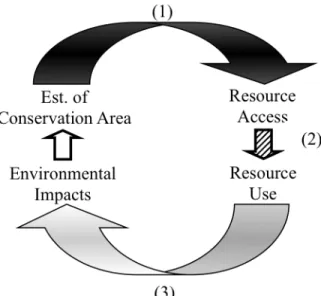
development on resource access at multiple scales (question 1 and black arrow in Figure 1.3), the effects of changes in resource access on household livelihood decisions
(question 2, hatched arrow), and the relationships between livelihoods and the environment (question 3, gray arrow).
Figure 1.3. Conceptual framework. This dissertation addresses the feedbacks between
conservation and human communities by examining (1) the effects of TNP on natural resource access, (2) the role of resource access in livelihood decisions, and (3) the influence of resource-use choices on the environment. The connection between environmental impacts and
34
Collectively, this work will identify system components, relationships, elements of continuity, and sources of innovation, which together provide an indication of system resilience (Robinson and Berkes 2010). These insights may also reveal strategies for enhancing the resilience of rangelands and pastoralist societies more broadly. Although pastoralist societies have been the subject of much research, “the resilience literature has not yet given much attention to pastoralism and particularly to the social elements of pastoralist social-ecological systems.” (Robinson and Berkes 2010: 337)
1.5. Study Site & Population 1.5.1. East African Rangelands
About 79% of the East African land surface is rangeland (Kenya 87%, Tanzania 74%, Uganda 79%) (Pratt and Gwynne 1977). These iconic landscapes maintain
remarkable populations of large mammals (e.g., wildebeest, elephant, rhino, lion), as well as archaeological evidence that humans and our ancestors have also occupied this
landscape for millions of years (Burney 1996). Although East Africa is often depicted as a timeless wilderness landscape, it has a long history of social dynamics (including the relatively recent immigration of Maasai pastoralists discussed below), and is currently undergoing land use alterations that are associated with shifting livelihoods,
demographics, and political-economic priorities.
35
conglomeration of tropical savanna (Aw), hot arid steppe (BSh), and temperate warm summer, dry winter (Cwb). This area also contains pockets of hot arid desert (BWh) and temperate dry/warm summer (Csb). Tropical monsoon (Am) and tropical rainforest (Af) zones are found at higher elevations. Annually, the climate regime is characterized by one long dry-season from June to October, and one rainy-season from November to May (Figure 1.4), which is subdivided into the short rains (November to January) and the long rains (February to May) (Prins and Loth 1988).
Figure 1.4. Monthly Mean Rainfall (mm) for Narok, Kenya (1913-2003); data from the Royal Netherlands Meteorological Institute
Seasonal rainfall is a result of north-south movments of the Intertropical
Convergence Zone (ITCZ). The ITCZ is an area of low pressure that forms as heated air rises and draws air masses from the north and south. These moisture-laden air masses rise as they hit the warm ITCZ, causing the air to cool, and water vapor to condense and precipitate. The ITCZ follows the overhead sun (i.e., the sun’s zenith) with lag of 2 weeks (Homewood 2008). It shifts southward during the long rains, a season which account for about 42% of annual rainfall in East Africa (Indeje et al. 2000). During the long rains there is weak correlation between rainfall at different stations, indicating large
0 40 80 120 160
Jan Feb Mar Apr May Jun Jul Aug Sep Oct Nov Dec
R
ai
n
fal
36
spatial variability. The short rains account for about 25% of annual precipitation. During this season there are strong station-to-station and seasonal-to-annual rainfall correlations (Nicholson 1996, Indeje et al. 2000), indicating that the short rains are a better predictor of annual rainfall, and that there are more uniform spatial patterns of precipitation during this season. Intra-annual variability is inversely related to mean annual rainfall (Prins and Loth 1988). Mean annual rainfall is positively correlated with elevation, especially during the long rains. The region exhibits very high inter-annual rainfall variability, and low-rainfall years are a common feature of the climate in East Africa (Figure 1.5) (Prins and Loth 1988).
Figure 1.5. Annual, long-term mean, and 3-year moving mean precipitation for Narok, Kenya (1914-1998); empty cells indicate missing data; data obtained from the Royal Netherlands Meteorological Institute
There are four major types of drought: meteorological, hydrological, agricultural, and socioeconomic. These are defined, respectively, in terms of: the magnitude and duration of departure from normal precipitation; the effect of precipitation shortfalls on
0 200 400 600 800 1000 1200 1400
P
re
ci
p
itati
on
(mm)
37
surface and subsurface water supply; the effect of soil moisture on crop yields; and the effect of drought on other human activities (American Meteorological Society 1997). These types of drought are distinct, but often related. In sum,
“many definitions have been offered for the term ‘drought’, but no single parameter (whether it be precipitation, runoff ,evapotranspiration, temperature, soil moisture or crop yields) can serve as an adequate or comprehensive drought index. Drought implies an extended and significant negative departure in rainfall, relative to the regime around with the society is stabilized. Thus, drought conditions in one region may be considered normal conditions in a more arid region, or during a more arid epoch.” (Rasmusson 1987: 8)
The context specific nature of droughts has resulted in different standards for identifying drought years according to annual precipitation. Meze-Hausken (2004) classifies years with 50 to 75% of a 30-year average as ‘below-normal’ and 0 to 50% as ‘much-below-normal.’ McCabe (2004) follows Stoddart et al.(1975) in using 85% of long term average as the cut-off for drought years.
38
More recent regional climate analyses demonstrate a correlation between the El Niño Southern Oscillation (ENSO) and annual rainfall. Warm ENSO (El Niño) years are associated with above normal rainfall, especially during the short rains, and post-ENSO (+1) years are associated with below normal rainfall (Nicholson 1996, Indeje et al. 2000, Camberlin et al. 2001). Cold ENSO (La Niña) cycles are also linked to decreased annual rainfall (Nicholson and Selato 2000, Paeth and Friederichs 2004). Over millennial timescales, climate reconstruction from sediments in Lake Naivasha, Kenya indicate the occurance of a dry, ‘Medieval Warm Period,’ (AD 1000-1270) and a wet, ‘Little Ice Age’ (AD 1270-1850) that was punctuated by 3 dry episodes (AD 1380-1420, 1560-1620, and 1760-1840) that were more severe than any recorded in the 20th Century (Verschuren et al. 2000).
39
humid forest11. These can be subdivided into vegetation communities based on the dominant genera or species present (Pratt and Gwynne 1977).
Invertebrates and fire consume most primary production, but larger herbivores structure vegetation biomass and community composition as well (Gichohi et al. 1996). The timing of fire is related to rainfall, with most fire occurring late in the dry season. Fire incidence and intensity interacts with vegetation biomass and herbivory. Grazing can reduce fire intensity through decreased fuel loads, thereby allowing for an increase in woody vegetation. On the other hand, browsing can decrease woody vegetation and enhance grass growth, thereby increasing fuel loads, and causing more intense fires that lead to greater declines in biomass (Van Langevelde et al. 2003). Pastoralists sometimes use fire to produce flushes of nutrient rich vegetation, clear dense bush, reduce parasite loads, and prevent large, catastrophic fires (Western 1982, Homewood and Rodgers 1991, Butz 2009).
The impacts of herbivores on vegetation condition and composition are varied and depend on the type of herbivore and habitat (Olff and Ritchie 1998). In the Serengeti ecosystem of northern Tanzania, grazing has been shown to increase grass quality and growth rate (McNaughton 1985). Moderate grazing has been associated with a doubling in grass production under certain levels soil moisture availability, and productivity can be maintained even under very heavy grazing (McNaughton 1979). Large herbivores also influence nutrient distributions (e.g., maintaining nitrogen levels in productive areas - Augustine et al. 2003), and seed dispersal (Miller 1996). On a larger scale, the combined
11
40
effects of elephants and pastoralists increase habitat diversity by creating and maintaining large-scale mosaics of woodland and grassland (Western and Maitumo 2004).
Forage abundance and quality (i.e., protein and mineral concentrations) as well as predator avoidance structure seasonal wildlife migrations (Fryxell and Sinclair 1988, McNaughton 1990). The availability and quality of forage declines during the dry-season (Sinclair 1975), which prompts a migration to foraging sites that maintain higher primary production. Water availability also exerts a strong influence on wildlife concentrations, especially during dry periods and in more arid areas, and swamps and rivers attract large numberes of wildlife (Amboseli Swamps - Western 1975, e.g., Tarangire River - Gereta 2004).
Riparian forests exhibit vegetation links to savanna woodland and tropical
rainforest (Hughes 1988). Thus, riparian zones sustain distinct vegetation communities as well as an array of local and migratory fauna (e.g., large mammals, birds, and non-human primates - Hughes 1988, Mathooko and Kariuki 2000). Not only do these systems
support wildlife, but animals such as elephants and hippopotami structure riparian zones through their influence on vegetation structure, channel morphology, and
microtopography (Naiman and Rogers 1997). Annual or biannual flooding are also important agents of change (Hughes 1988, Stave et al. 2003, Maingi and Marsh 2006). Thes unique biophysical characteristics of riparian zones are of value to both
41 1.5.2. Maasai
A variety of pastoralist, agriculturalist, and hunter-gatherer groups have shaped the rangelands of East Africa. The area of northern Tanzania and southern Kenya that is predominantly inhabited by Maa speakers who identify themselves as Maasai is
informally known as Maasailand (Figure 1.6) (Homewood et al. 2009). Maa speakers are linguistic descendents of the eastern branch of the Nilotic languages, a group that
originates in the southern Sudan; this origin indicates a north-south movement of Maa-speakers beginning early in the 1st millennium AD (Sommer and Vossenpp 1993). They were present in Tanzania by around the mid-16th century to early 17th century, but did not develop their specialized livestock-based economy and culture until around the 18th
42
Figure 1.6. Approximate extent of contemporary Maasailand (based on Homewood et al. 2009); NP=National Park; NR=National Reserve; CA=Conservation Area