Assessing infection control practices to
protect health care workers and patients in
Malawi from nosocomial transmission of
Mycobacterium tuberculosis
Robert J. Flick1,2,3☯, Adamson Munthali1☯, Katherine Simon1,4, Mina Hosseinipour2,5, Maria H. Kim1,4, Lameck Mlauzi6, Peter N. Kazembe1,4, Saeed Ahmed1,4
*
1 Baylor College of Medicine Children’s Foundation Malawi, Lilongwe, Malawi, 2 University of North Carolina
Project-Malawi, Lilongwe, Malawi, 3 University of Colorado School of Medicine, Denver, United States of America, 4 Baylor International Pediatric AIDS Initiative at Texas Children’s Hospital, Baylor College of Medicine, Houston, United States of America, 5 University of North Carolina at Chapel Hill, Chapel Hill, United States of America, 6 Malawi Ministry of Health National Tuberculosis Control Programme, Lilongwe, Malawi
☯These authors contributed equally to this work. *[email protected]
Abstract
Transmission of Mycobacterium tuberculosis (TB) in health settings threatens health care workers and people living with HIV in sub-Saharan Africa. Nosocomial transmission is reduced with implementation of infection control (IC) guidelines. The objective of this study is to describe implementation of TB IC measures in Malawi. We conducted a cross-sectional study utilizing anonymous health worker questionnaires, semi-structured interviews with facility managers, and direct observations at 17 facilities in central Malawi. Of 592 health care workers surveyed, 34% reported that all patients entering the facility were screened for cough and only 8% correctly named the four most common signs and symptoms of TB in adults. Of 33 managers interviewed, 7 (21%) and 1 (3%) provided the correct TB screening questions for use in adults and children, respectively. Of 592 health workers, only 2.4% had been screened for TB in the previous year. Most (90%) reported knowing their HIV status, 53% were tested at their facility of employment, and half reported they would feel comfort-able receiving ART or TB treatment at their facility of employment. We conclude that screen-ing is infrequently conducted and knowledge gaps may undercut its effectiveness. Further, health care workers do not routinely access TB and HIV diagnostic and treatment services at their facility of employment.
Introduction
Nosocomial transmission ofMycobacterium tuberculosis(TB) is a major public health threat in sub-Saharan Africa (SSA) [1,2]. Health care workers (HCWs), who face frequent occupational exposure, are at particularly high risk [3–7]. People living with HIV (PLHIV) are also at risk,
a1111111111 a1111111111 a1111111111 a1111111111 a1111111111 OPEN ACCESS
Citation: Flick RJ, Munthali A, Simon K,
Hosseinipour M, Kim MH, Mlauzi L, et al. (2017) Assessing infection control practices to protect health care workers and patients in Malawi from nosocomial transmission of Mycobacterium tuberculosis. PLoS ONE 12(12): e0189140.https:// doi.org/10.1371/journal.pone.0189140
Editor: Sarah L Pett, University of New South
Wales, AUSTRALIA
Received: April 9, 2017 Accepted: November 20, 2017 Published: December 6, 2017
Copyright:©2017 Flick et al. This is an open access article distributed under the terms of the
Creative Commons Attribution License, which permits unrestricted use, distribution, and reproduction in any medium, provided the original author and source are credited.
Data Availability Statement: Original data files are
included as supplemental information.
Funding: The study was made possible by the
due to impaired immune function and increased exposure to congregate health settings [8–
10]. Numerous nosocomial outbreaks have been documented these two groups [11,12]. Nosocomial exposure and transmission of TB is reduced with implementation of infection control (IC) guidelines that promote the rapid identification, triage, and isolation of potentially infectious patients, the improvement of ventilation, and the availability of personal protective equipment [13]. Routine TB screening for HCWs, combined with access to confidential HIV testing and antiretroviral therapy is crucial to both protect the health of providers and prevent HCWs from becoming sources of TB transmission [9,10,14].
The little available evidence describing the extent of IC guideline implementation in SSA suggests HCWs have limited access to confidential HIV testing, with both lack of services and a perceived lack of confidentiality contributing to low testing uptake [15–17]. As the region adopts WHO guidelines for universal ART, it is imperative to better understand the state of IC at facilities tasked with absorbing the influx of ART patients. Should IC be lacking, investments in health systems strengthening will be critical to ensure that accessing ART does not expose new patients to avoidable risk.
Malawi is a landlocked country in SSA that is implementing universal ART for its estimated million PLHIV [18]. Prior to the introduction of ART, TB was responsible for almost half of recorded deaths in HCWs [3]. Guidelines for IC have been developed, but their routine prac-tice has not been characterized. In this study, we aim to describe the implementation of IC guidelines prior to the shift to universal ART in Malawi.
Methods
Study design and setting
Malawi is a resource-limited country of 16 million people in sub-Saharan Africa, with an adult HIV prevalence of 10.3% and a TB incidence rate among adults of 227 cases per 100,000 [19]. We conducted a cross-sectional assessment in seventeen Malawi Ministry of Health (MOH) operated facilities (six hospitals, eleven health centers) in four districts in Malawi’s central region with a total estimated catchment area population of 1.2 million people. Sites were vis-ited between September 2014 and July 2015. Site selection was deliberate and made in coordi-nation with the MOH, with all surveyed facilities supported in various degrees by the Tingathe community health worker-based outreach program [20,21].
At the time of the study, NTP guidelines recommended universal cough screening for everyone entering health facilities. Intensified case finding was recommended for PLHIV according to WHO guidelines that recommended asking about a history of fever, cough, weight loss (poor weight gain in children), or night sweats. Guardians of children were also asked about a home TB contact. Presumptive TB patients were evaluated by sputum smear microscopy, and chest radiography if necessary. The GeneXpert MTB/RIF Assay was used for critically ill patients, or PLHIV with a negative smear result.
IC guidelines assessed
We assessed guidelines according to the four hierarchies widely used by both the WHO and the Malawi NTP: managerial activities, administrative controls, environmental controls, and personal protective equipment [22,23]. We included HCW access to care as a separate fifth cat-egory (Box 1). Three approaches were used to assess guideline implementation: i.) an anony-mous questionnaire distributed to HCWs; ii.) semi-structured interviews with facility managers; and iii.) direct observations made by researchers during site visits.
Foundation (New York, NY, USA) and NIH Research Training Grant number R25 TW009340 funded by the Fogarty International Center.
Competing interests: The authors have declared
Health care worker questionnaire
A short questionnaire was developed and piloted in English, the official language of Malawi (S1 Appendix). At each facility, the purpose of the study was described and questionnaires were distributed during morning report. All facility staff were invited to participate. Formal informed consent was waived for the questionnaire due to the operational nature of the study and the minimal risk involved, however the introduction included detailed information about the voluntary nature of the study, and the absence of punitive action for opting out.
Box 1. Guidelines targeted for evaluation.
Managerial controls
Establish and strengthen infection control (IC) committees
Provide training of all staff in IC
Write and disseminate IC standard operating protocols
Administrative controls
Screen all patients entering the facility for cough
Promptly triage of presumptive TB patients
Educate patients on cough hygiene
Encourage hospitalized TB patients to spend daylight hours outside
Restrict visitors to TB wards
Physically separate HIV-positive patients from those with known or suspected infectious tuberculosis
Environmental controls
Keep windows open when possible
Use fans in enclosed spaces
Provide coughing patients with surgical masks
Personal protective equipment
Provide HCWs with N95 respirators
Access to care for health workers
Access to confidential HTC, ART, and IPT
Manager interviews and direct observations
A tool was developed and piloted in English to guide semi-structured interviews with facility managers (S2 Appendix). Interviews were conducted with at least two managers at each facility using a standardized tool. Facility managers were defined as HCWs in formal leadership posi-tions whose responsibilities encompassed IC. The selection of interviewees was guided by either the District Health Officer or the senior leadership of the facility. Verbal informed consent was obtained from interviewees. Two researchers jointly conducted the interviews, completed separate forms for each interview, and reconciled differences based on shared agreement using the audio recording if necessary. No incentive was offered to interviewees.
Direct observations
Study staff recorded observations using a standardized checklist on a pre-selected group of IC measures (S3 Appendix). These observations detailed the presence and operation of ventilation systems, whether windows were open, and whether IC protocols were in place at clinic spaces, among other items. Site visits were part of routinely scheduled Tingathe clinical mentorship visits, allowing study staff to observe IC implementation under routine settings (versus specific preparation for an IPC assessment).
Background facility data
Health facility catchment area population was abstracted from semi-permanent data,[24] attendance figures from the Health Management Information System and Integrated HIV Pro-gram Reports published by the Malawi MOH [25,26].
Analysis
Univariate statistics were used to describe proportions, medians, and interquartile ranges. Summary variables for Likert scores were generated, with agreement defined as a response of “Agree” (4/5) or “Strongly Agree” (5/5). Two-tailed student’s t-test were used to compare con-tinuous variables. Analysis was conducted using STATA Special Edition 14.1 (Stat-Corp LP, College Station, TX, USA).
Ethics
This study was approved by the Malawi National Health Science Research Committee and the Baylor College of Medicine Institutional Review Board.
Results
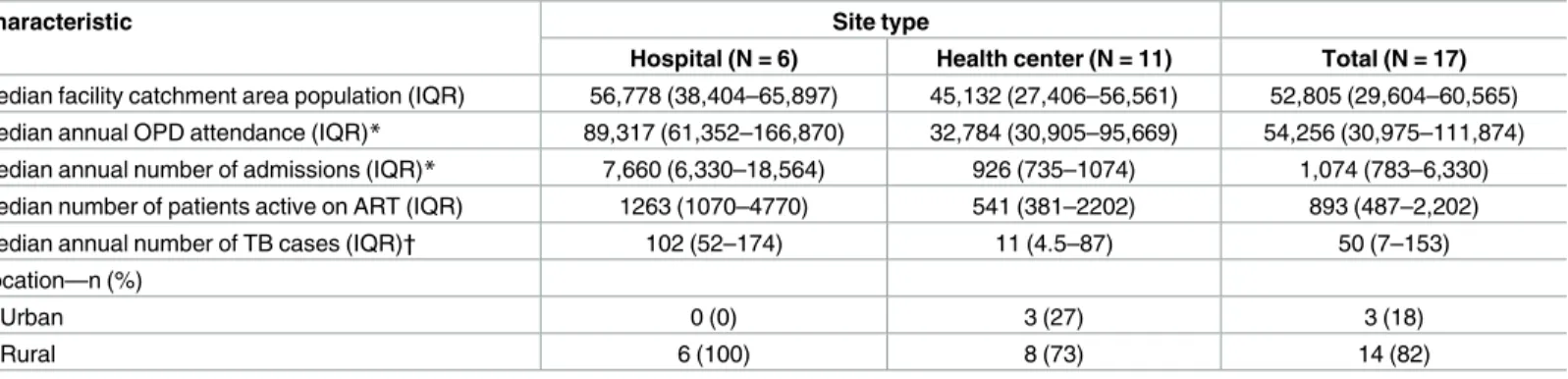
Median facility catchment area population at surveyed facilities was 52,805 (Table 1). Three facilities were in urban areas, and 14 were rural.
Respondent characteristics
Managerial activities
Of the 592 HCW respondents, 78% reported ever receiving IPC training (Fig 1); of these, less than half provided an estimated date for their last training (median years elapsed = 1.7, IQR 0.5–3.1), and 66 (11% of all respondents) reported IPC training within the last year. Of seven-teen facilities, 10 (59%) had separate waiting areas for TB and ART patients.
Administrative controls
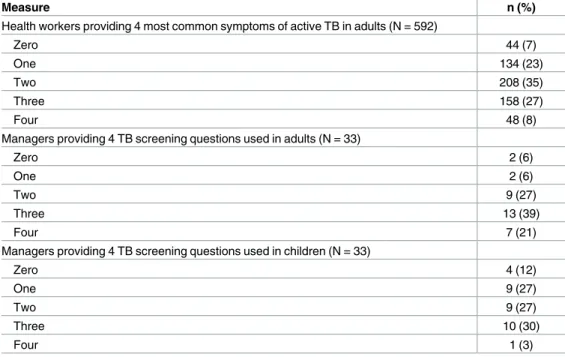
Of the 592 HCW respondents, 34% agreed that all patients entering the facility were screened for a cough (Fig 2). Of 592 HCW respondents, 236 (40%) provided cough as a TB symptom, Table 1. Characteristics of survey sites.
Characteristic Site type
Hospital (N = 6) Health center (N = 11) Total (N = 17)
Median facility catchment area population (IQR) 56,778 (38,404–65,897) 45,132 (27,406–56,561) 52,805 (29,604–60,565) Median annual OPD attendance (IQR)* 89,317 (61,352–166,870) 32,784 (30,905–95,669) 54,256 (30,975–111,874) Median annual number of admissions (IQR)* 7,660 (6,330–18,564) 926 (735–1074) 1,074 (783–6,330) Median number of patients active on ART (IQR) 1263 (1070–4770) 541 (381–2202) 893 (487–2,202)
Median annual number of TB cases (IQR)† 102 (52–174) 11 (4.5–87) 50 (7–153)
Location—n (%)
Urban 0 (0) 3 (27) 3 (18)
Rural 6 (100) 8 (73) 14 (82)
*Not unique patients
†3 Health centers missing data
https://doi.org/10.1371/journal.pone.0189140.t001
Table 2. Characteristics of HCW respondents (N = 592). Characteristic
Age in years—median (IQR) 31 (26–37)
Years working in health care—median (IQR) 6 (3–10)
Gender—n (%)
Male 267 (45.1)
Female 297 (50.2)
No response 28 (4.7)
Position—n (%)
Health surveillance assistant 118 (19.9)
Nurse 96 (16.2)
Community health worker 89 (15.0)
Student 73 (12.3)
Cleaner 68 (11.5)
Medical assistant 30 (5.1)
Clinical officer 24 (4.1)
Clerk 19 (3.2)
Environmental health officer 6 (1.0)
Other* 40 (6.8)
No response 29 (4.9)
*Other includes: hospital attendants, lab technicians, nutritionists, security guards, volunteers, and messengers
Fig 1. Pooled health worker responses. Numbers correspond with percent of respondents.
Fig 2. Pooled health worker responses. Numbers correspond with percent of respondents.
and 48 (8%) correctly named the four most common symptoms of active TB in adults (Table 3). Of 33 managers reporting that their facility conducts symptom screening for TB, only 7 (21%) could name the appropriate screening questions for adults and 1 (3%) named them for children. Of 33 managers indicating their facility conducts symptom screening, half reported this is done at ART clinic. All managers reported use of sputum smear microscopy to evaluate presumptive TB patients, and most (83%) perform the test on-site. Among managers, 43% reported use of GeneXpert.
Environmental controls and personal protective equipment
Of 592 HCW respondents, only 182 (31%) reported access to N95 respirators and no managers reported providing HCWs with N95 respirators. No sites were observed to have fans, ultravio-let lights, or air filters in use (Table 4).
HCW access to care
Most HCWs reported they have access to confidential HTC (82%), ART (84%), and IPT (64%). Roughly half of the respondents indicated they would feel comfortable receiving ART (49%) or TB treatment (55%) at the same facility where they work. Of note, these two ques-tions had the highest non-response rate (17% and 16%, respectively). Participants who would feel comfortable receiving ART at their place of work were older (33.8 vs 31.1 years, p = 0.0013) and had worked in health care longer (9.0 vs 7.0 years, p = 0.0068). Almost all of the 592 HCW respondents (90%) reported knowledge of their HIV status, however only 53% received an HIV test at the same facility where they work.
Among managers, 20% reported a policy of regular TB screening for HCWs. Of HCWs, 17.4% of HCWs surveyed reported having ever been screened for TB. Of these, half could approximate the date of their last screen (median years elapsed = 2.5, IQR 1.1–6.4). Among all respondents, 2.4% had been screened in the previous year. Thirty-four (5.7%) respondents Table 3. Answers from health workers and managers to questions regarding TB screening in adults and children.
Measure n (%)
Health workers providing 4 most common symptoms of active TB in adults (N = 592)
Zero 44 (7)
One 134 (23)
Two 208 (35)
Three 158 (27)
Four 48 (8)
Managers providing 4 TB screening questions used in adults (N = 33)
Zero 2 (6)
One 2 (6)
Two 9 (27)
Three 13 (39)
Four 7 (21)
Managers providing 4 TB screening questions used in children (N = 33)
Zero 4 (12)
One 9 (27)
Two 9 (27)
Three 10 (30)
Four 1 (3)
reported previous TB treatment. Of the 34 respondents reporting previous TB treatment, 12 (35%) indicated they received it at the same facility where they work. Of all 592 HCW respon-dents, 8 (1.4%) reported current TB treatment and 21 (3.5%) reported current IPT. Over half of respondents (51%) indicated the layout of their facility makes them concerned about getting TB from patients.
Discussion
This study is the first in over a decade to document the current state of IC guidelines in public facilities in Malawi. Further, it is the first in the era of widespread ART availability and task shifting to characterize access to care for HCWs. Our findings suggest that IC guideline imple-mentation is inadequate, and bring to light issues surrounding HCW access to care.
Our findings raise concern over the state of routine symptom screening for TB. Most anon-ymous respondents did not agree that screening is routine. Further, most of the manager respondents were unable to list the screening questions for TB in adults, and only one pro-vided the correct questions for children. Together, these findings suggest that TB screening is not routinely performed, and that when it does occur, is likely undercut by knowledge gaps.
Screening for TB is an upstream element of IC—almost all other components require an understanding of who is potentially infectious, and who is not. This understanding is only pos-sible through robust, routine screening protocols. If screening is impaired, downstream tar-geted interventions—such as isolation of infectious patients and use of N95 respirators—are of little use, placing HCWs and other patients at risk. The shockingly high incidence of TB identi-fied on autopsy studies among patients who were not suspected of having TB highlights the importance of this initial step [27,28].
Screening as part of a larger IC strategy has been described in the acronym FAST: Find cases Actively, Separate safely, and Treat effectively based on rapid drug susceptibility testing (DST)[29]. By coupling robust screening with improved diagnostics, this approach holds potential to halt the chain of transmission. With the growing availability of the GeneXpert rapid molecular test, the infrastructure is in place to more effectively evaluate individuals who screen positive. While significant, investments made now towards rapid and accurate case Table 4. Number of facilities implementing IPC guidelines according to data source (N = 17).
Measure—n (%) HCW survey1 Manager response2 Observation
n (%) n (%) n (%)
Administrative controls
Patients are screened for a cough 3 (18) 16 (94) —
Patients are educated about cough hygiene 7 (41) 6 (35) —
Hospitalized TB patients are encouraged to spend daylight hours outside 1 (6) 0 (0) — Environmental controls
Windows kept open when possible 16 (94) 12 (71) 16 (94)
HCWs have access to N95 respirators 2 (12) 0 (0) 0 (0)
Surgical masks are offered to patients with a cough 0 (0) 0 (0) 0 (0)
Fans used — 1 (6) 0 (0)
Ultraviolet lights used — 0 (0) 0 (0)
Access to care for health workers
Policy for regular screening of health workers* 0 (0) 1 (6) —
*For HCW survey, facilities were counted if a majority of respondents had been screened within the previous 365 days —Item was not measured in corresponding data source
identification could reduce transmission and slow the development of multidrug-resistant TB, which confers exponentially greater costs per case transmitted.
Our findings suggest suboptimal implementation of several other IC measures. Of note, no fans or germicidal ultraviolet lights (GUVs) were observed in use. While windows and doors were kept open, relying entirely on simple natural ventilation grows more difficult as the size and complexity of a facility grows [30]. Fans offer the simplest solution to improve ventilation in smaller facilities with direct exhaust paths to the outside air. For more complex facilities, Malawi guidelines recommend the use of GUVs, however uptake has been limited by their high initial costs, maintenance requirements, and need for a reliable source of power [23]. Reconsideration of GUVs may soon be warranted, given the development of cheaper LED fix-tures that can run on batteries and solar power. This is especially pertinent in large facilities where the cost per incremental air change is nine times lower for GUV compared to mechani-cal ventilation [31].
Our findings add to a limited body of evidence pointing to barriers for HCWs in accessing diagnostic and treatment services for HIV and TB [15–17,32]. The data is troubling: only one site reported a policy for regular HCW screening for TB, fewer than one in five HCWs reported ever being screened for TB, and only 2% of all HCWs had been screened in the last year. While most HCWs reported knowing their HIV status, a high proportion were not tested at their site of employment, and only half reported they would feel comfortable receiving ART at the facility where they work. These results are in line with other work suggesting that per-ceived lack of confidentiality at their facility of employment is a significant barrier for HCWs’ uptake of HIV testing services [15].
Preventive services for HCWs should be commensurate with the incremental risk they face in their routine tasks. This is particularly relevant in Malawi, where the health workforce is already stretched thin [33]. Access to HIV testing and ART—the most effective prevention measure for PLHIV regardless of profession—is critical, as is ensuring regular screening of HCWs for TB [34]. The consequences of inaction are well-documented: increased morbidity among HCWs, and also their patients, who would face increased exposure from their care pro-viders [14].
There are several important limitations of this study. Most measurements relied on self-reporting, introducing the possibility of social desirability bias. We attempted to minimize bias by drawing on a large sample of anonymous HCW responses, and by including objective observations in our analysis. Our use of a convenience sample introduces the potential that our sites are not representative of Malawi as a whole.
Conclusions
As the numbers of persons on ART increase, it is critical to ensure health facilities are not con-ferring increased risk to individuals accessing care. Current implementation of IC guidelines appears to be suboptimal, and barriers to care persist for HCWs. Improvements are needed to protect patients and HCWs in health settings. Robust implementation of routine symptom screening to rapidly identify presumptive TB patients and access to confidential HIV/TB-related services for HCWs is paramount to reduce the risk of nosocomial TB transmission and promote a safer health care setting.
Supporting information
S2 Appendix. Manager interview guide. (PDF)
S3 Appendix. Observation data recording tool. (PDF)
S1 Data. Complete study dataset, separated into health worker responses (ipc_hcw.dta), manager responses (ipc_manager.dta), and facility observations (ipc_obs.dta).
(ZIP)
Acknowledgments
This publication was made possible by support from USAID cooperative agreement number 674-A-00-10-00093-00. MHK was supported by the Fogarty International Center of the National Institutes of Health under award number K01 TW009644. RF was supported by the Doris Duke Charitable Foundation (New York, NY, USA) and NIH Research Training Grant number R25 TW009340 funded by the Fogarty International Center. The funders had no role in study design, data collection and analysis, decision to publish or preparation of this manu-script. The contents are the responsibility of the authors and do not necessarily reflect the views of the funders, including the National Institutes of Health, USAID and the United States Government. This study was presented in part at the 8th IAS Conference on HIV Pathogene-sis, Treatment and Prevention in Vancouver, Canada and was awarded the IAS TB/HIV Research Prize.
Author Contributions
Conceptualization: Maria H. Kim, Saeed Ahmed.
Data curation: Robert J. Flick, Adamson Munthali.
Formal analysis: Robert J. Flick, Saeed Ahmed.
Funding acquisition: Saeed Ahmed.
Investigation: Robert J. Flick, Adamson Munthali, Katherine Simon.
Methodology: Robert J. Flick, Adamson Munthali, Katherine Simon, Mina Hosseinipour, Maria H. Kim, Lameck Mlauzi, Saeed Ahmed.
Project administration: Robert J. Flick, Adamson Munthali, Katherine Simon, Peter N. Kazembe, Saeed Ahmed.
Resources: Maria H. Kim, Peter N. Kazembe, Saeed Ahmed.
Software: Robert J. Flick.
Supervision: Robert J. Flick, Mina Hosseinipour, Maria H. Kim, Lameck Mlauzi, Peter N. Kazembe, Saeed Ahmed.
Validation: Robert J. Flick.
Visualization: Robert J. Flick.
Writing – original draft: Robert J. Flick, Katherine Simon, Mina Hosseinipour, Maria H. Kim, Saeed Ahmed.
References
1. Gandhi NR, Moll A, Sturm AW, Pawinski R, Govender T, Lalloo U, et al. Extensively drug-resistant tuberculosis as a cause of death in patients co-infected with tuberculosis and HIV in a rural area of South Africa. Lancet 2006; 368:1575–80.https://doi.org/10.1016/S0140-6736(06)69573-1PMID:
17084757
2. Sepkowitz KA. Tuberculosis and the health care worker: a historical perspective. Ann Intern Med 1994; 120:71–9. PMID:8250459
3. Harries AD, Nyirenda TE, Banerjee A, Boeree MJ, Salaniponi FM. Tuberculosis in health care workers in Malawi. Trans R Soc Trop Med Hyg 1999; 93:32–5.https://doi.org/10.1016/S0035-9203(99)90170-0
PMID:10492785
4. Harries AD, Hargreaves NJ, Gausi F, Kwanjana JH, Salaniponi FM. Preventing tuberculosis among health workers in Malawi. Bull World Health Organ 2002; 80:526–31. PMID:12163915
5. Kassim S, Zuber P, Wiktor SZ, Diomande FVK, Coulibaly IM, Coulibaly D, et al. Tuberculin skin testing to assess the occupational risk of Mycobacterium tuberculosis infection among health care workers in Abidjan, Cote d’Ivoire. Int J Tuberc Lung Dis 2000; 4:321–6. PMID:10777080
6. Eyob G, Gebeyhu M, Goshu S, Girma M, Lemma E, Fontanet A. Increase in tuberculosis incidence among the staff working at the Tuberculosis Demonstration and Training Centre in Addis Ababa, Ethio-pia: a retrospective cohort study (1989–1998). Int J Tuberc Lung Dis 2002; 6:85–8. PMID:11931406 7. Kanyerere HS, Salaniponi FM. Tuberculosis in health care workers in a central hospital in Malawi. Int J
Tuberc Lung Dis 2003; 7:489–92. PMID:12757052
8. Edlin BR, Tokars JI, Grieco MH, Crawford JT, Williams J, EM S, et al. An outbreak of multidrug-resistant tuberculosis among hospitalized patients with the acquired immunodeficiency syndrome. N Engl J Med 1992; 326:1514–21.https://doi.org/10.1056/NEJM199206043262302PMID:1304721
9. Lawn SD, Wood R, De Cock KM, Kranzer K, Lewis JJ, Churchyard GJ. Antiretrovirals and isoniazid pre-ventive therapy in the prevention of HIV-associated tuberculosis in settings with limited health-care resources. Lancet Infect Dis 2010; 10:489–98.https://doi.org/10.1016/S1473-3099(10)70078-5PMID:
20610331
10. Suthar AB, Lawn SD, del Amo J, Getahun H, Dye C, Sculier D, et al. Antiretroviral therapy for prevention of tuberculosis in adults with HIV: a systematic review and meta-analysis. PLoS Med 2012; 9:
e1001270–15.https://doi.org/10.1371/journal.pmed.1001270PMID:22911011
11. Daley CL, Small PM, Schecter GF, Schoolnik GK, McAdam RA, Jacobs WR, et al. An outbreak of tuber-culosis with accelerated progression among persons infected with the Human Immunodeficiency Virus: an analysis using restriction-fragment—length polymorphisms. N Engl J Med 1992; 326.
12. Di Perri G, Danzi MC, De Checchi G, Pizzighella S, Solbiati M, Cruciani M, et al. Nosocomial epidemic of active tuberculosis among HIV-infected patients. Lancet 1989; 334:1502–4.
13. Maloney SA, Pearson ML, Gordon MT, Del Castillo R, Boyle JF, Jarvis WR. Efficacy of control mea-sures in preventing nosocomial transmission of multidrug-resistant tuberculosis to patients and health care workers. Ann Intern Med 1995; 122:90–5. PMID:7993001
14. Zaza S, Blumberg HM, Beck-Sague´ C, Haas WH, Woodley CL, Pineda M, et al. Nosocomial transmis-sion of Mycobacterium tuberculosis: role of health care workers in outbreak propagation. J Infect Dis 1995; 172:1542–9.https://doi.org/10.1093/infdis/172.6.1542PMID:7594714
15. Namakhoma I, Bongololo G, Bello G, Nyirenda L, Phoya A, Phiri S, et al. Negotiating multiple barriers: health workers’ access to counselling, testing and treatment in Malawi. AIDS Care 2010; 22:68–76.
https://doi.org/10.1080/09540121003607241PMID:20680862
16. Atukunda R, Peter M, Constance SS. Care for the caregiver: stress relief and burnout among health workers in HIV care. Global J Med Publ Health 2013; 2:1–7.
17. Kranzer K, Bekker LG, van Schaik N, Thebus L, Dawson M, Caldwell J, et al. Community health care workers in South Africa are at increased risk for tuberculosis. S Afr Med J 2010; 100:224–6. PMID:
20459967
18. Joint United Nations Programme on HIV/AIDS (UNAIDS). Global report: UNAIDS report on the global AIDS epidemic 2013. Geneva: 2013.
19. World Health Organization. Global tuberculosis report 2015. Geneva: 2015.
20. Kim MH, Ahmed S, Preidis GA, Abrams EJ, Hosseinipour MC, Giordano TP, et al. Low rates of mother-to-child HIV transmission in a routine programmatic setting in Lilongwe, Malawi. PLoS ONE 2013; 8: e64979.https://doi.org/10.1371/journal.pone.0064979PMID:23741437
intervention in Lilongwe, Malawi. J Int AIDS Soc 2015; 18.https://doi.org/10.7448/IAS.18.1.19305
PMID:25571857
22. World Health Organization. WHO Policy on TB Infection Control in Health-Care Facilities, Congregate Settings and Households. Geneva: 2009.
23. Government of Malawi Ministry of Health, Malawi National Tuberculosis Control Programme. Guide-lines for Infection Prevention and Control for Tuberculosis. Lilongwe: 2009.
24. Malawi National Statistical Office. 2014 Malawi Population. Zomba: 2014.
25. Malawi Ministry of Health Department of HIV & AIDS. Integrated HIV Program Report October— December 2014. Lilongwe: 2015.
26. Government of Malawi Ministry of Health. Malawi Health Information Management System
27. Bates M, O’Grady J, Mwaba P, Chilukutu L, Mzyece J, Cheelo B, et al. Evaluation of the burden of unsuspected pulmonary tuberculosis and co-morbidity with non-communicable diseases in sputum pro-ducing adult inpatients. PLoS ONE 2012; 7:e40774.https://doi.org/10.1371/journal.pone.0040774
PMID:22848401
28. Bates M, Mudenda V, Shibemba A, Kaluwaji J, Tembo J, Kabwe M, et al. Burden of tuberculosis at post mortem in inpatients at a tertiary referral centre in sub-Saharan Africa: a prospective descriptive autopsy study. Lancet Infect Dis 2015; 15:544–51.https://doi.org/10.1016/S1473-3099(15)70058-7
PMID:25765217
29. Barrera E, Livchits V, Nardell E. F-A-S-T: a refocused, intensified, administrative tuberculosis transmis-sion control strategy. Int J Tuberc Lung Dis 2015; 19:381–4.https://doi.org/10.5588/ijtld.14.0680PMID:
25859991
30. Atkinson J, Chartier Y, Pessoa-Silva CL, Jensen P, Li Y, Seto W-H. Natural Ventilation for Infection Control in Health-Care Settings. Geneva: World Health Organization; 2009.
31. Nardell EA. Indoor environmental control of tuberculosis and other airborne infections. Indoor Air 2015; 26:79–87.https://doi.org/10.1111/ina.12232PMID:26178270
32. Shisana O, Hall EJ, Maluleke R, Chauveau J, Schwabe C. HIV/AIDS prevalence among South African health workers. S Afr Med J 2004; 94:846–50. PMID:15532762
33. Government of Malawi Ministry of Health, UNICEF, UNFPA, World Health Organization, AMDD. Malawi 2010 EmONC needs assessment final report. Lilongwe: Ministry of Health; 2010.