DISORDER-SPECIFIC PATTERNS OF EMOTION COREGULATION IN COUPLES: COMPARING OBSESSIVE-COMPULSIVE DISORDER AND ANOREXIA NERVOSA
Melanie Sandy Fischer
A dissertation submitted to the faculty of the University of North Carolina at Chapel Hill in partial fulfillment of the requirements for the degree of Doctor of Philosophy in the Department of
Psychology and Neuroscience.
Chapel Hill 2015
Approved by: Donald H. Baucom Jonathan S. Abramowitz Brian R. Baucom
© 2015
ABSTRACT
Melanie Sandy Fischer: Disorder-Specific Patterns of Emotion Coregulation in Couples: Comparing Obsessive Compulsive Disorder and Anorexia Nervosa
(Under the direction of Donald H. Baucom)
Impaired emotion regulation and maladaptive strategies to manage distress are central to psychopathology, including obsessive-compulsive disorder (OCD) and anorexia nervosa (AN). Emotion regulation can be fostered or thwarted by romantic partners, and the tendency to rely on interpersonal emotion regulation may vary by disorder. The current study
in AN patients with treatment. Covariation differed in the opposite direction of the hypothesis (greater in AN compared to OCD); there was no difference in coupling. AN patients exhibited consistent coregulation, indicating high reactivity to partners` emotional arousal which may contribute to interpersonal avoidance. OCD couples showed limited predictability of patients’ emotional arousal over time, while partners were affected by the patients’ arousal; thus, symptom accommodation may in part be partners’ attempts at
ACKNOWLEDGEMENTS
This dissertation would never have been possible without the innumerable
contributions of many individuals who have been part of my work and training. I would like to thank my mentor Donald Baucom for all I have learned from him throughout graduate school and during the process of conducting this dissertation. I am forever grateful for his enthusiasm, wisdom, and support, and for being a role model as one of the finest scientist-practitioners I know. I would also like to thank my committee members Jonathan
Abramowitz, Brian Baucom, Cynthia Bulik, Laura Castro-Schilo, and Eric Youngstrom. Their expertise in each of their specialty areas was invaluable in helping me conduct a study at the intersection of research on romantic relationships, psychopathology, emotions, and statistical models that open new windows into interpersonal processes. I also cannot overstate my appreciation for Panayiotis Georgiou and Sandeep Chakravarthula who assisted in this project with their expertise as engineers in speech signal processing. I would like to thank the undergraduate research assistants who spent many hours in the lab preparing recorded
conversations for data extraction.
with helping me channel my enthusiasm for research in a productive direction that prepared me for graduate school; the broader community of the faculty in the UNC Department of Psychology and Department of Psychiatry who have created an environment of intellectual enthusiasm and critical thinking while never losing sight of the clinical implications of our work; my fellow lab members and graduate students at UNC who have made all the
difference in making graduate school rewarding and contributed greatly to my personal and professional growth; and my friends in and outside of graduate school who have been the home base I could not have done without. Last and most certainly not least, I would like to thank my family, who instilled me with curiosity from an early age, supported me
TABLE OF CONTENTS
LIST OF TABLES ... x
LIST OF FIGURES ... xii
LIST OF ABBREVIATIONS ... xiii
CHAPTER 1: INTRODUCTION ... 1
Interpersonal Emotion Regulation as a Normative Process ... 5
Disorder-Specific Patterns of Interpersonal Emotion Regulation in OCD and AN ... 13
Obsessive-compulsive disorder ... 14
Anorexia nervosa ... 16
Empirical findings implicating disorder-specific patterns of interpersonal emotion regulation ... 18
Attachment and associated features ... 22
Vocally Encoded Emotional Arousal ... 24
Current Study ... 27
Hypotheses ... 28
Hypotheses 1a-2b: Rationale.. ... 28
Hypothesis 1a ... 29
Hypothesis 1b ... 29
Hypothesis 2a ... 29
Hypothesis 2b.. ... 29
Hypothesis 3a. ... 31
Hypothesis 3b ... 31
CHAPTER 2: METHODS ... 32
Participants ... 32
Measures ... 36
Vocally encoded emotional arousal.. ... 36
OCD symptom severity.. ... 38
AN symptom severity ... 39
Procedure ... 40
OCD sample ... 40
AN sample ... 41
CHAPTER 3: RESULTS ... 43
General Data Analytic Strategy ... 43
Sample size and power ... 44
Preliminary Data Inspection, Analyses, and Descriptive Statistics ... 45
Hypothesis Testing ... 45
Aggregate models ... 46
Hypothesis 2a ... 47
Hypothesis 2b. ... 47
Hypothesis 3b. ... 48
Covariance: Cross-Lagged Actor-Partner Interdependence Models ... 48
Preliminary analyses ... 49
Hypothesis 1a. ... 51
Hypothesis 3a ... 55
Summary of covariance model results ... 60
Coupling: Coupled Linear Oscillator Models. ... 60
Estimation of derivatives and preliminary analyses ... 64
Hypothesis 1b ... 68
Hypothesis 3a ... 70
Summary of the CLO results ... 73
Integration of Results by Hypothesis ... 74
CHAPTER 4: DISCUSSION ... 76
Interpretation of Findings ... 76
Methodological Contributions ... 88
Limitations and Future Directions ... 90
Concluding Comments ... 96
APPENDIX 1: SUPPLEMENTAL FIGURES ... 98
APPENDIX 2: SUPPLEMENTAL INFORMATION ON LINEAR OSCILLATOR MODELS ... 100
ENDNOTES ... 102
LIST OF TABLES
Table 1 - Demographic information at baseline. Mean (SD), unless
otherwise indicated ... 34 Table 2 - Means (Standard Deviations) for all Study Variables ... 46 Table 3 - Fixed Effects and Simple Intercepts/Slopes for the Cross-
Lagged APIM at Baseline: Differences in Actor/Partner Effects
by Diagnosis, AN as Reference Group ... 53 Table 4 - Fixed Effects for the Cross-Lagged APIM at Baseline:
Differences in Actor/Partner Effects by OCD Symptom Severity ... 56 Table 5 - Fixed Effects for the Cross-Lagged APIM at Baseline:
Differences in Actor/Partner Effects by AN Symptom Severity ... 57 Table 6 - Fixed Effects and Simple Intercepts/Slopes for the Cross-
Lagged APIM for OCD: Differences in Actor/Partner Effects by
Time Point ... 58 Table 7 - Fixed Effects and Simple Intercepts/Slopes for the Cross-
Lagged APIM for AN: Differences in Actor/Partner Effects by
Time Point ... 59 Table 8 - Fixed Effects and Simple Slope Estimates for 2 CLO Models
at Baseline: Displacement from Equilibrium (f0), Slopes (1st Derivatives of f0), and Diagnosis Predicting Curvature (2nd
Derivatives of f0) for (A) Patients and (B) Partners.. ... 65 Table 9 - Fixed Effects for 2 CLOs at Baseline Testing Differences
Based on OCD Severity: Displacement from Equilibrium (f0), Slopes (1st Derivatives), and Y-BOCs Score Predicting Curvature
(2nd Derivative) for (A) OCD Patients and (B) OCD Partners ... 69 Table 10 - Fixed Effects for 2 CLOs at Baseline Testing Differences
Based on AN Severity: Displacement from Equilibrium (f0), Slopes (1st Derivatives), and EDE Global Score Predicting Curvature
(2nd Derivative) for (A) AN Patients and (B) AN Partners ... 70 Table 11 - Fixed Effects and Simple Slope Estimates for 2 CLOs for
OCD at Baseline and Posttest: Displacement from Equilibrium (f0), Slopes (1st Derivatives), and Time Point Predicting Curvature (2nd
Table 12 - Fixed Effects for 2 CLOs for AN at Baseline and Posttest: Displacement from Equilibrium (f0), Slopes (1st Derivatives), and Time Point Predicting Curvature (2nd Derivative) for (A) Patients
LIST OF FIGURES
Figure 1. Flow chart of couples included in analyses for each time
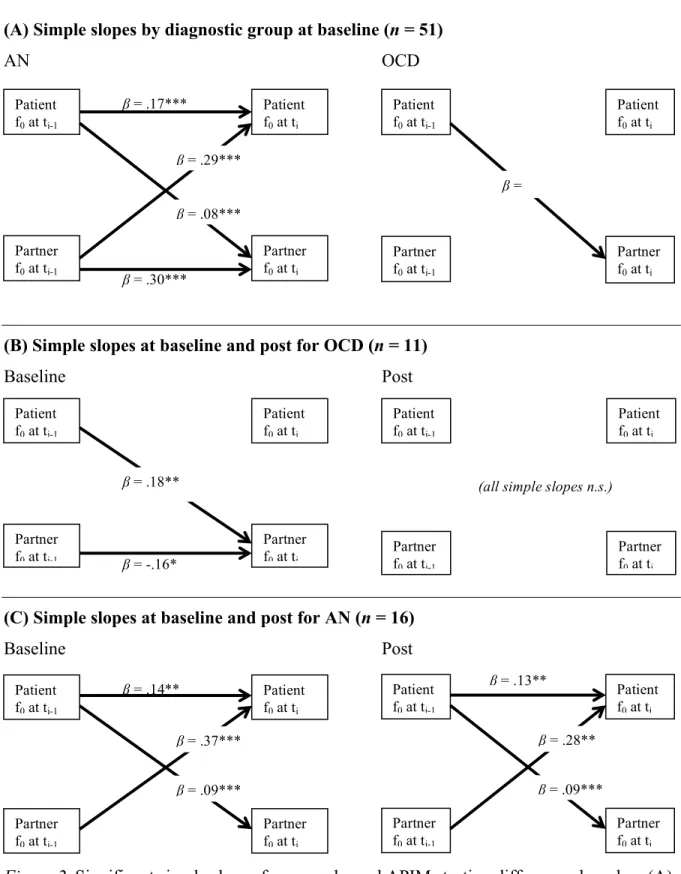
point for the OCD and AN samples ... 33 Figure 2. Significant simple slopes for cross-lagged APIMs testing
differences based on (A) diagnostic group, (B) time point in
the OCD group, and (C) time point in the anorexia group ... 54 Figure 3. Significant simple slopes for CLOs (displacement from
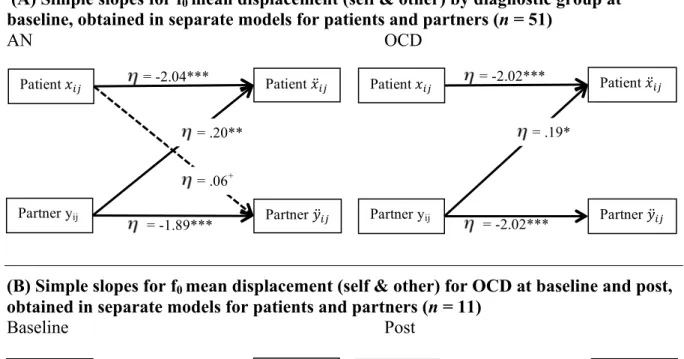
equilibrium) testing differences for (A) diagnostic group, (B)
time point in the OCD group, and (C) time point in the AN group ... 66 Figure 4. Lowess-smoothed plots of f0 mean for each talk turn.
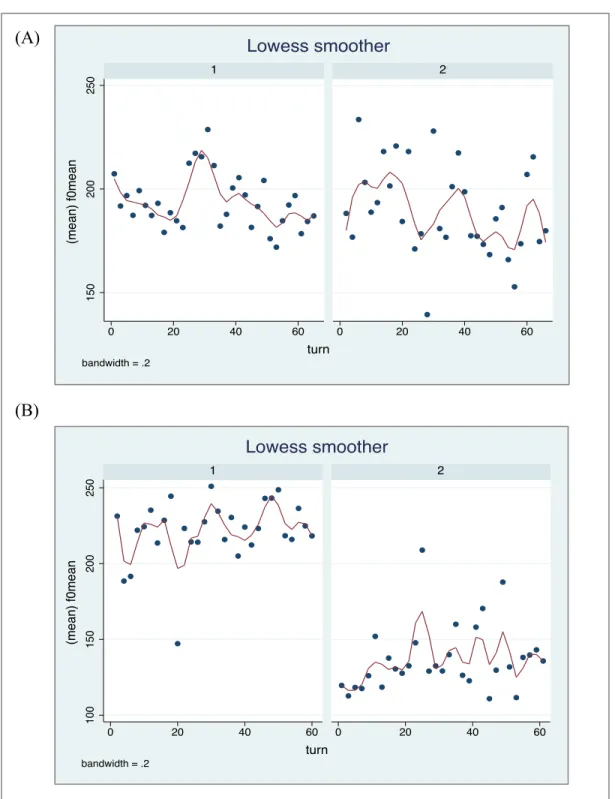
(A) Patient (panel 1) and partner (panel 2) of the OCD sample at baseline. (B) Patient (panel 1) and partner (panel 2) of the AN
sample at baseline. ... 98 Figure 5. Histograms of f0 mean at the talk turn and aggregate levels
LIST OF ABBREVIATIONS
AN Anorexia nervosa
APIM Actor-Partner Interdependence Model BMI Body mass index
EDE Eating Disorders Examination CLO Coupled linear oscillator f0 Fundamental frequency
OCD Obsessive-compulsive disorder LLA Local Linear Approximation
CHAPTER 1: INTRODUCTION
In recent decades, the field of clinical psychology has recognized a need to move beyond studies of symptoms, diagnoses, and their correlates towards a more functional understanding of the biological, psychological, and social factors that underlie individual disorders. Most recently, this shift to a focus on dimensions and mechanisms that cut across different disorders is prominently reflected in the National Institute of Mental Health’s Research Domain Criteria (RDoC) initiative (Insel et al., 2010). In many ways, changes in the experience, expression, and regulation of emotions are central to most psychological disorders and, thus, warrant special consideration (Kring, 2010). Whereas the type of emotions that are most relevant may differ greatly across disorders, many disorders have in common that individuals experience increased negative emotions, which they may respond to in a variety of ways. Typically, individuals with a given disorder have developed strategies to respond in a way that (seemingly) reduces distress in the short term, even if this maintains the disorder at the same time. This is quite obvious in avoidance behavior in anxiety
experience dietary restraint as calming (Brockmeyer et al., 2012; Haynos & Fruzzetti, 2011; Kaye et al., 2003; Kaye et al., 2005; Thornton, Dellava, Root, Lichtenstein, & Bulik, 2011). Thus, emotion regulation is a construct that has important implications for different disorders and their maintenance. Indeed, transdiagnostic conceptualizations and treatment approaches that consider processes related to emotion regulation have become increasingly common, for example, with a focus on experiential avoidance in anxiety disorders, depression, and eating disorders (Barlow et al., 2011; 2007; Hayes, 2012; Hayes, Wilson, Gifford, Follette, & Strosahl, 1996; Haynos & Fruzzetti, 2011).
In order to understand the function of emotions in individual disorders more fully, it is critical to consider the interpersonal context in which emotions occur. Emotions play a highly adaptive social communicative function deeply rooted in evolution (Juslin & Scherer, 2005; Keltner & Haidt, 1999; Turner, 2000), and healthy emotional development is
dependent upon interpersonal processes such as early attachment (Bowlby, 1969; Diamond & Aspinwall, 2003; Sbarra & Hazan, 2008). Despite the long tradition of understanding
children and adolescents’ emotion regulation in a social context in the developmental literature, this has only become a focus in research on adults more recently (Butler, 2011; Butner, Diamond, & Hicks, 2007; Diamond & Aspinwall, 2003; Ram, Shiyko,
(Coan, Schaefer, & Davidson, 2006), and that relationship distress is often associated with a pattern of negative reciprocity in which partners’ negative communications incite the other person to react negatively in return, which also leads negative emotions to escalate
(Levenson & Gottman, 1983; Pasch, Bradbury, & Davila, 1997).
Much less empirical evidence is available about interpersonal emotional processes as they relate to individual psychopathology. At the same time, on a broader level, close others are important in understanding and treating psychological disorders that are typically
conceptualized as individual problems. Much of this research is focused on behavioral patterns among family members or partners and patients. For example, relapse rates in schizophrenia are greatly elevated if an individual returns to a family with high levels of expressed emotion (Brown, Birley, & Wing, 1972; Hooley, 2007); symptom accommodation can inadvertently thwart recovery from obsessive-compulsive disorder (Boeding et al., 2013), and social support has been linked to a host of positive outcomes including a better prognosis in individuals with psychological disorders (Dobkin, Civita, Paraherakis, & Gill, 2002; Peirce, Frone, Russell, Cooper, & Mudar, 2000). More specific to adult psychopathology in a couples context, there is evidence demonstrating both cross-sectional and longitudinal
associations between relationship distress and individual psychopathology across disorders, benefits of including a romantic partner in treatment, and evidence that the effectiveness of individual psychotherapy is diminished if relationship distress is not addressed (see Whisman & Baucom, 2012 for a review). Taken together, multifaceted links between individual
psychopathology and interpersonal relationships clearly exist, yet the role of emotions within this interpersonal context of psychopathology has been underemphasized.
interpersonal context is critical in adults; and that on a behavioral level, the way that patients and partners interact is important for the maintenance and treatment of individual disorders. Yet, these three areas remain somewhat separate lines of research. Thus far, there has been limited investigation regarding interpersonal emotion systems in couples in the context of psychopathology, and which disorder-specific patterns of emotion coregulation may contribute to the maintenance of a problem.
The current study combined these lines of research to examine interpersonal emotion regulation processes in adult couples and the degree to which different patterns of
coregulation that are specific to various disorders exist. For this initial application, obsessive-compulsive disorder (OCD) and anorexia nervosa (AN) were chosen for study because couples addressing these two disorders appear to interact around the disorders in different and somewhat opposite ways, despite the fact that both disorders are marked by high anxiety. A comparison of these two groups could, therefore, facilitate the identification of distinct patterns of interpersonal emotion regulation, which could then be attributed to truly disorder-specific processes rather than resulting from the mere presence of anxiety. Drawing on advances both in the methods available to measure emotional arousal in couple interactions (i.e., speech signal processing) and to model coregulation and related features of
interpersonal emotion systems (time series and dynamic systems modeling), the current investigation also utilized methods and statistics that are seldom applied in psychopathology research but have the potential to make unique contributions.
in OCD and AN, as well as other factors that may affect interpersonal emotion regulation in the context of these disorders. Finally, speech signal processing is introduced as a method that allows for the measurement of emotional arousal in a way that has specific advantages in an interpersonal context.
Interpersonal Emotion Regulation as a Normative Process
Before turning to considerations about interpersonal emotion regulation in specific psychological disorders, it is important to understand relevant healthy emotional processes in couples that may become altered when one partner suffers from a disorder such as OCD or AN. A number of processes included under the umbrella of interpersonal emotion regulation have particular relevance in this context. The term emotion regulation is used in various ways throughout the literature (Gross, 2013). In the current context, emotion regulation is used to describe the processes by which “the occurrence, duration, and intensity of subjective experience, expression, and physiological arousal associated with emotions” are influenced (Butler & Randall, 2013, p. 367). Interpersonal emotion regulation, therefore, refers to processes through which each partner’s occurrence, duration, and intensity of emotions are affected by the other partner and the interaction between partners. This could take the form of one person affecting the other partner through the one person’s behaviors or emotions (e.g., emotion contagion, in which one partner might experience an increase in an emotion that the other partner displays), or the unique phenomena that evolve from the interplay of both partners’ emotion systems (e.g., coregulation as described in more detail below).
Aspinwall, 2003; Sbarra & Hazan, 2008). Rather, it is particularly important to examine processes such as coregulation that result from the interactions of the two individuals as a self-organizing, self-stabilizing system that promotes homeostasis and adapts to internal and external demands (Sbarra & Hazan, 2008). This concept of a self-stabilizing unit aimed toward homeostasis is a notion with a long tradition in family systems theories (Papero, 1990) but also reflects similar thinking found in dynamic systems theories (Butler, 2011). Originally based in the natural sciences, dynamic systems theories have found an increasing number of applications in psychology, particularly in conceptualizations of relationships and emotions as dynamic systems (Butler, 2011; Grandjean, Sander, & Scherer, 2008; Scherer, 2009). This perspective goes hand in hand with many of the traditional family systems ideas, but dynamic systems theory contributes terminology and models that allow us to describe and investigate important processes in close relationships in a more specific manner (Butler, 2011; Ferrer & Helm, 2013; Gottman, Swanson, & Swanson, 2002; Helm, Sbarra, & Ferrer, 2012; Ram et al., 2014; Steele & Ferrer, 2011). This approach also includes a greater focus on research designs and statistical methods that map onto interpersonal dynamics in a meaningful way as they unfold over time (Boker & Laurenceau, 2006; Castro-Schilo & Ferrer, 2013; Deboeck, Boker, & Bergeman, 2008; Felmlee & Greenberg, 1999; Ferrer & Helm, 2013).
Vallacher, Nowak, & Zochowski, 2005). Combining the two individual and relational components, an interpersonal dynamic system of emotions is then characterized by the two parallel oscillating emotion channels of the two individuals, which not only affect each other but also interact in unique ways that lead to self-regulation of the system, and, ideally, can serve to promote homeostasis at an adaptive level in a way that reduces individual costs of allostasis (Butler & Randall, 2013; Diamond, Hicks, & Otter-Henderson, 2008; Field, 2012; Sbarra & Hazan, 2008). Another important aspect of this conceptualization is the temporal dimension and ongoing change, with the implications that the state of the interpersonal system results from the state of all its parts at a given moment, its past states, as well as its dynamic characteristics that can only be identified using repeated observations (Butler, 2011).
The application of dynamic systems models is not specific to the study of emotion processes and romantic relationships, and previous studies have focused, for example, on behavioral patterns in couples (e.g., Boker & Laurenceau, 2006; Felmlee & Greenberg, 1999) and emotion regulation in parent-child dyads (e.g., Feldman, 2003) in similar frameworks. An exhaustive review of the literature on relationships as dynamic systems is beyond the scope of the current study, but a number of empirical studies and theoretical considerations are particularly relevant to the understanding of interpersonal emotion regulation in couples from this perspective.
Coregulation as a form of interpersonal emotion regulation deserves particular
as the “bidirectional linkage of oscillating emotional channels (...) between partners, which contributes to emotional and physiological stability for both partners in a close relationship” (Butler & Randall, 2013, p. 203). In this definition, the focus lies on coregulation of emotion components such as emotional arousal, psychophysiology, and consciously experienced feelings, but coregulation in couples also has been studied in broader emotional experiences and behaviors such as intimacy and self-disclosure (Boker & Laurenceau, 2006). Of note, the notion of oscillations around a stable level implies that there is an “equilibrium” specific to each person and couple, which reflects an optimal range of functioning (e.g., optimal levels of stimulation and arousal, Geen, 1984; Sterling, 2004) or a level that an individual naturally feels most comfortable at and seeks to return to (e.g., a comfortable level of intimacy,
Laurenceau, Barrett, & Rovine, 2005).
By definition, coregulation can only be observed over repeated measures and can be studied by examining a combination of indicators including covariation and more complex links such as the degree to which oscillations are coupled (Butler, 2011). Covariation is concerned with the degree to which the two partners’ levels of emotion are linked and move in tandem, while coupling is focused on the question of whether the dynamics of the
the partners, they do not explore whether the dynamic properties of each person’s emotional oscillations are related to the other partner’s emotions. Modeling these more complex aspects of the bidirectional linkage of the dynamics of each partner’s emotional oscillations has become more feasible with the applications of differential equation models in this context. In particular, coupled linear oscillator models allow investigators to assess coupling as the interdependence of dynamic systems (Boker & Laurenceau, 2006; Boker & Nesselroade, 2002; Butner et al., 2007; Helm et al., 2012), but other applications of differential equation models for modeling regulatory processes have been described as well (e.g., Deboeck, Montpetit, Bergeman, & Boker, 2009; Ferrer & Helm, 2013). As described in more detail by Boker and Laurenceau (2006), coupled oscillators can be visualized as a set of two
pendulums, each representing one partner’s emotions. Each pendulum will swing back and forth through an equilibrium point, and the properties of each pendulum’s swings can be described based on frequency, acceleration, and friction (leading to slowing of the swings). Thus, two pendulums (i.e., partners) may have their own patterns of oscillations, but in an interpersonal emotion system, these oscillations do not occur independently from one another. To represent this notion, one can imagine the two pendulums being connected by a set of springs. That is, the dynamics of each pendulum’s motions are coupled to the other pendulum, leading to changes in the characteristics of both pendulums’ oscillations (e.g., a pendulum may take longer to return back to equilibrium). The ways in which one partner’s emotional oscillations are coupled to the other partner in a coregulated emotion system can be thought of as very similar to the main properties of the coupled pendulums, with the only exception that coupling in dyads may be asymmetric; that is, one person’s emotional
A number of studies have applied this conceptualization to different components of emotions in couples. For example, Helm et al. (2012) reported coupling of respiration and heart rate in couples across three experimental tasks. Boker and Laurenceau (2006) found coupling of husbands’ and wives’ self-reported daily intimacy, and these models have also been applied to other dyadic settings using vocally encoded emotional arousal in parents and children (B. R. Baucom, Iturralde, et al., 2012). As Butler and Randall (2013) suggest, coregulation should ideally be assessed using multiple steps and models to assess covariation around a stable level as well as coupling, although this has rarely been explored thus far within a single investigation of couples. In a rare exception, Butner et al. (2007) found covariation of positive and negative self-reported daily affect and coupling of positive affect in couples.
Of course, other forms of interpersonal regulatory processes in couples can occur as well, including processes that imply an escalating or deescalating trajectory over time. Rather than fluctuations around a stable level, two partners’ emotion channels can be linked in a way that leads to a shared overall increase or decrease in levels of emotions over time. This
emotions, during conflict, and in maritally distressed couples); however, there is also evidence for transmission of emotional experiences in a positive context, such as emotion contagion mediated by empathy (Butler, 2011).
& Bodenmann, 2005). Thus, many of the adaptive behaviors often emphasized in the couple literature are likely vehicles for the establishment of interpersonal emotion regulation.
Moving towards an application of the theoretical considerations presented here to the study of coregulation in the context of individual psychopathology requires some adaptation of underlying assumptions. In particular, the conceptualization of a stable level as an optimal or comfortable level may better be thought of as a typical level in the presence of a disorder, in other words, a maladaptive but “as good as can be” level under the constraints that one partner’s disorder imposes on the system.
In conclusion, interpersonal emotion regulation occurs through a number of normative processes in healthy couples, and coregulation of emotion is a form of
interpersonal emotion regulation. When conceptualizing relationships as dynamic systems and emotion regulation processes as an important factor that could contribute to the maintenance of individual psychopathology, it becomes critical to understand
psychopathology in the context of interpersonal emotion systems. This is not to imply that psychopathology is a result of maladaptive relationship dynamics (in contrast to traditional family systems theories), or that a disorder has unidirectional influences on how two partners interact. Instead, the presence of a disorder is believed to introduce changes in one of the elements of the system (the patient’s emotion system) as well as place unique demands on the relationship in such a way that the system’s dynamics should, over time, be altered until some sort of stability is achieved. The resulting dynamics may not necessarily be adaptive or effectively reduce distress over time, but the dynamics should become organized as a
function of the demands and constraints associated with a given disorder. This set of
disorder in the long term. Understanding the central features of distinct interpersonal emotion regulation patterns that emerge in the presence of a disorder may ultimately be relevant for treatment.
Disorder-Specific Patterns of Interpersonal Emotion Regulation in OCD and AN
Despite recent interest in the interpersonal context of individual psychopathology and couple-based treatments (Whisman & Baucom, 2012), no studies to date examine
interpersonal emotion regulation in couples in the context of psychopathology. However, there are clear differences between disorders in terms of how individuals have learned to manage emotional distress, and this has implications for how they interact with their partners. While no direct empirical findings are available that would identify the characteristics of interpersonal emotion regulation specific to any given disorder, these behavioral patterns should, on a broader level, be related to the degree to which individuals “bring in” or “shut out” the partner from the emotional experience of the disorder. For example, it appears that in OCD, close others are inadvertently brought in into the ways in which patients manage obsessional fears, in particular by reassurance seeking and symptom accommodation. On the contrary, research on behavioral patterns and emotion regulation in AN patients suggests that the opposite takes place; partners tend to feel shut out, and patients tend to rely heavily on individual strategies to manage distress. These tendencies will be further discussed below, focusing on the available evidence on behavioral strategies of managing distress with implications for interpersonal emotion regulation, as well as other features of each disorder that may influence the degree to which emotional arousal is interpersonally regulated in patients with OCD and AN.
sense that anxiety is a central negative emotion present in both disorders. In fact, many individuals with AN have a history of an anxiety disorder that precedes the onset of the eating disorder or tend to be anxious even in the absence of an anxiety disorder diagnosis (Kaye, Bulik, Thornton, Barbarich, & Masters, 2004). OCD is the most common comorbid anxiety disorder in AN (Kaye et al., 2004), and symptoms similar to OCD can emerge secondary to the eating disorder and starvation (Channon & de Silva, 1985; Keys, Brozek, & Henschel, 1950). This includes preoccupations and compulsive behaviors that are focused on eating, food, weight, and shape (Kaye, Bailer, & Klabunde, 2012). However, obsessional thinking and compulsive behaviors unrelated to AN -specific domains also can emerge secondary to starvation (Keys et al., 1950). Thus, given the central role of anxiety and the prevalence of obsessional thoughts and behaviors in both OCD and AN, differences in interpersonal emotion processes between the two disorders would suggest that there are important factors that go beyond the presence of anxiety in understanding emotion regulation in an interpersonal context.
Obsessive-compulsive disorder. OCD is a disorder that is characterized by intrusive, recurring thoughts that elicit fear (obsessions), and repetitive, ritualistic behaviors or mental act (compulsions) that serve a function of reducing obsessional fears (American Psychiatric Association, 2013). Obsessions can take on a wide range of content but are often categorized into the domains of contamination (e.g., fears of contracting a fatal illness from touching surfaces), responsibility for harm (e.g., fears of accidentally harming one’s child),
unacceptable thoughts (e.g., thoughts of blasphemy or sexual content), and symmetry/order (Abramowitz et al., 2010). Compulsions can take any form of overt behaviors such as
great length to avoid obsessional stimuli. Taken together, time spent on compulsions along with constraints due to avoidance behaviors, OCD can lead to severe impairment of
functioning (Abramowitz, 2006).
Cognitive-behavioral theories of the maintenance of OCD and treatments based on this understanding (i.e., exposure and response prevention, ERP) are empirically well supported (Abramowitz, 2006; Eddy, Dutra, Bradley, & Westen, 2004; Olatunji, Davis, Powers, & Smits, 2012). Compulsive behaviors result in a (temporary) reduction in
obsessional fear, which negatively reinforces the behaviors. In addition, compulsive behavior prevents anxiety from habituating in the presence of an obsessional stimulus, and new
learning that would reduce obsessional fears cannot occur. In other words, the patient never learns that, (a) distress can be tolerated and/or would subside on its own and not just due to the performed compulsive behaviors, and, (b) the feared consequences are actually unlikely to occur and need not be prevented by rituals and avoidance (Taylor, Abramowitz, & McKay, 2007).
(Boeding et al., 2013), which indicates that it may be useful to examine the degree to which changes in interpersonal emotion regulation processes occur as a result of a couple-based intervention.
Anorexia nervosa. AN is an eating disorder characterized by an inability to maintain a healthy body weight, extreme fear of weight gain or becoming fat, body image
dissatisfaction and distortions, as well as a host of behaviors such as restricting, binge eating, purging, and excessive exercise (American Psychiatric Association, 2013). In addition, individuals with AN often overvalue weight and shape, do not recognize the severity of their condition, and frequently experience low motivation to change or ambivalence about
recovery (American Psychiatric Association, 2013; Vitousek, Watson, & Wilson, 1998). Low motivation to change is in part thought to be a function of low levels of experienced negative consequences of AN, along with perceived advantages including thinness as a valued
rate of all psychological disorders (Birmingham, Su, Hlynsky, Goldner, & Gao, 2005;
Papadopoulos, Ekbom, Brandt, & Ekselius, 2009 ; Sullivan, 1995; Zipfel, Lowe, Reas, Deter, & Herzog, 2000).
Similar to OCD, no investigations of AN have directly examined interpersonal emotion regulation as defined here. However, for a variety of reasons such as shame about their disordered eating or concerns that family members might force the patient to seek treatment or gain weight, individuals with AN often minimize, hide, or are deceitful regarding their disordered eating when interacting with others (Schmidt & Treasure, 2006; Vitousek et al., 1998). In addition, it appears that patients with AN generally revert to individual strategies (including disordered eating) to regulate negative emotions, attempt to suppress and control emotional arousal, and shut others out from their experience of the disorder (Bulik, Baucom, & Kirby, 2012). Taken together, this avoidance, minimizing the eating disorder, and individual focus for emotion regulation would suggest diminished interpersonal emotion regulation, at least regarding the eating disorder.
Whereas family-based interventions can be quite effective for the treatment of AN in adolescents (Couturier, Isserlin, & Lock, 2010; Eisler et al., 2000; Eisler et al., 1997; Eisler, Simic, Russell, & Dare, 2007; Lock, 2002; Lock, Couturier, & Agras, 2006; Loeb et al., 2007; Paulson-Karlsson, Engström, & Nevonen, 2009; Russell, Szmukler, Dare, & Eisler, 1987; Treasure, Schmidt, & Macdonald, 2010), no effective treatments are currently
Empirical findings implicating disorder-specific patterns of interpersonal
emotion regulation. In OCD, it is particularly apparent how partners become drawn into the patients’ emotion regulation efforts. Individuals with OCD have learned to manage their disorder-related emotional distress by engaging in behaviors that provide at least some immediate decrease in distress, and by avoiding fear-provoking stimuli. Partners can become drawn into this pattern extensively and often engage in a wide range of behaviors described as symptomaccommodation (Abramowitz, Baucom, Wheaton, et al., 2013; Boeding et al., 2013; Calvocoressi et al., 1995; Calvocoressi et al., 1999). Accommodation describes
anything that partners might (knowingly or unknowingly) do in order to reduce or prevent the patients’ obsessional fear. For example, partners might provide reassurance (“You’re not a bad person; I am sure you would never do anything to harm our grandson”), actively participate in rituals (e.g., excessive cleaning), or help the patient avoid anxiety-provoking stimuli and situations (e.g., taking over roles and responsibilities such as driving). Often, patients may seek out accommodation explicitly, such as by asking for reassurance (Boeding et al., 2013; Calvocoressi et al., 1995; Calvocoressi et al., 1999; Shafran et al., 1995;
Starcevic et al., 2012).
Partners may engage in these behaviors out of care and concern when seeing a loved one in distress, or because the patient would become angry or irritated if they did not do so; however, accommodation helps to maintain OCD in a similar way to compulsions.
consistent with their individual ways of managing obsessive fears (i.e., seeking fast-acting, short-term relief and/or extensive avoidance). In addition, given that accommodation
provides short-term relief, patients with OCD typically have little motivation to exclude their partners from their experience of distress, unless they hide obsessions because they are ashamed about their nature. Obsessions and compulsions are usually experienced as
unwanted and aversive by the patient. It appears that, in many cases, once partners are aware of the patients’ worries and concerns, they are eager to help the patient, and it may also be rewarding for partners if they provide reassurance and experience themselves as “helpful” (Abramowitz, Baucom, Wheaton, et al., 2013). Even if obsessions may be illogical and partners may become irritated with the patients, partners might still be able to empathize with the experience of unwanted anxiety, thoughts, and behaviors. Empathic responding and compassion can facilitate coregulation of emotions, because these responses involve some degree of mirroring of the emotional experience (Goetz et al., 2010; Levenson & Ruef 1992; Verhofstadt et al., 2008).
On the other hand, within couples in which one partner suffers from AN, both
understanding of interpersonal patterns.
There is evidence that experiential and harm avoidance play an important role in the maintenance of AN (Bulik, Sullivan, Fear, & Pickering, 2000; Haynos & Fruzzetti, 2011), and that individuals seek to suppress and down-regulate negative emotions as much as possible, primarily through individually focused strategies such as caloric restriction,
excessive exercise, and avoidance (Dellava et al., 2010; Kaye et al., 2003; Wildes, Ringham, & Marcus, 2010). In addition, interactions with others may also be a source of negative emotions (Lattimore, Gowers, & Wagner, 2000), and individuals with AN are found to be highly conflict avoidant, which is reflected in communication patterns in couples (Van den Broucke, Vandereycken, & Vertommen, 1995). Further, even well-intended comments of others e.g., about weight or eating behaviors, can lead to negative emotional reaction, and thus interpersonal avoidance may increase over the course of the disorder (Schmidt &
Treasure, 2006). For example, reassurance about fears of becoming fat or positive comments about looks are ineffective and/or perceived as dishonest, and partners are often extremely unsure how to respond (Fischer, Kirby, Raney, Baucom, & Bulik, in press). Thus, quite contrary to OCD, individuals with AN may display greatly decreased levels of interpersonal emotion regulation in part because they do not experience an immediate benefit of distress reduction as patients with OCD may.
patients report to derive from AN (Cockell et al., 2003; Kaye, Fudge, & Paulus, 2009; Nordbø et al., 2012; Schmidt & Treasure, 2006; Serpell et al., 1999). In addition, patients with AN often fail to recognize the severity of the disorder and its negative consequences (American Psychiatric Association, 2013), which can further impede motivation to recover. Also, if patients were to openly disclose to partners what they experience and the dangerous behaviors they engage in, many partners might try to stop eating disordered behaviors or ask that the patient seek treatment. This could either lead to increased conflict, or interfere with eating disordered behaviors that are strongly reinforced for the patient.
more difficult to empathize and respond compassionately to patients with AN than with OCD because reluctance to recover and positive attitudes towards AN may be extremely difficult to understand (Graap et al., 2008; Lock, Le Grange, Agras, & Dare, 2001); thereby
interpersonal emotion regulation may be further impaired.
Attachment and associated features. Apart from the research presented thus far,
additional insight can be gained from considering other psychological characteristics of individuals with OCD and AN that may impact someone’s tendency or ability for
interpersonal emotion regulation and coregulation in particular. One of these factors involves mechanisms related to attachment styles. Although attachment has mostly been studies in children, there is an increasing number of studies concerned with attachment styles in adults, which have important implications for emotion regulation (Butner et al., 2007; Mikulincer, Shaver, & Pereg, 2003). Whereas physiological coregulation between partners is thought to be an important mechanism for attachment overall (Sbarra & Hazan, 2008), differences in anxious compared to avoidant attachment are of particular interest here. Anxious attachment may facilitate greater interpersonal emotion regulation because of a general
“hyperactivation” of interpersonally oriented processes – such as hypersensitivity to
Consistent with this notion of attachment styles and emotion regulation strategies, Butner et al. (2007) found empirical evidence for greater coregulation of daily affect in couples associated with more anxious attachment styles, and less coregulation in couples associated with more avoidant attachment styles. Although somewhat dependent on the measure and experimental task, Helm et al. (2012) generally found similar patterns of effects of attachment anxiety and avoidance on coupling of oscillations in respiration and heart rate in couples. These differences in coregulation as a function of attachment style might lead to anticipated increased coregulation in OCD and decreased coregulation in AN. Both groups have been found to show high rates of insecure attachment styles, but a recent review of the literature suggests that individuals with AN are most likely to show avoidant/dismissive attachment patterns (O'Shaughnessy & Dallos, 2009), while some initial evidence suggests that individuals with OCD are more likely to show an anxious attachment style (Doron, Moulding, Kyrios, Nedeljkovic, & Mikulincer, 2009).
Consistent with the correlates of avoidant attachment mentioned above, individuals with AN have been found to be less facially expressive (Davies, Schmidt, Stahl, &
Tchanturia, 2011) and more likely to suppress negative emotions and self-silence (Geller, Cockell, & Goldner, 2000) than normal controls. Potentially related to attachment styles are findings that individuals with AN have difficulty identifying emotions in themselves
(Bourke, Taylor, Parker, & Bagby, 1992; Schmidt, Jiwany, & Treasure, 1993; Speranza, Loas, Wallier, & Corcos, 2007) and others (Oldershaw et al., 2011). Combined with decreased facial and verbal expressions of emotions, this may be related to impaired empathic responding by both partners, and thereby a decrease in emotion coregulation.
research regarding behavioral patterns of how individuals manage distress in each of these disorders, as well as research on other factors that can contribute or detract from
interpersonal emotion regulation, suggests that there are marked differences in how emotions become interpersonally processed. In order to examine these differences in emotion
regulation empirically, it is also important to consider which measure of emotional arousal is most suitable for the purposes of the current study.
Vocally Encoded Emotional Arousal
Previous studies have primarily used daily diary paradigms or interactions tasks with report measures of emotion, related psychological variables such as intimacy and self-disclosure, or psychophysiological measures to assess interpersonal regulatory processes (Boker & Laurenceau, 2006; Butner et al., 2007; Helm et al., 2012). However, measures of vocally encoded emotional information have recently found more applications in
psychological research on dyads (B. R. Baucom, 2010) and provide some unique advantages for the study of interpersonal emotion regulation in couples.
In humans, vocalization of distress is a process that is in part learned and under voluntary control, but partially it is mediated by more basal neurological structures that cannot be controlled (Eisenberger & Lieberman, 2004; Juslin & Laukka, 2003; Newman, 2003). For example, a husband might try to speak in a calm voice when delivering bad news to his wife, but the wife might still be alarmed because she picks up on “an unsettling tone.” These involuntary vocalizations of distress have evolved to communicate both physical and social/emotional pain (Eisenberger & Lieberman, 2004; Newman, 2003), and this has been quite extensively studied in infant cries (Protopapas & Eimas, 1997; Soltis, 2004; Zeskind & Marshall, 1988). Thus, changes in the voice are in part a direct response to emotional
information is transmitted to another person. This communicative function makes vocally encoded emotional arousal particularly interesting for the study of interpersonal emotion regulation because it is not an internally subjective state that only the individual experiences; other people often receive a message that the individual is emotionally aroused.
While a large number of features of human speech can be described (Juslin & Scherer, 2005), the mean and range of fundamental frequency of the voice are generally recommended as measures of emotional arousal (B. R. Baucom, 2010; Juslin & Scherer, 2005). Fundamental frequency (f0) refers to the lowest frequency harmonic of the speech sound wave, which is created by the opening and closing of the vocal folds while air flows outward from the lungs through the larynx during speech production (Atkinson, 1978). Whereas f0 is a physical property of speech and not subject to perceptual errors, it is closely associated with perceived pitch (Juslin & Scherer, 2005; Owren & Bachorowski, 2007; Weusthoff, Baucom, & Hahlweg, 2013b).
Conceptualized in a dynamic systems perspective of emotions, psychophysiology, self-report, and vocally encoded emotional arousal all represent unique but overlapping components of emotions (Scherer, 2009). As one would expect, fundamental frequency has been shown to be associated with self-report measures of negative emotions and
engagement in women with breast cancer while receiving social support from their partners (Fischer, Baucom, et al., in press), and poorer treatment outcome assessed two years after couple therapy completion (B. R. Baucom, Atkins, Simpson, & Christensen, 2009).
Currently, no published articles have examined coregulation in couples using f0 and coupled oscillator models. However, B. R. Baucom, Saxbe, et al. (2012) used single oscillator models and f0 range to examine regulation of emotional arousal in adolescents during conversations with their parents, and B. R. Baucom, Iturralde, et al. (2012) report the application of coupled oscillator models in the same family interactions and demonstrated that they can be used with f0 data in a meaningful way; in this case, demonstrating different degrees of coupling
depending on the gender of the child and parent, and domestic violence history.
Current Study
The goal of the current study was to examine coregulation as a form of interpersonal emotion regulation in couples who participated in one of two couple-based treatment
investigations, either for one partner’s OCD or AN. Coregulation was examined based on vocally encoded emotional arousal during videotaped couple conversations that were completed before and after treatment in a similar fashion across studies. The extent of coregulation was compared between the two groups, as well as associations with symptom severity within each group and changes over the course of treatment. Although the main focus lies on regulatory processes that are modeled from the time series of f0 measurements throughout the conversations, an aggregate measure of the level of emotional arousal across the conversations was also analyzed. This aggregate measure provides additional context to the analyses of regulatory processes.
No healthy control group was included in this investigation. Whereas coregulation is generally thought to be an adaptive process, it is unclear whether this is the case under all circumstances, and whether there is an adaptive “degree” of coregulation for any given couple. Here, high or low degrees of coregulation are not conceptualized as maladaptive per se; rather, the ways in which emotions are interpersonally processed are not functioning well in the context of OCD and AN because they may contribute to the maintenance of the disorders under these specific circumstances.
Data analyses are broadly consistent with Butler and Randall’s suggestions for examining emotion coregulation in couples, which includes a set of different analytic
approaches in a dynamic systems framework as further discussed below (Butler, 2011; Butler & Randall, 2013). This comprehensive approach was particularly important due to the
aspect of interpersonal emotion regulation will be most relevant in these couples. While the dynamic systems perspective of emotions in an interpersonal context generally is consistent with the investigation of emotional distress in psychopathology, it is important to reiterate some subtle changes in how certain key features of the dynamic systems framework need to be interpreted in this context. In particular, the assumed
equilibrium or stable level of emotional arousal around which oscillations occur is typically described as an optimal or comfortable level. In the presence of OCD or AN, this is likely not the case. However, the equilibrium can still be conceptualized as a typical level given the demands and constraints that OCD or AN impose on the system. That is, the interpersonal emotion system may evolve towards a homeostasis that may contribute to the maintenance of a disorder (Shoham V., Butler, Rohrbaugh, & Trost, 2007), but there is nevertheless a stable state (even if elevated) around which emotional arousal should fluctuate for the patients and partners. Note that in the hypotheses below, coregulation was assessed with a set of statistical models that analyze how emotional arousal of the two partners’ unfold over time, while aggregate emotional arousal refers to one measure of overall arousal for each partner across a conversation.
Hypotheses
Hypotheses 1a-2b: Rationale. Patients with OCD and AN are expected to exhibit opposing patterns of interpersonal emotion regulation, with higher levels of coregulation in OCD compared to AN. Consistent with this pattern, within each diagnostic group, the severity of symptoms is expected to be associated with the degree of coregulation. Thus, the degree of coregulation is hypothesized to vary between diagnostic groups and within
diagnostic group as a function of symptom severity (hypotheses 1a-b).
dynamics of the system over time are specific to the disorders, but those hypotheses do not focus on the overall level of emotional arousal of individuals with OCD and AN. Thus, additional analyses examined the overall, aggregate level of emotional arousal in order to provide more context to the regulatory processes that occur in the conversations (hypotheses 2a-b). There are no empirical studies directly comparing overall levels of emotional arousal in individuals with OCD and AN. However, drawing on other relevant findings and given the specific setting in which emotional arousal was assessed (couples talking about a problem related to the disorder), it is expected that over the course of the conversation, patients with OCD show higher aggregate emotional arousal than patients with AN. Patients with OCD are expected to become anxious when discussing OCD with their partner, whereas patients with AN are expected to withdraw and avoid discussing upsetting content. More specifically, the hypotheses are:
Hypothesis 1a. At baseline, patients with OCD will show stronger coregulation of
emotional arousal than patients with AN.
Hypothesis 1b. At baseline, symptom severity will be positively associated with
greater coregulation of emotional arousal in OCD and negatively associated with
coregulation emotional arousal in AN for the patients. That is, the more severe the disorder, the more patients will employ their hypothesized strategies to regulate emotion. Thus, OCD patients are expected to show more interpersonal regulation if their overall symptom severity is higher. AN patients are expected to show less interpersonal regulation if their overall psychological symptom severity is higher.
Hypothesis 2a. At baseline, patients with OCD will show greater aggregate emotional
arousal across the interaction compared to patients with AN.
greater aggregate emotional arousal than patients with less severe OCD. Patients with more severe AN are expected to show lower aggregate emotional arousal than patients with less severe AN.
Hypotheses 3a-b: Rationale. Finally, changes in coregulation over the course of treatment are also expected. If interpersonal emotion regulation styles are indeed disorder-specific and potentially a maintaining factor in OCD and AN, effective (couple-based) treatments should be associated with a decrease in extreme emotion regulation styles. Beyond possible changes due to symptom improvement, both treatments also intervened directly to alter how patients process emotions relative to their partners. For example, an important component of the OCD treatment was to reduce accommodation and reassurance seeking (Abramowitz, Baucom, Wheaton, et al., 2013), while the AN intervention sought to decrease secrecy and withdrawal around AN and help the couple address the disorder in a more shared way (Bulik, Baucom, & Kirby, 2012; Fischer, Kirby, et al., in press). That is, the therapists worked with the couples to reverse the tendency of the partners to be “brought into” or “shut out” from the patients’ experience of the disorder, in OCD and AN, respectively.
Consistent with the overall reduction of anxiety in OCD over the course of treatment, a reduction of the aggregate levels of emotional arousal in the couple conversations is
predicted as well. For AN, there are reasons to support both directions of the effects of treatment, and two competing, exploratory hypotheses are tested. As previously discussed, many individuals with AN experience high levels of anxiety as part of their disorder, which may recede with recovery (Pollice, Kaye, Greeno, & Weltzin, 1997). Therefore, a decrease in overall levels of emotional arousal during the conversations may be found. However,
lead to relatively low levels of arousal in the conversations at baseline. Given that therapists worked with the couples to help them talk more effectively about AN and guide the patients towards sharing their feelings more openly with partners, emotional arousal while talking about AN could potentially increase from baseline to post treatment in patients with AN as well. More specifically, the hypotheses are:
Hypothesis 3a. For patients with OCD, coregulation of emotional arousal is expected
to decrease from baseline to post, whereas coregulation of emotional arousal is expected to increase for patients with AN.
Hypothesis 3b. For patients with OCD, the aggregate level of emotional arousal is
CHAPTER 2: METHODS Participants
Participants included couples in which one partner suffered from OCD or AN and who took part in one of three treatment-outcome studies. The first group of couples (N = 18 at baseline) participated in an open trial of a couple-based intervention for the treatment of one partner’s OCD (Abramowitz, Baucom, Boeding, et al., 2013); the second group of couples (N = 34 at baseline) participated in one of two trials of a couple-based intervention for the treatment of one partner’s AN (Bulik, Baucom, & Kirby, 2012; Bulik et al., 2011). Both treatments draw on cognitive-behavioral couple therapy procedures integrated with principles of individual cognitive-behavioral interventions for each disorder; i.e., the interventions do not represent couple therapy focused on relationship distress (D. H.
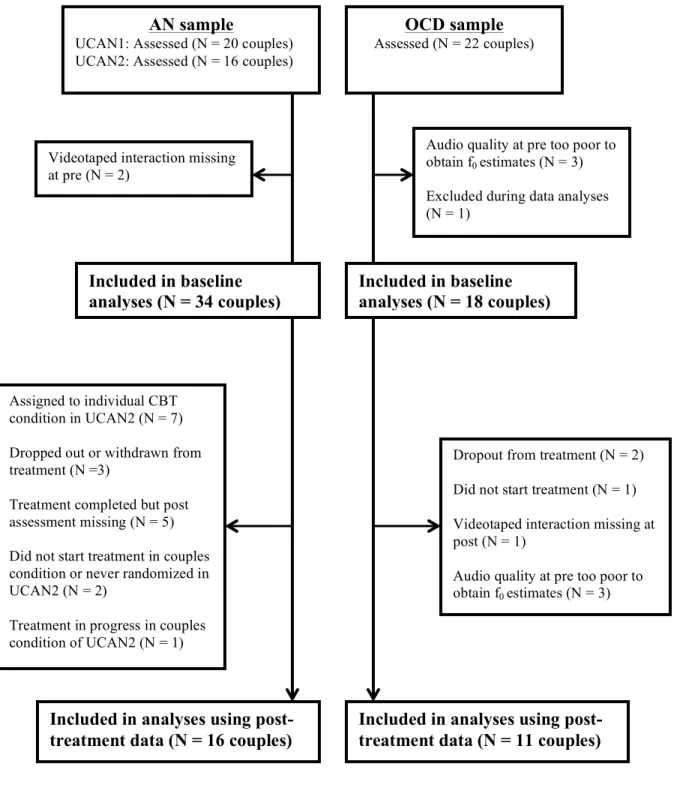
Baucom, Kirby, & Kelly, 2009). Demographic information and other sample characteristics are provided in Table 1. For a number of reasons, not all couples could be included for all analyses for the purpose of the current study; Figure 1 shows the sample composition and any exclusions for each time point.
In the OCD study, all couples received a couple-based intervention. Eligibility criteria were assessed in a screening phone call and in-person baseline assessment including the Mini International Neuropsychiatric Interview to confirm the diagnosis (Sheehan et al., 1998). Participants had to be between 18-75 years old, fluent in English, married or living together in a committed relationship for at least one year, willing to participate in all sessions
Videotaped interaction missing at pre (N = 2)
Audio quality at pre too poor to
obtain f0 estimates (N = 3)
Excluded during data analyses (N = 1)
Figure 1. Flow chart of couples included in analyses for each time point for the OCD and AN samples. One additional couple (UCAN) excluded from time-series analyses at baseline.
Included in baseline analyses (N = 34 couples)
AN sample
UCAN1: Assessed (N = 20 couples) UCAN2: Assessed (N = 16 couples)
Included in analyses using post-treatment data (N = 16 couples)
Assigned to individual CBT condition in UCAN2 (N = 7)
Dropped out or withdrawn from treatment (N =3)
Treatment completed but post assessment missing (N = 5)
Did not start treatment in couples condition or never randomized in UCAN2 (N = 2)
Treatment in progress in couples condition of UCAN2 (N = 1)
OCD sample
Assessed (N = 22 couples)
Included in baseline analyses (N = 18 couples)
1
Dropout from treatment (N = 2)
Did not start treatment (N = 1)
Videotaped interaction missing at post (N = 1)
Audio quality at pre too poor to
obtain f0 estimates (N = 3)
Included in analyses using post-treatment data (N = 11 couples)
Table 1
Demographic Information at Baseline. Mean (SD), Unless Otherwise Indicated
OCD sample (n = 18 at baseline)1 AN sample (n = 34 at baseline)2 Sex (patients) Sex (partners) Age (patients) Age (partners) Race/Ethnicity (patients) Race/Ethnicity (partners) 94.4% female 94.4% male 32.44 (8.10) 34.59 (9.79)
94.4% Caucasian, 5.6% Hispanic
83.3% Caucasian, 5.6% Asian American, 5.6% Other
97.1% female 94.4% male 33.97 (9.50) 36.69 (10.22)
85.3% Caucasian, 8.8% African American, 2.9% Asian American, 8.8% Hispanic
91.7% Caucasian, 2.8% African American, 2.8% Other, 2.8% Hispanic
Note:1demographic data except gender missing for 1 partner and 2 patients, percentages based on total number of participants; 2demographic data except gender missing for 1 couple, percentages based on total number of participants. In the AN sample, participants indicated Hispanic ethnicity in a separate question.
diagnosis of OCD (secondary diagnoses of other anxiety or mood disorders permitted) had to have a score of at least 16 on the Yale-Brown Obsessive Compulsive Scale (Goodman, Price, Rasmussen, Mazure, Delgado, et al., 1989; Goodman, Price, Rasmussen, Mazure,
Couples in which one partner suffered from AN participated either in the pilot study of UCAN (Bulik, Baucom, & Kirby, 2012; Bulik et al., 2011; referred to as UCAN1 in the following), or the subsequent, ongoing randomized controlled trial (referred to as UCAN2 in the following). In UCAN1, all couples received a couple-based intervention. In UCAN2, couples were randomized to two conditions of either (a) individual CBT or (b) individual CBT plus the couple-based intervention. Data of couples in the individual condition were used for analyses on baseline data only and excluded from any analyses including post
treatment data. Given the equivalence of the eligibility criteria, couple-based intervention and assessment procedures, couples from UCAN1 and 2 are referred to as one sample in the following descriptions; differences in procedures between the subgroups are noted.
bipolar I disorder. Additional exclusion criteria were moderate to high levels of physical violence between partners, an unwillingness to forgo non-protocol treatment for AN for the duration of the study, previous participation in the pilot study, and current AN diagnosis of the partner (i.e., couples in which both partners meet criteria for AN). In both studies, participants were accepted on stable doses of psychotropic medication. Medications were adjusted if needed by the study physician. Given the fairly common need for a higher level of care in the treatment of AN, participants were allowed to continue in the studies following a maximum of two periods of higher level of care.
Measures
the f0 estimates (see below); however, given the very large amount of the data and the technical nature of measurement, it is not possible to further ascertain the source of outliers. Therefore, f0 mean was used instead of range. F0 mean is another measure of vocally encoded emotional arousal with strong empirical support that is commonly used in psychological and couples research, is typically highly correlated with f0 range, and is less sensitive to a small number of extreme or biased estimates of f0 (B. R. Baucom, 2010; B. R. Baucom et al., 2011; Juslin & Scherer, 2005; Zeskind & Marshall, 1988). Greater f0 mean indicates greater emotional arousal.
Three undergraduate and recent college graduate research assistants were trained in the procedures to prepare the videotaped couple interactions for the extraction of f0 estimates. The extraction of f0 requires separate audio files for each partner, as the origin of the voice signals cannot be automatically distinguished. The available recordings included only one audio track per couple. Therefore, the recordings were manually segmented into separate tracks for patient and partner by the research assistants. The audio editing software Audacity 2.0.5 (http://audacity.sourceforge.net) was used to convert video recordings into audio files and to segment tracks for patient and partner. In addition, any background noises and
vocalizations that are not speech (e.g., laughter, crying), or overlaps in speech would result in distorted f0 estimates and were silenced from the tracks of both speakers. The original length of conversations for each sample was used (7 minutes in the OCD sample and 10 minutes in the AN sample). Because the couples were aware of the time they had available for the discussion, it was deemed important to preserve the natural flow of the conversation (e.g., couples may try to bring the conversation to a close and down-regulate emotional arousal towards the end).
2013). A band pass filter of 75 to 300 Hz was applied to restrict extraction to the frequency range of natural speech of adults, as recommended by Owren and Bachorowski (2007). Plots of f0 mean values across the conversation for each couple were visually inspected for
potential problems with the data (e.g., outliers for each person, unusually high/low values for males/females, extremely high number of talk turns, potential overlaps in speech). Concerns were clarified by referring back to the original recordings and revising segmenting or silencing of any background noises that were missed. Given the number of files with
problematic static background noise or relatively poor audio quality, Dr. Panayiotis Georgiou and Sandeep Chakravarthula who are experts in speech signal processing at the University of Southern California assisted with the extraction of final f0 estimates using robust pitch
extraction algorithms in Kaldi (http://kaldi.sourceforge.net/) with a band pass filter of 75 to 300 Hz applied to the previously segmented, cleaned, and de-identified audio files.
Once final estimates of f0 at each 250ms were obtained, mean f0 was calculated for each talk turn for use in all time series analyses, and as an aggregate measure of emotional arousal averaged across all talk turns (weighed by length of talk turn) for each conversation and person.
OCD symptom severity. The Yale-Brown Obsessive Compulsive Scale (Y-BOCS; Goodman, Price, Rasmussen, Mazure, Delgado, et al., 1989; Goodman, Price, Rasmussen, Mazure, Fleischmann, et al., 1989) is a semi-structured interview that was used to assess global OCD symptom severity and is considered the gold standard measure of OCD symptoms. The Y-BOCS was administered by trained interviewers at baseline and post treatment. The interview consists of two parts; first, a symptom checklist is used to identify the main obsessions and compulsions. Second, the total severity score is based on the
interviewer separately for the main obsessions and compulsions. The total severity score has a range of 0 – 40. There are no established cutoff scores to indicate clinical levels of OCD symptom severity. For general reference, Steketee, Frost, and Bogart (1996) report a mean total score of 7.2 (SD = 4.5) for a non-clinical sample.
AN symptom severity. The Eating Disorders Examination (EDE; Fairburn, Cooper, & O'Connor, 2008) is a standardized interview that was used to assess eating disorder
symptoms and confirm the diagnosis of AN. The EDE was administered by trained clinicians at baseline and post treatment. Along with several diagnostic items, questions included in scaled scores cover a wide array of eating disorder symptomology related to the four main areas of dietary restraint (e.g., restricting intake, avoiding certain food groups), concerns and behaviors related to eating (e.g., preoccupation with food or calories, fear of losing control over eating), concerns and behaviors related to body shape (e.g., feeling fat, overvalued importance of shape), and concerns and behaviors related to weight (e.g., preoccupation with weight, desire to lose weight). Only the global score of the EDE was used in the current study, which reflects symptom severity in the four areas described above and is considered the gold standard for assessing eating disorder pathology in treatment outcome studies, along with body mass index (BMI). The possible range of the EDE global score is 0-6. There are no established cutoff scores to indicate clinical levels of eating disorder pathology, and individuals without an eating disorder are not expected to score 0. In a community-based sample of young women, a mean global EDE score of .93 (SD = .81) was found (Fairburn & Bèglin, 1994; Fairburn et al., 2008).
While greater overall symptom severity should lead to both higher EDE global scores and lower BMI, BMI primarily captures weight status and consequences of starvation at very low weight. Given the inclusion criteria, no patients had extremely low BMIs that would warrant hospitalization, and some entered the study following discharge from higher levels of care. This can, in some cases, lead to a less severe BMI but patients may still experience very high levels of symptoms captured by the EDE. Thus, the EDE global score was deemed more appropriate for the purpose of the current study. However, BMI was included for exploratory purposes as well. BMI is a measure of weight status that takes both weight and height into account; it is calculated as [weight (kg)]/[height (m)]2. Weight was assessed at each time
point using a digital scale that is regularly calibrated. Height was assessed using a fixed stadiometer at baseline.
Procedure
and a problem-solving conversation. The research assistant remained in the room to help the couple select a topic but left the room for the duration of the couples’ conversation (7 minutes). The first interaction was selected for the purpose of this study because the
interaction task most closely resembles the one used in the UCAN studies (sharing thoughts and feelings on a topic the couple chooses together).
The treatment was a manualized, 16-session (90 to 120 minutes each) treatment conducted over the course of 12 weeks. The intervention included psychoeducation about OCD and ERP, communication training (emotional expressiveness and decision-making), partner-assisted exposure exercises, and interventions to reduce symptom accommodation and OCD-unrelated relationship stressors. All sessions were recorded and regularly supervised. A more detailed description of the treatment is provided in Abramowitz,
Baucom, Wheaton, et al. (2013). All study procedures for the OCD study were approved by the University of North Carolina at Chapel Hill Institutional Review Board.
that was an issue in their relationship (medium intensity) and to share their thoughts and feeling about the topic. Remaining procedures for the videotaped interactions were as described above for the OCD study.
In UCAN1, all patients received 20 weekly sessions of the couple-based intervention along with treatment as usual (TAU) delivered by clinicians of the research team or within the UNC Eating Disorders Outpatient Program. TAU typically involved weekly individual CBT sessions, biweekly psychiatry visits for medication management, and nutritional counseling sessions (beginning with weekly sessions and tapered over the course of
treatment). In UCAN2, patients were randomly assigned to either receive 22 weekly sessions of the couple-based intervention plus 22 weekly sessions of individual CBT, or to receive 44 sessions of twice-weekly individual CBT. In both conditions, patients also received
nutritional counseling sessions and psychiatry visits for medication management.
All sessions were audio- and video-recorded and regularly supervised. The couple-based intervention included psychoeducation about AN, communication training (emotional expressiveness and decision-making), working with the couple to address specific AN symptoms and challenges as a team, addressing challenges in areas of relationship