INFLAMMATION OF INNATE IMMUNE RESPONSES IN THE FEMALE GENITAL TRACT: ASSOCIATION WITH USE OF INJECTABLE PROGESTIN-ONLY CONTRACEPTION,
REPRODUCTIVE TRACT INFECTIONS AND RISK OF HIV ACQUISITION
Jennifer Caraway Deese
A dissertation submitted to the faculty of the University of North Carolina at Chapel Hill in partial fulfillment of the requirements for the degree of Doctor of Philosophy in the Department of
Epidemiology in the Gillings School of Global Public Health.
Chapel Hill 2015
©2015
ABSTRACT
Jennifer Caraway Deese: Inflammation of Innate Immune Responses in the Female Genital Tract: Association with Sse of Injectable Progestin-Only Contraception, Reproductive Tract
Infections and Risk of HIV Acquisition (Under the direction of William Miller)
The successes and failures of many HIV prevention trials, including those of microbicides, antiretrovirals and vaccines, have led to a renewed interest in the biological mechanisms at the site of HIV infection. In women, the anatomical site of exposure and first infection is most often the vaginal and cervical mucosa.[1] Well accepted biological risk factors for HIV infection in women include mucosal disruption; immune factors, including the availability of CD4+/CCR5+ cells types; sexually transmitted infections (STI) and disturbances in the vaginal biome (e.g., bacterial vaginosis (BV)).[2] More recently, the profile of innate immune biomarkers – including cytokines, chemokines and antibacterial proteins – and associated levels of cellular activation have become a focus of interest as a potential mechanism of increased HIV risk.
TABLE OF CONTENTS
LIST OF TABLES ... viii
LIST OF FIGURES ... ix
LIST OF ABBREVIATIONS ... x
CHAPTER 1: SPECIFIC AIMS ... 1
AIM 1: Cross sectional analysis of the association between selected immune biomarkers, injectable progestin-only contraception and RTIs ... 2
AIM 2: Case-cohort analysis of innate immune inflammation as a risk factor for HIV acquisition ... 4
CHAPTER 2: BACKGROUND AND SIGNIFICANCE ... 5
Sexual HIV transmission in women and innate immunity ... 6
Injectable progestin-only contraception, HIV and innate immune markers ... 7
Reproductive tract infections, HIV and innate immune markers ... 8
Innate immune markers and HIV acquisition – preclinical evidence ... 9
Innate immune markers and HIV acquisition – clinical evidence ... 10
Summary ... 11
CHAPTER 3: RESEARCH DESIGN AND METHODS ... 15
Aim 1: Cross sectional analysis of selected innate immune biomarkers and their association with progestin-only contraceptive use and reproductive tract infections among high risk population ... 15
Aim 2: Case-cohort analysis of selected immune biomarkers as risk factors for HIV infection ... 18
Laboratory Methods ... 21
Overview ... 25
Introduction ... 26
Methods ... 27
Results ... 29
Discussion ... 32
CHAPTER 5: INNATE IMMUNITY MARKERS ASSOCIATED WITH HIV ACQUISITION AMONG WOMEN AT HIGH RISK ... 41
Overview ... 41
Introduction ... 43
Methods ... 43
Results ... 48
Discussion ... 49
CHAPTER 6: DISCUSSION ... 59
Aim 1: Cross sectional analysis of the association between selected immune biomarkers, injectable progestin-only contraception and RTIs ... 59
Aim 2: Case-cohort analysis of innate immune inflammation as a risk factor for HIV acquisition ... 61
APPENDIX 1: STANDARD OPERATING PROCEDURE: HUMAN CYTOKINE MAGNETIC BEAD PLATE ASSAY ... 65
LIST OF TABLES
Table 2.1 Names and functions of selected cytokines ... 12
Table 3.1 Determination of minimally sufficient adjustment set, Aim 2 ... 24
Table 4.1 Study population characteristics ... 35
Table 4.2 Genital protein concentrations (median (IQR), pg/mL) by subgroups ... 36
Table 5.1 Characteristics of cases and non-cases ... 53
Table 5.2 Risk of HIV acquisition by baseline genital immune marker concentrations (continuous) ... 57
LIST OF FIGURES
Figure 2.1 Biological mechanisms that may contribute to an increased risk of HIV acquisition and transmission among women using hormonal
contraceptives such as DMPA ... 13
Figure 2.2 Inflammation, innate immunity, mucosal epithelial signaling and target cell availability at mucosal front lines ... 14
Figure 3.1 Directed Acyclic Graph, Aim 2 ... 23
Figure 4.1 Flow diagram of participant selection ... 34
Figure 4.2 Inflammatory marker concentrations in reference group and IPC users... 37
Figure 4.3 Total inflammatory markers concentrations by ‘risk group’ ... 38
Figure 4.4 Total inflammatory markers concentrations by ‘risk group’, removing IL-8 ... 39
Figure 4.5 Total SLPI concentrations by ‘risk group’ ... 40
Figure 5.1 Flow diagram of participant selection ... 52
Figure 5.2 Influence of variable (continuous) coding on hazard ratios ... 55
LIST OF ABBREVIATIONS
BV bacterial vaginosis
DMPA depot medroxyprogesterone acetate FTC/TDF emtricitabine/tenofovir disoproxil fumarate
GM-CSF granulocyte-macrophage colony-stimulating factor HIV human immunodeficiency virus
IVF intermediate vaginal flora IL interleukin
IP Interferon gamma-induced protein
IPC injectable progestin-only contraception MIP macrophage inflammatory protein
NET-EN norethisterone oenanthate PSA prostate specific antigen
RANTES regulated and normal T cell expressed and secreted RTI reproductive tract infection
SLPI secretory leukocyte peptidase inhibitor STI sexually transmitted infection
TFV tenofovir
CHAPTER 1: SPECIFIC AIMS
The successes and failures of many HIV prevention trials, including those of microbicides, antiretrovirals and vaccines, have led to a renewed interest in the biological mechanisms at the site of HIV infection. In women, the anatomical site of exposure and first infection is most often the vaginal and cervical mucosa.[1] Well accepted biological risk factors for HIV infection in women include mucosal disruption, which may occur via physical or
chemical disturbance; immune factors, including the availability of CD4+/CCR5+ cells types; sexually transmitted infections (STI) and disturbances in the vaginal biome such as with bacterial vaginosis (BV).[2] More recently, the profile of innate immune biomarkers – including cytokines, chemokines and antibacterial proteins – and associated levels of cellular activation have become a focus of interest as a potential mechanism of increased HIV risk.
The results of many studies of the relationship between innate immune biomarkers and HIV risk are quite varied, and additional research is needed. There are a plethora of potential reasons for the variable results including, but not limited to, 1) specimen variability (differences in collection timing, preparation and storage), 2) use of different assays, 3) methodological differences including varying exposure and outcome definitions and differential control of confounders, 4) statistical consequences – the increased probability of finding significant, yet spurious, associations in the case of measurement of multiple outcomes and multiple
hypothesis testing and 5) a large number of innate immune biomarkers that are costly to measure resulting in differential selection of endpoints by different study teams.
randomized, double-blind, placebo-controlled effectiveness and safety trial to assess the role of emtricitabine/tenofovir disoproxil fumarate (FTC/TDF, i.e., Truvada) in preventing HIV
acquisition in women. FEM-PrEP was conducted in Bondo, Kenya; Pretoria and Bloemfontein, South Africa; and Arusha, Tanzania. The trial enrolled HIV-negative women between the ages of 18-35 who met medical and behavioral eligibility criteria including being at high risk of HIV. Using stored specimens from the trial we estimated innate immune biomarker concentrations among Kenyan and South African women at high risk of HIV infection in the absence of known risk factors for HIV, and explored the association of those risk factors on biomarker
concentrations, and analyzed elevated innate immune biomarker concentrations as a risk factor for HIV infection in a longitudinal analysis.
The innate immune markers selected for this analysis were informed by prior research which demonstrated variability in concentrations of these markers to be associated with injectable progestin-only contraceptive (IPC) use and with risk of HIV infection.[4, 5] This research was designed to further elucidate whether there are significant differences in genital tract innate immune profiles among women with different risk factors for HIV infection (i.e., IPC use and reproductive tract infections (RTI)) and to determine if higher concentrations of innate immune biomarkers are associated with increased risk of HIV infection. The results of this research will provide insight into potential mechanisms of increased risk of HIV infection among women using IPC and may be useful in informing safety evaluations of existing and future HIV prevention products and other medical technologies.
AIM 1: Cross sectional analysis of the association between selected immune biomarkers, injectable progestin-only contraception and RTIs
Hypotheses:
Primary exposure:
cytokines and lower median secretory leukocyte peptidase inhibitor (SLPI) concentration as compared to the reference population.
Secondary exposures:
1. Norethisterone oenanthate (NET-EN) use ≥3 months: We did not anticipate any differences in exposure and outcome variables among users of NET-EN as compared to the reference population.
2. Gonorrhea: We hypothesized that women with Neisseria gonorrhoeae (NG) infection would
have higher median concentrations of all measured cytokines and lower median SLPI concentration as compared to the reference population.
3. Chlamydia: We hypothesized that women with Chlamydia trachomatis (CT) infection would have higher median concentrations of all measured cytokines and lower median SLPI concentration as compared to the reference population.
4. Trichomoniasis and BV: We hypothesized that women with Trichomonas vaginalis (TV) infection and BV would have higher median concentrations of all measured cytokines and lower median SLPI concentration as compared to the reference population.
5. Intermediate vaginal flora (Nugent score 4-6): We hypothesized that women with
intermediate vaginal flora (IVF) would have higher median concentrations of all measured cytokines and lower median SLPI concentration as compared to the reference population. 6. BV (Nugent score 7-10): We hypothesized that women with BV would have higher median
concentrations of all measured cytokines and lower median SLPI concentration as compared to the reference population.
Overview: Selected innate immune biomarker concentrations (cytokines: macrophage
Kenyan and South African women. We analyzed the association between the selected
biomarkers and IPC use (including both DMPA and NET-EN) and RTIs (including NG, CT, TV, IVF and BV). We also evaluated differences in markers by age and study site.
AIM 2: Case-cohort analysis of innate immune inflammation as a risk factor for HIV acquisition
Hypothesis: We hypothesized that overall innate immune inflammation would be positively
associated with the risk of HIV infection.
CHAPTER 2: BACKGROUND AND SIGNIFICANCE
Globally, women continue to experience a disproportionate burden of HIV compared to men.[6] In sub-Saharan Africa, the epicenter of the AIDS epidemic, women account for 58% of total HIV infections, and among women, young women (aged15-24) experience the highest rates of HIV infection. While dramatic gains have been made over the last decade in reducing HIV incidence in many countries, including among women, through increased delivery of prevention programs, antiretrovirals to HIV infected individuals which reduces transmission, implementation of adult male circumcision programs and other interventions, the total number of new HIV infections remains unacceptably high.
The underlying cause of higher HIV incidence rates among women as compared to men are a result of a complex set of social, behavioral and biological determinants that vary by region, and within regions, by populations defined by those determinants. These determinants range from socioeconomic and gender inequalities to biological differences in men and women that render women more susceptible to infection. Understanding the determinants of disease – at all levels – is necessary for designing optimal public health interventions.
In recent years, a number of large clinical trials have been done to evaluate the
effectiveness of numerous novel biomedical interventions – including, but not limited to, topical microbicides with various mechanisms of action, vaccines, treatment as prevention (TasP) and oral pre-exposure prophylaxis (PrEP) – for the prevention of HIV acquisition. While some of these trials were successful in identifying new approaches to reducing rates of HIV
genital compartment is one of the potential modifiers of intervention effectiveness identified in prior trials.[5, 14]
Sexual HIV transmission in women and innate immunity
The majority of sexual HIV transmissions in women are believed to occur in the lower reproductive tract which includes the ectocervix and vagina.[1, 15] Well accepted
vaginal/cervical biological risk factors for HIV infection include mucosal disruption, which may occur via physical or chemical disturbance; immune factors, including the availability of target cell types; genital co-infections (which likely increase risk through the aforementioned and additional mechanisms); and disturbances in the vaginal biome such as with BV.[2]
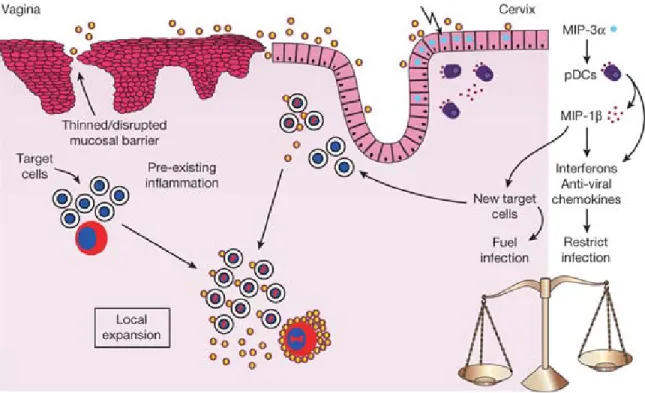
Successful establishment of HIV infection requires transmission across the multi-layered squamous epithelium of the vaginal mucosa, infection of innate immune cells, which likely first include Langerhans’ cells (LC) and macrophages, which stimulates an influx of CD4+ T cells, the primary cell target of HIV. These target cells are recruited to the focal area of infection by secretion of cytokines – chemical messengers that function at mucosal surfaces to regulate differentiation, maturation and recruitment of lymphocytes - by infected innate immune cells[16] It is hypothesized that rapid recruitment of target cells to the site of exposure, accompanied by a slower response by more effective immune mechanisms (e.g., natural killer cell, humoral
immune responses) may facilitate, rather than inhibit, HIV infection in a process that has been described as “too little too late”.[1]
Injectable progestin-only contraception, HIV and innate immune markers
The impact of IPC on HIV acquisition risk remains unclear.[20, 21] DMPA has long been associated with an increased risk of HIV infection in observational epidemiological studies and most recently, in two meta-analyses, one which pooled individual participant data from >37,000 women.[22-26] However, other studies, some of which were included in the aforementioned analysis, have found no such significant association.[21, 27-31] While the recent meta-analyses provide robust evidence, the inability to definitively untangle contraceptive use from associated risk behaviors (e.g., condom use) using observational methods has left open the possibility of unmeasured confounding. As such, a large randomized controlled trial on the topic is currently in planning.[32] The association of NET-EN use and HIV risk is also unclear, but has received much less attention.[23, 29, 31, 33, 34] The potential increased risk of HIV infection among DMPA users has been attributed to multiple potential causes including behavioral differences in DMPA vs. non-DMPA users, vaginal thinning, modification of RTI risk and both mucosal innate immune inflammation and suppression which are illustrated in Figure 2.1.[26, 35]
The majority of studies on the immunomodulatory effects of DMPA have been conducted in vitro using both human and mouse cell lines, and in vivo in macaques, with a predominant focus on IFN-γ production, establishment of HIV infection, post-infection viral load, viral diversity and antibody production. These studies are by necessity among small numbers of subjects with limited statistical power.[36-41] The relevance of in vitro and macaque studies to in vivo human responses is difficult to assess. Moreover, most studies that have been done in humans have evaluated immune responses in circulating plasmacytoid dendritic cells (pDC) and activated T cells in peripheral blood mononuclear cells and several studies have shown divergent innate immune responses in the systemic vs. female genital compartments.[36, 42]
polypeptides with reported antiviral activity found that DMPA users has significantly higher mean levels of human neutrophil peptides (HNP) 1-3 and human cathelicidin-related antimicrobial peptide 18 (LL-37) and lactoferrin as compared to non-users of HC.[43] The authors suggest that the seemingly contradictory finding of increased levels of proteins with antiviral activity among DMPA users could be explained by the unknown cumulative effects of these markers, and their complex interactions with other unmeasured markers. Another large study among 832 women in Zimbabwe and Uganda found that DMPA users had significantly higher RANTES and lower beta-defensin 2 (BD-2) as compared to non-HC users.[4] Research to better understand the biological associations of the innate immune system and HIV at the site of exposure and infection are needed to clarify the observed association of higher rates of HIV acquisition among DMPA users. If DMPA users are definitively found to have a higher increased biological risk of HIV infection, data from such biological studies could be used in future safety evaluations HIV prevention technologies and new and existing contraceptive methods.[35]
Reproductive tract infections, HIV and innate immune markers
Innate immune markers and HIV acquisition – preclinical evidence
Published reviews of early biological events during HIV infection and studies in macaques provide perhaps the clearest picture on the relationship between innate immune activation of cytokines and HIV. Macaque models provide the advantage of known exposure dose and time and the ability to take strategically timed pre- and post-infection specimens. Though the model has many advantages over human studies, it is important to acknowledge that it does not perfectly represent human infection – significantly higher virus doses have often been used as compared to levels women are exposed to during vaginal sex, cell-free virus is used for inoculation in macaques whereas cell-free and cell-associated virus exposure occurs in humans, macaques are often treated with DMPA to thin the vaginal epithelium (which, as
described above, may also cause other unknown physiologic and immunologic changes) and the natural vaginal biome differs between macaques and humans.[1]
adaptive immune response that is too late, insufficient to prevent spread to distant mucosal and lymphoid tissues.[44]
By extension of the aforementioned biology, numerous conditions which cause an increase in the inflammatory status of the genital tract could therefore theoretically increase susceptibility to HIV infection including, but not limited to, STIs, altered vaginal flora, sexual behavior and contraceptive use.
Innate immune markers and HIV acquisition – clinical evidence
Data from CAPRISA 004, a randomized controlled trial conducted in Durban, South Africa to evaluate the effectiveness of tenofovir vaginal gel for HIV prevention, when used before and after sex, suggest that genital tract elevation of MIP-1α and MIP-1β are associated with increased risk of HIV infection (after adjustment for age and tenofovir gel use).[5] Among women who became HIV infected during the trial, there was a statistically significant correlation in pre- and post-HIV infection cytokine elevation after adjusting for multiple comparisons (IL-1α, IL-1β, IL-6, TNF-α, MIP-1β, MCP-1 and IL-7). In a crude analysis not adjusted for tenofovir gel use, the incidence rate ratio (IRR) for women with and without increased cytokine levels was 2.1 (95% CI 0.9-5.3). In addition, the data suggest that elevated cytokines may modify the
effectiveness of tenofovir gel (IR 0.0 vs. 18.8). These sub-analyses however were limited by small sample sizes, notably with cell sizes of zero in some cases.
of confounder selection and possible unmeasured confounding (e.g., no data on STIs were included in the final model). Although the results are interesting, the design limitations of this study are substantial and additional research is necessary to confirm the results.
A well designed, large secondary analysis of women in Zimbabwe and Uganda who participated in a trial designed to compare the effect of DMPA, combined oral contraceptives (COC) and non-hormonal contraceptives on HIV acquisition provide additional insight into inflammation and HIV risk.[4] 199 women who became HIV infected during the study were matched to 633 uninfected women on the visit immediately preceding seroconversion
(scheduled visits occurred every three months), study site, age and STI status (positive defined as having CT, NG and/or BV). Overall, a statistically significant increase in RANTES and decrease in SLPI were associated with HIV seroconversion at the next visit. Notably, this is the previously described study which also found an increase in RANTES and lower BD-2 among DMPA users.
Summary
In summary, a better understanding of the innate immune factors that are associated with known and potential risk factors for HIV infection, such as DMPA use and RTIs, as well as innate immune inflammation that may exist in the absence of such risk factors, will improve our understanding of the determinants of HIV infection at the site of exposure. A complete
Table 2.1 Names and functions of selected cytokines [1, 46, 47]
Cytokine Function
Inflammatory
IL-1α
A member of the interleukin 1 cytokine family. Involved in various immune responses, inflammatory responses and hematopoiesis. Produced by monocytes and macrophages in response to cell injury and induced apoptosis.
IL-1β
A member of the interleukin 1 cytokine family. Mediator of the inflammatory response, involved in numerous cellular activities including cellular
proliferation, differentiation and apoptosis.
IL-6 Functions in inflammation and the maturation of B cells, recruits neutrophils, dendritic cells, macrophages and lymphocytes.
Chemokines
IP-10
A member of the CXC subfamily and ligand for the receptor CXCR3. Binding of this protein to CXCR3 results in pleiotropic effects, including stimulation of monocytes, natural killer and T-cell migration, and modulation of adhesion molecule expression.
MIP-1α/CCL3
Important in the early inflammatory response for activation and recruitment of multiple innate and adaptive effector cells to the site of virus entry. Plays a role in inflammatory responses through binding to the receptors CCR1, CCR4 and CCR5. Polymorphisms at this locus are associated with
susceptibility and resistance to HIV-1 infection. Expressed by plasmacytoid dendritic cells.
MIP-1β/CCL4 Expressed by plasmacytoid dendritic cells, recruits CCR5+ CD4 T cells and blocks the CCR5 co-receptor on CD4+ T cells.
IL-8
Secreted by multiple cell types and a major mediator of the inflammatory response through recruitment of neutrophils, dendritic cells, macrophages and lymphocytes.
RANTES
Displays chemotactic activity for blood monocytes, memory T helper cells and eosinophils, is one of the major HIV-suppressive factors produced by CD8+ cells as a natural ligand for the chemokine receptor CCR5 which thereby suppresses in vitro replication of the R5 strains of HIV-1.
Hematopoietic
GM-CSF
Figure 2.1 Biological mechanisms that may contribute to an increased risk of HIV acquisition and transmission among women using hormonal contraceptives such as DMPA
Figure and text taken directly from Murphy 2014
(1) Thinning of the epithelial barrier
(2) Disruption of intracellular junctional complexes
(3) Upregulation of Trojan horse receptors that capture HIV particles
(4) Increased secretion of inflammatory mediators that recruit or activate immune target cells and/or facilitate HIV replication
(5) Decreased secretion of antimicrobial peptides (e.g., SLPI, defensins) that contribute to soluble host defense
(6) Increases CCR5 expression on CD4+ cells rendering the cells more susceptible to HIV (7) Increased BV-associated bacteria
(8) Decreased hydrogen peroxide producing lactobacilli
Figure 2.2 Inflammation, innate immunity, mucosal epithelial signaling and target cell availability at mucosal front lines
CHAPTER 3: RESEARCH DESIGN AND METHODS
Aim 1: Cross sectional analysis of selected innate immune biomarkers and their association with progestin-only contraceptive use and reproductive tract infections among high risk population
Study Design
A cross-sectional design was used to estimate innate immune biomarker concentrations (cytokines: MIP-1α, MIP-1β, IL-6, IL-8, IP-10, IL-1α, IL-1β and RANTES and antibacterial protein: SLPI) among a selection of women categorized into single risk-factor exposure groups. The large size of the population screened for the FEM-PrEP trial provided a unique opportunity to evaluate associations between selected exposures and outcomes in subpopulations of participants without other potential confounding factors. Because genital samples were only uniformly collected at screening, only a cross-sectional analysis was possible for this aim. While this information does not provide evidence on the causal nature of the relationship
between these exposures and the selected innate immune markers, they provide additional data for hypothesis generation in this data-limited area of HIV prevention.
Study Population
Women who were screened for the FEM-PrEP clinical trial in the Bondo, Kenya and Pretoria, South Africa sites and met the following criteria were eligible for sampling:
Not menstruating (genital specimens not collected from menstruating women) Had valid screening HIV test results
Was using DMPA, NET-EN, a non-hormonal contraceptive method or no contraceptive method at screening
o If using DMPA or NET-EN at screening, she must have been using the method for ≥3 months
A total of 508 women were selected for this analysis, among whom 376 had stored specimens available for analysis. Women without and with characteristics suggested by previous research to be covariates of innate immune biomarker concentrations and HIV risk were selected (i.e., women using DMPA or NET-EN, and women with a STI or BV). This approach allowed for direct comparison of the Kenya and South Africa immune profiles in the absence of potentially important confounding factors and provided a reference population to which ‘risk-factor’ populations could be compared to analyze the association between innate immune elevation and various risk factors for HIV.
Exposure Assessment
A reference population of 99 women who reported not currently using HC and who were NG/CT/TV negative and had normal vaginal flora by Nugent score (hereafter referred to as RTI negative) was identified for comparison to seven ‘risk-groups’.
Seven ‘risk-groups’ were defined as follows:
1) DMPA (n=75) - women who self-reported having used DMPA within the past three months and who were RTI negative
2) NET-EN (n=37) - women who self-reported having used NET-EN within the past three months and who were RTI negative
3) NG (n=15) – women who were positive for Neisseria gonorrhoeae by laboratory testing, self-reported no use of HC and were otherwise RTI negative
5) TV + BV (n=27) - women who were positive for Trichomonas vaginalis by laboratory testing and had bacterial vaginosis by Nugent score, self-reported no use of HC and were
otherwise RTI negative
6) IVF (n=28) – women who had IVF by Nugent score, self-reported no use of HC and were otherwise RTI negative
7) BV (n=73) - women who had BV by Nugent score, self-reported no use of HC and were otherwise RTI negative
Notes:
There were an insufficient number of participants with Trichmoniasis and no other covariates
(n=3) for analysis of TV as a single exposure. The majority of participants with
Trichomoniasis infection at baseline had comorbid BV, therefore, only a combined category
of Trichomoniasis + BV could be analyzed.
Syphilis testing was done at baseline in the trial; however, low prevalence precluded
analysis of syphilis as a single exposure group.
Age was self-reported by participants at baseline. Participants were required to use an effective contraceptive method (defined as oral contraceptive pills (OC), injectables [DMPA or NET-EN], implant, intrauterine device (IUD) or have been previously sterilized) to meet trial eligibility criteria; the most frequently used contraceptive methods (i.e., OCs, injectables) were provided at the study sites. Contraceptive use was documented at baseline and during follow-up visits; injection dates were recorded for injectable methods. RTIs, including NG, CT, TV, BV and syphilis and were diagnosed by laboratory testing and treated at baseline. All data were
recorded on standard trial case report forms.
Outcome Assessment
Confounder Assessment
Prostate-specific antigen (PSA) testing was done to control for recent unprotected semen exposure. PSA testing was conducted using the Seratec © PSA semiquant assay (Seratec Diagnostica, Göttingen, Germany). Sex without a condom in the past seven days was self-reported by participants. Candida was detected using wet mount and microscopy.
Statistical Analysis
Reliability and reproducibility of cytokine and SLPI readings were assessed using
Spearman’s rank correlation. Cytokine and SLPI concentrations were calculated as the mean of duplicate samples from the same plate. For cases in which one observation was detectable and the second observation was below the limit of detection, the observed concentration was used. For cases in which both observations were below the lower limit of detection, the lower limit of detection was imputed. The associations between PSA detection and exposure and outcome variables were assessed using Fisher’s exact and Wilcoxon-Mann-Whitney tests. Exposure-outcome bivariate associations were assessed using Wilcoxon-Mann-Whitney tests and general linear models, controlling for PSA detection (as a marker of recent semen exposure), self-reported sex without a condom in the past seven days and the presence of candida. All analyses were done using SAS® software version 9.3 (SAS Institute, Cary, NC).[48]
Aim 2: Case-cohort analysis of selected immune biomarkers as risk factors for HIV infection
Study Design
pre-existing case-cohort sample. All cases and a 15% sub-cohort of the entire study population were previously selected to analyze the association between HIV infection and Truvada
(tenofovir and emtricitabine) plasma and intracellular drug levels. Use of this existing case-cohort sample provided the opportunity to control for time-varying Truvada exposure. In
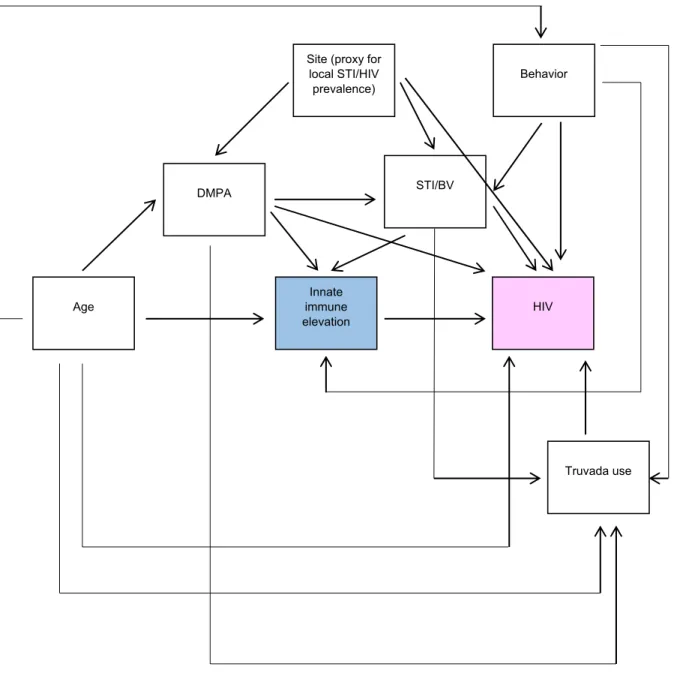
addition, a comprehensive review of the literature suggested the following variables as potential confounders of the effect of innate immune elevation on HIV risk: age, DMPA use, RTI and site (as a proxy variable for local STI/HIV prevalence). The relationships between the exposure, outcome and covariates is presented in Figure 3.1 in the form of a Directed Acyclic Graph.
Study Population
Women who were enrolled in the FEM-PrEP clinical trial in the Bondo, Kenya and Pretoria, South Africa sites and met the following criteria were eligible for inclusion:
Did not have a positive HIV RNA or DNA PCR result on the enrollment sample Sub-cohort: A 15% random sample of the entire enrolled study cohort
Cases: all participants with incident HIV infection defined as having initial and
confirmatory HIV positive antibody results according to the trial testing algorithm between enrollment and 60 weeks of follow-up and having been confirmed as an incident HIV case according to confirmatory testing at the Institute of Tropical Medicine in Belgium
Exposure Assessment
The following immune markers were quantified in stored endocervical specimens: MIP-1α, MIP-1β, IL-6, IL-8, IL-1α, IL-1β, IP-10, RANTES, GM-CSF and SLPI.
Outcome Assessment
Time to HIV infection was defined as the time between enrollment and date of collection of the first specimen which was HIV RNA and/or DNA positive.
Statistical Analysis
Reliability and reproducibility of cytokine and SLPI readings were assessed using Spearman’s rank correlation. Cytokine concentrations were calculated as the mean of duplicate samples from the same plate, the mean of duplicate samples from separate plates if one
observation was undetectable on the plate with duplicate specimens, the observed
concentration if only 1/3 readings was detectable and the median value between zero and the lowest observed standard if all three observations were undetectable. SLPI concentrations were calculated as the mean of duplicate readings; if both observations were below the limit of
detection, the midpoint between zero and the lower limit of detection was imputed, if both observations were above the limit of detection, the upper limit of detection was imputed.
Cytokines and SLPI were analyzed in multivariate models as: 1) ten dichotomous variables (one per marker), and 2) a single dichotomous summary variable of inflammation (cytokines) and a separate dichotomous variable for SLPI (< or ≥ the median concentration). For the former,
individual marker concentrations were dichotomously coded as < or ≥ the median concentration. For the latter, an intermediate summary variable was set equal to the number of cytokines ≥ the median concentration (range 0-9) per woman. The median of the intermediate summary
variable was then defined as the cut point for the final dichotomous inflammation variable. Missing covariate data was handled as follows: 1) RTI/STI pelvic exam data were used to impute missing results based on syndromic management assessment, 2) contraceptive method was carried forward from the previous non-missing visit, 3) FTC/TDF use was carried forward from the previous non-missing visit. FTC/TDF use was coded as no/low among all women in the placebo arm.
robust variance was used to model the association between immune marker concentrations and risk of HIV infection over time.[49-51] Age and RTI/STI were fixed at baseline whereas
contraceptive method and FTC/TDF use were time-varying. Covariates were evaluated as potential effect measure modifiers with retention of covariates pre-specified for likelihood ratio tests resulting in p<0.20. Covariates that resulted in >10% change in the hazard ratio through backwards selection were retained in the final model. All analyses were done using SAS® software version 9.3 (SAS Institute, Cary, NC).[48]
Laboratory Methods
The laboratory methods described here, with the exception of TFV and TFV-DP detection which are only applicable to Aim 2, are applicable to both Aims 1 and 2.
Sterile synthetic swabs were collected and eluted in 1000-1200µL phosphate buffered saline (PBS) and the volume which remained after NG/CT testing was stored at -70⁰C during the FEM-PrEP trial (between May 2009 and November 2010). Cytokine and SLPI testing was conducted on these stored aliquots between July 2012 and April 2013. Cytokine concentrations were measured using MilliplexTM Human Cytokine kits (Millipore, MA, USA) on a Bio-PlexTM Suspension Array Reader (Bio-Rad Laboratories Inc®, CA, USA) according to a written standard operating procedure in accordance with manufacturer instructions; specimens were pre-filtered by centrifugation using 0.2µm cellulose acetate filters (Sigma-Aldrich, USA) to ensure mucus did not interfere with the assay and were tested in duplicate on the same plate. Each sample was also tested on a second plate in order to evaluate inter-assay reproducibility. SLPI concentrations were measured in duplicate using the Quantikine Human SLPI
Immunoassay kit from R&D Systems (Minneapolis, MN) by adapting the manufacturer’s
was used for testing according to the manufacturer’s instructions with specimens classified as negative, low positive or positive.
Tables and Figures
Figure 3.1 Directed Acyclic Graph, Aim 2
STI/BV
HIV Innate
immune elevation
Behavior Site (proxy for
local STI/HIV prevalence)
DMPA
Age
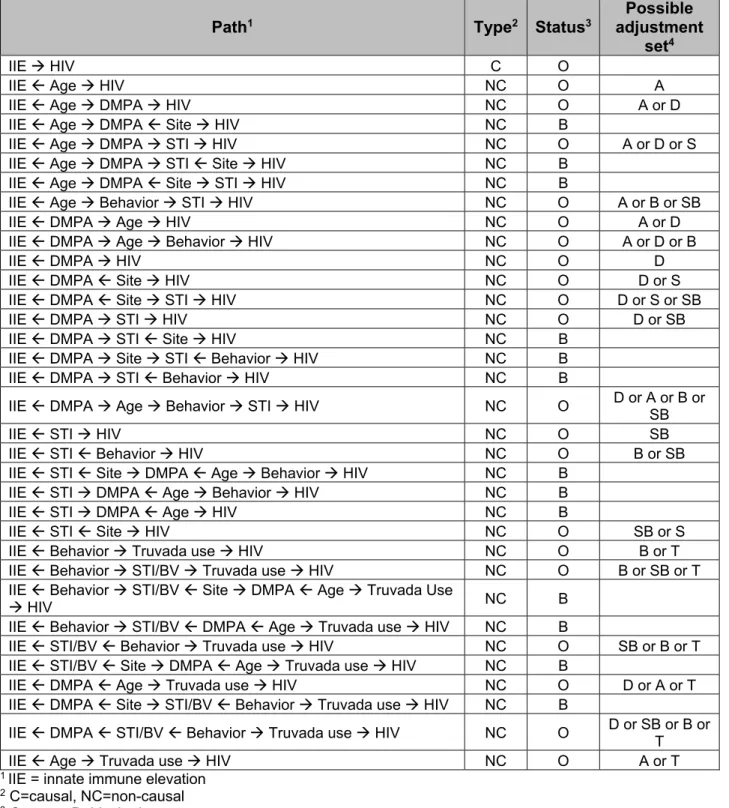
Table 3.1 Determination of minimally sufficient adjustment set, Aim 2
Path1 Type2 Status3
Possible adjustment
set4
IIE HIV C O
IIE Age HIV NC O A
IIE Age DMPA HIV NC O A or D
IIE Age DMPA Site HIV NC B
IIE Age DMPA STI HIV NC O A or D or S
IIE Age DMPA STI Site HIV NC B
IIE Age DMPA Site STI HIV NC B
IIE Age Behavior STI HIV NC O A or B or SB
IIE DMPA Age HIV NC O A or D
IIE DMPA Age Behavior HIV NC O A or D or B
IIE DMPA HIV NC O D
IIE DMPA Site HIV NC O D or S
IIE DMPA Site STI HIV NC O D or S or SB
IIE DMPA STI HIV NC O D or SB
IIE DMPA STI Site HIV NC B
IIE DMPA Site STI Behavior HIV NC B
IIE DMPA STI Behavior HIV NC B
IIE DMPA Age Behavior STI HIV NC O D or A or B or SB
IIE STI HIV NC O SB
IIE STI Behavior HIV NC O B or SB
IIE STI Site DMPA Age Behavior HIV NC B
IIE STI DMPA Age Behavior HIV NC B
IIE STI DMPA Age HIV NC B
IIE STI Site HIV NC O SB or S
IIE Behavior Truvada use HIV NC O B or T
IIE Behavior STI/BV Truvada use HIV NC O B or SB or T
IIE Behavior STI/BV Site DMPA Age Truvada Use
HIV NC B
IIE Behavior STI/BV DMPA Age Truvada use HIV NC B
IIE STI/BV Behavior Truvada use HIV NC O SB or B or T
IIE STI/BV Site DMPA Age Truvada use HIV NC B
IIE DMPA Age Truvada use HIV NC O D or A or T
IIE DMPA Site STI/BV Behavior Truvada use HIV NC B
IIE DMPA STI/BV Behavior Truvada use HIV NC O D or SB or B or T
IIE Age Truvada use HIV NC O A or T
1 IIE = innate immune elevation 2 C=causal, NC=non-causal 3 O=open, B=blocked
4 A=age, D=DMPA, S=site, B=behavior, SB=STI/BV
CHAPTER 4: INJECTABLE PROGESTIN-ONLY CONTRACEPTION IS ASSOCIATED WITH INCREASED LEVELS OF PRO-INFLAMMATORY CYTOKINES IN THE FEMALE GENITAL
TRACT
OVERVIEW
Problem
Genital inflammatory changes may be a mechanism of increased HIV risk among injectable progestin-only contraception (IPC) users.
Method of Study
We conducted a cross-sectional analysis of 376 Kenyan and South African women. Genital cytokines and secretory leukocyte peptidase inhibitor concentrations in a reference population were compared to IPC users and women with RTI.
Results
No significant variability in marker concentrations was observed by age or site. Depot
medroxyprogesterone acetate (DMPA) users had significantly higher MIP-1α, MIP-1β, IL-6, IL-8, IP-10 and RANTES concentrations. Norethisterone oenanthate (NET-EN) users had
significantly higher IL-6, IL-8 and RANTES concentrations. Women with sexually transmitted infections had variable inflammation, and women with BV exhibited a mixed phenotype of up and downregulation.
Conclusions
The finding of substantial mucosal inflammation among DMPA users provides evidence which, combined with the results of prior studies, suggests that DMPA may create an immune
INTRODUCTION
The successes and failures of many HIV prevention trials, including those of microbicides, antiretrovirals and vaccines, have led to great interest in the biology of HIV
transmission. In heterosexual women, the anatomical site of exposure and first infection is most often the vaginal and cervical mucosa.[1] Well-accepted biological cervicovaginal risk factors for HIV infection include mucosal epithelial disruption, which may occur via physical or chemical disturbance; immune factors, including the availability of CCR5+/CD4+ target T cells; sexually transmitted infections (STI); and disturbances in the vaginal microbiota, such as bacterial
vaginosis (BV).[2] Depot medroxyprogesterone acetate (DMPA), a progestin-only contraceptive injectable (IPC), has also been associated with altered inflammatory responses and increased HIV risk although epidemiological studies remain inconclusive.[22, 23]
METHODS
Design
We conducted a cross-sectional study to evaluate the association between genital mucosal inflammatory markers, IPC use and RTIs among women screened for the FEM-PrEP trial in Pretoria, South Africa and Bondo, Kenya. FEM-PrEP was a Phase III, randomized, double-blind, placebo-controlled effectiveness and safety trial to assess the role of
emtricitabine/tenofovir disoproxil fumarate (FTC/TDF, i.e., Truvada) in preventing HIV
acquisition in women conducted in Bondo, Kenya; Pretoria and Bloemfontein, South Africa; and Arusha, Tanzania.[3] The FEM-PrEP trial uniformly collected and stored endocervical swab specimens at the screening visit. Due to the large trial size, we were able to select sub-populations with single risk factors for comparisons; all ‘risk-groups’ were compared to a reference population of women who were not using HC, were STI negative and had normal vaginal flora.
Study population
otherwise RTI negative) n=22, 2e) women with both TV and BV (no current HC use and
otherwise RTI negative) n=27, 2f) women with intermediate flora (Nugent score 4-6, no current HC use and otherwise RTI negative) n=28, and 2g) women with BV (Nugent score 7-10, no current HC use and otherwise RTI negative) n=73 (Figure 4.1). Although syphilis testing was done at baseline, the low prevalence precluded analysis among women with syphilis.
Laboratory methods
The following immune markers were quantified: macrophage inflammatory protein (MIP)-1α, MIP-1β, IL-6, IL-8, IL-1α, IL-1β, IP-10, RANTES, granulocyte macrophage
colony-stimulating factor (GM-CSF) and SLPI. Prostate-specific antigen (PSA) testing was also done to control for recent semen exposure in statistical analyses.[56]
Sterile synthetic swabs were collected and eluted in 1000-1200µL phosphate buffered saline (PBS) and the volume which remained after NG/CT testing was stored at -70⁰C during the FEM-PrEP trial (between May 2009 and November 2010). Cytokine, SLPI and PSA testing were conducted on the stored aliquots between July 2012 and April 2013. Cytokine
concentrations were measured using MilliplexTM Human Cytokine kits (Millipore, MA, USA) on a Bio-PlexTM Suspension Array Reader (Bio-Rad Laboratories Inc®, CA, USA) according to a written standard operating procedure in accordance with manufacturer instructions; specimens were pre-filtered by centrifugation using 0.2µm cellulose acetate filters (Sigma-Aldrich, USA) to ensure mucus did not interfere with the assay and were tested in duplicate on the same plate. SLPI concentrations were measured in duplicate using the Quantikine Human SLPI
Immunoassay kit from R&D Systems (Minneapolis, MN) by adapting the manufacturer’s
negative, low positive or positive. RTI testing was done during the trial; NG/CT testing was done using polymerase chain reaction (PCR) on the Roche Cobas Amplicor platform, TV was
detected using wet mount microscopy and BV visualized using Gram staining and Nugent scoring.
Statistical analysis
Reliability and reproducibility of cytokine and SLPI readings were assessed using
Spearman’s rank correlation. Cytokine and SLPI concentrations were calculated as the mean of duplicate samples from the same plate. For cases in which one observation was detectable and the second observation was undetectable, the observed concentration was used. For cases in which both observations were undetectable, the lower limit of detection was imputed. The associations between PSA detection, as a potential confounder, and exposure and outcome variables were assessed using Fisher’s exact and Wilcoxon-Mann-Whitney tests. Exposure-outcome bivariate associations were assessed using Wilcoxon-Mann-Whitney tests and general linear models, controlling for PSA detection (as a marker of recent semen exposure), self-reported sex without a condom in the past seven days and the presence of candida. All analyses were done using SAS® software version 9.3 (SAS Institute, Cary, NC).[48]
This research was approved by the FHI 360 Protection of Human Subjects Committee and the Office of Human Research Ethics at the University of North Carolina at Chapel Hill. Trial participants included this analysis provided informed consent during the FEM-PrEP study for future research on stored specimens.
RESULTS
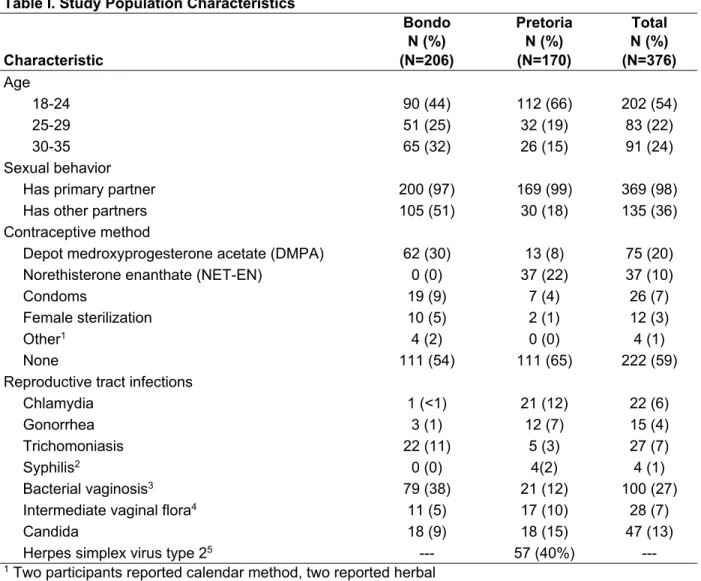
Among the 376 non-pregnant, HIV negative women in this analysis, the median age was 24 years (range 18-35). Women in Bondo were somewhat older than women in Pretoria
(Table 4.1), although women in Bondo used condoms less with either partner type as compared to women from Pretoria (primary partner mean percentage condom use in the last 7 days 27% vs. 40% and ‘other’ partner mean percentage condom use in the last 7 days 52% vs. 68%, respectively). Contraceptive use was generally low at the baseline visit (by study design), with over half of the population reporting no use of contraception. With the exception of TV and BV, RTIs were more prevalent among women in Pretoria. Herpes simplex virus type 2 (HSV-2) testing was only conducted on a subset of women in the parent clinical trial; among women in this analysis, HSV-2 data were available for 142 (36%) women from the Pretoria site with 85 (60%) of those women testing seronegative and 57 (40%) testing seropositive.
Cytokines and SLPI detection
Spearman correlation between intra-plate cytokine concentration readings was generally high with all correlation coefficients ≥0.96 with the exception of MIP-1α (0.84). The validity of extrapolated readings was evaluated separately; extrapolated readings remained significantly correlated (p≤0.05) for IL-6, IL-8, IL-1β and RANTES (ρ range: 0.85-0.95) although correlation was considerably lower for MIP-1α, MIP-1β, IL-1α and IP-10. Cytokine concentrations that were below the limit of detection ranged from <1% to 15%. Only one observation for one marker was above the limit of detection in this analysis (IL-8). GM-CSF was not included in any analyses due to a large number of observations below the detectable range (36%). Correlation between duplicate SLPI readings was high (ρ 0.99) and most observations were within the limits of detection (98.4%).
PSA detection
We measured PSA to control for contamination with semen. Three-quarters of
PSA positive. IL-6 (p=0.026), IL-8 (p=0.018) and IL-1β (p=0.042) concentrations were
significantly lower, and SLPI (p=0.020) concentrations were significantly higher, in specimens classified as PSA positive. In subsequent multivariable analyses, we therefore adjusted for PSA as a potential confounder with PSA coded dichotomously (low positive and positive collapsed into a single positive category).
Association of inflammatory markers with age and study site
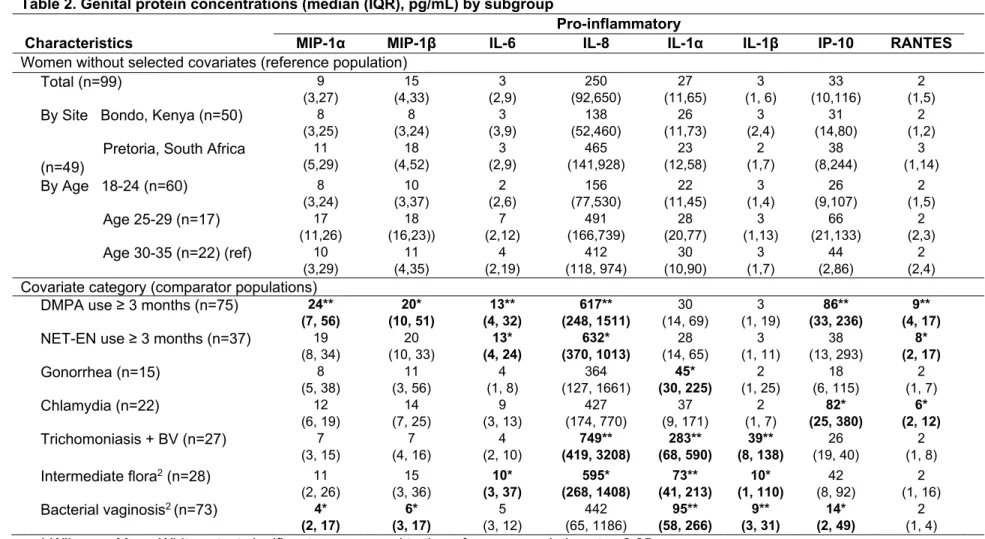
Cytokine and SLPI profiles in the reference population of 99 women reporting no HC use, and who were NG, CT and TV negative and with normal vaginal flora, did not vary significantly when stratified by site or age group (Table 4.2).
Association of inflammatory markers with injectable progestin-only contraceptive use DMPA users had the highest number of elevated genital inflammatory cytokines;
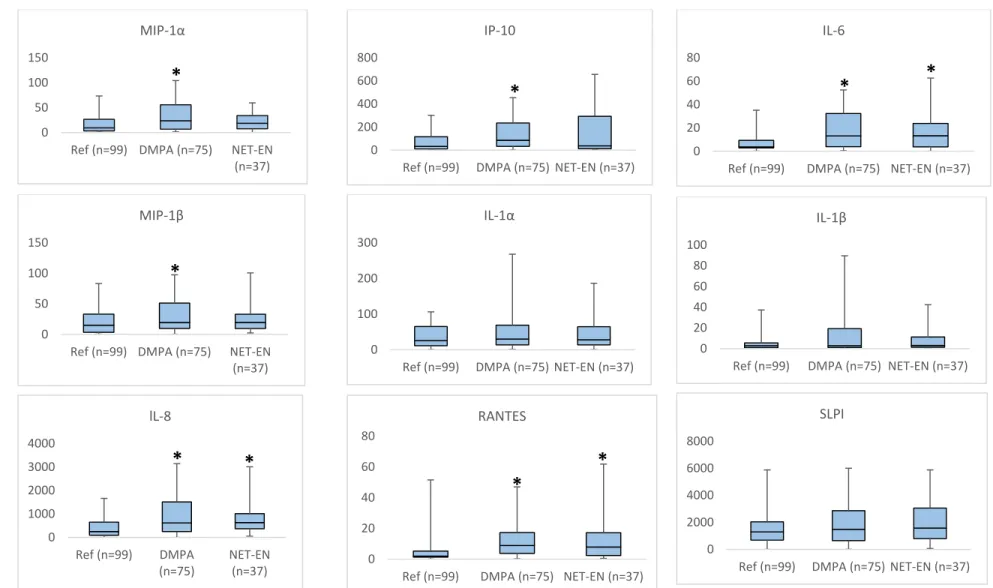
concentrations of MIP-1α, MIP-1β, IL-6, IL-8, IP-10 and RANTES were significantly elevated as compared to the reference group of women reporting no HC use and who were RTI negative (Table 2, Figures 4.2, 4.3, 4.4). Similarly, IL-6, IL-8 and RANTES concentrations were
significantly higher in NET-En users as compared to the reference population. Adjustment for PSA, self-reported sex without a condom in the past seven days and the presence of candida had little effect (data not shown).
Association of inflammatory markers with reproductive tract infections
Women with STIs or BV generally had less inflammation compared to DMPA users (Table 4.2). Women with NG had significantly higher IL-1α and lower SLPI concentrations, and women with CT had significantly higher IP-10 and RANTES concentrations, as compared to the reference group. Women who had both TV and had BV had significantly elevated IL-8, IL-1α
PSA, self-reported sex without a condom in the past seven days and the presence of candida had little effect (data not shown).
Sensitivity analysis
In a sensitivity analysis using available HSV-2 data, there were no significant differences in any of the measured immune markers between HSV-2 positive vs. HSV-2 negative women in the reference group. Furthermore, the proportion of women who were HSV-2 positive did not differ when comparing women between the reference and exposure groups, which suggests the results may not be confounded by HSV-2 status.
DISCUSSION
The impact of IPC on HIV acquisition risk remains unclear. DMPA has been associated with an increased risk of HIV infection in observational epidemiological studies and most recently, in two meta-analyses, one which pooled individual participant data from >37,000 women.[22, 23] However, other studies, some of which were included in the aforementioned meta-analysis, have found no such association.[28-31, 57] Association of NET-EN use and HIV risk is also unclear, but has received much less attention.[29, 31, 33, 34]
In this evaluation, we controlled for many potential confounders, including RTIs, HIV positivity, pregnancy and recent exposure to semen. We observed significant increases in IL-6, IL-8 and RANTES among both DMPA and NET-EN users, compared to women without RTIs or IPC use. DMPA users also had significantly higher concentrations of MIP-1α, MIP-1β and IP-10. The consistent findings among DMPA and NET-EN users suggest high-dose progestin
Perhaps surprisingly, women with RTIs had fewer median increases in inflammatory cytokines as compared to women using DMPA. Elevated RANTES and IP-10 concentrations among CT infected women and IL-1α among NG infected women has been observed
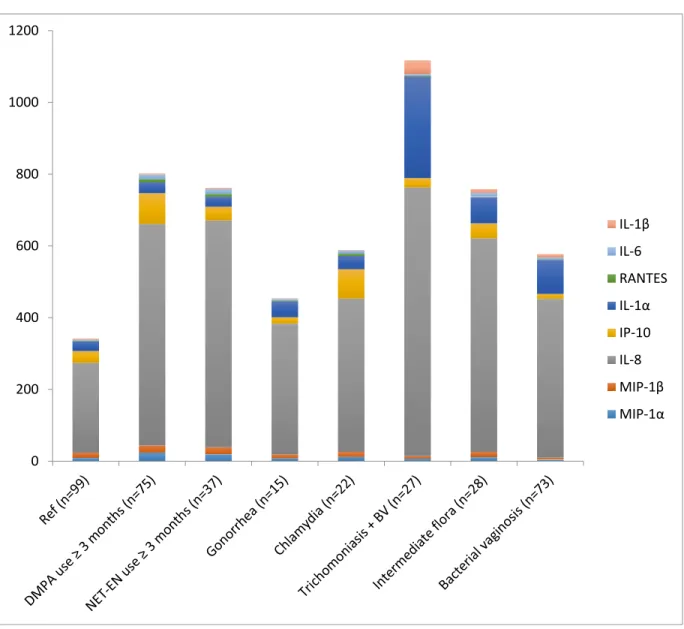
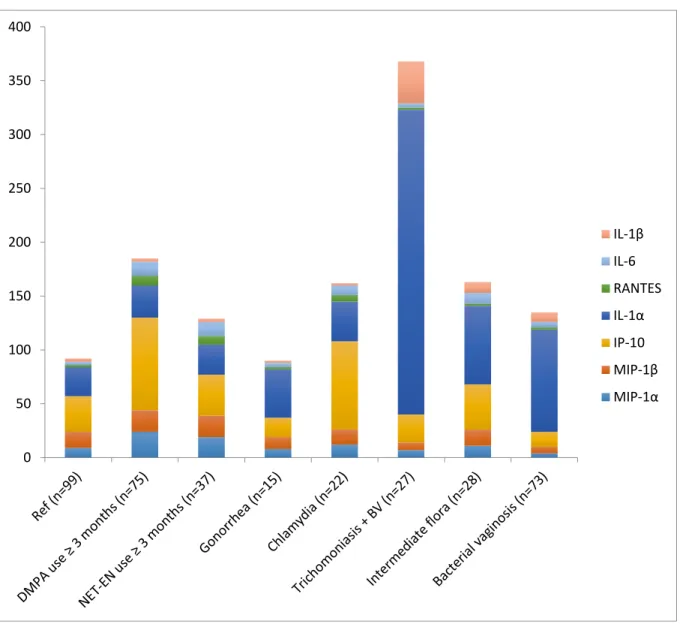
previously.[55] With BV, some markers of inflammation were increased and others decreased as previously reported.[55, 58] The marked difference in the distributions among women with both TV and BV, as compared to the reference population (Figures 4.3, 4.4, 4.5), suggests a potential synergistic force on inflammation, and suppression of SLPI, among women with both STIs and BV. A confirmed profile of inflammatory markers associated with RTIs could be used in the development of a cost-effective screening tool to improve RTI detection in high
prevalence settings that rely on syndromic management.
The lack of complete HSV-2 data among women in this study many have affected the results. However, a recent paper by Masson et al which sought to characterize innate immune profiles of women with STIs found no association between HSV-2 status as measured by antibody detection in serum or active infection with viral shedding.[55] Further, due to the cross-sectional design, a causal relationship between the exposures and observed increase in inflammatory markers cannot be established. However, the strict inclusion criteria and participant sampling approach utilized, along with measurement of PSA to control for recent sexual activity, methodologically controls for many potential confounders including pregnancy, comorbid RTIs and HIV.
Tables and Figures
Figure 4.1 Flow diagram of participant selection
34
Table 4.1 Study population characteristics
Table I. Study Population Characteristics
Bondo N (%)
Pretoria N (%)
Total N (%)
Characteristic (N=206) (N=170) (N=376)
Age
18-24 90 (44) 112 (66) 202 (54)
25-29 51 (25) 32 (19) 83 (22)
30-35 65 (32) 26 (15) 91 (24)
Sexual behavior
Has primary partner 200 (97) 169 (99) 369 (98)
Has other partners 105 (51) 30 (18) 135 (36)
Contraceptive method
Depot medroxyprogesterone acetate (DMPA) 62 (30) 13 (8) 75 (20)
Norethisterone enanthate (NET-EN) 0 (0) 37 (22) 37 (10)
Condoms 19 (9) 7 (4) 26 (7)
Female sterilization 10 (5) 2 (1) 12 (3)
Other1 4 (2) 0 (0) 4 (1)
None 111 (54) 111 (65) 222 (59)
Reproductive tract infections
Chlamydia 1 (<1) 21 (12) 22 (6)
Gonorrhea 3 (1) 12 (7) 15 (4)
Trichomoniasis 22 (11) 5 (3) 27 (7)
Syphilis2 0 (0) 4(2) 4 (1)
Bacterial vaginosis3 79 (38) 21 (12) 100 (27)
Intermediate vaginal flora4 11 (5) 17 (10) 28 (7)
Candida 18 (9) 18 (15) 47 (13)
Herpes simplex virus type 25 --- 57 (40%) ---
1 Two participants reported calendar method, two reported herbal
2 Syphilis results were not available for 15 participants (6 in Pretoria, 9 in Bondo) 3 Bacterial vaginosis defined as Nugent Score 7-10
4 Intermediate vaginal flora defined as Nugent Score 4-6
Table 4.2 Genital protein concentrations (median (IQR), pg/mL) by subgroups
Table 2. Genital protein concentrations (median (IQR), pg/mL) by subgroup
Pro-inflammatory
Characteristics MIP-1α MIP-1β IL-6 IL-8 IL-1α IL-1β IP-10 RANTES Women without selected covariates (reference population)
Total (n=99) 9
(3,27) 15 (4,33) 3 (2,9) 250 (92,650) 27 (11,65) 3 (1, 6) 33 (10,116) 2 (1,5)
By Site Bondo, Kenya (n=50) 8
(3,25) 8 (3,24) 3 (3,9) 138 (52,460) 26 (11,73) 3 (2,4) 31 (14,80) 2 (1,2) Pretoria, South Africa
(n=49) 11 (5,29) 18 (4,52) 3 (2,9) 465 (141,928) 23 (12,58) 2 (1,7) 38 (8,244) 3 (1,14)
By Age 18-24 (n=60) 8
(3,24) 10 (3,37) 2 (2,6) 156 (77,530) 22 (11,45) 3 (1,4) 26 (9,107) 2 (1,5)
Age 25-29 (n=17) 17
(11,26) 18 (16,23)) 7 (2,12) 491 (166,739) 28 (20,77) 3 (1,13) 66 (21,133) 2 (2,3)
Age 30-35 (n=22) (ref) 10
(3,29) 11 (4,35) 4 (2,19) 412 (118, 974) 30 (10,90) 3 (1,7) 44 (2,86) 2 (2,4) Covariate category (comparator populations)
DMPA use ≥ 3 months (n=75) 24**
(7, 56) 20* (10, 51) 13** (4, 32) 617** (248, 1511) 30 (14, 69) 3 (1, 19) 86** (33, 236) 9** (4, 17)
NET-EN use ≥ 3 months (n=37) 19
(8, 34) 20 (10, 33) 13* (4, 24) 632* (370, 1013) 28 (14, 65) 3 (1, 11) 38 (13, 293) 8* (2, 17)
Gonorrhea (n=15) 8
(5, 38) 11 (3, 56) 4 (1, 8) 364 (127, 1661) 45* (30, 225) 2 (1, 25) 18 (6, 115) 2 (1, 7)
Chlamydia (n=22) 12
(6, 19) 14 (7, 25) 9 (3, 13) 427 (174, 770) 37 (9, 171) 2 (1, 7) 82* (25, 380) 6* (2, 12)
Trichomoniasis + BV (n=27) 7
(3, 15) 7 (4, 16) 4 (2, 10) 749** (419, 3208) 283** (68, 590) 39** (8, 138) 26 (19, 40) 2 (1, 8)
Intermediate flora2 (n=28) 11
(2, 26) 15 (3, 36) 10* (3, 37) 595* (268, 1408) 73** (41, 213) 10* (1, 110) 42 (8, 92) 2 (1, 16)
Bacterial vaginosis2 (n=73) 4*
(2, 17) 6* (3, 17) 5 (3, 12) 442 (65, 1186) 95** (58, 266) 9** (3, 31) 14* (2, 49) 2 (1, 4) * Wilcoxon-Mann-Whitney test significant as compared to the reference population at p≤0.05
** Wilcoxon-Mann-Whitney test significant as compared to the reference population at p≤0.001
1 Sample sizes for SLPI analyses varied slightly from cytokine analyses due to SLPI assay failures as follows: DMPA=71, BV=72, ≥ 1 STI
and/or BV=136
2 Intermediate flora defined as Nugent Score 4-6; bacterial vaginosis defined as Nugent Score 7-10
36
Figure 4.2 Inflammatory marker concentrations in reference group and IPC users
y-axis is concentration of marker in pg/mL. Top whisker of all plots only extends to the 90th percentile to make central data visible. *Wilcoxon-Mann-Whitney test significant as compared to the reference population at p≤0.05
0 50 100 150
Ref (n=99) DMPA (n=75) NET‐EN (n=37) MIP‐1α
0 50 100 150
Ref (n=99) DMPA (n=75) NET‐EN (n=37) MIP‐1β
0 1000 2000 3000 4000
Ref (n=99) DMPA (n=75)
NET‐EN (n=37) lL‐8
0 200 400 600 800
Ref (n=99) DMPA (n=75) NET‐EN (n=37) IP‐10
0 100 200 300
Ref (n=99) DMPA (n=75) NET‐EN (n=37) IL‐1α
0 20 40 60 80
Ref (n=99) DMPA (n=75) NET‐EN (n=37) RANTES 0 20 40 60 80
Ref (n=99) DMPA (n=75) NET‐EN (n=37) IL‐6
0 20 40 60 80 100
Ref (n=99) DMPA (n=75) NET‐EN (n=37) IL‐1β
0 2000 4000 6000 8000
Figure 4.3 Total inflammatory markers concentrations by ‘risk group’
0 200 400 600 800 1000 1200
IL‐1β
IL‐6
RANTES
IL‐1α
IP‐10
IL‐8
MIP‐1β
Figure 4.4 Total inflammatory markers concentrations by ‘risk group’, removing IL-8
0 50 100 150 200 250 300 350 400
IL‐1β
IL‐6
RANTES
IL‐1α
IP‐10
MIP‐1β
Figure 4.5 Total SLPI concentrations by ‘risk group’
0 200 400 600 800 1000 1200 1400 1600 1800 2000
CHAPTER 5: INNATE IMMUNITY MARKERS ASSOCIATED WITH HIV ACQUISITION AMONG WOMEN AT HIGH RISK
OVERVIEW
Problem
Women with genital tract inflammation may be at increased risk of HIV infection independent of other known risk factors for HIV acquisition.
Method of Study
We conducted a case-cohort study to analyze the association between innate immune factors in the female genital tract and HIV acquisition. Women in Kenya and South Africa who became HIV infected between enrollment and 60 weeks of follow-up during a clinical trial of Truvada for HIV prevention were included as cases. A random sub-cohort of women in the clinical trial was selected from individuals who were HIV RNA and DNA PCR negative at enrollment and
completed at least one follow-up visit. A Cox model with pseudo likelihood and robust variance estimation were used to assess the association of innate immune factors and HIV acquisition.
Results
Conclusions
INTRODUCTION
Many biological risk factors for HIV acquisition, including mucosal epithelial disruption, the availability of CCR5+/CD4+ target cells, sexually transmitted infections, disturbances in the vaginal microbiota, such as bacterial vaginosis (BV), are well characterized and accepted.[59, 60] However, the association between innate immune factors and HIV acquisition remains unclear. Variations in innate immune factor concentrations in the female genital tract have been associated with HIV acquisition. In a trial in South Africa, women with increased MIP-1α, MIP-1β, IP-10 and IL-8 concentrations experienced higher rates of HIV acquisition; this finding was also observed within the active trial arm (tenofovir gel) suggesting that local inflammation may reduce the effectiveness of tenofovir gel for HIV prevention.[53] Women who seroconverted during a multi-center African trial were more likely to have detectable HβD-2 concentrations and greater E. coli bactericidal activity compared to women who remained HIV negative, and in a separate study among women in Zimbabwe and Uganda, higher RANTES concentrations and lower SLPI concentrations were associated with HIV seroconversion.[4, 61]
We evaluated the effect of innate immune concentrations on HIV acquisition using stored specimens collected during FEM-PrEP, a randomized trial of Truvada for prevention of HIV acquisition among high-risk women. Understanding the association between innate
immunity and HIV acquisition is important in the rationale design of biomedical technologies for HIV prevention, and for both understanding the results of clinical trials of biomedical HIV prevention products and their potential impact on the HIV epidemic.
METHODS Ethics statement
Study design and population
This prospective case-cohort analysis used data from the FEM-PrEP clinical trial, which has been described elsewhere.[3] In brief, FEM-PrEP was a randomized, double-blind, placebo-controlled trial of once-daily tenofovir disproxil fumarate-emtricitabine [TDF/FTC (marketed as Truvada); Gilead Sciences, Foster City, CA] designed to assess the effectiveness and safety of TDF/FTC as pre-exposure prophylaxis (PrEP) for HIV prevention among high-risk women in Africa.
Selection of the subcohort
We randomly selected ~15% of enrolled women stratified by site from clinical study sites that contributed at least one incident HIV infection during the clinical trial into a sub-cohort independent of case status for an analysis of Truvada drug exposure and HIV acquisition. However, the Bloemfontein, South Africa site did not store baseline genital specimens from participants, which were used to define our exposures, and was therefore excluded from this analysis. Women were eligible for selection into the sub-cohort if they were HIV RNA and DNA PCR negative at enrollment and completed at least one follow-up visit, yielding a sub-cohort of 200 women. Among these 200 women, 164 had stored specimens available for exposure assessment including 6 cases (Figure 5.1).
Selection of cases
All women from the Bondo, Kenya and Pretoria, South Africa sites who were HIV RNA and DNA PCR negative at enrollment, completed at least one follow-up visit and became HIV infected between enrollment and 60 weeks of follow-up were included as cases, yielding a total of 68 incident HIV infections. Among these 68 cases, 47 women had stored specimens
available for exposure assessment.
Ascertainment of exposure
interferon gamma induced-protein (IP)-10, regulated on activation normal T cell expressed and secreted (RANTES), granulocyte macrophage colony-stimulating factor (GM-CSF) and
secretory leukocyte peptidase inhibitor (SLPI).[4, 5, 42]
Ascertainment of covariates
The following covariates were identified using directed acyclic graphs: age, injectable contraception use, reproductive tract/sexually transmitted infections (RTI/STI), presence of prostate specific antigen (PSA) (marker of recent unprotected sexual exposure) and TDF/FTC use.[62, 63] Age was self-reported by participants at baseline. Participants were required to use an effective contraceptive method (defined as oral contraceptive pills (OC), injectables [DMPA or NET-EN], implant, IUD or have been previously sterilized) to meet trial eligibility criteria; the most frequently used contraceptive methods (i.e., OCs, injectables) were provided at the study sites. Contraceptive use was documented at baseline and during follow-up visits; injection dates were recorded for injectable methods. RTI/STI, including bacterial vaginosis (BV), Chlamydia trachomatis (CT), Neisseria gonorrhoeae (NG), Trichomonas vaginalis (TV) and syphilis and were diagnosed by laboratory testing and treated at baseline (subsequent RTI/STI infection was managed via syndromic diagnosis and treatment). Age, contraceptive method and RTI/STI were recorded on standard trial case report forms. Concentrations of tenofovir (TFV) in plasma and intracellular tenofovir diphosphate (TVF-DP) in upper layer packed cells were analyzed in stored specimens to assess TDF/FTC use.[11] TFV and TVF-DP concentrations were used to create a 5-level adherence variable in consultation with the study pharmacologist, and collapsed into three levels for this analysis (i.e., ‘none/low’ [TFV-DP <10,000
Ascertainment of incident HIV infection
HIV testing was conducted every four weeks from trial enrollment through 60 weeks of follow-up using a standardized rapid test algorithm; results were recorded on standardized case report forms. Confirmatory testing was done at the Institute of Tropical Medicine in Belgium on specimens from women who had positive antibody results. Time to HIV infection was defined as the time between enrollment and date of collection of the first specimen which was HIV RNA and/or DNA positive.
Laboratory methods
Sterile synthetic swabs were collected and eluted in 1000-1200µL phosphate buffered saline (PBS) and the volume which remained after NG/CT testing was stored at -70⁰C during the FEM-PrEP trial (between May 2009 and November 2010). Cytokine and SLPI testing was conducted on these stored aliquots between July 2012 and April 2013. Cytokine concentrations were measured using MilliplexTM Human Cytokine kits (Millipore, MA, USA) on a Bio-PlexTM Suspension Array Reader (Bio-Rad Laboratories Inc®, CA, USA) according to a written standard operating procedure in accordance with manufacturer instructions; specimens were pre-filtered by centrifugation using 0.2µm cellulose acetate filters (Sigma-Aldrich, USA) to ensure mucus did not interfere with the assay and were tested in duplicate on the same plate. Each sample was also tested on a second plate in order to evaluate inter-assay reproducibility. SLPI concentrations were measured in duplicate using the Quantikine Human SLPI
Immunoassay kit from R&D Systems (Minneapolis, MN) by adapting the manufacturer’s
RTI/STI testing was done during the trial; CT/NG testing was done using polymerase chain reaction (PCR) on the Roche Cobas Amplicor platform, TV was detected using wet mount microscopy and BV visualized using Gram staining and Nugent scoring. TFV and TVF-DP were measured in plasma and upper layer packed cells using protein precipitation and LC-MS/MS detection using methods that have been described previously.[3, 52]
Statistical analysis
Reliability and reproducibility of cytokine and SLPI readings were assessed using
Spearman’s rank correlation. Cytokine concentrations were calculated as the mean of duplicate samples from the same plate, the mean of duplicate samples from separate plates if one
observation was undetectable on the plate with duplicate specimens, the observed
concentration if only 1/3 readings was detectable and the median value between zero and the lowest observed standard if all three observations were undetectable. SLPI concentrations were calculated as the mean of duplicate readings; if both observations were below the limit of
detection, the midpoint between zero and the lower limit of detection was imputed, if both observations were above the limit of detection, the upper limit of detection was imputed.
Cytokines and SLPI were analyzed in multivariable models as: 1) continuous variables, and 2) a single dichotomous composite variable of inflammation (cytokines) and a separate dichotomous variable for SLPI (< or ≥ the median concentration). For the composite variable, an intermediate variable was set equal to the number of cytokines ≥ the median concentration (range 0-9) per woman. The median of the intermediate variable was defined as the cut point for the final composite inflammation variable. Exploratory analyses were done to evaluate the influence of exposure coding.
![Table 2.1 Names and functions of selected cytokines [1, 46, 47]](https://thumb-us.123doks.com/thumbv2/123dok_us/8276213.2191832/22.918.99.810.117.922/table-names-functions-selected-cytokines.webp)