This program is funded by California utility customers under the auspices of the California Public Utilities Commission and in support of the California Energy Commission.
Title 24 Standards
Essentials
What triggers the Energy
Code
(Title 24, part 6)?
Jon McHugh
McHugh Energy Consultants Inc.
2
California Building & Appliance
Standards
!
Building Standards (Title 24)
"
Part of “building code”
"
Enforced by building department
#
Local jurisdiction decides when permit required
for retrofits
!
Appliance Standards
"
Efficiency requirements at time of sale
"
Covered products must be in CEC appliance
databases
"
Spot checks by CEC
3
Title 24 Officially is all Building Codes, But often refers
to only Part 6 - the Building Efficiency Standards
!
Part 1 - California Building Standards Admin Code
!
Part 2 - California Building Code
!
Part 3 - California Electrical Code
!
Part 4 - California Mechanical Code
!
Part 5 - California Plumbing Code
!
Part 6 - California Energy Code
!
Part 7 - California Elevator Safety Construction Code
!
Part 8 - California Historical Building Code
!
Part 9 - California Fire Code
!
Part 10 - California Code for Building Conservation
!
Where can you find?
CEC website
"
http://www.energy.ca.gov/title24/2013standards/index.html
Where Can The Information Be
Found?
5
Application of Standards (Table 100.0-A
)
6
Number system has changed by adding decimal: 100.1 was 101
New sections
110.1: “Solar Ready” buildings
120.6: NR: “Covered Processes” instead of
“Refrigerated Warehouses”
120.7: NR “Mandatory Insulation
Requirements”
120.8: NR “Building Commissioning”
120.9: NR “Mandatory Requirements for
Commercial Boilers
130.5: NR “Electrical Power Distribution
Systems”
140.9: NR “Prescriptive Requirements For
Covered Processes”
141.1: NR “Requirements For Covered
Processes In Additions, Alterations To Existing Buildings That Will Be
Nonresidential, High-Rise Residential, And Hotel/Motel Occupancies”
Covered Processes
Title 24 Standards Essentials - What Is New & Exciting 7
•
Refrigeration system efficiency
•
Refrigerated warehouses > 3,000 sf
•
Supermarkets > 8,000 sf
•
Parking Garages
•
Motion controlled bi-level lighting
•
CO controlled VSD exhaust fans
•
Industrial boiler efficiency
•
Vent or flue damper
•
Parallel positioning and trim controls
•
Compressed air controls and swing compressor unloading
•
Computer room and data center HVAC
•
Air or water economizer
•
No reheat or steam humidification
•
Air containment, fan control and fan power
•
Commercial kitchens ventilation control
•
Laboratory exhaust systems where less than 10 ACH is
required
www.EnergyCodeAce.com
9
!
One-Stop Shop
♠
Tools
♠
Resources
♠
Learning Portal
♠
News &
Information
♠
Recognition
Opportunities
!
Personalized
♠
Recommendations
♠
Engaging “Point
Tracking”
!
E-mail lists
www.EnergyCodeAce.com
Stack your deck
with
Energy Code
Ace
Helping you play your cards right
™
!
Fact Sheets
– Summaries of
key requirements, definitions
and resources useful for Title
24, Part 6 implementation
!
Trigger Sheets
–
Summaries of sections of
Title 24, Part 6 that are
triggered based on project
scope.
!
Checklists
–
Coming Soon!
!
FAQs
–
Coming Soon!
!
Useful Links
–
Coming
Soon!
!
Traditional Classroom
Courses
– Offered at utility
training centers and on-site in
local jurisdictions –
we’ll come
to you!
!
Virtual Classroom Courses
– Interactive instructor-led
online classes
!
Online Self-Studies
– Take
them when and where you
like at your own pace
!
“Decoding” Talk Series
–
Facilitated online discussions
for Building Inspectors
Aids in determining which
compliance forms are applicable to
your specific project
Helps you navigate the Standards
using key word search capabilities,
hyperlinked tables and related
sections
A “field guide” to assist you in
identifying proper installation
techniques -
Coming Soon!
All tools, training and resources are offered free of charge
Workshop packages to help
Building Departments facilitate
trainings for local installation
contractors
11
!
Trigger Sheets identify which code sections to apply with
various new construction and retrofit scenarios
"
Use in conjunction with T-24 code and/or compliance
manual
!
Most of code written with new construction in mind
"
But over 2/3s of permits are for retrofits
"
New construction is approximately 1.5% of existing
building stock
!
Nonresidential retrofits (Section 141.0)
!
Industrial retrofits (included in Section 120.6)
"
Refrigeration alterations: only part altered has
requirement
"
Exceptions for retrofits
How to Use Trigger Sheets
Nonresidential Fenestration (Windows and
Skylights)
2013 Title 24, Part 6 Standards – Triggers for Energy Code Requirements 13
Footnotes:
A. Atria over 55 ft high is limited to a maximum 0.10 skylight to roof ratio
B. The minimum skylight daylit area requirement applies to roofs directly over spaces > 5,000 sq. ft. with a ceiling height of at least 15 ft and interior LPD of at least 0.5 W/sq. ft.
C. See table 141.0-A for efficiency values D. VT ≥ 0.11/WWR also applicable
E. See table 140.3 –B, C or D for minimum VT value
F. Window Films are applicable for use in existing glass in existing buildings and must be modeled under the performance approach to receive performance SHGC credit and must meet
the criteria of NA7.4.2.
G. Dynamic Glazing must use automatic controls and must meet the criteria in NA7.4.3
no
Lighting Alteration Triggers
A 130.1(a) - Area Controls: All luminaires shall be functionally controlled with manually switched ON and OFF lighting controls. Each area enclosed by ceiling-height partitions shall be independently controlled. B 130.1(b) - Multi-Level Lighting Controls: The general lighting of any enclosed area 100 square feet or larger, with a connected lighting load that exceeds 0.5W per square foot shall meet the requirements of §130.1(b) C 130.1(c) - Shut-OFF Controls: In addition to lighting controls installed to comply with Sections 130.1 (a) and (b), all installed indoor lighting shall be equipped with controls that meet the requirements of §130.1(c) D 130.1(d) - Automatic Daylighting Controls: Any altered luminaires providing general lighting that are in or are partially in daylit zones shall meet the requirements of §130.1 (d) 2
E 130.1(e) - Demand Responsive Controls: If space is added, or lighting power is increased, lighting power in buildings larger than 10,000 sq. ft. shall be capable of being automatically reduced in response to a demand response signal as per §130.1(e)
Yes
Yes
no
no
no!
Luminaire Modifications [Section 141.0(b)2Iii]
"
“…alterations where an existing lighting system is modified, luminaires are
replaced, or luminaires are disconnected from the circuit, removed and
reinstalled, whether in the same location or installed elsewhere.”
"
Also adding new luminaires
!
Luminaire Modifications-in-Place [Section 141.0(b)2Iiii]
"
Replacing lamps and ballasts with like type or quantity in a manner that
preserves the original luminaire listing.
"
Changing the number or type of light source:
#
socket renewal, relocation of lampholders, and internal wiring
"
Changing the optical system of a luminaire in part or in whole.
"
Replacement of whole luminaires one for one
#
only disconnecting the existing luminaire and reconnecting the
replacement luminaire.
"
Not a luminaire modification in place:
#
part of general remodeling or renovation of the enclosed space
#
involve any changes to the panelboard or branch circuit wiring
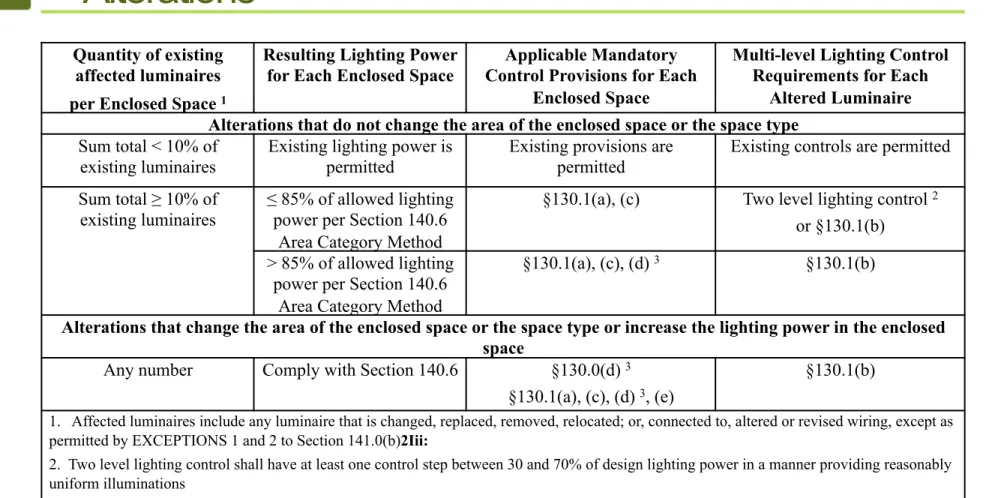
Lighting Retrofits: Luminaire Alterations
vs Luminaire Modifications in Place
Quantity of existing affected luminaires per Enclosed Space 1
Resulting Lighting Power
for Each Enclosed Space Control Provisions for Each Applicable Mandatory Enclosed Space
Multi-level Lighting Control Requirements for Each
Altered Luminaire Alterations that do not change the area of the enclosed space or the space type
Sum total < 10% of existing luminaires
Existing lighting power is permitted
Existing provisions are permitted
Existing controls are permitted
Sum total ≥ 10% of
existing luminaires
≤ 85% of allowed lighting
power per Section 140.6 Area Category Method
§130.1(a), (c) Two level lighting control 2
or §130.1(b) > 85% of allowed lighting
power per Section 140.6 Area Category Method
§130.1(a), (c), (d) 3 §130.1(b)
Alterations that change the area of the enclosed space or the space type or increase the lighting power in the enclosed space
Any number Comply with Section 140.6 §130.0(d) 3
§130.1(a), (c), (d) 3, (e)
§130.1(b)
1. Affected luminaires include any luminaire that is changed, replaced, removed, relocated; or, connected to, altered or revised wiring, except as permitted by EXCEPTIONS 1 and 2 to Section 141.0(b)2Iii:
2. Two level lighting control shall have at least one control step between 30 and 70% of design lighting power in a manner providing reasonably uniform illuminations
3. Daylight controls in accordance with Section 130.0(d) are required only for luminaires that are altered.
TABLE 141.0-E Requirements for Luminaire
Alterations
16
130.1(a) – Area controls; a light switch by the door
130.1(b) – Multi-level controls; for linear fluorescent a 4 step control, effectively a continuous dimming control Note: only applies to altered luminaires
130.1[c] - Automatic shut-off; a time sweep control or occupancy sensor depending on the space
130.1(d) – Automatic daylighting controls for luminaires in the primary sidelit zone or in daylit zone under skylights The primary sidelit zone is within one window head height of windows. Skylit zone within 0.7 x ceiling height of skylights 130.1(e) – Automatic demand responsive controls responding to signal from utility or ISO
For compliance with this Table, building space is defined as any of the following: 1. A complete single story building. 2. A complete floor of a multi floor building
3. The entire space in a building of a single tenant under a single lease. 4. All of the common, not leasable space in single building
Quantity of affected luminaires per Building Space
per annum
Resulting Lighting Power per Each Enclosed Space Where
≥ 10% of Existing Luminaires are Luminaire
Modifications-in-Place
Applicable mandatory control provisions for each enclosed
space 1
Applicable multi-level lighting control requirements for each
modified luminaire 2
Sum total < 40 Luminaire
Modifications-in-Place
Existing lighting power is
permitted
Existing provisions are
permitted
Existing controls are
permitted
Sum total
≥
40 Luminaire
Modifications-in-Place
≤
85% of allowed lighting
power per Section 140.6
Area Category Method
§130.1(a), (c)
Two level lighting
control
3Or §130.1(b)
> 85% of allowed lighting
power per Section 140.6
Area Category Method
§130.0(d)
4§130.1(a), (c), (d)
4§130.1(b)
1. Control requirements only apply to enclosed spaces for which there are Luminaire Modifications-in-Place. 2. Multi-level controls are required only for luminaires for which there are Luminaire Modifications-in-Place.
3. Two level lighting control shall have at least one control step between 30% and 70% of design lighting power in a manner providing reasonably uniform illuminations 4. Daylight controls in accordance with Section 130.0(d) are required only for luminaires that are modified-in-place.
TABLE 141.0-F Requirements for Luminaire
Modifications-in-Place
2013 Title 24, Part 6 Standards – Triggers for Energy Code Requirements 17
130.1(a) – Area controls; a light switch by the door
130.1(b) – Multi-level controls; for linear fluorescent a 4 step control, effectively a continuous dimming control Note: only applies to altered luminaires
130.1[c] - Automatic shut-off; a time sweep control or occupancy sensor depending on the space
130.1(d) – Automatic daylighting controls for luminaires in the primary sidelit zone or in daylit zone under skylights The primary sidelit zone is within one window head height of windows. Skylit zone within 0.7 x ceiling height of skylights
HVAC Controls Triggers
2013 Title 24, Part 6 Standards – Triggers for Energy Code Requirements 18
A Central Energy Management Control System (EMCS) should be installed at building site for optimal equipment operation and coordination. B Feedback received from zones through EMCS. Load required based on number of satisfied zones.
C Demand Control Ventilation. See §120.1(c) 3, 4, &5 for additional CO2 concentration setpoint information and sensor location requirements. D Must include automatic restart to maintain setback temperatures as necessary.
E Only applies to new air-cooled unitary direct-expansion systems with 54,000 Btu/h capacity or greater. See §120.2(i) for greater detail. F For systems serving multiple zones totaling more than 25,000 sq. ft..
G Include settings capable of disabling, manually controlling, or automatically operating equipment.
H Fault detection and diagnostics (FDD) systems are commonly available for packaged HVAC units, and can be integrated directly by the manufacturer. These are required for all systems with cooling capacity of 54 kBtu/h (4 ½ tons) or greater. Controls include economizer checks and refrigerant diagnostics. The systems can report failures or suboptimal conditions that impact efficiency. Required acceptance tests for these systems may be found Reference Appendix NA7, 7.5.11.”
I Simultaneous heat and cool prevention except for variable-air-volume and other system types listed in this section. Ambient conditions also provide lockout for seasonal operation only.
" J Variable Frequency Drive necessary to operate supply fan speed control at the unit.
" K Air-side applications referred to in respective code language. Central EMCS necessary for remote system
operation and ability to oversee all space-conditioning equipment and pumping needs.
" L Heating and Cooling Setpoint dead band of ± 5°F should be implemented on all temperature setpoints. Applies
only to equipment with heating AND cooling capability. Setback zone temperature setpoint to 55°F or lower for heating and 85°F or higher for cooling.
" M Exemptions for; gravity dampers, combustion air paths, 24 hour operation, or local law jurisdiction.
" N Stand-alone single room window units are exempt (See §110.2(c)).
" O Damper to reduce ventilation to zero during unoccupied periods.
" P Assuming system has ventilation capacity at the terminal device.
" Q Air or water source configuration.
" R Reference to combustion air requirements.
" S Configurations vary between availability of central plant in design or reliance on self-contained heating and
cooling.
" T Special application requirements for Hotels, High-rise Residential, and Perimeter Zoning. Setback capable
terminal devices should be used except where zone is not on EMCS. In that case, capability of four programmable control periods per 24 hours is required (§110.2(c)).
" U A reset strategy defined and applied to the supply air stream of the unit or terminal device.
" V Must include automatic time switch OR occ. sensor OR 4-hour timer. 7-day programmable local control
exemption.
" W Exemptions apply where: (1) outside air conditions are undesirable, (2) high-rise residential, (3) adverse effects
of other systems, like dehumidification, (4) high cooling efficiency systems [Table 140.1-A] (5) computer rooms served per §140.9(a).
More footnotes
Industrial Process Retrofits Triggers
2013 Title 24, Part 6 Standards – Triggers for Energy Code Requirements 20
!
Nonresidential Compliance
Manual Chapter 10
"
Second to last subsection
of each covered process
covers Additions and
Alterations
"
Typically just system being
altered has requirements
"
Some cases exceptions are
given for retrofits
"
All requirements including
retrofits contained in
Section 120.6 or 140.9
!
New Cooling Systems in an existing computer room must
have an air or water economizer if the cooling system is >
50 tons (600 kBtu/hr)
!
New Cooling Systems in an new computer room in an
existing building must have an air or water economizer if
the cooling system is > 50 tons (600 kBtu/hr)
"
For new computer rooms in a new building the trigger for
an economizer is 5 tons
Computer Room Retrofit Triggers
2013 Title 24, Part 6 Standards – Triggers for Energy Code Requirements 21
!
Expansions of existing
computer rooms are not
required to have air
containment
"
New rooms are required
to have containment when
the cooling system design
load > 175 kW/room
Thank you
22