SYNTHESIS, CHARACTERIZATION AND BIOLOGICAL
EVALUATION OF SUBSTITUTED
2-PHENOXY-NICOTINALDEHYDES AS
α-AMYLASE INHIBITORS
Ravibhushan S. Kulkarni,
[a]Nitin B. Haval,
[a]Jeetendra A. Kulkarni,
[b]Prashant
P. Dixit
[c]and
Kishan P. Haval
[a]*Keywords: diabetes; α-amylase; α-glucosidase; 2-phenoxynicotinaldehydes.
Diabetes mellitus is a chronic endocrine disorder that affects the metabolism of carbohydrates, proteins, fat, electrolytes and water. α -Amylase and α-glucosidase are the crucial enzymes required for the digestion of the carbohydrate. These enzymes play a vital role in the breakdown of starch in the diet and its activity has been correlated to postprandial blood glucose levels, the control of which is essential for maintaining the quality of life for diabetic patients. We report the synthesis, characterization and biological evaluation of new substituted 2-phenoxynicotinaldehydes as α-amylase inhibitors. A new general method based on the aromatic nucleophilic substitution reactions of 2-chloronicotinaldehyde with differently substituted phenols in the presence of K2CO3 in dry dioxane was developed to furnish the corresponding substituted 2-phenoxynicontinaldehydes with 70-80% yields.
* Corresponding Authors
E-Mail: [email protected]
[a] Department of Chemistry, Dr. B. A. M. University, SubCampus, Osmanabad 413501 (MS) INDIA [b] Department of Biotechnology, Dr. B. A. M. University,
SubCampus, Osmanabad 413501 (MS) INDIA [c] Department of Microbiology, Dr. B. A. M. University,
SubCampus, Osmanabad 413501 (MS) INDIA
Introduction
Diabetes Mellitus (DM) is an extended metabolic disease of several etiologies characterized by chronic hyperglycemia with a disorder of carbohydrate, fat and also protein metabolism. It includes a group of metabolic diseases characterized by hyperglycemia, in which blood sugar levels are elevated either from defects in insulin secretion, insulin action or both of them.1 Therefore, it is necessary to
decrease postprandial hyperglycemia to treat diabetes.2 This
can be achieved by the inhibition of carbohydrate-hydrolyzing enzymes like α-amylase and α-glucosidase.3
α-Amylase is responsible for the breakdown of long chain carbohydrates and α-glucosidase breaks down starch and disaccharides to glucose. They serve as the primary digestive enzymes and support in intestinal absorption. Both these enzymes are the potential targets in the development of lead compounds for the treatment of diabetes.4
Many natural products from plants have been used for the treatment of diabetes.5-8Various drugs are available for the
cure of Type 2 diabetes like acarbose, biguanides, sulphonylureas, thiozolidinediones, etc.9,10 But they have
also exhibited many undesired side effects like gastrointestinal side effects and thus signifying other effective substitutes.11
The pyridine substructure is one of the most predominant heterocycles found in natural products, pharmaceuticals, and
of pyridine have been developed and found to have a large number of biological activities.13-20 The pyridine structure is
found in natural compounds like nicotinic acid (vitamin B3)
and pyridoxine (vitamin B6). Over 100 medications on the
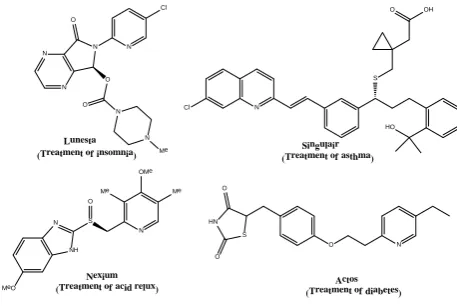
market today include pyridine rings, such as Lunesta, commonly used to treat insomnia,
Singulair, widely used to treat asthma, Nexium, widely used to treat acid reflux, and Actos, widely used to treat Type II diabetes (Figure 1).21
Figure 1. Some representative pyridine containing drugs
The pyridine moiety is also found in structurally simple drugs like isoniazid22and ethionamide23 (both prodrugs for
inhibitors of inter alia enoyl-acyl carrier protein reductase; tuberculosis), amrinone (phosphodiesterase 3 inhibitor; heart failure) and bupicomide (dopamine β-hydroxylase inhibitor; hypertension).
The high reactivity of pyridine allows for many possible chemical reactions.24-25 In continuation with our efforts on
the synthesis of bioactive heterocyclic compounds,26-32 the
present study was carried out to investigate the inhibitory
N Cl
N O
O N
N
N O
N Me
N Me OMe
Nexium (Treatmentofacidrelux)
S O
N
NH
MeO
Me
Lunesta (Treatmentofinsomnia)
N
Singulair (Treatmentofasthma)
N
Actos (Treatmentofdiabetes)
O HN
S O
O Cl
HO S
Results and discussion
We have synthesized a series of substituted 2-phenoxynicotinaldehydes by developing new reaction conditions. In the literature, various methods are reported for the aromatic nucleophilic substitution of 2-chloronicotinaldehydes by substituted phenols.33-39All these
reported methods have some limitations. It requires high temperature and longer reaction time. Hence, there was a need to develop better reaction conditions for the synthesis of substituted phenoxynicotinaldehydes from 2-chloronicotinaldehydes. In accordance with our aim, we performed the reaction of 2-chloronicotinaldehyde (1, 10 mmol) with phenol (2l, 10 mmol) in the presence of anhydrous K2CO3 (15 mmol) in dry dioxane at room
temperature and exclusively obtained the corresponding 2-phenoxynicotinaldehyde (3l) with 75 % yield. In the same conversion, use of 10 mmol (1 equiv.) of K2CO3 also
furnished the 2-phenoxynicotinaldehyde (3l) but less than 60 % yield, revealing that 15 mmol (1.5 equiv.) of K2CO3 is
necessary for quantitative conversion of 2-chloronicotinaldehydes to corresponding substituted 2-phenoxynicotinaldehydes.
To establish the generality of this new set of reaction condition, we performed the aromatic nucleophilic substitution reactions of 2-chloro-nicotinaldehyde with differently substituted phenols in the presence of K2CO3 in
dry dioxane to furnish the corresponding substituted 2-phenoxynicontinaldehydes with 70-80% yields (Scheme 1).
1H and 13C NMR spectral data confirmed the structures of
all the synthesized substituted 2-phenoxynicontinaldehydes.
Scheme 1. Synthesis of substituted 2-phenoxy
nicotinaldehydes
Biological activity
The enzyme inhibition activity was studied by agar diffusion method with some modifications.40 For evaluating
the enzyme inhibitory activity, commercially available α -amylase sample (from Hi media laboratory) was used. The synthesized compounds were dissolved in DMSO at 25 mg per ml concentration. A paper disc of 6 mm diameter from Hi media was impregnated with 10 µL of 1 % α-amylase solution. Subsequently, 10 µL of test compound solution was also impregnated to the enzyme discs. Control discs were prepared by adding 10 µL of DMSO only. Control and test discs were placed on 1 % starch containing Agar gel plates (pH 6.5). These plates were incubated at 37 0C for 24
h. After 24 h the plates were developed by Gram's iodine solution to observe the zone of clearance. Each zone was measured in millimetre (Table 1).
Table 1. Disc and medium preparation
Parameter Magnitude
Concentration of enzyme 10 mg in 1 mL Concentration of test compound 25 mg in 1 mL Concentration of starch (substrate) 10 mg in 1 mL Volume of the substrate in each plate 8 mL Amount of substrate in each plate 80 mg Diameter of zone (mm) for blank
without enzyme with DMSO Nil
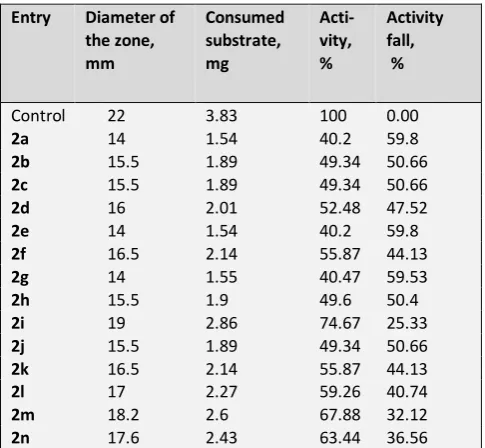
The zone of control was used to calculate the amount of starch hydrolyzed. The amount of starch hydrolyzed was calculated as shown in Table 2. The zone of clearance indicated the amount of starch hydrolyzed in milligrams. The amount of starch hydrolyzed by control was considered as 100 % activity and accordingly, % change in activity was measured.
From Table 3, it is observed that all the tested compounds showed anti-α-amylase activity in the range from 25 % to 59 %. Among these compounds 2i showed the least inhibition at 25.33 %, while compounds 2a, 2e, and 2g
showed higher inhibition of more than 59 %.
Table 2. Calculation for substrate consumed by control
Value of π 3.14
Thickness of medium, mm 1.01
Diameter of zone (mm) for control (with only
amylase and DMSO) 22
Radius of zone (mm) 11
Volume of the reaction zone, mm3,
[πr2*h (thickness of medium)]
383.7394
Amount of substrate consumed in control
mg 383.7394/100
Table 3. Calculation of percent reduction in α-amylase activity
Entry Diameter of the zone, mm
Consumed substrate, mg
Acti-vity, %
Activity fall, %
Control 22 3.83 100 0.00
2a 14 1.54 40.2 59.8
2b 15.5 1.89 49.34 50.66
2c 15.5 1.89 49.34 50.66
2d 16 2.01 52.48 47.52
2e 14 1.54 40.2 59.8
2f 16.5 2.14 55.87 44.13
2g 14 1.55 40.47 59.53
2h 15.5 1.9 49.6 50.4
2i 19 2.86 74.67 25.33
2j 15.5 1.89 49.34 50.66
2k 16.5 2.14 55.87 44.13
2l 17 2.27 59.26 40.74
2m 18.2 2.6 67.88 32.12
2n 17.6 2.43 63.44 36.56
N Cl
H O
K2CO3, Drydioxane rt,5-6hrs
(70-80%)
HO
R
N O
H O
3a:R = 4-Cl;3b:R = 2,4-Cl,Cl;3c:R = 2,5-Cl,Cl;3d:R = 4-CH3;3e:R =
2-Br;
3f:R = 2-CH3;3g:R = 3,4-Cl,Cl;3h:R = 3-CH3;3i:R = 2-CF3;3j:R = 3,5-Cl,Cl;
3k:R = 2-CF3;3l:R = H;3m:R = 2-Cl;3n:R = 3-Cl
1 2a-n
R
Experimental
General procedure for the synthesis substituted 2-phenoxy-nicotinaldehydes
2-Chloronicotinaldehyde (10 mmol), substituted phenols (10 mmol) and potassium carbonate (15 mmol) in dry dioxane were stirred at room temperature. The progress of the reaction was monitored by TLC. After completion of the reaction, the solvent was evaporated on a rotary evaporator. The reaction mixture was extracted by ethyl acetate. The crude product obtained was purified by recrystallization in ethanol to furnish the corresponding substituted 2-phenoxynicotinaldehydes with 70-80% yields.
2-(4-Chlorophenoxy)nicotinaldehyde (3a).
Yield: 74 %; M.p.: 80-82 oC; 1H NMR (CDCl 3, 400
MHz): δ ppm = 7.15-7.19 (m, 3H), 7.41-7.45 (m, 2H), 8.27 (dd, J = 8 and 2 Hz, 1H), 8.36 (dd, J = 7 and 2 Hz, 1H), 10.56 (s, 1H); 13C NMR (CDCl
3, 100 MHz): δ ppm = 119.32,
119.52, 123.12, 129.80, 130.83, 138.34, 151.46, 152.99, 163.72, 188.52.
2-(2,4-Dichlorophenoxy)nicotinaldehyde (3b)
Yield: 70 %; M.P.: 122-124 oC; 1H NMR (CDCl 3, 400
MHz): δ ppm = 7.17-7.20 (m, 1H), 7.26-7.28 (m, 1H), 7.34-7.37 (m, 1H), 7.51-7.52 (m, 1H), 8.28 (dd, J = 8 and 2 Hz, 1H), 8.31 (dd, J = 7 and 2 Hz, 1H), 10.60 (s, 1H); 13C NMR
(CDCl3, 100 MHz): δ ppm = 119.10, 119.58, 125.15, 128.18,
128.32, 130.41, 131.65, 138.41, 147.71, 152.85, 163.05, 188.33.
2-(2,5-Dichlorophenoxy)nicotinaldehyde (3c)
Yield: 70 %; M.P.: 88-90 oC; 1H NMR (DMSO-d 6, 400
MHz): δ ppm = 7.38 (dd, J = 8 and 5 Hz, 1H), 7.44 (dd, J = 8 and 2 Hz, 1H), 7.66-7.68 (m, 2H), 8.30 (dd, J = 8 and 2 Hz, 1H), 8.40 (dd, J = 5 and 2 Hz, 1H), 10.44 (s, 1H).
2-(p-Tolyloxy)nicotinaldehyde (3d)
Yield: 80 %; M.P.: 78-80 oC; 1H NMR (CDCl
3, 400 MHz):
δ ppm = 2.41 (s, 3H), 7.10-7.14 (m, 3H), 7.26-7.28 (m, 2H), 8.26 (dd, J = 8 and 2 Hz, 1H), 8.37 (dd, J = 5 and 2 Hz, 1H), 10.59 (s, 1H); 13C NMR (CDCl
3, 100 MHz): δ ppm = 20.94,
118.79, 119.45, 121.45, 130.31, 135.13, 138.04, 150.73, 153.19, 164.36, 188.94.
2-(2-Bromophenoxy)nicotinaldehyde (3e)
Yield: 76 %; M.P.: 83-85 oC; 1H NMR (CDCl
3, 400 MHz):
δ ppm = 7.15-7.22 (m, 2H), 7.23-7.34 (m, 1H), 7.42-7.46 (m, 1H), 7.68-7.70 (m, 1H), 8.28-8.34 (m, 2H), 10.65 (s, 1H);
13C NMR (CDCl
3, 100 MHz): δ ppm = 116.68, 119.23,
119.29, 124.38, 127.14, 128.67, 133.72, 138.21, 150.18, 152.95, 163.36, 188.68.
2-(o-Tolyloxy)nicotinaldehyde (3f)
Yield: 78 %; M.P.: Thick oil; 1H NMR (CDCl
3, 400 MHz):
δ ppm = 2.23 (s, 3H), 7.10-7.20 (m, 2H), 7.22-7.34 (m, 3H), 8.27 (dd, J = 8 and 2 Hz, 1H), 8.34 (dd, J = 5 and 2 Hz, 1H), 10.64 (s, 1H); 13C NMR (CDCl
3, 100 MHz): δ ppm = 16.51,
118.74, 119.13, 122.13, 125.86, 127.20, 130.75, 131.46, 138.17, 151.44, 153.30, 163.98, 188.77.
2-(3,4-Dichlorophenoxy)nicotinaldehyde (3g)
Yield: 72 %; M.P.: 82-84 oC; 1H NMR (CDCl
3, 400 MHz):
δ ppm = 7.09-7.20 (m, 1H), 7.20-7.22 (m, 1H), 7.37 (d, J = 2 Hz, 1H),7.52 (d, J = 8Hz, 1H), 8.28 (dd, J = 8 and 2 Hz, 1H), 8.36 (dd, J = 5 & 2Hz, 1H), 10.53 (s, 1H); 13C NMR
(CDCl3, 100 MHz): δ ppm = 119.51, 119.72, 121.45, 124.04,
129.32, 130.97, 133.23, 138.52, 151.68, 152.92, 163.23, 188.18.
2-(m-Tolyloxy)nicotinaldehyde (3h).
Yield: 75 %; M.P.: 54-56 oC; 1H NMR (CDCl
3, 400 MHz):
δ ppm = 2.42 (s, 3H), 7.01-7.10 (m, 2H), 7.12-7.16 (m, 2H), 7.34-7.38 (m, 1H), 8.26 (dd, J = 8 and 2Hz, 1H), 8.37 (dd, J
= 5 and 2 Hz, 1H), 10.58 (s, 1H); 13C NMR (CDCl 3, 100
MHz): δ ppm = 21.43, 118.59, 118.91, 119.57, 122.19, 126.33, 129.46, 138.06, 140.00, 153.07, 153.23, 164.23, 188.90.
2-(3-(Trifluoromethyl)phenoxy)nicotinaldehyde (3i)
Yield: 70 %; M.P.: 50-52 oC; 1H NMR (CDCl
3, 400 MHz):
δ ppm = 7.19-7.22 (m, 1H), 7.29-7.62 (m, 4H), 8.29 (dd, J = 8 and 2Hz, 1H), 8.37 (dd, J = 5 and 2 Hz, 1H), 10.57 (s, 1H); 13C NMR (CDCl
3, 100 MHz): δ ppm = 118.92, 119.00,
119.60, 119.63, 122.17, 122.24, 125.26, 130.24, 138.47, 152.94, 153.13, 163.36, 188.31.
2-(3,5-Dichlorophenoxy)nicotinaldehyde (3j)
Yield: 70 %; M.P.: 110-112 oC; 1H NMR (CDCl 3, 400
MHz): δ ppm = 7.17-7.22 (m, 2H), 7.23-7.24 (m, 1H), 7.29-7.30 (m, 1H), 8.28 (dd, J = 8 and 2 Hz, 1H), 8.39 (dd, J = 5 and 2 Hz, 1H), 10.51 (s, 1H); 13C NMR (CDCl
3, 100 MHz):
δ ppm = 119.62, 119.95, 120.83, 125.84, 135.50, 138.57, 152.96, 153.80, 162.98, 188.04.
2-(2-(Trifluoromethyl)phenoxy)nicotinaldehyde (3k)
Yield: 77 %; M.P.: 50-52 oC; 1H NMR (CDCl
3, 400 MHz):
δ ppm = 7.17-7.21 (m, 1H), 7.39-7.43 (m, 2H), 7.65-7.67 (m, 1H), 7.69-7.78 (m, 1H), 8.29 (dd, J = 8 and 2 Hz, 1H), 8.34 (dd, J = 5 and 2 Hz, 1H), 10.58 (s, 1H); 13C NMR (CDCl
3,
2-Phenoxynicotinaldehyde (3l)
Yield: 75 %; M.P.: 58-60 oC; 1H NMR (CDCl
3, 400 MHz):
δ ppm = 7.11-7.14 (m, 1H), 7.18-7.19 (m, 1H), 7.20-7.21 (m, 1H), 7.26-7.30 (m, 1H), 7.44-7.48 (m, 2H), 8.25 (dd, J = 8 and 2 Hz, 1H), 8.35 (dd, J = 5 and 2 Hz, 1H), 10.57 (s, 1H).
2-(2-Chlorophenoxy)nicotinaldehyde (3m)
Yield: 70 %; M.P.: 63-65 oC; 1H NMR (CDCl
3, 400 MHz):
δ ppm = 7.13-7.16 (m, 1H), 7.23-7.27 (m, 1H), 7.27-7.32 (m, 1H), 7.35-7.38 (m, 1H), 7.50-7.52 (m, 1H), 8.27 (dd, J = 8 and 2 Hz, 1H), 8.31 (dd, J = 5 and 2 Hz, 1H), 10.62 (s, 1H).
2-(3-Chlorophenoxy)nicotinaldehyde (3n)
Yield: 70 %; M.P.: 56-58 oC; 1H NMR (CDCl
3, 400 MHz):
δ ppm = 7.01-7.13 (m, 1H), 7.15-7.19 (m, 1H), 7.23-7.25 (m, 1H), 7.26-7.27 (m, 1H), 7.35-7.40 (m, 1H), 8.26 (dd, J = 8 and 2 Hz, 1H), 8.36 (dd, J = 5 and 2 Hz, 1H), 10.53 (s, 1H).
Conclusions
We have reported a new method for aromatic nucleophilic substitution of 2-chloronicotinaldehyde by substituted phenols to furnish the corresponding substituted 2-phenoxynicotinaldehydes. All the synthesized compounds showed anti-α-amylase activity. Among these compounds
2a, 2e and 2g showed very good inhibition of more than 59%. These three compounds can be subjected to in-vivo
studies.
Acknowledgments
KPH and JAK gratefully acknowledge Dr. Babasaheb Ambedkar Marathwada University, Aurangabad for the financial support.
References
1West, I. C., Radicals and oxidative stress in diabetes, Diabet. Med., 2000, 17, 171-180. https://doi:10.1016/j.jcis.2012.02.033
2Chakrabarti. R., Rajagopalan, R., Diabetes and insulin resistance associated disorders: disease and therapy, Curr. Sci., 2002, 83, 1533.
3Bhosale, U. P., Hallale, B. V., Gamma Radiation Induced Mutations in Black gram (Vigna mungo (L.) Hepper), Asian. J. Plant. Sci. Re.s, 2011, 1, 96-100.
4Subramanian, R., Asmawi, A. Z., Sadikun, A., In vitro α -glucosidase and α-amylase enzyme inhibitory effects of Andrographis paniculata extract and andrographolide, J. Pol. Biochem. Soc., 2008, 55, 391-398.
5Nickava, B., Yousefian, N., Inhibitory Effects of Six Allium Species on α-Amylase Enzyme Activity, Iran J. Pharmaceut. Res., 2009, 8, 53-57.
6Nair, S. S., Kavrekar, V., Mishra, A., In Vitro Studies on Alpha
7Dineshkumar, B., Mitra, A., Manjunatha, M., A comparative study of alpha-amylase inhibitory activities of common anti-diabetic plants at Kharagpur 1 block, Int. J. Green Pharm., 2010, 4, 15-121. https://doi: 10.4103/0973-8258.63887
8Dastjerdi, Z. M., Namjoyan, F., Azemi, M. E., Alpha Amylase Inhibition Activity of Some Plants Extract of Teucrium Species, Europ. J. Biol. Sci., 2015, 7, 26-31. https://doi: 10.5829/idosi.ejbs.2015.7.01.91127
9Cheng, A. Y. Y., Fantus, I. G., Oral antihyperglycemic therapy for type 2 diabetes mellitus, Can. Med. Assoc. J., 2005, 172, 213-226.
10Upadhyay, R. K., Ahmad, S., Management Strategies for Control of Stored Grain Insect Pests in Farmer Stores and Public Ware Houses, World J. Agric. Sci., 2011, 7, 527-549. 11Fowler, M. J., Diabetes Treatment, Part 2: Oral Agents for
Glycemic Management, Clin. Diabetes, 2007, 25, 131-134. 12Lin, Y., Yang, X., Pan, W., Rao, Y., One-Step Synthesis of
Diverse Pyridine-Containing Heterocycles with 3‑Ethoxycyclobutanones at Room Temperature, Org. Lett., 2016, 18, 2304-2308. https://doi:10.1021/acs.orglett.6b01027
13Bernardino, A. M. R., Castro, H. C., Design, synthesis, SAR, and biological evaluation of new 4-(phenylamino)thieno[2,3-b]pyridine derivatives, Bioorg. & Med. Chem., 2006, 14, 5765-5770. https://doi:10.1016/j.bmc.2006.03.013
14Attia, A. M., Mansour, H. A., Almehdi, A. A., Abasi, M. M., Synthesis of Some Pyridine Ribosides and Their Biological Activity, Nucleos Nucleot, 1999, 18, 2301-2307.
https://doi.org/10.1080/07328319908044882
15Bekhit, A. A., Hymete, A., Damtew, A., Mohamed, A. M. I., Bekhit, A. E. A., Synthesis and biological screening of some pyridine derivatives as anti-malarial agents, J. Enzyme Inhib. Med. Chem., 2012, 27, 69-77.
https://doi:10.3109/14756366.2011.575071
16Rodrigues, T., Guedes, R. C., dos Santos, D. J., Carrasco, M., Gut, J., Rosenthal, P. J., Moreira, R., Lopes, F., Bioorg. Med. Chem. Lett., 2009, 19, 3476-3481.
https://doi:10.1016/j.bmcl.2009.05.017
17Min, L. J., Shi, Y. X., Yang, M. Y., Zhai, Z. W., Weng, J. Q., Tan, C. X., Liu, X. H., Li, B. J., Zhang, Y. G., Microwave Assisted Synthesis and Antifungal Activity of Some Novel Hydrazones Containing Pyridine Moiety, Lett. Drug. Des. Discov., 2016, 13, 324-328.
18Duan, H., Ning, M., Chen, X., Zou, Q., Zhang, L., Feng, Y., Zhang, L., Leng, Y., Shen, J., Design, Synthesis, and Antidiabetic Activity of 4‑Phenoxynicotinamide and 4‑Phenoxypyrimidine-5-carboxamide Derivatives as Potent and Orally Efficacious TGR5 Agonists, J. Med. Chem., 2012, 55, 10475-10489. https://doi.org/10.1021/jm301071h
19Ali, A., Bansal, D., Kaushik, N. K., Kaushik, N., Choi, E. H., Gupta, R., Syntheses, characterization, and anti-cancer activities of pyridine-amide based compounds containing appended phenol or catechol groups, J. Chem. Sci., 2014, 126, 1091-1105.
20Wai, J. S., Williams, T. M., Bamberger, D. L., Fisher, T. E., Hoffman, J. M., Hudcosky, R. J., MacTough, S. C., Rooney, C. S., Saari, W. S., Thomas, C. M., Goldman, M. E., O’Brien, J. A., Emini, E. A., Nunberg, J. H., Quintero, U. C., Schleif, W. A., Andersont, P. S., Synthesis and Evaluation of 2-Pyridinone Derivatives as Specific HIV-1 Reverse Transcriptase Inhibitors, J. Med. Chem., 1993, 36, 249-255. 21Goetz, A. E., Shah, T. K., Garg, N. K., Pyridines and Indolynes
as Building Blocks for Functionalized Heterocycles and Natural Products, Chem. Commun., 2015, 51, 34-46.
https://doi: 10.1039/C4CC06445C
23Vannelli, T. A., Dykman, A., Ortiz de Montellano, P. R., The Antituberculosis Drug Ethionamide Is Activated by a Flavoprotein Monooxygenase, J. Biol. Chem., 2002, 277, 12824-12829. https://doi:10.1074/jbc.M110751200
24Dai, H., Yu, H. B., Liu, J. B., Li, Y. Q., Qin, X., Zhang, X., Qin, Z. F., Wang, T. T., Fang, J. X., Synthesis and bioactivities of novel trifluoromethylated pyrazole oxime ether derivatives containing a pyridyl moiety, ARKIVOC, 2009, (vii), 126-142. 25Moradi, A., Navidpour, L., Amini, M., Sadeghian, H., Shadnia,
H., Firouzi, O., Miri, R., Ebrahimi, S. E. S., Abdollahi, M., Zahmatkesh, M. H., Shafiee, A., Design and Synthesis of 2-Phenoxynicotinic Acid Hydrazides as Anti-inflammatory and Analgesic Agents, Arch. Pharm. Chem. Life Sci., 2010, 9, 509-518. https://doi:10.1002/ardp.200900294
26Haval, K. P., Argade, N. P., General strategy for the synthesis of natural and unnatural dialkylmaleic anhydrides, J. Org.
Chem., 2008, 73, 6936-6938.
https://doi/abs/10.1021/jo801284r
27Haval, K. P., Argade, N. P., Synthesis of natural fimbrolides, Synthesis, 2007, 2198-2202. https://DOI:10.1055/s-2007-983755
28Haval, K. P., Mhaske, S. B., Argade, N. P., Cyanuric chloride: decent dehydrating agent for an exclusive and efficient synthesis of kinetically controlled isomaleimides, Tetrahedron, 2006, 62, 937-942.
https://doi:10.1016/j.tet.2005.10.027
29Haval, K. P., Argade, N. P., Haval-Argade contrathermodynamic rearrangement of alkylidenesuccinimide to alkyl maleimide via the corresponding isoimides: a general approach to alkyl and dialkyl substituted maleimides, Tetrahedron, 2006, 62, 3557-3563. https://doi:10.1016/j.tet.2006.01.091
30Haval, K. P., Kulkarni, R. S., Phatak, P. S., Tigote, R. M., Si-Fe Catalyzed Biginelli Reaction: A Versatile Method for the Synthesis of Dihydropyrimidinones, Int. J. Sci. Res. Sci. Technol., 2017, 3, 24-26.
31Sathe, B. P., Phatak, P. S., Kadam, A. Y., Gulmire, A. V., Narvade, P. R., Haval, K. P., An Efficient Synthesis of Substituted-2, 3-dihydroquinazolin-4(1H)-ones using Fe3O4@SiO2SO3H Nano-catalyst, Int. Res. J. Sci. & Engin. 2018, A5, 99-104.
32Haval, K. P., Sathe, B. P., Phatak, P. S., Tigote, R. M., An Efficient and Green Synthesis of 1, 5-Benzodiazepines, Int. J. Sci. Res. Sci. Technol., 2017, 3, 53-56.
33Sun, G. X., Yang, M. Y., Shi, Y. X., Sun, Z. H., Liu, X. H., Wu, H. K., Li, B. J., Zhang, Y. G., Microwave Assistant Synthesis, Antifungal Activity and DFT Theoretical Study of Some Novel 1, 2, 4-Triazole Derivatives Containing Pyridine Moiety, Int. J. Mol. Sci., 2014, 15, 8075-8090.
https://doi:10.3390/ijms15058075
34Salahuddin, Mazumder, A., Shaharyar, M., Synthesis, Characterization, and In Vitro Anticancer Evaluation of Novel 2, 5-Disubstituted 1, 3, 4-Oxadiazole Analogue, Bio.
Med. Res. Int., 2014, 1-14.
https://doi.org/10.1155/2014/491492
35Wang, X., Zhi, B., Baum, J., Chen, Y., Crockett, R., Huang, L., Eisenberg, S., Ng, J., Larsen, R., Martinelli, M., Reider, P. A., Practical Synthesis of 2-((1H-Pyrrolo[2,3-b]pyridine-4-yl)methylamino)-5fluoronicotinic Acid, J. Org. Chem., 2006, 71, 4021-4023. https://doi: 10.1021/jo0602571
36Zen, Y. M., Chen, F., Liu, F. M., Synthesis and Structure Characterization of Thiazolyl-Pyrazoline Derivatives Bearing Quinoline Moiety, Phosphorus Sulfur Silicon Relat Elem., 2012, 187, 421. https://doi:10.1080/10426507.2011.621002
37Sangani, C. B., Shah, N. M., Patel, M. P., Patel, R. G. Microwave-assisted synthesis of novel 4H-chromene derivatives bearing 2-aryloxyquinoline and their antimicrobial activity assessment Med. Chem. Res., 2013, 22, 3831-3842. https://doi:10.1007/s00044-012-0381-7
38Ahn, S. H., Jang, S. S., Han, E. G., Lee, K. J., A New Synthesis of Methyl 7H-Dibenz[b,g]oxocin-6-carboxylates from Morita–Baylis–Hillman Adducts of 2-Phenoxybenzaldehydes, Synthesis, 2011, 377-386. https://doi:10.1055/s-0030-1258392
39Iino, T., Sasaki, Y., Bamba, M., Mitsuya, M., Ohno, A., Kamata, K., Hosaka, H., Maruki, H., Futamura, M., Yoshimoto, R., Ohyama, S., Sasaki, K., Chiba, M., Ohtake, N., Nagata, Y., Eiki, J. I., Nishimura, T., Discovery and structure-activity relationships of a novel class of quinazoline glucokinase activators, Biorg. Med. Chem. Lett., 2009, 19, 5531-5538.
https://doi:10.1016/j.bmcl.2009.08.064
40Kulkarni, J. A., Kothari, M. N., Baig, M. M. V., Optimization of disc diffusion assay to study pectinase activity in agar cell, Int. J. Adv. Biotechnol. Res., 2013, 4, 324.
This paper was presented at the “International Symposium on Exploring New Horizons in Chemical Sciences”, January 10–12, 2019, Aurangabad, India (ENHCS–2019).