Available online throug
ISSN 2229 – 5046
International Journal of Mathematical Archive- 8(9), Sept. – 2017 74
EFFECT OF SORET AND ROTATION ON MHD UNSTEADY FLOW PAST
AN INCLINED INFINITE POROUS PLATE EMBEDDED IN POROUS MEDIUM
WITH HEAT GENERATION/ ABSORPTION AND MASS TRANSFER
MOHAMMAD SULEMAN QURAISHI
1*, Dr. NIDHI PANDYA
21,2
Department of Mathematics & Astronomy,
University of Lucknow, Lucknow-226007, India.
(Received On: 11-07-17; Revised & Accepted On: 24-08-17)
ABSTRACT
I
n this paper we have studied Soret and rotation effect on MHD unsteady flow over an inclined infinite porous plate embedded in porous media. The dimensionless governing equation of flow field is solved analytically by Laplace Transform technique for different values of governing flow parameters. The primary velocity profile along the plate and secondary velocity profile perpendicular direction to plate, concentration profile and temperature profile are shown through graphs for different values of flow parameters.Key Words: MHD, Soret effect, thermal radiation, porous medium, heat and mass transfer and Laplace Transform Technique.
INTRODUCTION
Soret and radiation effect on MHD flows arise in many areas of engineering and applied physics. The study of such flow has application in MHD generators, chemical-engineering, nuclear reactors, geothermal energy, reservoir engineering and astrophysical studies. In nature, the assumption of the pure fluid is rather impossible. The presence of foreign mass in the fluid plays an important role in flow of fluid. Thermal diffusion or Soret effect is one of the mechanisms in the transport phenomena in which molecules are transported in a multi-component mixture driven by temperature gradient. The inverse phenomena of thermal diffusion, if multi component mixture were initially at the same temperature, are allowed to diffuse into each other, there arises a difference of temperature in the system. Sparrowand Cess[1] analyzed the effect of magnetic field on free convection heat transfer Alametal. [2] Investigated Dufour effect and Soret effect on MHD free convective heat and mass transfer flow past a vertical flat plate embedded in porous medium. Dursunkaya et al. [3] studied Diffusion thermo and thermal diffusion effect in transient and steady natural convection from vertical surface, Postelnicu [4] analyzed the Influence of a magnetic field on heat and mass transfer by natural convection from vertical surface in porous media considering Soret and Dufour effects. Raptis et al. [5] discussed radiation and free convection flow past a moving plate. Rajesh and Vijaya kumar verma [6] analyzed radiation and mass transfer effects on MHD free convection flow past an exponentially accelerated vertical plate with variable temperature. Shivaiah [7] analyzed chemical reaction effects on an unsteady MHD free convective flow past an infinite vertical porous plate with constant suction and heat source. Alabraba et.al [8] investigated the inter action of mixed convection with thermal radiation in laminar boundary flow taking into account the binary chemical reaction and Soret-Dufour effects. Karim et al. [9] investigated Dufour and Soret effect on steady MHD flow in presence of heat generation and magnetic field past an inclined stretching sheet. Recently Bhavana et al. [10] analyzed the Soret effect on free convective unsteady MHD flow over a vertical plate with heat source.
The object of this work is to investigate the effect of Soret and Rotation on MHD unsteady flow over an inclined porous plate embedded in porous medium with heat generation/ absorption and mass transfer. The dimensionless governing equation of flow field is solved analytically by Laplace Transform technique by for different values of governing flow parameters. The primary velocity profile in the direction of plate and secondary velocity profile perpendicular direction to plate, concentration profile and temperature profile are shown through graphs for different values of flow parameters.
Corresponding Author: Mohammad Suleman Quraishi
1*,
© 2017, IJMA. All Rights Reserved 75
MATHEMATICAL ANALYSIS
An unsteady flow of a viscous incompressible electrically conducting fluid past an impulsively started infinite inclined porous plate with constant temperature and constant mass diffusion in the presence of radiation are studied. The plate is inclined at angle Φ from vertical, is embedded in porous medium. x-axis is taken along the plate and z-axis is taken normal to it. It is also considered that the radiation heat flux in x -direction is negligible in comparison to z-direction. Initially the plate and fluid are at the same temperature and concentration level is zero and plate is at rest.
Now at time t > 0, the plate is moving impulsive motion along x-direction against gravitational field with constant velocity, the plate temperature and concentration raised by one unit. A transverse magnetic field of uniform strength B is assumed normal to the direction of flow. The transversely applied magnetic field and magnetic Reynolds number are very small and hence induced magnetic field is negligible, Cowling [11]. Due to infinite length in x-direction, the flow variables are functions of z and t only. Under the usual Boussinesq approximation, governing equations for this unsteady problem are given by
Continuity equation
constant
0
⇒
=
=
∂
∂
v
y
v
(1) Momentum equation 2 2 * 22
Cos (
)
Cos (
)
u
u
B u
u
v
g
T
T
g
C
C
t
z
k
σ
υ
υ
β
ϕ
β
ϕ
ρ
∞ ∞
∂
− Ω =
∂
+
−
−
−
+
−
∂
∂
(2)2 2
2
2
v
v
B v
v
u
t
z
k
σ
υ
υ
ρ
∂
+ Ω =
∂
−
−
∂
∂
(3)Energy equation: 2 2
'
(
)
pT
T
C
k
Q T
T
t
z
ρ
∂
=
∂
−
−
∞∂
∂
(4)Equation of continuity of mass transfer:
2 2
2 2
m T
m
D K
C
C
T
D
t
z
T
z
∂
∂
∂
=
+
∂
∂
∂
(5)Where u and v is the primary velocity and secondary velocity components along x-direction and z- direction respectively. g is the acceleration due to gravity, β is the volumetric coefficient of thermal expansion, β* is the coefficient of volume expansion for mass transfer, ν is the kinematic viscosity, µ is viscosity, ρ is the fluid density, B is magnetic parameter, k is the permeability of porous medium, σ is the electrical conductivity of the fluid, T is the
dimensional temperature, T∞ is temperature of fluid, C∞ is concentration of fluid, Dm is the chemical molecular
diffusivity, k’ is the thermal conductivity of the fluid ,Cp is specific heat at constant pressure, KT is thermal diffusion
ratio, C is the dimensional concentration, ,Tm is mean fluid temperature. Tw and Cw are the temperature and
concentration on plate.
Initial and boundary conditions are given as:
0 0
0;
0,
0,
0,
0
0;
1,
0,
,
0
0,
0,
,
w w
t
u
v
T
C
z
t
u
v
T
T C
C
at z
u
v
T
T C
∞C
∞as z
≤
=
=
=
=
∀
>
=
=
=
=
=
→
→
→
→
→ ∞
(6)
In order to form a non dimensional partial differential equation, introducing following non dimensional quantities:
2 *
0 0
3 3
0 0 0 0
2 2
0
2 2 2 2
0 0 0
(
)
(
)
,
,
,
,
,
,
,
,
,
,
,
,
,
(
)
'
w w m r w w p m Tr c r
m w p
tu
zu
T
T
C C
g
C
C
g
T
T
u
v
u
v
t
z
C
G
G
u
u
T
T
C
C
u
u
C
u
D K T
B
Q
k
k S
S
P
M
S
T C
C
D
k
u
u
C u
ν β
ν β
θ
ν
ν
µ
ν
µ ρν
σ ν
ν
ν
ν
ν
ρ
ρ
∞ ∞ ∞ ∞ ∞ ∞ ∞
−
−
−
−
=
=
=
=
=
=
=
=
−
−
∞
Ω
=
=
=
=
=
=
Ω =
=
© 2017, IJMA. All Rights Reserved 76 Gr, Gm, Sr, Sc, Pr, M, Ω and S are Thermal Grashof number, Solutal Grashof number, Soret number, Schmidt number,
Prandtl number, Magnetic parameter, rotation parameter and heat absorption/generation parameter.
By the substitution of above quantities we get the non dimensional form of equation (2) to (5) as:
2 2
2
rCos
mCos
u
u
u
v
G
G C
M u
t
z
θ
ϕ
ϕ
k
∂
∂
− Ω =
+
+
−
−
∂
∂
(8)2 2
2
v
v
v
u
M v
t
z
k
∂
∂
+ Ω =
−
−
∂
∂
(9)2 2 2 2
1
r cC
C
S
S
t
z
z
θ
∂
=
∂
+
∂
∂
∂
∂
(10)2 2
1
rS
P
t
z
θ
θ
θ
∂
=
∂
−
∂
∂
(11)The following initial and boundary condition in non dimensional form as:
0
0;
0,
0,
0,
0
0;
1,
0,
1,
1
0
0,
0,
0,
0
t
u
v
C
z
t
u
v
C
at z
u
v
C
as z
θ
θ
θ
≤
=
=
=
=
∀
>
=
=
=
=
=
→
→
→
→
→ ∞
(12)For the sake of convenience dropping the bars then we have the system as
2 2
2
rCos
mCos
u
u
u
v
G
G C
Mu
t
z
θ
ϕ
ϕ
k
∂
∂
− Ω =
+
+
−
−
∂
∂
(13)2 2
2
v
v
v
u
Mv
t
z
k
∂
+ Ω =
∂
−
−
∂
∂
(14)2 2 2 2
1
r cC
C
S
t
S
z
z
θ
∂
=
∂
+
∂
∂
∂
∂
(15) 2 21
rS
t
P
z
θ
θ
θ
∂
∂
=
−
∂
∂
(16)With initial and boundary conditions as:
0
0;
0,
0,
0,
0
0;
1,
0,
1,
1
0
0,
0,
0,
0
t
u
v
C
z
t
u
v
C
at z
u
v
C
as z
θ
θ
θ
≤
=
=
=
=
∀
>
=
=
=
=
=
→
→
→
→
→ ∞
(17)METHOD OF SOLUTION
Equations (13) to (16) are partial differential equation with initial and boundary conditions are solved analytically by Laplace Transform Technique using initial and boundary conditions given by equation (17).
For solving equations (13) and (14) together we have assumed that q=u + i v then combined form of these equations is:
2
2 r
Cos
mCos
2
q
q
q
G
G C
Mq
i q
t
z
θ
ϕ
ϕ
k
∂
=
∂
+
+
−
− Ω −
∂
∂
(18)With boundary condition
0;
0,
0,
0
1,
1,
1,
0
0,
0,
0
t
q
C
z
q
C
at z
and q
C
as z
θ
θ
θ
≤
=
=
=
∀
© 2017, IJMA. All Rights Reserved 77 Now taking Laplace Transform (L.T.) on both sides of equation (16) we have
)
*
1
(
2
1
2 31 30 z P S z PS r
S
S
e
re
+
+
=
−θ
On putting the value of theta in equation (15) we have by L.T.
2 2
34 2 3/ 2 70 36 37 3/ 2 86
70
1
1
1
(
(
( 1
)
2
c c c
S t S z S S z S S z S
r c c
C
S
z
e
S
e
S
e
S
S
S S P
zS
zS
− − − − −
=
+
− −
+
−
+
3/ 2 70 35
86 2 3/ 2 70 48 87 48 88
70
2
( 1
)
1
1
1
)
(
(
( 1
*
)
2
r
S z P
c r
r
r c r r
S
S
S
S
S
z
e
S
S
S
S
S
zP
zP
S
zP
Sc
S S
P
−
− +
−
−
−
− −
−
+
+
70 76 74 74 3/ 22
( 1
[
])
1
1
)
)
St
c r
r r c r c
e
S
Erf S
S
S
S S
zP
z P S
zP S
−
− +
+
−
Now solving equation (18) by Laplace Transform after putting the values of Theta and C,
we have
q
= +
u
iv
and
67 68 3 4 5 4 6 67 68
1
[(1 / 2)
*
Cos[ ](
(1
*
)
*
)
2(
r)
rq
S
S
S
S
S
S
S
S
S
G
T
S P
ϕ
=
+
+
−
−
−
+
−
7 8 9 8 10 67 68
1
Cos[ ](
(1
*
)
*
)
2
T
ϕ
S
+
S
−
S
−
S
S
−
S
S
G
m+
2
64 65 2 73 87 72 13 72 14 7 81 56
1
* *
(
(
( 1
*
)) / (
c(
*
c)) (
*
) /
r
S
z S
S
S
S
S
S
S
S z S
S
T
S S
S
S
S
S T z P
−
− −
−
+
− + +
+
2
7 81 56 7 81 56 75 23 85 22 85
(2 *
S
*
S
*
S
c) /
S
(
S
*
S
*
S
c) /
S
S
S
*
S
*
P
rS
*
S
*
S S
c)
r−
+
−
+
+
−
2 2
64 65 73 87 72 13 72 14 75
{
S
* *
z S
( (
−
S
) / (
S zP
r(
− +
T
SP
r)) (
+
S
( 1
− −
S
−
S
+
S
*
S
)) / (
S
(
S
−
T zS
)
c)
−
S
+
78 82 78 82 23 85 22 85
(
S
) / (
S
) (2
−
S P
r) / (
S
)
+
S
*
S
*
P
r+
S
*
S
*
S S
c) }
r−
2 1
3 4 28 4 29 30 31
1
1
{ Cos[ ]
(
(
(1
*
)
(1
))}
2
r r
r
z SP z SP
r T S P
r
G
S
S
S
S
S
e
S
e
S
T
SP
ϕ
−−
+
+
−
+
− +
+
+
−
3/ 2 70 35
7 8 32 8 33 34 64 2
2
( 1
)
1
{
Cos[ ](
(1
*
) 2
)
} {
Cos[ ]
(
2
m m c r cS
S
S
S
S
S
S
S
G
zS
G S
T
ϕ
ϕ
S TzP
S
− +
+
+
−
−
−
−
2 2 2 3/ 2
70 36 37 84
(
S t S z Sc( 1
S z Sc S z Sc)) / (
(
)) (
) /
c c
e
− − −S
− −
e
−−
S
+
e
−S
S zS
− + +
S
T
SS
+
S
3/ 2 2 3/ 2
84 56 84 56 86 58
(
Tz S
c(
− + +
S
T
SS
c)(
TS
c−
P
r(
− + +
S
T
SS
c))) (2
−
S
S
c) /
S
+
(
S S
c) /
S
+
(
S P
r) / (
S zS
cS
)
−
2 2 2 3/ 2
70 36 37 84
(
S t S z Sc( 1
S z Sc S z Sc)) / (
(
)) (
) /
c c
e
− − −S
− −
e
−−
S
+
e
−S
S zS
− + +
S
T
SS
+
S
3/ 2 2 3/ 2
84 56 84 56 86 58
(
Tz S
c(
− + +
S
T
SS
c)(
TS
c−
P
r(
− + +
S
T
SS
c))) (2
−
S
S
c) /
S
+
(
S S
c) /
S
+
(
S P
r) / (
S zS
cS
)
−
2 3/ 2 2 2
86 58 86 58 86 58 65 70
70
1
(2
) / (
) (2
) / (
) (
) / (
)) }
( (
( 1
2
r
S z P
r c c c r r
r
S P
S zS
S
S
S z S S
S
S
S zP S
S
zS
e
S
S
P
−
−
+
+
−
− −
2 3/ 2 70 76
48 76 48 76 2
2
( 1
[
])
[
]
[
])) / (
(
))
(
)
S t
r r
r c
e
S
Erf S
S
Erf
S t
S
S Erf
S t
S
S zP
T
SP
S S
T z P S
−
− +
−
−
+
+
− +
+
−
2
74 58 71
(2
S
) / (
S z P S
r) (
S
) / ((
S
T z
)
−
+
− +
P
r(
− +
T
SP
r)
3/ 258
) (2
71 r) / (
82) (
71 r) / (
82)
S
−
S
P
S
+
S P
S
+
2
74 58 71
(2
S
) / (
S z P S
r) (
+
S
) / ((
− +
S
T z
)
P
r(
− +
T
SP
r)
3/ 258
) (2
71 r) / (
82) (
71 r) / (
82)
S
−
S
P
S
+
S P
S
+
2 2 3/ 2
74 58 74 58
(
S
P
r) / (
S zS S
c) (
+
S S
c) / (
S zP
rS
))
S
r]
1
Re[ ]
Im[ ]
2
,
1
u
q
and
v
q
where T
M
i
i
k
© 2017, IJMA. All Rights Reserved 78
The expression for the symbols involved in solutions are given in the appendix.
RESULT AND DISCUSSION
Soret and rotation effect on MHD unsteady flow over an inclined infinite porous plate embedded in porous media. The dimensionless governing equation of flow field is solved analytically by Laplace Transform technique by for different values of governing flow parameters. The secondary velocity profile in the direction of plate and primary velocity profile perpendicular direction to plate, concentration profile and temperature profile are shown through graphs for different values of flow parameters. The consequences of the relevant parameters on the flow field are broke down and discussed with the help of graphs of velocity profiles, temperature profiles and concentration profiles.
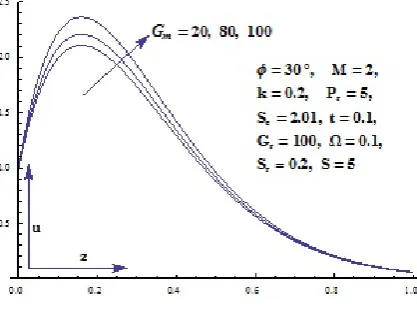
Fig.1, 2, 3, 9 and 9.1 depicts that the primary velocity ‘u’ increases with increase in Gm , Gr, k, t and Sr.
Fig. 4, 5, 6, 7 and 8 show that velocity decreases with increase in M, Φ,
P
r, Ω and S.Fig.10, 12, 14 and 19 for Secondary velocity ‘v’ described that ‘v’ decreases with increase in Φ,
P
r, M and Sc.Fig. 11, 13, 15, 16, 17 and 18 shows that ‘v’ increases with increase in Ω, t, Gm, Gr, K and S.Temperature profile
θ
inFig. 20, 21 and 22 show decreases with increase in t, S and
P
r respectively. Concentration profile ‘C’ increases with time ‘t’ in Fig. 23 and decreases with Sc in Fig. 24.
Fig. 1: Velocity Profile ‘u’ for different values of Gm Fig. 2: Velocity Profile ‘u’ for different values of
G
r
© 2017, IJMA. All Rights Reserved 79
Fig. 5: Velocity profile ‘u’ for different values of ‘Φ’ Fig. 6: Velocity profile ‘u’ for different values of ‘
P
r’
Fig. 7:Velocity profile ‘u’ for different values of Ω Fig. 8: Velocity profile ‘u’ for different values of ‘S’
© 2017, IJMA. All Rights Reserved 80
Fig. 10: Secondary velocity profile ‘v’ or different value of ‘Φ’Fig. 11: Secondary velocity v for different values of Ω
Fig. 12: Velocity profile ‘v’ for different values of
P
r Fig. 13: Velocity profile ‘v’ for different values of ‘t’
Fig. 14: Velocity profile ‘v’ for different values of ‘M’ Fig. 15: Velocity profile v for different values of
G
m
Fig. 16: velocity profile v for different values of
G
r© 2017, IJMA. All Rights Reserved 81
Fig. 17: Velocity profile for different values of ‘k’ Fig. 18: Velocity profile ‘v’ for different values of ‘S’
Fig. 19: Velocity profile ‘v’ for different values of Sc Fig. 20: Temperature profile
θ
for different values of time ‘t’
Fig. 21: Temperature profile
θ
for different values of ‘S Fig. 22: Temperature profileθ
for different values of'
'
P
r
© 2017, IJMA. All Rights Reserved 82
CONCLUSIONS
In this work we have concluded that Soret and rotation effects on MHD unsteady flow over an inclined infinite porous plate embedded in porous media concluded the following conclusions:
1. Increasing inclination angle, velocity decreases rapidly. 2. Increasing rotation parameter, velocity increases rapidly. 3. Velocity increases speedily as Soret number increases. 4. Velocity also increases with time.
5. Temperature decreases with time.
6. Concentration decreases with increase in Schmidt number.
REFERENCES
1. E. M. Sparrow, R. D. Cess, Effect of Magnetic field on free convection heat transfer, Int. J Heat Mass Transfer. 3 (1961) 267-70.
2. M. S. Alam, M. M. Rahman, Dufour and Soret effect on MHD free convective Heat and Mass transfer flow past a vertical flat plate embedded in a porous medium, Journal of Naval Architecture and Marine engineering. 2(1) (2005)55-65.
3. Z. Dursunkaya, W.M. Worek, Diffusion thermo and thermal diffusion effects in transient and steady natural convection from vertical surface, International Journal of Heat and Mass Transfer. 35(8)(1992)2060-2065. 4. A. Postelnicu, Influence of a magnetic field on heat and mass transfer by natural convection from vertical
surface in porous media considering Soret and Dufour effects, International Journal of Heat and Mass Transfer. 47(67) (2004)1467-1472.
5. A. Raptis, C. Perdikis, Radiation and free convection flow past a moving plate, Appl. Mech. Eng. 4(4) (1999) 817-821.
6. V. Rajesh, V. K. Verma, Radiation and mass transfer effects on MHD free convection flow past an
exponentially accelerated vertical plate with variable temperature, ARPN Journal of Eng. And App. Sci. 4(6) (2009) 20-26.
7. Shivaiah, S. and Anand Rao, J. 2011. Chemical reaction effect on an unsteady MHD free convective flow past and infinite vertical porous plate with constant suction and heat source. Int. J. of Appl. Math. And Mech. 7(8): 98-118.
8. M.A. Alabraba, AR. Bestman, A. Ogulu, Laminar convection in binary mixed of Hydro Magnetic flow with Radiative Heat Transfer, Astrophysics and SpaceScience.195(2)(1992)431-439.
9. M.D. Enamul Karim, M.D. Abdus Samad, M.D. Maruf Hasan, Dufour and Soret effect on steady MHD flow in presence of Heat generation and Magnetic field past an inclined stretching sheet, Open Journal of Fluid Dynamics. 2(2012)91-100.
10. M. Bhavana, D. Kesaraiah Chenna, A. Sudhakarraiah, The Soret effect on free convective unsteady MHD flow over a vertical plate with heat source, Int. J. of Innovative R. in Sci. Eng. And Tech.2(5)(2013)1617-1628. 11. T.G.Cowling, Magnetohydro dynamics, Inter Science Publishers. New York, 1957.
12. Brice Carnahan, H. A. Luthor, J.O.Wilkes, Applied Numerical Methods, John Wiley and Sons, New York, 1969.
Appendix:
(
)
2
2
1
[
], 2
[
], 3
[
] ,
1
1
1
2
2
r r
r r r
St P
S
T P
t T
z
t T
z
tT
S
Erf
S
Erf
S
Exp
z
P
P
P
t
t
− +
−
+
=
==
=
−
−
− +
− +
− +
(
)
(
)
2
2
1
1
(
)
4
[2
], 5
[
], 6
[
],
1
2
2
r r
r r
r
r
S
T P
S
T P
z
t
z
t
P
P
S
T P
S
Exp z
S
Erf
S
Erf
P
t
t
− +
− +
−
+
− +
− +
− +
=
=
=
− +
2
1
7
[
], 8
[2
], 9
[
],
1
1
1
2
2
1
10
[
]
2
c
c
c c
c c c
c
c
TS
z
t
S
TS
TS
tT
S
Exp
z
S
Exp z
S
Erf
S
S
S
t
TS
z
t
S
S
Erf
t
−
− +
=
−
=
=
− +
− +
− +
+
© 2017, IJMA. All Rights Reserved 83
11
[
], 12
[
], 13
[
],
2
2
2
14
[
],
2
z
z
z
S
Erf
t T
S
Erf
t T
S
Erf
t
S
T
t
t
t
z
S
Erf
t
S
T
t
=
−
=
+
=
− + −
=
− + +
15
[
], 16
[
],
1
1
2
2
17
[
],
c c
c c
r r c
r
r c r c
TS
TS
z
z
S
Erf
t
S
Erf
t
S
S
t
t
SP
TP
TS
St P
S
Exp
z
P
S
P
S
=
−
=
+
− +
− +
−
+
−
=
−
−
−
−
21
18
, 19
[2
],
(
(
))
(
)
20
[
],
2
r r c
c r c r c
r c
r c
SP
TP
TS
S
S
Exp z
S z
TS
P
S
T
S S
P
S
S
T P
TS
z
S
Erf
t
P
S
t
−
+
−
=
=
−
+
− + +
−
− +
−
=
−
−
2(
)
1
21
[
], 22
,
(
(
))
2
r c
r c c c r c
S
T P
TS
z
S
Erf
t
S
P
S
S z S
TS
P
S
T
S S
t
− +
−
=
+
=
−
−
+
− + +
2(
)
1
23
, 24
[
],
(
(
))
1
1
1
(
)
25
[2
],
1
r r
r c r c r r r
r
r
St P
S
T P
tT
S
S
Exp
z
S z P
TS
P
S
T
S S
P
P
P
S
T P
S
Exp z
P
− −
=
=
−
−
−
+
− + +
− +
− +
− +
− −
=
− +
2
1
(
)
(
)
26
[
], 27
[
], 28
[
],
1
1
2
2
2
r r
r r
r r
S
T
t
z P
P
S
T P
S
T P
z
z
S
Erf
t
S
Erf
t
S
Erf
P
P
t
t
t
− +
−
− +
− −
− −
=
−
=
+
=
− +
− +
2
1
2
2
29
[
], 30
[
], 31
[
],
2
2
2
2
1
32
[
],
2
r
r r r
c c
S
T
t
z P
P
St
zP
St
zP
S
Erf
S
Erf
S
Erfc
t
t
t
T
t
z S
S
S
Erf
t
− +
+
− +
−
−
=
=
=
−
− +
=
2
1
33
[
], 34
[
], 35
[
], 36
[
],
2
2
2
2
c
c c c c
T
t
z S
S
z S
z S
z S
S
Erf
S
Erfc
S
Erf
S
Erf
t
S
t
t
t
t
+
− +
=
=
=
=
− −
37
[
], 38
[
], 39
[
],
1
1
1
2
2
c c
c
c c c
z S
T
z S
tT
T
S
Erf
t
S
S
Erf
t
S
Exp
z
S
S
S
S
t
t
=
− +
=
−
=
− −
− +
− +
− +
40
[2
], 41
[
], 42
[
],
1
1
2
c
c r r
c
c c r c r c
z S
TS
T
St P
S P
S
Exp z
S
Erf
t
S
Exp
z
S
S
S
t
P
S
P
S
−
=
=
+
=
−
−
− +
− +
−
−
43
[2
], 44
[
], 45
[
],
2
2
48
[2
]
c c
r r r
c
r c r c r c
r
z S
z S
S P
S P
S P
S
Exp z
S
S
Erf
t
S
Erf
t
P
S
P
S
t
P
S
t
S
Exp z S P
−
−
−
=
=
−
=
+
−
−
−
© 2017, IJMA. All Rights Reserved 84
46
[
], 47
[2
], 49
[
],
2
r
c c c
r
r r
r c r c r c r c
z P
S S
S S
S S
St P
S
Exp
z
P
S
Exp z
P
S
Erf
t
P
S
P
S
P
S
t
P
S
−
−
−
=
−
−
=
=
−
−
−
−
−
(
)
50
[
], 51
[
],
1
1
1
2
(
)
52
[2
],
1
r c r r
r c r r r
r
r
z P
S S
tT
St P
S
T P
S
Erf
t
S
Exp
z
P
S
P
P
P
t
S
T P
S
Exp z
P
−
− −
=
+
=
−
−
−
− +
− +
− +
− +
=
− +
53
[
], 54
[
], 55
-1+S8+S15+S8*S16,
1
2
1
2
r r
r r
z P
z P
S T
S T
S
Erf
t
S
Erf
t
S
P
t
P
t
− +
− +
=
−
=
+
=
− +
− +
S56= (T z (-S+T+S*Sc) (T Sc -Pr (-S+T+S*Sc))),S57= -1-S19+S20+S19*S21
S58= (-T Sc+ Pr (-S+T+S Sc)),S59= -1-S40-S38+S40*S41,S60= -1-S52-S53+S52*S54
2 2
S61= -1-S43-S44+S43*S45,S62= -1-S47+S49+S47*S50, 63
S
= − −
1
e
z T−
S
11
+
e
z T* 12,
S
2
1
64
, 65
Cos[ ]
, 66
(
) (
), 67
, 68
* 2 1
1,
2
z T z T
m c r
r
S
S
G S S
S
T z
T
SP
S
e
S
e
S
S
P
ϕ
π
−
=
=
= − +
− +
=
=
+ +
2
69
-1-S25+S26+S25*S27,S70
, 71 S51*S70*S60,S72
z S T, 73
S67*S70*S63,
S
=
=
π
S
=
=
e
− +S
=
S74
S46*S70*S62,S75
2*S18*S17*S50*S57,S76
, 77
, 78
S24 S70*(S69),
2
2
c
r
z S
z P
S
S
t
t
=
=
=
=
=
(
)
S79
, 80
, 81 S70*S55,S82
S66*S58,S83
,S84=S39*S70*S59,
1
1
1
c r
c r c
T S
S
T P
T
S
S
S
P
S
−
=
=
=
=
=
− +
− +
− +
S85=S17*S70*S57,S86= S42* S70*S61,S87
=
Erf[ S t -S76],S88
=
Erf[ S t
+
S76]
Source of support: Nil, Conflict of interest: None Declared.