ISSN-L: 2501 - 1235 Available on-line at: www.oapub.org/edu
doi: 10.5281/zenodo.1434477 Volume 4 │ Issue 11 │ 2018
COMPARATIVE STUDY OF PERSONALITY
FACTORS BETWEEN SPORTSPERSONS OF
CONTACT AND NON-CONTACT SPORTS
Gulzar Ahmad Rathar1, Jigmat Dachen2
1Research Scholar, Bhagwant University,
Ajmer, Rajasthan, India
2Assistant Professor,
Directorate of Physical Education & Sports, University of Kashmir, Srinagar, Jammu and Kasmir, India
Abstract:
The main purpose of the present study was to compare the personality factors between the sportspersons of the contact and non-contact sports. Big five personality inventory was employed among the sportsperson selecting randomly from colleges of Ganderbal Kashmir region. The size of sample under study was 70, in which 26 were from contact sports (football, hockey, kabaddi, basketball, handball and rugby) and 44 were from non-contact sports (cricket, volleyball, badminton, baseball, ball badminton and shooting ball). The groups were compared on different factors of personality i.e, extroversion, agreeableness, conscientiousness, neuroticism and openness. The results show almost same personality characteristics exist between the sportspersons of contact and non-contact sports, since calculated ‘t’ values of 0.76 (extraversion), 0.31 (agreeableness), 1.05 (conscientiousness), 0.05 (neuroticism) and 1.1 (openness) for five personality factors were not found statistically significant (p≤0.05 ).
Keywords: personality, contact, non-contact sports
1. Introduction
weak evidences were found as far as personality and sports performance are concerned, but we can’t altogether ignore the psychic effect on sports performance. Individual possessing certain personality traits are attracted towards sports whereas, some individual don’t like sports at all, this phenomena is explain by ‘gravitational hypothesis’ (Morgan, 1974), Morgan believed that individual who possess stable, extraverted personalities are generally attracted toward certain sports. It is well established fact that personality factors of sportspersons are distinctly different from general norm (Morgan 1980), the literature shows that sportspersons in one sport often differ in personality type and profile from sportspersons in other sports (Franken, Hill & Kierstead, 1994). Moreover, there are personality differences exist between the sportspersons of team sports (e,g, football, rugby etc) and individual sports (body builder, gymnastic, karate participants etc), between the direct and parallel sports, similarly between the sports persons of different skill levels. The numerous studies focus on personality differences are available in the literatures are: Singer (1969); Schuur, Ashley, and Joy (1977); Clingman and Hilliard (1987); Franken, Hill & Kierstead, (1994); Davis & Mogk, (1994); Morgan, (1980) etc. It seems reasonable for example, to expect a sportspersons of contact sports like football, rugby, wrestling and hockey to be more aggressive, anxious and tolerant of pain than a golfer or a tennis player or badminton player. However, it is unreasonable to expect a high correlation between personality factors and sports type. Therefore, in the present study we attempted to compare the personality factors between the sportspersons of contact and non-contact sports on different parameters of big five personality factors.
2. Method and Materials
The purpose of the study was to compare the personality factors between contact and non-contact sportspersons.
2.1 Tools
Structure questionnaire namely Big Five Personality Inventory developed by Goldberg in 1993 was used as tool for the purpose of collecting data on personality factor. Big fix personality inventory is a widely used tool to access the personality makeup of sports persons regarding the field of games and sports. The Big Five personality questionnaire consist of five universal personality factors namely; extroversion, agreeableness, conscientiousness, neuroticism and openness which comprise of 44 items.
2.2 Participants
in cricket, volleyball, badminton, baseball, ball badminton and shooting ball were grouped into non-contact sports. At the time of collecting data, the respondents were fully instructed and all the 44 items of the questionnaire were verbally dictated up to the understanding levels of every respondent and then the respondents solved the questionnaire by their own. After scoring with the help of keys, the data was analysis with the help of statistical package (SPSS). The results were established and then put in a tabular form and the mean difference was calculated to find out the significant difference in personality between contact and non-contact sportsperson with the help of the ‘t’–test.
3. Results and Discussions
After interpreting, the collected data two tables (Table 1 & 2) are generated to display the descriptive statistics (mean and standard deviation) to describe the nature of data and compare the groups on personality factors.
Table 1: Descriptive Statistics of Personality Factors among the Sportspersons Contact and Non-contact Sports
Personality factors Sports N Mean S.D Std. error mean
Extroversion Contact Sports 26 27.61 3.49 .68
Non-Contact Sports 44 26.84 4.44 .66
Agreeableness Contact Sports 26 33.69 5.28 1.03
Non-Contact Sports 44 34.06 4.66 .70 Conscientiousness Contact Sports 26 32.42 3.98 .78 Non-Contact Sports 44 33.54 4.50 .67
Neuroticism Contact Sports 26 21.69 4.05 .79
Non-Contact Sports 44 21.75 4.47 67
Openness Contact Sports 26 34.30 4.09 .80
Non-Contact Sports 44 35.59 4.85 .73
The Table 1 shows that the mean, standard deviation and standard error of mean are normal and data is normally distributed which is importance for the application of parametric statistics like ‘t’ Test.
Table 2: Independent sample ‘t’ test on Personality Factors between contact and non-contact sportsperson
Variables ‘t’ Value df Sig. (2-tailed) Mean difference Std. error difference
Extroversion 0.76 68 0.45 0.77 1.01
Agreeableness 0.31 68 0.75 0.37 1.21
Conscientiousness 1.05 68 0.29 1.12 1.66
Neuroticism 0.05 68 0.95 0.05 1.06
Openness 1.13 68 0.26 1.2 1.13
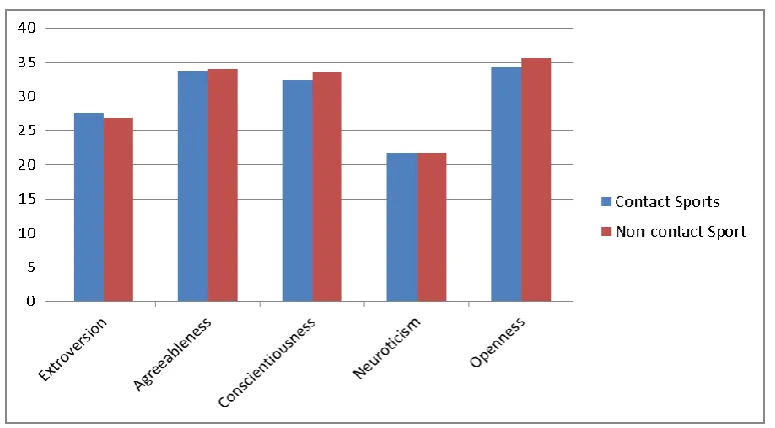
Figure 1: Graphical representation of difference between contact and non-contact sportspersons on personality factors
In this study the main concern was to study the overall personality patterns of the sports persons for that Big Five Inventory was used to check and compare the personality on different patterns of personality like, openness, neuroticism, extroversion, conscientiousness and agreeableness whereas, it is found that no differences exist between the two groups. The earlier studies conducted on comparison of personalities on national and Olympic level athletes show significant differences on level of extroversion and neuroticism, openness and conscientiousness. Some other studies in this field also show some differences in parameters due to the influence of express at different competitive levels. Unlike previous studies which compare personality between sportsperson and non-sports persons, between individual and team sports, in the present study there is no significant difference in personality between contact and non-contact sportspersons.
4. Conclusions
includes, emotions, aspirations, feelings, stress, anxiety, fear, anger, love, self-esteem, achievement, motivation and dedication.
References
1. Cillingman, J.M., & Hilliard, D.V. (1987). Some personality characteristics of the super-adherer: Following those who go beyond fitness. Journal of Sports Behavior, 10, 123-136.
2. Cox, R. H. (2002). Sports Psychology: Concepts and application. McGraw Hill New York.
3. Davis, C., & Mogk, J.P. (1994). Some personality correlates of interest and excellence in sports, International Journal of Sports Psychology, 25, 131-143. 4. Franken, R.E., Hill, R., & Kierstead, J. (1994). Sports interest as predicted by the
personality measures of competitiveness, mastery, instrumentality, expressivity and sensation seeking. Personality and Individual Differences, 17(4),467-476. 5. John, O.P., & Srivastava, S. (1999). The Big-Five trait taxonomy: History,
measurement, and theoretical perspectives. In L. A. Pervin & O. P. John (Eds.), Handbook of personality: Theory and research (Vol. 2, pp. 102–138). New York: Guilford Press.
6. Morgan, W.P. (1974). Selected psychological considerations in sports. Research Quarterly, 45, 32-339.
7. Morgan, W.P. (1980). The trait psychology controversy. Research Quarterly for Exercise and Sports, 51, 50-76.
8. Morris, T. & Summer J. (2004). Sports Psychology: theory, application and Issues. John Willey & Sons Australia.
9. Schurr, K.T., Ashley, M.A., & Joy, K.L. (1977). A multivariate analysis of male athlete characteristic: sports type and success. Multivariate Experimental Clinical Research, 3, 53-68.
10.Singer (1969). Personality differences between and within baseball and tennis players. Research Quarterly, 40, 582-587.
Creative Commons licensing terms