Available on-line at: www.oapub.org/edu
doi: 10.5281/zenodo.3890982 Volume 6 │ Issue 4 │ 2020
ARCHITECTURAL DESIGN AS A PREDICTOR OF PATRONAGE
OF RECREATIONAL CENTRES IN KADUNA STATE, NIGERIA
Benjamin Tunji Olaosebikan1,
Jimada Yahaya Danladi2,
Abdulsalam Abdullah3i,
M. G. Yakasai4,
Dahiru Abdullahi Dan Asabe5 1Department of Physical and Health Education,
University of Maiduguri, Borno State, Nigeria 2Department of Social Development, Kaduna Polytechnic, Nigeria 3Department of Physical and Health Education,
University of Maiduguri, Borno State, Nigeria 4Department of Physical and Health Education,
Bayero University Kano, Kano State, Nigeria 5Ibrahim Badamasi Babagida University,
Lapai, Niger State, Nigeria
Abstract:
The study assesses architectural design as a predictor of patronage of recreational centres in Kaduna State, Nigeria. One research questions were answered, and one hypothesis were formulated to guide this study. A descriptive survey research design was used for this study. The population for the study comprised all staff of recreational centres in Kaduna State, with a population of 3,249. Multistage sampling technique was used to select the sample for the study. Researcher developed questionnaire was used as the instrument for data collection and it was validated by 3 experts from the Department of Physical and Health Education, Faculty of Education, Bayero University, Kano. A pilot study was conducted and a reliability index of 0.87 was obtained. Out of 441 copies of questionnaire administered by the researcher and his assistants, 432 copies were duly completed, returned and analyzed. Frequency count and percentage were used to describe the demographic information of the respondents while Chi-square (χ2) statistics
of recreational centres in Kaduna state c2 = 140.08, df = 1, P < 0.05. It was recommended among others, that authorities such as ministry of tourism and culture should set up a board each to plan, execute and supervise the existing buildings in the recreational centres.
Keywords: architectural design; predictor and patronage of recreational centres
1. Introduction
The design, construction and maintenance of buildings and infrastructure are essential for economic development and sustainable growth as well as for the quality of life of the people, the answers to many of the challenges facing the environment depend on the construction sector (Barford, 2002). The basic frame work of fundamental natural
processes surrounding man‘s activities in the environment as established by Fadamiro
(1998), include; climate, vegetation, wind, flood, ice melting, volcanic action and earth
movement; while conservation considerations derived from the impact of man‘s activities
on nature are needed for balance and equilibrium amongst the identified environmental elements.
In recent years, Nigerian Architecture is characterized by the post-modern
buildings of the 1990’s and a sprawling new design concept and engrossed with new
building materials mainly imported from China. Tofa (2011) reported that most beautiful circular shapes apparent in Hausa Architecture with its domed roofs, thick monolithic walls and decorative plasters have been replaced by a rectangular concrete prototype with imported roman column replicas. It is insignificantly to structural function rather possessing decorative elements adorning the entrance of the buildings. In spite of the significance benefits associated with traditional architecture in its possession of fairly adaptation to the environment, little efforts have been initiated to explore the characteristics (Ade-Adedokun, 2014).
According to Dabiri (2006), what constitutes recreation is not as easy to specify as it might seem. Recreation can be generally conceived as the consumption of leisure or leisure facilities for the purpose of refreshing oneself. A distinction can readily be made between active recreation involving participation in sports and games and passive recreation in which the individual is essentially a spectator.
Akintola (2003) stated that, use of land for recreational purposes involves, for the most part outdoor activities on sites consciously developed and equipped with facilities that permit both active and passive recreational involvement. Recreational centres can be conceptualized as those centres, spots or sites on which recreation activities can be carried out whether natural or artificial spaces of various forms.
almost all kinds of recreational activities. Similarly, recreational activities such as swimming, sailing could take place only in the existence of water bodies (Burton, 2005).
2. Hypothesis
H01: Architecturally designed buildings will not significantly influence the patronage of recreational centres in Kaduna state.
3. Methodology
A descriptive survey research design was used for this study. According to Nwana (2005), descriptive survey design focuses on the people and their beliefs, opinions, perception and behaviours. Sunusi (2008) stated that descriptive survey design is a kind of survey design in which a person is able to find out the feelings of others about something. He added that descriptive survey design is a systematic description of event in a very factual and accurate manner.
The population of the study comprised all the staff in the recreational centres in Kaduna state, with the population of 3,249 (Source: Kaduna State Ministry of Culture and Tourism Report, 2016).
Four hundred and forty-one (441) respondents were sampled for this study. Krejcie and Morgan (1970) suggested that for any population of the study up to 3000, the sample should not be less than 341. However, the sample of 441 is adequate to represent a population of about 3,249. The researcher used a multistage sampling procedure to select the sample for the study.
According to Njodi and Bwala (2004), multistage sampling is a procedure carried out in phases and usually involves more than one sampling method. They further stated that in a very large and diverse study population, sampling may be done in two or more stages. Hence, the stages for sample selection in this study were as follows:
• Stage 1: Stratified sampling technique was used to stratify Kaduna state into three (3) stratum as in the Senatorial zones, Kaduna Central zone strata one, Kaduna Northern zone strata two, and Kaduna Southern zone strata three.
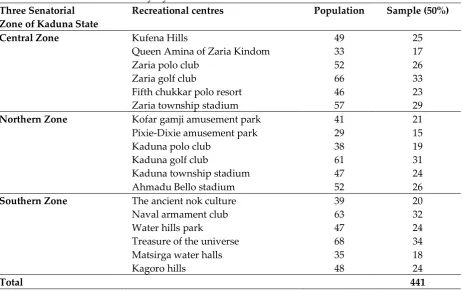
• Stage 2: Simple random sampling technique was used to select six (6) recreational centres from the 3 senatorial zones of Kaduna State.
Table 1: Distribution of population and sample used for the study by senatorial zone and recreational centres
Three Senatorial Zone of Kaduna State
Recreational centres Population Sample (50%)
Central Zone Kufena Hills 49 25
Queen Amina of Zaria Kindom 33 17
Zaria polo club 52 26
Zaria golf club 66 33
Fifth chukkar polo resort 46 23
Zaria township stadium 57 29
Northern Zone Kofar gamji amusement park 41 21
Pixie-Dixie amusement park 29 15
Kaduna polo club 38 19
Kaduna golf club 61 31
Kaduna township stadium 47 24
Ahmadu Bello stadium 52 26
Southern Zone The ancient nok culture 39 20
Naval armament club 63 32
Water hills park 47 24
Treasure of the universe 68 34
Matsirga water halls 35 18
Kagoro hills 48 24
Total 441
• Stage 4: Simple random sampling technique was used to administer the questionnaire to the respondents in each of the recreational centre in Kaduna state.
The instrument for data collection in this study was a researcher’s developed
questionnaire. The questionnaire consists of two (2) sections A and B. Section “A”
contained the information on the demographic characteristics of the respondents
(Gender, age range and highest educational qualification) while Section “B” contained
information on the influence of power supply on the patronage of recreational centers. The variables are four (4), therefore, statements were formulated on each variable. The questionnaire was prepared on four (4) points Likert scale and the rating score was as follows: Strongly Agreed (SA) 4 points, Agreed (A) 3 points, Disagreed (D) 2 points and Strongly Disagreed (SD) 1 point.
In order to establish the content validity of the questionnaire, the questionnaire was subjected to vetting by the 3 experts in the Department of Physical and Health Education, Bayero University, Kano. Their observations and corrections were incorporated in the final draft of the questionnaire to the satisfaction of the supervisor before administration for a pilot study.
subjected to a statistical test using Spearman-Brown Prophecy Formula, and the reliability index of 0.86 was obtained which confirmed the questionnaire as reliable for usage.
An introductory letter was obtained from the Head of Department, Physical and Health Education Department, Bayero University, Kano, which was taken to the authorities of the sampled recreational centers in Kaduna State, to seek permission to conduct the study. After permission was granted, the researcher employed the services of six (6) research assistants who helped in administering and retrieving the questionnaire within a week. Four hundred and forty-one (441) copies of questionnaires were administered and four hundred and thirty two (432) copies were duly completed, returned and analyzed.
Simple frequency count and percentage was used to organize and describe the demographic information of the respondents while Chi-square (χ2) statistic was used to
test the formulated hypotheses at 0.05 level of significance. On the course of analysis, all the responses (strongly agree, agree, strongly disagree and disagree) were merged to agree and disagree.
4. Results
Out of four hundred and forty-one (441) copies of questionnaires administered, four hundred and thirty two (432) were duly completed, returned, analyzed and presented in the tables below:
Table 2: Demographic Information of the Respondents
Variables Frequency Percentage (%)
Gender:
Male 304 70.4
Female 128 29.6
Total 432 100
Age:
18-29 years 259 60.0
30-39 years 122 28.2
40 years and above 51 11.8
Total 432 100
Highest Educational Qualification:
University Degree/HND 35 8.1
NCE/OND 252 58.3
SSCE/Grade II/WASCE 145 33.6
Total 432 100
were University Degree/HND holders, 252 (58.3%) were NCE/OND holders while 145 (33.6%) were SSCE/Grade II/WASCE holders.
4.1 Hypotheses Testing
H01: Architecturally designed buildings will not significantly influence the patronage of recreational centres in Kaduna state.
Table 3: 2 summary on the influence of architecturally designed
buildings on the patronage of recreational centres
Variables Observe Expected df 2 P-value
Agreed 339 216.0
1 140.08 0.001
Disagreed 93 216.0
2 = 140.08, df = 1, P < 0.05.
Table 3 revealed that 339 of the respondents agreed that provision of architecturally designed buildings influence the patronage of recreational centres while 93 of the respondents disagreed. From the table, it is indicated that the number of respondents that agreed are more than those disagreed. 2 statistical computation indicated the 2 value of
140.08 at df = 1, P<0.05. The null hypothesis tested is therefore rejected on the basis that architecturally designed buildings influence the patronage of recreational centres in Kaduna state.
5. Discussion
The finding of this study indicates that architecturally designed buildings influence the patronage of recreational centres in Kaduna State. This finding is in line with that of Schleien, Fahnstock, Green and Rynders (2009) who found that presence of good
buildings encourages many peoples’ participation in recreational activities and seeks to
ensure appropriate opportunities to meet the needs of the people. However, Government acknowledges that recreation stems from a basic human need for activities which are essential to the mental and physical well-being of the individual and the community as a whole. Also, recreation is accepted as an essential activity for which architecturally designed building attracts people to participate.
6. Conclusion
6.1 Recommendations
Based on the various facts that emerged from this study, the following recommendations are made:
• Authorities such as ministry of tourism and culture should set up a board each to plan, execute and supervise the existing buildings in the recreational centres. This
will improve the community members’ social and psychological value and
enhance the patronage of recreational centres.
References
Ade-Adedokun, A. A. (2014). The practice and constraints of physical planning in Nigeria. Journal of the Nigerian Institute of Town Planners (JNITP), 4(5): 49-58. Akintola, O. (2003). Urban-rural planning as a national development strategy. Journal of
the Nigerian Institute of Town Planners (JNITP) 10:66-74.
Barford, F. (2002). Architecturally designed building in recreation centers and Solid Waste Management: A preliminary survey of environmental pollution in Ibadan. Department of Geography, University of Ibadan, special publication.
Burton, T. L. (2005). Recreation Research and Planning. Lea and Fabiger, Philadelphia. Dabiri, E. P. (2006). Utilization of recreational facilities in Colleges of Education in
Cross-River States. Journal of Sport Science and Medicine, 1(1):21-24.
Fadamiro (1998). The role of international agencies in the support of urban research in developing countries: The experience, the opportunities and potential pitfalls. Paper presented at the Meeting on Urban Research in the Developing World in Cairo.
Njodi, I. A. & Bwala, D. W. (2004). Skills & Techniques of Reporting Research Outcomes in Health Education. Loud Books Publishers 5, Awolowo Street, Bodija-Ibadan. Nwana, A. (2005). Introduction to Research Method in Education. Ibadan. University Press. Sanusi, M. (2008). Determinants of participation in sports and recreational activities
among physically challenged in Bauchi State. Bauchi Journal of Education, 2(2):19-24.
Schleien, S. J., Fahnstock, M., Green, R. & Rynders, J. E. (2009). Building positive social networks through environmental interventions in integrated recreation programs.
Therapeutic Recreation Journal, 24(4):42-52.
Creative Commons licensing terms